If you are looking for a wills and trusts lawyer Detroit MI residents can compare with confidence, start with three facts. Michigan wills and trusts fall under the Estates and Protected Individuals Code (MCL 700.1101 et seq.), a Michigan will needs a signed writing and two witnesses (a handwritten, dated will is the narrow exception), and probate for a Detroit resident runs through the Wayne County Probate Court in the Coleman A. Young Municipal Center at 2 Woodward Avenue.
This guide explains what the work involves, the Michigan rules that shape your documents, the Detroit and Wayne County courts and free help nearby, how lawyers charge, and how to compare them before you sign an engagement agreement. It is general information, not advice about your situation.
What a Wills and Trusts Lawyer in Detroit Does, From First Call to Signing
A wills and trusts lawyer turns your wishes about property, children and health decisions into documents that Michigan courts, banks and hospitals will accept. The work is mostly planning and drafting, not courtroom work. Most clients never see a judge, and good planning is often meant to keep it that way.
The sections below follow the order most engagements follow: first contact, the choice of documents, and the companion papers that travel with a will or trust. If you only want to know how to pick someone, jump ahead to the comparison section.
The usual path from first call to signed documents
Estate-planning engagements follow a steady rhythm even though every family’s facts differ. Knowing that rhythm helps you notice a firm that skips steps or hurries you toward a signature.
Intake, conflict check and scope
The first contact is usually a short call or online form covering whether you are married, whether you have children, and roughly what you own. Before anything substantive, a firm should run a conflict check, meaning a search to confirm it does not already represent someone whose interests clash with yours, such as a relative who would inherit under your plan.
Ask the firm to describe its scope of work in plain language: which documents it will draft, whether it will prepare deeds, and whether retitling accounts into a trust is included.
Fact-gathering and drafting
Next comes a longer conversation about family structure, assets, debts and goals. The lawyer will ask who should manage your affairs if you cannot, who should raise minor children, and what should happen if a beneficiary dies before you do. These are life decisions, not legal technicalities, and the better prepared you are, the less drafting time you pay for.
Drafts should come back in writing so you can read them at your own pace. Read names, shares and the people you appoint twice, because a misspelled name or a wrong percentage is far cheaper to fix before signing than after a death.
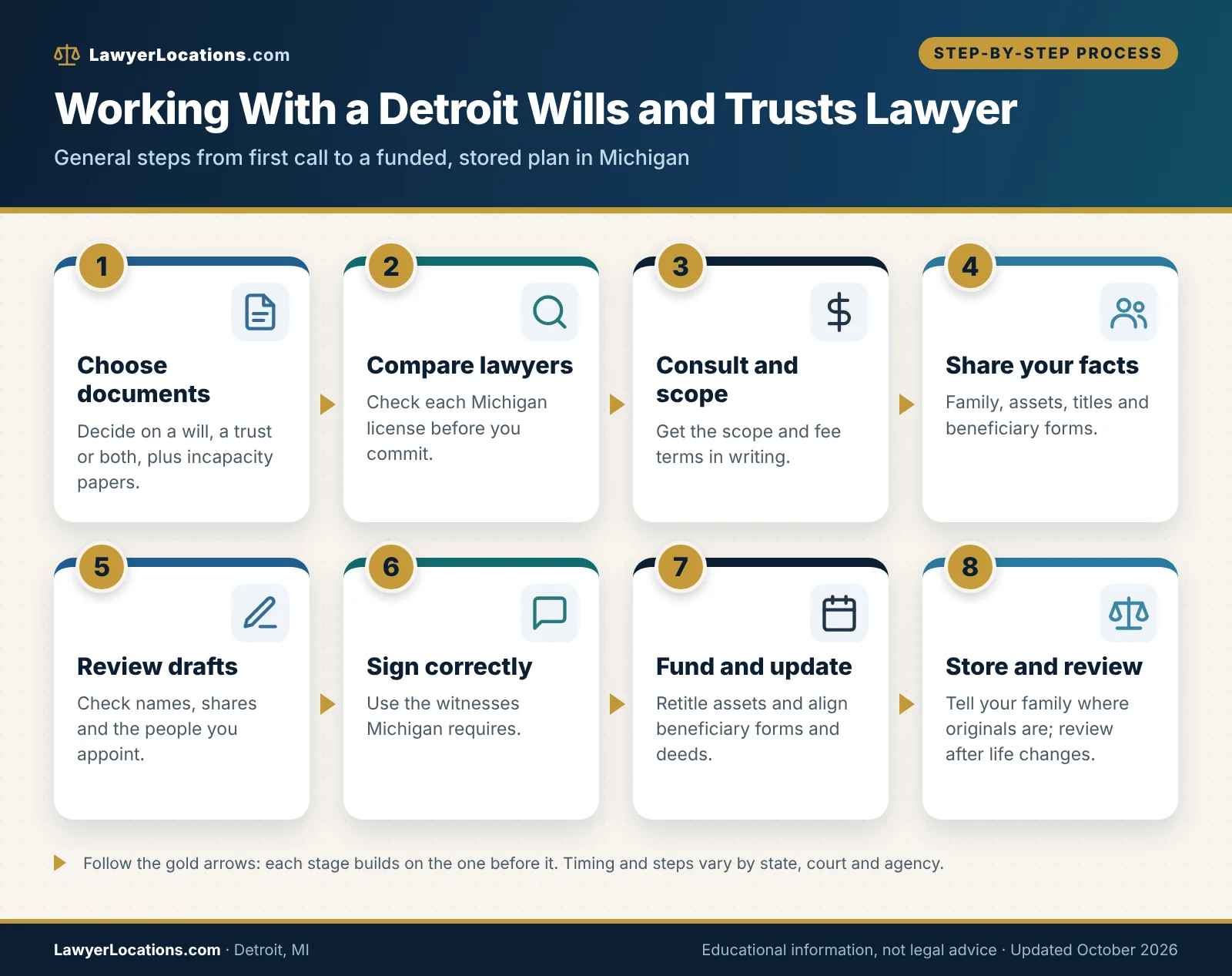
Text version of this graphic
- Choose documents: decide on a will, a trust or both, plus incapacity papers.
- Compare lawyers: check each Michigan license before you commit.
- Consult and scope: get the scope and fee terms in writing.
- Share your facts: family, assets, titles and beneficiary forms.
- Review drafts: check names, shares and the people you appoint.
- Sign correctly: use the witnesses Michigan requires.
- Fund and update: retitle assets and align beneficiary forms and deeds.
- Store and review: tell your family where originals are; review after life changes.
Will, trust or both: how lawyers frame the choice
Neither document is automatically better. A will says who receives what you own at death and who names the people in charge, while a revocable living trust is a written arrangement that you can change during life and that a trustee manages for your chosen beneficiaries.
What a will does and what it cannot do
A will names a personal representative (Michigan’s term for an executor), directs who receives your probate property, and can name a guardian for minor children. It generally takes effect only after death and usually has to pass through the probate court, where the will is filed and the personal representative receives authority to act.
A will does not control property that passes by contract or title, such as a life insurance policy with a named beneficiary or a bank account with a joint owner. That is why a lawyer will ask for your account statements and beneficiary forms, not just your list of wishes.
What a revocable trust adds, and what it costs you in effort
A funded revocable trust can keep assets out of probate and can let a successor trustee step in during incapacity without a court order. The catch is funding: a trust only controls the property that has actually been retitled into it, so the paperwork after signing matters as much as the document itself.
For a comparison of the national picture, see our guide to what to know before hiring a living trust lawyer. Many Michigan households end up with a trust and a short “pour-over” will that catches anything left out.
Ask any lawyer who recommends a trust to explain, in writing, which of your assets will be retitled and who does that work. If the answer is “you,” get a funding checklist before you leave the signing meeting.
Documents that often travel with a will or trust
A complete plan usually includes more than a will. Two of the companion documents deal with life rather than death, and Michigan has specific rules for both.
Financial power of attorney
A power of attorney lets someone you choose handle money and property if you cannot. Michigan’s Uniform Power of Attorney Act, found at MCL 556.201 et seq., took effect in 2024, so older forms and online templates may not reflect the current rules. A lawyer can check that the powers you want, such as managing real estate or making gifts, are spelled out the way the new act expects.
Banks and title companies sometimes ask questions about older documents. A recent, properly signed form avoids delays when someone needs to use it.
Patient advocate designation
Michigan’s health care decision-maker is called a patient advocate, created under MCL 700.5506. The designation must be in writing, signed, dated and witnessed by two people, and the advocate’s authority applies only when you cannot take part in treatment decisions. Certain people cannot serve as witnesses, including your spouse, parent, child, grandchild, sibling, presumptive heir, physician or the patient advocate.
The designation must also be placed in your medical record before it takes effect, so give copies to your doctor and hospital after signing. A signed form in a drawer does little for a medical team at 2 a.m.
| Document | What it does | When it matters | Michigan signing point |
|---|---|---|---|
| Will | Names a personal representative, directs probate property, can name guardians for minors | After death | Signed writing plus two witnesses; handwritten, dated will is the exception (MCL 700.2502) |
| Revocable living trust | Holds assets you retitle into it; a successor trustee manages and distributes | During incapacity and after death | Works only for property actually transferred in; ask for a funding checklist |
| Financial power of attorney | Lets an agent handle money and property you specify | While you are alive | Governed by the Uniform Power of Attorney Act, MCL 556.201 et seq. (2024) |
| Patient advocate designation | Names a person to make care and treatment decisions when you cannot | When you cannot take part in decisions | Signed, dated, two qualifying witnesses; placed in your medical record (MCL 700.5506) |
| Beneficiary forms and deeds | Move accounts and real estate outside the will by contract or title | At death | Must match the plan; a lawyer should review them with the will or trust |
Michigan Law Behind Your Will and Trust
Michigan’s wills, probate and trust rules sit in one statute, the Estates and Protected Individuals Code, found in Chapter 700 of the Michigan Compiled Laws. These are state-law questions, so a Detroit resident gets the same legal rules as a Grand Rapids resident, while the courts, forms and local habits differ by county.
Making a valid will in Michigan
The signing rules are short, and most disputes over wills trace back to a signing mistake or an unclear document. A lawyer’s job here is partly to make sure nothing about the ceremony can be questioned later.
Signing and witnessing a will
Under MCL 700.2502, a will is valid if it is in writing, signed by the person making it (or by someone else in that person’s conscious presence and at that person’s direction), and signed by at least two witnesses. Each witness must sign within a reasonable time after seeing the signing or hearing the maker acknowledge the signature or the will.
Notarization is not what makes a Michigan will valid. Many lawyers still add a witness affidavit, sometimes called a self-proving affidavit, because it can spare the family from tracking down witnesses years later.
Handwritten (holographic) wills
Michigan also recognizes a holographic will, which can be valid without witnesses if it is dated and both the signature and the material portions are in the maker’s own handwriting. The same section lets a court consider outside evidence of intent, and the statute was amended in 2020.
A handwritten will can be a stopgap, but it leaves room for arguments about what was meant. Do not treat a handwritten note as a finished plan if you own a home, have minor children, or have a blended family.
Electronic wills and safekeeping
Online will-signing tools are everywhere, but commentary from a Michigan trust company in early 2026 reported that the state had not adopted the Uniform Electronic Wills Act, with bills pending. Ask any lawyer or platform how Michigan will treat an electronically signed will before you rely on it.
For the paper original, MCL 700.2515 lets a person deposit a sealed will with the probate court in the county where they live. The court issues a certificate of deposit, releases the will during your life only to you or someone you authorize in writing, and opens it publicly at the first court session after it learns of your death. The statewide probate fee table lists the deposit fee as $25.
How Michigan treats trusts
Michigan’s trust rules appear in the same code. Most families meet them in two places: setting up and funding a trust, and the time limits that apply after a death.
Setting up and funding a trust
A trust is only as useful as the assets in it. For a home, funding usually means a new deed; for bank and brokerage accounts, it means retitling or naming the trustee as owner; for retirement accounts and life insurance, it often means checking the beneficiary form instead of retitling.
Ask the lawyer to give you a written list of each asset, how it is titled today, and what step moves it. That list is the single best protection against the common failure of a signed trust that holds nothing.
The clock on challenging a revocable trust
Michigan sets a time limit for contesting the validity of a trust that was revocable at the maker’s death. Under MCL 700.7604, a challenge must be brought within the earlier of 2 years after death or 6 months after the trustee sends a notice containing the information the statute lists. The trustee may distribute under the trust’s terms, and the statute ties the trustee’s exposure to knowing of a pending contest or receiving written notice of a possible one.
The notice route can shorten the window sharply, so a beneficiary who receives a trustee’s notice should read it closely and speak to a lawyer promptly.
If a trustee sends you a formal notice about a trust, the six-month period in MCL 700.7604 may already be running. Do not set the letter aside. Note the date you received it and ask a Michigan lawyer to read it with you.
Taxes, creditors and small estates
Three money questions come up in almost every first meeting: whether the estate will owe tax, how creditors fit in, and whether a smaller estate can skip full probate.
Estate and gift taxes
Michigan’s Department of Treasury states that the state’s estate tax is not operative because of changes in federal law, and that the inheritance tax applies only to estates of people who died before October 1, 1993. For federal tax, the IRS says the basic exclusion amount is $15,000,000 for 2026 deaths and the annual gift exclusion is $19,000 per recipient. A surviving spouse can elect to carry over a deceased spouse’s unused exclusion by filing a timely estate tax return.
Most Detroit households will not owe federal estate tax, but that does not make planning optional. The documents still decide who is in charge and who receives what.
Small-estate options
Under MCL 700.3982, a small estate can be assigned to a spouse or heirs by court order without full probate. According to the Kent County Probate Court’s published table, the limit is $53,000 for deaths on or after January 1, 2026, measured after funeral and burial expenses, with a separate deduction for liens on real property up to $264,000. A cheaper path, an affidavit under MCL 700.3983, is available when the estate contains no real property, at least 28 days have passed since death, and no personal representative has been appointed.
The limit is adjusted every year and was raised in 2024, so use the figure for the year of death. The affidavit goes to the person holding the property, such as a bank, not to the court.
Creditors’ claims
When a personal representative publishes notice to creditors, MCL 700.3803 generally bars claims not presented within 4 months of publication. If the notice requirements were not met, the outside limit for claims arising before death is 3 years after death. Heirs other than a spouse or minor children who receive property under the small-estate petition process can be responsible for the decedent’s unpaid debts for 63 days after the court order, up to the value they received.
That is one reason lawyers often advise families not to rush distributions. Paying a few bills out of order is rarely a problem, but handing out the whole estate before the claim period runs can be.
| Item | Figure | Authority | Why it matters |
|---|---|---|---|
| Small-estate limit | $53,000 for deaths on or after Jan. 1, 2026 | MCL 700.3982 (Kent County Probate Court table) | Decides whether a court assignment or affidavit can replace full probate |
| Real property lien deduction | Up to $264,000 (2026 deaths) | MCL 700.3982 (same table) | Lets liens on real estate reduce the value counted toward the limit |
| Small-estate affidavit conditions | No real property; 28+ days since death; no personal representative | MCL 700.3983 (Kent County page) | Allows collection without filing in court |
| Creditor claims window | 4 months after publication of notice; 3 years if notice rules unmet | MCL 700.3803 | Controls how long creditors can present claims |
| Revocable trust contest | Earlier of 2 years after death or 6 months after trustee notice | MCL 700.7604 | Limits challenges to a trust’s validity |
| Michigan estate tax | Not operative; inheritance tax only for deaths before Oct. 1, 1993 | Michigan Department of Treasury | No state estate tax return for most current estates |
| Federal estate tax exclusion | $15,000,000 (2026 deaths) | IRS | Sets the federal tax threshold; portability can add a spouse’s unused amount |
| Annual federal gift exclusion | $19,000 per recipient (2026) | IRS | Frames lifetime gifting conversations |
The same statute governs a will in Detroit, Flint and Marquette. What changes from county to county is the probate court’s forms, scheduling habits and fee page, so ask a Detroit-area lawyer how Wayne County handles the step you care about.
Probate is the court-supervised process of proving a will (or finding heirs if there is no will), appointing someone to manage the estate, paying valid debts and distributing what remains. A funded trust, joint ownership and beneficiary designations can move some property around that process.
Detroit and Wayne County: Courts, Family Homes and Local Help
For a Detroit resident, estate and trust matters are handled by the Wayne County Probate Court, a downtown court on the 13th floor of the Coleman A. Young Municipal Center. Detroit’s local story is as much about family homes as about money, because unresolved ownership of inherited houses is one of the city’s best-documented legal problems.
Where probate and trust matters are handled
Michigan probate courts are county courts. A lawyer with Wayne County experience will know the court’s forms, how it schedules hearings, and what its staff look for when they review a filing.
The Wayne County Probate Court
The court is located at Two Woodward Avenue in downtown Detroit, in the Coleman A. Young Municipal Center, and its own website lists Room 1305. Michigan Legal Help gives the phone number as (313) 224-5706, and the court’s website is wcpc.us. That site links a Probate Fees page, a “Case Access” docket search, probate forms, local administrative orders and a page for requests for accommodations.
Before you plan a trip downtown, check the court’s home page for filing hours and closure notices, which it posts ahead of holidays. The court also posts a local form for emergency filings and for asking to adjourn, reschedule or withdraw a hearing.
Which county is “your” county
Searches for a Detroit lawyer often come from people who live in nearby cities and suburbs. Probate cases generally belong to the county where the person lived at death, so a Detroit address points to Wayne County, while an Oakland County or Macomb County address points to those counties’ probate courts. Ask any lawyer which court your matter would belong to before you compare prices, because fee pages and forms are posted county by county.
The table below shows how metro-Detroit households usually sort themselves. It is a planning aid, not a venue rule for your particular facts.
| County | Usual fit | What to look up | Official starting point |
|---|---|---|---|
| Wayne County | Residents of Detroit and other Wayne County communities | Probate Fees page, Case Access docket search, local administrative orders, emergency-filing form | wcpc.us |
| Oakland County | Residents of Oakland County communities | The probate court’s pages on the county site: fees, forms and filing instructions | oakgov.com |
| Macomb County | Residents of Macomb County communities | Probate court fees page and small-estate petition instructions | macombgov.org |
Local forms and orders your lawyer should know
Statewide forms from the State Court Administrative Office carry a “PC” number, and individual courts add their own local forms and administrative orders on top. A lawyer who files in Wayne County regularly will know which local requirements apply to a petition, a hearing request or an emergency filing.
Ask a prospective lawyer how often they file in the Wayne County Probate Court, and whether they will handle a probate or trust administration there if you ever need one. That question separates drafting-only practices from firms that also handle the court side.
Detroit family homes and title problems
If a house passes through a family without any court record showing who now owns it, the result is what Detroit advocates call a tangled title or heirs’ property. The problem is common enough in the city that a 2024 report gave it a number.
What the Detroit research found
Detroit Future City published Keeping Your Family Home in February 2024, a first-of-its-kind analysis of heirs’ properties in the city. The report found that more than 5,500 family properties in Detroit have title problems, which arise when an owner dies without formal legal proceedings, such as a will, to show who now owns the property.
The same report notes that title problems can keep owners from qualifying for home-repair and property-tax relief programs, which can lead to property tax foreclosure and make it harder for families to pass wealth down through a home. Coverage in BridgeDetroit and the Detroit Free Press reported the same findings.
How a will or trust prevents the problem
A will or funded trust gives the family a clear paper trail. A will names the person who can ask the probate court for authority to deal with the house, and a trust or a properly prepared deed can pass the house without a probate case at all. Which tool fits depends on the family, the mortgage, taxes and who lives in the home.
Because deeds have tax and benefit consequences, ask the lawyer to explain the choice in plain language before you sign anything. A deed signed from an internet form can create the very title problem you were trying to avoid.
When the problem already exists
If a parent or grandparent died years ago and nothing was filed, the next step usually involves the probate court: opening an estate, or asking the court to determine heirs. The statewide fee table lists $150 for a petition to determine heirs when no estate is pending, though Wayne County’s own Probate Fees page controls what you pay.
Gather the death certificate, the property tax bill, any old deed and a family tree before you call a lawyer or a legal aid office. Those papers help a professional assess how hard the case will be. The guide to probate lawyers in Milwaukee shows how a probate filing works in another Great Lakes city.
Be wary of anyone who offers to “buy the house fast” or “fix the title” for a large upfront payment while the owner’s estate is unresolved. Ask for the offer in writing and have a licensed Michigan lawyer review it before you sign or pay anything.
Free and low-cost help in the Detroit area
Not every household can pay a private firm. Several legitimate options exist, though each has limits on who qualifies and what kinds of problems it handles.
Michigan Legal Help
Michigan Legal Help is a statewide self-help website with guides, forms and a directory of legal-aid and referral programs, including a listing for the Wayne County Probate Court. It is a good place to learn the vocabulary before you speak to a lawyer, and to find court contact details.
It will not tell you whether your plan is right for your family. Use it to prepare, then take your questions to a licensed professional.
Legal Aid and Defender Association
The Legal Aid and Defender Association (LAD) is located at 613 Abbott Street, Suite 610, in Detroit, and serves low- and moderate-income residents of Wayne, Oakland and Macomb counties who cannot afford an attorney. Its toll-free number is (877) 964-4700, and intake is by phone during posted hours. The directory listing does not say whether LAD handles wills or estate matters, so ask when you call.
Legal aid programs set priorities based on funding, and many focus on housing, family safety and benefits first. A “no” on a will does not mean a “no” on an inherited-home problem, so describe your situation fully.
State Bar of Michigan Lawyer Referral Service
The State Bar’s Lawyer Referral Service matches callers by practice area, judicial circuit and language. You can call (800) 968-0738 or use the online request form at lrs.michbar.org; after a match is found, the caller pays a $25 administrative fee that covers a consultation of up to 25 minutes.
The service’s page does not say whether wills and estate planning are among its practice areas, so ask. A referral is a starting point, not an endorsement of any lawyer, and you should still run your own checks as described in the next section.
A Detroit homeowner in her seventies has a three-bedroom house, a small pension and two adult children who do not get along. Her goals are keeping the house in the family and avoiding a court fight. She could ask a lawyer whether a will, a trust with a deed, or a different structure makes sense, and how each would play out in the Wayne County Probate Court. This is an illustration of questions to ask, not advice.
How to Compare Wills and Trusts Lawyers in Detroit
Compare at least two or three lawyers on the same short list of questions: license status, how much of their work is estate planning, whether they handle Wayne County Probate Court matters, and how they charge. Treat price as one factor, not the first, because an inexpensive document that is signed or funded wrongly can cost far more to fix later.
LawyerLocations.com is an education and lawyer-discovery resource, not a law firm, and does not rank or recommend individual lawyers. The steps below show you how to do your own comparison.
Verify the license and the record first
Before you spend time on a consultation, confirm the person is licensed to practice in Michigan and has no public discipline that would change your mind. This takes a few minutes and filters out most surprises.
Confirm active Michigan licensing
The State Bar of Michigan keeps a public member directory that shows whether a lawyer is licensed and in good standing. Search by name and compare the listing with what the lawyer’s own website says. If a profile claims a license in Michigan and the directory does not show one, move on.
A lawyer licensed only in another state cannot give you advice on Michigan wills or file in Michigan courts unless they are admitted here. Out-of-state familiarity is not a substitute for a Michigan license.
Look for discipline and read marketing carefully
Michigan’s attorney discipline system publishes public records of sanctions. A single old, minor matter does not necessarily rule someone out, but a pattern involving client money or neglect of client matters deserves a hard look.
Also read the wording on websites and ads. Michigan lawyers may not mislead clients about their credentials, so be cautious about claims such as “specialist” or “best,” promises of results and about “free consultation” offers that are really sales calls.
Where candidate lawyers come from
Good candidates come from several places, and none of them is perfect on its own. Using two sources gives you a better view than relying on one.
Referrals from people who know your situation
Friends and family can tell you how a lawyer communicated, but they cannot judge legal quality. Accountants, financial advisers, bank trust officers and hospital social workers often know who handles estate planning well because they see the paperwork afterward. Ask them what went smoothly and what did not.
If a referral source stands to gain from the referral, ask directly whether they receive anything for it. A trustworthy source will answer plainly.
Bar referral services and online directories
The State Bar of Michigan Lawyer Referral Service is a bar-run starting point that matches callers by practice area, judicial circuit and language, with a $25 fee for a consultation of up to 25 minutes. Online directories, including this site, can help you understand the market, but paid placement can influence what you see.
Whatever you use, treat the result as a lead and then run the license check and the questions below.
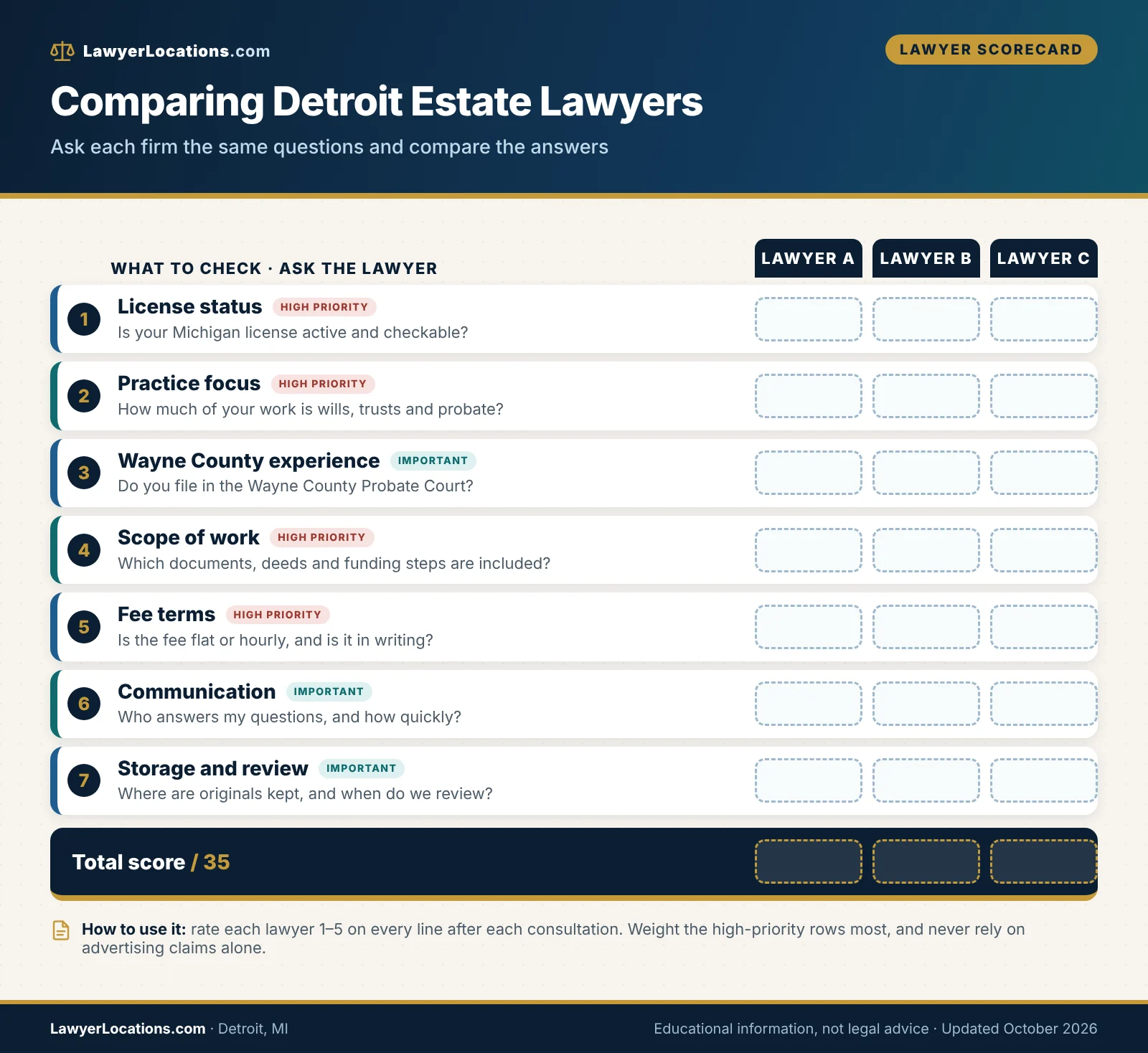
Text version of this graphic
| Criterion | Question to ask | Weight |
|---|---|---|
| License status | Is your Michigan license active and checkable? | High |
| Practice focus | How much of your work is wills, trusts and probate? | High |
| Wayne County experience | Do you file in the Wayne County Probate Court? | Medium |
| Scope of work | Which documents, deeds and funding steps are included? | High |
| Fee terms | Is the fee flat or hourly, and is it in writing? | High |
| Communication | Who answers my questions, and how quickly? | Medium |
| Storage and review | Where are originals kept, and when do we review? | Medium |
Questions to ask and how to compare the answers
A scorecard keeps you from choosing on charm alone. Ask each firm the same questions, write the answers down, and compare them side by side after the last meeting.
Practice focus and court experience
Ask what share of the lawyer’s work is estate planning and probate, and whether they handle Wayne County Probate Court filings or only draft documents. Neither answer is wrong. A drafting-only practice can serve a straightforward plan well, while a family with a complicated house or a likely dispute may want someone who also works in court.
Ask how many hearings or filings they typically handle in a month. A concrete answer shows familiarity; a vague one tells you something too.
Scope, staff and communication
Ask who does the drafting, who attends the signing, and who you call with questions. Many firms use paralegals for document preparation under a lawyer’s supervision, which is normal if it is disclosed and priced accordingly.
Ask how fast the firm replies to calls and email. A firm that is hard to reach before it has been paid is unlikely to improve afterward.
Storage, updates and succession
Ask where signed originals will be kept, whether the firm will hold them, and whether they charge for storage. Ask when they will contact you for a plan review and what happens if the lawyer retires. A will that nobody can find after a death creates its own problems, and the probate court’s deposit service described earlier is one low-cost answer.
Write down what you hear and compare it with the fee terms. A higher fee that includes funding, storage and a review may cost less than a cheap document that leaves all of that to you.
| Provider type | Typical strength | Watch for | Good question to ask |
|---|---|---|---|
| Solo or small estate-planning firm | Personal attention and often flat fees for standard packages | Limited coverage if the lawyer is unavailable | Who covers my file if you are out? |
| Larger firm with trust and estate group | Depth for complex estates, business owners and tax questions | Hourly billing and junior staff doing routine work | Who will draft my documents, and at what rate? |
| Online document service | Low cost for a simple will | No Michigan-specific advice, funding help or review of deeds and beneficiaries | Does this service explain how Michigan treats my signing method? |
- The firm explains scope and fees in writing before you commit.
- You can describe, in plain language, how the lawyer will handle funding and storage.
- The lawyer asks about your family, assets and goals before recommending a document.
- You are pressured to sign at the first meeting.
- The lawyer recommends a trust without asking what you own.
- Fees are vague, or “extras” appear only after you have paid.
A seminar or “free workshop” that ends with a high-pressure trust sale is a classic setup. A reputable lawyer will let you take the proposal home, compare it with other quotes and call back when you are ready.
Fees, Court Costs and Timing
Estate-planning lawyers in Detroit generally charge either a flat fee for a defined package or an hourly rate for open-ended work, and the court charges separate filing fees if a case is ever opened. Ask for the fee structure in writing and for a plain list of what is not included. This guide does not state average prices, because no official source publishes reliable Detroit-area averages.
How estate-planning lawyers charge
Michigan does not set what a lawyer charges for a will or trust, but the lawyer’s ethics rules require fees to be reasonable and clearly explained. The practical question is what you are buying for the number you are quoted.
Flat fees for defined packages
Many firms quote one price for a will, a financial power of attorney and a patient advocate designation, or for a revocable trust package with a pour-over will and deeds. Flat fees make budgeting easy and remove the fear of a running meter. They only help if the scope is spelled out, so ask what happens if you need a second round of edits.
Ask whether the flat fee includes the signing meeting, notary and witness arrangements, recording a deed and retitling accounts into a trust. Those extras are where a low headline price can grow.
Hourly work and retainers
Hourly billing is more common for complex plans, business owners, blended families and disputes. The lawyer estimates hours, you may be asked for an advance deposit called a retainer, and each hour is billed against it.
Ask for a written estimate range, how often you will receive itemized bills, and who works on the file at what rate. A firm that welcomes those questions is giving you a good early signal.
What the engagement agreement should say
An engagement agreement is the contract between you and the firm. It should describe the work, the fee, what is excluded, how and when you will be billed, and what happens if you end the relationship early. Read it at home and ask for changes before you sign it.
If a firm refuses to put terms in writing, treat that as a reason to compare other options. For a look at how fee conversations work in another practice area, see our guide on how criminal defense lawyers price their work, which covers the same flat-versus-hourly questions.
Court and other costs beyond the lawyer’s bill
Court fees are published, and they apply only if a case is opened or a service is used. Knowing the main ones lets you check any estimate you are given.
Probate court filing and service fees
The State Court Administrative Office publishes a statewide probate fee table. In its February 2025 edition, opening a decedent estate (an application or petition for probate or appointment of a personal representative) is listed at $150 under MCL 600.880(1), and some county courts show a higher combined amount for the same step. Wayne County’s own Probate Fees page is the authority for what you pay at its counter.
The same table lists filing a will for safekeeping at $25 under MCL 600.880c(2) and registering a trust at $25. It says the safekeeping fee is waivable, and that inventory fees cannot be waived.
| Court step | Fee on the statewide table | Statute cited |
|---|---|---|
| Petition or application for probate, or to appoint a personal representative (opens an estate) | $150 | MCL 600.880(1) |
| Same type of paper filed after an estate is already open | $20 | MCL 600.880b(1) |
| Petition to determine heirs, no estate pending | $150 | MCL 600.880(1) |
| Petition for assignment (small estate) | $25, not including inventory fee | MCL 600.880(2) |
| Will filed for safekeeping | $25 (waivable) | MCL 600.880c(2) |
| Registration of a trust | $25 | MCL 600.880c(2) |
| Petition to open a safe deposit box | $10 | MCL 700.2517(2)(a) |
The inventory fee scale
When an estate is opened, the personal representative files an inventory, and the court charges a sliding fee based on the estate’s value under MCL 600.871. The scale starts at $5 plus 1% of the amount over $500 for very small estates, is $25 for estates of $1,000 to $2,999.99, and rises in steps. For example, an estate from $100,000 to $500,000 pays $362.50 plus one-eighth of 1% of the amount over $100,000, after subtracting liens on real property.
The fee depends on the value reported in the inventory, so it grows with the estate. Ask your lawyer to estimate it using the state calculator the courts link to.
Recording, notary and copy costs
If a deed is part of your plan, expect a recording fee at the Wayne County Register of Deeds, and ask whether the lawyer’s quote includes it. Notary and witness arrangements at the signing, certified copies of letters of authority and death certificates add smaller costs.
Certified copies are priced by the court’s fee page, so the number varies by county. Ask your lawyer to list these small items separately so they do not surprise you at the end.
Ask for a line-item estimate that separates the lawyer’s fee, court fees, recording fees and copies. If a firm cannot break it down, you cannot compare it fairly with another quote.
Timing and decision points
Planning timelines depend mostly on how quickly you gather information and make decisions. After a death, timelines depend on the court, the type of estate and whether anyone objects.
Planning timeline: now through signing
A straightforward will and power of attorney can move quickly once you have chosen a lawyer, while a trust with deeds and multiple accounts takes longer because of the funding steps. Time spent gathering account statements and deeds before the first meeting shortens everything that follows.
Plan for a review after each major life event, such as marriage, divorce, a birth, a move or a large purchase. A document that was right five years ago can be wrong today.
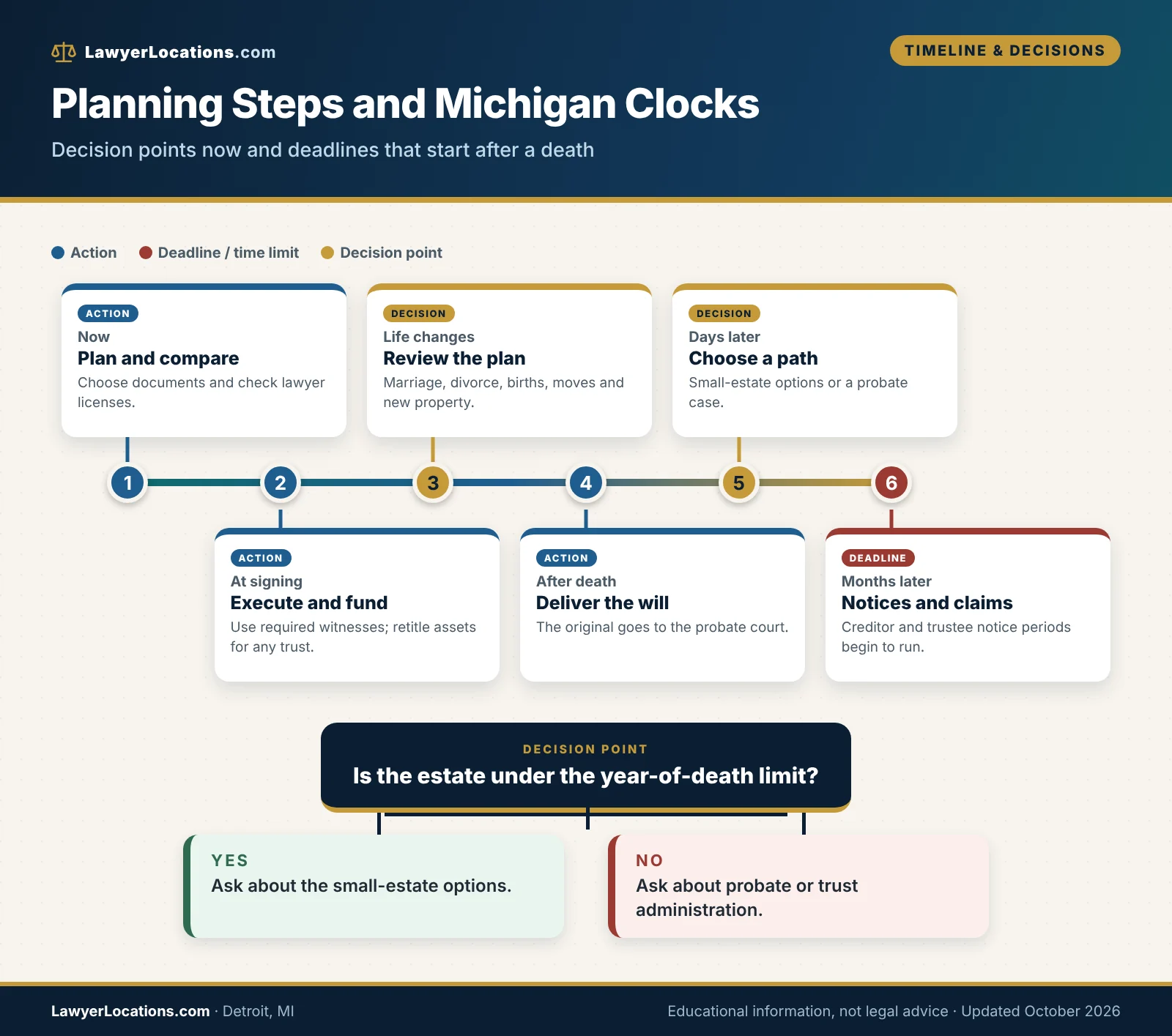
Text version of this graphic
- Now (action): plan and compare. Choose documents and check lawyer licenses.
- At signing (action): execute and fund. Use the witnesses Michigan requires and retitle assets for any trust.
- Life changes (decision): review the plan after marriage, divorce, births, moves and new property.
- After death (action): deliver the will. The original goes to the probate court.
- Days later (decision): choose a path. Small-estate petition or affidavit, or a probate case.
- Weeks and months later (deadline): notices and claims. Creditor and trustee notice periods begin to run.
Decision point: is the estate under the year-of-death limit? If yes, ask about the small-estate options. If no, ask about probate or trust administration.
After a death: first steps in Wayne County
The person holding the original will should locate it and ask a lawyer how to deliver it to the probate court. If the estate is small enough, the family may be able to use the court’s small-estate petition or the affidavit route described earlier. Otherwise, the personal representative will file to open an estate and later publish notice to creditors, which starts the claim period discussed in Section 2.
The Wayne County Probate Court posts its current procedures and filing options on wcpc.us. Because court practices change, read that site before you plan around any particular step.
Some Michigan deadlines start running before anyone notices: the claim period after a notice to creditors, and the trust-contest period after a trustee’s notice. If you have received a notice from a court or a trustee, put the date on your calendar the day it arrives.
| Stage | Rule | Practical step |
|---|---|---|
| Small-estate affidavit | At least 28 days after death; no real property; no personal representative appointed (MCL 700.3983) | Gather the death certificate and a list of assets; ask the account holder about its own forms |
| Claims after published notice | 4 months from publication (MCL 700.3803) | Hold back distributions until the lawyer says the claim period has run |
| Claims if notice rules were not met | 3 years after death for pre-death claims (MCL 700.3803) | Ask the lawyer whether publication and mailed notices were done properly |
| Trust contest | Earlier of 2 years after death or 6 months after the trustee’s notice (MCL 700.7604) | Calendar the date the notice arrives and speak with a lawyer promptly |
| Heirs and small-estate debts | 63 days from the assignment order for heirs other than a spouse or minor children (Kent County Probate Court guidance on MCL 700.3982) | Pay known funeral and valid debts first; keep receipts |
Preparing for the Consultation and Avoiding Common Mistakes
Good preparation shortens the meeting, lowers the bill and surfaces problems early. Bring paper, not memories: deeds, statements, beneficiary forms and any documents you already signed.
What to bring and what to decide beforehand
The first meeting goes better when you arrive with facts and a rough set of choices. You do not need final answers, but you do need a starting point.
Documents and information to gather
Start with the papers that prove who owns what and who gets what by contract. A lawyer can only plan around assets they can see.
- Photo ID and current contact details for you and your spouse or partner.
- Deeds, mortgage statements and the most recent property tax bill for any Detroit-area real estate.
- Recent bank, brokerage and retirement account statements, with the beneficiary forms for each.
- Life insurance policies and any annuity contracts.
- Any existing will, trust, power of attorney or patient advocate designation.
- Names, ages and addresses of children and other likely beneficiaries.
- Business ownership papers, if you own part of a company.
- A list of questions about fees, scope, timing and storage.
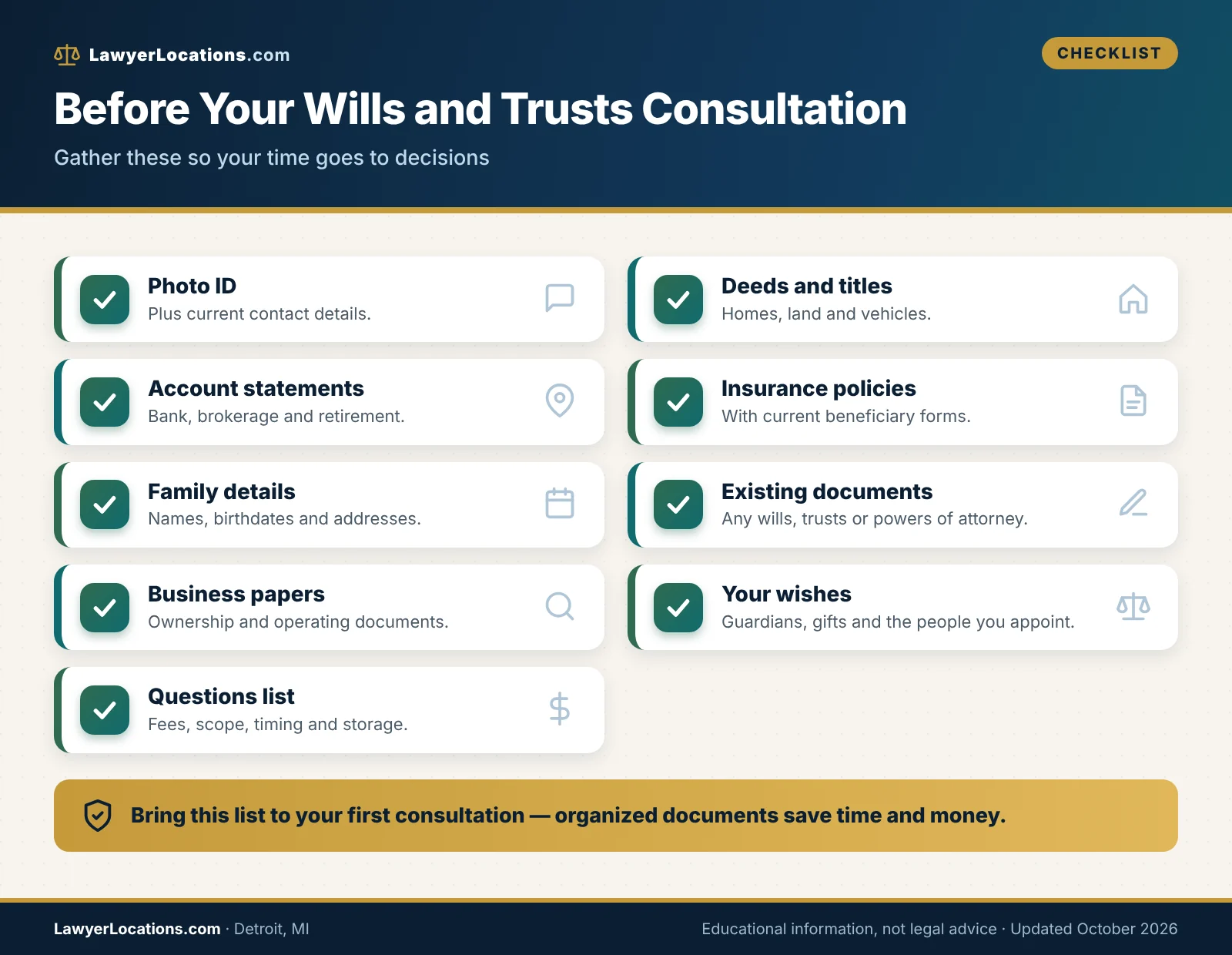
Text version of this graphic
- Photo ID: plus current contact details.
- Deeds and titles: homes, land and vehicles.
- Account statements: bank, brokerage and retirement.
- Insurance policies: with current beneficiary forms.
- Family details: names, birthdates and addresses.
- Existing documents: any wills, trusts or powers of attorney.
- Business papers: ownership and operating documents.
- Your wishes: guardians, gifts and the people you appoint.
- Questions list: fees, scope, timing and storage.
Decisions to think through
You will be asked to name several people: a personal representative, a successor trustee if you choose a trust, a financial agent, a patient advocate and, if you have minor children, a guardian. Choose people who are able, willing and likely to get along with each other, and name backups in case your first choice cannot serve.
Talk to the people you plan to name before the meeting. Learning that your first choice would decline is much easier to deal with before the documents are drafted.
Write down who should receive keepsakes and tangible items before the meeting, and ask the lawyer how Michigan handles personal property lists. Many family fights are about photo albums and jewelry, not money.
Common mistakes in Michigan wills and trusts
Most estate-planning errors are not exotic. They are small gaps between what the documents say and what actually happens to the property.
A signed trust with nothing in it
The most common problem is a trust that was signed but never funded. If the house is still in your name and the accounts are not retitled, the trust has little to control, and the family may face probate anyway. Ask for a funding checklist and a date by which each step will be done.
Check the work a few months later. A short follow-up call to confirm the deed was recorded and the accounts were retitled costs little and catches errors.
Beneficiary forms that contradict the plan
A retirement account, life insurance policy or payable-on-death account passes to whoever is named on the form, whatever your will says. Old forms naming a former spouse or a deceased parent are surprisingly common. Review every form when you review your plan.
Joint ownership can have the same effect. Adding a child to a deed or account for convenience can expose the asset to that child’s creditors and can override your will, so ask the lawyer before you change title.
Do-it-yourself deeds and unsigned originals
Quitclaim deeds and “transfer” forms found online look simple, yet they can trigger tax and benefit consequences, and a defective deed can cloud title. Detroit’s tangled-title research is a reminder of how costly an unclear ownership record can become for the next generation.
Also keep track of the original signed documents. A copy of a will is not the same as the original, and a missing original can force extra court steps. Consider the probate court’s deposit service, or ask the firm about storage.
Two siblings inherit a Detroit house from a parent who left no will. One sibling lives in the house and pays the taxes; the other lives out of state. Without a probate case, neither can easily sell, refinance or qualify for some assistance programs. A lawyer might begin with the court filing that determines heirs or opens an estate. This is a scenario to discuss with a licensed Michigan lawyer, not a prediction.
Red flags when hiring
Most lawyers are straightforward, and a few warning signs are worth knowing. If you see two or more, keep comparing.
Pressure, promises and vague credentials
- A demand to sign at the first meeting or “while the discount lasts.”
- A promise that your family will “never go through probate” with no discussion of funding or exceptions.
- Claims of being “the best” or a “specialist” without a clear basis you can check.
- No Michigan license you can verify.
Good lawyers explain trade-offs, including where a trust will not help you. They also tell you when you do not need one.
Money and communication problems
- Unwillingness to put the fee and scope in writing.
- Requests to pay in cash, or to pay a personal account instead of the firm’s account.
- Staff who cannot tell you who is responsible for your file.
- A lawyer who talks mainly about products or investments rather than your documents.
If something feels off, ask a second lawyer to review the proposal. A second opinion costs little compared with fixing a bad plan.
Common Questions and Next Steps
The short answers below pull together the points above for readers who want a quick check. Each is general information about Michigan and Detroit, not advice about your facts.
Quick answers on Michigan documents, dollar figures and local help
These answers mix law, logistics and local resources. Dollar figures come from official or court sources and carry the dates noted.
Do I need a trust if I already have a will?
Not always. A will controls probate property and names guardians for children, while a funded trust can avoid probate for the assets it holds and can manage property during incapacity. A trust costs more to set up and has to be funded. To see how another state frames the same choice, read our guide to a wills and trusts lawyer in Colorado Springs or the trust attorney guide for Tulsa.
What are the key 2026 dollar figures for Michigan families?
The Kent County Probate Court’s published table lists $53,000 as the small-estate limit for deaths on or after January 1, 2026. The IRS lists $15,000,000 as the federal estate tax exclusion for 2026 deaths and $19,000 as the annual gift exclusion, and Michigan Treasury says the state estate tax is not operative. The statewide probate fee table lists $150 to open an estate and $25 to deposit a will for safekeeping, but Wayne County’s own fee page controls.
Does a Michigan will have to be notarized?
No. Under MCL 700.2502 a will is valid with a signed writing and two witnesses. Many lawyers add a witness affidavit so the court can accept the will without calling the witnesses, but notarization alone does not replace the witnesses.
Can I write my own will in Michigan?
You can, and a fully handwritten, dated and signed will can be valid even without witnesses. The risk is ambiguity, a missing date or a gap that leads to an argument in court. If you own a home, have children or have a blended family, ask a lawyer to review it.
Where is probate filed if I live in Detroit?
Probate generally follows the county where the person lived at death, so a Detroit resident’s estate usually belongs in the Wayne County Probate Court at Two Woodward Avenue. Residents of Oakland or Macomb County would use those counties’ courts, and a lawyer can confirm the correct venue for your situation.
Can I store my original will with the court?
Yes. MCL 700.2515 lets a person deposit a sealed will with the probate court in the county where they live. The court issues a certificate of deposit and releases the will during your life only to you or someone you authorize in writing. The statewide fee table lists $25 for the deposit.
Does Michigan have an estate tax?
Michigan Treasury states that the state estate tax is not operative, and that the inheritance tax applies only to estates of people who died before October 1, 1993. Federal estate tax is separate, and the 2026 federal exclusion is $15,000,000.
What if my parent died without a will and the Detroit house is still in their name?
This is the heirs’ property problem described in Section 3. The usual starting point is a probate filing, such as opening an estate or asking the court to determine heirs. Gather the death certificate, the property tax bill and any old deed, then talk to a licensed Michigan lawyer or a legal aid program.
How much does a wills and trusts lawyer cost in Detroit?
Prices vary by firm and by how complicated your plan is, and no official source publishes reliable Detroit-area averages. Compare flat-fee and hourly quotes, ask what is included, and get the terms in writing. Court fees are published separately.
Is there free legal help in Detroit for a will or an inherited house?
The Legal Aid and Defender Association serves income-eligible residents of Wayne, Oakland and Macomb counties, and Michigan Legal Help offers self-help guides and a directory. Neither listing says estate matters are covered, so ask when you call. The State Bar of Michigan Lawyer Referral Service offers a short paid consultation.
How do I check that a Michigan lawyer is licensed?
Search the State Bar of Michigan’s public member directory by name and compare it with the lawyer’s website. Also look for any public discipline record. If the license does not show up, keep looking.
What is a patient advocate, and do I need one?
A patient advocate is the person you name under MCL 700.5506 to make care decisions when you cannot. The designation needs your signature, a date and two qualifying witnesses, and it has to be placed in your medical record before it takes effect. Most complete plans include one.
Your next steps
Choosing a wills and trusts lawyer in Detroit does not have to be a marathon. A short, structured process gets most people to a sound decision.
This week
- List your assets and how each is titled, and find your latest beneficiary forms.
- Pick two or three lawyers and check each one’s Michigan license.
- Ask each firm for fee terms and scope in writing before you meet.
- If a family house is in a relative’s name, collect the death certificate, tax bill and old deeds.
Before you sign
Read the drafts for names and shares, confirm who will witness the signing, and ask for a funding checklist if a trust is involved. Tell the people you name where the originals are kept. After signing, put a reminder on your calendar to review the plan after major life changes. If long-term care planning is also on your mind, our guide to an elder law attorney in Memphis shows what to ask about that topic, and you can compare Wisconsin’s rules in our estate planning attorney guide.
Ready to compare your options?
Searching for a wills and trusts lawyer Detroit MI is the easy part. Use the scorecard questions, verify each license, and get fee terms in writing before you decide. For a broader look at trusts, read our living trust lawyer guide.
General information only. LawyerLocations.com is a legal-education and lawyer-discovery resource, not a law firm, and nothing here is legal advice or creates an attorney-client relationship. Laws, court fees and local rules change, and your facts matter. Consult a lawyer licensed in Michigan about your situation.
Sources & References
Show all 16 sources
- MCL 700.2502 Execution of will — Michigan Legislature — legislature.mi.gov — accessed October 2026
- MCL 700.2515 Deposit of will for safekeeping — Michigan Legislature — legislature.mi.gov — accessed October 2026
- MCL 700.3803 Limitations on presentation of claims — Michigan Legislature — legislature.mi.gov — accessed October 2026
- MCL 700.5506 Patient advocate designation — Michigan Legislature — legislature.mi.gov — accessed October 2026
- MCL 700.7604 Limitation on action contesting validity of revocable trust — Michigan Legislature — legislature.mi.gov — accessed October 2026
- Small Estates (MCL 700.3982 and 700.3983 thresholds and procedure) — Kent County Probate Court — kentcountymi.gov — accessed October 2026
- Michigan Probate Court Fee Tables (February 2025) — Michigan Courts, State Court Administrative Office — courts.michigan.gov — accessed October 2026
- Probate Court Fees — Macomb County Probate Court — macombgov.org — accessed October 2026
- Wayne County Probate Court home page — Wayne County Probate Court — wcpc.us — accessed October 2026
- Wayne County Probate Court listing — Michigan Legal Help — michiganlegalhelp.org — accessed October 2026
- Legal Aid and Defender Association listing — Michigan Legal Help — michiganlegalhelp.org — accessed October 2026
- Lawyer Referral Service — State Bar of Michigan — michbar.org — accessed October 2026
- What’s New — Estate and Gift Tax — Internal Revenue Service — irs.gov — accessed October 2026
- Estate Tax Forms — Michigan Department of Treasury — michigan.gov — accessed October 2026
- Report: More than 5,500 family properties in Detroit have title problems (Keeping Your Family Home, February 2024) — Detroit Future City — detroitfuturecity.com — accessed October 2026
- Michigan’s Uniform Laws (February 2026) — Greenleaf Trust — greenleaftrust.com — accessed October 2026
Legal Disclaimer and Limitation of Liability
Informational and illustrative purposes only. This article was prepared by LawyerLocations.com solely on the basis of the information available to us at the time of writing. It is an illustrative, general overview. It is not a complete or authoritative statement of the law, and it has not been reviewed by a lawyer licensed in your state or county.
Not legal advice. Nothing in this article is legal, financial, tax or immigration advice, and reading it does not create an attorney-client relationship between you and LawyerLocations.com or any author, lawyer or firm mentioned. Laws, court rules, fees, filing deadlines and agency procedures differ by state, county and court, and they change often. Some details here may be simplified, incomplete or out of date, and time limits for legal claims can be short.
No warranty. We make no representation or warranty, express or implied, about the accuracy, completeness, timeliness or suitability of this content for your situation. Please do not rely on it to make, delay or skip any legal decision. Check the facts against official sources and speak with a licensed attorney in the relevant jurisdiction before you act.
Limitation of liability. To the fullest extent permitted by law, LawyerLocations.com and its owners, authors and contributors disclaim all liability for any loss, damage, cost or other consequence arising from the use of, or reliance on, this article, including any content on third-party websites we link to. Mentioning a lawyer, firm, organization or service is not an endorsement and is not a promise of any result. If you are in immediate danger, contact your local emergency number.