
Finding a bankruptcy attorney in South Dakota comes down to three things: knowing that every case is filed in one federal court (the U.S. Bankruptcy Court for the District of South Dakota), understanding the state exemption rules that decide what you keep, and comparing a few lawyers on fees, experience in that court and communication before you sign anything.
This guide explains how a South Dakota case moves from first call to discharge, which state statutes matter, where the court and legal-aid resources are, what lawyers and the court charge, and which questions to ask at a consultation. It is general information, not legal advice.
How bankruptcy works in South Dakota and when a lawyer fits
Bankruptcy is a federal process, but it plays out through South Dakota courts, South Dakota property rules and South Dakota trustees. A bankruptcy attorney helps you choose a chapter, claim the right exemptions, and avoid paperwork errors that can cost you property or sink the case. This section gives you the map before we get into the details.
The federal system with a South Dakota address
One federal court for the whole state
Unlike a divorce or a small-claims case, bankruptcy cannot be filed in a county courthouse. Every South Dakota bankruptcy goes to the U.S. Bankruptcy Court for the District of South Dakota, which covers the entire state. The court has clerk’s offices in Sioux Falls and Pierre, and holds hearings in Sioux Falls, Rapid City, Pierre and Aberdeen. There is no clerk’s office in Rapid City, so someone living in the Black Hills may attend a hearing locally but still deals with the clerk through the Sioux Falls or Pierre offices or through electronic filing.
That single-court structure is good news for comparing lawyers. A South Dakota bankruptcy lawyer, whether based in Sioux Falls, Rapid City, Aberdeen or a smaller town, files in the same court, follows the same local rules and deals with the same panel of trustees. When you ask a lawyer about experience, the useful question is not “where is your office?” but “how often do you file in this court, and with which trustees?”
Because one court serves the whole state, you are not limited to a lawyer in your own town. Many consultations can be done by phone or video, though you will still need to sign documents and attend the meeting of creditors on the schedule the court sets.
Chapter 7 and Chapter 13 in plain terms
Most individuals and families use one of two chapters. Chapter 7 is often called “liquidation”: a court-appointed trustee reviews your property, may sell anything that is not protected by an exemption, and pays creditors from the proceeds. Most people who file a Chapter 7 have little or nothing the trustee can sell, and many of their eligible unsecured debts, such as credit cards and medical bills, are discharged (legally wiped out) a few months after filing.
Chapter 13 is a repayment plan. You propose a plan, usually lasting three or five years depending on income, and pay what you can afford through a trustee. It can help you catch up on a mortgage or car loan, keep property that would be at risk in Chapter 7, or deal with debts and timing problems Chapter 7 cannot solve. The U.S. Trustee Program explains that for some debtors the means test result is the starting point for the amount owed under a Chapter 13 plan.
Chapters 11 and 12 exist for businesses and family farmers. Those cases are more complex, and a lawyer is practically essential. If you run a farm or a business, say so at the very first call so the lawyer can tell you whether they handle those chapters at all.
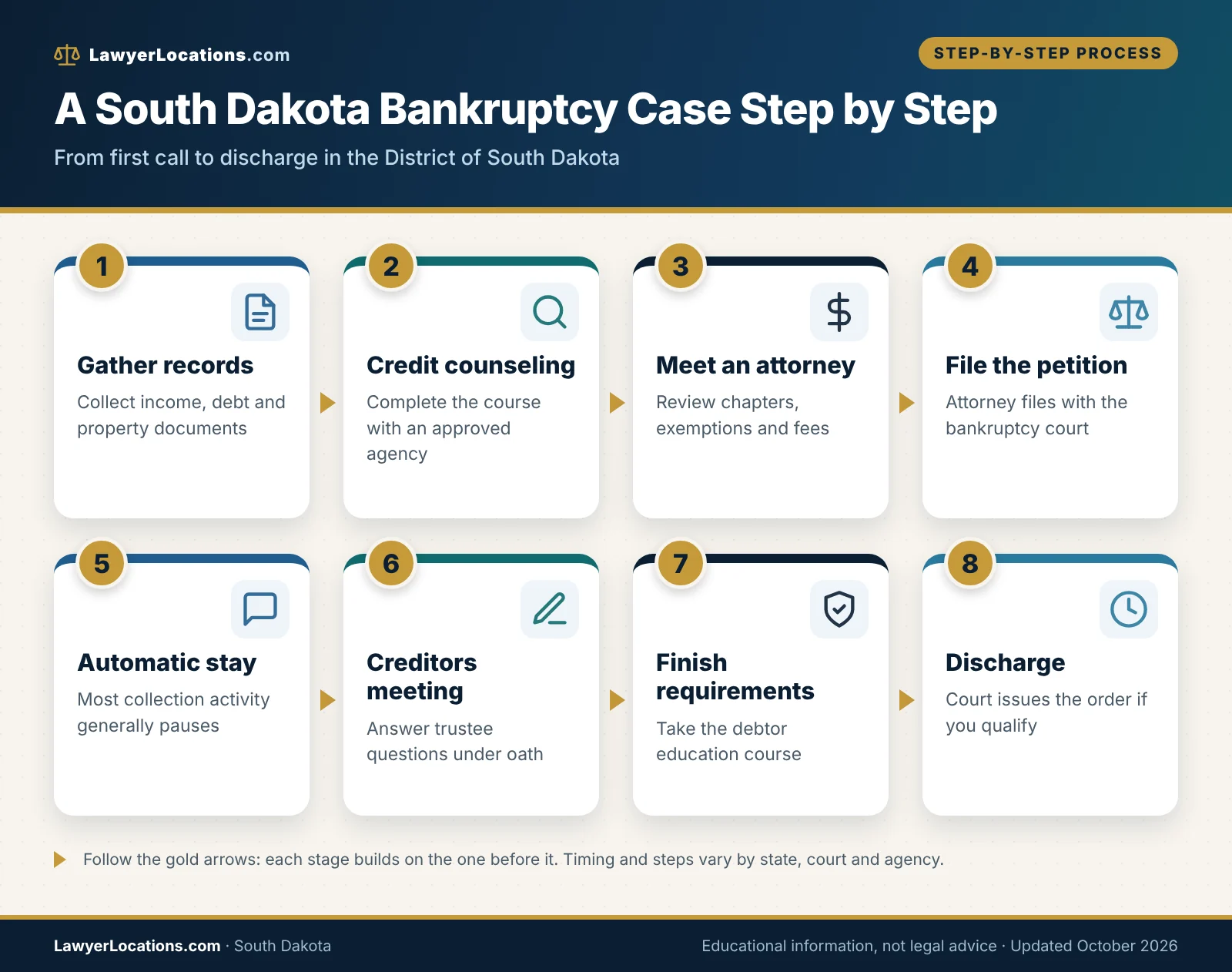
Text version of this graphic
- Review your debts, income and property and gather records.
- Complete credit counseling from an approved agency.
- Meet a bankruptcy attorney and choose a chapter.
- Prepare and file the petition, schedules and means test in the District of South Dakota.
- The automatic stay begins and a trustee is assigned.
- Attend the meeting of creditors (341 meeting) and answer questions under oath.
- Finish any debtor education course and plan payments if you filed Chapter 13.
- Receive the discharge order if you qualify.
How a case moves from first call to discharge
Before filing: counseling, paperwork and the means test
Federal law requires individuals to complete credit counseling with an approved agency within the 180 days before filing, through an individual or group briefing. There are limited exceptions for emergencies. Your lawyer will usually tell you to complete the course early, because the certificate must be filed with the case.
The heavy lifting happens in this preparation stage. Your attorney collects pay records, tax returns, bank statements, a list of every creditor, and details of everything you own. They then complete the schedules and the means test, the formula the Bankruptcy Code uses to compare your income with the state median. The test applies to individuals with primarily consumer debts who want Chapter 7. If your income is above the median and the calculation shows enough disposable income, the case can be presumed abusive and face dismissal or conversion to Chapter 13.
The Census-based median income figures used in the means test are updated on a schedule, and the most recent update posted by the U.S. Trustee Program applies to cases filed on or after April 1, 2026. Ask your lawyer which figures they are using and for which household size.
After filing: the stay, the meeting of creditors and the discharge
The moment your petition is filed, the automatic stay (11 U.S.C. 362) generally stops most collection activity: calls, lawsuits, repossession attempts and wage garnishments. Creditors receive notice from the court. A trustee is assigned and reviews your paperwork.
About three to six weeks after filing, typically 21 to 40 days in a Chapter 7, you attend the meeting of creditors, also called the 341 meeting. You answer questions about your finances and property under oath. Creditors may attend but rarely do in consumer cases. In most Chapter 7 cases the court issues the discharge roughly 60 to 90 days after the date first set for that meeting, unless someone files an objection.
Your lawyer’s role in this stage is to prepare you for the questions, respond to the trustee’s document requests, and deal with any creditor who challenges the discharge of a particular debt. Keep every notice you receive and forward it to your attorney at once.
When hiring a lawyer makes the most sense
Situations where legal help matters most
Nothing in the Bankruptcy Code prohibits filing without an attorney, and the court’s website has a section for people who file on their own. But some situations carry real risk for a do-it-yourself filer:
- You own a home, land or a vehicle with equity and need to know whether exemptions protect it.
- You have recently paid back a relative, sold property or received a large tax refund or inheritance.
- You face a foreclosure, repossession, lawsuit or wage garnishment and need the stay to start on time.
- Your income is near or above the state median and the means test is not clear-cut.
- You own a farm, ranch or small business, or you have debts a creditor may argue cannot be discharged.
- You filed a bankruptcy case before, which can limit a new discharge.
If none of these apply, your finances are simple and you have limited resources, the court’s pro se materials and the legal-aid options covered later may be a reasonable starting point. Even then, a short paid consultation can be money well spent.
Alternatives to consider before you file
Bankruptcy is not the only tool. Depending on the debt, you may have other options: negotiating a payment plan with a creditor, asking a lender for a loan modification, disputing a debt you do not owe, or using a nonprofit credit counseling agency to set up a debt management plan. South Dakota’s wage-garnishment limits, explained below, may also change how urgent your situation really is.
A good lawyer will lay out these alternatives, including ones that do not generate a fee for the firm. If you are mainly worried about a wage garnishment, our guide to stopping wage garnishment with bankruptcy and non-bankruptcy options compares the paths. If medical bills are the main driver, who pays medical bills after a car accident covers how insurance and liens can affect what you owe.
Be cautious of anyone who tells you bankruptcy is the only answer before they have reviewed your income, property and debts. A trustworthy lawyer explains the downsides, such as credit impact and the possible loss of non-exempt property, alongside the benefits.
South Dakota law that shapes your case
South Dakota is an “opt-out” state: its residents use South Dakota exemptions rather than the federal list in 11 U.S.C. 522(d). The state statutes below decide what you can keep, so they are central to any conversation with a bankruptcy attorney. All statute references reflect the South Dakota Codified Laws as published online in October 2026; the legislature can amend them, so ask your lawyer to confirm the current text.
Property exemptions in South Dakota
The homestead exemption
Under SDCL 43-45-3, a homestead as defined and limited in chapter 43-31 is exempt from process. Chapter 43-31 limits the size of a homestead: SDCL 43-31-4 caps it at one acre inside a town plat and 160 acres outside a town plat, with smaller limits for certain mineral claims. Unlike many states, the statute does not set a fixed dollar cap on the equity in a qualifying homestead for most owners.
The statute does contain dollar figures in other places. If a homestead is sold voluntarily or by court process, proceeds up to $100,000 stay exempt for one year after the owner receives them. For an owner age 70 or older, or an unremarried surviving spouse, the statute refers to a $170,000 limit. How these provisions interact with a bankruptcy trustee’s sale of a home is a lawyer question, not a do-it-yourself one.
To use South Dakota’s exemptions, federal law generally requires that you lived in the state for at least 730 days before filing; otherwise the exemptions of your prior state may apply (11 U.S.C. 522(b)(3)(A)). If you moved to South Dakota within the last two years, tell your lawyer on day one.
Personal property, the “head of family” allowance and what is not covered
SDCL 43-45-2 lists property that is “absolutely exempt.” It includes family pictures, a pew or seat in a house of worship, a burial lot, clothing of the debtor and family, provisions for one year and fuel, prescribed health aids, and the family Bible, schoolbooks and library books up to $200 in total value. It also covers court-ordered domestic support that is not a lump sum, up to $750 per month.
On top of that, SDCL 43-45-4 lets a debtor select additional personal property up to an aggregate value of $7,000 if they are head of a family, or $5,000 if not. That allowance is what many filers use to protect a vehicle, household goods, tools or cash. It has to cover everything you want to protect that is not already listed as absolutely exempt, so careful valuation matters.
Finally, SDCL 43-45-13 states that South Dakota residents are not entitled to the federal exemptions under 11 U.S.C. 522(b), while preserving the exemptions given by the state constitution and statutes. Retirement accounts, insurance and other categories may be protected by separate state or federal laws, so a lawyer should walk through each asset rather than assuming.
| Topic | Statute | What it provides |
|---|---|---|
| Absolutely exempt items | SDCL 43-45-2 | Family pictures, clothing, one year of provisions and fuel, prescribed health aids, listed items; books up to $200; support up to $750 per month |
| Homestead | SDCL 43-45-3; 43-31-4 | Homestead exempt within size limits (one acre in town plat, 160 acres elsewhere); sale proceeds up to $100,000 exempt for one year |
| Added personal property | SDCL 43-45-4 | Up to $7,000 aggregate value for head of family; $5,000 otherwise |
| Federal exemption list | SDCL 43-45-13 | 11 U.S.C. 522(d) exemptions not available to South Dakota residents |
| Earnings | SDCL 43-45-14; 21-18-51 to 21-18-53 | Earnings exempt to the extent provided in the garnishment statutes; earned but unpaid wages may be claimed exempt in bankruptcy subject to SDCL 43-45-4 |
Wages, garnishment and the automatic stay
South Dakota’s wage garnishment limits
SDCL 21-18-51 limits how much of a worker’s disposable earnings can be garnished in a workweek. The garnishable amount is the lesser of two figures: 20 percent of disposable earnings, or the amount by which disposable earnings exceed 40 times the applicable minimum hourly wage, reduced by $25 per week for each dependent family member living with the debtor. These limits do not apply to court orders for the support of any person or to orders of a bankruptcy court.
In plain English, a creditor with a judgment cannot take your whole paycheck, but it can take a meaningful share if your income is above the floor. Child support and similar orders follow different rules and can reach more. If you are being garnished, tell the lawyer how much is coming out of each check and when it started, because the timing can affect what a trustee does with recent payments.
For a side-by-side look at the options, including how a lawyer in another state approaches the question, see our guide on wage garnishment lawyers in Fort Worth, TX; the federal stay works the same way nationwide, even though exemption details are state-specific.
What the automatic stay does and does not do
The stay is the immediate benefit of filing. It generally pauses collection calls, lawsuits, garnishments and repossession efforts while the court reviews your case. For a person facing a foreclosure sale or a wage garnishment, timing the petition correctly can matter more than any other decision.
But the stay has limits. It does not erase debts by itself, it may not stop certain actions such as ongoing child support collection, and it can be shortened or lifted if you have had earlier cases dismissed, or if a secured creditor asks the court for relief. The federal courts’ Chapter 7 overview mentions a 180-day waiting period after certain prior dismissals. If you filed before, give your lawyer the case number and dates.
A worker in a small town receives notice that a creditor with a judgment will begin garnishing wages next pay period. The worker meets a lawyer, finishes credit counseling that same week, and the lawyer files the petition before the first garnishment. Whether that sequence is available in any real case depends on the creditor, the paperwork and the court’s calendar; this is an illustration, not a prediction.
Courts, trustees and local resources
South Dakota’s bankruptcy system has a small footprint, which makes it easier to understand. There is one court, a handful of hearing locations, a U.S. Trustee office that supervises cases from outside the state, and several legal-aid and referral programs. Knowing who does what helps you read the notices you receive and ask better questions of a lawyer.
The U.S. Bankruptcy Court for the District of South Dakota
Clerk’s offices, hours and hearing locations
The court’s website lists two clerk’s offices. Both are open Monday through Friday, 8:00 a.m. to 5:00 p.m. Central time, excluding federal holidays. Confirm addresses and hours on the court’s site before visiting, because buildings, security screening and counter services can change.
| Location | Address | Phone | Notes |
|---|---|---|---|
| Sioux Falls | U.S. Courthouse, 400 South Phillips Avenue, Room 104, Sioux Falls, SD 57104-6851 | (605) 357-2400 | Clerk’s office and hearing location |
| Pierre | U.S. Post Office and Federal Courthouse, 225 South Pierre Street, Room 203, Pierre, SD 57501-2463 | (605) 945-4460 | Clerk’s office and hearing location |
| Rapid City | Hearings only; no clerk’s office listed | Use Sioux Falls or Pierre | Hearing location |
| Aberdeen | Hearings only; no clerk’s office listed | Use Sioux Falls or Pierre | Hearing location |
Your lawyer will normally tell you which hearing location is assigned for your meeting of creditors and any court hearings, and the court posts calendars on its website. If your assigned location is far from home, ask whether any part of the process can be handled remotely under the court’s current procedures.
Write down your case number the day you file and keep it with your notices. Every clerk’s office call, trustee email and lawyer update will start with that number, and it speeds up everything.
Local rules, electronic filing and the court’s self-help pages
The court publishes local rules, general orders, local forms and an electronic-filing guide. Attorneys file through the court’s electronic system, which is one reason a lawyer in any part of the state can file your case without a trip to a clerk’s office. The court also maintains a section for people filing without a lawyer, covering how to prepare and sign a petition, how to find an attorney, and links to low-fee or no-fee options and to bankruptcy statutes, rules and forms.
Even if you plan to hire a lawyer, those pages are worth reading. They show what the court expects and give you a vocabulary for your first consultation. If a lawyer’s explanation of a step does not match what you read on the court’s site, ask about the difference rather than assuming you misunderstood.
Local rules can change with little notice, which is another reason to hire someone who files in this court regularly. A lawyer who files often will know when a form was updated or when a trustee changed a document request.
Trustees and who else is involved
The U.S. Trustee and your case trustee
Two different kinds of trustees appear in a bankruptcy. The U.S. Trustee is part of the Department of Justice and supervises the administration of cases, including reviewing means test results. According to the Department of Justice’s list of regions and offices, South Dakota falls in Region 12, and the U.S. Trustee’s Des Moines, Iowa office (210 Walnut Street, Suite 793, Des Moines, IA 50309-2108; 515-284-4982) administers South Dakota bankruptcy estates.
The case trustee is the person assigned to your own file. In Chapter 7, the trustee conducts the 341 meeting, reviews your property and decides whether anything non-exempt should be sold. In Chapter 13, a standing trustee collects your plan payments and distributes them to creditors. Your lawyer will tell you the name of your trustee after filing and should explain the trustee’s preferences about documents and deadlines.
The trustee does not work for you and is not your advocate, but a trustee is not your enemy either. Treat requests politely, answer on time and be accurate. Most problems in consumer cases begin when a debtor ignores a request or gives an answer that later turns out to be incomplete.
Legal aid, bar referral and low-fee options
The court’s “low-fee or no-fee attorneys” page points to four programs that may provide help to a qualifying debtor. Eligibility rules, income limits and the kinds of cases each program accepts vary, so contact them directly or use their websites to check.
| Resource | What it is | Website |
|---|---|---|
| State Bar of South Dakota lawyer referral | A referral service that may help you find a local attorney to assist with filing bankruptcy | findalawyerinsd.com |
| State Bar Access to Justice program | The State Bar’s program connecting people with civil legal help | statebarofsouthdakota.com |
| East River Legal Services | A legal-aid organization listed by the court as a possible source of low-fee or no-fee help | erlservices.org |
| Dakota Plains Legal Services | A legal-aid organization listed by the court as a possible source of low-fee or no-fee help | dpls.org |
| South Dakota Law Help | Online legal information and help finding services | sdlawhelp.org |
Legal-aid programs generally focus on people with limited income and sometimes prioritize certain case types. Being turned away by one program does not mean you are out of options; try the bar’s referral service and ask about reduced-fee arrangements.
How to compare bankruptcy attorneys in South Dakota
You are looking for a licensed lawyer who files regularly in the District of South Dakota, explains your options candidly, quotes a clear fee and returns your calls. This directory does not rank or recommend lawyers, so the job of comparing falls to you. The framework below gives you criteria that matter more than a slogan or a billboard.
Where to look and how to check a lawyer’s standing
Starting points that do not depend on advertising
The court points to the State Bar of South Dakota’s lawyer referral service as a way to find a local attorney to help with bankruptcy. Personal referrals from a financial counselor, a legal-aid office or a friend who has been through the process can also be useful, though your situation may differ from theirs. Online directories, including this one, help you learn what to ask, but they should not replace your own checking.
Aim to speak with two or three lawyers before deciding. Ask each the same questions, write down the answers and compare. The differences in how clearly they explain the process are often more telling than differences in price.
If you want general advice on getting more from a first meeting, our guide to what to ask before hiring a lawyer at a consultation covers questions that apply to most legal practice areas, though bankruptcy has its own specifics listed below.
Verifying credentials and avoiding look-alikes
Confirm that the person you are dealing with is a licensed attorney in South Dakota by checking with the State Bar of South Dakota, and ask whether they regularly file in the Bankruptcy Court for the District of South Dakota. Do not rely on a title such as “specialist” or “expert” in advertising; ask what share of the practice is consumer bankruptcy and how long they have handled these cases.
Be wary of non-lawyer “petition preparers” or debt-relief companies that offer to handle your case. Federal law regulates non-attorney petition preparers and they cannot give legal advice about which chapter to file or what you may keep. If a company wants a large upfront payment and is vague about who will actually sign the petition, treat that as a reason to stop and check.
Any promise that a lawyer or company will promise a discharge, “erase all debt” or keep every asset is a reason to walk away. Outcomes depend on your facts, the trustee, the creditors and the court.
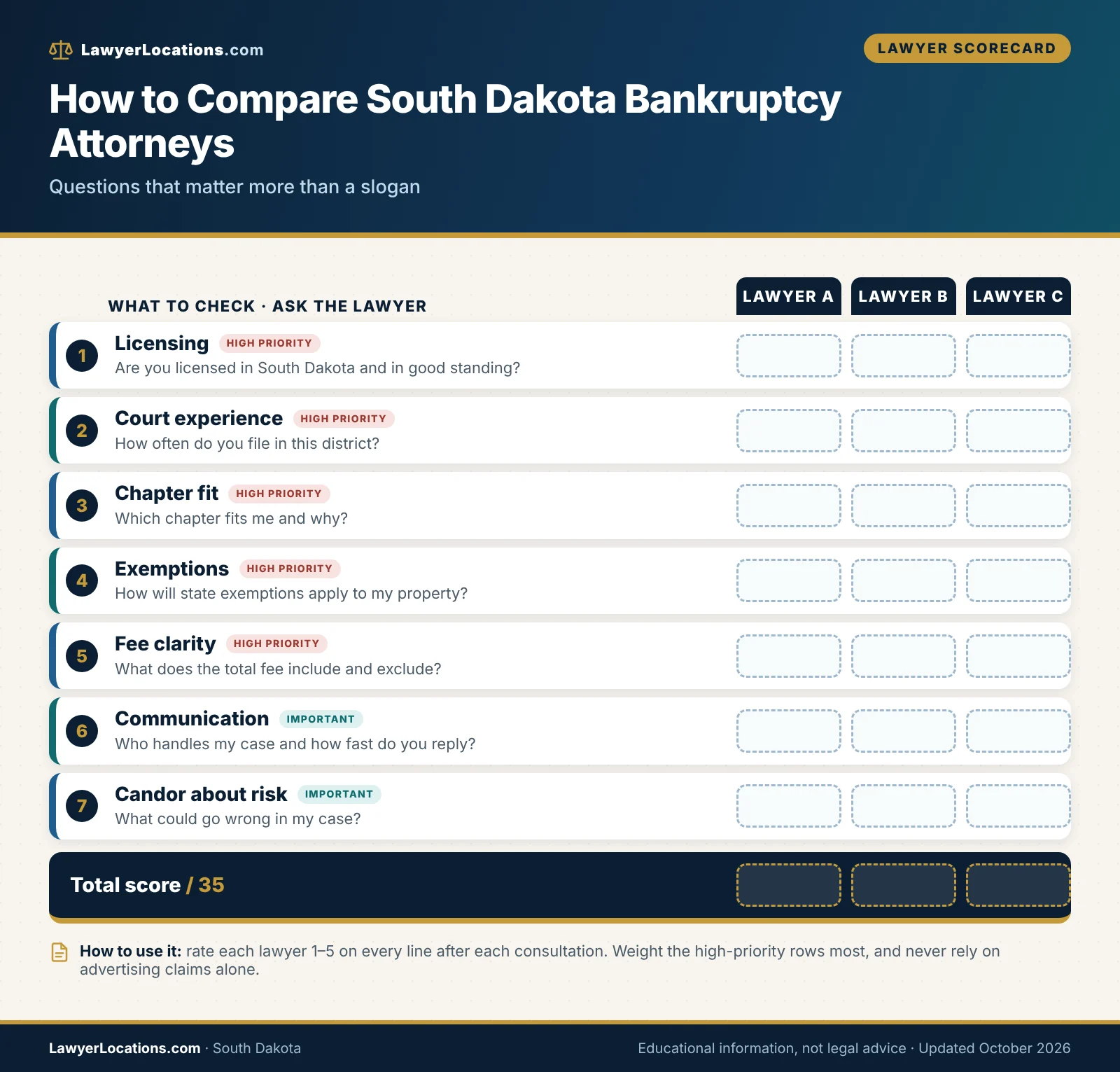
Text version of this graphic
| Criterion | Question to ask |
|---|---|
| Licensing | Are you licensed in South Dakota and in good standing? |
| Court experience | How often do you file in the District of South Dakota? |
| Chapter fit | Which chapter do you suggest for me, and why? |
| Exemptions | How will South Dakota exemptions apply to my property? |
| Fee clarity | What is the total fee, and what is included? |
| Communication | Who will I deal with day to day, and how fast do you reply? |
| Honesty about risk | What could go wrong in my case? |
Questions to ask at the consultation
Questions about your case
Come prepared with a one-page summary of your debts, income, property and any pending lawsuits or garnishments. Then use these questions:
- Which chapter do you think fits my situation, and what are the alternatives?
- How do South Dakota’s exemptions apply to my home, vehicle, tools, accounts and tax refund?
- Do I pass the means test, and which household-size and income figures are you using?
- Will any debts likely survive the bankruptcy, such as support obligations, certain taxes or student loans?
- Do I have any recent transfers, repayments to family or large purchases that you need to address before filing?
- Who is the likely trustee, and what do they usually ask for?
- If a creditor challenges the discharge of a debt, is that handled under the fee or at an extra cost?
Pay attention to how the lawyer responds to uncomfortable facts. A careful lawyer will want to know about a recent transfer or an old tax problem and will explain how to handle it. One who brushes past it may create trouble later.
Questions about fees, service and timing
Bankruptcy fees are often quoted as a package, but packages differ in what they include. Ask for the fee in writing and use these questions:
- What is your total fee for my chapter, and what does it include and exclude?
- How much of the fee is due before filing, and how much can be paid through the case?
- Are the court filing fee, credit counseling and debtor education course costs separate?
- What happens if my case is dismissed or I need to convert to another chapter?
- Who will prepare and review my petition: the attorney, a paralegal or software?
- How quickly can you file if I face a garnishment, a foreclosure sale date or a repossession?
- How will you update me, and who answers if I have a question between meetings?
The lawyer must also disclose compensation to the court. Federal law requires attorneys representing debtors to file a statement of the compensation paid or agreed, which means your fee arrangement becomes part of the court record.
Red flags and green flags
Warning signs when choosing a lawyer
- Pressure to sign immediately or to pay the full fee in cash on the spot without a written agreement.
- Advice to hide, transfer or “park” assets before filing. This can lead to denial of discharge or worse.
- Advice to run up credit cards before you file or to pay one relative ahead of other creditors.
- A reluctance to explain the fee, the court costs or the differences between chapters.
- No clear person to contact, or you never speak with the lawyer who will sign your petition.
Treat these as signals to ask harder questions or look elsewhere. Concealing assets in bankruptcy is serious, and a lawyer who encourages it is putting you at risk for their own convenience.
Signs of a good fit
A good fit looks like clear explanations in plain English, a written fee agreement, a checklist of documents, realistic talk about risks and a plan for the first 30 days. The lawyer asks detailed questions about your finances, explains why each document matters and tells you what you should not do before filing, such as favoring one creditor or transferring property.
You do not need a lawyer who makes you comfortable by minimizing the problem; you need one who makes you informed. If the lawyer’s explanation of South Dakota’s exemptions and the trustee’s role matches what you read in this guide and on the court’s site, that is a good sign. If you feel you must understand more, ask the lawyer to walk you through your own numbers, one asset at a time.
Ask for a sample of the documents you will be asked to provide before you pay anything. A firm that has done this many times will have a standard list and can send it right away.
Costs, deadlines and decision points
Bankruptcy costs fall into two buckets: what you pay the lawyer and what you pay the court and required service providers. Deadlines come from federal law, so they are the same in Sioux Falls and Aberdeen. This section explains both buckets and the timing rules that most often change a decision. Dollar figures for lawyer fees are deliberately not quoted here: they vary by firm and case, and there is no official South Dakota average to cite.
What you pay: the lawyer and the court
How bankruptcy lawyers structure their fees
Most consumer bankruptcy lawyers quote a package price for a given chapter, though some bill hourly for complex or contested matters. The package should be described in a written fee agreement. Federal law requires a debtor’s attorney to disclose the compensation paid or agreed to the court, so the number is not a secret and should not be vague.
| Structure | How it usually works | What to ask |
|---|---|---|
| Package fee, Chapter 7 | One quoted price covering preparation, filing and attendance at the meeting of creditors, often due before filing | What is excluded, such as adversary proceedings, amendments or lien avoidance motions? |
| Fee paid through a Chapter 13 plan | A base fee for plan work, with some or all of it potentially paid through the plan payments | How much is due upfront, how the court and trustee treat the fee, and what happens if the plan fails? |
| Hourly billing | Time charged at an hourly rate, usually for contested or unusual matters | What is the estimate and the cap, and how often will you receive a bill? |
| Reduced-fee or no-fee help | Offered by some legal-aid programs or volunteer lawyers to qualifying debtors | What are the income limits, and which chapters or issues are covered? |
Do not choose a lawyer on price alone. A very low quote that leaves out key services can cost more after add-ons. A higher quote is not automatically better either. Compare what is included, how the firm communicates and whether you understood the explanation of your options.
The court filing fee, installments and waivers
The federal courts’ Chapter 7 overview explains that the filing fee has three components: a case filing fee, a miscellaneous administrative fee and a trustee surcharge. Add them up from the court’s current fee schedule, because amounts are set by federal fee schedules and can change; the District of South Dakota’s schedule is posted on its website, with the version we reviewed listed as effective December 1, 2023.
Individuals can ask the court’s permission to pay in up to four installments, with the final installment due within 120 days of filing. In addition, the court may waive the Chapter 7 fee if your income is below 150 percent of the poverty level and you cannot pay even in installments. Failure to pay the fee can lead to dismissal of the case, so do not treat the installment plan as optional. Mark every due date.
If you pay the filing fee in installments, missing a payment can get your case dismissed and end the protection of the stay. Put each due date in your calendar and tell your lawyer if money gets tight before the date.
Budget separately for the credit counseling course and, later, the debtor education course. Both come from approved providers. Ask each provider about its fee and whether it offers reductions based on ability to pay. Your lawyer should tell you which providers the court accepts, and the U.S. Trustee Program maintains the lists of approved providers.
Timing rules that change your options
Waiting periods between bankruptcy cases
If you have been through bankruptcy before, the Bankruptcy Code limits when you can get a new discharge. Under 11 U.S.C. 727(a)(8), a Chapter 7 discharge is barred if you received a discharge in a Chapter 7 or Chapter 11 case commenced within 8 years before the new petition. Under 11 U.S.C. 727(a)(9), a Chapter 13 discharge in a case commenced within 6 years bars a new Chapter 7 discharge unless the earlier plan paid at least 100 percent of allowed unsecured claims, or at least 70 percent in good faith as your best effort.
Other timing rules apply when the earlier or new case is Chapter 13, and a case dismissed earlier can limit the automatic stay in a new filing. The federal courts also describe a 180-day waiting period after certain dismissals. Because these rules are measured from specific dates, give your lawyer the filing date, chapter and outcome of every prior case.
Do not refile “just to stop a sale” without legal advice. A rushed second filing can bring a short stay or none at all, and may lead to dismissal.
The ordinary clock from counseling to discharge
For a typical Chapter 7 case, the federal courts describe this sequence: credit counseling within 180 days before filing; the meeting of creditors typically 21 to 40 days after filing; and the discharge roughly 60 to 90 days after the date first set for that meeting, if no one objects. Chapter 13 cases take much longer because the plan runs for years and discharge generally follows completion of the plan.
| Milestone | Typical timing | Who acts |
|---|---|---|
| Credit counseling | Within the 180 days before filing | You, with an approved agency |
| Filing and automatic stay | On the day the petition is filed | Your attorney files; the stay arises by law |
| Meeting of creditors (341) | Typically 21 to 40 days after filing | You and the case trustee |
| Means test report | U.S. Trustee reports within 10 days after the 341 meeting if abuse is presumed | U.S. Trustee |
| Discharge | About 60 to 90 days after the date first set for the 341 meeting | The court |
Dates move when a trustee asks for more documents, a creditor files an objection or the court reschedules. Treat the timeline as a range and plan your budget around the longer end.
Choosing between Chapter 7 and Chapter 13
When Chapter 7 tends to fit
Chapter 7 tends to fit when your debts are mostly unsecured (credit cards, medical bills, personal loans), your income is at or below the median for your household size or the means test otherwise allows it, and most of your property is protected by exemptions. It is faster and ends with no multi-year payment plan.
It is less suited to people who are behind on a mortgage and want to keep the house, because Chapter 7 does not by itself give a way to cure missed payments over time. A lawyer can also tell you whether your property fits under South Dakota’s homestead rules and the $7,000 or $5,000 allowance discussed above, since non-exempt property is what a trustee may sell.
When Chapter 13 tends to fit
Chapter 13 tends to fit when you have regular income but cannot qualify for Chapter 7, are behind on secured debts you want to keep, or hold non-exempt property that you would lose in a liquidation. The plan lets you pay what the law requires over three to five years while the stay protects the property. If you do not complete the plan, the case may be dismissed or converted, and creditors can resume collection.
Because plan terms depend on income, expenses and the debts involved, ask your lawyer to model the monthly plan payment before you commit. For a look at how another state’s Chapter 13 market works, see Chapter 13 bankruptcy lawyers in Utah, and for a metropolitan example of fees and consultations, bankruptcy attorney guidance for Boston. Procedures and local customs differ, but the questions to ask are similar.
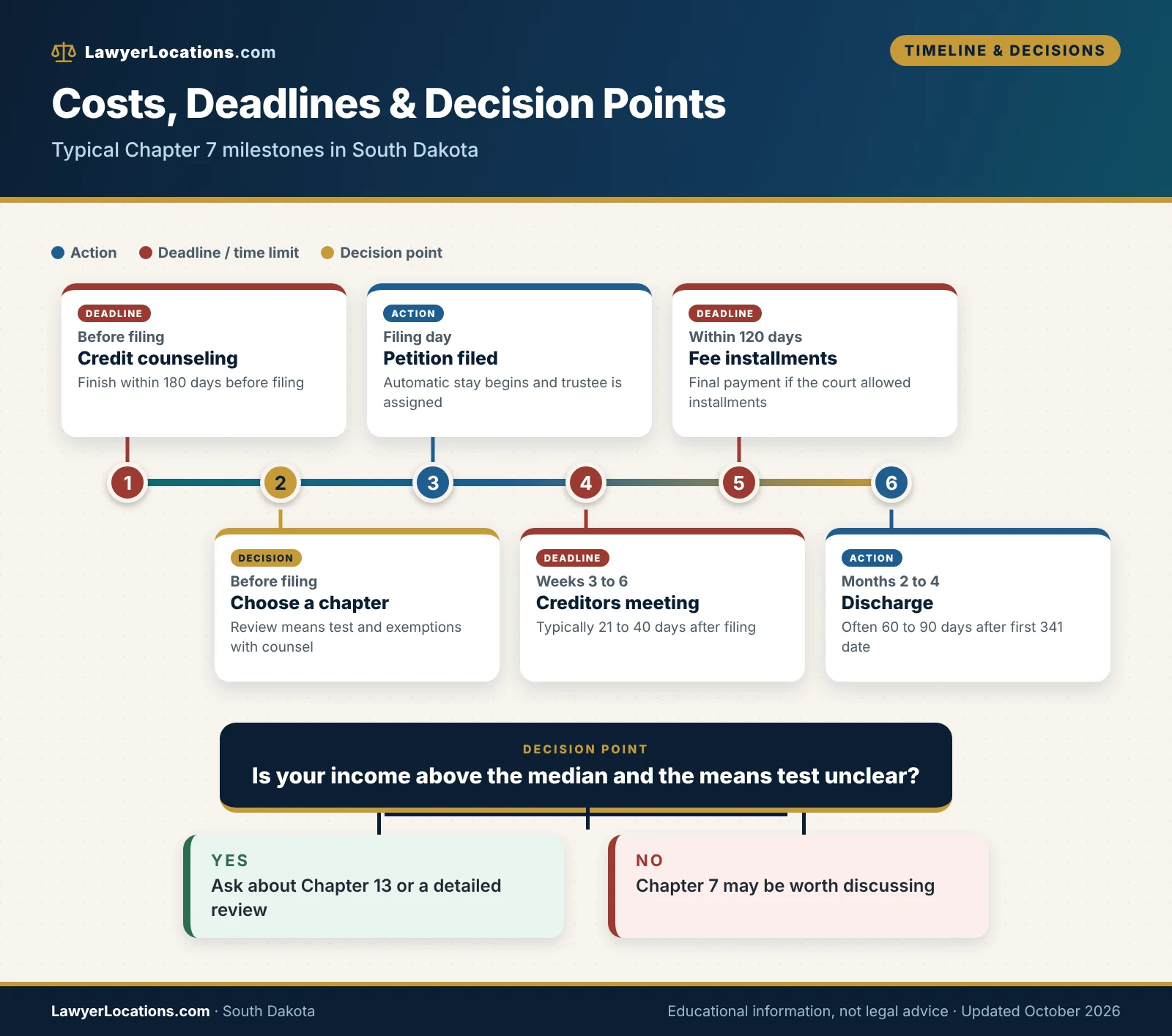
Text version of this graphic
- Before filing: complete credit counseling within the 180-day window and gather records.
- Decision point: pick a chapter with your attorney after the means test and exemption review.
- Filing day: petition filed; the automatic stay begins.
- Weeks 3 to 6: meeting of creditors, typically 21 to 40 days after filing.
- Court fee deadlines: installment payments due within 120 days if the court allowed them.
- About 60 to 90 days after the first 341 date: discharge in many Chapter 7 cases.
- Later: Chapter 13 plan payments continue for years; keep the discharge order.
Decision question: Is your income above the median and the means test unclear? If yes, ask about Chapter 13 or a detailed review; if no, Chapter 7 may be worth discussing.
Getting ready, common mistakes and next steps
Most of the work of a bankruptcy happens before the petition is filed. Preparing well shortens the process, reduces what your lawyer must bill for and lowers the chance of a trustee request that delays the case. This section gives you the documents to gather, the mistakes to avoid and a practical plan for the next 30 days.
Documents and evidence to gather
Income and tax records
Start with proof of what you earn and have earned. Your lawyer will need recent pay stubs or income records for the period the means test covers, plus your most recent tax returns. If you are self-employed, a farm or ranch owner or a seasonal worker, gather profit-and-loss records and account statements that show how income moves through the year. Trustees review these closely.
- Pay stubs or income statements for recent months
- The latest federal tax returns and any notices from the IRS or the South Dakota Department of Revenue
- Bank and credit union statements for all accounts, including savings and online accounts
- Records of benefits, such as Social Security, unemployment or child support received or paid
- For business owners, profit-and-loss statements and business tax records
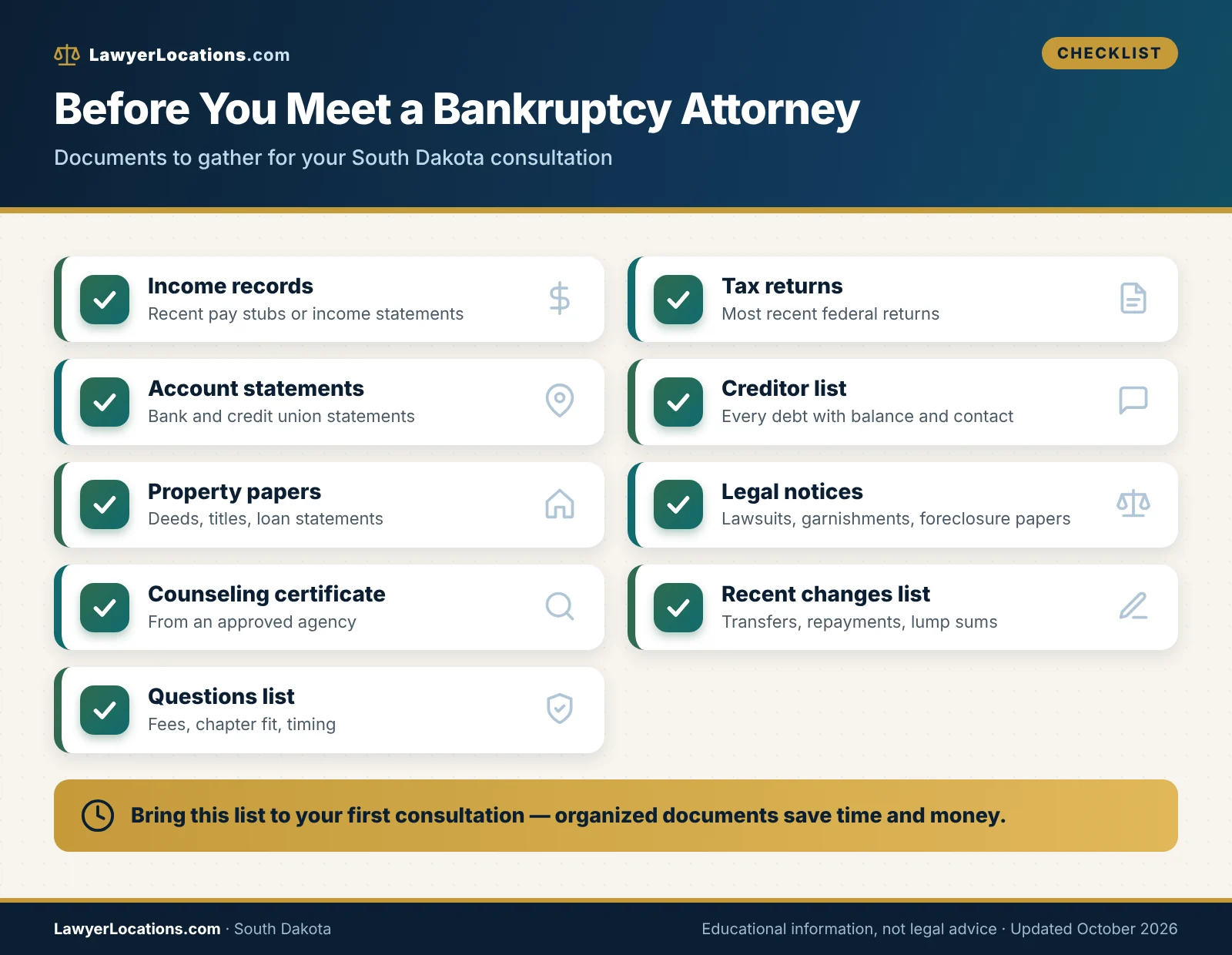
Text version of this graphic
- Recent pay stubs and income records
- Latest tax returns
- Bank and account statements
- List of every creditor with balances
- Mortgage, deed and vehicle titles
- Lawsuit, garnishment or foreclosure papers
- Credit counseling certificate
- Questions list for the consultation
Debts, property and legal papers
List every debt, even small ones and debts to family or friends. Leaving a creditor off the list can leave that debt in place and can cause trouble if the omission looks deliberate. Include the creditor’s name, address, account number if you have it, the balance and whether the debt is secured by property.
For property, gather deeds, mortgage statements, vehicle titles and loan statements, life insurance policies, retirement account statements, and a rough list of household goods, tools, firearms, livestock or equipment with approximate values. Include any court papers: a summons, a judgment, a notice of garnishment or a foreclosure notice. The dates on these papers can decide how fast your lawyer needs to act.
Make a “recent changes” page: anything sold, gifted, repaid to a relative, inherited or received as a lump sum in the past couple of years. Bring it to the first meeting so the lawyer can judge whether any of it matters.
Common mistakes to avoid
Mistakes before filing
- Paying back a relative or a favorite creditor just before filing. A trustee may be able to undo some recent payments.
- Transferring a car, land or cash to someone else to “protect” it. This can lead to losing the discharge.
- Running up credit cards or taking cash advances you know you cannot repay.
- Cashing out a retirement account to pay unsecured debts, turning protected money into exposed money.
- Ignoring a lawsuit summons. A default judgment can lead to a garnishment or lien.
- Estimating the value of your property too low or too high without a basis.
The common thread is acting on instinct before you understand the rules. Make any large payment, sale or transfer only after speaking to a lawyer.
Mistakes after filing
Once you file, the work is not over. Missing the meeting of creditors, failing to send requested documents to the trustee, or leaving out a debt or asset can lead to dismissal or an objection to discharge. Keep your address current with the court and your lawyer, because notices go to the address on file.
Some debts are not wiped out by a standard discharge. The federal courts list examples including alimony and child support, certain taxes, certain education debts, debts from death or injury caused by drunk driving and certain criminal restitution orders. Debts based on false pretenses, fiduciary fraud or willful and malicious injury can be discharged unless a creditor timely sues and wins. Ask your lawyer which of your debts fall into these categories so you are not surprised after the case.
Stay in touch with the lawyer after discharge, too. Keep a copy of the discharge order, check your credit reports for correct reporting and call the lawyer if a creditor tries to collect a discharged debt.
Next steps and quick answers
A practical 30-day plan
- Days 1 to 3: Stop and gather. Read every collection notice, note any court date, and collect the documents listed above. Do not sell or transfer property.
- Days 3 to 10: Compare lawyers. Use the State Bar’s referral service or legal-aid options, speak with two or three lawyers, and ask for fee agreements in writing.
- Days 7 to 14: Counseling. Complete credit counseling with an approved agency and keep the certificate.
- Days 10 to 21: Choose a chapter. Review the means test, exemptions and risks with your lawyer and decide whether to file, wait or pursue an alternative.
- Days 14 to 30: Review and sign. Read the petition and schedules line by line before you sign under penalty of perjury. Confirm the filing fee arrangement and installment dates.
Ready to compare your options?
Use the checklist and scorecard above to speak with two or three South Dakota bankruptcy attorneys, and ask each about fees, the exemptions that apply to your property and how quickly they can file if you face a garnishment or sale date. If cost is a barrier, start with the State Bar’s referral service or the legal-aid programs listed earlier. For wage-related pressure, read our guide on how to stop wage garnishment.
Quick answers to common South Dakota bankruptcy questions
Where do I file bankruptcy in South Dakota?
In the U.S. Bankruptcy Court for the District of South Dakota, which covers the whole state. The clerk’s offices are in Sioux Falls and Pierre; hearings are also held in Rapid City and Aberdeen. Lawyers usually file electronically.
Can I keep my house if I file bankruptcy in South Dakota?
South Dakota’s homestead statutes protect a qualifying homestead within size limits (one acre in a town plat, 160 acres outside one), but mortgages and liens still matter and your facts decide the outcome. A lawyer should review your deed, mortgage and any recent transfers.
Does South Dakota let me choose the federal exemptions?
No. Under SDCL 43-45-13, South Dakota residents cannot use the federal exemption list in 11 U.S.C. 522(d). They use the state’s exemptions, plus federal exemptions that apply outside bankruptcy.
What personal property can I protect?
Items listed as absolutely exempt in SDCL 43-45-2, plus additional property you select up to $7,000 in aggregate value if you are head of a family or $5,000 if not (SDCL 43-45-4). Valuation and categories matter, so list everything with your lawyer.
Can I file bankruptcy without a lawyer in South Dakota?
Yes, individuals may file on their own, and the court’s website has materials for people filing without an attorney. The risks are higher if you own property with equity, have a recent transfer or face a deadline, so many people get at least a consultation.
Are there free or low-cost bankruptcy lawyers in South Dakota?
The court points to the State Bar’s Access to Justice program, East River Legal Services, Dakota Plains Legal Services and South Dakota Law Help as possible sources of low-fee or no-fee help. Eligibility varies, so check each program.
How long does a Chapter 7 case take?
The meeting of creditors is typically 21 to 40 days after filing, and discharge usually comes roughly 60 to 90 days after the date first set for that meeting, unless someone objects. Complications can add time.
Will bankruptcy stop a wage garnishment?
The automatic stay generally pauses most garnishments once the petition is filed, but support orders and some other actions are treated differently. South Dakota’s garnishment statute (SDCL 21-18-51) already limits how much of your disposable earnings a creditor can take.
How soon can I file again after a Chapter 7 discharge?
A new Chapter 7 discharge is barred if the earlier Chapter 7 case was commenced within 8 years before the new petition (11 U.S.C. 727(a)(8)). Other time limits apply for Chapter 13, so share your prior case dates with your lawyer.
Do I have to take a class before I file?
Individuals must complete credit counseling from an approved agency within the 180 days before filing, and later a debtor education course. Your lawyer will tell you which providers to use.
Finding the right bankruptcy attorney in South Dakota is a matter of preparation: know the court, know the exemption rules that apply to your property, compare more than one lawyer and get every fee in writing. That sequence puts you in the best position to make a calm decision rather than a rushed one.
General information only. This article is for general education and is not legal advice. Reading it does not create an attorney-client relationship, and LawyerLocations.com is not a law firm and does not recommend or rank lawyers. Laws, fees, court rules and procedures change, and your facts matter. Consult a lawyer licensed in South Dakota about your situation.
Sources & References
Show all 12 sources
- U.S. Bankruptcy Court, District of South Dakota (home page, court locations, hours) — U.S. Bankruptcy Court for the District of South Dakota — sdb.uscourts.gov — accessed October 2026
- Fee Schedule and Finding an Attorney pages — U.S. Bankruptcy Court for the District of South Dakota — sdb.uscourts.gov — accessed October 2026
- Low-Fee or No-Fee Attorneys — U.S. Bankruptcy Court for the District of South Dakota — sdb.uscourts.gov — accessed October 2026
- Chapter 7 Bankruptcy Basics — Administrative Office of the U.S. Courts — uscourts.gov — accessed October 2026
- Means Testing — U.S. Trustee Program, Department of Justice — justice.gov — accessed October 2026
- U.S. Trustee Regions and Offices — U.S. Trustee Program, Department of Justice — justice.gov — accessed October 2026
- SDCL 43-45-2, 43-45-3, 43-45-4, 43-45-13, 43-45-14 (exemptions) — South Dakota Codified Laws, as reproduced by Justia — law.justia.com — accessed October 2026
- SDCL Chapter 43-45 index — South Dakota Legislature — sdlegislature.gov — accessed October 2026
- SDCL 43-31-1 and 43-31-4 (homestead) — South Dakota Codified Laws, as reproduced by Justia — law.justia.com — accessed October 2026
- SDCL 21-18-51 (garnishment limits) — South Dakota Codified Laws, as reproduced by Justia — law.justia.com — accessed October 2026
- 11 U.S.C. 727 (discharge) — Legal Information Institute, Cornell Law School — law.cornell.edu — accessed October 2026
- South Dakota Bankruptcy Homestead Exemption — Nolo — nolo.com — accessed October 2026
Legal Disclaimer and Limitation of Liability
Informational and illustrative purposes only. This article was prepared by LawyerLocations.com solely on the basis of the information available to us at the time of writing. It is an illustrative, general overview. It is not a complete or authoritative statement of the law, and it has not been reviewed by a lawyer licensed in your state or county.
Not legal advice. Nothing in this article is legal, financial, tax or immigration advice, and reading it does not create an attorney-client relationship between you and LawyerLocations.com or any author, lawyer or firm mentioned. Laws, court rules, fees, filing deadlines and agency procedures differ by state, county and court, and they change often. Some details here may be simplified, incomplete or out of date, and time limits for legal claims can be short.
No warranty. We make no representation or warranty, express or implied, about the accuracy, completeness, timeliness or suitability of this content for your situation. Please do not rely on it to make, delay or skip any legal decision. Check the facts against official sources and speak with a licensed attorney in the relevant jurisdiction before you act.
Limitation of liability. To the fullest extent permitted by law, LawyerLocations.com and its owners, authors and contributors disclaim all liability for any loss, damage, cost or other consequence arising from the use of, or reliance on, this article, including any content on third-party websites we link to. Mentioning a lawyer, firm, organization or service is not an endorsement and is not a promise of any result. If you are in immediate danger, contact your local emergency number.
