

Choosing an estate planning attorney Wisconsin residents can work with comes down to three things: what your family and property look like, how the lawyer charges, and whether the documents will be signed and stored correctly under Wisconsin law. A basic plan usually means a will, a financial power of attorney and a health care power of attorney, and many families add a revocable trust. Wisconsin is a marital property state, has no state estate tax, and sets its own signing rules for each document.
This guide explains the Wisconsin statutes that matter, how fees and written fee agreements work, how to verify a license, which questions to ask, and where free or low-cost help exists. It is general legal information, not advice for your situation.
What an Estate Planning Attorney in Wisconsin Does and When You Need One
An estate planning attorney in Wisconsin drafts and coordinates the documents that decide who manages your money and health decisions if you cannot, and who receives your property when you die. Most people need at least three core documents, and the lawyer’s real value is making sure those documents work together and are signed the way Wisconsin law expects. This section explains the documents, the incapacity side of planning, and how to decide between a lawyer and do-it-yourself forms.
The documents most Wisconsin plans include
A complete plan is a set of documents that each do one job. Understanding what each one does, and what it cannot do, makes it much easier to judge what a lawyer is quoting you for.
Wills and what they control
A will is a signed document that names who receives property you own in your own name at death, names a personal representative (the person who manages your estate, called an executor in many states), and can nominate guardians for minor children. A will generally goes through the court-supervised process called probate. It does not control assets that pass by beneficiary designation, joint ownership with survivorship, or trust terms.
In Wisconsin, the will must meet the signing formalities in Wis. Stat. 853.03, covered in detail in the next section. A well-drafted will also includes a backup plan if a beneficiary dies first, because an unplanned gap is one of the most common sources of family disputes.
Revocable living trusts
A revocable living trust is a written arrangement in which you (the settlor) transfer assets to a trustee, usually yourself while you are healthy, to be managed for you and then paid out to beneficiaries under terms you set. Wisconsin’s trust code lists several ways to create a trust, including a transfer of property to a trustee and a declaration by an owner that they hold identifiable property as trustee (Wis. Stat. 701.0401).
The main practical draw is that assets properly titled in the trust usually avoid the probate process, and a successor trustee can step in if you become incapacitated. The trade-off is that the trust must actually be funded. Our overview of what a living trust lawyer does walks through that decision in more depth.
| Document | What it does | What it does not do |
|---|---|---|
| Will | Names beneficiaries for property in your sole name, names a personal representative, can nominate guardians for minor children | Does not control beneficiary-designated accounts, survivorship property or trust assets; generally goes through probate |
| Revocable living trust | Holds titled assets for your benefit now and for beneficiaries later; names a successor trustee for incapacity or death | Does not work for assets never retitled into it; does not by itself shield assets from long-term care costs |
| Financial power of attorney | Lets a named agent handle money and property matters while you are alive | Ends at death; does not decide who inherits |
| Health care power of attorney | Names an agent to make medical decisions if you cannot | Does not manage finances; has its own witness rules |
| Declaration to health care professionals (living will) | States your wishes about life-sustaining treatment in terminal or persistent vegetative conditions | Does not appoint an agent; does not apply to other conditions |
| Beneficiary designations and transfer on death | Moves retirement accounts, life insurance, bank accounts and (if recorded) real estate directly to named people | Overrides your will for those assets, so mismatches create conflict |
Ask any lawyer you interview to show you, in one page, how each of your assets will pass: by will, by trust, by beneficiary designation, or by survivorship. If the lawyer cannot sketch that map in the first meeting, the plan may be built on guesses.
Planning for incapacity, not just death
Many Wisconsin families discover the cost of poor planning during a medical crisis, not after a death. Two separate documents cover incapacity, and each has its own statutory rules.
Financial power of attorney
A power of attorney for finances gives a chosen agent authority over specified money matters. Under Wis. Stat. 244.04, a Wisconsin power of attorney is durable (it keeps working if you become incapacitated) unless the document expressly says that incapacity terminates it. The agent has a fiduciary duty, which means a legal obligation to act in your interest and keep records.
Section 244.05 covers how the document is signed: the principal signs, and a notarized acknowledgment makes the signature presumed genuine. The scope of the agent’s authority, such as gifting, real estate and digital accounts, is where careful drafting matters most, so ask the lawyer how broad the powers are and who can watch the agent.
Health care power of attorney and living will
A health care power of attorney names a person to make medical decisions for you if you cannot. Wisconsin’s statutory form is in Wis. Stat. 155.30, and it uses two witnesses who must meet strict qualifications: each must be at least 18, not related to you by blood, marriage or adoption, not your domestic partner, not directly financially responsible for your care, not your health care provider or an employee of one (with exceptions for chaplains and social workers), not your agent, and without a known claim on your estate.
A separate declaration to health care professionals (often called a living will) under Wis. Stat. 154.03 records your treatment wishes for terminal conditions or a persistent vegetative state, and requires two witnesses with similar qualifications. Picking witnesses who qualify is a detail lawyers handle routinely and DIY signers often miss.
Do you need a lawyer or will forms do?
You do not need a lawyer to make a will in Wisconsin, but the rules are technical and the cost of an error usually shows up years later, when you cannot fix it. The fair question is whether your situation is simple enough that a form is a reasonable risk.
Situations that often fit simple documents
Forms or a limited-scope consultation may be reasonable when you are single or married with straightforward finances, own few assets outside accounts that already have beneficiaries, have adult children you trust, and have no disputes in the family. Even then, a one-time review by a lawyer can catch signing errors, which are the most preventable failures.
If you go the form route, follow the signing instructions to the letter, use witnesses who are not beneficiaries, and review the documents against your beneficiary designations. The State Bar’s referral program discussed later in this guide lets you book a short, price-capped consult to review what you have drafted.
Situations where a lawyer is usually worth the cost
A lawyer is usually worth the cost when you are in a second marriage or blended family, own a business or farmland, have a child with special needs or a beneficiary who receives public benefits, own property in several states, expect your estate to approach the federal exclusion, worry about long-term care costs, or anticipate a family conflict.
Wisconsin’s marital property rules add another reason, because the way a couple’s property is classified affects what each spouse can leave by will. If any of those descriptions fits, plan on at least an initial consultation, and read the sections below on fees and vetting before you call.
Wisconsin Law That Shapes Your Estate Plan
Wisconsin’s estate planning rules come from state statutes on marital property, wills, trusts, powers of attorney and health care directives, layered over federal tax law. Knowing the outline helps you see why a generic national form can miss local requirements. Statute summaries below reflect the published text available in October 2026; confirm the current wording of any section before relying on it.
Marital property and what it means for couples
Wisconsin is one of a small group of states that follows a community-style system called marital property. It affects married couples more than any other single feature of state law.
How Wisconsin treats property of married couples
Chapter 766 of the Wisconsin Statutes, titled “Property rights of married persons; marital property,” classifies spouses’ property (see Wis. Stat. 766.31, “Classification of property of spouses”) and allows spouses to change the default classification with a written marital property agreement (Wis. Stat. 766.58). In general terms, property acquired by either spouse during the marriage is presumed to be marital property in which each spouse holds an equal interest, while certain gifts, inheritances and pre-marriage property can be individual property.
Because the details of classification turn on facts like when and how property was acquired and whether it was mixed together, a lawyer should review your actual accounts and deeds rather than rely on a rule of thumb.
Why classification matters for wills, trusts and second marriages
Your will can generally dispose of your own share of marital property and your individual property, not your spouse’s share. In a second marriage, that distinction decides how much you can leave to children from an earlier relationship, and it can collide with a surviving spouse’s rights.
A marital property agreement, a trust, or a coordinated set of beneficiary designations can reduce surprises. If you are separating or divorcing, read our guide to legal separation versus divorce and update your documents promptly, since your old plan can name a spouse in ways you no longer intend.
A lawyer who gives you a Wisconsin plan without asking whether you are married, when you married, and how your major assets are titled has skipped the question that most affects a Wisconsin estate plan.
Formalities for wills, trusts and powers of attorney
Each Wisconsin estate planning document has its own signing rule. Getting those details wrong is how otherwise sensible plans get challenged.
Signing a valid will
Under Wis. Stat. 853.03, a will must be in writing and signed by the testator (or by another person at the testator’s direction and in the testator’s conscious presence). At least two witnesses must sign within a reasonable time after observing the signing or the testator’s acknowledgment of the will, in the testator’s conscious presence. Wisconsin also permits remote witnessing by real-time audiovisual technology, but only under supervision of a Wisconsin-licensed attorney, with the parties physically in Wisconsin, identity confirmation, and an attorney’s affidavit of compliance attached.
A self-proved will under Wis. Stat. 853.04 adds a sworn affidavit from the testator and witnesses before an authorized officer, which can simplify proving the will later. The statute provides a one-step method (done at signing) and a two-step method (added afterward). The attorney’s affidavit for a remote signing counts as a self-proving affidavit.
Powers of attorney, health care documents and trusts
For a financial power of attorney, Wis. Stat. 244.05 requires the principal’s signature and gives a presumption of genuineness to a notarized acknowledgment; it also describes a two-witness remote route supervised by a Wisconsin attorney. The health care power of attorney and the living-will declaration each require two qualified witnesses (155.30 and 154.03), and the remote signing option for the declaration also needs a Wisconsin-licensed supervising attorney.
A trust can be created by several methods under Wis. Stat. 701.0401, but a trust that never receives assets accomplishes little. The table below collects these provisions in one place for quick comparison.
| Topic | Statute | What the text addresses | Practical effect |
|---|---|---|---|
| Will signing | Wis. Stat. 853.03 | Writing, testator signature, two witnesses in conscious presence, attorney-supervised remote witnessing | Follow the witness steps exactly; remote signing is limited to Wisconsin-based parties with an attorney |
| Self-proved will | Wis. Stat. 853.04 | One-step and two-step sworn affidavits before an authorized officer | Can make later proof of the will easier |
| Trust creation | Wis. Stat. 701.0401 | Transfer to a trustee, owner declaration, other listed methods | Funding the trust is still your job |
| Financial power of attorney, durability | Wis. Stat. 244.04 | Durable unless the document expressly says incapacity terminates it | Review whether the document says anything unusual |
| Financial power of attorney, signing | Wis. Stat. 244.05 | Principal signs; notarized acknowledgment presumed genuine; attorney-supervised remote witnessing | Many people notarize so institutions accept it more readily |
| Health care power of attorney | Wis. Stat. 155.30 | Department form, two qualified witnesses | Witness choice matters |
| Declaration to health care professionals | Wis. Stat. 154.03 | Two qualified witnesses; takes effect on execution | Tell your doctors and keep copies in your medical record |
| Transfer on death for real estate | Wis. Stat. 705.15 | Recorded designation naming a beneficiary | Must be recorded before the owner’s death |
Taxes and transfer-on-death tools
Tax law shapes plans for a smaller group of families than people fear, but the numbers are worth knowing as of October 2026.
Estate tax: federal exposure, no Wisconsin tax
The Wisconsin Department of Revenue states that there is no Wisconsin estate tax for decedents dying after December 31, 2007, and no Wisconsin inheritance tax for decedents dying on or after January 1, 1992. At the federal level, the IRS lists a basic exclusion amount of $15,000,000 for people who die in 2026, and an annual gift tax exclusion of $19,000 per recipient for 2026 gifts.
Most Wisconsin families will not owe federal estate tax, so their planning focus is control, probate avoidance, incapacity and family fairness. Federal figures can change by legislation and inflation adjustments, so ask the lawyer which figures they are using and why.
Transfer on death property and beneficiary designations
Wisconsin lets an owner designate a beneficiary for real property under Wis. Stat. 705.15. The designation must name the owner, the beneficiary and state that the transfer takes effect only at death, and it is not effective unless it is submitted with recording fees to the register of deeds in the county where the property sits before the owner’s death. If the property is marital property, both spouses with an interest must sign. The owner can change or cancel the designation without the beneficiary’s consent by recording a new document, and the capacity needed matches the capacity to make a will.
Because these designations override a will, a lawyer should coordinate them with the rest of your plan. A recorded designation naming one child will quietly defeat a will that says “equal shares.”
A widowed Wisconsin homeowner signs a will leaving everything equally to her three children, then records a transfer on death designation naming only her oldest child. At death, the home passes to the oldest child under the recorded designation, regardless of the will. The fix is coordination at signing, not litigation later.
How an Estate Planning Engagement Works, Step by Step
Hiring an estate planning attorney in Wisconsin usually moves through intake, drafting, signing and follow-through, and most of the mistakes happen at the handoffs between those stages. Knowing the sequence helps you prepare, ask for timelines, and spot a process that is skipping steps. Exact timing varies with the lawyer’s workload and how complicated your family and assets are, so ask for a written estimate of each stage.
Intake: from first call to engagement letter
The intake stage decides whether a lawyer is a fit and what the work will include. It is also the stage where fee terms should be put on paper.
The first call and conflict check
Most offices start with a short call or form to learn your county, your family structure and what you want done. The office should run a conflict check, a screening to make sure the firm does not already represent someone whose interests clash with yours, such as a relative who is contesting a parent’s plan. If you are a couple, ask whether the lawyer will represent you jointly and how the firm handles information one spouse shares that the other does not.
Expect the office to ask for basic facts rather than legal advice over the phone. Anything you tell a prospective lawyer while seeking representation is generally treated as confidential, but reading this guide or contacting LawyerLocations does not create an attorney-client relationship.
The engagement letter and scope of work
Before drafting starts, you should receive a written description of what the lawyer will do and how you will be charged. Wisconsin’s professional conduct rule on fees, SCR 20:1.5, requires the scope of the representation and the basis or rate of the fee to be communicated in writing, with an exception for modest matters where the total cost is reasonably foreseeable to be $1,000 or less.
Read the letter for four things: which documents are included, how many revisions are covered, who does the signing logistics, and whether post-signing items such as trust funding or beneficiary updates are in or out of the price.
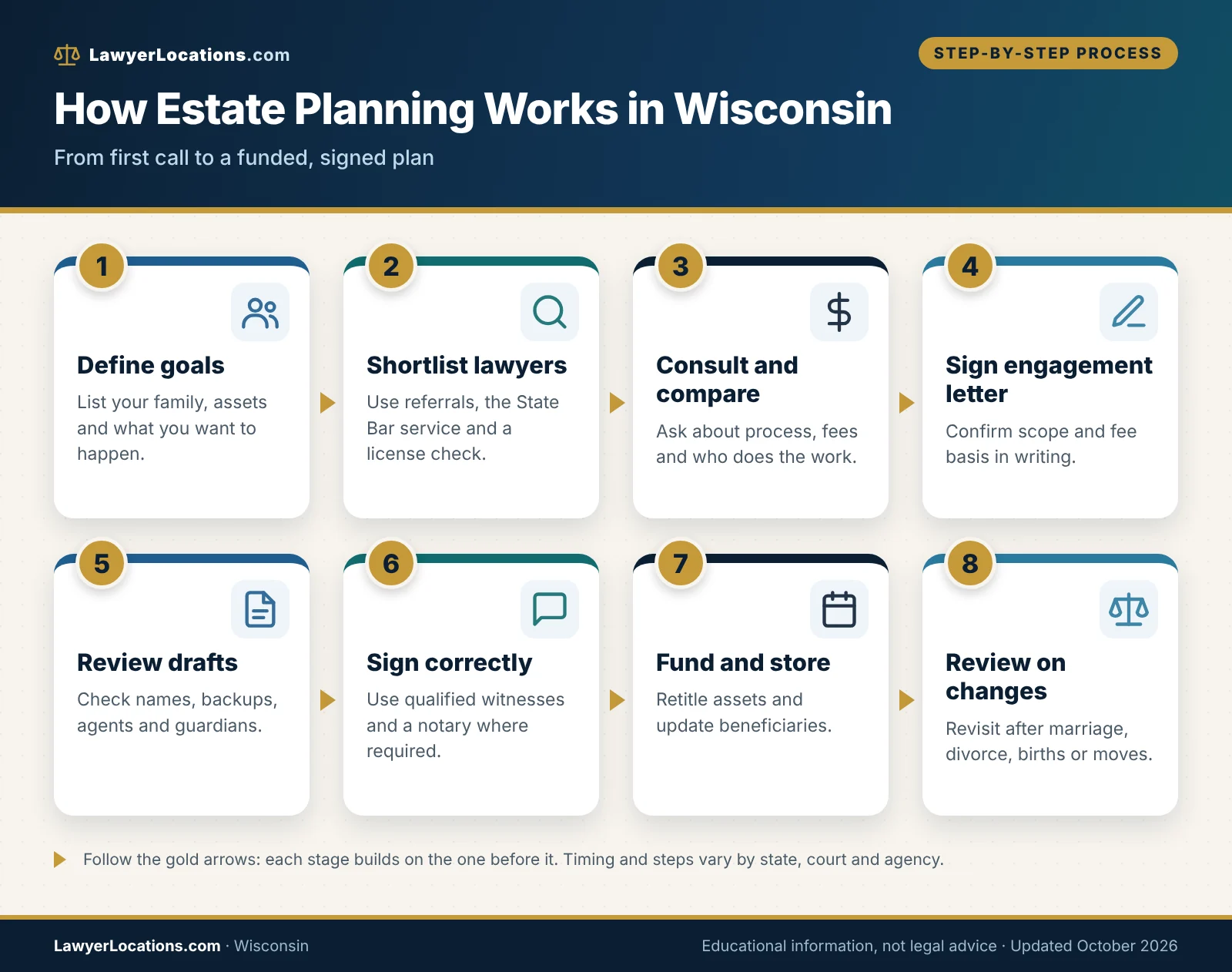
Text version of this graphic
- Define goals. List your family, your assets and what you want to happen.
- Shortlist lawyers. Use referrals, the State Bar service and a license check.
- Consult and compare. Ask about process, fees and who does the work.
- Sign an engagement letter. Confirm scope, fee basis and revisions in writing.
- Review drafts. Check names, backups, agents and guardians line by line.
- Sign correctly. Use qualified witnesses and a notary where the document calls for one.
- Fund and store. Retitle assets, update beneficiaries, and tell your agents where the originals are.
- Review on life changes. Revisit the plan after marriage, divorce, births, deaths or moves.
Drafting and review
Drafts are where your decisions become language. A lawyer’s questions at this stage should force you to confront choices you may have avoided.
Decisions the drafts will force you to make
Expect to choose a personal representative, a trustee and successor trustee, agents under the financial and health care powers of attorney, and guardians for any minor children, plus backups for each. You will decide how and when beneficiaries receive property, whether young or financially inexperienced heirs get outright gifts or trust-managed distributions, and what happens if a beneficiary dies first.
Take time on these choices. People often name the oldest child by default, then realize that child lives far away, dislikes paperwork, or would clash with siblings. A good lawyer will ask about family dynamics and explain the duties of each role before you commit.
How to review a draft effectively
Read every document aloud with a pen. Confirm the spelling of every name, the relationship labels, the order of backup choices, and the dollar amounts or percentages. Check that your agents are the people you intend and that the document authorizes only the powers you are comfortable granting.
Ask the lawyer to summarize the plan in plain language and to explain any clause you do not understand. If the plan includes a trust, ask for a list of assets to be titled in it, so you can tick them off later. Return corrections in writing so there is a record of what changed.
Ask for a one-page summary showing each person named in the plan and what role they hold. Seeing “agent,” “trustee,” “guardian” and “personal representative” side by side makes overlaps and gaps obvious.
Signing, funding and storing
A perfectly drafted plan fails if it is signed incorrectly or never put into effect. This stage is where lawyers earn trust, and where DIY plans most often stumble.
The signing meeting
For a will, Wisconsin requires the testator’s signature and at least two witnesses who sign after observing the signing or acknowledgment in the testator’s conscious presence (Wis. Stat. 853.03). Witnesses should be adults who are not beneficiaries, and a notary can supervise a self-proving affidavit under Wis. Stat. 853.04. The health care documents have their own witness lists, described earlier.
If you cannot attend in person, Wisconsin law allows attorney-supervised remote signing for some documents, but the parties must be physically in Wisconsin and the attorney completes an affidavit. Ask the lawyer how they handle original documents, who holds them after signing, and whether the firm keeps copies.
Funding the plan and storing the originals
Funding means making your plan operate on real assets. For a revocable trust, that means retitling accounts and deeds into the trust and updating beneficiary designations where appropriate. For transfer on death real estate, the designation must be recorded with the county register of deeds before death (Wis. Stat. 705.15). For retirement accounts and life insurance, it means updating beneficiary forms with the institution.
Store originals where your personal representative or agent can reach them, and tell those people where they are. Many families keep a locked fireproof box, or leave originals with the lawyer’s office. Avoid a safe deposit box no one else can open without a court order.
| Stage | What happens | What you bring or decide | Ask the lawyer |
|---|---|---|---|
| Intake | Call, conflict check, consultation | Family facts, asset overview, goals | How do you charge, and what is in scope? |
| Engagement | Written scope and fee terms signed | Questions about fees and revisions | What happens if my plans change mid-drafting? |
| Drafting | Lawyer prepares documents | Names for agents, trustees, guardians and backups | Can you summarize the plan in plain language? |
| Review | You mark corrections | Written feedback on every document | How many revision rounds are included? |
| Signing | Witnesses and notary, as each document requires | Qualified witnesses or the firm’s staff | Which documents will be self-proved? |
| Funding | Retitle assets, update beneficiaries, record any TOD deeds | Account statements, deeds, beneficiary forms | Is funding included or extra? |
| Maintenance | Periodic review and life-event updates | A reminder date and contact list | What does a review cost? |
What an Estate Planning Attorney Costs in Wisconsin
Estate planning costs in Wisconsin vary widely by lawyer, county and complexity, and this guide does not quote a statewide average, so treat any single number you read online with caution. What you can control is knowing how the lawyer charges, getting the terms in writing, and asking what is not included. This section covers common fee structures, the Wisconsin fee rule, and the factors that move the price.
Common fee structures
Most estate planning lawyers use either a quoted flat fee for a defined package or hourly billing. Each has benefits and risks, and many firms combine them.
Flat fee packages
A flat fee is a set price for a defined bundle of work, such as a will, financial and health care powers of attorney, and a living will. It gives you cost certainty, which suits straightforward plans. The risk is scope creep: if your situation turns out to be more complex than the package assumes, the lawyer may quote additional fees or recommend a higher-tier package.
Ask what is included (number of documents, revisions, signing meeting, funding help), what triggers extra charges, and whether any advance payment is held in a trust account until earned. A clear written scope protects both sides.
Hourly billing and retainers
Hourly billing charges for time spent, and it often applies to complicated plans, trust administration or consultations that do not result in documents. Lawyers may require a retainer, an advance payment held against future work. You should understand the hourly rates of everyone who will work on your file, how often you will be billed, and whether you will receive itemized statements.
Hourly billing rewards efficiency on your side: bring organized documents, send questions in batches, and ask for a not-to-exceed estimate for each phase. If the lawyer will not estimate at all, consider that a signal about how the relationship will go.
| Structure | How it works | Fits best | Watch for |
|---|---|---|---|
| Flat fee | One price for a defined package | Standard plans for individuals or couples | Exclusions, add-on charges, upgrades mid-engagement |
| Hourly | Time billed at stated rates | Complex or uncertain scope | Open-ended totals; ask for phase estimates |
| Hybrid | Flat fee for core documents, hourly for extras | Plans with a trust or special circumstances | What counts as “extra” |
| Limited-scope consult | Paid review or advice only | Reviewing DIY documents or one question | Make sure you understand what the lawyer is not doing |
| Subscription or maintenance plan | Recurring fee for updates | People who want periodic reviews | Cancellation terms and what is covered |
What Wisconsin’s fee rule requires
Wisconsin lawyers are bound by the Rules of Professional Conduct adopted by the Wisconsin Supreme Court. The fee rule gives you concrete rights you can ask a lawyer to honor.
Written fee communication
SCR 20:1.5(b) requires that the scope of the representation and the basis or rate of the fee and expenses be communicated to the client in writing, before or within a reasonable time after the representation begins. Any later change in the basis or rate of the fee or expenses must also be communicated in writing. The rule recognizes that for a small matter whose total cost is reasonably foreseeable to be $1,000 or less, an oral explanation may be enough.
In practice, ask for a written fee agreement every time. If the lawyer’s total charge will exceed $1,000, the rule also requires the purpose and effect of any retainer or advance fee to be communicated in writing.
Advance fees, trust accounts and refunds
Under the same rule, unearned fees and funds a client advances for fees must be held in trust until earned, and funds advanced for costs are held in trust until the costs are incurred (SCR 20:1.5(f)). Subsection (g) provides an alternative to depositing advance fees in trust, which requires written notice to the client covering the amount, the fee basis, expenses, the refund obligation, arbitration, and the Wisconsin Lawyers’ Fund for Client Protection. On termination, the client is entitled to a refund of any unearned advanced fees and costs.
If you change your mind about hiring a lawyer, the refund provision is your protection. Ask the lawyer how advance payments are handled before you pay.
Get the fee terms in writing before or promptly after the work begins. If the fee basis changes midway, Wisconsin’s rule expects that change to be communicated in writing too, so do not accept a verbal “that will cost extra” without a follow-up email or letter.
What moves the price and how to control it
Cost is mostly a function of complexity, document count and how organized you are when you arrive.
Factors that push cost up or down
Plans cost more when they include trusts, multiple properties, business interests, blended-family provisions, special-needs planning, or tax planning for large estates. They cost less when assets are simple, beneficiaries are clear, and you arrive organized. The type of lawyer’s office also matters, as does the county you live in, and none of these effects can be summarized with a verified Wisconsin average. Compare written quotes for the same scope.
| Factor | Tends to raise cost | Tends to lower cost |
|---|---|---|
| Documents | Trusts, multiple trusts, special-needs trusts | Will plus powers of attorney only |
| Family | Blended family, estranged heirs, dependent adults | Clear, cooperative beneficiaries |
| Assets | Business, farmland, out-of-state property | Accounts with beneficiary designations |
| Preparation | Missing records, repeated changes | Organized asset list and decisions made in advance |
| Services | Funding help, deed work, tax planning | Drafting only |
| Follow-up | Periodic reviews, ongoing availability | One-time delivery |
Keeping costs reasonable without cutting corners
Bring a one-page asset list, beneficiary decisions, and a list of agents with backups. Ask the lawyer to quote in phases so you can stop after the core documents if budget is tight. A modest plan done correctly is better than a sprawling plan that never gets signed.
The State Bar of Wisconsin Lawyer Referral Service caps the first 30-minute consultation at $20 for referred clients, and the Milwaukee Bar Association’s service lists a first half-hour at $20 or less. Work beyond the first consultation is billed at the lawyer’s regular rates. Use that consultation to ask about the cost of the full plan, not to receive a complete legal analysis.
How to Find and Vet an Estate Planning Attorney in Wisconsin
The most reliable way to find an estate planning attorney in Wisconsin is to combine two or three sources, such as a referral from someone who used the lawyer for a similar plan, the State Bar’s referral service, and your own research, then verify the license and compare written fee terms. LawyerLocations does not rank or recommend individual lawyers, so this section focuses on a method you can apply to anyone you consider.
Where to look for candidates
No single source is complete. Each gives you something different, and it helps to know what.
The State Bar of Wisconsin Lawyer Referral Service
The State Bar’s Lawyer Referral Service is a structured way to find a lawyer who handles your type of issue in your area. You can call (800) 362-9082 or (608) 257-4666 on weekdays from 8 a.m. to 5 p.m. A legal assistant, who does not give legal advice, talks through your situation and, if you need a lawyer, refers you to one. According to the State Bar, referred lawyers agree to cap the first 30-minute consultation at $20, and anything after that is billed at the lawyer’s regular rates.
The phone referral is free. An online version is available around the clock with a separate non-refundable payment shown on the State Bar’s page. When you contact the lawyer, mention that you were referred by the service to get the capped consultation rate.
Other routes: local bar services, referrals and your own network
The Milwaukee Bar Association runs its own lawyer referral service, listed by the Wisconsin State Law Library with a first half-hour at $20 or less. Many counties and communities also have local bar associations that can point you to members. Ask friends, financial advisors, accountants and trusted professionals who have seen estate plans work, and ask what they liked about the process, not just the result.
If you use search engines, treat results as a starting list, not a quality ranking. Advertising and review volume do not measure legal skill, so the checks in the next subsection matter even more.
| Source | What it offers | Cost or limits | Notes |
|---|---|---|---|
| State Bar of Wisconsin Lawyer Referral Service | Phone and online referral to a lawyer in your area for your issue | Referred first 30-minute consultation capped at $20; online service has a separate non-refundable payment | Mention the referral when you contact the lawyer |
| Milwaukee Bar Association referral service | Referrals in the Milwaukee area | First half-hour $20 or less per the State Law Library listing | Confirm current terms with the service |
| Personal referrals | Experience from people with similar situations | Free | Ask what the plan covered and how communication went |
| Wisconsin Court System lawyer status search | License status and discipline history | Free | Verifies a name; does not recommend anyone |
| Free Legal Answers Wisconsin (ABA) | Volunteer attorneys may answer questions submitted online | Free for Wisconsin residents who qualify | A starting point for questions, not a full plan |
| State Bar Modest Means Program | For people whose income is too high for free services but too low for a standard rate | Eligibility rules apply | Ask the State Bar for current details |
Verifying a Wisconsin license and discipline history
Verification takes five minutes and filters out most problems before you spend money.
Using the Wisconsin Court System lawyer lookup
The Wisconsin Court System provides a “Search lawyer status and history” tool at lawyerhistory.wicourts.gov, tied to the Office of Lawyer Regulation, which oversees lawyer discipline. Search the lawyer’s name and confirm that the license is active, that the name matches the firm’s website, and that any public discipline is something you can evaluate.
Also confirm that the lawyer you speak with is the one who will actually do the work. In many firms, paralegals or associates handle drafting, and that can be perfectly fine if the supervising lawyer reviews and signs off.
Reading what you find sensibly
A clean record does not prove skill, and a disciplinary entry does not automatically disqualify a lawyer. Read what the entry says: Is it about trust account handling, neglect, or communication? Is it recent? Does it relate to estate work? The Court System also links to a professional discipline compendium for details.
Be wary of any lawyer who claims a special credential without explaining the basis. Lawyers can describe their practice areas truthfully, but ask for specifics: how many wills and trusts they draft in a typical year, and what share of their work is estate planning.
Comparing candidates fairly
Comparing two or three lawyers using the same questions produces a better decision than picking the first firm that answers the phone.
A simple scorecard
Score each candidate from one to five on the same criteria: relevant experience with plans like yours, clarity about process, transparent fees and written terms, responsiveness, who does the work, coordination with your financial advisor or accountant, and your comfort level. Weigh fee clarity and process heavily, because those predict how the engagement will feel.
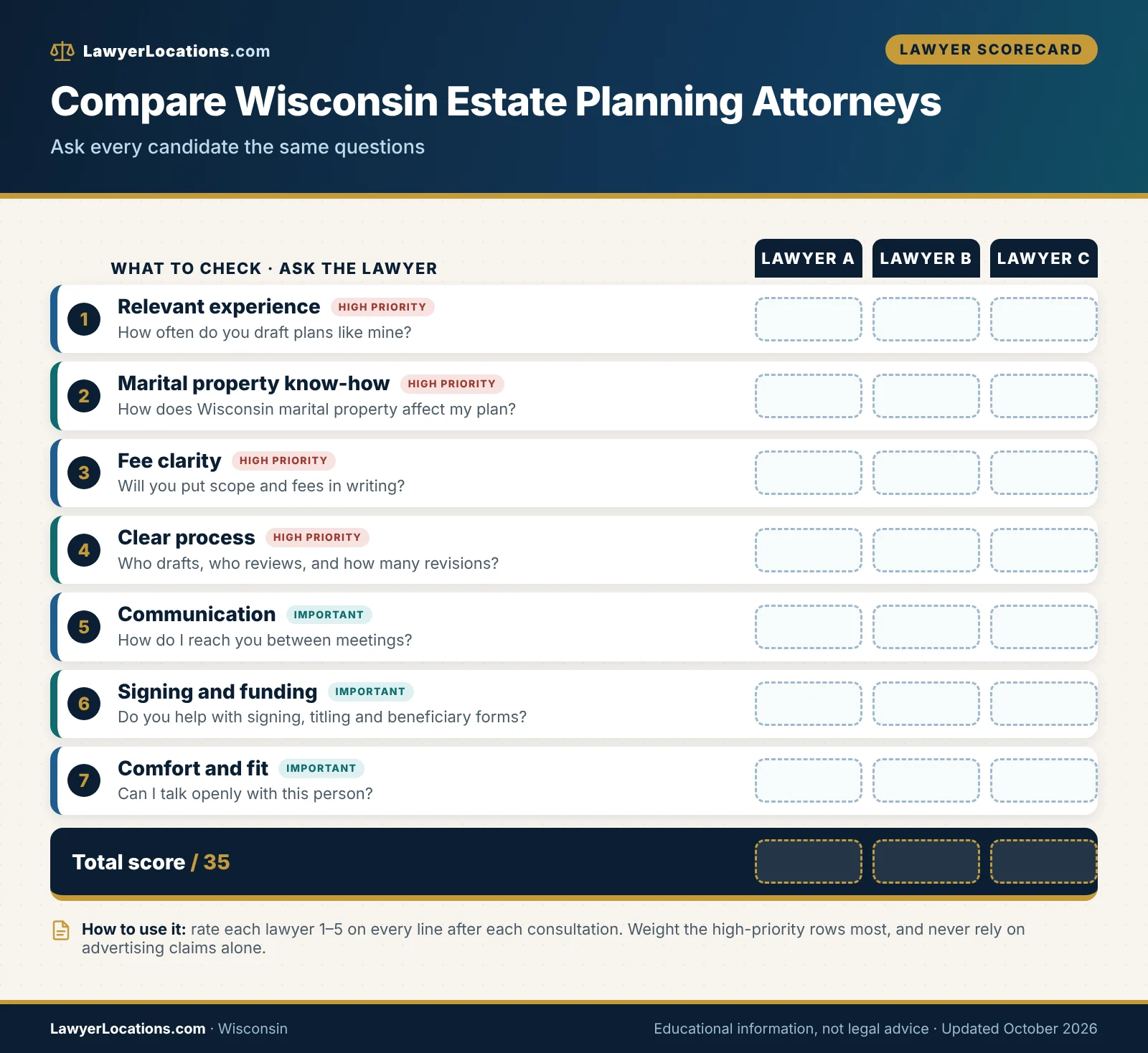
Text version of this graphic
- Relevant experience. Ask how often the lawyer drafts plans like yours.
- Wisconsin focus. Ask how marital property affects your plan.
- Fee clarity. Ask for the fee basis and scope in writing.
- Process. Ask who drafts, who reviews, and how revisions work.
- Communication. Ask how questions are handled between meetings.
- Signing and funding help. Ask what is included after the documents are drafted.
- Fit and comfort. Ask yourself whether you can talk openly with this person.
Local, regional or remote?
Estate planning does not have to be done in the lawyer’s building, but Wisconsin law ties remote signing to Wisconsin-licensed attorney supervision and requires the parties to be physically in Wisconsin (Wis. Stat. 853.03). If you split time between states, say so at the first call, because the lawyer must handle out-of-state property and documents may need different signing rules elsewhere.
For rural and northern Wisconsin, a lawyer a few counties away may be more practical than none, and video or phone meetings for intake and review can be fine. Just plan the signing meeting carefully so the witnesses, notary and original documents are handled correctly.
If a website, mailer or caller promises to “avoid probate for everyone,” quotes a price before asking about your family, or pushes a trust as the answer to every situation, slow down. Good planning starts with your facts, not a product.
Preparing for Your Consultation: Questions and Documents
Going into the consultation organized shortens the meeting, reduces cost and improves the plan. Prepare a basic asset list, family information and decisions about agents, then bring written questions about experience, process and fees. The first meeting should also show whether the lawyer asks good questions, not just whether they give good answers.
What to gather before you go
You do not need perfect records, but you need enough information for the lawyer to see the whole picture.
Documents and information to bring
Bring existing wills, trusts and powers of attorney, a list of accounts with approximate values and current beneficiary designations, deeds or a list of properties and how they are titled, life insurance and retirement account details, business ownership documents, and information about any prior marriages, children or support obligations. Include digital assets such as online accounts, along with notes on where to find passwords.
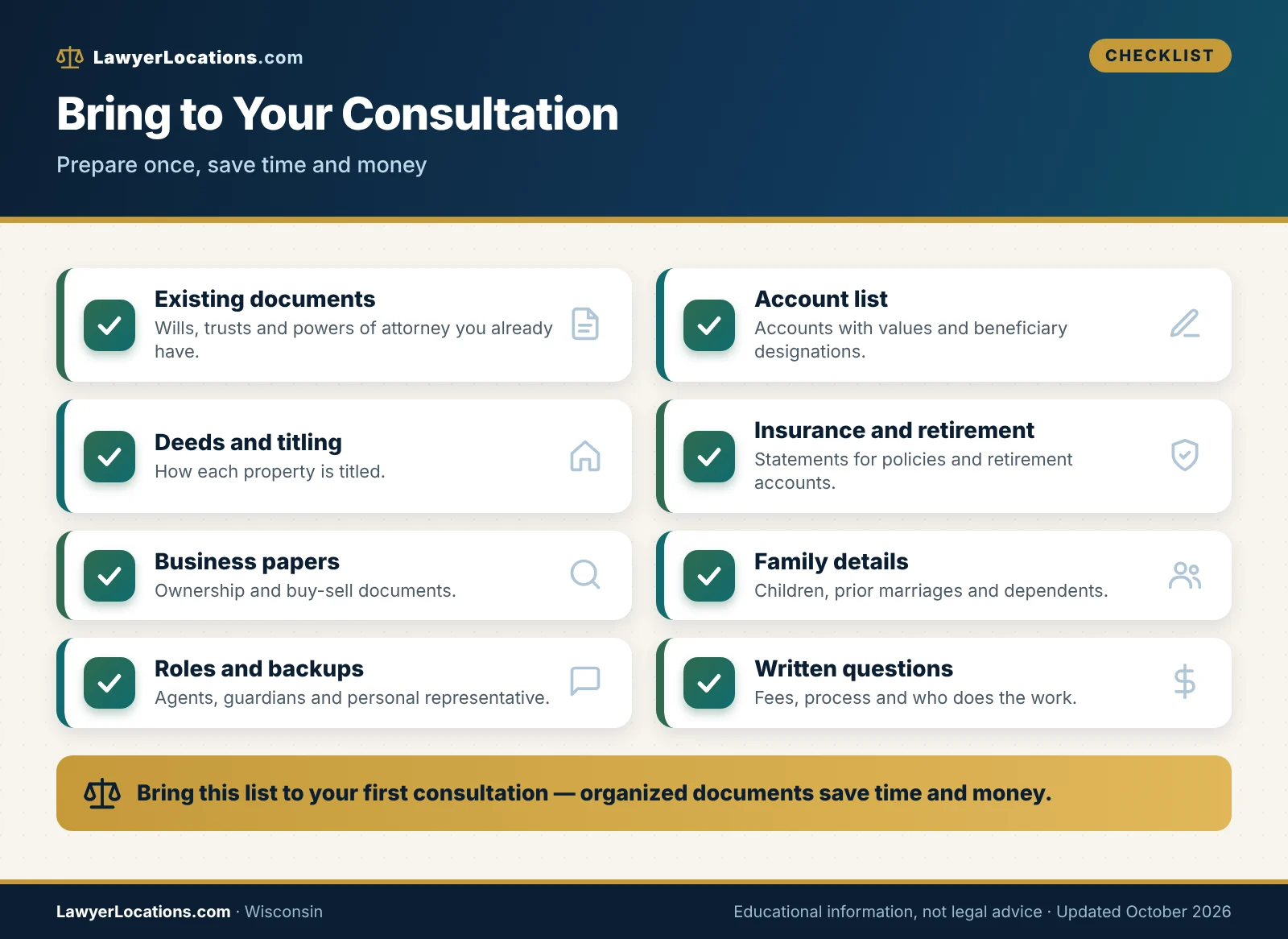
Text version of this graphic
- Existing wills, trusts and powers of attorney
- Account list with beneficiary designations
- Deeds and how each property is titled
- Life insurance and retirement account statements
- Business ownership documents
- Family tree including prior marriages and dependents
- Names for agents, guardians and personal representative, with backups
- Written questions for the lawyer
Decisions to think through in advance
Think about who should serve as personal representative or trustee, who should hold your financial and health care powers, who would raise minor children, and how you want property divided. For each role, name a backup. If you are unsure, say so, and ask the lawyer to explain what each role involves.
Also think about what you would want if you became seriously ill: Which people should receive medical information, what are your wishes about life support, and who can pay your bills? Those answers drive the health care and financial documents.
Questions to ask the lawyer
Questions are most useful when they are specific. These sets cover experience, process and fees.
Questions about experience and process
Ask: How much of your practice is estate planning? How do you handle married couples under Wisconsin’s marital property law? Who will draft my documents, and who will I speak with? How long do plans like mine usually take from first meeting to signing? Do you handle the signing meeting, and do you provide witnesses? What happens if I become incapacitated after signing and before funding is done?
Listen for specific, plain-language answers. A lawyer who explains how a decision would play out for your family is a better signal than one who recites credentials.
Questions about fees, scope and communication
Ask: Is your fee flat or hourly? What exactly is included? What would trigger extra charges? Will you give me a written fee agreement? Do you hold advance payments in trust until earned? How are phone calls and emails billed? What does a review after a life change cost? How do I reach you between meetings?
Wisconsin’s fee rule (SCR 20:1.5) supports asking for the scope and fee basis in writing, so these are reasonable questions to expect a clear answer to.
Questions the lawyer should ask you
The quality of the lawyer’s questions tells you about the quality of the plan. A thin intake often produces a thin plan.
Family and relationship questions
A careful lawyer asks about your marriage or marriages, children (including adult children and stepchildren), anyone who depends on you, any family member with special needs or who receives public benefits, and any relationships that could produce conflict. They should ask whether you have a marital property agreement, whether you have been divorced, and whether any beneficiary has creditor or addiction issues.
Those questions are not intrusive; they are how the lawyer decides whether outright gifts, trusts or other structures fit your family. If you are uncomfortable answering a question, say so, and ask why it matters.
Asset and goal questions
The lawyer should ask what you own, how it is titled, which accounts have beneficiaries, whether you own real estate or a business, and whether you own anything outside Wisconsin. They should ask what you want to happen at your death and during incapacity, what you want to avoid, and how long you expect the plan to last before review.
If the lawyer does not ask about beneficiary designations, ask why. Coordinating those designations with the will or trust is one of the most valuable things a lawyer does.
Special Situations: Blended Families, Long-Term Care, and Property in More Than One Place
Some situations raise the stakes of choosing the right lawyer because the default rules or standard forms do not fit. This section covers blended families and children with special needs, long-term care and Medicaid, and out-of-state or unusual property. Use it to decide what to raise at the first consultation.
Family structures that need extra care
Standard forms assume a married couple leaving everything to each other and then to their children. Many Wisconsin families do not fit that script.
Second marriages and blended families
When one or both spouses have children from earlier relationships, the question is how to provide for the surviving spouse without cutting out those children. Because Wisconsin treats much of a married couple’s property as marital property, each spouse has a share that can be dealt with by will, and the interplay with a surviving spouse’s rights can surprise people. Solutions include trusts that provide for the surviving spouse during life and then pass the balance to the first spouse’s children, written marital property agreements (Wis. Stat. 766.58), and coordinated beneficiary designations.
Ask the lawyer to model a few “what if I die first” and “what if you die first” scenarios before you sign. Our Detroit wills and trusts guide discusses blended-family questions from a Michigan angle, which is useful if you also own property across the state line.
Minor children, guardians and children with special needs
A will can nominate a guardian for minor children, and a trust can hold their inheritance until a stated age or event. Naming a guardian is different from a custody dispute, which is handled in family court. If a custody conflict is already underway, see our guide to the child custody lawyer in Milwaukee for how that process differs.
If a child or other beneficiary has a disability and receives means-tested public benefits, an outright inheritance can disrupt eligibility. A properly drafted supplemental or special needs trust can help, but drafting rules are technical, so ask whether the lawyer has handled this specific arrangement and who reviews it.
Long-term care, Medicaid and elder law planning
Care costs and public benefits can dwarf other estate concerns for older families. This area overlaps estate planning, and some lawyers focus on it as elder law.
Medicaid estate recovery in Wisconsin
The Wisconsin Department of Health Services operates an Estate Recovery Program that seeks repayment from the assets of certain Medicaid long-term care members after they or their dependents no longer need those assets. The Department lists programs including Medicaid, BadgerCare Plus, the Wisconsin Chronic Disease Program, the Community Options Program and the Non-Medicaid Family Care Program, and says members aged 55 or older who live in the community and do not receive long-term care or Wisconsin Chronic Disease Program services are not affected. The Department’s Estate Recovery phone numbers are (608) 264-6755 and (608) 264-7739.
Do not assume a simple rule about the home or a spouse. Treatment depends on the specific program and facts, which is exactly the type of question to bring to a lawyer who handles Wisconsin Medicaid planning.
Timing, transfers and when to see an elder law attorney
Benefit programs generally review transfers made before applying for long-term care coverage, so giving property away without advice can create a penalty period. The details change, so ask a lawyer for current rules before moving assets. See our guide on elder law attorneys in Memphis for how these questions are framed in another state.
The best time to ask is before a health crisis. Waiting until a parent is in a nursing facility narrows options and raises stress. Raise long-term care costs in your first consultation if you are over 55, caring for an aging parent, or have a spouse with significant health needs.
Be skeptical of any pitch that promises to “protect everything from the nursing home” for a flat price. Rules depend on timing, program and family facts, and a responsible lawyer will explain limits as readily as benefits.
Property in more than one place or in unusual forms
Real life is rarely tidy. Cabins in the north woods, farmland and family businesses all need planning that fits the asset.
Out-of-state property and part-year residents
If you own real estate in another state, that state’s law typically governs transfer of the property, and a Wisconsin will may not avoid a separate court process there. A revocable trust holding the property can sometimes avoid that second proceeding. Many Wisconsin families own lake homes in Michigan, Minnesota or Illinois, so ask your lawyer whether they can coordinate local counsel.
If you move to Wisconsin from another state, have your old documents reviewed. A document signed elsewhere may still be valid, but terms like marital property classification and witness rules for health care forms differ.
Family businesses, farmland and digital assets
Closely held businesses and farmland require succession planning that goes beyond a will: who runs it, who owns it, how siblings who do not work in the business are treated, and how buy-sell agreements and tax planning fit together. These plans often involve an accountant and sometimes a financial advisor, so ask whether the lawyer works with your team.
Digital assets such as email, photo storage, cryptocurrency and online accounts have their own access problems. Ask how your plan authorizes your agent or personal representative to manage them, and keep a secure, updated inventory of accounts and recovery methods separate from the will itself.
Probate in Wisconsin: What Planning Can and Cannot Avoid
Probate is the court process that validates a will, appoints a personal representative, pays debts and distributes assets. Wisconsin offers several pathways, from small-estate shortcuts to formal administration, and the right planning can shrink or skip the court process for many assets. This section explains the framework and the key thresholds so you can discuss them with a lawyer.
The Wisconsin probate framework
Wisconsin probate is run through the circuit court in the county where the decedent lived, and each county has a Register in Probate who handles filings and procedure.
Governing law and where to file
Wisconsin’s probate law is found in Chapters 851 through 882 of the Wisconsin Statutes, according to the Wisconsin Court System’s self-help page. That page directs you to your county’s Register in Probate and to the circuit court forms library for probate actions, and notes that some counties have local forms where no standard form exists. It also points to “A Personal Representative’s Guide to Informal Estate Administration in Wisconsin” for the basic process.
For families in the largest metro area, our guide to a probate lawyer in Milwaukee covers the county-level details. If you live elsewhere, call your county’s Register in Probate to ask which filings and fees apply.
Pathways at a glance
Which pathway applies depends on the size of the estate, who survived the decedent, and whether the will or heirs are contested. The table summarizes the pathways discussed here and the thresholds that Wisconsin statutes set.
| Pathway | When it can apply | Key rule | Source |
|---|---|---|---|
| Transfer by affidavit | Gross value of the decedent’s property subject to administration in Wisconsin does not exceed $50,000 | A named personal representative generally cannot receive real property by affidavit; a 30-day wait applies in some cases | Wis. Stat. 867.03 |
| Summary settlement | Estate (less secured debts) is within listed costs and claims, or does not exceed $50,000 and the decedent left a spouse or domestic partner or minor children | Notice to the Department of Health Services and a 30-day wait if the decedent or spouse received certain long-term care or medical assistance | Wis. Stat. 867.01 |
| Informal administration | Estates handled through the probate registrar with lighter court involvement | Registrar sets the claims deadline | Chs. 851 to 882; court self-help |
| Formal administration | Contested matters or situations needing court supervision | Court sets deadlines and holds hearings | Chs. 851 to 882 |
Small-estate shortcuts
Two statutes allow smaller estates to skip full probate. They have different tests, so the details matter.
Transfer by affidavit under Wis. Stat. 867.03
Under Wis. Stat. 867.03, the transfer-by-affidavit process applies when the decedent’s property subject to administration in Wisconsin does not exceed $50,000 in gross value. The affidavit states the total value and whether the decedent or the decedent’s spouse received certain long-term care or medical assistance benefits.
When the affiant is the person named in the will as personal representative, the property holder may not transfer property until 30 days after receiving the affidavit, and the named personal representative may not receive real property this way. Those two limits do not apply if the personal representative is also an heir, a trustee of the decedent’s revocable trust, or the decedent’s guardian at death.
Summary settlement under Wis. Stat. 867.01
Wis. Stat. 867.01 lets a court summarily settle an estate in two situations: when the estate, minus secured debts, does not exceed listed costs, expenses, allowances and claims; or when it does not exceed $50,000 and the decedent was survived by a spouse or domestic partner, minor children, or both. Anyone with standing to petition for administration may ask for it.
If the decedent or spouse received certain long-term care, medical assistance or related aid, the petitioner must notify the Department of Health Services by certified mail, and the court can enter its order only after 30 days have passed since the notice. Planning ahead can keep assets inside these limits or out of probate entirely.
Small-estate procedures in Wisconsin reduce paperwork, but they do not reduce the importance of valid documents. A clear will and updated beneficiary designations still make any process faster and less contentious.
Claims, timing and the personal representative’s role
Even a simple probate has duties and deadlines. The personal representative carries those duties, so choosing the right person is part of estate planning.
The creditor claims deadline
When an application for administration is filed, the court (or the probate registrar in informal proceedings) sets a deadline for filing claims against the estate. Under Wis. Stat. 859.01, that deadline must fall at least three months and no more than four months after the date of the order. A claim filed after the deadline faces the consequences set in the related statute.
For families, that means the claims window effectively sets the minimum timeline before final distributions, so expect the process to last at least several months even in a simple estate. Ask the lawyer to explain how the deadline interacts with notices to known creditors.
Choosing a personal representative and deciding whether to hire probate counsel
Choose someone organized, honest and willing, and name a backup. The role includes inventorying assets, notifying heirs and creditors, paying debts and taxes, and distributing property. A professional fiduciary is an option for complicated or conflicted estates.
Some families handle simple probates with help from the court’s self-help materials, while others hire a lawyer for hearings, contested matters or real estate. Our Milwaukee probate guide walks through when a lawyer’s help adds value.
Deadlines, Review Triggers and Decision Points
Estate planning has few filing deadlines before death, but it has many moments when the plan should be revisited, and a handful of dates and thresholds that matter after a death. This section lists the numbers verified for this guide, the life events that should trigger a review, and the main decision points when choosing scope.
Dates and thresholds that matter
Numbers help when they are current and sourced. These are the ones this guide verified as of October 2026.
After a death: the Wisconsin timing rules
The creditor claims deadline is set between three and four months after the court’s order (Wis. Stat. 859.01). Transfer by affidavit applies to estates up to $50,000 gross value and has a 30-day holding period in some cases (Wis. Stat. 867.03). Summary settlement involving certain public benefit recipients adds a 30-day notice period to the Department of Health Services (Wis. Stat. 867.01).
Beyond those, deadlines for tax returns, real estate transfers and benefit claims vary, and a lawyer or accountant can build a calendar for your family’s specific situation.
Federal figures to keep in mind
For 2026, the IRS lists a $15,000,000 basic exclusion amount for estate tax and a $19,000 annual gift tax exclusion per recipient. Wisconsin has no state estate tax for deaths after 2007 and no inheritance tax for deaths since 1992, according to the Department of Revenue.
Because federal rules are set by Congress and adjusted over time, ask your lawyer to confirm the figures at the time of planning rather than relying on any article, including this one.
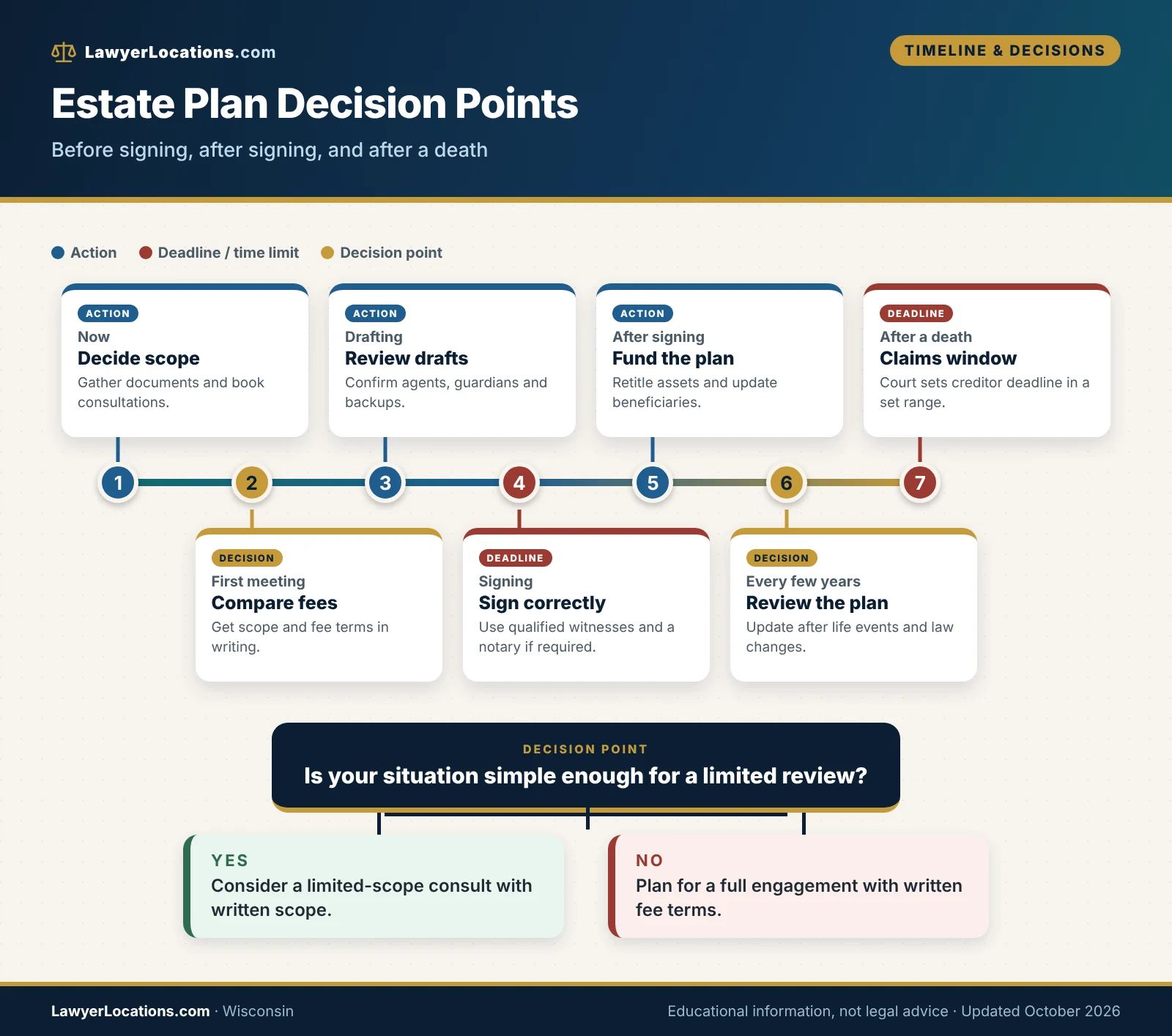
Text version of this graphic
- Now. Decide scope, gather documents and book consultations.
- First meeting. Compare lawyers and get fee terms in writing.
- Drafting. Review each document and name backups.
- Signing. Use qualified witnesses and a notary where required.
- Funding. Retitle assets and update beneficiaries.
- Periodic review. Revisit after life events and law changes.
- After a death. Claims window runs three to four months from the court’s order.
Decision point: Is your situation simple enough for limited-scope help, or does it call for a full plan? Simple: consider a limited consult or review. Complex: plan for a full engagement with written scope.
Life events that should trigger a review
A plan is a snapshot. Reviews keep it aligned with your life.
Relationship and family changes
Marriage, divorce, legal separation, a new domestic partnership, the birth or adoption of a child, a death in the family, and a child reaching adulthood each deserve a fresh look. Divorce is especially important because old documents and beneficiary designations can still name a former spouse. Our guide to legal separation versus divorce explains how those statuses differ.
Review the people you named as agents, trustees and guardians too. Someone who was a great choice ten years ago may have moved, changed health, or fallen out of the family.
Money, property and law changes
Selling or buying real estate, starting or selling a business, receiving an inheritance, retiring, moving to another state, or a major change in tax law can all require updates. So can a change in your health or a loved one’s care needs.
A reasonable rule of thumb is to ask the lawyer at signing what review schedule they recommend, and to set a calendar reminder. Many people also want a quick check every few years even when nothing seems to have changed.
| Life event | Documents to revisit | Why |
|---|---|---|
| Marriage or domestic partnership | Will, trust, beneficiary designations, powers of attorney | New legal relationships and marital property effects |
| Divorce or separation | All documents and designations | Former spouse may remain named |
| Birth or adoption | Will, guardian nominations, trust | New heirs and guardianship needs |
| Death of an agent or beneficiary | Backups, trust terms | Plan may have gaps |
| Move to or from Wisconsin | Entire plan | Witness rules, marital property and tax law differ |
| Sale or purchase of real estate | Deeds, trust funding, TOD designations | Titling must match the plan |
| Diagnosis or care needs | Powers of attorney, health care directives, long-term care plan | Incapacity planning becomes urgent |
| Business change | Succession and buy-sell documents | Control and value shift |
The main decision: how much help do you need?
Most readers face the same fork: a limited-scope fix, or a full plan.
When a limited review is enough
If you already have documents and want a second opinion, a limited-scope review may make sense. Ask the lawyer to check signing formalities, beneficiary coordination and whether your agents and guardians are still right. Put the scope in writing so you know what was and was not reviewed.
A limited review works best when the plan is simple and the documents were drafted by a lawyer or from reliable forms. It does not work well if you suspect a deeper structural problem.
When to commission a full plan
Choose a full plan when your situation has any of the complexities described earlier: blended families, special needs, business or farm interests, property in multiple states, long-term care concerns or sizable assets. Also choose a full plan when you have no documents at all.
The cost of a thorough plan is usually small compared with the assets and family relationships it protects. Compare two or three written quotes for the same scope and pick based on clarity and fit, not just price.
Free and Low-Cost Legal Help in Wisconsin
Wisconsin has several statewide and regional programs for people who cannot afford a full-price estate plan, and some are open to people with moderate incomes. Eligibility changes, so confirm each program’s current rules before you count on it. This section lists programs named by the Wisconsin State Law Library and the State Bar, grouped by who they serve.
Statewide programs
Start here if you are not sure which program fits.
Free Legal Answers, Wisconsin Law Help and the Modest Means Program
Free Legal Answers – Wisconsin (an ABA program) lets Wisconsin residents submit civil legal questions online, and volunteer attorneys may answer them. Wisconsin Law Help (wislawhelp.org) is a statewide directory of legal assistance organizations and clinics. The State Bar’s Modest Means Program is aimed at people whose income is too high for free services but too low for a standard lawyer’s rate.
These programs are usually better for questions and guidance than for drafting a full plan, but they can help you decide your next step and prepare for a paid consultation.
Lawyer referral services at a reduced first-meeting rate
The State Bar of Wisconsin Lawyer Referral Service caps the first 30-minute consultation at $20 for referred clients, with phone referrals free and an online option that carries a separate non-refundable payment. The Milwaukee Bar Association lists a first half-hour at $20 or less. These are not free legal services, but they give you a low-cost way to meet a lawyer, ask about total cost and decide whether to continue.
Ask each service what the first meeting covers and what happens if you hire the lawyer afterward.
Regional and population-focused programs
Many programs target specific groups or regions. Eligibility depends on income, age, disability, military status or county.
Legal aid organizations and county coverage
Legal Action of Wisconsin provides civil legal services for low-income residents, with offices in Green Bay, La Crosse, Madison, Milwaukee, Oshkosh and Racine. Wisconsin Judicare serves low-income people in 33 northern counties. The University of Wisconsin Law School’s Economic Justice Institute runs clinics for particular needs. Legal aid programs often prioritize housing, benefits, family and consumer problems, so ask whether wills or powers of attorney are within their current priorities.
Local law libraries, including the Dane Law Library’s guide to low-cost legal assistance in Dane County, can point you to county-level options.
Seniors, people with disabilities and veterans
Senior Law, a Legal Action of Wisconsin program, serves Milwaukee County residents over 60 with benefits, elder rights, scam and housing issues. Benefit specialists, available through Wisconsin’s Department of Health Services programs and local aging and disability resource centers, help with public benefits. Disability Rights Wisconsin provides advocacy for people with developmental, mental, physical or sensory disabilities who meet its criteria, and Wisconsin Legal Assistance for Military Personnel serves service members, veterans and families.
If your estate planning question touches public benefits, long-term care or guardianship, these programs are worth a call before you hire anyone.
| Program | Who it serves | What it does |
|---|---|---|
| Free Legal Answers Wisconsin (ABA) | Wisconsin residents who qualify | Volunteer attorneys may answer online civil legal questions |
| Wisconsin Law Help | Anyone | Directory of legal assistance organizations and clinics |
| State Bar Modest Means Program | People above free-service income limits but unable to pay standard rates | Reduced-rate access to a lawyer; ask the State Bar for terms |
| State Bar Lawyer Referral Service | Anyone seeking a lawyer | Referral; first 30-minute consultation capped at $20 |
| Milwaukee Bar Association referral service | Milwaukee area | Referral; first half-hour $20 or less |
| Legal Action of Wisconsin | Low-income residents | Civil legal services from offices in Green Bay, La Crosse, Madison, Milwaukee, Oshkosh and Racine |
| Senior Law (Legal Action of Wisconsin) | Milwaukee County residents over 60 | Benefits, elder rights, scams, housing |
| Wisconsin Judicare | Low-income residents of 33 northern counties | Civil legal services |
| Disability Rights Wisconsin | People with qualifying disabilities | Individual advocacy |
| Wisconsin Legal Assistance for Military Personnel | Service members, veterans and families | Legal help for military families |
Local starting points by region
Wisconsin’s cities and rural counties have different practical options. The common thread is your county’s probate office and local bar resources.
Milwaukee, Madison, Green Bay and other urban areas
Larger cities have more lawyers, more referral services and more clinics. In Milwaukee, the Milwaukee Bar Association referral service and Legal Action’s Milwaukee office are starting points, and our Milwaukee probate lawyer guide covers what to expect at the county level. In Madison, the UW Law School’s clinics and the Dane Law Library’s guide offer information. In Green Bay, Oshkosh, La Crosse and Racine, Legal Action maintains offices.
More choices means more comparison work. Use the scorecard approach and verify each lawyer’s license before you meet.
Rural and northern Wisconsin
In smaller communities, the nearest lawyer who handles estate planning may be in the next town or county. Judicare covers 33 northern counties for eligible low-income residents. For everyone else, the State Bar’s referral line can match you with a lawyer who serves your area, and phone or video intake may save travel.
Plan the signing carefully. Because remote witnessing under Wisconsin law needs attorney supervision and the parties physically in Wisconsin, ask how the office handles in-person or remote signing, and where originals will be kept.
Red Flags, Common Mistakes and Your Next Steps
Most estate planning problems come from avoidable choices: signing without qualified witnesses, leaving beneficiary designations out of sync, never funding a trust, or hiring based on a slogan. This section lists red flags in lawyers and marketing, the mistakes that show up most often, and a simple plan for the coming week.
Red flags when choosing a lawyer
Red flags are patterns, not proof of misconduct, but they justify slowing down and asking more questions.
Pressure, promises and unclear claims
Be cautious if a firm uses high-pressure tactics, such as a “today only” price for documents or a free dinner seminar that ends in a sales pitch. Be cautious if anyone promises that a plan will avoid all taxes, all probate, or all family conflict. Be cautious if you cannot tell from the website or call who will actually draft your documents.
Marketing is allowed, but substance should follow. A lawyer who is confident in their work will explain the limits as clearly as the benefits.
Fees and communication problems
Another set of red flags involves fees and communication: no written fee agreement, vague scope, refusal to explain how advance payments are held, or unexplained add-ons. Poor communication before hiring usually continues after hiring, so note whether calls and emails are answered.
Wisconsin’s fee rule requires scope and fee basis to be communicated in writing, and advance fees to be handled under trust rules or the written-notice alternative (SCR 20:1.5). If you are uncomfortable, you can decline to hire or ask for a written explanation.
- No written fee agreement or scope of work
- Promises of a sure result, such as “no probate, no taxes, no problems”
- Pressure to sign or pay on the spot
- Unwillingness to say who drafts the documents
- No questions about your marriage, children, or how assets are titled
- A one-size-trust sold to every client regardless of circumstances
- No explanation of how an advance fee is held in trust until earned
Common planning mistakes
Even with a good lawyer, some mistakes are easy to make. Knowing them lets you ask the right follow-up questions.
Unfunded trusts, outdated beneficiaries and mismatched designations
An unfunded revocable trust is an empty box. Accounts and deeds must be retitled, and beneficiary designations must be coordinated, or the trust accomplishes little. A transfer on death designation on real estate (Wis. Stat. 705.15) overrides a will for that property. Retirement accounts and life insurance pass to the named beneficiary regardless of what the will says.
Check beneficiary designations after marriage, divorce, births and deaths. It takes minutes and prevents surprises that can take years to unravel.
Signing errors and DIY pitfalls
Wills in Wisconsin require two witnesses who sign after observing the signing or acknowledgment in the testator’s conscious presence (Wis. Stat. 853.03). Health care documents require witnesses who meet specific qualifications (155.30, 154.03), and a witness who is a relative or beneficiary can create problems. Out-of-state forms may not fit Wisconsin law.
If you use forms, have a lawyer review them. If you hire a lawyer, make sure the signing meeting follows the lawyer’s instructions exactly, and ask for copies of the signed documents.
| Topic | Red flag | Healthy sign |
|---|---|---|
| Fees | Verbal quote only; vague extras | Written scope and fee basis |
| Process | Cannot say who drafts | Clear roles; supervising lawyer reviews |
| Questions | Little interest in family or titling | Detailed questions about family, assets and goals |
| Promises | “No probate, no taxes” for everyone | Explains what the plan can and cannot do |
| Communication | Slow or unclear replies | Reasonable timelines and a stated contact path |
| After signing | No help with funding or storage | Explains funding and where originals go |
Your next steps
Estate planning feels big, but the first steps are small.
A simple plan for the next seven days
Day one: write down who you would want as agents, personal representative and guardian, with backups. Days two and three: build your one-page asset list and gather existing documents and beneficiary forms. Day four: call the State Bar Lawyer Referral Service or ask for personal referrals. Day five: verify two or three lawyers on the Wisconsin Court System lookup. Days six and seven: book consultations and prepare your questions.
If you are searching for an estate planning attorney Wisconsin families recommend, remember that recommendations help, but your own comparison on fees, process and fit is what protects you.
What to do if your situation is urgent
If a parent has just been diagnosed with dementia, a spouse has died, or someone is entering long-term care, the planning questions change. Call a lawyer promptly, tell the office the situation, and ask whether they can take the matter. Capacity to sign documents depends on the person’s condition, so timing can matter.
If cost is the barrier, use the free and low-cost programs above, including Senior Law, the State Bar referral service and benefit specialists.
More Wisconsin estate planning questions, answered
These shorter answers cover questions readers often ask after the main guide. They are general information, and your facts may change the answer.
Costs, hiring and choosing
How much does an estate planning attorney cost in Wisconsin?
It depends on the lawyer, the county and the complexity of your plan, so this guide does not quote a statewide average. Ask for a written flat-fee or hourly estimate for the same scope from two or three lawyers. Wisconsin’s fee rule expects the scope and fee basis to be communicated in writing.
Can I get a cheap first consultation in Wisconsin?
Yes. Lawyers who take referrals from the State Bar of Wisconsin Lawyer Referral Service agree to cap the first 30-minute consultation at $20, and the Milwaukee Bar Association lists a first half-hour at $20 or less. Confirm the current terms when you call.
Do I need an estate planning attorney or just a will?
A will alone covers only property in your sole name and does not handle incapacity. Most people also want financial and health care powers of attorney. A lawyer is especially useful for blended families, businesses, special-needs beneficiaries and out-of-state property.
How do I check that a Wisconsin lawyer is licensed?
Use the Wisconsin Court System’s lawyer status and history search at lawyerhistory.wicourts.gov. It shows license status and public discipline, and the Office of Lawyer Regulation oversees complaints.
Is it okay to hire an estate planning attorney outside my county?
Usually yes. Estate planning does not require a courthouse visit, but make sure the lawyer knows Wisconsin law and can arrange a proper signing. Remote witnessing under Wisconsin law needs attorney supervision with the parties physically in Wisconsin.
Should a married couple use one lawyer or two?
Many couples use one lawyer, but ask how the lawyer handles confidential information and conflicts. If your interests may differ, as in some second marriages, separate counsel may make sense.
What is the difference between an elder law attorney and an estate planning attorney?
The fields overlap. Elder law lawyers focus on aging-related issues such as long-term care, benefits and guardianship, while estate planning lawyers focus on wills, trusts and transfers. Many Wisconsin lawyers do both, so ask what share of their work involves your issue.
Does a revocable trust replace a will?
Usually not. Most trust-based plans include a will that catches assets never moved into the trust. Our guide to living trust lawyers explains the difference in more detail.
What should I do if I already have documents from another state?
Have a Wisconsin lawyer review them. Documents signed elsewhere may still be valid, but marital property, witness rules and health care forms can differ.
How often should I update my plan?
Review after major life events such as marriage, divorce, births, deaths, a move, a new business or a change in health, and ask your lawyer to recommend a regular schedule.
Wisconsin law, probate and taxes
Does Wisconsin have an estate tax?
No. The Wisconsin Department of Revenue states there is no Wisconsin estate tax for deaths after December 31, 2007, and no inheritance tax for deaths on or after January 1, 1992. Federal estate tax can still apply to very large estates, with a 2026 basic exclusion amount of $15,000,000 per person.
How many witnesses does a Wisconsin will need?
At least two, who sign after observing the signing or the testator’s acknowledgment in the testator’s conscious presence. Under Wis. Stat. 853.03, remote witnessing is allowed only with a Wisconsin-licensed attorney supervising and the parties physically in Wisconsin.
What is a self-proved will?
It is a will accompanied by a sworn affidavit from the testator and witnesses before an authorized officer, as described in Wis. Stat. 853.04. It can simplify proving the will later.
Is a Wisconsin power of attorney durable?
Yes, by default. Wis. Stat. 244.04 says a power of attorney is durable unless it expressly provides that it terminates on the principal’s incapacity.
Who can witness a Wisconsin health care power of attorney?
Two adult witnesses who are not related to you by blood, marriage or adoption, not your domestic partner, not financially responsible for your care, not your health care provider or a provider’s employee (chaplains and social workers excepted), not your agent, and without a known claim on your estate.
Can I avoid probate in Wisconsin?
For many assets, yes, through beneficiary designations, joint ownership with survivorship, recorded transfer on death designations for real estate, or a funded revocable trust. Smaller estates may also qualify for transfer by affidavit or summary settlement, each with its own limits.
How small does an estate have to be for the affidavit process in Wisconsin?
Under Wis. Stat. 867.03, the gross value of the decedent’s property subject to administration in Wisconsin must not exceed $50,000. A 30-day wait applies in some cases, and a named personal representative generally cannot receive real property this way.
How long do creditors have to file claims against an estate in Wisconsin?
The court or registrar sets the deadline between three and four months from the date of its order under Wis. Stat. 859.01.
Can I name a beneficiary for my house in Wisconsin?
Yes, through a transfer on death designation under Wis. Stat. 705.15. It must be recorded with the county register of deeds before your death, and both spouses must sign if the property is marital property.
Does Medicaid estate recovery apply to everyone in Wisconsin?
No. The Department of Health Services says members aged 55 or older who live in the community and do not receive long-term care or Wisconsin Chronic Disease Program services are not affected. Recovery applies to certain long-term care members, so ask a lawyer about your facts.
Ready to compare lawyers? Gather your asset list and family details, call the State Bar’s referral service or two personal referrals, verify each license, and ask for written fee terms before you decide. If a probate is already underway, start with our guide to a probate lawyer in Milwaukee and your county’s Register in Probate. LawyerLocations is a legal-education resource, not a law firm, and does not recommend individual lawyers.
General information only. This article is for general educational purposes and is not legal advice. Reading it does not create an attorney-client relationship, and LawyerLocations.com is not a law firm. Laws, court rules, fees and program terms change, and your facts matter. Consult a lawyer licensed in Wisconsin, or the state where your property is located, about your situation.
Sources & References
Show all 21 sources
- Wis. Stat. 853.03, Execution of wills — Justia (Wisconsin Statutes) — law.justia.com — accessed October 2026
- Wis. Stat. 853.04, Self-proved wills — Justia (Wisconsin Statutes) — law.justia.com — accessed October 2026
- Wis. Stat. 701.0401, Methods of creating trust — Justia (Wisconsin Statutes) — law.justia.com — accessed October 2026
- Wis. Stat. 244.04, Durability of power of attorney — Justia (Wisconsin Statutes) — law.justia.com — accessed October 2026
- Wis. Stat. 244.05, Execution of power of attorney — Justia (Wisconsin Statutes) — law.justia.com — accessed October 2026
- Wis. Stat. 155.30, Statutory form for power of attorney for health care — Justia (Wisconsin Statutes) — law.justia.com — accessed October 2026
- Wis. Stat. 154.03, Declaration to health care professionals — Justia (Wisconsin Statutes) — law.justia.com — accessed October 2026
- Wis. Stat. 705.15, Transfer on death for real property — Justia (Wisconsin Statutes) — law.justia.com — accessed October 2026
- Wis. Stat. chapter 766, Property rights of married persons; marital property — Justia (Wisconsin Statutes) — law.justia.com — accessed October 2026
- Wis. Stat. 867.01, Summary settlement and transfer — Justia (Wisconsin Statutes) — law.justia.com — accessed October 2026
- Wis. Stat. 867.03, Transfer of small estates by affidavit — Justia (Wisconsin Statutes) — law.justia.com — accessed October 2026
- Wis. Stat. 859.01, Time for filing claims — Justia (Wisconsin Statutes) — law.justia.com — accessed October 2026
- SCR 20:1.5, Fees — Wisconsin Court System, Office of Lawyer Regulation — wicourts.gov — accessed October 2026
- Lawyer Regulation and lawyer status search — Wisconsin Court System — wicourts.gov — accessed October 2026
- Probate self-help — Wisconsin Court System — wicourts.gov — accessed October 2026
- Lawyer Referral Service — State Bar of Wisconsin — wisbar.org — accessed October 2026
- Finding a lawyer / Lawyer Referral Service — Wisconsin Law Help — wislawhelp.org — accessed October 2026
- Legal Assistance — Wisconsin State Law Library — wilawlibrary.gov — accessed October 2026
- Estates, Trusts, and Fiduciaries FAQ — Wisconsin Department of Revenue — revenue.wi.gov — accessed October 2026
- What’s New: Estate and Gift Tax — Internal Revenue Service — irs.gov — accessed October 2026
- Medicaid Estate Recovery Program — Wisconsin Department of Health Services — dhs.wisconsin.gov — accessed October 2026
Legal Disclaimer and Limitation of Liability
Informational and illustrative purposes only. This article was prepared by LawyerLocations.com solely on the basis of the information available to us at the time of writing. It is an illustrative, general overview. It is not a complete or authoritative statement of the law, and it has not been reviewed by a lawyer licensed in your state or county.
Not legal advice. Nothing in this article is legal, financial, tax or immigration advice, and reading it does not create an attorney-client relationship between you and LawyerLocations.com or any author, lawyer or firm mentioned. Laws, court rules, fees, filing deadlines and agency procedures differ by state, county and court, and they change often. Some details here may be simplified, incomplete or out of date, and time limits for legal claims can be short.
No warranty. We make no representation or warranty, express or implied, about the accuracy, completeness, timeliness or suitability of this content for your situation. Please do not rely on it to make, delay or skip any legal decision. Check the facts against official sources and speak with a licensed attorney in the relevant jurisdiction before you act.
Limitation of liability. To the fullest extent permitted by law, LawyerLocations.com and its owners, authors and contributors disclaim all liability for any loss, damage, cost or other consequence arising from the use of, or reliance on, this article, including any content on third-party websites we link to. Mentioning a lawyer, firm, organization or service is not an endorsement and is not a promise of any result. If you are in immediate danger, contact your local emergency number.