Finding a personal injury lawyer in Sacramento, CA comes down to three things: knowing California’s filing deadlines, knowing which Sacramento court or public agency your claim will touch, and comparing several lawyers on fees, communication and experience with your kind of injury. Most California injury lawsuits must be filed within 2 years, but a claim against a city, county or other public entity can require paperwork within 6 months.
This guide explains how a Sacramento injury case moves from first call to resolution, where the local courts sit, how contingency fees work under California law, and what to ask before you sign anything. It is general information, not legal advice.
How a Personal Injury Case Works in Sacramento, CA
A personal injury case is a civil claim for money to cover harm caused by someone else’s carelessness or wrongful conduct. In Sacramento that usually means a car, truck, bicycle or pedestrian crash, a fall on unsafe property, a dog attack, or an injury caused by a product or a business. Most claims settle with an insurer before any judge decides anything, but a lawsuit in Sacramento County Superior Court is the backstop when settlement talks fail.
What counts as a personal injury claim here
California treats an injury claim as a civil matter between you and the person, business or government body you say caused the harm. You are not asking the state to punish anyone. You are asking for compensation for losses you can describe and prove.
Vehicle and roadway injuries
Crashes involving cars, trucks, motorcycles, bicycles and pedestrians make up the bulk of injury work in any large California city. The legal questions are usually who was at fault, how much insurance sits behind the at-fault driver, and whether your own policy adds coverage. If the other driver had little or no insurance, your own uninsured motorist coverage may matter; see our guide to uninsured motorist claims for how that works.
Premises liability: falls and unsafe property
Premises liability is the area of law covering injuries that happen on someone else’s property, such as a wet floor at a store, a broken stair at an apartment building, poor lighting in a parking structure, or a hazard on a sidewalk. These cases turn on whether the owner or occupier knew, or reasonably should have known, about the hazard and failed to fix or warn about it. Photographs, incident reports and maintenance records often decide them. For a California example of how these cases are framed in another city, see our slip and fall guide for San Jose.
Other injury claims you may hear about
Dog bites, defective products, medical negligence and wrongful death are all personal injury claims, though some carry special rules and shorter or longer deadlines. A lawyer who handles one type routinely may not handle another. Ask early whether the firm takes your specific kind of case rather than assuming every injury lawyer does everything.
Contingency fee means the lawyer is paid a percentage of what is recovered instead of billing by the hour. If nothing is recovered, you generally owe no fee, though case costs are a separate question covered later in this guide.
The usual path from injury to resolution
The stages below are typical, not a promise about any one case. Some matters resolve in a few months and others take years, and the pace depends on the severity of the injury, how clear fault is, and how the insurer responds.
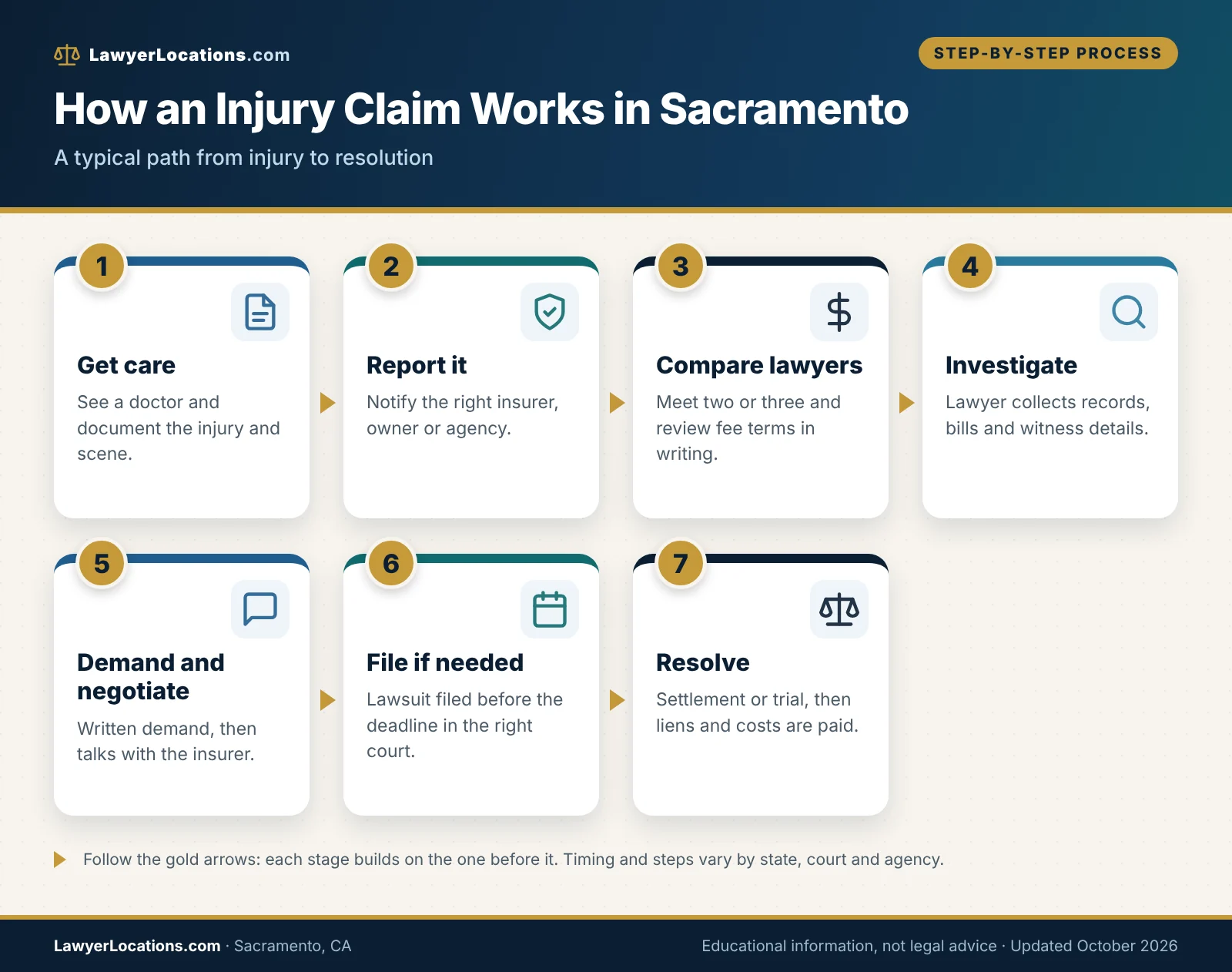
Text version of this graphic
- Get medical care and document the injury and the scene.
- Report the incident to the right insurer, property owner or agency.
- Consult one or more lawyers and compare fee terms in writing.
- Your lawyer investigates, gathers records and sends a demand.
- Negotiation with the insurer, sometimes with mediation.
- If needed, a lawsuit is filed before the deadline in the correct court.
- Settlement, trial or other resolution, followed by paying liens and costs.
Stage one: treatment, documentation and early reports
Your health comes first, and the medical record also becomes the backbone of the claim. Gaps in treatment are a common argument insurers use to question how serious an injury is. Our checklist on what to do after a car accident walks through the first hours in detail.
Stage two: investigation and the demand
Once you hire a lawyer, the firm typically collects medical records and bills, wage information, photos, witness names and any police report. When treatment has stabilized, the lawyer sends the insurer a written demand explaining fault, injuries and losses. Sending a demand too early, before the full extent of the injury is known, is a classic way to undervalue a case.
Stage three: negotiation, filing suit and resolution
Insurers respond with an offer, a denial or a request for more information. If talks stall and the deadline approaches, the lawyer can file a complaint in the correct Sacramento court. Filing a lawsuit does not mean a trial is coming; many filed cases still settle. For a realistic picture of how long each phase can take, read our car accident settlement timeline.
Why the Sacramento setting matters
California law is the same statewide, but where you file, which agency receives a claim and which local resources you can use are all Sacramento-specific. Sacramento is also the seat of state government, so claims that involve a state agency, a state-maintained roadway or a state worker can raise special procedural steps. A lawyer who regularly works in the local courts will know how those steps play out in practice.
State rules versus local logistics
Deadlines, fault rules and damages principles come from California statutes and court decisions. Local logistics include which courthouse handles your filing, how to reach the court’s self-help services, and which city, county or district office accepts a claim. Keeping these two layers separate prevents confusion when you read advice written for a different county.
When a claim reaches beyond Sacramento County
If the crash happened in a neighboring county or the defendant lives elsewhere, the case may belong in a different court. Venue (the proper court location) depends on where the injury occurred and where the defendants live or do business. Ask any lawyer you consult to explain in plain terms where your case would be filed and why.
Write down the exact date, time and place of the injury before you call anyone. Every deadline in this guide is counted from that date, and being precise saves time in your first consultation.
California Law That Shapes a Sacramento Injury Claim
California state law controls almost every Sacramento injury claim. The rules that most affect your options are the filing deadline, the shortened deadline for claims against public entities, the way fault is shared, and special limits on certain damages. Check each against your own dates early, because a missed deadline can end an otherwise valid claim.
Filing deadlines you cannot ignore
Deadlines are the single most unforgiving part of injury law. Two timelines matter most for Sacramento residents, and they are very different in length.
The two-year rule for most injury lawsuits
California’s general statute of limitations for injury or death caused by the wrongful act or neglect of another is two years under Code of Civil Procedure section 335.1. That statute covers assault, battery, and injury to or death of an individual. The clock usually starts on the date of injury, though exceptions and extensions exist for situations such as claims by minors, so do not assume your situation is simple. Our national guide on how long you have to file a personal injury claim compares deadlines across states.
The six-month rule for claims against public entities
If a city, county, school district, transit agency or other public entity may be responsible, the Government Claims Act adds a separate step before you can sue. Under Government Code section 911.2, a claim for death or injury to a person must be presented to the entity within six months after the cause of action accrues; most other claims have a one-year window. After a written rejection, Government Code section 945.6 generally gives you six months from the date the notice is delivered or mailed to file suit, and two years from accrual if no compliant notice is given.
A fall on a city sidewalk or a crash caused by a county road defect is not governed by the two-year rule alone. The six-month claim step comes first. If you are close to or past six months, talk to a California lawyer promptly; a late-claim application may be possible in some circumstances but is decided by the entity and is never automatic.
Fault, damages and who pays
Once you know you are within the deadline, the next question is what you can recover and from whom. California’s rules on shared fault and on how damages are divided shape every settlement conversation.
Shared fault and your own responsibility
California applies a comparative fault system, meaning that if you are partly to blame, your recovery can be reduced by your share of responsibility rather than eliminated outright. Insurers use this principle aggressively, often by suggesting you contributed to the crash or fall. A lawyer’s job in many cases is to resist an inflated fault percentage with evidence such as video, photographs and witness accounts.
Economic and non-economic damages
Under Civil Code section 1431.2, economic damages are objectively verifiable monetary losses such as medical expenses, lost earnings, and repair or replacement costs. Non-economic damages are subjective, non-monetary losses such as pain, suffering, emotional distress and loss of companionship. The statute also says that, in comparative-fault injury cases, each defendant is liable for non-economic damages only in proportion to its own share of fault, rather than jointly for the whole amount.
Why the several-liability rule matters in practice
When more than one party contributed to your injury, such as a driver and a company that maintained a dangerous road, the split of fault affects how much of the non-economic award each can be made to pay. If one party is uninsured or cannot pay, that rule can limit what you collect for those losses from the others. This is one reason a lawyer will ask early about every possible responsible party, not just the most obvious one.
If you were driving or owned an uninsured vehicle involved in the crash, Civil Code section 3333.4 can bar recovery of non-economic damages such as pain and suffering from a negligent driver. A person convicted of driving under the influence at the time of the crash faces the same bar. Raise this with a lawyer immediately rather than hoping it will not come up.
Insurance requirements and mandatory reports
Insurance is where most Sacramento injury claims are won or limited. Knowing the baseline requirements helps you understand why a serious injury can quickly exceed what the at-fault driver’s policy covers.
California minimum liability limits
According to the California DMV, the minimum liability insurance limits are $30,000 for bodily injury to one person, $60,000 for bodily injury to more than one person in an accident, and $15,000 for property damage. Those are floors, not what a driver necessarily carries, and a serious injury can generate medical bills far above them. Ask your lawyer to look for every layer of coverage, including your own underinsured motorist coverage.
Reporting a crash to the DMV
The DMV’s SR 1 form states that the driver must report an accident to the DMV within 10 days if there was an injury, a death, or property damage in excess of $1,000, regardless of fault. An insurance agent or attorney may file it for you. This is separate from any police report or insurance claim, and missing it can create problems with your driver’s license.
Sacramento Courts, Agencies and Filing Venues
Sacramento County has a single Superior Court that spreads its work across several buildings. Injury lawsuits generally start at the downtown civil courthouse, while small claims cases are handled at a separate justice center. Claims against public bodies go first to the entity itself, not to the court.
The Superior Court of California, County of Sacramento
California’s trial-level courts are called superior courts, and each county has one. The Sacramento court lists its locations and the divisions at each building on its official website, which is worth checking before any visit because assignments can change.
Where civil cases are heard
The court’s locations page lists the Gordon D. Schaber Sacramento County Courthouse at 720 9th Street, Sacramento, CA 95814 as housing the civil and criminal divisions. The Hall of Justice at 813 6th Street, Room 212, 2nd Floor, is listed for civil law and motion matters, meaning the hearings where judges decide procedural and legal requests before trial.
Where small claims and other divisions sit
The Carol Miller Justice Center at 301 Bicentennial Circle, Sacramento, CA 95826 is listed for small claims, traffic and unlawful detainer (landlord and tenant) cases. Family law, juvenile dependency and probate are listed at the William R. Ridgeway Family Relations Courthouse on Power Inn Road, which is why a personal injury filing should never be directed there.
| Location | Address | Divisions listed | Why it may matter to you |
|---|---|---|---|
| Gordon D. Schaber Sacramento County Courthouse | 720 9th Street, Sacramento, CA 95814 | Civil and criminal | Typical home of civil lawsuits for injury damages |
| Hall of Justice | 813 6th Street, Room 212, 2nd Floor, Sacramento, CA 95814 | Civil law and motion | Procedural and legal motions in civil cases |
| Carol Miller Justice Center | 301 Bicentennial Circle, Sacramento, CA 95826 | Small claims, traffic, unlawful detainer | Small injury or property claims within the small claims limit |
| William R. Ridgeway Family Relations Courthouse | 3341 Power Inn Road, Sacramento, CA 95826 | Family law, juvenile dependency, probate | Not for injury lawsuits; relevant only if a related probate or family issue exists |
Before you travel to any courthouse, confirm the address, department and hours on the court’s official site. Building assignments and room numbers can shift, and showing up at the wrong location costs time you may not have.
Which court track fits the size of the claim
California sorts civil cases by the amount in dispute. The track affects the filing fee, the procedures and whether you realistically need a lawyer for the filing itself.
Small claims, limited civil and unlimited civil
The California Courts self-help site explains that limited civil cases are cases for $35,000 or less and unlimited civil cases are for more than $35,000. For lawsuits of $12,500 or less, an individual plaintiff may be able to use small claims court instead, and business entities can sue for up to $6,250 there. Most injuries involving surgery, lengthy treatment or lost work land in the unlimited category, which is why lawyers handle them.
Filing fees at the Sacramento court
The Sacramento court’s statewide civil fee schedule, revised January 1, 2024, listed a first-paper fee of $435 for an unlimited civil complaint, $370 for a limited civil complaint over $10,000 up to $35,000, and $225 for a limited complaint of $10,000 or less. It also listed a nonrefundable advance jury fee of $150. Fee schedules are updated by the Legislature, so check the court’s current schedule before relying on any figure, and ask about fee waivers if the cost is a barrier.
| Track | Amount in dispute | Listed filing fee | Typical fit |
|---|---|---|---|
| Small claims (individual plaintiff) | $12,500 or less | Check the court’s current small claims fee information | Minor injuries or property damage; no lawyers argue the case in small claims |
| Limited civil | $35,000 or less | $225 (up to $10,000); $370 (over $10,000 to $35,000) | Moderate claims with simplified procedures |
| Unlimited civil | Over $35,000 | $435 for a complaint | Serious injuries, disputed fault, multiple defendants |
Claims against the City, the County and other public bodies
Because Sacramento is dense with public property, a claim against a government body is more common here than many people expect. Each body has its own filing address, and sending a claim to the wrong office can cost you the deadline.
City of Sacramento claims
The City of Sacramento’s published claim instructions say claims go only to the Office of the City Clerk, 915 I Street, 5th Floor, Sacramento, CA 95814, and that claims sent to the City Attorney, Risk Management or other departments will not be accepted. The City says claimants are notified of the action to be taken within 45 days, plus extra days if the form was mailed. Keep a complete copy of everything you submit.
County of Sacramento and other agencies
The County of Sacramento’s filing guide says claims for death, personal injury or property damage must be presented not later than six months after accrual, and that a claim is delivered or mailed to the Clerk of the Board of Supervisors, 700 H Street, Room 2450, Sacramento, CA 95814. The City’s instructions add that claims against the Sacramento Housing and Redevelopment Agency, Sacramento Regional Transit, Sacramento Municipal Utilities District or Sacramento City Unified School District go directly to those agencies. Claims involving state agencies follow a state process, so ask a lawyer which office applies.
| Responsible body | Where the claim goes | Key timing rule |
|---|---|---|
| City of Sacramento | Office of the City Clerk, 915 I Street, 5th Floor | Statewide six-month rule for injury claims; the City reports notifying claimants of its action within 45 days |
| County of Sacramento | Clerk of the Board of Supervisors, 700 H Street, Room 2450 | Six months after accrual for personal injury; a late-claim application is a separate step |
| Regional Transit, SMUD, school district, housing agency | Directly to the agency involved | Same six-month statutory window applies to injury claims against public entities |
| State agencies | State claims process; confirm with a lawyer | Treat the six-month window as the working deadline |
Do not wait for an insurer’s reply before presenting a government claim. The six-month period runs from the injury, and negotiating with an adjuster does not pause it.
How to Compare Personal Injury Lawyers in Sacramento
Compare at least two or three lawyers before you sign, and compare them on the same questions. Fees matter, but so do communication, the firm’s experience with your type of injury, and whether the person you meet is the person who will actually handle your file.
Where to start your search
A search engine will surface advertising first. Starting with neutral, verifiable sources gives you a better list to work from.
Lawyer referral services certified by the State Bar
The State Bar of California certifies lawyer referral services and publishes a page listing the certified services covering the Sacramento and Northern California area. That page lists several services for the region, and some are statewide or focused on a particular area of law rather than being Sacramento County programs, so read what each service actually offers before relying on it. Confirm the service you use is on the State Bar’s certified list.
Court and community resources
The Sacramento court’s legal referral page points to 2-1-1 Sacramento, a free, confidential information and referral line open 24 hours a day, and to the Sacramento County Public Law Library, which provides free public access to legal information. It also lists Legal Services of Northern California and Capital Pro Bono, which help low-income residents with certain civil issues. Ask those groups whether they handle or can refer your problem rather than assuming an injury case is within their scope.
Checking a lawyer’s license
Every lawyer who practices in California must be licensed by the State Bar of California, and the State Bar’s attorney licensee search shows a lawyer’s profile and license status. Run this check on anyone you are considering, and compare the lawyer’s name and bar number to the engagement paperwork you receive.
Questions that separate lawyers from each other
Good questions are concrete and tied to your case. They also reveal how the firm communicates, which is a preview of the next year or two of your life.
Experience and staffing questions
Ask how many cases like yours the lawyer has handled and who at the firm does the day-to-day work, such as a paralegal or case manager. Ask who you will speak with when you have a question, and how quickly the firm normally returns calls. Avoid choosing based on billboard promises; a lawyer cannot honestly guarantee a result.
Trial readiness and strategy questions
Ask whether the firm files lawsuits when negotiations fail, or mostly settles at the pre-suit stage. A firm that never goes to court may be less persuasive at the bargaining table, while a firm that litigates everything may be slower. Neither approach is automatically right; you want a clear explanation of how they decide.
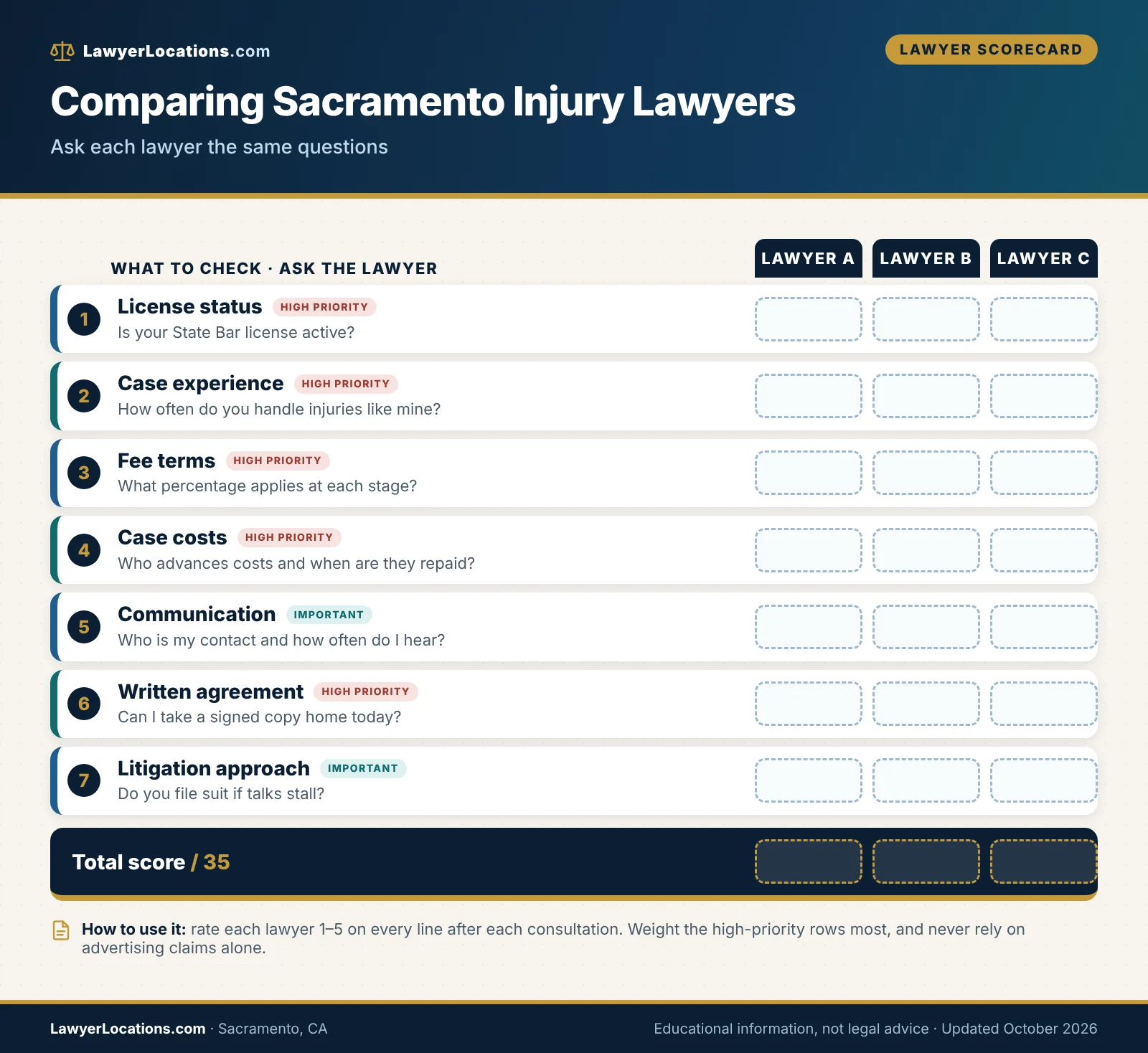
Text version of this graphic
| Criterion | Question to ask |
|---|---|
| License status | Is your State Bar license active, and may I see your bar number? |
| Case experience | How often do you handle injuries like mine? |
| Fee terms | What percentage applies, and does it change if you file suit? |
| Case costs | Who advances costs, and are they deducted before or after the fee? |
| Communication | Who will be my main contact, and how often will you update me? |
| Written agreement | Will I get a signed copy of the fee agreement today? |
| Litigation approach | Do you file suit if the insurer will not negotiate fairly? |
| What to compare | What a clear answer sounds like | What should give you pause |
|---|---|---|
| Fee agreement | Written, explains the percentage at each stage, and notes the fee is negotiable | Pressure to sign on the spot or no written copy offered |
| Case costs | Explains which costs are advanced and how they are repaid | Vague answer about who pays for experts and records |
| Experience | Specific, honest description of similar matters without naming confidential clients | Promises about results or comparisons to other cases |
| Communication | Named contact and a stated update schedule | You never meet anyone who will actually work on the file |
| Licensing | Active license that matches the State Bar’s record | Cannot give a bar number or the profile does not match |
Red flags and good signs
Most lawyers are honest, but the path from a crash to a first call is also where unscrupulous intake practices thrive. Knowing what to look for protects you.
Warning signs when you first call
- Anyone who contacts you uninvited right after a crash, offering to take your case.
- A promise or prediction of what your case is worth before they have reviewed your records.
- A refusal to give you the fee agreement to read at home before signing.
- Requests for money upfront for a contingency case, beyond what the written agreement describes.
Any of these is a reason to slow down and keep comparing.
Signs of a well-run practice
- The lawyer asks detailed questions about your injuries, treatment and timeline.
- The lawyer tells you honestly about weaknesses, such as shared fault or a gap in treatment.
- Fee terms arrive in plain language and in writing.
- You are told in advance about the government-claim deadline if a public entity may be involved.
These behaviors tell you more than any advertising slogan.
You are allowed to meet with more than one lawyer before choosing, and you can usually take the fee agreement home to read before you sign. A lawyer who is confident in the terms will not object.
Suppose a pedestrian is hit in a crosswalk and the driver’s insurer blames the pedestrian. At a first consultation, one lawyer explains how comparative fault could reduce recovery and asks about video from nearby businesses; another simply promises a big settlement. The first lawyer’s answer shows how they think about the evidence; the second sounds like a sales pitch. See our guide to pedestrian accident lawyers in Oakland for another California perspective.
Fees, Costs and Decision Points
Most Sacramento injury lawyers work on contingency, which means they are paid from a recovery rather than by the hour. California law regulates how that agreement must be written, and understanding the terms before you sign prevents most fee disputes later.
What California requires in a contingency agreement
Business and Professions Code section 6147 sets the baseline for contingency fee contracts. The rules protect you by forcing the key terms into a document you can read and keep.
The required terms
The statute requires a contingency fee agreement to be in writing, with a duplicate copy signed by both the attorney and the client given to the client when the contract is made. It must state the contingency fee rate, explain how disbursements and costs affect the fee and the client’s recovery, and say whether and to what extent the client may owe the attorney compensation for related matters outside the contingency contract. For claims not governed by the medical-negligence fee provisions of section 6146, the agreement must state that the fee is not set by law and is negotiable between attorney and client.
What happens if the lawyer leaves something out
If the attorney does not comply with the statute’s requirements, the agreement is voidable at the client’s option, and the attorney is then limited to a reasonable fee. That is a protection for you, but it is a blunt tool, and it is far easier to get clear terms before signing than to untangle a defective agreement afterward. The statute excludes contingency contracts for workers’ compensation benefits, which follow their own rules.
Ask the firm to walk through a sample settlement on paper: gross recovery, the fee, repaid costs, medical liens, and what lands in your pocket. Seeing the arithmetic in advance prevents surprises.
Costs, liens and what you actually keep
The fee percentage is only one number in the equation. What you take home depends on the order and amount of deductions, which should be spelled out in the agreement.
Case costs versus attorney fees
Costs are the out-of-pocket expenses of pursuing a claim, such as court filing fees, medical record charges, deposition costs and expert witnesses. Ask whether costs are deducted before or after the fee percentage is calculated, because the order changes your net recovery. Also ask what happens to costs if the case does not recover anything; this is a term that varies from firm to firm and should be stated in writing.
Medical bills and liens
Even after a settlement, medical providers, health insurers or government programs may have a right to be repaid from the proceeds. These repayment claims are called liens, and negotiating them can change what you keep. Our guide on who pays medical bills after a car accident explains the common sources, and our piece on wrongful death lawyer costs shows how fee and cost questions look in a related setting.
Fee disputes and checking the agreement
If you disagree with a bill or fee later, start by asking the firm to explain it in writing against the signed agreement. The State Bar of California offers information about resolving fee disputes with attorneys, and many local bar programs offer fee arbitration; ask the firm at signing how fee disagreements are handled so you know your options in advance.
| Item | What to ask | Why it matters |
|---|---|---|
| Fee percentage | Does it change if the case is filed in court or goes to trial? | Many agreements increase the percentage at later stages |
| Who advances costs | Does the firm pay costs upfront and when are they repaid? | Affects your cash flow and your net recovery |
| Order of deductions | Is the fee calculated before or after costs are subtracted? | Changes the final dollar amount you receive |
| Medical liens | Who negotiates liens and is there an added charge? | Liens can take a large share of a settlement |
| If the case loses | Do I owe costs if there is no recovery? | Differs by firm; must be clear in writing |
| Related matters | Do any other legal matters fall outside the contingency fee? | Required topic under section 6147 |
Key decision points and deadlines on one timeline
Between the injury and the end of the case, there are a handful of moments where your choices matter most. Seeing them in order helps you avoid the common error of treating every step as equally urgent.
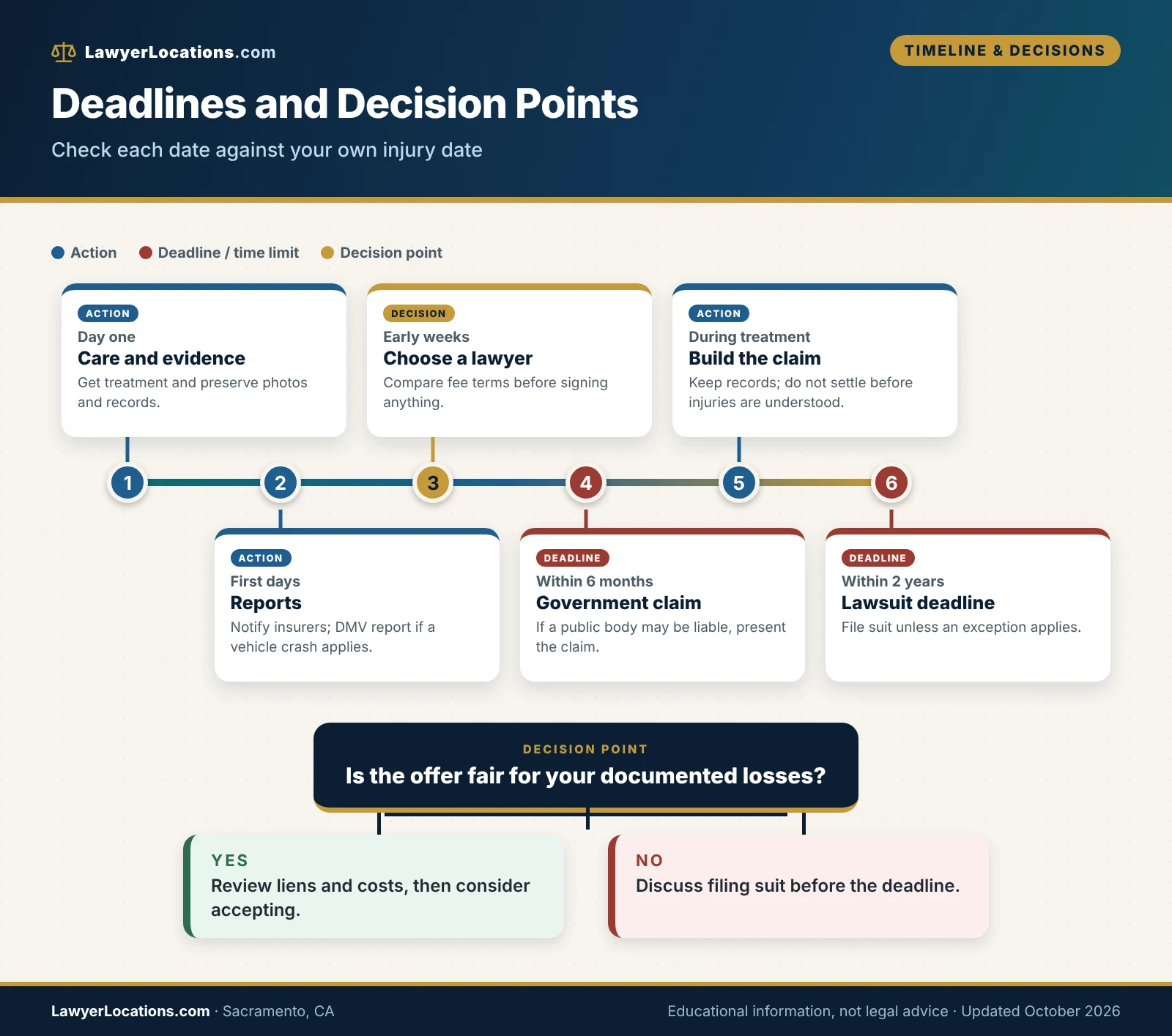
Text version of this graphic
- Day of injury: Seek medical care, preserve evidence, note the date and place.
- Within days: Report to the right insurer or property owner; consider the DMV report if a vehicle crash.
- Early weeks: Consult and compare lawyers; review the fee agreement before signing.
- Before six months: If a public entity may be responsible, present the government claim.
- During treatment: Keep records; avoid settling before the injury is understood.
- Before two years: File the lawsuit if the case has not resolved, unless an exception applies.
Decision point: Is the insurer’s offer fair compared with your documented losses? If yes, consider accepting after the lawyer explains liens and costs. If no, consider filing suit before the deadline.
Early decisions: reporting, signing and treating
Early on you decide what to tell insurers, whether to give a recorded statement and which lawyer to hire. You are generally not obligated to give the other driver’s insurer a recorded statement, and it is usually wise to speak with a lawyer before doing so. Your own insurer has different rules, so read your policy.
Middle decisions: when to demand and when to file
Midway through the process you decide whether to push for settlement, how long to keep treating, and when to file suit. The two-year deadline and any government claim window are hard stops, so many lawyers file a lawsuit well before those dates if negotiations are not moving.
Late decisions: accept, reject or go to trial
Near the end, you decide whether an offer is acceptable. Ask your lawyer to explain the likely range, the risks of trial, the effect of liens and costs, and the timeline for payment. Do not feel rushed by an insurer’s deadline to accept; a lawyer can tell you whether it is real.
Signing a release with an insurer ends your claim. Once you sign, you generally cannot ask for more, even if your condition worsens. Have a lawyer review any release before you sign it.
Evidence, Mistakes and Preparing for the First Call
A well-prepared first consultation saves time and often improves the quality of the advice you receive. Gather the documents below, list your questions, and avoid the handful of mistakes that insurers rely on.
Documents and evidence to gather
You do not need everything before you call a lawyer, but starting a folder now makes the first conversation more useful. Keep both paper and digital copies in one place.
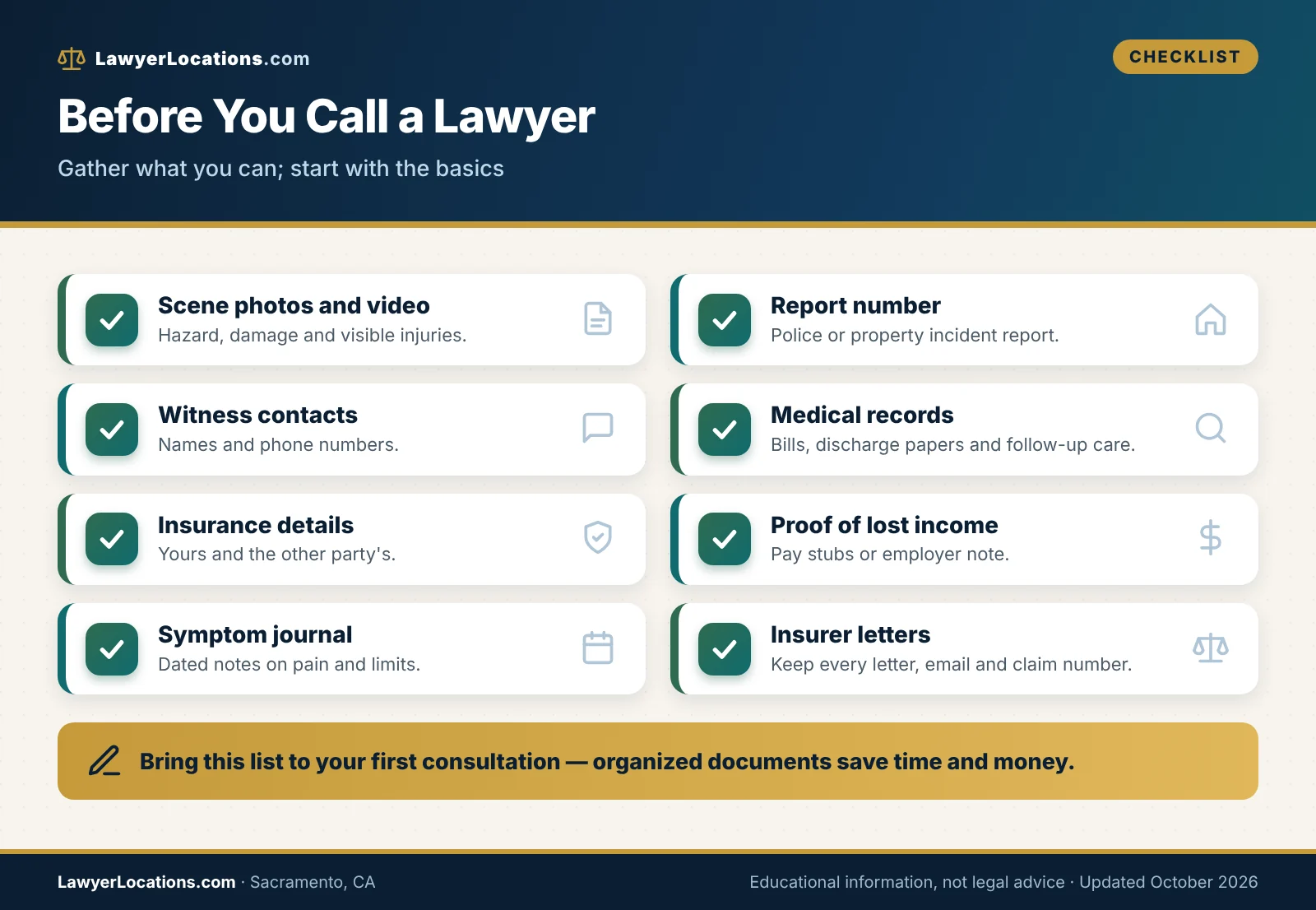
Text version of this graphic
- Photos and video of the scene, hazard and injuries
- Police or incident report number
- Names and contact details of witnesses
- Medical records, bills and discharge papers
- Insurance information for all involved
- Pay stubs or proof of missed work
- A dated journal of symptoms and daily limits
- Any letters or emails from insurers
Scene, injury and witness evidence
- Photographs of the location, the hazard, vehicle damage and your injuries over time.
- The report number from the police or the property owner’s incident report.
- Names and phone numbers for witnesses.
- Any surveillance footage a business may have, noted early because recordings are often overwritten.
Ask a lawyer promptly about sending a preservation request for video or maintenance records.
Medical, financial and insurance records
- Medical records and bills, including emergency, imaging and follow-up care.
- Proof of lost income, such as pay stubs or a note from your employer.
- Your own auto or health insurance policy information.
- Every letter, email and claim number from any insurer.
These documents let a lawyer judge the size of the claim quickly and spot lien issues early.
Mistakes that hurt injury claims
Insurers are professionals at limiting payouts. Most of the damage to a claim comes from ordinary human choices made in the first weeks.
Statements, social media and settlement shortcuts
- Giving a recorded statement to the other side’s insurer before you understand your injuries.
- Posting about the incident or your activities on social media.
- Accepting a quick check before you know the full extent of treatment.
- Guessing about fault or apologizing at the scene.
Each of these can be used later to argue the claim is smaller or the fault is yours.
Treatment gaps and missed deadlines
Skipping medical appointments invites an insurer to argue you were not seriously hurt. Missing a filing deadline is worse, because it can end the claim no matter how strong the facts are. If you are unsure which deadline applies, assume the shortest one and ask a lawyer quickly; our guide on whether you need a lawyer after a car accident can help you decide how soon to call.
Preparing for your first consultation
The first meeting is a two-way interview. You are deciding whether to hire the lawyer as much as the lawyer is deciding whether to take the case.
Questions to bring
Bring a written list: which deadlines apply, what the fee percentage is at each stage, how costs are handled, who will work on the file and how you will be kept informed. Add questions specific to your situation, such as how a public-entity claim would be handled or what happens if you were partly at fault. Take notes, and ask for the answers about fees in writing.
What to expect from the meeting
Expect the lawyer to ask about the facts, review the documents you brought and explain, in general terms, how a case like yours would be handled. A lawyer should not promise a result. If the firm declines the case, ask whether they see a deadline problem so you can keep looking promptly, and remember that a decline from one firm is not a verdict on your claim.
Reading a website, including this one, does not create an attorney-client relationship. Confidentiality and legal duties begin only when a lawyer agrees to represent you, so be careful about what you send before that point.
Common Questions and Next Steps
The short answers below pull together the most frequent Sacramento questions. They are general information and do not replace advice from a California-licensed lawyer who has reviewed your facts.
Quick answers about Sacramento injury claims
Use these as a starting point for your own questions. Where a deadline is involved, treat the shortest possible period as your working date.
How to use these answers
Each answer below is a starting point, not a verdict on your case. If your facts involve a public body, a minor, a death or an unusual deadline, confirm the details with a California-licensed lawyer before you rely on a general answer.
Short answers on deadlines, courts, fees and lawyers
How long do I have to file a personal injury lawsuit in California?
For most injury or death claims the general period is two years under Code of Civil Procedure section 335.1, though exceptions exist. Claims against public entities require a government claim first, usually within six months.
What if the city or county caused my injury?
Present a written claim to the correct public body within six months of the injury, then watch for its written response. After a written rejection you generally have six months to file suit.
Where do I file a personal injury lawsuit in Sacramento?
Civil lawsuits generally begin in the Superior Court of California, County of Sacramento, with the civil division listed at the Gordon D. Schaber Courthouse at 720 9th Street. A lawyer will confirm the proper venue for your facts.
Can I handle a smaller claim without a lawyer?
Possibly. Individuals can bring claims of $12,500 or less in small claims court, and the Sacramento court lists a small claims advisory clinic for procedural information. Injuries with ongoing treatment or disputed fault are usually worth discussing with a lawyer first.
How much does a personal injury lawyer cost in Sacramento?
Many work on contingency, taking a percentage of any recovery, and California law says that percentage is negotiable and must be in a signed written agreement. Compare percentages, cost handling and what changes if the case is filed in court.
How do I know a Sacramento lawyer is licensed?
Search the lawyer’s name or bar number on the State Bar of California’s attorney licensee search and compare the profile to your paperwork.
Do I have to report a car crash to the DMV?
The DMV’s SR 1 form says the driver must report within 10 days when there is an injury, a death or property damage over $1,000. Insurance agents and attorneys can file it for you.
What if I was partly at fault?
California uses a comparative fault approach, so shared blame usually reduces rather than eliminates recovery. Exceptions apply in specific situations, such as the uninsured-driver limits in Civil Code section 3333.4.
Where can I find a lawyer referral in Sacramento?
Start with the State Bar’s page of certified lawyer referral services for the Sacramento area, and use the court’s legal referral page for 2-1-1 Sacramento and the public law library.
Putting it together
The practical sequence is short: protect your health, note your deadlines, collect your records, and compare lawyers on written terms. Doing those four things in the first few weeks leaves you with the most options.
A simple next-steps plan
- Write down the date and place of the injury. Every deadline is counted from it.
- Decide whether a public body may be involved. If so, calendar the six-month claim window right away.
- Gather your documents. Use the checklist in this guide.
- Consult two or three lawyers. Verify licenses with the State Bar and compare fee terms in writing.
- Read the fee agreement at home. Confirm the contingency percentage, cost handling and lien terms.
Finding the right personal injury lawyer in Sacramento, CA
The right personal injury lawyer in Sacramento, CA is one who is licensed, explains the local and statewide rules in plain language, puts the fee terms in writing, and communicates in a way that suits you. Take your time within the deadlines, ask direct questions and trust the lawyers who answer them directly.
Ready to compare your options?
Use the questions and worksheet in this guide to speak with more than one California-licensed lawyer, and bring your records to each meeting. For a deeper look at timing, read our car accident settlement timeline next.
General information only. This article is legal information, not legal advice, and reading it does not create an attorney-client relationship. LawyerLocations.com is a legal-education and lawyer-discovery resource, not a law firm, and it does not endorse or rank individual lawyers. Laws, fees, court procedures and agency practices change, and your facts may change the answer. Consult a lawyer licensed in California about your situation, and confirm deadlines and current fees with the court or agency before you act.
Sources & References
Show all 17 sources
- Court Locations, Superior Court of California, County of Sacramento — Superior Court of California, County of Sacramento — saccourt.ca.gov — accessed October 2026
- Civil Self-Help Services — Superior Court of California, County of Sacramento — saccourt.ca.gov — accessed October 2026
- Legal Referral Resources — Superior Court of California, County of Sacramento — saccourt.ca.gov — accessed October 2026
- Statewide Civil Fee Schedule (rev. January 1, 2024) — Superior Court of California, County of Sacramento — saccourt.ca.gov — accessed October 2026
- Civil cases in California — California Courts Self-Help Center — selfhelp.courts.ca.gov — accessed October 2026
- California Code of Civil Procedure section 335.1 — Justia — law.justia.com — accessed October 2026
- California Government Code section 911.2 — Public.Law — california.public.law — accessed October 2026
- California Government Code section 945.6 — Public.Law — california.public.law — accessed October 2026
- California Business and Professions Code section 6147 — Public.Law — california.public.law — accessed October 2026
- California Civil Code section 1431.2 — Public.Law — california.public.law — accessed October 2026
- California Civil Code section 3333.4 — Public.Law — california.public.law — accessed October 2026
- Find a Sacramento and Northern California Area Lawyer Referral Service — State Bar of California — calbar.ca.gov — accessed October 2026
- Attorney Licensee Search — State Bar of California — apps.calbar.ca.gov — accessed October 2026
- Insurance Requirements — California Department of Motor Vehicles — dmv.ca.gov — accessed October 2026
- Report of Traffic Accident (SR 1) — California Department of Motor Vehicles — qr.dmv.ca.gov — accessed October 2026
- How to File a Claim — City of Sacramento — cityofsacramento.gov — accessed October 2026
- Filing a Claim — County of Sacramento — personnel.saccounty.net — accessed October 2026
Legal Disclaimer and Limitation of Liability
Informational and illustrative purposes only. This article was prepared by LawyerLocations.com solely on the basis of the information available to us at the time of writing. It is an illustrative, general overview. It is not a complete or authoritative statement of the law, and it has not been reviewed by a lawyer licensed in your state or county.
Not legal advice. Nothing in this article is legal, financial, tax or immigration advice, and reading it does not create an attorney-client relationship between you and LawyerLocations.com or any author, lawyer or firm mentioned. Laws, court rules, fees, filing deadlines and agency procedures differ by state, county and court, and they change often. Some details here may be simplified, incomplete or out of date, and time limits for legal claims can be short.
No warranty. We make no representation or warranty, express or implied, about the accuracy, completeness, timeliness or suitability of this content for your situation. Please do not rely on it to make, delay or skip any legal decision. Check the facts against official sources and speak with a licensed attorney in the relevant jurisdiction before you act.
Limitation of liability. To the fullest extent permitted by law, LawyerLocations.com and its owners, authors and contributors disclaim all liability for any loss, damage, cost or other consequence arising from the use of, or reliance on, this article, including any content on third-party websites we link to. Mentioning a lawyer, firm, organization or service is not an endorsement and is not a promise of any result. If you are in immediate danger, contact your local emergency number.