In the legal separation vs divorce question, the core difference is simple: a legal separation changes your rights and duties but leaves you married, while a divorce ends the marriage and lets both of you remarry. Both can produce court orders on property, debts, support and parenting. Not every state offers a formal legal separation, and the rules on residency, waiting periods, taxes, health insurance and federal benefits can differ sharply from one choice to the other.
This national guide, current as of October 2026, compares the two paths, shows how states differ, flags the benefit and tax traps, and explains when a family lawyer is worth hiring. It is general legal information, not advice for your situation.
Legal Separation vs Divorce: The Core Difference
A legal separation keeps the marriage intact on paper while a court sets the practical rules for living apart. A divorce ends the marriage itself. Everything else in this guide builds on that one distinction.
What each path does to your marital status
Marital status is the legal fact that drives taxes, benefits, inheritance and the right to remarry. The two paths treat it very differently.
Legal separation: still married, with court orders
A legal separation is a court judgment (in states that offer it) that lets spouses live apart under enforceable orders without ending the marriage. The orders can cover who pays what, who lives where, how the children are cared for and how property and debts are handled while you are apart.
Because the marriage continues, you cannot legally remarry while separated. California’s court system, for example, states plainly that you stay legally married after a legal separation and cannot marry or enter a domestic partnership with someone else.
Divorce: the marriage ends and you can remarry
A divorce (also called dissolution of marriage in many states) is a final judgment that terminates the marriage. Each person returns to single status, and the court divides the marital property and debts and decides support and parenting issues as part of the same judgment.
The finality is the point for many people, and also the reason others hesitate. Once the decree is entered, benefits that depend on being a spouse, such as coverage under the other spouse’s employer health plan, generally end or change.
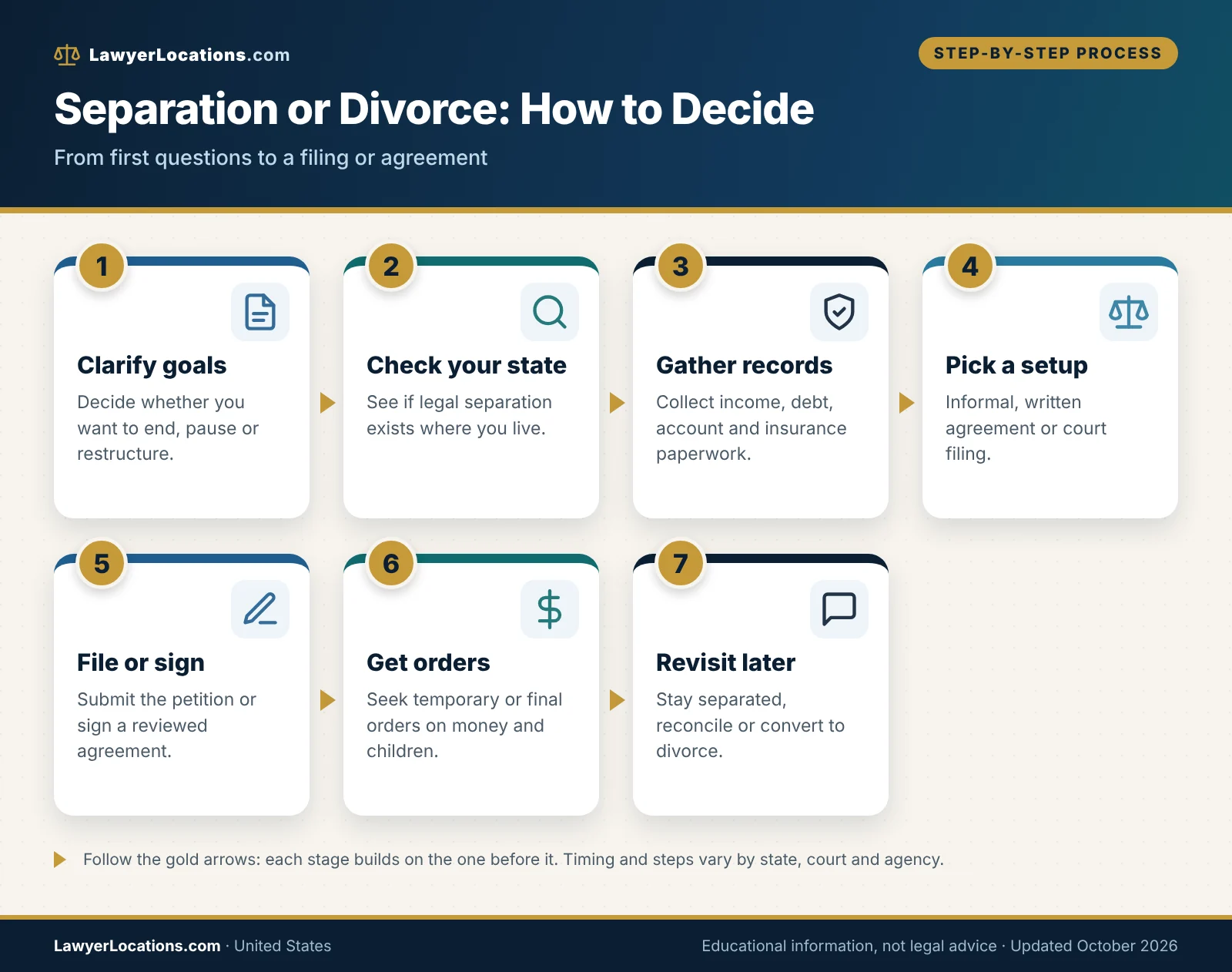
Text version of this graphic
- Clarify your goals: end the marriage, pause it, or protect benefits for now.
- Check your state: does it offer legal separation, or only divorce and support orders?
- Gather financial records: income, debts, accounts, insurance and retirement plans.
- Decide the interim setup: informal separation, written agreement, or court filing.
- File or sign: a separation petition, a divorce petition, or a separation agreement.
- Get temporary or final orders on support, parenting and property.
- Revisit later: stay separated, reconcile, or convert to divorce.
Legal separation, informal separation and separation agreements
People use the word “separated” for three different situations. Only one involves a judge, so it pays to know which one you are in.
Informal or “trial” separation
An informal separation means you simply live apart, with no court case and no written terms. It costs nothing to start, but nothing is enforceable. Either spouse can still run up joint debt, and a spouse who stops paying the mortgage has not broken any court order because none exists.
Some states treat the date you began living apart as legally meaningful anyway, because a period of living “separate and apart” can be a ground or a waiting-period clock for divorce. Write down the date and the circumstances.
Separation agreements: a contract, not a decree
A separation agreement is a written contract between spouses that covers support, parenting, property and debts while they live apart. It is not the same thing as a court-issued legal separation, though a court can sometimes approve an agreement and make it part of a judgment.
The IRS recognizes the difference in one narrow setting: payments under a written separation agreement can count as alimony for tax purposes under older rules, even while spouses share a household, as long as they are not legally separated under a decree. More on that tax history in the benefits section below.
Side-by-side comparison
The table below puts the two paths next to each other on the issues people ask about most. Treat it as a map, because state law fills in the details.
| Issue | Legal separation | Divorce |
|---|---|---|
| Marital status | Still legally married | Marriage legally ends |
| Remarriage | Not allowed | Allowed once the judgment is final |
| Court orders on support, custody, property | Available in states that offer separation | Available in every state |
| Employer health plan for a spouse | Depends on plan terms; legal separation can trigger COBRA rights | Spouse generally loses coverage; COBRA rights may apply |
| Federal tax filing status | Unmarried for the year only with a final decree of separate maintenance; otherwise still married | Unmarried for the whole year if the decree is final by December 31 |
| Social Security divorced-spouse benefits | Not available; you are still married | Possible if the marriage lasted at least 10 years and other rules are met |
| Reversibility | Easier to reconcile; can often be converted to divorce | Reconciliation requires remarrying |
| Typical state availability | Not offered as a decree in every state | Every state |
What stays the same in both paths
Courts decide parenting time and child support using the child’s interests in either case, and a divorce is not required before a judge can order child support. Florida’s statute, for instance, lets a spouse ask a court for alimony and child support without seeking dissolution of marriage.
Spousal support, a division of property and orders protecting people from abuse can also be handled in both settings, depending on the state. The difference is mostly about status and the follow-on effects, not about whether the court can help.
What changes only at divorce
Three things generally change only when the divorce is final: the right to remarry, the end of spousal status for taxes and many benefits, and the end of automatic spousal rights such as inheritance in many states. Those effects can be good, bad or neutral depending on your situation.
That is why the decision belongs in a planning conversation, not a rushed filing. A short consult with a family lawyer licensed in your state before you file anything can save you from a choice that is hard to unwind.
Why people choose one over the other
The legal differences matter most when they line up with a personal reason. These are the reasons that come up most often.
Religious or personal beliefs
Some people belong to faith traditions that discourage or do not recognize divorce, or hold personal convictions against ending a marriage. A legal separation lets them get court-ordered structure while leaving the marriage intact. California’s court self-help site lists “religious reasons, personal beliefs, or financial reasons” among the common reasons people choose separation.
A civil divorce, a religious annulment and a religious dissolution are separate processes with separate authorities. A court decree does not decide a faith question, and a religious decision does not change your civil status. If this matters to you, talk with both your religious adviser and a lawyer.
Insurance, benefits and timing
Another common reason is keeping a spouse on an insurance or benefit plan for a while longer. The California court page lists this directly, noting that people sometimes keep a spouse on a plan through separation. Others wait to reach a milestone, such as the 10-year marriage mark that Social Security uses for divorced-spouse benefits.
Do not delay a divorce purely to reach a benefit milestone without confirming the rule. Plans can end spousal coverage at legal separation, and some federal rules count time in different ways. Ask your plan administrator and a lawyer before you build a strategy around a date.
Not ready, or not yet eligible to divorce
Some couples want structure while they decide, especially when children are involved. Others cannot yet file for divorce because of residency rules. In California, a spouse who does not meet the divorce residency requirements may file for legal separation first, because only one spouse has to live in the state, with no minimum time.
A trial period of separation can also give both people room to see whether counseling or a changed arrangement could work. Reconciliation after a legal separation is simpler than remarrying after a divorce.
Which States Offer Legal Separation, and Residency Rules
Many states offer a legal separation judgment, but not all do. A handful of states have no stand-alone decree, and some use older names such as “divorce from bed and board” or “separate maintenance.” Check your own state before you plan around the option.
Three groups of states
The states fall into roughly three groups. The examples below are drawn from state statutes and court pages we opened; other states need a local check.
States with a formal legal separation judgment
California, Illinois, New York and Washington all provide a way to ask a court for a legal separation. California’s courts describe it as an option with no waiting period. Illinois’ statute, 750 ILCS 5/402, provides for a judgment of legal separation and says it does not bar either spouse from later filing for dissolution. New York calls it a judgment of separation under Domestic Relations Law § 200.
Washington’s RCW 26.09.030 says that if a spouse asks for legal separation, the court must enter it unless the other spouse objects. If the other spouse objects and files for dissolution, the court does not have to enter legal separation.
States that use “bed and board” or separate-maintenance remedies
Some states keep an older remedy. Virginia’s Va. Code § 20-95 allows a divorce from bed and board on grounds that include cruelty, desertion or abandonment, or the parties living separate and apart with the intent of at least one to remain apart permanently. North Carolina’s G.S. 50-7 allows it for fault grounds such as abandonment, cruelty, indignities, excessive drug or alcohol use, and adultery.
These remedies are not the same as an ordinary no-fault separation. They can require proving fault, and they do not end the marriage. Other states use “separate maintenance” or “separate support” actions; a secondary legal-reference source lists Georgia, Massachusetts, South Carolina and Utah among them.
States with no stand-alone legal separation decree
Florida, Texas and Pennsylvania do not issue a stand-alone legal separation decree, according to a secondary legal-reference source; Maryland repealed its limited divorce effective October 1, 2023. We opened Maryland’s 2023 repeal act and confirmed the repeal of Family Law § 7-102, which had given courts authority to grant a limited divorce.
That does not mean spouses in those states are stuck. Florida’s Fla. Stat. § 61.09 lets a spouse seek alimony and child support without seeking dissolution of marriage. Pennsylvania treats a period of living apart as a divorce ground rather than a separate decree, and Texas has no separation action but still allows child support and property orders in other contexts.
If you live in a state with no separation decree, ask a local lawyer what the closest substitute is: a support order without divorce, a written separation agreement, or simply filing for divorce and asking for temporary orders while the case is pending.
State comparison table
This table shows only what we verified from statutes or official court pages in October 2026, plus a clearly labeled secondary-source row. It is not a 50-state list.
| State | What is available | Source we opened |
|---|---|---|
| California | Legal separation; no waiting period; only one spouse must live in California | California Courts Self-Help |
| Illinois | Judgment of legal separation; does not bar a later dissolution filing | 750 ILCS 5/402 |
| New York | Judgment of separation on six listed grounds, including irretrievable breakdown for at least six months | N.Y. Dom. Rel. Law § 200 |
| Washington | Legal separation entered unless the other spouse objects and seeks dissolution | RCW 26.09.030 |
| Virginia | Divorce from bed and board; separate-and-apart grounds | Va. Code § 20-95 |
| North Carolina | Divorce from bed and board on fault grounds; one year apart for full divorce | G.S. 50-7 and 50-6 |
| Maryland | Limited divorce repealed effective October 1, 2023 | 2023 Md. Laws ch. 646 |
| Florida | No stand-alone decree reported; support without dissolution available | Fla. Stat. § 61.09; secondary source for the “no decree” point |
| Texas | No stand-alone separation action reported; divorce residency and waiting rules apply | Tex. Fam. Code §§ 6.301, 6.702; secondary source for the “no action” point |
| Pennsylvania | No stand-alone decree reported; divorce by mutual consent or one year apart | 23 Pa.C.S. § 3301; secondary source for the “no decree” point |
How to read the table
A “legal separation” in one state may be a complete package of orders, while in another it may be a narrow remedy for support. Do not assume that a friend’s experience in a different state applies to you.
The rows that rely on a secondary source are the ones most worth confirming on your own state court’s self-help site or with a local lawyer.
Why states missing from the table need a local check
We did not verify every state. If yours is not listed, search for your state court system’s self-help page on separation and divorce, or call the clerk of the family or circuit court and ask what forms exist for separation.
A good question to ask: “Does this state issue a legal separation judgment, and if not, what is the closest option?” Clerks cannot give legal advice, but they can usually tell you which forms exist.
Residency requirements and waiting periods
Most states require that at least one spouse has lived in the state for a set time before filing. Some also add a waiting period before a divorce can become final. Separation can be quicker to start in some places.
Residency rules for filing
Residency requirements are set by each state and sometimes by each county. Texas requires that one spouse has been a domiciliary of the state for six months and a resident of the filing county for 90 days (Tex. Fam. Code § 6.301). Florida requires six months of residence before filing for dissolution (Fla. Stat. § 61.021). North Carolina requires six months in the state for a divorce under G.S. 50-6.
California requires six months in the state and three months in the filing county for divorce, but only that one spouse live in California for legal separation, with no minimum time.
Waiting periods before a divorce is final
Several states build in a cooling-off period or separation clock. Together with residency, these numbers shape whether separation first makes sense for your timeline.
| State | Residency before filing | Waiting or separation period |
|---|---|---|
| California | 6 months in state, 3 months in county (none for legal separation beyond living in the state) | Earliest final divorce is 6 months after service or response; none for legal separation |
| Texas | 6 months in state, 90 days in county | No divorce before the 60th day after filing, with a family-violence exception |
| Florida | 6 months in state | Check your state’s rule |
| Washington | Check your state’s rule | 90 days after filing and service |
| Pennsylvania | Check your state’s rule | Mutual consent: 90 days after filing; otherwise one year living separate and apart |
| Virginia | Check your state’s rule | One year apart; six months if there is a separation agreement and no minor children |
| North Carolina | 6 months in state | One year living separate and apart |
| Maryland | Check your state’s rule | Six-month separation ground after the 2023 changes |
Waiting periods usually start on a specific event, such as filing, service or the day you began living apart. If your state counts from a date you can prove, keep a record of it. If it counts from service, the clock may not start until your spouse is formally served.
Property, Debts, Support and Parenting
The money and parenting questions are the heart of both processes. A separation order and a divorce judgment can both address them, but a divorce settles them for good in a way separation often does not.
Property and debts
Marital property is generally what either spouse earned or acquired during the marriage, though states differ on what counts and how it is divided. Debts follow similar rules, with one big wrinkle: creditors are not bound by your court order.
Dividing property while you are separated
In states with a formal separation judgment, property can sometimes be divided or managed, often by agreement. In states without one, a written separation agreement or a divorce case with temporary orders usually does the job. Community-property states and equitable-distribution states use different starting rules, so the same facts can lead to different results.
If you own a home, retirement accounts, a business or a pension, get the account statements and valuation records early. Dividing a retirement plan usually takes a special court order, so ask your lawyer which kind your plan needs.
Debts, joint accounts and credit cards
A court order or agreement that says your spouse will pay a joint credit card binds the two of you. It does not bind the credit card company, which can still pursue either name on the account. Separation does not end joint liability to creditors, and neither does a divorce decree on its own.
Practical steps that often help: close or freeze joint credit lines when you can do so legally and by agreement, keep records of what each spouse pays, and pull your credit reports so there are no surprises.
Before moving money, check whether your state or court imposes automatic financial restrictions once a case is filed. Many courts discourage large transfers, hiding assets or running up new debt during a case. A lawyer licensed in your state can tell you what applies.
Spousal support and child support
Support is the part of separation that most people need first, because two households cost more than one. Support does not require a divorce in many states.
Spousal support during separation
Support while living apart is sometimes called temporary maintenance, spousal support or alimony. Florida’s Fla. Stat. § 61.09 states that a spouse who is not receiving support may apply to the court for alimony without seeking dissolution of marriage. Illinois’ 750 ILCS 5/402 likewise provides a remedy for reasonable support and maintenance while spouses live apart.
How much support, and for how long, depends on state law, the length of the marriage, each spouse’s income and other factors. We do not quote averages, because no reliable national figure exists.
Child custody and child support
Parenting orders, called custody, parenting time or a parenting plan depending on the state, can be set whether the parents separate or divorce. Courts focus on the child’s best interests in both. The statute you need is your state’s, and which state’s court has authority can itself become a question if the family has moved recently.
Child support is also available without a divorce. If you are comparing paths for the sake of the children, remember that their schedule, schooling and support can usually be settled under either, so the choice is more about your own legal status.
Two parents in a state with no separation decree agree to live apart. One files a case asking for child support and a temporary parenting schedule while the other keeps paying the mortgage. They have not divorced, and they are not expected to decide on divorce until later. The details are state-specific, which is why a local family lawyer’s read of the options is worth the time.
Inheritance, beneficiaries and estate plans
A legally separated spouse is still a spouse. That has estate-planning consequences that surprise many people.
Spousal inheritance rights
In most states, a surviving spouse has inheritance rights unless they have waived them or the marriage has ended. A legal separation alone generally does not remove those rights, although some states treat a decree of separation differently, so check the rule where you live.
If you want to change what happens at your death, you generally need a new will, trust or beneficiary designation. A living trust lawyer can explain how those documents interact with state spousal-rights rules.
Beneficiary forms and retirement accounts
Life insurance and retirement accounts usually pay whoever is named on the form, regardless of what your will says. Review each one when you separate, and ask first whether a court order or automatic restriction in your state limits changes during a pending case.
Federal retirement plans, such as employer plans governed by ERISA, may follow their own plan documents. When in doubt, ask the plan administrator in writing and keep the answer.
Health Insurance, Taxes and Federal Benefits
The biggest practical differences between the two paths often show up here. Health coverage, tax filing status and federal benefits can turn on whether you are legally separated or divorced, and on the exact date a decree becomes final.
Health insurance after separation or divorce
Whether your spouse keeps coverage depends on the plan’s own rules, federal COBRA rights and the marketplace.
Employer plans and COBRA
The U.S. Department of Labor lists divorce or legal separation as a COBRA qualifying event for a spouse and dependent children who lose coverage because of it. A spouse can generally have up to 36 months of continuation coverage. The plan may set a time limit for the notice, but it cannot be less than 60 days, and the plan must give at least 60 days to elect COBRA.
The key practical point is that COBRA applies when coverage is lost. Some employer plans keep covering a legally separated spouse until divorce; others drop them at separation. Read the plan’s summary plan description and call the administrator before you file anything.
Marketplace coverage
HealthCare.gov says that getting divorced or legally separated and losing health insurance qualifies you for a Special Enrollment Period, which gives you a limited window to enroll outside the usual open enrollment. The page also says that a divorce or legal separation without losing coverage does not qualify, and it sets the household-change window at 60 days.
If you are already a household of one and cost matters, compare marketplace plans, a new employer plan and COBRA. COBRA can be the most expensive because you may pay the full premium.
Taxes: filing status and alimony
Tax rules look to your status on December 31 of the tax year, not to how you feel about the marriage. Separation and divorce can lead to different results.
Filing status
IRS Publication 504, written for 2025 returns, says you are unmarried for the whole year if you have a final decree of divorce or separate maintenance by the last day of the tax year, and that state law determines whether you are divorced or legally separated. It also says that if you are separated without a final decree by year-end, you are still married for the whole year, and an interlocutory decree is not a final decree.
The publication also describes a head of household rule: you may be treated as unmarried if your spouse did not live in your home during the last six months of the tax year, you file a separate return, you pay more than half the cost of keeping up the home, and the child tests are met. That is a narrow test. Talk with a tax professional before relying on it.
Alimony after the 2018 tax law changes
For divorce or separation instruments executed after December 31, 2018, the payer cannot deduct alimony or separate maintenance payments, and the recipient does not report them as income, according to IRS Topic 452. For older agreements, payments are generally deductible by the payer and taxable to the recipient, and a pre-2019 agreement that is later modified keeps the old treatment unless the modification expressly adopts the new rule.
The IRS also notes that the same-household rule applies only if spouses are legally separated under a decree of divorce or separate maintenance. Child support is never deductible and never income. This is federal tax law, so it does not change by state.
Do not copy tax language from a friend’s older agreement. An agreement signed before 2019 may use a different tax rule, which can make a major difference in what each spouse takes home.
Social Security, military and immigration
Federal programs use their own definitions of marriage and divorce. Some treat a legally separated couple as still married, and some count the length of the marriage only to the divorce date.
Social Security
The Social Security Administration says divorced-spouse benefits require that you were married to your ex-spouse for 10 years or more, are unmarried, are at least 62, and that your ex is entitled to retirement or disability benefits. You can apply even if your ex has not retired if you have been divorced at least two years. The benefit can be up to one-half of your ex-spouse’s full retirement amount and does not reduce your ex-spouse’s own benefit.
A legally separated spouse is still married, so these divorced-spouse rules do not apply until a divorce is final. Because the 10-year clock is tied to the length of the marriage, the timing of a divorce can matter. Confirm your situation with the SSA before choosing a date.
Military pay and health care
For military families, two federal rules matter most. Under the Uniformed Services Former Spouses’ Protection Act, the Defense Finance and Accounting Service (DFAS) pays a former spouse directly when the marriage overlapped at least 10 years of military service, and the maximum a former spouse can receive is 50 percent of disposable retired pay, according to a South Dakota court-system guide. Below that threshold, the service member generally pays the former spouse directly.
For health care, TRICARE says a former spouse’s benefits end on the day of the divorce or annulment, and that some former spouses stay eligible under the 20/20/20 rule (20 years of marriage, 20 years of service and a full overlap) or the 20/20/15 rule (at least 15 years of overlap, with a time limit). The TRICARE pages we opened do not discuss legal separation, so confirm the effect of a separation decree with your local ID card office.
Immigration
USCIS policy treats these paths differently. For naturalization under the spouse-of-a-citizen provision, a legal separation means you are not “living in marital union,” and a legal separation during the required period makes the applicant ineligible. A divorce ends the marital relationship and has the same effect. An informal separation matters mainly if it suggests marital disunity, and officers weigh factors such as the length of the separation and whether the spouses still support each other.
Other marriage-based immigration cases can turn on whether the marriage is ongoing, so speak with an immigration lawyer before you separate or file. A guide to green card lawyers explains how to compare them. Separation or divorce must never be handled casually when status is at stake.
| Benefit or rule | Legal separation | Divorce |
|---|---|---|
| COBRA continuation coverage | A qualifying event if coverage is lost because of separation | A qualifying event; up to 36 months for a spouse |
| Marketplace Special Enrollment Period | Yes if you lose coverage; 60-day window | Yes if you lose coverage; 60-day window |
| Tax filing status | Unmarried only with a final separate maintenance decree by December 31 | Unmarried all year if final by December 31 |
| Alimony tax treatment | Post-2018 instruments: not deductible, not income | Same |
| Social Security divorced-spouse benefit | Not yet available | Possible after 10-year marriage, age 62 and other rules |
| TRICARE | Not addressed on the pages we opened | Former-spouse coverage ends at divorce unless 20/20/20 or 20/20/15 applies |
| Naturalization (spouse of U.S. citizen) | Not living in marital union during legal separation | Ineligible under that path after divorce |
When a Lawyer Matters and How to Compare One
You can start a separation or divorce without a lawyer in most places, and some simple cases finish that way. A lawyer matters most when children, retirement money, military or immigration issues, a business or safety concerns are involved, or when your spouse has a lawyer.
When legal advice is worth it
The cost of one consultation is usually small compared with the cost of a bad agreement that is hard to change. These are the situations where advice tends to pay for itself.
Situations that call for a family lawyer
Consider talking to a lawyer licensed in your state before you file or sign anything if any of the following apply:
- You have children and disagree about where they will live or how decisions will be made.
- One spouse has a pension, a military retirement or several retirement accounts.
- One of you is not a U.S. citizen, or immigration status could be affected.
- You own a business, rental property or a home with significant equity.
- Your spouse has a lawyer, or you have a prenuptial or postnuptial agreement. Our prenup lawyer guide for Miami-Dade County explains how those agreements are reviewed.
- There has been abuse, threats or controlling behavior.
If you are in California, our California family law attorney guide walks through the state’s process in more detail.
When limited help may be enough
Some couples agree on nearly everything and need only forms and a review. Many courts have self-help centers, and some lawyers offer limited-scope help, such as reviewing a draft agreement for a flat or hourly fee. That can be a middle path if your situation is simple and you both cooperate.
A limited-scope arrangement should be in writing and should say exactly what the lawyer will and will not do. If a dispute surfaces, you may need to upgrade to full representation.
How to compare family lawyers
LawyerLocations.com is a legal-education and lawyer-discovery resource, not a law firm, and does not rank or recommend lawyers. The questions below help you compare any lawyer you find, wherever you find them.
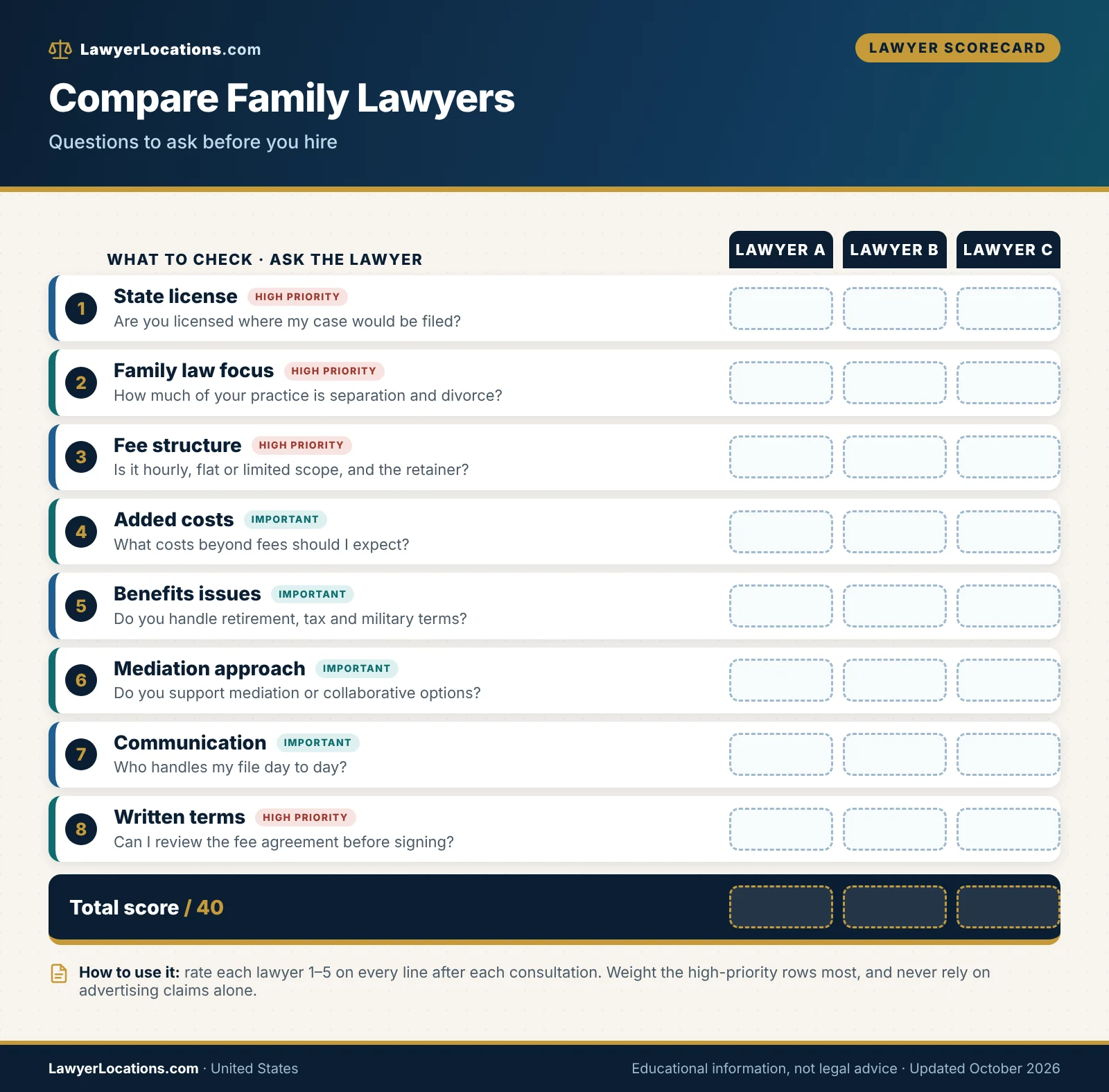
Text version of this graphic
| Criterion | Question to ask | Weight |
|---|---|---|
| State license | Are you licensed in the state where my case would be filed? | High |
| Family law focus | How much of your practice is separation and divorce? | High |
| Fee structure | Is it hourly, flat or limited-scope, and what is the retainer? | High |
| Added costs | What costs besides fees should I expect? | Medium |
| Benefits issues | Do you handle retirement, military or tax-sensitive terms? | Medium |
| Mediation approach | Do you support mediation or collaborative options? | Medium |
| Communication | Who handles my case day to day, and how do we communicate? | Medium |
| Written terms | Can I review the fee agreement before signing? | High |
Experience, licensing and fees
Start with the basics: confirm the lawyer is licensed in your state and in good standing by checking the state bar’s attorney lookup. Ask how much of the lawyer’s practice is family law, whether they have handled issues like yours, and who else in the office will work on your file.
On fees, ask whether the lawyer charges hourly, by flat fee for defined tasks, or by retainer, what the retainer is, and how it is replenished. Ask for an estimate in writing, and ask what could make the total go up. We do not quote average fees because they vary too much by place and case.
Red flags when hiring
- A promise of a particular outcome, or an assurance about child custody or support results.
- Pressure to sign the same day or to sign without a written fee agreement.
- Reluctance to explain how fees, retainers and costs are billed.
- Advice to hide assets, move money or ignore a court deadline.
- Trouble getting a straight answer about whether legal separation even exists in your state.
A good first meeting leaves you with a clearer map of your options, not a rush to file.
Preparing for a consultation
A little preparation makes a consultation far more useful. Bring documents and a short list of questions so the time goes to your decisions, not to hunting for paperwork.
Documents and information to gather
Gather what you can without taking anything that is not yours. Ask whether a document may be shared before copying files from a shared account.
- Recent tax returns and pay stubs for both spouses.
- Bank, credit card, mortgage and retirement account statements.
- Insurance policies and the health plan summary.
- Any prenuptial or postnuptial agreement.
- Marriage date, children’s birth dates and the date you began living apart.
- A short written timeline of key events and concerns.
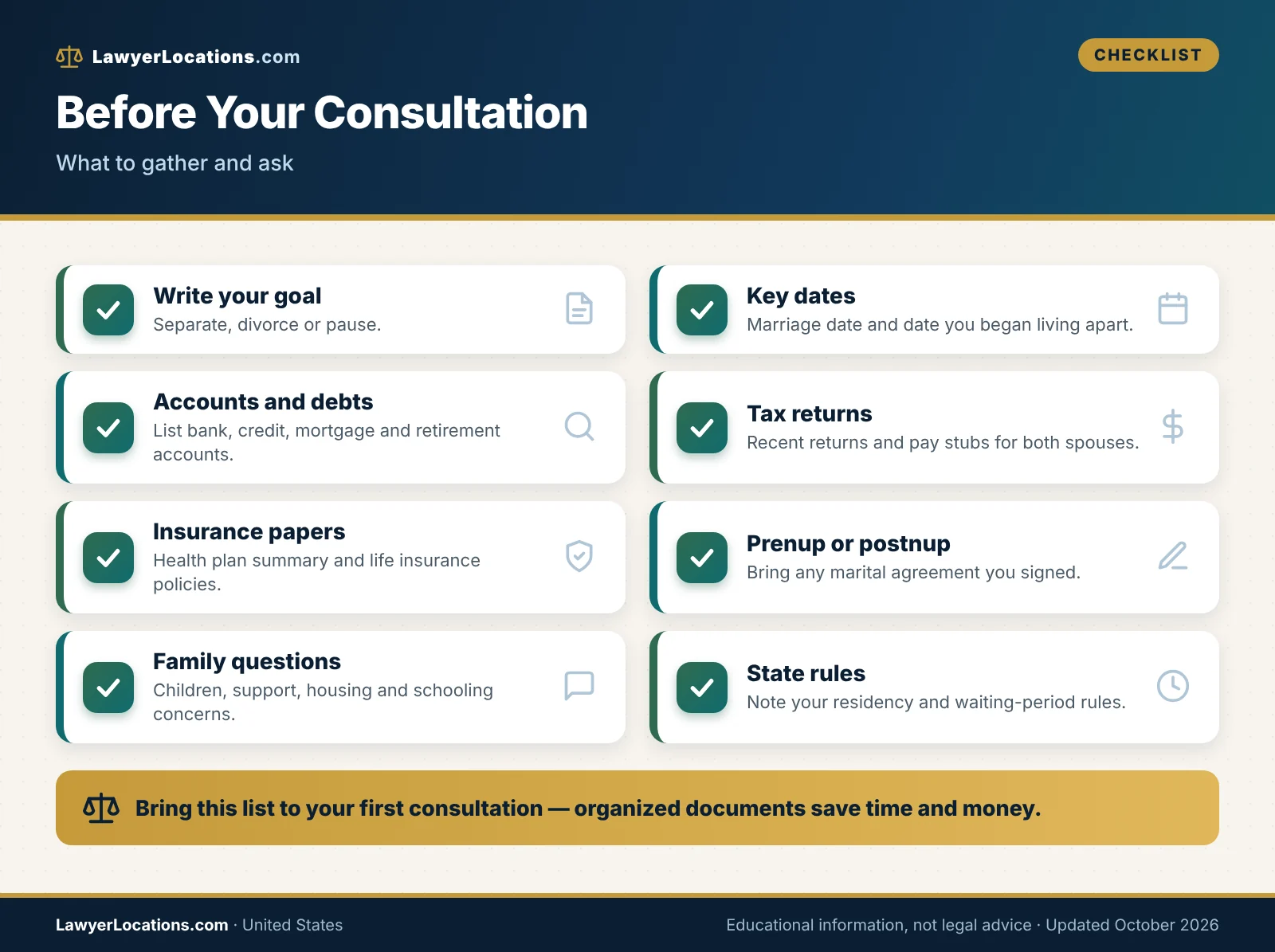
Text version of this graphic
- Write your goal: separate, divorce or pause.
- Note your marriage date and the date you began living apart.
- List all accounts, debts and retirement plans.
- Gather recent tax returns and pay stubs.
- Copy insurance and benefit plan summaries.
- Collect any prenuptial or postnuptial agreement.
- Write down questions about children, support and housing.
- Check your state’s residency rule.
Questions to bring
Ask the lawyer whether your state offers legal separation, what it would do differently from divorce, how it affects your health plan and taxes, and what happens if you later convert to divorce. Ask what a realistic timeline looks like and what your first three steps would be.
Take notes, and ask for any advice you rely on to be summarized in writing. Reading this page does not create an attorney-client relationship, and only a signed engagement with a lawyer does.
Converting to Divorce, Separation Agreements, Cost and Mediation
A separation is often a stop on the way to either reconciliation or divorce. Understanding how you convert, what a separation agreement should contain and what drives cost helps you plan.
Converting a separation to a divorce
Many people start with separation and later decide to divorce. The rules for that switch depend on your state and on how far the separation case has gone.
Amending or filing a new case
California’s court self-help site says you can usually change a legal separation to a divorce if you decide before it is final, by amending the petition, and that a spouse who is served with a separation petition can respond by saying they want a divorce. Illinois’ statute provides that a judgment of legal separation does not bar either party from filing for dissolution, and that the court decides maintenance anew unless an agreement makes it non-modifiable.
In Washington, the court does not have to enter a legal separation if the other spouse objects and petitions for dissolution. In short, a spouse who wants a divorce can usually obtain one even if the other asked only for separation, though the path varies.
When living apart is the clock for divorce
In several states, a period of living apart is a divorce ground, so a separation can also start the clock. Pennsylvania’s 23 Pa.C.S. § 3301(d) allows divorce after the parties have lived separate and apart for at least one year, and North Carolina requires a year apart. Virginia requires one year, or six months if there is a separation agreement and no minor children.
These periods have definitions and proof rules, including whether you can live under the same roof. Document the date and the facts, and ask a lawyer how your state counts the time.
If you want your divorce to be final before December 31 for tax reasons, court processing time and mandatory waiting periods can push a decree into the next year. Start early and ask the clerk how long entry of judgment usually takes.
Separation agreements
A separation agreement is the document most separated couples sign. Done well, it prevents later fights. Done carelessly, it can lock in a bad deal.
What a separation agreement should cover
A thorough agreement usually addresses housing, support, parenting schedules and decision-making, child support, health insurance, the division of property and debts, retirement accounts, taxes, life insurance and what happens if one of you wants to convert to divorce.
- Who pays which bills and when, in clear dollar terms.
- A parenting schedule and a way to resolve disagreements.
- How each spouse will keep or replace health coverage.
- A statement of which tax rules apply, including how alimony is treated.
- How the agreement turns into, or is replaced by, a divorce judgment.
Making it enforceable
Courts generally look for a written, signed agreement made with full disclosure of income and assets and without pressure. Whether a court can enforce your agreement as its own order depends on your state and on how the agreement is presented. Agreements that are never filed or approved may be enforceable only as contracts.
Both spouses should ideally get their own legal review. One lawyer cannot generally represent both sides when their interests conflict.
Cost, timeline and mediation
Cost and speed depend on how much you disagree, not just on which label you choose. A cooperative divorce can cost less than a contested separation.
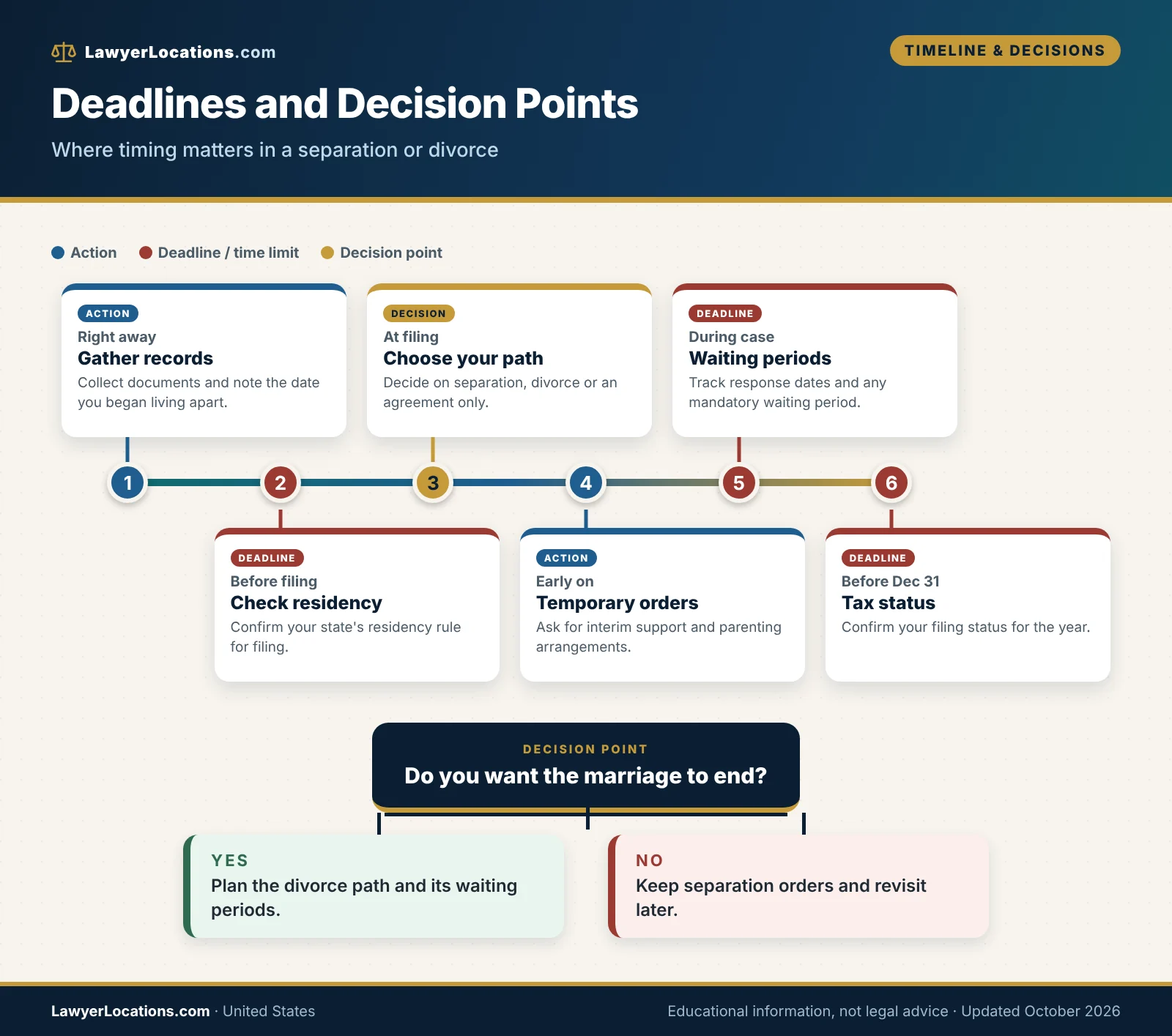
Text version of this graphic
- Right away: gather documents and note the date you began living apart (action).
- Before filing: check your state’s residency rule (deadline).
- At filing: decide separation, divorce or an agreement only (decision).
- Early in the case: ask for temporary orders on support and parenting (action).
- During the case: watch waiting periods and response deadlines (deadline).
- Before December 31: confirm your tax filing status (deadline).
- Later: stay separated, reconcile or convert to divorce (decision).
Decision point: do you want the marriage to end? If yes, plan the divorce path. If no, keep the separation orders and revisit later.
What drives cost
Court filing fees differ by state and sometimes by county, and many courts offer a fee-waiver process for people who qualify. Ask the clerk of your court for the current fee schedule, and ask about fee waivers if money is tight. Lawyer fees depend on hourly rates or flat fees, the complexity of the property and parenting issues, and how much your spouse contests.
Separating first and divorcing later can mean paying for two proceedings, so ask your lawyer to estimate both paths. In some states, there is no stand-alone separation filing, and the choice is moot.
Mediation and collaborative options
Mediation and collaborative processes are voluntary in many places, and they often leave spouses more control over the outcome than a judge-decided case. They are not a fit for every family, particularly where there is abuse or a serious power imbalance.
In mediation, a neutral person helps spouses reach their own agreement. The mediator does not decide for you, and mediation is voluntary in many places, though some courts require it for custody disputes. A mediated agreement can then be reviewed by each spouse’s lawyer and submitted to the court.
Collaborative law is a related process in which each spouse has a lawyer and everyone agrees to settle without going to court. Mediation is not appropriate in every case, especially where there has been abuse or a serious power imbalance. Ask the court and your lawyer what is available in your county.
Common Mistakes, Quick Answers and Next Steps
Most avoidable problems come from rushed decisions, missing documents and assumptions about the law. The sections below pull together the most common slips, short answers to questions people ask most, and a plan for your first week.
Common mistakes to avoid
These mistakes show up again and again, and nearly all of them can be prevented with a little planning.
Legal mistakes
- Assuming your state offers legal separation when it may not.
- Moving out without understanding how it affects custody or support in your state.
- Signing a separation agreement without reviewing the tax, insurance and benefit consequences.
- Ignoring a court deadline or a notice, which can lead to a default order.
- Assuming that an informal separation protects you from a spouse’s new debts.
Money and benefit mistakes
- Letting health coverage lapse without checking COBRA or Special Enrollment Period deadlines.
- Skipping the December 31 tax-status rule.
- Delaying a divorce to reach a benefit milestone without confirming how it is counted.
- Failing to update beneficiary forms, or updating them in violation of a court order.
Quick answers to common questions
These short answers pull together points from earlier sections. Details vary by state, so use them as a starting point.
Questions about eligibility and timing
Is legal separation the same as divorce?
No. A legal separation leaves you married, so you cannot remarry. A divorce ends the marriage.
Which states do not allow legal separation?
A secondary legal-reference source reports that Florida, Texas and Pennsylvania do not issue a stand-alone separation decree, and Maryland repealed its limited divorce effective October 1, 2023. Check your state’s court website, because laws change.
Can I get legally separated without being a resident for months?
It depends on the state. California, for example, requires only that one spouse live in the state for legal separation, with no minimum time.
Can I convert a legal separation to a divorce later?
Usually yes. California lets you amend before the separation is final, and Illinois says a separation judgment does not bar a later dissolution filing.
Do I need a lawyer for a legal separation?
Not always, but advice is wise when children, retirement money, immigration or abuse are involved.
Questions about money and benefits
Does legal separation affect health insurance?
It can. The Department of Labor lists divorce or legal separation as a COBRA qualifying event for a spouse who loses coverage, but whether the plan drops a separated spouse depends on its terms.
How are taxes handled when legally separated?
Under IRS Publication 504, you are unmarried for the year only if you have a final decree of divorce or separate maintenance by December 31. Otherwise you are still married for tax purposes.
Is alimony taxable after 2018?
For instruments executed after 2018, the payer cannot deduct alimony and the recipient does not count it as income, according to IRS Topic 452.
Can I get Social Security from my spouse if we are separated?
You are still married, so divorced-spouse rules do not apply yet. After divorce, benefits generally require a 10-year marriage, age 62 and that you are unmarried.
Is legal separation cheaper than divorce?
Not necessarily. Cost depends on how much you disagree, and separating first can mean two proceedings.
Does separation protect me from my spouse’s debts?
Not by itself. Creditors are not bound by your agreement, so ask a lawyer about closing joint accounts and documenting who owes what.
Your next steps
If you are weighing legal separation vs divorce, the first week is about information, not filing. Take a calm, organized approach and avoid irreversible moves.
A practical first-week plan
- Write down your goal. Do you want the marriage to end, or a pause with structure?
- Check your state’s options. Find your state court’s self-help page on separation and divorce.
- Confirm insurance. Call your health plan administrator about what happens to a spouse.
- Collect financial records. Use the checklist above.
- Book a consultation. Ask about fees up front and bring your questions.
Ready to compare your options?
Use the scorecard questions above to compare family lawyers in your state, and ask each one how legal separation vs divorce would work where you live. For related reading, see our guide to child support lawyers in Louisville, Kentucky, which shows how local child support rules and court steps work in practice. Reading this guide does not create an attorney-client relationship.
Safety comes first
If you are afraid of your spouse or partner, separation can be a dangerous time. Protective orders and safety planning are available regardless of whether you separate or divorce. The National Domestic Violence Hotline lists a free, confidential line at 800-799-7233 (800.799.SAFE) and a text option, by texting START to 88788.
If you are in immediate danger, call 911. Tell any lawyer you consult about safety concerns at the start.
Sources & References
Show all 21 sources
- Legal Separation (California Courts Self-Help Guide) — Judicial Council of California — selfhelp.courts.ca.gov — accessed October 2026.
- 750 ILCS 5/402, Judgment of legal separation — Illinois General Assembly — ilga.gov — accessed October 2026.
- N.Y. Domestic Relations Law § 200 — New York State Senate — nysenate.gov — accessed October 2026.
- RCW 26.09.030, Dissolution or legal separation petition — Washington State Legislature — app.leg.wa.gov — accessed October 2026.
- Va. Code §§ 20-91 and 20-95 — Virginia Law — law.lis.virginia.gov — accessed October 2026.
- N.C. Gen. Stat. §§ 50-6 and 50-7 — North Carolina General Assembly — ncleg.gov — accessed October 2026.
- 2023 Md. Laws ch. 646 (HB 14), repeal of limited divorce — Maryland General Assembly — mgaleg.maryland.gov — accessed October 2026.
- Fla. Stat. § 61.09, Alimony and child support unconnected with dissolution — Florida Legislature — flsenate.gov — accessed October 2026.
- Fla. Stat. § 61.021, Residence requirements — Florida Statutes (public.law mirror) — florida.public.law — accessed October 2026.
- Tex. Fam. Code §§ 6.301 and 6.702 — Texas Statutes (public.law mirror) — texas.public.law — accessed October 2026.
- 23 Pa.C.S. § 3301, Grounds for divorce — Justia — law.justia.com — accessed October 2026.
- Legal Separation by State (2026) — Recording Law (secondary source) — recordinglaw.com — accessed October 2026.
- Publication 504, Divorced or Separated Individuals (for 2025 returns) — Internal Revenue Service — irs.gov — accessed October 2026.
- Topic no. 452, Alimony and separate maintenance — Internal Revenue Service — irs.gov — accessed October 2026.
- An Employee’s Guide to Health Benefits Under COBRA — U.S. Department of Labor, EBSA — dol.gov — accessed October 2026.
- Special Enrollment Period — HealthCare.gov — healthcare.gov — accessed October 2026.
- Ex-Spouse Benefits and You — Social Security Administration blog — blog.ssa.gov — accessed October 2026.
- Divorced Spouses of Military Service Members — South Dakota Unified Judicial System — ujs.sd.gov — accessed October 2026.
- TRICARE Life Events: Divorce, and Former Spouses eligibility — TRICARE, Defense Health Agency — tricare.mil — accessed October 2026.
- USCIS Policy Manual, Volume 12, Part G, Chapter 2 (marital union) — U.S. Citizenship and Immigration Services — uscis.gov — accessed October 2026.
- National Domestic Violence Hotline — The Hotline — thehotline.org — accessed October 2026.
General information only. This article is a general legal-information resource from LawyerLocations.com, which is not a law firm. It is not legal, tax or immigration advice, and reading it does not create an attorney-client relationship. Laws, court rules and agency policies change, and the facts of your situation matter. Consult a lawyer licensed in the state where your case would be filed before you act.
Legal Disclaimer and Limitation of Liability
Informational and illustrative purposes only. This article was prepared by LawyerLocations.com solely on the basis of the information available to us at the time of writing. It is an illustrative, general overview. It is not a complete or authoritative statement of the law, and it has not been reviewed by a lawyer licensed in your state or county.
Not legal advice. Nothing in this article is legal, financial, tax or immigration advice, and reading it does not create an attorney-client relationship between you and LawyerLocations.com or any author, lawyer or firm mentioned. Laws, court rules, fees, filing deadlines and agency procedures differ by state, county and court, and they change often. Some details here may be simplified, incomplete or out of date, and time limits for legal claims can be short.
No warranty. We make no representation or warranty, express or implied, about the accuracy, completeness, timeliness or suitability of this content for your situation. Please do not rely on it to make, delay or skip any legal decision. Check the facts against official sources and speak with a licensed attorney in the relevant jurisdiction before you act.
Limitation of liability. To the fullest extent permitted by law, LawyerLocations.com and its owners, authors and contributors disclaim all liability for any loss, damage, cost or other consequence arising from the use of, or reliance on, this article, including any content on third-party websites we link to. Mentioning a lawyer, firm, organization or service is not an endorsement and is not a promise of any result. If you are in immediate danger, contact your local emergency number.