

A search for a “birth injury lawyer New York” is usually a search for a medical malpractice lawyer who handles injuries to babies and mothers during pregnancy, labor, delivery, or the first days of life. In New York, the usual deadline is two years and six months under CPLR 214-a, a child’s own claim can get extra time under CPLR 208 (capped at ten years for malpractice), and claims against public hospitals can require a notice within 90 days.
This guide explains those rules, the state’s Medical Indemnity Fund, how a case moves through the New York courts, how contingency fees are capped, and what to ask before you hire anyone.
What a birth injury lawyer does in New York
A birth injury lawyer in New York is a lawyer who handles medical malpractice claims tied to pregnancy, labor, delivery, or newborn care. New York does not license a separate “birth injury” specialty, so the title describes a practice focus, not a credential. The legal claim itself is medical malpractice, and it follows the same state rules as other malpractice cases, with a few features that matter most when the patient is a baby.
LawyerLocations.com is a legal-education resource, not a law firm, and nothing here is a referral to a particular lawyer. The goal is to help you understand the New York rules well enough to ask sharp questions when you do talk to one. If you want the broader malpractice picture in another state, our guide to the surgical error lawyer in Missouri shows how much these rules vary by state.
What counts as a birth injury claim
The legal test: a departure from accepted care that caused harm
A medical malpractice claim in New York generally asks two questions. Did a doctor, nurse, midwife, or hospital depart from accepted standards of medical care, and did that departure cause the injury? A bad outcome by itself does not prove either point. Babies can be hurt during pregnancy or delivery even when everyone followed the book.
That is why these cases lean heavily on medical experts. A lawyer will usually have an independent physician review the prenatal records, the fetal monitoring strips, the delivery notes, and the newborn chart before deciding whether a claim has a reasonable basis.
Injuries families commonly ask about
Families usually come to a lawyer after a diagnosis such as cerebral palsy, a brain injury linked to low oxygen, a nerve injury to the shoulder and arm, or a serious newborn infection that was not caught in time. Mothers can have their own claims too, for example after a surgical injury during a cesarean section or a missed complication after delivery.
Cerebral palsy is a group of conditions affecting movement, balance, and posture that result from abnormal development of, or damage to, the developing brain. The CDC reports that most cases are congenital, meaning they begin before or during birth, and that lack of oxygen during birth accounts for only a small share of cases. A diagnosis alone does not tell you whether anyone was negligent.
Why many diagnoses are not malpractice cases
Because the cause of many childhood conditions is unknown or begins before labor, a lawyer will often tell a family that no viable claim exists. That is not a dismissal of the child’s needs. It reflects the fact that a New York malpractice case has to be supported by expert opinion that specific care fell short and that the shortfall caused the harm.
Expect an honest lawyer to say “no” some of the time. A lawyer who is certain about the outcome before reading a single page of the chart is a red flag.
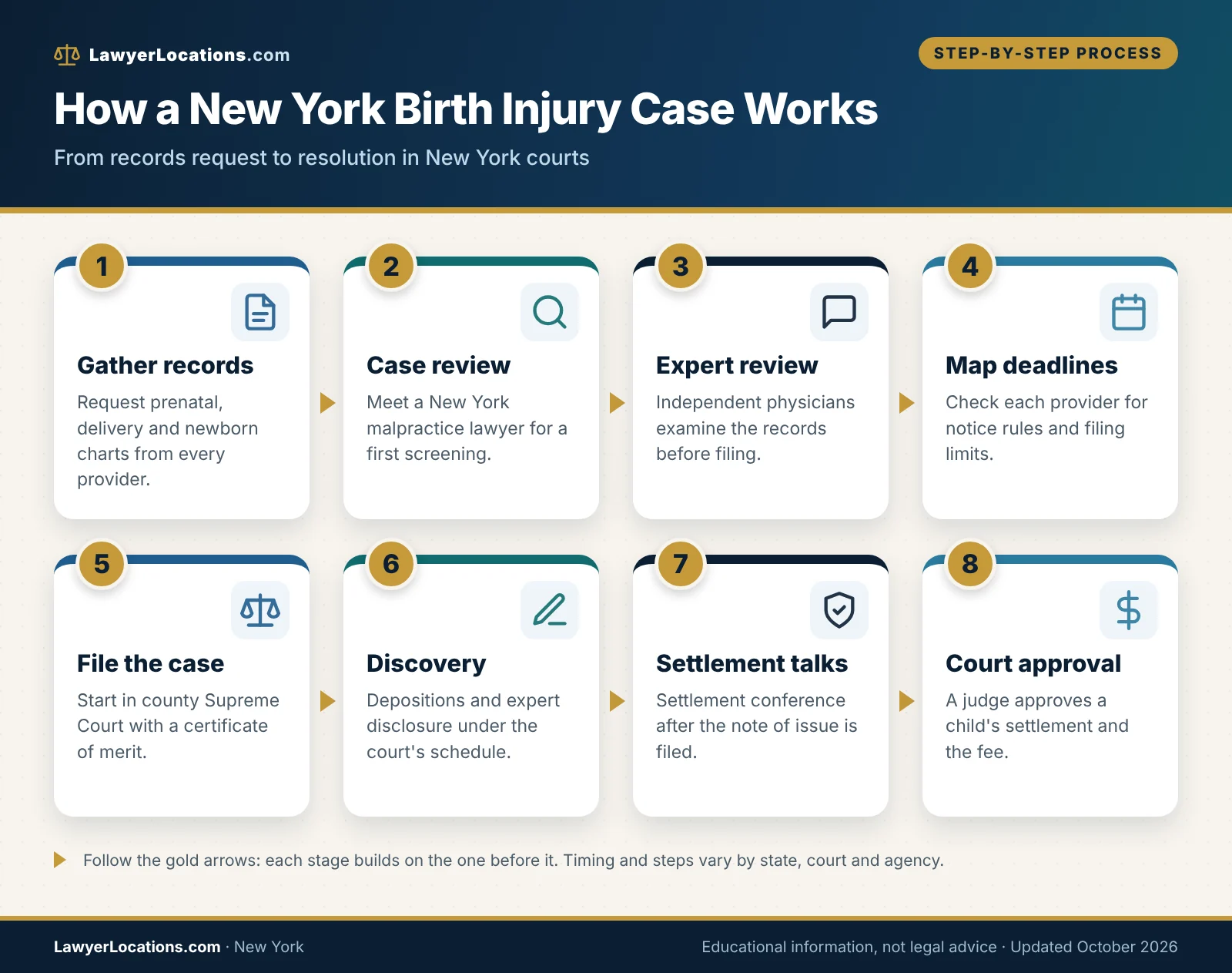
Text version of this graphic
- Notice a concern: a diagnosis, a delivery that went badly, or a developmental delay.
- Request the mother’s and the baby’s records from every provider.
- Consult a New York malpractice lawyer for an initial case review.
- Independent medical experts review the records.
- Calendar every deadline and notice rule that applies to each claim.
- File in New York Supreme Court, or a notice of claim against a public hospital first.
- Discovery, depositions, and expert disclosure.
- Settlement conference, court approval for a child’s settlement, or trial.
When it makes sense to talk to a lawyer
Signals that justify a records review
You do not need proof before calling a lawyer. A records review is where proof comes from. Reasonable triggers include a baby who needed resuscitation or intensive care right after birth, a delivery that involved an emergency you were never told about, a newborn diagnosis that doctors cannot explain, or a mother who was seriously hurt and told little about why.
Writing down a timeline while memories are fresh helps. Note who was in the room, what monitoring was used, how long things took, and what you were told afterward.
What a first consultation can and cannot do
A first consultation is a screening conversation. The lawyer listens, asks about the dates, and explains whether the case is worth the cost of expert review. It is not a verdict on whether you were wronged.
Reading a website, including this one, does not create an attorney-client relationship. A relationship begins only when a lawyer agrees to represent you, and under New York’s rules that agreement should be in writing, a point covered in the fees section below.
Why the timing question comes first
The main reason to talk to a lawyer sooner rather than later is the deadline structure, which is more tangled in birth cases than in most. A child’s claim, a mother’s claim, and a parent’s separate claims can run on different clocks, and a public hospital adds a short notice requirement on top.
If any provider involved is a public hospital or a state facility, a 90-day notice requirement may apply, and it can expire long before the main filing deadline. Ask about this in the very first call.
How New York differs from other states
No-fault compensation is not the model here
Some states channel certain birth injuries into special compensation systems. New York is not one of them. A New York family pursues a regular malpractice claim in court, then, if the case qualifies, can use the state’s Medical Indemnity Fund to handle the future medical costs portion of the recovery. That fund is covered in detail in the next section.
If your question is more about how personal injury timelines work generally, see our guide on how long you have to file a personal injury claim. Malpractice deadlines in New York are their own category, so do not assume the general rule applies.
Venue and court structure
The trial court for these cases is the New York State Supreme Court, which despite its name is the state’s general trial court, not its highest court. Cases are filed in the Supreme Court of a particular county. Each county’s court, and often each judge, has its own part rules and practices, which is one reason local experience matters.
If your case starts in a New York City borough versus Long Island versus upstate, the courthouse, the judge assignment, and the pace can differ. Ask a prospective lawyer which courts they appear in regularly. Our overview of a personal injury lawyer in New York City covers the city court landscape from the injury side.
New York deadlines, notice rules, and the Medical Indemnity Fund
The standard deadline is two years and six months, but birth injury claims often involve extra time for the child, shorter notice rules for public hospitals, and a state fund for future medical costs. Treat the dates below as a map, not a calendar. A New York lawyer has to apply them to your specific providers and dates.
Time limits that apply to birth injury claims
The two-years-six-months rule and continuous treatment
Under CPLR 214-a, a medical, dental, or podiatric malpractice action generally must be started within 2 years 6 months of the act or omission, or of the last treatment where there was continuous treatment for the same condition. The statute also says that examinations requested only to find out a patient’s condition do not count as continuous treatment.
For a mother, the clock often begins around delivery or the end of a course of treatment for the same problem, such as postpartum care. For the baby, the same starting point applies, but the child gets additional time described next.
Extra time for a child under CPLR 208
CPLR 208 extends deadlines for a person who is under a disability, including being a minor, when the claim arises. For medical malpractice, the statute says the extension cannot push the deadline beyond ten years after the claim accrues. The exception that lets infancy extend a claim past ten years applies to actions other than medical, dental, or podiatric malpractice.
For a claim based on events at delivery, that cap generally points to somewhere near the child’s tenth birthday. Do not plan around that date. Waiting leaves evidence, memories, and records to fade, and other arguments can shorten the time available.
Why a parent’s own claims are different
The extra time under CPLR 208 is written for the person under the disability, the child. A parent’s separate claims, including a mother’s own injury claim, are not automatically given that same extra time. A careful lawyer calendars each person’s claim on its own schedule and files before the earliest one runs out.
Any advice like “you have until your child turns 18” is a warning sign in a New York malpractice matter. The statute caps infancy tolling for malpractice claims at ten years after accrual, and the mother’s claim may be on a much shorter timeline.
| Situation | Rule | Source | Practical note |
|---|---|---|---|
| Private hospital or doctor, adult patient or parent | 2 years 6 months from the act or last continuous treatment | CPLR 214-a | Start the records request early; do not wait for a diagnosis to settle. |
| Child’s own malpractice claim | Extra time for infancy, capped at 10 years after accrual | CPLR 208(a) | The cap is a ceiling, not a target date. |
| Public corporation (for example, a municipal hospital system) | Notice of claim within 90 days after the claim arises, with a late-notice application possible | General Municipal Law 50-e | Infancy is one factor a court may weigh for late notice; it is not an automatic pass. |
| State-operated facility | Claim filed and served within 90 days, or a notice of intention, which then allows 2 years to file | Court of Claims Act 10 | Claims go to the Court of Claims, not Supreme Court. |
| Wrongful death after a death | 2 years after the decedent’s death | EPTL 5-4.1 | Ask the lawyer how this interacts with the malpractice period. |
Public hospitals and state facilities
Notice of claim for municipal and public hospital systems
If the hospital is run by a city, county, or other public corporation, General Municipal Law 50-e generally requires a sworn written notice of claim within 90 days after the claim arises. The notice must include the claimant’s name and address, the nature of the claim, and the time, place, and manner in which it arose.
In wrongful death cases, the 90 days run from the appointment of a representative for the estate. A lawyer can often tell from the hospital’s name whether it is a public entity, but confirm it, because the answer drives everything.
Late-notice applications and the role of infancy
If the 90 days are missed, a court can allow a late notice in its discretion, but the extension cannot go beyond the time limit for starting the lawsuit against that public body. Under the statute, infancy is one of the factors a court considers, along with things like incapacity. It is not a guaranteed exception.
Applications are made to the Supreme or County Court and must include the proposed notice of claim. This is a motion, not a form, and it is far easier to serve the notice on time than to ask the court for forgiveness later.
State-run facilities and the Court of Claims
For negligence claims against the State of New York, Court of Claims Act 10 requires the claim to be filed and served on the Attorney General within 90 days after it accrues, or a written notice of intention to be served in that time, which then allows two years to file the claim. A claimant under a legal disability has a separate provision allowing filing within two years after the disability is removed, and the court has discretion to allow a late claim by weighing listed factors such as excuse for delay and prejudice to the State.
Because the rules differ for state versus city versus private providers, a birth that involved a transfer between hospitals can mean more than one notice track. Your lawyer should map each provider to its track in the first meeting.
The New York Medical Indemnity Fund
Who qualifies
The Medical Indemnity Fund, created under Public Health Law Article 29-D, helps pay future health care costs for children with a birth-related neurological injury. Under PHL 2999-h, a qualified plaintiff must have a birth-related neurological injury, must have either won or settled a malpractice claim over it, and must be ordered by a New York court to be enrolled in the fund.
The statute defines the injury as damage to the brain or spinal cord of a live infant, caused by oxygen deprivation or mechanical injury during labor, delivery, or resuscitation, or by other medical services during the delivery admission, resulting in a permanent and substantial motor impairment, a developmental disability, or both.
What the fund pays for and what it does not
The fund pays “qualifying health care costs,” which the statute describes as future medical, hospital, surgical, nursing, dental, rehabilitation, habilitation, respite, and custodial care, plus durable medical equipment, home and vehicle modifications, assistive technology, transportation to appointments, and medications. A treating physician, physician assistant, or nurse practitioner determines the need.
The Department of Health’s FAQ page says the fund does not cover health insurance premiums or services available through an IEP, preschool supportive health services, or Early Intervention, unless a reasonable request for those services was denied. Other insurance, except Medicaid and Medicare, must be used first.
| Topic | What the sources say |
|---|---|
| Who enrolls | A plaintiff with a birth-related neurological injury, a judgment or court-approved settlement, and a court order directing enrollment |
| Covered costs | Future medical, nursing, rehabilitative, custodial, equipment, home and vehicle modifications, and medications determined necessary by a treating practitioner |
| Not covered | Health insurance premiums; services available through an IEP, preschool supportive health services, or Early Intervention unless a reasonable request was denied; services needing prior approval that was not obtained |
| Other insurance | Health insurers (other than Medicare and Medicaid) pay first; the fund has no right of recovery against the plaintiff or attorney except for fraud or mistake |
| Claims filing | Claims are to be filed within 90 days of service, according to the Department of Health FAQ |
| Administrator | The Department of Health FAQ names Public Consulting Group as Fund Administrator |
How the fund changes a settlement
When a settlement or judgment in a qualifying case includes future medical expenses, PHL 2999-j provides that those expenses are paid through the fund instead of through the corresponding portion of the settlement, and a court must direct changes to the settlement as a condition of approval if it does not say so. Enrollment happens by applying with a certified copy of the judgment or court-approved settlement.
That means the settlement talks look different than in an ordinary injury case. Ask a prospective lawyer how they handle the split between money paid to the family and future costs paid by the fund, and how it affects the fee. The statute says the fee is based on the entire sum awarded or the full settlement, so the lawyer should explain exactly how that works for your matter.
Ask any lawyer you consult: “Have you handled cases that were enrolled in the Medical Indemnity Fund, and how do you coordinate the fund with a special-needs trust and with Medicaid?” A clear, specific answer is a good sign.
If a baby or mother dies
The wrongful death time limit
Under EPTL 5-4.1, a wrongful death action must be started within two years after the decedent’s death, and the claim is brought by the decedent’s personal representative. The statute is silent on how it interacts with the malpractice period, so a lawyer must analyze which timelines govern when the death follows medical care.
Our guide to wrongful death lawyer costs explains how fees work in those cases in general terms. For a stillbirth or a death shortly after birth, the legal questions can be specific and painful. A lawyer who handles them should approach the first conversation with patience.
Estate appointments and who files
Because the claim is brought by a personal representative, someone usually has to be appointed through the Surrogate’s Court process before the lawsuit can proceed. The notice-of-claim clock for a public hospital runs from that appointment in wrongful death cases, according to General Municipal Law 50-e.
If you are the parent of a child who died, you may feel pressure to deal with paperwork right away. A lawyer can handle the appointment process and the notice together so nothing falls through the cracks.
How a birth injury case moves through New York courts
Most birth injury cases are filed in the Supreme Court of a New York county and follow a special set of medical malpractice rules under 22 NYCRR 202.56. The process is slow by design. Expert review comes before filing, discovery takes about a year, and the court has to approve any settlement for a child.
Before a lawsuit is filed
Getting the medical records
Under Public Health Law 18, a parent or guardian of a child can request the child’s records for care they consented to, and a provider must make records available for inspection within ten days of a written request. Copies must be provided within a reasonable time. A provider may charge a reasonable fee that cannot exceed seventy-five cents per page for paper copies, and the statute says access cannot be denied solely because of inability to pay.
A mother makes her own written request for her own chart, which is separate from the baby’s chart. Ask for both, and for every facility involved: the obstetrician’s office, the delivery hospital, the neonatal intensive care unit, and any hospital the baby was transferred to.
New York hospital regulations require hospitals to keep records for at least six years from discharge or three years after the patient reaches age 18, whichever is longer (10 NYCRR 405.10). Do not count on a record being kept forever, and do not wait to ask for it.
The expert review and the certificate of merit
Before a malpractice complaint is filed, New York’s CPLR 3012-a requires it to come with a certificate signed by the plaintiff’s attorney. In the usual form, the attorney states that they reviewed the facts, consulted at least one licensed physician whom they reasonably believe is knowledgeable in the relevant field, and concluded there is a reasonable basis for the action.
The statute includes narrow alternatives, for example where a limitations period would otherwise bar the case, or where three good-faith attempts to consult different physicians failed. The attorney and the consulted professional generally do not have to be named. This rule is a practical reason birth injury lawyers invest in expert review before they take a case to court.
Choosing which defendants to name
Birth cases often involve several parties: an obstetrician, a midwife, nurses, an anesthesiologist, a pediatrician or neonatologist, and one or more hospitals. A lawyer decides who to name after reviewing the chart and expert opinions, and the choice depends partly on who employed whom and which notice rules apply.
Ask your lawyer to explain, in plain terms, why each defendant is in the case. Naming too few can cost you a source of recovery, and naming too many without support can raise the cost of the case.
Filing and discovery in Supreme Court
Starting the case: court fees and the notice of medical malpractice action
According to the New York State court system’s fee page, as listed in October 2026, buying an index number in Supreme Court civil matters costs $210, a request for judicial intervention costs $95, and the note of issue fee is $30 (or $125 where a request for judicial intervention is not required). Fees can change, so check the court’s current schedule before relying on these amounts.
Medical malpractice cases have their own step under 22 NYCRR 202.56. The plaintiff must file a notice of medical, dental, or podiatric malpractice action within 60 days after all defendants have joined issue, meaning they have all answered, unless the court grants leave for good cause. The notice describes the parties, the specialties of individual defendants if known, and the type of malpractice claim.
The preliminary conference and the disclosure timetable
After the notice is filed, the assigned judge holds a preliminary conference as soon as practicable. The judge can direct disclosure, set dates for depositions and expert disclosure, set a trial date, and encourage settlement. Under the rule, disclosure generally must be completed within 12 months of the filing of the notice, unless the court orders otherwise.
The attorneys who attend must be fully familiar with the case and authorized to make binding stipulations. In practice that means your lawyer should be able to explain what was decided at each conference after it happens.
Depositions and expert disclosure
During discovery, each side takes depositions, which are out-of-court question-and-answer sessions under oath. You and your spouse may be questioned about the pregnancy, the delivery, and your child’s development. Doctors and nurses are questioned about their care.
Expert disclosure is governed by CPLR 3101(d)(1). In medical malpractice cases, a party responding to an expert request may omit the expert’s name but must still disclose the other required information, such as subject matter, the substance of the facts and opinions, qualifications, and a summary of the grounds. A party can also serve a written offer to disclose an expert’s name and make the expert available for deposition, and the other side has 20 days to accept or reject it.
| Stage | What happens | Rule or source |
|---|---|---|
| Records request | Parent or guardian asks each provider for charts; inspection within 10 days, copies within a reasonable time | Public Health Law 18 |
| Expert review | Attorney consults a qualified physician before filing | CPLR 3012-a |
| Public hospital notice | Sworn notice of claim served within 90 days if a public corporation is involved | General Municipal Law 50-e |
| Filing | Summons and complaint with certificate of merit; index number purchased | CPLR 3012-a; court fee schedule |
| Notice of malpractice action | Filed within 60 days after all defendants join issue | 22 NYCRR 202.56 |
| Preliminary conference | Judge sets discovery schedule; disclosure generally to be completed within 12 months | 22 NYCRR 202.56 |
| Note of issue | Case declared ready for trial; the rule points to filing within 18 months of the notice “to the extent feasible” | 22 NYCRR 202.56 |
| Settlement conference | Held within 45 days after the note of issue is filed | 22 NYCRR 202.56; CPLR 3409 |
| Infant settlement approval | Court approves a child’s settlement and the lawyer’s fee | CPLR 1207 |
Settlement, approval, and trial
The settlement conference
The court must hold a settlement conference under CPLR 3409 within 45 days after the note of issue is filed. The attorneys attending must be fully familiar with the case and authorized to settle it, and the court may order parties or insurance representatives to attend in person or remotely.
Most malpractice cases that resolve do so through negotiation at or around this stage, though some resolve earlier and some go to trial. No lawyer can promise which path your case will take.
Court approval for a child’s settlement
A child cannot settle their own claim. Under CPLR 1207, a guardian of the child’s property, a guardian ad litem, or a parent with custody can ask the court to approve a settlement of a pending action. The approval order has the effect of a judgment, and the court must approve the fee for the child’s attorney.
In birth injury cases that involve large future needs, families commonly use a special needs trust or structured arrangements, and the court typically reviews them. Ask your lawyer whether they work with a trust-and-estates or special-needs planning professional, and whether that cost is built into the fee discussion.
If the case goes to trial
If the case does not settle, it goes to trial in the Supreme Court, in front of a judge or jury. Trials in birth injury cases can be long because of the volume of medical testimony. A verdict is also not the end: the losing side can appeal to the Appellate Division, the intermediate appeals court, which adds time.
Be cautious about any lawyer who guarantees a result, a dollar amount, or a settlement date. Birth injury cases depend on expert opinions and court schedules that no one controls.
How to compare birth injury lawyers in New York
Compare lawyers on specific malpractice experience, resources to pay for experts, communication, and fee clarity, not on advertising. LawyerLocations.com does not rank or recommend lawyers. What follows is a framework for doing your own comparison.
Experience and resources that fit a birth injury case
Medical malpractice experience, not just injury experience
Birth injury cases are among the most expensive and expert-heavy cases a lawyer can take. A general personal injury practice, such as the kind described in our guide to a personal injury lawyer in New York City, may not handle malpractice. Ask how many birth-related cases the lawyer has handled to resolution and in which counties.
Do not expect an exact number to prove quality. Listen for specifics: the kinds of experts they work with, how they approach a fetal monitoring review, and how they explain the difference between bad outcomes and negligence.
Who fronts the costs
Expert physicians, record reviews, and trial preparation cost real money. Most contingency arrangements have the law firm advance case costs, but how those costs are repaid, and whether the client owes them if the case loses, varies by agreement and must be in writing. Ask for the answer before you sign.
A firm that cannot explain how it will finance expert review for a case that may last years is a practical risk, regardless of how confident it sounds.
Capacity and who actually does the work
Some firms assign a case to a senior lawyer at intake and then hand most of the work to junior staff. That can be fine if it is disclosed. Ask who will attend depositions, who you will call with questions, and how often you can expect updates.
Also ask whether the lawyer is licensed in New York. Medical malpractice cases in New York courts are handled by lawyers admitted in New York, though out-of-state lawyers can sometimes appear with local counsel.
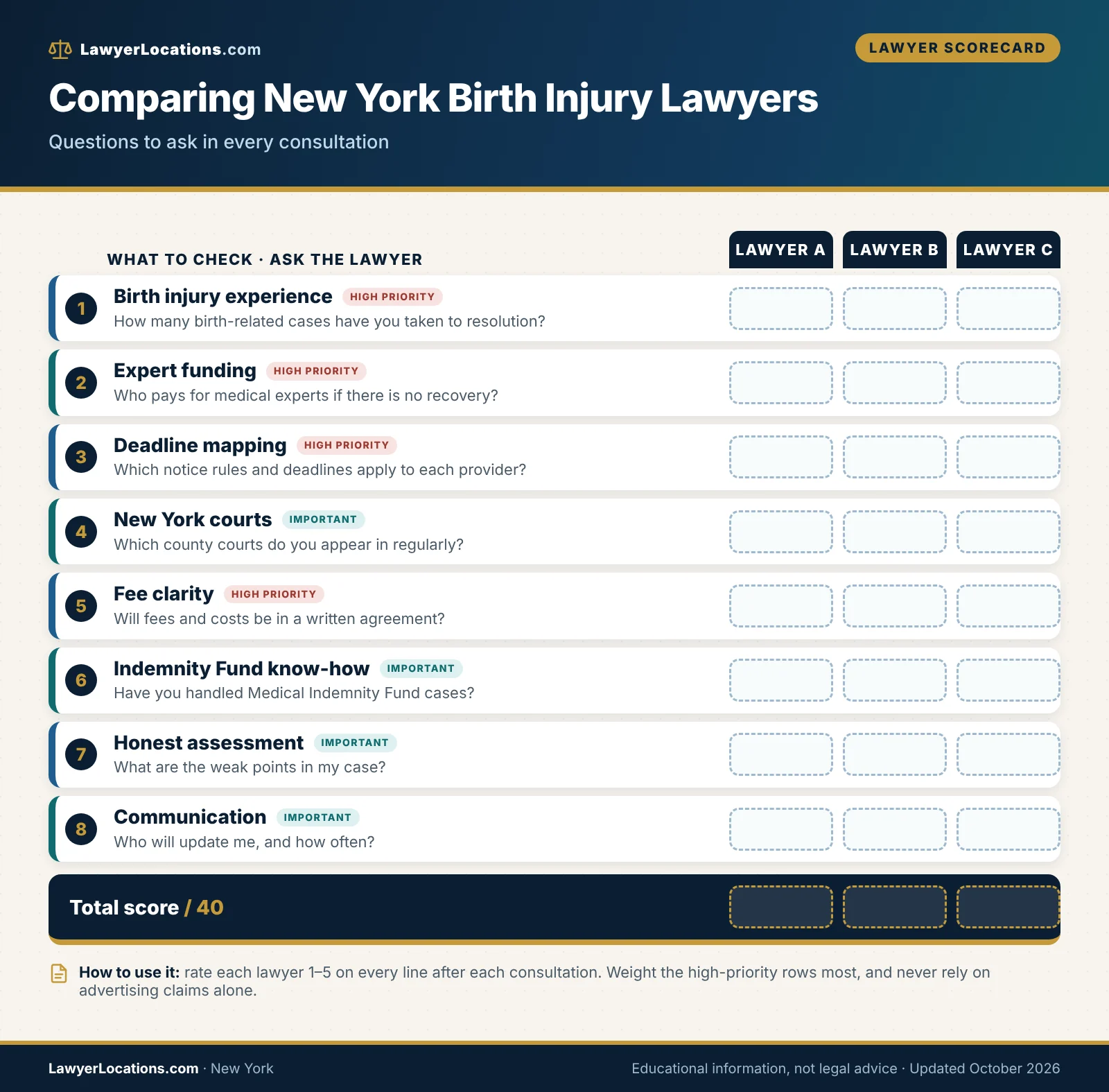
Text version of this graphic
- Birth injury experience: how many birth-related cases have you handled to resolution?
- Expert network: how do you select and pay for medical experts?
- New York court familiarity: which county courts do you appear in regularly?
- Fee clarity: are fees and costs explained in a written letter of engagement?
- Medical Indemnity Fund knowledge: have you handled fund-enrolled cases?
- Communication: who will update me and how often?
- Honest assessment: what are the main weaknesses of my case?
- Public hospital notice: have you mapped every notice and deadline for each provider?
Questions to ask in a consultation
Questions about the case
Ask the lawyer to walk through the timeline as they understand it and tell you which deadlines and notices they see. Then ask what would make the case stronger or weaker, what expert reviews they would order first, and whether there are any providers they would exclude and why.
Pay attention to how the lawyer handles uncertainty. A good consultation produces a plan with open questions, not a promise.
Questions about money
Ask whether the fee is contingent, what percentage applies, whether the percentage is calculated before or after costs, who pays for experts if there is no recovery, and what happens if you change lawyers midway. Under New York’s court rules, a lawyer must provide a written letter of engagement explaining the scope of services, fees, expenses, and billing practices, and where applicable notice of the right to arbitrate fee disputes (22 NYCRR 1215.1).
The written document can be a letter of engagement or a signed retainer agreement covering the same points. If you are handed neither, ask for it before work begins.
Questions about the Medical Indemnity Fund and long-term planning
If your child has a significant neurological injury, ask how the lawyer approaches the fund, a special needs trust, and Medicaid planning. These topics sit at the edge of malpractice law and elder or special-needs planning, and lawyers who handle them often coordinate with other professionals.
Ask to be told in advance what the process will cost and who is responsible for each step.
| Question | What a solid answer sounds like | Cause for concern |
|---|---|---|
| How many birth injury cases have you taken to resolution? | Specific experience described without confidential details, plus how they use experts | Vague claims, or “we handle everything” |
| Who pays for experts if we lose? | A clear, written answer in the fee agreement | “We’ll figure it out later” |
| Which deadlines apply to each provider? | A provider-by-provider list including any public hospital notice | A single “you have time” answer |
| What is the weakest part of my case? | Specific candor about causation, records gaps, or standard of care | Only good news |
| Will the court have to approve the fee? | Yes for a child’s claim; explains the CPLR 1207 process | Unaware of infant settlement approval |
| Who will I talk to day to day? | A named person and an update schedule | No clear point of contact |
Finding lawyers in New York
Bar association referral services
The New York State court system’s “find a lawyer” page lists the New York State Bar Association Lawyer Referral and Information Service, which it says helps you find a lawyer in your area, and the New York City Bar Legal Referral Service, which refers to screened lawyers. The page describes the NYSBA service’s initial 30-minute meeting as free for certain matters including medical malpractice, but terms can change, so confirm them directly with the service.
The court system’s page also states that it cannot recommend specific lawyers. A bar referral service is a starting point, not an endorsement of a particular result.
Legal aid and other help
The same court system page points to LawHelpNY, a directory where you can search by county and legal problem for legal services organizations, though many serve only low-income applicants and legal aid groups rarely take large malpractice cases. For the non-legal side of caring for a child with a disability, county health and disability agencies can help, and your pediatrician can usually point you to them.
Use these resources alongside, not instead of, your own research into any lawyer you are considering.
Checking a physician’s record
The Department of Health’s Office of Professional Medical Conduct investigates complaints about physicians and physician assistants, and it publishes a searchable record of disciplined practitioners going back to 1990. A complaint to that office is separate from a lawsuit. The page does not describe the office as a source of compensation, so do not expect a complaint to substitute for a legal claim.
Searching a doctor’s discipline history may tell you something, but a clean record does not mean care was proper, and a lawyer will not rely on it either way.
Meet at least two lawyers if you can. Bring the same one-page timeline to each and compare how they respond. Differences in how they explain deadlines, costs, and weaknesses will tell you more than any brochure.
Fees, costs, and decision points in New York
New York caps contingency fees in medical malpractice cases with a sliding scale in Judiciary Law 474-a, and a court must approve the fee when the client is a child. That makes fee comparisons between New York lawyers narrower than in many states, but costs, timing, and trust planning still vary.
The statutory fee schedule
How the tiers work
Judiciary Law 474-a sets a ceiling on contingent fees in medical, dental, and podiatric malpractice claims. The fee is calculated on a sliding scale: 30% of the first $250,000 recovered, 25% of the next $250,000, 20% of the next $500,000, 15% of the next $250,000, and 10% of any amount over $1,250,000. The percentages apply to the recovery after certain case expenses are deducted, as the statute provides.
These are maximums, not set prices. A lawyer may charge less. The statute also lets a lawyer ask the court for greater compensation in “extraordinary circumstances,” in which case the court must explain its decision in a written order.
An illustration with round numbers
The table below applies the statutory tiers to hypothetical net recoveries. These are arithmetic examples, not predictions or averages, and they do not describe what any case is worth.
| Hypothetical net recovery | Maximum fee under the schedule | Share of recovery |
|---|---|---|
| $250,000 | $75,000 | 30.0% |
| $500,000 | $137,500 | 27.5% |
| $1,000,000 | $237,500 | 23.75% |
| $1,250,000 | $275,000 | 22.0% |
| $2,000,000 | $350,000 | 17.5% |
On a hypothetical $1,000,000 net recovery, the schedule allows up to $75,000 on the first $250,000, $62,500 on the next $250,000, and $100,000 on the remaining $500,000, for a maximum of $237,500. A child’s settlement of that size would still need the court to approve the fee.
Fees when a child is the client
Judiciary Law 474-a says fees in claims brought on behalf of an infant remain subject to Judiciary Law 474, and CPLR 1207 requires the court to approve the attorney’s fee in a child’s settlement. In other words, the court has the last word on what the lawyer is paid out of a child’s recovery.
When the Medical Indemnity Fund is involved, PHL 2999-j addresses the fee calculation: it is based on the entire sum awarded or the full settlement, and it refers to payment under Judiciary Law 474-a. Ask your lawyer to put the dollars in writing for your own numbers.
Costs beyond the lawyer’s percentage
Case expenses
Case expenses are the out-of-pocket costs of building the case: records fees, physician expert review and testimony, court reporter and deposition costs, and filing fees such as the $210 index number purchase. Medical records in New York can be charged at up to seventy-five cents per page under Public Health Law 18, and large birth charts can run to thousands of pages.
The fee agreement should say whether expenses are deducted before or after the fee percentage is calculated, and who bears them if the case loses.
Written agreements and fee disputes
As noted, the letter of engagement or retainer must explain fees, expenses, and billing practices. If a fee dispute arises later, 22 NYCRR Part 137 offers arbitration for disputes between $1,000 and $50,000, with the client having 30 days from receiving the required notice to elect it. The program excludes disputes involving fees set by statute, rule, or court order, so it may not reach a fee that a court has fixed in an infant compromise.
If a problem is about professional conduct instead of a fee, that is a different channel, and a lawyer can explain it.
Costs you may not expect
Beyond litigation costs, planning for a child with long-term needs may involve a special needs trust, a guardianship or guardian ad litem fee, and ongoing professional fees. Some of these are paid from the recovery and some are approved by the court.
Ask for a rough list in your first meeting so you are not surprised at settlement time.
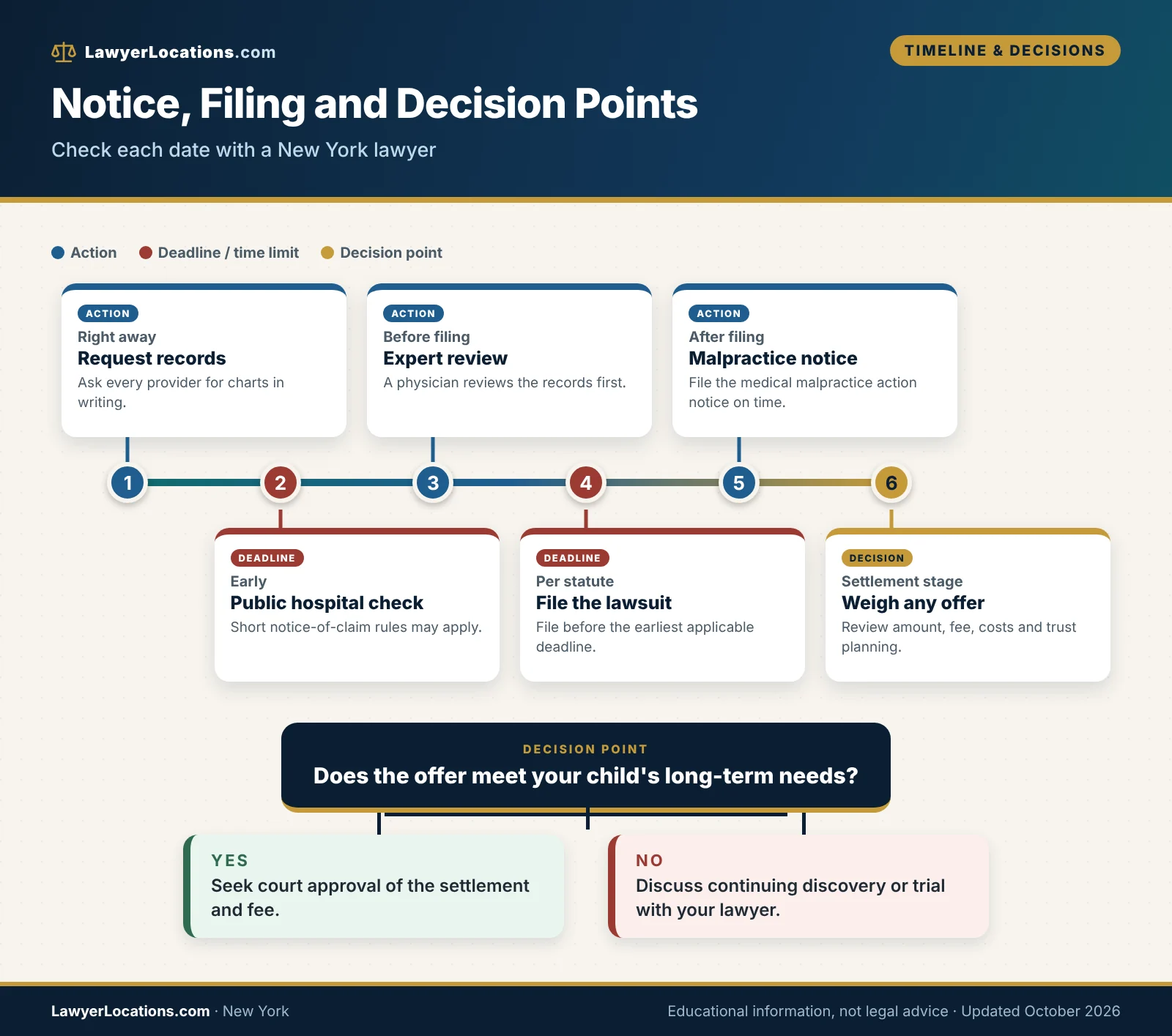
Text version of this graphic
- Right away: request records and write a timeline.
- Within 90 days: check for any public hospital or state facility notice requirement.
- Early: expert review before filing.
- Before the earliest deadline: file in the correct court.
- After filing: notice of malpractice action within 60 days after all defendants join issue.
- Within about a year: disclosure under the preliminary conference order.
- After the note of issue: settlement conference within 45 days.
- Decision point: accept a court-approved settlement or go to trial.
Decision points along the way
Whether to pursue a claim at all
The first decision is whether an expert review supports a claim. Some families choose to stop after the review, and that is a legitimate choice. A lawyer should tell you plainly if the review does not support moving forward.
Think about the emotional and time cost of a multi-year case, including depositions about the birth, alongside the legal merits.
Whether to settle
If an offer arrives, ask for a written explanation of the amount, the fee, the costs, and how the money would be handled for your child. Ask how the Medical Indemnity Fund, if it applies, changes the structure. Ask what happens to public benefits such as Medicaid.
You are entitled to take time with a major decision. A lawyer who pushes you to sign immediately, without explaining the numbers, should be questioned.
Whether to switch lawyers
You can change lawyers, but the former lawyer may have a claim for fees and costs, and the court may need to resolve it in a child’s case. Raise any concerns about communication or strategy early, and ask what a change would cost before acting.
If there is a fee dispute within Part 137’s range, arbitration may be available, subject to the program’s exclusions.
| Item | What to clarify | Governing rule |
|---|---|---|
| Contingency fee percentage | Maximum allowed and whether lower rates are offered | Judiciary Law 474-a |
| Case expenses | Who advances them, and how they are repaid if there is no recovery | Written letter of engagement, 22 NYCRR 1215.1 |
| Court filing fees | Index number, request for judicial intervention, note of issue | Court system fee schedule |
| Child’s settlement fee | Court approves the fee; process and timing | CPLR 1207; Judiciary Law 474-a |
| Future medical costs | Whether the Medical Indemnity Fund applies | Public Health Law Article 29-D |
| Fee disputes | Whether arbitration is available for your amount | 22 NYCRR Part 137 |
Records, mistakes to avoid, next steps, and quick answers
The most useful thing you can do now is gather records, write a timeline, and ask any lawyer you consult which deadline applies to each provider. Everything else builds on those three steps.
Evidence and documents to gather
Records to request
Start with a written request to each provider. Include the prenatal care office, the delivery hospital, the labor and delivery unit, the neonatal unit, any transferring hospital, and the pediatric practice. Ask specifically for fetal heart rate monitoring strips, delivery and operative notes, nursing notes, medication records, and newborn and discharge summaries.
Keep a log of when you asked, how you asked, and what you received. Under Public Health Law 18, a provider must give you the chance to inspect within ten days of a written request, so follow up if you do not hear back.
- Prenatal records from every obstetric or midwife visit
- Labor and delivery chart, including monitoring strips and nursing notes
- Operative and anesthesia records if there was a cesarean section
- Neonatal intensive care and newborn records
- Pediatric, therapy, and specialist records since birth
- Insurance cards, Medicaid information, and explanation-of-benefits statements
- Your own timeline and any photos or messages from the hospital stay
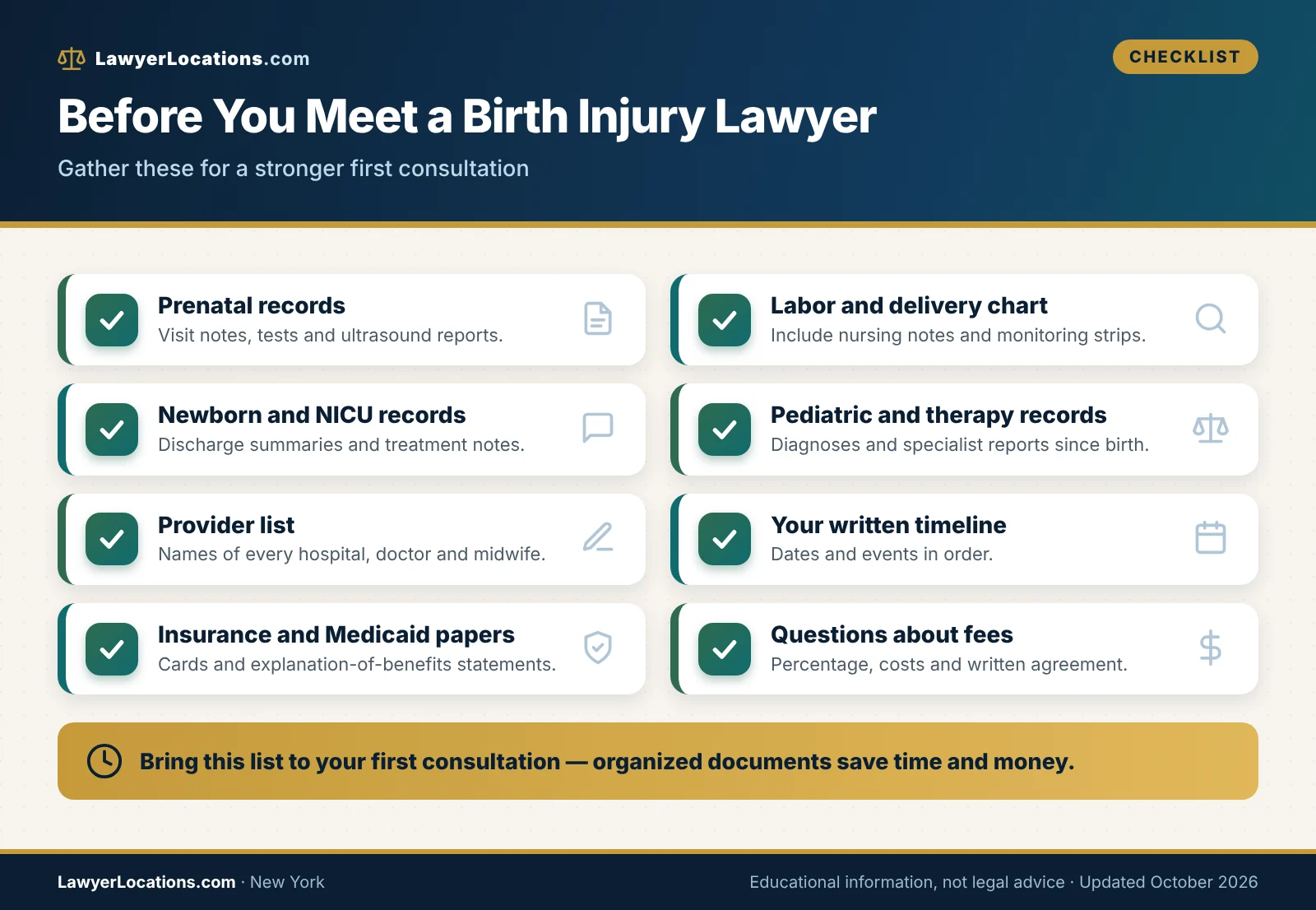
Text version of this graphic
- Request prenatal, delivery, and newborn records in writing.
- Ask for fetal monitoring strips and nursing notes.
- Write a dated timeline of the pregnancy and birth.
- Note every provider and whether any is a public hospital.
- Save insurance and Medicaid paperwork.
- List questions about deadlines and fees.
- Bring the same package to each consultation.
- Do not sign anything you have not read.
Your timeline and notes
Write down what you remember, with dates, in the order it happened. Include who you spoke to, what you were told, and what changed. Keep it factual and separate from any emotional reflections, which you can keep in a private journal.
Notes made soon after events are generally more reliable than recollections years later, and a lawyer will use yours to ask better questions of the records.
What not to do with the evidence
Do not edit or annotate original documents, and do not post details of the case on social media. Defense lawyers can request and review public posts. Do not sign broad medical authorizations from an insurer or hospital risk department without asking a lawyer what they cover.
If a hospital offers to “make things right,” ask a lawyer before signing any release.
Common mistakes and red flags
Mistakes families make
- Waiting for a final diagnosis before gathering records or talking to a lawyer
- Assuming the child’s extra time applies to every claim in the family
- Missing the 90-day notice when a public hospital is involved
- Signing a fee agreement without a written explanation of costs
- Talking to a hospital risk manager or insurer without legal advice
Each of these is avoidable with a short consultation and a copy of the records.
Red flags in lawyers and marketing
Be cautious about guarantees, pressure to sign quickly, no written fee agreement, vague answers about who pays expert costs,, and self-descriptions such as “best” or “specialist” that you cannot check. LawyerLocations.com does not endorse any lawyer, and you should not read any ad, including a directory listing, as an endorsement.
Confirm that a lawyer is admitted in New York before you sign, and read the written agreement start to finish.
Never accept an advance, “case funding,” or a loan offer from a stranger tied to a lawsuit before reading the terms with a lawyer. Interest and repayment terms can take a large share of a recovery.
Next steps and quick answers
A simple order of operations
- Write the timeline. Dates, providers, and what you were told.
- Request records. In writing, from every provider involved.
- Identify public hospitals. If one is involved, ask about the 90-day notice right away.
- Consult at least one New York malpractice lawyer. Use the questions in this guide.
- Get fees in writing. Percentage, costs, and what happens if there is no recovery.
- Plan for your child’s needs. Ask about the Medical Indemnity Fund, trusts, and benefits.
Ready to compare your options?
Take your timeline and records to a consultation with a New York lawyer who handles medical malpractice. Ask about every deadline, the fee schedule, and the Medical Indemnity Fund. For general background on filing windows, read our guide on how long you have to file a personal injury claim.
Quick answers to common questions
How long do I have to file a birth injury lawsuit in New York?
The usual malpractice period under CPLR 214-a is two years and six months from the act or the end of continuous treatment. A child’s own claim may get extra time under CPLR 208, capped at ten years after accrual for malpractice. A public hospital can require notice within 90 days. A lawyer should confirm which applies.
Can my child’s lawsuit wait until they turn 18?
Not for medical malpractice. CPLR 208 states that infancy tolling cannot extend beyond ten years after the claim accrues in medical, dental, or podiatric malpractice actions. The exception that allows longer extension applies to other kinds of cases.
What is the Medical Indemnity Fund?
It is a New York program under Public Health Law Article 29-D that pays qualifying future health care costs for plaintiffs with a birth-related neurological injury who have a court-approved settlement or judgment and a court order enrolling them. The Department of Health publishes FAQs about it.
How much does a birth injury lawyer cost in New York?
Medical malpractice contingency fees are capped by Judiciary Law 474-a on a sliding scale from 30% down to 10%, calculated after certain expenses. Costs and the court’s approval of a child’s fee are separate topics to discuss with the lawyer. Always get the terms in writing.
Do I have to pay a lawyer up front?
Many malpractice lawyers work on contingency, meaning the fee is paid from a recovery. Whether you owe expenses if there is no recovery depends on the written agreement, so ask before signing.
Does a court have to approve a settlement for my child?
Yes. Under CPLR 1207, a settlement for a child needs court approval, and the order must approve the attorney’s fee.
Can I get my child’s medical records myself?
A parent or guardian can generally request them under Public Health Law 18. Providers must allow inspection within ten days of a written request, and paper copies cannot cost more than seventy-five cents per page.
What if the hospital is run by a city or the state?
A notice of claim within 90 days may be required under General Municipal Law 50-e or Court of Claims Act 10. Late applications are possible but discretionary, so raise this immediately.
Is a complaint to the state a substitute for a lawsuit?
No. The Office of Professional Medical Conduct investigates physicians, but its page does not describe it as a source of compensation for patients. A lawsuit is the route to damages.
What if my baby died?
A wrongful death action under EPTL 5-4.1 generally must be started within two years after the death and is brought by the personal representative. A lawyer needs to analyze how that interacts with the malpractice period.
Can I switch lawyers if I am unhappy?
Yes, though the first lawyer may claim a fee for work done, and in a child’s case the court may have to resolve it. Part 137 arbitration may be available for some fee disputes between $1,000 and $50,000.
Where to start looking for a lawyer
The court system’s find-a-lawyer page lists the NYSBA Lawyer Referral and Information Service, the New York City Bar Legal Referral Service, and LawHelpNY. Use them to build a short list, then check each lawyer’s experience and written terms yourself. If you want the closest general overview from the injury side, see our guide on a personal injury lawyer in New York City.
Whichever lawyer you choose, keep copies of everything and keep your own timeline current.
General information only. This article is educational and is not legal or medical advice. Reading it does not create an attorney-client relationship, and LawyerLocations.com is not a law firm or a lawyer referral service. Laws, court rules, fees, and deadlines change and depend on the facts of each case. Consult a lawyer licensed in New York about your situation, and do not delay seeking advice because of anything you read here.
Sources & References
Show all 21 sources
- CPLR 214-a, Actions for medical, dental or podiatric malpractice — New York State Senate (Open Legislation) — nysenate.gov — accessed October 2026
- CPLR 208, Disabilities — New York State Senate (Open Legislation) — nysenate.gov — accessed October 2026
- Judiciary Law 474-a, Contingent fees in medical malpractice — New York State Senate (Open Legislation) — nysenate.gov — accessed October 2026
- Public Health Law 2999-h, Medical Indemnity Fund definitions — New York State Senate (Open Legislation) — nysenate.gov — accessed October 2026
- Public Health Law 2999-j, Medical Indemnity Fund payments, enrollment and attorney fees — New York State Senate (Open Legislation) — nysenate.gov — accessed October 2026
- Medical Indemnity Fund Frequently Asked Questions — New York State Department of Health — health.ny.gov — accessed October 2026
- General Municipal Law 50-e, Notice of claim — New York State Senate (Open Legislation) — nysenate.gov — accessed October 2026
- Court of Claims Act 10, Claims — New York State Senate (Open Legislation) — nysenate.gov — accessed October 2026
- CPLR 3012-a, Certificate of merit in medical malpractice actions — New York State Senate (Open Legislation) — nysenate.gov — accessed October 2026
- CPLR 3101, Scope of disclosure (expert disclosure) — New York State Senate (Open Legislation) — nysenate.gov — accessed October 2026
- CPLR 1207, Settlement of action or claim by infant — New York State Senate (Open Legislation) — nysenate.gov — accessed October 2026
- EPTL 5-4.1, Action by personal representative for wrongful act — New York State Senate (Open Legislation) — nysenate.gov — accessed October 2026
- Public Health Law 18, Access to patient information — New York State Senate (Open Legislation) — nysenate.gov — accessed October 2026
- 22 NYCRR 202.56, Medical, dental and podiatric malpractice actions; special rules — Legal Information Institute, Cornell Law School (New York codes) — law.cornell.edu — accessed October 2026
- 10 NYCRR 405.10, Medical records (hospitals) — Legal Information Institute, Cornell Law School (New York codes) — law.cornell.edu — accessed October 2026
- 22 NYCRR 1215.1, Written letter of engagement — Legal Information Institute, Cornell Law School (New York codes) — law.cornell.edu — accessed October 2026
- Part 137, Fee Dispute Resolution Program — New York State Unified Court System — nycourts.gov — accessed October 2026
- Filing fees — New York State Unified Court System — nycourts.gov — accessed October 2026
- Find a Lawyer — New York State Unified Court System — nycourts.gov — accessed October 2026
- Office of Professional Medical Conduct — New York State Department of Health — health.ny.gov — accessed October 2026
- About Cerebral Palsy — Centers for Disease Control and Prevention — cdc.gov — accessed October 2026
Legal Disclaimer and Limitation of Liability
Informational and illustrative purposes only. This article was prepared by LawyerLocations.com solely on the basis of the information available to us at the time of writing. It is an illustrative, general overview. It is not a complete or authoritative statement of the law, and it has not been reviewed by a lawyer licensed in your state or county.
Not legal advice. Nothing in this article is legal, financial, tax or immigration advice, and reading it does not create an attorney-client relationship between you and LawyerLocations.com or any author, lawyer or firm mentioned. Laws, court rules, fees, filing deadlines and agency procedures differ by state, county and court, and they change often. Some details here may be simplified, incomplete or out of date, and time limits for legal claims can be short.
No warranty. We make no representation or warranty, express or implied, about the accuracy, completeness, timeliness or suitability of this content for your situation. Please do not rely on it to make, delay or skip any legal decision. Check the facts against official sources and speak with a licensed attorney in the relevant jurisdiction before you act.
Limitation of liability. To the fullest extent permitted by law, LawyerLocations.com and its owners, authors and contributors disclaim all liability for any loss, damage, cost or other consequence arising from the use of, or reliance on, this article, including any content on third-party websites we link to. Mentioning a lawyer, firm, organization or service is not an endorsement and is not a promise of any result. If you are in immediate danger, contact your local emergency number.