How long do I have to file a personal injury claim? In most states you must file a lawsuit within two or three years of the injury, but state law ranges from 1 year in Kentucky to 6 years in Maine, Minnesota and North Dakota. Claims against a city, county, state or federal agency can carry separate notice deadlines as short as 90 days, and wrongful death, medical malpractice and children’s claims follow their own rules.
This national guide gives a 50-state-plus-D.C. deadline table built from statute text, explains the discovery rule and tolling, separates insurance deadlines from lawsuit deadlines, and shows what to do when time is short. The deadline that controls your case is the one for your state, your defendant and your type of claim.
How Long Do I Have to File a Personal Injury Claim? The Short Answer
You usually have between one and six years to file a personal injury lawsuit, depending on the state, and two years is the single most common limit. The period is set by a state law called a statute of limitations. If you miss it, a court will almost always dismiss the case, no matter how strong the evidence is.
The three clocks that run after an injury
People who search for a filing deadline are usually thinking about one clock. In practice, up to three can run at the same time, and they do not share a start date or a length. Sorting them out early is the single most useful thing you can do for your own case.
The lawsuit deadline (statute of limitations)
This is the outer limit for putting a complaint on file with a court. It comes from state statute, and it is what most people mean by “the deadline.” In Illinois, for example, 735 ILCS 5/13-202 requires actions for injury to the person to be commenced within two years after the cause of action accrued, while Maine’s 14 M.R.S. § 752 gives six years for civil actions generally.
When this deadline passes, the defendant can ask the court to dismiss the case as time-barred. Negotiations, a pending insurance claim and medical treatment do not stop it in most situations.
Notice-of-claim deadlines for government defendants
If a public entity may be responsible, such as a city bus, a county road crew or a federal agency, the law often requires a written notice or administrative claim first. Those windows are frequently far shorter than the lawsuit deadline. New York’s General Municipal Law § 50-e, for instance, calls for a notice of claim “within ninety days after the claim arises” for most claims against a public corporation.
The details are in the government section below. The point for now: a person with a two-year lawsuit deadline can still lose the claim in the first 90 days if the defendant is public.
Insurance policy deadlines
Insurance policies and no-fault systems have their own reporting and proof-of-claim clocks. Florida’s personal injury protection (PIP) statute, for example, conditions medical benefits on receiving initial care within 14 days of the crash. Those rules govern your benefits under a policy, not your right to sue, but missing them can cost you real money.
We cover these in the insurance section. Keep them separate in your mind from the lawsuit deadline: an insurer can be fully engaged with your claim while the lawsuit clock keeps running.
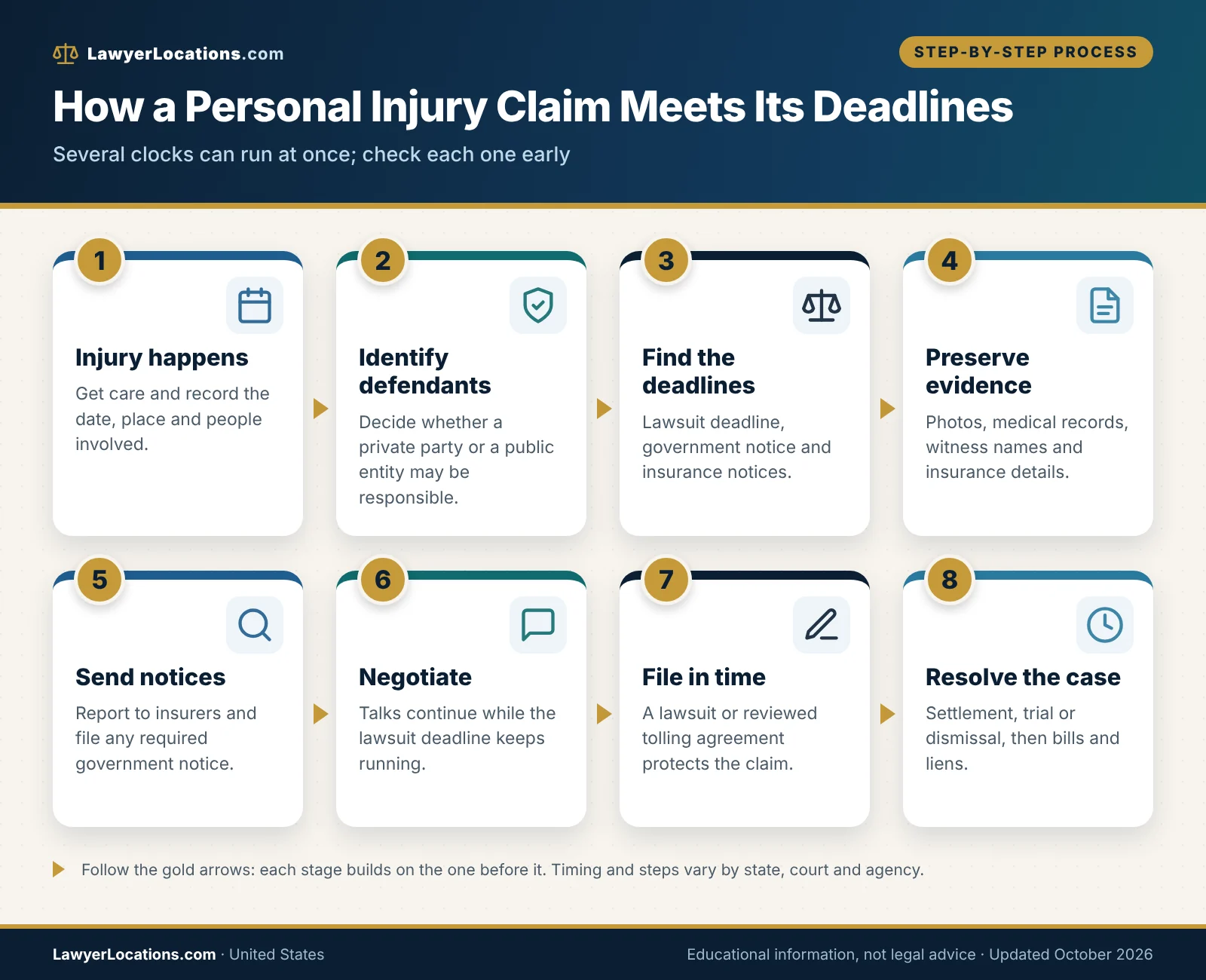
Text version of this graphic
- Injury happens. Get medical care and write down the date, place and who was involved.
- Identify who may be responsible. Private person or business, or a government entity.
- Find the deadlines. Lawsuit deadline, any government notice, and any insurance notice.
- Preserve evidence. Photos, medical records, witness names and the insurance information.
- Report and notify. Send required notices and report the claim to the right insurers.
- Negotiate or investigate. Settlement talks happen while the lawsuit deadline keeps running.
- File before time runs out. A lawsuit or agreed tolling document protects the claim.
- Resolve the case. Settlement, trial or dismissal, then medical bills and liens.
Why the number varies so much from state to state
Each state legislature sets its own limitation periods, so there is no national personal injury deadline. The only nationwide rule is a federal one that applies when the defendant is the U.S. government. For everything else, the answer sits in your state code.
Legislatures set the periods, courts apply them
Courts do not choose a deadline for a particular case. They read the statute, decide which category your claim falls into, work out when it accrued, and apply any exception. That is why two people hurt in the same kind of accident in neighboring states can have very different filing windows.
It is also why local counsel matters. The words of the statute, and the cases interpreting them, control.
Why two years is the most common period
By our count of the statutes reviewed for this guide, 25 of the 51 jurisdictions (50 states plus D.C.) use two years for the general personal injury period, 17 use three years, three use four years, one uses five years, three use six years, and two use one year. A longer period gives injured people more time to recover and gather records. A shorter one lets defendants close their books before witnesses and records fade.
The totals shift when legislatures act. Florida moved from four years to two for most negligence claims in 2023, and Louisiana moved from one year to two in 2024, so older charts you may see online are often wrong.
What this guide can and cannot do
This guide explains how deadlines work and where to look them up. It cannot tell you the exact last day to file in your situation, because that depends on facts a lawyer has to review: the accrual date, the defendant, your age and capacity, and any exceptions.
How we checked the numbers
We opened state legislature and statute-publication pages, court opinions and federal code pages for each period shown in the table, and we cite them in the Sources section. Confirm the row for your state against the cited statute, because legislatures amend these periods.
Law as of October 2026. Statutes are amended, sometimes with deadlines that apply only to claims arising after a certain date, so always confirm the current text.
When to treat the deadline as an emergency
Some situations call for same-week action rather than a leisurely search. Treat the clock as urgent if any of the following is true:
- A city, county, state or federal agency, school district, public hospital or public transit system may be responsible.
- Your state is one of the shorter-deadline states in the table below, or the injury happened more than a year ago.
- The injured person has died, or the claim involves medical care.
- You are dealing with a no-fault or PIP policy that has a short notice or first-treatment requirement.
Do not rely on a settlement conversation to protect your deadline. An adjuster saying “we’re still reviewing” does not extend the statute of limitations in most states. Only a court filing, or a written tolling agreement your lawyer has reviewed, protects the claim.
What a Statute of Limitations Is and How the Clock Starts
A statute of limitations is a legislative deadline for filing a lawsuit, and it usually starts on the day the claim “accrues,” which for most injuries means the day you were hurt. Exceptions exist when the harm is hidden, when the injured person is a child, and when the defendant is a public body.
Accrual: the date the clock starts
Lawyers call the start date the accrual date. Everything else in this guide, from the discovery rule to tolling, is a way of adjusting that start date or pausing the count.
The injury date as the default
For a car crash, a fall in a store or a dog bite, the clock usually starts on the date of the event, because the injury and its cause are obvious right away. Texas phrases it this way for personal injury: suit must be brought “not later than two years after the day the cause of action accrues,” and for injury resulting in death the cause of action accrues on the death of the injured person (Tex. Civ. Prac. & Rem. Code § 16.003).
Write the date of injury down on the first day. Everything else you calculate starts from it.
The discovery rule in brief
Some injuries are not apparent when they happen, such as a foreign object left after surgery or illness from an exposure. A number of states start the clock later in those cases. New Hampshire’s RSA 508:4, for example, gives three years from the time the plaintiff discovers, or in the exercise of reasonable diligence should have discovered, the injury and its causal relationship to the act or omission.
The discovery rule is narrower than many people assume. A later-diagnosed injury from an obvious accident, such as a car crash, generally does not restart the clock. We return to it in the tolling section.
Statutes of repose: an outer limit
A statute of repose sets an absolute outer limit measured from the defendant’s act, no matter when you discovered the harm. Kansas bars actions under its general injury statute more than 10 years after the act giving rise to the cause of action (K.S.A. 60-513(b)), and North Carolina provides that no personal injury cause of action accrues more than 10 years after the defendant’s last act or omission (G.S. 1-52(16)).
Repose rules show up most often in medical malpractice and product claims. If your injury surfaced years after the event, ask a lawyer whether a repose period applies in addition to the ordinary deadline.
Counting the days and meeting the filing requirement
Knowing the length of the period is half the job. The other half is knowing what counts as “commencing” the action and how the days are counted.
Filing the complaint versus serving the defendant
In many courts, a lawsuit is “commenced” when the complaint is filed with the clerk, but service of the summons on the defendant then has its own deadline under court rules. A case can be lost if the filing was on time and service was not. Ask any lawyer you consult how your state’s court rules treat both steps.
Do not assume that mailing a letter to the defendant or the insurer counts as filing. It does not.
Weekends, holidays and court closures
Court rules in most states explain how to count days, and the last day often moves forward when it falls on a weekend or court holiday. The safe approach is to treat the anniversary of the accrual date as the last day and file well before it, instead of testing a rule about the calendar.
E-filing portals can also fail or reject a filing for format errors. Filing early leaves room to fix problems.
Why waiting until the last weeks is risky
A lawyer needs time to gather medical records, identify every responsible party, and draft a complaint that survives a motion to dismiss. In a case with a government defendant or a medical provider there may be pre-suit steps as well. A consultation in the final month of the deadline limits what anyone can do.
If the deadline is less than 60 days away, say so in your first call. A lawyer who knows the date can prioritize the filing.
Claims that are not “personal injury” for deadline purposes
The label on your claim matters, because the same event can generate several claims with different deadlines.
Intentional torts such as assault and battery
Some states set shorter periods for intentional wrongs. The District of Columbia’s code gives 1 year for assault, battery, mayhem and wounding (D.C. Code § 12-301(4)) while falling back to a three-year residual period for negligence (§ 12-301(8)). Montana lists assault and battery at two years in a subsection separate from its three-year general rule (MCA 27-2-204).
If an injury came from a deliberate act, the shorter period may apply to part of the case. Raise this with a lawyer immediately.
Property damage and mixed claims
Vehicle repair costs and personal injury often come from one crash but follow different statutes. Virginia, for instance, requires personal injury actions within two years, while injury to property is five years (Va. Code § 8.01-243(A)-(B)). Settling a property damage claim does not close the injury claim, and the reverse is also true.
Keep each claim’s deadline on its own line in your calendar, and do not sign a broad release when you only meant to resolve the property piece.
Personal Injury Deadlines by State: All 50 States and D.C.
The tables below list the general personal injury filing period for every state and the District of Columbia, with the statute we read for each. Two years is the most common period, one year (Kentucky, Tennessee) is the shortest, and six years (Maine, Minnesota, North Dakota) is the longest.
These are the general periods for ordinary injury claims against private defendants. Government defendants, medical providers, wrongful death, children, product exposure, intentional wrongs and sexual-abuse claims often follow different rules.
How to read the state tables
Each row shows the number a court would most likely apply to a plain negligence claim, such as a car crash or a fall on someone’s property. That is the right starting point, but it is only a starting point.
What the numbers mean
The “general period” column is the time from accrual to filing a complaint. Where a state’s statute starts the clock at discovery or imposes an outer cap, the cell says so. The “statute” column shows the section we opened, so a lawyer or a clerk can look at the same text.
The last column lists exceptions we could verify in the same source. It is not exhaustive, and the absence of an exception in a row does not mean none exists.
What the tables leave out
The tables do not cover every special statute in every state, local-court rules, or case law that interprets accrual. They also do not capture claims filed on behalf of a child, a person who lacks capacity, or an estate, except where the same statute mentions them.
If your situation involves any of those, use the table to understand the ballpark and then ask a lawyer licensed in your state for the controlling date.
State-by-state deadlines
We grouped the 51 jurisdictions into four regions so you can find your state quickly. Within each table the states appear alphabetically. On a phone, scroll the table sideways.
Northeast and Mid-Atlantic
This group includes the District of Columbia and ranges from two years (Delaware, New Jersey, Pennsylvania) to six years (Maine). New York and Maryland sit at three, and Connecticut and New Hampshire build discovery into the rule.
| State | General period | Statute | Notable exceptions and what to check |
|---|---|---|---|
| Connecticut | 2 years from injury or discovery; 3-year outer limit | Conn. Gen. Stat. § 52-584 | Negligence actions: two years from when the injury is first sustained or should have been discovered, but no more than three years from the act or omission. Text read in a legislative bill reproducing the statute, not the current code page. |
| Delaware | 2 years | 10 Del. C. § 8119 | Expressly subject to § 8127 of Title 10, which contains tolling provisions. |
| District of Columbia | 3 years (residual negligence period) | D.C. Code § 12-301(8) | Assault, battery, mayhem and wounding fall under a 1-year period in § 12-301(4). |
| Maine | 6 years | 14 M.R.S. § 752 | Applies to civil actions generally unless another statute provides otherwise; check separate statutes for public bodies and health care providers. |
| Maryland | 3 years | Md. Code, Cts. & Jud. Proc. § 5-101 | Applies unless another provision of the Code sets a different period. |
| Massachusetts | 3 years | M.G.L. c. 260, § 2A | Covers tort actions and contract actions for personal injury. |
| New Hampshire | 3 years, with discovery rule | RSA 508:4, I | If the injury and its cause could not reasonably have been discovered, three years from discovery. |
| New Jersey | 2 years | N.J.S.A. 2A:14-2(a) | A minor’s birth-injury medical malpractice action must be filed before the minor’s 13th birthday. |
| New York | 3 years | CPLR 214(5) | Medical malpractice is 2 years 6 months (CPLR 214-a); wrongful death is 2 years (EPTL 5-4.1); latent-injury exposure claims have their own rule (CPLR 214-c); most public-entity claims need a 90-day notice of claim. |
| Pennsylvania | 2 years | 42 Pa.C.S. § 5524(2) | The same paragraph covers injury to the person and death caused by another’s wrongful act or negligence. |
| Rhode Island | 3 years | R.I. Gen. Laws § 9-1-14(b) | Claims based on child sexual abuse or exploitation are governed by § 9-1-51. |
| Vermont | 3 years, with discovery rule | 12 V.S.A. § 512(4) | Injury claims are deemed to accrue on the date the injury is discovered. |
South
The South holds both of the one-year jurisdictions we found and some of the biggest recent changes. Florida’s 2023 reform and Louisiana’s 2024 extension both fall in this group, so older charts can be wrong for these states.
| State | General period | Statute | Notable exceptions and what to check |
|---|---|---|---|
| Alabama | 2 years | Ala. Code § 6-2-38(l) | Catch-all for injury to the person or rights of another not arising from contract; the section lists other, shorter periods for specific claims. Read via a code reproduction, not the official page. |
| Arkansas | 3 years | Ark. Code Ann. § 16-56-105 | Court opinions apply this section’s three-year period to other claim types, not to personal injury specifically. |
| Florida | 2 years (negligence accruing after March 24, 2023) | Fla. Stat. § 95.11(5)(a) | Was 4 years before HB 837 (ch. 2023-15). Wrongful death is 2 years; medical malpractice is 2 years with a 4-year outer limit (§ 95.11(5)(c), (e)). |
| Georgia | 2 years | O.C.G.A. § 9-3-33 | Loss-of-consortium claims are listed at 4 years in the version we read. Text read in a code reproduction, not the official site. |
| Kentucky | 1 year | KRS 413.140(1)(a) | Medical negligence has a discovery-based rule with a 5-year outer limit (KRS 413.140(2)). Motor-vehicle claims can carry separate rules; confirm before relying on one year. |
| Louisiana | 2 years for injuries after July 1, 2024 | La. Civ. Code art. 3493.1 | The former rule was 1 year. Wrongful death and survival actions: the longer of 1 year from death or 2 years from injury (Act 176 of 2025, effective Aug. 1, 2025). |
| Mississippi | 3 years | Miss. Code Ann. § 15-1-49(1) | General limitations section as quoted by the Mississippi Court of Appeals in Clearman v. Pipestone Property Services (2023). |
| North Carolina | 3 years, with discovery rule | N.C.G.S. § 1-52(16) | Accrues when bodily harm becomes apparent or should have; no cause of action accrues more than 10 years after the defendant’s last act or omission. |
| Oklahoma | 2 years | 12 O.S. § 95(A)(3) | Two-year list also covers injury to the rights of another not arising on contract. Read in a code reproduction, not the official site. |
| South Carolina | 3 years | S.C. Code Ann. § 15-3-530(5) | Section 15-3-535 starts the three years when the person knew or reasonably should have known of the cause of action. |
| Tennessee | 1 year | Tenn. Code Ann. § 28-3-104(a)(1) | Commonly cited as a one-year rule; confirm it against the code or with a lawyer. |
| Texas | 2 years | Tex. Civ. Prac. & Rem. Code § 16.003(a) | Injury resulting in death: 2 years from the death (§ 16.003(b)). Time as a minor or while of unsound mind is not counted (§ 16.001). |
| Virginia | 2 years | Va. Code § 8.01-243(A) | Wrongful death: 2 years after death (§ 8.01-244(B)). Property injury is 5 years (§ 8.01-243(B)). |
| West Virginia | 2 years | W. Va. Code § 55-2-12(b) | Property damage also 2 years under the same section. |
Midwest
Midwestern deadlines are the most varied: Minnesota and North Dakota allow six years, Missouri five, Nebraska four, and the rest two or three. Wisconsin shortens the period for certain motor-vehicle death claims.
| State | General period | Statute | Notable exceptions and what to check |
|---|---|---|---|
| Illinois | 2 years | 735 ILCS 5/13-202 | Minors and people under a legal disability: 2 years after turning 18 or after the disability is removed (735 ILCS 5/13-211). |
| Indiana | 2 years | Ind. Code § 34-11-2-4(a) | Child sexual abuse injury actions have a longer period in subsection (b). Read in a code reproduction, not the official site. |
| Iowa | 2 years | Iowa Code § 614.1(2) | Malpractice: 2 years from discovery, 6-year outer limit; for a minor under 8, until the 10th birthday if later (§ 614.1(9)). |
| Kansas | 2 years; fact-of-injury accrual | K.S.A. 60-513(a)(4) | Accrual waits until the fact of injury is reasonably ascertainable, with a 10-year outer limit (60-513(b)). |
| Michigan | 3 years | MCL 600.5805(2) | Malpractice: 2 years (600.5805(8)). Minors generally get 1 year after turning 18 (600.5851(1)). |
| Minnesota | 6 years | Minn. Stat. § 541.05, subd. 1(5) | The six-year list includes any other injury to the person or rights of another not arising on contract and not enumerated elsewhere. |
| Missouri | 5 years | RSMo 516.120(4) | A 2025 bill (HB 68) proposed cutting this to 2 years; the current published statute still lists five years. |
| Nebraska | 4 years | Neb. Rev. Stat. § 25-207 | Four-year list includes injury to the rights of another not arising on contract. |
| North Dakota | 6 years | N.D.C.C. § 28-01-16(5) | Actions for injuries done to the person when death ensues are in the 2-year list (28-01-18(4)). |
| Ohio | 2 years | Ohio Rev. Code § 2305.10(A) | Special discovery-based accrual for certain exposure claims (§ 2305.10(B)). Medical claims: 1 year plus a possible 180-day extension (§ 2305.113). |
| South Dakota | 3 years | SDCL 15-2-14(3) | The section lists an action for personal injury in its three-year group. |
| Wisconsin | 3 years | Wis. Stat. § 893.54(1m)(a) | Wrongful death is 3 years, but 2 years when death arises from a motor vehicle accident (§ 893.54(2m)). |
West
Western states cluster at two or three years, with Utah and Wyoming at four. Colorado is a good example of why the claim type matters: general tort claims are two years, while motor-vehicle injury claims are three.
| State | General period | Statute | Notable exceptions and what to check |
|---|---|---|---|
| Alaska | 2 years | AS 09.10.070 | Applies to personal injury or death claims in the version we read. Read in a code reproduction (FindLaw), not the official site. |
| Arizona | 2 years | A.R.S. § 12-542 | Same section covers injuries when death ensues; the clock for a death claim runs from the death. |
| California | 2 years | Cal. Code Civ. Proc. § 335.1 | Covers assault, battery, and injury or death caused by the wrongful act or neglect of another. Read in a superior-court statute table and a 2025 code reproduction. |
| Colorado | 2 years (3 years for motor vehicle injury) | C.R.S. § 13-80-102(1)(a); § 13-80-101(1)(n)(I) | The Colorado Court of Appeals describes the general two-year tort period and quotes the three-year motor-vehicle provision (Nesjan v. J & A Distributing, 2025 COA 81). |
| Hawaii | 2 years | HRS § 657-7 | Applies “except as provided in section 657-13,” the tolling section. |
| Idaho | 2 years | Idaho Code § 5-219(4) | Foreign-object and fraudulent-concealment claims accrue on discovery; filing within one year of accrual or two years from the act, whichever is later. |
| Montana | 3 years | MCA 27-2-204(1) | Wrongful death 3 years, or 10 years if the death results from a homicide; assault and battery 2 years (27-2-204(2)-(3)). |
| Nevada | 2 years | NRS 11.190(4)(e) | Covers injuries to a person and death caused by wrongful act or neglect, except as provided in NRS 11.215 or 11.217. |
| New Mexico | 3 years | NMSA 1978, § 37-1-8 | Injury to the person or reputation within three years in the 2019 version we read; a newer version exists. Read in a code reproduction. |
| Oregon | 2 years | ORS 12.110(1) | Time can pause for minors or a disabling mental condition (ORS 12.160), up to 5 years or 1 year after the disability ends, whichever is first. |
| Utah | 4 years (residual provision) | Utah Code § 78B-2-307 | The four-year section ends with a catch-all for relief not otherwise provided for by law. |
| Washington | 3 years | RCW 4.16.080(2) | Claims against local governments require a claim filed and a 60-day wait before suit (RCW 4.96.020(4)). |
| Wyoming | 4 years | Wyo. Stat. § 1-3-105(a)(iv)(C) | Several intentional-tort claims, such as libel and slander, sit in a 1-year list at (a)(v). |
Look up your state’s table row, then subtract at least a month from the deadline when you plan. A lawyer needs time to investigate, and you need time to choose one. Counting backward from the last day is how claims get lost.
Grouping the states by length of deadline
Sorting jurisdictions by the length of the general period shows how heavily the field clusters around two and three years. It also shows how small the group of one-year states is, which is why those two deserve extra attention.
The summary table
The table below counts each jurisdiction once, using the headline general period. Colorado is counted at two years; its three-year motor-vehicle rule is noted separately.
| General period | Count | Jurisdictions |
|---|---|---|
| 1 year | 2 | Kentucky, Tennessee |
| 2 years | 25 | Alabama, Alaska, Arizona, California, Colorado, Connecticut (discovery-based, 3-year cap), Delaware, Florida, Georgia, Hawaii, Idaho, Illinois, Indiana, Iowa, Kansas, Louisiana (injuries after July 1, 2024), Nevada, New Jersey, Ohio, Oklahoma, Oregon, Pennsylvania, Texas, Virginia, West Virginia |
| 3 years | 17 | Arkansas, District of Columbia, Maryland, Massachusetts, Michigan, Mississippi, Montana, New Hampshire, New Mexico, New York, North Carolina, Rhode Island, South Carolina, South Dakota, Vermont, Washington, Wisconsin |
| 4 years | 3 | Nebraska, Utah, Wyoming |
| 5 years | 1 | Missouri |
| 6 years | 3 | Maine, Minnesota, North Dakota |
A longer period is not a reason to wait
A state with a four- or six-year general period still has shorter periods for public entities, malpractice and some intentional torts, and evidence still disappears long before the legal deadline. Witnesses move, surveillance video is overwritten and medical providers purge records on their own schedules.
Treat the table as an outer boundary on the lawsuit, not as permission to put the matter off.
Changes from 2023 through 2026
We looked for statutes that changed limitation periods in recent years, because stale charts are a common source of wrong advice. The confirmed changes below are in the statute text or session-law summaries we opened.
Florida: negligence cut from four years to two (2023)
Florida’s HB 837 (ch. 2023-15) moved “an action founded on negligence” from the four-year list in section 95.11 to the two-year list. The act took effect when the Governor approved it on March 24, 2023, and the amendment to section 95.11 applies to causes of action that accrue after that date. Injuries before that date remain under the older rule in principle.
The same act added a “greater than 50 percent” bar on recovery in most negligence cases (Fla. Stat. § 768.81(6)). A person found more than half at fault for their own harm generally recovers nothing, except in medical negligence actions under chapter 766.
Louisiana: one year to two (2024), then wrongful death (2025)
Louisiana calls its limitation period “liberative prescription.” Act 423 of the 2024 Regular Session (HB 315), effective July 1, 2024, replaced the one-year period for delictual (tort) actions with two years under Civil Code article 3493.1, and the act applies prospectively to actions arising after the effective date.
Act 176 of the 2025 session (HB 291), effective August 1, 2025, changed wrongful death and survival actions to the longer of one year from death or two years from the injury, while medical malpractice wrongful death actions prescribe one year from death. The act summary we read does not say how the change treats deaths before the effective date, so a lawyer should confirm that point.
Proposals and pending changes: Missouri, Montana and others
Missouri’s House bill HB 68 (2025) would have cut the five-year period for personal injury to two years for claims accruing on or after August 28, 2025. We read the fiscal note for that bill and, as of October 2026, the published text of RSMo 516.120 still lists five years, so we show five.
Montana’s code page shows a version of MCA 27-2-204 effective October 1, 2026 that adds a cross-reference to 27-2-219 and leaves the three-year period unchanged. We found no confirmed change to Tennessee’s one-year rule.
If your injury happened before a law changed, the old period may still apply. Florida and Louisiana both tied their changes to when the claim accrued or arose, so the date of your injury decides which version of the law applies.
The Discovery Rule, Tolling and Other Ways the Clock Can Pause
Three ideas can delay or pause a deadline: the discovery rule (the clock starts when the harm is, or should have been, discovered), tolling (a legal pause, such as during childhood), and agreed or statutory waiting periods. Each is narrow, and none should be assumed to apply to you.
The discovery rule: when the clock starts late
Some injuries stay hidden for months or years. States handle that in different ways, and a few write the rule right into the limitation statute.
How states write it
The statutes we read use three patterns. Some tie accrual to when the injury becomes apparent, some to when the plaintiff knew or should have known, and some to a specific kind of harm such as a foreign object or toxic exposure.
| State and statute | What the statute says in substance |
|---|---|
| New Hampshire, RSA 508:4 | Three years from the act, but if the injury and its causal link were not discoverable then, three years from when the plaintiff discovers or reasonably should have discovered them. |
| Vermont, 12 V.S.A. § 512(4) | Three years, with the cause of action deemed to accrue on the date the injury is discovered. |
| North Carolina, G.S. 1-52(16) | Accrual when bodily harm becomes apparent or ought reasonably to have, with a 10-year cap from the defendant’s last act or omission. |
| Kansas, K.S.A. 60-513(b) | No accrual until the act first causes substantial injury or the fact of injury is reasonably ascertainable, with a 10-year cap. |
| South Carolina, § 15-3-535 | Three years from when the person knew or reasonably should have known of the cause of action. |
| Ohio, R.C. 2305.10(B) | For listed exposure claims, accrual on the earlier of notice from competent medical authority or when reasonable diligence would reveal the injury. |
| New York, CPLR 214-c | For latent injury from exposure, three years from discovery of the injury, with a one-year extension window after discovering its cause in some cases. |
| Idaho, § 5-219(4) | For a foreign object left in the body or fraudulent concealment, accrual on discovery, and the claim must be filed within one year of accrual or two years from the act, whichever is later. |
Limits on the discovery rule
Courts apply the discovery rule to harm that is truly hidden, not to harm that is merely worse than expected. A broken bone from a car crash is discovered at the scene even if you learn later that it needs surgery. The “should have known” wording means a court can find that you were on notice sooner than you say.
Many of these statutes also include an outer cap. A person who discovers the harm after the cap has run may still be barred, which is the practical effect of a repose period.
A patient learns in March that a surgical sponge was left in her body during an operation two years earlier. In a state with a foreign-object rule, the clock may start in March. In a state without one, it may have started on the day of surgery. Which result applies depends on the state’s statute, so the discovery date should be written down and shown to a lawyer immediately.
Minors and people who lack capacity
Most states pause the clock while the injured person is a child or lacks the capacity to manage legal affairs. The pause is called tolling. The length of the pause, and whether it is capped, differs widely.
Examples by state
| State and statute | Rule in substance |
|---|---|
| Texas, CPRC § 16.001 | A person is under a legal disability if younger than 18 or of unsound mind; the time of the disability is not included in the limitations period. |
| Illinois, 735 ILCS 5/13-211 | A minor or person under a legal disability may sue within 2 years after turning 18 or after the disability is removed. |
| Michigan, MCL 600.5851(1) | A person under 18 or insane has 1 year after the disability is removed; medical malpractice claims for a child under 8 must be brought by the 10th birthday or within the ordinary period, whichever is later (subsection 7). |
| Oregon, ORS 12.160 | Pause while a minor or while a disabling mental condition lasts, capped at five years or one year after the disability ends, whichever comes first. |
| New York, CPLR 208 | For periods of three years or more, the deadline is extended to three years after the disability ceases; shorter periods are extended by the length of the disability; an overall ten-year cap applies, with an exception for infancy in non-malpractice actions. |
| Virginia, § 8.01-229(A) | An infant may bring the action within the ordinary period after the disability is removed; time during incapacity is not counted when a person becomes incapacitated after accrual. |
| Iowa, § 614.1(9)(b) | For malpractice actions on behalf of a child under 8, filing by the 10th birthday or the ordinary period, whichever is later. |
| Florida, § 95.11(5)(c) | The four-year medical malpractice outer limit does not apply to an action brought on behalf of a minor on or before the child’s 8th birthday. |
Tennessee has also amended its incapacity-tolling statute, Tenn. Code Ann. § 28-1-106, to add a presumption that adults are competent and to define who lacks capacity, according to the public chapter we opened.
Parents’ claims and children’s medical expenses
The child’s claim and the parent’s claim for the child’s medical bills may run on different clocks. Virginia gives five years for an action by a parent or guardian against a wrongdoer for expenses of curing the child, in the same section that sets a two-year period for the injury itself (Va. Code § 8.01-243(A)-(B)). Oregon, by contrast, pauses the parent’s medical-expense claim for the same period as the child’s claim (ORS 12.160).
Because courts often look for a parent’s claim to be filed alongside the child’s, ask a lawyer how your state treats both. Do not assume the child’s pause protects the parent’s own claim.
Do not count on childhood tolling without confirming it. Some states cap the pause or draw exceptions for specific claims. If a child was injured, ask a lawyer to write down the date the child’s claim and any parent’s claim will expire.
Other pauses: blocked filing, a party’s death and pre-suit notice
Beyond childhood and discovery, a handful of other situations can change the count. These are the ones that appear most often in the statutes we reviewed.
Obstruction by the defendant
Virginia provides that when a defendant uses bankruptcy or “any other direct or indirect means to obstruct the filing of an action,” the time that the obstruction continued is not counted (Va. Code § 8.01-229(D)). Other states have similar provisions, often tied to a defendant who conceals themselves or leaves the state.
These tolling rules require proof of the obstruction. Do not assume that a defendant’s moving away or going silent changes your deadline.
Death of the injured person or the defendant
If the injured person dies after the injury but before filing, a different clock may apply to the estate. Virginia’s code lets a personal representative file within the original period or within one year after qualifying, whichever is later, and it has parallel rules when the defendant dies (Va. Code § 8.01-229(B)). Wrongful death statutes then add their own deadlines, covered in a later section.
Because a probate court usually has to appoint the representative first, the estate-opening timeline is part of the deadline planning, not an afterthought.
Pre-suit notice and agency review
Some pre-suit notice regimes pause the deadline themselves. Texas provides that proper pre-suit notice in a health care liability case tolls limitations for up to 75 days (Tex. Civ. Prac. & Rem. Code § 74.051(c)). Washington tolls the limitation period during the 60-day waiting period after a claim is filed against a local government (RCW 4.96.020(4)). Florida tolls medical malpractice and wrongful death limitations while a state agency considers a claim (Fla. Stat. § 768.28(6)(d)).
Ohio lets a claimant who sends a certified-mail notice before the one-year medical deadline expires file within 180 days of the notice (R.C. 2305.113(B)). These add time, but they also add paperwork, and mistakes in the notice can cost the extension.
Comparing Lawyers When the Deadline Is the Main Worry
When time is short, the most useful comparison between lawyers is how clearly each one identifies your deadlines, in writing, in the first conversation. LawyerLocations.com is a legal-education and lawyer-discovery resource, not a law firm, so this section teaches you how to compare, not whom to hire.
What to ask about deadlines in the first call
A personal injury lawyer who has screened your case should be able to name the deadlines that apply before they ask you to sign anything. Use the same questions with every lawyer so the answers are comparable.
Questions that test whether deadlines have been spotted
Ask these questions, and ask for the answers in an email so you have a record:
- What is the lawsuit deadline for my claim, and what date does it start from?
- Could a government entity be involved, and if so what notice is required and by when?
- Is there any insurance notice, no-fault application or proof-of-claim deadline I should be meeting now?
- Are there exceptions, such as the discovery rule or a child’s tolling, that you are or are not relying on?
- Who on your team calendars the deadlines, and what is your process for a reminder well before they arrive?
What a solid answer sounds like
A solid answer names the statute or at least the category, gives a specific date or a method for calculating it, and separates the facts the lawyer knows from the ones still to check. “Two years from the crash, so we’d target filing well before that, but I need to confirm whether the vehicle was a city bus” is the kind of answer to look for.
Be cautious if a lawyer waves the question away with “we have plenty of time” without asking for the accident date or the defendant’s identity.
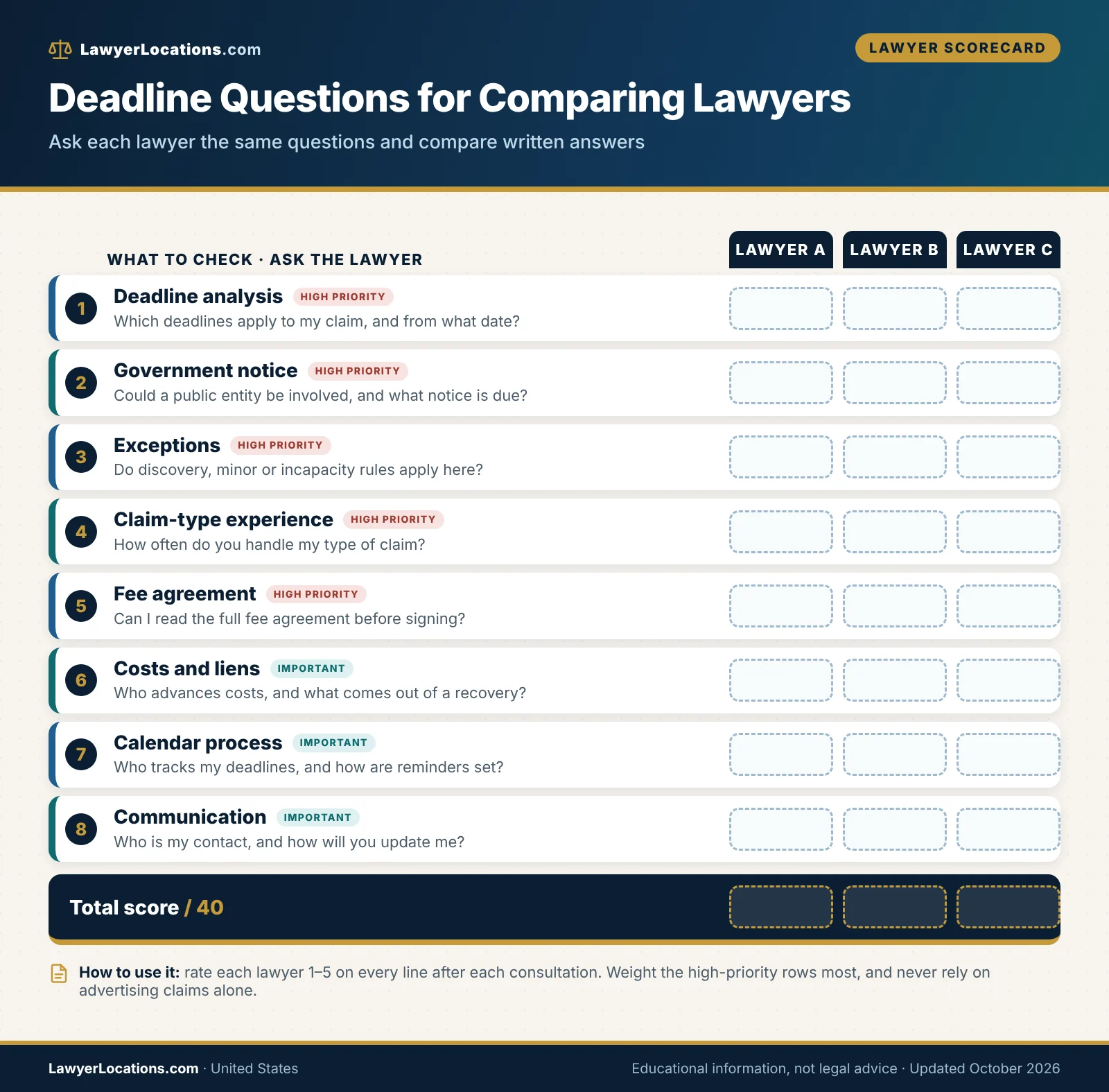
Text version of this graphic
| Criterion | Question to ask | Weight |
|---|---|---|
| Deadline analysis | What deadlines apply to my claim, and from what date? | High |
| Government notice | Could a public entity be a defendant, and what notice is due? | High |
| Exceptions | Do discovery, minor or incapacity rules apply? | High |
| Claim-type experience | How often do you handle my kind of claim in this state? | High |
| Fee agreement | Can I see the full fee agreement before signing? | High |
| Costs and liens | Who advances costs, and what comes out of a recovery? | Medium |
| Calendar process | Who tracks my deadlines, and how are reminders set? | Medium |
| Communication | How will you update me, and who is my point of contact? | Medium |
Fee structures and costs when you are up against a deadline
Fee terms are negotiated between you and the lawyer, and they vary. We do not publish fee averages here because we found no official source that supports one. What follows is how to compare structures, not what you should expect to pay.
Contingency, hourly and hybrid arrangements
In a contingency fee arrangement the lawyer is paid a share of any recovery instead of hourly. Hourly and hybrid arrangements exist too, particularly in cases that are mostly about insurance coverage or a defense. Ask which structure is proposed, the exact percentage or rate, and whether it changes if the case is filed or goes to trial.
Ask for the agreement in writing and read what happens to the fee if you change lawyers midway or the case is dropped. A tight deadline is not a reason to sign something you have not read.
Case costs, liens and who pays if the case is lost
Case costs are separate from the lawyer’s fee. They can include court filing fees, records, experts and depositions. Ask who advances them, whether they are repaid from a recovery before or after the fee is calculated, and what you owe if there is no recovery.
Also ask about liens, which are claims by health insurers, Medicare, Medicaid or providers on part of a recovery. The lawyer should be able to explain how liens are handled in your state. For more on how settlement money flows, see our guide to the car accident settlement timeline, and for wrongful death fees our wrongful death lawyer cost guide.
Make two or three calls in the same week and ask each lawyer the same deadline questions. The one who names your specific deadline and asks about government involvement has done the screening that matters most when time is short.
Consultation preparation: what to bring and what to avoid
A focused first meeting saves days. A lawyer who can see the dates, the parties and the paperwork can estimate the deadline in minutes.
Documents and dates to gather
Gather what you already have. You do not need a perfect file, and the lawyer will request records. Bring the items below, or photos of them, and write the dates in a single timeline page.
- The date, time and place of the injury, and a short account in your own words.
- Names and contact details of everyone involved, including witnesses and any public agency.
- Insurance cards, claim numbers and the adjusters’ names for every policy involved.
- Medical records, bills and a list of treating providers with dates of treatment.
- Photos, video, police or incident reports and any notices you have received.
- Any letters, emails or recorded statements exchanged with an insurer.
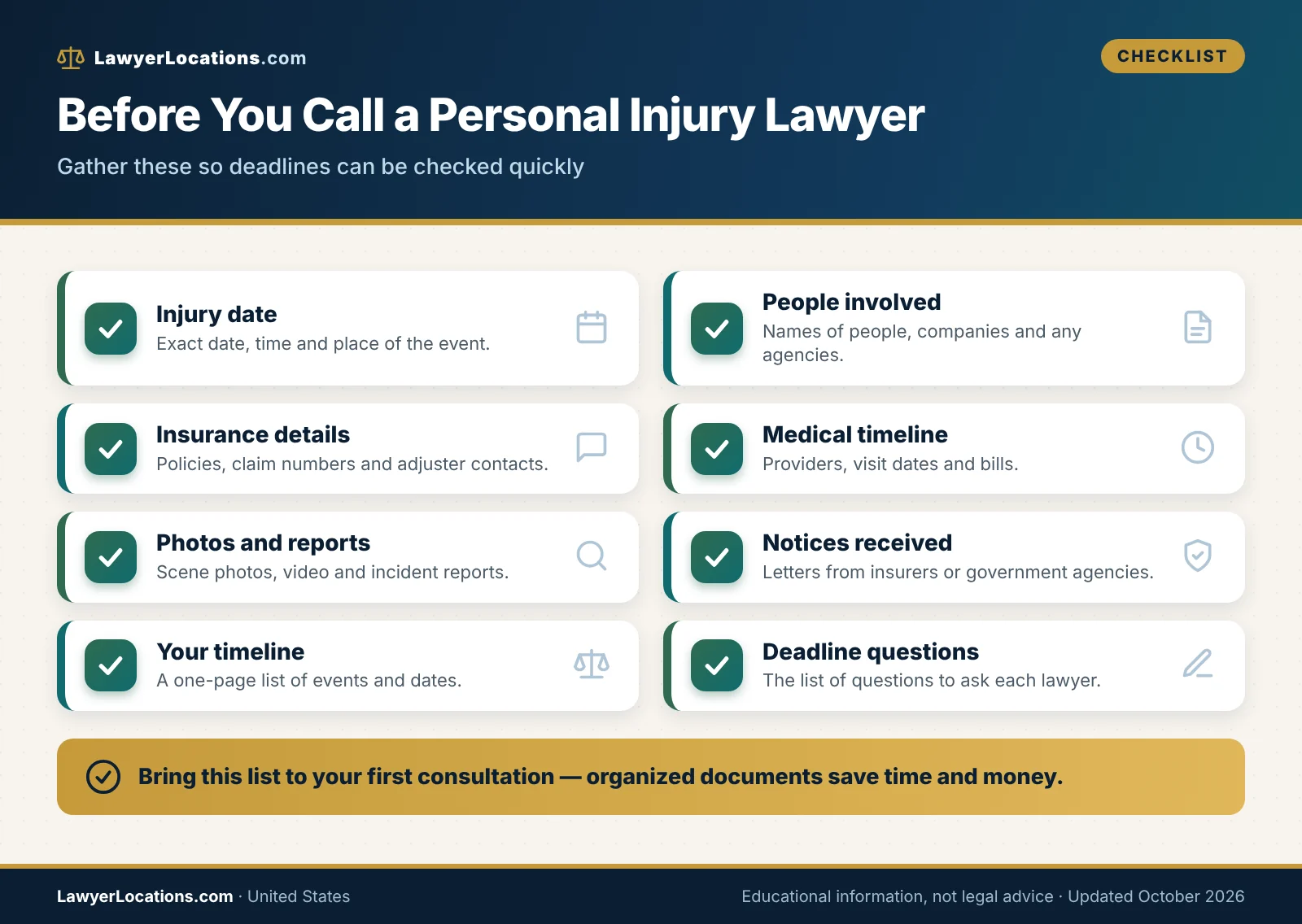
Text version of this graphic
- Injury date. Exact date, time and place of the event.
- Who was involved. Names of people, companies and agencies.
- Insurance details. Policies, claim numbers and adjuster contacts.
- Medical timeline. Providers, visit dates and bills.
- Photos and reports. Scene photos, video and incident reports.
- Notices received. Letters from insurers or government agencies.
- Your written timeline. A one-page list of events and dates.
- Deadline questions. The list from the first call, ready to ask.
Red flags when hiring under time pressure
Time pressure makes people sign quickly, and a few warning signs are worth knowing in advance. None of them proves wrongdoing, but each is a reason to slow down and ask questions.
- A promise of a result or a dollar figure before the lawyer has reviewed your records.
- Unwillingness to put the fee terms or the deadline analysis in writing.
- Pressure to sign immediately, or to sign a release for an insurer before a lawyer has reviewed it.
- Vagueness about whether the lawyer is licensed in your state or handles your type of claim.
- No explanation of how costs, liens and the fee are paid out of a recovery.
You can usually confirm a lawyer’s license status through the state bar. If you are in the Chicago area, our guide to finding a personal injury lawyer in Chicago walks through how that comparison works in one metro area.
Shorter or Different Clocks: Government, Wrongful Death and Malpractice
Three kinds of claims regularly run on clocks that differ from the state’s general personal injury period: claims against government bodies, wrongful death claims, and medical malpractice claims. If any of the three describes your situation, find that rule before you rely on the table above.
Claims against government entities
A government body can be sued for negligence in many situations, but usually only after following a notice procedure written by statute. Missing that step can end the case regardless of the underlying merits.
The federal government: the Federal Tort Claims Act
When the defendant is the United States, such as a negligent federal employee driving a government vehicle or a federal medical facility, the Federal Tort Claims Act (FTCA) sets a two-step process. Under 28 U.S.C. § 2401(b), a tort claim against the United States is “forever barred” unless it is presented in writing to the appropriate federal agency within two years after the claim accrues, or unless an action is begun within six months after the date of mailing, by certified or registered mail, of notice of final denial of the claim by the agency.
The administrative step is mandatory. 28 U.S.C. § 2675(a) says an action may not be instituted unless the claimant first presented the claim to the appropriate federal agency and the agency finally denied it in writing, and agency inaction for six months can, at the claimant’s option, be treated as a final denial.
What a federal claim must include
Under 28 CFR § 14.2(a), a claim is presented when the agency receives an executed Standard Form 95 or other written notification of an incident, together with a claim for a fixed sum of money. The signer’s title or legal capacity must be identified, and proof of authority must accompany a filing made for someone else.
Section 2675(b) also limits a later lawsuit to the amount stated in the administrative claim, with narrow exceptions for newly discovered evidence or later developments. That makes the dollar figure in the claim a serious decision, not a formality.
The FTCA two-year period is for presenting the claim to the agency, not for filing a lawsuit. A person who waits two years and then hires a lawyer to sue may find the claim already barred. Ask early whether any federal employee, vehicle or facility was involved.
State and local examples
States set their own notice rules for state agencies, counties, cities and school districts, and the rules differ in length, form and consequences. The table shows five examples we verified in statute text, which illustrate the range rather than cover every state.
| Jurisdiction | Requirement in substance | Authority |
|---|---|---|
| United States (federal) | 2 years to present a written administrative claim to the agency; suit within 6 months after a mailed final denial | 28 U.S.C. §§ 2401(b), 2675(a) |
| New York | 90 days to serve a notice of claim on a public corporation; for wrongful death, the 90 days run from the appointment of the estate’s representative | Gen. Mun. Law § 50-e(1)(a) |
| Texas | 6 months from the incident for the governmental unit to receive notice, unless it had actual notice | Tex. Civ. Prac. & Rem. Code § 101.101(a), (c) |
| Michigan (highway defects) | 120 days from the injury to serve written notice of the injury and the defect, specifying the exact location, the injury and known witnesses | MCL 691.1404(1) |
| Florida (state agencies and subdivisions) | Claim presented in writing to the agency within 3 years (2 years for wrongful death, to the Department of Financial Services); agency has 6 months (90 days for medical malpractice and wrongful death) before silence is a denial; suit within 4 years of accrual | Fla. Stat. § 768.28(6), (14) |
| Washington (local governments) | Claim presented to the entity’s designated agent, then a 60-day wait before suit; the limitation period is tolled during the wait | RCW 4.96.020(4) |
Late notice, actual notice and how to look up your rule
Some states allow late notice in limited circumstances. New York’s section 50-e(5) lets a court extend the time to serve a notice of claim, but the extension “shall not exceed the time limited for the commencement of an action” by the claimant. Texas excuses the six-month notice when the governmental unit has actual notice of the injury or death.
To find the rule for a particular agency, search your state code for “claims against the state” or “tort claims act,” then look at the municipal code or charter for city and county claims. School districts and special districts often have their own claim forms. A lawyer in your state can usually confirm the right entity, form and recipient faster than you can.
Wrongful death
A wrongful death claim is a statutory right, created by state law, that lets certain family members or an estate recover when a death was caused by another’s wrongful act. The deadline often differs from the injury deadline, and it often starts on the date of death.
Who files and when the clock starts
In many states a court-appointed personal representative of the estate brings the action for the benefit of the survivors. New York’s EPTL 5-4.1 lets the decedent’s personal representative sue, and the action “must be commenced within two years after the decedent’s death,” and Virginia’s section 8.01-244(B) uses a similar two-year rule from the date of death. Arizona’s statute states that wrongful death claims accrue at the injured party’s death.
The time needed to open an estate and obtain letters can be significant. Ask a lawyer to build the deadline backward from the death date, including the time to be appointed, the same way you would for an injury.
Wrongful death deadlines in states we verified
| State | Period | Authority |
|---|---|---|
| Arizona | 2 years; accrues at death | A.R.S. § 12-542 |
| California | 2 years | Cal. Code Civ. Proc. § 335.1 |
| Florida | 2 years | Fla. Stat. § 95.11(5)(e) |
| Idaho | 2 years (injury to the person or death caused by wrongful act or neglect) | Idaho Code § 5-219(4) |
| Louisiana | Longer of 1 year from death or 2 years from the injury; medical malpractice wrongful death 1 year from death | La. Civ. Code art. 2315.2 as amended by Act 176 (2025) |
| Montana | 3 years; 10 years if the death results from a homicide | MCA 27-2-204(2) |
| Nevada | 2 years | NRS 11.190(4)(e) |
| New York | 2 years from death | EPTL 5-4.1(1) |
| North Dakota | 2 years (injuries when death ensues) | N.D.C.C. § 28-01-18(4) |
| Pennsylvania | 2 years | 42 Pa.C.S. § 5524(2) |
| Texas | 2 years; accrues on death | Tex. Civ. Prac. & Rem. Code § 16.003(b) |
| Virginia | 2 years after death | Va. Code § 8.01-244(B) |
| Wisconsin | 3 years; 2 years if the death arises from a motor vehicle accident | Wis. Stat. § 893.54(1m)(b), (2m) |
Families often ask about cost before they call anyone. Our wrongful death lawyer cost guide explains fee structures and case expenses for these claims.
Medical malpractice and other special claims
Medical negligence cases often have shorter filing periods than ordinary injuries, plus extra steps such as pre-suit notice. Other claim types, such as abuse or exposure, have their own windows.
Medical malpractice: a patchwork of periods
| State | Rule in substance | Authority |
|---|---|---|
| Florida | 2 years from the incident, with a 4-year outer limit that does not apply to an action on behalf of a minor filed by the child’s 8th birthday | Fla. Stat. § 95.11(5)(c) |
| Idaho | Professional malpractice 2 years; foreign-object and concealment claims accrue on discovery, with 1 year from accrual or 2 years from the act, whichever is later | Idaho Code § 5-219(4) |
| Iowa | 2 years from when the claimant knew or should have known, with a 6-year outer limit; minors under 8 have until the 10th birthday if later | Iowa Code § 614.1(9) |
| Kentucky | Accrues on discovery, with a 5-year outer limit from the act or omission | KRS 413.140(2) |
| Michigan | 2 years for malpractice; a child under 8 has until the 10th birthday or the ordinary period, whichever is later | MCL 600.5805(8), 600.5851(7) |
| New York | 2 years 6 months from the act, or from the end of continuous treatment; foreign object claims 1 year from discovery | CPLR 214-a |
| Ohio | 1 year from accrual, 180 days more if a notice is sent in time, with a 4-year outer limit | R.C. 2305.113 |
| Texas | 2 years from the breach or end of treatment; 60-day pre-suit notice tolls 75 days; 10-year repose | Tex. Civ. Prac. & Rem. Code §§ 74.251, 74.051 |
| Wisconsin | The later of 3 years from the injury or 1 year from discovery, with a 5-year limit on the discovery path | Wis. Stat. § 893.55(1m) |
Because the periods are shorter and the notice rules stricter, a surgical or diagnostic error is one of the situations where a same-week consultation matters most. Our guide to surgical error lawyers in Missouri shows how those cases are handled in a single state.
Sexual abuse and other extended windows
Some states set longer or separate windows for abuse claims, especially for survivors who were children. Wyoming allows certain civil actions based on sexual assault of a minor within the later of eight years after the minor’s 18th birthday or three years after discovery (Wyo. Stat. § 1-3-105(b)). Rhode Island assigns child sexual abuse claims to section 9-1-51 instead of its general injury statute, and Indiana’s version we read has a longer period for child sexual abuse in subsection (b) of its injury statute.
Legislatures revise these provisions often, sometimes with temporary look-back windows. If your claim involves abuse, ask a lawyer who handles those cases to confirm the current rule instead of relying on a general chart.
Workers’ compensation and other administrative systems
On-the-job injuries usually run through a state workers’ compensation system, with its own notice and claim deadlines and its own agency, instead of the ordinary lawsuit deadline. The same is true for some benefits programs and administrative claims.
We do not summarize those deadlines here because they vary by state and agency. For a state-specific starting point, see our guide to finding a workers’ comp lawyer in Los Angeles, and confirm the rule for your own state with the agency or a lawyer.
Insurance Deadlines, Comparative Fault and Multiple Defendants
Three side issues routinely derail otherwise timely claims: confusing an insurance claim with a lawsuit, missing a short no-fault deadline, and misunderstanding how shared fault and multiple defendants interact with the clock. Each is manageable once you know it exists.
Insurance claims versus lawsuits
An insurance claim is a request for payment under a policy, made to an insurer. A lawsuit is a case filed in court. The first does not substitute for the second, and the deadlines are independent.
Why an open insurance claim does not stop the lawsuit clock
You can be in active settlement talks with an adjuster for months while the statute of limitations runs. Unless a statute or a signed agreement says otherwise, the insurer has no duty to remind you of the date, and the claim does not become timely because the insurer is still communicating.
That is why a lawyer will often file suit before negotiations are finished, then keep negotiating. Filing preserves the claim, and nothing prevents a settlement after it.
Policy notice and proof-of-claim conditions
Policies commonly require prompt notice of an accident or loss and written proof within a stated period. The wording differs from insurer to insurer and from state to state, so read the notice conditions in your own policy and in any policy that may cover the other driver or property owner.
Late notice can lead an insurer to deny coverage or dispute benefits, and the rules on how much prejudice the insurer must show vary by state. Report the incident promptly, in writing, and keep a copy of what you sent.
No-fault and PIP deadlines
A number of states use no-fault or personal injury protection (PIP) coverage, which pays certain medical costs and lost income regardless of fault. These systems often include short notice and care deadlines that arrive within days of a crash.
Examples from Florida, New York and Michigan
| State | Deadline in substance | Authority |
|---|---|---|
| Florida | PIP medical benefits are payable only if the injured person receives initial services and care within 14 days of the accident; the required PIP limit is $10,000 for medical and disability benefits and $5,000 for death benefits | Fla. Stat. § 627.736(1) |
| New York | Notice of the accident as soon as reasonably practicable and in no event more than 30 days after the accident, with an exception for written proof of clear and reasonable justification; proof of claim for health service expenses within 45 days of services and for work loss or other expenses within 90 days | 11 NYCRR § 65-1.1 (mandatory endorsement), as published by Cornell LII |
| Michigan | An action for PIP benefits may not be commenced later than 1 year after the accident unless written notice of injury was given within a year or the insurer already paid benefits; recovery is limited to losses incurred within one year before the action was filed | MCL 500.3145(1)-(2) |
Why no-fault deadlines are easy to miss
The deadlines come early, when people are focused on recovery and may not yet know they have a claim. A person who skips follow-up care for two weeks after a Florida crash could lose PIP medical benefits that the statute conditions on early treatment.
If you were in a crash in a no-fault state, open a claim with your own insurer right away and ask what proof is due and when. Our guides to motorcycle accident lawyers in New York City and rear-end accident claims give more context on how these claims start.
An insurer’s “request for more information” is not an extension. If you receive one, respond in writing and calendar the date. Treat every written deadline from an insurer as real until a lawyer tells you otherwise.
Comparative fault and shared responsibility
Comparative fault rules reduce, or in some states bar, recovery when the injured person is partly at fault. They affect how much you may recover. They do not move the filing deadline.
Fault rules change the payout, not the filing date
Several states we reviewed set a 50 percent line. Texas bars recovery if the claimant’s percentage of responsibility is greater than 50 percent and otherwise reduces damages by that percentage (Tex. Civ. Prac. & Rem. Code §§ 33.001, 33.012(a)). Illinois bars recovery if the plaintiff is more than 50 percent at fault (735 ILCS 5/2-1116). Florida added its own greater-than-50-percent bar in 2023, with an exception for medical negligence cases (Fla. Stat. § 768.81(6)).
Other states use different rules, and a few follow stricter approaches, so ask a lawyer in your state how fault is allocated. For deadline purposes the point is simple: a fault dispute is something you argue after filing, not a reason to wait.
Don’t wait because you think you were partly at fault
People sometimes assume they have no claim because they were partly to blame, or because the insurer says so. Fault is usually a contested question that depends on evidence, and an insurer’s first position is not a ruling. If you wait and the deadline passes, the argument never gets made.
Avoid detailed statements about who was at fault in conversations with other drivers or insurers before you have spoken to a lawyer, and keep your account factual.
Multiple defendants and different clocks
One accident can involve several parties, including a driver, an employer, a property owner and a public agency. Each can have a different deadline or a different notice rule.
Private and public defendants in one accident
If a city worker and a private driver both contributed to a crash, the claim against the city may require a notice within months while the claim against the driver has a multi-year deadline. In Texas, filing suit against a governmental unit is an irrevocable election that bars suit against the unit’s employee on the same subject matter (Tex. Civ. Prac. & Rem. Code § 101.106(a)), so who you name first can matter.
A lawyer should map out every potentially responsible party early and note each party’s deadline separately. For a Louisiana-specific look at hiring, see our guide to bicycle accident lawyers in New Orleans, and remember that Louisiana’s two-year period applies to injuries after July 1, 2024.
Adding a defendant after the deadline
Courts generally apply limitation periods to each defendant separately, and the rules for adding a new defendant after the deadline are narrow. A plaintiff who names only the first defendant they identify may find it too late to add the real one.
The practical lesson is to identify everyone who might share responsibility, including owners, employers and contractors, well before the deadline. That is one reason an early investigation is worth doing even if the case may later settle.
What to Do When Time Is Short, or Already Gone
If your deadline is close, the useful steps are to confirm the date with a lawyer licensed in your state, protect evidence, and send any required notices now. If you think it has passed, do not assume the claim is dead until someone has checked for exceptions, other defendants and other claims.
The first 72 hours
The first few days after an injury shape both your health and your claim. You do not need to solve the deadline question in this window, but a few actions make everything later easier.
Medical care and records
Get medical attention and follow the treatment plan. Insurers and defense lawyers look for gaps in care, and in no-fault states such as Florida a delay of more than 14 days can affect PIP medical benefits. Ask for copies of discharge papers and keep a simple list of providers and dates.
Keep the focus on your health. A lawyer can collect formal medical records later, but only if you can name the providers.
Evidence and notice
Photograph the scene, your injuries and any property damage as soon as it is safe. Save the names and contact information of witnesses. Do not post about the accident on social media, and keep a short, private written timeline of what happened.
Report the incident to the property owner, employer or agency involved if that is appropriate, and tell your own insurer promptly. If a public entity may be involved, ask a lawyer immediately about the notice rule, because the window may already be running.
Write the date of injury on a calendar today, then add reminders at six months, one year and 90 days before the shortest possible deadline. A reminder you set in week one is worth more than a deadline you discover in month eleven.
Building a deadline calendar
A written calendar turns a vague worry into a checklist. It also gives a lawyer something concrete to check on the first call.
A worksheet for the clocks that may apply
| Clock | Date to record | Where the rule comes from | Who confirms it |
|---|---|---|---|
| Lawsuit deadline (private defendant) | Date of injury plus the general period | State statute of limitations (see the state tables) | A lawyer licensed in your state |
| Government notice or claim | Date of injury plus the notice window | State or local tort claims statute, charter or federal FTCA rules | A lawyer, or the agency’s claims office |
| Wrongful death | Date of death plus the statutory period | State wrongful death statute | A lawyer; also the court that opens the estate |
| Medical malpractice | Date of treatment, discovery date, any pre-suit notice date | State medical liability statute | A lawyer who handles malpractice cases |
| No-fault or PIP | Date of accident plus the notice and care deadlines | State insurance statute and your policy | Your insurer and a lawyer |
| Child’s claim | Date of injury, child’s birthday and any tolling end date | State tolling statute | A lawyer; do not assume childhood tolling |
Decision points on a timeline
Several decisions arrive in a predictable order after an injury: whether to seek care, whether to notify insurers, whether a public entity is involved, and when to hire a lawyer. The earliest deadline, which is often a government notice or a no-fault requirement, controls how quickly you need to decide.
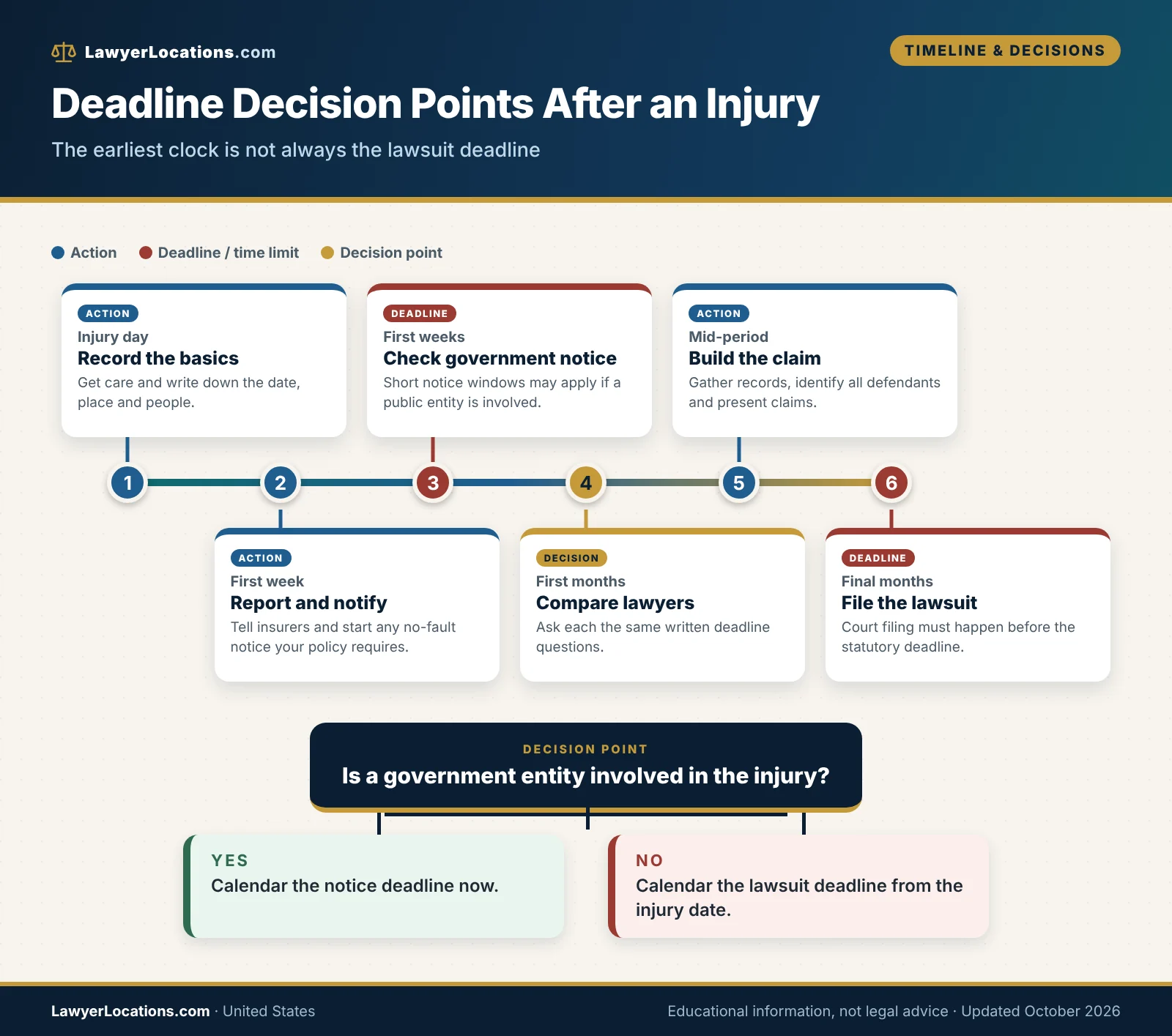
Text version of this graphic
- Injury day (action). Get care and write down the date, place and people involved.
- First week (action). Report to insurers and start any no-fault notice your policy requires.
- First weeks (deadline). Watch for short government notice windows if a public entity may be involved.
- First months (decision). Compare lawyers using the same written deadline questions.
- Middle of the period (action). Records gathered, defendants identified, claim presented.
- Final months (deadline). Lawsuit must be filed; an agreed written extension may be an option.
- Decision question. Is a government entity involved? If yes, calendar the notice deadline now. If no, calendar the lawsuit deadline from the injury date.
If you think the deadline has passed
A missed deadline is serious, but it is not always the end of the matter. The honest answer is that it depends on facts a lawyer has to review.
Exceptions and angles to ask about
These are the questions worth putting to a lawyer, one at a time:
- Did the clock start later because of the discovery rule or a hidden injury?
- Was the injured person a minor or someone who lacked capacity when the claim accrued?
- Is there a different defendant, such as an employer or property owner, with a later deadline?
- Did the defendant do something that blocked or delayed filing?
- Is there a longer statute that fits the claim, such as a different claim type or a death claim?
- Is there a late-notice procedure, such as the court-approved late notice some public-entity statutes allow?
- Do first-party insurance benefits, which have their own rules, remain available?
When the answer is that the claim is time-barred
Courts apply limitation statutes strictly, and a claim that is truly time-barred generally cannot be revived because the injury was serious or the defendant was clearly at fault. If one lawyer tells you the deadline passed, a second opinion from a lawyer who handles your claim type is reasonable, because deadline calculations involve accrual, tolling and claim-type questions that are easy to get wrong.
If a lawyer you hired earlier let a deadline pass, another lawyer can evaluate that separately. Ask for a prompt review, because there are time limits on those claims too.
Common mistakes that cost people their claims
Most lost claims lose the race against the calendar in predictable ways. The lists below group them by when they tend to happen.
Mistakes in the first months
- Assuming the insurer will remind you of the deadline.
- Skipping follow-up medical care or leaving gaps that look like recovery.
- Missing a short no-fault notice or proof-of-claim date.
- Failing to check whether a government entity was involved.
- Signing a release or accepting a quick payment before knowing the full extent of the injury.
Mistakes near the deadline
- Starting the search for a lawyer in the last month of the deadline.
- Treating a lawyer’s verbal “we have time” as confirmation, instead of asking for the date in writing.
- Mailing a demand letter and treating it as filing.
- Waiting for medical treatment to finish before filing when the deadline does not wait.
- Naming only one defendant when several may be responsible.
Our car accident settlement timeline explains how the claim process unfolds from first report to payment, which is a useful reality check on how little slack there may be inside a short window.
Frequently Asked Questions About Personal Injury Filing Deadlines
These are the questions people ask most often when they search for a filing deadline. Each answer is short and points back to the section above that explains it. Details depend on your state, so treat them as orientation, not advice.
Deadline basics and counting the clock
The first group covers what the deadline is, what happens if it passes, and how to count it.
The most common deadline questions
How long do I have to file a personal injury claim in most states?
In most states you have two or three years from the date of injury to file a lawsuit. Twenty-five of the 51 jurisdictions in our table use two years and seventeen use three. A few are shorter or longer, so check your state’s row, then confirm it with a lawyer.
What is the shortest personal injury deadline in the U.S.?
Kentucky’s general rule is one year (KRS 413.140(1)(a)), and Tennessee is listed at one year as well. Several states also set shorter periods for specific claims such as assault or battery, or for claims against public entities.
What is the longest?
Among the statutes we reviewed, Maine, Minnesota and North Dakota allow six years for general injury claims, and Missouri allows five. A long deadline does not remove shorter ones for government or medical defendants.
What happens if I file after the statute of limitations has expired?
The defendant can ask the court to dismiss the case as time-barred, and courts generally grant that request unless an exception applies. Strong evidence about fault does not usually change the result.
Is a personal injury “claim” the same as a personal injury lawsuit?
No. A claim is usually a demand made to an insurer, and a lawsuit is a case filed in court. The insurance process can run for months, while the lawsuit deadline keeps counting down.
Does the clock run from the accident or from the end of my treatment?
Usually from the date of injury, not the end of treatment. A few states start the clock later when the harm is not discoverable, but ongoing treatment for a known injury generally does not delay it.
Starting, pausing and counting the clock
Do settlement talks with the insurance company pause the deadline?
Not in most situations. Unless a statute or a signed written agreement says otherwise, talks do not extend the deadline, and an adjuster has no general duty to warn you about it.
Can the deadline be extended by agreement?
Sometimes the parties sign a written tolling agreement that pauses the clock. Whether that works depends on state law and on the wording, so have a lawyer review any such document before you rely on it.
What counts as “filing” a claim for deadline purposes?
For a lawsuit, generally filing a complaint with the court, with a separate rule for serving the defendant. Mailing a demand letter, filing an insurance claim or emailing an adjuster does not stop the lawsuit clock.
Which state’s deadline applies if I was hurt while traveling?
It can depend on where the injury happened, where the defendant lives and where the case is filed, and courts sometimes apply the filing state’s limitation rules. Ask a lawyer where the case can be brought before you assume either state’s period.
Is there a deadline for hiring a lawyer?
No legal deadline exists, but practically a lawyer needs time to investigate and draft a complaint. Starting the search well before the lawsuit deadline, and earlier if a government entity is involved, gives you the most options.
Special situations
The second group covers children, hidden injuries, public defendants, death claims and medical care.
Children, discovery and tolling
Do children have more time to file?
Often, but the rules differ. Texas does not count time while a person is under 18, Illinois allows two years after turning 18, and Oregon pauses time up to a cap. Do not assume a child’s claim is open indefinitely.
What is the discovery rule?
It starts the clock when the injury, and sometimes its cause, was or should have been discovered instead of when it happened. States such as New Hampshire and Vermont write it into the statute, and others limit it to specific kinds of harm.
Does the clock stop if the injured person lacks capacity?
Many states pause the clock for a disabling condition at accrual, with different caps and conditions. Texas, Oregon and Virginia, among others in our review, have such provisions.
What if the person who hurt me leaves the state or hides?
Some states pause the count when a defendant blocks filing, as Virginia does for obstruction. Others handle it differently, and proving the obstruction is your burden. Do not wait on the assumption that the clock has stopped.
What is a statute of repose?
An outer time limit measured from the defendant’s act regardless of when you found the harm. Kansas and North Carolina each have a 10-year limit in their general injury statutes, and medical and product claims often carry repose periods.
Government, wrongful death and medical claims
How long do I have to sue a city, county or state agency?
It varies, and the first step is often a written notice rather than a lawsuit. Examples we verified include 90 days in New York, six months in Texas, 120 days for Michigan highway defects and up to three years for a Florida claim presented to a state agency.
How long do I have to make a claim against the federal government?
Under the Federal Tort Claims Act you generally must present a written claim to the agency within two years after it accrues, then sue within six months after a mailed final denial. Agency silence for six months can be treated as a denial at your option.
What is the deadline for a wrongful death claim?
Many states use two years from the date of death, including New York, Texas and Virginia in our review. Others differ: Montana allows three years and Wisconsin allows three, or two for a motor vehicle death.
Is the medical malpractice deadline shorter?
Often yes, and it can come with pre-suit notice and outer limits. Ohio is one year, New York is two years and six months, and Florida is two years with a four-year outer limit.
Do workers’ compensation claims follow the same deadline?
No. They usually go through a separate state system with its own notice and filing deadlines. Confirm the rule with the workers’ compensation agency or a lawyer in your state.
Insurance, lawyers and next steps
The last group covers insurance payments, fault, finding a lawyer and cost concerns.
Insurance and settlement
How long do I have to report an accident to my own insurer?
Your policy sets this, and no-fault states can be short. Florida conditions PIP medical benefits on care within 14 days, and New York’s no-fault endorsement calls for notice within 30 days. Report as soon as you can in writing.
Does accepting an insurance payment end my right to sue?
It can, if you sign a release. A release often ends the claim in exchange for payment. Do not sign one for a payment that does not cover your injuries until a lawyer has reviewed it.
Does being partly at fault change the deadline?
No. Shared fault can reduce or bar recovery under state law, such as the 50 percent bars in Texas, Illinois and Florida, but it does not move the filing date.
Is the deadline different for a car crash than a fall in a store?
The general negligence period is usually the same, though the defendant matters. A fall on city property can trigger a short government notice rule, and a crash may involve no-fault deadlines.
Lawyers, costs and next steps
How soon should I talk to a lawyer?
As soon as you can, and immediately if a public entity, a death or medical care is involved. A lawyer can check the notice rules and calendar the lawsuit deadline.
Can I file a personal injury case myself?
Individuals can file their own cases, and many courts have self-help centers. The risk is missing a deadline, a notice requirement or a procedural rule, so consult a lawyer before relying on the do-it-yourself route for a serious injury.
What if I cannot afford a lawyer?
Personal injury lawyers commonly use contingency fees, where the fee comes from a recovery, so ask how fees and costs are handled. Legal aid organizations and your state bar’s referral service can also point you to options.
Is this guide legal advice?
No. It is general information and does not create an attorney-client relationship. Statutes change, and a lawyer licensed in your state must confirm the deadline for your facts.
Next Steps: Turning a Deadline Into a Plan
If you are still asking how long do I have to file a personal injury claim, the practical answer is to find your state’s row, check for a government or medical twist, and have a lawyer licensed in your state confirm the date in writing. The steps below turn that into a week of action.
A seven-day action plan
You can do most of this without a lawyer, and it makes any first consultation faster and more productive.
Days one to three
- Write down the dates. Record the date of injury (and the date of death if relevant) and put it on a calendar.
- Identify the defendant type. Decide whether a private party, a company, a medical provider or a public entity may be responsible.
- Look up your state row. Use the state tables above, then note any shorter rule for government, medical or wrongful death claims.
- Protect your health and your records. Keep appointments, and save bills, photos and reports.
Days four to seven
- Notify the right insurers. Report in writing, and ask what no-fault or proof-of-claim deadlines apply.
- Compare lawyers. Use the same deadline questions with each, and ask for answers in writing.
- Ask about a government notice. If a public body could be involved, make this the first question.
- Do not sign a release. Hold off on any settlement paperwork until a lawyer has reviewed it.
Where to find state-specific help
The deadline in your state is the one that matters, and several types of organizations can help you confirm it. None of them replaces advice from a lawyer who knows your facts.
Court self-help centers and bar referral services
Many state courts operate self-help centers and websites that explain how to file a case, and state bar associations typically run lawyer referral services and let you confirm that a lawyer is licensed. Search for your state’s court system and bar association by name, and use official sites rather than ads.
Legal aid organizations may help people who cannot afford a lawyer, particularly where the claim has other legal angles such as housing or benefits. Eligibility rules differ by organization.
Using LawyerLocations.com
LawyerLocations.com is a legal-education and lawyer-discovery resource. We do not rate or recommend individual lawyers, and reading this guide does not create an attorney-client relationship. Our state and city guides use the same approach as this one: verified statutes, plain-English explanations and questions you can ask any lawyer.
Use them to prepare, then make the call yourself. When a deadline is involved, a short delay in choosing a lawyer is usually less costly than a long delay in starting the search.
Ready to compare your options?
Write down your injury date, find your state’s row in the tables above, and ask at least two lawyers licensed in your state the same deadline questions. If a government agency, a medical provider or a death is involved, start with that question. Nothing in this guide is a promise about how your case will turn out.
Sources & References
Show all 80 sources
- Arizona Revised Statutes § 12-542 — Arizona Legislature — azleg.gov — accessed October 2026
- Delaware Code, Title 10, Chapter 81 (§ 8119) — Delaware General Assembly — delcode.delaware.gov — accessed October 2026
- D.C. Code § 12-301 — Council of the District of Columbia — code.dccouncil.gov — accessed October 2026
- Florida Statutes § 95.11 (limitations other than for the recovery of real property) — Florida Legislature (Online Sunshine) — leg.state.fl.us — accessed October 2026
- Florida Statutes § 95.11 (2025), subsection numbering — Florida Senate — flsenate.gov — accessed October 2026
- Chapter 2023-15, Laws of Florida (HB 837) — Florida Laws (laws.flrules.org) — laws.flrules.org — accessed October 2026
- Florida Statutes § 768.28 (waiver of sovereign immunity) — Florida Legislature (Online Sunshine) — leg.state.fl.us — accessed October 2026
- Florida Statutes § 768.81 (comparative fault) — Florida Legislature (Online Sunshine) — leg.state.fl.us — accessed October 2026
- Florida Statutes § 627.736 (PIP benefits) — Florida Legislature (Online Sunshine) — leg.state.fl.us — accessed October 2026
- HRS § 657-7 — Hawaii State Legislature — data.capitol.hawaii.gov — accessed October 2026
- Idaho Code § 5-219 — Idaho Legislature — legislature.idaho.gov — accessed October 2026
- 735 ILCS 5/13-202 (personal injury) — Illinois General Assembly — ilga.gov — accessed October 2026
- 735 ILCS 5/13-211 (minors and persons under legal disability) — Illinois General Assembly — ilga.gov — accessed October 2026
- 735 ILCS 5/2-1116 (modified comparative fault) — Illinois General Assembly — ilga.gov — accessed October 2026
- Iowa Code § 614.1 — Iowa Legislature — legis.iowa.gov — accessed October 2026
- K.S.A. 60-513 — Kansas Office of Revisor of Statutes — ksrevisor.gov — accessed October 2026
- KRS 413.140 — Kentucky Legislature — apps.legislature.ky.gov — accessed October 2026
- Louisiana Civil Code art. 3493.1 — Louisiana State Legislature — legis.la.gov — accessed October 2026
- Act 423 (HB 315), 2024 Regular Session, digest — Louisiana State Legislature — legis.la.gov — accessed October 2026
- Act 176 (HB 291), 2025 Regular Session, digest and enrolled text — Louisiana State Legislature — legis.la.gov — accessed October 2026
- 14 M.R.S. § 752 — Maine Legislature — legislature.maine.gov — accessed October 2026
- Courts and Judicial Proceedings § 5-101 — Maryland General Assembly — mgaleg.maryland.gov — accessed October 2026
- M.G.L. c. 260, § 2A — Massachusetts Legislature — malegislature.gov — accessed October 2026
- MCL 600.5805 (limitations periods for injury to persons) — Michigan Legislature — legislature.mi.gov — accessed October 2026
- MCL 600.5851 (minors and insane persons) — Michigan Legislature — legislature.mi.gov — accessed October 2026
- MCL 691.1404 (notice of defective highway injury) — Michigan Legislature — legislature.mi.gov — accessed October 2026
- MCL 500.3145 (no-fault PIP limitations) — Michigan Legislature — legislature.mi.gov — accessed October 2026
- Minnesota Statutes § 541.05 — Minnesota Office of the Revisor of Statutes — revisor.mn.gov — accessed October 2026
- Clearman v. Pipestone Property Services, LLC (Miss. Ct. App. No. 2022-CA-00651-COA, Nov. 21, 2023), quoting Miss. Code Ann. § 15-1-49 — Mississippi Supreme Court and Court of Appeals — courts.ms.gov — accessed October 2026
- RSMo § 516.120 — Missouri Revisor of Statutes — revisor.mo.gov — accessed October 2026
- HB 68 (2025), fiscal note — Missouri House of Representatives — documents.house.mo.gov — accessed October 2026
- Montana Code Annotated 27-2-204 — Montana Legislature — mca.legmt.gov — accessed October 2026
- Neb. Rev. Stat. § 25-207 — Nebraska Legislature — nebraskalegislature.gov — accessed October 2026
- NRS Chapter 11 (§ 11.190) — Nevada Legislature — leg.state.nv.us — accessed October 2026
- RSA 508:4 — New Hampshire General Court — gc.nh.gov — accessed October 2026
- P.L. 2019, c.120 (amending N.J.S.A. 2A:14-2) — New Jersey Legislature — pub.njleg.gov — accessed October 2026
- CPLR 214 (limitation periods) — New York State Senate — nysenate.gov — accessed October 2026
- CPLR 214-a (medical malpractice) — New York State Senate — nysenate.gov — accessed October 2026
- CPLR 214-c (latent injury) — New York State Senate — nysenate.gov — accessed October 2026
- CPLR 208 (infancy or insanity) — New York State Senate — nysenate.gov — accessed October 2026
- EPTL 5-4.1 (wrongful death) — New York State Senate — nysenate.gov — accessed October 2026
- General Municipal Law § 50-e (notice of claim) — New York State Senate — nysenate.gov — accessed October 2026
- 11 NYCRR § 65-1.1 (mandatory personal injury protection endorsement) — Cornell Legal Information Institute (republication of New York regulations) — law.cornell.edu — accessed October 2026
- N.C.G.S. § 1-52 — North Carolina General Assembly — ncleg.gov — accessed October 2026
- N.D.C.C. Chapter 28-01 — North Dakota Legislative Branch — ndlegis.gov — accessed October 2026
- Ohio Revised Code § 2305.10 — Ohio Legislative Service Commission — codes.ohio.gov — accessed October 2026
- Ohio Revised Code § 2305.113 (medical claims) — Ohio Legislative Service Commission — codes.ohio.gov — accessed October 2026
- ORS Chapter 12 (§§ 12.110, 12.160) — Oregon Legislature — oregonlegislature.gov — accessed October 2026
- 42 Pa.C.S. § 5524 — Pennsylvania General Assembly — legis.state.pa.us — accessed October 2026
- R.I. Gen. Laws § 9-1-14 — Rhode Island General Assembly — webserver.rilegislature.gov — accessed October 2026
- S.C. Code Title 15, Chapter 3 (§§ 15-3-530, 15-3-535) — South Carolina Legislature — scstatehouse.gov — accessed October 2026
- SDCL 15-2-14 — South Dakota Legislature — sdlegislature.gov — accessed October 2026
- Texas Civil Practice and Remedies Code, Chapter 16 (§§ 16.001, 16.003) — Texas Legislature — tcss.legis.texas.gov — accessed October 2026
- Texas Civil Practice and Remedies Code, Chapter 33 (proportionate responsibility) — Texas Legislature — tcss.legis.texas.gov — accessed October 2026
- Texas Civil Practice and Remedies Code, Chapter 74 (§§ 74.051, 74.251) — Texas Legislature — tcss.legis.texas.gov — accessed October 2026
- Texas Civil Practice and Remedies Code, Chapter 101 (§§ 101.101, 101.106) — Texas Legislature — tcss.legis.texas.gov — accessed October 2026
- Utah Code § 78B-2-307 — Utah Legislature — le.utah.gov — accessed October 2026
- 12 V.S.A. § 512 — Vermont General Assembly — legislature.vermont.gov — accessed October 2026
- Va. Code §§ 8.01-229, 8.01-243, 8.01-244 — Virginia Law (Virginia Division of Legislative Services) — law.lis.virginia.gov — accessed October 2026
- RCW 4.16.080 — Washington State Legislature — app.leg.wa.gov — accessed October 2026
- RCW 4.96.020 — Washington State Legislature — app.leg.wa.gov — accessed October 2026
- W. Va. Code § 55-2-12 — West Virginia Legislature — code.wvlegislature.gov — accessed October 2026
- Wis. Stat. § 893.54 (injury to the person) — Wisconsin Legislature — docs.legis.wisconsin.gov — accessed October 2026
- Wis. Stat. § 893.55 (medical malpractice) — Wisconsin Legislature — docs.legis.wisconsin.gov — accessed October 2026
- Wyoming Statutes Title 1 (§ 1-3-105) — Wyoming Legislature — wyoleg.gov — accessed October 2026
- Statutes of limitations table for small claims (CCP § 335.1) — Superior Court of California, County of Santa Clara — santaclara.courts.ca.gov — accessed October 2026
- Cal. Code Civ. Proc. § 335.1 (code reproduction; secondary source) — Justia — law.justia.com — accessed October 2026
- Nesjan v. J & A Distributing, Inc., 2025 COA 81 — Colorado Judicial Department — coloradojudicial.gov — accessed October 2026
- Conn. Gen. Stat. § 52-584 as reproduced in 2015 Raised Bill 1028 (secondary reproduction) — Connecticut General Assembly — cga.ct.gov — accessed October 2026
- Ala. Code § 6-2-38 (code reproduction; secondary source) — Justia — law.justia.com — accessed October 2026
- AS 09.10.070 (code reproduction; secondary source) — FindLaw — codes.findlaw.com — accessed October 2026
- O.C.G.A. § 9-3-33 (code reproduction; secondary source) — Justia — law.justia.com — accessed October 2026
- Ind. Code § 34-11-2-4 (2023 code reproduction; secondary source) — Justia — law.justia.com — accessed October 2026
- NMSA 1978, § 37-1-8 (2019 code reproduction; secondary source) — Justia — law.justia.com — accessed October 2026
- 12 O.S. § 95 (code reproduction; secondary source) — Justia — law.justia.com — accessed October 2026
- Tennessee litigation update and statutes of limitation (quoting Tenn. Code Ann. § 28-3-104(a)(1); law-firm article, secondary source) — McAngus Goudelock & Courie — mgclaw.com — accessed October 2026
- Tennessee Public Chapter 932 (109th General Assembly), amending Tenn. Code Ann. § 28-1-106 — Tennessee Secretary of State — publications.tnsosfiles.com — accessed October 2026
- 28 U.S.C. § 2401 (time for commencing action against United States) — Cornell Legal Information Institute (republication of the U.S. Code) — law.cornell.edu — accessed October 2026
- 28 U.S.C. § 2675 (disposition by federal agency as prerequisite) — Cornell Legal Information Institute (republication of the U.S. Code) — law.cornell.edu — accessed October 2026
- 28 CFR § 14.2 (administrative claims; when presented) — Cornell Legal Information Institute (republication of the Code of Federal Regulations) — law.cornell.edu — accessed October 2026
General information only. This guide is educational and is not legal advice. Reading it does not create an attorney-client relationship with LawyerLocations.com or any lawyer. LawyerLocations.com is not a law firm and does not recommend or rate individual lawyers. Statutes, court rules and agency procedures change, and the deadline for your situation depends on facts a lawyer must review. Consult a lawyer licensed in the relevant jurisdiction before acting. Law as of October 2026; legal review is pending.
Legal Disclaimer and Limitation of Liability
Informational and illustrative purposes only. This article was prepared by LawyerLocations.com solely on the basis of the information available to us at the time of writing. It is an illustrative, general overview. It is not a complete or authoritative statement of the law, and it has not been reviewed by a lawyer licensed in your state or county.
Not legal advice. Nothing in this article is legal, financial, tax or immigration advice, and reading it does not create an attorney-client relationship between you and LawyerLocations.com or any author, lawyer or firm mentioned. Laws, court rules, fees, filing deadlines and agency procedures differ by state, county and court, and they change often. Some details here may be simplified, incomplete or out of date, and time limits for legal claims can be short.
No warranty. We make no representation or warranty, express or implied, about the accuracy, completeness, timeliness or suitability of this content for your situation. Please do not rely on it to make, delay or skip any legal decision. Check the facts against official sources and speak with a licensed attorney in the relevant jurisdiction before you act.
Limitation of liability. To the fullest extent permitted by law, LawyerLocations.com and its owners, authors and contributors disclaim all liability for any loss, damage, cost or other consequence arising from the use of, or reliance on, this article, including any content on third-party websites we link to. Mentioning a lawyer, firm, organization or service is not an endorsement and is not a promise of any result. If you are in immediate danger, contact your local emergency number.