
Wrongful death lawyer cost is usually structured as a contingency fee: the lawyer is paid a percentage of any money recovered, and a family generally owes no attorney fee if nothing is recovered. The American Bar Association describes that percentage as often one-third to 40 percent, but your signed agreement, the stage of the case and, in some states, a legal cap decide the real number. Case costs such as filing fees and medical reviews are a separate line item, and you may still owe them if the case is lost.
This national guide, current as of October 2026, explains how fees and costs work, who can bring the claim, where medical malpractice caps apply, when a judge must approve a settlement, and what to ask before you sign anything. We are sorry you are facing this. You do not have to decide quickly.
Wrongful Death Lawyer Cost: How Contingency Fees Work
Most families who hire a lawyer after a death caused by someone else’s carelessness or wrongdoing pay no hourly bill and no up-front retainer for the attorney’s time. Instead, the lawyer takes a percentage of whatever the case recovers. This section explains that arrangement, the separate world of case costs, and the less common fee structures you might be offered.
The basics of a contingency fee
A wrongful death claim is a civil lawsuit, brought under a state statute, seeking money for the losses a family suffers when someone dies because of another person’s or company’s negligence or misconduct. Because a grieving family often cannot also fund a long, expensive legal fight, the contingency fee exists to make legal help reachable.
No attorney fee unless there is a recovery
Under a contingent fee, the lawyer is paid only if the case produces money, and the fee comes out of that money. The American Bar Association’s consumer guidance puts it this way: if the case is lost, you will not be required to pay your attorney for the work done on the case. The fee is not an extra bill that arrives later; it is carved out of a settlement or verdict before or as the money reaches you.
That model changes what it means to “afford” a lawyer, but it does not make the lawyer’s time free. The lawyer is investing months or years of work and taking the risk of earning nothing. That risk is one reason contingency percentages tend to be higher than the hourly-equivalent fees you might see in other kinds of legal work.
How much the percentage usually is
The ABA’s guidance for consumers says a lawyer on a contingent fee takes a fixed percentage of the recovery, often one-third to 40 percent, and that you may be able to negotiate a lower percentage if the case settles quickly, before a lawsuit is filed. Cornell Law School’s Legal Information Institute likewise describes about one-third as typical in personal injury cases. Those are descriptions of what is common, not rules, and we do not publish a national “average” because no official source tracks one.
Many agreements use a tiered percentage: a lower figure if the case resolves before a lawsuit is filed, and a higher figure once the lawyer files suit or goes to trial. Rule 1.5(c) of the ABA Model Rules requires the agreement to state the percentage or percentages that apply “in the event of settlement, trial or appeal,” so every stage should be written down.
Fees versus case costs: two different bills
The most common surprise for families is learning that “no fee unless we win” does not automatically mean “no money out of pocket.” Attorney fees pay for the lawyer’s work. Case costs, also called litigation expenses, are the outside expenses of building and proving the claim.
What counts as a case cost
The ABA’s consumer guidance says that even on a contingent fee you will probably have to pay court filing fees, the costs of deposing witnesses and similar charges. In a wrongful death case, costs can also include obtaining medical records and autopsy or investigation reports, fees for accident reconstruction or medical review, expert witnesses who testify about cause of death and financial loss, court reporters and transcripts, process servers, and mediator fees.
- Court filing and service fees
- Records, reports and certified copies
- Medical, engineering or economic experts
- Depositions, transcripts and court reporters
- Mediation or private settlement-conference fees
- Travel, copying and similar case-specific charges
We have not found an official national figure for how much costs run in these cases, and they vary enormously with complexity. A claim against a hospital that needs several medical reviewers is a different animal from a straightforward crash with clear liability. Ask for a good-faith explanation, not a promise of a number.
Who advances costs and when you repay them
ABA Model Rule 1.8(e) allows a lawyer to advance court costs and expenses of litigation and to make repayment contingent on the outcome of the case. That is a permission, not a requirement. Some lawyers advance every cost and recover it only from a settlement or verdict. Others ask the client to repay costs regardless of outcome, and some ask for a cost deposit up front.
All of this should be spelled out in the written agreement. The ethics rule says a contingent-fee agreement must identify the litigation expenses to be deducted from the recovery and must “clearly notify the client of any expenses for which the client will be liable” whether or not the client is the prevailing party. If your agreement is silent or vague, ask for it to be fixed before you sign.
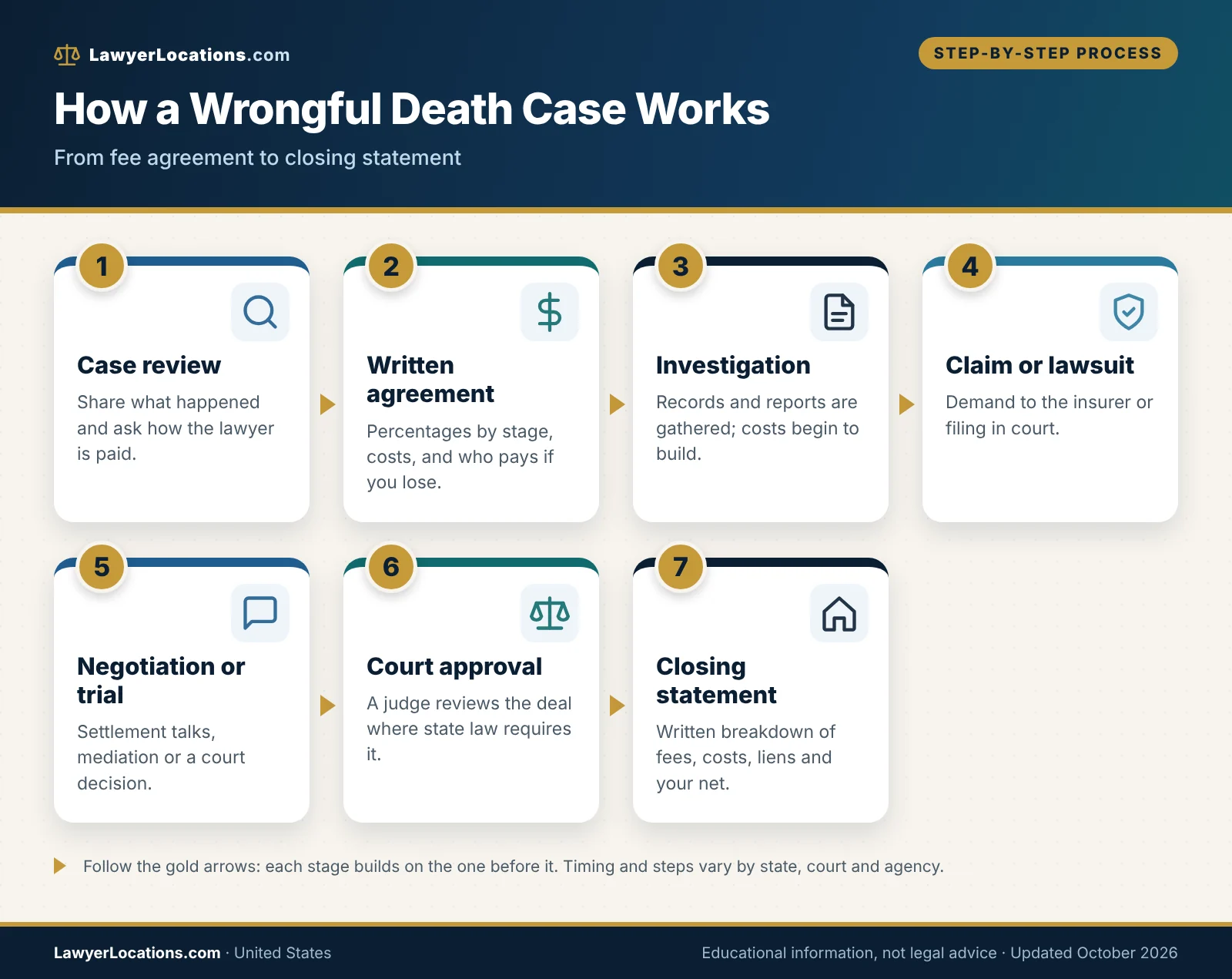
Text version of this graphic
- Initial case review: share what happened and ask how the lawyer would be paid.
- Written fee agreement: percentage by stage, costs, and who pays if the case is lost.
- Investigation: records, reports and, where needed, experts; costs begin to accumulate.
- Claim or lawsuit: demand to the insurer or filing in court, depending on the facts and deadlines.
- Negotiation or trial: settlement talks, mediation, or a court decision.
- Approval and distribution: court approval where required, then liens, costs and fees are paid.
- Closing statement: a written breakdown of what was recovered and what you received.
Ask each lawyer to write a one-page summary of the percentage at each stage and a list of the costs the firm expects to advance. Putting two summaries next to each other is the easiest way to compare offers.
Who Can Bring a Wrongful Death Claim, and Who Signs the Fee Agreement
Wrongful death claims are created by state statutes, so the answer to “who can file” depends on the state where the death occurred or where the case belongs. This matters for cost because the person who signs the fee agreement binds the claim, and family members may have different financial interests.
Who has the legal right to file
Cornell’s Legal Information Institute explains that wrongful death claims are governed by state statutes, which define who may sue and who may benefit. Statutes typically name children and spouses and sometimes extend to parents, siblings and other dependents.
States where a personal representative files
In many states, the claim is brought not by the family directly but by the estate’s court-appointed personal representative, who recovers money for the survivors and the estate. Florida is an example: under Fla. Stat. § 768.20, the action is brought by the decedent’s personal representative, who recovers for the benefit of the survivors and the estate. New York follows a similar model under EPTL § 5-4.1, where the decedent’s personal representative may bring the action if the decedent was survived by distributees.
In practice, that means a family may first need a probate or surrogate’s court to appoint a representative. Ask any lawyer you speak with whether they handle that step, whether it is included in the contingency agreement, and whether separate fees or court costs apply to opening the estate.
States where family members file
Other states let certain relatives bring the case themselves. Texas is an example. Under Tex. Civ. Prac. & Rem. Code § 71.004, the action is for the exclusive benefit of the surviving spouse, children and parents; any of them may bring it for the benefit of all; and if none of them has begun the action within three calendar months of the death, the executor or administrator must bring it unless those family members request otherwise.
The point is not that one model is better. It is that the same death could lead to different first steps depending on the state, and different people being the legal client. Always ask the lawyer to name the state statute that governs the case and who must sign.
| State | Who brings the action | Who benefits | Statute cited |
|---|---|---|---|
| Florida | The decedent’s personal representative | Survivors and the estate | Fla. Stat. § 768.20 |
| New York | The decedent’s personal representative, if the decedent was survived by distributees | Distributees (set by statute) | EPTL § 5-4.1 |
| Texas | Surviving spouse, children or parents; an executor or administrator if none sue within three calendar months | Surviving spouse, children and parents | Tex. Civ. Prac. & Rem. Code § 71.004 |
One death, more than one claim
Fee agreements often cover more than one type of claim arising from the same death. Understanding the difference helps you understand what the lawyer is being paid a percentage of.
Wrongful death and survival claims
A wrongful death claim compensates the survivors for what they lost because of the death. Cornell’s explanation of damages includes lost financial support, funeral expenses, and in some states other categories, and notes that amounts can depend on the person’s income, expected future earnings and how much family members relied on them. A survival action is a separate claim in many states: it belongs to the estate and seeks compensation for the harm the person suffered before dying.
Whether a state has both, how they are named and who receives the money differ by state. For fee purposes, ask whether the agreement applies the same percentage to both claims and whether the fee is calculated on the combined recovery. In New Jersey, for example, a published summary of the court rule says that in joint or wrongful death representations the fee is calculated on the aggregate recovery; confirm any such rule with a lawyer in your state.
When one lawyer represents several relatives, ABA Model Rule 1.8(g) bars a group settlement unless each client gives informed consent in a writing signed by the client. If your family disagrees about money, tell the lawyer early. Also ask who the client is: the personal representative, the estate, or each relative.
When a death also involves a criminal case
A related criminal prosecution runs on a separate track from the civil lawsuit, and a conviction is not required for a civil claim, since civil courts use a lower burden of proof. Some states build in extra time: New York gives a personal representative at least one year after a related criminal case ends to file, even if the usual two-year period has run. That is a New York rule, not a national one.
Fee Caps and Court Limits on What Lawyers Can Charge
A handful of legal limits shape wrongful death lawyer cost. Some states cap contingent fees in medical malpractice cases, federal law caps fees in claims against the United States under the Federal Tort Claims Act, and every lawyer’s fee must still be reasonable under the ethics rules. Outside those limits, the percentage is generally set by agreement. The details differ by state, so treat this section as a map of what to ask, not a substitute for your state’s current law.
State limits on medical malpractice fees
Medical malpractice claims, including those that end in a death, are the area where legislatures have been most willing to limit contingent fees. If your loved one died after a mistake in a hospital, clinic, nursing home or doctor’s office, ask whether a fee limit applies and whether it reaches wrongful death claims in your state. For background on one state’s malpractice rules, see our guide to surgical error lawyers in Missouri.
Three states with verified fee limits
California limits contingency fees in actions against health care providers for professional negligence under Bus. & Prof. Code § 6146. The fee may not exceed 25 percent of the amount recovered if the case settles before a complaint or demand for arbitration is filed, and 33 percent if recovery comes after filing. The lawyer may ask the court or arbitrator for a higher fee after a trial or arbitration for good cause. The statute defines professional negligence to include acts that cause wrongful death, and measures the fee on the net after case disbursements.
Florida sets the limit from the family’s side. Article I, Section 26 of the Florida Constitution says that in a medical liability claim involving a contingency fee, the claimant is entitled to receive no less than 70 percent of the first $250,000 in damages and 90 percent of damages above that amount, with reasonable and customary costs excluded from the calculation. The provision does not say whether it reaches wrongful death claims, so ask a Florida lawyer how it applies to your facts.
New York caps fees in medical, dental and podiatric malpractice actions under Judiciary Law § 474-a: 30 percent of the first $250,000 recovered, 25 percent of the next $250,000, 20 percent of the next $500,000, 15 percent of the next $250,000 and 10 percent of anything over $1,250,000, computed on the net recovery after expenses and disbursements. A court may approve a greater fee in extraordinary circumstances, though not above any contractual fee.
| Jurisdiction | What the rule says | Kind of authority |
|---|---|---|
| California | 25% if settled before a complaint or arbitration demand; 33% after; a higher fee may be sought at trial for good cause | Statute: Bus. & Prof. Code § 6146 |
| Florida | Claimant receives at least 70% of the first $250,000 and 90% above that; costs excluded from the calculation | State constitution: Art. I, § 26 |
| New York | Sliding scale from 30% down to 10%, computed on net recovery after expenses; court may approve more in extraordinary circumstances | Statute: Judiciary Law § 474-a |
| Federal (FTCA claims) | 20% of an administrative award or settlement; 25% of a judgment or settlement after suit | Federal statute: 28 U.S.C. § 2678 |
What other states publish, and why you should double-check
The American Medical Association’s 2026 chart of state medical liability laws lists a larger group of states with limits on attorney fees. Its summary includes Connecticut, Illinois, Massachusetts, Michigan, Tennessee and Utah, among others. We include it as a pointer, not as final law. Statutes change, and a short chart cannot capture exceptions. Always confirm against the current statute or court rule.
| State | Limit as summarized by the AMA |
|---|---|
| Connecticut | Sliding scale: 33⅓% of the first $300,000, 25% of the next $300,000, 20% of the next $300,000, 15% of the next $300,000, and 10% above $1.2 million |
| Illinois | One-third of the plaintiff’s award |
| Massachusetts | 40% of the first $150,000, 33⅓% of the next $150,000, 30% of the next $200,000, and 25% above $500,000 |
| Michigan | One-third of total compensation |
| Tennessee | Fees may not exceed 33⅓% of total damages |
| Utah | Total compensation may not exceed one-third of total damages |
The AMA chart is a secondary summary, so confirm each state’s current statute or court rule before publication. The same chart lists other states, including Delaware, Maine, Nevada, Oklahoma, Wisconsin and Wyoming. We left New Jersey out of the table because published summaries of its court-rule schedule list different bracket amounts, so check New Jersey’s current court rule directly.
Fee cap: a legal ceiling on the share of a recovery that a lawyer may take under a contingent-fee agreement. A cap is a maximum, not a promise that every lawyer will charge that much, and lower fees are allowed.
Claims against the federal or a state government
If a government agency or employee may share responsibility for the death, the rules change, including who is sued, what notices are required and what the lawyer may charge.
The Federal Tort Claims Act percentage caps
For claims under the Federal Tort Claims Act, 28 U.S.C. § 2678 limits attorney fees to 20 percent of any award, compromise or settlement of an administrative claim, and 25 percent of a judgment or of a settlement made after a lawsuit is filed. A lawyer who charges more can face a fine of up to $2,000, imprisonment for up to a year, or both. If your loved one’s death may involve a federal employee, a federal facility or a federal program, ask any lawyer you consult whether the fee agreement complies with those caps.
State and local government defendants
Claims against a state, county, city, school district or public hospital can carry special notice requirements and shorter deadlines than claims against private parties. We cannot catalog them nationally. Tell any lawyer at the first meeting if a public agency, employee or facility may be involved, and ask what notice, if any, must be given and by when.
Wrongful death filing deadlines are set by state law and can be short. New York, for example, generally requires an action within two years of the death under EPTL § 5-4.1, with exceptions. Other states differ. For a broader look at how time limits work, read our guide to personal injury filing deadlines by state.
When no cap applies: the reasonableness standard
Even where the law sets no percentage ceiling, a lawyer may not charge or collect an unreasonable fee. That standard is the main legal protection in many wrongful death cases.
The factors courts and ethics boards weigh
ABA Model Rule 1.5(a) bars unreasonable fees and lists factors for judging them, including the time and labor required, the difficulty of the questions, the fee customarily charged locally for similar services, the amount involved and results obtained, the lawyer’s experience, and whether the fee is fixed or contingent. States adopt their own versions, so your state’s rule text controls.
Negotiating and questioning a fee
The ABA says a lower percentage may be negotiable when a case settles quickly, before a lawsuit is filed. You can ask politely, and in writing. If a dispute arises later, many state and local bar associations run fee-dispute programs, so ask your state bar what exists.
How to Compare Wrongful Death Lawyers and Read a Fee Agreement
The most reliable way to compare wrongful death lawyer cost is to put each lawyer’s proposed terms on paper, read them side by side, and ask about the parts that change what your family keeps. LawyerLocations.com is a legal-education and lawyer-discovery resource, not a law firm, and does not rate or recommend individual lawyers, so this section teaches you how to judge for yourself.
What a written fee agreement should spell out
ABA Model Rule 1.5(c) says a contingent fee must be in a writing signed by the client. It must state how the fee is determined, including the percentages for settlement, trial or appeal, identify the expenses to be deducted from the recovery, say whether expenses are deducted before or after the fee is calculated, and clearly notify the client of any expenses the client is liable for whether or not the client wins. Your state’s version may add more, such as a signed copy for the client or specific disclosures, so read both the agreement and your state’s rule text if you can.
The percentage, the stages and the base
Look for three things. First, the percentage at each stage: before a lawsuit, after filing, at trial, and on appeal. Second, what the percentage is applied to. A fee calculated on the gross recovery is larger than one calculated on the net after costs. Third, whether a lawyer’s separate work, such as opening the estate or handling a survival claim, is included or billed separately.
The table below uses a hypothetical settlement with round numbers purely to show how the “before or after costs” clause changes the family’s share. The inputs are not typical amounts and are not predictions.
| Step | Costs deducted after the fee | Costs deducted before the fee |
|---|---|---|
| Settlement | $300,000 | $300,000 |
| Case costs advanced | $30,000 | $30,000 |
| Amount the fee is figured on | $300,000 (gross) | $270,000 (net of costs) |
| Lawyer’s one-third fee | $100,000 | $90,000 |
| Left for the family before liens | $170,000 | $180,000 |
That $10,000 difference came from one sentence in the agreement. You may not be able to change a lawyer’s standard approach, but you can ask and you can compare it across lawyers.
Costs, liens and the closing statement
The agreement should explain who advances costs, whether you repay them if the case is lost, how interest or financing charges (if any) are handled, and what the firm does about liens. Rule 1.5(c) also requires that, at the end of a case with a recovery, the lawyer give you a written statement showing the outcome of the matter and, if there is a recovery, the remittance to the client and the method of its determination.
Ask for a sample closing statement before you sign, or at least ask what it will include. A statement that lists the gross recovery, the fee, each cost item, each lien and your net payment is the easiest way to confirm that everything matches the agreement.
Comparing lawyers without relying on advertising
Billboards, ads and review pages are marketing, not proof of fit. A lawyer’s willingness to explain fees clearly is one of the best early signs you can judge for yourself.
Experience that matches your situation
Ask whether the lawyer has handled wrongful death claims against the type of defendant involved, such as a hospital, a trucking company, a property owner, a product maker or a government agency. Ask who will do the day-to-day work, how often you will get updates, and whether the firm is prepared to try the case if talks fail. Do not treat a title or label as proof of quality on its own; ask what any claimed credential means and who awards it.
If the death followed a rear-end collision, our guide to rear-end accident claims and when to call a lawyer covers fault questions that overlap with the cost conversation.
Referrals and shared fees
Some firms accept a case and then bring in another firm as co-counsel, or refer the case out entirely. ABA Model Rule 1.5(e) allows a fee split between lawyers in different firms only if the division reflects the work each does or each takes joint responsibility, the client agrees and the agreement is confirmed in writing, and the total fee is reasonable. Ask directly: will anyone outside this firm share the fee, and does that change the total percentage? Ask whether the referral raises your total cost.
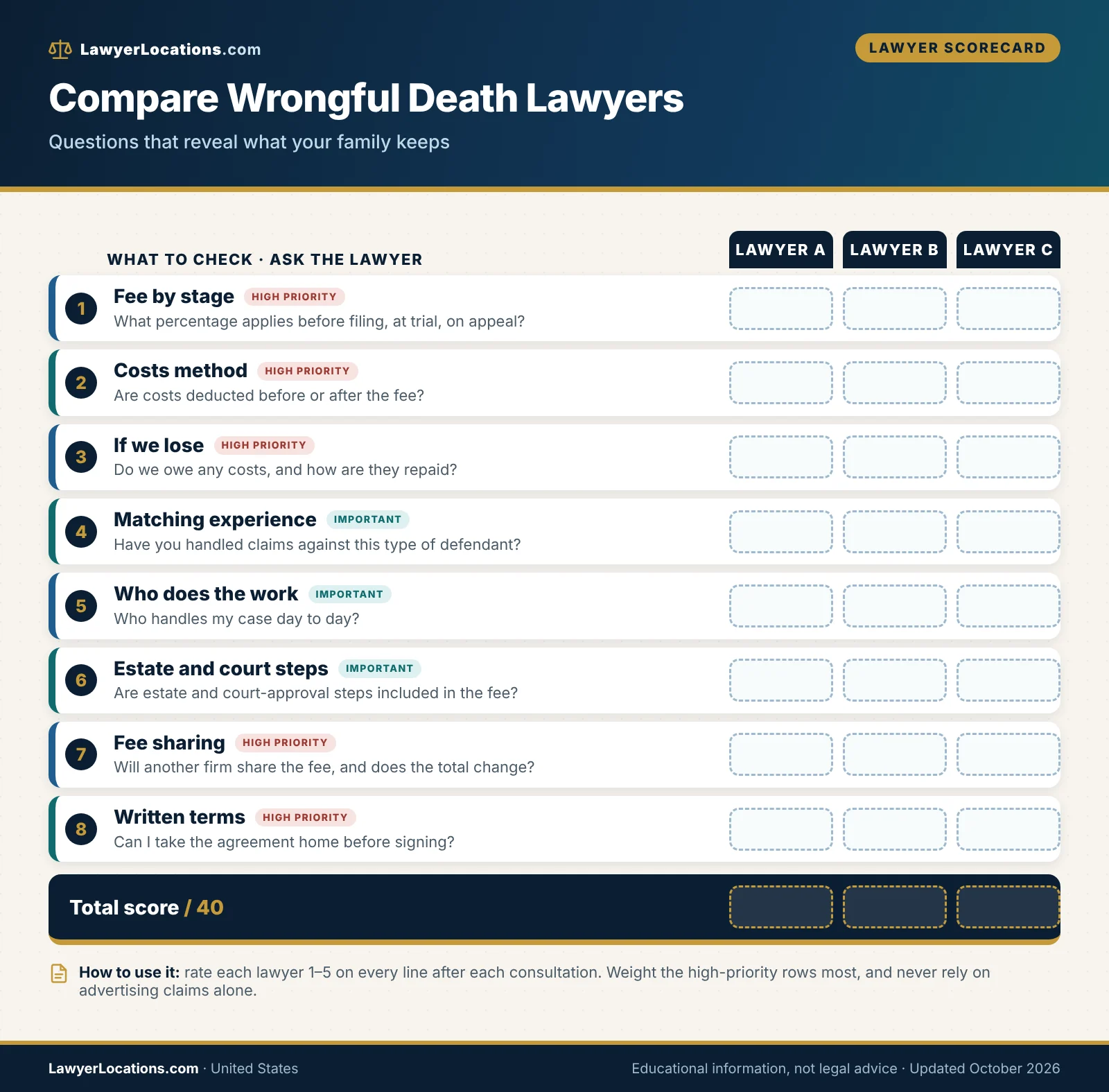
Text version of this graphic
| Criterion | Question to ask |
|---|---|
| Fee percentage by stage | What do I pay before filing, after filing, at trial and on appeal? |
| Costs method | Are costs deducted before or after the fee is figured? |
| If the case is lost | Do I owe any costs, and how are they repaid? |
| Matching experience | Have you handled claims against this type of defendant? |
| Who does the work | Who will handle my case day to day, and how will you update me? |
| Estate and court steps | Is opening the estate or court approval included in the fee? |
| Fee sharing | Will another firm share the fee, and does the total change? |
| Written terms | Can I take the agreement home and compare it before signing? |
Getting ready for the first conversation
You do not need a perfect file to talk to a lawyer. Start with what you have, and expect that the lawyer will help gather the rest.
Documents worth gathering
This list is a starting point, not a requirement.
- Death certificate, or the date, place and cause of death if you do not have it yet
- Police, incident, workplace or facility reports, and the names of any witnesses
- Medical, hospital and emergency records, if the death followed treatment
- Insurance information for the person who died, the other party and your household
- Funeral, burial and medical bills, and any letters from insurers or hospitals
- Basic financial information, such as pay stubs or tax returns that show who depended on the person
- Any estate documents, including a will or court papers appointing a representative
What to hold off on until you have advice
Insurers and investigators sometimes contact families quickly. You are not required to give a recorded statement or sign a release just because someone asks, and a signed release can end a claim, so ask a lawyer to read it first. Keep every letter, email and voicemail. For how insurance claims generally move, see our car accident settlement timeline.
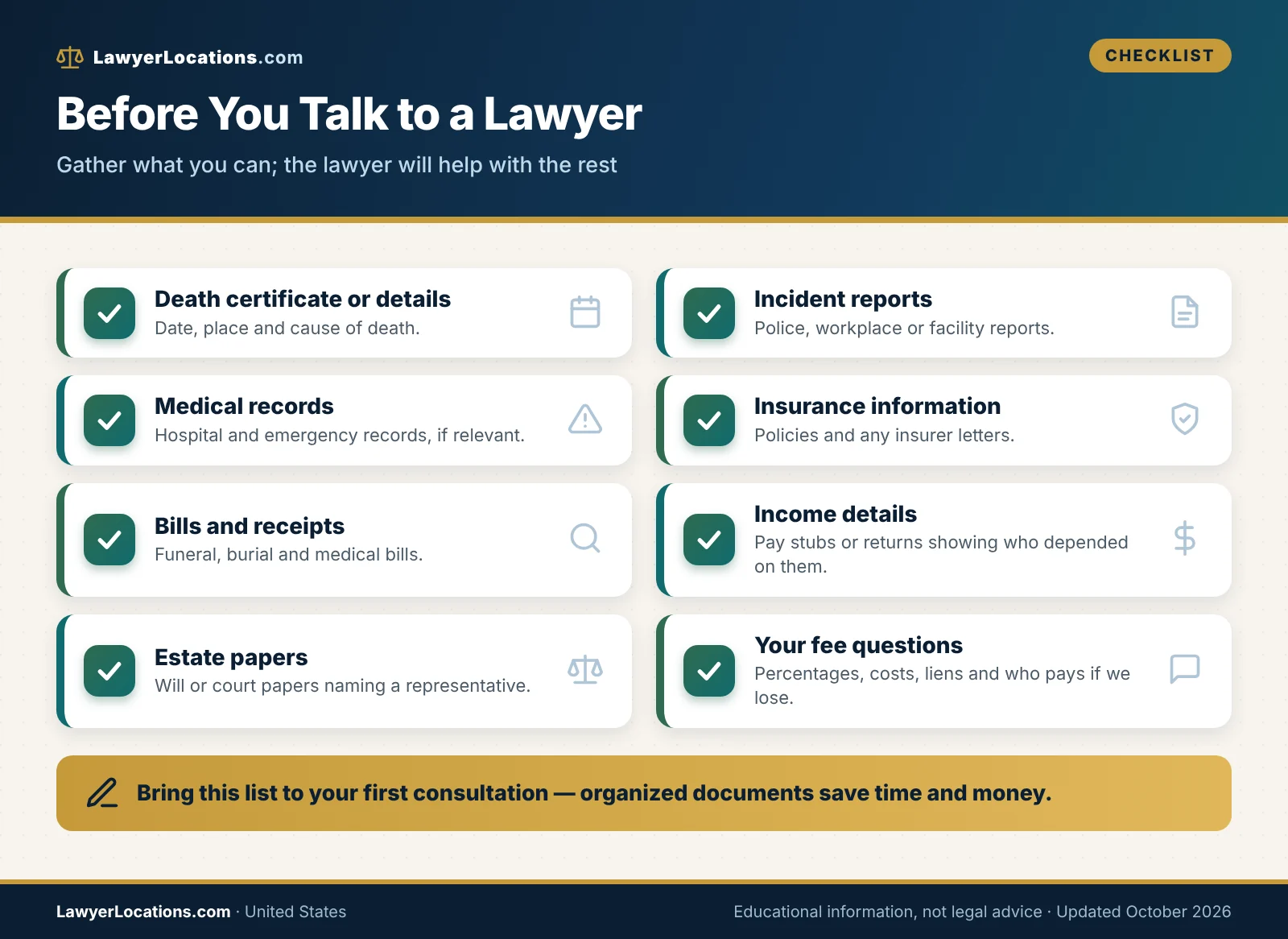
Text version of this graphic
- Death certificate or details of the death
- Incident, police or facility reports
- Medical and hospital records
- Insurance policies and insurer letters
- Funeral and medical bills
- Income and dependency information
- Estate papers and appointment of a representative
- Your written list of questions about fees and costs
Case Costs, Losing, Liens and Court Approval: Where the Money Goes
A wrongful death recovery is not a single check that goes straight to the family. Fees, case costs, liens and, in some situations, a judge’s approval all stand between the settlement figure and the amount that reaches the people it is meant to help. Knowing the order of those steps in advance prevents painful surprises.
If the case is lost
Nobody wants to plan for a loss, but asking about it at the start is one of the clearest ways to compare lawyers. The answers reveal how much of the financial risk the lawyer carries and how much your family might carry.
What happens to the attorney fee
On a pure contingency agreement, a lost case means no attorney fee. The ABA’s consumer guidance says that if you lose, neither you nor the lawyer receives money from the case and you will not be required to pay your attorney for the work done. That is the core promise of the model, and it should be stated plainly in the agreement. If the engagement also includes hourly or flat-fee work, such as opening an estate, ask which tasks are covered by the contingent fee and which are billed separately.
What happens to case costs and the other side’s costs
Costs are where agreements differ most. The ABA’s guidance says you will probably have to pay court filing fees, deposition costs and similar charges even under a contingent fee. Rule 1.8(e) lets a lawyer advance costs and make repayment depend on the outcome, but lawyers are not required to. Some firms absorb costs on a lost case; others require repayment. The Model Rules say the agreement must clearly notify you of any expenses you will owe whether or not you win.
Also ask about costs charged by the winning side. In federal court, Rule 54(d)(1) of the Federal Rules of Civil Procedure says costs other than attorney’s fees should be allowed to the prevailing party unless a statute, the rules or a court order says otherwise. State rules differ, so ask whether your agreement addresses this risk.
If a lawyer says you will “never owe anything” under any outcome and will not put that in writing, treat it as a warning. The ethics rules expect clear written notice of any expenses you may owe, so the honest answer is in the document, not in a verbal assurance.
What reduces the net amount your family receives
Even after the lawyer is paid and costs are repaid, other claims on the money may remain. Some are legal requirements; others are choices the family makes. Ask your lawyer to estimate them early rather than at the end.
Liens and reimbursement claims
A lien or reimbursement claim is a payer’s right to be repaid from a settlement for bills it covered. If the person who died was on Medicare, the program may seek repayment for conditional payments it made for care related to the incident. According to the Centers for Medicare & Medicaid Services’ beneficiary reference guide, Medicare’s recovery of conditional payments starts at the date of incident and ends at the date of settlement, attorney fees and costs can reduce the amount owed through a pro-rata reduction in some cases, and people should contact the Benefits Coordination & Recovery Center when a claim is pending. The guide does not discuss deceased beneficiaries or estates, so ask your lawyer how the rules apply when the beneficiary has died.
Private health plans, Medicaid and hospitals may assert their own claims under state law and plan terms. Ask your lawyer to identify each one and put it in the closing statement.
Funeral bills, taxes and how payments are made
Funeral and burial expenses may be recoverable as damages in many wrongful death claims, but families often pay them first and are reimbursed later. Read any lender’s or “advance” company’s terms against the future settlement with the same care as a fee agreement.
Taxes are also fact-specific. Federal law excludes from income damages, other than punitive damages, received on account of personal physical injuries or physical sickness (26 U.S.C. § 104(a)(2)). IRS Publication 4345 says punitive damages and interest on a settlement are generally taxable, and it does not address wrongful death settlements directly. Because the allocation of a settlement between different kinds of damages can matter, ask the lawyer whether you should speak with a tax professional before the settlement is finalized.
| Deduction or step | Who usually decides it | Question to ask your lawyer |
|---|---|---|
| Attorney fee | The signed agreement, within any state cap and reasonableness rules | What percentage applies at the stage where we settle, and what is it figured on? |
| Case costs | The agreement, then the actual bills | Which costs have been paid so far, and what do you expect next? |
| Medicare or other health-plan claims | Federal or state rules, plan terms and negotiation | Which payers are claiming repayment and can the amounts be reduced? |
| Hospital or provider bills and liens | State law, provider contracts and negotiation | Are any liens recorded, and who is negotiating them? |
| Funeral and estate expenses | The estate, family and court where required | Which expenses are reimbursed from the recovery, and when? |
| Court approval and distribution | A judge, where state law or the facts require it | Does the settlement need court approval, and how will the money be divided? |
| Taxes | Federal and state tax rules applied to the settlement terms | Should a tax professional review how the settlement is allocated? |
Court approval and distribution of a settlement
Many families assume that a settlement is final once the insurer and the lawyer agree. In wrongful death cases, a court may have the last word, especially when more than one person shares the money, when a child is among the beneficiaries or when the claim runs through an estate.
When a judge must approve the settlement
The rule varies by state. Florida’s wrongful death statute, Fla. Stat. § 768.25, provides that while an action under the act is pending, a settlement as to amount or apportionment among beneficiaries is not effective unless approved by the court if it is objected to by any survivor or if it affects a survivor who is a minor or an incompetent. New York’s EPTL § 5-4.6 goes further: on application by the personal representative, the court examines the merits and the proposed amount and approves or disapproves the compromise in writing, including attorney fees and expenses, and payments go into an interest-bearing escrow account for the distributees.
These are two examples, not a national rule. Other states differ. Ask: does this settlement need a judge’s approval where we are, and how long does that step usually take?
How judges protect minors and review fees
Where approval is required, the judge can look at the fairness of the amount, the division among beneficiaries and the attorney’s fee. In New York, where a distributee is a minor or otherwise under a disability, the court decides whether a guardian ad litem must be appointed before payments are made. That can add steps and time, but it is also an independent check on the deal. Ask whether court-approval costs are in the fee or are an added expense.
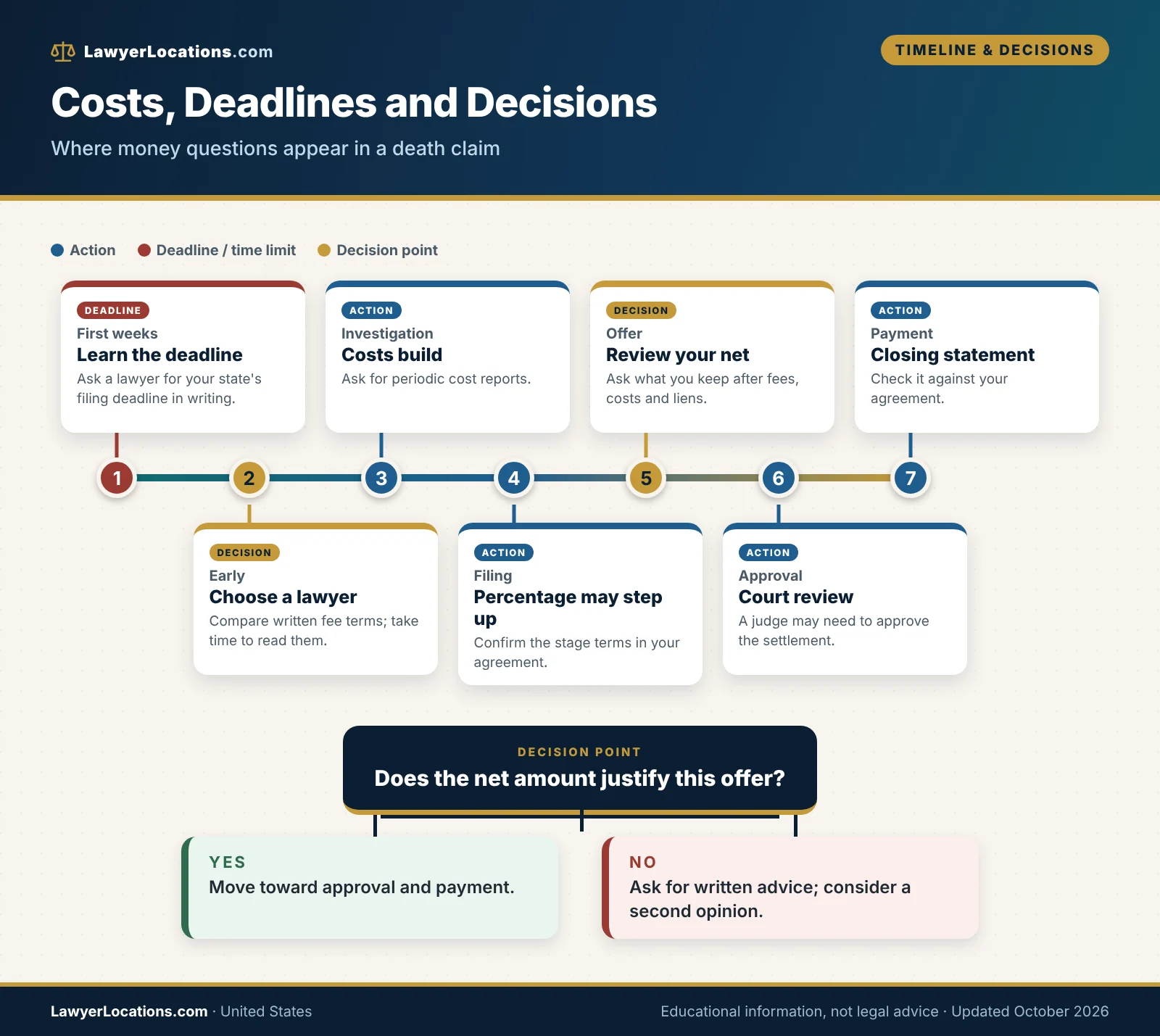
Text version of this graphic
- First weeks: gather records, learn the filing deadline for your state, and avoid signing insurer releases.
- Choosing a lawyer: compare written fee terms; take the time you need.
- Investigation: costs begin to build; ask for periodic cost reports.
- Filing or claim: the percentage may step up; confirm the stage terms.
- Settlement offer (decision point): ask what you will net after fees, costs and liens.
- Court approval, where required: a judge reviews the deal and the division among beneficiaries.
- Payment and closing statement: liens, costs and fees are paid and you receive a written breakdown.
Red Flags, Questions to Ask and Next Steps
You can protect your family’s finances with a handful of habits: get the terms in writing, ask about costs and liens, and refuse pressure. The sections below give you specific red flags, a question list for your first meeting, short answers to common cost questions and a calm order of next steps.
Red flags in fee agreements and sales pitches
Most lawyers approach grieving families with care. A few approaches deserve a pause, and the list below can help you recognize them.
Pressure and promises
Be wary of a lawyer who promises a specific result or dollar amount, claims your case is certain to win, or tells you that a decision must be made within hours. No ethical lawyer can promise an outcome, and a wrongful death claim depends on facts, evidence, insurance coverage and a court’s view of the case. Also be cautious about unsolicited contact right after a death. Rules on lawyer solicitation vary by state, so if someone contacts you uninvited, ask how they found you and check your state bar’s rules or ask the bar directly.
- A promised result or a promised dollar amount
- Pressure to sign immediately or refusal to let you take the agreement home
- A request to sign blank forms or documents you have not read
- Discouragement from speaking with other lawyers
Money red flags
Check the financial terms with equal care.
- No written agreement, or terms that conflict with what was said aloud
- Costs described only as “standard” with no explanation of who pays if you lose
- Fee percentages that change without your signed consent
- Pressure toward high-cost loans or advances against the settlement
- Reluctance to provide a closing statement at the end
Questions to ask at the first meeting
The first meeting is a two-way conversation. You are learning whether the lawyer is a good fit, and the lawyer is deciding whether to take the case. Many personal injury firms offer an initial consultation without charge, but policies differ, so ask whether there is any fee before you book.
Questions about fees and costs
These questions bring the main cost terms into the open and let you compare lawyers on equal footing.
- What is your percentage at each stage? Ask for it before filing, after filing, at trial and on appeal.
- Is the fee figured before or after costs? Ask for an example in writing.
- Who advances costs, and do I repay them if we lose? Ask for the answer in the agreement.
- Does a state cap apply? Ask whether a medical malpractice or government-claim limit applies to this case.
- Will anyone outside your firm share the fee? Ask whether that changes the total.
- What happens if I change lawyers? Ask how fees and costs would be handled.
- Will the estate or court steps cost extra? Ask what is included in the percentage.
Questions about the process and your role
Ask which deadlines apply to your case and have the lawyer write them down, how often you will receive updates, who your day-to-day contact will be, and whether a settlement needs your approval and a court’s. A thoughtful lawyer will understand that you may want time to compare options.
Quick answers to common cost questions
The short answers below pull together the points above. They are general information, and your state or the facts of your case may change them.
Fee and agreement questions
How much does a wrongful death lawyer cost?
Usually a percentage of any recovery rather than an hourly bill. The ABA’s consumer guidance describes the percentage as often one-third to 40 percent. Your agreement and any state cap decide the real number.
Do I have to pay anything up front?
Many contingency lawyers do not charge an attorney fee up front, but practices on costs differ. Some advance all costs; others ask for a deposit or repayment regardless of outcome. Ask for it in writing.
Settlement and money questions
Does a wrongful death settlement need court approval?
Sometimes. In Florida, approval is needed if a survivor objects or a survivor is a minor or incompetent. In New York, the court reviews and approves a compromise, including attorney fees and expenses, on the representative’s application. Other states differ.
Can Medicare or a health plan take part of the settlement?
Possibly. Medicare may seek repayment of conditional payments, and its guide says attorney fees and costs can reduce the amount owed in some cases. Other payers may also claim repayment, so ask your lawyer how liens will be handled.
Next steps for your family
There is no single right pace. Some families want answers quickly; others need weeks before they can read a legal document. What matters is that you learn your filing deadline early, protect the paper trail and choose a lawyer on clear written terms.
A calm order of next steps
- Write down the key facts and dates. Include when and where the death occurred and who was involved.
- Find out the filing deadline for your state. Ask any lawyer you speak with to state it in writing, and read our guide to personal injury filing deadlines for background.
- Hold off on insurer releases and recorded statements. Have a lawyer review any document before you sign it.
- Talk to more than one lawyer if you can. Ask each the same fee and cost questions.
- Take the agreement home. Read it with a trusted person, and ask for changes in writing.
- Keep a folder. Save every letter, bill, email and text related to the death and the claim.
Where to look for help
Many state and local bar associations run lawyer referral services, and civil legal aid organizations may help families who cannot afford a private lawyer. Contact your state bar to learn what is available, and ask whether any referral program charges a fee.
If the death occurred in your own community, a local lawyer-directory page on LawyerLocations.com can help you find lawyers to contact, and compare them on the questions in this guide. We do not rate or recommend lawyers, and visiting this page does not create an attorney-client relationship. If you are researching wrongful death lawyer cost for a loved one, our related guide to hiring a personal injury lawyer in Chicago shows how the same questions play out in a specific city.
Ready to compare your options?
Start with the two questions that matter most for wrongful death lawyer cost: what percentage applies at each stage, and who pays case costs if the case is lost. Get both answers in a signed, written agreement, and take the time you need before you decide.
Sources & References
Show all 21 sources
- ABA Model Rules of Professional Conduct, Rule 1.5: Fees (contingent fees, writing, expenses, fee division) — American Bar Association — americanbar.org — accessed October 2026.
- ABA Model Rules of Professional Conduct, Rule 1.8: Current Clients, Specific Rules (financial assistance, aggregate settlements) — American Bar Association — americanbar.org — accessed October 2026.
- When You Need a Lawyer: Contingent Fees (consumer guidance) — American Bar Association — americanbar.org — accessed October 2026.
- Fees and Expenses (ABA Home Front information center) — American Bar Association — americanbar.org — accessed October 2026.
- Contingent fee (Wex) — Legal Information Institute, Cornell Law School — law.cornell.edu — accessed October 2026.
- Wrongful death (Wex) — Legal Information Institute, Cornell Law School — law.cornell.edu — accessed October 2026.
- Cal. Business and Professions Code § 6146 (contingency fee limits, health care providers) — California Legislature, as reproduced by Public.Law — california.public.law — accessed October 2026.
- Florida Constitution, Article I, Section 26 (claimant’s right to fair compensation) — Florida Senate — flsenate.gov — accessed October 2026.
- New York Judiciary Law § 474-a (contingent fees in medical, dental or podiatric malpractice) — New York State Senate — nysenate.gov — accessed October 2026.
- State Laws Chart I: Liability Reforms (attorney fee limits) — American Medical Association, 2026 — ama-assn.org — accessed October 2026.
- 28 U.S.C. § 2678: Attorney fees, penalty (Federal Tort Claims Act) — Legal Information Institute, Cornell Law School — law.cornell.edu — accessed October 2026.
- Fla. Stat. § 768.20 (Who brings the action) — Florida Legislature — leg.state.fl.us — accessed October 2026.
- Fla. Stat. § 768.25 (Court approval of settlements) — Florida Legislature — leg.state.fl.us — accessed October 2026.
- New York EPTL § 5-4.1 (Action by personal representative for wrongful act) — New York State Senate — nysenate.gov — accessed October 2026.
- New York EPTL § 5-4.6 (Compromise of action; court approval) — New York State Senate — nysenate.gov — accessed October 2026.
- Tex. Civ. Prac. & Rem. Code § 71.004 (Benefitting from and bringing action), as reproduced by Public.Law — texas.public.law — accessed October 2026.
- New Jersey Court Rule 1:21-7 (Contingent Fees), third-party reproduction used for secondary reference only — CourtRules.net — courtrules.net — accessed October 2026.
- Federal Rule of Civil Procedure 54 (costs) — Legal Information Institute, Cornell Law School — law.cornell.edu — accessed October 2026.
- Non-Group Health Plan (NGHP) Medicare Secondary Payer Beneficiary Reference Guide — Centers for Medicare & Medicaid Services, July 2024 — cms.gov — accessed October 2026.
- Publication 4345, Settlements: Taxability — Internal Revenue Service, Rev. 9-2023 — irs.gov — accessed October 2026.
- 26 U.S.C. § 104 (Compensation for injuries or sickness) — Legal Information Institute, Cornell Law School — law.cornell.edu — accessed October 2026.
General information only. This guide is general legal information, not legal advice, and reading it does not create an attorney-client relationship with LawyerLocations.com or anyone else. LawyerLocations.com is not a law firm and does not recommend, rate or endorse individual lawyers. Laws, court rules, fee limits and agency procedures change and differ by state and by case. Consult a lawyer licensed in the relevant jurisdiction about your own situation, and check current statutes and rules before relying on anything here.
Legal Disclaimer and Limitation of Liability
Informational and illustrative purposes only. This article was prepared by LawyerLocations.com solely on the basis of the information available to us at the time of writing. It is an illustrative, general overview. It is not a complete or authoritative statement of the law, and it has not been reviewed by a lawyer licensed in your state or county.
Not legal advice. Nothing in this article is legal, financial, tax or immigration advice, and reading it does not create an attorney-client relationship between you and LawyerLocations.com or any author, lawyer or firm mentioned. Laws, court rules, fees, filing deadlines and agency procedures differ by state, county and court, and they change often. Some details here may be simplified, incomplete or out of date, and time limits for legal claims can be short.
No warranty. We make no representation or warranty, express or implied, about the accuracy, completeness, timeliness or suitability of this content for your situation. Please do not rely on it to make, delay or skip any legal decision. Check the facts against official sources and speak with a licensed attorney in the relevant jurisdiction before you act.
Limitation of liability. To the fullest extent permitted by law, LawyerLocations.com and its owners, authors and contributors disclaim all liability for any loss, damage, cost or other consequence arising from the use of, or reliance on, this article, including any content on third-party websites we link to. Mentioning a lawyer, firm, organization or service is not an endorsement and is not a promise of any result. If you are in immediate danger, contact your local emergency number.