If you typed domestic violence lawyer Los Angeles CA into a search bar, the first thing to pin down is which side of the case you need help with. A person charged or under investigation needs a criminal defense lawyer who regularly appears in Los Angeles County Superior Court. A person who wants protection, or who has been served with a restraining order, needs help with a civil domestic violence restraining order (DVRO). California treats these as different tracks with different rules, so the right lawyer depends on the track.
This guide explains how a case moves through Los Angeles courts, the California statutes that drive charges and probation, how protective orders work, what lawyers charge and how to compare them, and what to do in the first days. It is general legal education, not legal advice, and law is stated as of October 2026.
How a Domestic Violence Case Works in Los Angeles, CA
A domestic violence case in Los Angeles usually starts with a police response, moves to a prosecutor’s charging decision, and then runs through the Superior Court of Los Angeles County. The process is the same statewide in its legal framework, but the agencies, courthouses and local habits are specific to Los Angeles County. This section walks through the stages so you know what a lawyer will be handling and when.
What counts as domestic violence under California law
California does not have a single crime called “domestic violence.” Instead, the label describes certain crimes, such as battery or inflicting injury, when the person who was hurt (or threatened) has a particular relationship to the accused. The definitions matter because they decide which charges, programs and protective orders can apply.
The relationships the law covers
Under Penal Code 13700, domestic violence is abuse committed against an adult or minor who is a spouse, former spouse, cohabitant, former cohabitant, or a person with whom the suspect has had a child or is having or has had a dating or engagement relationship. A cohabitant is defined there as two unrelated adults living together for a substantial period, resulting in some permanency of relationship, and the statute lists factors such as shared finances, joint property and how long the relationship lasted.
That means a roommate dispute is not automatically domestic violence, while a boyfriend and girlfriend who share an apartment can be. Whether a relationship qualifies is sometimes a real legal question, and a lawyer will look at it early.
What the law means by abuse
The same statute defines abuse as intentionally or recklessly causing or attempting to cause bodily injury, or placing another person in reasonable apprehension of imminent serious bodily injury to oneself or another. So a case can exist even where nobody was physically hurt, if the conduct put someone in reasonable fear of serious injury.
Notice the words “intentionally or recklessly.” Accidents, self-defense and mutual shoving incidents are argued under these definitions, which is why the details of what happened (not just the label on the police report) shape a defense.
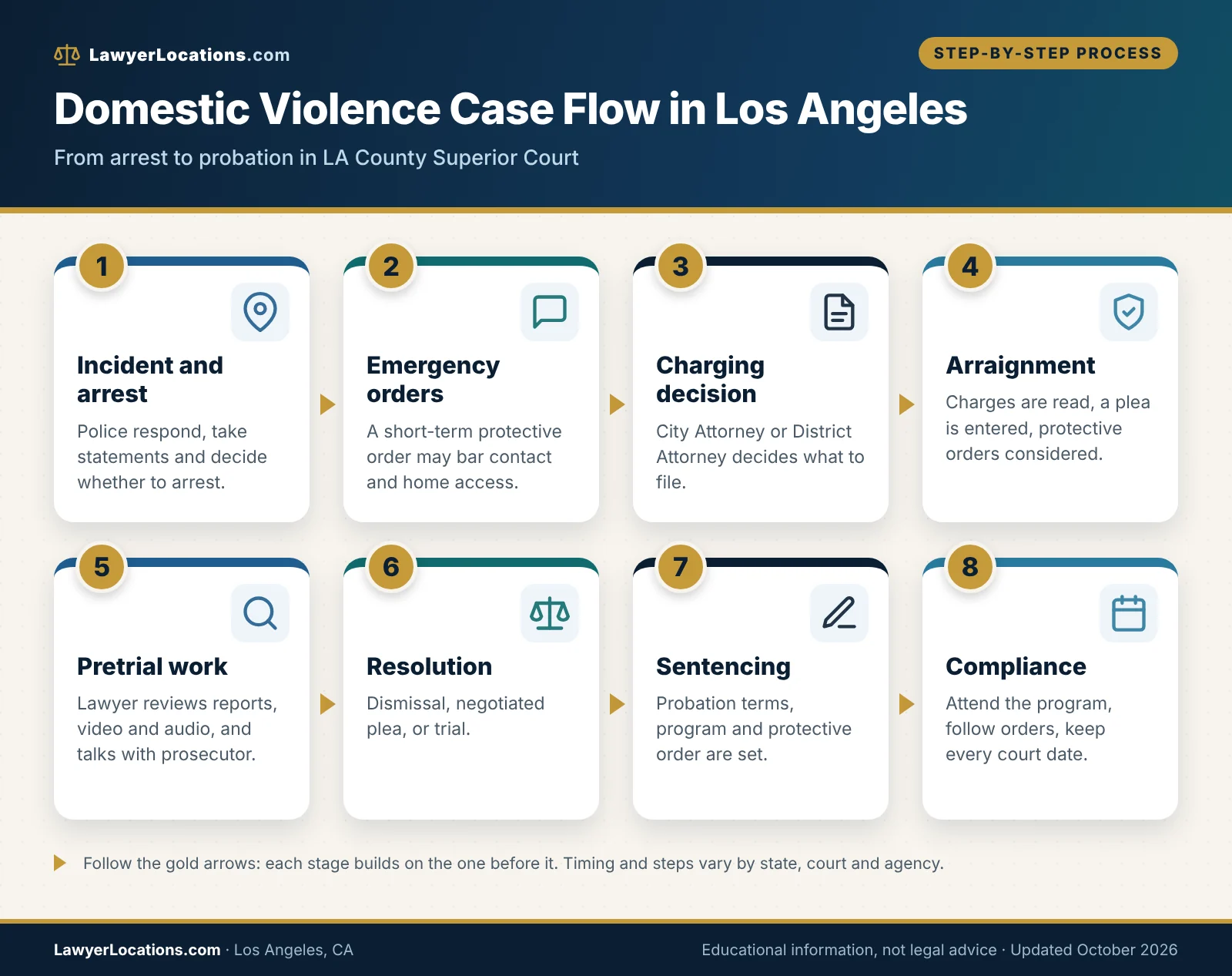
Text version of this graphic
- Incident and 911 call or police response.
- Arrest, booking and possible emergency protective order.
- Prosecutor reviews the report and decides whether and how to charge.
- Arraignment in the Superior Court of Los Angeles County, with a protective order considered.
- Pretrial stage: evidence exchange, motions and negotiations.
- Resolution: dismissal, plea, or trial.
- If convicted: sentencing, probation terms and program requirements.
- After the case: compliance, possible record relief and order modification.
From the incident to arraignment
Most Los Angeles cases begin before any lawyer is involved: a call to 911, an officer interview, and an arrest decision made on the spot. What you say and do in these first hours often becomes the core of the prosecution’s file.
The police response and arrest
When officers respond to a domestic violence call, they typically separate the people involved, take statements, photograph any injuries and decide whether there is probable cause to arrest someone. Officers may arrest even when the person who called does not want the other person arrested, because the decision belongs to law enforcement and later to the prosecutor, not to the caller.
If you are arrested, you can decline to answer questions about what happened until you have spoken with a lawyer. Saying you want a lawyer is not an admission of anything, and it is far easier to explain your side later with counsel than to walk back a statement made in a stressful moment.
Do not contact the other person to “work it out” after an arrest, even if they reach out first. A court order may already bar contact, and a message sent in good faith can be used as evidence or can become a separate violation. Let a lawyer handle any communication.
Emergency protective orders and release
After a domestic violence arrest, officers can seek an emergency protective order that lasts only a short time and can include a stay-away and no-contact condition. Because these orders can be issued quickly, often before the accused person has told their side to anyone, people are sometimes surprised to learn they cannot return home or contact their own partner.
Release from custody depends on the booking process and the court’s rules for the charge. A defense lawyer can explain the bail or release terms that apply to your booking and, where appropriate, ask the court to revisit conditions.
Who prosecutes domestic violence in Los Angeles, and where
Two different prosecuting offices handle domestic violence in Los Angeles County, and which one has your case changes who your lawyer negotiates with. Knowing the office is a practical first question for any lawyer you interview.
City Attorney versus District Attorney
The Los Angeles City Attorney’s Criminal Branch prosecutes criminal misdemeanors and infractions committed within the city limits, and its own description names domestic violence among the offenses its prosecutors handle. Felony cases, and misdemeanors arising outside the City of Los Angeles, generally belong to the Los Angeles County District Attorney. Many incidents are charged as wobblers, meaning the prosecutor can file them as either a felony or a misdemeanor, which is one reason the same type of incident can land in different offices.
The District Attorney’s Family Violence Division describes its focus as vertically prosecuting the most serious and complex intimate-partner abuse cases, meaning one prosecutor follows the case from start to finish. It reports handling cases at 12 court locations in three regions.
Courthouses across the county
The Family Violence Division lists its locations by region. In the north: Antelope Valley, Central, San Fernando and Van Nuys. In the east: Alhambra, Norwalk, Pasadena and Pomona. In the south: Airport, Compton, Long Beach and Torrance. Downtown Los Angeles criminal matters are heard in the Central District, which includes the Clara Shortridge Foltz Criminal Justice Center.
Which courthouse hears your case depends on where the incident happened. The Superior Court’s official website (lacourt.org) has a courthouse locator and case-lookup tools, and your arraignment paperwork lists the department and date. A lawyer who regularly appears at that courthouse will know its calendars, its prosecutors and how its departments tend to run.
Write down the case number, courthouse, department number and next court date from your paperwork the day you receive it. Missing a court date can lead to a warrant, and a lawyer can often only help in time if they have those details.
After arraignment: the pretrial stage and resolution
Arraignment is the first formal court appearance, where charges are read and a plea is entered. Most of the real work in a domestic violence case happens between arraignment and trial, and it is where a lawyer’s judgment matters most.
The arraignment and protective orders
Protective orders are usually one of the first things a judge addresses once a domestic violence charge is filed. Under Penal Code 136.2(e)(1), when a defendant is charged with a domestic violence crime, the court shall consider issuing protective orders on its own motion, and all interested parties receive a copy. These “criminal protective orders” can order no contact, stay-away distances and, under related provisions, firearm relinquishment.
Because the order is issued by the criminal court, only that court can change it. Contacting the protected person because they say it is “fine” does not cancel the order, and the person who is restrained is the one who faces the consequences for a violation.
Pretrial work, negotiation and trial
Between arraignment and trial, a defense lawyer typically requests the police report, body-camera footage, 911 audio and photographs, interviews witnesses where appropriate, and evaluates whether evidence was gathered properly. They also assess what a prosecutor is likely to offer and what the risks of trial are, based on the evidence rather than on assumptions.
Outcomes range from dismissal or reduction of charges to a negotiated plea to trial, and no honest lawyer can promise one. If you ask a lawyer to predict a result and they answer with certainty before reviewing the discovery, treat that as a warning sign.
Our broader overview, Domestic Violence Defense Lawyer: Protective Orders, Charges and Next Steps, covers the national picture. This guide stays focused on Los Angeles and California rules.
California Law That Shapes a Los Angeles Domestic Violence Case
Los Angeles prosecutors charge domestic violence under California statutes, not city ordinances, so the same Penal Code sections apply in Los Angeles, San Diego or Sacramento. What differs locally is who brings the charge, which courthouse hears it and how the local calendar and programs operate. This section covers the statutes you will hear in court.
The main charges: Penal Code 273.5 and 243(e)(1)
Two statutes account for most domestic violence filings. They differ in what the prosecution must prove and in how serious the penalty can be.
Penal Code 273.5: corporal injury to a spouse or partner
Penal Code 273.5 covers willfully inflicting corporal injury that results in a traumatic condition on a spouse, cohabitant, former cohabitant or certain other partners. The base offense is punishable by state prison for two, three or four years, or by county jail for up to one year, or by a fine of up to $6,000, or by both a fine and imprisonment. Because the prosecutor can choose between prison-eligible and county-jail treatment, it is a wobbler.
The statute also raises penalties when the accused has a qualifying prior conviction within seven years, and it sets minimum jail time as a probation condition in repeat situations (not less than 15 days with one qualifying prior within seven years, and not less than 60 days with two or more), though the court may waive that on a showing of good cause stated on the record. Read the current statute text or ask a lawyer how any prior record affects you.
Penal Code 243(e)(1): battery against a partner
Penal Code 243(e)(1) covers battery against a spouse, cohabitant, co-parent, former spouse, fiance(e), or a person the defendant is or was dating or engaged to. It does not require a visible injury, which is a major reason prosecutors use it. The statute provides a fine of up to $2,000 or imprisonment in county jail for not more than one year, or both.
If the court grants probation or suspends a sentence, the statute requires the person to participate in and successfully complete a batterer’s treatment program for no less than one year. For comparison, ordinary battery under Penal Code 243(a) carries a fine of up to $2,000 and may include up to six months in county jail, which shows why the partner-specific version is treated more seriously.
| Charge | What the prosecution must show | Classification | Penalties stated in the statute |
|---|---|---|---|
| Penal Code 273.5(a) corporal injury | Willful infliction of corporal injury resulting in a traumatic condition on a qualifying partner | Wobbler: felony or misdemeanor | State prison for 2, 3 or 4 years, or county jail up to 1 year, or fine up to $6,000, or fine and imprisonment |
| Penal Code 243(e)(1) domestic battery | Battery against a qualifying partner; no visible injury required | Misdemeanor | Fine up to $2,000 or county jail up to 1 year, or both; batterer’s program of at least 1 year if probation is granted |
| Penal Code 243(a) simple battery | Battery with no partner relationship element | Misdemeanor | Fine up to $2,000, or county jail up to 6 months, or both |
A wobbler can start as a felony complaint and later be reduced. Ask your lawyer early whether a reduction is realistic, because a felony conviction triggers consequences, such as long-term firearm limits, that a misdemeanor may not.
Probation, batterer’s programs and protective orders after a conviction
Many domestic violence cases end with probation rather than prison. The probation terms are often the part of a plea that affects daily life the most, so they deserve as much attention as the charge itself.
What Penal Code 1203.097 requires
When probation is granted for a crime against a person in the protected relationships listed in the Family Code, Penal Code 1203.097 sets standard conditions. These include a minimum probation period of 36 months, completion of an approved batterer’s program of not less than one year, and a criminal court protective order. Sessions run weekly for at least two hours, with progress reports to the court every three months or less, and the program is to be completed within 18 months unless the court finds good cause to change that.
The statute also sets a $500 minimum fee, which the court may reduce or waive after a hearing if the defendant is unable to pay, with its reasons stated on the record. In place of a fine, the court may order reimbursement of the victim’s reasonable expenses or payments of up to $5,000 to a domestic violence shelter-based program, after determining ability to pay.
| Condition | What the statute says | Practical meaning |
|---|---|---|
| Length of probation | Minimum of 36 months | Three years or more of supervision, with a risk of violation hearings if anything goes wrong |
| Batterer’s program | Not less than one year; weekly sessions of at least two hours; reports every three months or less | Missing sessions can be reported to the court, so scheduling matters |
| Completion window | Within 18 months unless the court finds good cause | Enroll quickly rather than waiting for the sentencing date to pass |
| Program fee | $500 minimum, reducible or waivable after a hearing for inability to pay | Bring proof of income if you will ask for a reduction |
| Protective order | Criminal court order protecting the victim, which may include stay-away or residence exclusion | The order controls contact even if the protected person wants contact |
| Payments in place of a fine | Victim reimbursement or up to $5,000 to a shelter-based program, after an ability-to-pay finding | Raise ability to pay with your lawyer before sentencing |
Criminal protective orders and firearms
Under Penal Code 136.2, after a conviction for a qualifying offense the court shall consider issuing an order restraining the defendant from any contact with the victim, and the order may be valid for up to 10 years, as determined by the court. Section 273.5 contains its own protective-order subdivision for convictions under that statute, so ask your lawyer which provision and which maximum applies to your charge.
A person subject to a protective order under Section 136.2 may not own, possess, purchase or receive, or attempt to purchase or receive, a firearm while the order is in effect, and the court orders relinquishment under Code of Civil Procedure 527.9. Violations are punishable under Penal Code 29825. If you own firearms, ask a lawyer how to comply with a relinquishment order properly, because the way you hand over a gun can itself create trouble.
Time limits and other consequences that catch people off guard
The charge and the sentence are only part of the picture. Time limits and side effects can matter as much as the penalty on paper.
The prosecution’s time limit
California sets deadlines for prosecutors to start a case. Under Penal Code 801, prosecution for an offense punishable by state prison generally must start within three years after the offense, with exceptions in Sections 799 and 800. Because a Penal Code 273.5 charge is prison-eligible, that is the general rule for it, while misdemeanor-only charges have a shorter period set elsewhere in the same chapter.
Do not treat a time limit as a plan. Prosecutors can file well within the period, and counting the exact deadline (including whether any exception applies) is a lawyer’s job, not something to attempt from a calendar.
Consequences outside the courtroom
A domestic violence charge or conviction can reach into other parts of life. Federal immigration law attaches serious consequences to some domestic violence convictions, so a non-citizen should speak with an immigration lawyer before any plea, not after. Employers, licensing boards and landlords may also see the record, and a family court deciding custody or visitation can take the allegations into account.
These effects are why a good defense lawyer asks about your job, immigration status, family situation and licenses at the first meeting. They shape what a “good” outcome looks like for you, and they are also why a quick plea to end things may cost far more than it appears. For longer-term clean-up, read about expungement and record clearing, and for felony stakes see our guide to felony defense from arraignment through trial.
Never plead to a domestic violence charge only to “get it over with” without asking in writing how it affects immigration, firearms, professional licenses and custody. Those consequences are often permanent or very hard to undo.
Protective Orders and Restraining Orders in Los Angeles County
There are two kinds of orders people mix up: the criminal protective order issued in a prosecution, and the civil domestic violence restraining order a person can request on their own. They have different judges, different procedures and different lawyers. Getting the right one matters for safety and for staying out of trouble.
Criminal protective order versus civil DVRO
A criminal protective order protects the alleged victim during and after the criminal case. A DVRO is a civil order that a person can ask for whether or not anyone has been arrested.
How the two orders differ
The criminal order comes from the judge handling the prosecution, so the people who control it are the prosecutor and the court, not the protected person. The civil DVRO is requested by the person seeking protection, who files forms with the court and asks a judge at a hearing, and the judge can grant orders that last for years.
The table below compares the main differences using the statutes and the California Courts self-help site as sources.
| Feature | Criminal protective order | Civil DVRO |
|---|---|---|
| Where it comes from | The criminal court handling the prosecution, under Penal Code 136.2 and related sections | A civil or family court after a person files a request |
| Who asks for it | The court may consider it on its own motion; the prosecutor and victim can also raise it | The person seeking protection files the forms |
| Cost to request | No separate request by the victim is needed in a pending case | The California Courts self-help site says there is no court fee to file |
| Length | While the case is pending and, after conviction, up to 10 years under Penal Code 136.2(i)(1) as determined by the court | After the court date, an order can last up to 5 years according to the self-help site |
| Firearms | Firearm ownership and possession barred while the order is in effect | Can require the restrained person not to have guns, firearms, ammunition or body armor |
| Who can change it | Only the criminal court, on a proper request | The civil or family court, on a proper request |
When both orders exist at once
It is common to have both a criminal protective order and a DVRO at the same time, sometimes with different terms. When two orders conflict, the safe assumption for the restrained person is to obey the stricter one until a judge changes it, and to get a lawyer to ask the right court for clarification.
Because the two cases move on separate calendars, a lawyer will track hearing dates in both. A missed civil hearing can lead to an order being issued without your side being heard.
Asking for or responding to a DVRO
The California Courts self-help center explains that a DVRO can be sought by someone who has been abused, and abuse is described there as emotional, psychological, verbal or physical, and it can happen anywhere, including online. The person asking must have a qualifying relationship, such as someone they dated or had an intimate relationship with, a spouse or domestic partner, or a close relative.
If you are asking for protection
The self-help site states that there is no court fee to ask for a domestic violence restraining order and that you do not need a lawyer to do it. A person 12 or older can ask on their own. The forms include the temporary restraining order request and the notice of court date, and the court can issue short-term orders before the hearing.
A lawyer or a legal aid clinic can still help you organize evidence such as messages, photos and medical records, and prepare for the hearing. If safety is an immediate concern, call 911, and the National Domestic Violence Hotline (1-800-799-7233) offers confidential support.
Whether you are the person asking or the person responding, save texts, call logs, voicemails and photos in their original form and keep copies somewhere safe. Screenshots with dates and contact names are much more useful than your memory of a conversation.
If you have been served with a DVRO request
Being served does not mean a judge has decided anything yet, but a temporary order may already be in force. Read the papers for the hearing date and the stay-away and firearm terms, and comply with them from the moment you are served.
You usually have a chance to respond and to appear at the hearing. If criminal charges are also pending, speak with a defense lawyer before filing any written response, since statements in a civil case can be used in a criminal case. A lawyer can coordinate the two so your civil answers do not undercut your criminal defense.
How to Compare Domestic Violence Lawyers in Los Angeles, CA
Choosing a domestic violence lawyer in Los Angeles is mostly about fit: the right kind of practice, real familiarity with the courthouse where your case sits, and a fee arrangement you understand. LawyerLocations.com is an education resource, not a law firm, and does not rank or recommend any lawyer, so this section gives you the questions and checks to use on your own.
Where to find and vet Los Angeles lawyers
There are several legitimate routes to a lawyer, and each has different strengths. Whatever route you use, confirm the license yourself.
State Bar-certified referral services
The Los Angeles County Bar Association runs the SmartLaw Lawyer Referral Service, which describes itself as a nonprofit public service and says it is certified by the State Bar of California and the American Bar Association. You can request a referral online at smartlaw.org or by phone at 1-866-762-7852 (1-866-SMARTLAW), in English or Spanish, and referrals are limited to Los Angeles County. The service states that each referred client gets a free consultation of up to 20 minutes, and that all of its attorneys charge fees after that.
The State Bar explains that certified referral services refer you to attorneys who are State Bar licensees in good standing with experience in your type of issue and who carry professional liability insurance. Certified services display a State Bar certification mark in their advertising, which helps you tell them apart from lead-generation sites that only resemble referral services.
License checks and court-appointed counsel
Before you pay anyone, look up the lawyer on the State Bar’s attorney search (apps.calbar.ca.gov/attorney/LicenseeSearch/QuickSearch) to confirm a license is active and to see any public discipline. That takes a few minutes and is the single most useful background check you can run.
If you are charged and cannot afford a private lawyer, tell the judge at arraignment, because the court can appoint counsel for people who qualify. Do not wait until the day of trial to raise it. For a civil restraining order, legal aid organizations and court self-help centers can assist people who meet income guidelines; call ahead because demand is high.
The questions that separate a good fit from a poor one
Skip the glossy ads and judge a lawyer on specific answers. A lawyer who can describe your likely courthouse, prosecutor and next three steps without hype is giving you real information.
Questions about Los Angeles court experience
Ask how often the lawyer appears in the courthouse where your case is pending, and whether they regularly handle cases brought by the City Attorney or the District Attorney, whichever has yours. Ask what percentage of their work is criminal defense and whether they handle domestic violence cases specifically, not only a general practice.
Also ask who will actually appear at your hearings. Some firms have a senior lawyer sign the contract and send an associate to court, which is not wrong, but you should know in advance. Avoid anyone who claims to be a “specialist” or “certified” unless they can show a State Bar certified specialization and explain what it means.
Questions about strategy, communication and conflicts
Ask what the lawyer would want to review first (the police report, 911 audio, body-camera footage, photos, messages) and what could change the charge. Ask how they communicate, how quickly they return calls under their normal practice, and who handles questions when they are in court.
Ask about conflicts too. A lawyer who has represented the other person, or a related party, cannot properly represent you in the same matter, and a clear answer here protects your confidentiality.
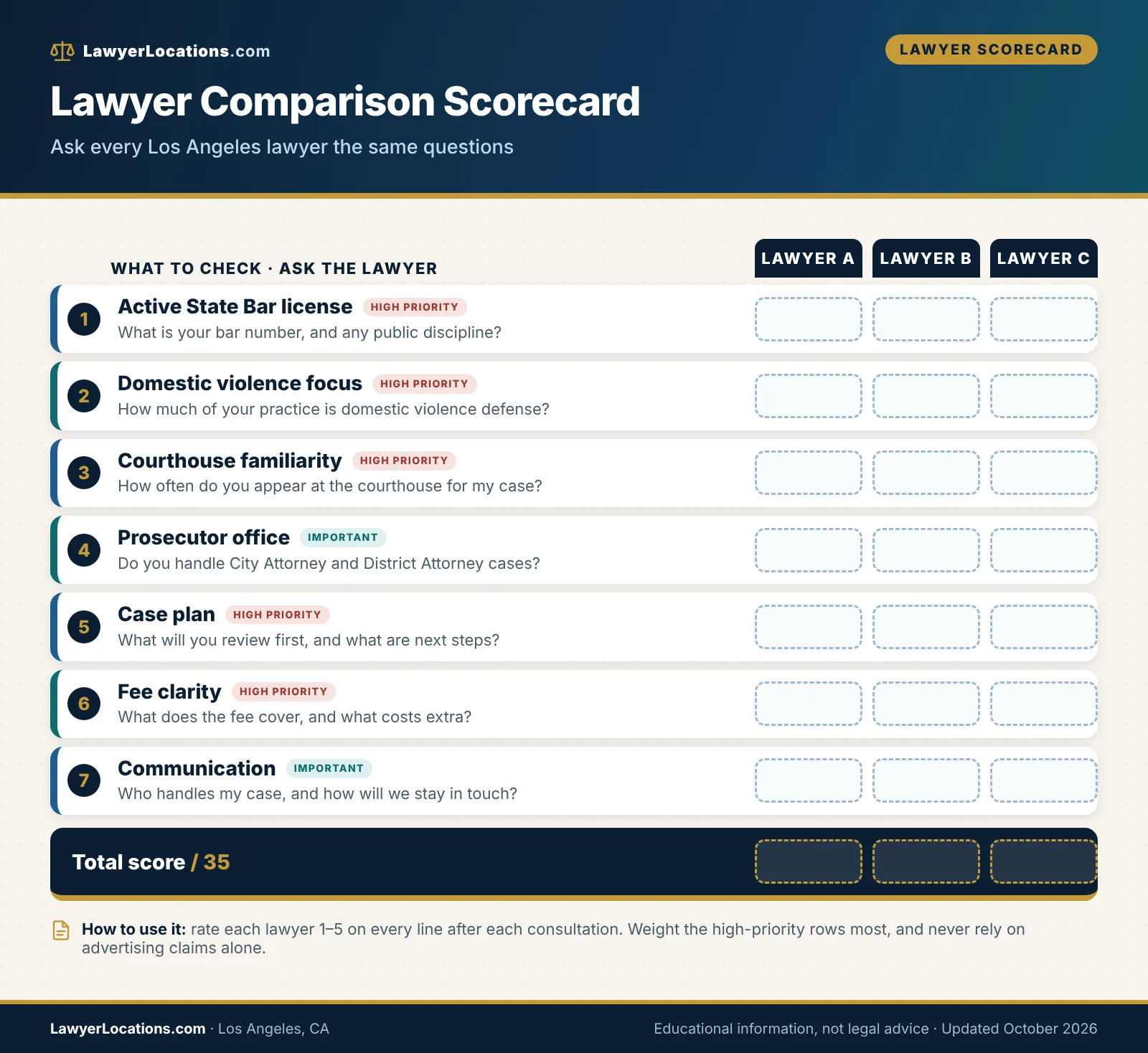
Text version of this graphic
| Criterion | What to ask |
|---|---|
| License status | Is your State Bar license active, and have you ever been disciplined? |
| Domestic violence focus | How much of your practice is domestic violence defense? |
| Courthouse familiarity | How often do you appear in the courthouse that has my case? |
| Prosecutor office | Do you regularly handle City Attorney and District Attorney cases? |
| Case plan | What would you review first and what are the next steps? |
| Fee clarity | What is covered by the fee, and what costs extra? |
| Communication | Who will handle my case and how will we stay in contact? |
| What to check | Why it matters | A reassuring answer sounds like | A concerning answer sounds like |
|---|---|---|---|
| Active State Bar license | Only licensed lawyers can give legal advice and appear in California courts | Gives their bar number and invites you to check it | Avoids the question or says “it’s pending” |
| Domestic violence experience | Probation terms, protective orders and programs are specialized | Explains how they handle charges, protective orders and programs | Says all criminal cases are the same |
| Courthouse familiarity | Local calendars and practices affect timing and negotiation | Names the likely courthouse and explains what to expect there | Cannot say where your case would be heard |
| Honest outlook | No lawyer controls the outcome | Describes risks, options and what they need to see first | Promises a dismissal or “guaranteed” result |
| Written fee agreement | Prevents surprises about scope and cost | Provides a written agreement and explains each term | Demands cash with no paperwork |
| Communication plan | Court deadlines move quickly | Names who you will talk to and how updates arrive | Hands you off to an unnamed staff member |
Red flags when choosing a domestic violence lawyer
Because people searching for this topic are often stressed and in a hurry, some sales tactics are aimed at pressure. Slow down enough to compare at least two lawyers if the court calendar allows.
Promises and pressure
No ethical lawyer can promise to “make charges go away,” predict a judge’s decision before seeing the evidence or claim inside influence with prosecutors. Pressure to sign immediately, or warnings that you must hire today “or lose your chance,” are also warning signs unless there is a genuine court deadline that the lawyer can point to.
- A promised or “guaranteed” outcome before reviewing the police report.
- Claims of being the “best” or “top” lawyer with no way to verify.
- No license number, or reluctance to let you check the State Bar record.
- Advice to contact the other person to “fix things” while a protective order is in place.
Fee and paperwork red flags
Be wary of fee arrangements that are vague about what is included, or that are tied to the outcome of a criminal case, since professional-conduct rules generally bar contingent fees in criminal matters. If a lawyer will not put the scope and fee in a written agreement, take that as your answer and keep looking.
Our guide on what to ask before hiring a criminal defense lawyer goes deeper on consultations, and it pairs well with the scorecard above.
Take the same list of questions to every consultation and score the answers afterward. It is much easier to compare lawyers by notes than by memory, especially when you are under stress.
Costs, Deadlines and Decision Points in Los Angeles
The honest answer to “what does a domestic violence lawyer cost?” is that it depends on the charge, the court, the amount of work, and the lawyer’s billing method. This site does not publish a price average, because no verified official source sets one, but you can learn how fees are structured and which questions flush out the real total.
How domestic violence defense lawyers charge
Most criminal defense work is billed in one of two ways, flat fees or hourly rates, sometimes mixed. Understanding the structure matters more than the headline number.
Flat fees and staged fees
A flat fee is a set price for a defined stage of work, such as handling a case through arraignment and pretrial negotiation. Many lawyers divide the flat fee into stages and charge more if the case goes to trial, so ask exactly which events are included and what triggers an additional fee.
The advantage is predictability. The risk is that the flat fee may cover only part of what you will need, for example not an appeal, a probation violation hearing or a separate civil restraining order hearing.
Hourly rates and retainers
With hourly billing, you deposit a retainer that the lawyer draws against as work is done. Ask for the hourly rate, the billing increments, who bills at what rate (partner, associate, paralegal) and how often you will receive itemized statements.
Hourly billing can be cheaper if the case ends early and costly if it drags on. Ask for a written estimate for each phase, and ask what happens to unused retainer money.
| Fee structure | How it works | Main advantage | Questions to ask |
|---|---|---|---|
| Flat fee | One agreed price for a defined scope of work | Predictable cost | What stages are included? What triggers extra charges, such as trial? |
| Staged flat fee | Separate fees for pretrial, trial and later stages | You pay for what you actually need | What is the total if the case goes to trial? |
| Hourly with retainer | You deposit funds that are billed against hourly work | Can be lower if the case resolves quickly | What are the hourly rates, increments and billing statements? |
| Court-appointed counsel | The court appoints a lawyer if you qualify and cannot afford one | No private fee for people who qualify | How do I ask the court to consider appointment? |
| Contingency fee | Fee depends on the result | Not generally available in criminal defense | Why is this being offered at all? Treat it as a red flag. |
For a broader look at pricing across charges, see our guide to how much a criminal defense lawyer costs.
Other costs in a Los Angeles case
The lawyer’s fee is only one line on the budget. Probation, programs and expert help can add up, so plan for the full picture.
Program, probation and court-related costs
If you are placed on probation under Penal Code 1203.097, the statute sets a $500 minimum fee, which the court may reduce or waive after a hearing if you cannot pay. The batterer’s program itself runs weekly for at least a year and has its own enrollment and attendance requirements, and the court may also order reimbursement of the victim’s reasonable expenses or payments to a shelter-based program.
If cost is a concern, tell your lawyer before sentencing so they can raise ability to pay with the judge. The burden of showing inability to pay is on the defendant, so gather income records in advance.
Investigators, experts and records
Some cases need an investigator, a medical expert, or copies of records and audio. Ask whether these costs are included in the fee or billed separately, and whether the lawyer will get your approval before spending money on them.
Also ask about travel or appearance costs if your case is in a courthouse far from the lawyer’s office. Los Angeles County is large, and a lawyer who is based in one region may charge differently for appearances in another.
Timeline and decision points
There is a rhythm to a case, and knowing the decision points helps you avoid rushed choices. The two biggest decisions are usually who your lawyer will be and whether to accept a plea offer.
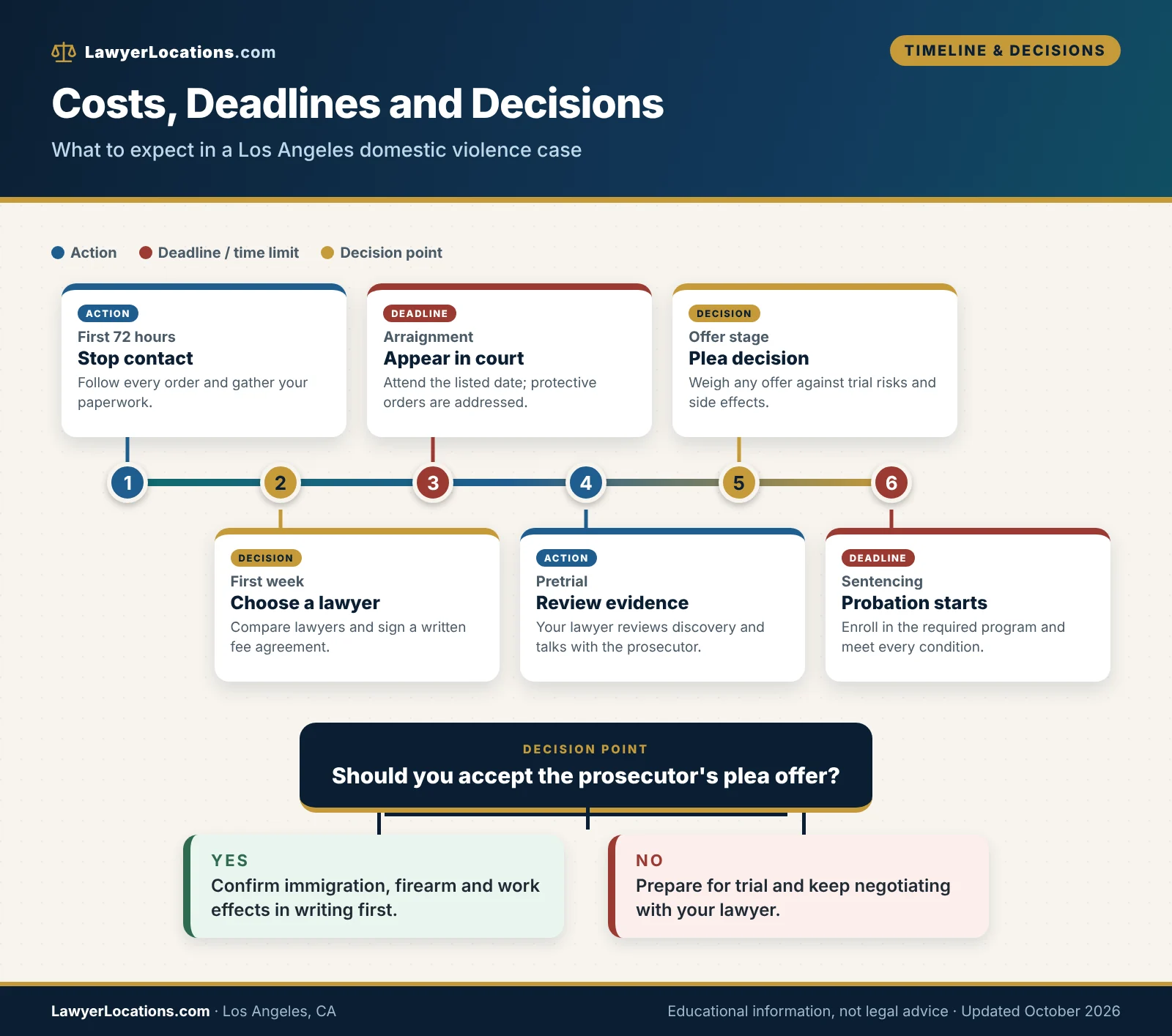
Text version of this graphic
- First 24 to 72 hours (action): Stop contacting the other person and gather your paperwork.
- Days 1 to 7 (decision): Choose a lawyer and sign a written fee agreement.
- Arraignment (deadline): Appear on the date listed; protective orders are addressed.
- Pretrial (action): Your lawyer reviews evidence and talks with the prosecutor.
- Plea decision (decision): Weigh any offer against the trial risks and side effects.
- Sentencing and probation (deadline): Enroll in the required program and meet probation terms.
Decision point: Do you accept the plea offer? If yes, confirm the side effects first. If no, prepare for trial with your lawyer.
The first week
In the first week, the main decisions are to stop contact, preserve evidence and choose representation. If a court date is already on your paperwork, build your timeline backward from it, and leave time to compare at least a couple of lawyers.
If you were served with a civil restraining order request, look at the hearing date immediately. That date is a hard deadline, and missing it can let the other side get an order without hearing from you.
The plea decision
If the prosecutor offers a plea, you will have to decide whether to accept it, negotiate or go to trial. A good lawyer lays out the evidence, the likely range of outcomes and the side effects (immigration, firearms, licenses, custody) in plain terms, then respects that the decision is yours.
Ask for the offer in writing, ask what happens if you do not complete the program, and ask how the plea would show up on a background check. Do not accept a plea you do not understand.
Court dates are the one deadline you cannot negotiate. Put every hearing in your calendar with a reminder a week ahead, and confirm each date with your lawyer’s office or the court’s online tools.
Preparing, Next Steps and Common Questions
Whether you were arrested, are under investigation or are seeking an order, a little preparation makes your first consultation far more useful. The goal of the first meeting is to give the lawyer an accurate, complete picture while keeping the conversation private.
Preparing for your first consultation
Lawyers can only advise on what they know. A short written timeline and the right documents can save an hour of billable time.
Documents and information to bring
Gather everything related to the incident and the case, and organize it by date. Include anything that shows your side, as well as anything that seems to hurt it, since a lawyer must know both.
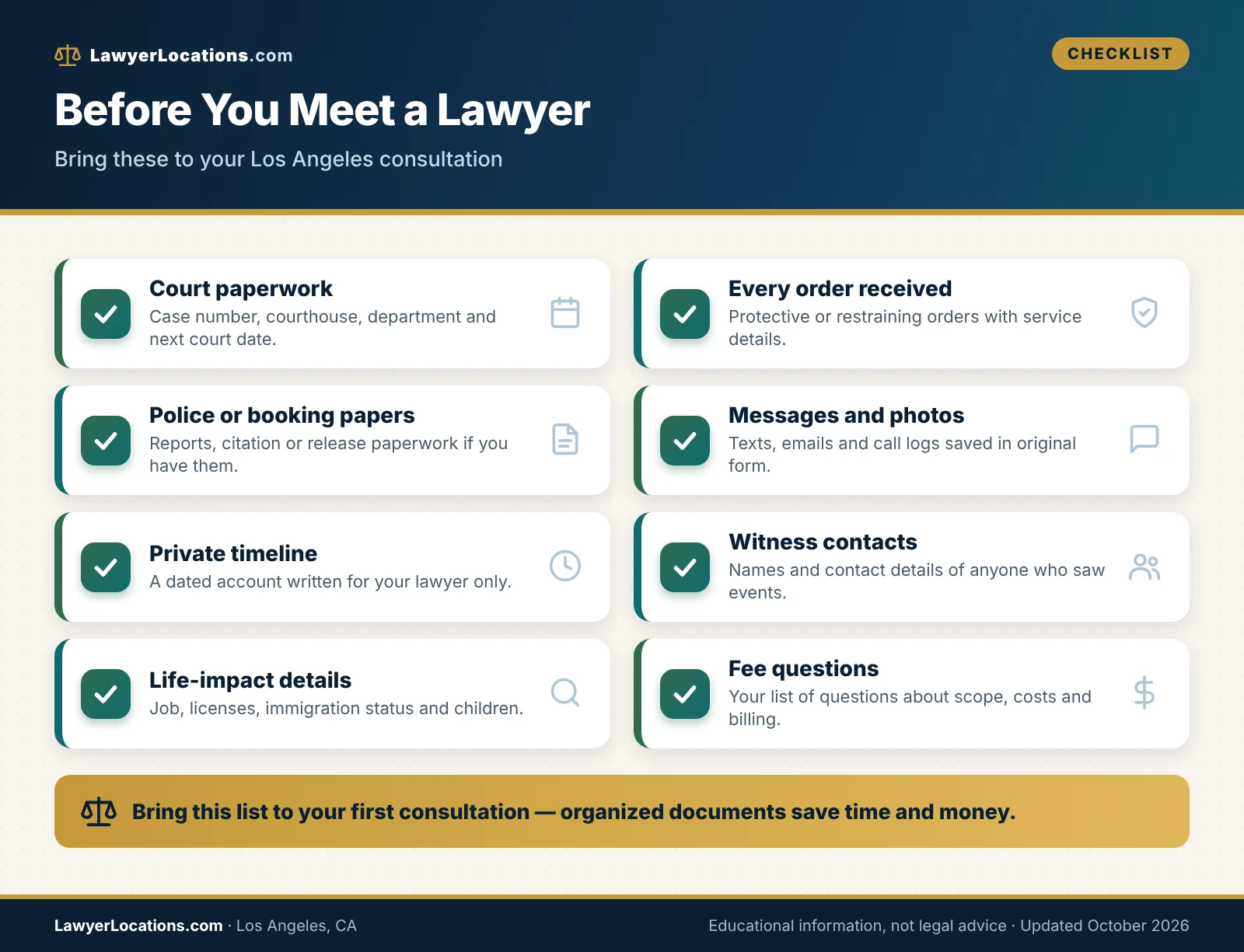
Text version of this graphic
- Court paperwork: case number, courthouse, department and next court date.
- Any protective order, restraining order or emergency order, plus the proof of service.
- The police report or booking information, if you have it.
- Messages, emails, call logs and photos in original form.
- A short written timeline of events, for your lawyer only.
- Names and contact details of possible witnesses.
- Information about your job, licenses, immigration status and children.
- Your questions for the lawyer and a list of fee questions.
- Case number, courthouse, department and next court date.
- Every order you have received, with the date and the way you were served.
- Photos, texts, emails and call history, saved in original form.
- A private, dated timeline of what happened, shared only with your lawyer.
- Names and contact information of anyone who saw or heard relevant events.
- Work, licensing, immigration and family details that a plea could affect.
What to say, and what to keep private
Be honest with your lawyer, who is bound by attorney-client confidentiality once you have retained them or begun seeking legal advice from them. Do not post about the case on social media, and do not discuss it with friends or the other person, since those conversations are not protected.
Keep the written timeline for your lawyer only. Sending it to others, or storing it on a shared device or account, can weaken the protection around it.
Your next steps
The right next move depends on your situation. The two tracks below summarize the practical order of operations.
If you have been arrested or charged
- Stop contact. Follow every order exactly, even if the other person contacts you.
- Write down your court date. Missing it can lead to a warrant.
- Talk to a defense lawyer before talking to police or prosecutors. Use the scorecard in this guide.
- Preserve evidence. Save messages and photos and do not delete anything.
- Ask about side effects. Immigration, firearms, work and custody all deserve a direct question.
If you also have family court issues such as custody, see our California family law attorney guide for how that process works and how it can interact with a criminal case.
If you need protection or have been served with an order
If you need protection, call 911 in an emergency and consider asking the court for a DVRO, which has no court filing fee according to the California Courts self-help site. If you were served, read the order, comply immediately and calendar the hearing.
In both situations, a lawyer or legal aid clinic can help you prepare. If a criminal case is also open, speak with a defense lawyer before submitting written statements in the civil case.
Common questions about domestic violence cases in Los Angeles
These short answers cover questions people ask most often. They are general information, and your facts may change the answer.
About the criminal case
Can the alleged victim drop the charges in Los Angeles?
Not by themselves. The decision to file, reduce or dismiss belongs to the prosecutor, who represents the state, and the court. A victim’s wishes can matter, but they do not end the case on their own, and an attempt to pressure a witness can create new legal problems.
Do I need a lawyer for a misdemeanor domestic violence charge?
A misdemeanor under Penal Code 243(e)(1) can still bring up to a year in county jail, a program of at least one year and long probation, plus effects on firearms, immigration and work. Because of those stakes, most people consult a defense lawyer, or ask the court about appointed counsel if they cannot afford one.
Which Los Angeles courthouse will hear my case?
It generally depends on where the incident happened. Your arraignment paperwork lists the courthouse and department, and the Superior Court’s website has a courthouse locator. The District Attorney’s Family Violence Division lists 12 court locations, including Central, Van Nuys, Airport, Compton, Long Beach and Pasadena.
Can I contact the protected person if they say it is okay?
No, not while a protective order is in effect. The order binds the restrained person, and only the court that issued it can change it. If you want contact, your lawyer can ask the court to modify the order.
Can I keep my firearms while a protective order is in place?
Under Penal Code 136.2, a person subject to a protective order may not own, possess or buy a firearm while the order is in effect, and the court orders relinquishment. Ask your lawyer how to comply correctly.
About lawyers and costs
Is the first consultation free?
It varies by lawyer. The LACBA SmartLaw referral service states that referred clients receive a free consultation of up to 20 minutes, and some private lawyers offer free or low-cost first meetings, while others charge. Ask when you call and get the answer in writing if you can.
How much does a domestic violence lawyer cost in Los Angeles?
There is no single price. Fees depend on the charge, whether it is a felony or misdemeanor, how far the case goes and whether the lawyer bills flat or hourly. Compare written fee agreements from at least two lawyers and ask what is not included.
Can I get a restraining order without a lawyer?
Yes. The California Courts self-help site says there is no court fee to ask for a domestic violence restraining order and that you do not need a lawyer. A lawyer or legal aid clinic can help with evidence and the hearing.
What if I am not a U.S. citizen?
Some domestic violence convictions have serious immigration consequences under federal law. Tell your defense lawyer your status at the first meeting, and consult an immigration lawyer before any plea.
Can a conviction be cleared later?
Some convictions can later be dismissed or sealed under California record-clearing laws, but eligibility depends on the offense, the sentence and whether you completed probation. See our overview of expungement lawyers and record clearing.
Ready to compare your options?
Use the scorecard and checklist above to talk with at least two licensed Los Angeles criminal defense lawyers, or request a referral from a State Bar-certified service. When you are ready, start with our overview of domestic violence defense lawyers and then book consultations with questions in hand. This site does not rank or recommend lawyers, and reading it does not create an attorney-client relationship.
General information only. This article is educational, is not legal advice, and does not create an attorney-client relationship. Laws, court rules, fees and procedures change and vary by case. Consult a lawyer licensed in California about your situation. If you are in danger, call 911.
Sources & References
Show all 12 sources
- California Penal Code section 273.5 — Justia — law.justia.com — accessed October 2026
- California Penal Code section 243 — California Public.Law — california.public.law — accessed October 2026
- California Penal Code section 1203.097 — California Public.Law — california.public.law — accessed October 2026
- California Penal Code section 13700 — California Public.Law — california.public.law — accessed October 2026
- California Penal Code section 801 — California Public.Law — california.public.law — accessed October 2026
- California Penal Code section 136.2 — California Public.Law — california.public.law — accessed October 2026
- Domestic violence restraining orders in California — Judicial Council of California, California Courts Self-Help Guide — selfhelp.courts.ca.gov — accessed October 2026
- Family Violence Division — Los Angeles County District Attorney’s Office — da.lacounty.gov — accessed October 2026
- About the Los Angeles City Attorney’s Office — Los Angeles City Attorney — cityattorney.lacity.gov — accessed October 2026
- SmartLaw Lawyer Referral Service — Los Angeles County Bar Association — lacba.org — accessed October 2026
- What a Certified Lawyer Referral Service Can Do for You — State Bar of California — calbar.ca.gov — accessed October 2026
- Superior Court of Los Angeles County official website and courthouse information — Superior Court of California, County of Los Angeles — lacourt.org — accessed October 2026
Legal Disclaimer and Limitation of Liability
Informational and illustrative purposes only. This article was prepared by LawyerLocations.com solely on the basis of the information available to us at the time of writing. It is an illustrative, general overview. It is not a complete or authoritative statement of the law, and it has not been reviewed by a lawyer licensed in your state or county.
Not legal advice. Nothing in this article is legal, financial, tax or immigration advice, and reading it does not create an attorney-client relationship between you and LawyerLocations.com or any author, lawyer or firm mentioned. Laws, court rules, fees, filing deadlines and agency procedures differ by state, county and court, and they change often. Some details here may be simplified, incomplete or out of date, and time limits for legal claims can be short.
No warranty. We make no representation or warranty, express or implied, about the accuracy, completeness, timeliness or suitability of this content for your situation. Please do not rely on it to make, delay or skip any legal decision. Check the facts against official sources and speak with a licensed attorney in the relevant jurisdiction before you act.
Limitation of liability. To the fullest extent permitted by law, LawyerLocations.com and its owners, authors and contributors disclaim all liability for any loss, damage, cost or other consequence arising from the use of, or reliance on, this article, including any content on third-party websites we link to. Mentioning a lawyer, firm, organization or service is not an endorsement and is not a promise of any result. If you are in immediate danger, contact your local emergency number.