A criminal defense lawyer free consultation is a first conversation, often by phone or in a short office meeting, where a lawyer hears the outline of your situation and explains how the process works, what the lawyer would do and what it would cost. It is not always free, and “free” never means the lawyer has taken your case. Across the United States, what you tell a lawyer while seeking representation is generally treated as confidential, but the exact protection depends on your state’s rules and on how you communicate.
This national guide explains what a free consultation covers, how confidentiality and attorney-client privilege apply, what to bring and ask, how fee structures work, and what to do about police, bail and arraignment while you decide. It also explains the constitutional right to a court-appointed lawyer if you cannot afford one. It is general information, not legal advice, and it never suggests dodging the police or the court.
Criminal Defense Lawyer Free Consultation: What “Free” Covers
A free consultation is a sales-and-screening conversation that also gives you real information. The lawyer learns enough to judge whether to take your matter, and you learn enough to judge whether to hire the lawyer. Nothing says it must be free, so ask first.
What a free consultation usually includes
Think of the meeting as a structured first look. It is short, it is based on what you say rather than on a full review of evidence, and it ends with either an offer to represent you or a polite pass.
The conversation itself
Most free consultations run from 15 to 45 minutes, by phone, video or in person. The lawyer asks what you are charged with or what you are being investigated for, what court you are in, whether you are in custody, and when your next court date is. You can expect a plain-language overview of how a case like yours typically moves through the system and what decisions are coming up.
The Federal Trade Commission’s consumer guidance says the first meeting is often free, but you should ask the lawyer whether you will be charged for the lawyer’s time before you meet. Illinois Legal Aid Online makes the same point: attorneys often offer free consultations, but not always. Treat “free” as something to confirm, not assume.
What you should leave with
You should leave knowing the lawyer’s general approach, who would actually handle your case, and what the fee arrangement would look like. You should also know the next deadline or court date that matters most. A consultation that ends without a clear picture of the fee and the next step has not done its job.
If the lawyer wants to move forward, ask for the fee agreement in writing and take time to read it. A reputable lawyer will not mind you comparing terms with another office.
A free consultation is not a retainer agreement and not a commitment on either side. You can walk away, and the lawyer can decline the case. Until you sign a fee agreement and the lawyer agrees to represent you, no one is formally your lawyer.
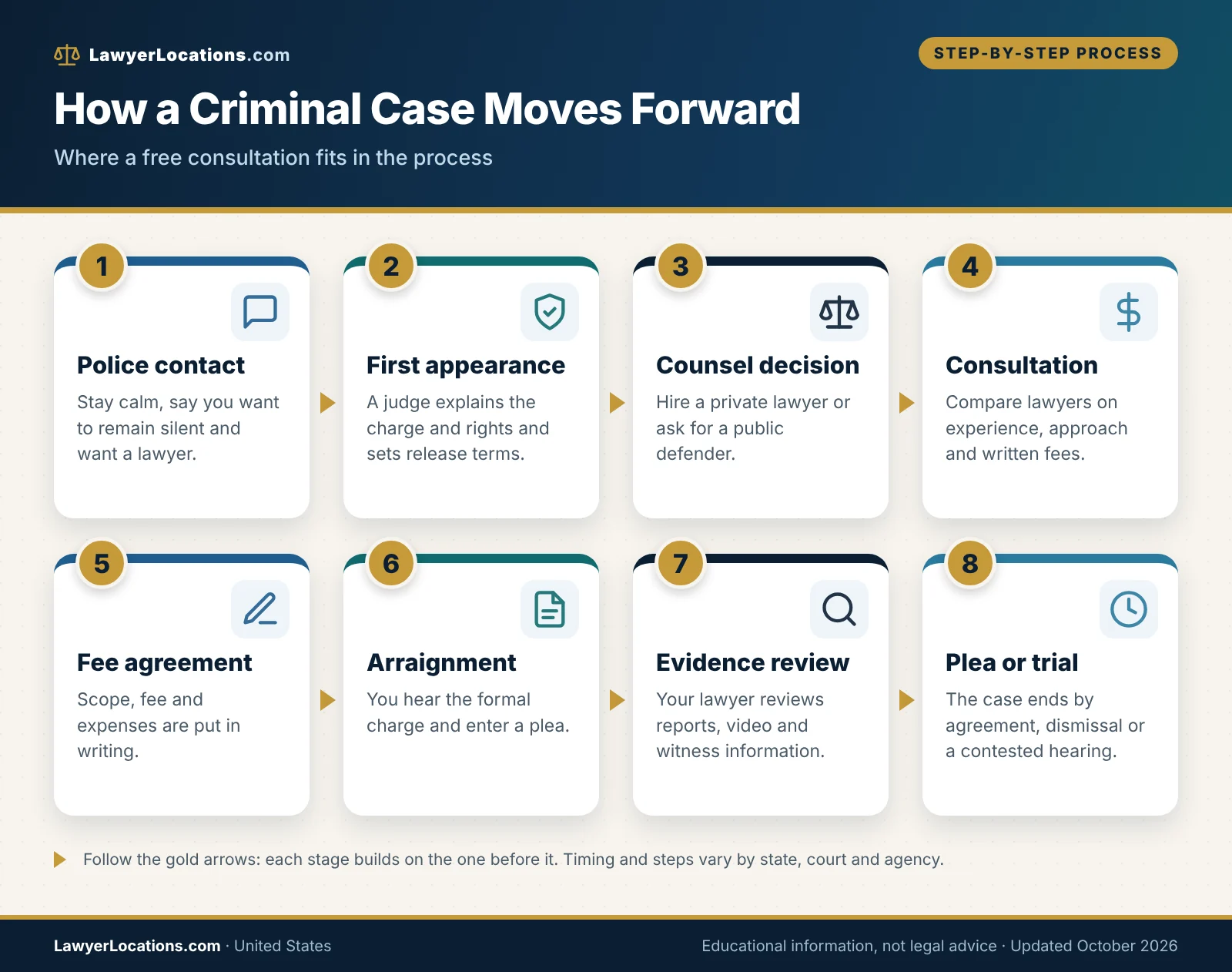
Text version of this graphic
- Police contact or charge. You are questioned, arrested, cited or learn of an investigation.
- Silence and a request for counsel. You state calmly that you want to remain silent and want a lawyer.
- First appearance and bail. A judge informs you of the charge and decides on release conditions.
- Consultation. You speak with one or more lawyers, or ask for a public defender.
- Fee agreement. The scope, fee and expenses are put in writing.
- Arraignment and plea. You hear the formal charge and enter a plea, usually with counsel beside you.
- Evidence review. Your lawyer requests reports, video and witness information.
- Negotiation or trial. The case ends by agreement, dismissal or a contested hearing.
What a free consultation does not cover
Free ends where work begins. The consultation does not include filing motions, calling witnesses, reading your full file or appearing in court for you. It also may not include a verdict-style opinion about how your case will turn out, because no honest lawyer can give one before reviewing the evidence.
Work that costs money
Once you hire a lawyer, fees cover things like reviewing discovery (the evidence the prosecution must share), talking with the prosecutor, court appearances and, in some cases, motions to challenge the stop, the search or a statement. Outside costs, such as investigators, records, interpreters or expert witnesses, may be billed separately. Ask exactly which items are included in the quoted fee and which are not.
Promises that should not be part of the meeting
A lawyer may explain realistic ranges and what typically drives results, but should not promise an outcome. Illinois Legal Aid Online specifically cautions against lawyers who promise fast results, since outcomes are hard to predict. If a consultation turns into pressure to sign immediately, with talk of a “sure thing”, treat that as a red flag and move on.
Why the first conversation matters in criminal cases
Criminal matters differ from many civil disputes because liberty is at stake and early events happen quickly. The first calls you make can affect bail, what you say to investigators and which evidence is preserved.
Early choices that are hard to undo
Statements made to police, consent to a search and missed court dates are difficult to repair later. A short conversation with a lawyer before you talk to investigators is the strongest reason to use a free or low-cost consultation early.
Consultation is not the same as hiring
You are allowed to speak with more than one lawyer. Many people hold two or three consultations in a day or two, compare answers and fees, and then decide. Doing so is normal and sensible, and it does not signal disloyalty to anyone.
When you call, ask three things before you share any detail: Is the consultation free? How long is it? Will the lawyer I speak with be the lawyer who handles my case? Write down the answers.
Free, low-cost and paid first meetings compared
Not every lawyer treats the first meeting the same way. The table below sorts the common arrangements so you can see what to ask about on the phone. It is a general pattern, not a rule, and each office sets its own policy.
The common arrangements
Some lawyers offer a free phone screening and a paid in-depth evaluation, and others credit a consultation fee toward the retainer. For example, Illinois Legal Aid Online notes that the Illinois State Bar Association offers a 30-minute phone consultation for a fixed fee of $25 (as described by that source in October 2026), which shows how referral programs can differ from a lawyer’s own policy.
| Arrangement | What it usually means | What to ask |
|---|---|---|
| Free phone screening | A brief call so the office can check the court, the charge and any conflict of interest. | Is a longer evaluation free or paid? Who will I talk to? |
| Free in-person or video meeting | A longer conversation with a lawyer, often 30 to 45 minutes. | Is it with a lawyer or with staff? Is anything billed if I leave without hiring? |
| Paid consultation | A flat fee for a case evaluation, sometimes credited toward the retainer. | Is the fee credited if I hire you? What will I receive for it? |
| Bar referral service | A short, fixed-fee meeting arranged through a bar program. | What is the fee? Does it cover criminal matters in my county? |
| Public defender intake | A screening for eligibility for a court-appointed lawyer. | What documents do I need to prove income? Is there an application fee? |
Why the policy differences exist
Free consultations are a business choice, not a legal requirement. Some offices use them to build trust, while others limit them because cases involve sensitive detail that takes time to assess. A paid evaluation is not a warning sign by itself, as long as the price is disclosed up front and the lawyer explains what you receive.
Confidentiality and Attorney-Client Privilege in a Consultation
When you consult a lawyer about hiring them, the lawyer generally owes you a duty to keep what you say confidential, even if you never become a client. The details depend on your state’s version of the ethics rules and on whether the privilege (a rule of evidence) also applies. Here is how those pieces fit together.
Two different protections: confidentiality and privilege
People often use the two terms as if they were one. They are related but not identical, and understanding the difference helps you decide how much to say and how.
The ethical duty of confidentiality
The ABA’s Model Rule 1.18 addresses “prospective clients,” meaning people who consult a lawyer about forming a client-lawyer relationship. Washington’s version of the rule, for example, says a lawyer who receives information from a prospective client generally may not use or reveal that information, even if no relationship follows, subject to listed exceptions. Each state has its own rule, so the wording differs, but the basic idea is widely shared.
These duties are real, but prospective clients receive some, not all, of the protections that clients receive. The commentary to the rule says so directly.
The evidentiary privilege
Attorney-client privilege is a rule that keeps certain confidential communications between lawyer and client out of court. Cornell’s Legal Information Institute explains that it covers confidential communications made to get legal advice, in speech, writing, email or text, and that the client holds it. An Oregon State Bar article notes that courts there have extended privilege to a person who gave a lawyer documents while considering hiring the lawyer, but also warned the holding does not stretch to everyone who might conceivably be called a “prospective” client.
The practical lesson: a genuine, private conversation seeking representation is the situation both rules are built for. A casual message sent to a stranger is much less clearly protected.
Attorney-client privilege is a legal rule that lets a client keep confidential lawyer-client communications from being used as evidence. Confidentiality is the broader ethical duty a lawyer owes to keep information about a client or prospective client private. The privilege is the courtroom protection; confidentiality is the professional-conduct protection.
Where the protection can weaken
Privilege and confidentiality are strong, but not unlimited. Most problems come from how and where you communicate, not from the lawyer.
Other people in the room or on the line
A third party’s presence can compromise confidentiality. Cornell’s explanation notes the exception for someone essential to the relationship, such as an interpreter. A friend, relative or partner who sits in on your consultation may create an argument that the privilege was waived, and that person can potentially be questioned later.
If you need support, ask the lawyer in advance whether the person can attend, or whether it is safer for them to wait outside. If a family member is paying the fee, ask the lawyer how that arrangement affects confidentiality and who the lawyer’s client is.
Unilateral messages, web forms and shared accounts
Under the commentary to Rule 1.18 as adopted in Washington, a consultation is likely to have occurred when a lawyer invites information “without clear and reasonably understandable warnings and cautionary statements that limit the lawyer’s obligations.” Unilateral messages that only describe the lawyer’s background or general legal information do not create a consultation. A contact form that carries a disclaimer saying no relationship is formed may limit what the lawyer owes you.
So read the disclaimer before you type a detailed narrative into a web form, chat widget or text message. Do not use a work email account, a shared family device or a jail phone for a first conversation about your case.
The crime-fraud exception and limits on confidentiality
The privilege does not protect a request for legal advice to further a crime or fraud, according to Cornell’s explanation. Talking to a lawyer about a past event is different from asking for help committing a future one. Separately, state ethics rules can allow a lawyer to disclose limited information in narrow circumstances, such as preventing serious physical harm, so ask the lawyer to explain the exceptions that apply in your state.
Never ask a lawyer to help you hide evidence, contact a witness to change a story or mislead investigators. That is outside any lawyer’s role, can create new criminal exposure for you and is not protected conversation.
Practical steps to protect what you say
You can reduce risk with a few simple habits. None require legal training.
Before and during the meeting
Ask at the start: “Is this conversation confidential, and what if I decide not to hire you?” Request that the lawyer confirm in writing that your information will stay private either way. Speak from a private room, use your own phone or computer and keep the meeting to the people who need to be there.
After the meeting
Do not repeat what you discussed to friends, coworkers or on social media. Those conversations are not privileged, and posts can be copied and used. If you are in jail, remember that calls are generally monitored. The federal Bureau of Prisons rule at 28 CFR 540.102 allows monitoring of inmate calls but says staff may not monitor a properly placed call to an attorney, and state and county jails have their own procedures, so ask the jail how to arrange a private attorney call.
Before the Consultation: Dealing With Police Calmly
If police have contacted you, the safest posture is calm, polite and quiet. Say clearly that you want to remain silent and that you want a lawyer, then stop answering questions about the matter. Nothing in this section is about avoiding the police, and none of it should be used that way.
Your rights when officers want to talk
Two constitutional rights matter most in a police conversation: the privilege against self-incrimination and the right to counsel. Both have rules about how to use them, and the rules reward clarity.
What Miranda warnings say and when they apply
Under Miranda v. Arizona, 384 U.S. 436 (1966), police must warn a person in custody, before questioning, that they have the right to remain silent, that anything said can be used in court, that they may consult a lawyer and have the lawyer present, and that a lawyer will be appointed if they cannot afford one. If the person asks for a lawyer, interrogation must stop until a lawyer is present. If the person says they want to remain silent, questioning must stop.
The warnings apply to custodial interrogation, not to every conversation. Officers can approach you on the street, at home or at work and ask questions without reading you anything, so do not wait for a warning before protecting yourself.
Say it out loud, and say it clearly
The Supreme Court has held that a suspect must unambiguously invoke the right to remain silent. In Berghuis v. Thompkins, 560 U.S. 370 (2010), a largely silent three-hour interrogation did not count as invoking the right. In Davis v. United States, 512 U.S. 452 (1994), the remark “Maybe I should talk to a lawyer” was found ambiguous, so officers could keep questioning.
In Salinas v. Texas, 570 U.S. 178 (2013), the Court held that a person who was not in custody and who did not expressly invoke the privilege could not later object when his silence on one question was used against him. A plain sentence works best: “I am going to remain silent. I want a lawyer.”
Staying quiet is not always enough on its own. Because courts have required a clear statement, use words, then stop talking. Once you ask for counsel in custody, police generally may not restart questioning until a lawyer is available unless you start the conversation yourself, under Edwards v. Arizona, 451 U.S. 477 (1981).
What not to say or do
The list below is about protecting your position, not about hiding anything. You can be respectful and cooperative about identity and logistics while declining to discuss the facts.
Do not explain, guess or “clear things up”
People often talk because they believe a quick explanation will end the matter. Casual remarks and guesses can be quoted later and compared with other evidence, and even innocent details can sound inconsistent once an officer writes them down.
Decline politely: “I do not want to answer questions without a lawyer.” You do not need to argue or justify the request, and you do not need to give a reason.
Never lie
A false statement is often worse than silence. Under 18 U.S.C. § 1001, knowingly and willfully making a materially false statement in a matter within the jurisdiction of the federal government can carry up to 5 years in prison, and many states have their own false-reporting or obstruction laws. Silence is a right; a lie is a new problem.
Do not consent to searches, and do not resist physically
In Schneckloth v. Bustamonte, 412 U.S. 218 (1973), the Supreme Court held that a voluntary consent can justify a search without a warrant, and that police are not required to warn you that you may refuse. If you do not want a search, say calmly: “I do not consent to a search.” Say it once, do not interfere and leave any dispute to your lawyer, since resisting can create new charges and risk injury.
The ACLU’s police-encounter guidance emphasizes staying calm and not showing hostility toward officers. It also stresses that the burden of de-escalation does not fall on private citizens, and that no approach can promise safety, so the goal is simply to lower risk.
Do not run, hide, give a false name, destroy anything or ignore a summons, warrant or court date. Cooperating with process (identifying yourself, showing up to court, complying with lawful orders) while declining to discuss the facts is the lawful and safer path. If a warrant exists, a lawyer may be able to arrange a calm, planned surrender or appearance.
If police have not charged you yet
Contact from investigators, a search warrant at your home or a call from a detective does not mean you must answer questions on the spot. It does mean you should speak to counsel quickly, because the earlier you receive advice, the more options you tend to have.
Calls, visits and letters from investigators
If a detective or agent calls, you can say you will have a lawyer contact them, take their name and number and end the call. Do not leave a voicemail explaining the facts. Federal investigators sometimes send letters, and a lawyer can read the exact wording and explain what it signals.
If officers arrive with a warrant
Stay calm, stay out of the way and do not obstruct. Ask to see the warrant and read its stated scope, and then note the officers’ names, agencies and what they remove. Say you want to remain silent and want a lawyer, and call one as soon as you can.
Public Defenders and the Right to Counsel
If you cannot afford a lawyer, you may be entitled to one at public expense. The right comes from the Sixth Amendment, and the details of eligibility, timing and cost vary by state and by court. Applying for a public defender does not prevent you from also consulting private counsel.
The constitutional rule: Gideon and its limits
Understanding how far the right extends helps you know what to ask for and when. It is broader than many people assume, but it is not unlimited.
Gideon v. Wainwright and felony cases
In Gideon v. Wainwright, 372 U.S. 335 (1963), decided March 18, 1963, the Supreme Court held that a state must provide a lawyer to a defendant charged with a serious crime who cannot afford one. The Court reasoned that the right to counsel is fundamental to a fair trial and applies to the states through the Fourteenth Amendment. That decision is why every state has some system for appointed defense counsel.
Misdemeanors and the “actual imprisonment” line
The Court later tied the right in lower-level cases to the possibility of jail time. According to the Court’s summary in Alabama v. Shelton, 535 U.S. 654 (2002), Argersinger v. Hamlin requires appointed counsel in prosecutions that lead to actual imprisonment, and Scott v. Illinois held that a fine-only case does not trigger appointed counsel. Shelton then held that a suspended sentence that may end in actual imprisonment cannot be imposed unless the defendant had counsel.
In short, if jail is a real possibility, ask the court whether you are entitled to appointed counsel. Some states provide more than the constitutional minimum.
When the right begins
In Rothgery v. Gillespie County, 554 U.S. 191 (2008), the Court held that a defendant’s initial appearance before a judicial officer, where he learns of the charge and his liberty is restricted, starts the adversary judicial proceedings that trigger the Sixth Amendment right to counsel. In practice, you may need to ask for a lawyer at that first appearance, and the judge should tell you that you can. For federal felonies, Federal Rule of Criminal Procedure 5(d)(1) requires the judge to inform the defendant of the right to retain counsel or request appointed counsel.
How eligibility works in practice
There is no single national income test. Courts and public defender offices look at income, assets, family size and sometimes whether you posted bail, using rules that differ by state and by county.
Federal court
Under the Criminal Justice Act, 18 U.S.C. § 3006A, each federal district runs a plan to provide counsel for people “financially unable to obtain adequate representation.” Coverage is mandatory for felonies and Class A misdemeanors, and the statute lets the court direct payment if it finds funds are available. The U.S. Courts website reports that federal defender organizations and private panel attorneys handle the vast majority of federal criminal defense, with federal defenders receiving about 60 percent of appointments and panel attorneys about 40 percent.
State court: examples of how rules differ
The table below compares how five jurisdictions handle the question, using their own statutes or court-system sources. It is illustrative, not complete, and your county may add procedures of its own.
| Jurisdiction | How “unable to afford” is decided | Notable details |
|---|---|---|
| Federal courts | 18 U.S.C. § 3006A(a): “financially unable to obtain adequate representation,” under each district’s plan. | Mandatory for felonies and Class A misdemeanors; the court may order payment if funds are available. |
| Florida | Fla. Stat. § 27.52: the clerk of court makes the initial indigence determination; income at or below 200 percent of federal poverty guidelines, or receipt of listed benefits, qualifies. | An application fee of $50 applies, but an indigent person cannot be refused counsel for failing to pay it; costs may later become a lien. |
| Washington | RCW 10.101.010: public-assistance recipients, involuntary commitment, after-tax income at or below 125 percent of the federal poverty level, or no funds to pay for counsel. | A separate category, “indigent and able to contribute,” covers people who can pay part of the cost. |
| New York | County Law § 722: each county runs a plan for people “financially unable to obtain counsel.” | Plans may use a public defender, a private legal aid bureau, a bar-association assigned-counsel plan or a combination. |
| Texas | Code of Criminal Procedure art. 26.04: the court or its designee may consider income, assets, obligations, expenses, dependents and spousal income. | The court may not consider whether the defendant has posted bail except as it reflects financial circumstances. |
Texas also sets appointment deadlines after a request: counsel is to be appointed no later than the end of the third working day in smaller counties and the first working day in counties of 250,000 or more. (confirm against the official Texas statute site).
Public defender or private lawyer?
This is a personal choice that depends on your eligibility, your case and your resources. Neither option is automatically better.
What public defenders offer
Public defenders are licensed lawyers whose daily work is criminal defense, and many know the local courts well. They are paid by the government, not by you, although some states charge application fees or reimbursement. Federal defender organizations, for example, employ salaried attorneys who are barred from private practice under the statute.
What private counsel may offer
Private lawyers set their own caseloads and may build a practice around a particular court or type of charge. You also choose the lawyer, which has its own value. The tradeoff is cost, which is why the fee questions later in this guide matter.
Preparing for the Meeting and Comparing Lawyers
You will get more from a criminal defense lawyer free consultation if you arrive organized and ask the same questions of every lawyer. Preparation also helps the lawyer give an accurate fee quote, since the scope of work depends on your actual paperwork.
What to bring and what to write down
Illinois Legal Aid Online suggests that for criminal matters you bring statements to police, photos or videos, arrest documents, court papers and the names and badge numbers of officers. The list below builds on that advice.
Documents and records
Gather whatever you were handed or received: the citation, the arrest or release paperwork, bail or bond papers, any summons, the charging document if you have one, and notices of court dates. Bring any property receipts from a search. Tell the lawyer about any prior record or probation, since it can change the advice.
- Government-issued photo ID and your contact details
- Charging papers, citation, summons or warrant, if any
- Release, bail or bond paperwork and the next court date
- Names and badge numbers of officers, if you have them
- Photos, video, texts or messages you already hold
- Names and phone numbers of witnesses
- A list of prior cases or current probation or parole terms
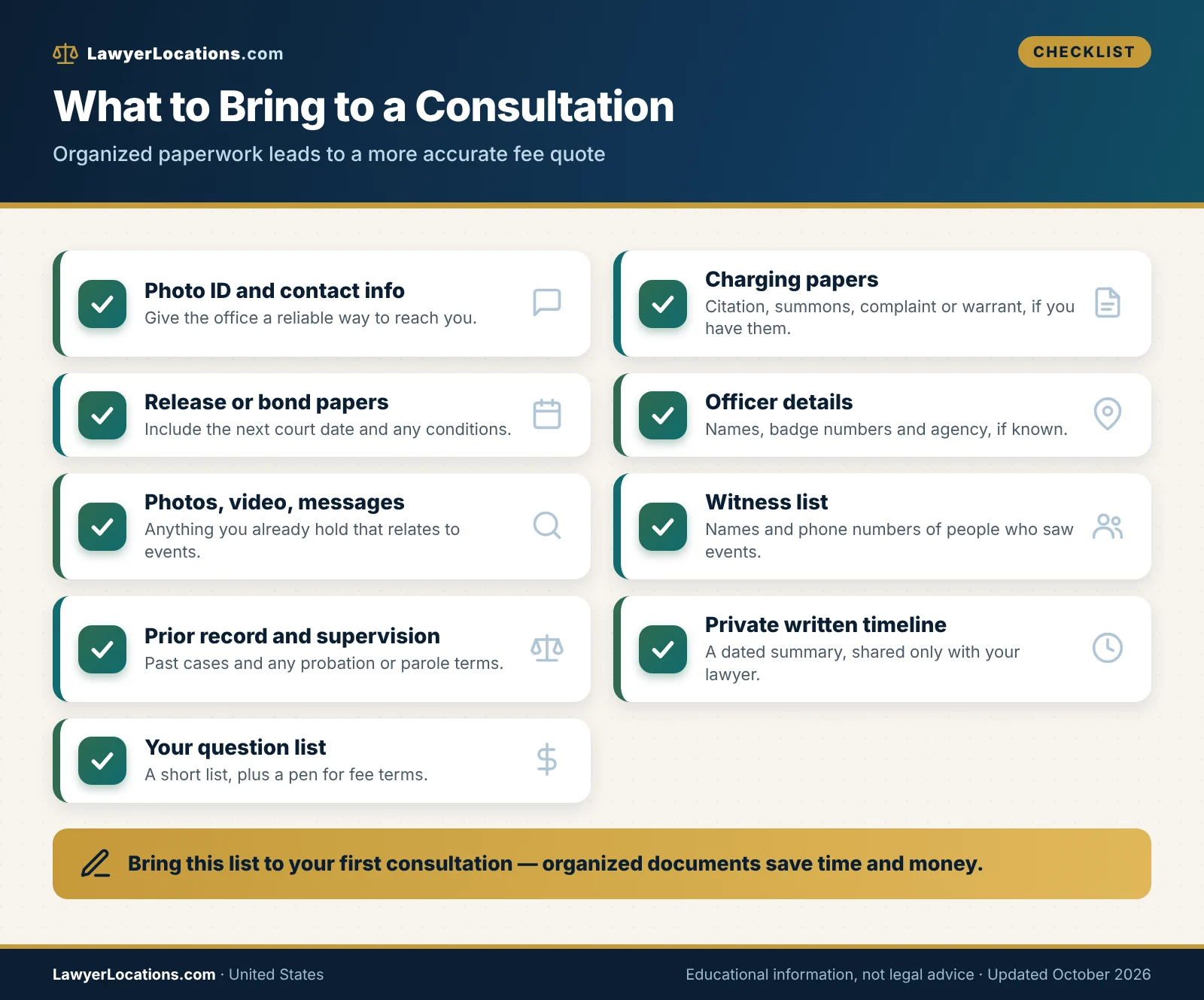
Text version of this graphic
- Photo ID and contact details. Bring a way for the office to reach you.
- Charging papers. Citation, summons, complaint or warrant, if you have them.
- Release or bond papers. Include the next court date and any conditions.
- Officer information. Names, badge numbers and agency, if known.
- Evidence you already hold. Photos, video, texts and messages.
- Witness list. Names and phone numbers of anyone who saw events.
- Prior record and supervision. Past cases, probation or parole terms.
- Written timeline. A private summary of events, for your lawyer only.
- Your questions. A short list, and a pen for the fee terms.
A private written timeline
Write a short account of what happened, in order, with dates and places, and label it clearly as prepared for your lawyer. Keep it to yourself and give it only to the lawyer you are consulting. Do not post it, text it to friends or send it to anyone else, since it may not be protected once shared.
Questions to ask in the consultation
Asking the same questions of each lawyer lets you compare answers fairly. Focus on what the lawyer actually does and how, not on reputation claims or slogans.
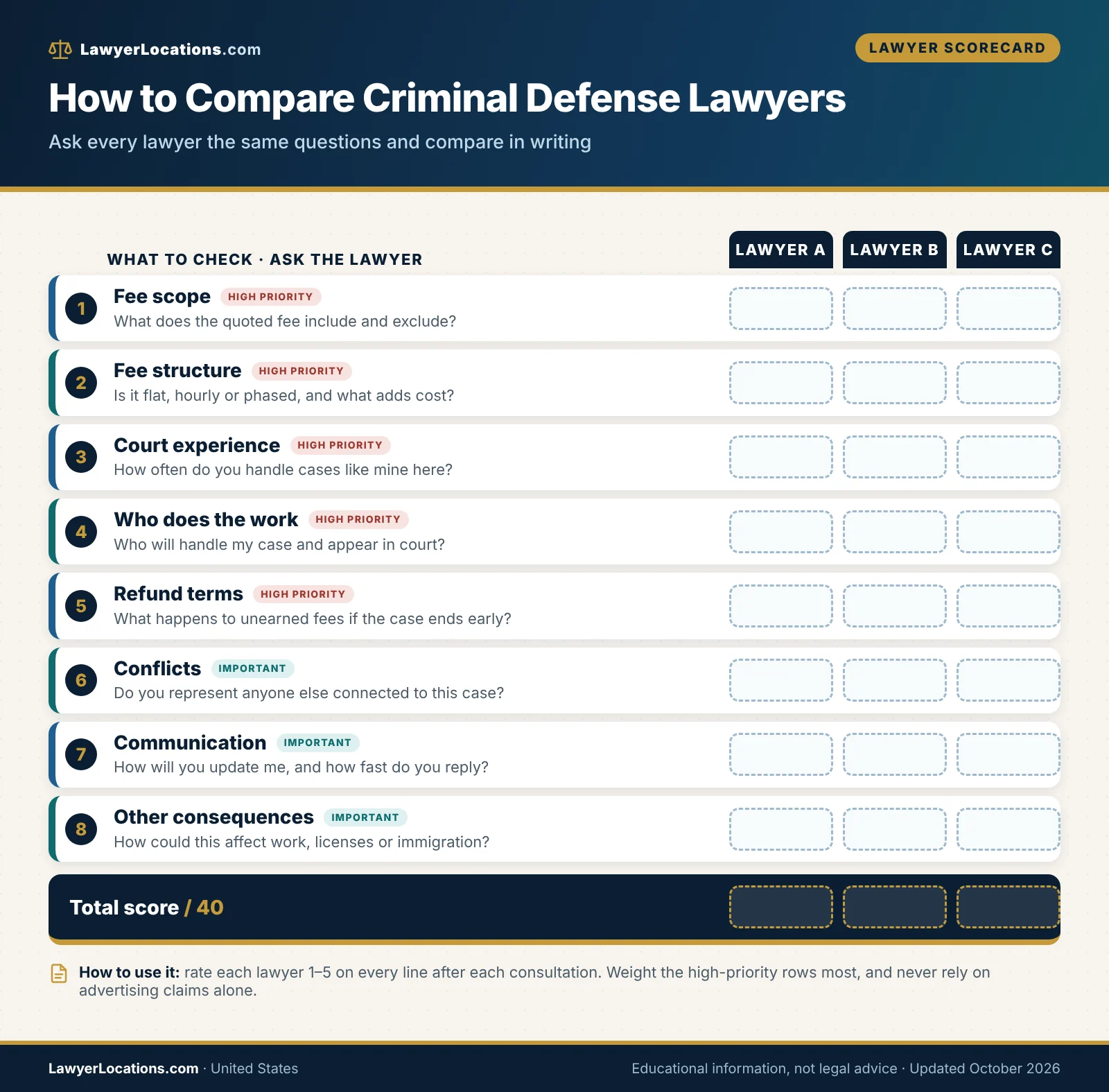
Text version of this graphic
| Criterion | Question to ask | Weight |
|---|---|---|
| Fee scope | What does the quoted fee include and exclude? | High |
| Fee structure | Is it flat, hourly or phased, and what adds cost? | High |
| Court experience | How often do you handle cases like mine in this court? | High |
| Who does the work | Who will handle my case and appear in court? | High |
| Refund terms | What happens to unearned fees if the case ends early? | High |
| Conflicts | Do you represent anyone else connected to this case? | Medium |
| Communication | How will you update me, and how fast do you reply? | Medium |
| Other consequences | How could this affect work, licenses, firearms or immigration? | Medium |
Experience, staffing and approach
Ask how often the lawyer handles criminal cases like yours, and whether in the specific court where you are charged. Ask who will appear at hearings, whether an associate or paralegal handles part of the work, and how the lawyer would approach the first few weeks. Illinois Legal Aid Online suggests asking about trial experience, years in practice and experience in your county’s courts, along with the strengths and weaknesses of your case.
Conflicts of interest and co-defendants
If more than one person is charged, ask whether the lawyer represents anyone else involved. The commentary to ABA Model Rule 1.7 warns that the potential for conflict in representing multiple defendants in a criminal case is so grave that lawyers generally should avoid representing more than one co-defendant. A lawyer who is candid about this is protecting you.
Collateral consequences and immigration
A criminal case can affect jobs, professional licenses, housing, firearm rights, student aid and immigration status. In Padilla v. Kentucky, 559 U.S. 356 (2010), the Supreme Court held that defense counsel must tell noncitizen clients whether a guilty plea carries a risk of deportation, and must give correct advice where the consequence is clear. If you are not a U.S. citizen, say so in the first meeting and ask how the lawyer would handle immigration consequences; our green card lawyer guide explains when separate immigration counsel may help.
Fee structures you will hear about
The Federal Trade Commission describes three common arrangements: an hourly rate, a flat fee for a defined service, and a contingency fee. In criminal defense, only the first two are normally available, because ABA Model Rule 1.5(d)(2) bars a lawyer from charging a contingent fee for representing a defendant in a criminal case. Confirm your state’s version of that rule with the lawyer.
Flat, hourly and phased fees
A flat fee covers a defined set of tasks for one price. An hourly arrangement bills time, usually against an advance deposit. A phased fee sets separate prices for stages, such as pretrial work and trial. No national price exists that is both honest and useful, so this guide prints no averages; see our DUI lawyer cost guide for how one charge type is priced and why quotes differ.
| Structure | How it works | What to confirm |
|---|---|---|
| Flat fee | One price for a stated scope of work. | Exactly what is included; what happens if the case goes to trial; whether any portion is refundable. |
| Hourly with retainer | You deposit money up front, and the lawyer bills time against it. | The hourly rate, who bills at what rate, how often you receive itemized statements and whether you must replenish the deposit. |
| Phased or staged fee | Separate fees for stages, for example pretrial and trial. | What triggers the next stage and who decides. |
| Contingency fee | Fee depends on the result. | Generally barred in criminal defense under ABA Model Rule 1.5(d)(2); a lawyer proposing it deserves questions. |
| Court-appointed or public defender | Government pays the lawyer. | Any application fee, possible reimbursement or lien, and eligibility rules in your court. |
Retainers, refunds and written terms
Comment [4] to ABA Model Rule 1.5 says that a lawyer may require advance payment of a fee but is obliged to return any unearned portion. Ask how the retainer is held, when it is treated as earned and what you would receive back if you or the lawyer ended the relationship early. States differ on how they treat flat fees paid up front, so read the agreement closely and ask your state bar if the wording is unclear.
Rule 1.5(b) says the scope of the representation and the basis of the fee and expenses should be communicated to the client, preferably in writing. The comments add that a written statement of the engagement terms reduces the possibility of misunderstanding. Get yours in writing before you pay.
Ask for the fee agreement by email so you can read it away from the office. Compare scopes, not just totals, because a lower quote that excludes a hearing or trial may cost more in the end than a higher quote that includes it.
Red flags when comparing lawyers
Most lawyers are honest, but a few practices should make you pause. These are patterns to notice, not proof of wrongdoing.
Pressure and promises
Be wary of anyone who promises an outcome, claims inside influence with a judge or prosecutor, or pushes you to sign on the spot. Illinois Legal Aid Online also cautions against lawyers who rush you into signing or will not explain the contract.
- A promised result, “sure thing” or “I can make this go away”
- Pressure to pay or sign before you have read the agreement
- Refusal to put the fee and scope in writing
- Vague answers about who will actually handle your case
- Unusual requests, such as paying only in cash with no receipt
Money and communication problems
Watch for unexplained add-on charges, unwillingness to discuss refunds and lawyers who go silent when you ask basic questions. If an office will not explain how it bills, look elsewhere.
No lawyer, directory or website can ethically promise that you will win, avoid jail or have a charge dismissed. LawyerLocations.com does not rank lawyers or recommend any particular lawyer.
Bail, Arraignment and the First Days After an Arrest
If you or someone close to you has been arrested, the first appearance and bail decision can come within a day or two. A lawyer’s help is most useful before and at those events, which is why many people do not wait to compare options at leisure.
First appearance and bail
The first appearance is the initial court hearing after arrest. Its name and timing differ by state, and some places call it a bail hearing or a presentment.
What the law says about speed
In federal court, Rule 5(a)(1)(A) requires an arresting officer to bring the defendant before a magistrate judge “without unnecessary delay.” For state arrests, the Supreme Court held in County of Riverside v. McLaughlin, 500 U.S. 44 (1991), that a jurisdiction combining a probable-cause determination with other pretrial proceedings must do so as soon as reasonably feasible and no later than 48 hours after arrest, subject to narrow exceptions. Your state may set a shorter limit.
How release decisions are made
Federal law, 18 U.S.C. § 3142, lets the judge order release on personal recognizance or an unsecured bond, release on conditions or detention. The judge weighs the nature of the offense, the weight of the evidence, your history and characteristics and the danger release would pose. The statute also says the court may not impose a financial condition that results in pretrial detention. States have their own bail laws, and they vary widely, so ask a local lawyer about your court’s practice.
A lawyer can present facts that matter to release, such as stable housing, work and family ties, and may be able to ask the judge to revisit bail or conditions, depending on state procedure.
Arraignment: the formal charge and the plea
Arraignment is the court event where you are formally told the charge and asked how you plead. In some courts, the first appearance and arraignment happen on the same day; in others, they are separate.
What happens at an arraignment
Under Federal Rule of Criminal Procedure 10(a), an arraignment is held in open court and consists of making sure you have a copy of the indictment or information, reading it to you or stating its substance, and asking you to plead. State courts follow similar steps, but details differ, including what happens if a lawyer has not yet been hired.
Why to have counsel before you plead
A plea has consequences, so do not make that choice alone. If you appear without a lawyer, tell the judge you want to hire one or apply for appointed counsel, and ask for time. Do not discuss the facts with the judge, the prosecutor or court staff, since those conversations are not confidential.
Court dates, release conditions and filing deadlines are set by the specific court and can change quickly. Never miss a court date; if you cannot attend because of an emergency, contact a lawyer or the clerk right away, since a missed date can lead to a warrant and a bail forfeiture.
Costs, deadlines and decision points at a glance
The stages below show where decisions tend to arise. The exact sequence and timing vary by state and by the seriousness of the charge, so treat this as a map, not a schedule.
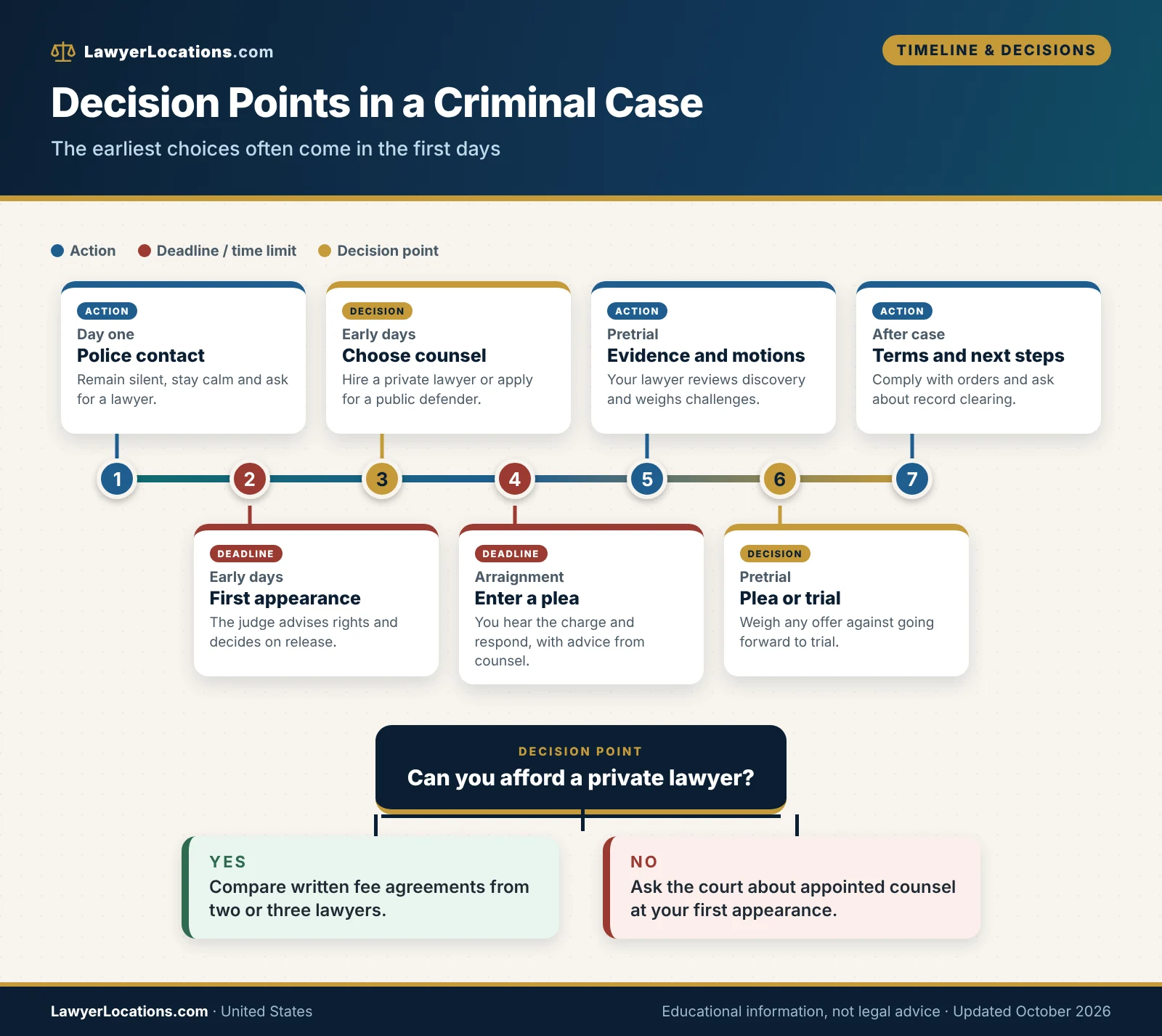
Text version of this graphic
- Police contact or arrest. Stay calm, remain silent and ask for a lawyer.
- First appearance. The judge advises you of rights and decides on release.
- Counsel decision. Hire a private lawyer or apply for a public defender.
- Arraignment. You hear the formal charge and enter a plea.
- Evidence review and motions. Your lawyer reviews discovery and considers challenges.
- Negotiation or trial. You weigh a plea offer against going to trial.
- Sentencing and aftermath. Court conditions, appeals and record-clearing options.
Decision point: can you afford private counsel? If yes, compare written fee agreements. If no, apply for appointed counsel at your first appearance or sooner.
A stage-by-stage view
| Stage | What happens | Your main decision |
|---|---|---|
| Police contact or arrest | Questioning, search requests or custody. | Whether to speak; say you want to remain silent and want a lawyer. |
| First appearance and bail | The judge states the charge, explains rights and decides on release. | Request appointed counsel if you cannot afford a lawyer; present release information. |
| Consultation and hiring | You meet one or more lawyers or apply for a public defender. | Choose counsel; sign a written fee agreement only after you understand it. |
| Arraignment | The charge is read and a plea is entered. | Plea, with advice from counsel. |
| Discovery and motions | The defense reviews the prosecution’s evidence and may challenge it. | Which issues to raise. |
| Plea talks or trial | The prosecutor may offer a deal; otherwise the case proceeds to a hearing or trial. | Accept an offer or go forward. |
| Sentencing and later options | The court imposes terms; appeals or record-clearing may be possible. | Compliance and next steps; see our expungement lawyer guide. |
How costs are spread across the stages
Costs usually arrive in layers. The lawyer’s fee comes first, followed by possible bail or bond costs, court fines and fees if the case ends in a conviction, and consequences that carry a financial cost, such as lost work. The details differ by state and charge type, so ask for an itemized estimate and ask which outside costs are not in the quote.
For more on how criminal fees compare across charge types, you can also read our guide to finding a drug crime lawyer in Atlanta, GA or our Idaho criminal defense lawyer guide for a state-specific view.
Common Mistakes, Red Flags and Next Steps
Most avoidable problems in criminal cases come from waiting, talking or signing too fast. A calm, organized approach tends to work better than a rushed one.
Mistakes people make after contact with police
These are patterns lawyers commonly describe; they are not unique to any state.
Waiting too long to get advice
Delay can cost you options, from release conditions to evidence that disappears. If you are arrested, charged or told you are under investigation, schedule a consultation quickly, and apply for a public defender if you cannot pay.
Talking, posting and contacting witnesses
Explaining your side to police, friends or the public can create statements that are used against you. Contacting a complaining witness or posting about the case can also violate release conditions or be seen as pressure. Let your lawyer handle communication about the case.
A simple plan for the next 24 to 72 hours
If you are searching for a criminal defense lawyer free consultation, here is a straightforward order of steps. Adjust it for your court and custody status.
Step by step
- Protect your position. Stay calm, remain silent about the facts and ask for a lawyer.
- Write down dates. Record every court date, release condition and deadline in one place.
- Contact two or three lawyers. Ask whether the first meeting is free and how long it lasts.
- Apply for appointed counsel if needed. Ask the court or the public defender’s office about eligibility.
- Compare in writing. Review fee agreements side by side before paying.
- Follow every court order. Attend every hearing and comply with conditions.
Ready to compare your options?
Use this guide’s questions to hold a criminal defense lawyer free consultation with two or three lawyers licensed in your state, and compare their written fee terms. LawyerLocations.com is an educational resource and directory, not a law firm, and does not promise results. If you cannot afford a lawyer, ask the court about appointed counsel. For record-clearing questions after a case ends, see our expungement lawyer guide.
Quick answers to common questions
These short answers cover questions people often ask before and after a first call. They are general information, and your state’s rules control.
About the consultation
Is a criminal defense lawyer free consultation really free?
Often, but not always. The FTC says the first meeting is often free and advises you to ask before you meet whether you will be charged for the lawyer’s time. Confirm the cost and length when you book.
Is what I say in a consultation confidential if I don’t hire the lawyer?
Generally yes. Rules like Model Rule 1.18, as adopted in states such as Washington, bar lawyers from using or revealing a prospective client’s information even if no relationship follows, with listed exceptions. Protections vary by state and by how you communicate.
About police, bail and cost
What should I say if police want to question me?
Say clearly, “I am going to remain silent. I want a lawyer,” and then stop talking about the matter. Courts have required a clear invocation, as in Berghuis v. Thompkins and Davis v. United States.
Can I get a public defender?
If you cannot afford a lawyer and face the possibility of jail, you likely have a right to appointed counsel. Eligibility rules and application fees differ by state and court.
Can a criminal defense lawyer work on contingency?
Under ABA Model Rule 1.5(d)(2), a lawyer may not charge a contingent fee for representing a defendant in a criminal case. Confirm your state’s rule.
Sources & References
Show all 31 sources
- Gideon v. Wainwright, 372 U.S. 335 (1963) — Justia, U.S. Supreme Court Center — supreme.justia.com — accessed October 2026.
- Miranda v. Arizona, 384 U.S. 436 (1966) — Justia — supreme.justia.com — accessed October 2026.
- Berghuis v. Thompkins, 560 U.S. 370 (2010) — Justia — supreme.justia.com — accessed October 2026.
- Davis v. United States, 512 U.S. 452 (1994) — Justia — supreme.justia.com — accessed October 2026.
- Salinas v. Texas, 570 U.S. 178 (2013) — Justia — supreme.justia.com — accessed October 2026.
- Edwards v. Arizona, 451 U.S. 477 (1981) — Justia — supreme.justia.com — accessed October 2026.
- Schneckloth v. Bustamonte, 412 U.S. 218 (1973) — Justia — supreme.justia.com — accessed October 2026.
- Padilla v. Kentucky, 559 U.S. 356 (2010) — Justia — supreme.justia.com — accessed October 2026.
- Alabama v. Shelton, 535 U.S. 654 (2002) — Legal Information Institute, Cornell Law School — law.cornell.edu — accessed October 2026.
- Rothgery v. Gillespie County, 554 U.S. 191 (2008) (slip opinion, No. 07-440) — Supreme Court of the United States via SCOTUSblog — scotusblog.com — accessed October 2026.
- County of Riverside v. McLaughlin, 500 U.S. 44 (1991) — Justia — supreme.justia.com — accessed October 2026.
- 18 U.S.C. § 3006A, Adequate representation of defendants — Legal Information Institute — law.cornell.edu — accessed October 2026.
- 18 U.S.C. § 3142, Release or detention of a defendant pending trial — Legal Information Institute — law.cornell.edu — accessed October 2026.
- 18 U.S.C. § 1001, Statements or entries generally — Legal Information Institute — law.cornell.edu — accessed October 2026.
- Federal Rule of Criminal Procedure 5, Initial Appearance — Legal Information Institute — law.cornell.edu — accessed October 2026.
- Federal Rule of Criminal Procedure 10, Arraignment — Legal Information Institute — law.cornell.edu — accessed October 2026.
- Federal Rule of Criminal Procedure 46, Release from Custody; Supervising Detention — Legal Information Institute — law.cornell.edu — accessed October 2026.
- 28 CFR § 540.102, Monitoring of inmate telephone calls — Legal Information Institute — law.cornell.edu — accessed October 2026.
- Model Rule 1.5, Fees, and Comment — American Bar Association — americanbar.org — accessed October 2026.
- Model Rule 1.7, Comment [23] — American Bar Association — americanbar.org — accessed October 2026.
- RPC 1.18, Duties to Prospective Client (Washington version) — Washington Courts — courts.wa.gov — accessed October 2026.
- “Prospective clients” (Bar Counsel column), Oregon State Bar Bulletin, June 2005 — Oregon State Bar — osbar.org — accessed October 2026.
- Attorney-client privilege — Wex, Legal Information Institute — law.cornell.edu — accessed October 2026.
- Hiring a Lawyer — Federal Trade Commission (Consumer Advice) — consumer.ftc.gov — accessed October 2026.
- Hiring an Attorney — Illinois Legal Aid Online — illinoislegalaid.org — accessed October 2026.
- Know Your Rights: Stopped by Police — American Civil Liberties Union — aclu.org — accessed October 2026.
- Defender Services — United States Courts — uscourts.gov — accessed October 2026.
- Fla. Stat. § 27.52, Determination of indigent status — Florida Legislature — leg.state.fl.us — accessed October 2026.
- RCW 10.101.010, Definitions — Washington State Legislature — app.leg.wa.gov — accessed October 2026.
- N.Y. County Law § 722, Plan for representation of persons accused of crime — New York State Senate — nysenate.gov — accessed October 2026.
- Texas Code of Criminal Procedure art. 26.04 and art. 1.051 — Public.Law (unofficial mirror of Texas statutes; confirm against the official Texas Statutes site) — texas.public.law — accessed October 2026.
General information only. This article is educational and is not legal advice. Reading it does not create an attorney-client relationship with LawyerLocations.com or with any lawyer. Laws, court rules and fees change and differ by state and county, so consult a lawyer licensed in the relevant jurisdiction about your situation. LawyerLocations.com is not a law firm and does not promise any outcome.
Legal Disclaimer and Limitation of Liability
Informational and illustrative purposes only. This article was prepared by LawyerLocations.com solely on the basis of the information available to us at the time of writing. It is an illustrative, general overview. It is not a complete or authoritative statement of the law, and it has not been reviewed by a lawyer licensed in your state or county.
Not legal advice. Nothing in this article is legal, financial, tax or immigration advice, and reading it does not create an attorney-client relationship between you and LawyerLocations.com or any author, lawyer or firm mentioned. Laws, court rules, fees, filing deadlines and agency procedures differ by state, county and court, and they change often. Some details here may be simplified, incomplete or out of date, and time limits for legal claims can be short.
No warranty. We make no representation or warranty, express or implied, about the accuracy, completeness, timeliness or suitability of this content for your situation. Please do not rely on it to make, delay or skip any legal decision. Check the facts against official sources and speak with a licensed attorney in the relevant jurisdiction before you act.
Limitation of liability. To the fullest extent permitted by law, LawyerLocations.com and its owners, authors and contributors disclaim all liability for any loss, damage, cost or other consequence arising from the use of, or reliance on, this article, including any content on third-party websites we link to. Mentioning a lawyer, firm, organization or service is not an endorsement and is not a promise of any result. If you are in immediate danger, contact your local emergency number.