

Do I need a workers comp lawyer? Not always. Many straightforward claims are accepted and paid without one, but a lawyer is worth a consultation when your claim is denied, payments stop, the insurer disputes your doctor or your restrictions, or you are offered a settlement. Workers’ compensation in the United States is mostly a state-by-state system, with separate federal programs for federal employees and certain other workers, so deadlines and fee rules depend on where you work.
This guide explains the signs that your claim needs legal help, how a workers’ compensation attorney’s role fits into each stage, what lawyers may charge under state and federal rules, and how to compare your options. It is general education, not legal advice, and it does not recommend any firm.
Do You Need a Workers’ Comp Lawyer? A Plain-English Answer
A lawyer is not required to file or receive workers’ compensation benefits, and plenty of injured workers never hire one. The better question is whether your claim is running smoothly or showing trouble, because trouble is when legal help tends to matter.
When you may not need a lawyer
If the injury was reported promptly, your employer’s insurer accepted the claim, your treatment is approved, and your wage payments arrive on time, you may be able to handle the paperwork yourself. State agencies publish claim forms and plain-language guides, and many run free help lines or ombudsman programs for injured workers. You can still hire a lawyer later if something changes.
Claims that often move without a dispute
Short, clearly documented injuries are the best candidates for going it alone. Think of a sprain or cut with a witnessed accident, a prompt report, a treating doctor who releases you to full duty in a few weeks, and no disagreement about what happened. In those cases the insurer has little reason to fight, and the main job is staying organized.
Even then, keep your own paper trail. Save every letter, appointment slip, work-status note and pay stub, and write down dates as they happen.
Free and low-cost help that already exists
Most states run an agency that helps unrepresented workers understand the process. California points injured workers to the Division of Workers’ Compensation Information and Assistance Unit and a live help line, and New York offers an Office of the Advocate for Injured Workers and a customer service line through its Workers’ Compensation Board. Look for the equivalent office in your state.
These offices can explain forms and deadlines. They generally cannot act as your personal lawyer, so they are a starting point rather than a substitute when a claim turns adversarial.
Reading about the system before you need it costs nothing. If your claim is accepted today, save your documents anyway, because insurers sometimes dispute claims months later when a treatment bill or surgery request arrives.
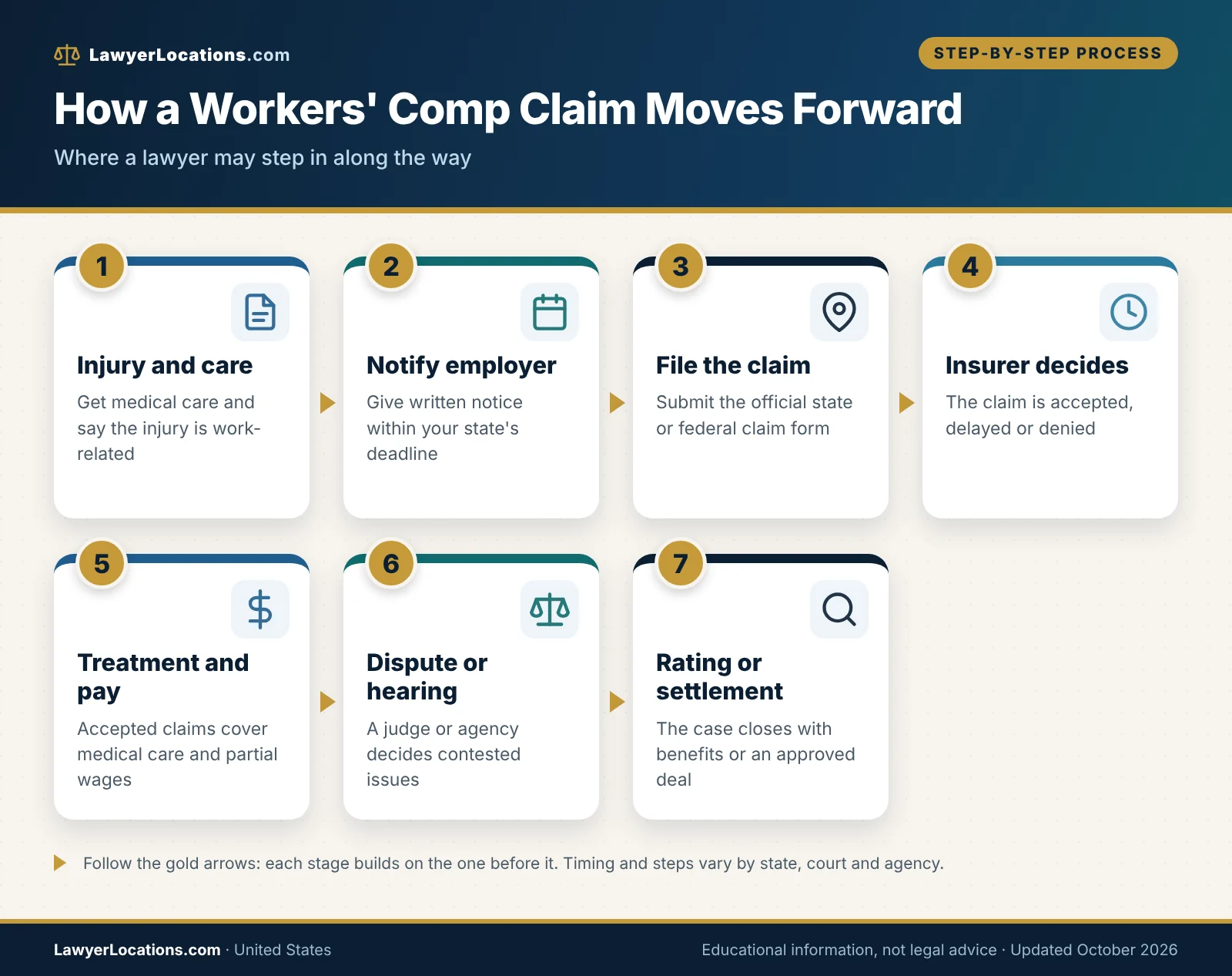
Text version of this graphic
- Injury happens and you get care. Get medical attention and tell the provider the injury is work-related.
- Report to your employer. Give written notice within your state’s deadline.
- File the claim form. Use your state agency’s form or the federal form if you are a federal employee.
- Insurer investigates. The carrier accepts, delays or denies the claim.
- Treatment and wage benefits. Accepted claims pay medical bills and partial wages.
- Dispute or hearing. If benefits are denied or cut, a judge or agency decides.
- Permanent rating or settlement. The case ends with a rating, benefits or an approved settlement.
When a consultation is worth your time
A consultation is a fact-finding meeting, not a commitment. In many places lawyers who take injury claims on a percentage basis offer an initial meeting without a fee, though that varies by firm and you should confirm it before you go. The meeting is a low-cost way to learn whether your situation is routine or risky.
Questions a short consultation can answer
You can learn whether your deadlines are still open, whether the insurer’s reason for denial is common and fixable, and whether your state limits what a lawyer may charge. You can also ask what the lawyer would do first and what evidence is missing.
That information holds value even if you decide not to hire anyone. Many people leave a consultation knowing which forms to file and which deadline to protect.
The cost of waiting too long
Workers’ compensation deadlines tend to be short and unforgiving. A late notice to your employer or a late claim form can end a claim that would otherwise have been valid, and some systems allow very little room for excuses.
If you are within days of a deadline or already past one, speak to a licensed lawyer in your state quickly. A lawyer can tell you whether an exception, such as late discovery of an occupational illness, might apply.
Several states require notice to your employer within 30 days of the injury, and California warns that failing to report within 30 days could cost you benefits. New York requires notice within 30 days and a claim filed within two years. Your state may differ, so confirm it with your state agency.
Warning Signs That Your Claim Needs Legal Help
The clearest signs are a denial, a sudden stop in payments, a fight over your medical care, or a settlement offer you do not fully understand. Each has a different level of urgency, which the table below sorts out.
Problems with the claim itself
The first group of warning signs concerns whether your claim is accepted at all. If the insurer is not treating the injury as covered, you are in a dispute, and disputes follow formal rules with deadlines.
A denial or a “controverted” claim
A denial means the insurer has decided not to pay. In New York, for instance, an insurer that wants to contest a claim must notify the worker and file a notice of controversy with the Board, giving its reasons for not paying. Other states use different names, but the idea is the same: the insurer is on record disputing something.
Read the stated reason closely. Common reasons include missed notice, a claim that the injury did not happen at work, and a claim that a pre-existing condition is the true cause. Each reason points to different evidence, and some are answered by a witness, a medical opinion or a time record.
Delays, missing checks and silence
Some claims are never formally denied but simply stall. You may wait weeks for a decision, receive no explanation for missing wage checks, or find calls and emails unanswered. Delay can pressure a worker into returning too early or accepting less.
Write down the dates you reported the injury, the dates you asked about payment, and who you spoke with. Many state agencies take complaints about late payments, and a lawyer can often raise the delay with the agency or judge on the record.
Disputes about how the injury happened
Insurers sometimes argue that an injury occurred off the job, that you were not acting within the scope of your work, or that you were an independent contractor rather than an employee. Worker classification is a frequent trouble spot for gig, delivery and construction workers.
These disputes turn on facts and legal definitions that vary by state. They are among the situations where early legal advice is most useful, since the first statements you give can shape the file for years.
Be careful about giving a recorded statement to an adjuster without understanding what it will be used for. You can ask for the questions in writing and for time to think. If the claim is already contested, speak with a lawyer before you give a detailed statement.
Problems with medical care and benefits
Even an accepted claim can run into trouble when the insurer limits treatment, questions your restrictions, or reduces payments. These disputes are common and often technical.
Treatment is delayed, limited or switched
Many systems let the insurer or employer influence which doctor you see, require pre-approval for certain care, or review treatment requests through a utilization process. Surgery, physical therapy, injections and diagnostic imaging are frequent flashpoints.
If a treating doctor recommends care and the insurer refuses, there is usually a formal way to challenge that refusal, and the deadline can be short. Ask your doctor to document why the treatment is medically necessary and keep a copy of every denial letter.
An insurer-arranged medical exam goes against you
Insurers can often require you to attend an independent or insurer-requested medical examination. The word “independent” can mislead, since the insurer chooses and pays the examiner. The report may say you are healed, can work, or that a pre-existing condition explains your symptoms.
A report like that can lead to benefit cuts. If you receive one that conflicts with your own doctor, that is a strong sign to get advice on how your state resolves medical disagreements.
Return-to-work and light-duty conflicts
Employers may offer modified or light-duty work. Refusing a genuine offer within your restrictions can sometimes affect wage benefits, while accepting a job beyond your restrictions can risk reinjury. Neither choice is simple, and rules differ across states.
Keep the written restrictions from your doctor, and compare them with the written job offer. If the two do not match, get the mismatch in writing before you accept or decline and ask for guidance on how your state treats the situation.
A warehouse worker hurts a shoulder. The insurer accepts the claim and pays for therapy. Three months later, an insurer-selected examiner writes that the shoulder has healed, and wage payments stop. The worker’s own surgeon still recommends surgery. This is a classic point for a consultation, because there are now two medical opinions and a stopped payment.
Settlement, permanent injury and special situations
The highest-stakes decisions come when a case moves toward permanent disability ratings or a lump-sum settlement. Some situations also fall outside the standard state system.
Permanent impairment and disability ratings
If a doctor says you have reached maximum improvement but still have lasting limits, the system usually assigns a rating or classification that affects benefits. Different states use different guides and formulas, and a few points in a rating can change the value of a claim.
This is a technical area. Ask how the rating was calculated, whether your own doctor agrees, and whether your state allows a second opinion or dispute process.
Settlement offers and what you may give up
A lump-sum settlement can close parts of a claim, sometimes including future medical care, depending on state law and the terms. Once approved, it can be very hard to reopen. Settlements may also interact with Medicare, Social Security disability benefits and other coverage.
Do not sign a settlement you do not understand. A short consultation before signing can help you see what the document gives up and whether the money matches the long-term picture.
Federal employees, maritime and other special programs
Federal civilian employees file under the Federal Employees’ Compensation Act, administered by the Department of Labor’s Office of Workers’ Compensation Programs (OWCP). The law sets a claim window of 3 years under 5 U.S.C. § 8122, with exceptions such as actual knowledge by a supervisor within 30 days or latent disability. Other federal programs exist for certain harbor, maritime and mine workers, and each has its own rules.
If your employer or job type is unusual, confirm which system covers you before relying on general advice. The rest of this guide notes where federal rules differ.
| Warning sign | Why it matters | Urgency | Sensible first move |
|---|---|---|---|
| Written denial or notice of controversy | The insurer has formally disputed the claim, and appeal clocks may be running | High | Read the reason, note the date, and consult a licensed lawyer or the state agency right away |
| Wage payments stop without explanation | May reflect a medical report, a return-to-work claim, or a paperwork error | High | Ask in writing why, then contact the agency or a lawyer if you receive no clear answer |
| Treatment request refused | Delays care and may be challenged through a formal review process | Medium to high | Ask your doctor to document medical necessity and keep the refusal letter |
| Insurer-arranged exam contradicts your doctor | Can be used to cut benefits or close the claim | High | Request a copy of the report and compare it with your own doctor’s notes |
| Settlement offer received | May permanently close medical or wage benefits | High before signing | Do not sign until you understand each term; consider a consultation |
| Employer pressure not to file | Reporting protections and retaliation rules may apply | High | Report in writing, keep copies, and ask about anti-retaliation rules in your state |
| Claim accepted and paid on time | Little dispute today, though things can change | Low | Keep records and watch for changes in tone or payments |
How a Workers’ Compensation Attorney Case Works
A workers’ compensation case moves from injury and reporting to a claim decision, then to treatment, and sometimes to a hearing or settlement. A lawyer can step in at any of these points, and what the lawyer does depends on where the claim stands.
The stages of a typical claim
The details change by state, but the arc is similar nearly everywhere. Understanding it helps you see where problems usually appear and where help can shift the outcome.
Reporting the injury and filing the claim
Most systems separate two steps: telling your employer about the injury, and filing a formal claim with the agency or insurer. In New York, the Workers’ Compensation Board states that you must notify your employer within 30 days and that Form C-3 must be filed within two years of the accident, or two years after you knew or should have known of a work-related illness. You can read the Board’s file a claim page for the current language.
Other states set different numbers. Because notice and filing deadlines can be as short as a few weeks, report in writing as soon as you can and keep a copy.
Denials, hearings and appeals
If the insurer contests the claim, the dispute typically goes before an administrative judge, hearing officer or board. The worker presents medical evidence and testimony, the insurer presents its own, and a written decision follows. Further appeals go to an appeals board and sometimes to state courts.
Procedures, names and time limits differ widely. This is where a lawyer’s knowledge of local forms and judges can matter, and where unrepresented workers most often feel out of their depth.
Workers’ compensation is a no-fault insurance system. Injured workers receive medical care and partial wage replacement without proving employer fault, and in exchange they generally cannot sue the employer for ordinary negligence.
What a workers’ compensation attorney actually does
People often picture a courtroom, but much of a lawyer’s work is paperwork, evidence and negotiation. Knowing the real tasks helps you judge whether the help justifies the fee.
Building the record and handling the insurer
A lawyer can collect medical records, request witness statements, organize wage proof and prepare you for questioning. The lawyer also becomes the point of contact, so the adjuster talks to counsel rather than catching you off guard. That shift alone can reduce stress for some workers.
Where a claim is contested, the lawyer prepares the legal argument for why the injury is work-related and why the benefits are owed. In New York, for example, an attorney may file a Request for Further Action by Legal Counsel (Form RFA-1LC) on a worker’s behalf.
Evaluating and negotiating a settlement
When settlement is on the table, a lawyer can compare the offer with the likely value of remaining wage benefits, permanent disability benefits and future medical care. The lawyer can also explain how a lump sum interacts with other benefits you may receive.
Lawyers cannot promise a result, and a good one will say so. What they can do is explain trade-offs, flag missing information and help you decide whether to accept, counter or keep litigating.
A lawyer is not the only person who can help. Many state agencies run ombudsman or information programs, and union representatives and some legal aid offices assist injured workers. Use them alongside, or instead of, a private lawyer when the dispute is simple.
| Jurisdiction | Notice or claim deadline (verified examples) | Attorney fee rule (verified examples) |
|---|---|---|
| Federal employees (FECA) | Claim within 3 years of injury or death, with exceptions (5 U.S.C. § 8122) | Fee must be approved by the Department of Labor; contingency fees are not allowed (20 CFR § 10.702) |
| New York | Notify employer within 30 days; file Form C-3 within 2 years | Check the Board’s rules for approval of legal fees before agreeing to terms |
| California | Report injury within 30 days or risk losing benefits, per the state’s DWC page | Ask the Division of Workers’ Compensation how fees are approved before you sign |
| Texas | Confirm current notice and claim deadlines with the state’s Division of Workers’ Compensation | Capped at 25% of each weekly income benefit payment, with agency approval (28 TAC § 152.1) |
| Illinois | Confirm current deadlines with the Illinois Workers’ Compensation Commission | Capped at 20% of compensation recovered; no fee on undisputed medical expenses (820 ILCS 305/16a) |
| Florida | Confirm current deadlines with the state’s Division of Workers’ Compensation | Tiered: 20% of first $5,000, 15% of next $5,000, 10% of the rest for benefits in the first 10 years, then 5% (Fla. Stat. § 440.34) |
How to Compare Workers’ Compensation Attorneys
Compare lawyers on how much of their practice is workers’ compensation in your state, how clearly they explain fees, how they communicate, and what they say about your risks. Avoid anyone who promises a result or pushes you to sign on the first call.
What to look for before you hire
Workers’ compensation is its own corner of the law, with forms, medical standards and hearing practice that differ from other injury work. A lawyer who handles personal injury or other civil cases may or may not work regularly in this system.
Experience in your state’s system
Ask how many workers’ compensation claims the lawyer handles in your state’s system and how often they appear before the agency or judges that would hear your case. If your case could also involve a lawsuit against a third party, ask whether the lawyer handles both or would bring in colleagues. Our guide on whether you need a lawyer after a car accident covers how an injury claim outside the comp system works.
You can check a lawyer’s license and discipline record on the state bar’s website. Verify the license yourself, and treat advertising claims with healthy skepticism.
Communication, staffing and expectations
Ask who will actually work on your file, how updates are delivered and how quickly questions are usually answered. A firm that routes you to a paralegal for everything may be fine, as long as you know that up front and can reach a lawyer for decisions.
Listen for how the lawyer talks about outcomes. A careful lawyer explains ranges of possibilities and what could go wrong. One who promises you a big payout in the first meeting is a warning sign, not a comfort.
Be wary of anyone who asks for a large upfront fee in a system where fees are normally taken from benefits, who will not put the fee agreement in writing, or who contacts you uninvited right after your injury. Never sign a blank or incomplete agreement.
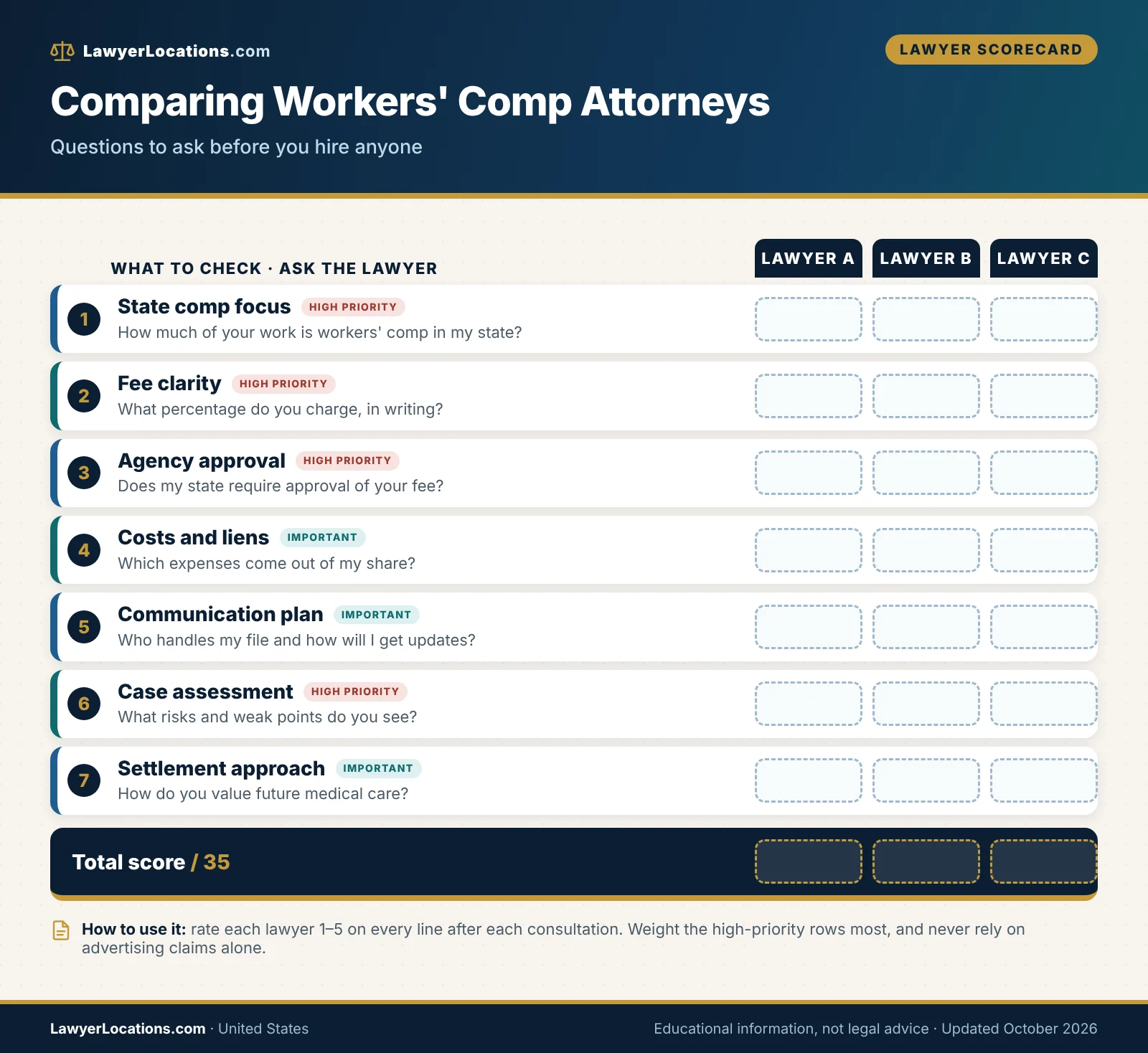
Text version of this graphic
- Workers’ comp focus: How much of your practice involves state workers’ compensation claims?
- Fee clarity: What percentage will you charge, and what costs come out of my share?
- Agency approval: Does my state require approval of your fee?
- Communication plan: Who handles my file and how will you update me?
- Case assessment: What are the main risks and weak points you see?
- Settlement approach: How do you evaluate offers and future medical care?
- Third-party claims: Do you handle related injury lawsuits, or refer them?
Preparing for a consultation
A prepared client gets more out of a short meeting. Bring facts, documents and questions, and expect the lawyer to ask hard questions back.
Documents and facts to bring
Bring anything that shows what happened and what has followed. A simple folder or a phone album of photos is enough to start.
- Your written notice to the employer and any claim form you filed
- Letters, emails and texts from the insurer or employer, including denials
- Medical records, work-status notes and restrictions from your doctors
- Pay stubs showing your average earnings before the injury
- A short timeline of the accident, symptoms and each person you told
- Names of witnesses and any photos of the scene or equipment
Questions that protect you
Ask what the lawyer thinks the key issue is, what happens next, what you should avoid doing, and how the fee works in your state. Our guide to free consultations with a lawyer explains how these first meetings generally work in another practice area, and many of the same questions apply here.
Take notes and do not feel pressured to decide on the spot. A reasonable lawyer will give you time to read the agreement, and one who will not is telling you something.
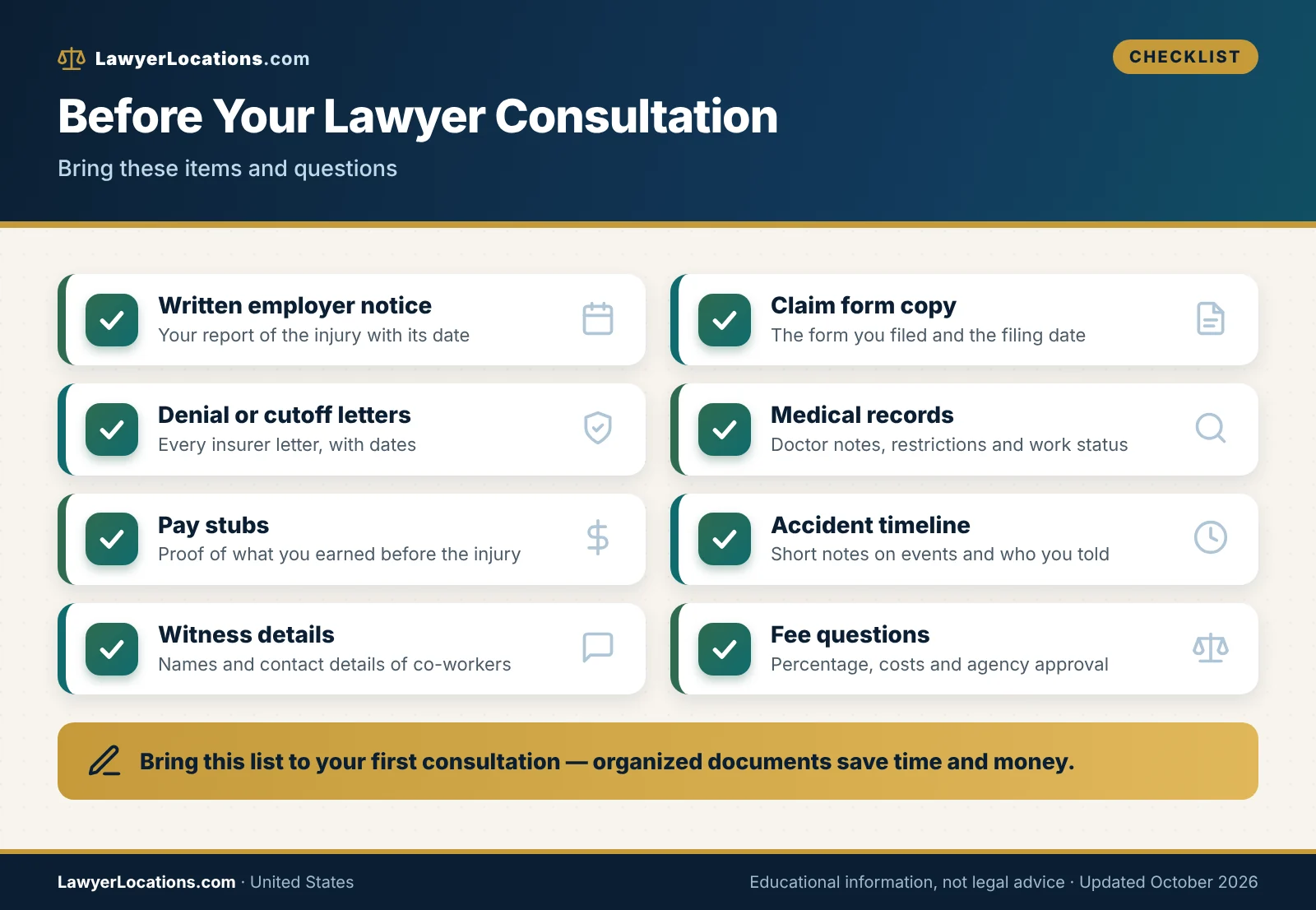
Text version of this graphic
- Written notice to employer
- Claim form and filing date
- Denial or cutoff letters
- Medical records and restrictions
- Pay stubs and wage proof
- Accident timeline and witnesses
- Questions about fees and approval
- Lawyer license check
| Option | Best suited when | Limits to keep in mind | How it is usually paid |
|---|---|---|---|
| Handle it yourself with agency help | The claim is accepted, treatment is approved and payments are on time | Agency staff cannot act as your personal lawyer or argue your case | No cost beyond your own time |
| Union rep, legal aid or advocacy program | You are eligible and the dispute is manageable | Eligibility and capacity vary; some programs do not take every case | Usually free or low cost |
| Private workers’ compensation attorney | Denial, stopped benefits, disputed care, permanent injury or settlement | Fees reduce what you keep; quality and fit vary by lawyer | Often a percentage of benefits recovered, regulated by your state |
What a Workers’ Comp Lawyer Costs: Fee Rules and Examples
In most workers’ compensation systems a lawyer is paid a percentage of the benefits recovered, and the percentage is limited or approved by the state. Federal employee claims work differently: the Department of Labor does not allow contingency fees.
How lawyer fees usually work
Because workers’ compensation benefits are set by statute, many states regulate attorney fees more tightly than they do in ordinary injury lawsuits. That regulation exists to protect injured workers from losing too much of modest weekly benefits.
Percentage fees, caps and approval
A contingency fee means the lawyer is paid only if benefits are recovered, and the payment comes out of those benefits. Caps and approval rules vary, which is why you should always ask about your state’s rule before signing.
In Texas, the rule at 28 TAC § 152.1 limits an approved fee to 25% of each weekly income benefit payment and requires agency approval of the amount. Illinois law at 820 ILCS 305/16a limits fees to 20% of compensation recovered and paid, requires the fee contract to be on prescribed forms approved by the Commission, and bars fees on compensation for undisputed medical expenses.
Fees versus costs
A fee pays the lawyer for time and skill. Costs are out-of-pocket expenses such as records fees, medical report charges, deposition transcripts and expert opinions. Ask whether costs are deducted before or after the fee is calculated and whether you owe them if the claim fails.
Request an itemized statement at the end of the case so you see exactly what was deducted from your recovery.
Florida uses a sliding scale: 20% of the first $5,000, 15% of the next $5,000, 10% of the remainder for benefits provided in the first 10 years, and 5% of benefits secured after 10 years, under Fla. Stat. § 440.34. The judge of compensation claims must approve fees, and a judge is not required to approve any retainer agreement.
Special rules and cost questions
Fee rules are not identical for every worker or every kind of claim. A few patterns repay attention before you agree to terms.
Federal employees and hourly arrangements
Under 20 CFR § 10.702, a representative in a federal claim may charge a fee, but the fee must be approved by the Secretary of Labor before it can be collected, and contingency fees are not allowed in any form. The claimant is solely responsible for the fee, which OWCP does not reimburse. The fee application must include an itemized statement of hours worked and the hourly rate, and the rules treat collection of an unapproved fee as a possible misdemeanor.
If you are a federal worker, ask any lawyer how they bill and whether they have handled FECA claims. The regulation is available on eCFR.
Third-party lawsuits are a separate fee question
If someone other than your employer caused the injury, such as a negligent driver or a defective-equipment maker, you may have a separate injury claim with its own fee arrangement and deadline. Our overview of personal injury filing deadlines explains why those clocks matter. The comp insurer may also claim reimbursement from a third-party recovery, so ask how that would be handled.
Make sure any agreement states which claim it covers, because a comp fee agreement and a personal injury agreement are different contracts.
| Question | What a clear answer sounds like | Why it matters |
|---|---|---|
| What percentage will you charge? | A specific figure within your state’s cap, put in writing | Fee caps and approval rules differ by state |
| Does the agency or judge approve the fee? | Yes or no, with the rule explained | Approval limits surprises and gives you a place to complain |
| What expenses will I owe? | A list of typical costs and who advances them | Costs can reduce your net recovery |
| Is the fee taken from medical benefits? | An explanation tied to your state’s rule | Some states bar fees on undisputed medical expenses |
| What happens if I end the relationship? | A written explanation of how earned fees are handled | You want a clear exit if the fit is poor |
Questions to ask about money
A few extra questions protect you from surprises, whether you hire a lawyer or only talk with one.
Will I owe anything if I lose?
Under percentage arrangements the lawyer’s fee is usually paid only from benefits recovered, but costs may be handled differently. Ask for the answer in writing.
If an agreement is unclear on this point, ask the lawyer to revise it before you sign.
How are settlements and liens handled?
If you settle, ask who calculates what is owed to medical providers, health insurers or government programs. Some benefits create reimbursement claims that reduce the net amount you receive.
Ask for a written settlement statement showing the gross amount, the fee, costs, liens and your net figure.
Deadlines, Costs and Decision Points in a Workers’ Comp Claim
Three clocks tend to run at once: the deadline to tell your employer, the deadline to file the claim, and the deadline to challenge a decision. Missing the first or second can end a claim, so they set the pace for deciding whether to hire a lawyer.
The clocks that matter most
Because the numbers vary, the safest habit is to find your state’s own deadlines on the official agency website on the day you are hurt, and write them on your calendar.
Notice to your employer
Many states set a short window to report a work injury, and some measure from the date you knew or should have known the condition was work-related. California’s Division of Workers’ Compensation says that if you do not report your injury within 30 days, you could lose your right to benefits. New York likewise requires notice within 30 days.
Give notice in writing, keep a dated copy, and ask a supervisor to acknowledge it. A text or email works as a record if your employer has no form.
Filing the claim and challenging a decision
The claim form deadline is usually longer than the notice deadline, but it is just as firm. New York gives two years for Form C-3, and the federal system gives employees three years under 5 U.S.C. § 8122, with exceptions for cases where a supervisor had actual knowledge within 30 days, written notice was given within 30 days, or a latent disability develops later. You can read the statute on Cornell’s Legal Information Institute.
Deadlines to appeal a denial or request a hearing are often much shorter and are printed on the denial letter or agency notice. Read the fine print the day it arrives.
Do not wait for a denial letter before checking your deadlines. A late notice is one of the easiest reasons for an insurer to deny a claim, and it is often the hardest to fix. If you are unsure whether a deadline has passed, ask a licensed lawyer or your state agency now, not after the next appointment.
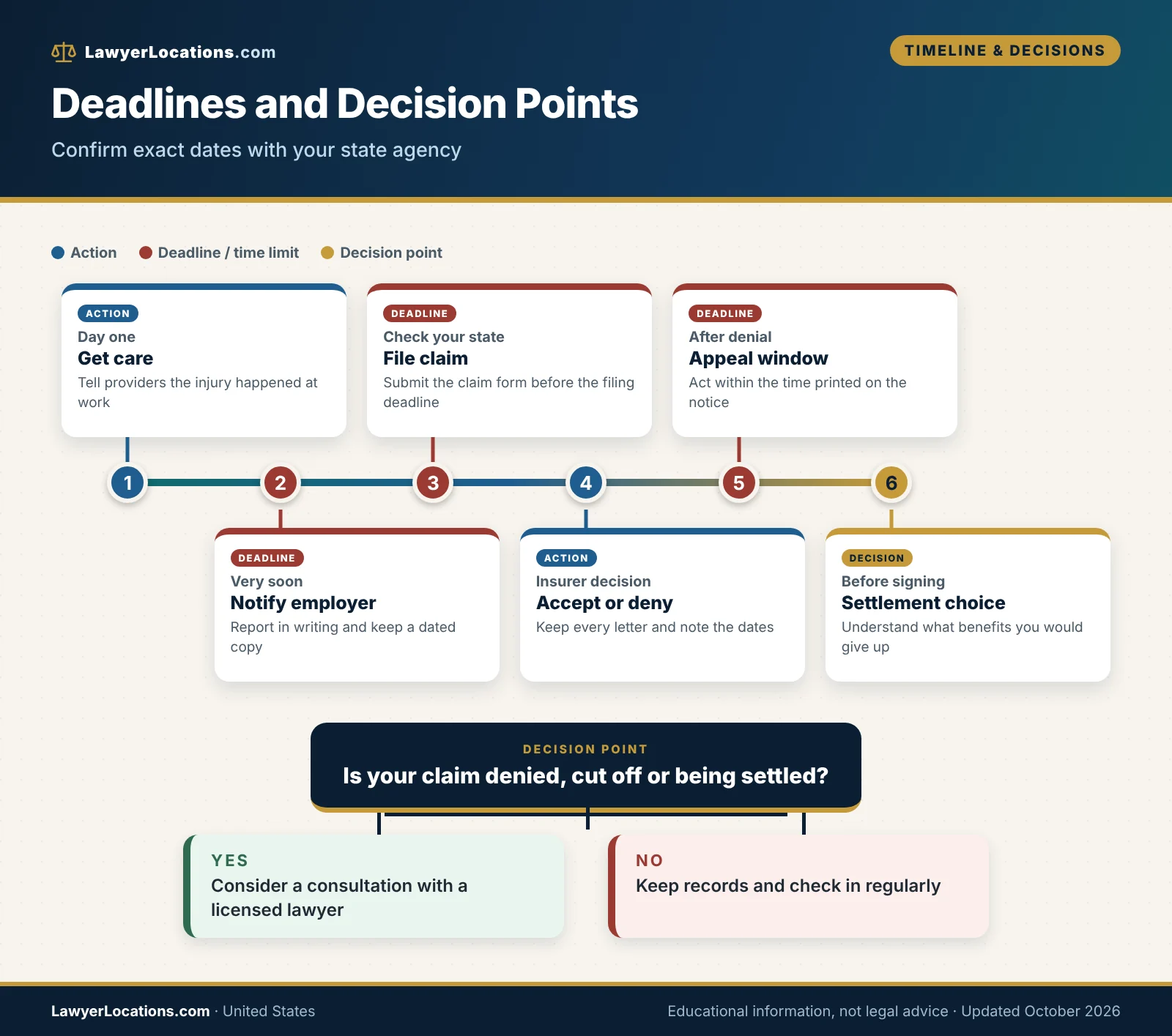
Text version of this graphic
- Day of injury (action): Get care and tell your doctor the injury is work-related.
- Within days (deadline): Give written notice to your employer.
- Within weeks to months (deadline): File the claim form with your state agency or the federal program.
- Insurer decision (action): Accepted, delayed or denied; keep every letter.
- Dispute period (deadline): Act within the time printed on any denial or notice.
- Settlement or rating (decision): Decide whether to accept after understanding what you give up.
Decision point: Is the claim denied, cut off, disputed or being settled? If yes, consider a consultation with a licensed lawyer. If no, keep records and check in regularly.
Decision points: when to hire and when to wait
Think of the claim as a series of decision points. At each one, ask whether the stakes and the risk of a mistake justify paying for help.
Signals that favor hiring now
Hire or consult soon if the claim is denied, you cannot work for an extended period, you have a permanent injury, a deadline is near, or you are being asked to sign a settlement or give a recorded statement. Complex facts, such as an occupational disease, a disputed employment relationship or a third party who caused the accident, also point toward getting advice early.
The earlier a lawyer is involved, the more options may remain open, though early involvement does not guarantee any outcome.
Signals that favor waiting
If your claim is accepted, bills are being paid and you are on track to return to work, you may reasonably wait. Hiring a lawyer at that point could mean paying a percentage on benefits you would have received anyway, and in some states the rules limit what can be charged on undisputed benefits.
Waiting is not the same as ignoring the claim. Keep your records current, attend appointments and watch for changes in the insurer’s tone, payment pattern or medical requests.
Set a calendar reminder for every date in your file: the injury, the notice, the claim filing, and any hearing or appeal date. One missed date costs more than an hour spent organizing.
| Decision point | What to weigh | Reasonable next step |
|---|---|---|
| Right after the injury | Your health, notice deadlines and whether to report | Get care, report in writing and keep a copy |
| Claim form filing | Accuracy of the account and the deadline | Describe the injury plainly and file on time |
| Insurer denies or delays | Stated reason, appeal clock and evidence available | Consult a licensed lawyer or the state agency promptly |
| Disagreement over medical care or work status | Competing medical opinions and wage loss | Gather records and ask how your state resolves medical disputes |
| Settlement offer | Future medical care, permanent limits and other benefits | Do not sign until you understand every term |
| Case closing | Whether benefits remain open, liens and net payment | Request a written breakdown of fees, costs and liens |
Common Mistakes, Next Steps and Your Questions Answered
The most common mistakes are waiting too long, saying too much, and signing too soon. The most useful next steps are to report in writing, document everything and talk with someone who knows your state’s system.
Mistakes that hurt workers’ comp claims
Most claim problems come from small, avoidable choices made in the first weeks. Knowing them ahead of time costs nothing.
Waiting, minimizing and gaps in treatment
Workers sometimes tough it out, delay reporting, or tell a doctor the injury is minor to avoid trouble. Insurers read delays and gaps in treatment as signs that an injury was not serious or not work-related.
- Waiting weeks to report because you hope the pain will pass
- Telling the doctor you hurt yourself at home or while exercising
- Skipping appointments or physical therapy without telling anyone
- Posting activity on social media that could be read as inconsistent with your limits
Be honest, consistent and complete about how and where you were hurt, and follow the treatment plan unless your doctor changes it.
Signing or agreeing too quickly
Adjusters and employers may ask you to sign medical releases, recorded statements or settlement papers soon after an injury. A broad release can give the insurer access to records that have nothing to do with your injury, and a statement taken before you understand your condition can be used against you later.
Ask what a document does, ask for time, and consider advice before you sign anything that closes or limits a benefit.
If anyone at work discourages you from filing, suggests paying medical bills yourself, or hints that reporting could affect your job, take it seriously. Many places have protections against retaliation for filing a claim, and those protections often come with short deadlines. Ask your state agency or a lawyer how they work in your state.
Your next steps
Whether or not you hire a lawyer, a few steps put you in a stronger position. Take them in roughly this order.
A practical sequence to follow
- Get medical care. Tell every provider that the injury happened at work and follow the plan.
- Report in writing. Send your employer a dated note or email describing what happened and keep a copy.
- File the claim form. Use your state’s official form, or the federal process if you are a federal employee.
- Collect and organize records. Keep denials, medical notes, pay stubs and a running timeline.
- Check your deadlines. Confirm notice, claim and appeal dates on your state agency’s website.
- Decide about legal help. If any warning sign in this guide applies, book a consultation and ask about fees.
If you want a sense of how city-level practice differs, see our local guides to workers’ comp lawyers in Los Angeles, workers’ compensation attorneys in New York City and workers’ compensation lawyers in Nashville.
Finding a lawyer licensed in your state
Start with your state bar’s referral service or lawyer directory, which lets you confirm that a lawyer is licensed and in good standing. Local legal aid offices and union representatives can also point you toward help, and some handle cases directly if you qualify.
LawyerLocations.com is an educational resource and is not a law firm or a referral service that vouches for any lawyer. Use this guide to prepare questions, then verify credentials and fee terms yourself.
Ready to compare your options?
If any warning sign above sounds familiar, write down your key dates, gather your documents, and speak with a lawyer licensed in your state about your specific situation. A conversation costs little compared with a missed deadline, and you decide what happens next.
Quick answers to common questions
The questions below come up most often when workers decide whether to get legal help. Answers are general, so check the rules in your state.
Questions about whether you need a lawyer
Can I file for workers’ comp without a lawyer?
Yes. In most systems you can report the injury and file the claim yourself, and state agencies publish forms and guides. A lawyer becomes more useful if the claim is contested or complicated.
Should I hire a lawyer if my claim was denied?
A denial is one of the strongest reasons to get a consultation. Appeal deadlines can be short, and the stated reason for denial often suggests what evidence matters.
Can my employer fire me for filing a claim?
Many states and federal laws protect workers from retaliation for filing a claim, but the rules and deadlines differ. If you suspect retaliation, document what happened and ask your state agency or a lawyer promptly.
Do I need a lawyer to settle my claim?
You are not required to have one, but a settlement can close benefits for good. Many people get advice before signing so they understand future medical care and how the money interacts with other benefits.
Questions about cost, process and timing
How much does a workers’ comp lawyer cost?
Most are paid a percentage of the benefits recovered, and many states cap or approve the percentage. For example, Texas caps an approved fee at 25% of weekly income benefits and Illinois at 20% of compensation recovered. Ask for the figure in writing.
Can a federal employee pay a lawyer a percentage?
No. Under 20 CFR § 10.702, contingency fees are not allowed in federal FECA claims, and any fee must be approved by the Department of Labor before it is collected.
What if I cannot afford a lawyer?
Percentage arrangements mean you usually pay from benefits recovered rather than upfront. You can also ask state agencies, union representatives and legal aid offices about free help.
How soon after an injury should I talk to a lawyer?
There is no single rule, but earlier is better when a claim is denied, a deadline is close, or you are facing a settlement. For minor accepted claims, you can wait and watch.
Can I switch lawyers if I am unhappy?
Usually yes, though the first lawyer may have a claim to fees already earned, and some systems require agency notice or approval. Read your fee agreement and ask the new lawyer how it would be handled.
General information only. This guide is educational and is not legal advice. Reading it does not create an attorney-client relationship, and LawyerLocations.com is not a law firm. Workers’ compensation laws, deadlines, fees and agency procedures change and differ by state and by program, so consult a lawyer licensed in the relevant jurisdiction about your situation.
Sources & References
Show all 8 sources
- 28 Tex. Admin. Code § 152.1, Attorney Fees: General Provisions — Cornell Legal Information Institute (Texas Administrative Code) — law.cornell.edu — accessed October 2026
- 820 ILCS 305/16a, Workers’ Compensation Act, attorney fees — Illinois General Assembly — ilga.gov — accessed October 2026
- Fla. Stat. § 440.34, Attorney fees; costs — Florida Statutes (Public.Law mirror) — florida.public.law — accessed October 2026
- 20 CFR Part 10, Subpart H, Representative Fees and Penalties — Electronic Code of Federal Regulations — ecfr.gov — accessed October 2026
- 5 U.S.C. § 8122, Time for making claim — Cornell Legal Information Institute — law.cornell.edu — accessed October 2026
- File a Claim — New York State Workers’ Compensation Board — wcb.ny.gov — accessed October 2026
- Workers’ Compensation: Understanding the Claims Process — New York State Workers’ Compensation Board — wcb.ny.gov — accessed October 2026
- Information for Injured Workers — California Department of Industrial Relations, Division of Workers’ Compensation — dir.ca.gov — accessed October 2026
Legal Disclaimer and Limitation of Liability
Informational and illustrative purposes only. This article was prepared by LawyerLocations.com solely on the basis of the information available to us at the time of writing. It is an illustrative, general overview. It is not a complete or authoritative statement of the law, and it has not been reviewed by a lawyer licensed in your state or county.
Not legal advice. Nothing in this article is legal, financial, tax or immigration advice, and reading it does not create an attorney-client relationship between you and LawyerLocations.com or any author, lawyer or firm mentioned. Laws, court rules, fees, filing deadlines and agency procedures differ by state, county and court, and they change often. Some details here may be simplified, incomplete or out of date, and time limits for legal claims can be short.
No warranty. We make no representation or warranty, express or implied, about the accuracy, completeness, timeliness or suitability of this content for your situation. Please do not rely on it to make, delay or skip any legal decision. Check the facts against official sources and speak with a licensed attorney in the relevant jurisdiction before you act.
Limitation of liability. To the fullest extent permitted by law, LawyerLocations.com and its owners, authors and contributors disclaim all liability for any loss, damage, cost or other consequence arising from the use of, or reliance on, this article, including any content on third-party websites we link to. Mentioning a lawyer, firm, organization or service is not an endorsement and is not a promise of any result. If you are in immediate danger, contact your local emergency number.