A property dispute lawyer Los Angeles County CA handles conflicts over who owns, controls or owes money on real estate: boundary lines, easements, co-owner fights, quiet title, purchase-contract breaches and neighbor encroachments. These cases are governed by California law and filed in the Superior Court of California, County of Los Angeles, whose local rules generally send real property cases to the courthouse for the district where the property sits.
This guide explains how a property dispute moves through Los Angeles County, which California time limits matter, which local courts and programs exist, and how to compare lawyers before you sign anything. It is general information as of October 2026, not advice about your property.
How a Property Dispute Lawyer Case Works in Los Angeles County, CA
Most property disputes in Los Angeles County start as a paper problem, not a courtroom problem. Someone has a deed, a survey, a purchase contract or a recorded easement that says one thing, while another person acts as if it says something else. A lawyer’s first job is usually to read that paper trail and tell you what position is realistic, long before anyone files a complaint.
Los Angeles County mixes dozens of incorporated cities with large unincorporated areas, so the same dispute can involve very different local government offices depending on where the lot sits. The legal rules, however, come from California, and the court that decides a lawsuit is the Los Angeles County Superior Court in nearly every case.
What counts as a property dispute
“Property dispute” is an everyday label, not a single legal claim. California law breaks these conflicts into separate claims with their own elements and deadlines, and a good intake conversation sorts yours into the right box quickly. Here are the families of disputes that reach lawyers in Los Angeles County most often.
Boundary, fence and encroachment conflicts
These start when a fence, wall, hedge, driveway, garage or addition sits on or across a line that neighbors disagree about. Hillside lots, older subdivisions and lots that were split decades ago often have fuzzy lines on the ground even when the recorded map is clear. A licensed land surveyor’s work product is typically the first piece of evidence a lawyer asks for.
Depending on the facts, the legal theories can include trespass (an unauthorized physical intrusion onto land), encroachment (a structure that crosses the line), nuisance, or a claim that the line was informally agreed on years ago. Many of these end in a negotiated boundary line agreement or a recorded easement rather than a trial.
Easements and access rights
An easement is a legal right to use someone else’s land for a limited purpose, such as a shared driveway, a utility line or a path to a landlocked parcel. Disputes arise when an easement is blocked, widened, abandoned, never written down, or claimed through long use instead of a recorded document.
Because easements are often recorded, the title company’s preliminary report and the county’s recorded documents are core evidence. If you are buying or selling and an easement surfaces late, our closing attorney guide for Los Angeles County explains how title review fits into the escrow timeline.
Quiet title, partition and co-owner fights
A quiet title action asks a court to declare who actually owns property or holds a particular interest in it, which is useful when a deed is missing, a claim is clouding the record, or heirs and relatives disagree. A partition action lets certain co-owners ask a court to divide the property or have it sold and the proceeds split.
Under Code Civ. Proc. § 872.210, a partition case can be brought by a co-owner of personal property, or by an owner of an inheritance, life or term-of-years interest in real property that is owned by several people at once or in successive estates. The same section carves out spouses and putative spouses fighting over community or quasi-community property, which is handled through family law instead.
Purchase-contract and transaction disputes
When a sale falls apart, the dispute may be over a deposit, a seller’s disclosures, a missed contingency date, unpermitted work that surfaced after closing, or a promise in a written agreement. Written agreements about real property are central here, and the general time limit to sue on a written contract is four years, discussed in the next section.
These cases overlap with the closing process, so some readers should start with our broader Los Angeles real estate lawyer guide and then come back here if the situation has turned adversarial.
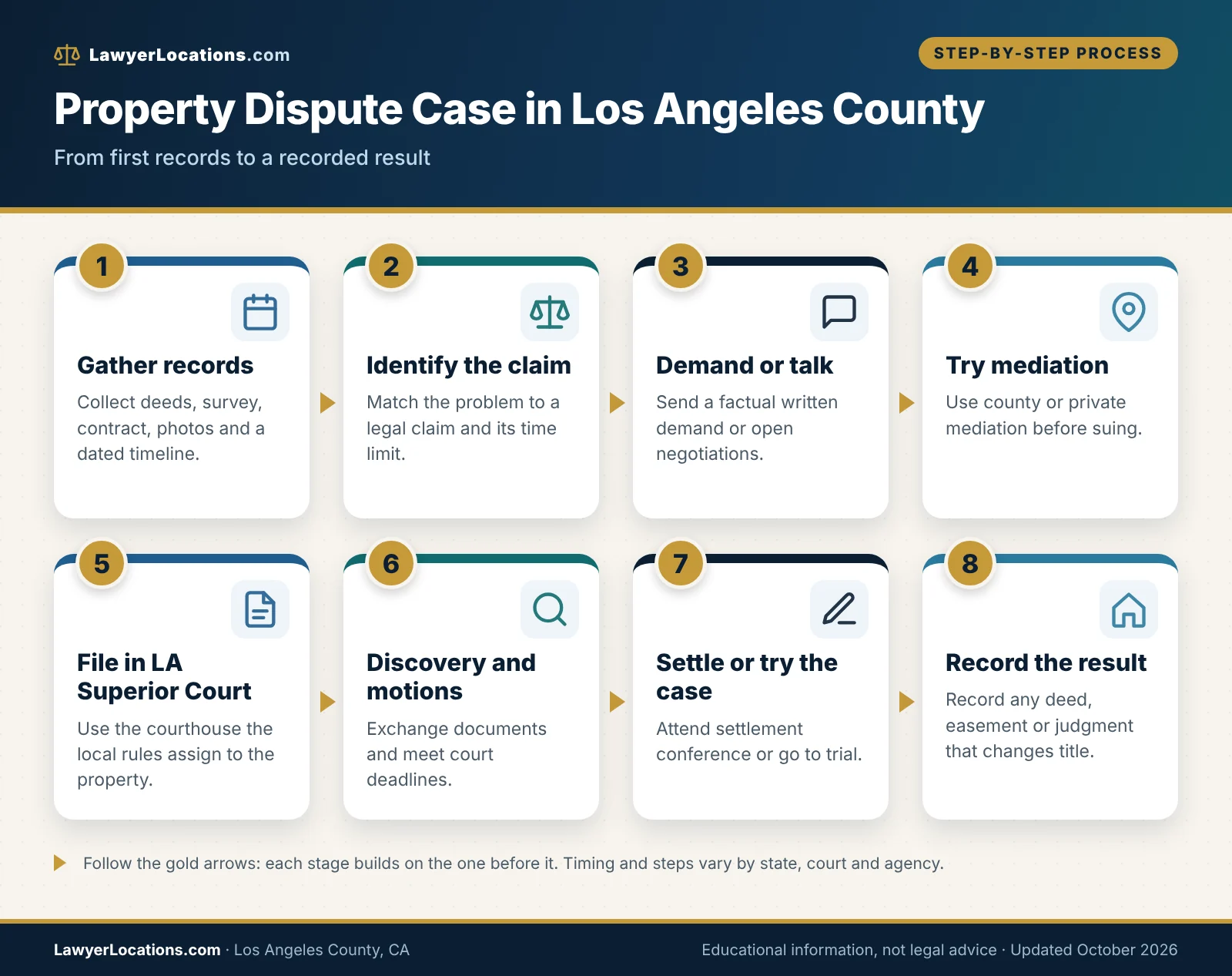
Text version of this graphic
- Gather the deed, survey, contract and photos.
- Identify the claim and check the time limit.
- Send a written demand or open talks.
- Try mediation or a negotiated agreement.
- File in the Los Angeles County Superior Court if needed.
- Exchange evidence and prepare for trial or settlement.
- Record the result so the title reflects it.
The stages of a typical case
The path from first call to resolution is fairly consistent even though every property has its own story. Knowing the stages helps you ask better questions at a consultation and spot a lawyer who is skipping steps that would save you money.
Before anything is filed: records, demand and negotiation
A careful lawyer starts with the recorded documents (your grant deed, any prior deeds, the title company’s preliminary report, recorded maps and easements), then compares them with what is physically on the ground. The goal is to find out whether you have a strong claim, a weak one, or a problem that a boundary survey or a corrective document would solve.
The next step is often a demand letter, a written statement of what you say happened, what you want done and by when. Many property disputes settle at this stage because the other side realizes the paperwork is not on their side. Keep the tone factual, because the letter may be an exhibit later.
Mediation and settlement
Mediation is a confidential, voluntary conversation led by a neutral person who helps the sides find terms they can both live with. It is common in neighbor, co-owner and contract disputes because the parties often have to keep living next to each other or sharing a family property afterward.
Los Angeles County Department of Consumer and Business Affairs runs a Dispute Resolution Program described as informal dispute resolution focused on conciliation and mediation as an alternative to formal court proceedings, and the Superior Court lists its own settlement programs, covered in the local resources section below. Any settlement that changes who owns or may use land should be put in writing and, where appropriate, recorded.
If a lawsuit is filed
A lawsuit begins with a complaint filed with the Superior Court. The other side responds, the parties exchange information and documents in discovery, judges rule on motions, and unresolved claims go to a settlement conference or trial. Real property cases often include a request for a specific order, such as declaring a boundary or an easement, rather than only money.
Because a court judgment about land is only useful if the public record reflects it, the last step is usually recording the judgment or the settlement document with the county. Your lawyer should tell you in advance who handles that follow-through.
When you may not need a full lawsuit
Not every disagreement about property needs a litigation firm. The honest answer to “do I need a lawyer?” depends on the amount at stake, the strength of the paperwork and how permanent the outcome needs to be.
Smaller money disputes and small claims
If the dispute is purely about money damages up to the small claims limit, such as a modest repair bill from a neighbor’s tree or fence damage, small claims court may be a practical forum. The Superior Court’s civil page identifies small claims as one of its civil categories and notes that unrepresented civil cases below the small claims ceiling are handled there. Check the court’s current small claims instructions for the dollar limit and rules, since both can change.
Small claims is a poor fit when you need a judge to decide who owns land or to order someone to remove a structure, because those claims usually belong in the general civil courts. A one-time consultation with a lawyer can help you decide which route fits.
When a lawyer’s help is more clearly worth it
Hiring a lawyer tends to make sense when title to land is in question, when a recorded document may need to be corrected, when a deadline is close, when the other side already has counsel, or when the property is your largest asset. Mistakes in these cases can be hard to undo because they affect what a buyer, lender or title insurer will accept later.
- A claim that could change who owns or may use your property
- A written contract or deed whose meaning is being argued
- A deadline that may be near or already passed
- Co-owners who disagree about selling, buying out or occupying the property
- A structure or improvement that may cross a property line
Before your first call, write a one-page timeline of who did what and when, with dates you are sure about marked separately from your best guesses. A lawyer can spot a time-limit problem from a good timeline faster than from a long phone story.
California Law Behind the Most Common Property Disputes
California statutes, not county ordinances, decide most property disputes, and the single most important rule is that every claim has a clock. Missing a statute of limitations (the legal deadline to file a lawsuit) can end an otherwise strong case. The table below shows the main time limits and ownership rules that come up in Los Angeles County property cases, based on the statutes we reviewed in October 2026.
Time limits that shape every property case
The period that applies to you depends on the kind of claim you have, not on the label you use for the dispute. A single story, such as a neighbor’s addition that crosses the line, can involve more than one claim with different clocks, which is why lawyers look at the dates first.
| Type of claim | Governing rule | What it says in general terms | Practical note |
|---|---|---|---|
| Breach of a written contract or instrument | Code Civ. Proc. § 337(a) | An action on a contract, obligation or liability founded on a written instrument is generally brought within four years. | Purchase agreements, written easement agreements and written co-owner agreements may fall here. When the clock starts depends on the breach. |
| Rescission of a written contract | Code Civ. Proc. § 337(c) | The time generally runs from the date the facts entitling the party to rescind occurred; for fraud or mistake, from discovery of the facts. | Relevant when you want a sale or agreement unwound rather than damages. |
| Trespass upon or injury to real property | Code Civ. Proc. § 338(b) | An action for trespass upon or injury to real property is generally brought within three years. | Applies to many encroachment, tree and structure-damage claims. Ongoing conditions can raise harder timing questions. |
| Adverse possession | Code Civ. Proc. § 325 | Possession must be continuous for five years, and the claimant (or predecessors) must have timely paid the property taxes assessed on the land. | Proof of tax payments comes from certified county tax collector records. |
| Partition of co-owned property | Code Civ. Proc. § 872.210 | Sets out who may bring a partition action, including owners of certain interests in real property held concurrently or in successive estates. | Spouses cannot use this title to partition community or quasi-community property. |
| Quiet title | Code Civ. Proc. § 760.050 (venue) | A quiet title action over real property belongs in the county where the property, or part of it, is located. | For Los Angeles County properties, that means the Los Angeles County Superior Court. |
Contract-based claims and the four-year rule
Purchase agreements, written easement agreements, loan and seller-carryback documents, and co-owner agreements are all written instruments. Under Code Civ. Proc. § 337, a lawsuit founded on a written instrument generally has to be brought within four years. A rescission claim on a written contract follows its own start-date rule: the time runs from the date the facts that entitle the party to rescind occurred, and for fraud or mistake from discovery of those facts.
The same section also says that once the period has run, a person may not sue, start arbitration or begin another proceeding to collect the debt, with the period extendable only as the statute allows. Because a contract may also say something about when claims must be raised, a lawyer should read the actual document instead of relying on a general rule.
Trespass and injury to land
Subdivision (b) of Code Civ. Proc. § 338 sets a three-year period for an action for trespass upon or injury to real property. Encroachment, damage from construction next door, and unauthorized entry onto land are typical examples. The statute’s separate subdivision (j) addresses actions to recover for physical damage to private property under Article I, section 19 of the California Constitution, the clause about property taken or damaged for public use.
Whether a continuing condition, like a structure that stays in place, restarts or extends the period is a case-specific question. Do not assume your claim is timely or late until a lawyer has looked at the dates.
Why the first date you write down matters
Start your timeline with the date you first learned of the problem and the date the underlying event actually occurred. Those two dates can differ by years, and the difference sometimes matters. Courts look at documents such as survey reports, emails, permits and recorded deeds to fix those dates, so save everything.
If your dispute involves a written contract, a fence or building that crosses the line, or an injury to your land, check the dates now. The general periods in the table above are four years for written contracts and three years for trespass or injury to real property, and they can be shorter or longer for particular facts. A short consultation costs far less than losing the claim.
Ownership claims: quiet title, adverse possession and partition
Some disputes are not about money at all. They ask a judge to say who owns what. In those cases the remedy is a declaration of ownership or a court-ordered division, and the case is built on documents and possession history instead of damages.
Quiet title actions
A quiet title action asks the court to settle competing claims to real property. Under Code Civ. Proc. § 760.050, venue for a quiet title action involving real property lies in the county where the real property, or some part of it, is located, subject to the court’s power to transfer. For a Los Angeles County lot, that is the Los Angeles County Superior Court, and the Superior Court’s local rule on filing places real property and title cases at the courthouse for the district where the property is located.
These cases tend to turn on the chain of title: who conveyed what to whom, whether a deed was properly signed and delivered, and whether a recorded claim should be removed. Expect the lawyer to order a title report early.
Adverse possession
Adverse possession lets someone who openly occupies land as their own for long enough become its owner, even without a deed. California sets a high bar. Under Code Civ. Proc. § 325, for claims not founded on a written instrument, judgment or decree, the land must have been protected by a substantial enclosure or usually cultivated or improved, occupied and claimed continuously for five years, and the claimant or predecessors must have timely paid the state, county or municipal taxes levied and assessed on the land.
That tax-payment element often defeats claims by neighbors who fenced a strip but never paid taxes on it. The statute says payment is established by certified records of the county tax collector. If someone claims a piece of your lot, ask a lawyer how these elements apply to the actual facts.
Partition among co-owners
Siblings who inherit a house, friends who buy together and former business partners can all end up as co-owners with different goals. Partition is the legal exit. The statute listing who may bring the action is Code Civ. Proc. § 872.210, and it excludes spouses and putative spouses disputing community or quasi-community property, which belongs in family court.
Many partition cases settle with a buyout: one co-owner purchases the others’ shares at an agreed or appraised value. A lawyer can explain how a court is likely to approach division or sale, and what a buyout agreement should contain so it is enforceable and recorded.
Protecting the record while a case is pending
A lawsuit about land can take a long time, and during that time the property can be sold or encumbered. California has a tool for putting the world on notice, and lawyers weigh carefully when to use it.
Notice of pendency of action (lis pendens)
Under Code Civ. Proc. § 405.20, a party to a lawsuit who asserts a real property claim may record a notice of pendency of action, often called a lis pendens, describing the claim. It is recorded with the recorder of each county where the property lies, and it must name all parties and describe the property. In Los Angeles County, recording is done through the Registrar-Recorder/County Clerk.
A recorded notice can make a buyer or lender hesitate, which is exactly why it can be powerful and why it carries risk if the claim is weak. Do not record one yourself without advice.
Settlement agreements and judgments that touch title
If a settlement moves a boundary, grants an easement or transfers an interest, it should be documented in a form that can be recorded, such as a deed, easement agreement or boundary line agreement. A private promise in an email will not show up in a title search and will not bind a future buyer.
Ask your lawyer who will prepare the recordable documents, whether the title company has reviewed them, and how you will confirm that the recorded version matches what you agreed to.
You can often look up how a property is described in recorded documents without hiring anyone. Start with your own deed and title policy, then ask the county recorder or a title company how to search recorded documents. The documents you gather make the first consultation much more productive.
Los Angeles County Courts, Programs and Local Resources
In Los Angeles County, the Superior Court of California, County of Los Angeles hears property lawsuits, and its local rules decide which courthouse a case starts in. Mediation, bar-run referral services and legal aid organizations fill in the rest of the local picture. This section is the part of the guide that will not apply in San Diego, Orange County or anywhere else.
Where a property case is filed in Los Angeles County
The Los Angeles court is organized into geographic districts, and the district rules are in Chapter 2 of the Superior Court’s local rules. Filing in the wrong courthouse wastes time, so lawyers check the rule before they draft the complaint.
The district filing rule for real property
Local Rule 2.2 lists the court’s twelve geographic districts and their courthouses. Local Rule 2.3(a)(1) then sets the filing rules for unlimited civil cases: actions about real property, title, eminent domain, forcible entry and unlawful detainer are filed in the district where the property is located. By contrast, contract cases are filed where performance is required or where the defendant lives, and tort cases are filed where the cause of action arose.
That distinction matters for mixed disputes. A quiet title or easement case follows the land, while a pure breach-of-contract claim over a failed sale may have more than one proper courthouse. The same rule says unlimited civil cases cannot be filed in the Northeast District, and that a Civil Case Cover Sheet Addendum (form LACIV 109) must accompany new civil filings.
The Central District: Stanley Mosk and Spring Street
Rule 2.2 places two major civil courthouses in the Central District: the Stanley Mosk Courthouse at 111 North Hill Street and the Spring Street Courthouse at 312 North Spring Street, both in downtown Los Angeles. Under Rule 2.1, the Civil Supervising Judge sits in Department 1 of the Central District, and transfer motions between districts are heard there under Rule 2.3(b)(2).
Rule 2.8 and Rule 2.9 describe Central District assignments for provisional remedies, injunctive relief, receiverships, special proceedings, writs and receivers. For example, Rule 2.8 notes that Spring Street Departments 25 and 26 hear many limited civil law-and-motion and ex parte matters. If your case involves an urgent request, such as stopping construction or a sale, your lawyer will check which department applies.
Limited civil and small claims venue
Smaller cases follow a different rule. Rule 2.3(a)(2) says limited civil, small claims, collections and unlawful detainer cases must be filed at the courthouse serving the ZIP code and community that determines venue, with other limited civil actions going to Stanley Mosk. The court’s online filing court locator, which the court publishes for this purpose, helps you find the right location.
The Superior Court’s civil division page groups its work into limited collections, limited non-collections, small claims and unlimited general civil cases, and says the amount in dispute drives which category applies. Check the court’s current page for dollar limits before you choose a path.
| Type of case | Where it is generally filed | Local rule | What to check |
|---|---|---|---|
| Real property or title action (unlimited civil) | The district where the property is located | Rule 2.3(a)(1) | Which district courthouse serves your address; unlimited civil cases cannot be filed in the Northeast District |
| Contract dispute (unlimited civil) | Where performance is required or where the defendant lives | Rule 2.3(a)(1) | The performance location in the contract and the defendant’s address |
| Limited civil, small claims, collections | Courthouse serving the venue ZIP code | Rule 2.3(a)(2) | Use the court’s filing locator |
| Transfer between districts | Motion heard in Department 1, Central District | Rule 2.3(b)(2) | Reasons such as witness convenience or the ends of justice |
| Provisional remedies and injunctions (Central District) | Departments assigned under Rules 2.8 and 2.9 | Rules 2.8, 2.9 | Department assignment depends on the case type and number |
Mediation and settlement options in the county
Because land disputes often involve neighbors, family or an ongoing business relationship, Los Angeles County offers several routes that never reach a trial. Using them early can reduce cost, and judges often expect parties to have considered settlement.
Court-connected settlement programs
The Superior Court’s civil division page lists Alternative Dispute Resolution, Settlement Programs and the Judicial Mandatory Settlement Conference (MSC) Program, as well as a Complex Civil Litigation Program. Which of them apply to a given property case depends on the court, the type of case and the judge’s orders.
Once a case is filed, your lawyer should explain which settlement options are required or available and how any cost is shared. If you are representing yourself, read the notices the court gives you at filing.
The county Dispute Resolution Program
The Los Angeles County Department of Consumer and Business Affairs (DCBA) runs a Dispute Resolution Program that its website describes as informal dispute resolution at the municipal level, focused on conciliation and mediation as an alternative to formal court proceedings. The page also explains that mediation is generally confidential in California, subject to listed exceptions, and links to a mediation request portal.
The page does not spell out which kinds of disputes each program covers or what, if anything, parties pay, so contact DCBA directly to find out whether your matter qualifies. Neighbor conflicts over fences, trees, noise or shared driveways are the type of problem many people try to mediate first.
If you want to try mediation, send a short written invitation to the other party before you hire anyone, and keep a copy. A lawyer can later show a judge that you made a good-faith attempt to resolve the problem without a lawsuit.
Finding a lawyer or free help locally
Lawyer-discovery tools exist at three levels in the county: bar association referral services, nonprofit legal aid and the court’s own self-help resources. None of them replaces a careful comparison, but they are a reliable starting point.
Bar-run referral services
The State Bar of California certifies lawyer referral services, and its Los Angeles-area page lists, among others, the Los Angeles County Bar Association’s SmartLaw service, the Attorney Referral Service of the San Fernando Valley Bar Association, the Referral Service of the South Bay Bar Association and the San Gabriel Valley Lawyer Referral Service. Inclusion on the page means the service is State Bar certified; it is not a rating of any lawyer.
The LACBA SmartLaw page says referrals are limited to Los Angeles County and that a referral is made after you give basic case information. It also describes the terms of an initial consultation and says referred attorneys charge fees after that, so confirm the current terms when you call. The State Bar page also links to a tool for checking a lawyer’s license profile.
Legal aid for people with limited income
The Legal Aid Foundation of Los Angeles (LAFLA) says it generally assists people with income below 125 percent of the federal poverty guidelines, though some people above that level may qualify. Its published list of areas of law includes housing and eviction defense, but it does not list homeownership or boundary disputes specifically, so ask whether your problem is within scope instead of assuming.
The page also says LAFLA does not handle criminal law, bankruptcy or probate and wills. If your dispute is really about an inheritance, you may need a different resource, and our living trust lawyer guide explains how trusts and wills interact with real estate.
Government offices that hold records
Many property disputes are won or lost on records held by government offices: the county recorder (deeds and recorded easements), the county tax collector (proof of tax payments, which matters for adverse possession under Code Civ. Proc. § 325) and the city or county building department (permits for walls, additions and accessory units). Which building department applies depends on whether the lot is inside a city or in an unincorporated area.
Requesting records early is inexpensive compared with the cost of litigating blind. Ask your lawyer which records they will obtain and which you should gather yourself.
Be wary of anyone who offers to “fix” a recorded title problem by phone for a flat fee, or who pressures you to sign a quitclaim deed or a power of attorney. A deed or document that changes title can be difficult to reverse. Have a licensed California lawyer review it first.
City or unincorporated area: which local office handles what
Los Angeles County is not one local government. A lot may sit inside a city with its own building and planning departments, or in an unincorporated area served by county departments. The court, the recording office and the state law stay the same, but the permit and code-enforcement paper trail changes with the address.
| What you need | Typical source | Why it matters in a dispute |
|---|---|---|
| Recorded deeds, easements and maps | County recorder and your title company | Shows what the public record says about ownership, access rights and boundaries |
| Proof of property tax payments | County tax collector (certified records) | Central to an adverse possession claim under Code Civ. Proc. § 325 |
| Permits and plans for walls, additions and accessory units | The city building department, or the county department if the lot is unincorporated | Shows who built what, when, and whether work was approved |
| Court filings and case status | Superior Court of California, County of Los Angeles | Docket, deadlines and department assignments |
| Mediation help | County DCBA Dispute Resolution Program or a private mediator | Possible settlement without a lawsuit |
| Lawyer license check and referral services | State Bar of California and certified referral services | Confirms the person is licensed and gives a starting point for comparing lawyers |
Why your address matters before you hire anyone
Tell every lawyer exactly where the property is, including whether it lies inside a city, because that decides which building department holds the permit file and which courthouse district the local rule assigns to the case. A lawyer who is vague about those points may not have handled many local property cases.
It also affects how fast you can get answers. Some records can be requested online or by mail, while others require a visit, so build that time into your plan.
Using the same facts in different Los Angeles courthouses
If your dispute involves several properties or defendants in different parts of the county, venue can get complicated. Rule 2.3(b)(2) lets the Civil Supervising Judge transfer cases between districts for witness convenience or the ends of justice, and Department 1 in the Central District hears those motions. Ask your lawyer whether venue is likely to be contested, since a venue fight adds cost.
A lis pendens is a public notice, recorded with the county, that a lawsuit about a specific piece of real property is pending. It warns buyers and lenders that the outcome could affect the title.
How to Compare Property Dispute Lawyers in Los Angeles County
Compare lawyers on the same few questions and get the answers in writing. A property dispute lawyer should be able to explain, in plain language, which claim you have, what the time limit is, what court will hear it, what it will cost and what a realistic outcome looks like. LawyerLocations.com does not rank or recommend individual lawyers, so this section gives you the checklist to do the comparing yourself.
Verify the basics before the first consultation
Two checks take ten minutes and screen out most problems: confirming the person is licensed in California, and confirming they actually handle disputes about real property instead of only transactions.
License and standing with the State Bar
Only a lawyer licensed by the State Bar of California may practice California law. The State Bar’s Los Angeles referral-service page links to its attorney profile search, where you can confirm that a lawyer is licensed and check for public discipline. Do this for every lawyer you consider, including those who come through a referral service.
Also ask whether the lawyer works at a firm, who else will touch your file and who is responsible for deadlines. A solo lawyer and a firm with paralegals can both do good work, but you should know which one you are hiring.
Relevant experience in property litigation and local courts
Real estate lawyers fall into two broad groups: those who mostly do transactions (purchases, sales, leases) and those who also litigate. A boundary or quiet title lawsuit is a courtroom and discovery matter, so ask how many property-related cases the lawyer has handled in the Los Angeles County Superior Court and which courthouse or district they expect yours to be assigned to under the local rules.
Avoid relying on advertising terms such as “top” or “best.” Instead, ask for a concrete description of a similar problem and how it was resolved, without client names or confidential details.
Questions that reveal how a lawyer would handle your case
A strong consultation produces a plan, not a sales pitch. Use the same questions with each lawyer and compare their answers side by side.
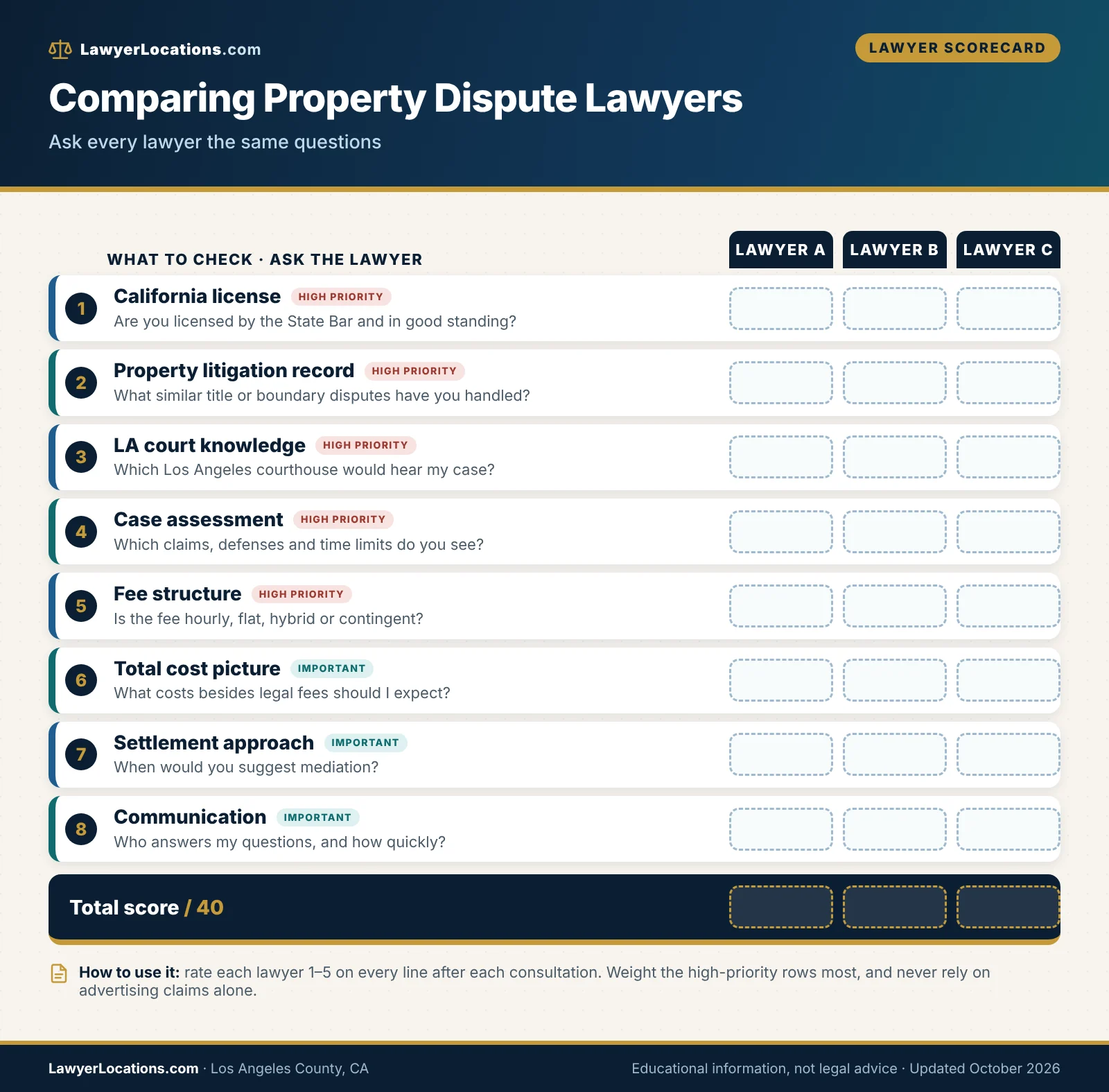
Text version of this graphic
| Criterion | Question to ask |
|---|---|
| California license | Are you licensed by the State Bar, and in good standing? |
| Property litigation experience | What similar boundary, title or contract disputes have you handled? |
| Local court knowledge | Which Los Angeles courthouse would hear my case? |
| Case assessment | What claims and time limits do you see? |
| Fee structure | Is the fee hourly, flat, hybrid or contingent? |
| Total cost estimate | What costs besides legal fees should I expect? |
| Settlement approach | When would you suggest mediation? |
| Communication | Who will answer my questions, and how fast? |
Case assessment and strategy
Ask the lawyer to tell you what claims you might bring, which defenses the other side is likely to raise and what evidence would decide the case. A thoughtful answer includes the chance that the paperwork favors the other side. Be cautious if a lawyer predicts a certain win; no one can promise a result in a property case.
Ask about alternatives to a lawsuit: a negotiated boundary agreement, a recorded easement, a buyout among co-owners or mediation. Lawyers who offer only one path may not be looking at your goals.
Staffing, communication and workload
Find out who does the actual work. If a partner meets you and an associate or paralegal handles the file, ask how work is divided and billed. Ask how and how quickly the office answers client questions, and whether you will receive copies of everything filed or sent on your behalf.
Put your preferred way of communicating in the engagement letter. Disputes over what you were told are common and easily avoided with a short written summary after each major call.
Red flags when hiring for a property dispute
Most lawyers are conscientious, but a few patterns should make you pause and ask more questions before signing.
Pressure, guarantees and vague fees
Walk away from anyone who guarantees an outcome, pushes you to sign the same day, or cannot explain how fees are calculated. Under Bus. & Prof. Code § 6148, a written fee agreement is required when it is reasonably foreseeable that the total expense to the client, including attorney fees, will exceed $1,000, subject to listed exceptions. The agreement must state the basis of compensation, the general nature of the services and each side’s responsibilities, and the lawyer must give you a signed copy.
If the agreement does not comply, it becomes voidable at the client’s option, though the lawyer may still collect a reasonable fee. Read the whole document and ask about anything unclear before you sign.
Unlicensed “document preparers” and title-clearing offers
Only licensed lawyers may give legal advice about your rights, and non-lawyers who try to resolve title problems can create new ones. Be especially wary of unsolicited calls, letters or ads offering to “clear title,” “stop foreclosure” or “buy out your co-owner” for an upfront fee. Check any lawyer’s license and ask for a written fee agreement before paying anything.
- No written fee agreement even though total costs will exceed $1,000
- A promise of a specific result or a deadline “guarantee”
- Pressure to sign a deed, quitclaim or power of attorney immediately
- No explanation of the time limit that applies to your claim
- Unwillingness to describe how costs besides legal fees are handled
Two neighbors in a hillside community disagree about where the property line runs after one of them built a retaining wall. A lawyer who starts by ordering a survey and the recorded maps, then proposes a letter and an offer to mediate before any complaint, is following the cheapest sensible path. A lawyer who suggests filing suit within a week without looking at the documents deserves more questions.
Costs, Deadlines and Decision Points
Property disputes can be expensive because the work is document-heavy and sometimes needs outside experts, but costs are controllable if you decide early what you actually want. No honest source can give a single price for a Los Angeles County property dispute. This section explains how fees are structured and where the decision points fall so you can budget realistically.
How property dispute lawyers charge
Fee arrangements are a matter of negotiation, and each has trade-offs. Ask every lawyer which structures they offer and put the choice in the written agreement.
| Fee structure | How it works | Often used for | Questions to ask |
|---|---|---|---|
| Hourly | You pay for time spent, usually against a retainer (an advance deposit) that is drawn down. | Litigation with unpredictable work | What are the hourly rates for each person who will work on my file, and how often will I get a bill? |
| Flat or fixed fee | One price for a defined task. | Reviewing a deed, drafting a demand letter or a boundary agreement | Exactly what is included, and what triggers extra charges? |
| Limited-scope arrangement | The lawyer handles one defined part of the matter and you handle the rest. | Coaching, document review, one hearing | Which tasks are excluded, and what happens if the case grows? |
| Contingency or hybrid | Part or all of the fee depends on the result and is paid from money recovered. | Money-damages claims; rarely title or boundary claims where no money is recovered | What percentage applies, and are costs deducted before or after the fee? |
Hourly work and retainers
Hourly billing is the default for litigation because no one can predict how much discovery or motion work the other side will force. Ask for a budget range for each phase (pre-filing, pleadings, discovery, mediation, trial) and agree on when the lawyer will check in if the budget needs to change.
Keep invoices and review them. If you disagree with a bill, raise it promptly in writing and ask the lawyer to explain the entries.
Flat fees, limited scope and unbundled help
Many people need only a piece of help: a lawyer to read a deed and tell them where they stand, draft a demand letter or prepare a recordable boundary agreement. A flat fee or limited-scope arrangement can make sense for those tasks, as long as the written agreement says what is and is not included.
The trade-off is that if the matter escalates, the new work usually requires a new or expanded agreement. Ask about that at the start.
Contingency fees and fee-shifting clauses
Contingency fees are common when someone is seeking money damages but less common in title and boundary cases, where the goal is a declaration or removal of a structure. Even in those matters, a contract may shift attorney fees to the loser. Under Civ. Code § 1717, when a contract provides that attorney’s fees go to one party or to the prevailing party, the party who prevails on the contract can recover reasonable fees, and a one-sided clause is generally read to apply both ways.
The statute also says the court decides who prevailed, may find that no party prevailed, and treats a voluntary dismissal or a dismissal under a settlement as no prevailing party. Read any fee clause in your purchase contract or co-owner agreement before you decide to sue or defend, because the risk can run in both directions.
Costs beyond legal fees
Legal fees are only part of the budget. A property case can involve professional reports, record searches, court costs and the cost of fixing the underlying problem.
Surveys, title reports and experts
A licensed surveyor’s boundary survey is often the single most important document in a line dispute. Title reports and recorded-document searches show what the record says. Depending on the case, you may need an appraiser (to value a buyout), a contractor or engineer (for structure or retaining wall disputes) or a forensic accountant (for co-owner expense claims). Ask the lawyer to list which of these they expect and who will pay upfront.
Expert costs are separate from the lawyer’s fee in most arrangements. Ask how expert invoices will be handled and whether you may approve them in advance.
Court fees and the cost of delay
Filing a complaint, responding to one and making many motions carry court fees that change over time, so check the Superior Court’s current fee schedule instead of relying on a number from an article. People who cannot afford court fees may ask for a fee waiver, and Rule 2.18 of the local rules describes where complex civil fee waiver applications are filed.
Delay has costs too: property taxes continue, a blocked sale may lose a buyer, and a dispute can reduce a home’s marketability. Consider those when you weigh settlement against a trial.
Deadlines and decision points from first call to resolution
Think of a property dispute as a series of decisions, with deadlines that are fixed by statute and by the court. The timeline below shows a typical order, but your own dates will differ.
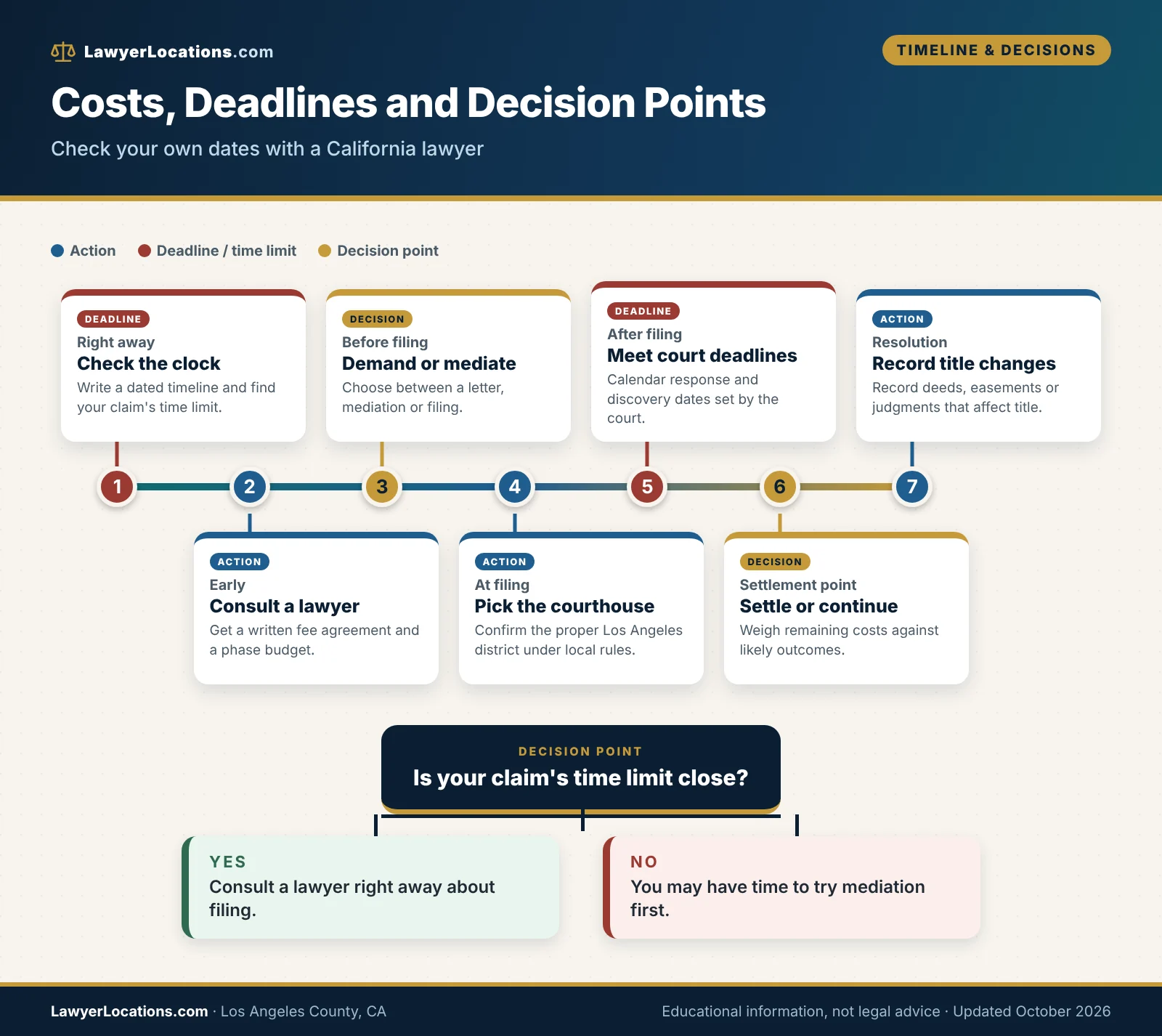
Text version of this graphic
- Right away: gather documents and write a dated timeline; check the time limit for your claim.
- Early: consult a lawyer; decide whether a demand letter or mediation comes first.
- Before filing: confirm the proper Los Angeles courthouse under the local rules.
- After filing: watch response and discovery deadlines set by the court.
- Settlement point: decide whether to settle through mediation or a settlement conference.
- Judgment or settlement: record any document that changes title or use.
Decision question: is the statute of limitations close? If yes, consult a lawyer immediately; if no, you may have time to try mediation first.
Early decisions: assess, demand, mediate
The first decision is whether to act at all, and the first fact to establish is whether you are inside the time limit that applies. After that, decide whether to start with a demand letter, a mediation invitation or a direct filing. Cost and relationship concerns usually point toward the first two, but if the deadline is close, filing may be the safer route.
If the other side has already sent you a demand or a complaint, calendar the response date immediately. Response deadlines are strict, and missing one can allow a default judgment.
After filing: court deadlines and settlement windows
Once a case is filed, the court and the rules set many deadlines, from serving the complaint to responding to discovery. Your lawyer should give you a calendar. Settlement discussions often intensify after key documents are exchanged, and the court’s settlement programs may come into play.
Before you reject or accept an offer, ask your lawyer to explain what each side would pay in fees and costs to continue, and how a recorded settlement would change title.
You can usually ask a lawyer to explain a bill, an estimate or a deadline in writing. A clear written explanation is a sign of an organized office.
Never ignore a lawsuit, a demand letter that cites a deadline, or a court notice. Take any paper you receive to a lawyer right away, because the time to respond is short and missing it can limit your options.
Evidence, Mistakes and Next Steps
The strongest property cases are built from paper collected early and photographs taken before anything changes. This section lists what to gather, the mistakes that most often hurt owners in Los Angeles County, and a short plan for the next two weeks.
Documents and evidence to gather before you call
Bringing organized records to a first consultation saves billable time and lets the lawyer give a more precise assessment. You do not need everything on the list; bring what you have.
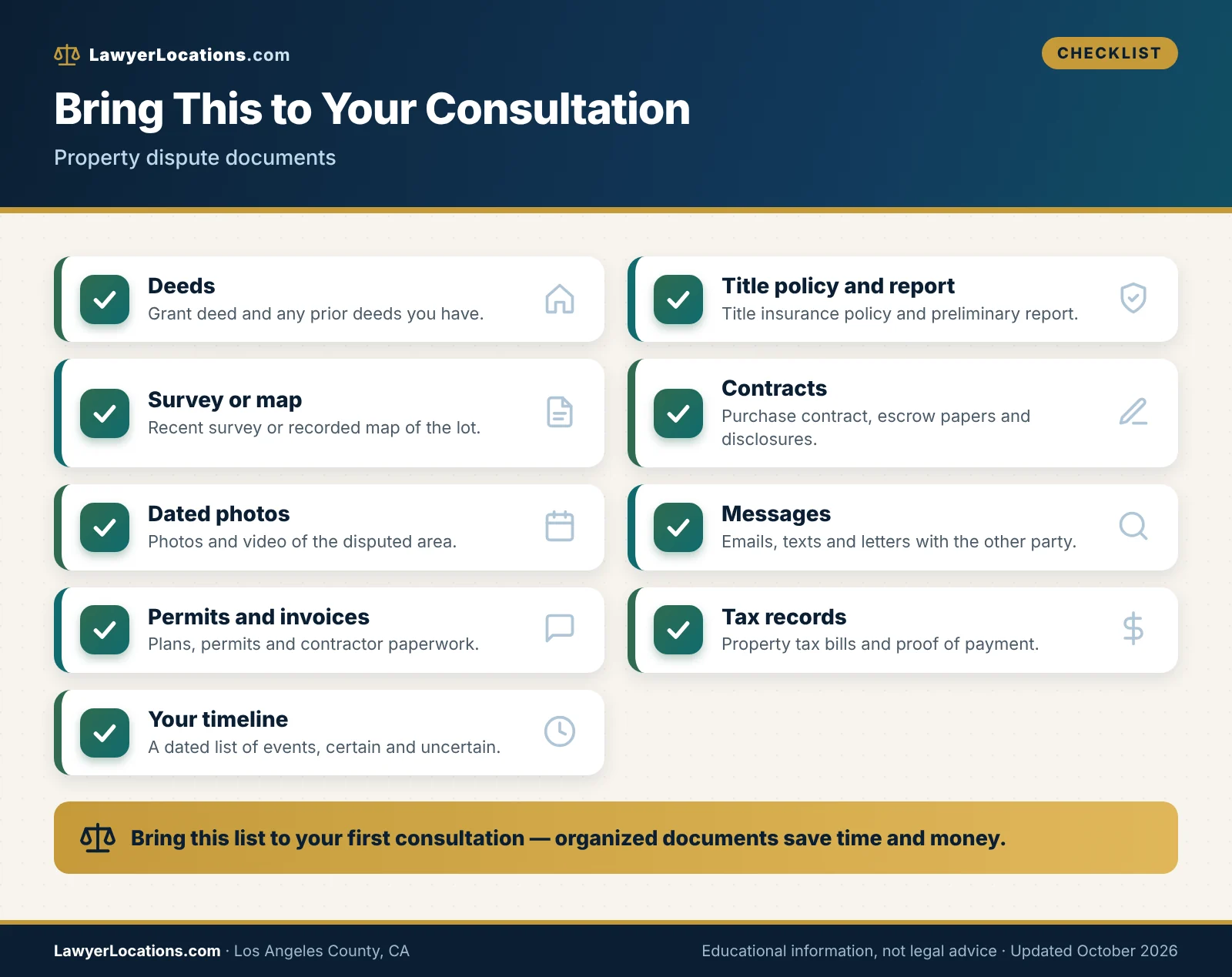
Text version of this graphic
- Grant deed and any prior deeds
- Title insurance policy and preliminary report
- Recent survey or recorded map
- Purchase contract, escrow papers and disclosures
- Photographs and videos with dates
- Emails, texts and letters with the other party
- Permits, plans and contractor invoices
- Property tax bills and proof of payment
- Your dated timeline of events
Ownership and title records
Start with the documents that prove what you own: the deed you received at closing, your title insurance policy, any recorded easements or maps, and the preliminary title report from your purchase. If you inherited the property, add the trust or probate paperwork and any deed that moved title after the owner died.
- Grant deed and prior deeds, if you have them
- Title insurance policy and preliminary report
- Recorded easements, maps and CC&Rs (the recorded restrictions for a community)
- Trust, will or probate documents if the property was inherited
Physical and photographic evidence
Photograph the disputed area from several angles and date the photos. If a fence, wall or structure is involved, capture it before anyone moves or removes it. A licensed surveyor’s report, even a preliminary one, is often the most persuasive physical evidence.
Save permits, plans, contractor invoices and any correspondence with city or county building departments, because they show who built what and when. Note where the work was permitted, since that can point to the correct city or county office for records.
Communications and payment records
Save emails, text messages, letters and voicemail from the other party, plus your own replies. Keep records of property tax payments, which are central if anyone claims adverse possession, because the statute ties that claim to timely paid taxes proven by certified county tax collector records.
Do not edit or delete messages, and avoid sending angry replies. Anything you write can become an exhibit.
Mistakes that make property disputes harder
Most of the damage in these cases comes from decisions made before a lawyer is involved. The list below is not exhaustive, but it covers the patterns we see repeatedly in published guidance and court practice.
Self-help remedies that backfire
Tearing down a fence, cutting a neighbor’s tree, blocking an access road or changing locks may feel satisfying and then lead to a counterclaim for trespass or property damage. Under Code Civ. Proc. § 338(b), an action for trespass upon or injury to real property is generally subject to a three-year period, so a neighbor you wrong today can sue you for years.
Ask a lawyer before taking physical action on the land, even if you are sure the line is yours. A written position and a survey beat a bulldozer.
Waiting too long or signing too fast
Waiting lets time limits run and evidence fade. Signing quickly, however, is its own risk: quitclaim deeds, easement agreements, boundary line agreements and settlement releases can be hard to reverse once they are recorded.
The middle path is to get the dates straight within days, then take whatever time the lawyer says is available to negotiate carefully.
Treating a recorded document as the whole story
Deeds and maps are powerful, but the dispute may turn on who has used the land, who has paid taxes, what the parties agreed in writing and what has been built. Tell your lawyer about informal arrangements, old handshake deals and prior owners’ promises, even if they seem unimportant.
Your next steps and quick answers
If you are in a Los Angeles County property dispute right now, the next two weeks matter more than the next two years. The plan below keeps your options open without committing to a lawsuit.
A practical two-week plan
- Write the timeline. List every important date, marking certain and uncertain ones.
- Gather the documents. Use the checklist above and request missing records from the county recorder, title company or building department.
- Check the clock. Compare your dates to the general periods in this guide: four years for written contracts, three years for trespass or injury to land and five years plus taxes for adverse possession.
- Compare two or three lawyers. Verify licenses with the State Bar, ask the same questions, and get fee agreements in writing.
- Consider mediation. If the relationship matters, contact the county’s Dispute Resolution Program or propose a private mediator.
If you are also buying, selling or refinancing, read our Los Angeles County closing guide for how escrow and title interact with an unresolved claim. Readers comparing counties can also see how a nearby market works in our San Diego County real estate attorney guide.
Ready to compare your options?
Use the scorecard and checklist above to interview two or three California-licensed lawyers about your property dispute lawyer Los Angeles County CA search. If you want broader context first, start with our Los Angeles real estate lawyer guide. LawyerLocations.com is not a law firm and does not refer you to a specific lawyer.
Quick answers about hiring and cost
Do I need a lawyer for a boundary dispute with my neighbor in Los Angeles County?
No law requires one, and many boundary conflicts settle through a conversation, a survey and a written agreement. A lawyer becomes more important if the neighbor refuses to talk, the paperwork is unclear, a deadline may be near or you need an agreement recorded against title.
How much does a property dispute lawyer cost?
There is no single price because fees depend on the lawyer, the work involved and whether the case settles. Ask for a written fee agreement, which California law generally requires when the expected total expense will exceed $1,000 under Bus. & Prof. Code § 6148, and ask for a phase-by-phase budget.
Can I recover my attorney’s fees if I win?
Only if a contract or statute provides for it. Under Civ. Code § 1717, a contract clause awarding fees to a prevailing party is generally mutual, but the court decides who prevailed and may find that no one did.
Where do I find a lawyer if I cannot afford a private firm?
Start with the legal aid organizations and court self-help resources serving Los Angeles County, such as the Legal Aid Foundation of Los Angeles, and ask whether your issue is within their scope. Bar-run referral services, including the Los Angeles County Bar Association’s SmartLaw program, can match you with a lawyer, who will then charge their own fees.
Quick answers about courts, deadlines and ownership
Which court hears a property dispute in Los Angeles County?
The Superior Court of California, County of Los Angeles. Under its Local Rule 2.3(a)(1), real property and title cases in unlimited civil are filed in the district where the property is located, while contract cases are filed where performance is required or the defendant lives.
How long do I have to sue over a breach of a written real estate contract?
The general period under Code Civ. Proc. § 337 is four years for an action founded on a written instrument, but the starting date and exceptions depend on your facts. Have a California lawyer review the contract and your dates soon.
Can a neighbor take my land by using it for five years?
Only if they meet every element of adverse possession. Under Code Civ. Proc. § 325, claims not based on a written instrument require enclosure or cultivation or improvement, continuous occupation for five years and timely payment of the taxes assessed on the land.
Can co-owners force a sale of inherited property?
A partition action under the California partition statutes may allow certain co-owners to ask a court to divide or sell the property. Code Civ. Proc. § 872.210 lists who may bring the action. Many families settle through a buyout instead, so ask a lawyer about both routes.
Should I record a lis pendens against the other party’s property?
Only a party who asserts a real property claim in a lawsuit may record one under Code Civ. Proc. § 405.20. Because it can affect sales and financing, get legal advice before recording.
Is mediation available before I sue?
Yes. The Los Angeles County Department of Consumer and Business Affairs operates a Dispute Resolution Program that focuses on conciliation and mediation, and private mediators are also available. Check what disputes each program accepts.
Sources & References
Show all 14 sources
- Code of Civil Procedure section 337 — California Legislature (text via California Public Law) — california.public.law — accessed October 2026
- Code of Civil Procedure section 338 — California Legislature (text via California Public Law) — california.public.law — accessed October 2026
- Code of Civil Procedure section 325 (adverse possession) — California Legislature (text via California Public Law) — california.public.law — accessed October 2026
- Code of Civil Procedure section 872.210 (partition) — California Legislature (text via California Public Law) — california.public.law — accessed October 2026
- Code of Civil Procedure section 760.050 (quiet title venue) — California Legislature (text via California Public Law) — california.public.law — accessed October 2026
- Code of Civil Procedure section 405.20 (notice of pendency of action) — California Legislature (text via California Public Law) — california.public.law — accessed October 2026
- Civil Code section 1717 (contractual attorney’s fees) — California Legislature (text via California Public Law) — california.public.law — accessed October 2026
- Business and Professions Code section 6148 (written fee agreements) — California Legislature (text via California Public Law) — california.public.law — accessed October 2026
- Local Rules, Chapter 2 (Civil) — Superior Court of California, County of Los Angeles — lacourt.ca.gov — accessed October 2026
- Civil Division overview — Superior Court of California, County of Los Angeles — lacourt.org — accessed October 2026
- Facts About LA County Dispute Resolution Services — Los Angeles County Department of Consumer and Business Affairs — dcba.lacounty.gov — accessed October 2026
- Find a Los Angeles Area Lawyer Referral Service — State Bar of California — calbar.ca.gov — accessed October 2026
- SmartLaw Lawyer Referral Service — Los Angeles County Bar Association — lacba.org — accessed October 2026
- Get Help — Legal Aid Foundation of Los Angeles — lafla.org — accessed October 2026
General information only. This article is legal education, not legal advice, and reading it does not create an attorney-client relationship with LawyerLocations.com or anyone else. LawyerLocations.com is a legal-education and lawyer-discovery resource, not a law firm, and it does not rank or endorse individual lawyers. Laws, court rules and local programs change; statements here are as of October 2026 and should be confirmed with the cited agency or court. Consult a lawyer licensed in California about your situation.
Legal Disclaimer and Limitation of Liability
Informational and illustrative purposes only. This article was prepared by LawyerLocations.com solely on the basis of the information available to us at the time of writing. It is an illustrative, general overview. It is not a complete or authoritative statement of the law, and it has not been reviewed by a lawyer licensed in your state or county.
Not legal advice. Nothing in this article is legal, financial, tax or immigration advice, and reading it does not create an attorney-client relationship between you and LawyerLocations.com or any author, lawyer or firm mentioned. Laws, court rules, fees, filing deadlines and agency procedures differ by state, county and court, and they change often. Some details here may be simplified, incomplete or out of date, and time limits for legal claims can be short.
No warranty. We make no representation or warranty, express or implied, about the accuracy, completeness, timeliness or suitability of this content for your situation. Please do not rely on it to make, delay or skip any legal decision. Check the facts against official sources and speak with a licensed attorney in the relevant jurisdiction before you act.
Limitation of liability. To the fullest extent permitted by law, LawyerLocations.com and its owners, authors and contributors disclaim all liability for any loss, damage, cost or other consequence arising from the use of, or reliance on, this article, including any content on third-party websites we link to. Mentioning a lawyer, firm, organization or service is not an endorsement and is not a promise of any result. If you are in immediate danger, contact your local emergency number.