Searching for a real estate attorney Mesa AZ offers? Start with one fact: Arizona does not require a lawyer to buy or sell a home. Escrow and title companies run most closings, and licensed brokers fill in the standard contract forms. A lawyer becomes worth the cost when something is unusual, contested or high-stakes: a title problem, a spouse who is not on the deed, a contract dispute, an association fight, or a transaction you cannot afford to get wrong.
This guide explains how real estate law works in Mesa, which Maricopa County offices and courts matter, what lawyers charge for in general terms, and how to compare attorneys before you sign an engagement letter. It is general information, not legal advice.
What a Real Estate Attorney Does in Mesa and When You Need One
A real estate attorney in Mesa advises on the legal side of property: contracts, title, deeds, disputes and the paperwork that follows. In Arizona you can legally close a home sale without one, so the real question is whether your situation carries enough risk to justify paying for legal advice. Most routine sales do not need a lawyer. Complicated or contested ones often do.
How Arizona Closings Work Without a Required Attorney
Arizona is a state where a neutral third party, usually an escrow or title company, handles the money and documents at closing. If you have bought property in a state where attorneys conduct closings, this will feel different. Here, the lawyer is an optional adviser rather than the person who runs the closing table.
The role of escrow and title companies
Once a buyer and seller sign a purchase contract, an escrow officer opens an escrow, collects the earnest money, orders a title search and prepares closing documents. The title company issues the title insurance policy that protects against many (not all) ownership defects. Escrow officers and title staff are neutral, and they cannot give either side legal advice. Ask any escrow company you use to show you its state license information, and ask who is responsible if wired funds go astray.
Because the escrow officer follows the contract instructions, a mistake in the contract itself usually flows straight through to closing. That is why many people who hire a lawyer in Arizona do so before signing, not at the closing table.
What licensed brokers can and cannot do with contracts
Article 26, Section 1 of the Arizona Constitution lets a licensed real estate broker or salesperson, acting for a party to a sale, exchange or lease, draft or complete related documents such as purchase agreements, earnest money receipts and deeds, as part of the transaction. Brokers commonly use standardized forms and fill in the blanks. That authority does not turn a broker into your lawyer. A broker can explain what a form says in practical terms, but advice about your legal rights, how to rewrite a clause, or how to resolve a title dispute is legal advice.
If your broker suggests an unusual clause, a side agreement or a contract rewrite, that is a natural moment for a one-time lawyer review. Ask the lawyer to look at the exact text before you sign, not after.
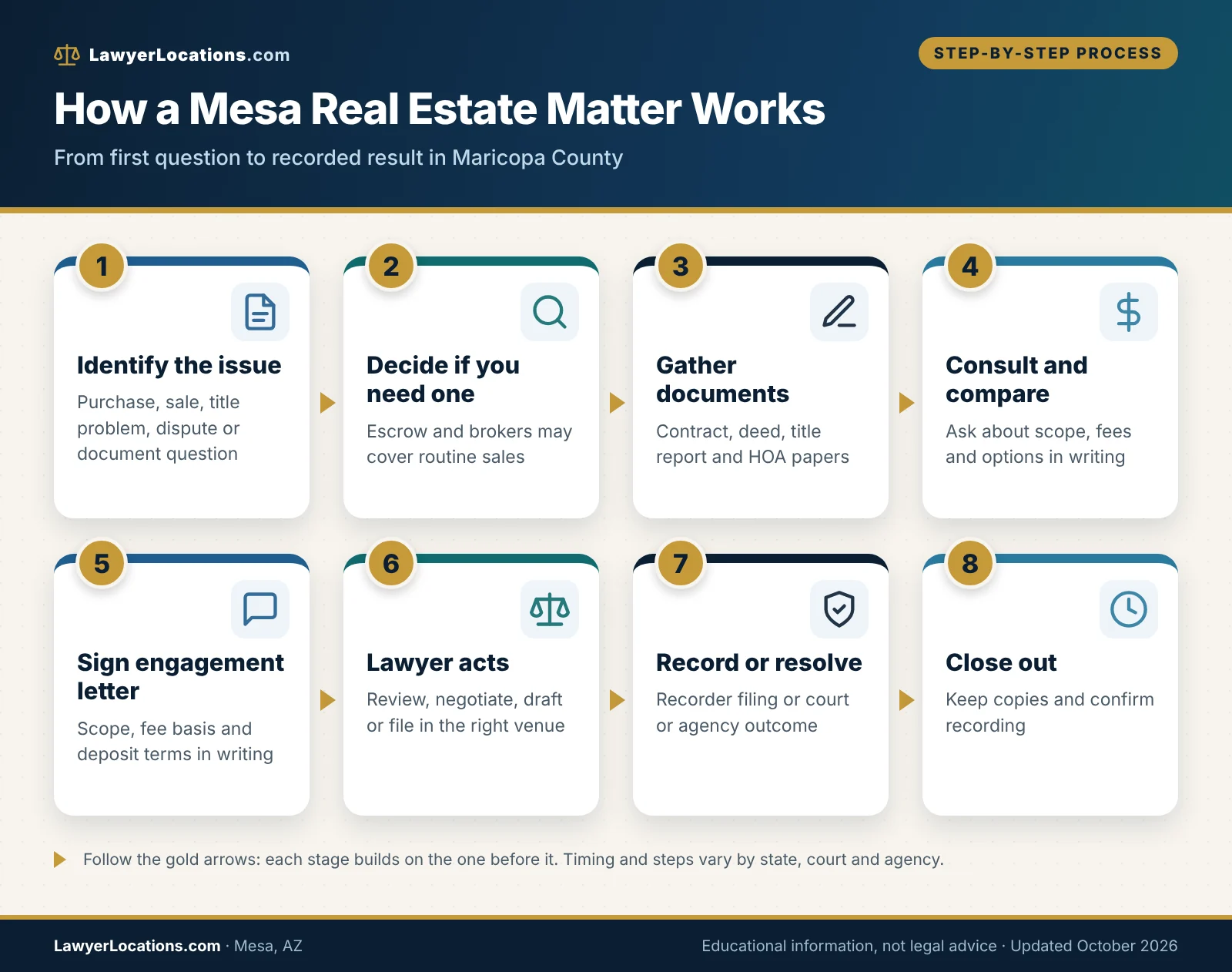
Text version of this graphic
- Identify the issue: purchase, sale, title problem, dispute or document question.
- Decide whether you need a lawyer or only escrow, title and a broker.
- Gather the contract, deed, title report and association papers.
- Hold a consultation and compare fee structures in writing.
- Sign an engagement letter that defines the scope of work.
- Your lawyer reviews, negotiates, drafts or files in the right Maricopa County venue.
- Documents are recorded with the Maricopa County Recorder, or the dispute is resolved.
- Close out: keep copies, confirm recording and set a follow-up if needed.
Situations Where Paying for a Lawyer Makes Sense
The more of the following boxes your situation checks, the more a lawyer is likely to earn their fee. None of these is a rule. They are common pressure points in Arizona transactions and disputes.
Ownership, marriage and family-transfer questions
Arizona is a community property state, and its statute on spousal joinder, A.R.S. § 25-214, requires both spouses to join in most transactions for the acquisition, disposition or encumbrance of an interest in real property. The only listed exceptions are an unpatented mining claim and a lease of less than one year. If one spouse alone signs a deed or a loan document for community real estate, the transaction can be challenged, and sorting that out is a legal job. A lawyer is also useful when property moves between family members, when an owner has died, or when you want to use a beneficiary deed to pass a home outside probate (see Section 2).
If your question is really about how a marriage ending affects a house, our guide to legal separation versus divorce explains the broader choices, and a family-law lawyer will usually coordinate with a real estate lawyer on the deed.
Contract disputes and deals that fall apart
Earnest money fights, missed inspection or financing deadlines, repair-request disagreements and claims that a seller hid a defect are all contract disputes. They tend to need a lawyer because the outcome depends on the exact wording of the signed contract and the dates on which things happened. Under A.R.S. § 12-341.01, a court may award reasonable attorney fees to the successful party in a contested action arising out of a contract. That possibility cuts both ways: it can help a party who wins, and it is a financial risk for one who loses. A lawyer can explain whether your contract adds its own fee clause.
Association, easement and neighbor problems
Many Mesa homes sit in planned communities with a homeowners association (HOA), and others rely on shared walls, shared access, utility easements or older recorded restrictions. Disputes here involve recorded documents (the declaration, plat and bylaws) and specific Arizona statutes. Section 2 explains the HOA resale disclosure rule and the state’s administrative hearing route for certain HOA disputes. Because owner-versus-builder claims are handled differently, it pays to know which door you are knocking on.
Mesa has two airports that affect residential buyers in different parts of town, Falcon Field and Phoenix-Mesa Gateway. Arizona law has the state real estate department keep maps of territory near public airports, and airports record those maps with the county recorder (A.R.S. § 28-8486). If aircraft noise matters to you, ask your broker, escrow officer or lawyer whether the property falls inside a mapped territory.
Arizona Law and Mesa-Area Venues That Shape Your Matter
Real estate law in Mesa is Arizona state law applied in Maricopa County. No federal rule replaces it for ordinary property deals, so the statutes, courts and recorder described here are the ones that matter. This section is deliberately specific because the local layer is where a Mesa case differs from a case in another state, or even another Arizona county.
Arizona Statutes You Will Hear About
The statutes below are the ones that come up most often in Arizona residential matters. Each description is a plain-English summary of the statute as it read in October 2026. Statutes can be amended, so a lawyer should check the current text and any exceptions that apply to you.
Spousal joinder and community property
Under A.R.S. § 25-214, either spouse can usually manage community property alone, but joinder of both spouses is required for real property transactions of the kind described earlier. In practice that means both spouses should sign the deed and the deed of trust when a married couple sells or refinances community real estate. If a spouse is unavailable, uncooperative or the marriage is ending, a lawyer is the right person to decide how to proceed. Do not rely on a buyer, broker or title officer to resolve that question for you.
Written-contract deadlines and fee shifting
Arizona sets different time limits for different kinds of claims. For actions to collect a debt founded on a written contract executed in Arizona, A.R.S. § 12-548 provides a six-year limit, running from when the claim accrues. Other claims, such as construction defects, fraud or claims against an association, may have shorter or longer periods, and some have special notice steps. The takeaway is simple: do not assume you have six years. Ask a lawyer to identify the deadline for your specific claim at your first consultation.
As noted above, A.R.S. § 12-341.01 lets the court award fees to the successful party in a contested contract action. The statute describes the purpose of the award as easing the cost of litigation for a party pursuing a just claim or defense, says the award need not match the fees actually paid, and caps it at the amount paid or agreed to be paid. A judge, not a jury, decides the amount. It also contains a mechanism for written settlement offers, which is a strategic point worth discussing with a lawyer before you reject an offer.
Quiet title actions and beneficiary deeds
If someone else claims an interest in your property that conflicts with yours, A.R.S. § 12-1101 lets a person who has or claims an interest in the property bring a quiet title action, a lawsuit asking the court to settle who owns what. It applies whether or not the plaintiff is in possession. A lawyer will usually try a cleaner fix first, such as a corrective deed or a release, because a lawsuit is slower and more expensive.
On the estate-planning side, A.R.S. § 33-405 authorizes a beneficiary deed. The owner signs and records a deed that names who receives the property at the owner’s death. To work, the deed must say it is effective on the owner’s death, and it must be executed and recorded with the county recorder where the property sits before the owner dies. The owner can revoke it by recording a revocation, and if several beneficiary deeds are recorded, the last one recorded before death controls. Joint owners and community property with survivorship add wrinkles, including a rule that the deed is void in some situations if the last surviving owner did not sign. Our living trust lawyer guide compares a beneficiary deed with a trust, which is the other common tool.
Do not copy a deed form from the internet and record it without legal review if the property is community property, is held with someone else, or has a mortgage. A recorded deed with a mistake can create a title problem that costs far more to fix than it cost to prevent.
| Topic | Statute | What it does in plain English |
|---|---|---|
| Spouses and real property | A.R.S. § 25-214 | Requires both spouses to join in most real property acquisitions, sales and encumbrances; leases under one year and unpatented mining claims are excluded. |
| Attorney fees in contract suits | A.R.S. § 12-341.01 | Lets a court award reasonable fees to the successful party in a contested contract action; amount is capped at fees paid or owed. |
| Debt on a written contract | A.R.S. § 12-548 | Six-year limit for debt claims founded on a written contract executed in Arizona. |
| Quiet title | A.R.S. § 12-1101 | Allows a person with or claiming an interest in real property to ask a court to resolve conflicting claims. |
| Beneficiary deed | A.R.S. § 33-405 | Lets an owner record a deed that takes effect at death and can be revoked during life. |
| HOA resale disclosure | A.R.S. § 33-1806 | Sets the package an association must supply a buyer, the timing and a cap on certain fees. |
| HOA hearing petitions | A.R.S. § 32-2199.01 | Lets an owner or an association petition the state real estate department for a hearing on certain community disputes. |
| Airport territory maps | A.R.S. § 28-8486 | Directs the state real estate department and public airports to maintain and record maps of territory near airports. |
Where Matters Are Filed and Recorded Around Mesa
Mesa sits in Maricopa County, so most court filings and every recorded document go to county-level offices rather than a city office. Knowing which door to use saves time and keeps you from filing in the wrong place.
Maricopa County Superior Court, Southeast Facility
Lawsuits over title, contracts, partition and similar real estate claims are generally brought in the Maricopa County Superior Court. The court operates a Southeast Facility in Mesa at 222 E Javelina Ave, Mesa, AZ 85210, open Monday through Friday from 8:00 a.m. to 5:00 p.m., with judges’ divisions closed daily from 12:00 p.m. to 1:30 p.m. The court’s listing gives a phone number of 602-506-3204. A lawyer will tell you which courthouse your particular case is assigned to, because assignment depends on the case type and the court’s current practices rather than on the address of the property alone.
Justice courts and the Mesa city court
Maricopa County’s justice courts handle categories that include evictions, small claims and civil suits, among others, according to the county justice courts website. Evictions run on a compressed schedule measured in days, so a landlord or tenant who receives a notice or a summons should read the paperwork immediately and look at the court’s published timeline guidance. The justice courts site includes a court locator, which is the quickest way to learn which precinct court covers a given Mesa address. The City of Mesa has its own municipal court for city-level matters, but title and contract disputes between private parties are not resolved there.
Eviction paperwork is not a “deal with it next month” document. Maricopa County justice court timelines for eviction actions are short and are set by statute, so a landlord or tenant who gets a notice or summons should act within days and consider legal aid or a lawyer right away. See the free renter resources in Section 4.
Maricopa County Recorder and Title Alert
Deeds, deeds of trust, releases, liens and beneficiary deeds are recorded with the Maricopa County Recorder. The downtown office is at 301 W Jefferson St., Second Floor, Suite 200, Phoenix, AZ 85003, and the office offers a recorded document search and a digital recording program for e-recording. The Recorder cannot give legal advice, help you complete documents or provide notary services. Starting September 13, 2026, the Recorder requires photo identification for in-person and kiosk recordings. The Recorder also runs Maricopa Title Alert, a notification service aimed at helping owners learn when documents are recorded against their names or property. Check the Recorder’s Title Alert page for how it works, because deed and title fraud is a real concern for owners of free-and-clear property.
| Office or court | Typical use | Local detail |
|---|---|---|
| Maricopa County Superior Court, Southeast Facility | Title, contract, partition and similar civil suits; case assignment is made by the court | 222 E Javelina Ave, Mesa; weekdays 8:00 a.m. to 5:00 p.m.; 602-506-3204 |
| Maricopa County Justice Courts | Evictions, small claims, civil suits and related matters | Use the justice courts’ locator for the precinct that covers the Mesa address |
| Maricopa County Recorder | Recording deeds, deeds of trust, releases, beneficiary deeds; document search; e-recording; Title Alert | Downtown Phoenix office at 301 W Jefferson St.; photo ID for in-person recordings from September 13, 2026 |
| Arizona Department of Real Estate | Licensing of brokers; HOA hearing petitions; airport territory maps; Buyer Advisory | State agency; forms and fees are posted on its website |
| State Bar of Arizona | Member directory, fee arbitration, lawyer discipline information | Main number 602.252.4804; fee arbitration line 602.340.7379 |
From Contract to Recording: How a Mesa Transaction or Dispute Unfolds
Most real estate legal work in Mesa follows one of two tracks: a transaction that goes forward (buying, selling, refinancing, transferring) or a problem that has to be repaired (a title defect, a broken contract, a dispute with an association). The steps differ, but both tracks end the same way: with a signed document, a court order or a recorded instrument. Here is how each track usually looks.
Buying or Selling a Mesa Home With a Lawyer in the Loop
Hiring a lawyer does not replace your broker or the escrow company. It adds a second set of eyes on the legal terms, usually at a few key points. Think of the lawyer as an adviser you consult on the parts that matter most rather than a replacement for the usual team.
Before you sign: the contract and due diligence
Arizona buyers and sellers commonly work from standardized purchase forms published by the Arizona Association of Realtors. The Arizona Department of Real Estate also publishes a Buyer Advisory that lists issues buyers are encouraged to investigate, and sellers commonly complete a Seller’s Property Disclosure Statement (SPDS) describing what they know about the property. A lawyer reviewing the contract before signing can check that the contingency dates, repair provisions, earnest money terms and any addenda say what you think they say. If you are a seller with a known defect, a lawyer can help you disclose it accurately, because a knowingly incomplete disclosure can turn into a dispute later.
During the due diligence window, buyers typically order inspections, review the title commitment and gather association documents. Reading the title commitment is one of the highest-value moments for a lawyer’s time. It lists the recorded easements, liens and restrictions that will follow the property, and it lists the requirements that must be satisfied before title insurance is issued.
Association disclosures under A.R.S. § 33-1806
If the home is in a planned community with an HOA, A.R.S. § 33-1806 governs the resale disclosure package. Where the community has fewer than 50 properties, the seller must deliver the package to the buyer or the buyer’s agent within 10 days after accepting the offer. For larger communities, the seller notifies the association in writing and the association then has 10 days to deliver the package. The package includes the governing documents, recent board minutes, a dated statement of assessments and liens, the operating budget, the latest audit or review and reserve study, a summary of pending lawsuits and a statement about declarant control.
The statute caps what the association or its manager may charge. As of October 2026 the statute allows a preparation-and-delivery fee of up to $400, a rush fee of up to $100 if services are needed within 72 hours, and an update fee of up to $50 when an update is requested 30 or more days after the original disclosure. The fees may be collected no earlier than close of escrow and only once per transaction. A buyer or seller harmed by a knowing or reckless failure to disclose, or by knowingly false information, may pursue remedies that include reasonable attorney fees.
Read the HOA package for three things: unpaid assessments or liens, pending lawsuits against the association, and any special assessment approved or proposed. These are the items most likely to cost you money after closing, and they are exactly the kind of fine print a lawyer can summarize in a short consultation.
Closing, wire safety and recording
At closing, the escrow officer collects funds, pays off existing liens, disburses proceeds and sends the deed to be recorded. Recording matters because it puts the world on notice of your ownership. The Maricopa County Recorder’s recorded document search and Title Alert service can help you confirm what is of record after closing. For wire instructions, call the escrow company at a phone number you found independently, not one in an email, before sending money. Wire fraud targets home buyers precisely because the sums are large and the timing is tight.
When a Property Problem Needs Repair or a Fight
Problems fall into recognizable groups. Each needs a different first step, and a lawyer’s first job is usually to tell you which group you are in and how much it is likely to cost to fix compared with the value at stake.
Title defects, boundaries and claims against ownership
A title defect might be a missing spouse’s signature, an old lien that was never released, a recording mistake or a neighbor’s claim to part of the lot. The first step is usually practical: obtain the recorded documents, ask the title company whether the issue is covered by a title insurance policy, and try to cure the problem with a corrective deed, a release or an agreement. If that fails, A.R.S. § 12-1101 provides the quiet title lawsuit described earlier. The lawyer’s role is to choose the cheapest path that will actually produce a clean, insurable title.
HOA and community disputes
For certain disagreements between an owner and a condominium or planned community association, A.R.S. § 32-2199.01 lets either side petition the Arizona Department of Real Estate for a hearing. The filing fee is set by the commissioner, the respondent has 20 days to respond, and if the respondent does not answer, the allegations can be treated as admitted. The route has limits: the department cannot hear disputes between owners when the association is not a party, and it cannot hear disputes between an owner and a developer, builder or seller about the design, construction, condition or sale of the property. Disputes that fall outside the petition process, including most construction defect claims, belong in court or another forum, which is another reason to talk to a lawyer before choosing a path.
Failed deals and earnest money disputes
When a purchase falls through, the contract and its dispute resolution clause decide who gets the earnest money and what happens next. Many standard forms include steps such as mediation before a lawsuit and a provision about attorney fees, so read those clauses before you send an angry email or refuse to sign a cancellation. Do not sign an escrow release or cancellation form without understanding what it gives up. A short lawyer review can be the cheapest protection in the whole transaction.
A buyer’s financing contingency date passes, the lender asks for more time, and the seller refuses to extend. Whether the buyer can recover the earnest money may depend on the exact wording of the contingency, on whether the buyer gave written notice by the deadline, and on what the cancellation form says. This is a hypothetical for illustration, not a prediction of how any real dispute will turn out.
How to Compare and Choose a Real Estate Attorney in Mesa
Choose a real estate attorney the way you would choose any professional you must trust with money and paperwork: verify the license, compare fee terms in writing, ask how they would handle your matter, and watch for red flags. Do not choose on advertising alone. A directory like LawyerLocations.com is a place to learn and compare, not a recommendation of any particular lawyer.
Finding and Verifying Candidates
Start with official sources so you know the person is licensed, then widen the search through referrals and your own network.
The State Bar of Arizona member directory
The State Bar of Arizona maintains a member directory where you can look up lawyers, legal paraprofessionals and alternative business structures, search by legal need or by name, and filter by formal specialization. Profiles can include fee information such as typical hourly rates, flat fees and whether free consultations are offered, depending on what the lawyer has chosen to publish. If a lawyer claims a formal specialization, confirm it in the Bar’s directory rather than relying on a website or a mailer. The Bar also warns consumers to use only its official search tools and to contact an attorney’s office directly if someone unsolicited claims to represent that attorney. The Bar’s main number is 602.252.4804.
Referrals, legal aid and non-lawyer services
Friends, a trusted broker or an escrow officer may offer names. Treat referrals as leads, not endorsements, and note whether the referrer has a financial interest. If money is tight, look at free and low-cost options. Community Legal Services serves Arizona residents with civil legal needs, and Maricopa County posts a page of legal assistance resources for renters facing eviction. Both are starting points for residents who may qualify, and eligibility rules apply.
The Arizona Supreme Court also regulates legal document preparers, who may help people complete forms but cannot give legal advice or represent you. For a deed or other recorded document on a property with any complexity, a preparer’s help may not be enough, because the hard part is deciding what the document should say. Our guides to other markets, such as the Philadelphia real estate attorney guide and the Los Angeles real estate lawyer guide, show how closing customs and attorney roles differ elsewhere, which can help you judge whether a lawyer’s description of “how things are done” matches Arizona practice.
Consultation Questions and Red Flags
A first meeting is a two-way interview. Bring documents and a short written summary of your goal so the lawyer can give you something concrete in the time available.
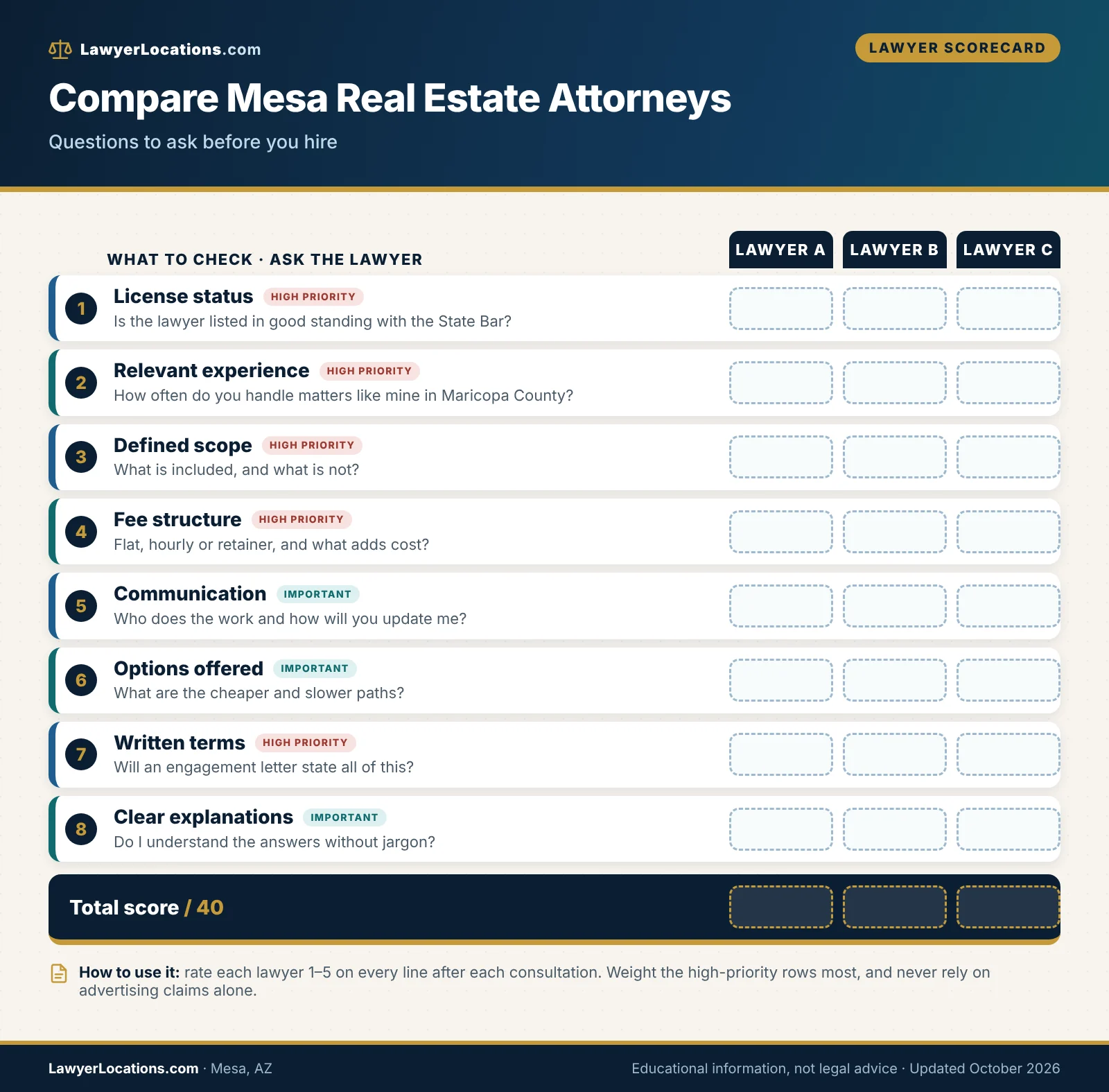
Text version of this graphic
- License status: is the lawyer in good standing in the State Bar of Arizona directory?
- Relevant experience: how often does the lawyer handle matters like yours in Maricopa County?
- Scope: what exactly is included, and what is not?
- Fee structure: hourly, flat or retainer, and what triggers extra charges?
- Communication: who will you deal with, and how will updates be sent?
- Strategy: what are the realistic paths, including cheaper ones?
- Written terms: will the engagement letter spell out the above?
- Fit: do you understand the answers without jargon?
Questions worth asking
- Is my situation one where a lawyer is necessary, or could escrow, title or the broker handle it?
- How often do you handle this kind of Arizona matter, and in which courts or offices?
- What are the realistic options, including the cheaper and slower ones?
- How will you charge me (hourly, flat, retainer), and what extra costs should I expect?
- Who will do the work, and how will you keep me updated?
- What do you need from me, and by what dates?
- If the matter turns into a lawsuit, how would your fee terms change?
Ask for the answers in an engagement letter. A good letter states the scope, the fee basis, how deposits are handled and how either side can end the relationship.
Red flags to watch for
- Promises about the result of a dispute or a guaranteed timeline.
- Pressure to sign or pay the same day, or “limited time” language.
- Vague answers about fees, or refusal to put terms in writing.
- Unlicensed people or businesses offering legal advice or presenting themselves as a law practice.
- Someone who contacts you first, claims to represent a lawyer and asks for payment.
If a person or website claims a formal specialization, check the State Bar directory yourself. If you cannot find the credential there, ask the person to explain where it comes from before you pay anything.
If You Have a Fee Problem Later
Fee disagreements are rarer than people fear, but it helps to know there is an off-ramp. The State Bar of Arizona runs a Fee Arbitration Program that is free and voluntary. An arbitrator decides what a reasonable fee is for the legal services performed. It is available only if no litigation is pending to resolve the fee dispute, and the amount in dispute must be $1,000 or more. If both the client and the lawyer agree to arbitrate, the decision is a binding award. The program’s number is 602.340.7379.
When arbitration fits
It fits when you disagree about how much you owe for work already done, the amount is at least $1,000, and neither side has sued over the fee. You do not need a lawyer to participate. It does not decide whether the lawyer’s work was good, and it is not a substitute for a complaint about misconduct.
Keeping your own records
Save the engagement letter, every invoice, payment proof and key emails. If a dispute ever arises, a clean paper trail is worth more than memory. Ask for itemized bills in the first month so you can raise a concern early rather than at the end.
Fees, Deadlines and Decision Points in Mesa
Real estate attorney fees in Mesa depend on the kind of work, the lawyer’s billing model and how contested the matter becomes. This guide does not publish an “average” fee, because no verified official source sets one. What you can do is learn the common structures, know which costs belong to other parties, and map the deadlines that drive decisions.
How Real Estate Attorneys Commonly Charge
Arizona lawyers use the same broad billing models found across the country. Which one fits depends on whether the work is a defined task, an open-ended negotiation or a lawsuit.
Flat fees and hourly rates
A flat fee is a set price for a defined task, such as reviewing a purchase contract, drafting a deed or preparing a beneficiary deed. It gives you certainty, but only for the scope described. An hourly rate bills the time actually spent and fits open-ended work such as negotiating a dispute or responding to a title problem. Ask for an estimate range and agree on a point at which the lawyer will check in with you before spending more. The State Bar directory lets lawyers publish typical hourly, flat and contingency fee information on their profiles, which can help you compare before you call.
Retainers, deposits and contingency fees
Many lawyers ask for an advance deposit, often called a retainer, and then bill against it. Ask whether the money is held in a client trust account until earned, how you will receive invoices and whether unused funds are refunded. A contingency fee, where the lawyer is paid a percentage only if you recover money, is uncommon in routine transactional work and is more likely to appear, if at all, in some disputes where money damages are the goal. Any contingency arrangement should be in writing and should explain how costs are handled.
Ask one question that exposes the whole structure: “Under what circumstances would my bill go beyond the number you just gave me?” A clear answer is a good sign. A hedge is a reason to ask again in writing.
| Fee structure | Usually used for | Main benefit | What to ask |
|---|---|---|---|
| Flat fee | Contract review, deed drafting, a single defined document | Predictable cost | What is included, and what triggers extra charges? |
| Hourly rate | Negotiations, title cures, disputes of uncertain length | Pay for time used | Who bills time, in what increments, and what is your estimated range? |
| Advance deposit (retainer) | Larger or ongoing matters | Funds work to begin | Is it in a trust account, and how are unused funds returned? |
| Contingency | Less common; some money-recovery disputes | No fee unless there is a recovery | What percentage, which costs do I owe, and what if there is no recovery? |
| Limited-scope arrangement | One task in a larger matter, such as a single hearing or document review | Lower total spend | Exactly which tasks are covered, and who handles the rest? |
Costs That Are Not Attorney Fees
People often confuse legal fees with other charges that show up in a Mesa transaction. Knowing who charges what helps you ask the right person the right question.
Escrow, title and association charges
Escrow companies and title insurers charge their own fees, which are separate from any lawyer’s bill. In an HOA community, the resale disclosure fees described in Section 3 are regulated by A.R.S. § 33-1806, and charging unauthorized fees can lead to a civil penalty. Ask for a written estimate of closing costs early, and ask your lawyer to flag any charge that looks unusual. The Arizona Department of Real Estate publishes consumer materials, including a Buyer Advisory, that can help you know what to expect.
Recording and court costs
The Maricopa County Recorder charges to record documents, and its website has a recording fees page. Court filing fees and fee-waiver rules are set by the court, and they change, so check the current schedule on the court’s website or with the clerk instead of relying on a number printed in an article. If you cannot afford filing fees, ask the court or a legal aid organization about fee deferral and waiver options.
| Cost item | Who sets or charges it | Where to confirm the current amount |
|---|---|---|
| Legal fees | Your attorney, under a written engagement letter | The engagement letter; compare in a consultation |
| Escrow and title fees | The escrow company and title insurer you use | Written closing cost estimate from the escrow officer |
| HOA resale disclosure fees | Association or manager, within the caps in A.R.S. § 33-1806 | The disclosure package and the statute |
| Recording fees | Maricopa County Recorder | Recorder’s Recording Fees page |
| Court filing fees | The court where you file | Court’s current fee schedule or the clerk |
| HOA hearing petition fee | Set by the Arizona Department of Real Estate commissioner | The department’s petition form and fee notice |
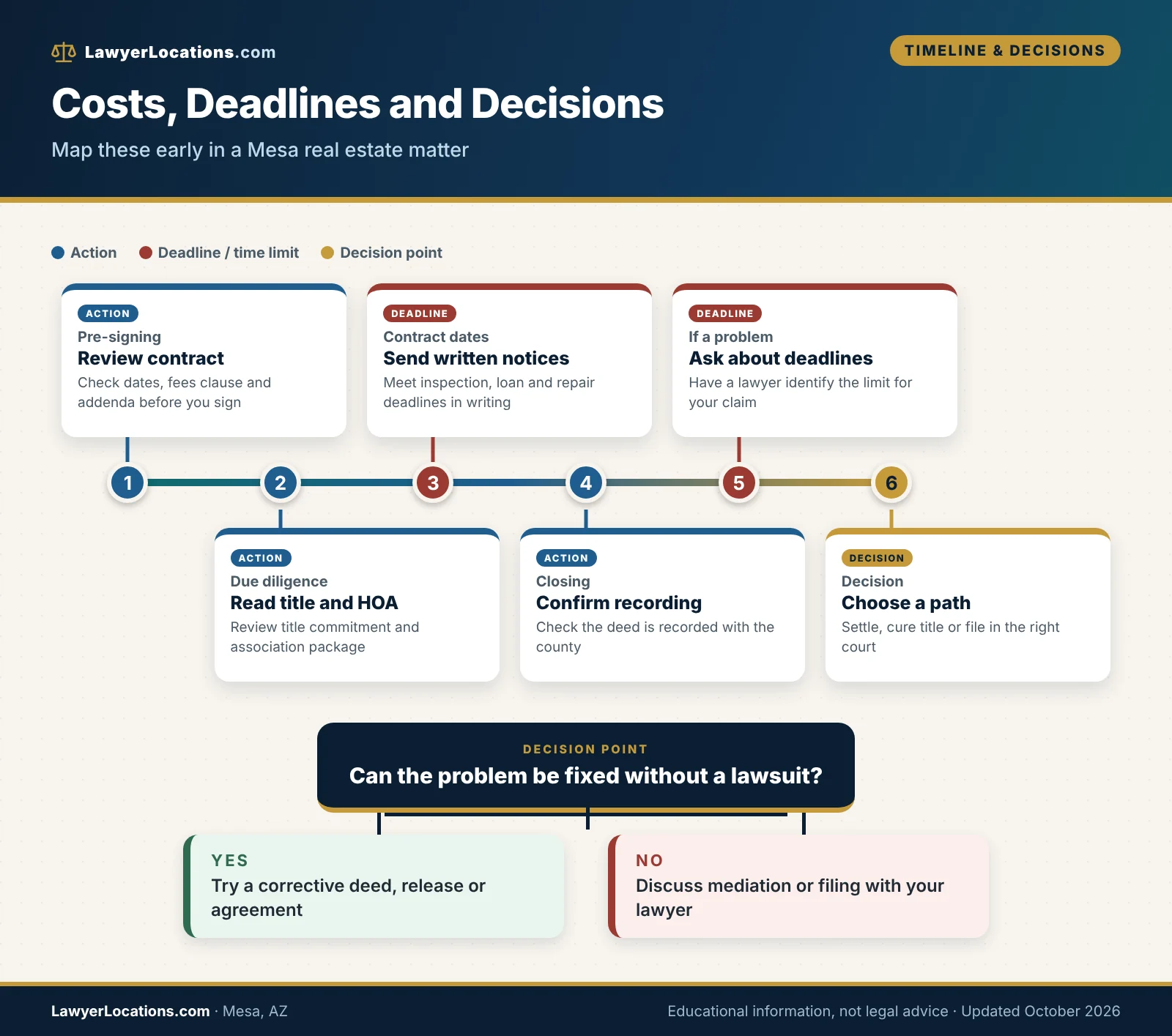
Text version of this graphic
- Before you sign: have the contract and any addenda reviewed if anything is unusual.
- Due diligence window: inspect, read the title commitment and the HOA package.
- Within about 10 days of accepted offer: HOA package is due (A.R.S. 33-1806; confirm the facts for your community).
- Contract deadlines: send written notices on time and keep proof.
- Closing and recording: confirm the deed is recorded with the Maricopa County Recorder.
- After a problem appears: ask a lawyer to identify the legal deadline for your type of claim.
- Decision point: settle, cure the title defect, or file in the correct court.
Deadlines and Decision Points
Deadlines come from three places: your contract, Arizona statutes and the rules of whichever court or agency is involved. Missing any of them can cost you leverage or a claim, so write them all down at the start.
Contract and association deadlines
Purchase contracts set dates for inspections, repair requests, loan approval and closing. These are the dates most buyers and sellers actually miss, and they are often strict. Keep a calendar, give any required notices in writing, and keep proof of delivery. For HOA communities, the disclosure timing in A.R.S. § 33-1806 (10 days, as described above) means a buyer should expect the package soon after the offer is accepted and should read it promptly.
Written notice deadlines in your purchase contract are among the easiest to miss and the hardest to fix afterward. If a date is approaching and you are unsure what to send, call your broker and a lawyer the same day rather than waiting.
Statutory and court deadlines
Statutes of limitation set the last day to file a claim. For a debt founded on a written contract executed in Arizona, the limit is six years under A.R.S. § 12-548, running from when the claim accrues, but other types of claims have their own periods and exceptions. Evictions run on much shorter timelines that are measured in days, and an appeal of an eviction judgment has a very short window. Property tax valuation appeals have their own deadlines, which the Maricopa County Assessor and the state board of equalization explain on their websites. Do not guess: ask a lawyer or the agency to confirm the deadline in writing, and do it as early as possible.
| Decision point | Common options | Who to involve |
|---|---|---|
| Reviewing a purchase contract | Sign as written; ask for changes; walk away within contract terms | Broker, and a lawyer if terms are unusual |
| Spouse not on title or unavailable | Obtain joinder; delay the transaction; seek legal solutions | Lawyer and title company |
| Title defect found | Corrective deed or release; title insurance claim; quiet title lawsuit | Lawyer and title company |
| HOA package shows liens or lawsuits | Negotiate; require payoff at closing; renegotiate price; cancel if the contract allows | Broker, escrow and a lawyer |
| Contract dispute | Negotiate; mediate; sue or defend; settle | Lawyer, with attention to any fee clause and A.R.S. § 12-341.01 |
| Passing a home to heirs | Beneficiary deed; trust; will and probate | Estate planning lawyer and, for recording, the Recorder |
Preparing, Avoiding Mistakes and Taking Next Steps
You get the most from a consultation when you arrive organized, know the common traps and have clear questions. This section gives you a document checklist, a short list of mistakes that cost Mesa-area owners money, and straight answers to common questions about hiring a real estate attorney in Mesa, AZ.
Documents and Information to Gather
Bring copies, not originals. If you cannot find something, say so, because your lawyer or title company may be able to pull it from county records.
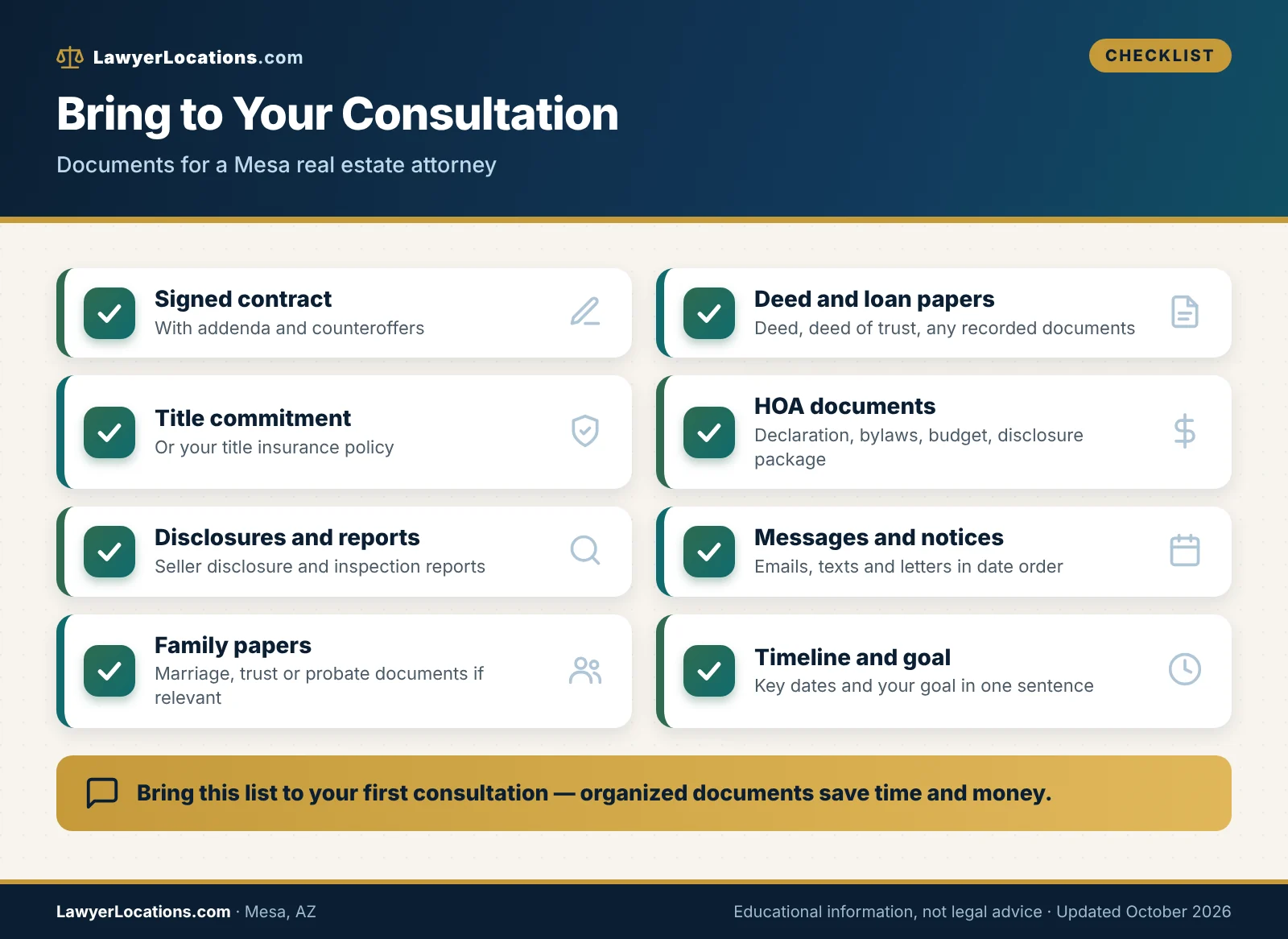
Text version of this graphic
- Signed purchase contract, addenda and counteroffers.
- Deed, deed of trust and any recorded documents you already have.
- Title commitment or title insurance policy.
- HOA declaration, bylaws, budget and resale disclosure package.
- Seller’s Property Disclosure Statement and inspection reports.
- Emails, texts and notices exchanged with the other party.
- Marriage, trust or probate documents if they affect ownership.
- A one-page timeline and your goal in one sentence.
For buyers and sellers in a transaction
- The signed contract, every addendum and every counteroffer.
- The title commitment and the list of exceptions it shows.
- Association documents and the resale disclosure package, if the home is in an HOA.
- Seller disclosures and inspection reports.
- Escrow instructions and the closing cost estimate.
Add a short written timeline of key dates and your goal in one sentence. A lawyer can usually give more useful advice in 30 minutes when you arrive with that than when you arrive with a shoebox of papers.
For owners with a title, estate or dispute problem
- Your deed and any deed of trust, release or lien paperwork you have.
- The recorded documents from the Maricopa County Recorder’s search, if you can find them.
- Marriage, divorce, trust or probate papers if they affect who owns the property.
- Letters, emails and texts with the other side, in date order.
- Photos, surveys or repair estimates that relate to the problem.
If a family member has died, add the death certificate and any will or trust. If the dispute involves an association, add the notice letters and the declaration pages the association cited.
Mistakes That Cost Owners Money
Most expensive mistakes are avoidable. They come from rushing, assuming and not asking.
Transaction mistakes
- Signing a contract without reading the dispute resolution, attorney fee and cancellation clauses.
- Missing a written notice deadline and assuming the other side will be flexible.
- Skipping the title commitment and association package because the transaction feels routine.
- Recording or signing a deed without both spouses where community property may be involved.
- Sending wire funds based on emailed instructions without a call-back to a verified number.
The common thread is that each mistake feels small in the moment and expensive later. A short legal review at the right moment is often cheaper than repairing the problem afterward.
Hiring and communication mistakes
- Hiring without a written engagement letter that states scope and fees.
- Choosing a lawyer from an ad or a cold call without checking the State Bar directory.
- Waiting until a deadline is days away to ask for help.
- Withholding facts that seem embarrassing. Your lawyer needs the full picture to protect you.
- Assuming that this website, or any article, creates an attorney-client relationship. It does not.
Quick Answers to Common Questions
These short answers reflect Arizona law and Maricopa County practice as of October 2026. Details can change and depend on your facts, so confirm them with a licensed Arizona lawyer.
Fees, hiring and consultations
Do I need a real estate attorney to buy a house in Mesa?
No. Arizona does not require one. Escrow and title companies conduct the closing and brokers complete the standard forms. A lawyer is optional and most useful when something is unusual, such as a title problem, a missing spouse, a contract dispute or an association issue.
How much does a real estate attorney in Mesa cost?
It depends on the work and the lawyer’s billing model. Flat fees for a defined task and hourly rates for open-ended work are the most common. No verified official source sets an average, so ask for a written fee quote or range, and compare at least two lawyers.
How do I find a real estate attorney near me?
Search the State Bar of Arizona member directory by legal need, confirm the person is licensed, and then compare fee terms and communication style in a consultation. Ask for referrals, but verify each name yourself.
Can I get free or low-cost real estate legal help in Mesa?
Possibly. Community Legal Services and the Maricopa County renter resources offer help to people who qualify, mostly in housing matters. The State Bar’s fee arbitration program is free, but it only resolves fee disputes with a lawyer you already hired. Eligibility rules apply to all of these.
Documents, disputes and deadlines
Can my real estate agent give me legal advice?
No. Arizona’s Constitution lets licensed brokers draft or complete transaction documents for the parties they represent, but that is different from advising you on your legal rights. For legal advice, consult a lawyer.
Does my spouse have to sign when I sell our house?
Generally yes. Under A.R.S. 25-214, both spouses must join in most real property sales and encumbrances of community property, with narrow exceptions. A lawyer can advise on special situations such as separate property or a divorce in progress.
How long do I have to sue over a broken real estate contract?
For a debt claim founded on a written contract executed in Arizona, the limit is six years under A.R.S. 12-548. Other claims have different limits and special rules, so ask a lawyer to identify the deadline for your specific claim as early as possible.
Can I pass my Mesa home to my children without probate?
Arizona allows a beneficiary deed under A.R.S. 33-405 if it is properly executed and recorded with the Maricopa County Recorder before the owner dies. A trust is another route. A lawyer can explain which fits your family and mortgage situation.
Where do I file a lawsuit about my Mesa property?
Title and contract suits are generally filed in the Maricopa County Superior Court, which has a Southeast Facility in Mesa. Evictions go to a Maricopa County justice court. A lawyer will confirm the correct venue for your case.
Ready to compare your options?
Write down your goal, gather the documents in the checklist above and use the State Bar of Arizona member directory to confirm each lawyer’s license before you call. If your question involves a business entity that owns Mesa property, our Maricopa County business attorney guide may help. For a real estate attorney in Mesa, AZ, choose the one who explains the options clearly and puts the fee terms in writing.
General information only. This article is legal education, not legal advice, and reading it does not create an attorney-client relationship. LawyerLocations.com is not a law firm and does not endorse or rank any lawyer. Laws, fees, court rules and agency procedures change, and your facts matter. Consult a lawyer licensed in Arizona about your specific situation.
Sources & References
Show all 21 sources
- Arizona Revised Statutes § 25-214, Management and control of community property — Arizona Legislature — azleg.gov — accessed October 2026
- Arizona Revised Statutes § 12-341.01, Recovery of attorney fees — Arizona Legislature — azleg.gov — accessed October 2026
- Arizona Revised Statutes § 12-548, Written contracts and credit card debt — Arizona Legislature — azleg.gov — accessed October 2026
- Arizona Revised Statutes § 12-1101, Quiet title actions — Arizona Legislature — azleg.gov — accessed October 2026
- Arizona Revised Statutes § 33-405, Beneficiary deeds — Arizona Legislature — azleg.gov — accessed October 2026
- Arizona Revised Statutes § 33-1806, Planned community resale disclosure — Arizona Legislature — azleg.gov — accessed October 2026
- Arizona Revised Statutes § 32-2199.01, Condominium and planned community hearing petitions — Arizona Legislature — azleg.gov — accessed October 2026
- Arizona Revised Statutes § 28-8486, Territory in the vicinity of a public airport — Arizona Legislature — azleg.gov — accessed October 2026
- Arizona Constitution, Article 26, Section 1, Powers of real estate broker or salesman — Arizona Legislature — azleg.gov — accessed October 2026
- Superior Court Southeast Facility, Mesa — AZ Court Help — azcourthelp.org — accessed October 2026
- Maricopa County Justice Courts — Maricopa County Justice Courts — justicecourts.maricopa.gov — accessed October 2026
- Eviction Action Timeline (EA 8150-219) — Maricopa County Justice Courts — justicecourts.maricopa.gov — accessed October 2026
- Maricopa County Recorder’s Office — Maricopa County Recorder — recorder.maricopa.gov — accessed October 2026
- Maricopa Title Alert — Maricopa County Recorder — recorder.maricopa.gov — accessed October 2026
- Fee Arbitration Program — State Bar of Arizona — azbar.org — accessed October 2026
- Find a Lawyer / Member Directory — State Bar of Arizona — azbar.org — accessed October 2026
- Buyer Advisory — Arizona Department of Real Estate — azre.gov — accessed October 2026
- Legal Document Preparer Program — Arizona Supreme Court, Certification and Licensing Division — azcourts.gov — accessed October 2026
- Legal Assistance for Renters — Maricopa County — maricopa.gov — accessed October 2026
- Serving Arizona Since 1952 — Community Legal Services — clsaz.org — accessed October 2026
- How to Appeal — Arizona State Board of Equalization — sboe.az.gov — accessed October 2026
Legal Disclaimer and Limitation of Liability
Informational and illustrative purposes only. This article was prepared by LawyerLocations.com solely on the basis of the information available to us at the time of writing. It is an illustrative, general overview. It is not a complete or authoritative statement of the law, and it has not been reviewed by a lawyer licensed in your state or county.
Not legal advice. Nothing in this article is legal, financial, tax or immigration advice, and reading it does not create an attorney-client relationship between you and LawyerLocations.com or any author, lawyer or firm mentioned. Laws, court rules, fees, filing deadlines and agency procedures differ by state, county and court, and they change often. Some details here may be simplified, incomplete or out of date, and time limits for legal claims can be short.
No warranty. We make no representation or warranty, express or implied, about the accuracy, completeness, timeliness or suitability of this content for your situation. Please do not rely on it to make, delay or skip any legal decision. Check the facts against official sources and speak with a licensed attorney in the relevant jurisdiction before you act.
Limitation of liability. To the fullest extent permitted by law, LawyerLocations.com and its owners, authors and contributors disclaim all liability for any loss, damage, cost or other consequence arising from the use of, or reliance on, this article, including any content on third-party websites we link to. Mentioning a lawyer, firm, organization or service is not an endorsement and is not a promise of any result. If you are in immediate danger, contact your local emergency number.