Finding a real estate lawyer in Los Angeles, CA means matching the problem to the right kind of attorney: a transaction lawyer for a purchase, sale, title or contract question, or a litigator for a property dispute that may end up in the Los Angeles County Superior Court. California law, not city law, sets most of the rules, but Los Angeles adds its own seller report, transfer-tax rules, courthouses, referral services and legal-aid groups. California requires a written fee agreement when a lawyer’s total fees and costs will reasonably exceed $1,000, so ask for one before you pay anything.
This guide explains what a real estate lawyer does here, how a matter moves through the California system, which Los Angeles agencies and courts matter, how to compare attorneys, how fees and consultations usually work, and what to bring to a first meeting. General information only, not legal advice.
What a real estate lawyer does in Los Angeles
A real estate lawyer is a licensed attorney who advises on, drafts and, when needed, litigates matters involving land, buildings and the contracts around them. In Los Angeles most people hire one for a specific problem, not for every sale. The two big categories are transactional work (reviewing or drafting documents before something is signed) and disputes (resolving a conflict after something goes wrong).
The two kinds of real estate legal work
Transactional work: deals, contracts and title
Transactional lawyers review purchase agreements, counteroffers, addenda, leases, easement documents, trust or LLC transfers and title reports. They are most useful before you sign, because changing a clause costs far less than litigating one. Typical questions include whether a contingency deadline is realistic, what a title exception means, and whether a deed will accomplish what you intend.
If your question is mainly about the closing itself, our guide to a closing attorney in Los Angeles County covers that narrower job in more detail.
Dispute work: negotiation, mediation and court
Dispute lawyers handle conflicts such as a seller who allegedly hid a defect, a buyer who walked away from a deal, a neighbor who built across a line, co-owners who cannot agree, or a contractor who left a project unfinished. Many of these matters settle after a demand letter or mediation. Some require filing in court to preserve rights before a deadline passes.
For a county-wide view of disputes, see our guide to a property dispute lawyer in Los Angeles County.
Who does what in a Los Angeles sale
Escrow, title, agents and lawyers are different jobs
California residential sales are typically run through a neutral escrow holder and a title company, with licensed real estate agents on each side. The escrow officer follows the written instructions both parties sign. The escrow officer does not give legal advice, and neither does a title officer. An agent can explain the market and the standard forms but cannot advise on legal rights.
escrow is a neutral third-party arrangement in which money and documents are held until every condition of the sale is met. The escrow holder acts only on instructions that both sides have signed.
Where a lawyer adds something the others cannot
A lawyer is the only person in this group who can give you legal advice and act as your advocate. That matters when the contract language is unusual, when a title problem surfaces, when the other side threatens to cancel, or when you want someone to draft a demand or negotiate a settlement. A lawyer’s loyalty runs to you, whereas the escrow holder serves both sides.
| Role | What they typically do | What they cannot do for you |
|---|---|---|
| Real estate agent or broker | Prices the property, markets it, helps complete standard forms and relays offers | Give legal advice on your rights or draft a legal remedy |
| Escrow officer | Holds funds and documents, follows signed instructions, coordinates closing | Take your side or advise you on a dispute with the other party |
| Title company | Researches recorded ownership, issues the title report and title insurance | Resolve a defect by itself or advise how to cure it |
| Home inspector | Reports on visible condition of the structure and systems | Interpret contract rights or decide who pays for a repair |
| Real estate attorney | Advises you, reviews or drafts documents, negotiates, and represents you in court | Promise an outcome or act for both sides in a contested matter |
Common property problems that send people to a lawyer
Ownership and boundary questions
These include unclear title, a missing name on a deed, a recorded lien nobody expected, an easement that blocks a planned project, a fence or structure on the wrong side of a line, and co-owners who cannot agree on selling. Venue for title and land cases generally follows the county where the property sits, which for Los Angeles properties means the Los Angeles County Superior Court.
The fix often begins with a close read of the recorded documents. A lawyer can tell you whether the issue calls for a negotiated agreement, a corrective deed, a title-insurance claim or a lawsuit.
Sale, disclosure and contract disputes
Most sale disputes turn on two things: what the written contract required and what the seller disclosed. In California, a seller of covered residential property must deliver a Real Estate Transfer Disclosure Statement under Civil Code section 1102 and following, and a buyer who receives a required disclosure after making an offer has a short window to terminate. The mechanics appear in the next section.
Before you call anyone, write a one-page timeline: date of the offer, each document you signed, each deadline in the contract, and the date you first noticed the problem. A dated timeline makes a first meeting faster and cheaper.
How a real estate matter works under California law
Real estate matters in Los Angeles follow California statutes, and the clock is often set by the contract and by the statute together. Most of your leverage comes from acting before a contract deadline or a limitation period expires. This section walks through a typical transaction, then the point where it turns into a dispute.
The life of a transaction, step by step
From offer to opening escrow
A residential deal starts with a written offer. Once the parties sign a purchase agreement, escrow opens and the contingency clock begins: inspections, financing, appraisal and disclosure review each have deadlines written into the contract. Missing a contingency deadline can weaken a buyer’s right to cancel and keep the deposit, so these dates deserve a lawyer’s attention if the deal is unusual.
If you are a seller, the City of Los Angeles adds a step before escrow closes. That requirement is covered in the local section below.
Disclosures and the buyer’s right to terminate
Under Civil Code section 1102.3, a buyer can terminate only if a required disclosure, or a material amendment to one, is delivered after the buyer has made an offer. The termination right runs 3 days after in-person delivery, or 5 days after the disclosure is mailed or delivered electronically (electronic delivery only counts if the parties agreed to transact electronically). The buyer must give written notice of termination to the seller or the seller’s agent.
The 3-day and 5-day periods are short and run from delivery, not from when you read the document. If a disclosure arrives late, speak with a lawyer the same day about whether to send a written notice of termination.
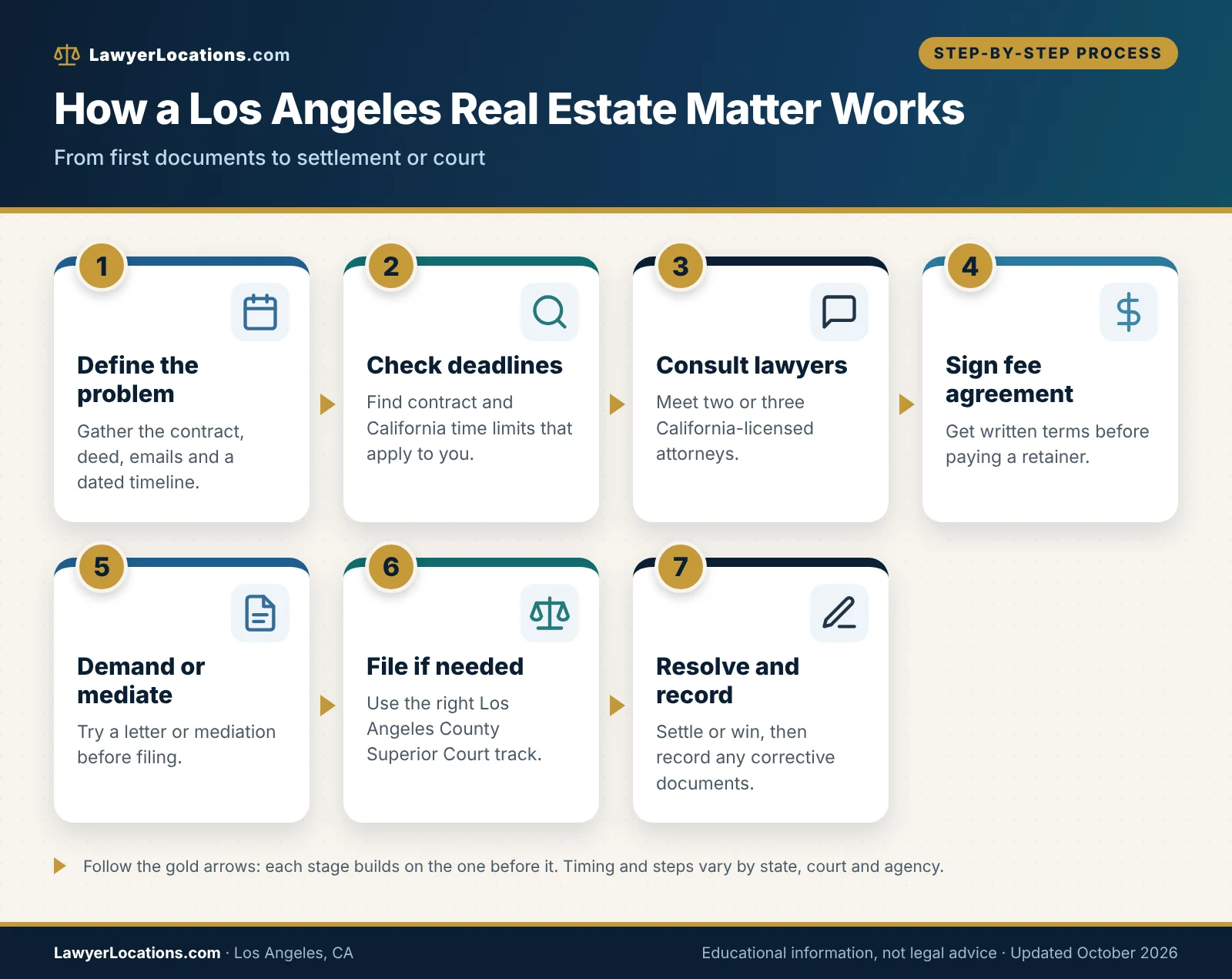
Text version of this graphic
- Define the problem and gather the contract, deed and emails.
- Check the deadlines in the contract and in California law.
- Request a consultation with a California-licensed real estate attorney.
- Review the fee agreement in writing before paying.
- Send a demand or negotiate, often with a mediator.
- If needed, file in the Los Angeles County Superior Court.
- Resolve by settlement, judgment or corrective documents, then record what must be recorded.
When a transaction turns into a dispute
Deadlines that decide whether you have a claim
California sets different limitation periods for different claims, and the right one depends on what happened, so the table below is a starting map and not a substitute for advice. An action on a written contract generally must be filed within four years under Code of Civil Procedure section 337. Trespass on, or injury to, real property and fraud or mistake claims generally carry three-year periods under section 338, and the fraud and mistake clock starts when the injured party discovers the facts.
For construction-related problems, section 337.15 sets a ten-year outer limit for claims about latent deficiencies in an improvement to real property, measured from substantial completion, with exceptions such as willful misconduct and fraudulent concealment. A latent deficiency is one that reasonable inspection would not reveal.
| Situation | Rule | Where it comes from |
|---|---|---|
| Buyer terminates after a late required disclosure | 3 days after in-person delivery; 5 days after mailing or agreed electronic delivery | Civil Code § 1102.3 |
| Action on a written contract | Generally 4 years | Code of Civil Procedure § 337 |
| Trespass on or injury to real property | 3 years | Code of Civil Procedure § 338(b) |
| Fraud or mistake | 3 years, starting when the facts are discovered | Code of Civil Procedure § 338(d) |
| Latent construction deficiency | 10 years from substantial completion, with exceptions | Code of Civil Procedure § 337.15 |
| Client request for State Bar fee arbitration | 30 days after receiving the attorney’s notice of the right to arbitrate | State Bar fee-arbitration program |
Notice, demand and mediation before filing
Many purchase contracts require mediation before anyone can sue, and a lawsuit filed too early can cost you a fee award. A lawyer will read the dispute clauses first. A well-written demand letter that cites the contract, states the facts and proposes a fix resolves a surprising number of disputes.
Keep your tone factual in anything you send. Anything you write may be an exhibit later.
Courts and filing choices in Los Angeles County
Which kind of case goes where
The Los Angeles County Superior Court is a single court system with many courthouses. Its civil division lists four categories: limited (collections), limited (non-collections), small claims and unlimited. A limited civil case has an amount in controversy of no more than $35,000 under Code of Civil Procedure section 85, counting the demand, the value of property or the amount of a lien but not attorney fees, interest or costs. Small claims is capped at $12,500 for an individual under section 116.221, with statutory exceptions.
Real estate disputes often involve more than money. A request to decide who owns land, to end a co-ownership or to cancel a deed seeks relief a small claims court generally cannot grant, so the dollar amount alone does not tell you which court fits.
Using the court’s locator and self-help tools
The court publishes a Filing Court Locator and a Civil Courthouses page showing which courthouse takes which case type. It also runs a free online dispute-resolution program for eviction cases and operates a Shriver Los Angeles housing self-help center. Check the court’s current pages before you file, because courthouse assignments and department numbering change.
A lawyer familiar with the court knows the practical details: how fast a hearing can be set, how departments handle motions, and how mediation is typically ordered.
| Court track | Amount in controversy | Typical fit | Lawyer needed? |
|---|---|---|---|
| Small claims | Up to $12,500 for an individual (exceptions apply) | Deposit disputes and simple money claims between people | Designed for people without lawyers |
| Limited civil | Up to $35,000 | Smaller contract, repair and money disputes | Often helpful; many people still hire one |
| Unlimited civil | Above $35,000, or relief reserved to unlimited cases | Title, partition, major contract and construction disputes | Strongly advisable |
| Unlawful detainer (eviction) | Special summary procedure | Landlord-tenant possession cases; court offers free online dispute resolution | Time-sensitive; get help immediately |
Los Angeles agencies, courts and local resources
Los Angeles layers city, county and state offices on top of California law. Which office matters depends on whether the property is inside the City of Los Angeles, in another city in the county, or in an unincorporated area. Check the property’s address with the county before assuming a city rule applies.
City of Los Angeles rules that touch a sale
The seller’s Residential Property Report
The Los Angeles Department of Building and Safety (LADBS) says that the seller of residential property in the City of Los Angeles must apply to the City for a report of Residential Property Records and Pending Special Assessment Liens, often called the RPR or Form 9, and cite Los Angeles Municipal Code section 96.300. The seller must deliver the report to the buyer before the agreement of sale or exchange, or before close of escrow. LADBS lists the fee at $70.85 per report as of October 2026; confirm the current fee on the department’s page.
Why it matters: the report surfaces recorded permit and code information a buyer should see. A seller who skips it, or a buyer who never receives it, may later face a dispute over what was disclosed. Raise it with your lawyer or escrow officer early.
If you are buying a City of Los Angeles home and no one has mentioned the city’s residential property report, ask your agent and escrow officer about it in writing. Do not rely on a verbal assurance.
Measure ULA and other transfer taxes
Measure ULA is a City of Los Angeles transfer tax on high-value property sales. It is imposed on each qualifying sale, not annually, and sits on top of the City’s ordinary transfer tax and the county documentary transfer tax. Its price thresholds start in the millions of dollars and are adjusted each year, so most home sales fall below them. Some exemptions have been proposed or placed before voters in 2026, and the City’s Director of Finance issues implementation rules.
If your sale price is near a threshold, the tax can change the economics of timing, structure and who pays. That is a conversation for a real estate or tax attorney well before listing, and you should check the City Finance Office’s current published rates rather than a marketing blog.
A seller with a high-value property asks whether to sign a purchase agreement now or wait for a July threshold adjustment. A lawyer would review the contract’s allocation of transfer taxes, check the City’s current schedule and flag the closing-date risk, without promising a result.
County records, fraud protection and filing venues
Recorded documents and the property owner alert program
Deeds, liens, deeds of trust and notices of pendency of action (called lis pendens) are recorded with the county recorder where the property sits. A lis pendens may be recorded by a party who asserts a real property claim in a lawsuit under Code of Civil Procedure section 405.20, and it warns the world that title is in litigation. Because it can freeze a sale, courts take improper filings seriously, and you want a lawyer’s advice before recording one.
The California Department of Real Estate lists county property-owner alert programs that notify you when a document is recorded against your property, and it lists Los Angeles County among those offering electronic notifications. Signing up is a low-cost way to catch a forged or fraudulent deed early.
Venue: city, district and county
Because the Los Angeles County Superior Court is a county-wide court, a dispute over a Los Angeles property is filed in that court rather than in a city-level court. The court’s Filing Court Locator tells you which courthouse hears your case type. Lawyers also consider whether a contract’s venue clause, an arbitration clause or a mediation requirement changes the first step.
If your property is in San Diego rather than Los Angeles, the local courts and resources differ; compare with our guide to a real estate attorney in San Diego County.
Free and low-cost help in Los Angeles
Legal aid for housing and property problems
Legal Aid Foundation of Los Angeles (LAFLA) lists eviction defense, housing and homelessness, tenant harassment and related services, and states that it assists only people with income under 125 percent of the federal poverty guidelines, with some exceptions for people above that line. Applications are available through its website. Other nonprofits in the county serve tenants and low-income homeowners, so a legal-aid screen is worth doing before you pay a private fee.
Legal aid typically focuses on housing stability. For purely commercial deals or investment disputes you will likely look to private counsel or a referral service.
Lawyer referral services and bar programs
The State Bar of California publishes a list of certified lawyer referral services serving the Los Angeles area. It includes the Los Angeles County Bar Association Lawyer Referral and Information Service (SmartLaw), the San Fernando Valley Bar Association referral service, the South Bay Bar Association service, the San Gabriel Valley Lawyer Referral Service and others. These services match you with participating lawyers, and each sets its own rules for fees and initial consultations, so ask before booking.
A referral is a starting point, not an endorsement. You still need to check the lawyer’s license, experience and written fee terms yourself.
| Office or program | What it does for you | When to use it |
|---|---|---|
| Los Angeles County Superior Court | Hears civil, small claims and eviction cases; publishes a Filing Court Locator; runs self-help programs | Before filing, to choose the right courthouse and case type |
| LADBS | Processes the seller’s Residential Property Report under LAMC § 96.300; handles building permits and records | Selling or buying residential property in the City of Los Angeles |
| City of Los Angeles Director of Finance | Issues implementation rules for Measure ULA | High-value sales near the tax thresholds |
| County recorder | Records deeds, liens and notices; some programs alert owners to new filings | Title concerns, suspected deed fraud, lis pendens |
| Legal Aid Foundation of Los Angeles | Free civil legal help for eligible low-income residents in housing matters | Eviction, tenant harassment, substandard housing |
| State-certified referral services | Matches you with participating lawyers; terms vary | You have no lawyer and need a starting list |
| State Bar fee arbitration | Resolves attorney fee disputes with a client | You and a lawyer disagree about a bill |
How to compare real estate lawyers in Los Angeles
Comparing lawyers is a screening exercise, not a search for a winner. Verify the license, match the lawyer’s work to your problem, read the fee terms, and notice how clearly the lawyer explains your options. This section gives a repeatable method, whichever way you found the names.
Verify the basics before you book
License and discipline history
Every lawyer who advises on California law should be licensed by the State Bar of California. Use the State Bar’s attorney search to confirm that the person is in good standing and to review any public discipline. Do the check before you send documents, not afterward, and write down the bar number you find.
If a firm lists several names, ask who will actually work on your matter. Many firms use associates or paralegals for routine tasks, which is fine when disclosed.
Experience that matches your problem
Real estate law is broad, and a lawyer who does closings daily may not litigate title disputes. The State Bar certifies legal specialists only in a limited set of fields, so a missing specialty label tells you little; you can check its list. Ask instead how many matters like yours the lawyer has handled recently, how they ended in general terms, and which court or agency steps are involved.
Be wary of any advertisement or caller who claims to be the best or promises a result. Rules of professional conduct restrict misleading claims, and no honest lawyer can promise how a court will rule.
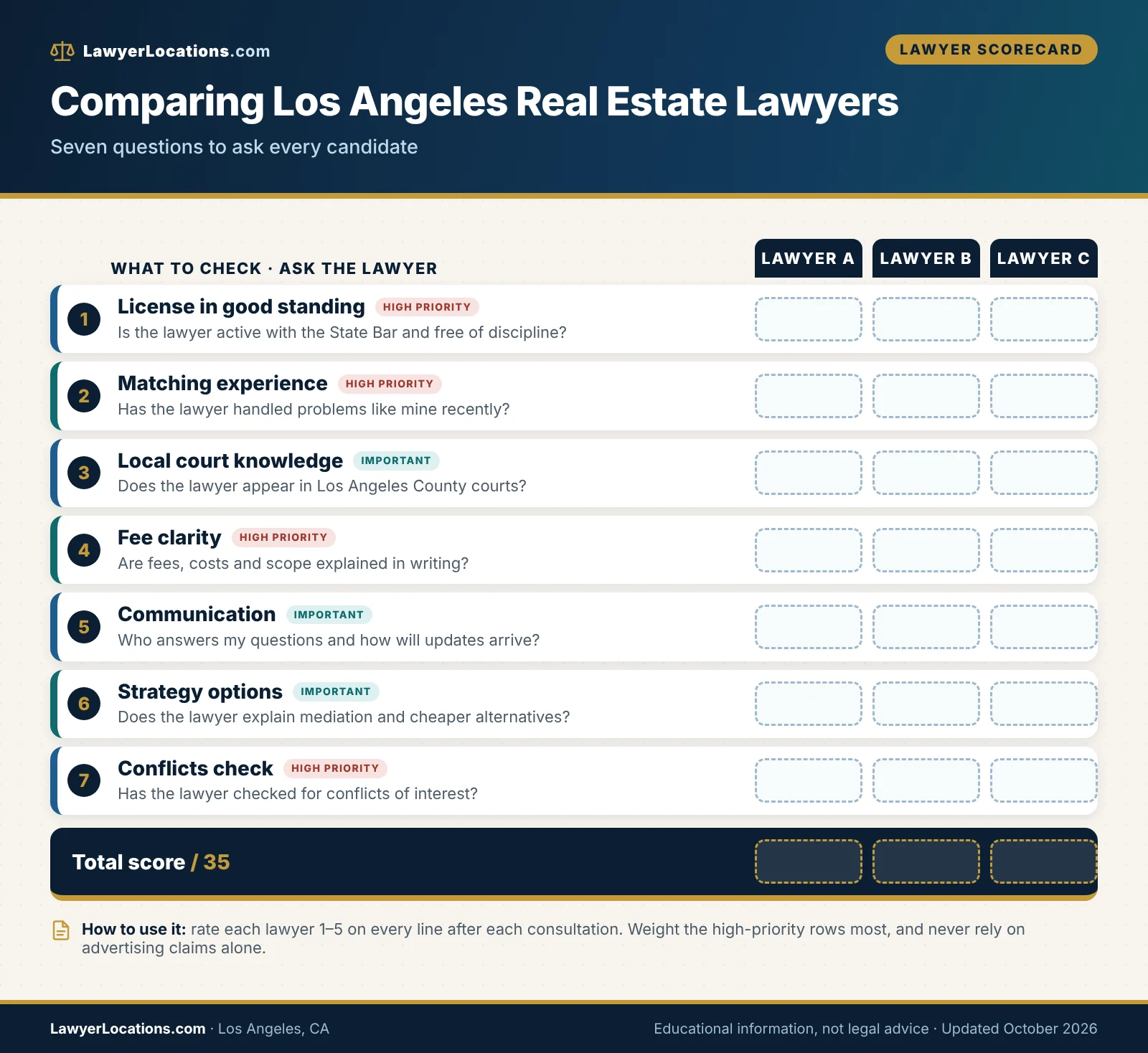
Text version of this graphic
- License and discipline: is the lawyer in good standing with the State Bar?
- Matching experience: has the lawyer handled problems like yours?
- Local court knowledge: does the lawyer regularly appear in Los Angeles County courts?
- Fee clarity: is the fee structure explained in writing?
- Communication: who will answer your questions and how fast?
- Strategy: does the lawyer explain options, risks and alternatives like mediation?
- Conflicts: has the lawyer checked for conflicts of interest?
What to ask in the first consultation
Questions about the case
Bring your timeline and ask what the lawyer sees as the strongest and weakest points, what deadlines are coming, and what a realistic range of outcomes looks like. A good answer is specific and cautious. Be skeptical of an answer that is immediate and absolute.
- What are the top two ways this could go, and what would change them?
- Which deadlines apply to me now, and who calendars them?
- Would you start with a letter, mediation or a filing, and why?
- What facts or documents would hurt my position?
- Is there a cheaper path that gets most of what I want?
Questions about money and staffing
Ask for the fee structure in plain terms: hourly rate, flat fee, retainer, how costs are billed and whether you will get itemized statements. Ask who does the work and at what rate. If a lawyer will not put the terms in writing, move on, because California law expects a written agreement when the total expense will reasonably exceed $1,000.
You will find more on this in the next section.
Warning signs and good signs
Red flags when hiring
Pressure to sign immediately, vague billing, guarantees, refusal to explain strategy and a demand for cash with no written agreement are all warning signs. So is a lawyer who tells you what you want to hear on a point that depends on facts they have not reviewed. Take your time; a short delay rarely harms a case, unless a deadline is days away.
- No written fee agreement when fees will exceed $1,000.
- Promises about the outcome or the speed of a court.
- Unwillingness to name who will work on your file.
- Requests that you wire money to an unfamiliar account without a trust-account explanation.
- A lawyer who also represents the other side without clear written conflict disclosures.
Signs of a careful lawyer
Careful lawyers read your documents before the meeting if you sent them, explain the legal terms they use, identify the next deadline, and describe alternatives like negotiation or mediation. They tell you what they do not know and what they would need to find out. They also give you a written engagement letter that says what the job covers and what it does not.
- You bring a dated timeline and the key documents.
- You ask for the fee terms in writing before paying.
- You compare two or three lawyers on the same questions.
- You choose only on an advertisement or the lowest quote.
- You skip the license check.
- You wait until a contract deadline is hours away.
Fees, consultations and decision points
There is no single price for a Los Angeles real estate lawyer, because the work ranges from a one-hour contract review to a multi-year lawsuit. What you can control is the structure: ask for it in writing, understand what triggers extra charges, and set a budget checkpoint. We do not quote averages because no official source publishes reliable ones for this work.
How real estate lawyers usually charge
Hourly, flat and limited-scope arrangements
Hourly billing is common for disputes and negotiations, because the work is hard to predict. Flat fees are common for defined tasks such as reviewing a contract, preparing a deed or handling a straightforward closing. Some lawyers offer limited-scope (sometimes called unbundled) help, where they handle one task, such as drafting a demand letter or coaching you for a hearing, while you handle the rest.
Each model shifts risk differently. A flat fee gives certainty but the lawyer may decline to expand the scope; hourly billing is flexible but can grow.
Retainers, costs and contingency
A retainer is money you deposit up front, from which the lawyer bills as work is done. Ask whether it is a deposit held in a client trust account or a fee already earned, and how unused funds are returned. Costs such as filing fees, process servers, appraisers and expert witnesses are usually separate from fees.
Some disputes that seek money damages may be offered on a contingency basis, where the lawyer is paid a share of any recovery. California regulates those arrangements through its Business and Professions Code, so insist on a signed writing with the percentage and the cost rules spelled out.
| Structure | How it works | Good fit for | Watch for |
|---|---|---|---|
| Hourly | You pay for time spent, billed against a retainer or invoiced | Disputes, negotiations, uncertain scope | Rate for each timekeeper, minimum billing increments, cost caps |
| Flat fee | One agreed price for a defined task | Contract review, deed drafting, routine closings | What is excluded, and what triggers an add-on charge |
| Limited scope | Lawyer handles only the tasks listed in the engagement letter | Budget-conscious clients who can handle the rest | Gaps between tasks, and deadlines you now own |
| Contingency | Fee is a percentage of money recovered, if any | Some money-damage claims | Percentage, how costs are repaid, and what happens if you lose |
| Retainer | Deposit against future fees and costs | Ongoing representation | Trust-account handling and refund of unused funds |
The fee agreement and what California requires
When a written agreement is required
Under Business and Professions Code section 6148, a written fee contract is required when it is reasonably foreseeable that the total expense to the client, including attorney fees, will exceed $1,000. The attorney must give you a duplicate copy signed by both of you. The contract must state the basis of compensation (hourly rates, statutory or flat fees, other standard charges), the general nature of the services, and each side’s responsibilities.
The statute has exceptions, such as emergencies, services of the same general kind previously rendered and paid for, a client’s knowing written waiver after full disclosure, and corporate clients. If the lawyer does not comply, the agreement is voidable at the client’s option, though the lawyer may still collect a reasonable fee.
Before you sign, ask the lawyer to confirm in the engagement letter what the fee covers (for example, negotiation but not a lawsuit), who bills, what happens if the case ends early, and how disputes about the bill will be handled.
If you disagree with a bill
California’s State Bar runs a Mandatory Fee Arbitration Program. A client can generally request arbitration of a fee dispute, and the arbitration is mandatory for the lawyer if the client requests it, with limited exceptions. If a lawyer claims you owe unpaid fees, the lawyer must give you a notice of your right to arbitrate, and you then have 30 days from receiving it to submit your request and any filing fee.
The process is usually nonbinding unless both sides agree in writing after the dispute arises. A losing party can reject a nonbinding award by filing a court action within 30 days of the award’s mailing. Local bar programs often run these hearings, and the State Bar handles cases where there is no local program.
Cost drivers and fee-shifting in property disputes
What makes a property case expensive
The usual drivers are the number of parties, the amount of documentary evidence, whether experts such as appraisers, surveyors or contractors are needed, how much motion practice the other side forces, and whether the case settles early or goes to trial. Cases that depend on old recorded documents or on construction records also cost more to assemble.
A lawyer should be able to describe the stages and rough cost drivers even if they cannot predict a total. Ask for a staged estimate and a point at which you will review the budget together.
Attorney-fee clauses in contracts
Many California real estate contracts include a clause awarding attorney fees to the winning party. Civil Code section 1717 makes a one-sided fee clause work both ways: whichever party prevails on the contract may recover reasonable fees, even if the clause named only the other side, and a voluntary dismissal or settlement-based dismissal produces no prevailing party. That cuts both ways: a clause can reward a win and punish a loss.
Do not assume that a fee clause means you will get your lawyer’s bill paid. A court decides who prevailed and what amount is reasonable, and a loss can leave you responsible for the other side’s fees.
For a business holding real property through an entity, the structure of the ownership also affects who is a party to the contract. Our overview of a corporate lawyer in California covers that side, and our guide to a living trust lawyer explains how placing a home in a trust changes who signs.
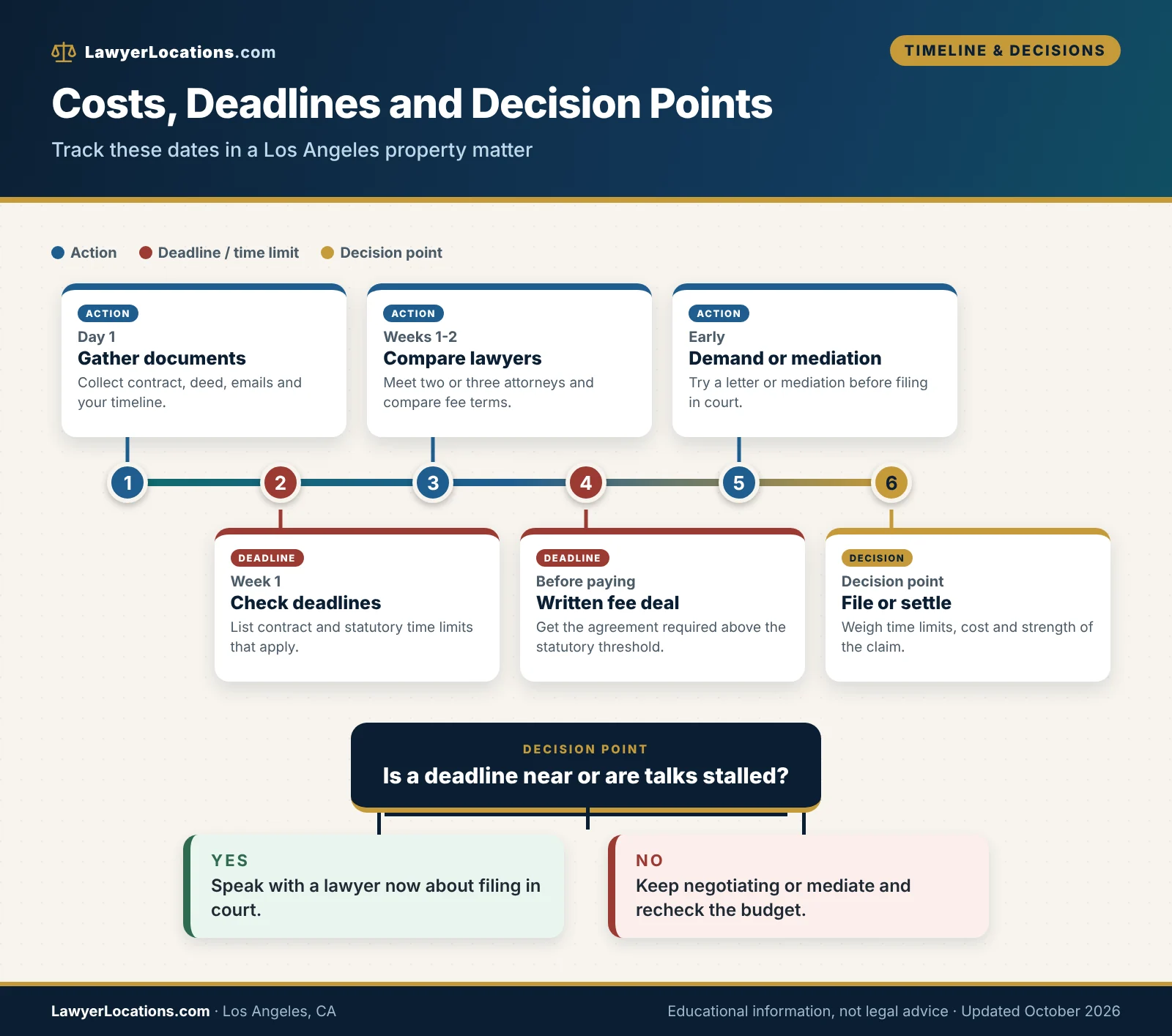
Text version of this graphic
| When | Stage | What happens |
|---|---|---|
| Day 1 | Gather documents | Collect the contract, deed, emails and your timeline. |
| Week 1 | Check deadlines | Identify contract and statutory deadlines that apply to you. |
| Weeks 1-2 | Consult and compare | Meet two or three lawyers and compare fee terms. |
| Before paying | Sign fee agreement | Get the written agreement required when fees will exceed $1,000. |
| Early | Demand or mediation | Try a letter or mediation before filing. |
| Decision | File or settle? | If a deadline is near or talks stall, consider filing in court; otherwise settle. |
Documents, mistakes and next steps
The first meeting goes best when you arrive organized. Bring paper, not memories, and tell the lawyer about the facts that hurt you as well as the ones that help. This section covers what to gather, what to avoid and how to take the next step.
Documents to bring to a first consultation
Documents for a purchase, sale or title problem
Bring the signed purchase agreement and every addendum or counteroffer, the disclosures you received or delivered, the title report and any title insurance policy, escrow instructions and statements, inspection and appraisal reports, and any communications with agents, escrow and the other side. If the City of Los Angeles Residential Property Report applies, bring it.
Keep originals safe and bring copies. If something is only on your phone, print or export it before the meeting.
Documents for a neighbor, co-owner or contractor dispute
Bring the recorded deed and legal description, any survey or plat, permits and plans, written agreements with neighbors or contractors, photographs with dates, invoices and payments, and your timeline of events. Note who has been to the property and who has made repairs, because those details can matter to a claim.
If the issue involves a recorded document you suspect is wrong, ask the lawyer about checking the county records for related filings.
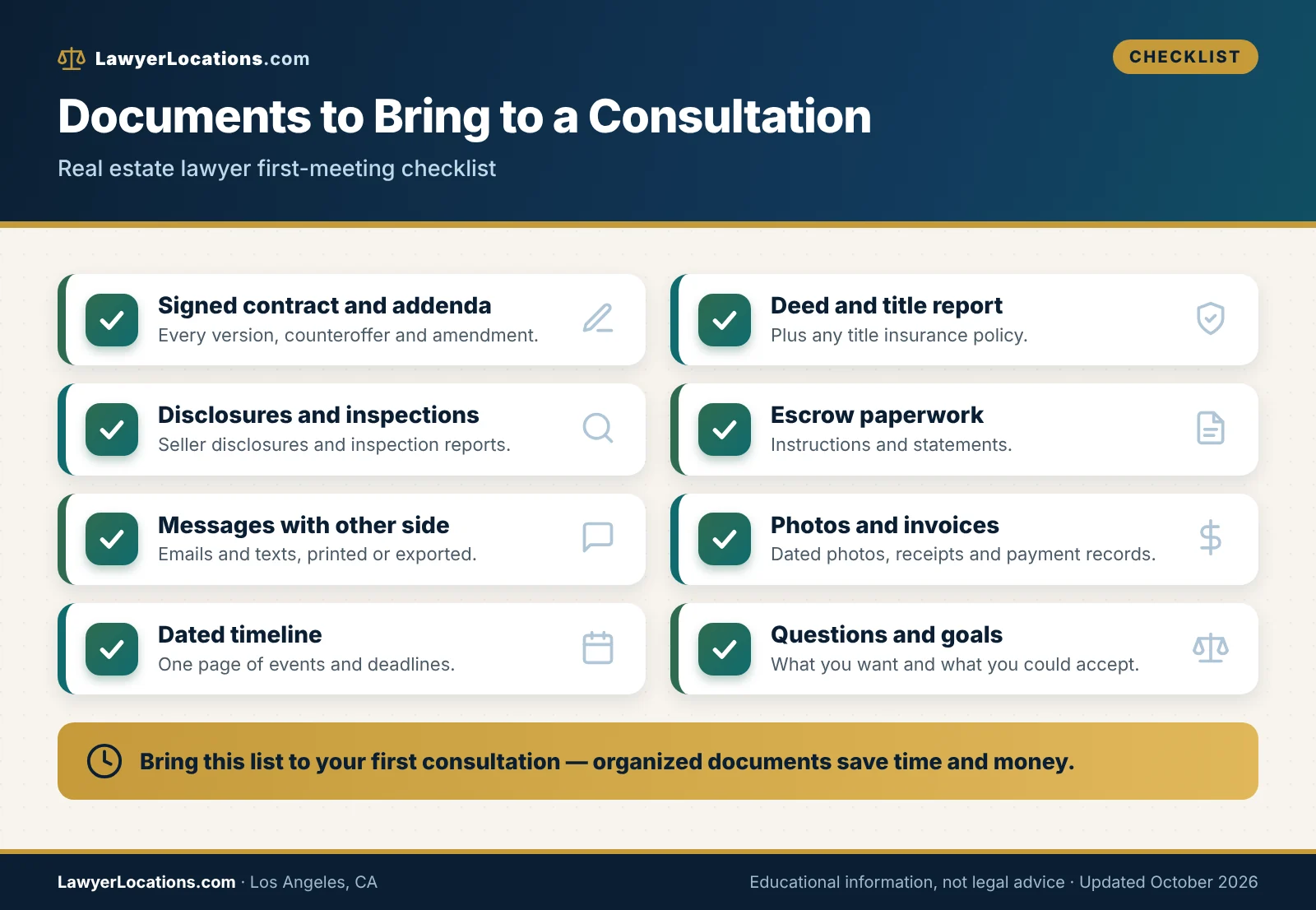
Text version of this graphic
- Signed contract and all addenda
- Deed, title report and title policy
- Disclosures and inspection reports
- Escrow instructions and statements
- Emails and texts with the other side
- Photos, invoices and payment records
- Dated timeline and list of questions
- Any fee agreement you are asked to sign
- Print or export the key documents.
- Write a one-page dated timeline.
- List the outcome you want and the one you could accept.
- Write down the other side’s full legal name and the property’s full address and parcel number.
- Bring ID and any prior lawyer’s file.
Common mistakes to avoid
Mistakes that cost money or rights
The most expensive mistakes are missing a contract deadline, signing a document you do not understand, and waiting while a limitation period runs. Another is relying on an oral promise. If the real agreement is in a text or call, document it and ask the lawyer how to handle it.
- Letting a contingency or disclosure deadline pass without a written notice.
- Recording a document against a property without legal advice.
- Signing a fee agreement you have not read.
- Posting about the dispute online or messaging the other side in anger.
- Skipping title insurance questions because the deal is moving fast.
Mistakes when choosing a lawyer
Hiring only on price, skipping the license check, never asking who will do the work and failing to ask about a budget checkpoint are the usual ones. Another is calling just one lawyer. Speaking to two or three gives you a baseline for how each approaches the problem and what they charge.
If you already hired someone and the relationship is not working, ask for your file, a final bill and a written closing letter, and use fee arbitration if there is a billing dispute.
Clear next steps and common questions
A simple action plan
- Write the timeline. Capture dates, documents and deadlines.
- Check legal aid eligibility if housing is at stake. The Legal Aid Foundation of Los Angeles publishes its criteria online.
- Shortlist two or three lawyers. Use a State Bar-certified referral service or other sources, then verify each license.
- Compare in writing. Ask each for fee terms and scope.
- Decide with a deadline in mind. Hire, narrow the scope or handle a small matter in the right court.
Ready to compare your options?
Use this guide to prepare questions and a timeline, then speak with a California-licensed attorney about your property facts. For a county-wide view of disputes, read our guide to a property dispute lawyer in Los Angeles County.
Questions people ask
The questions below come up often when people search for a real estate lawyer in Los Angeles. Answers are general and depend on your facts.
Do I need a real estate lawyer to buy a home in Los Angeles?
Not always. California sales typically close through escrow and title companies with agents involved, so many buyers do not hire an attorney. A lawyer becomes worthwhile when the contract is unusual, a title problem appears, or a dispute is developing.
What is the difference between an escrow officer and a real estate attorney?
An escrow officer is a neutral party who follows both sides’ signed instructions. An attorney represents you, can give legal advice and can negotiate or litigate for you.
Does a Los Angeles seller have to give the buyer a city report?
For residential property in the City of Los Angeles, LADBS says the seller must apply for the Residential Property Records report under LAMC section 96.300 and deliver it before the agreement or close of escrow. Properties in other cities or unincorporated areas follow different local rules.
How long do I have to cancel after getting a late disclosure?
Under Civil Code section 1102.3, a buyer can terminate in writing within 3 days after in-person delivery or 5 days after mailing or agreed electronic delivery, when a required disclosure arrives after the offer. Act quickly and get advice the same day.
How long do I have to sue over a broken real estate contract?
Generally four years for an action on a written contract under Code of Civil Procedure section 337, but other claims have different periods and the clock can start at different moments. A lawyer should confirm the deadline for your claim early.
Can I use small claims for a property dispute?
For money claims up to $12,500 as an individual, subject to exceptions. Disputes over ownership, partition or recorded documents generally need relief small claims cannot give, so ask a lawyer or the court’s self-help center first.
Will a lawyer give me a free consultation?
Policies vary, and we do not promise any. Ask when you call whether there is a charge, how long the meeting lasts, and whether the fee is credited if you hire the lawyer.
What if I think my lawyer overbilled me?
Ask for an itemized statement first. If the issue remains, a client can request State Bar fee arbitration, which is mandatory for the lawyer in most cases, and you have 30 days from receiving the attorney’s notice to request it.
How do I check that a lawyer is licensed in California?
Use the State Bar of California’s attorney search to confirm license status and public discipline before you share documents.
Can I get free help with a housing problem in Los Angeles?
Legal Aid Foundation of Los Angeles offers free civil legal help to eligible low-income residents in eviction defense, housing and related matters, and the Superior Court runs a free online dispute-resolution program for eviction cases. Check each program’s current rules.
How can I protect myself from deed fraud on my Los Angeles property?
Sign up for the county property-owner alert program, which the California Department of Real Estate lists for Los Angeles County, and review recorded documents periodically. If you see a document you did not sign, speak with a lawyer promptly.
A calm, organized first step usually serves you better than a rushed one. Once you know your deadlines and your goals, searching for a real estate lawyer in Los Angeles, CA becomes a comparison of fit, fees and communication.
General information only. This guide is general legal information, not legal advice, and reading it does not create an attorney-client relationship. LawyerLocations.com is a legal-education and lawyer-discovery resource, not a law firm, and does not recommend or rank individual lawyers. Laws, fees, court procedures and local rules change, and the details of your situation matter. Consult a lawyer licensed in California about your specific facts.
Sources & References
Show all 17 sources
- Business and Professions Code section 6148 (written fee contracts) — California Legislature, via public.law — california.public.law — accessed October 2026
- Code of Civil Procedure section 337 (four-year period, written instruments) — California Legislature, via public.law — california.public.law — accessed October 2026
- Code of Civil Procedure section 338 (three-year periods) — California Legislature, via public.law — california.public.law — accessed October 2026
- Code of Civil Procedure section 337.15 (latent construction deficiencies) — California Legislature, via public.law — california.public.law — accessed October 2026
- Code of Civil Procedure section 405.20 (notice of pendency of action) — California Legislature, via public.law — california.public.law — accessed October 2026
- Code of Civil Procedure section 85 (limited civil cases) — California Legislature, via public.law — california.public.law — accessed October 2026
- Code of Civil Procedure section 116.221 (small claims jurisdiction) — California Legislature, via WomensLaw.org — womenslaw.org — accessed October 2026
- Civil Code section 1102.3 (buyer’s right to terminate after late disclosure) — California Legislature, via public.law — california.public.law — accessed October 2026
- Civil Code section 1717 (contractual attorney’s fees) — California Legislature, via public.law — california.public.law — accessed October 2026
- Residential Property Report and requirements when selling — Los Angeles Department of Building and Safety — dbs.lacity.gov — accessed October 2026
- Measure ULA ordinance updates — Hanson Bridgett LLP — hansonbridgett.com — accessed October 2026
- Civil Division overview — Superior Court of California, County of Los Angeles — lacourt.org — accessed October 2026
- Find a Los Angeles Area Lawyer Referral Service — State Bar of California — calbar.ca.gov — accessed October 2026
- Frequently Asked Questions: Fee Disputes — State Bar of California — calbar.ca.gov — accessed October 2026
- Legal Specialty Areas — State Bar of California — calbar.ca.gov — accessed October 2026
- County Recorder Property Owner Alert Program — California Department of Real Estate — dre.ca.gov — accessed October 2026
- Get Help (housing and eviction defense services) — Legal Aid Foundation of Los Angeles — lafla.org — accessed October 2026
Legal Disclaimer and Limitation of Liability
Informational and illustrative purposes only. This article was prepared by LawyerLocations.com solely on the basis of the information available to us at the time of writing. It is an illustrative, general overview. It is not a complete or authoritative statement of the law, and it has not been reviewed by a lawyer licensed in your state or county.
Not legal advice. Nothing in this article is legal, financial, tax or immigration advice, and reading it does not create an attorney-client relationship between you and LawyerLocations.com or any author, lawyer or firm mentioned. Laws, court rules, fees, filing deadlines and agency procedures differ by state, county and court, and they change often. Some details here may be simplified, incomplete or out of date, and time limits for legal claims can be short.
No warranty. We make no representation or warranty, express or implied, about the accuracy, completeness, timeliness or suitability of this content for your situation. Please do not rely on it to make, delay or skip any legal decision. Check the facts against official sources and speak with a licensed attorney in the relevant jurisdiction before you act.
Limitation of liability. To the fullest extent permitted by law, LawyerLocations.com and its owners, authors and contributors disclaim all liability for any loss, damage, cost or other consequence arising from the use of, or reliance on, this article, including any content on third-party websites we link to. Mentioning a lawyer, firm, organization or service is not an endorsement and is not a promise of any result. If you are in immediate danger, contact your local emergency number.