Anyone searching for a real estate attorney Philadelphia PA is usually trying to settle three things: whether a lawyer is needed at all, what one costs, and what to ask before hiring. In Pennsylvania, a buyer or seller is not legally required to hire a lawyer for an ordinary residential sale, but Philadelphia deals carry local wrinkles that make legal review worth weighing: a combined 4.578% realty transfer tax, row-house party walls, tangled titles, and water, tax and judgment liens that follow the property.
This guide explains how a Philadelphia sale works, which city and state rules matter, how real estate lawyers typically charge, and how to compare them. It is general information, not advice about your deal, stated as of October 2026.
Do You Need a Real Estate Attorney in Philadelphia?
No statute or court rule we found requires a lawyer for a residential sale in Pennsylvania. Hiring one is a risk decision, and the answer changes with the property, the contract and how much you are relying on other professionals.
What a real estate attorney does in a Philadelphia sale
A real estate attorney is a Pennsylvania-licensed lawyer who advises on the contract, title and closing paperwork. The work falls into two phases, and the first is when input is cheapest to use, because terms are still negotiable.
Before you sign the agreement of sale
Most Pennsylvania residential contracts use a standard form published by the Pennsylvania Association of Realtors. The association describes its current Standard Agreement for the Sale of Real Estate (Form ASR) as a residential sales contract with commonly used clauses, designed to be adjusted with addenda. Read every addendum, because deal-specific risk usually lives there.
A lawyer can read the form, addenda and seller documents together and explain what each deadline and contingency does. A contingency is a condition that lets a party back out or renegotiate if something happens, such as a failed inspection or a mortgage that falls through. Pennsylvania also requires licensees to put the property’s zoning classification in a sales agreement unless it is zoned solely or primarily single-family, so check that line on any multi-unit row house.
Between signing and settlement
After both sides sign, the work shifts to title and logistics: reviewing the title commitment, flagging liens or easements, coordinating payoffs, and negotiating repair requests. None of this is legally required, and many deals close without a lawyer. The difference shows up when something goes wrong, such as a missing heir on the deed or an unpaid water bill, which is far easier to fix before settlement than after.
Is an attorney required, and who runs settlement?
FindLaw’s survey of closing practices lists the states where only a licensed attorney can handle a closing, and Pennsylvania is not on it. In states outside that list, closings may be handled by attorneys, escrow or title companies, or lenders.
What Pennsylvania law does and does not require
The key distinction is between running a settlement and representing a party at one. A Pennsylvania Bar Association Unauthorized Practice of Law Committee opinion (Opinion 96-102) concluded that representing a seller or purchaser at settlement is the practice of law, which only a Pennsylvania-licensed attorney may do. It is an advisory committee opinion, and the version we reviewed shows no date.
In practice, a settlement agent can collect signatures, disburse funds and record documents, but explaining legal consequences to one side is a lawyer’s job. The City of Philadelphia also says buyers may choose their own title insurance company. Who sits at the table varies by lender and firm, so confirm the arrangement for your deal.
Settlement is Pennsylvania’s usual word for the closing: the process where the buyer’s funds are paid out, the deed is signed, and the transfer is sent for recording.
When a lawyer is most worth considering
Some situations carry more risk than an ordinary mortgage-financed house purchase. If any of these applies, price out a legal review before signing.
- The seller is an estate, trust or LLC, or the seller’s name differs from the name on the deed.
- The property is a condominium or planned community with a resale-certificate process.
- New construction or recent rehab brings in an abatement, permit or certificate of occupancy.
- You plan to add a unit, build up or change the use, which brings in zoning.
- The sale is by owner, as-is, or involves seller financing.
- A title search shows judgments, liens, easements or gaps in ownership.
The Philadelphia transaction, step by step
The order below is typical for a financed purchase; cash deals skip the lender steps.
From offer to agreement of sale
A buyer makes an offer, usually through an agent, and the parties negotiate. Once both sign the agreement of sale, the contingency clocks start. If you plan to use the City’s Philly First Home grant, the City requires City-funded homeownership counseling before you sign an agreement of sale, which can affect timing.
A 2019 Pennsylvania Association of Realtors explainer on the form’s inspection paragraph describes a default 10-day inspection period if the blank is left empty and a default 5-day negotiation window after a buyer’s written corrective proposal. The association warns that the clause has changed over the years, so rely on the current form text and your own entries.
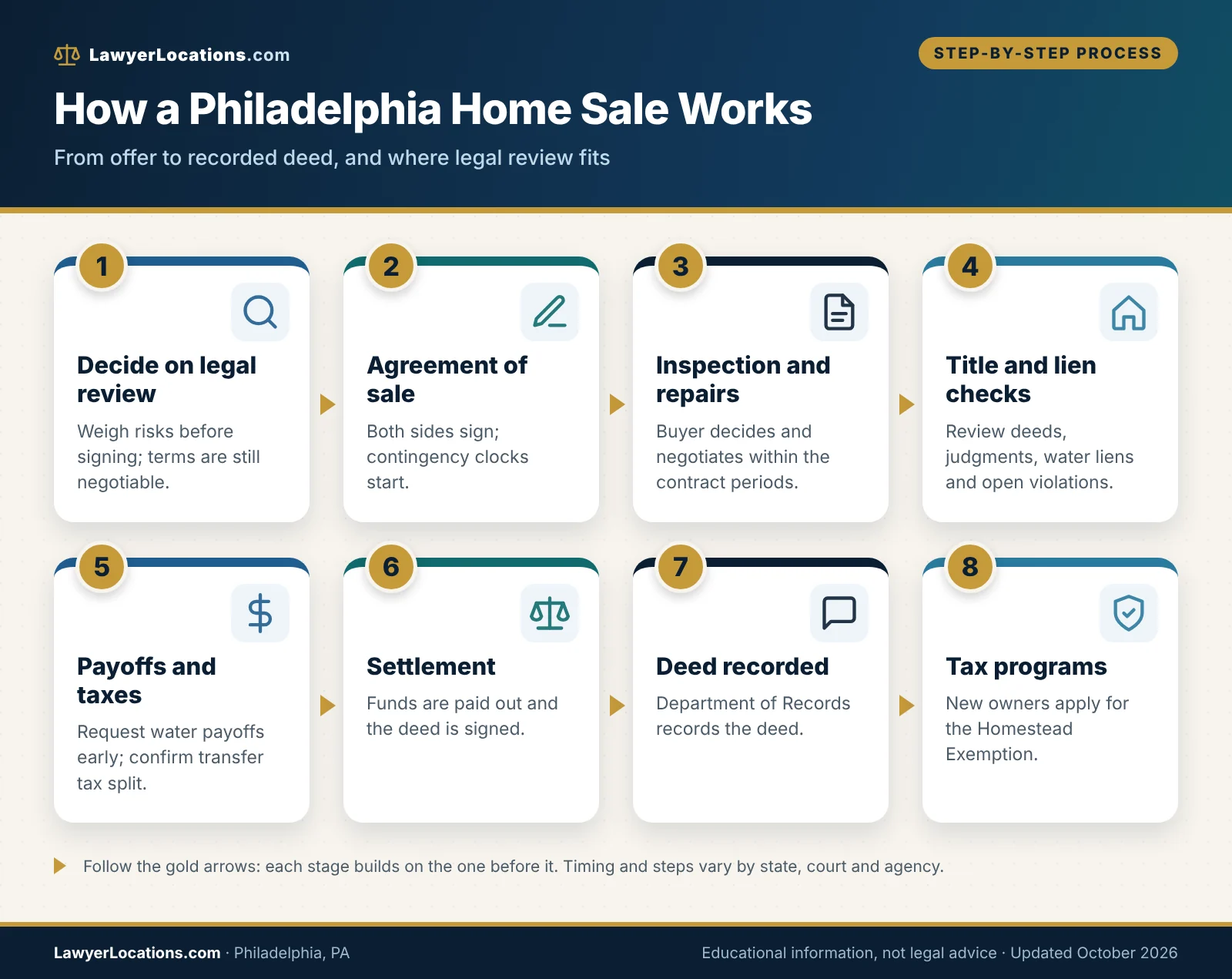
Text version of this graphic
- Decide whether to get legal review before signing.
- Sign the agreement of sale; contingency clocks start.
- Inspection and repair negotiations.
- Title, lien and violation checks.
- Payoffs requested; transfer tax split confirmed.
- Settlement: funds paid out and deed signed.
- Deed recorded by the City Department of Records.
- New owner applies for tax programs such as the Homestead Exemption.
Settlement, recording and what happens after
At settlement, the buyer signs loan and transfer documents, funds are disbursed and the seller signs the deed. The deed is then recorded with the Department of Records, which acts as Philadelphia’s recorder of deeds; the City says recorded documents give notice to everyone. The realty transfer tax is due when the deed is presented for recording, and owner-occupants should then apply for the Homestead Exemption on its own calendar.
| Role | What they typically do | What they do not do |
|---|---|---|
| Real estate agent | Markets or searches for the property, presents offers, helps fill in the standard form | Give legal advice; Pennsylvania’s consumer notice says licensees must advise consumers to seek outside advice beyond their expertise |
| Lender | Underwrites and funds the loan; usually requires a lender’s title policy | Protect the buyer’s interest in the contract or title |
| Title company or settlement agent | Searches title, issues policies, coordinates funds and recording | Represent either side; explaining legal consequences to one party is practicing law |
| Real estate attorney | Reviews and negotiates the contract, advises on title and disclosure, represents one side | Predict how a court or agency will rule, or promise a result |
| Department of Records | Records deeds and mortgages; collects transfer tax at recording | Hold lien or judgment records |
Pennsylvania and Philadelphia Rules That Shape Your Deal
Three rule sets do most of the work in a Philadelphia sale: the state’s Seller Disclosure Law, the City’s realty transfer tax, and the certificate and tax-program rules for condos and new construction.
Pennsylvania’s Real Estate Seller Disclosure Law
The Real Estate Seller Disclosure Law is 68 Pa.C.S. § 7301 et seq. (Chapter 73), and it governs what residential sellers must tell buyers about the property.
What sellers must disclose and when
Under § 7303, a seller must disclose material defects known to the seller on a signed, dated property disclosure statement delivered before the agreement of transfer is signed. The State Real Estate Commission’s form must cover 17 subjects, including roof, structure, plumbing, water and sewage, pests, hazardous substances and title issues.
If disclosed information becomes inaccurate before final settlement, § 7307 requires the seller to notify the buyer. The statute does not define “material defect,” which is why disputes over what should have been disclosed reach judges.
What the law does not do
Under § 7308, a seller has no duty to investigate beyond what the seller knows, though a seller may not make statements known to be false or misleading. Section 7309 shields a seller who had no knowledge of an error or who relied on an inspector, contractor or other professional.
Section 7302 exempts fiduciary transfers such as estates and trusts, and qualifying never-occupied new construction with a warranty, code inspection and certificate of occupancy. A condo or co-op seller discloses only the unit being sold.
Two years from final settlement. Section 7311 says suits under the Seller Disclosure Law must be filed within two years after the date of final settlement. A transfer is not invalidated solely for noncompliance, but a person who willfully or negligently violates the chapter is liable for the buyer’s actual damages.
Philadelphia realty transfer tax
The realty transfer tax is a one-time tax on a transfer of real estate, payable when the deed is recorded. Philadelphia’s rate rose in 2025, so older articles and sample closing sheets may be wrong.
The current combined rate and who customarily pays
The City reports that its rate changed effective July 1, 2025. The City portion is now 3.578% and the Commonwealth portion is 1%, for a combined 4.578%, up from a City portion of 3.278%. The City says the tax is usually split evenly between buyer and seller, but that this is not legally required, and the City can collect 100% from either party.
On an imaginary $300,000 sale, 4.578% comes to $13,734: $10,734 City and $3,000 State. Split evenly, each side would owe $6,867. Your contract controls who pays; this is arithmetic to show scale.
The City’s tax page lists 3.578% in its rate table but 3.278% in its mail-payment instructions, an apparent leftover from the old rate. Confirm the figure with the Department of Revenue at (215) 686-6442 before paying by mail.
Exemptions, penalties and how it is paid
The tax is owed when the document is presented for recording and can be paid through the Philadelphia Tax Center, in person at the Department of Records, or by mail. The base is the sale price or assessed value plus any assumed debt. The City lists exemptions for most transfers among spouses, direct ascendants and descendants, and siblings, with documentation, but property bought from an estate is not exempt, and a penalty of up to 50% can apply for misrepresenting a transaction or failing to record.
| Item | What the City says |
|---|---|
| Rate | 3.578% City + 1% Commonwealth = 4.578%, effective July 1, 2025 |
| Tax base | Sale price or assessed value, plus assumed debt; computed value if no sale price |
| Customary payer | Usually split evenly between buyer and seller; not legally required |
| When due | When the document is presented for recording |
| Family exemptions | Most transfers among spouses, direct ascendants and descendants, and siblings, with documents; not for property bought from an estate |
| Penalty | Up to 50% of the tax for misrepresentation or failing to record |
| Where to pay | Philadelphia Tax Center, in person at the Department of Records, or by mail |
Condos, new construction and tax programs
Condominiums and new homes have extra steps, and Philadelphia’s property tax programs depend on who applies and when.
Condo resale certificates and the five-day right to cancel
For a condo resale, the Uniform Condominium Act requires the selling unit owner to give the buyer, before the contract is signed, the declaration, bylaws, rules and a certificate with items such as the monthly common expense assessment. Under 68 Pa.C.S. § 3407(d), the contract is voidable by the buyer until the certificate has been provided and for five days thereafter, or until conveyance, whichever comes first.
The Pennsylvania Association of Realtors describes a parallel certificate and five-day right for planned communities. We read § 3407 through a statute republisher because the legislature’s site blocked automated access, so a lawyer should confirm the current text.
Abatements and the Homestead Exemption
The City’s ten-year tax abatement for new residential construction is applied for by the owner or developer, not a later buyer, within 60 days of the building permit being issued. The abated share of building value declines by 10 percentage points a year. A buyer of a new house should ask for the approval paperwork and confirm its status with the Office of Property Assessment.
For owner-occupants, the Homestead Exemption removes $100,000 of assessed value from taxation in 2026, according to the City. Applications are due by December 1, a buyer whose settlement falls between December 2 and 31 can still apply, and you must reapply when your deed changes. A property with an active ten-year abatement cannot claim it until the abatement expires.
Title, Liens and Land Records in Philadelphia
Recording a deed does not clear a property’s history. The City itself says recording a deed does not mean the title is clean, and some of the costliest surprises, such as water liens and court judgments, sit in records other than the deed index.
Where Philadelphia land records live
Philadelphia is both a city and a county, so one office serves as recorder of deeds for the whole city. Other facts that affect a purchase sit in separate city and court systems.
The Department of Records and its online search
The Department of Records is in City Hall, Room 156. For deed copies, the City lists an online tool called Philadox covering deeds and other property records from 1974 to the present; earlier documents must be requested by mail or in person. Newly recorded documents become searchable two to four weeks after recording, so a very recent transfer may not show up yet.
Viewing watermarked copies online is available, while printing requires a paid subscription, and the City Hall counter (Room 154) is open Monday through Friday, 8:30 a.m. to 3:30 p.m. Fees change, so check the Department’s current fee schedule.
What the recorder does not show
The City’s explainer says unpaid taxes, liens, judgments and other debts are not in the Department of Records’ files. It points to the Court of Common Pleas Judgments and Lien Index, a separate system, and recommends title insurance plus a real estate professional or attorney, because title professionals search both sets of records.
The Court of Common Pleas offers a civil Judgment Search by name and judgment dates; the page notes a $5 convenience fee at checkout as of October 2026. Water debts live in yet another place, covered in the table below.
| Question | Where to look | Notes from the official source |
|---|---|---|
| Who owns it, and what deeds and mortgages are recorded? | Department of Records (Philadox online; City Hall counter) | Online coverage 1974 to present; older records by mail or in person; new filings take 2 to 4 weeks to appear |
| Are there court judgments or liens? | Court of Common Pleas, Judgment Search (civil) | Separate from the deed records; $5 convenience fee noted at checkout |
| Is there a water or sewer lien? | City water lien search (water-lien.phila.gov) | Free; shows liens docketed in the past 15 years; request a payoff at least 30 days before settlement |
| What is the assessed value and sales history? | property.phila.gov (Office of Property Assessment) | Shows ownership, sales history, value and physical characteristics |
| What permits and violations exist? | Atlas (atlas.phila.gov) or the L&I Property History lookup | Shows licenses, permits, violations, zoning history and assessments |
| Has anything been recorded in my name? | Fraud Guard email alerts from the Department of Records | Sends alerts when documents are recorded with your name |
Title insurance and who protects you
Title insurance is a one-time policy against defects in the chain of ownership that a search missed. The City promotes owner’s policies as part of its mission to protect homeowners and prevent property fraud.
Owner’s policy versus lender’s policy
A lender’s policy protects the mortgage company, most lenders require it, and it does not protect you as the buyer. An owner’s policy protects you, covers the full purchase price, and lasts as long as you or your heirs hold the property.
The City’s examples of covered problems include unpaid prior mortgages, a previous owner’s unpaid taxes, child support liens, missing heirs, undisclosed easements, forgery and recording errors. A lawyer reviewing the commitment can explain its listed exceptions, which are the parts the policy will not cover.
Choosing a title company and comparing quotes
The City states that buyers may choose their own title company and that title insurance costs about 0.5% to 1% of the purchase price, paid once. Treat that as a rough description rather than a quote, and ask for a written breakdown of the premium and settlement fees.
The Pennsylvania Insurance Department’s consumer resources include ways to research an agent or company and to file a complaint. Keep the commitment, policy and settlement statement as your paper trail if a claim arises years later.
Ask for the title commitment as early as your contract allows and read the exceptions before the inspection period ends. A surprise is far easier to negotiate while contingencies are still open.
Tangled titles and deed fraud
Two title problems get special attention in Philadelphia: homes where the residents are not the owners of record, and recorded documents that were faked.
Tangled titles, quiet title actions and the Tangled Title Fund
A tangled title exists when the recorded owner is no longer the person who actually owns or lives in the home, often after a death with no estate administered. Philadelphia VIP, a pro bono legal organization, administers the City-funded Tangled Title Fund, which lists an income limit of 80% of Area Median Income, an asset limit, and a maximum of $6,500 in covered costs, with up to $3,500 more considered case by case for transfer tax. The fund pays costs rather than providing legal help, and funding is discretionary.
When informal fixes fail, a quiet title action may be the route. Pennsylvania Rule of Civil Procedure 1061(b) lists when one can be brought, including to determine any right, lien, title or interest in land and to compel a party to record, cancel or satisfy a deed. Whether it fits a given property is a question for a lawyer.
Deed fraud: alerts, reports and the new transfer-tax refund
The Department of Records offers a free Fraud Guard service that emails you when documents are recorded with your name. The City says to report suspected deed or mortgage fraud immediately, online or at (215) 686-2290, to file a police report, and to seek legal help.
A February 2026 City announcement describes a new law letting a victim who proves in court that property was stolen by a fraudulent deed ask the City to refund the transfer tax the criminal paid, excluding the State portion. The court order must direct the refund, the request must come within three years of the order, and the refund will not cover all of a victim’s costs.
How to Compare Real Estate Attorneys in Philadelphia, PA
Compare lawyers on the same written questions, not on ads or hunches. The goal is a Pennsylvania-licensed lawyer whose scope, pricing and communication fit your transaction, with the license verified before you pay. LawyerLocations.com does not rank or recommend lawyers.
Finding and verifying a lawyer
Referrals from friends and agents are a start, but check each against official records.
Using the Philadelphia Bar Association’s referral service
The Philadelphia Bar Association runs a Lawyer Referral & Information Service (LRIS). Its page says you can request a lawyer online at any time or by phone at (215) 238-6333, Monday through Friday, 9 a.m. to 5 p.m.; an intake staff attorney discusses your issue before you are referred to a screened lawyer. Real estate is among its areas, including closing documents, construction and landlord/tenant. The page does not state a fee for an initial consultation, so ask when referred.
It also says staff may refer people who cannot afford a lawyer to a legal aid agency. A referral is a convenience, not an endorsement; you still decide whether the lawyer fits.
Checking license status and discipline
The Disciplinary Board of the Supreme Court of Pennsylvania runs a public attorney lookup that, per its FAQ, shows license status, contact information, public discipline history and whether the lawyer carries malpractice insurance. Run every candidate through it before the first meeting.
The Board’s complaint process addresses violations of the Rules of Professional Conduct; its disciplinary counsel does not represent you against a lawyer. The separate Pennsylvania Lawyers Fund for Client Security compensates clients for money improperly taken by lawyers, but the Board says it does not pay claims for professional negligence or fee disputes.
Questions to ask every lawyer
Ask each lawyer the same questions so the answers are comparable, and keep notes in writing.
Scope, experience and local knowledge
Ask what the lawyer would do on your deal: read the contract, review title, attend settlement, negotiate repairs. Ask how often the lawyer handles Philadelphia residential transactions, and whether the lawyer has handled your issue, such as a condo resale, an estate sale or a zoning appeal. A clear answer helps; a promise about the outcome is a red flag.
Ask who will do the work, whether a paralegal or associate handles parts of it, and who your day-to-day contact will be as settlement nears.
Fees, billing and communication
Ask whether the fee is flat, hourly or mixed, what it includes, and what triggers extra charges, such as a moved settlement date or a title problem. Ask how any deposit is handled, whether unused money is returned, and which expenses are billed separately. Pennsylvania’s fee rule, covered in the fees section, requires the fee basis to be communicated in writing when the lawyer has not regularly represented you.
Ask how you will get updates and how quickly questions are answered. Avoid any lawyer who dodges fee questions or pressures you to sign on the spot.
- The lawyer explains scope, fee basis and exclusions in plain language before you sign.
- You get fee terms in writing and can compare them with other quotes.
- The lawyer names the specific records and deadlines that matter for your property.
- The lawyer promises how a city agency, court or title company will rule.
- The fee is called “standard” with no breakdown.
- You are told to skip a title search or contingency with no clear reason.
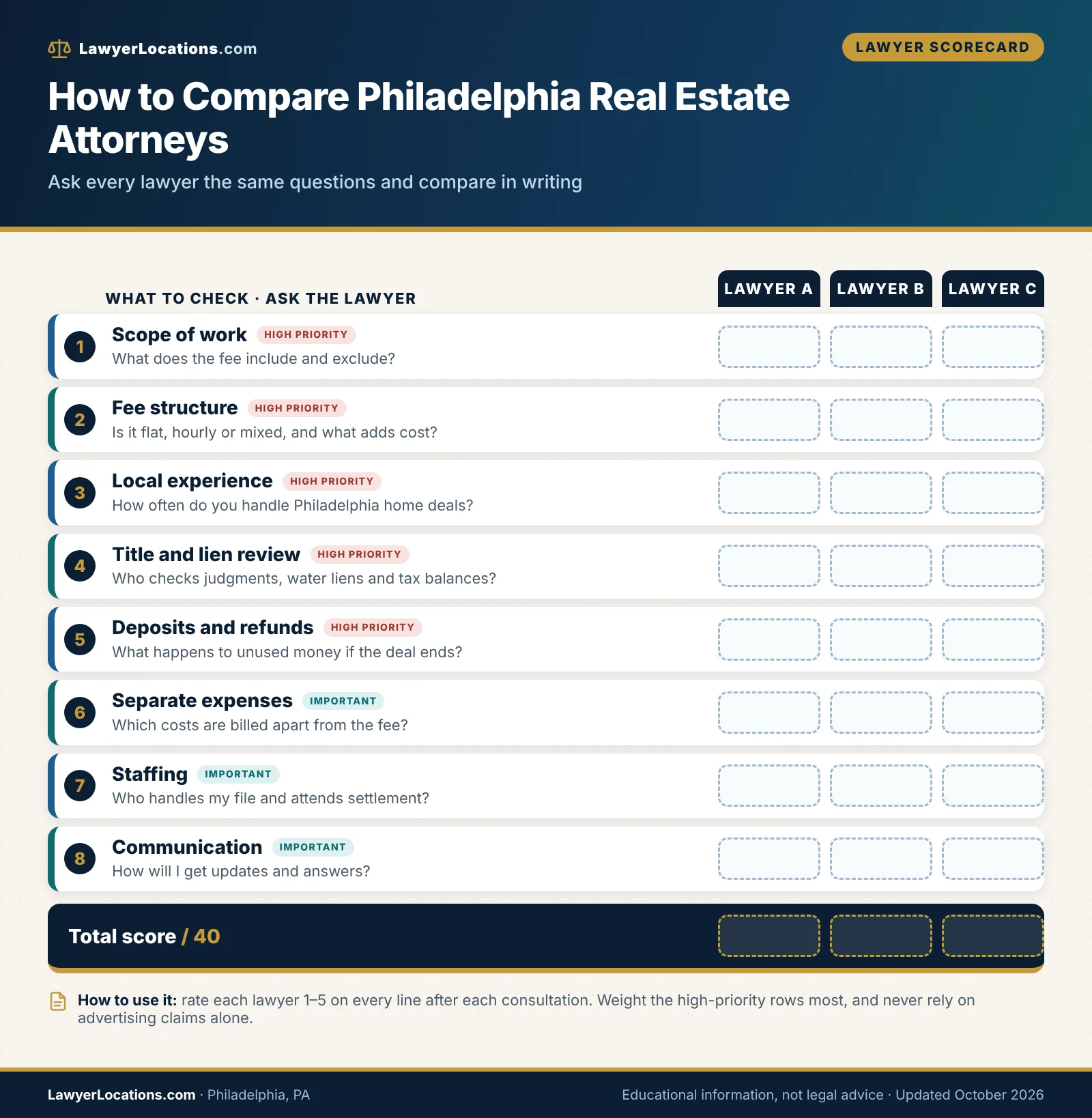
Text version of this graphic
- Scope of work: what does the quoted fee include and exclude?
- Fee structure: is it flat, hourly or mixed, and what adds cost?
- Local experience: how often do you handle Philadelphia home deals?
- Title and lien review: who checks judgments, water liens and tax balances?
- Deposits and refunds: what happens to unused money if the deal ends?
- Separate expenses: which costs are billed apart from the fee?
- Staffing: who handles my file and attends settlement?
- Communication: how will I get updates and answers?
Preparing for the consultation
Lawyers quote more accurately when they see the actual documents rather than a description of them.
Documents to bring or send
Bring the agreement of sale with every addendum, the seller’s disclosure statement, inspection reports, the title commitment if you have it, and recent tax and water bills. Sellers should also bring the deed and permits for past work.
- Agreement of sale, addenda and amendments, in full.
- Seller’s property disclosure statement and inspection reports.
- Title commitment, survey or plot plan, if available.
- Recent real estate tax and water bills, City notices and violations.
- For condos, the declaration, bylaws, rules and resale certificate.
- A written list of deadlines already running, plus your questions.
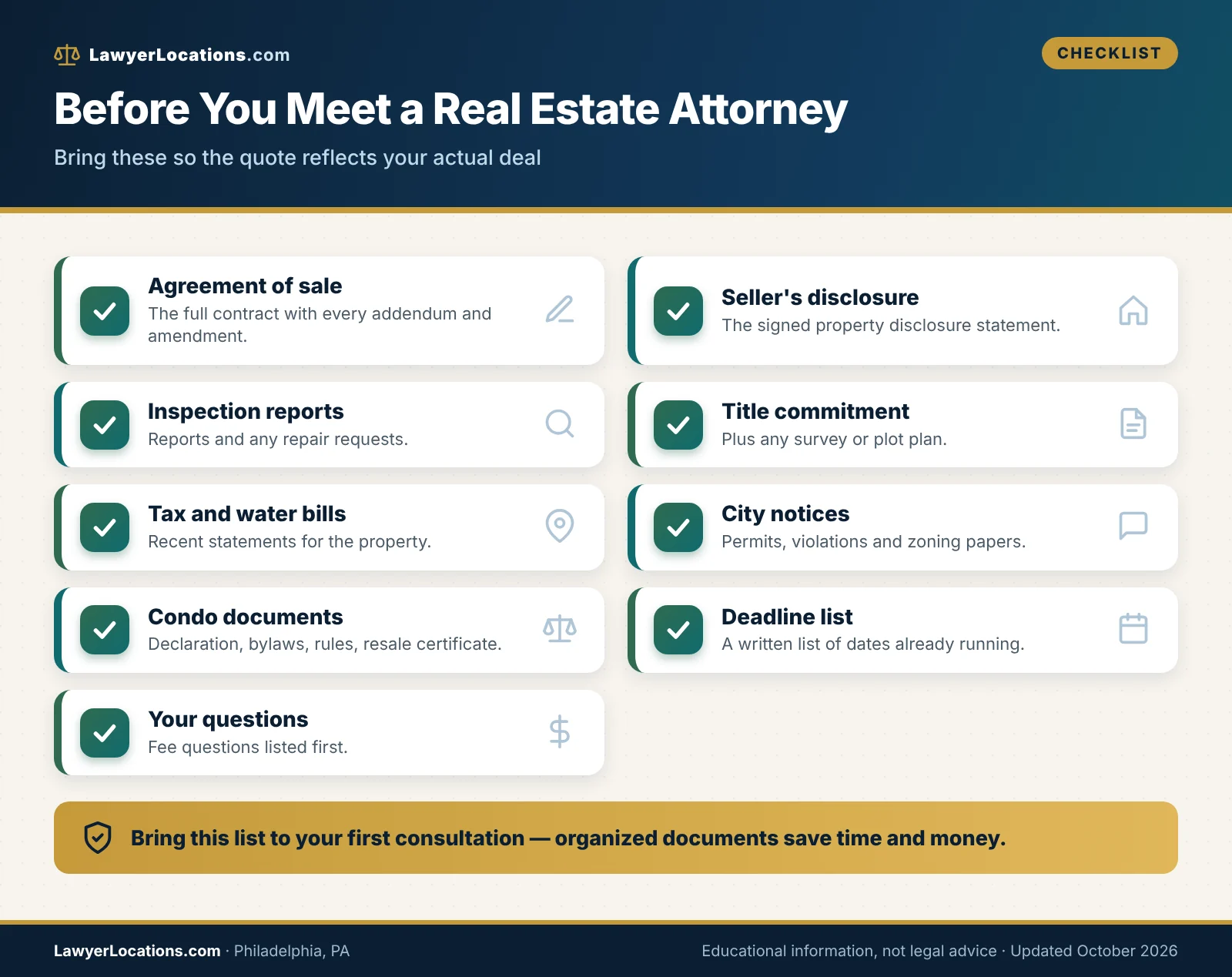
Text version of this graphic
- Agreement of sale with all addenda
- Seller’s property disclosure statement
- Inspection reports and repair requests
- Title commitment and any survey
- Recent tax and water bills
- City notices, permits and violations
- Condo documents and resale certificate (if a condo)
- Written list of deadlines and questions
What to expect at the first meeting
A first meeting usually covers your goals, the facts, the lawyer’s initial read of the risks and a fee proposal. Ask directly whether there is a charge for the consultation, since practice varies. For what “free consultation” does and does not mean, see our guide on free consultation questions to ask a lawyer; the practice area differs, but the questions about terms carry over.
Do not sign an engagement agreement at the first meeting unless you have read it. Take it home, compare it with other quotes, and ask about anything unclear.
What a Real Estate Attorney Costs in Philadelphia and What Else You Pay
Real estate lawyers usually quote a flat fee for a defined task or bill by the hour, and the quote should say in writing what it covers. We found no official source that publishes average real estate legal fees for Philadelphia, so this guide gives no dollar ranges. What you can compare reliably is structure, scope and the rules lawyers must follow.
How real estate lawyers structure fees
The right structure depends on how predictable your matter is. A routine contract review is easy to price in advance; a title dispute is not.
Flat, hourly and hybrid fees
A flat fee is a set price for a defined service, such as reviewing an agreement of sale or attending settlement for one side. Hourly billing charges for time spent and suits open-ended work such as complicated negotiations or title cleanup. Some lawyers combine them: a flat fee for the standard package and hourly rates for anything outside it.
Whatever the structure, ask what happens if the deal falls through, the settlement date moves, or the title search turns up a problem needing extra work.
| Structure | Works well for | Ask about |
|---|---|---|
| Flat fee | Defined tasks: contract review, attending settlement, preparing a deed | Exactly what is included, and what triggers extra charges |
| Hourly | Open-ended work: negotiations, title cleanup, zoning appeals | Hourly rate, who bills (lawyer or staff), billing increments, estimates |
| Hybrid | A standard package plus the chance of extra work | Where the flat fee ends and hourly billing begins |
| Advance deposit (retainer) | Work billed hourly or in stages | How it is held, applied and returned if unused |
Deposits and unearned money
Comment 2 to Pennsylvania’s fee rule says a lawyer may require advance payment but is obliged to return any unearned portion. Ask where the money will be held and how it will be accounted for, and ask what is refundable if the deal terminates or the work stops partway.
Pennsylvania’s rule on lawyer fees
Lawyer fees are governed by Pa.R.P.C. 1.5, part of the Rules of Professional Conduct. The rule sets limits and requires communication rather than setting prices. For flat versus hourly arrangements in a different practice area, see how DUI lawyer fees are structured; the fee concepts carry over, but the legal rules do not.
Reasonable fees and the factors that count
Rule 1.5(a) says a lawyer shall not enter into an agreement for, charge or collect an illegal or clearly excessive fee. Its factors include the time and labor required, the difficulty of the questions, the fee customarily charged in the locality for similar services, time limits, and the experience and ability of the lawyers doing the work.
That list is why two fair quotes can differ: a straightforward condo purchase and a deed correction involving several heirs are very different jobs.
Writing requirements, contingent fees and fee sharing
Under Rule 1.5(b), when a lawyer has not regularly represented you, the basis or rate of the fee must be communicated to you in writing, before or within a reasonable time after the representation begins. Rule 1.5(c) separately requires any contingent fee agreement to be in writing. Under Rule 1.5(e), lawyers in different firms may divide a fee only if the client is advised of and does not object to every lawyer’s participation, so ask whether a referral shares the fee.
If a lawyer will not put the fee basis in writing, pause. The rule requires it when the lawyer has not regularly represented you, so asking for a short written fee description is not rude.
Costs that are not the lawyer’s fee
Much of what you pay at settlement goes to the government or other businesses. Ask your lawyer for a list of third-party costs so nothing arrives as a surprise.
Government and third-party charges
The 4.578% combined transfer tax is a major government charge, and your contract sets the split. Deed and mortgage recording runs through the Department of Records under its fee schedule. The title premium goes to the title company; the City describes a rough range of 0.5% to 1% of the price. Sellers should request any water payoff from the Water Revenue Bureau at least 30 days before settlement.
Planning a closing budget
List each cost with a payer, starting from the contract. The City describes a Philly First Home grant of up to $10,000 or 6% of the purchase price, whichever is less, for down payment or closing costs while funding lasts; the home must be a single-family house or duplex in Philadelphia, condos are not eligible, and the grant must be repaid if you move or refinance within 15 years. Confirm current terms with the Division of Housing and Community Development at (215) 686-9749 before relying on a grant to close.
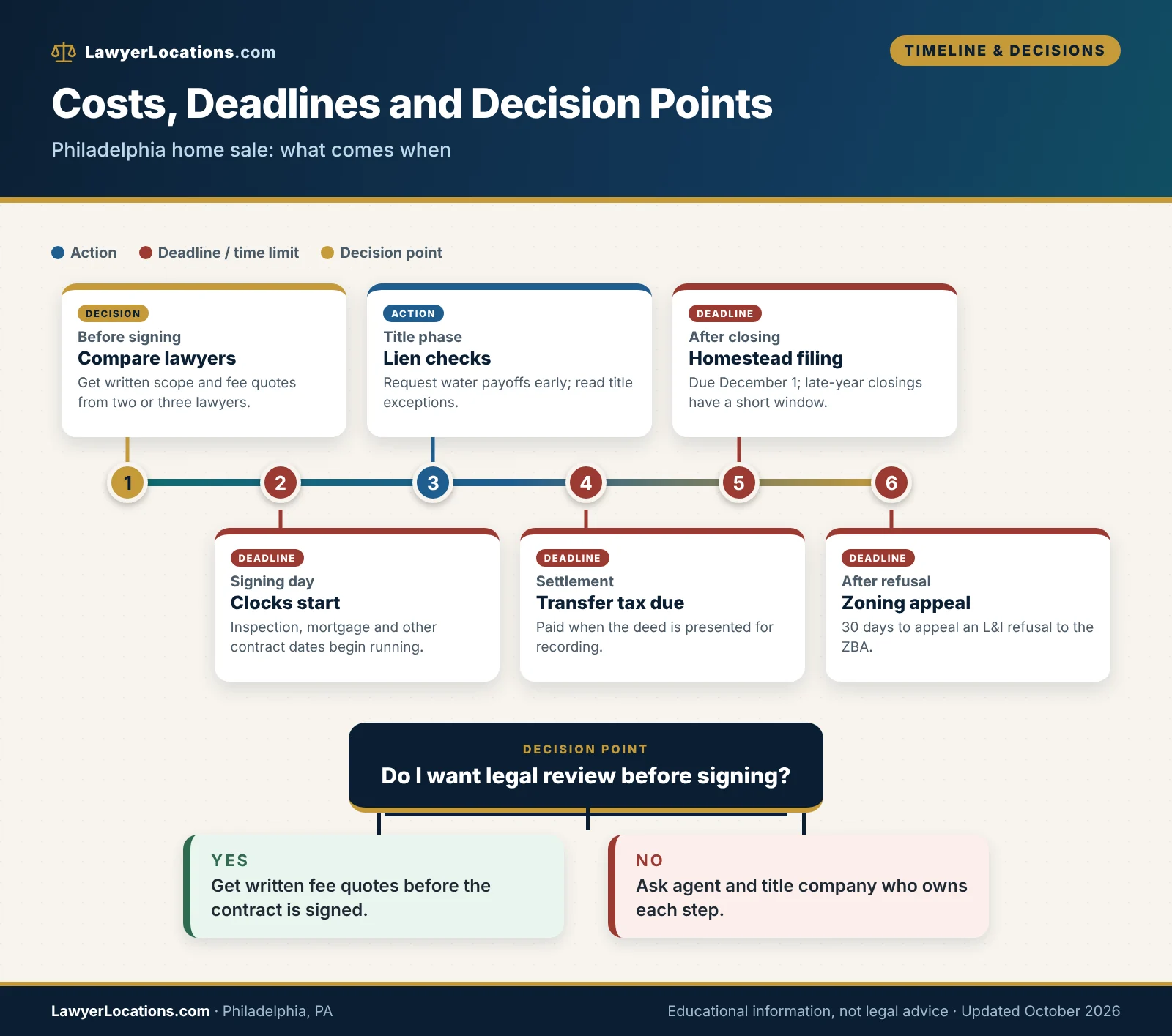
Text version of this graphic
- Before signing: compare lawyers and get written scope and fee quotes (decision point).
- Signing day: contingency clocks start, such as inspection and mortgage dates (deadline).
- Title phase: order title and lien checks; the City asks for water payoff requests at least 30 days before settlement (action).
- Settlement: transfer tax is due when the deed is presented for recording (deadline).
- After closing: apply for the Homestead Exemption by December 1; late-year closings have a short window (deadline).
- Zoning refusal: 30 days to appeal an L&I refusal to the Zoning Board of Adjustment (deadline).
- Decision: Do I want legal review before signing? If yes, get written fee quotes now. If no, ask the agent and title company who owns each step.
Zoning, Row Houses and Code Issues in Philadelphia
Philadelphia’s housing stock is dense with attached row houses, so zoning, shared walls and neighbors’ construction come up often. This section covers the city agencies and time limits involved. Municipal Court landlord-tenant disputes are a different practice area and are not covered here.
Zoning, L&I and the Zoning Board of Adjustment
Two city bodies matter. The Department of Licenses and Inspections (L&I) enforces building-related codes and issues permits; the Zoning Board of Adjustment (ZBA) hears appeals of L&I decisions under the Philadelphia Zoning Code.
Checking zoning and permits before you commit
The City says Atlas and the L&I Property History lookup show licenses, permits, violations, zoning history and assessments for an address, and Atlas adds deed and mortgage history. Before buying a house you plan to alter or convert, check these records, and ask while contingencies are open about any open violations or unfinished permit work.
The 30-day appeal clock and ZBA hearings
If L&I refuses your zoning application or refers it to the ZBA, you have 30 days to appeal. The ZBA can grant a variance or special exception or overturn the L&I decision. Individuals may appear for themselves or through a Pennsylvania-licensed attorney, while corporations, nonprofits and LLCs must use a Pennsylvania-licensed attorney.
The ZBA is at 1515 Arch St., 18th Floor, Room 18-006, (215) 686-2429. The City lists fees effective August 1, 2026 of $125 for existing one- or two-family dwellings and $811 for all other properties, among others; the fee on your L&I refusal controls.
| Stage | Who decides | Time limit and notes |
|---|---|---|
| Zoning application | Department of Licenses and Inspections | May approve, refuse or refer the application to the ZBA |
| Appeal of a refusal or referral | Zoning Board of Adjustment | 30 days to appeal; for variances and special exceptions the ZBA sends instructions for notifying near neighbors and attending a community meeting |
| Appeal of a ZBA denial | Court of Common Pleas | 30 days after the denial to request reconsideration or appeal to the court |
| Filing fee | ZBA | $125 for existing 1- or 2-family homes; $811 for other properties (fees effective Aug. 1, 2026) |
Row houses, party walls and construction next door
A party wall is a wall shared by two adjoining buildings, so what one owner builds, removes or excavates beside it can affect the other.
What the City requires of builders next door
L&I describes notice rules for permit applications submitted on or after January 1, 2023. Notice to adjacent owners is required for excavation deeper than 5 feet below grade within 10 feet of your building, for demolition or structural alteration directly affecting a shared party wall, for changes to shared porches, balconies or facades, and for historic-registry properties within 90 feet of excavation, new construction or demolition next door.
Before work starts, the owner or developer must give adjacent owners the contractor’s general liability certificate of insurance and contact information, and the contractor must describe how your property will be protected. For applications on or after January 1, 2024, a chimney or vent that must be extended triggers a separate notice at least 60 days before work.
Limits of those rules and how to document your property
The City’s FAQ says an owner may do construction affecting a shared party wall without the neighbor’s permission, except that excavation below the wall requires the written notice. It describes no mandatory pre-construction survey but recommends timestamped photos of your property’s condition beforehand.
The City also says it cannot represent you in a dispute with an owner or contractor or reimburse repair costs; damage claims run through the contractor’s insurance and may require private legal help. Community Legal Services lists a Rowhouse Protection Project among its housing resources, though its public page does not describe eligibility.
If you are buying a row house, ask whether construction next door is planned or underway and whether permits for work on a shared wall are open. Dated photos of walls and ceilings at closing create a baseline if a dispute starts later.
Mistakes to Avoid, Free Help and Next Steps
Most avoidable problems come from skipping a written fee description, missing a contingency date, or assuming the title company is on your side. This section collects the mistakes, the free help available in Philadelphia, and a short plan for comparing a real estate attorney Philadelphia PA buyers and sellers can verify.
Common mistakes and red flags
Mistakes cluster around timing and assumptions.
Mistakes buyers and sellers make
- Assuming the agent can answer legal questions; Pennsylvania’s consumer notice sends consumers elsewhere for matters beyond a licensee’s expertise.
- Waiting until the last week to read the title commitment, after contingencies have expired.
- Using an old tax quote after the 2025 rate change; check the 4.578% combined rate and your contract’s split.
- Missing the Homestead Exemption deadline or assuming the seller’s exemption transfers.
- Treating the Seller Disclosure Law as an inspection; a seller has no duty to investigate beyond what the seller knows.
Red flags when hiring
Pause if a lawyer promises the outcome of a title issue, refuses to put the fee in writing, or cannot explain what is included. Be cautious if someone who is not a Pennsylvania-licensed attorney offers to represent you at settlement; the Pennsylvania Bar committee has said that representing a party at settlement is the practice of law.
Wire instructions can be faked. Call a known, verified number to confirm them before sending any closing money, and verify every lawyer on the Disciplinary Board’s lookup.
Free and low-cost help in Philadelphia
Several Philadelphia organizations help low-income homeowners and buyers, and eligibility rules differ.
Legal aid and the Tangled Title Fund
Community Legal Services (CLS) provides free civil legal assistance to low-income Philadelphians; its Center City office is at 1424 Chestnut Street, 215-981-3700. Philadelphia VIP trains and supports volunteer lawyers for low-income Philadelphians and administers the Tangled Title Fund, whose phone is (215) 523-9553. Both apply eligibility rules, so call to ask whether your issue fits.
City housing counseling and assessment help
The City’s Division of Housing and Community Development funds housing counseling agencies and answers questions at (215) 686-9749. The counseling covers budgeting, avoiding risky mortgages and deeds and other legal housing documents, and is required before signing an agreement of sale if you use Philly First Home. For assessment questions, the Office of Property Assessment is at 601 Walnut St., Suite 300 W., hotline (215) 686-9200.
Next steps and quick answers
You do not need to resolve everything at once. A short sequence keeps the process manageable.
A short action plan
- Read your contract and note every deadline. Keep the inspection, mortgage and settlement dates in one place.
- Decide whether you want legal review. Use the risk list in this guide and price it out before signing.
- Verify two or three lawyers. Use the Philadelphia Bar LRIS or your own list, then check each on the Disciplinary Board lookup.
- Ask the same written questions. Use the scorecard to compare scope, fee basis and communication.
- Order title and lien checks early. Include judgments, water liens and permit history.
- Confirm taxes and programs. Check the transfer tax split and the Homestead Exemption window.
Ready to compare your options?
Use this guide’s questions and checklist when you talk with a real estate attorney Philadelphia PA residents can verify through the Disciplinary Board, and compare quotes in writing before you sign. LawyerLocations.com does not recommend any individual lawyer or firm, and reading this page does not create an attorney-client relationship. If the home came through an estate or you are weighing a trust, see how living trust lawyers handle property transfers; trust and probate rules are state-specific.
Quick answers to common questions
Do I need a real estate attorney to buy a house in Philadelphia?
Not by law, as far as we found. FindLaw’s survey of attorney-only closing states does not list Pennsylvania. Whether to hire one depends on the contract, title and property.
Who pays the Philadelphia realty transfer tax?
The City says it is usually split evenly but not legally required. Your agreement of sale controls the split, and the City can collect the full amount from either party.
How do I find liens on a Philadelphia property?
Check the Court of Common Pleas Judgment Search for judgments and the City’s water lien search for water debts. The Department of Records holds deeds and mortgages, not liens or judgments.
How do I report deed fraud in Philadelphia?
Report it online through the City or call (215) 686-2290, file a police report, and seek legal help. Fraud Guard alerts you when documents are recorded in your name.
Will the lawyer’s fee be in writing?
Rule 1.5(b) requires the fee basis to be communicated in writing when the lawyer has not regularly represented you. Ask for it before you pay.
Sources & References
Show all 40 sources
- City of Philadelphia, Department of Revenue — Realty Transfer Tax — phila.gov — accessed October 2026
- City of Philadelphia, Department of Revenue — “Philly’s realty transfer tax rate is now 4.578%” (July 28, 2025) — phila.gov — accessed October 2026
- Pennsylvania General Assembly — 68 Pa.C.S. Chapter 73, Real Estate Seller Disclosure — legis.state.pa.us — accessed October 2026
- 68 Pa.C.S. § 3407, Resales of units (Uniform Condominium Act) — Onecle republication — law.onecle.com — accessed October 2026
- Pennsylvania Association of Realtors — Certificates of Resale post — parealtors.org — accessed October 2026
- Pennsylvania Association of Realtors — About the Standard Agreement of Sale — parealtors.org — accessed October 2026
- Pennsylvania Association of Realtors — Inspection Contingency Review (Oct. 18, 2019) — parealtors.org — accessed October 2026
- Pennsylvania Department of State, State Real Estate Commission — Written Consumer Notice — pa.gov — accessed October 2026
- Pennsylvania Bar Association, Unauthorized Practice of Law Committee — Opinion 96-102 — pabar.org — accessed October 2026
- FindLaw — Do I Need a Lawyer to Buy a House? — findlaw.com — accessed October 2026
- Disciplinary Board of the Supreme Court of Pennsylvania — Rules of Professional Conduct (Rule 1.5) — padisciplinaryboard.org — accessed October 2026
- 204 Pa. Code r. 1.5, Fees (Cornell LII) — law.cornell.edu — accessed October 2026
- Disciplinary Board of the Supreme Court of Pennsylvania — FAQs for the Public — padisciplinaryboard.org — accessed October 2026
- Pennsylvania Lawyers Fund for Client Security — program summary (Pennsylvania courts) — pacourts.us — accessed October 2026
- Philadelphia Bar Association — Lawyer Referral & Information Service — philadelphiabar.org — accessed October 2026
- City of Philadelphia, Department of Records — Department page — phila.gov — accessed October 2026
- City of Philadelphia — “What is a recorder of deeds and why does it matter?” (June 23, 2025) — phila.gov — accessed October 2026
- City of Philadelphia — Get a copy of a deed or other recorded document — phila.gov — accessed October 2026
- City of Philadelphia — “Why title insurance is your best friend when buying a home in Philadelphia” (April 7, 2026) — phila.gov — accessed October 2026
- First Judicial District of Pennsylvania — Court of Common Pleas — courts.phila.gov — accessed October 2026
- First Judicial District of Pennsylvania — Court of Common Pleas, Civil, Judgment Search — fjdefile.phila.gov — accessed October 2026
- City of Philadelphia, Water Department — “Buying or selling a property? Search Philly water liens online” (Oct. 22, 2024) — phila.gov — accessed October 2026
- City of Philadelphia — Resolve water liens and judgments — phila.gov — accessed October 2026
- City of Philadelphia, Office of Property Assessment — phila.gov/OPA — accessed October 2026
- City of Philadelphia — “Got Homestead questions? We have the answers” (Nov. 20, 2025) — phila.gov — accessed October 2026
- City of Philadelphia — Property tax abatements — phila.gov — accessed October 2026
- City of Philadelphia, Office of Property Assessment — New Construction Residential abatement application (2025) — phila.gov — accessed October 2026
- City of Philadelphia — Buy my first home (Philly First Home) — phila.gov — accessed October 2026
- City of Philadelphia — Apply for a grant to clear your home’s title — phila.gov — accessed October 2026
- Philadelphia VIP — Tangled Title Fund — phillyvip.org — accessed October 2026
- Philadelphia VIP — home page — phillyvip.org — accessed October 2026
- City of Philadelphia — “New law helps deed fraud victims get money back” (Feb. 13, 2026) — phila.gov — accessed October 2026
- Pennsylvania Rule of Civil Procedure 1061 (231 Pa. Code r. 1061) — Cornell LII — law.cornell.edu — accessed October 2026
- City of Philadelphia — Appeal a zoning decision to the Zoning Board of Adjustment — phila.gov — accessed October 2026
- City of Philadelphia — Zoning Board of Adjustment — phila.gov — accessed October 2026
- City of Philadelphia, Department of Licenses and Inspections — phila.gov — accessed October 2026
- City of Philadelphia — Search for property history and business license information — phila.gov — accessed October 2026
- City of Philadelphia, L&I — Construction next door FAQs — phila.gov — accessed October 2026
- Community Legal Services of Philadelphia — clsphila.org and housing resources — accessed October 2026
- Pennsylvania Insurance Department — Consumer Resource Library — pa.gov — accessed October 2026
General information only. This article is legal information, not legal advice, and reading it does not create an attorney-client relationship. LawyerLocations.com is not a law firm and does not recommend or rank individual lawyers. Laws, tax rates, fees and local procedures change; verify current rules with the official sources cited and consult a lawyer licensed in Pennsylvania about your situation.
Legal Disclaimer and Limitation of Liability
Informational and illustrative purposes only. This article was prepared by LawyerLocations.com solely on the basis of the information available to us at the time of writing. It is an illustrative, general overview. It is not a complete or authoritative statement of the law, and it has not been reviewed by a lawyer licensed in your state or county.
Not legal advice. Nothing in this article is legal, financial, tax or immigration advice, and reading it does not create an attorney-client relationship between you and LawyerLocations.com or any author, lawyer or firm mentioned. Laws, court rules, fees, filing deadlines and agency procedures differ by state, county and court, and they change often. Some details here may be simplified, incomplete or out of date, and time limits for legal claims can be short.
No warranty. We make no representation or warranty, express or implied, about the accuracy, completeness, timeliness or suitability of this content for your situation. Please do not rely on it to make, delay or skip any legal decision. Check the facts against official sources and speak with a licensed attorney in the relevant jurisdiction before you act.
Limitation of liability. To the fullest extent permitted by law, LawyerLocations.com and its owners, authors and contributors disclaim all liability for any loss, damage, cost or other consequence arising from the use of, or reliance on, this article, including any content on third-party websites we link to. Mentioning a lawyer, firm, organization or service is not an endorsement and is not a promise of any result. If you are in immediate danger, contact your local emergency number.