
A workers compensation lawyer Nashville TN injured workers hire is a Tennessee-licensed attorney who handles a job-injury claim inside the state’s no-fault system: the Tennessee Bureau of Workers’ Compensation, its mediators, and the Court of Workers’ Compensation Claims. The law is state law, so the rules are the same in Nashville as in Knoxville; what is local is the court calendar, the Davidson County courthouses for related lawsuits, and the lawyers and legal-aid groups you can reach. Report the injury to your employer right away and in writing within 15 days, and treat 1 year as the general outer limit to file a petition.
This guide explains how a Nashville claim moves, what benefits look like, how lawyer fees work, how to compare lawyers, and what to ask before you sign.
What a Workers’ Compensation Lawyer Does in Nashville, and When Hiring One Makes Sense
A workers’ compensation lawyer represents an injured employee in Tennessee’s no-fault system for job injuries and work-related illnesses. The lawyer’s job is to protect your medical care, your wage benefits and your rights at each step, and to speak for you in mediation, at hearings and in settlement talks. Some Nashville workers resolve a simple claim without one, so the real question is when the stakes or the friction justify the cost.
What the job covers
Workers’ comp is different from a car-wreck or slip-and-fall case. You do not have to prove your employer was careless, and in exchange you generally cannot sue your employer for the injury. That trade-off, often called the exclusive remedy rule, shapes everything a lawyer does.
Tasks a lawyer handles on a typical claim
In practice, the work is a mix of paper, medicine and negotiation. A lawyer gathers your medical records, checks that the employer or its insurance carrier has offered a proper panel of doctors, tracks whether temporary disability checks are being paid on time, and files the petition that starts a case in court if the claim stalls. The lawyer also prepares you for mediation, communicates with the adjuster, and reviews any settlement before you sign it.
A good lawyer also explains the trade-offs in plain language: what a closed medical file means, what you give up in a lump-sum deal, and what the insurer may ask you to prove.
What a lawyer cannot do
A lawyer cannot change the benefit formulas set by Tennessee law, cannot promise a result, and cannot make a doctor reach a particular opinion. Nor can a lawyer force an employer to keep you in a job. If your concern is a firing or demotion after you reported an injury, that is a separate type of claim, covered later in this guide.
LawyerLocations.com is an education and discovery resource, not a law firm. Nothing here creates an attorney-client relationship, and we do not rank or recommend individual lawyers. Use this guide to ask better questions.
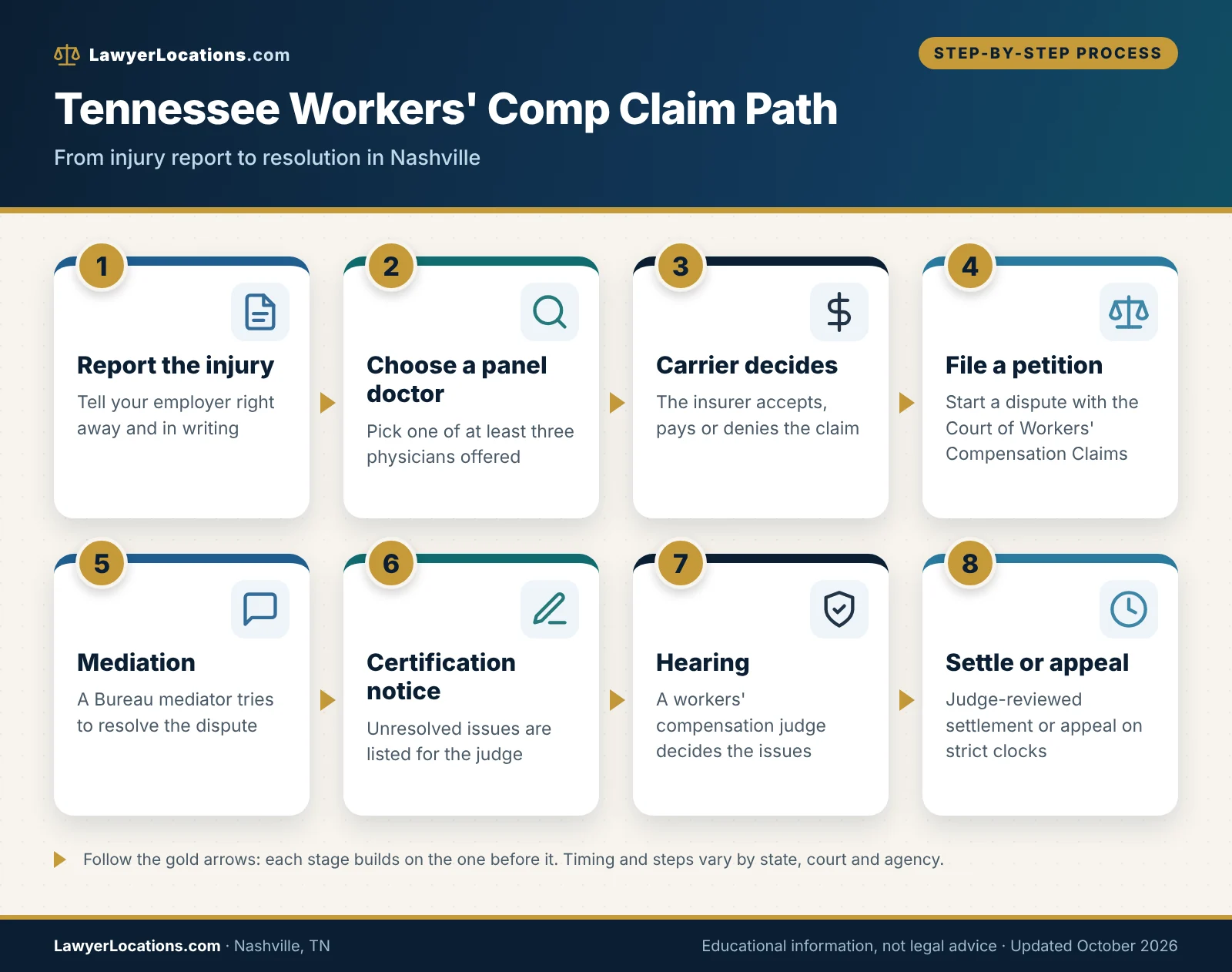
Text version of this graphic
- Report the injury to your employer, in writing if possible.
- Get care from a doctor on the employer’s panel.
- The carrier accepts or denies the claim.
- If there is a dispute, file a Petition for Benefit Determination.
- A mediator works with both sides.
- If mediation fails, a Dispute Certification Notice lists the open issues.
- Request a hearing before a workers’ compensation judge.
- Settle with judicial approval or appeal the order.
Signs your claim needs legal help
Not every claim needs a lawyer on day one. The signals below are the ones that most often change a manageable claim into a contested one.
Denials, delays and unreturned calls
If the carrier denies the claim, says the injury is not work-related, or goes quiet after the first report, you are in a dispute even if nobody calls it that. The same is true if the employer never gives you a list of doctors, or if wage checks stop without a written explanation. At that point the practical question is whether to start the court process before the filing clock runs down.
For a plain-language checklist of the situations where hiring tends to matter, see our national guide on whether you need a workers’ comp lawyer.
Doctor, rating and return-to-work disputes
Medical questions are the second major trigger. Examples include a doctor who releases you to work before you can do the job, a dispute over whether surgery is approved, an impairment rating you think is too low, or an employer who offers light duty that does not fit your restrictions. Because the impairment rating feeds directly into permanent disability benefits, an early disagreement can affect the value of the whole claim.
Before paying anyone, call the Bureau’s free Ombudsman line at 1-800-332-2667. The Ombudsman gives general information on the process, not legal advice, and can tell you where you stand procedurally.
Tennessee’s System and Where Nashville Cases Are Heard
Tennessee runs workers’ compensation through the Bureau of Workers’ Compensation, part of the state Department of Labor and Workforce Development. Disputed claims for injuries on or after July 1, 2014 are decided by the Court of Workers’ Compensation Claims, with appeals to the Workers’ Compensation Appeals Board and then the Tennessee Supreme Court. Because the system is statewide, a Nashville claim follows the same steps as a claim anywhere in Tennessee.
The state system in brief
Understanding who runs what helps you avoid sending a letter to the wrong place or waiting on an office that cannot act.
No-fault coverage and the exclusive remedy
Tennessee’s workers’ compensation law pays medical care and part of lost wages for covered job injuries regardless of who was at fault. The tradeoff is the exclusive remedy rule: you generally cannot sue the employer for pain and suffering. Since the 2010s reforms, the injury must arise primarily out of and in the course and scope of employment, so the cause of your condition becomes a central fight in many contested claims.
Employers above a small-headcount threshold are generally required to carry coverage or qualify as self-insured, and the threshold is lower in some industries. If your employer has no coverage, the Uninsured Employers Fund can help in limited circumstances for injuries on or after July 1, 2015.
The Bureau, mediators and the Ombudsman program
The Bureau handles the administrative side: forms, mediation, and the Ombudsman program that answers questions from workers who do not have lawyers. Mediators are assigned after a petition is filed and work by phone, video or in person to settle disputes. If you were injured on or after July 1, 2016 and are unrepresented, an Ombudsman attorney may be available to give limited legal advice, though that attorney cannot appear in court for you.
A Petition for Benefit Determination is the form that starts a contested claim. It lists your contact information, your employer, the date of injury and a short statement of what happened, and it is filed with the court clerk with a copy to the employer or carrier.
Where Nashville cases are heard
Nashville is the state capital and home to the Bureau’s central administration, but your case is not decided at a single Nashville courthouse. The court assigns each case to a judge and a calendar, and many procedural hearings are held by telephone or video.
The Court of Workers’ Compensation Claims
This is the trial court for disputed claims. After mediation fails, the case proceeds through hearings that differ by purpose. An expedited hearing addresses temporary disability or medical benefits and requires a sworn statement. A status hearing is a telephone check-in while you are still treating. A scheduling hearing is held after you reach maximum recovery and an impairment rating, and the compensation hearing is the final trial that ends in a written order.
Check the court’s page for the current location of the judge assigned to your case and whether your hearing will be in person, by phone or by video. A Nashville-area lawyer will usually know the local judges’ scheduling habits, which is a legitimate reason to compare local firms.
Appeals Board and Tennessee Supreme Court
Either side can appeal. For an interlocutory order such as an expedited hearing order, a notice of appeal is due within 7 business days, with an Appeals Board filing fee of $75 due within 10 calendar days. For a final compensation order, the notice of appeal is due within 30 calendar days. After the Appeals Board rules, a further appeal to the Tennessee Supreme Court has its own 30-day clock from the date the order is certified as final. These deadlines cannot be extended for the notice itself, and fees and timing can change, so confirm them on the court’s current appeal instructions.
Appeal clocks are short and the notice of appeal cannot be extended. If you receive an order you disagree with, write down the stamped date on the order the same day and talk to a lawyer immediately.
| Stage | Who handles it | What happens |
|---|---|---|
| Report and care | Employer and insurance carrier | You give notice, receive a panel of physicians, and the carrier accepts or denies. |
| Questions without a lawyer | Bureau Ombudsman program | General information about the process; limited legal advice from an Ombudsman attorney in qualifying cases. |
| Starting a dispute | Court clerk, Court of Workers’ Compensation Claims | You file a Petition for Benefit Determination. |
| Mediation | Bureau mediator | Both sides attempt to resolve the dispute; a Dispute Certification Notice lists unresolved issues. |
| Hearings | Workers’ compensation judge | Expedited, status, scheduling and compensation hearings. |
| Appeals | Appeals Board, then Tennessee Supreme Court | Review of the judge’s orders on tight deadlines. |
Davidson County courts and related claims
Some disputes that arise from a work injury are not decided by the workers’ compensation court at all. Those go to ordinary civil courts, where Davidson County is the home venue for many Nashville employers.
Retaliation lawsuits
If you are fired because you filed or pursued a workers’ comp claim, the legal claim is a retaliatory discharge lawsuit in a regular state court, not a petition before the workers’ compensation judge. Such suits are generally filed in the circuit or chancery court of the county where the employer is located or the events happened, which for many Nashville workers means Davidson County. Federal court is possible in some situations. We discuss the elements and evidence in the retaliation section below.
Third-party injury claims
Sometimes someone other than your employer caused the injury: a driver who hit you while you were on a delivery route, a contractor on a shared construction site, or the maker of a defective machine. Workers’ comp pays you regardless, but you may also have a separate personal injury claim against the outsider, which can recover amounts that workers’ comp does not. Read our overview of personal injury filing deadlines and our guide on when a lawyer matters after a vehicle crash if your injury involved a car or truck on the job. If a worker died, see our Nashville wrongful death guide, since survivors may have both workers’ comp death benefits and other legal options.
Do not sign a release or accept a payment from a third party’s insurer without understanding how it may affect your workers’ comp benefits and any reimbursement the comp carrier can claim from a third-party recovery.
Deadlines and the First Weeks After a Nashville Job Injury
The early weeks decide a surprising amount of a Tennessee claim. Tell your employer immediately and in writing, get treated by a doctor from the employer’s panel, and keep the one-year filing clock in view. Missing a notice or filing deadline can end an otherwise valid claim.
Notice to your employer
Notice is the first legal step, and it is the easiest one to get wrong because people assume a verbal “I hurt my back” to a coworker counts.
Telling your supervisor and putting it in writing
Tell your supervisor as soon as the injury happens, and follow up in writing if you can. According to the Tennessee court guide for injured workers, if you do not give immediate notice you must give written notice within 15 days of the injury, or of when you knew or should have known the condition was work-related. A short email or text that states the date, what happened and which body part hurts is usually enough to create a record, and you should keep a copy.
Gradual injuries such as repetitive strain or hearing loss are where the “knew or should have known” language matters, and that is a common area for disputes over when the clock began.
What the employer must then do
After notice, the employer should report the injury to its carrier and give you a panel of physicians. Ask for the panel in writing if it is not offered. Keep a log of every call: date, time, the person’s name, and what they said. That log becomes useful evidence if the carrier later says it never received notice.
When in doubt, give written notice sooner rather than later. Earlier written notice is always safer than arguing later about whether verbal notice was enough.
The filing clock and the court calendar
Notice to the employer is not the same as filing a claim. If the carrier accepts and pays, you may never need to file. If it denies or stops paying, the court clock matters.
The one-year general limit
Generally, the Petition for Benefit Determination must be filed within one year of the date of injury or of the date the employer or carrier last paid benefits. Because “last paid” can move the date forward, workers sometimes believe they have more time than they do. A lawyer can calculate the exact date and flag any exceptions that apply to your facts.
For a comparison with another state’s approach, see how the process is described in our Los Angeles and New York City workers’ comp guides, where both the clocks and the forums differ.
Clocks that run after mediation
Once a mediator files a Dispute Certification Notice, you have five business days to ask for missing information to be added, since the judge can decide only issues listed on the notice. You then have 60 days after the notice is filed to request a hearing. If you do not, you may be ordered to attend a telephone show-cause hearing and the case can be dismissed. Workers without a lawyer can lose ground here simply because the notice arrives and nobody points out that the 60 days have started.
| Event | Time limit | Why it matters |
|---|---|---|
| Notice to employer | Immediately; written notice within 15 days if not immediate | Late notice can be used to contest the claim. |
| File Petition for Benefit Determination | Generally 1 year from injury or last payment | Missing it can bar the claim. |
| Correct a Dispute Certification Notice | 5 business days | The judge decides only the issues listed. |
| Request a hearing after the notice | 60 days | Otherwise a show-cause hearing and possible dismissal. |
| Appeal an interlocutory order | 7 business days | No extension for the notice of appeal. |
| Appeal a compensation order | 30 calendar days | Starts from the stamped order date. |
Medical Care, Benefits and Settlements in a Tennessee Claim
In Tennessee, the employer provides a panel of at least three doctors and you choose one as your authorized treating physician. Temporary total disability generally pays two-thirds of your average weekly wage while you cannot work, and permanent disability is calculated from an impairment rating. Knowing which doctor controls your file, and how ratings convert into money, is the core of valuing a claim.
The authorized doctor and medical disputes
Medical care is the part of the claim you feel first, and it is also where the insurer has the most influence.
Choosing from the panel
The employer must offer a list of at least three physicians. You pick one, and that doctor becomes your authorized treating physician, who decides on treatment, work restrictions, referrals and your impairment rating. Choose carefully, ask about the doctor’s experience with work injuries, and tell every provider that the condition is work-related so the bills go to the right place.
Ask the doctor to describe in the chart how the work activity caused the problem. Under Tennessee’s causation standard, that medical opinion often matters more than your own account.
When treatment is delayed or refused
If the carrier will not authorize recommended care, the usual route is an expedited hearing before a workers’ compensation judge on medical benefits. That hearing requires a sworn statement or affidavit, and a denial at that stage does not close the door on a later compensation hearing. A lawyer can often move faster because the judge expects the medical evidence organized in a specific way.
Keep a symptom diary and every work-status note. If a doctor releases you to light duty, write down whether the employer actually has work within those restrictions.
Wage and disability benefits
Wage replacement is the second major piece. It comes in phases, and the phase you are in determines which formula applies.
Temporary disability while you heal
While you are totally unable to work, temporary total disability generally pays two-thirds of your average weekly wage from the year before the injury, subject to the state’s maximum rates. If you can return to work part-time or at lower pay, temporary partial benefits may cover part of the difference. Check the Bureau’s current published rates rather than relying on figures from an old article, since the maximums are updated periodically.
Ask the carrier in writing how it calculated your average weekly wage. Errors, such as leaving out overtime or a second job where permitted, are common reasons for underpayment.
Permanent disability after maximum recovery
When you reach maximum medical improvement, the authorized doctor assigns an impairment rating. Under the court guide’s summary, permanent disability is the impairment percentage times the compensation rate (two-thirds of average weekly wage) times 450 weeks. Additional rules can raise or limit the result depending on whether you return to work at the same pay, so the details matter. This is where a rating dispute, an independent medical examination, or a vocational issue can change the value of the case.
| Benefit | Basic idea | What to watch |
|---|---|---|
| Medical care | Reasonable and necessary treatment for the work injury from the authorized physician | Authorization delays and disputes over causation |
| Temporary total disability | Generally two-thirds of average weekly wage while you cannot work | Correct wage calculation; stoppage without notice |
| Temporary partial disability | Partial wage replacement if you work with restrictions at lower pay | Whether light duty is genuinely offered |
| Permanent partial disability | Impairment percentage times weekly rate times 450 weeks | The rating, and whether you return to the same job |
| Death benefits | Payments to qualifying dependents after a fatal work injury | Eligibility rules and burial expense provisions |
Settlements and what you give up
Most Tennessee claims that end by agreement do so through a settlement. Settlement is final in ways that matter, so it deserves its own review.
Judicial approval and the lump-sum question
Settlements of workers’ compensation claims in Tennessee are generally reviewed by a judge before they take effect, to confirm that the agreement is in the worker’s best interest. A lump-sum settlement pays a single amount in place of ongoing weekly payments, and it may close or limit future benefits. Before agreeing, ask your lawyer to explain which parts of the claim are being released and what you would pay for related care later.
Medicare and future medical care
If you are on Medicare or expect to be within a short period, the settlement may need to account for Medicare’s interests in future injury-related treatment. Ask whether the proposed terms include a set-aside arrangement and who pays for creating it. Also ask how the settlement affects other benefits such as Social Security disability or private disability insurance.
Be wary of pressure to sign quickly, an offer that arrives before you reach maximum improvement, or a release that is broader than the injury at issue.
How to Compare Workers’ Compensation Lawyers in Nashville and What They Cost
Workers’ compensation lawyers in Tennessee are generally paid on contingency, meaning a percentage of what you recover, and the fee is limited by statute and subject to judicial approval. Compare lawyers on their experience with this specific court system, how they communicate, and how the fee agreement treats expenses, then verify each license through the state’s official attorney directory.
How fees work
Fees are the most common worry, and the system is more regulated than many people expect.
The statutory cap and judge review
Tennessee law, at Tenn. Code Ann. 50-6-226, addresses fees for attorneys and physicians in workers’ compensation cases. As generally described, a workers’ comp attorney’s fee is capped at 20 percent of the award, and the fee is subject to approval by the judge. Ask any lawyer to point to the fee language in the written agreement and to explain which of your benefits it applies to. Because your lawyer’s fee comes from a recovery, you typically pay no hourly bill during the claim.
Tennessee’s lawyer conduct rules also require that a contingent-fee agreement be in writing and state how the fee and expenses are determined.
Expenses, medical evaluations and who pays
Separate from the fee are case expenses: records fees, deposition costs, expert or independent medical evaluations. Ask whether expenses are advanced by the firm, whether they are repaid only from a recovery, and whether they come out before or after the fee is calculated. Request an example in writing using a hypothetical award so you can see the arithmetic.
If a hypothetical award is $50,000 and the agreement sets a 20 percent fee, the fee would be $10,000, with expenses handled as the contract says. This is only arithmetic to help you read an agreement, not a prediction of any real outcome.
Questions to ask in a consultation
A consultation is a two-way interview. Prepare your questions and your documents so you can compare several lawyers in a consistent way. Do not assume any lawyer offers a free first meeting; ask about it directly. Our guide on what to expect from a free consultation shows the general framework, which also applies here.
Experience, staffing and strategy
Ask how many of the lawyer’s current cases are Tennessee workers’ compensation claims, whether the lawyer regularly appears before the Court of Workers’ Compensation Claims, and who will actually handle your file day to day. Ask what the lawyer sees as the first major decision point in your case and what would make the lawyer recommend mediation, a hearing or a settlement.
Communication and expectations
Ask how updates are delivered, who answers when you call, and what the firm needs from you each month. A lawyer who explains risks plainly, avoids promises, and gives you a written fee agreement to take home is easier to trust than one who rushes you to sign.
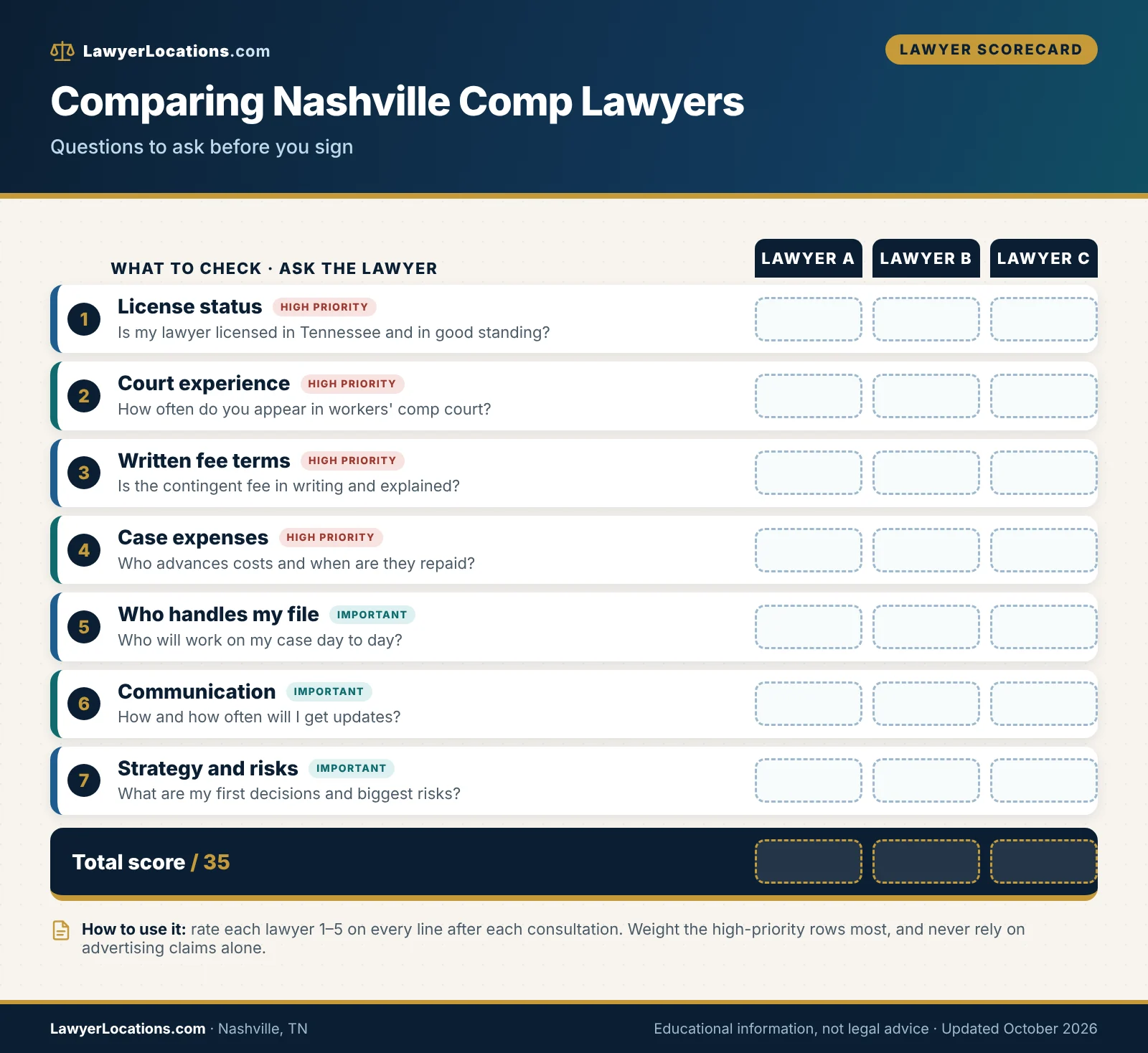
Text version of this graphic
| Criterion | Question to ask |
|---|---|
| License status | Is the lawyer licensed in Tennessee with no discipline I should know about? |
| Court experience | How often do you appear before the Court of Workers’ Compensation Claims? |
| Fee agreement | Is the contingent fee in writing, with the judge-approval step explained? |
| Expenses | Who advances costs and when are they repaid? |
| Staffing | Who will handle my file and answer my calls? |
| Communication | How and how often will I get updates? |
| Strategy | What are the first decisions and risks in my claim? |
| Option | Cost to you | Works well when | Limits |
|---|---|---|---|
| Handle it yourself with Bureau Ombudsman help | No fee for general information | Benefits are being paid and issues are simple | Ombudsman attorneys give limited advice and do not appear in court for you |
| Hire a private workers’ comp lawyer | Contingent fee capped by statute and approved by a judge; expenses per contract | Denial, medical dispute, rating dispute, retaliation concern or settlement offer | Fee reduces your recovery; you must choose and manage the relationship |
| Legal aid or referral service | Varies by program and eligibility | Limited income or you need help finding a lawyer | Eligibility rules, waiting times, and limited case types |
Verifying and finding a lawyer
After you have a short list, check the basics before you meet anyone.
License and discipline checks
The Tennessee Board of Professional Responsibility maintains an online attorney directory where you can confirm that a lawyer is licensed and see public discipline. The Tennessee courts also publish a Find a Lawyer resource. Never rely on an advertisement as proof of experience, and be cautious of any lawyer who claims a special title or promises results.
Referral services and legal aid in the Nashville area
The Nashville Bar Association is the local bar group and offers a lawyer referral service plus information pages for the public, including on workers’ compensation. A referral is a starting point, not an endorsement. If your income is limited, the Legal Aid Society of Middle Tennessee and the Cumberlands is a nonprofit worth contacting for eligibility, though eligibility rules and the types of cases handled vary. Always confirm the current program details directly.
- The fee agreement is written and explained in plain language.
- The lawyer describes real risks and next steps, not promises.
- Your questions get direct answers.
- Staffing and communication are clear before you sign.
- You are pressured to sign at the first meeting.
- The lawyer guarantees a result or settlement amount.
- Fees and expenses are described only verbally.
- Nobody can tell you who will work on your file.
Retaliation, Denials and Other Nashville Complications
Tennessee recognizes a lawsuit for retaliatory discharge when an employer fires a worker for filing or pursuing a workers’ compensation claim. Separately, claims are denied for reasons that can often be answered with better medical proof. Both situations are time-sensitive and are where a lawyer’s judgment tends to matter most.
Retaliation after a job injury
Many injured workers fear losing a job after reporting. Tennessee follows the general rule that employment is at will, but the courts have carved out an exception for firings tied to a comp claim, beginning with the Tennessee Supreme Court’s decision in Clanton v. Cain-Sloan Co. (1984).
What a worker generally has to show
In broad terms, a retaliatory discharge claim requires that you were an employee, that you made a workers’ compensation claim, that the employer ended your employment, and that the claim was a substantial factor in that decision. Courts look at the facts around the firing: who knew about the claim, what reasons were given, and whether those reasons hold up. This is a separate lawsuit from your comp claim and carries a much shorter window to act than many people expect; commonly a one-year limit is discussed, so ask a lawyer to confirm the date for your facts.
Evidence that tends to matter
Save the timeline. Keep performance reviews from before the injury, any written warnings after it, emails or texts about your injury, the termination notice, and names of coworkers who saw what happened. A sudden change in how a supervisor treated you after the report is useful context but needs documents to support it.
Do not resign in anger without legal advice. How a job ends can change both a retaliation claim and your eligibility for other benefits such as unemployment.
- Termination soon after you reported the injury or filed a petition.
- New “performance” complaints that never appeared in earlier reviews.
- Pressure not to see the panel doctor or to use your own health insurance.
- Threats about your job if you file.
Denied or disputed claims
A denial is not the end of the claim. It is the start of a dispute that follows the court path outlined earlier.
Common reasons carriers deny
Typical grounds include late notice, an argument that the injury did not happen at work, a claim that a pre-existing condition is the real cause, a statement that the worker was an independent contractor, and a dispute over whether a gradual injury is work-related. Each reason points to a different kind of proof, such as witness statements, medical opinions or payroll records.
Responding to a denial
Get the denial in writing and read the stated reason. Gather the medical record that ties the condition to work activity, ask your doctor whether they are willing to address causation, and consider filing a Petition for Benefit Determination well before the one-year limit. Mediation after filing is often where a denial is first tested against evidence.
Situations that change the picture
A few fact patterns deserve special attention because they alter who is responsible or what rules apply.
Uninsured employers and misclassification
If your employer did not carry required coverage, tell the Bureau or ask a lawyer about the Uninsured Employers Fund, which applies under limited conditions to injuries on or after July 1, 2015. If you were labeled an independent contractor but work under the company’s control, your classification may be disputed. Misclassification is common in delivery, construction trades and gig work, and the label on your paperwork does not decide the question by itself.
Injuries involving other people or older claims
If a third party caused the injury, you may have an additional claim as discussed above. Injuries before July 1, 2014 follow a different court route than the Court of Workers’ Compensation Claims, so ask a lawyer which system applies if your injury is older or an old claim is being reopened. Occupational illnesses that develop over time can also raise questions about when the clock started.
Timeline, Documents, Common Mistakes and Your Next Steps
A typical Tennessee claim moves from notice to treatment, then either payment or a dispute that goes through mediation and hearings. The steps below turn the process into decision points so you can see where a lawyer’s advice makes the most difference.
Timeline and decision points
The timeline is not a promise about how long any one case will take, since duration depends on medical recovery and whether the carrier disputes the claim.
The path from injury to resolution
First comes notice and treatment. If benefits are paid without a fight, the claim may continue until you reach maximum improvement and receive a rating. If the carrier denies or delays, the court path begins: petition, mediation, a Dispute Certification Notice, hearings, then a final order or settlement. Appeals follow on strict clocks.
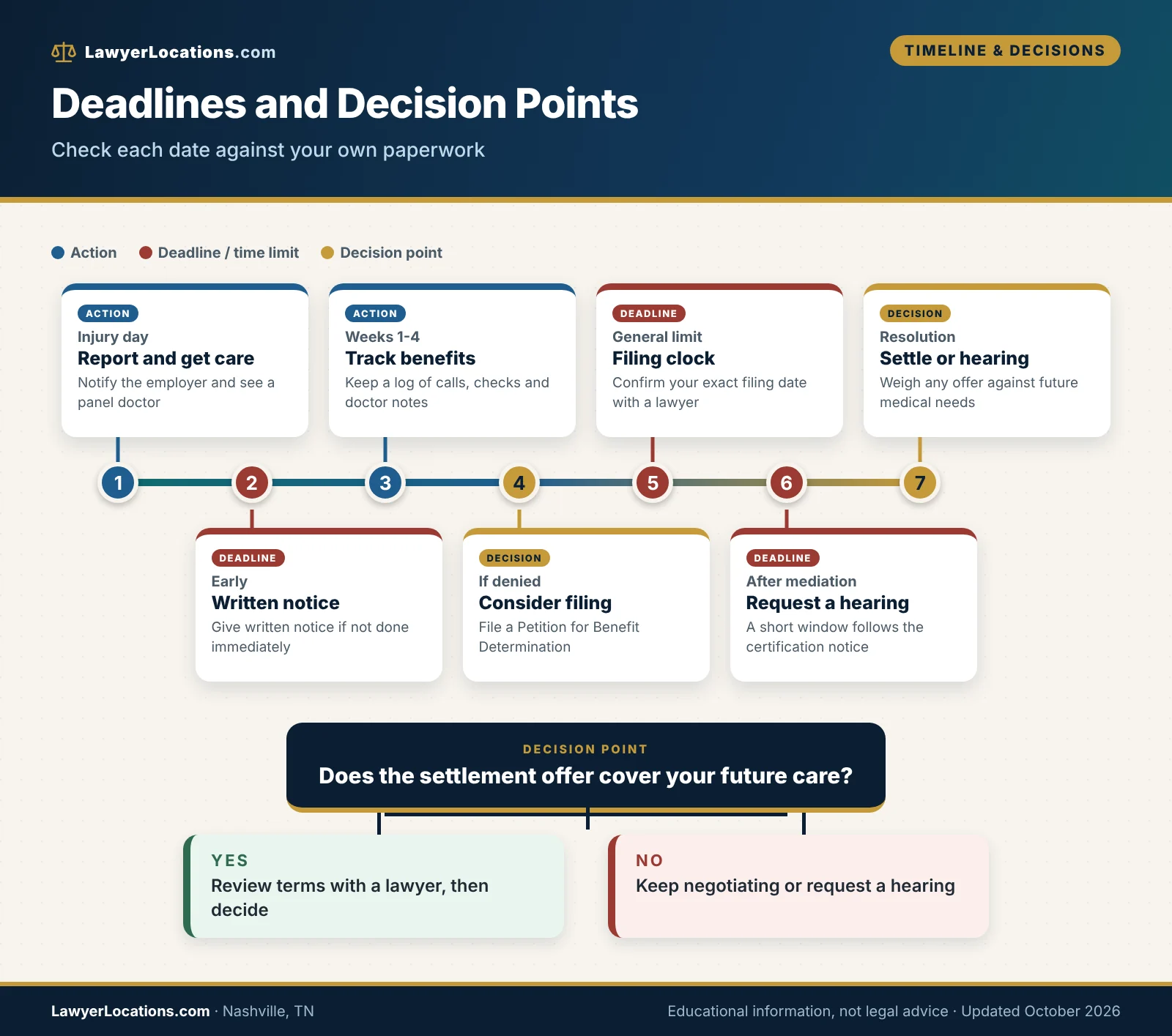
Text version of this graphic
- Injury day: report it, get care, write down what happened.
- Within 15 days: written notice to the employer if not already given.
- Early weeks: choose a doctor from the panel and track benefit payments.
- If denied or stopped: consider filing a Petition for Benefit Determination.
- Within 1 year generally: file before the limit passes.
- After mediation: use the 60-day window to request a hearing.
- Decision point: settle, or proceed to a hearing and possible appeal?
Decision points where advice matters
Three decisions deserve a lawyer’s input: whether to accept a doctor’s release or impairment rating, whether to file or wait when benefits slow down, and whether a settlement offer fairly accounts for future medical care. Write down the date each decision is due and ask the lawyer to state, in writing, the main risk of each choice.
Documents to gather
Organized records shorten consultations and help any lawyer give you a straight answer on the first call.
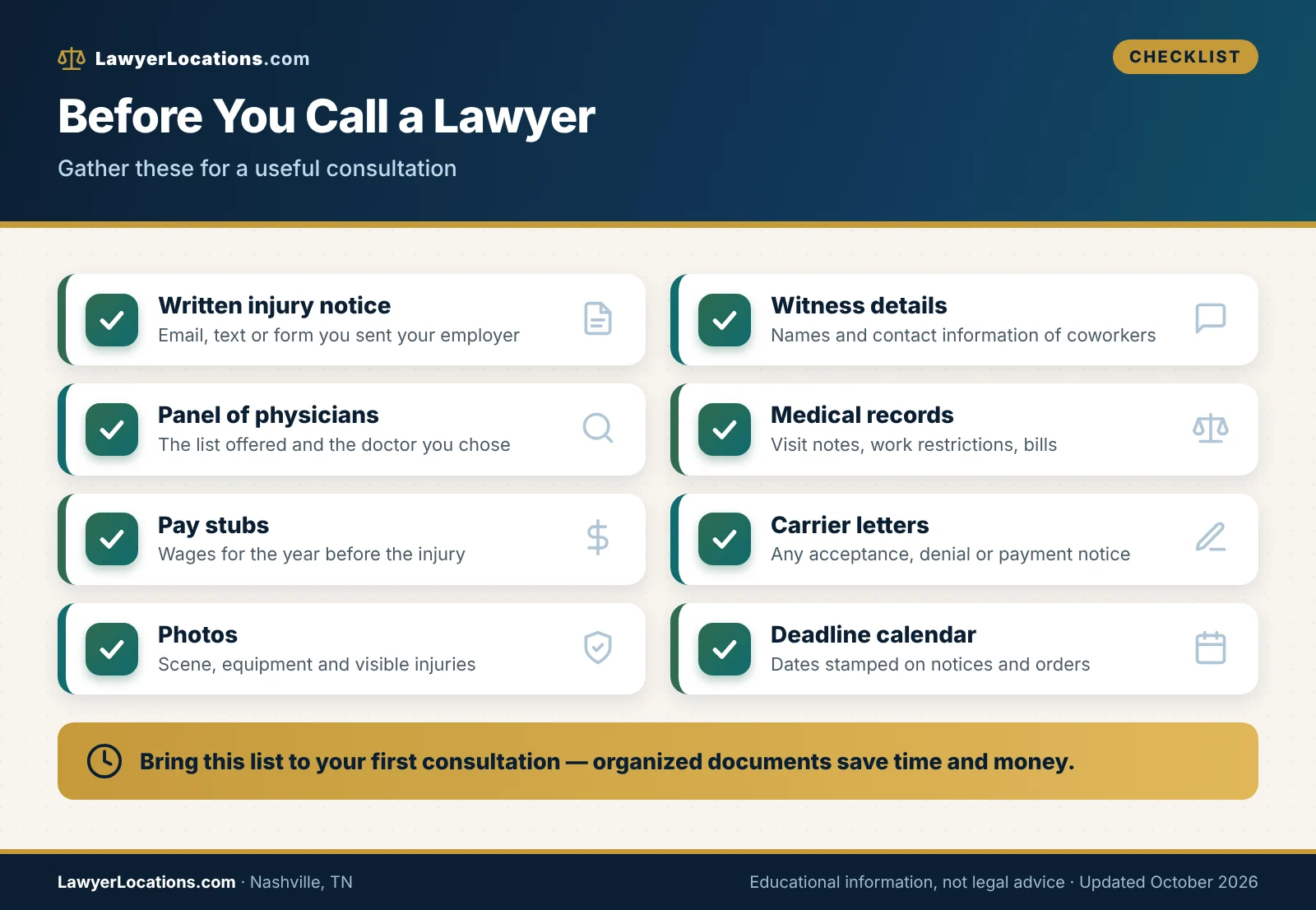
Text version of this graphic
- Written notice or email to your employer.
- Names and contact details of witnesses.
- Panel of physicians and the doctor you chose.
- Medical records, work-status notes and bills.
- Pay stubs showing wages for the year before the injury.
- Letters from the carrier, including any denial.
- Photos of the scene, equipment or injury.
- Calendar of deadlines and a log of calls.
Records about the injury and your job
- Your written notice and any incident report.
- Pay stubs for the year before the injury, plus job description.
- Photos, witness names and any surveillance or safety logs you know exist.
- Every letter and email from the employer and the carrier.
Medical and benefit records
- The panel list and the name of the physician you selected.
- Visit summaries, work restrictions, imaging and prescriptions.
- Records of any prior injury to the same body part.
- A record of every benefit payment: date, amount and what it covered.
Mistakes to avoid and next steps
Most avoidable problems come from timing and from signing documents too quickly.
Common mistakes
- Waiting to report the injury because it seemed minor.
- Relying on a verbal report with no written record.
- Missing a deadline after a Dispute Certification Notice.
- Posting about the injury or activities on social media.
- Signing a settlement or release without understanding what it closes.
Insurers can review public posts, so a photo of you lifting something heavy while you claim a back injury can be used against you even when the context is innocent.
Your next steps and quick answers
- Report and document. Give written notice and keep copies.
- Get care from the panel. Choose a physician and follow restrictions.
- Call the Ombudsman if you have process questions. The number is 1-800-332-2667.
- Compare two or three lawyers. Use the scorecard questions and verify each license.
- Calendar every deadline. Count from the dates stamped on notices and orders.
How much does a workers compensation lawyer in Nashville cost?
Workers’ comp lawyers in Tennessee are generally paid on contingency, with the fee capped by statute and approved by a judge. You typically pay no hourly bill during the claim, but case expenses can be separate, so read the agreement.
Can I choose my own doctor after a job injury in Tennessee?
Generally you choose from a panel of at least three physicians the employer provides. The doctor you select becomes your authorized treating physician.
How long do I have to report a work injury in Tennessee?
Tell your employer immediately. If you do not, written notice is generally due within 15 days of the injury or of when you knew or should have known it was work-related.
What is the deadline to file a workers’ comp claim in Nashville?
Generally one year from the date of injury or the date the employer or carrier last paid benefits. A lawyer can confirm the date for your situation.
Can my employer fire me for filing a claim?
An employer generally cannot lawfully fire you because you filed or pursued a comp claim. If it happens, a retaliatory discharge lawsuit may be possible, and it has its own, often shorter, deadline.
Is there free help if I do not have a lawyer?
The Bureau’s Ombudsman program answers process questions at 1-800-332-2667. In some cases an Ombudsman attorney can give limited legal advice but cannot appear in court for you.
What happens if mediation does not settle my claim?
The mediator files a Dispute Certification Notice listing the open issues. You then have 60 days to request a hearing, or the case can be dismissed after a show-cause hearing.
Do I need a lawyer if the insurer is paying my benefits?
Not always. Consider one if benefits stop, a doctor releases you early, you receive a low impairment rating, or a settlement offer arrives.
Where do I find a licensed workers’ comp lawyer in Nashville?
Start with the Nashville Bar Association’s referral resources, then verify each name through the Tennessee Board of Professional Responsibility directory.
Ready to compare your options?
Write down your injury date, your employer’s notice record and the next deadline you can identify. Then speak with two or three Tennessee-licensed lawyers about a workers compensation lawyer Nashville TN workers can compare on fees and approach. See our guide on when a workers’ comp lawyer is worth hiring for a decision framework.
Sources & References
Show all 8 sources
- Practical information about how to represent yourself in the Court of Workers’ Compensation Claims — Tennessee Bureau of Workers’ Compensation — tn.gov — accessed October 2026
- Court of Workers’ Compensation Claims — Tennessee Department of Labor and Workforce Development — tn.gov — accessed October 2026
- Mediation Services — Tennessee Bureau of Workers’ Compensation — tn.gov — accessed October 2026
- Tenn. Code Ann. 50-6-226, Fees of attorneys and physicians, and hospital charges — Justia (state code mirror) — law.justia.com — accessed October 2026
- Workers’ Compensation — Nashville Bar Association — nashvillebar.org — accessed October 2026
- Online Tennessee Attorney Directory — Tennessee Board of Professional Responsibility — tbpr.org — accessed October 2026
- Find a Lawyer — Tennessee Administrative Office of the Courts — tncourts.gov — accessed October 2026
- Tennessee Rule of Professional Conduct 1.5, Fees — Court Rules — courtrules.net — accessed October 2026
General information only. This article is educational and is not legal advice. Reading it does not create an attorney-client relationship, and LawyerLocations.com is not a law firm or a lawyer referral service. Laws, fees, deadlines and court procedures change, so consult a lawyer licensed in Tennessee about your situation.
Legal Disclaimer and Limitation of Liability
Informational and illustrative purposes only. This article was prepared by LawyerLocations.com solely on the basis of the information available to us at the time of writing. It is an illustrative, general overview. It is not a complete or authoritative statement of the law, and it has not been reviewed by a lawyer licensed in your state or county.
Not legal advice. Nothing in this article is legal, financial, tax or immigration advice, and reading it does not create an attorney-client relationship between you and LawyerLocations.com or any author, lawyer or firm mentioned. Laws, court rules, fees, filing deadlines and agency procedures differ by state, county and court, and they change often. Some details here may be simplified, incomplete or out of date, and time limits for legal claims can be short.
No warranty. We make no representation or warranty, express or implied, about the accuracy, completeness, timeliness or suitability of this content for your situation. Please do not rely on it to make, delay or skip any legal decision. Check the facts against official sources and speak with a licensed attorney in the relevant jurisdiction before you act.
Limitation of liability. To the fullest extent permitted by law, LawyerLocations.com and its owners, authors and contributors disclaim all liability for any loss, damage, cost or other consequence arising from the use of, or reliance on, this article, including any content on third-party websites we link to. Mentioning a lawyer, firm, organization or service is not an endorsement and is not a promise of any result. If you are in immediate danger, contact your local emergency number.