Choosing a car accident lawyer Raleigh NC drivers can rely on comes down to three things: knowing the North Carolina rules that govern your claim, knowing where a Raleigh case is actually filed (the Wake County courts), and asking every lawyer the same practical questions about fees, communication and experience. North Carolina generally gives injured people three years to sue, but its fault rules are stricter than in most states, so early evidence matters.
This guide walks through the state statutes, the local court logistics, how contingency fees and medical liens work, and a repeatable way to compare lawyers before you sign anything. It is general legal information for Raleigh and Wake County, not advice about your crash.
How a Car Accident Lawyer Case Works in Raleigh, NC
A car accident case in Raleigh is a North Carolina state-law claim, usually resolved by negotiating with an insurance company and sometimes by filing a lawsuit in the Wake County courts. A lawyer’s job is to investigate fault, document your losses, deal with the insurers and liens, and file suit before the deadline if the claim does not resolve.
The short version of a Raleigh car accident claim
Who you are dealing with first
In the first days after a crash, the people you hear from are usually the responding officer, your own insurer, the other driver’s insurer, and medical billing offices. Each has its own interest. The other driver’s adjuster, for example, is trained to evaluate and limit the claim, not to explain your rights.
Anything you say on a recorded line can later be quoted back to you. A calm, factual description of the crash is fine for your own insurer; detailed statements about injuries or fault to the other side are worth discussing with a lawyer first. Our guide on what to do after a car accident covers the first hours in more detail.
Why the lawyer search usually starts early
You do not need to hire anyone the day of the crash. But injuries often evolve over days or weeks, and evidence such as video footage, vehicle data and witness memories fades. Talking to a lawyer early gives you a chance to learn what to preserve while the facts are fresh.
That said, you can take your time choosing. A sensible approach is to speak with two or three lawyers using the same list of questions, which this guide provides, and then decide. If you are unsure whether you need representation at all, read do I need a lawyer after a car accident.
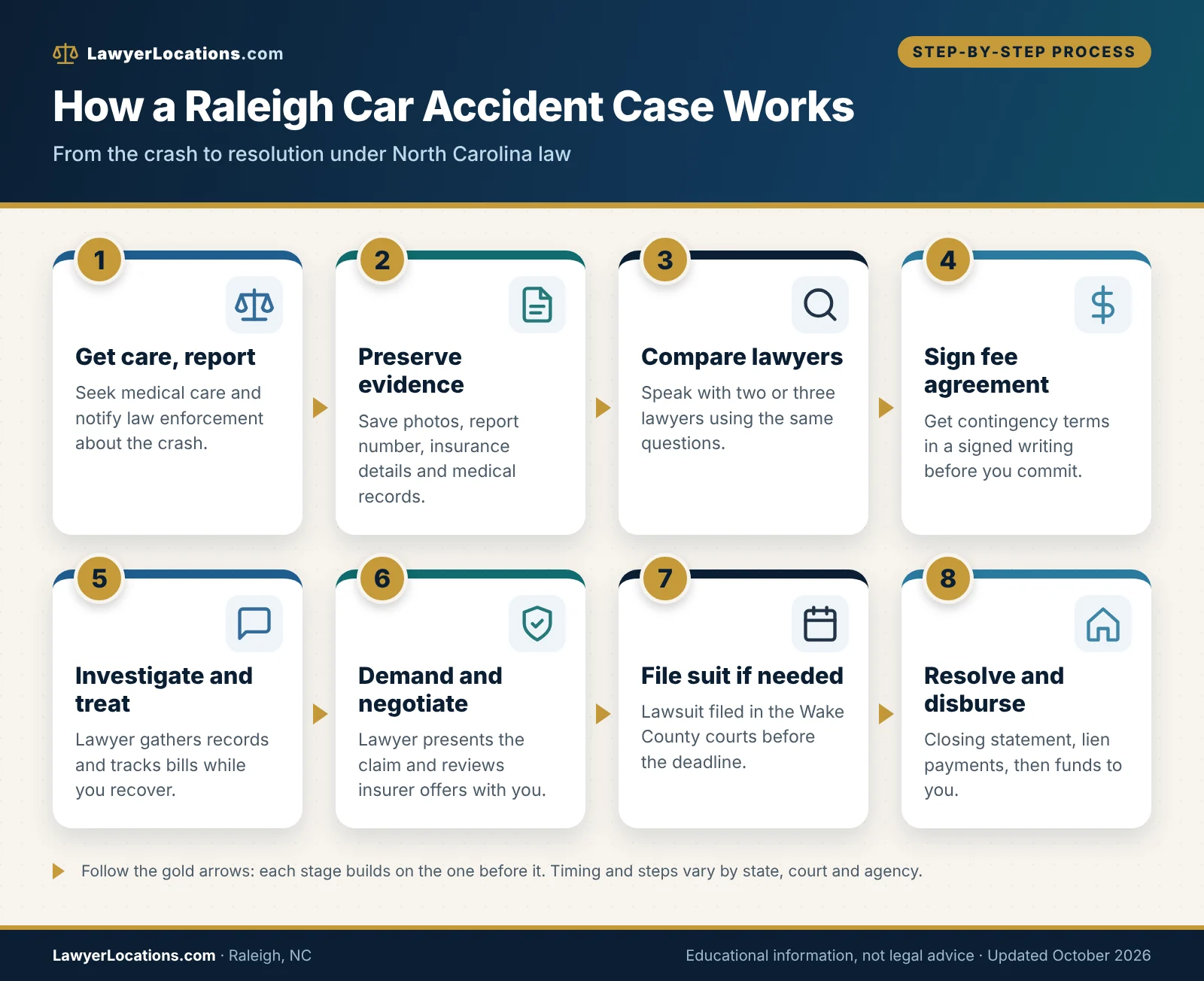
Text version of this graphic
- Get medical care and report the crash to law enforcement.
- Notify your insurer and preserve photos, records and receipts.
- Speak with two or three lawyers using the same questions.
- Sign a written fee agreement with the lawyer you choose.
- Investigation and treatment: the lawyer gathers records while you heal.
- Demand and negotiation with the insurer.
- If needed, a lawsuit is filed in the Wake County courts before the deadline.
- Settlement or judgment, then lien payments and disbursement.
What a lawyer actually does at each stage
Investigation and building the claim
Early work usually includes collecting the crash report, identifying every insurance policy that might apply, sending preservation requests for evidence, and gathering medical records and bills. A careful lawyer also tracks lost income and asks your doctors whether treatment is complete before putting a number on the claim.
Settling before you know the full extent of your injuries is one of the most expensive mistakes in injury cases, because a signed release generally ends the claim. For how long this process tends to take, see our overview of the car accident settlement timeline.
Negotiation, and filing suit when needed
Most claims resolve through negotiation. The lawyer sends a demand package to the insurer, which responds with an offer, and the two sides go back and forth. You decide whether to accept; the lawyer advises.
When talks stall, or when the deadline approaches, the lawyer can file a complaint in court. Filing a lawsuit does not mean the case will go to trial. It starts a formal process with its own deadlines, and many suits still settle along the way.
What this guide covers and what it does not
Local versus state versus federal
The substantive rules for car crash claims, such as the deadline, fault rules and insurance minimums, come from North Carolina law and apply statewide. What is truly local to Raleigh is the court system where a case is filed, the agencies that respond to and report crashes, and the lawyers and referral resources available nearby.
Federal law enters only in side issues, such as Medicare repayment rights or the occasional case in federal court. Nothing in this guide is a prediction about how a particular judge, jury or insurer will treat your claim.
What LawyerLocations is and is not
LawyerLocations.com is a legal-education and lawyer-discovery resource. It is not a law firm, does not give legal advice and does not rank or recommend individual attorneys. Reading this page does not create an attorney-client relationship.
What it can do is give you a framework: the legal background, the questions to ask, and the red flags to watch for, so you can evaluate any Raleigh lawyer on the merits.
North Carolina Law That Shapes Your Raleigh Claim
Four state-law rules do most of the work in a Raleigh car accident claim: the filing deadline, the fault rule, the insurance limits that cap what is realistically collectible, and the duty to report the crash. Understanding them helps you judge whether a lawyer is giving you straight answers.
Time limits: the three-year rule and its edges
The general three-year period
North Carolina’s general statute of limitations, G.S. 1-52, is titled “Three years” and applies to many civil claims, including personal injury and physical damage to your property under subdivision (16). The state legislature publishes the statute at ncleg.gov.
In practical terms, that usually means a lawsuit must be filed within three years, not that a settlement must be reached in that time. Settlement talks do not automatically pause the deadline. Our national explainer on how long you have to file a personal injury claim compares North Carolina with other states.
Do not assume you have the full period. Different defendants (for example, a government entity), different claims (such as a wrongful death claim) and different facts can change which time limit applies. Ask each lawyer you interview, in writing if possible, which deadline they believe applies to your case and what date they have calendared.
When the clock starts and the outer limit
Under G.S. 1-52(16), a personal injury or property damage claim does not accrue until the bodily harm or physical damage “becomes apparent or ought reasonably to have become apparent” to the claimant, whichever comes first. For a typical collision, that is the date of the crash.
The same subdivision also sets an outer boundary: no cause of action accrues more than 10 years from the last act or omission of the defendant, subject to listed exceptions. That outer limit is rarely relevant in ordinary crashes, but it shows why you should never treat the deadline as a loose guideline.
Fault rules: why North Carolina is unforgiving
Contributory negligence in plain English
North Carolina applies the common-law rule of contributory negligence. In plain terms, a defendant can argue that you were also careless and that your carelessness helped cause the crash, and if a jury agrees, that finding can bar any recovery rather than just reducing it. That is very different from the “comparative fault” systems used in many other states, where your award is trimmed by your share of the blame.
North Carolina Court of Appeals decisions illustrate how this plays out. In Parker v. Willis, 167 N.C. App. 625 (2004), the defendant pleaded contributory negligence as a defense that would bar any recovery, and the jury found both drivers negligent. The court nonetheless ordered a new trial because the judge had refused to instruct the jury on last clear chance, a doctrine that can allow recovery when the defendant had the time and ability to avoid injuring a plaintiff who had negligently placed himself in helpless peril.
If anyone, including an adjuster, suggests you were partly to blame, do not agree to it or sign anything admitting fault. Fault in North Carolina can decide the whole claim, so have a lawyer review the facts before you respond.
Why this raises the stakes for early evidence
Because even a small share of blame can become a legal argument, the details of the crash matter more here than the general idea of who “caused” it. Photos of the scene, skid marks, traffic signals, vehicle positions, witness names and any camera footage can decide whether a fault defense succeeds.
Evidence also disappears quickly. Businesses overwrite security video, vehicles get repaired or sold, and memories blur. Write down what happened as soon as you are able, avoid guessing about speeds or distances, and ask any lawyer you interview how they would investigate fault in your specific crash.
Insurance limits and the coverage that protects you
Minimum liability limits after July 1, 2025
Under G.S. 20-279.21(b)(2), the statute’s minimum liability limits are $50,000 for bodily injury or death to one person in an accident, $100,000 for two or more people, and $50,000 for property damage. The North Carolina Department of Insurance explains that these higher minimums apply to policies that are new or renewed on or after July 1, 2025; the earlier minimums were $30,000 per person, $60,000 per accident and $25,000 for property damage.
Because the limits follow the policy rather than the calendar date of your lawsuit, the other driver’s policy in force on the date of the crash is what matters. A driver who carries only the minimum may have far less coverage than your injuries cost, which is why your own coverage can matter.
Uninsured and underinsured motorist coverage
Under G.S. 20-279.21(b)(3), North Carolina policies covering vehicles registered or principally garaged in the state must include uninsured motorist (UM) coverage for people legally entitled to recover damages from owners or operators of uninsured and hit-and-run vehicles. Subdivision (b)(4) separately requires underinsured motorist (UIM) coverage, with limits tied to the highest bodily injury liability limits for any one vehicle under the policy and capped at $1,000,000 per person and per accident.
The Department of Insurance notes that the 2025 changes also affect how an underinsured vehicle is determined, restrict most setoffs against this coverage and combine the highest limits across multiple applicable policies. Because these provisions are technical, ask any lawyer you interview how UM and UIM apply to your policies. Our guide to uninsured motorist claim lawyers goes deeper.
Find your own policy’s declarations page now and keep a copy. It lists your liability, UM/UIM and medical payments limits, which a lawyer will want to see at the first consultation.
Reporting the crash
What the statute asks of drivers
Under G.S. 20-166.1, a driver involved in a reportable accident must immediately notify the appropriate law enforcement agency by the quickest means of communication. The statute does not set a dollar threshold in its text, so when in doubt, call.
The officer’s written report is due within 24 hours of the accident under the same statute. Drivers generally do not file crash reports with the Division of Motor Vehicles themselves; the investigating officer or agency forwards the report.
Getting the report afterward
The agency that responded, whether Raleigh Police, the Wake County Sheriff’s Office or the State Highway Patrol, is the place to ask how to obtain a copy of your crash report. Request it early, then read it for errors in names, vehicles, insurance details and the diagram.
A crash report is evidence, but it is not the final word on fault. An officer’s opinion about the cause may be limited or contested, so lawyers treat it as one piece of the file.
If the report contains a factual mistake, such as the wrong insurer or a missing witness, tell the investigating agency and keep a record of your request. Do not argue with the other driver about it by text or social media.
| Topic | What the law says (summary) | Where to verify |
|---|---|---|
| Suit deadline | General three-year period for personal injury and property damage; accrual when harm is or should be apparent; 10-year outer limit | G.S. 1-52, ncleg.gov |
| Minimum liability limits | $50,000 per person, $100,000 per accident, $50,000 property damage for policies new or renewed on or after July 1, 2025 | G.S. 20-279.21(b)(2); NC Department of Insurance |
| Uninsured motorist | Required on NC-garaged vehicles; covers uninsured and hit-and-run vehicles | G.S. 20-279.21(b)(3) |
| Underinsured motorist | Required; limits tied to highest per-vehicle bodily injury limits, capped at $1,000,000 per person and per accident | G.S. 20-279.21(b)(4) |
| Crash reporting | Drivers notify police immediately; officer report due within 24 hours | G.S. 20-166.1 |
| Medical provider liens | Attach to settlement funds; cannot exceed 50% of damages recovered, exclusive of attorney fees | G.S. 44-49 and 44-50 |
Wake County Courts and Raleigh Logistics
Raleigh is the county seat of Wake County, so a lawsuit over a Raleigh crash is typically filed in the Wake County courts. The state judicial branch lists civil matters, other than marriages, as being handled at the Wake County Courthouse in downtown Raleigh.
Where civil cases are handled in Raleigh
Wake County Courthouse
The North Carolina Judicial Branch lists the Wake County Courthouse at 316 Fayetteville St. Mall, Raleigh, NC 27601, with a mailing address of PO Box 351, Raleigh, NC 27602, and a main phone number of (919) 792-4000. It reports hours of Monday through Friday, 8:30 a.m. to 5:00 p.m., and says all civil matters except marriages are conducted there. Criminal matters are listed at the separate Wake County Justice Center.
Parking is paid, with a lot, street parking and a garage, and the building has an accessible entrance, parking and restroom according to the judicial branch page. If you are a witness or party, plan extra time for security screening and parking.
District court, superior court, and federal court
North Carolina’s state trial courts are divided into district and superior court divisions, and which division hears a civil case depends mainly on the type of claim and the amount at stake. Your lawyer will decide where to file and explain why; you do not need to choose.
A small number of crash cases end up in federal court, for example when the people involved live in different states and the stakes are high enough. That is a separate system with its own rules, and it is another reason to ask a prospective lawyer whether they regularly litigate in the court where your case would likely be heard.
Which agency responded matters
Police, sheriff, or Highway Patrol
A crash inside Raleigh city limits is typically handled by Raleigh Police, one just outside may involve the Wake County Sheriff’s Office, and interstate and highway crashes may involve the State Highway Patrol. The responding agency is the one that holds your report and any officer notes or body-camera footage.
Write down the officer’s name, agency and any report or case number before you leave the scene. That detail saves days when you or a lawyer later request records.
Practical logistics for Raleigh residents
Wake County is a large, fast-growing county, and your lawyer may be located in Raleigh, Cary, Durham or elsewhere in the Triangle. A lawyer’s office does not need to be near your home, but it helps to know how the firm handles meetings, whether it offers phone or video check-ins, and who your day-to-day contact will be.
If your case reaches the courthouse, you may need to attend mediation, a deposition or a hearing in downtown Raleigh. Ask how often clients are typically asked to appear and how the firm prepares them.
| Item | Detail | Why it matters |
|---|---|---|
| Civil courthouse | Wake County Courthouse, 316 Fayetteville St. Mall, Raleigh, NC 27601 | Where civil lawsuits and most civil hearings are conducted |
| Mailing address | PO Box 351, Raleigh, NC 27602 | Mail to the courthouse offices |
| Main phone | (919) 792-4000 | General contact listed by the NC Judicial Branch |
| Hours | Monday to Friday, 8:30 a.m. to 5:00 p.m. | Plan visits and filings within these hours |
| Criminal matters | Wake County Justice Center | Traffic or criminal charges from the same crash are handled separately from the civil claim |
| Crash report | Responding agency (Raleigh Police, Sheriff or Highway Patrol) | Source of the official report and any officer notes |
How to Compare Car Accident Lawyers in Raleigh, NC
Compare lawyers by the same measuring stick: license status, relevant experience, how the firm communicates, how the fee agreement reads, and whether you understand the plan after the first conversation. A confident sales pitch is not a substitute for any of those.
Where to find candidates and check them out
Confirm the license first
Every lawyer who handles your case should be licensed in North Carolina. The North Carolina State Bar, the state agency that licenses and disciplines lawyers, offers a Lawyer Search directory at ncbar.gov where you can look up a lawyer’s licensing status, and a separate page of past discipline orders. Do this before the consultation, not after.
A license check tells you the lawyer is allowed to practice, and the discipline page shows whether public orders exist. It does not tell you whether the lawyer is a good fit for your case, so treat it as the floor, not the finish line.
Referral services and other starting points
The North Carolina Bar Association runs a Lawyer Referral Service that connects members of the public with North Carolina-licensed attorneys who are bar association members, through a call center at 919-677-8574 and an online request. Its page says participating attorneys offer an initial 30-minute consultation for $50 to referred clients, with fees beyond that set by the attorney, so confirm the current terms when you call.
Other starting points include trusted recommendations from people who handled similar claims, but treat those as leads to vet with the same questions. Whatever starting point you use, avoid choosing based on billboard slogans or the loudest advertising. Advertising shows a firm can afford to advertise; it says little about how it will treat your file.
Questions that separate careful lawyers from careless marketing
Experience that matches your crash
Ask how many car accident claims the lawyer has handled recently, and whether any involved facts like yours: a rear-end collision, a hit-and-run, a crash with a commercial vehicle, a disputed-fault intersection, or a low-limit policy. If your crash involved a large truck, read our comparison of a truck accident lawyer versus a car accident lawyer, because those cases bring extra evidence and insurance issues.
Ask who will actually work on your file. Some firms assign the lawyer you meet to the case; others hand day-to-day work to paralegals or case managers. Neither is automatically wrong, but you should know the structure and who you can call with questions.
Communication, trial readiness and candor
Ask how often the firm updates clients, how quickly it typically returns calls, and what the best way to reach someone is. Treat any promise to hit a certain response time as something to put in writing, not a reason to sign.
Ask whether the lawyer is willing to file suit and take a case to trial if the insurer’s offers are unreasonable. Insurers pay attention to lawyers who are prepared to try cases. Also listen for candor: a good lawyer will describe the weak points of your case, including fault arguments and gaps in treatment, not just the strengths.
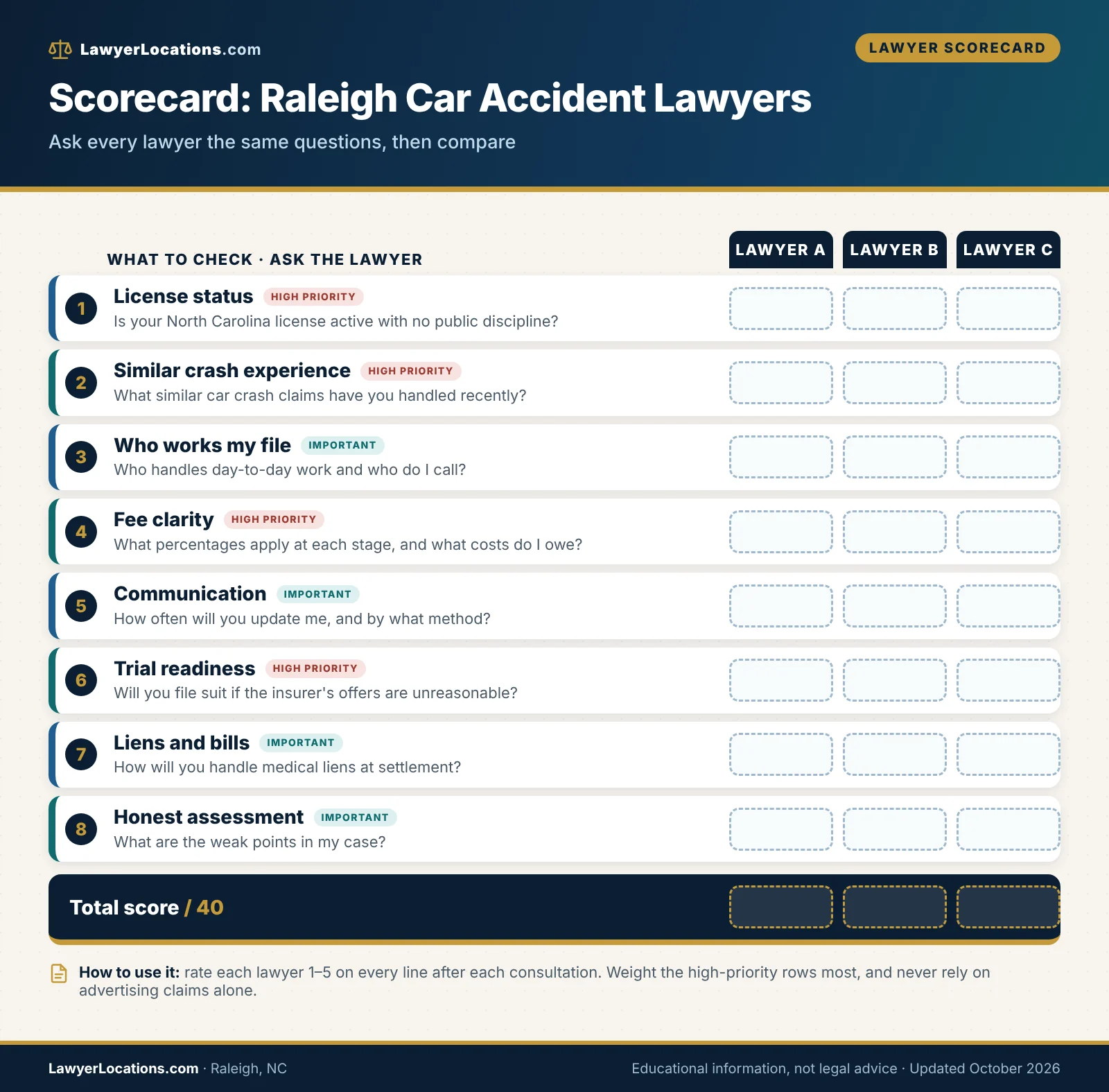
Text version of this graphic
| Criterion | Question to ask |
|---|---|
| License status | Is your North Carolina license active, and is there any public discipline? |
| Relevant experience | What similar car crash claims have you handled recently? |
| Who works my file | Who handles day-to-day work, and who do I call? |
| Fee clarity | What percentage applies at each stage, and which costs do I owe? |
| Communication | How often will you update me, and by what method? |
| Trial readiness | Will you file suit if the insurer’s offers are unreasonable? |
| Liens and bills | How will you handle medical bills and liens at settlement? |
| Honest assessment | What are the weak points of my case? |
Print the scorecard or copy the questions into your notes app. Fill it in right after each consultation, while your impressions are fresh. After two or three consultations, patterns become obvious.
Red flags and how to read a fee agreement
Warning signs in the sales conversation
Be cautious if anyone promises a result or a dollar amount, pressures you to sign on the spot, discourages you from talking to other lawyers, or is vague about who will handle the case. Lawyers in North Carolina are bound by the State Bar’s Rules of Professional Conduct, and the State Bar is the agency to contact if you believe a lawyer has crossed a line.
- A promised outcome or a settlement figure before any records are reviewed.
- Pressure to sign immediately or to stop speaking with other lawyers.
- An unwillingness to put the fee terms in writing or to explain them.
- Someone who contacts you uninvited at the hospital or at home soon after the crash.
- No clear answer on who will actually work on your file.
What a North Carolina contingency agreement must say
Under Rule 1.5(c) of the North Carolina Rules of Professional Conduct, a contingent fee agreement must be in a writing signed by the client. It has to state the percentage or percentages that go to the lawyer in the event of settlement, trial or appeal, and it must spell out the litigation and other expenses to be deducted from the recovery, including whether they come out before or after the fee is calculated.
The agreement must also clearly notify you of any expenses you will owe whether or not you win. When the matter ends, the lawyer must give you a written statement of the outcome, and if there is a recovery, the amount sent to you and how it was calculated. If a draft agreement is silent on any of those points, ask for it to be added before you sign.
| What to compare | Good sign | Caution sign |
|---|---|---|
| Licensing | Active North Carolina license confirmed through the State Bar | Cannot or will not give a license number or bar status |
| Fee agreement | Written, signed, with percentages for settlement, trial and appeal and a clear costs section | Verbal terms, vague “standard” fees, or surprise charges |
| Case assessment | Explains strengths and weaknesses, including fault issues | Promises an outcome or number before reviewing records |
| Communication | Names a point of contact and an update schedule | Cannot say who handles your file |
| Willingness to litigate | Explains when and why suit would be filed | Seems to avoid court at all costs or pushes quick settlement |
| Liens and bills | Explains how medical liens and insurer claims are handled | Skips the topic until settlement day |
Fees, Liens, Costs and Decision Points
Most car accident lawyers are paid a percentage of the recovery, with case expenses handled separately, and your net recovery depends on that fee, those expenses and any medical liens. Ask for a written explanation of how each piece comes out of a settlement.
How contingency fees and costs work
Fee percentage versus case expenses
A contingency fee means the lawyer is paid a percentage of what is recovered rather than hourly. The percentage can change at different stages, such as before suit, after suit is filed, and after trial begins, which is why Rule 1.5(c) requires the agreement to list the percentages for settlement, trial and appeal.
Case expenses are a separate category: items like records fees, expert witnesses, filing fees and deposition costs. The agreement should say whether expenses are deducted before or after the fee percentage is applied, because that order changes your net amount. Ask the lawyer to walk through a hypothetical settlement showing both methods side by side.
What you may owe if the claim does not succeed
Ask a direct question: “If we recover nothing, do I owe anything, including expenses?” Rule 1.5(c) requires the agreement to notify you of any expenses for which you will be liable whether or not you win, so the answer should be in the document. If it is not, get it clarified before signing.
For a more detailed look at how injury lawyers are typically paid, our guide on wrongful death lawyer costs explains the same contingency concepts, which apply broadly across injury practice areas.
Medical bills, liens and who gets paid first
Medical provider liens under G.S. 44-49 and 44-50
North Carolina law lets certain medical providers assert a lien on personal injury recoveries. Under G.S. 44-50, the lien attaches to funds paid as compensation for, or settlement of, the injuries, and whoever receives those funds must hold back enough to pay valid claims for medical care once notice of them has been received. The lien is perfected through G.S. 44-49 when an attorney represents the injured person.
The statute also caps these liens: they cannot exceed 50% of the damages recovered, exclusive of attorneys’ fees. It further says a client’s instructions for disbursing settlement proceeds are not binding where they conflict with the lien statutes. In plain terms, a lawyer cannot simply wire you the whole settlement and ignore a valid provider lien.
If a lawyer or anyone else suggests ignoring medical bills until after the case, ask how that squares with the lien statute. Unpaid bills can go to collections, and a lien can reduce your net recovery. Our guide to medical bills after a car accident explains the options.
Health insurers, Medicare and other repayment claims
Separate from provider liens, your own health plan, Medicaid, Medicare or another payer may claim repayment from a settlement. These rules differ by plan type, and federal programs have their own procedures. Ask every lawyer how they identify and negotiate repayment claims, and whether that is included in the fee or billed separately.
A well-run file addresses these claims before settlement, not after. Surprises at the end of a case are usually the result of nobody asking the question early.
Timeline and decision points
The stages you will move through
A claim usually moves from medical treatment, to records and demand, to negotiation, and then either to resolution or to a lawsuit. The length of each stage varies widely with the severity of injuries and how the insurer responds, so be wary of any lawyer who gives you a firm end date.
The one date that should be fixed from the start is the filing deadline. Ask the lawyer to tell you what deadline they have calendared and when the firm plans to decide whether to file suit.
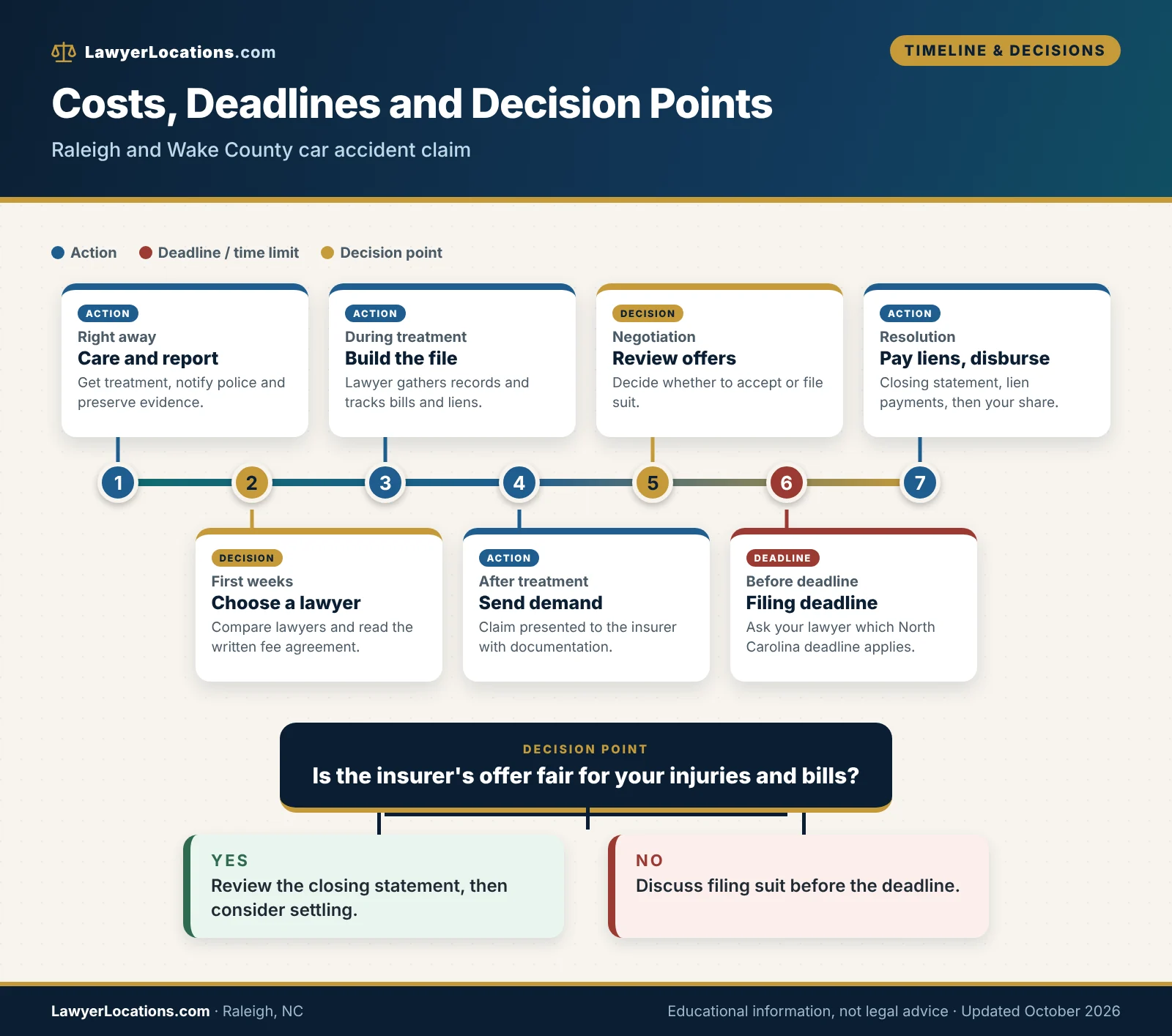
Text version of this graphic
- Right after the crash: get care, report the crash, preserve evidence (action).
- First weeks: compare lawyers and sign a written fee agreement (decision).
- During treatment: lawyer gathers records and tracks bills and liens (action).
- After treatment stabilizes: demand sent to the insurer (action).
- Negotiation: review offers with your lawyer (decision).
- Before the filing deadline: file suit or resolve the claim (deadline).
- Resolution: closing statement, lien payments and disbursement (action).
Decision point: Is the insurer’s offer fair for your injuries and bills? If yes, consider settling after reviewing the closing statement; if no, discuss filing suit before the deadline.
The decision that matters most: accept an offer or file suit
The key decision comes when the insurer makes an offer you are not sure about. Your lawyer should explain what the offer covers, what it leaves out, what a lawsuit would involve and what the risks are, including the fault rules discussed earlier. The choice belongs to you.
Ask for the advice in writing if you are on the fence. Our overview of the car accident settlement timeline can help you set realistic expectations for the waiting stages.
| Item | What it is | What to ask |
|---|---|---|
| Contingency fee | Percentage of the recovery paid to the lawyer | What percentage applies before suit, after suit and at trial or appeal? |
| Case expenses | Records, experts, filing and deposition costs | Are they deducted before or after the fee, and who owes them if we lose? |
| Medical provider liens | Statutory claims by providers against the recovery (G.S. 44-49, 44-50) | How will liens be identified, verified and negotiated? |
| Health plan or Medicare repayment | Claims by insurers or government programs for treatment they paid for | Is this negotiation included in the fee? |
| Closing statement | Written summary of outcome, amounts and calculations (Rule 1.5(c)) | Will I receive it before I sign the final release? |
Preparing for Your Consultation and Avoiding Mistakes
A prepared client gets a better consultation. Bring the documents you already have, write a short timeline of the crash and your symptoms, and come with your questions listed so you can compare lawyers on equal terms.
Documents and information to gather
Crash and insurance paperwork
Collect the crash report or report number, photos and video of the scene and vehicles, the other driver’s name, insurer and policy number, witness contact information, and your own insurance declarations page. If your car was repaired, keep the repair estimates and invoices, because property damage records often help show how severe the impact was.
If a tow, rental car or loss of use applies, save those receipts too. A simple folder, paper or digital, keeps everything in one place and saves hours later.
Medical records and work records
List every provider who has treated you since the crash, with dates, and keep discharge papers, bills, explanation-of-benefits statements and pharmacy receipts. If pain or symptoms started later, say so plainly and let your providers document it.
For lost income, gather pay stubs from before and after the crash and a note from your employer about missed time. Keep a short daily log of pain, sleep, missed activities and appointments; it helps you remember details months later.
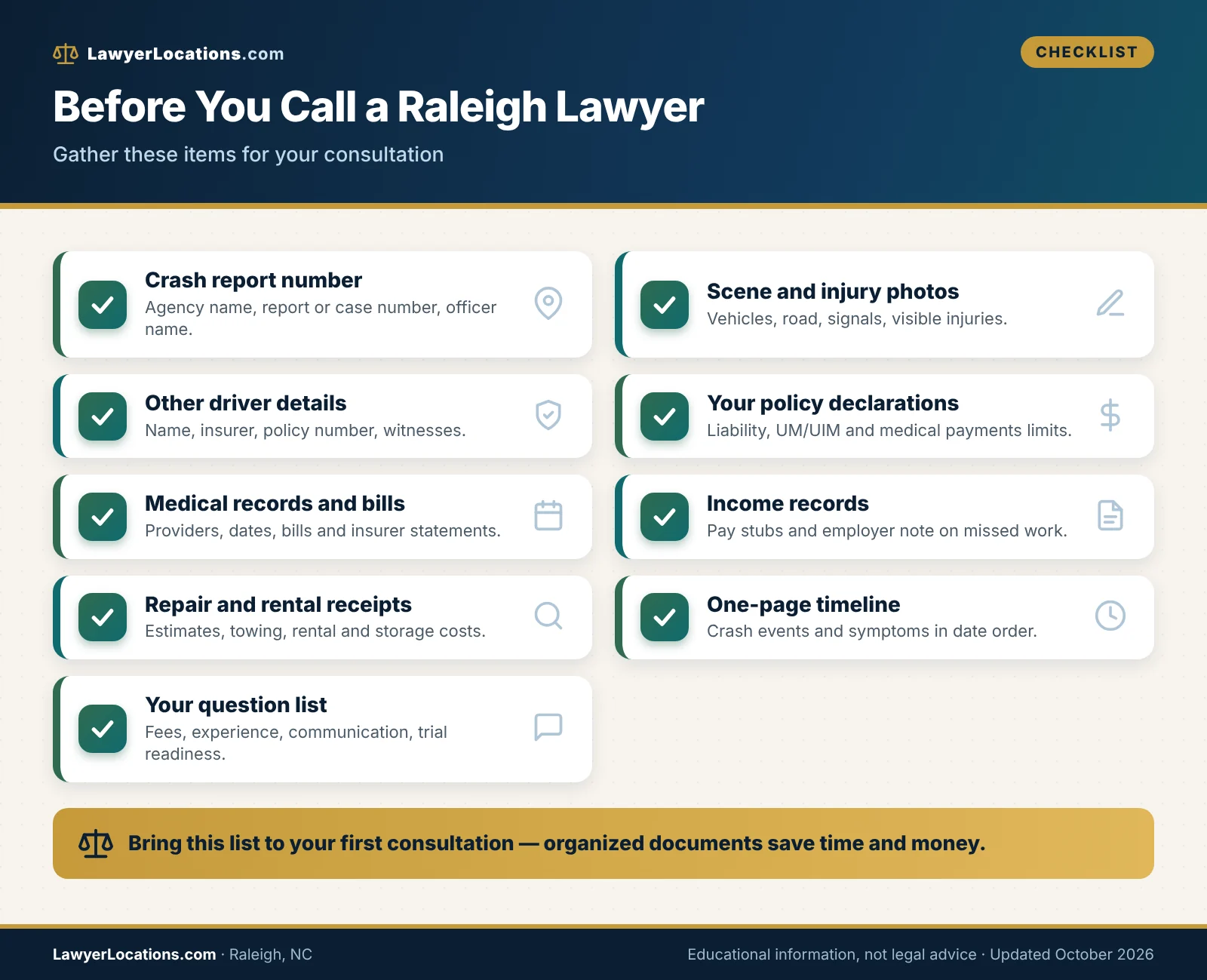
Text version of this graphic
- Crash report number and responding agency.
- Photos and video of the scene, vehicles and injuries.
- Other driver and witness contact details.
- Your insurance declarations page and claim number.
- Medical records, bills and explanation-of-benefits statements.
- Pay stubs and employer note about missed work.
- Repair estimates, rental and towing receipts.
- A one-page timeline of the crash and symptoms.
- Your list of questions for the lawyer.
Maya is rear-ended on a busy road in Raleigh and feels sore but declines an ambulance. Two days later her neck pain worsens. Because she saved the crash report number, photographed the damage and wrote down when the pain began, her records line up when she meets two lawyers the next week. That is an illustration of good preparation, not a prediction about any real outcome.
Common mistakes and how to avoid them
Mistakes with insurers and statements
Giving a recorded statement to the other driver’s insurer before you understand your injuries is a frequent misstep. So is signing a medical authorization that gives the insurer broad access to your health history, or accepting a quick payment and signing a release before treatment is complete.
You can be polite, share the basic facts the insurer needs, and still decline to speculate about fault or injuries. If you are unsure what to say, tell the adjuster you will follow up and use the time to talk to a lawyer.
Mistakes with evidence and social media
Posting photos or comments about the crash, your activities or your health can be pulled out of context. Avoid deleting anything either, since deleting posts after a claim arises can look worse than the posts themselves; instead, stop posting and adjust privacy settings, and ask your lawyer what to do about existing content.
Do not repair or dispose of evidence, such as a damaged vehicle or a phone with photos, before it has been documented. Ask your lawyer and insurer about the vehicle’s data and any preservation steps first.
- Giving a recorded statement to the other driver’s insurer without advice.
- Signing a release or accepting a check before treatment is complete.
- Skipping medical follow-up, which leaves gaps insurers may exploit.
- Posting about the crash, injuries or activities on social media.
- Waiting so long that evidence disappears or the filing deadline gets close.
Raleigh Car Accident Lawyer FAQs and Next Steps
Short answers to the questions Raleigh drivers ask most often follow, and then a clear set of next steps. Each answer is general information, so confirm the details for your situation with a lawyer licensed in North Carolina.
Quick answers for Raleigh drivers
Questions about cost, deadlines and coverage
How much does a car accident lawyer cost in Raleigh?
Most injury lawyers work on a contingency basis, which means the fee is a percentage of the recovery, but the percentage and the expense terms vary by firm. North Carolina’s Rule 1.5(c) requires a contingent fee agreement to be in a writing signed by the client, so compare the written terms rather than relying on a verbal figure.
Do I have to pay anything upfront?
That depends on the agreement. Ask whether any expenses or retainer are required, and what you owe if the claim does not succeed. The agreement must notify you of any expenses you will be liable for whether or not you win.
How long do I have to file a lawsuit after a car accident in North Carolina?
The general period under G.S. 1-52 is three years for personal injury and physical damage to property, though other deadlines can apply to particular defendants or claims. Ask your lawyer which date applies to you.
What if the other driver has no insurance or too little?
North Carolina requires uninsured and underinsured motorist coverage in auto policies on vehicles registered or principally garaged in the state, within the limits described in G.S. 20-279.21. Look at your own declarations page and ask a lawyer how those coverages apply.
What if I was partly at fault?
Do not assume you have no claim, but do take it seriously. North Carolina recognizes contributory negligence as a defense that can bar recovery, and the doctrine of last clear chance can sometimes apply. A lawyer can assess the facts quickly.
Where would a lawsuit be filed?
For a Raleigh crash, a civil lawsuit is typically filed in the Wake County courts, with civil matters conducted at the Wake County Courthouse at 316 Fayetteville St. Mall. Your lawyer chooses the proper court and division.
Do I have to pay my medical providers from the settlement?
Valid provider liens under G.S. 44-49 and 44-50 must be held back and paid from settlement funds once notice is received, and they cannot exceed 50% of the damages recovered exclusive of attorney fees. Ask how your lawyer verifies and negotiates them.
Should I talk to the other driver’s insurance company?
You can give basic facts, but you are not required to give a recorded statement or speculate about injuries. Speak with a lawyer before agreeing to anything that could limit your claim.
How to use these answers
Treat the answers as a starting point for your own list of questions. The exact deadline, the amount of coverage available and how a court would view fault depend on facts that only a lawyer who reviews your records can assess.
If your question is not here, write it down and bring it to your consultation. A good lawyer will answer it plainly or tell you what information is missing.
Your next steps
A simple five-step plan
- Protect your health. Follow your providers’ advice and keep every record and bill.
- Preserve evidence. Save the crash report number, photos, insurance details and a short written timeline.
- Verify licenses. Check any lawyer you are considering through the North Carolina State Bar.
- Compare two or three lawyers. Use the same scorecard questions and ask for the fee agreement in writing.
- Calendar the deadline. Ask your chosen lawyer which filing deadline applies and when it falls.
Choosing a car accident lawyer in Raleigh, NC is a decision you can make calmly and methodically. The rules in this guide give you the vocabulary, and the scorecard gives you a way to compare.
When you are ready to compare options
Start with the first two steps today, then use the questions in this guide when you speak to lawyers. If you want a broader overview before deciding, read do I need a lawyer after a car accident or review what to do after a car accident.
Ready to compare your options?
Use the scorecard and consultation checklist above, verify each lawyer’s North Carolina license, and ask for the fee terms in writing. LawyerLocations does not recommend or rank individual lawyers, and nothing here promises any result.
General information only. This page is legal education, not legal advice, and reading it does not create an attorney-client relationship. LawyerLocations.com is not a law firm and does not endorse or rank any lawyer. Laws, fees, court procedures and insurance rules change, and the facts of each case differ. Consult a lawyer licensed in North Carolina about your situation, and confirm statutes and court information with the official sources listed below.
Sources & References
Show all 10 sources
- N.C. Gen. Stat. § 1-52 (Three years) — North Carolina General Assembly — ncleg.gov — accessed October 2026
- N.C. Gen. Stat. § 20-279.21 (Motor vehicle liability policy defined; minimum limits; uninsured and underinsured motorist coverage) — North Carolina General Assembly — ncleg.gov — accessed October 2026
- N.C. Gen. Stat. § 20-166.1 (Reports of accidents) — North Carolina General Assembly — ncleg.gov — accessed October 2026
- N.C. Gen. Stat. § 44-50 (Medical provider liens on personal injury recoveries) — North Carolina General Assembly — ncleg.gov — accessed October 2026
- Changes to the Rating of Automobile Insurance Policies, Effective July 1, 2025 — North Carolina Department of Insurance — ncdoi.gov — accessed October 2026
- Rule 1.5, Fees (North Carolina Rules of Professional Conduct) — North Carolina State Bar — ncbar.gov — accessed October 2026
- Lawyer Referral Service — North Carolina Bar Association — ncbar.org — accessed October 2026
- Lawyer Search and discipline orders — North Carolina State Bar — ncbar.gov — accessed October 2026
- Wake County Courthouse (location, hours and civil matters) — North Carolina Judicial Branch — nccourts.gov — accessed October 2026
- Parker v. Willis, 167 N.C. App. 625 (2004) (contributory negligence and last clear chance) — North Carolina Court of Appeals, via Harvard Caselaw Access Project — cite.case.law — accessed October 2026
Legal Disclaimer and Limitation of Liability
Informational and illustrative purposes only. This article was prepared by LawyerLocations.com solely on the basis of the information available to us at the time of writing. It is an illustrative, general overview. It is not a complete or authoritative statement of the law, and it has not been reviewed by a lawyer licensed in your state or county.
Not legal advice. Nothing in this article is legal, financial, tax or immigration advice, and reading it does not create an attorney-client relationship between you and LawyerLocations.com or any author, lawyer or firm mentioned. Laws, court rules, fees, filing deadlines and agency procedures differ by state, county and court, and they change often. Some details here may be simplified, incomplete or out of date, and time limits for legal claims can be short.
No warranty. We make no representation or warranty, express or implied, about the accuracy, completeness, timeliness or suitability of this content for your situation. Please do not rely on it to make, delay or skip any legal decision. Check the facts against official sources and speak with a licensed attorney in the relevant jurisdiction before you act.
Limitation of liability. To the fullest extent permitted by law, LawyerLocations.com and its owners, authors and contributors disclaim all liability for any loss, damage, cost or other consequence arising from the use of, or reliance on, this article, including any content on third-party websites we link to. Mentioning a lawyer, firm, organization or service is not an endorsement and is not a promise of any result. If you are in immediate danger, contact your local emergency number.