
Searching for a real estate attorney San Diego County CA starts with one fact: California does not require a lawyer for an ordinary home sale, because escrow officers handle the closing mechanics. A lawyer earns the fee when the deal or dispute is unusual, such as a contract problem, a title defect, an HOA fight, a boundary or easement conflict, a trust or entity owner, tribal or coastal land, or a lawsuit in the Superior Court of California, County of San Diego.
This guide covers the local courts, county offices, California rules, cost structures and comparison questions that matter in San Diego County. It is general information as of October 2026, not advice about your property or contract.
Real Estate Attorney in San Diego County, CA: What a Lawyer Does and When You Need One
A real estate attorney in San Diego County advises on property contracts, title problems and disputes, and represents clients in negotiations or in court. Hiring one is optional for routine sales and purchases, but the choice often turns on how much money, risk or ownership complexity is on the line. This section explains the work, the process and the line between a lawyer and the other professionals on a deal.
What a real estate attorney handles in San Diego County
Real estate law covers a wide field, so lawyers tend to concentrate on part of it. Knowing which part you need makes your search sharper and your first call shorter.
Transactions: contracts, title and entity work
On the transaction side, a lawyer can review a purchase agreement before you sign, draft addenda for unusual terms, and explain what the contingency periods in the contract mean. In plain English, a contingency is a condition, such as a satisfactory inspection or loan approval, that lets a buyer back out or renegotiate if it is not met in time.
Lawyers also help with deals that do not fit the standard form: a sale by a trust or an estate, a purchase through an LLC, a lease option, seller financing, a 1031 exchange, a sale between family members, or a property with an unrecorded agreement attached. The corporate lawyer in California guide covers the business-entity side when an LLC or partnership holds the property.
Disputes: contract, title, boundary, HOA and landlord-tenant
On the dispute side, the work includes a seller who will not close, a buyer who wants a deposit back, hidden defects, undisclosed permits, a neighbor’s fence or driveway on your lot, a disagreement with a homeowners’ association, and landlord-tenant conflicts. Some of these end with a demand letter. Others go to mediation or to the Superior Court.
If your problem is a dispute rather than a transaction, our guide to property dispute lawyers in Los Angeles County shows how a neighboring county’s courts handle similar claims, and the California rules discussed below apply the same way in San Diego County.
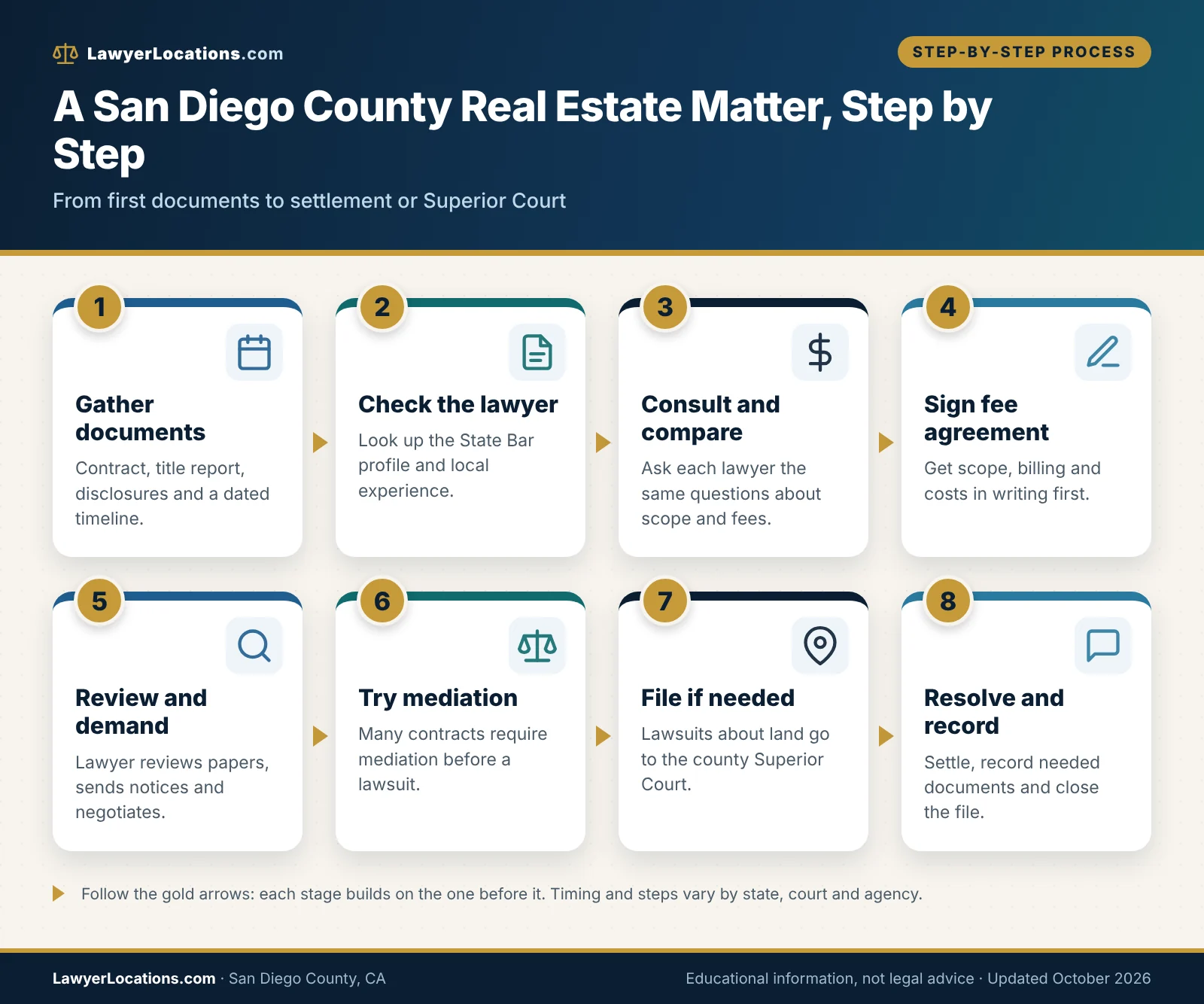
Text version of this graphic
- Define the problem and gather the contract, title and escrow papers.
- Check each lawyer’s State Bar record and local experience.
- Hold a consultation and compare scope, fees and strategy.
- Sign a written fee agreement that states scope and billing.
- Lawyer reviews documents, sends notices or demands, and negotiates.
- Try mediation or another settlement process.
- If needed, file in the Superior Court for the county where the property sits.
- Resolve the matter, record any needed documents and close out.
How a real estate matter usually moves from first call to resolution
Most matters follow the same path, whether the issue is a contract review or a lawsuit. The speed differs, but the stages are predictable.
Intake, conflicts check and written fee agreement
At intake, the lawyer’s office asks who the parties are, what documents exist and what outcome you want. The firm runs a conflict check, meaning it confirms it does not already represent someone on the other side. Then comes a written fee agreement. In California, a lawyer must put the fee arrangement in writing when the total cost is reasonably expected to exceed $1,000, under Bus. & Prof. Code § 6148.
Read the agreement before you sign it. It should say what the lawyer will and will not do, how fees and costs are billed, and what happens if the matter grows beyond the first plan.
Document review, demand and negotiation
Next, the lawyer reads the contract, title report, disclosures and communications, then identifies the strongest and weakest points. For many disputes, the practical next step is a demand letter, a written statement of the claim and what the other side must do to resolve it. A well-grounded letter can settle a dispute without a filing, and it also builds the record if you later sue.
Expect your lawyer to ask for patience on timing. Negotiations in real estate often depend on a closing date, a loan commitment or a tenant move-out date that sits outside anyone’s control.
Mediation, filing and trial
If negotiation fails, the next stop is often mediation, where a neutral person helps the sides reach a deal. Many California purchase agreements require mediation before a lawsuit and can limit attorney-fee recovery for a party who skips it, so check your contract before you file anything. If the case does go to court, a lawsuit about land is filed in the county where the property is located under Code Civ. Proc. § 392, which for San Diego County property means the Superior Court in this county.
Few real estate disputes reach a trial. The cost of litigation, the time and the risk on both sides push most matters toward settlement.
Do you need a lawyer, or will an escrow officer and agent do?
California practice differs from East Coast states where attorneys run closings. Our Philadelphia real estate attorney guide shows the contrast, and the Southern California escrow model is explained in more detail in the closing attorney guide for Los Angeles County. The short version applies here too.
Escrow officers, agents and the line at Bus. & Prof. Code § 6125
An escrow officer is a neutral stakeholder who holds money and documents until the conditions in the escrow instructions are met. A real estate agent is licensed by the California Department of Real Estate and can help with forms and pricing. Neither can give legal advice about your rights, because practicing law in California requires a State Bar license under Bus. & Prof. Code § 6125.
That is the gap a lawyer fills. If you have a question that begins with “what are my rights if…” or “is this clause safe…”, you are asking a legal question and the answer should come from a licensed attorney.
When San Diego County conditions raise the stakes
Some San Diego County properties come with extra layers: coastal-zone permits, wildfire hazard zones, tribal trust land, military-related leases, cross-border owners, HOAs and special-tax districts. Each is covered in a later section. If your property touches more than one of these, a short paid consultation before you sign is usually cheaper than fixing a mistake afterward.
Ask for legal review before the contingency period ends, not after. Once a buyer removes contingencies in writing, the buyer’s leverage drops sharply, and a lawyer called afterward often has fewer options to offer.
San Diego County Courts, Offices and Agencies: Where Real Estate Matters Are Filed
One trial court, the Superior Court of California, County of San Diego, hears real estate lawsuits for the entire county. The court sits in several regional courthouses, and the county Assessor/Recorder/County Clerk, the Treasurer-Tax Collector and your city all play separate roles. Knowing which office does what saves time and avoids filing in the wrong place.
The Superior Court of California, County of San Diego
California has one Superior Court per county. San Diego County’s court is one of the largest in the state, and it organizes its work by case type and by geographic region rather than by city.
One county court, several regional courthouses
The court operates downtown San Diego courthouses plus regional centers serving North County (Vista), East County (El Cajon) and South County (Chula Vista). Which building hears a civil, landlord-tenant or small claims case depends on the case type, the dollar amount and the part of the county involved, and the court has moved departments between buildings over the years. Always confirm the current location on the court’s own pages before you file or appear, because a notice posted months ago may be out of date.
The court’s landlord-tenant locations page and a public notice about relocating the unlawful detainer courtroom, both listed in our sources, show how often assignments change.
Do not rely on a courthouse address from an old filing, a search listing or a form you downloaded years ago. Confirm the current courthouse and department on the San Diego Superior Court website or by calling the clerk before a hearing.
Civil case types and dollar tiers
California sorts civil cases by amount. As of October 2026, limited civil cases generally involve claims up to $35,000, unlimited civil cases involve more, and small claims cases are capped for individuals at $12,500. Real property disputes can also turn on the type of relief, such as ownership of land or a court order, rather than on dollars alone, so the label on a case is not always obvious. A lawyer will tell you which track fits.
In small claims court, lawyers generally may not appear for the parties, so a lawyer’s role there is advice before the hearing. The court runs a small claims legal advisor service, listed in our sources.
| Matter | Typical forum | Local note |
|---|---|---|
| Breach of a purchase agreement, deposit dispute above small claims limits | Superior Court, civil division (limited or unlimited) | Filed in the county where the property is located; many contracts require mediation first |
| Small deposit or repair dispute | Small claims division | Individual cap of $12,500; lawyers generally do not appear |
| Quiet title, partition, boundary or easement | Superior Court, unlimited civil | Often needs surveys, title reports and a lis pendens decision |
| Eviction (unlawful detainer) | Superior Court landlord-tenant location | Courthouse assignments have changed; check the court’s current locations page |
| HOA enforcement | Mediation or ADR first, then Superior Court | State law requires a good-faith ADR attempt before certain HOA suits |
| Recording a deed, trust deed or lien release | County Recorder | The Recorder records documents; it does not decide ownership disputes |
| Property tax value or exclusion questions | County Assessor | Prop 19 and exclusion programs are administered by the Assessor |
Unlawful detainer and landlord-tenant cases
An unlawful detainer is the court case a landlord files to evict a tenant. It follows a notice process and quick deadlines set by state law, Code Civ. Proc. § 1161. Tenants and landlords both benefit from early advice, because small notice errors can derail a case or leave a tenant with only days to respond.
Statewide tenant protections, including just-cause rules and a rent cap for many rentals under Civ. Code §§ 1946.2 and 1947.12, apply in San Diego County, and some cities add their own rules. The City of San Diego publishes a tenant resources sheet listed in our sources.
County offices that touch every transaction
Two county departments appear in almost every sale, refinance or ownership change. Neither is a court, and neither gives legal advice, but both hold records a lawyer will ask you to pull.
The Assessor/Recorder/County Clerk
San Diego County combines three functions in one office, known as the Assessor/Recorder/County Clerk (ARCC). The Recorder division records deeds, deeds of trust, liens and releases in the public land records. The Assessor division sets the assessed value used for property tax and decides whether exclusions apply. Recording requirements and the fee schedule are published on the ARCC website, and fees change, so check the current schedule instead of relying on a quoted number.
The county transfer tax follows a statewide formula of $1.10 per $1,000 of value under Rev. & Tax. Code § 11911, and a few charter cities add their own tax on top. Ask your escrow officer to confirm whether your property’s city levies one.
The Treasurer-Tax Collector and the property tax calendar
The county Treasurer-Tax Collector bills and collects secured property tax. In California, the annual bill is generally payable in two installments, with the first due November 1 and the second due February 1, and each becomes delinquent after a later cut-off date that your bill states. Missing a due date triggers penalties, so buyers should confirm with escrow who pays which installment at closing.
After a change in ownership or new construction, the Assessor issues a supplemental assessment that can produce an extra bill months after closing. First-time San Diego County buyers are often surprised by it, so budget for it before you close.
City and state agencies
San Diego County has 18 incorporated cities plus unincorporated areas, and each local government has its own permit and land-use rules. State agencies add another layer.
Cities, permits, ADUs and rent rules
Building permits, zoning, accessory dwelling units (ADUs), short-term rental licensing and local rent or tenant ordinances are set by the city where the property sits, or by the county for unincorporated land. A seller who built a garage conversion without a permit may face a buyer demand to fix it or a price cut, and a city may require corrections before it approves a later project. Lawyers who work in your city regularly can usually predict how its planning staff treats such issues.
When a question is about the city’s own code, ask the lawyer whether they have appeared before that city’s planning commission or code enforcement office, not just whether they handle “real estate.”
State regulators: DRE, State Bar and the Coastal Commission
The California Department of Real Estate licenses agents and brokers and takes complaints about them. The State Bar of California licenses and disciplines attorneys. Along the coast, the California Coastal Commission and local governments share authority over development in the coastal zone under the Coastal Act, Pub. Res. Code § 30000 et seq. If your problem involves a licensed agent or broker rather than a lawyer, the DRE is the place to file a complaint, and a lawyer can help you decide whether to also pursue a civil claim.
Local Factors That Change a San Diego County Deal
San Diego County has features that most inland counties lack: a long coastline, wildfire-prone canyons, large military installations, an international border and many tribal reservations. Each affects disclosures, permits, financing or who has authority over the land. A lawyer who works these issues regularly can spot problems that a standard form will not.
Coast, canyons and fire: location-based disclosures and permits
Where the property sits can matter as much as what the contract says. Two location-driven issues come up repeatedly in the county.
The coastal zone
Property near the shoreline may sit in the coastal zone, where many improvements need a coastal development permit from the local government or the Coastal Commission. Seawalls, bluff-top additions, public beach access and view issues can all turn into legal fights. Permit history matters when you buy, because an unpermitted addition in the coastal zone can lead to enforcement that follows the property to its next owner.
If you are buying or selling in the coastal zone, ask the lawyer how often they work with the local coastal program and the Commission’s staff.
Wildfire and natural hazard disclosures
Much of eastern and inland San Diego County lies in or near areas mapped for high fire risk. California requires sellers of residential property to provide a Natural Hazard Disclosure that says whether the property sits in a flood zone, a very high fire hazard severity zone, an earthquake fault zone and similar mapped areas, under Civ. Code § 1103 et seq. A property in a fire hazard zone may carry defensible-space duties and can affect homeowners’ insurance availability and cost.
Insurance is not a legal technicality. If a buyer cannot get coverage at a price the lender accepts, the deal can fail, so smart buyers ask about insurability early in the contingency period.
Military, border and tribal-land context
San Diego County’s large military presence, its position on the border and its reservations shape the kinds of real estate questions people bring to lawyers.
Service members and the SCRA
The federal Servicemembers Civil Relief Act, 50 U.S.C. § 3901 et seq., gives active-duty service members certain protections around leases, evictions and some mortgage matters. For example, a service member who receives qualifying orders may be able to end a residential lease early under 50 U.S.C. § 3955 by giving written notice. Landlords and tenants near Navy and Marine Corps installations should understand how that protection works before a move.
The County Assessor also has a Servicemembers Civil Relief Act form for property tax purposes, which appears on its tax-savings page in our sources. Veterans and service members may also qualify for property tax exemptions, so ask the Assessor directly.
Cross-border buyers and foreign owners
Because of the border, San Diego County has many buyers, sellers and heirs who live outside the United States or hold property through foreign or mixed-citizenship families. Federal tax rules can require withholding when the seller of U.S. real property is a foreign person, and California has its own withholding rules for certain sellers. Your escrow officer handles the paperwork, but a lawyer or tax professional should explain who owes what before the sale closes.
Cross-border estates add another wrinkle, because inheriting a San Diego County home may involve a California probate and sometimes a proceeding in another country. Our living trust lawyer guide explains one way owners reduce that friction.
Tribal trust land
San Diego County is home to many federally recognized tribes and reservations. Land held in trust for a tribe or for individual tribal members is governed by federal law and tribal law, and it often cannot be sold, leased or mortgaged like fee land without federal approval. Ordinary California deed forms, title insurance and county recording practice may not work the same way there.
If any part of your transaction involves reservation land, hire a lawyer with direct experience in Indian land law. Do not assume that a general real estate lawyer or escrow officer has it covered.
HOAs, ADUs, short-term rentals and special taxes
Many San Diego County homes sit inside planned communities or special-tax districts, and these private and local layers can bind owners as firmly as a state statute.
HOAs and the Davis-Stirling Act
Common-interest developments in California are governed by the Davis-Stirling Common Interest Development Act, Civ. Code § 4000 et seq. Sellers must provide resale documents, including the governing documents and financial information, to buyers under Civ. Code § 4525. Before suing to enforce the governing documents in many cases, the parties must attempt alternative dispute resolution, Civ. Code § 5930.
Read the CC&Rs (covenants, conditions and restrictions) for rental limits, architectural approval rules and special assessments. A lawyer can review them in an hour or two, and the cost is small next to a six-figure surprise.
ADUs and short-term rentals
State law has made ADUs easier to build, but cities still set many details, and an HOA or deed restriction may add its own limits. Short-term rentals are regulated city by city, with licensing, caps or bans in some places. Never rely on a listing that says “ADU allowed” or “STR friendly” without confirming current rules with the city and reading the HOA documents.
Disputes about unpermitted units or rental income are common ground for a property lawyer, and the cost to cure often exceeds the price of getting advice first.
Mello-Roos and other special taxes
Newer communities may carry a Mello-Roos special tax, a voter-approved levy that funds roads, schools or utilities and appears on the property tax bill. It can last decades and may add a significant amount per year. Sellers must disclose special taxes and assessments, and buyers should read the notice carefully. Mello-Roos law is found in Gov. Code § 53311 et seq.
Ask escrow or the title company for the amount, the end date and whether the tax can be prepaid. Those three answers shape your true monthly cost.
None of these local layers is unusual on its own. What trips up buyers is finding out late. Ask for the preliminary title report, HOA documents and hazard disclosures in the first days of the contract so a lawyer can look at them while you still have options.
California Rules Every San Diego County Buyer, Seller and Owner Should Know
State law, not county law, sets most of the rules that decide real estate disputes in San Diego County. The contract, the disclosure statutes and the statutes of limitation drive outcomes, and the county supplies the courts and offices that apply them. This section covers the rules that come up most often.
Disclosures and contract formalities
California is a disclosure state, and its contract rules favor written terms. Both facts matter for anyone buying or selling a home in the county.
The Transfer Disclosure Statement and the right to cancel
Sellers of most one-to-four-unit residential property must deliver a Transfer Disclosure Statement (TDS) that lists known defects and conditions, under Civ. Code § 1102 et seq. If the disclosures are delivered after the buyer has signed the purchase offer, the buyer generally has a short window to terminate, three days after personal delivery or five days after delivery by mail, under Civ. Code § 1102.3. Count the days carefully and keep proof of the delivery date.
Selling “as is” does not erase the duty to disclose known material facts. Buyers should also read the inspection reports, because a disclosure is the seller’s statement, not an independent check.
Real property contracts must be in writing
California’s statute of frauds, Civ. Code § 1624, requires a signed writing for an agreement to sell real property and for leases longer than one year. A handshake deal on land is risky for that reason, and courts enforce oral promises about real estate only in narrow situations. If you made a verbal promise or accepted one, ask a lawyer how it fits the writing requirement before you act on it.
The same principle applies to changes. If buyer and seller agree to extend a deadline by text message, get it in a signed addendum so no one argues later about what was agreed.
Deposits and liquidated damages
Many purchase agreements let the seller keep the buyer’s deposit as liquidated damages if the buyer defaults. For a residential purchase of one to four units where the buyer intends to live in the property, California law presumes a deposit up to 3% of the purchase price is reasonable, under Civ. Code § 1675. Both sides generally must sign or initial the liquidated damages clause for it to apply. Anything beyond those limits is likely to draw a challenge.
A buyer who wants out of a deal should look at the contingency language first, since a properly timed cancellation under a contingency can avoid a default altogether.
Deadlines for filing real estate claims
Time limits, called statutes of limitation, decide whether a court will hear a claim at all. The periods below are general California rules; discovery rules, tolling and exceptions can change the date, and a lawyer should calculate yours.
Contract, fraud and property claims
The most common rule is the four-year limit for written contracts. Oral contract claims get a shorter period, and claims based on fraud or trespass have their own rules. Do not guess the date: the clock may start when the breach happened, when you discovered it or when the work was substantially completed.
| Type of claim | General period | Statute |
|---|---|---|
| Written contract (purchase agreement, written lease) | 4 years | Code Civ. Proc. § 337 |
| Oral contract | 2 years | Code Civ. Proc. § 339 |
| Fraud or mistake | 3 years from discovery | Code Civ. Proc. § 338 |
| Trespass or injury to real property | 3 years | Code Civ. Proc. § 338 |
| Patent construction defects | 4 years | Code Civ. Proc. § 337.1 |
| Latent construction defects | 10 years from substantial completion | Code Civ. Proc. § 337.15 |
| Claim against a lawyer for professional error | 1 year from discovery, with an outer limit | Code Civ. Proc. § 340.6 |
These are general ranges, not a calculation for your case. A missed limitation date can end a valid claim, and some contracts shorten the practical window with notice or mediation steps. See a lawyer early if you think you have a claim.
Construction defects and the pre-suit process
Defect claims against builders of newer homes may require a notice-and-repair process before a lawsuit, under California’s construction defect statutes. Homeowners who find water intrusion, cracked foundations or other defects should document them in writing and photographs, and avoid doing repairs that destroy evidence before a lawyer or expert has seen the problem.
Warranties from the builder or a home warranty company can also shorten the real deadline, so read them promptly.
Remedies in property disputes
What a court can order depends on the claim. Land is treated as unique, so California courts can sometimes order a seller to complete a sale rather than just pay money.
Specific performance and lis pendens
Specific performance is a court order requiring a party to perform the contract, such as completing a sale. A buyer who files a lawsuit claiming an interest in the property can record a notice of pending action, called a lis pendens, which warns the world that the property is in litigation, under Code Civ. Proc. § 405.20. The other side can ask the court to remove it, and an unjustified lis pendens can lead to payment of the other side’s fees.
Recorded notices cloud title and can freeze a sale, so lawyers treat them as a serious step rather than a bargaining chip.
Quiet title, partition and adverse possession
A quiet title action asks the court to declare who owns property or an interest in it, Code Civ. Proc. § 760.010 et seq. A partition action asks the court to divide or sell property that co-owners cannot agree about, Code Civ. Proc. § 872.010 et seq. Claims of adverse possession require long, open use and, in California, payment of property taxes for five years, Code Civ. Proc. § 325. They are hard to win and fact-heavy.
Boundary and easement conflicts between neighbors often start these cases. A survey from a licensed land surveyor is usually the first piece of evidence.
Attorney fees, mediation clauses and who pays
California follows the American rule, so each side normally pays its own lawyer unless a contract or statute says otherwise. When a contract includes a prevailing-party attorney-fee clause, Civ. Code § 1717 makes the clause work both ways, even if it was written to favor one side. Many form purchase agreements also require mediation first, and refusing to mediate can cost a party its fee recovery.
These clauses change the risk math. A strong claim with a fee clause may justify a lawsuit, while a weak claim with the same clause can be expensive to lose.
A buyer in East County cancels after an inspection and the seller keeps the deposit. The buyer’s lawyer reads the contract and finds that the buyer gave the cancellation notice a day after the contingency period ended. The lawyer explains the options: negotiate a split of the deposit, demand mediation, or accept the loss. This is a hypothetical to show how dates in the contract drive the advice, not a prediction for any case.
How to Compare Real Estate Attorneys in San Diego County
Compare lawyers on license status, relevant experience, scope, fees and communication, and get the terms in writing. Marketing language is not evidence. The checks below are free or cheap and can be done before you pay anyone.
Verify the lawyer before you talk about your case
Start with verification. It takes a few minutes and removes the most serious risks.
Check the State Bar profile
Every California lawyer has a public profile on the State Bar of California website that shows license status, admission date and any public discipline. Look up the person who will actually do your work, not just the firm. A lawyer who is “not eligible to practice” or who has been disciplined for misusing client money is a hard stop for most people.
If a firm lists several lawyers, ask who would handle your matter and check that person by name.
Be careful with specialty claims
A website that calls a lawyer a “certified” real estate lawyer may be using the word loosely. Ask who certified the lawyer and what the standard was.
The State Bar of California recognizes legal specialization in a limited list of fields, and real property law has not been among them. A lawyer who says they are a “certified” real estate lawyer deserves a follow-up question about who certified them. Experience is better shown through the kinds of matters handled, how often and in which courts. Ask for specifics, and do not accept slogans.
Review claims such as “highly rated” or awards the same way: ask who grants them and whether the lawyer paid to be listed.
Use certified referral services with care
A lawyer referral service certified by the State Bar must meet minimum standards under state law, and it screens participating lawyers for license status and insurance. The State Bar explains how a certified service works on its website. The San Diego County Bar Association operates a referral service in this area, and other certified services may also serve the county. A referral is a starting point, not an endorsement of any lawyer’s quality, and you should still ask the questions below.
Uncertified “find a lawyer” websites are often paid advertising. Treat their rankings as marketing.
Questions that separate a good fit from a poor one
A first meeting should leave you knowing what the lawyer thinks of your problem, what they would do and what it will cost. These questions get you there.
Scope and local experience
Ask what share of the lawyer’s work is real estate and what share is your type of problem. A lawyer who mostly drafts leases may not be the right fit for a quiet title case, and the reverse is also true. Ask how often they appear in the San Diego Superior Court, in which courthouse regions, and whether they know the city or HOA involved. Ask for a plain-English summary of how they would approach the matter.
Request an honest view of the weak points. A lawyer who only tells you what you want to hear is not helping.
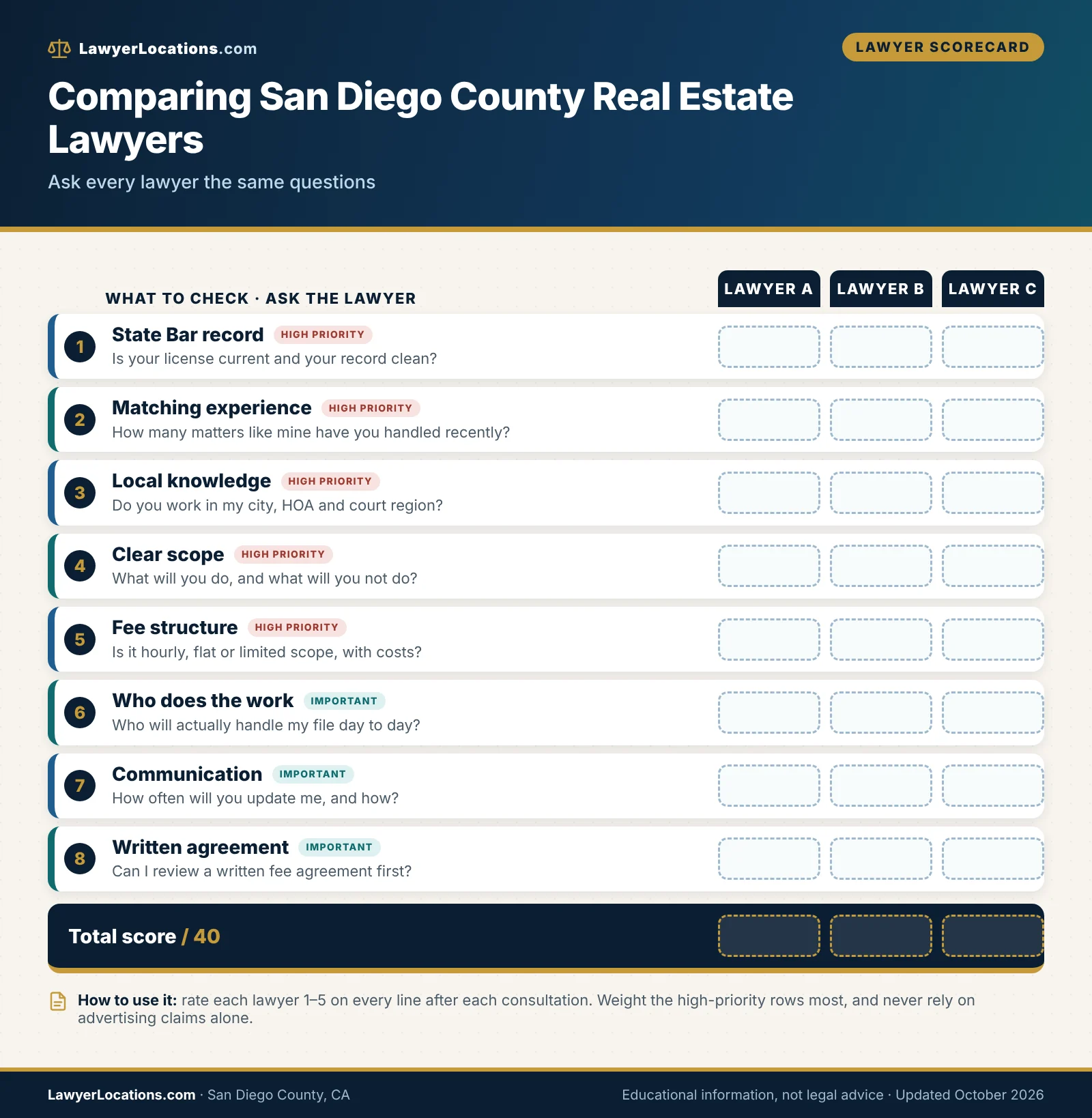
Text version of this graphic
| Criterion | Question to ask |
|---|---|
| License status | Is your State Bar record clean and current? |
| Matching experience | How many matters like mine have you handled recently? |
| Local knowledge | Do you work in my city, HOA or court region? |
| Scope of work | What exactly will you do and not do? |
| Fee structure | Is the fee hourly, flat or limited scope, and what are the costs? |
| Staffing | Who will actually work on my file? |
| Communication | How and how often will you update me? |
| Written agreement | Will you give me a written fee agreement to review? |
Staffing, communication and conflicts
Ask who will do the work: the lawyer you meet, an associate or a paralegal. Staffing by itself is not a problem, because paralegals lower cost when supervised, but you should know. Ask how the office communicates, how fast it returns calls, and what to expect between meetings. Ask directly whether the firm represents anyone connected to the other side, including the agent, builder or HOA management company.
If a lawyer promises a result, treat it as a red flag. No honest lawyer can promise an outcome in a property dispute.
Fees, costs and the written agreement
Ask for the fee structure in writing: hourly rate or flat fee, retainer amount, billing increments, who bills time, and how costs such as filing fees, surveys, expert reports and courier charges are handled. Ask whether the lawyer will give a cost range for each stage. Compare two or three lawyers on the same facts, since the cheapest hourly rate does not always produce the lowest total.
Under Bus. & Prof. Code § 6148 the agreement must also state the basis of compensation, the general nature of the services and the responsibilities of lawyer and client. Read it before signing.
| You ask about | A reassuring answer sounds like | A weak answer sounds like |
|---|---|---|
| Experience | “I handle HOA and boundary disputes regularly and appear in the county court.” | “We handle all real estate matters” with no examples |
| Strategy | A clear first step, a fallback and the risks of each | An outcome promised with no caveats |
| Fees | Written structure, retainer, billing practice and cost estimate by stage | Vague “we’ll see” billing or reluctance to put terms in writing |
| Communication | A named contact and a stated response practice | Calls routed to no one in particular |
| Conflicts | A conflict check done before the meeting ends | Surprise about who is on the other side |
| Alternatives | Mention of mediation, limited-scope help or a demand letter first | Pressure to file suit immediately |
Preparing for a consultation
A prepared client gets more from a first meeting, often in less time and at lower cost. The goal is to let the lawyer see the whole picture quickly.
Documents to gather
A preliminary title report is the title company’s early snapshot of who owns a property and which mortgages, liens, easements and restrictions are recorded against it. Lawyers ask for it first in almost every purchase or title question.
Collect the paper trail in one folder, digital or physical, and bring copies rather than originals. A short, organized stack is better than a box of unsorted mail.
- The signed purchase agreement, lease or other contract, with all addenda and counteroffers
- The preliminary title report, deed and any recorded documents tied to the property
- Seller disclosures, inspection reports and repair requests
- Escrow instructions and closing statements, if escrow has opened or closed
- HOA governing documents, assessment notices and correspondence
- Permits, plans and surveys, and any city or county notices
- Emails, texts and letters with the other side, in date order
- Photos and videos with dates, plus a one-page timeline of events
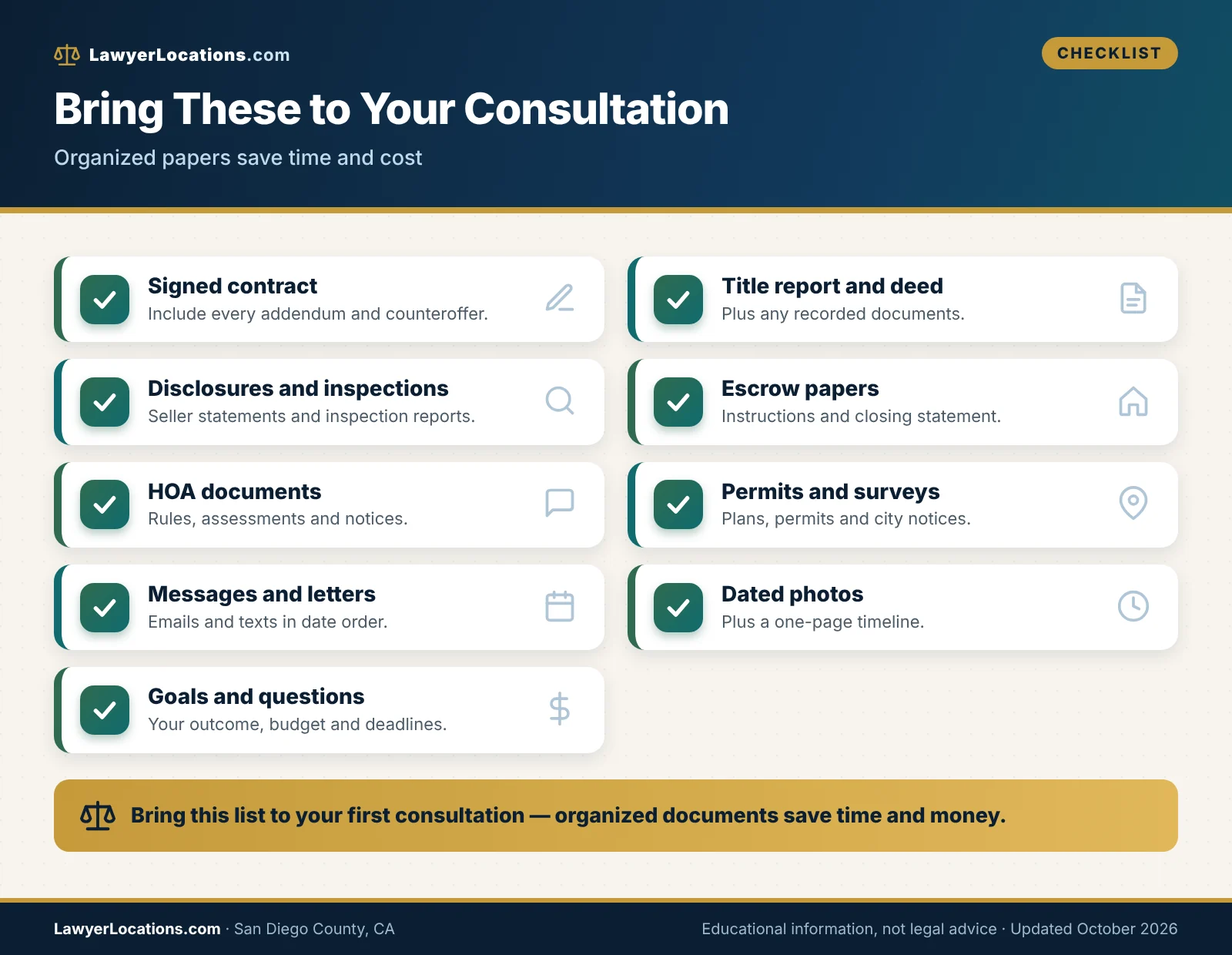
Text version of this graphic
- Signed contract and every addendum
- Title report, deed and recorded documents
- Seller disclosures and inspection reports
- Escrow instructions and closing statement
- HOA documents and notices
- Permits, plans and surveys
- Emails, texts and letters in date order
- Dated photos and a one-page timeline
- A list of questions and your goal
Your goals, budget and questions
Write down what a good result looks like: closing on time, getting a deposit back, removing a lien, keeping a neighbor off your land. Decide what you would accept as a compromise, and state your budget range. A lawyer can only plan a strategy that fits your goals and your wallet if you share both. Add questions about timing, risk and the first step.
Bring the deadlines too. If a contingency expires on Friday, say so in the first sentence of the call.
Ask each lawyer the same five questions and take notes. Comparing written notes the next day, not the sales pitch, is the clearest way to choose between two lawyers who both sounded reassuring in the room.
For related decisions that overlap with property, such as a divorce that affects the family home, see our guide to family law attorneys in San Diego. Questions about how a lawyer’s fees work in a nearby market are discussed in the real estate lawyer guide for Los Angeles.
Costs, Deadlines and Decision Points
Real estate legal costs depend on the fee structure, the complexity of the matter and how long it runs, and no honest source can quote a single price for San Diego County. This section explains the common billing models, what drives cost, and where the key decisions fall on a typical timeline. Verify any rate a lawyer quotes in a written fee agreement.
How real estate lawyers charge
Fees vary widely by firm, by lawyer and by task. Understanding the models lets you compare offers on equal terms.
Hourly, flat-fee, limited-scope and contingency models
Most real estate work is billed hourly or for a flat fee on a defined task such as a contract review. In a limited-scope arrangement, the lawyer handles only part of the matter, such as coaching you before mediation or drafting a letter, and you handle the rest. Contingency fees, where the lawyer is paid a share of a recovery, are less common in real estate and must meet requirements in Bus. & Prof. Code § 6147.
The table below compares the models. It deliberately gives no dollar figures, because rates vary and published averages are rarely reliable.
| Model | How it works | Often used for | Watch for |
|---|---|---|---|
| Hourly | You pay for time spent, usually against a retainer | Disputes, negotiations, open-ended review | Billing increments, who bills time, and no cap on total |
| Flat fee | One price for a defined task | Contract review, a deed, a demand letter | What is excluded, and what triggers extra charges |
| Limited scope | Lawyer does part of the matter, you do the rest | Coaching, document drafting, a single hearing | A clear written list of what the lawyer will not do |
| Contingency | Lawyer is paid a share of any recovery | Some damages claims where money is recovered | Percentage, who pays costs, and what counts as recovery |
| Hybrid | Reduced hourly rate plus a share of a result | Complex disputes with an upside | How the pieces add up if the matter drags on |
What drives the total up or down
Cost follows effort. A simple contract review takes a fraction of the time a contested title case needs. Several factors push the total up: the number of parties, the amount of paper to review, urgency, the need for surveys, appraisals or expert witnesses, and a defendant who fights every step. Filing fees and similar costs are separate from the lawyer’s fee, and the court posts its current fee schedule on its website.
You can control some of this. Organized documents, quick answers to the lawyer’s questions and a settlement-minded approach all reduce hours.
The written fee agreement and fee disputes
Under California law, a written fee agreement is required when the total is reasonably expected to exceed $1,000. If you disagree with a bill, the State Bar’s Mandatory Fee Arbitration Act, Bus. & Prof. Code § 6200 et seq., gives clients a path to arbitration, and the State Bar publishes a sample written fee agreement and instructions listed in our sources. Raise billing concerns early and in writing.
Keep a copy of every invoice and every email about fees. If the matter ends, ask in writing for your file and any unused retainer.
A timeline of deadlines and decision points
Real estate matters move on deadlines that come from a contract, a statute or a court. The decisions fall in a predictable order.
Before you sign or remove contingencies
This stage offers the most leverage and the cheapest advice. Read the preliminary title report, HOA documents and hazard disclosures. Compare repair requests with inspection findings. Decide whether to ask for a lawyer’s review, and do it before any contingency removal deadline in your contract. Removing a contingency in writing usually means you accept the property’s condition and the terms as they stand.
A short consultation here can address a single clause, a single lien or a single question about whether a permit exists.
After a problem appears or a dispute starts
Once a dispute starts, preserve evidence, stop making statements that could be used against you, and calendar every contract and statutory deadline. Check the contract for notice requirements, mediation steps and attorney-fee clauses. Decide whether to send a demand, propose mediation or file. If you plan to sue, remember that the limitation periods discussed above keep running, and a lawyer should confirm the date you must file by.
If the other side has recorded a lien or a lis pendens, ask a lawyer right away about options to remove it.
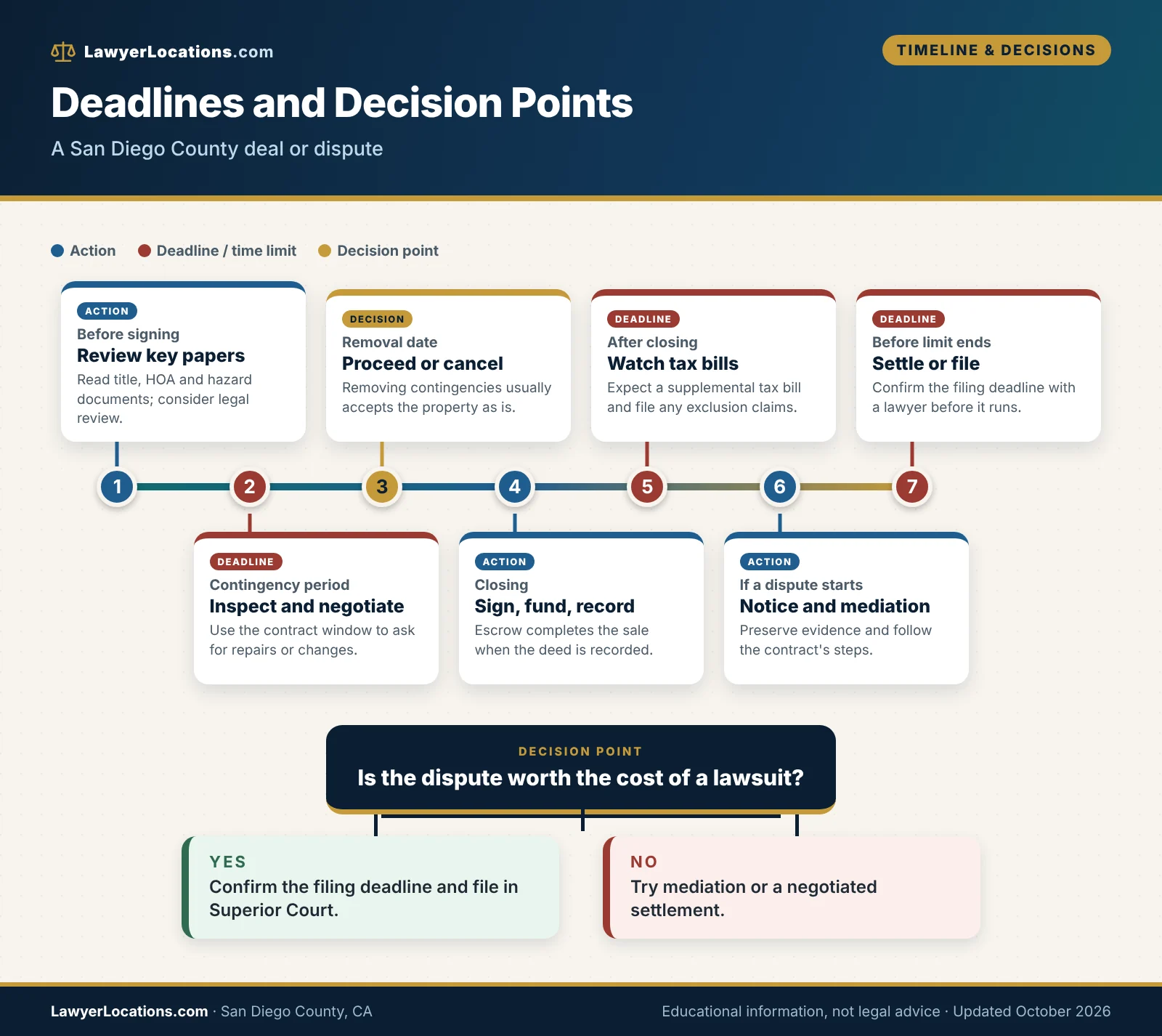
Text version of this graphic
- Before signing: review title, HOA and hazard documents; decide on legal review.
- Contingency period: complete inspections and negotiate; deadline to remove contingencies.
- Decision point: proceed, renegotiate or cancel under the contingency.
- Escrow and closing: sign documents, fund, record the deed.
- After closing: watch for the supplemental tax bill and file any tax-exclusion claims.
- If a dispute arises: send notice or demand, try mediation, and check the filing deadline.
- Decision point: settle, or file in the Superior Court if no deal is possible.
Decision question: Is the dispute worth the cost of litigation? If yes, confirm the filing deadline and file. If no, consider settlement or mediation.
Lower-cost options in San Diego County
Not everyone needs or can afford full representation. Several local and statewide options sit between doing nothing and hiring a lawyer for the whole matter.
Court self-help and small claims
The San Diego Superior Court runs a Self-Help Center that offers procedural information, forms and guidance for people who represent themselves. Staff there cannot give legal advice, but they can explain how a process works. For small disputes, the court’s small claims legal advisor service helps people prepare. Both are listed in our sources, and hours and access methods change, so check the court’s website.
These services help most with process, not strategy. Use them alongside a limited-scope consultation if your case has complications.
Legal aid, pro bono and referral options
Legal aid organizations in the county, including the Legal Aid Society of San Diego and the San Diego Volunteer Lawyer Program, help eligible low-income residents with housing and related civil matters. Eligibility rules and the types of cases they take change, so contact them directly. A State Bar-certified referral service can also connect you with a lawyer for a first consultation, as explained above.
If you have a landlord-tenant issue, start with the tenant resources published by your city. The City of San Diego and the City of Chula Vista both publish resource pages, listed in our sources.
Eviction notices, contingency periods and limitation dates are all short fuses. If you have received a notice with a response date, treat that date as fixed and seek advice right away.
Mistakes to Avoid, Quick Answers and Next Steps
Most expensive real estate mistakes in San Diego County are preventable: missed dates, unread documents, unwritten promises and late calls to a lawyer. This section lists the mistakes and red flags, answers common questions and sets out next steps.
Common mistakes and red flags
Two groups of mistakes show up repeatedly: those made by people in a transaction, and those made while hiring help.
Mistakes during a transaction or dispute
These are the errors lawyers see most often.
- Removing contingencies without reading the title report, HOA documents and disclosures
- Relying on an oral promise or a text message instead of a signed addendum
- Missing a notice date, mediation requirement or filing deadline
- Ignoring permit history on a coastal, hillside or older property
- Making repairs that destroy evidence before anyone documents a defect
- Talking to the other side’s insurer, agent or lawyer without advice after a dispute starts
- Assuming the escrow officer or agent can tell you what your legal rights are
Red flags when hiring a lawyer
Watch for warning signs in a first meeting or a marketing pitch.
- A promised outcome or a claim that a case is a “sure win”
- Pressure to sign or pay a retainer before you have read the agreement
- Reluctance to put fees and scope in writing
- A State Bar record that shows a suspension, restriction or serious discipline
- No explanation of risks, alternatives or likely cost
- Requests for payment through unusual channels
Quick answers to common San Diego County real estate questions
These short answers complement the longer sections above. Details depend on your facts, and a lawyer should confirm them.
Hiring and cost questions
Do I need a real estate attorney to buy a home in San Diego County?
No, California does not require one, and escrow officers handle the closing. A lawyer is worth considering if the deal involves a trust, an LLC, an unusual contract, a title problem or an HOA, coastal or tribal-land issue.
How much does a real estate attorney cost in San Diego County?
It depends on the fee model, the task and the lawyer. Contract review is often a flat fee, while disputes are usually hourly. Ask for a written fee agreement and a cost range per stage rather than relying on published averages.
How do I find a real estate attorney near me?
Use a State Bar-certified lawyer referral service, ask your title or escrow company for names, and verify each lawyer on the State Bar website. Then compare at least two lawyers on the same questions.
Is the first consultation free?
Policies differ by firm. Some offer a free or reduced-fee first meeting and some charge for it, so ask before you book and get the terms in writing.
Can a lawyer help if I cannot afford full representation?
Possibly. Limited-scope help, a single consultation, court self-help services and legal aid organizations may fit a smaller budget. Eligibility and availability vary.
Transaction and dispute questions
Where do I file a real estate lawsuit in San Diego County?
In the Superior Court of California, County of San Diego, because lawsuits about land are filed in the county where the property sits. The court assigns the case to a courthouse by case type, so confirm the current location with the clerk.
How long do I have to sue over a broken real estate contract?
The general limit for a written contract is four years, and for an oral contract it is two, but exceptions exist. A lawyer should calculate the date for your facts.
Can I get my deposit back if I cancel a purchase?
It depends on whether you cancelled under a contingency in time and on the contract’s deposit terms. Read the contingency and liquidated damages clauses before you act, and get advice quickly.
What is a lis pendens?
It is a recorded notice that a lawsuit claims an interest in a property. It can block a sale until it is removed or the case ends, and misusing it can lead to financial consequences.
Does San Diego County require anything special when selling a home?
State disclosure rules apply, including the Transfer Disclosure Statement and natural hazard disclosures, and HOA, special-tax and city requirements may add to them. Ask your agent, escrow officer and lawyer to confirm the list for your property.
Who handles a dispute with my HOA?
Start with the HOA’s own procedures and the alternative dispute resolution step state law requires before certain suits. A lawyer who knows the Davis-Stirling Act can advise on whether to negotiate, mediate or file.
Next steps
If you are ready to act, a few concrete moves will put you in a stronger position, whether you are buying, selling, renting out or facing a dispute.
This week
Gather your documents, write a one-page timeline, and list every deadline in your contract or notice. Look up two or three lawyers on the State Bar website, and book short consultations. Do not sign anything new, including releases and extensions, until you understand what it does.
If you are buying a home in the county, request the preliminary title report, HOA documents and hazard disclosures now.
Before you sign or file
Compare the lawyers you met using the scorecard above, choose one, and review the written fee agreement line by line. Confirm in writing the scope, the billing method, the first steps and the next deadline. If a lawsuit is on the table, ask the lawyer to explain the settlement and mediation options and the cost of each stage before you decide.
When in doubt about the limits of what you read here, ask the lawyer to explain it in plain English until you understand it.
Ready to compare your options?
If your situation involves a business entity or family change, our guides to corporate lawyers in California and family law attorneys in California explain how to compare lawyers in those areas. For another California county’s approach to property disputes, see the Los Angeles County property dispute guide. LawyerLocations.com is an educational directory resource, not a law firm, and does not endorse any lawyer.
General information only. This guide is general legal information for readers in San Diego County, California, and is not legal advice. Reading it does not create an attorney-client relationship, and LawyerLocations.com is not a law firm. Laws, court rules, fees and local procedures change, so confirm the current rules with the court, the county office or a lawyer licensed in California before you act.
Sources & References
Show all 15 sources
- Property Tax Savings (Prop 19, exclusions, SCRA form, Assessor contact) — County of San Diego Assessor/Recorder/County Clerk — sdarcc.gov — accessed October 2026
- Recording Documents (Recorder requirements) — County of San Diego Assessor/Recorder/County Clerk — sdarcc.gov — accessed October 2026
- Recorder/County Clerk Fee Schedule — County of San Diego Assessor/Recorder/County Clerk — sdarcc.gov — accessed October 2026
- Landlord/Tenant Locations — Superior Court of California, County of San Diego — sdcourt.ca.gov — accessed October 2026
- Notice of Relocation of the Unlawful Detainer Courtroom — Superior Court of California, County of San Diego — sdcourt.ca.gov — accessed October 2026
- Self-Help Center — Superior Court of California, County of San Diego — sdcourt.ca.gov — accessed October 2026
- Small Claims Legal Advisor — Superior Court of California, County of San Diego — sdcourt.ca.gov — accessed October 2026
- How a Certified Lawyer Referral Service Works — State Bar of California — calbar.ca.gov — accessed October 2026
- Sample Written Fee Agreement Instructions — State Bar of California — calbar.ca.gov — accessed October 2026
- Business and Professions Code section 6148 (written fee agreements) — Justia California Codes — law.justia.com — accessed October 2026
- Business and Professions Code section 6147 (contingency fee agreements) — California Public Law — california.public.law — accessed October 2026
- Code of Civil Procedure section 337 (contract limitation period) — California Public Law — california.public.law — accessed October 2026
- Proposition 19 guidance (Letter to Assessors 2021/008) — California State Board of Equalization — boe.ca.gov — accessed October 2026
- Tenant Resources Sheet — City of San Diego — sandiego.gov — accessed October 2026
- Housing Resources — City of Chula Vista Development Services — chulavistaca.gov — accessed October 2026
Legal Disclaimer and Limitation of Liability
Informational and illustrative purposes only. This article was prepared by LawyerLocations.com solely on the basis of the information available to us at the time of writing. It is an illustrative, general overview. It is not a complete or authoritative statement of the law, and it has not been reviewed by a lawyer licensed in your state or county.
Not legal advice. Nothing in this article is legal, financial, tax or immigration advice, and reading it does not create an attorney-client relationship between you and LawyerLocations.com or any author, lawyer or firm mentioned. Laws, court rules, fees, filing deadlines and agency procedures differ by state, county and court, and they change often. Some details here may be simplified, incomplete or out of date, and time limits for legal claims can be short.
No warranty. We make no representation or warranty, express or implied, about the accuracy, completeness, timeliness or suitability of this content for your situation. Please do not rely on it to make, delay or skip any legal decision. Check the facts against official sources and speak with a licensed attorney in the relevant jurisdiction before you act.
Limitation of liability. To the fullest extent permitted by law, LawyerLocations.com and its owners, authors and contributors disclaim all liability for any loss, damage, cost or other consequence arising from the use of, or reliance on, this article, including any content on third-party websites we link to. Mentioning a lawyer, firm, organization or service is not an endorsement and is not a promise of any result. If you are in immediate danger, contact your local emergency number.