If you and your spouse agree on every term, you can finish a Minnesota divorce without a trial, and an uncontested divorce lawyer Minneapolis MN couples hire is usually there to draft, check and file the agreement rather than fight about it. Cases for Minneapolis residents are filed in Hennepin County District Court, at least one spouse must have lived in Minnesota for 180 days, and the state filing fee for a dissolution in Hennepin County is currently $402.
This guide explains what “uncontested” really means under Minnesota law, what the local court expects, how lawyers price this work, and how to compare the people you interview. It is general information, not legal advice.
What an uncontested divorce is (and isn’t) in Minnesota
An uncontested divorce is one where both spouses agree to end the marriage and agree on every issue the court has to decide: property, debts, support, and, if you have children, parenting time and child support. Minnesota calls the legal action a “dissolution of marriage,” and the written agreement that settles it becomes part of the final judgment and decree. If a single issue is still in dispute, the case is contested, even if the spouses are on friendly terms.
How Minnesota defines the starting point
No-fault grounds make agreement easier
Minnesota is a no-fault state. The only ground for dissolution is that the marriage has suffered an irretrievable breakdown, which the statute sets out in Minn. Stat. § 518.06. Neither spouse has to prove adultery or misconduct, so there is no fault story to fight over, and that is a big reason many couples can settle.
In practical terms, an uncontested case often starts with a joint petition that both spouses sign, or with one spouse filing a petition and the other signing an acknowledgment and a settlement. Your lawyer will explain which route fits your facts.
Uncontested is not the same as default or summary
People mix up three different tracks. An agreed case is one where both of you negotiate and sign a settlement. A default case happens when one spouse is served and never responds, which is not an agreement at all and can raise problems later. A summary dissolution is a streamlined statutory process (see Minn. Stat. § 518.195) with strict eligibility limits that rule out many couples, especially those with minor children or significant property.
Read the eligibility conditions in the summary dissolution statute and on the Minnesota Judicial Branch divorce page before assuming you qualify. If you do not fit squarely inside it, an agreed (uncontested) dissolution is the safer, more common track.
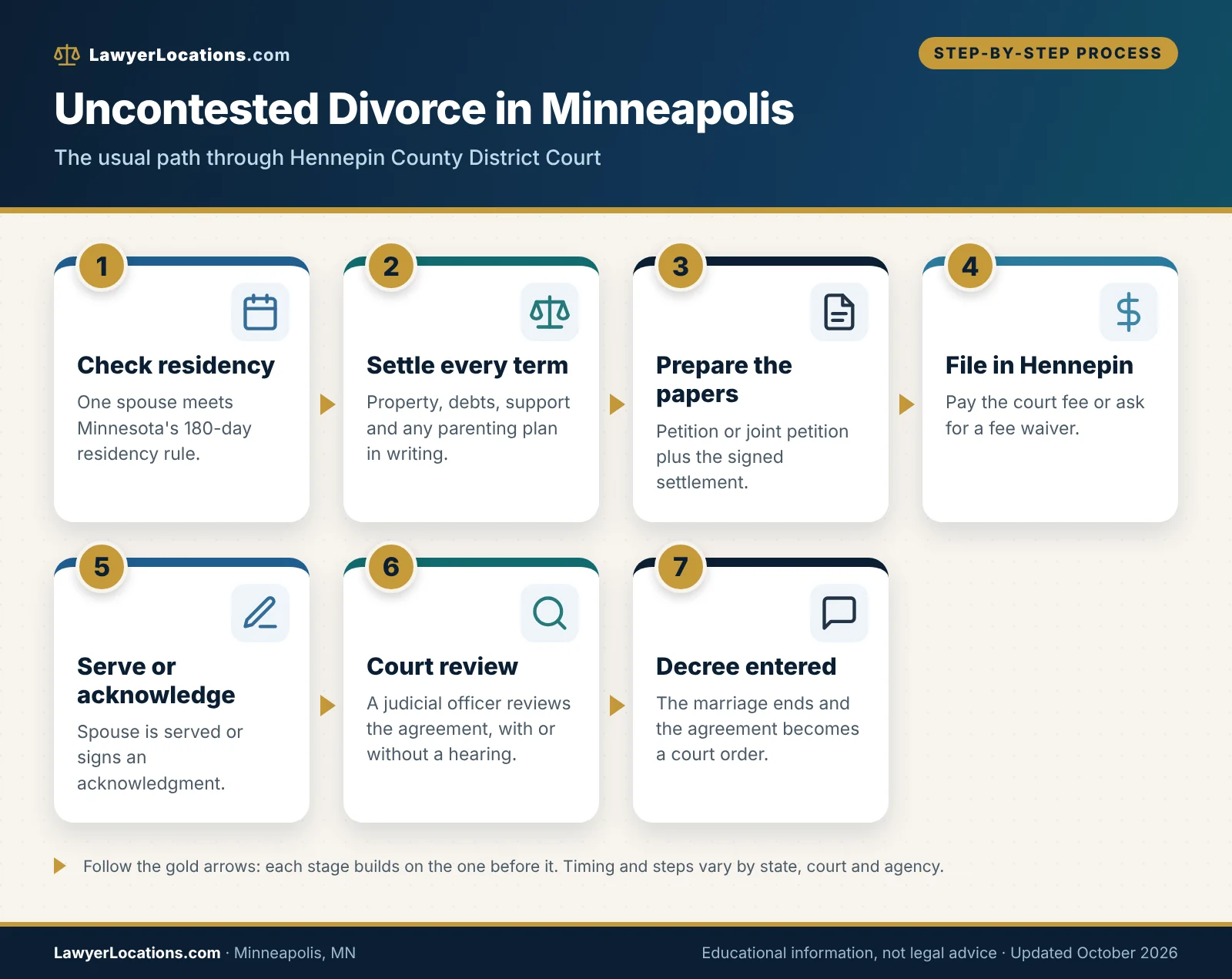
Text version of this graphic
- Confirm eligibility. One spouse meets the 180-day Minnesota residency rule.
- Settle the terms. Property, debts, support, and any parenting plan.
- Prepare the papers. Petition or joint petition, plus a written settlement.
- File in Hennepin County. Pay the fee or ask for a waiver.
- Serve or acknowledge. The other spouse is served or signs an acknowledgment.
- Court review. A judicial officer reviews the agreement, with or without a hearing.
- Judgment and decree. The marriage ends and the agreement becomes a court order.
When a lawyer adds value to an agreed divorce
When forms alone can work
Some couples handle an agreed divorce on their own with the court’s forms. That tends to work when the marriage was short, there are no children, there is little property, and no one is giving up a retirement account or a house. The Hennepin County fee schedule lists a low-cost forms packet for dissolutions with or without children, which shows the court expects some people to file without counsel.
Even then, many self-filers pay a lawyer for a one-time document review. A review of your settlement before you sign costs far less than a motion to fix it afterward.
When an attorney earns the fee
Hire a lawyer if there is a home, a pension, a business, a large retirement balance, spousal maintenance, or children. These are the places where one wrong sentence can cost you real money or parenting time, and where the court may send a settlement back for repair. A lawyer also helps when one spouse is much more financially savvy than the other.
- One spouse “handled all the money” and the other has never seen the statements.
- A retirement account must be divided between you.
- You plan to stay in the house, or sell it, and refinancing is involved.
- You and your spouse disagree about even one parenting issue.
One attorney cannot represent both spouses in a divorce. If a lawyer offers to “handle everything for both of you,” ask how they will manage the conflict of interest. Typically one spouse hires the lawyer and the other either hires separate counsel, uses a mediator, or signs knowingly without legal advice.
Mediation and collaborative options in the Twin Cities
Mediation as a bridge to agreement
If you almost agree, a neutral mediator can help you close the gap without a courtroom. A mediator does not give either of you legal advice or take sides, so many people still ask a lawyer to review the final draft. Minnesota courts also have an alternative dispute resolution framework for family cases, which is why mediation is a familiar step for local judges.
Ask any lawyer you interview whether they mediate, whether they only draft for clients who already agree, or whether they would refer you to someone else if talks break down.
Collaborative and unbundled help
Some firms offer collaborative divorce, where both spouses and both lawyers sign an agreement to settle out of court. Others offer limited-scope representation, where you hire a lawyer for a defined task such as drafting the settlement, and you handle the rest yourself. For a plain agreed divorce, the second model can stretch a small budget.
If you think your divorce may become contested later, read our overview of legal separation versus divorce before you commit to a path.
Minnesota law your agreement has to fit
A judge will not rubber-stamp an agreement just because both of you signed it. The settlement has to address the issues Minnesota law requires, and any child-related terms must meet the state’s child support guidelines and the child’s best interests. The table below maps each topic to the statute lawyers use as their starting point, so you know what to expect in the draft.
Residency and the basic filing rules
The 180-day residency requirement
Under Minn. Stat. § 518.07, a Minnesota court can grant a dissolution when at least one spouse has lived in Minnesota, or been stationed here as a member of the armed forces, for 180 days immediately before the proceeding starts. A spouse who is domiciled in Minnesota for the same period also qualifies. The statute also addresses a narrow case in which neither spouse lives in Minnesota but the marriage was performed here and their home state would not allow a dissolution action.
If you moved to Minneapolis recently, count the days carefully before you file. Filing early can lead to dismissal and a second filing fee.
Where to file when you live in Minneapolis
The Minnesota Judicial Branch says you file in the county where one spouse lives, and the venue rules appear in Minn. Stat. § 518.09. Minneapolis sits entirely inside Hennepin County, so a Minneapolis couple files in Hennepin County District Court. That is the same court whether you live downtown, in a neighborhood such as Uptown or Longfellow, or in a nearby suburb. If you and your spouse live in different counties, a lawyer can tell you which county is available for your filing.
The 180-day clock runs before you file, not after. Write down the date you or your spouse became a Minnesota resident and keep a lease, mortgage statement or driver’s license showing it.
What the agreement must settle
Property, debts and retirement accounts
Minnesota divides marital property in a way the statute calls “just and equitable,” and it presumes that each spouse contributed to the marriage, including as a homemaker. The governing section is Minn. Stat. § 518.58. “Equitable” does not always mean 50/50, so your agreement should say exactly who keeps the house, vehicles, bank accounts, and each retirement plan, and who pays each debt.
Retirement accounts such as a 401(k) or pension usually need a separate court order, often called a QDRO, so the plan administrator can split them without tax penalties. Ask the lawyer who will prepare that order and whether its cost is included in a flat fee.
Spousal maintenance
Minnesota calls alimony spousal maintenance, and it is governed by Minn. Stat. § 518.552. In an agreed case you can set the amount and duration yourselves, or waive maintenance altogether. Be careful with waivers and with language saying the amount can never be changed, because those choices can be hard to undo.
A good draft states the amount, the start and end dates, what ends it (for example, remarriage), and whether the court keeps the power to modify it later.
Children: parenting time and support
If you have minor children, the agreement needs a parenting plan and a child support calculation. Parenting time is decided in the child’s best interests, under Minn. Stat. § 518.17 and § 518.175, and child support follows the income-based guidelines in Minn. Stat. chapter 518A. Parents can agree to terms, but the court can reject a plan that does not meet the legal standards.
If you want to see how another city’s guide handles a family-court process, our Milwaukee child custody guide is a Midwest comparison, but remember that Minnesota’s statutes control your case.
Name changes, insurance and the details people forget
Restoring a former name
A spouse who wants to return to a prior name can ask the court to include it in the decree. The authority is Minn. Stat. § 518.27, and including it in the decree saves a separate name-change filing. Ask the lawyer to put the exact name you want on the paperwork.
After the decree is signed, you will still need to update your Social Security record, driver’s license, passport and bank accounts, so request several certified copies.
Health insurance, taxes and beneficiaries
Divorce ends a spouse’s eligibility for the other’s employer health plan, so plan the coverage gap before the decree is entered. Update beneficiary designations on life insurance and retirement accounts, and discuss who claims the children for tax purposes. A lawyer or a tax professional can help you write those terms clearly.
These loose ends are where a rushed “do-it-yourself” settlement tends to leave money behind.
| Issue | What the agreement should say | Starting point in Minnesota law |
|---|---|---|
| Residency | Which spouse meets the 180-day rule and since when | Minn. Stat. § 518.07 |
| Grounds | Statement that the marriage is irretrievably broken | Minn. Stat. § 518.06 |
| Property and debts | Who keeps each asset and pays each debt, including retirement accounts | Minn. Stat. § 518.58 |
| Spousal maintenance | Amount, duration, end events and modifiability, or a waiver | Minn. Stat. § 518.552 |
| Parenting time | Schedule, decision-making, holidays, transportation | Minn. Stat. §§ 518.17, 518.175 |
| Child support | Guideline calculation, health coverage, child care | Minn. Stat. chapter 518A |
| Name restoration | The exact name the spouse will use after the decree | Minn. Stat. § 518.27 |
| Parent education | Whether a parenting class applies to your case | Minn. Stat. § 518.157 |
| Attorney fees | Who pays each lawyer, or that each side pays their own | Minn. Stat. § 518.14 |
Filing in Minneapolis: Hennepin County Family Court
Every Minneapolis dissolution is filed with the Hennepin County District Court, which is part of Minnesota’s Fourth Judicial District and has a dedicated family court. The Minnesota Judicial Branch publishes Hennepin-specific pages for family court, and the statewide fee schedule lists Hennepin’s fees separately. Use those official pages, not a lawyer’s summary, for hours, locations and current procedures, because they change.
The court that hears your case
Hennepin Family Court and the Fourth Judicial District
Hennepin County is Minnesota’s largest county, and its family court handles dissolutions, custody, parenting time and child support for Minneapolis and the surrounding suburbs. The Judicial Branch’s Hennepin Family Court pages explain help topics, how to contact the court and quick links to forms. Start at mncourts.gov and select Hennepin, then Family Court, rather than a third-party site.
Your case will be assigned a court file number and a judicial officer, and that file number goes on every document you file or sign afterward.
E-filing, paper filing and forms
Minnesota courts use an electronic filing system, and lawyers generally file electronically as a matter of routine. People who represent themselves may have options to e-file or to file on paper, depending on the court’s rules at the time, so confirm the current rule on the Hennepin pages. If you hire counsel, the firm normally handles filing and service for you.
The court’s forms packets for dissolution, with or without children, are listed on the Hennepin fee page at a small charge. Using the official packet or a lawyer who knows the local format reduces the odds of the clerk rejecting your filing for a missing page.
Fees, waivers and what you pay the court
Hennepin County court fees as of October 2026
The Minnesota Judicial Branch’s Hennepin County fee page lists a $402 total for a dissolution, with or without children. The page breaks that into a $340 base fee, a $50 additional fee and a $12 law library fee. It also lists a $100 fee to file a motion or a response to a motion and a $10 charge for a forms packet.
These are court costs only. They do not include your lawyer, a mediator, a process server or the cost of copies of the decree, and the court can change the schedule, so check the page the week you file.
| Item | Fee | What it covers |
|---|---|---|
| Dissolution of marriage (with or without children) | $402 | Base $340, additional $50 and law library $12 |
| Legal separation or annulment | $372 | Base $310, additional $50 and law library $12 |
| Custody, paternity, parenting time | $322 | Base $310 and law library $12 |
| Motion, or response to a motion | $100 | Each side pays when a motion is contested |
| Forms packet (dissolution) | $10 | Official fill-in packet for do-it-yourself filers |
Fee waivers if money is tight
The same fee page says that if you cannot afford a court fee, you can ask for it to be reduced or waived. The Judicial Branch has a fee waiver process, usually done by an application describing your income and expenses. If you are on public benefits or have a very low income, ask the clerk or a legal aid office whether you qualify before you pay.
A fee waiver covers court fees, not attorney fees. If you need both, apply for the waiver first and then ask legal aid or a limited-scope lawyer how to use your budget on the part of the case that carries the most risk.
Local help beyond a private lawyer
Free and low-cost legal help in the Minneapolis area
Minnesota’s statewide legal aid directory, LawHelpMN.org, lists civil legal aid programs by county and income. Minneapolis also has volunteer-lawyer and clinic programs, including the Volunteer Lawyers Network, which recruits private attorneys for free help. Eligibility rules are set by each program and usually depend on income and case type, so call or apply online before assuming you do or do not qualify.
The Self-Help Centers listed on the Hennepin Family Court pages offer information and resources for people who do not have a lawyer.
The Hennepin County Law Library and lawyer referral
The Hennepin County Law Library serves the public and publishes a “get legal help” page listing local clinics, referral services and self-help resources. The Hennepin County Bar Association appears in state directories as operating an attorney referral service, and the Minnesota Judicial Branch keeps a page of lawyer referral resources. A referral service connects you with a licensed lawyer for an initial meeting, which is a starting point and not an endorsement of any lawyer.
Lawyer referral service: a bar-association or nonprofit program that matches callers with participating attorneys by practice area. It does not rate or vouch for the lawyers, and the fee for the first meeting is set by the program or the lawyer.
How to compare uncontested divorce lawyers in Minneapolis
Pick a lawyer on fit, clarity and verifiable standing, not on advertising. For an agreed divorce, that means a licensed Minnesota attorney who does real family-law work, explains the price in writing, and tells you honestly when your case is more complicated than it looks. Interview two or three before you decide.
The criteria worth scoring
License, discipline and family-law focus
Confirm that the person is licensed in Minnesota, and check for public discipline with the state’s Lawyers Professional Responsibility Board, which publishes its records online. Then ask what share of the lawyer’s work is family law, and how many agreed dissolutions they handle in Hennepin County in a typical year. A question like this tells you more than a slogan on a website.
Do not rely on terms such as “expert” or “specialist” in marketing. Minnesota lawyers can describe their experience, but you are better off asking for specifics about the kinds of matters they have handled.
Scope, staffing and communication
Ask exactly what the fee covers: drafting the petition, negotiating the settlement, preparing the retirement-division order, attending a hearing if one is needed, and filing the final papers. Ask who will do the work, because some firms assign drafting to a paralegal under attorney review. Finally, ask how the firm communicates and how fast clients usually hear back.
Write the answers down. If a lawyer will not put the scope in writing, treat it as a warning sign.
Score every lawyer on the same one-to-five scale right after each call, before you hear the next pitch. Memory blurs quickly, and a simple score sheet keeps a charming personality from outweighing a weak fee explanation.
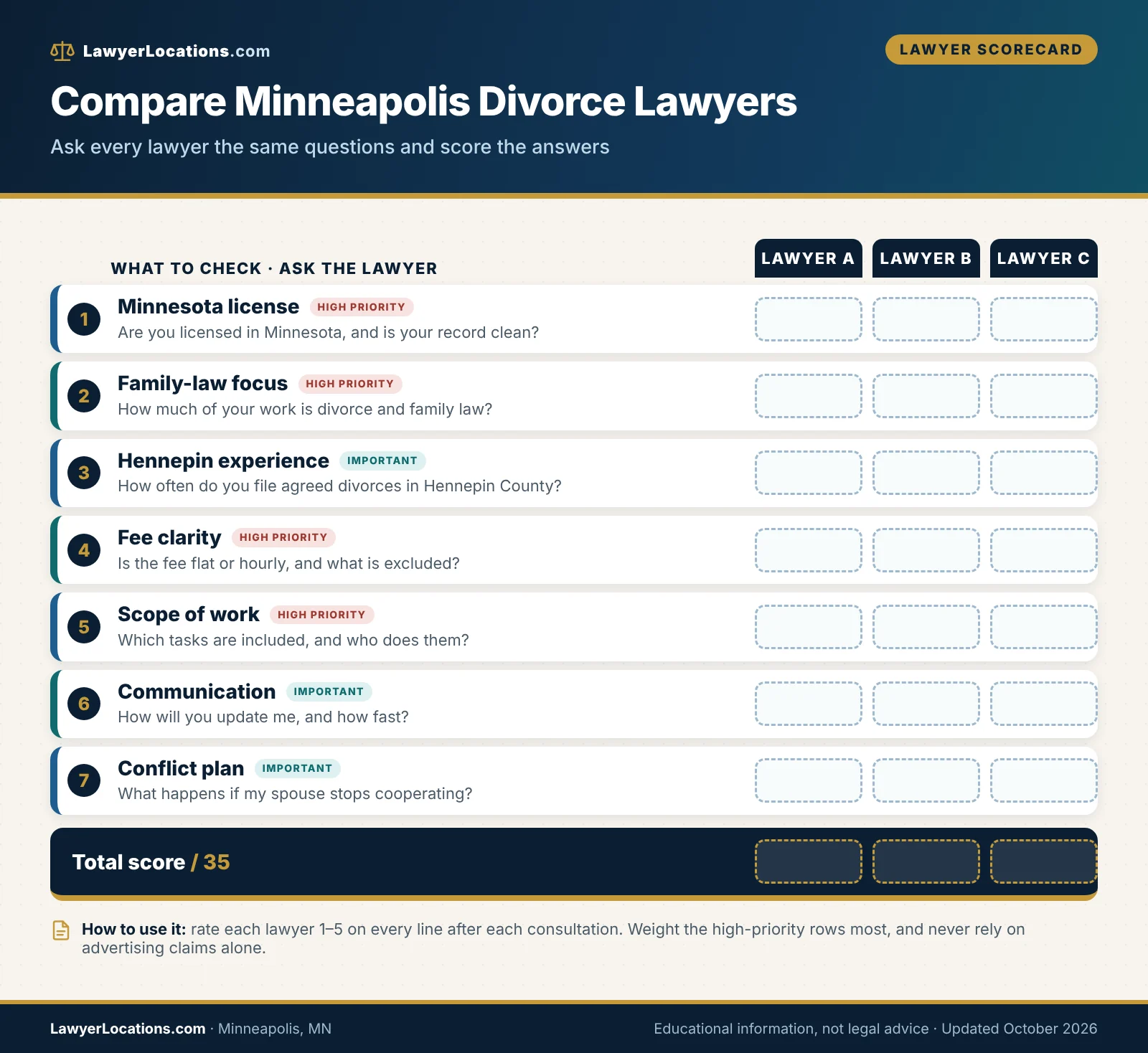
Text version of this graphic
| Criterion | Question to ask |
|---|---|
| Minnesota license | Are you licensed in Minnesota, and is your record clean? |
| Family-law focus | How much of your work is divorce and family law? |
| Hennepin experience | How often do you file agreed divorces in Hennepin County? |
| Fee clarity | Is the fee flat or hourly, and what is excluded? |
| Scope of work | Which tasks are included, and who does them? |
| Communication | How will you update me, and how fast? |
| Conflict handling | What happens if my spouse stops cooperating? |
Preparing for the first consultation
Documents and facts to bring
A prepared client gets better advice and a more accurate quote. Gather what you can before the meeting, and tell the lawyer what you cannot find. Missing documents are normal, and a lawyer can often help request them.
- Marriage date, both spouses’ dates of birth, and children’s names and birth dates.
- Recent pay stubs and the last two years of tax returns.
- Bank, credit card, mortgage and loan statements.
- Retirement account and pension statements.
- Deed, vehicle titles and any prenuptial or postnuptial agreement.
- Health, life and other insurance information.
If a prenuptial agreement exists, mention it first. See our guide to prenup lawyers for how those contracts usually work in a divorce.
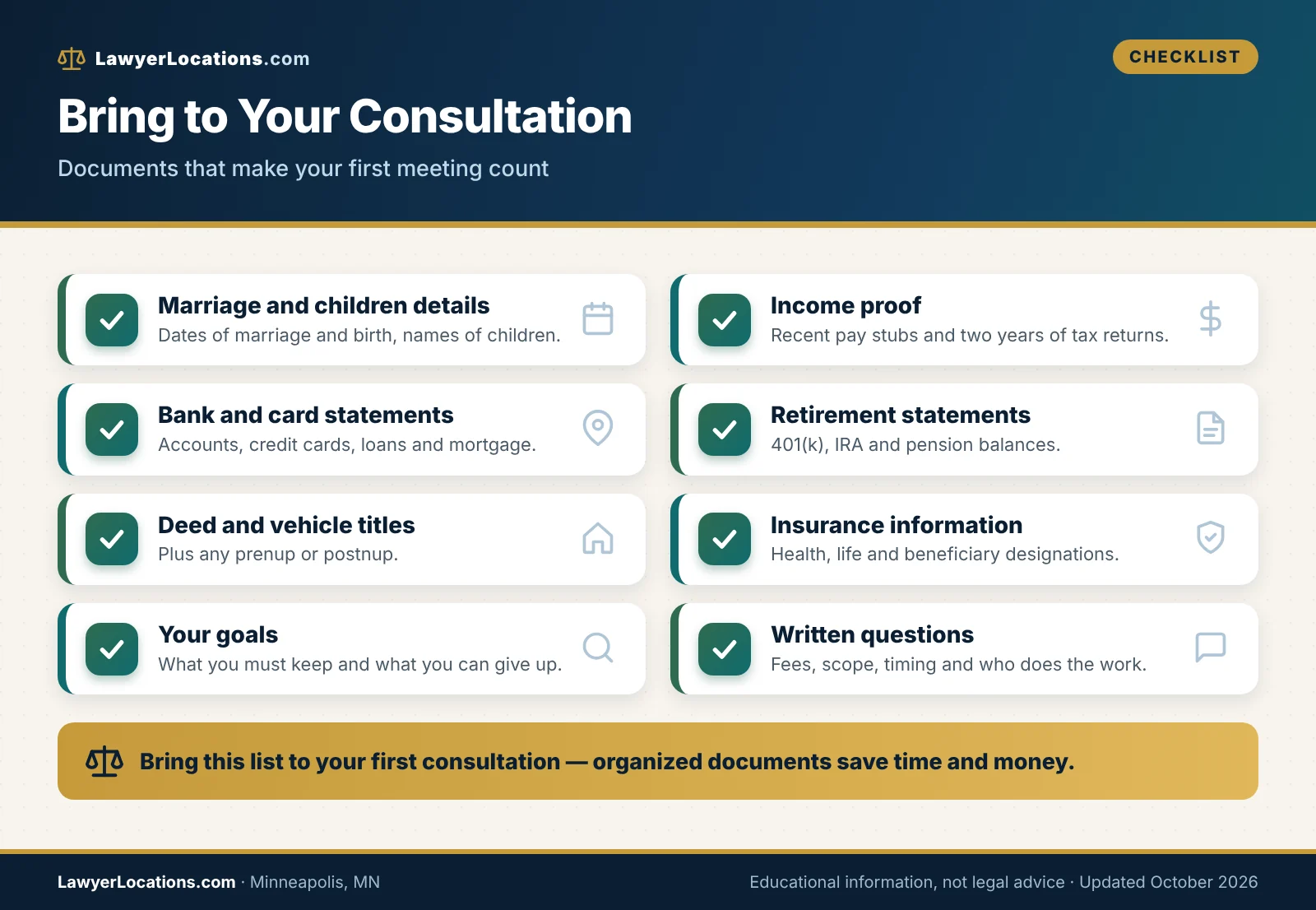
Text version of this graphic
- Marriage and children details
- Income proof: pay stubs and tax returns
- Bank, card and loan statements
- Retirement and pension statements
- Deed, titles and any prenup
- Insurance policies and beneficiaries
- Your goals and your must-haves
- List of questions for the lawyer
Questions that surface the real price
Ask for the fee structure in plain terms, and ask what could change it. Typical questions include whether the quote is flat or hourly, what the retainer is, whether court fees are separate, and what happens if a hearing is needed. Ask what the firm charges to prepare a QDRO or other retirement-division order, and whether it bills separately for phone calls and emails.
Ask the same questions of every lawyer so the answers are comparable.
Red flags and good signs
Warning signs that should end the interview
Walk away from anyone who promises a result, pressures you to sign a retainer on the spot, or quotes a fee with no written scope. In Minnesota, a lawyer also cannot charge a contingent fee that depends on obtaining a divorce or on the amount of support or property, under the state’s professional conduct rule on fees. Treat any offer of that kind as a reason to look elsewhere.
- A promised outcome, a promised timeline or a pledge to “win” your divorce.
- Refusal to give a written fee agreement.
- A fee that changes the moment you mention a house or children.
- Pressure to hide assets or to skip financial disclosure.
Signs of a good fit
A good lawyer asks about your goals before quoting, explains trade-offs without jargon, and tells you what they would need from your spouse. They explain that they represent only you, and they are candid about what is and is not included in the fee. They may also tell you that your case needs a different path, such as mediation or limited-scope help.
- You and your spouse already agree on the big terms.
- You want a lawyer to draft, review and file.
- You can both provide financial documents quickly.
- One spouse is pressuring the other to sign quickly.
- There is a home, business or retirement plan to divide.
- Domestic abuse is part of the history.
Costs, deadlines and decision points
An uncontested divorce is usually the least expensive way to end a marriage, but the total depends on your lawyer’s fee model and on how complete your agreement is on day one. Court fees in Hennepin County are fixed and published; attorney fees are not, and no honest article can give you a single “average.” What you can do is compare the structures and ask the right questions.
How lawyers charge for an agreed divorce
Flat fees and hourly retainers
Many lawyers quote a flat fee for an agreed dissolution: one price for a defined list of tasks. Others bill hourly against an advance payment called a retainer, and draw the fee from it as they work. Flat fees give you a predictable number, while hourly billing can cost less in a very simple case and more if the spouses take long to respond to each other.
Whichever model you choose, Minnesota’s professional conduct rule on fees (Rule 1.5) expects the lawyer to tell you the scope of the work and the basis of the fee, preferably in writing, before or soon after the work begins.
Limited-scope help and unbundled services
With limited-scope representation, you hire a lawyer for one or two defined tasks, for example drafting the settlement or reviewing a draft your spouse prepared. It is a good fit when you are comfortable handling the court paperwork but nervous about the legal language. The written agreement should list what the lawyer will and will not do, so there are no surprises at the filing stage.
A rule worth knowing: under the same professional conduct rule, a Minnesota lawyer cannot charge a fee in a divorce that depends on getting the divorce or on the amount of support or property you receive. If you see a “percentage of what you win” offer, treat it as a red flag.
| Fee model | How it works | Good fit when | Ask before you sign |
|---|---|---|---|
| Flat fee | One price for a written list of tasks | Terms are agreed and documents are ready | What happens if a hearing, QDRO or motion is needed? |
| Hourly retainer | Advance deposit billed down by the hour | The facts are uncertain or still being negotiated | What is the hourly rate, and who bills time? |
| Limited scope | Lawyer handles a defined task only | You will file and manage the case yourself | Which tasks are excluded, and who answers later questions? |
| Document review | Lawyer reviews your or your spouse’s draft | You want a second set of eyes before you sign | Will you explain risks in writing or only by phone? |
| Contingent fee | Fee depends on result | Not allowed in a divorce | Not applicable; a red flag if offered |
What moves the total cost
Complexity, speed and cooperation
Fees rise with complexity: a house to sell or refinance, a business, several retirement accounts, spousal maintenance, or a parenting schedule that needs a detailed plan. They also rise with delay, because every back-and-forth between spouses adds time. If both of you gather documents early and answer the lawyer’s questions quickly, you control a large share of the cost yourselves.
Ask the lawyer to list the three things most likely to push the bill above the quote in your situation. A candid answer is a good sign.
Court and outside costs
Budget separately for the Hennepin County filing fee of $402, a service or process-server charge if your spouse is not signing an acknowledgment, certified copies of the decree, and a mediator if you use one. A retirement-division order may have its own preparation cost, and some plan administrators have their own review steps. Your lawyer should tell you which of these apply to you.
Two spouses with no children agree to split savings evenly, and one keeps the car. They file a joint petition and pay the court fee. By contrast, a couple with two children, a house and a 401(k) needs a parenting plan, a support calculation, a deed or refinance, and a retirement order. The second case is still “uncontested,” but it takes more drafting and more fees. These are illustrations, not price quotes.
Timeline and decision points
How long an agreed divorce usually takes
The Minnesota Judicial Branch says on its divorce page that the process can take several months before the divorce is final. How long it takes for you depends on how fast the paperwork is complete, whether the court needs a hearing, and the judicial officer’s calendar. Our national guide to how long divorce takes explains the general factors that speed up or slow down a case.
Plan on a timeline of months, not weeks, and build in time for a retirement-division order and for updating insurance after the decree.
An agreed case is not automatically a fast one. A complete, signed, well-drafted agreement is what saves time, because a clerk or judicial officer who has to send papers back for corrections adds weeks you cannot control.
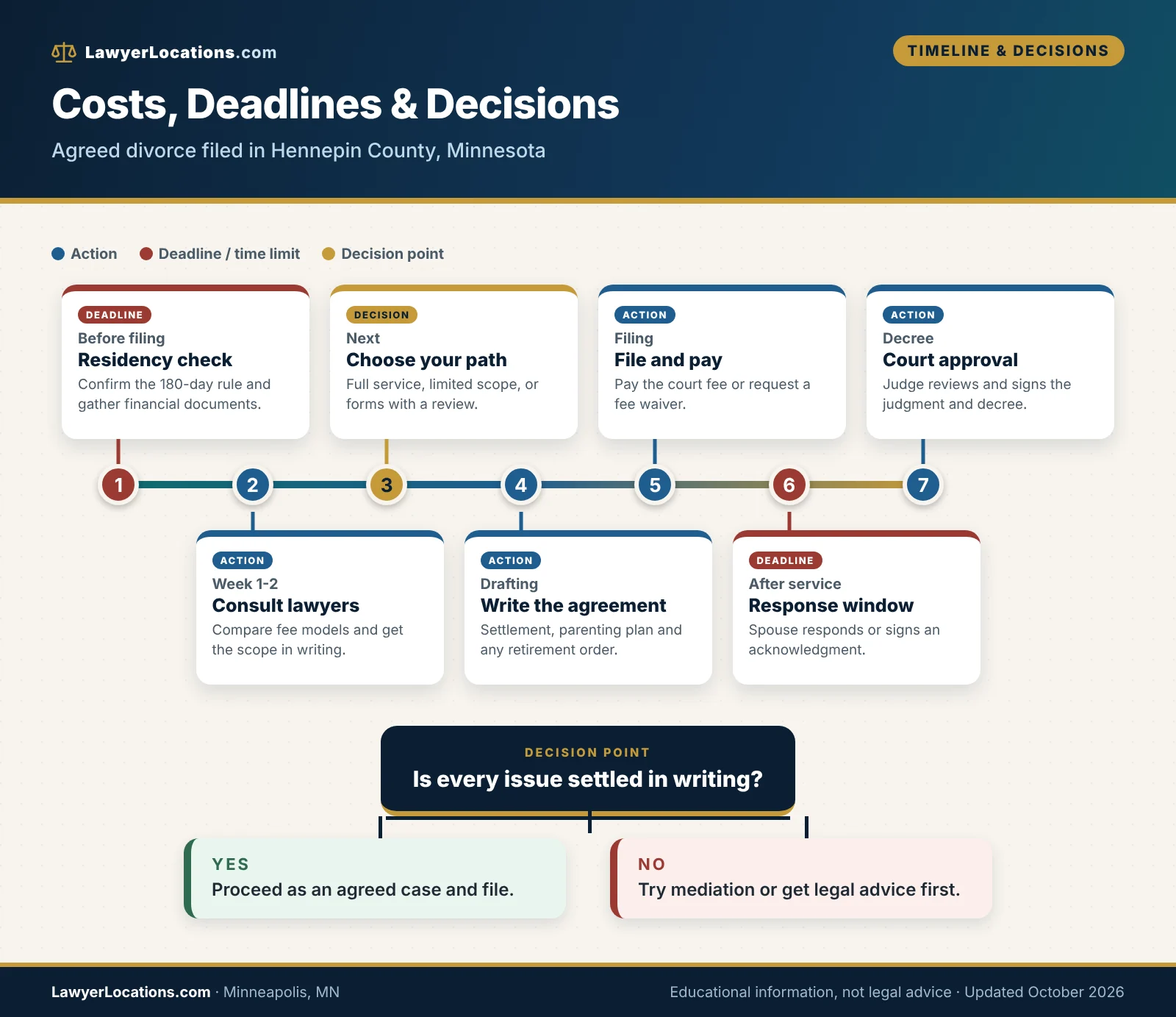
Text version of this graphic
- Before filing: confirm the 180-day residency rule and gather financial documents.
- Consult and decide: choose full representation, limited scope, or forms with a document review.
- Draft: write the settlement, parenting plan and any retirement order.
- File: submit to Hennepin County District Court and pay the fee or request a waiver.
- Serve or acknowledge: your spouse is served or signs an acknowledgment.
- Review and decree: the court reviews the agreement and signs the judgment and decree.
- After the decree: complete transfers, update insurance, beneficiaries and your name records.
Decision point: Is every issue settled in writing? If yes, continue as an agreed case. If no, consider mediation or talk with a lawyer about a contested path.
The decision that matters most
The key decision is whether your agreement is truly complete. If any issue is open, whether it is the house, the retirement account or the parenting schedule, pause before filing and use mediation or legal advice to close the gap. Filing an incomplete agreement can cause the court to reject it or send you into a contested case anyway.
Two dates drive the whole case: the date you meet the 180-day residency rule, and the date your spouse must respond after being served. Your lawyer will calendar the response period for you; if you file on your own, read the summons carefully and write the deadline on your calendar.
Mistakes to avoid, next steps and common questions
Most problems in an agreed divorce come from rushing, vague wording or incomplete information, not from bad intent. You can avoid nearly all of them with a short checklist and a lawyer who reviews the final paper before you sign.
Mistakes that cost people money
Signing before you see the full financial picture
If one spouse does not know what the other earns, owns or owes, an agreement can look fair and still be badly one-sided. Ask for statements, tax returns and account balances before you sign. A reputable lawyer will insist on exchanging financial information, and a spouse who resists that exchange is worth noticing.
Minnesota’s § 518.145 (decree, finality and reopening) allows relief from a decree only on limited grounds, and that is a hard and costly path. It is far cheaper to disclose everything up front.
Vague wording and forgotten details
Terms like “reasonable parenting time” or “the house will be sold soon” invite arguments later. Write dates, dollar amounts, account names and who pays what. Check that every account, vehicle and debt is assigned, and that the decree explains how a deed, a car title or a retirement transfer will actually be carried out.
- No deadline for refinancing or selling the house.
- No plan for who pays the credit card balance in both names.
- No health insurance plan for the spouse losing coverage.
- A waiver of maintenance signed without understanding the long-term effect.
Your next steps
A simple plan for the next two weeks
Take small steps in order, and do not file anything until you know your agreement is complete. This sequence works for most people who are searching for an uncontested divorce lawyer Minneapolis MN residents can interview.
- Write down your priorities. List what you must keep, what you can give up, and what worries you most.
- Gather your documents. Use the checklist above and note anything you cannot find.
- Talk with your spouse. Agree on the big issues in principle before paying anyone to draft.
- Interview two or three lawyers. Ask the same questions, and get each fee quote in writing.
- Check the official pages. Review the Hennepin fee page and the Judicial Branch divorce forms the week you file.
- Review before signing. Read the final agreement line by line and ask for plain-English explanations.
Where to go for more help
For free or reduced-cost help, start with the Minnesota Judicial Branch’s Self-Help Centers, LawHelpMN.org and the Hennepin County Law Library’s legal help page. For a paid lawyer, use a bar referral service or your own research, then confirm the license before you sign. If a parenting plan is part of your case, read the Hennepin Family Court page on parent education programs to see whether a class applies to you.
Comparing lawyers in a neighboring market can also be useful. Our Orange County uncontested divorce guide and our Las Vegas divorce attorney guide show how local court rules change the process from one place to another.
Ready to compare your options?
Use the scorecard and checklist in this guide to interview two or three Minnesota-licensed lawyers about your agreed divorce, ask each one for a written fee scope, and confirm the Hennepin County fee on the court’s own page before you file. LawyerLocations.com is an education and discovery resource, not a law firm, and nothing here creates an attorney-client relationship.
Common questions, answered
Hiring a lawyer and paying for one
How much does an uncontested divorce lawyer in Minneapolis cost?
It depends on the lawyer, the fee model and how complex your property and children issues are. The Hennepin County court fee is a separate, published amount, currently $402. Ask each lawyer for a written quote that lists what is and is not included.
Can my spouse and I share one lawyer?
Generally no. A lawyer represents one client in a divorce because your interests can conflict. Some couples use a neutral mediator, and each spouse may still have a lawyer review the final draft.
Can I hire a lawyer for just part of the process?
Often yes. Limited-scope representation lets you hire a lawyer to draft or review documents while you handle the rest. Make sure the engagement letter lists exactly which tasks are covered.
Can a Minnesota divorce lawyer charge a percentage of what I receive?
No. Minnesota’s professional conduct rule bars a fee in a divorce that depends on obtaining the divorce or on the amount of support or property, though collecting past-due support after judgment is treated differently.
How do I check that a Minneapolis lawyer is licensed?
Search for the attorney on the Minnesota Judicial Branch’s attorney licensing records and check the Lawyers Professional Responsibility Board for public discipline. Confirm the name and license status before you pay a retainer.
What if I cannot afford a lawyer or the court fee?
Ask the court about a fee waiver, and contact legal aid programs listed on LawHelpMN.org. The Hennepin County Law Library and the court’s Self-Help Centers can also point you to resources for people without a lawyer.
Filing, timing and what comes after
Where do I file for divorce if I live in Minneapolis?
The Minnesota Judicial Branch says you file in the county where one spouse lives. For Minneapolis residents, that is Hennepin County District Court, and Family Court is located in the Hennepin County Government Center downtown.
How long must I live in Minnesota before I can file?
One spouse must have been a Minnesota resident for at least 180 days before the proceeding starts, under Minn. Stat. § 518.07. Certain members of the armed forces who keep Minnesota residency also qualify.
Do we have to go to court if we agree on everything?
It depends on the case and the judicial officer. Some agreed cases need a short hearing, while others can be reviewed on paper. Ask your lawyer what Hennepin County expects for your facts.
How long does the divorce take once we file?
The Judicial Branch describes the process as taking several months. Complete paperwork, quick signatures and a straightforward agreement are the best ways to avoid delay.
What if my spouse is served and does not respond?
That moves the case toward a default rather than an agreement, which Minn. Stat. § 518.13 addresses (failure to answer, findings and hearing), and the court will still need to review the terms you propose. Talk with a lawyer, because the rules for default and for children’s issues are strict.
Can we change the divorce terms after the decree?
Some terms, such as child support or parenting time, can be modified if circumstances change. Property terms are much harder to reopen, and Minn. Stat. § 518.145 allows relief from a decree only on limited grounds. Draft carefully the first time.
Is legal separation the same as an uncontested divorce?
No. A legal separation keeps you married while a court sets terms for property, support and children. Our guide on legal separation versus divorce explains how the two differ in benefits and finances.
General information only. This article is for education and is not legal advice. Reading it does not create an attorney-client relationship, and LawyerLocations.com is not a law firm or a lawyer referral service. Laws, court fees and local procedures change, so confirm current rules with the court and consult a lawyer licensed in Minnesota about your situation.
Sources & References
Show all 11 sources
- Minn. Stat. § 518.07, Residence requirement — Office of the Revisor of Statutes, State of Minnesota — revisor.mn.gov — accessed October 2026
- Minnesota Rules of Professional Conduct, Rule 1.5 (Fees) — Office of the Revisor of Statutes, State of Minnesota — revisor.mn.gov — accessed October 2026
- District Court Fees: Hennepin County — Minnesota Judicial Branch — mncourts.gov — accessed October 2026
- Divorce (Dissolution of Marriage) help topic — Minnesota Judicial Branch — mncourts.gov — accessed October 2026
- Hennepin Family Court: Help Topics — Minnesota Judicial Branch — mncourts.gov — accessed October 2026
- Hennepin Family Court: Parent Education Programs — Minnesota Judicial Branch — mncourts.gov — accessed October 2026
- Other Lawyer Referral Resources — Minnesota Judicial Branch — mncourts.gov — accessed October 2026
- Get Legal Help — Hennepin County Law Library — hclawlib.org — accessed October 2026
- Hennepin County Legal Referrals — Minnesota State Law Library — mn.gov — accessed October 2026
- Minnesota Statutes chapters 518 and 518A (dissolution and child support) — Office of the Revisor of Statutes, State of Minnesota — revisor.mn.gov — accessed October 2026
- LawHelpMN — Minnesota legal aid directory — lawhelpmn.org — accessed October 2026
Legal Disclaimer and Limitation of Liability
Informational and illustrative purposes only. This article was prepared by LawyerLocations.com solely on the basis of the information available to us at the time of writing. It is an illustrative, general overview. It is not a complete or authoritative statement of the law, and it has not been reviewed by a lawyer licensed in your state or county.
Not legal advice. Nothing in this article is legal, financial, tax or immigration advice, and reading it does not create an attorney-client relationship between you and LawyerLocations.com or any author, lawyer or firm mentioned. Laws, court rules, fees, filing deadlines and agency procedures differ by state, county and court, and they change often. Some details here may be simplified, incomplete or out of date, and time limits for legal claims can be short.
No warranty. We make no representation or warranty, express or implied, about the accuracy, completeness, timeliness or suitability of this content for your situation. Please do not rely on it to make, delay or skip any legal decision. Check the facts against official sources and speak with a licensed attorney in the relevant jurisdiction before you act.
Limitation of liability. To the fullest extent permitted by law, LawyerLocations.com and its owners, authors and contributors disclaim all liability for any loss, damage, cost or other consequence arising from the use of, or reliance on, this article, including any content on third-party websites we link to. Mentioning a lawyer, firm, organization or service is not an endorsement and is not a promise of any result. If you are in immediate danger, contact your local emergency number.