If you are looking for an uncontested divorce lawyer Orange County CA courts will see you through, start with one fact: an uncontested divorce is not a separate kind of case in California. It is an ordinary dissolution of marriage in which both spouses agree on the main terms, so the paperwork is mostly about proving that agreement to the Orange County Superior Court. Family law filings are handled at the Lamoreaux Justice Center in Orange, and the marriage cannot legally end until six months have passed.
This guide explains the three agreed-divorce routes, the local filing steps, the court fees as listed in October 2026, free court help, and how to compare lawyers before you hire one.
How an uncontested divorce works in Orange County
An uncontested divorce in Orange County is a California dissolution case in which you and your spouse have agreed on the terms, so no judge has to decide a disputed issue. The case still goes through the Orange County Superior Court, still needs the right forms, and still ends with a signed judgment. What you save is the contested hearing, not the paperwork.
What “uncontested” means in practice
People use the word loosely. In California courts, the label does not change which law applies. Everything is governed by the California Family Code, and the case is simply easier when nobody is fighting about property, parenting time or support.
The agreement is the product
Think of the written agreement as the main deliverable. It says who keeps which assets, who pays which debts, whether either spouse receives spousal support (money paid by one spouse to the other after separation), and, if you have children, how custody and child support will work. The court judgment then makes those terms enforceable.
Under Family Code 2550, the court generally divides the community estate equally, unless the spouses agree otherwise in writing or orally in open court. That is why a clear written agreement matters: it is how an unequal but voluntary split becomes official.
What has to be settled before the case is truly uncontested
- Whether the marriage or domestic partnership will end (both spouses agree).
- How community property and debts are divided, including retirement accounts and any home.
- Whether spousal support will be paid, waived or reserved for later.
- Child custody, parenting time and child support, if there are children under 18.
- Who handles the paperwork, and whether each spouse will get independent legal advice.
Dissolution of marriage is California’s formal term for divorce. A registered domestic partnership ends through the same court process, which is why Orange County court packets cover both.
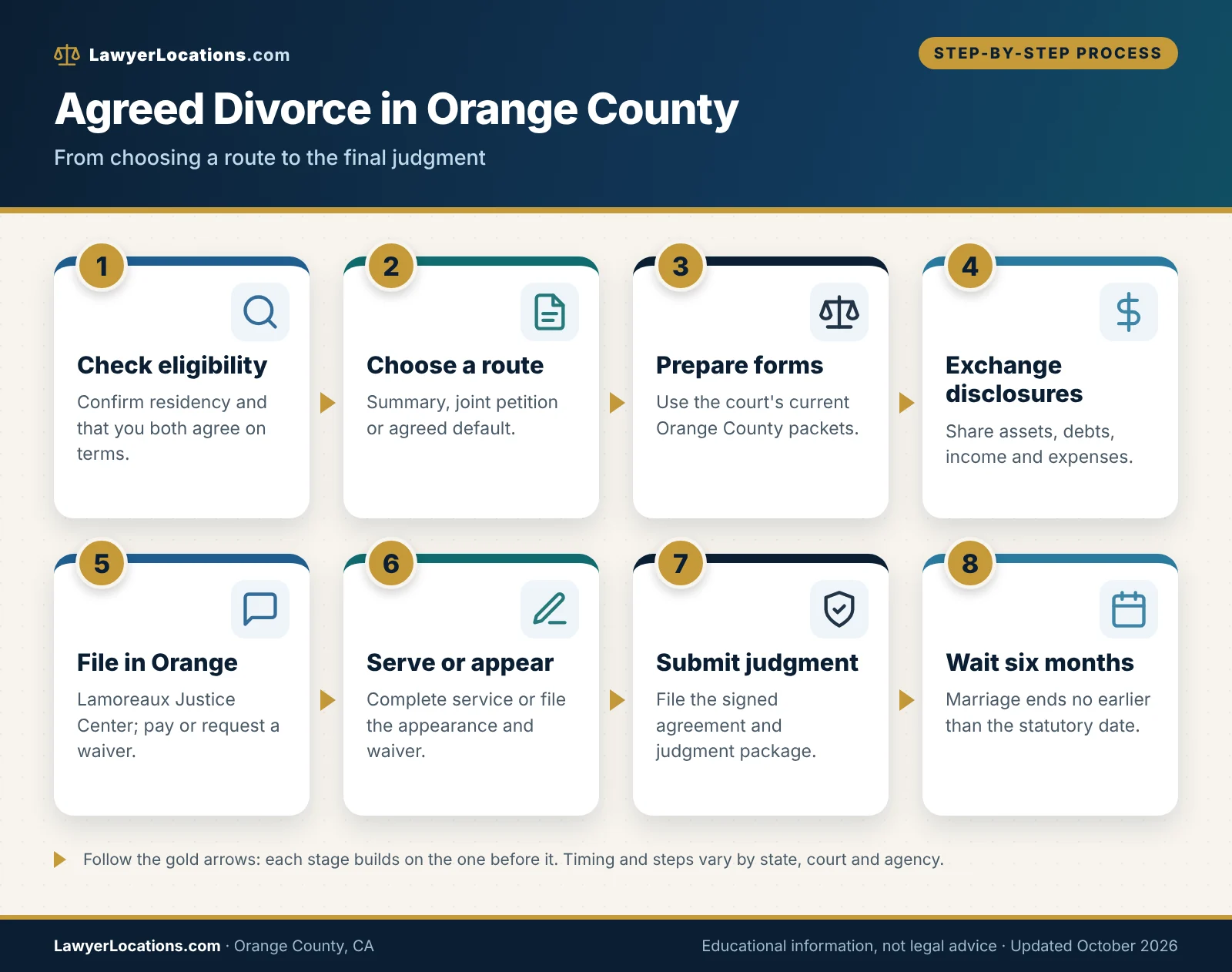
Text version of this graphic
- Confirm you meet California residency and that you and your spouse agree on terms.
- Choose the route: summary dissolution, joint petition with a stipulated judgment, or a petition with an agreed default.
- Complete the forms and exchange financial disclosures.
- File at the Lamoreaux Justice Center (or e-file where available) and pay the fee or request a waiver.
- Serve the papers, or have the other spouse sign an appearance and waiver, as the route requires.
- Submit the judgment package with the signed agreement.
- Wait out the six-month minimum, then confirm the final judgment and keep certified copies.
Three routes to an agreed divorce
Most agreed divorces fit one of three routes. Which one applies depends on the length of the marriage, your assets, whether you have children and how willing both spouses are to cooperate on paperwork.
Summary dissolution: the shortest form of divorce
Summary dissolution is a simplified process for short, simple marriages. The California Courts Self Help Guide lists these requirements as of October 2026: the marriage lasted less than 5 years from the date of marriage to the date of separation; you have no minor children together and nobody is pregnant; neither spouse owns or leases real estate (with a narrow exception for a rental lease ending within a year); and debts are under $7,000 (car loans excluded).
Property earned during the marriage must be worth less than $57,000 together (cars excluded, retirement accounts included), and each spouse’s separate property must also be under that figure. Both spouses must agree that neither will ever receive spousal support. Orange County’s own packet, SHC-D-03, walks through the sequence: a Summary Dissolution Information form (FL-810), a Joint Petition (FL-800), an Orange County party-identification form (L-1120) and a Judgment (FL-825).
Joint petition or petition with a stipulated judgment
If the marriage is longer, you own a house, or you have children, summary dissolution is off the table. The usual agreed route then is a regular petition (FL-100) with a written settlement and a stipulated judgment, meaning a judgment both spouses have agreed to in advance. Orange County publishes a packet for this route when there are no children (SHC-D-06), which lists the Appearance, Stipulations and Waivers form (FL-130), the Declaration for Default or Uncontested Dissolution (FL-170) and the Judgment (FL-180).
The court fee schedule also lists a non-summary joint petition at $870, which reflects both spouses’ first-paper fees filed together. A lawyer can tell you whether a joint filing or a petition followed by a response is cleaner for your situation.
A petition with an agreed default
In a default with agreement, one spouse files and serves the petition, the other does not file a contested response, and the judgment follows the signed settlement. Family Code 2336 says a dissolution judgment may not be granted on default alone; the court still requires proof of the grounds, which can be by written declaration. The statute also lists the limited situations in which a personal appearance may be required, such as when a proposed custody or support order raises concerns.
Orange County’s checklist notes that the respondent’s signature on a default-with-agreement paper must be notarized. Because court packets are revised from time to time, check the version you download.
| Route | Best fit | Main limits | Forms named in court materials |
|---|---|---|---|
| Summary dissolution | Short marriage, no children together, little property, full agreement | Under 5 years; no real estate; debts under $7,000; property under $57,000; no spousal support | FL-810, FL-800, L-1120, FL-825 |
| Joint petition with stipulated judgment | Spouses who want to file together and have a written settlement | Court schedule lists a higher joint-petition fee ($870); full financial disclosure still applies | FL-130, FL-170, FL-180, FL-144 (waiver of final disclosure, if eligible) |
| Petition with agreed default | One spouse files and serves; the other signs a settlement and does not contest | Proof of grounds still required (often by declaration); notarized signature on the agreement per the court checklist | FL-100, FL-115, FL-165, FL-170, FL-180 |
Residency and the six-month clock
Two timing rules shape every agreed divorce: where you have lived, and how long the court makes you wait. Neither can be skipped by agreement.
Who can file in Orange County
One spouse must have lived in California for the last 6 months and in the filing county for the last 3 months, according to the California Courts Self Help Guide. If you moved to Orange County recently, count the days before you file. If the dates are close, ask a lawyer or Self-Help staff to confirm your eligibility before you pay a filing fee.
The six-month minimum
Under Family Code 2339, a dissolution judgment does not end the marriage until six months have passed, counted from the earlier of service of the summons and petition or the respondent’s appearance. The court may extend the period for good cause. In practice, you can have a signed judgment before the six months run, but your marital status does not change until they do.
Do not plan a remarriage, a home purchase in only your name or a tax filing around a date before the six-month point. Ask the lawyer or Self-Help staff to confirm your earliest possible termination date from your actual service or appearance date.
For a wider look at timing and delay factors across the country, see our guide on how long a divorce takes. If you are unsure whether you want a divorce or something less final, compare options in legal separation vs. divorce.
Orange County courts, forms and local filing steps
In Orange County, family law cases are filed at the Lamoreaux Justice Center in the city of Orange, and the court publishes its own form packets and milestones. The local layer is what separates this guide from a general California overview.
Where family law is handled
The Superior Court of California, County of Orange has several justice centers, but a divorce petition is filed in one place. Knowing which door to walk through saves a wasted trip.
Lamoreaux Justice Center
The court’s family law self-help page lists family law filings at the Lamoreaux Justice Center, 341 The City Drive South in Orange (the page notes the seventh floor). Its packets also pre-print this address. The page shows two different ZIP codes for the building, so confirm the mailing details on the court’s site before you send anything by mail. The court lists its Family Court Services mediation office on the fifth floor of the same building and the Family Law Facilitator on the first floor.
The Clerk’s Office is listed as open Monday to Friday, 8 a.m. to 4 p.m. Self-Help is listed Monday to Thursday, 8 to 4, and Friday, 8 to 3, with document review ending an hour earlier. Hours change, so check before you go. Orange County also offers an online route: its packets tell you to scan your completed forms into one PDF and send them through the Self-Help Services request form on the court’s website, selecting Family Law as the case type.
Other justice centers and kiosks
You do not have to drive to Orange for every question. The court lists Self-Help Centers at the Central Justice Center in Santa Ana and live Self-Help kiosks at the Costa Mesa Justice Complex, the West Justice Center in Westminster, the North Justice Center in Fullerton and the Harbor Justice Center in Newport Beach. Those locations help with forms and procedure; the divorce filing itself still belongs to the family court at Lamoreaux.
| Location | Address | Family-law help listed | Self-Help hours listed |
|---|---|---|---|
| Lamoreaux Justice Center (Orange) | 341 The City Drive South | Family law filings; Self-Help Center; Family Law Facilitator; Family Court Services | Mon-Thu 8-4; Fri 8-3 |
| Central Justice Center (Santa Ana) | 700 Civic Center Drive West | Self-Help Center | Mon-Thu 8-4; Fri 8-3 |
| Costa Mesa Justice Complex | 3390 Harbor Blvd. | Live Self-Help kiosk | Mon-Thu 8-4; Fri 8-3 |
| West Justice Center (Westminster) | 8141 13th Street | Live Self-Help kiosk | Mon-Thu 8-4; Fri 8-3 |
| North Justice Center (Fullerton) | 1275 N. Berkeley Ave. | Live Self-Help kiosk | Mon-Thu 8-4; Fri 8-3 |
| Harbor Justice Center (Newport Beach) | 4601 Jamboree Rd. | Live Self-Help kiosk | Mon-Thu 8-4; Fri 8-3 |
Because family law filings are centralized at Lamoreaux, a Newport Beach or Fullerton resident may be better off using the online Self-Help request or a kiosk for questions and saving the trip to Orange for the filing itself, if the filing cannot be done another way.
The forms the court expects
California uses Judicial Council forms statewide, and Orange County adds local forms and checklists on top. Missing one local form is a common reason for a returned package.
Packets for cases without children
The court’s no-children stipulated-judgment packet (SHC-D-06) lists a judgment checklist (FL-182), the appearance and waiver form (FL-130), a stipulation and waiver of the final declaration of disclosure (FL-144), the uncontested-dissolution declaration (FL-170), spousal support attachments, an Orange County expedited-processing attachment (L-1300), the judgment (FL-180) and a notice of entry of judgment (FL-190).
The checklist asks for an original and two copies of most papers and several copies of the judgment. It also mentions other forms depending on your facts, such as the proof of service (FL-115), the request to enter default (FL-165), an income and expense declaration (FL-150) and a property declaration (FL-160). That packet carries a 2021 revision date, so download the current version from the court’s website rather than relying on an old copy.
When children are involved
The court’s packet states that cases with minor children need additional forms, including the child custody jurisdiction declaration (FL-105), an income and expense declaration (FL-150) and a child support attachment. Your parenting plan has to be specific enough for a judge to approve, which is where a lawyer’s drafting often earns its keep. The next section covers custody and support.
Local milestones: the Family Centered Case Resolution program
Orange County runs family cases under a case-management protocol based on California Rule of Court 5.83 and Local Rule 701.1. For an agreed divorce, it means the court expects steady progress and sends notices when a case stalls.
The 60-day checkpoints
According to the court’s family law page, the milestones include proof of service within 60 days of starting the case; a request to enter default within 60 days after the response due date if no response is filed and no extension was agreed; the petitioner’s preliminary declaration of disclosure within 60 days of filing the petition; and a judgment submitted within 60 days after default is entered. If you are negotiating or mediating, the page says a written agreement for judgment should be submitted within six months of filing, or a trial date requested.
What to do if you get a missed-milestone notice
The court reviews cases electronically every 180 days until 500 days. If you get a notice, the court page suggests visiting a Self-Help Center promptly. Do not ignore it just because both spouses agree: an uncontested case that stops moving can still be flagged.
A “forgotten” divorce is a real risk. If a spouse stops cooperating after the petition is filed, the case can sit unfinished while the milestone notices pile up. Ask any lawyer you hire who tracks these dates and how you will be told when one is coming.
The court’s public notice on e-filing says attorneys are generally expected to e-file family law documents, while self-represented parties are encouraged but not required to. The notice also lists some originals, including judgments, that cannot be e-filed. Ask how your specific filing will be submitted.
Disclosures, property, children and support in an agreed divorce
Even when you agree on everything, California requires spouses to exchange financial information, and the court needs enough detail to approve the terms. This is the stage where uncontested cases most often slip, because people assume that agreeing is the same as being finished.
Financial disclosure rules
Disclosure is a formal step with its own forms and, in some cases, its own waiver. Skipping it, or doing it casually, is the most common way an agreed divorce gets challenged later.
The preliminary declaration of disclosure
Each spouse prepares a preliminary declaration of disclosure listing assets, debts, income and expenses under Family Code 2104. Orange County’s milestone for the petitioner is to complete it within 60 days of filing the petition, and the court points to the disclosure forms under Dissolution Step 3 of its form packets page. The forms commonly used are the declaration of disclosure (FL-140), the schedule of assets and debts (FL-142), the income and expense declaration (FL-150) and the declaration regarding service (FL-141).
Disclosure covers what you own, what you owe, and how each item is characterized as community or separate property. Include retirement accounts, business interests, cryptocurrency, stock options and vehicles. If a number is a good-faith estimate, say so on the form.
The final declaration and the waiver
The final declaration of disclosure updates the first one and is normally exchanged before or at the time the spouses agree on property or support. Family Code 2105 allows the spouses to waive it by a stipulation signed under penalty of perjury. The waiver has to include specific statements: that both complied with the preliminary disclosure rules, that they exchanged current income and expense declarations, that they updated their preliminary disclosures, that each waived knowingly and voluntarily, and that each understands the waiver does not end ongoing disclosure duties.
Orange County’s packet lists the waiver form as FL-144. A waiver can speed things up, but if one spouse hid an asset, the judgment may later be challenged. Under the statute, perjury in a declaration can be grounds to set aside the judgment.
Be wary of any “quick divorce” pitch that tells you to skip disclosure entirely. The waiver is allowed only when both spouses have already done the underlying work and sign the required statements.
Dividing property and debts
California is a community property state, so property and debts acquired during the marriage are generally owned equally by both spouses. The divorce agreement is where you say what happens to each item.
The equal-division default and how to depart from it
Under Family Code 2550, the court divides the community estate equally unless the spouses agree in writing, or orally in open court, to something different. A written agreement can split things unevenly, for example one spouse keeping the home in exchange for a larger share of the other’s retirement account, but both spouses should understand what they are giving up. Ask for a plain-language list of each asset, its value and who receives it.
Homes, retirement accounts and debts
These three items cause the most trouble in agreed divorces. A home with a mortgage raises two questions: who keeps it, and who is legally responsible for the loan after the divorce. A refinance, a sale, or a buyout clause may be needed. Retirement accounts often need a separate court order to divide them without tax problems, and the plan administrator has its own rules. Debts divided in the agreement still bind the lender only as the loan contract says, so a spouse can remain liable to the creditor even if the agreement assigns the debt to the other.
The state’s summary dissolution thresholds can serve as a rough benchmark: if you are over the $57,000 or $7,000 limits, or own real estate, expect to use the regular process and consider professional help with the settlement.
Two spouses agree that one keeps the house and the other keeps a larger share of savings. If the mortgage stays in both names, the lender can still pursue either of them if payments stop. A lawyer would typically address a refinance deadline or a sale date in the settlement so the agreement matches the loan.
Children, custody and support
If you have children under 18, “uncontested” depends on a parenting plan that a judge finds workable and child support that follows the state formula. Courts look at the child’s interests, not just the parents’ agreement.
Parenting plans and Family Court Services
Orange County’s Family Court Services handles child custody mediation from the Lamoreaux Justice Center, and the court’s resource sheet lists the office on the fifth floor. If you and the other parent can agree, you may not need a hearing, but the court can still ask questions about a plan that looks unclear or not in the child’s best interest. Family Code 2336 states that on a default-style judgment the court can require an in-person appearance if a proposed custody order does not appear to serve the child’s best interest.
A strong parenting plan covers regular schedule, holidays, school breaks, transportation, decision-making on education and health, and how to change the plan. Vague wording (“reasonable visitation”) is a common source of later disputes.
Child support, spousal support and the Family Law Facilitator
Child support is set under a statewide guideline formula, and the court can reject an agreed amount that is lower than the paying parent can afford. The court’s affidavit rules in Family Code 2336 also require estimates of each party’s monthly gross income when the case involves children.
The Orange County Family Law Facilitator is an attorney employed by the court who, according to the court’s description, helps self-represented parties with child support, spousal support and health insurance issues in existing cases. The court’s facilitator information sheet describes services such as procedural information, form packets and review of completed forms, so ask what is available for your situation. The court is clear that the Facilitator is neutral and is not your lawyer. For spousal support, you can agree to pay, to waive or to reserve the question. Waiving or reserving is a big decision, so get independent advice first.
Bring your last two years of tax returns, recent pay stubs and your health insurance details to any child support conversation. Accurate income numbers prevent rejections and later requests to modify.
Families outside Orange County sometimes compare notes with neighbors. Our guides to San Diego family law attorneys and San Diego child support lawyers show how another large Southern California county handles the same state rules.
Do you need a lawyer? Self-help, limited-scope and full-service options
You are not required to hire a lawyer for an uncontested divorce in Orange County, but legal help is worth considering when you own property, have children or are unsure what you are giving up. The right level of help depends on how simple your facts really are.
Free court help and its limits
The Orange County Superior Court provides Self-Help Services for people without attorneys. Used well, they can take care of the mechanics of a simple case.
What Self-Help staff can do
According to the court, Self-Help staff provide procedural information, legal forms, answers to process questions and review of most completed forms. They cover starting a dissolution, parentage, custody, support and domestic violence matters, and services are offered in person or remotely. The court also offers interpreters, which you can request through its language access page.
What they cannot do
The court states that Self-Help staff do not provide legal advice or attorney representation. They will not tell you whether a settlement is fair, whether to waive spousal support or how to protect a pension. The Family Law Facilitator is likewise neutral and open to both parties. If you want someone on your side of the table, that has to be a private lawyer or a legal aid attorney.
The court also lets you ask Self-Help to review your completed forms before filing. Doing that review before you file can help you avoid a rejected package, even if you hire no one else.
Limited-scope and full-service lawyers
Between doing it all yourself and hiring a lawyer for every step is a middle path that many people overlook.
Limited-scope representation
Under California Rule of Court 5.425, a family law attorney and client can agree that the lawyer will handle only specific tasks. In a noticed limited-scope arrangement, the lawyer files a Notice of Limited Scope Representation (FL-950), and ends the engagement through a completion notice (FL-955). In an undisclosed arrangement, the lawyer helps you draft documents without appearing in the case.
For an agreed divorce, typical limited-scope tasks include reviewing your settlement, drafting the marital settlement agreement, or preparing the judgment package. Write the scope into the fee agreement so you know where the lawyer’s job ends.
Full-service representation and one-lawyer limits
Full service means the lawyer handles filing, service, disclosures, the agreement and the judgment. It can make sense with a home, a business, children, or a spouse who is hard to reach. One practical point: a lawyer ordinarily represents only one spouse in a divorce, because spouses’ interests can conflict. If a lawyer or document service offers to “handle it for both of you,” ask who the lawyer represents and what happens if you later disagree.
- The marriage is short and there is little property.
- No children, or a simple and clearly agreed parenting plan.
- Both spouses are cooperative, responsive and have similar financial knowledge.
- There is a home, retirement account, business or large debt.
- You would waive spousal support or accept an unequal split.
- One spouse controls most of the financial information.
- You feel pressured, or safety is a concern.
Court fees and fee waivers
Fees come in two layers: the court’s filing fees and any lawyer’s fee. The court side is set by statute and published in the fee schedule.
Court filing fees as listed in 2026
The Orange County fee schedule effective January 1, 2026 lists a petition for dissolution, legal separation or nullity at $435, a response at $435, a non-summary joint petition at $870 and a joint petition for summary dissolution at $435. Orange County’s summary dissolution packet also states a $435 fee. Fees can change, so verify them on the current schedule before you pay.
| Item | Listed fee | Who usually pays |
|---|---|---|
| Petition for dissolution, legal separation or nullity | $435 | The spouse who files |
| Response to a petition | $435 | The responding spouse (unless a waiver applies) |
| Joint petition, non-summary | $870 | Both spouses together |
| Joint petition for summary dissolution | $435 | Both spouses together |
| Copy of a paper on file, per page | $0.50 | Whoever requests it |
| Certified copy of a dissolution record (other applicants) | $15 | Whoever requests it |
| Certifying a copy of a paper on file | $40 | Whoever requests it |
The court also notes that a check returned unpaid carries a $45 service charge and that an underpaid filing can be voided if the full fee is not paid in time. Make checks payable to the Clerk of the Court.
Fee waivers
If you cannot afford the fee, the California Courts Self Help Guide says you qualify for a fee waiver if you meet any one of three tests: you receive public benefits such as Medi-Cal, CalFresh, SSI/SSP or CalWORKs; your household income is below the limit listed on form FW-001; or you cannot pay for basic needs and court fees. You file FW-001 and the order form FW-003. A waiver covers court fees, but not lawyer fees, private mediation or transcripts, and the court can revisit it if your finances improve.
How lawyers usually charge
This guide does not publish dollar figures for lawyer fees, because they vary widely by firm, scope and complexity, and we do not have an official source for them. What you can do is understand the structures and ask the right questions.
Flat fees, hourly rates and retainers
A flat fee is a set price for a defined package, often used for agreed divorces. An hourly rate charges for time, usually against a deposit called a retainer. Some firms combine them, with a flat fee for the filing and hourly billing for extras. Ask what happens if the case stops being agreed: some flat-fee agreements end at that point or switch to hourly billing.
What the fee usually does and does not include
- Court filing and response fees (often charged separately from the lawyer’s fee).
- Process server or other service costs.
- Drafting the settlement agreement and parenting plan.
- Number of revisions and communications included.
- Court appearances, if one is ordered.
- Costs for retirement-account division orders, appraisals or a mediator.
Ask for the fee agreement in writing before you pay, and ask for a plain statement of what is excluded. A clear exclusions list protects you from surprise bills later.
How to compare uncontested divorce lawyers in Orange County
Compare lawyers on licensing, scope, fee structure, local court familiarity and communication, not on advertising claims. An uncontested case rewards a lawyer who is organized and responsive more than one with a dramatic courtroom style.
Where to find and verify a lawyer
Start with sources that check qualifications, and keep in mind that this site is an education resource, not a referral service. We do not rank, rate or recommend any individual lawyer or firm.
State Bar tools and certified referral services
The State Bar of California offers an attorney search that shows whether a lawyer is licensed and in good standing, and any public discipline. The State Bar also advises using only lawyer referral services that it has certified. Its page explains that a certified service will usually offer an initial consultation for a reduced or no fee, but cannot estimate your total legal costs. A certified service must show its State Bar certification in advertising, and you can complain to the State Bar about one.
Orange County resources
The court’s legal resource information sheet (form L-1172) lists the Orange County Bar Association lawyer referral service, a free lawyer referral service run by Community Legal Aid SoCal, the Public Law Center and other organizations. Ask each whether it handles family law and whether you meet its income or eligibility rules.
| Resource | What it is | Listed contact |
|---|---|---|
| Orange County Bar Association Lawyer Referral Service | Bar-sponsored referral and information service | (949) 440-6747; ocbar.org |
| Free Lawyer Referral Service (Community Legal Aid SoCal) | Referral service run by a legal aid organization | (714) 571-5204; socallawyerreferral.com |
| Community Legal Aid SoCal | Free civil legal services for eligible low-income residents and seniors | 2101 N. Tustin Ave., Santa Ana; (714) 571-5200 |
| Public Law Center | Nonprofit legal services organization | 601 Civic Center Dr. West, Santa Ana; (714) 541-1010 |
| State Bar of California Lawyer Referral Service | Statewide referral line listed by the court | (866) 442-2529 |
| Waymakers Domestic Violence Assistance Program | Help with domestic violence restraining orders at the courthouse | Lamoreaux Justice Center, 7th floor; (714) 935-7956 |
| Orange County Public Law Library | Public law library with legal research materials | 515 N. Flower St., Santa Ana; (714) 338-6790 |
Search the State Bar site for the exact name that appears on the fee agreement. Check that the lawyer’s license status is active and look for any public discipline. The result takes only a minute and does not require contacting the lawyer.
Questions that separate careful lawyers from careless ones
A first consultation is a chance to test the lawyer as much as to explain your case. Prepare a short list and listen for specifics.
Scope, fees and who does the work
- Who exactly will I be working with, and who answers my calls and emails?
- Do you represent me alone? How do you handle my spouse’s questions?
- Is this a flat fee, hourly or a hybrid? What is not included?
- What happens to the fee if my spouse stops cooperating?
- How are court fees, service costs and copies billed?
- Will you give me a written fee agreement before I pay?
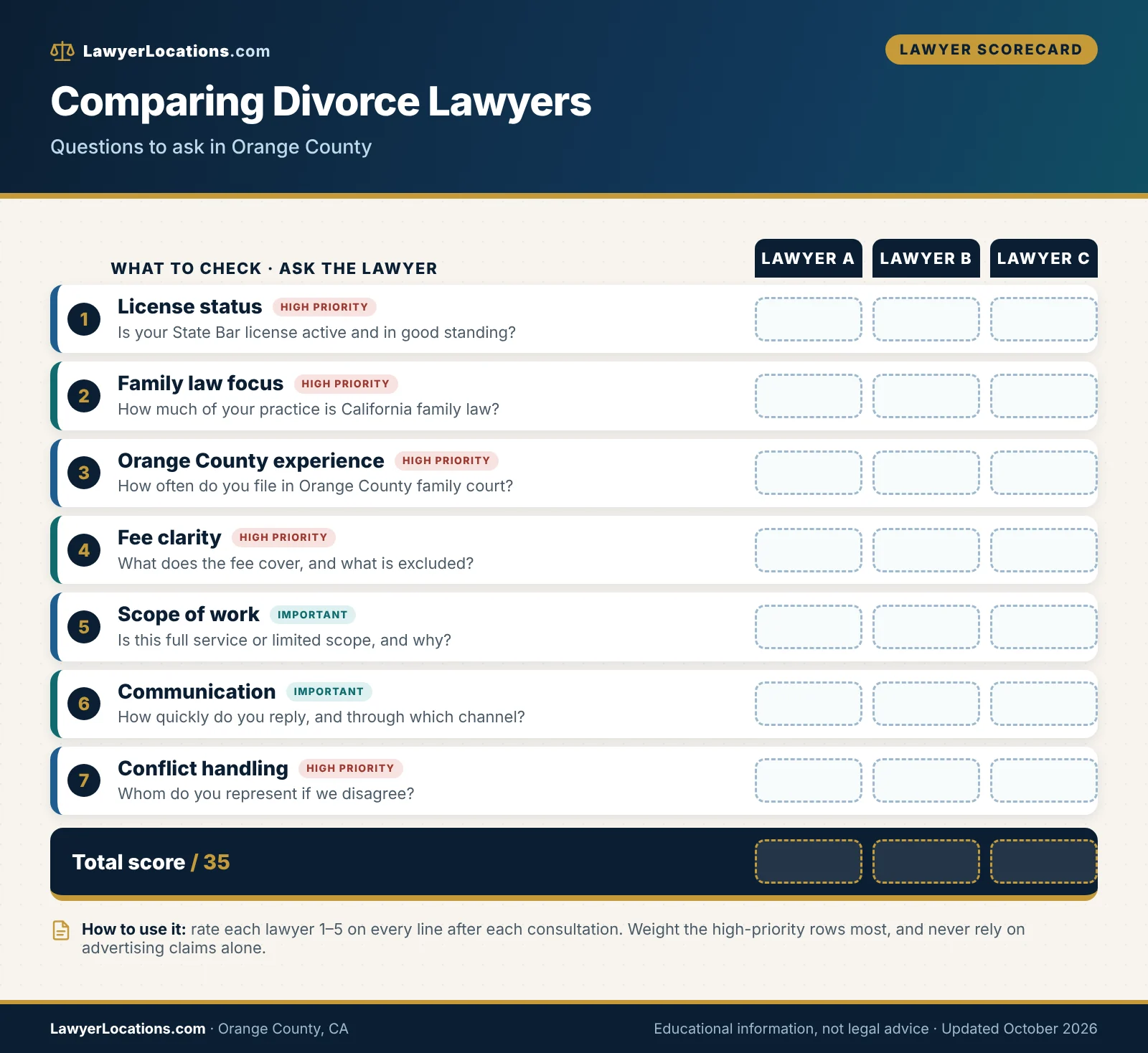
Text version of this graphic
| Criterion | Question to ask |
|---|---|
| License status | Is your State Bar license active and in good standing? |
| Family law focus | How much of your practice is California family law? |
| Orange County experience | How often do you file in Orange County family court? |
| Fee clarity | What exactly does the fee cover and exclude? |
| Scope of work | Is this full service or limited scope, and why? |
| Communication | How quickly do you reply, and through which channel? |
| Conflict handling | Whom do you represent, and what if we disagree? |
Orange County practice and process
- How do you handle the court’s 60-day milestones and what happens if one is missed?
- Do you use the court’s Self-Help review or e-filing, and what must be filed in person?
- How long do your uncontested cases usually take from filing to judgment, and what slows them down?
- What will you need from me, and by when?
- Do you recommend a disclosure waiver in my case, and why?
A lawyer who answers these without hedging, and who is willing to say “that depends on your facts, and here is how,” is giving you honest information. A lawyer who can only say “it’s easy” has not looked at your case.
Red flags and good signs
Because family law touches homes, children and safety, a poor fit costs more than money. Watch for signals early.
Red flags
- Promises of a specific outcome, a guaranteed date or a “best price”.
- No written fee agreement, or one that is vague about exclusions.
- Pressure to sign a settlement or waive disclosure before you understand it.
- Offers to represent both spouses, or an unwillingness to explain who the client is.
- Requests for payment methods that are hard to trace or refuse a receipt.
- An unlicensed “document preparer” describing their work as legal advice.
Good signs
- A clear explanation of the route (summary, stipulated judgment or default) and why it fits.
- Honest discussion of risks, such as spousal support waivers and retirement accounts.
- A written timeline with named milestones.
- Willingness to offer limited-scope help if full service is more than you need.
If you are in a relationship where you fear your spouse, an “uncontested” plan can place you at risk. Safety comes before paperwork. The Waymakers Domestic Violence Assistance Program is listed at the Lamoreaux Justice Center, and you should speak to a lawyer or advocate before agreeing to anything.
Costs, deadlines and decision points
The main timing rule is the six-month minimum, and the main money decisions are the filing fee, whether to hire help, and whether to give up rights in the settlement. Mapping these early keeps small questions from turning into expensive ones.
A realistic timeline for an agreed divorce
No source we reviewed publishes a guaranteed processing time for Orange County, and the court does not promise one. The milestones below come from the court’s own case-management program and the Family Code.
The first 60 days
This is the paperwork phase. You choose the route, prepare forms, file the petition, serve the other spouse (or obtain their appearance) and, in the court’s program, complete the petitioner’s preliminary declaration of disclosure. The court expects proof of service within 60 days of starting the case.
From response to judgment and the six-month point
After the other spouse responds or the response time passes, the case moves to settlement and judgment. The court’s milestone is a judgment submitted within 60 days after default is entered, or a written agreement for judgment within six months of filing if you are negotiating. The marriage ends no earlier than six months after service or appearance under Family Code 2339, even if the judgment is signed sooner.
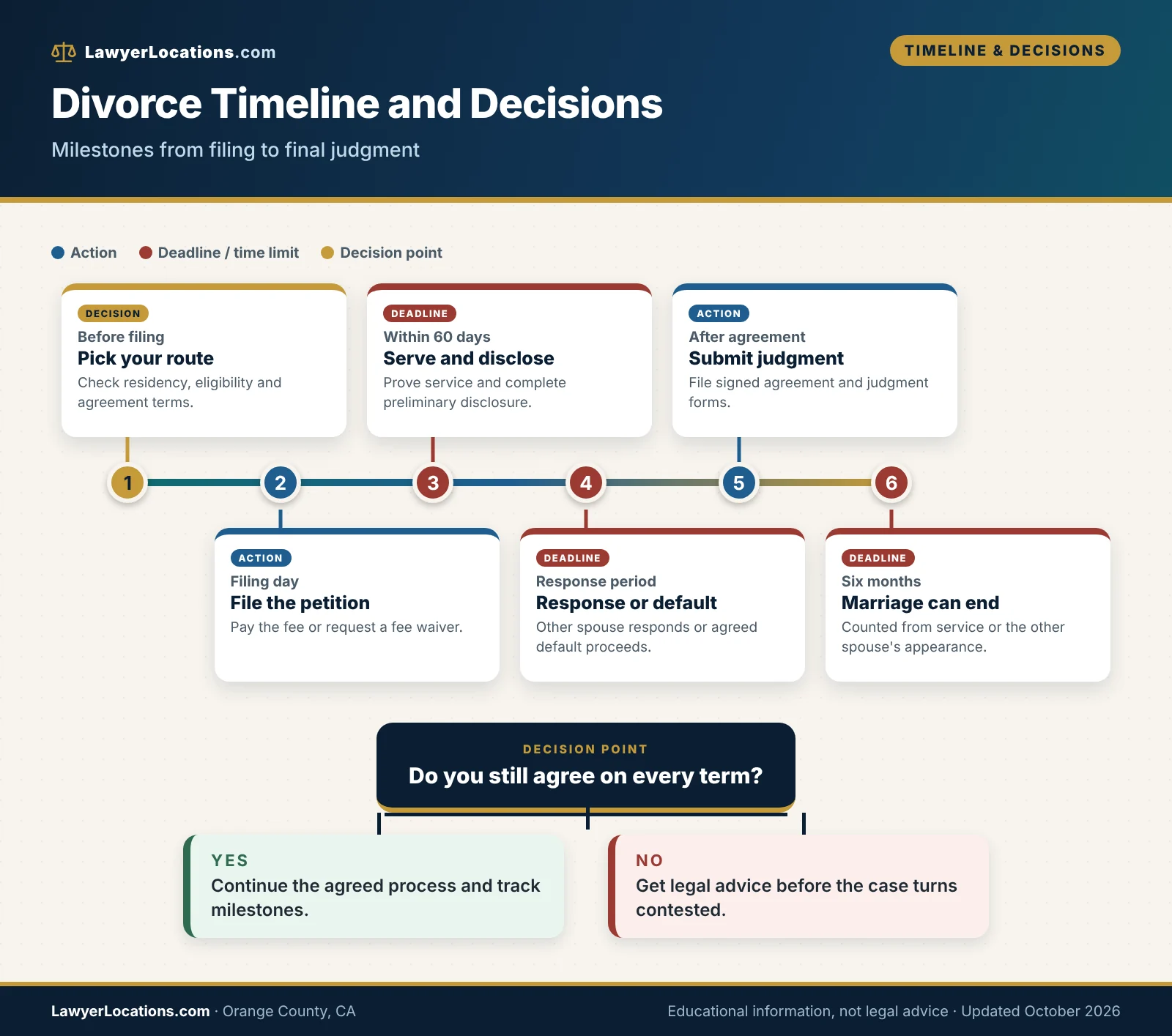
Text version of this graphic
- Before filing: confirm residency, choose the route, and gather financial records.
- Filing (action): file at Lamoreaux Justice Center and pay or request a waiver.
- Within 60 days (deadline): prove service and complete the preliminary disclosure.
- Response period (deadline): the other spouse responds, appears, or the case proceeds by agreed default.
- Judgment package (action): submit the signed agreement and judgment forms.
- Six months from service or appearance (deadline): the marriage can end no earlier than this date.
- Decision: if the spouses stop agreeing, switch to a contested process with legal advice.
| Stage | Timing | Source of the rule | Practical step |
|---|---|---|---|
| Proof of service | Within 60 days of starting the case | Orange County case-management milestones | Use a process server or other adult who is not a party |
| Preliminary disclosure (petitioner) | Within 60 days of filing the petition | Orange County milestones; Family Code 2104 | Complete and serve the disclosure forms |
| Request to enter default | Within 60 days after the response due date, if no response | Orange County milestones | Submit the default request and agreement papers |
| Judgment after default | Within 60 days of entry of default | Orange County milestones | Submit judgment package with signed agreement |
| Written agreement if negotiating | Within six months of filing | Orange County milestones | Request a trial date if no agreement is reached |
| Marriage ends | No earlier than six months after service or appearance | Family Code 2339 | Calendar the date and ask for a final copy of the judgment |
Decision points that change cost and risk
Three choices usually decide how smooth the case is. Make each one deliberately rather than by default.
Summary dissolution or a regular case
If you meet every summary dissolution requirement, the process is simpler and the court lists the same $435 fee. But the requirements are strict, including a waiver of spousal support and no real estate, and either spouse can stop the process before it becomes final by filing a Notice of Revocation (FL-830). If you are close to a limit, assume you will need the regular route.
Waive final disclosure or exchange it
A waiver saves time and possibly some fees. It is appropriate only if both spouses have exchanged full information already. If you suspect hidden accounts or a spouse refuses to share records, do not waive. A lawyer can explain how to protect yourself.
Summary dissolution can be revoked by either spouse before the effective date, but not after. If you change your mind, act before the date printed on the judgment. Revocation after that point is not available under the court’s packet instructions.
When an uncontested case stops being uncontested
Many agreed divorces stay agreed, but some do not. Plan for the possibility without assuming it.
Warning signs
- Your spouse stops returning calls or does not sign the settlement.
- New information appears about an account, debt or property.
- Parenting plan details become sources of argument.
- A demand to change terms after you have signed.
What to do if the agreement breaks down
Save the drafts, emails and any signed pages. If a response has been filed, you will need to follow the response and hearing process. If you are on your own, a limited-scope lawyer may be enough to review your position and help you decide how to respond. Our guide to California family law attorneys covers the contested path and how to hire a lawyer statewide.
A default in family court does not mean someone “lost.” It means the other spouse did not file a response in time, and the court can proceed on the first spouse’s papers, still requiring proof of the facts.
Preparing for a consultation and next steps
Go to a first consultation with your documents sorted, a short list of goals and a list of questions. Preparation reduces billable time and helps the lawyer or Self-Help staff tell you quickly which route fits.
What to bring
You do not need everything on day one, but a basic folder shortens the conversation.
Identity and relationship documents
- Marriage or domestic partnership date and place of registration.
- Date of separation (the date matters for summary dissolution and property).
- Children’s names and birth dates, and current living arrangements.
- Any earlier court orders, such as restraining or support orders.
Financial documents
- Last two years of tax returns and recent pay stubs.
- Bank, credit card, loan and mortgage statements.
- Retirement, investment and cryptocurrency account statements.
- Deed, vehicle titles, insurance policies and business records.
- A draft of any agreement the spouses have already reached.
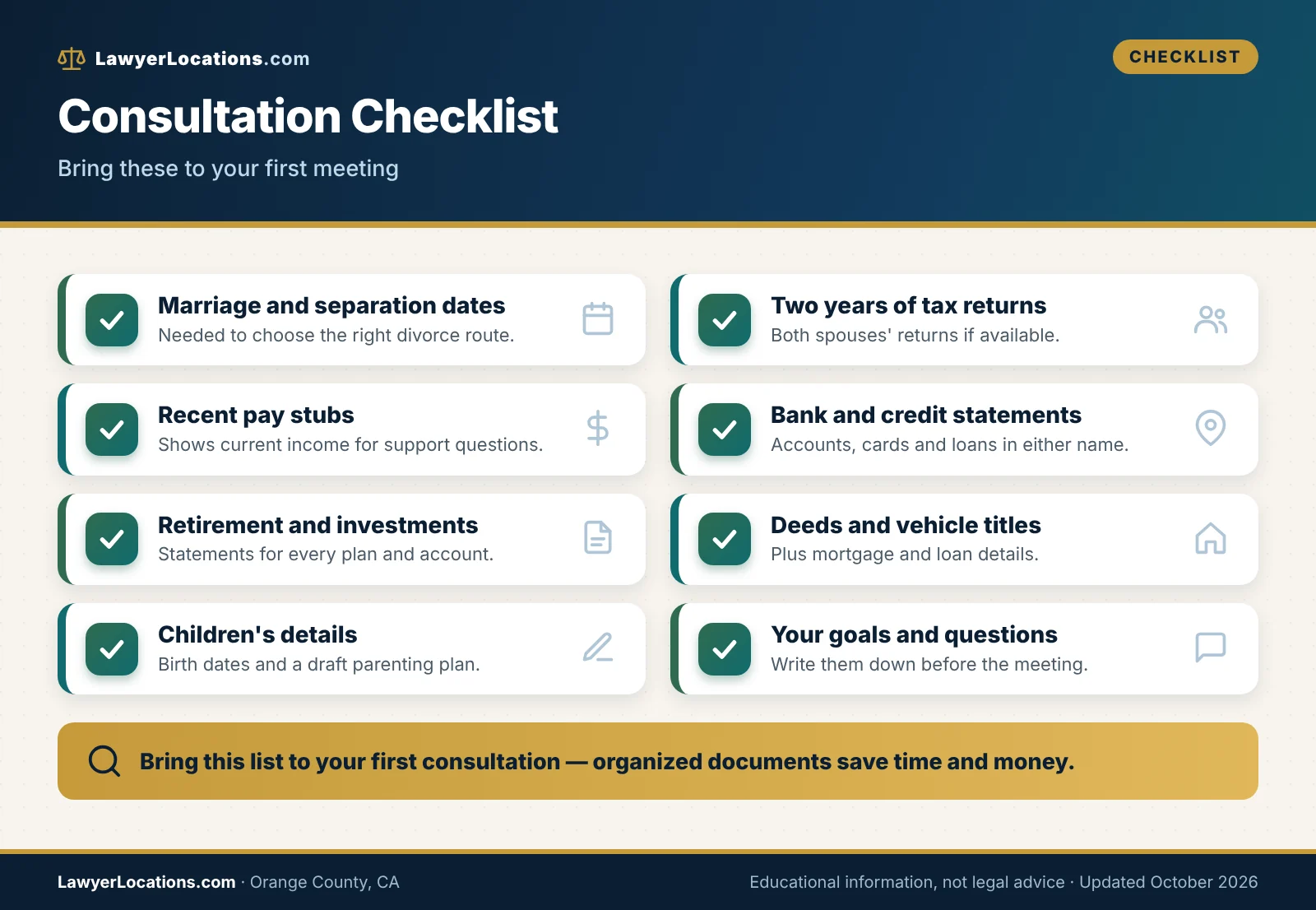
Text version of this graphic
- Marriage date and separation date
- Both spouses’ tax returns for two years
- Recent pay stubs and income details
- Bank, loan and credit card statements
- Retirement and investment statements
- Deed, mortgage and vehicle titles
- Children’s details and a draft parenting plan
- Your questions and goals, written down
Common questions people ask
These answers are general. Your facts may change them.
Timing and cost questions
How long does an uncontested divorce take in Orange County?
The marriage cannot end until six months after service or the other spouse’s appearance. Paperwork errors, disclosure delays or a missing signature can make it longer. Neither the court nor this site can promise a date.
How much does it cost to file?
The Orange County fee schedule effective January 1, 2026 lists $435 for a petition and $435 for a response, with a non-summary joint petition listed at $870. Check the current schedule, and ask about a fee waiver if you qualify.
How much does an uncontested divorce lawyer cost in Orange County?
It depends on scope and the firm’s fee structure, and no official source publishes a reliable figure. Ask for a written fee agreement that states what is included and what is not.
Can I find an uncontested divorce lawyer near me in Orange County for a one-time review?
Often yes. Ask about limited-scope help under California Rule of Court 5.425, where the lawyer reviews or drafts specific documents. Referral services such as the Orange County Bar Association’s can point you to lawyers who handle family law.
Paperwork and agreement questions
Can my spouse and I use one lawyer?
A lawyer ordinarily represents one client in a divorce, because spouses’ interests can conflict. Ask any lawyer who offers to help both of you to explain exactly whom they represent.
Do we have to go to court?
Often an agreed divorce is decided on written papers. Under Family Code 2336, the court may require a personal appearance in limited situations, such as concerns about a custody or support order.
Can we skip the financial disclosures?
The preliminary disclosures are required. The final declaration can be waived only through a stipulation that includes the statements listed in Family Code 2105, and the waiver does not erase ongoing disclosure duties.
What if we do not qualify for summary dissolution?
You can still have an agreed divorce through a regular petition, a stipulated judgment or an agreed default. The paperwork is longer, and legal advice becomes more valuable.
Next steps
Whether you hire anyone or not, a clear sequence keeps the process manageable.
A simple action plan
- Check eligibility. Compare your facts to the summary dissolution requirements and the residency rule.
- Write down the deal. List each asset, debt, support term and parenting detail you and your spouse have agreed on.
- Get advice on the big items. Use a consultation or limited-scope review for property, retirement accounts and support waivers.
- Prepare forms. Download current Orange County packets, and use Self-Help review before filing.
- File, serve and calendar. Track the 60-day milestones and the six-month date.
Where to start this week
If you only do one thing, schedule a short consultation with a lawyer licensed in California, or use the court’s Self-Help request form, and bring the documents listed above. If you are worried about your safety, tell the lawyer or Self-Help staff at the first contact.
Ready to compare your options?
Use the questions in this guide to compare at least two lawyers or services before you commit. LawyerLocations.com does not recommend or rank lawyers; it helps you ask better questions. For statewide context, read our California family law attorney guide.
Sources & References
Show all 18 sources
- Family Law Self-Help — Superior Court of California, County of Orange — occourts.org — accessed October 2026
- Summary Dissolution Packet SHC-D-03 — Superior Court of California, County of Orange — occourts.org — accessed October 2026
- Stipulated Judgment Packet (No Children) SHC-D-06 — Superior Court of California, County of Orange — occourts.org — accessed October 2026
- Public Fee Schedule, effective January 1, 2026 — Superior Court of California, County of Orange — occourts.org — accessed October 2026
- Legal Resource Information Sheet L-1172 — Superior Court of California, County of Orange — occourts.org — accessed October 2026
- Family Law Facilitator information sheet — Superior Court of California, County of Orange — occourts.org — accessed October 2026
- Electronic filing expanded to include family law appeals (public notice) — Superior Court of California, County of Orange — occourts.org — accessed October 2026
- In-person Self-Help Services at the Lamoreaux Justice Center — Orange County Bar Association — ocbar.org — accessed October 2026
- Find out if you qualify for summary dissolution — California Courts Self Help Guide — selfhelp.courts.ca.gov — accessed October 2026
- Start your divorce — California Courts Self Help Guide — selfhelp.courts.ca.gov — accessed October 2026
- Fee waiver — California Courts Self Help Guide — selfhelp.courts.ca.gov — accessed October 2026
- Rule 5.425, Limited scope representation — California Rules of Court — courts.ca.gov — accessed October 2026
- Family Code 2336 — public.law (California Codes mirror) — california.public.law — accessed October 2026
- Family Code 2339 — public.law (California Codes mirror) — california.public.law — accessed October 2026
- Family Code 2105 — public.law (California Codes mirror) — california.public.law — accessed October 2026
- Family Code 2550 — public.law (California Codes mirror) — california.public.law — accessed October 2026
- How a Certified Lawyer Referral Service Works — State Bar of California — calbar.ca.gov — accessed October 2026
- Attorney Licensee Search — State Bar of California — apps.calbar.ca.gov — accessed October 2026
General information only. LawyerLocations.com is a legal-education and lawyer-discovery resource, not a law firm. This page does not give legal advice and reading it does not create an attorney-client relationship. Laws, court fees, forms and local rules change; confirm current requirements with the Superior Court of California, County of Orange and consult a lawyer licensed in California about your situation.
Legal Disclaimer and Limitation of Liability
Informational and illustrative purposes only. This article was prepared by LawyerLocations.com solely on the basis of the information available to us at the time of writing. It is an illustrative, general overview. It is not a complete or authoritative statement of the law, and it has not been reviewed by a lawyer licensed in your state or county.
Not legal advice. Nothing in this article is legal, financial, tax or immigration advice, and reading it does not create an attorney-client relationship between you and LawyerLocations.com or any author, lawyer or firm mentioned. Laws, court rules, fees, filing deadlines and agency procedures differ by state, county and court, and they change often. Some details here may be simplified, incomplete or out of date, and time limits for legal claims can be short.
No warranty. We make no representation or warranty, express or implied, about the accuracy, completeness, timeliness or suitability of this content for your situation. Please do not rely on it to make, delay or skip any legal decision. Check the facts against official sources and speak with a licensed attorney in the relevant jurisdiction before you act.
Limitation of liability. To the fullest extent permitted by law, LawyerLocations.com and its owners, authors and contributors disclaim all liability for any loss, damage, cost or other consequence arising from the use of, or reliance on, this article, including any content on third-party websites we link to. Mentioning a lawyer, firm, organization or service is not an endorsement and is not a promise of any result. If you are in immediate danger, contact your local emergency number.