How long does divorce take in the United States? There is no single national answer, because divorce is governed by state law and run by local courts. An agreed, paperwork-only case can finish in a matter of weeks or a few months once any state waiting period has passed, while a contested case with children, a business or a hidden-asset fight can run a year or more.
The national court-administration benchmark asks courts to resolve 75% of divorce cases within 120 days, 90% within 180 days and 98% within 365 days, not counting any statutory waiting period. This guide explains the three clocks that decide your own timeline, compares waiting periods in eleven states using statute text, shows what causes delay, and lists practical ways to move faster.
The short answer: why no single number exists
Divorce timelines run from a few weeks to several years, and the honest range depends on three things: your state’s minimum waiting period, how much you and your spouse agree on, and how busy your local court is. Anyone who quotes you one number without asking where you live and whether you have children is guessing.
This section sets out the benchmark courts use, the three separate clocks running inside every case, and how to read the timelines you will see in advertising and online articles. Knowing the difference between a legal minimum and a realistic schedule is the single most useful thing you can take into a first conversation with a lawyer.
The benchmark courts use
What the national model time standard says
The Model Time Standards for State Trial Courts, approved in August 2011 by the Conference of State Court Administrators, the Conference of Chief Justices, the American Bar Association House of Delegates and the National Association for Court Management, set a target for dissolution and divorce cases. Under the standard, 75% of cases should be resolved within 120 days, 90% within 180 days and 98% within 365 days.
The standard expressly leaves out any waiting period that a statute imposes. It also no longer separates contested from uncontested cases, which older 1983 standards did, using roughly three months and six months. Think of it as a yardstick for courts, not a promise to any one family.
What the benchmark does not tell you
A benchmark is a goal for the court system as a whole. It does not say how long your county takes, whether judges in your courthouse hold trials on a tight or loose schedule, or how often hearings get moved. It also says nothing about how much the court’s clock is stretched when one spouse is hard to serve, when a child-related evaluation is ordered, or when the parties agree to pause.
Some courts publish their own case-processing statistics or standing orders with deadlines for filing financial disclosures and completing discovery. If your court does, that document tells you more about your likely pace than any national number. Ask the clerk or your lawyer where to find it.
Three clocks run inside every divorce
The statutory clock: waiting periods and separation requirements
Many states set a minimum time before a court may grant or finalize a divorce. Some count from filing, some from service on the other spouse, and some require a period of living apart. In a few states the judge may sign on the first day the law allows, and in others a signed judgment is not final until a further period passes.
This clock is the floor. No amount of cooperation, money or motion practice can shorten a mandatory waiting period unless the statute itself lets the court shorten it for a specific reason, such as certain hardship or safety findings. The state comparison table later in this guide shows how much these floors vary.
The case-work clock: disclosures, negotiation and decisions
Even after the legal floor passes, the case cannot end until the issues are decided. Those issues usually include dividing property and debts, deciding whether either spouse pays support, and, where there are children, a parenting schedule and child support. Each requires information: bank statements, tax returns, pay records, retirement account statements and appraisals.
The case-work clock runs at the speed of the slowest participant. A spouse who takes two months to produce a statement, or a lawyer who is waiting on an appraiser, can add more time than any waiting period.
The court clock: calendars, judges and paperwork review
Finally, the court has to process everything. Clerks review filings, judges review proposed judgments, and hearings are set according to available dates. In a busy urban court, a contested hearing may be scheduled well into the future, while a small county might have an opening within weeks.
Judges can also reject incomplete or inconsistent paperwork, which restarts part of the review. A clean, complete submission is the most reliable way to avoid losing weeks on the court clock.
A waiting period is a time a state requires to pass before a court may grant, or finalize, a divorce. A separation period is a related rule that requires spouses to live apart for a set time before one can obtain a no-fault divorce. Both are set by state law, so check the rule where you file.
How to read the timelines you find online
Why averages mislead
An average blends quick agreed cases with multi-year trials into one figure, and the figure describes almost nobody. Two couples with identical finances can land at opposite ends of the range simply because one agreed on parenting and the other did not. Treat any single average as a rough sketch, and look for the range and what moves a case within it.
Also check where the number came from. A figure with no named court or agency, no date and no description of the case type should not drive a decision. We do not publish a national average here for that reason.
Questions to ask before you trust an estimate
- Which state and county does the estimate cover?
- Does it include any statutory waiting period, or only the active work?
- Does it assume the spouses agree on everything, or does it include contested issues?
- Does it count to the day a judge signs, or to the day the divorce is legally final?
- Is the estimate dated, and from a court, agency or lawyer who can be asked to explain it?
When you speak with a lawyer, ask for a best case, likely case and slow case estimate for your county and what would move you from one to another. A thoughtful answer is a good sign; a single confident number with no conditions is a red flag.
The divorce process stage by stage
Almost every divorce moves through the same stages: preparing, filing, serving the other spouse, a response, temporary orders, information exchange, settlement or trial, and a final judgment. Names and forms differ by state, but knowing where time is spent at each stage lets you plan around it.
The stages below follow the order in which most cases unfold. Some, like temporary orders, are optional or skipped in simple cases. Others, like service, cannot be skipped in any state.
Before filing: residency and preparation
Meeting the residency requirement
A court can generally hear a divorce only if at least one spouse has lived in the state, and sometimes in the county, for a minimum time. The required time varies by state and sometimes by the facts. New York, for example, ties the required length of residency to where the couple married and lived and where the grounds arose, using periods of one or two years in N.Y. Dom. Rel. Law § 230.
North Carolina requires that one spouse has lived in the state for six months before an absolute divorce can be granted under N.C. Gen. Stat. § 50-6. If you recently moved, residency can decide where you are allowed to file at all.
Gathering documents before you file
The most common avoidable delay is a scramble for paperwork after filing. Collecting key documents in advance means your financial disclosure can be completed on the first attempt. The usual list includes recent tax returns, pay records, bank and credit card statements, mortgage and loan statements, retirement account statements, insurance policies, and records of any business interests.
If you are worried that your spouse might hide or move accounts, make copies of what you legitimately have access to, and tell a lawyer. Do not take or access accounts, devices or files you are not entitled to use; that can create legal trouble and slow the case.
Filing, service and the response
Filing the petition or complaint
A divorce starts when one spouse files a petition (some states say complaint) with the right trial court. Courts differ on whether you file with the county clerk, the family court clerk or an online portal. Many courts accept electronic filing, which can save days compared with mail or drop-off.
A rejected filing, usually for a missing form, an unsigned page or a wrong fee, can cost a week or more. Check the court’s current fee schedule and its checklist for divorce filings before you submit.
Serving the other spouse
The filing spouse must formally notify the other spouse, a step called service of process. Rules say who may deliver papers (often a sheriff, a process server or any adult who is not a party) and how proof is filed. When the other spouse cooperates, they can often sign an acknowledgment or a joint filing to speed things up.
In some states the statutory clock starts at service or at the other spouse’s first appearance rather than at filing. In California, for example, the six-month period runs from service of the summons and petition or the respondent’s appearance, whichever comes first, under Cal. Fam. Code § 2339. Prompt service therefore directly affects the earliest possible end date.
The response and what happens if there is none
The served spouse has a deadline to respond, set by state or local rules and stated in the papers they receive. A timely response may agree with the petition, disagree with parts of it or raise additional claims. If no response is filed, the filing spouse may ask for a default, which is discussed in the case-types section.
Anyone served should read the deadline on the papers the same day and ask a lawyer or the court’s self-help center about it. Missing a response deadline can limit what you are allowed to argue later.
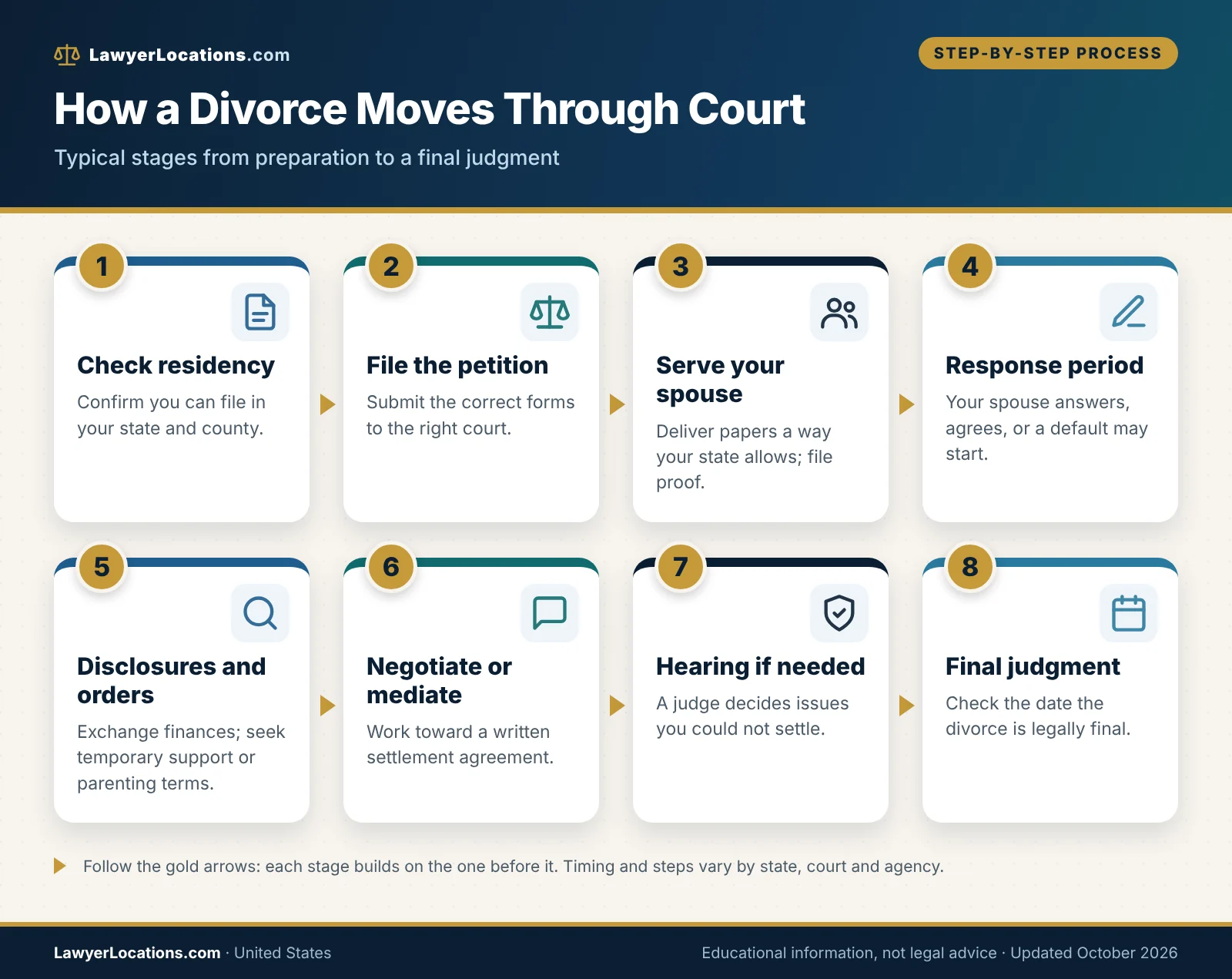
Text version of this graphic
- Check residency and prepare. Confirm you can file in your state and county, and gather financial documents.
- File the petition. Submit the correct forms to the right court.
- Serve the other spouse. Deliver the papers in a way your state allows and file proof.
- Response period. The other spouse answers, agrees, or lets a default begin.
- Temporary orders and disclosures. Short-term support and parenting arrangements; exchange of financial information.
- Negotiate or mediate. Work toward a written settlement agreement.
- Hearing or trial if needed. A judge decides what remains in dispute.
- Judgment and finality. The judge signs; observe any waiting or appeal period before the divorce is final.
Temporary orders and the exchange of information
Temporary orders for support, parenting and property
While a divorce is pending, either spouse can usually ask for temporary orders. These cover who lives where, a short-term parenting schedule, interim child or spousal support and sometimes limits on large financial moves. Temporary orders can add a hearing early in the case, but they also give structure that makes the rest of the case calmer.
They can also shape the outcome in practice, because a schedule that works for months often becomes the starting point for the final plan. Treat them as important, not as a formality.
Financial disclosure
Most states require each spouse to disclose income, assets, debts and expenses, often on a sworn form with supporting documents. Courts take incomplete or inaccurate disclosures seriously, and a spouse who is caught hiding something can face penalties and a much longer case.
Accurate, complete disclosure early is both an ethical requirement and a speed strategy. The other side cannot settle without it, and a judge will not approve a deal built on missing information.
Discovery: when formal information requests start
If disclosure alone is not enough, lawyers can use discovery: written questions, requests for documents, sworn testimony called depositions, and subpoenas to banks or employers. Discovery is the part of a divorce that most often stretches the schedule because each request invites a response period and sometimes a dispute.
In simple cases there may be little or no formal discovery. In complex ones, it can run for months. Ask a lawyer early whether the case is likely to need it and what it would add.
Settlement, trial and the final judgment
Negotiation and mediation
Most divorces end by agreement, usually written as a settlement agreement that the judge reviews and incorporates into the judgment. Mediation, where a neutral person helps the spouses reach agreement, is common and in many courts expected before a contested trial.
A settlement can happen at any point, including the week before trial. The earlier it happens, the less time and money the case consumes, but a rushed settlement made without full information is a risk of its own.
Trial and judge’s decision
If the spouses cannot agree, a judge decides the open issues after a hearing or trial. Trials in family court may be set in segments over several dates, and the judge may take the decision under advisement for weeks before issuing a ruling.
The calendar in front of the judge matters. A case that would take two days of testimony may be spread across months simply because of the court’s availability.
The judgment, the decree and finality
The result is a written judgment, sometimes called a decree, that ends the marriage and sets out the property, support and parenting terms. In some states it is final when signed, while in others there is a further waiting or appeal period. Massachusetts, for example, enters a conditional judgment nisi that becomes absolute 90 days after entry unless the court orders otherwise, under M.G.L. c. 208, § 21.
Because of rules like this, a finalized date on paper may be later than the date of your hearing. The finality section later in this guide explains why that matters for remarriage, insurance and name changes.
State waiting periods and residency rules
The legal minimum time to a divorce varies enormously by state: from 20 days in Florida to a full year of living apart in North Carolina. The table below compares eleven states using the statute text, so you can see how different the floors are and where the clock starts.
These are only the statutory minimums. Your real timeline is longer if the case needs financial disclosure, negotiation or a hearing. Also, a state that has no long waiting period is not necessarily faster, because court congestion and contested issues can dominate.
What a waiting period is and what it is not
When the clock starts
Some statutes count from the filing date, others from service on the respondent or the respondent’s appearance, and a few use more than one trigger. In Washington, for example, the 90 days must pass after the petition is filed and also after the respondent has been served (or after first publication of the summons), under RCW 26.09.030. In Colorado the 91 days run from the date the court acquires jurisdiction over the respondent, which happens through service, joinder or appearance, under C.R.S. § 14-10-106.
The practical lesson is to serve promptly and to confirm in writing when the clock started. A delay in service can quietly push your earliest possible date back by the same number of days.
Exceptions and shortened periods
Some states let a judge shorten or skip the wait for specific reasons. Florida’s statute allows entry of the judgment before the 20 days end if the requesting party shows that waiting would be unfair, under Fla. Stat. § 61.19. Texas does not apply its 60-day wait when the court finds either a family-violence conviction or deferred adjudication involving the petitioner or household, or an active protective order based on family violence committed during the marriage, under Tex. Fam. Code § 6.702.
Michigan allows testimony before the usual 60-day wait only on a petition showing unusual hardship or compelling necessity, under MCL 552.9f. In California, the court may extend the six-month period for good cause, so the period can grow but, as a rule, should not be assumed to shrink.
A waiting period is a minimum, not an estimate. If your state counts from service, serving the papers late postpones the earliest end date. Confirm the start date with the clerk or a lawyer licensed in your state.
State-by-state snapshot
Eleven states compared
The table lists the statutory rule we verified for each state, the event that starts the count and the statute. Rules can change and exceptions exist, so use the table to understand the spread, then confirm your own state’s current statute or ask the court clerk.
| State | Minimum rule | What starts or limits the count | Statute |
|---|---|---|---|
| California | Six months before a dissolution judgment is final; court may extend for good cause | Service of summons and petition, or the respondent’s appearance, whichever is first | Cal. Fam. Code § 2339 |
| Colorado | 91 days before a decree; one spouse domiciled in the state for 91 days before the case began | The court gains jurisdiction over the respondent (service, joinder or appearance) | C.R.S. § 14-10-106 |
| Florida | At least 20 days before final judgment; earlier entry possible if waiting would be unfair | Filing of the original petition | Fla. Stat. § 61.19 |
| Massachusetts | Judgment nisi, then absolute after 90 days unless the court orders otherwise | Entry of the judgment nisi | M.G.L. c. 208, § 21 |
| Michigan | No testimony until 60 days (no minor children) or six months (minor children) after filing | Filing of the complaint; hardship petition possible | MCL 552.9f |
| New York | No waiting period shown in the residency statute; residency of one or two years depending on the facts | Continuous residence before filing | N.Y. Dom. Rel. Law § 230 |
| North Carolina | One year living separate and apart; one spouse resident for six months | Date separation began; isolated intimacy does not restart it | N.C. Gen. Stat. § 50-6 |
| Pennsylvania | 90 days (mutual consent) or one year of separation (irretrievable breakdown) | Commencement of the action (mutual consent); date of separation (one-year route) | 23 Pa.C.S. § 3301(c), (d) |
| Texas | Court may not grant a divorce before the 60th day after filing; family-violence exception | Date the suit was filed | Tex. Fam. Code § 6.702 |
| Virginia | One year living separate and apart; six months only with a separation agreement and no minor children | Date separation began without cohabitation | Va. Code § 20-91(A)(9) |
| Washington | 90 days after filing and after service (or first publication) before a decree | Filing and service, both | RCW 26.09.030 |
Short waits versus long waits: what the spread means
States with short waits, like Florida and Texas, let a prepared couple finish in a matter of weeks or a couple of months. Those with multi-month waits, like Washington, Colorado and Pennsylvania’s mutual-consent route, build in a cooling-off period of about three months. California’s six months and the one-year separation requirements in North Carolina and Virginia are the longest floors in this table.
If you are comparing states because you or your spouse could file in more than one, remember that jurisdiction rules limit your choice, and filing in a state you are not connected to can lead to dismissal. A lawyer can tell you whether a choice exists. Our guide on legal separation versus divorce also explains why some couples use separation to bridge a required living-apart period.
Both California and Massachusetts show that a signed judgment is not always the end. California’s six-month rule and Massachusetts’s 90-day nisi period mean the marriage may continue legally for months after a judge approves an agreement. Local guides, such as our California family law guide and our Boston divorce lawyer guide, cover those details.
Residency requirements and choosing where to file
How residency rules differ
States ask for a minimum period of residence before a court will hear a divorce. New York’s statute sets one year in several situations and two years in all others, and North Carolina’s rule requires six months. Colorado requires that one spouse have been domiciled in the state for 91 days before the case began.
Domicile means more than a mailing address. It generally means living in the state with the intention to stay, which a court may test using a lease, driver’s license, voter registration or work records. If you moved recently, gather those documents before filing.
What happens if you file too early or in the wrong place
A case filed before the residency period has passed can be dismissed, and the filing date does not carry over. You then have to refile, losing time and a filing fee. In some states a defect in residency can be raised years later to attack a judgment, which is why courts take it seriously.
When spouses live in different states, there can also be a race to file. Which state gets the case affects the waiting period, the law that divides property and the courthouse where hearings will be held. This is a moment to speak with a lawyer before filing, not after.
Uncontested, contested and default divorces
The biggest swing factor in timing is whether you and your spouse agree. An uncontested divorce, where both sides agree on every issue, can move as fast as the law and the court’s paperwork review allow. A contested divorce moves at the speed of the hardest unresolved issue.
A third path, the default divorce, is for when the other spouse does not take part. Each path has its own typical timeline drivers, summarized in the table below.
The uncontested (agreed) divorce
What makes an agreed divorce fast
Agreed divorces move quickly when the paperwork is complete, the settlement covers every issue and the court has a simplified process. Many courts have forms or a dedicated track for couples with a signed agreement, and some allow a judge to sign without a hearing. A joint petition, where both spouses file together, can also skip the service step.
Local examples of this approach appear in our guides to uncontested divorce in Orange County, California and uncontested divorce in Minneapolis. Rules and forms differ by county, so use the one for your court.
What can still slow an agreed divorce down
Even when spouses agree, time is lost to statutory waiting periods, incomplete financial disclosures, missing signatures, forms that do not match the agreement and courts that review proposed judgments slowly. Agreements that leave a topic unclear, such as who keeps a retirement account or how a house will be refinanced, can be sent back for correction.
Another hidden delay is the follow-through after signing. If the judgment requires a deed transfer, a retirement-plan division order or a refinance, those tasks continue past the judgment and can take longer than the divorce itself.
The contested divorce
How contested issues extend the case
A divorce is contested if the spouses disagree about anything essential, such as the parenting schedule, child or spousal support, how property is valued or divided, or even whether the marriage should end. Each disputed issue adds steps: temporary hearings, discovery, expert reports, mediation and finally a trial.
Disputes about children and about valuing a business or professional practice tend to be the most time-consuming, because they involve outside evaluators and, in the case of children, a court focused on the child’s best interests rather than the parents’ timetable.
Getting a trial date
If the case goes to trial, the date depends on the court’s calendar and on how many days the trial needs. Some courts require a settlement conference, a mediation attempt or a pretrial statement before they will set trial. Continuances, which move a hearing to a later date, are common and add up.
The cost of delay is real: each additional month usually means more legal fees, ongoing temporary support and months of unresolved life decisions. Weigh those costs against what is actually in dispute.
Default divorces and the missing spouse
When the other spouse does not respond
If a served spouse does not respond by the deadline, the filing spouse can usually ask the court to enter a default, which lets the judge decide the case based on what the filing spouse presents. Courts still review the requested terms, require proof of proper service and often require a hearing, especially where children or significant property are involved.
A default can be quicker than a contested case but is not instant. It also carries risk: a judgment entered without the other spouse can sometimes be challenged later if service was defective, which is why careful service matters.
When you cannot find your spouse
If the spouse cannot be located after diligent effort, courts may permit alternative service such as publication or posting. These methods usually require you to show what you did to find the person, often with a sworn statement, and approval takes time.
Publication also affects the clock in some states: in Washington, for example, the waiting period is counted from the first publication of the summons when service is made that way. Expect extra weeks or months, and do not skip the search step.
| Path | What usually sets the pace | Common causes of delay | Rough sense of range |
|---|---|---|---|
| Uncontested, no children | State waiting period plus the court’s paperwork review | Incomplete forms, missing disclosures, slow service | From a few weeks to a few months once any statutory wait ends |
| Uncontested, with children | Waiting period, parenting plan review, any required class | Unclear parenting schedule, child support calculation errors | Usually a few months, longer where a longer statutory wait applies |
| Contested, modest finances | Disclosure, mediation and hearing availability | One disputed issue, missed deadlines, rescheduled hearings | Often several months to a year |
| Contested, children in dispute | Temporary orders, evaluations, mediation, trial setting | Custody evaluations, relocation requests, allegations | Often a year or more |
| Contested, complex assets | Valuations, expert reports, discovery | Business appraisals, hidden assets, retirement division | Commonly more than a year |
| Default | Proof of service, then court review | Defective service, searches for an absent spouse | Varies widely with service and local rules |
What causes delays
Most delay comes from four sources: the court’s calendar, a spouse’s behavior, difficult substantive issues and avoidable paperwork errors. Only some are within your control, so it helps to sort them early and put your effort where it matters.
The sections below describe each source, what a realistic response looks like and when delay becomes a sign that something needs to change, such as a different strategy or a different lawyer.
Court-driven delays
Crowded calendars and limited hearing dates
Family courts handle many types of cases: divorce, custody, support, protective orders and enforcement. A judge may have only certain days for contested hearings, and emergencies, such as safety-related matters, understandably take priority. The result is that a hearing that takes an hour can wait weeks or months for a slot.
You cannot change the calendar, but you can prepare well so that a hearing is not wasted. Arriving with complete documents and a clear, short list of what you are asking for makes it more likely that the court can rule on the day.
Continuances, review time and staffing
A continuance is a postponement of a hearing to a later date. They happen when a party is unavailable, when a document is missing, when an interpreter or evaluator is not ready or when the judge’s schedule changes. Each one can add weeks.
Review time also matters. In some courts, a proposed judgment sits in a queue before a judge or commissioner reviews it, and any error sends it back. Ask the clerk or your lawyer how long review usually takes at your court, and ask whether the court has a process for checking your paperwork before the final submission.
Delays caused by a spouse’s choices
Slow responses, missed deadlines and avoidance
A spouse who avoids service, ignores requests for documents or takes the maximum time for every response can stretch a simple case. Courts have tools for this, such as motions to compel production, orders to appear and, in some cases, sanctions. Each tool takes its own time and expense, however, so lawyers often weigh whether the pressure is worth the cost.
A calm paper trail helps. Keep requests in writing, note deadlines and avoid angry exchanges that can distract from the issue the judge will actually look at.
Incomplete disclosure and hidden assets
When there is concern that income or accounts have not been fully disclosed, the case often expands into discovery, subpoenas and sometimes a forensic accountant. That is legitimate when there are real warning signs, such as unexplained transfers or a sudden change in business income. It also takes months.
A spouse who is open about finances from the outset typically shortens the case for both sides. A court that finds deliberate concealment can order consequences, including fee awards, so honesty is also the lower-risk path.
Do not move, spend down or hide marital assets, and do not delete records, even if you fear your spouse will. Courts can undo transfers, penalize concealment and draw negative conclusions. If you are worried about your spouse’s behavior with money, tell a lawyer and let the court’s process address it.
Delays caused by the issues themselves
Parenting disputes and evaluations
Disagreements about where children will live and how decisions will be made are the most emotional and often the slowest part of a divorce. Courts may require mediation, parenting classes or a parenting plan before a contested hearing, and may appoint a guardian ad litem or custody evaluator to investigate and make recommendations. These steps are meant to protect children, and they take time.
Local custody practice varies. For examples of how courts in different places approach custody, see our guides on child custody in Jacksonville, Florida and child custody in Milwaukee, Wisconsin.
Valuing a business, property or retirement assets
Dividing a closely held business, a professional practice, real estate in more than one state, stock options or pensions usually needs outside valuation. Appraisers need records, and each side may hire its own expert, which leads to reports, rebuttals and sometimes testimony.
Retirement accounts add another step: many plans require a special court order, often called a qualified domestic relations order or QDRO, before they will divide an account. Drafting and plan approval of that order can take longer than the divorce judgment itself, so plan for it early.
Paperwork and procedural errors
Rejected filings and incomplete forms
Clerks and judges reject filings that are unsigned, missing a required attachment, filed in the wrong county or inconsistent with each other. Each rejection restarts a review queue. A frequent source of error is a settlement agreement that says one thing while the proposed judgment says another.
Before submitting anything, read the court’s current checklist, confirm the names and dates match across documents and keep copies of everything you file. If your court offers a document review service or self-help center, use it.
Service defects and notice problems
If papers are not served correctly, the court may refuse to proceed, and a judgment can be attacked later. Common errors include serving the wrong person, using a method the state does not allow or failing to file proof of service on time.
The fix is simple but easy to overlook: use the method your court’s rules describe, ask the court whether a signed acknowledgment from your spouse is allowed, and file the proof the same day if possible.
| Source of delay | Why it adds time | Practical response |
|---|---|---|
| Crowded court calendar | Limited dates for contested hearings and trials | Ask about remote hearings, early settlement conferences and hearing-ready preparation |
| Continuances | Each postponement moves the next date back by weeks | Confirm document and witness readiness well before the hearing date |
| Slow or missing disclosure | Settlement and orders cannot be based on missing information | Use written requests with deadlines; ask the court to compel if needed |
| Parenting disagreements | Mediation, classes, evaluators and best-interest findings | Propose a detailed parenting plan and try mediation early |
| Business or asset valuation | Experts, reports and rebuttals | Agree on one neutral appraiser where possible |
| Retirement division orders | Plan administrators review and approve orders | Request the plan’s model order language and start drafting before the judgment |
| Service problems | Court cannot proceed without valid notice | Use an allowed method, or a signed acknowledgment, and file proof promptly |
| Paperwork errors | Rejected filings restart review | Check court checklists; ensure the agreement and judgment match |
Children, military service, safety and complex finances
Certain situations reliably change the schedule: minor children, a spouse in the military, safety concerns and complex finances. Each brings its own rules and its own likely time additions.
This section explains how each situation typically affects timing and what to raise with a lawyer at the first consultation. The examples are general; your state’s statutes and local rules control.
Divorce with minor children
Parenting plans and required classes
Courts require a parenting arrangement for minor children, either agreed by the parents or decided by a judge. Many courts also require parents to attend an education class or mediation. If your court requires a class, schedule it as soon as possible; classes are often offered on set dates, and missing a date can hold up the final judgment.
Some states also lengthen their waiting periods when children are involved. Michigan’s statute, for example, sets 60 days without minor children and six months with them for the earliest point at which testimony may be taken, absent a hardship petition, under MCL 552.9f.
Child support and relocation questions
Child support is typically calculated under state guidelines using both parents’ incomes and the parenting schedule. Input errors in the calculation, such as outdated income or incorrect overnights, are a common reason for corrections. For a local look at the process, see our guide on child support in Nashville, Tennessee.
A request to move a child to another area during or after the divorce can add a separate contested hearing. If either parent might relocate, raise it with a lawyer early, because unplanned relocation requests are a frequent cause of delay.
Military service and federal protections
The Servicemembers Civil Relief Act
When a spouse is on active duty, a federal law can pause a civil case. Under 50 U.S.C. § 3931, a court must grant a stay of at least 90 days in certain circumstances, for example when the servicemember may have a defense that cannot be presented without being present, or when counsel cannot reach the defendant after due diligence. In default cases, courts check military status before entering judgment.
These rules protect people who are deployed or otherwise unable to take part. They can legitimately lengthen a case, and a judgment entered while ignoring them can be reopened.
Jurisdiction, residency and military pensions
Military families often have unusual residency situations: a service member may be stationed in one state while legally domiciled in another. Where you can file therefore needs care, and some states have special residency provisions for military members.
Dividing a military retirement involves federal rules and specific paperwork. Because those rules are technical, speak with a lawyer who regularly handles military divorces and ask about the order the pension administrator will require.
Safety concerns and urgent protection
Safety comes before speed
If you are afraid of your spouse, the timeline for the divorce matters less than your safety. Protective orders and emergency custody orders can often be requested quickly and run on a separate track from the divorce. A local domestic violence program, the court’s self-help center or a lawyer can explain how to request one in your county.
Some laws also treat safety as a reason to adjust the usual divorce timeline. Texas, for example, drops its 60-day wait when a court finds specified family-violence facts, under Tex. Fam. Code § 6.702. Other states handle this differently, so ask a local advocate or lawyer.
Planning around safety in a lengthy case
A contested case can mean months of contact through lawyers, exchanges of children and hearings. Courts can order structured exchanges, limited communication methods and supervised parenting time when circumstances call for it.
Keep records of incidents, save threatening messages and share them with your lawyer or advocate. Do not rely on a social media post or an informal message to someone else as the way to document your situation.
If safety is a concern, tell the lawyer in your first call before talking about timing. The strategy, the order of filings and the speed of the case may all change.
High-asset, business and cross-border cases
Business owners and high-asset couples
Where there is a business, a professional practice or substantial investments, the timeline is usually set by valuation and discovery rather than the waiting period. Expect appraisers, accountants and sometimes expert testimony. Agreeing early on a single neutral expert, and on what date to use for valuing the assets, can save months.
Settlement is often possible even in high-asset cases, particularly when mediation or a private judge is used to match the pace of the parties rather than the court’s calendar. Ask your lawyer whether that is available in your court.
Spouses or assets in another country
A spouse who lives abroad can complicate service, since formal service in another country may follow international treaty procedures and take longer than domestic service. Assets overseas can raise questions about valuation and enforcement.
If a spouse or significant property is outside the United States, a lawyer should look at jurisdiction and service from the first day. Skipping that step is a common reason cases have to be redone.
How a lawyer affects the timeline, and how to compare lawyers
A lawyer cannot shorten a statutory waiting period or speed up a court calendar, but a good fit can prevent the delays that come from errors, missed deadlines and unfocused disputes. The goal when comparing divorce lawyers is realistic planning, not promises.
This section covers what a lawyer can and cannot change, how to compare divorce lawyers on process and communication, and how to use a first consultation to get a timeline you can plan around. LawyerLocations.com is an education and discovery resource, not a law firm, and nothing here recommends a particular lawyer.
What a lawyer can and cannot change about timing
Where a lawyer can save time
A lawyer familiar with your court knows what the clerk requires, how long review takes and which judges expect mediation first. That knowledge prevents rejected filings, defective service and mismatched agreements. A lawyer can also structure negotiations so the real disagreement is addressed early rather than after months of side disputes.
Lawyers can also advise when a short compromise is better than a long fight. Many people find that a clear view of the cost and delay of an issue changes what they decide to argue about.
What no lawyer can change
Statutory waiting periods, the judge’s calendar and the other spouse’s decisions are outside any lawyer’s control. A lawyer who promises a specific end date, or a specific outcome, is promising something no lawyer can deliver.
What a lawyer can do is give you a range, explain what drives it and update the estimate as the case develops. If the estimate shifts, a good lawyer explains why.
How to compare divorce lawyers
Fee structures and how they affect speed
Divorce lawyers commonly use hourly billing with a retainer paid in advance, flat fees for simple uncontested cases, or limited-scope arrangements where the lawyer handles only certain tasks, such as reviewing a settlement agreement. How fees are structured changes incentives: hourly billing rewards thoroughness but costs more when a case drags, while a flat fee gives certainty but may cover only specified steps.
Ask for the fee agreement in writing, and ask what is and is not included, how often you will receive invoices, what happens if the case needs a trial, and how court costs, expert fees and process server fees are handled. Our guide to legal separation versus divorce includes related cost questions for couples deciding which path fits.
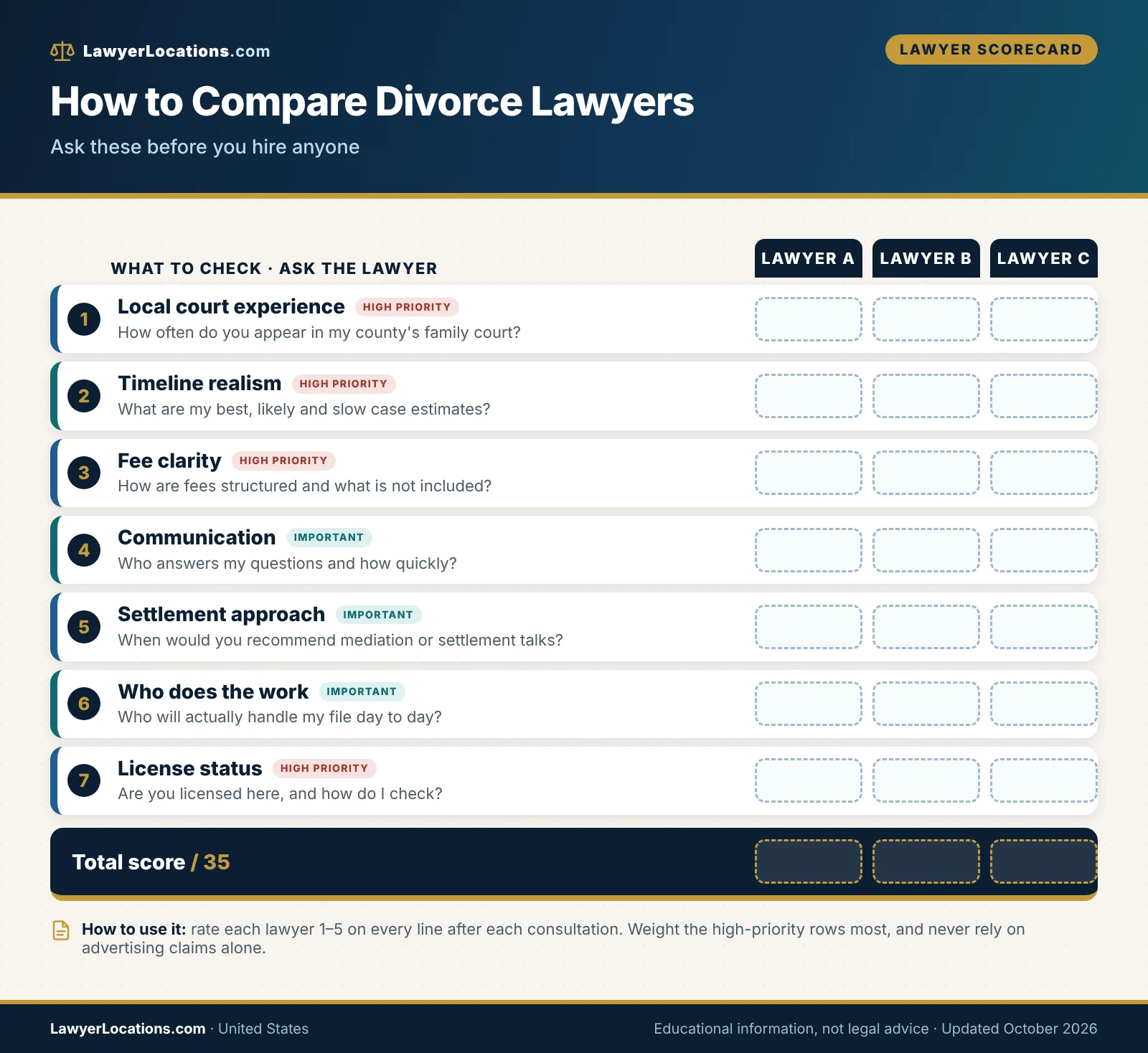
Text version of this graphic
| Criterion | Question to ask |
|---|---|
| Local court experience | How often do you appear in my county’s family court? |
| Timeline realism | What are the best, likely and slow cases, and what moves me between them? |
| Fee clarity | How are fees structured, and what is not included? |
| Communication | Who will answer my questions, and how quickly is a typical response? |
| Settlement approach | When do you recommend mediation or settlement talks? |
| Case staffing | Who will actually do the work on my file? |
| Licensing and standing | Are you licensed in this state, and how can I check your bar record? |
Experience in your court and in your kind of case
Ask how often the lawyer handles cases in your county’s family court and with issues like yours, whether children, business ownership, military service or safety concerns. Local knowledge shows up in details: how soon temporary hearings are set, whether the court expects mediation and what the clerk accepts.
Confirm the lawyer is licensed in your state and check the state bar’s lawyer directory for license status and any public discipline. Avoid relying on advertising words such as “top” or “best”; they do not measure anything verifiable. Look instead for clear answers about process and fees.
Be cautious about any lawyer who promises a result or a date, discourages you from asking about fees, pressures you to sign on the spot or cannot explain the steps in plain language. A good consultation leaves you with more clarity, not more pressure.
Free consultations and preparing for your first meeting
What to expect from a consultation
Some lawyers offer a free or low-cost initial consultation and others charge for the time. Policies differ, so ask when you schedule what the consultation costs, how long it lasts and whether a retainer is needed to proceed. A consultation is also a chance to see whether you feel comfortable working with the lawyer and the office.
Reading this page or contacting a lawyer does not by itself create an attorney-client relationship. Lawyer ethics rules generally give people who consult a lawyer some confidentiality protection, but the details vary, so ask about confidentiality when you book, and hold back sensitive details until you know the terms.
What to bring and what to ask
Bring a short summary of your situation (marriage date, children’s ages, who lives where), recent tax returns, pay records and a list of accounts, property and debts. A one-page timeline of key events helps the lawyer assess issues quickly.
- What is the likely range for my case in this county, and what would speed it up or slow it down?
- Which steps could be handled through agreement or mediation?
- What will you need from me in the first 30 days?
- What are your fee structure, retainer and billing practices?
- How will we communicate, and who else will work on my case?
- If the case is contested, what would you expect the major cost drivers to be?
Doing it yourself, with help, or fully represented
When a self-represented divorce may be realistic
Many courts publish forms and instructions for couples with an agreement, no complex property and few or no children. If both spouses are cooperative and the paperwork is straightforward, a self-represented divorce may be realistic. Courts’ self-help centers and legal aid programs can explain forms and procedure, though they cannot give legal advice on your particular choices.
The risk of going alone is a mistake that is costly to fix, such as an agreement that gives up retirement rights or a judgment that cannot be enforced as written.
Limited-scope help as a middle option
Some lawyers will take on part of the work, for instance reviewing your agreement before you sign, coaching you for a hearing or drafting a required order. This can be a middle road that controls cost without leaving you unsupported.
If you consider it, ask whether your state and court allow limited-scope appearances and exactly which tasks are covered. Put that scope in writing.
Legitimate ways to speed things up
The most reliable ways to shorten a divorce are preparation, complete and consistent paperwork, early agreement on as many issues as possible and using the simplified procedures your court offers. None of them removes a statutory waiting period, but they remove avoidable delay around it.
Below are the practical levers, grouped as preparation, alternative dispute resolution and use of court procedures. A comparison table summarizes the tradeoffs.
Prepare before and during the case
Assemble documents early
Build a document folder before you file: tax returns, pay records, account statements, loan and mortgage records, insurance policies, retirement statements and any business records. Having them ready makes your financial disclosure faster and your lawyer’s early advice more precise.
Keep the folder updated during the case, and respond to requests quickly. Missed deadlines on your side are among the most controllable sources of delay.
Decide your priorities before negotiating
Cases lengthen when each side treats every issue as equally important. Write down which outcomes matter most (for example, the parenting schedule or keeping the home) and which you can compromise on. A realistic list helps you settle faster and shows your lawyer where to focus.
Think too about what a prolonged fight will cost compared to what it could gain. A modest concession that ends a dispute can be worth more than a marginal win that adds months.
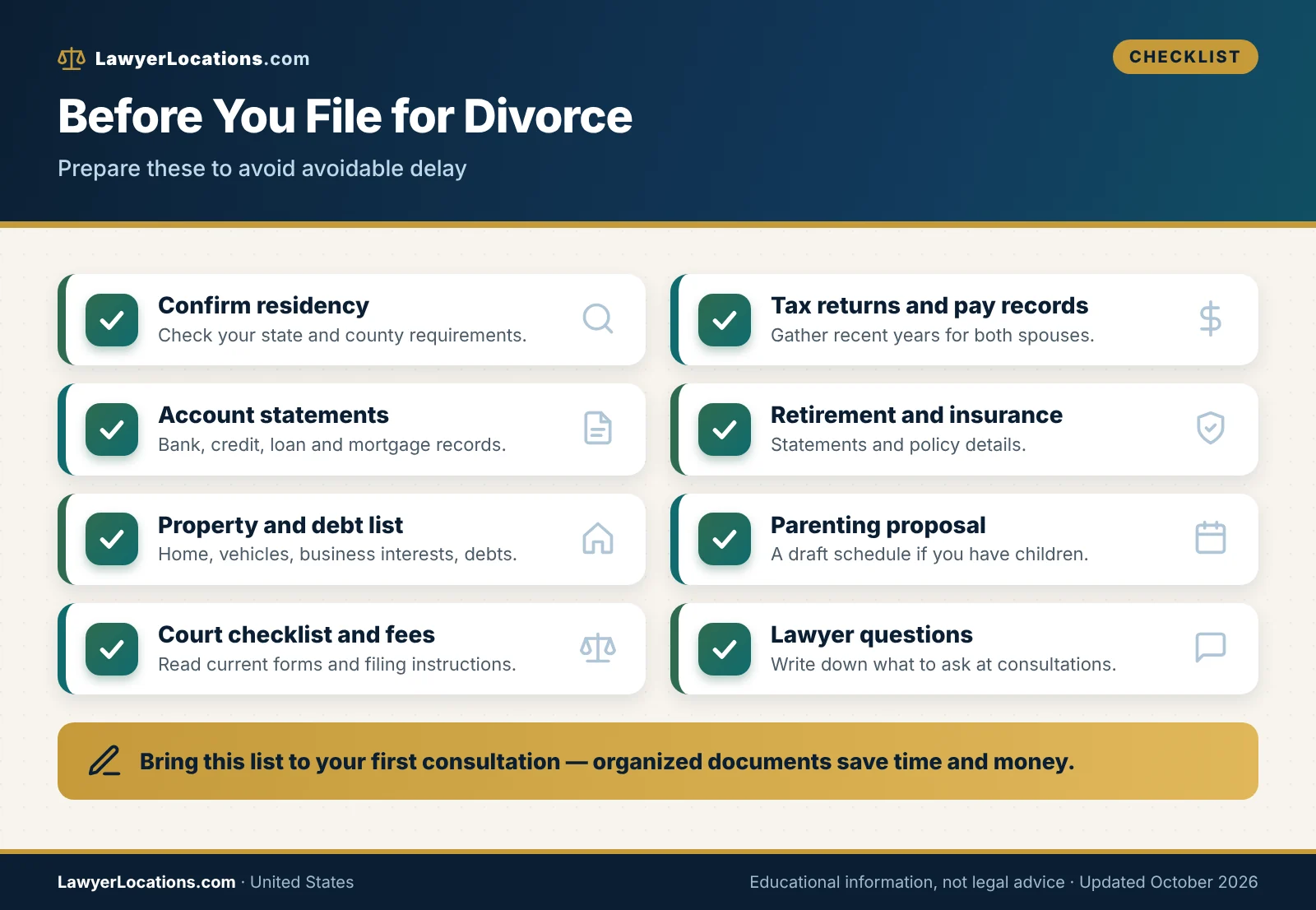
Text version of this graphic
- Confirm residency and where you can file.
- Collect tax returns and pay records.
- List all accounts, property and debts.
- Gather retirement and insurance statements.
- Write a short parenting and housing proposal.
- Check court forms, fees and local checklists.
- Prepare questions for a lawyer consultation.
- Plan how you will serve or exchange papers.
- Residency confirmed and filing county identified
- Tax returns, pay records and account statements gathered
- List of property, debts and retirement accounts prepared
- Draft parenting proposal, if you have children
- Court checklist and current fee schedule reviewed
Use alternative dispute resolution
Mediation
In mediation, a neutral third party helps spouses negotiate. It is private, usually quicker than waiting for a hearing date and often cheaper than litigation, and many courts encourage or require it for contested issues. A mediator does not decide the case or give either spouse legal advice, so many people still consult their own lawyer before signing.
Mediation does not work well in every situation. When there has been abuse or one spouse has overwhelming power over the other, ask a lawyer or advocate whether mediation is safe and appropriate before agreeing.
Collaborative process and private decision-makers
In a collaborative divorce, each spouse has a lawyer, and all agree in writing to work toward settlement without going to court. Some couples instead hire a private judge or arbitrator to decide issues on a faster schedule than the court offers, where state law permits.
These options can match the speed of the participants rather than the court. They can also cost more per hour, so compare total expected cost, not just speed.
Use the court’s simplified procedures
Simplified, summary or uncontested tracks
Many states offer a simplified track for couples with an agreement, few assets and sometimes no minor children. These procedures can mean fewer forms, no hearing or a short one. Eligibility rules vary, so check your court’s website or ask the clerk whether your situation qualifies.
For a look at how this works in practice, see our local guides on uncontested divorce in Orange County, California and Minneapolis, Minnesota. Remember that the statutory waiting period still applies.
E-filing, remote hearings and self-help centers
Electronic filing can save days of mailing and processing time, and some courts offer remote appearances for uncontested hearings. Many courts have self-help centers or facilitators who can check forms before you submit them. Using that review is one of the cheapest ways to avoid rejection.
Ask what your court offers, including interpreter services and accommodations, and request them early. If you need an interpreter or accommodation, requesting it late can force a rescheduled hearing.
| Approach | How it helps timing | Tradeoffs to weigh |
|---|---|---|
| Early document gathering | Faster disclosure and settlement | Takes effort up front |
| Mediation | Can resolve issues before a hearing date arrives | Not suitable when there is abuse or a major power imbalance; neutral cannot advise either side |
| Collaborative process | Settlement work on the parties’ schedule | If it fails, lawyers may have to withdraw and new counsel starts over |
| Private judge or arbitrator | Choice of dates, faster decisions | Added cost; availability depends on state law |
| Simplified court track | Fewer forms and hearings | Eligibility limits; errors are costly |
| Joint filing or acknowledgment of service | Skips or shortens the service step | Requires the other spouse’s cooperation |
| Limited-scope lawyer help | Fewer errors with lower cost | You handle the rest; scope must be clear in writing |
Costs, deadlines, decision points and finality
Time and money move together in divorce: each extra month of contested litigation usually adds fees, and each decision to settle or fight changes both the schedule and the bill. Knowing the decision points ahead of time lets you make those calls on purpose instead of by drift.
This section links time to cost, lists the deadlines and decisions that matter most, and explains when a divorce is actually final, which is often later than people expect. We do not publish average fees; costs vary too widely by place and case type, and any figure you rely on should come from a lawyer’s written fee agreement or the court’s current fee schedule.
How time and cost connect
Why a longer case costs more
Under hourly billing, every hearing, round of discovery and negotiation session adds time on the invoice. Court filing fees, process server charges, mediator fees, expert fees for appraisers or custody evaluators, and parenting class fees add to that. The more issues are disputed, the more of these costs appear.
Delay carries other costs: ongoing temporary support, two households instead of one, postponed decisions about housing and work, and strain on children. Counting these helps you judge whether an argument over a single item is worth its price in time.
Questions that keep cost predictable
Ask your lawyer for a written estimate of the phases of your case and what each would cost under the fee agreement, and ask to be told before major steps such as hiring an expert or filing a contested motion. Ask how the retainer works, what happens when it runs out and whether you will receive itemized statements.
If cost is a concern, ask about limited-scope help, payment plans or a court fee waiver based on income; your court’s self-help center can explain whether waivers are available and how to apply.
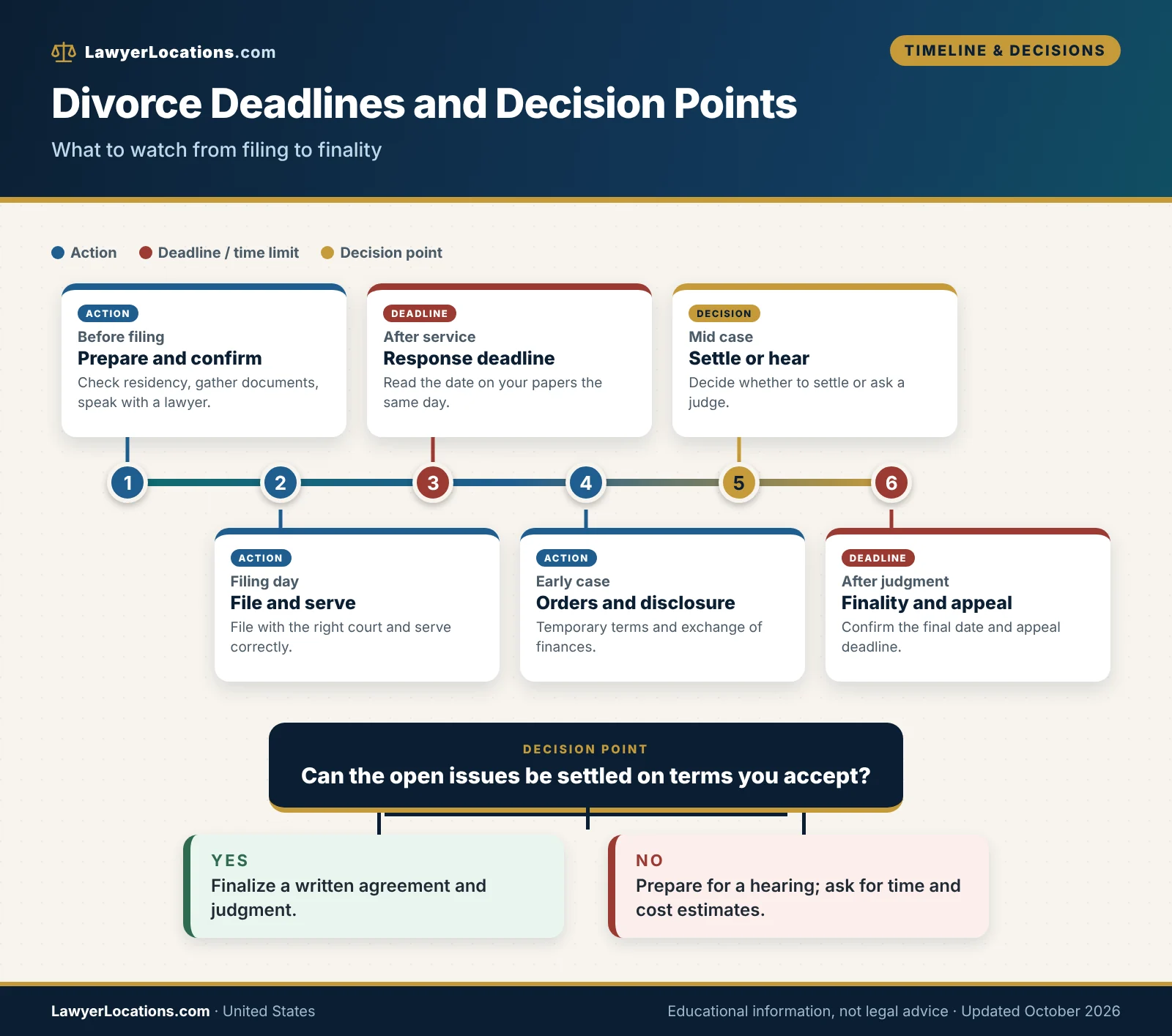
Text version of this graphic
- Before filing (action). Confirm residency, gather documents, speak with a lawyer.
- Filing and service (action). File with the right court; serve your spouse correctly.
- Response period (deadline). The served spouse must answer by the date in the papers.
- Temporary orders and disclosure (action). Short-term support and parenting terms; exchange financial information.
- Settlement or hearing (decision). Decide whether to settle or ask a judge to decide.
- Judgment and finality (deadline). Check the date the divorce is legally final and any appeal deadline.
Decision point: Can the remaining issues be settled on terms you can accept? If yes, finalize a written agreement. If no, prepare for a hearing and ask your lawyer about the expected time and cost.
Deadlines and decision points to track
Deadlines that can hurt you if missed
Most of the dates that matter come from papers you receive or file: the response deadline after service, dates for financial disclosure, hearing dates, deadlines to object to a proposed order and the deadline to appeal a judgment. These differ by state and court, so write down every date you are given and confirm each one with your lawyer or the clerk.
A missed deadline can lead to a default on an issue, a lost right to object or an order entered without your input. When you are served, read the response deadline on the papers on the same day.
The response deadline after service and any appeal deadline after judgment are set by your state’s rules and are stated on the papers or in the judgment. Check them the day you receive them rather than relying on this guide or on memory.
A framework for settle-or-fight decisions
At each major issue, compare four things: what you realistically expect a judge to do, what the other side has offered, what continuing will cost in fees and time, and how important the issue is to you. When the gap between offer and expected result is small and the cost of continuing is large, settlement is often the sensible choice.
Some issues deserve a fight even when it is expensive, especially those involving children’s safety or a fundamental financial protection. Your lawyer can help separate those from issues that are mainly about pride.
| Decision point | When it usually arises | What to weigh |
|---|---|---|
| Where to file | Before filing, if more than one state or county is possible | Residency rules, waiting periods, where the spouses and children live |
| Whether to hire a lawyer | Before filing or on being served | Complexity, children, safety, assets, your comfort with forms |
| Temporary orders | Early in the case | Immediate need for support or a parenting schedule; effect on the final outcome |
| Mediation or settlement offer | After disclosure; before trial setting | Gap between offer and expected result; cost and time of continuing |
| Hiring experts | When business, property or custody issues are disputed | Value at stake compared with the expert’s cost; sharing one neutral expert |
| Trial or final agreement | Near the trial setting | Risk of an unfavorable ruling; ability to craft terms that fit your family |
| Appeal or enforcement | After judgment | Deadlines, grounds for appeal, practical cost |
When the divorce is final, and what comes after
Signed is not always final
Depending on the state, a judge’s signature may end the marriage immediately or start a further period. In California, no judgment of dissolution is final for terminating the marriage until six months from service or appearance have expired, under Cal. Fam. Code § 2339. In Massachusetts, a judgment nisi becomes absolute 90 days after entry unless the court orders otherwise, under M.G.L. c. 208, § 21, and after a nisi judgment is entered, neither spouse can have the case dismissed on motion alone, with limited exceptions.
Always ask your lawyer or the clerk for the date your divorce becomes legally final and get it in writing. That date, not the hearing date, controls remarriage, name changes in some places, insurance and many tax and benefit questions.
After-judgment tasks that take their own time
A judgment often creates a list of tasks that can take months: transferring or refinancing a home, retitling vehicles and accounts, completing retirement division orders, changing beneficiaries on insurance and retirement accounts, updating wills and powers of attorney, and changing your name on identity documents if you choose to.
Check with your employer or plan administrator about health coverage before the final date, because coverage often depends on marital status. Keep a certified copy of the judgment; banks, agencies and plan administrators usually ask for one.
Mistakes to avoid, long-tail questions and next steps
The most expensive divorce mistakes are rushed agreements, missed deadlines, hidden assets and treating the process as a contest. The cheapest fix for most of them is information, gathered early.
This final section lists common errors, answers more than twenty questions people ask about divorce timing in plain terms and ends with next steps you can take this week.
Common mistakes that add time or risk
Mistakes that slow the case
- Filing before checking residency requirements or the right county
- Serving papers by a method the court does not accept, or not filing proof of service
- Submitting incomplete financial disclosures or forms that do not match each other
- Missing the response deadline or a required parenting class date
- Waiting to start retirement division orders until after the judgment
- Treating every issue as equally important, which prolongs negotiation
Each of these is avoidable with a checklist and a review of your papers before filing. A short consultation to review your plan costs far less than refiling.
Mistakes that risk your rights
Signing an agreement you do not understand, skipping disclosure because you “trust” your spouse, moving assets, ignoring a protective order or posting about the case online can create lasting problems. A signed settlement is hard to undo.
Before you sign, ask someone qualified, ideally a lawyer licensed in your state, to explain every term, including how the agreement handles retirement accounts, taxes, health insurance, debts and what happens if circumstances change.
Long-tail questions answered
Timing, waiting periods and process questions
How long does an uncontested divorce take?
It depends mostly on your state’s waiting period and the court’s review time. If you agree on everything, the paperwork is complete and no long statutory wait applies, it can take a matter of weeks to a few months. Where a longer period applies, such as six months in California, the minimum is longer.
What is the fastest a divorce can be finalized?
The fastest statutory floor in our comparison is Florida’s 20 days from filing, though a judge may enter judgment earlier if waiting would be unfair. Texas requires 60 days, subject to a family-violence exception. Actual speed also depends on service, paperwork and the court.
Can I get divorced in 30 days?
Only in a state where the law allows a decree that soon and where the case is fully agreed and perfectly documented. In states with 60-day, 90-day or longer waits, it is not possible unless a statutory exception applies. Ask your court clerk about your state’s minimum.
How long does a contested divorce take?
Often many months to more than a year, driven by how many issues are disputed and by the court’s calendar. Disputes over children, businesses and hidden assets tend to take the longest.
How long does a divorce with children take?
If the parents agree on a parenting plan and support, it can be close to an uncontested case, although some states have longer waits when minor children are involved, as Michigan does. If parenting is disputed, expect mediation, possible evaluations and a longer schedule.
How soon after filing can a Texas court grant a divorce?
Under Tex. Fam. Code § 6.702, a court may not grant a divorce before the 60th day after the suit was filed, unless the family-violence exception applies. Many cases take longer because the issues have to be resolved first.
Does California’s six-month wait start when I file?
No. Under Cal. Fam. Code § 2339 it runs from service of the summons and petition or the respondent’s appearance, whichever comes first. That is why prompt, proper service matters.
How long do I have to live in a state before I can file?
It varies. Colorado requires one spouse to have been domiciled there for 91 days, North Carolina six months for an absolute divorce, and New York uses one-year or two-year residency rules depending on the facts. Confirm your state’s rule before filing.
Does time spent separated count toward the divorce?
In states with a separation requirement, yes. North Carolina requires one year of living separate and apart, and Virginia generally requires one year, or six months with a separation agreement and no minor children. In North Carolina, isolated incidents of intercourse do not restart the one-year period.
Can my spouse stop the divorce by refusing to sign?
In most places a spouse cannot indefinitely block a no-fault divorce, but they can slow it by not cooperating. In Washington, for instance, if a spouse denies the marriage is irretrievably broken, the court weighs the circumstances and may continue the matter up to 60 days for counseling before deciding.
What if my spouse does not respond to the papers?
You may be able to ask for a default after the response deadline passes and you have proof of proper service. The judge will still review the requested terms, so expect some additional steps.
Does military service delay a divorce?
It can. Federal law at 50 U.S.C. § 3931 requires a stay of at least 90 days in certain circumstances when a servicemember is a defendant. Courts check military status before entering default judgments.
Why is my divorce taking so long?
Common reasons are a statutory waiting period, slow service, incomplete disclosure, disputes about children or valuation, continuances and paperwork errors. Ask your lawyer which of these applies and what could be done about it.
Cost, children and life-after-divorce questions
Is my divorce final the day the judge signs?
Not always. In California the judgment is not final for ending the marriage until the six-month period has run, and in Massachusetts a judgment nisi becomes absolute after 90 days. Ask for the legal finality date in writing.
How soon can I remarry?
Only after your divorce is legally final in your state, which may be later than the hearing date. Confirm the exact date with your lawyer or the clerk before making wedding plans.
Can I change my name as part of the divorce?
Many courts allow you to ask for a name change in the divorce papers, but procedures differ. Ask the clerk or your lawyer, and request certified copies of the judgment for agencies and banks.
Is legal separation faster than divorce?
Not necessarily. It follows its own rules and does not end the marriage, though it can create the living-apart record some states require. Our guide on legal separation versus divorce compares the two.
Will hiring a lawyer make my divorce faster?
It can reduce avoidable delay from errors and missed deadlines, but it cannot shorten waiting periods or the court calendar. Be wary of anyone who promises a date.
Do I have to go to court?
In many uncontested cases the judge can approve the paperwork without a hearing, or the hearing is brief or remote. Contested cases usually involve at least some hearings. Check your court’s practice.
Can my spouse and I use the same lawyer?
A lawyer generally represents one spouse, because the spouses’ interests can conflict. Couples who want a neutral helper can consider a mediator, who does not give legal advice to either side. Ask about your state’s rules.
What happens to health insurance when the divorce is final?
Coverage under a spouse’s plan often ends at or soon after finality. Ask the plan administrator what options exist and by when you must act, and do it before the final date.
How long does it take to divide a retirement account?
Many plans require a court order, often a QDRO, that the plan administrator must approve, and the process can take months after the judgment. Starting the draft before the judgment can help.
Can I stop or pause a divorce?
Often yes, before judgment, by dismissing the case or agreeing with the other side to pause it, but rules vary. In Massachusetts, after a judgment nisi is entered, neither spouse can dismiss on motion alone, with limited exceptions under M.G.L. c. 208, § 21.
What if we reconcile partway through?
You can usually ask the court to dismiss the case, and some courts may require counseling in contested situations. In Pennsylvania, for example, a court that finds a reasonable chance of reconciliation under the one-year separation route postpones the case 90 to 120 days and requires counseling.
Is there a waiting period in New York?
The residency statute, N.Y. Dom. Rel. Law § 230, sets one-year and two-year residence requirements rather than a countdown after filing. Other New York requirements apply to the grounds and to resolving the case, so ask a New York lawyer or the court clerk for the current process.
Next steps
What to do this week
Confirm residency and the right county, then write down the three issues that matter most to you. Gather the key financial documents, and read your court’s website for the divorce checklist, forms, fees and any self-help center. If you were served, note the response deadline today.
If safety is a concern, contact a local domestic violence program or the court’s protective-order office first. Divorce timing can wait; your safety should not.
When you are ready to talk to a lawyer
Use the questions in this guide to compare at least two divorce lawyers or limited-scope providers, and ask each for best case, likely case and slow case timelines for your county. A state bar lawyer referral service or your court’s self-help center can point you toward licensed lawyers; they can also tell you about legal aid if cost is a barrier.
For related reading, see our guides on legal separation versus divorce, divorce attorneys in Las Vegas and family law attorneys in Dallas.
Ready to compare your options?
Start with the question of how long does divorce take where you live: confirm your state’s waiting period, list your documents and ask any lawyer you consult for a written range for your county. Browse LawyerLocations.com to learn how to compare lawyers by location, then confirm any lawyer’s license with your state bar.
General information only. This guide is general legal information, not legal advice, and reading it does not create an attorney-client relationship. LawyerLocations.com is a legal-education and lawyer-discovery resource, not a law firm. Divorce laws, waiting periods, fees and court procedures change and differ by state and county. Consult a lawyer licensed in the relevant jurisdiction and confirm current requirements with your court clerk.
Sources & References
Show all 13 sources
- Model Time Standards for State Trial Courts (approved August 2011) — National Center for State Courts, via Texas Judicial Branch — txcourts.gov — accessed October 2026
- California Family Code § 2339 — California Legislature (statute text) — california.public.law — accessed October 2026
- Texas Family Code § 6.702 — Texas Legislature (statute text) — texas.public.law — accessed October 2026
- Florida Statutes § 61.19, Entry of judgment of dissolution of marriage; delay period — Florida Legislature — leg.state.fl.us — accessed October 2026
- RCW 26.09.030, Dissolution of marriage or domestic partnership — Washington State Legislature — app.leg.wa.gov — accessed October 2026
- Colorado Revised Statutes § 14-10-106, Dissolution of marriage — Colorado General Assembly (statute text) — colorado.public.law — accessed October 2026
- 23 Pa.C.S. § 3301, Grounds for divorce — Pennsylvania General Assembly (statute text) — law.justia.com — accessed October 2026
- Michigan Compiled Laws § 552.9f — Michigan Legislature — legislature.mi.gov — accessed October 2026
- North Carolina General Statutes § 50-6, Divorce after one year’s separation — North Carolina General Assembly — ncleg.gov — accessed October 2026
- Code of Virginia § 20-91, Divorce from bond of matrimony — Virginia Division of Legislative Services — law.lis.virginia.gov — accessed October 2026
- Massachusetts General Laws c. 208, § 21 — Massachusetts Legislature — malegislature.gov — accessed October 2026
- New York Domestic Relations Law § 230 — New York State Senate — nysenate.gov — accessed October 2026
- 50 U.S.C. § 3931, Servicemembers Civil Relief Act, stay of proceedings — Legal Information Institute, Cornell Law School — law.cornell.edu — accessed October 2026
Legal Disclaimer and Limitation of Liability
Informational and illustrative purposes only. This article was prepared by LawyerLocations.com solely on the basis of the information available to us at the time of writing. It is an illustrative, general overview. It is not a complete or authoritative statement of the law, and it has not been reviewed by a lawyer licensed in your state or county.
Not legal advice. Nothing in this article is legal, financial, tax or immigration advice, and reading it does not create an attorney-client relationship between you and LawyerLocations.com or any author, lawyer or firm mentioned. Laws, court rules, fees, filing deadlines and agency procedures differ by state, county and court, and they change often. Some details here may be simplified, incomplete or out of date, and time limits for legal claims can be short.
No warranty. We make no representation or warranty, express or implied, about the accuracy, completeness, timeliness or suitability of this content for your situation. Please do not rely on it to make, delay or skip any legal decision. Check the facts against official sources and speak with a licensed attorney in the relevant jurisdiction before you act.
Limitation of liability. To the fullest extent permitted by law, LawyerLocations.com and its owners, authors and contributors disclaim all liability for any loss, damage, cost or other consequence arising from the use of, or reliance on, this article, including any content on third-party websites we link to. Mentioning a lawyer, firm, organization or service is not an endorsement and is not a promise of any result. If you are in immediate danger, contact your local emergency number.