Anyone searching for a probate lawyer milwaukee wi is usually trying to answer three questions at once: does this estate have to go through probate, what will it cost, and who should I call. In Wisconsin, small estates of $50,000 or less can often skip full probate through a transfer by affidavit under Wis. Stat. 867.03, while larger or disputed estates go through the Milwaukee County Circuit Court, Register in Probate, in Room 207 of the courthouse at 901 N. 9th Street.
This guide explains the Wisconsin rules, the Milwaukee County steps and local bond practice, how probate attorneys are paid under the “just and reasonable” standard, and how to compare lawyers before you sign a fee agreement. It is general information for readers in Milwaukee, not advice about your family’s situation.
How Probate Works in Wisconsin: The Rules Behind Every Milwaukee Case
Probate is the court-supervised process of settling a deceased person’s affairs and passing on what they owned. Wisconsin’s probate rules are state law, found mainly in chapters 851 to 879 of the Wisconsin Statutes, so an estate in Milwaukee follows the same code as one in Superior or La Crosse. The next sections explain what goes through the court, which of four procedures applies, and how Wisconsin’s marital property system changes the picture.
What probate is and which assets go through it
The State Bar of Wisconsin’s consumer pamphlet describes probate as a court-supervised procedure for transferring ownership of someone’s assets after death. It validates a will, determines what the estate owes in taxes and to creditors, and distributes what is left. An estate can go through probate even when there is no will, in which case state intestacy law decides who inherits.
Assets that usually pass through the estate
Property the person owned in their sole name, with no beneficiary or co-owner who takes automatically, is what probate administers. Think of a checking account with no payable-on-death designation, a car titled only to the decedent, or a house held in one name. Life insurance and retirement accounts also fall into the estate when no beneficiary was named, or when the estate itself was named as the beneficiary.
The person who handles the estate is called the personal representative, which is Wisconsin’s term for an executor or administrator. A will can nominate one, but the nomination alone does not give authority. Only an appointment by the Register in Probate or a judge creates legal authority, and the paper that proves it is called domiciliary letters.
Assets that usually pass outside probate
Many assets pass by contract or by the way title is held, so the probate court never touches them. The State Bar pamphlet lists jointly owned property that passes to the surviving owner, and life insurance and retirement accounts with a named beneficiary other than the estate. Its estate-planning page adds survivorship marital property and transfer-on-death or payable-on-death accounts to the list.
Wisconsin also lets owners designate a beneficiary for real estate. Under Wis. Stat. 705.15, a transfer-on-death designation must be submitted to the register of deeds in the county where the property sits before the owner dies, or it is not effective.
Four ways Wisconsin settles an estate
Wisconsin does not push every estate down one track. The statutes and the court system’s guide describe a ladder that runs from a short affidavit up to continuous supervision by a judge.
Transfer by affidavit and summary procedures for small estates
The simplest path is a transfer by affidavit. Under Wis. Stat. 867.03(1g), it applies when the decedent’s property subject to administration in Wisconsin does not exceed $50,000 in gross value. An heir, a trustee of the decedent’s revocable trust, a personal representative named in the will, or a former guardian can use it to collect property from banks and others. The court system lists the form as PR-1831, Transfer by Affidavit ($50,000 and Under).
There are guardrails. A will-named personal representative generally cannot use the affidavit for real estate unless they also qualify as an heir, trustee or former guardian, and holders of property generally wait 30 days before releasing assets to a will-named representative. Notice to the Department of Health Services is required when the decedent or a spouse received certain long-term care or medical assistance benefits.
Two related procedures sit nearby. Wis. Stat. 867.01 allows summary settlement when the estate, after secured debts, is $50,000 or less and the decedent left a spouse or domestic partner, minor children, or both. The court’s guide also describes summary assignment for estates of $50,000 or less that do not fit summary settlement. Both use petitions in the formal administration form set.
Informal administration
Informal administration is probate without continuous court supervision. Under chapter 865, a probate registrar, an officer of the court, performs the court’s functions. The Wisconsin court system’s guide says it does not require an attorney, although a person may consult one at any point.
It is the common route for estates with a valid will, cooperative heirs and no disputes. The statute (Wis. Stat. 865.02) allows it when the will does not prohibit it and names a personal representative who accepts. If there is no will, all interested persons must consent in writing to informal administration and to the same person serving as representative.
Formal administration
Formal administration happens under a judge’s continuing supervision. The State Bar pamphlet says it is generally required when a will has contested issues, because only a judge can decide disputes, and that a lawyer must represent the personal representative. Milwaukee County’s own informal probate page says that when an application is not eligible for informal handling, the filer is notified that formal administration is required and must hire an attorney.
Side-by-side comparison of the four paths
| Procedure | Typical use | Key limit | Lawyer required? |
|---|---|---|---|
| Transfer by affidavit (Wis. Stat. 867.03) | Small estates; collecting accounts and personal property | $50,000 gross value of property subject to administration | No (the court guide advises consulting an attorney first) |
| Summary settlement or assignment (Wis. Stat. 867.01 and the court guide) | Small estates, often with a spouse or minor children | $50,000 (net of secured debts for settlement) | Ask the Register; the petitions are in the formal-administration form set |
| Informal administration (ch. 865) | Valid will or consenting heirs, no disputes | Must not be prohibited by the will; no demand for formal proceedings | No, but advisable for hearings |
| Formal administration (Wisconsin probate code) | Disputes, unclear will, contested claims | Judge supervises | Yes, per the State Bar pamphlet |
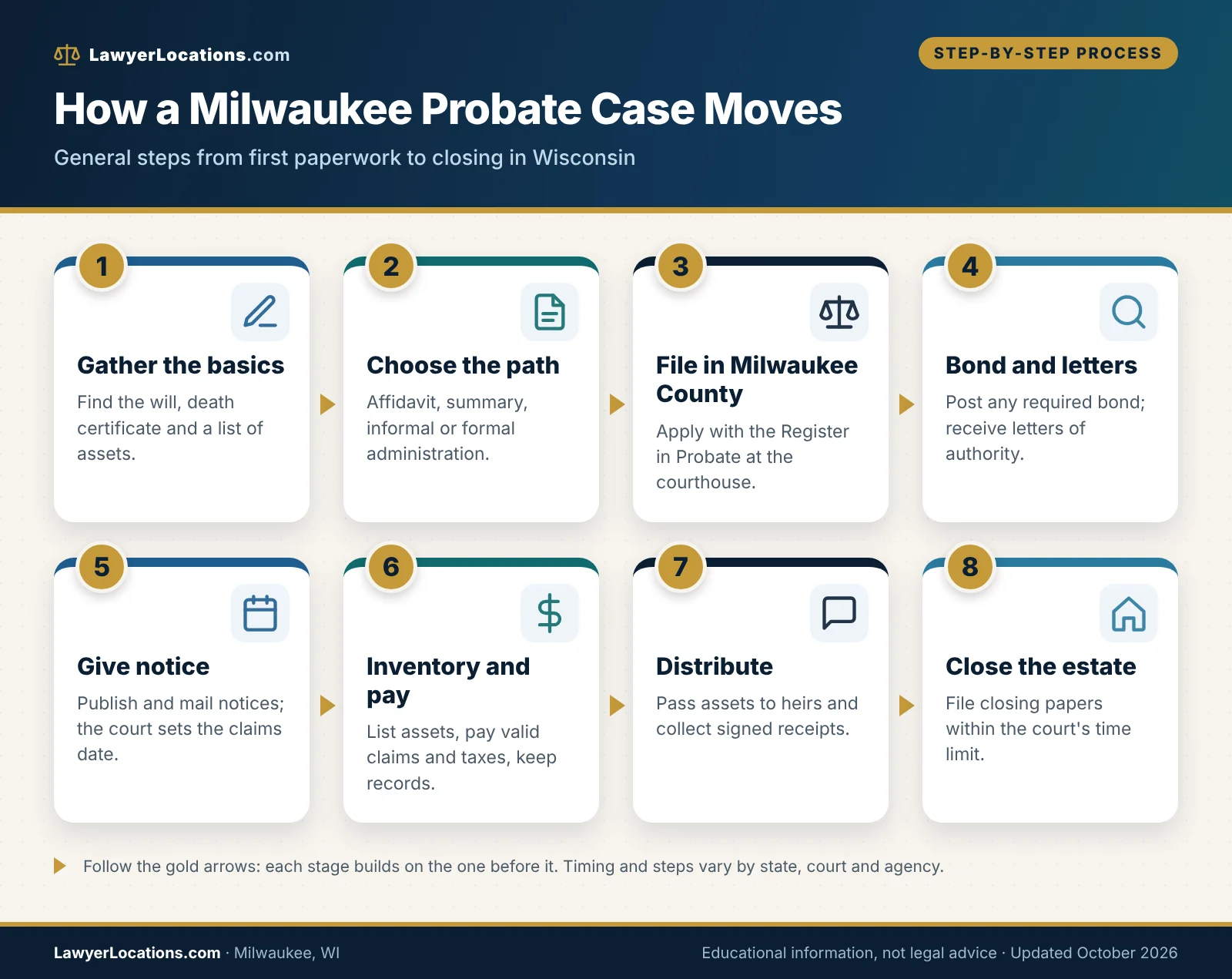
Text version of this graphic
- Gather the will, death certificate and a list of assets and debts.
- Decide the path: affidavit, summary procedure, informal or formal administration.
- File the application with the Milwaukee County Register in Probate.
- Post any required bond and receive letters from the Register or a judge.
- Give notice, then wait for the creditor claims deadline the court sets.
- File the inventory, pay valid claims and taxes, and keep records.
- Distribute what remains, file the closing papers and collect receipts.
How Wisconsin’s marital property law shapes an estate
Wisconsin is a marital property state, which means married couples hold most property acquired during the marriage in a way that is close to community property. For an estate, this changes what the decedent actually owned and can leave by will. A Milwaukee lawyer will usually sort this out before anyone talks about who inherits what.
Each spouse’s one-half interest
Under Wis. Stat. 766.31(3), each spouse has a present undivided one-half interest in each item of marital property. At the first spouse’s death, the decedent controls only their half, and the survivor keeps their own half whether or not a will exists.
The practical result is that the estate to be probated may be smaller than the total household wealth. That can matter for the $50,000 small-estate ceilings and for the court fee, which is based on the net value subject to administration.
Survivorship agreements, the elective share and intestacy
Spouses can sign a marital property agreement that sends property to a person or trust at death without probate. Wis. Stat. 766.58(3)(f) allows property to pass “without probate to a designated person, trust or other entity by nontestamentary disposition,” and the provision is revoked on divorce.
A surviving spouse also has a statutory safety net. Wis. Stat. 861.02 lets the survivor elect up to half of the augmented deferred marital property estate. If there is no will, Wis. Stat. 852.01 gives the spouse the entire estate when all children are shared with the decedent, and one-half when a child comes from outside the marriage. The State Bar recommends an attorney review of any will drafted in a state without a marital property system.
Milwaukee County Probate: Courts, Offices, Bonds and Local Steps
Probate for a Milwaukee County resident is handled by the Register in Probate, which is part of the Milwaukee County Circuit Court. The venue rule is simple: a Wisconsin resident’s estate is opened in the county where they were domiciled, meaning their permanent home, not where the lawyer’s office is. This section covers the local offices, the filing sequence, Milwaukee County’s bond practice and the deadlines that set the pace.
Where probate happens in Milwaukee County
The Milwaukee County Courthouse at 901 N. 9th Street, Milwaukee, WI 53233, houses both the Register in Probate and the Clerk of Circuit Court. Suburbs such as Wauwatosa and West Allis sit inside Milwaukee County, so those residents also file here, while a resident of Waukesha County or Ozaukee County files in their own county’s probate office. If the decedent did not live in Wisconsin but owned property here, the court guide says the filing can be made in a Wisconsin county where the property is located.
The Register in Probate and the Clerk of Circuit Court
Milwaukee County’s court pages list the Register in Probate in Room 207 of the courthouse, open 8 a.m. to 4:30 p.m. The Clerk of Circuit Court is in Room 104 at the same address, also 8:00 a.m. to 4:30 p.m. in person. The county’s informal probate page tells filers to call the probate office at (414) 278-4444, option 2 to speak with the Register or a Deputy Register, and suggests calling ahead before an in-person visit.
| Office or service | Location | Contact and hours |
|---|---|---|
| Register in Probate (informal probate questions) | Courthouse, 901 N. 9th St., Room 207 | (414) 278-4444, option 2; 8 a.m. to 4:30 p.m. |
| Wills for safekeeping | Register in Probate | (414) 278-4444; $10 fee |
| Appointments for closed or microfilmed records | Register in Probate | (414) 278-4452 |
| Clerk of Circuit Court | Courthouse, 901 N. 9th St., Room 104 | (414) 278-5362; 8:00 a.m. to 4:30 p.m. in person |
| Online case lookup | Wisconsin Circuit Court Access (WCCA) | wcca.wicourts.gov |
Records, wills for safekeeping and online lookup
Records from before 1985 are viewable in person only in Room 207, while newer probate records are searchable online through Wisconsin Circuit Court Access. The Register’s office also accepts wills for safekeeping for a $10 fee. The county’s page states that a will held this way cannot be viewed, and that the writer can withdraw it with identification and the original receipt. If a family member thinks the decedent left a will with the court, call the safekeeping number on the county page before assuming none exists.
Milwaukee’s filing steps and bond rules
Filing an informal estate in Milwaukee County follows the statewide form sequence, with one local twist that catches many first-time filers: the bond policy. The court system’s guide and Milwaukee County’s own page together give a fairly complete picture, though forms and local practice can change, so confirm with the Register’s office before you file.
Filing an informal case: forms and notices
The court guide, revised November 2025, lists the opening forms: PR-1801 Application for Informal Administration, PR-1806 Proof of Heirship, PR-1807 Consent to Serve, PR-1808 Statement of Informal Administration and PR-1810 Domiciliary Letters. Depending on whether every interested person signs a waiver, the notice to creditors is PR-1804 or PR-1805. Milwaukee County’s page links to the same forms plus an IRS Form 56 and a Department of Health Services probate claims notice.
After the Register signs the notice, the personal representative takes it to a newspaper designated by the Register. First publication within 15 days of the Register’s signature, running once a week for three consecutive weeks, is the requirement the guide describes, and Wis. Stat. 859.07(1) contains the same 15-day language. Known creditors are mailed a copy, and interested persons receive the notice, application and will.
The filing can be made in person, by mail or electronically, according to the county’s page. The State Bar’s probate pamphlet adds that Milwaukee County requires the personal representative to appear in person at the initial informal hearing, which is a practical point worth confirming by phone.
Bond rules that are specific to Milwaukee County
A probate bond is a kind of insurance that protects the estate if a personal representative mismanages assets. The county page says Milwaukee County does not accept signature bonds, and that the minimum bond in informal cases is $50,000. With no will, a bond is always required. A sole heir serving as representative, or an attorney serving, still needs one.
The Register will always accept a bond equal to the estimated estate value, and heirs may pledge their shares as excess surety under Wis. Stat. 856.25(3), though the $50,000 minimum still applies in no-will cases. The premium is an estate expense to ask a lawyer about.
A will that waives bond does not always end the discussion in Milwaukee County. The county page says that even with a will waiving bond, some bond is likely required when there is no attorney, and a full bond may be required. Ask the Register’s office, or a lawyer who files here regularly, what bond they expect before you rely on a waiver.
When the case turns formal
If a dispute arises or the Register decides an application is not suitable for informal handling, the case moves to formal administration before a judge. On the specific question of a bond disagreement, Milwaukee County’s page says to call the probate office and ask for a Deputy Register, or file for formal probate and request a hearing before the assigned judge. The county also offers a court calendar search for hearing dates.
Deadlines that set the pace of a Wisconsin estate
Most probate dates in Wisconsin are not a fixed number printed in a statute alone. They are set by an order in your case, then counted from there. Those order-based dates are what you should write on your calendar, and a lawyer will often track them for you.
The creditor claim deadline
Under Wis. Stat. 859.01, the court, or the probate registrar in informal proceedings, sets by order a deadline for filing claims against the estate. The date must be not less than 3 nor more than 4 months from the date of the order. An annotation to that section, citing Estate of Palmer, says the limitation period may not be waived.
The State Bar pamphlet says creditors typically have three to four months and that the court sets the exact date. Where the decedent or a spouse received certain long-term care or medical assistance benefits, Wis. Stat. 859.07(2) requires notice by registered or certified mail not less than 30 days before the deadline. If a claim is disputed, the court guide says an objection must be served or mailed and filed within 60 days of when the claim was mailed or served on the personal representative.
Do not guess the creditor deadline from a general rule. The date is in the order the Register or court signs in your case, and the notice published in the newspaper repeats it. Put that date on your calendar the day you receive it, and ask your lawyer which other dates run from it.
Inventory, closing and extensions
The inventory lists the fair market value of everything the decedent owned at death, and the guide says it should not be prepared until letters are granted. The court filing fee is tied to it: 0.2% of the net value of assets subject to probate, due within six months of appointment unless the deadline was shortened or extended. For closing, the guide says an informal estate must be closed within 12 months of opening and only after the claims deadline passes, while extensions are requested on forms PR-1833 and PR-1834.
The State Bar pamphlet says a small, uncomplicated estate may take up to six months and large or contested estates two years or more. It describes the outside closing limit more broadly, saying state law requires closing within 18 months, with several counties aiming for 12, and that courts can grant extensions. Because the two descriptions differ, ask the Register which date applies to your case. A missed deadline can require the personal representative to appear and show cause why they should not be removed, which is an avoidable and costly detour.
Do You Need a Probate Lawyer in Milwaukee? A Decision Framework
Wisconsin law does not require a lawyer for every estate, but it does require one in formal administration, and many families find they need legal advice well before that point. This section gives you a way to decide, based on the structure of the estate and the people involved rather than on a rule of thumb about size alone.
Situations where a lawyer is required or strongly advisable
Think of the decision as a two-part test: does the law require representation, and does the risk to you as personal representative justify paying for it? The first part is easy to answer. The second is a judgment call, and these facts tend to tip it.
Where the law requires an attorney
Formal administration requires an attorney for the personal representative, according to the State Bar pamphlet and the court system’s guide. If the Register tells you that informal administration is not available, Milwaukee County’s page says you must retain an attorney. Disputed claims, a will contest, or a disagreement about who the heirs are all lead to the same place.
Red-flag facts that call for legal advice
Some facts make a do-it-yourself estate risky even when the court would let you try. If any of these apply, a consultation is usually cheaper than a mistake.
- Heirs disagree about the will, about who serves as personal representative, or about how to split personal items.
- The original will cannot be found, or its signing or witnessing may be defective, which are listed reasons an application may be denied.
- The decedent owned real estate, a business, or out-of-state property.
- The decedent or a spouse received long-term care or medical assistance benefits, which triggers notice to the state.
- Debts may exceed assets, or the estate may be insolvent.
Situations where a self-directed informal estate may be reasonable
Some families settle an estate without a lawyer, and the court system supports that choice for informal cases. The question is whether your facts look like the ones the process was built for.
Features of a straightforward estate
A straightforward estate often has a valid original will that names a willing representative, heirs who agree, a modest number of accounts, and no claim that looks contested. If an estate falls under the $50,000 line, an affidavit may be all that is needed.
An adult daughter in Wauwatosa is named personal representative in her mother’s will. Her mother owned a house, a checking account and a modest brokerage account in her own name, and the three siblings all agree on the split. This looks like an informal case, but the daughter would still need to handle bond, publication, creditor notice and an inventory. A one-time consultation about whether the house and the Wisconsin marital property history create any title issues could be money well spent even if she files on her own.
What the Register can and cannot do for you
The Register in Probate is a court official, not your advisor. The court guide says the Register can review filings, request more information, set bond, issue notices and grant letters, but cannot give legal advice and generally cannot complete forms for the filer. The State Bar pamphlet makes the same point, noting the register can answer procedural questions but not give legal advice.
Other legal questions that travel with probate
Probate rarely stands alone. Taxes, benefit recovery and possible claims by the estate can all land on the same desk. A lawyer’s value often lies in spotting these side issues early.
Taxes: federal and Wisconsin
The IRS reports a federal basic exclusion amount of $15,000,000 for decedents dying in 2026, so most Milwaukee estates owe no federal estate tax. The State Bar pamphlet says the Wisconsin estate tax expired December 31, 2007, and it notes the estate pays state and federal income tax on income earned from the date of death until probate closes. The court guide also lists a closing certificate for fiduciaries from the Wisconsin Department of Revenue (Schedule CC) among the closing documents.
Benefit recovery notices and possible claims by the estate
If the decedent or a spouse received certain long-term care or medical assistance benefits, Wisconsin law requires notice to the state before the claims deadline, and the affidavit procedure carries the same kind of disclosure. A lawyer can help you identify when notice is required and respond if the state files a claim.
A death that resulted from someone else’s negligence can raise separate legal questions. A claim for the death itself is a different matter from probate, with its own rules and deadlines; see our guide to wrongful death lawyer costs and our overview of personal injury filing deadlines by state. Whoever handles the estate may need to coordinate with a lawyer on that claim.
How to Compare Probate Lawyers in Milwaukee
Choosing a probate lawyer in Milwaukee comes down to four checks: license and discipline history, fit with your kind of estate, how the lawyer communicates, and how the fee is structured. No directory, including this one, can tell you who is right for your family. What it can do is give you a repeatable method, so that each consultation produces answers you can compare side by side.
Checking credentials and discipline history
Verification takes about ten minutes and costs nothing. Do it before you pay a retainer, and again if a lawyer was recommended to you by a friend, a bank or a funeral home.
License status and discipline history search
The Wisconsin court system runs a lawyer status and history search at lawyerhistory.wicourts.gov. The search form accepts a last name, first name, State Bar number, law firm and city, among other fields. Use it to confirm that the person is licensed in Wisconsin and to see whether public discipline appears. The court system’s lawyer regulation pages also explain how to file a grievance if something goes wrong later.
Referral services and what they do and do not promise
Two bar-run referral services serve Milwaukee residents. The Milwaukee Bar Association’s Lawyer Referral & Information Service describes itself as a free phone referral service, and says that if you are referred to an attorney, the first half-hour of consultation costs no more than $20.00. The State Bar of Wisconsin’s Lawyer Referral Service makes the same $20 first-30-minute commitment for attorneys referred through it.
Neither referral service vouches for quality. The State Bar says its service “does not guarantee or certify special expertise in any specific legal area for which a referral is made.” Use a referral to get a first appointment, then evaluate the lawyer with the questions below.
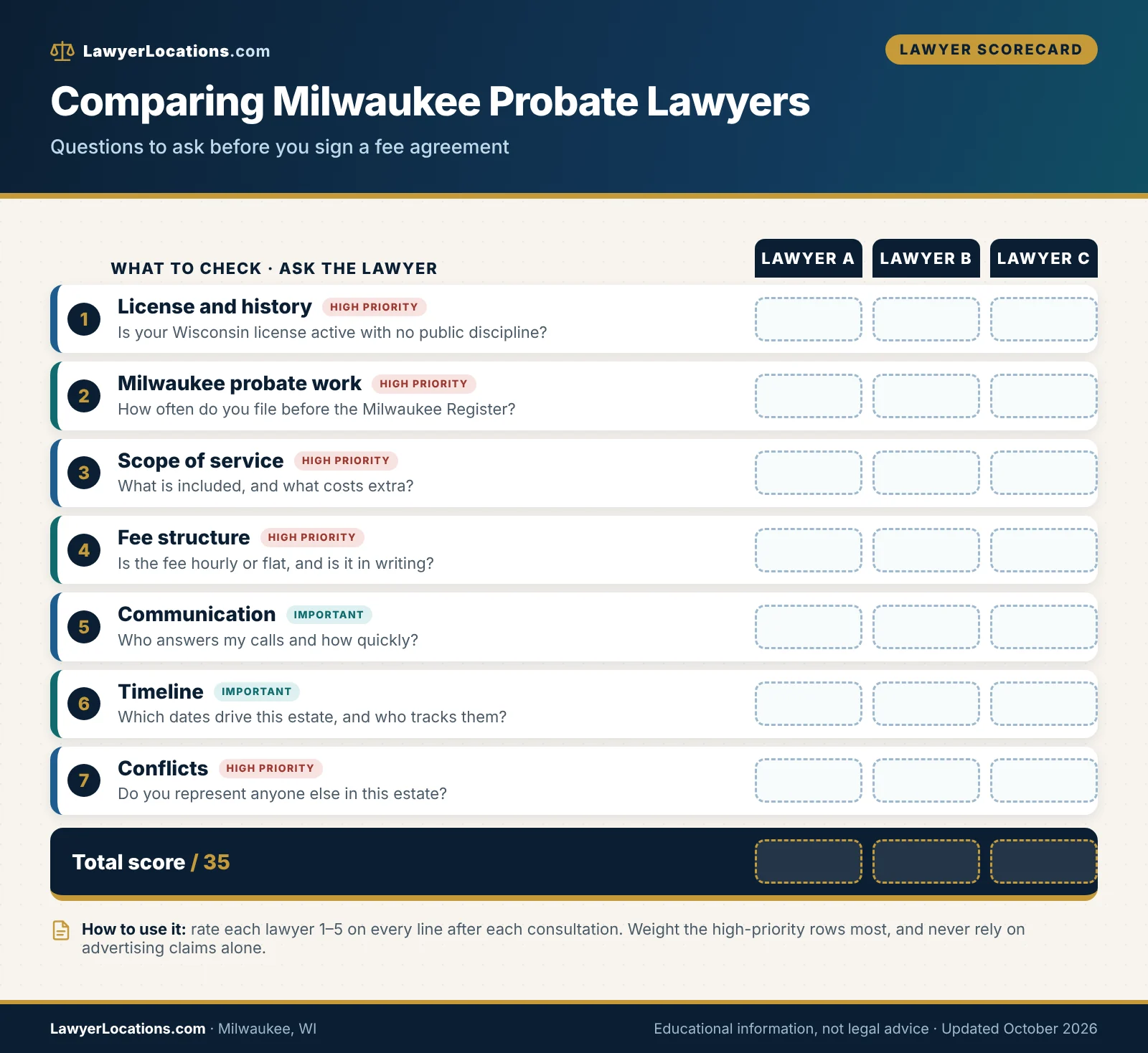
Text version of this graphic
| Criterion | Question to ask | Weight |
|---|---|---|
| License and history | Is your Wisconsin license active, with no public discipline? | High |
| Milwaukee probate work | How often do you handle estates before the Milwaukee Register? | High |
| Scope of service | What is included, and what costs extra? | High |
| Fee structure | Is the fee hourly or flat, and is it in writing? | High |
| Communication | Who will answer my calls, and how fast? | Medium |
| Timeline estimate | What dates drive this estate, and who tracks them? | Medium |
| Conflicts | Do you represent anyone else with an interest in this estate? | High |
Fit: experience, communication and local familiarity
Credentials tell you a lawyer may practice. Fit tells you whether the person will move your estate along without surprises. The best test is to listen to how they answer specific questions about your facts, not general ones about probate.
Questions about experience with Milwaukee County probate
The State Bar’s consumer guidance suggests asking what experience a lawyer has in the area of law, how many similar cases they have handled, whether they can provide references, and whether they can recommend someone else if they do not handle your kind of matter. For probate in Milwaukee, add local questions.
- How often do you open informal and formal estates in Milwaukee County, as opposed to other counties?
- What bond do you expect the Register to require for an estate like mine?
- Would you recommend informal or formal administration here, and why?
- Have you handled estates with Wisconsin marital property questions like mine?
- If a dispute arises, will you handle the formal proceeding yourself?
Communication, staffing and who does the work
Many estates are handled partly by paralegals and assistants, which is not a problem if the arrangement is clear. Ask who will prepare the inventory, who will talk to heirs, and who will attend hearings. If you will be the personal representative, you are the one who signs under oath, so you want a lawyer who explains the reasons behind each filing.
Red flags when choosing a probate lawyer
A few warning signs show up again and again in consumer guidance on hiring lawyers. They do not mean a lawyer is dishonest, but they are reasons to slow down and ask questions.
Fee and contract red flags
- No written explanation of the fee basis when the total cost will foreseeably exceed $1,000. SCR 20:1.5(b) requires the communication to be in writing in that situation.
- A fee quoted only as a percentage of the estate. The State Bar pamphlet says attorneys cannot base probate charges on a percentage of estate value, and the statute says the value of the estate may not be the controlling factor.
- Unclear handling of advance fees. Unearned fees must be held in trust until earned, unless the lawyer meets the rule’s written-notice alternative.
- Pressure to sign at the first meeting or to pay a large retainer before you have seen a written agreement.
Conduct red flags
- Promising an outcome or a timeline you cannot verify, especially on a contested estate.
- Being vague about conflicts, such as representing both the personal representative and a beneficiary who is in a dispute with them.
- Contacting you uninvited after a death notice and pressing you to hire quickly. Verify the person independently before you share any estate information.
Be wary of anyone who asks you to move estate money into a personal account or pay a “probate processing fee” outside the court’s published fee schedule. Court fees are paid to the clerk or Register in Probate, and attorney fees are subject to review by the court under Wis. Stat. 851.40.
Probate Lawyer Fees and Estate Costs in Milwaukee, WI
There is no published price list for probate in Milwaukee, and this guide does not quote fee averages because no official source supports one. What Wisconsin law does provide is a standard for attorney fees, a published court fee for opening and inventorying an estate, a default rate for the personal representative, and rules for how lawyers must communicate fees. Those are the building blocks of a realistic budget.
How Wisconsin treats attorney fees
Probate attorney fees are not set by law in dollar amounts. They are governed by a reasonableness standard that applies both to the lawyer’s contract with you and to the court’s review of fees charged to the estate.
The reasonableness standard in Wis. Stat. 851.40
Under Wis. Stat. 851.40(1), any attorney performing services for a deceased person’s estate under chapters 851 to 879, including informal administration under chapter 865, is entitled to “just and reasonable compensation for such services.” Subsection (2) allows a personal representative, heir, beneficiary under a will, or other interested party to petition the court to review the fee.
When the decedent died without a will or the will says nothing about attorney fees, the court looks at the time and labor required, the attorney’s experience and knowledge, the complexity and novelty of the problems, the responsibilities assumed and results obtained, and the sufficiency of available assets. On that last factor the statute adds that the value of the estate may not be the controlling factor.
Fee structures, retainers and written agreements
The State Bar’s consumer pamphlet says probate attorneys may bill hourly or by flat fee, and that by law they cannot base probate charges on a percentage of the estate’s value. It describes an hourly fee as time spent multiplied by an hourly rate, and a flat fee as a fixed price for a defined service.
The Wisconsin Supreme Court rule on fees, SCR 20:1.5, says a lawyer may not charge an unreasonable fee and lists factors that include the time and labor required and the fee customarily charged in the locality for similar services. It also requires the scope of representation and the basis of the fee to be communicated to the client in writing, before or within a reasonable time after the work begins. If the total cost is reasonably foreseen to be $1,000 or less, the communication may be oral or in writing, and above $1,000 the purpose and effect of any retainer or advance fee must be in writing.
Court costs, bonds and other estate expenses
The lawyer is only one line in the estate’s budget. Court fees, bond, publication, appraisals and accounting costs are paid from the estate, and some of them depend on facts unique to your family.
Court fees you can verify
Under Wis. Stat. 814.66, the register in probate collects a fee tied to the value of the estate: $20 if the net value subject to administration is $10,000 or less, and 0.2% of that value above $10,000. The court guide describes the same 0.2% fee on the net inventory value and says it is due within six months of appointment. By simple arithmetic, 0.2% of a $500,000 net estate is $1,000, though your own figure depends on the inventory.
| Item | Fee | Notes |
|---|---|---|
| Estate filing fee | $20, or 0.2% of net value | $20 if net value is $10,000 or less; 0.2% above that; paid when the inventory is filed. |
| Copies | $1 per page | Certified or not; also listed on Milwaukee County’s page. |
| Filing a claim against an estate | $3 | Added to the claim amount and recoverable as part of it. |
| Will safekeeping | $10 | Milwaukee County Register in Probate. |
| Electronic filing | $35 per party, per case | Effective May 1, 2024, per the Wisconsin court system; fee waiver available on form CV-410. |
Milwaukee County’s informal probate page does not list probate fees, and the general civil fee schedule it links to carries an old effective date, so ask the Register’s office to confirm the amount due before you file.
Costs that vary by estate
Several costs have no fixed amount and depend on the facts. A bond premium varies by the bond amount, which in Milwaukee County starts at $50,000 in informal cases. Newspaper publication is paid to the newspaper the Register designates. Appraisals, tax preparation, and accounting help are added when the estate includes real estate, a business, or complicated tax issues.
Personal representative pay and fee disputes
Two final money questions come up in nearly every consultation: what the personal representative can be paid, and what to do if a fee looks wrong.
The personal representative’s own compensation
Under Wis. Stat. 857.05, the personal representative may be reimbursed for reasonable costs of administration and may receive a service fee. The statute sets compensation at a rate of 2 percent, or a rate agreed in writing, and makes it “subject to the approval of the court.” The State Bar pamphlet describes the 2 percent as applied to the inventory value of assets less mortgages or liens. The court may reduce or deny pay if the representative neglects their duties.
Some personal representatives choose not to take the fee. Whichever way you decide, ask a lawyer or tax adviser how the choice plays out for taxes, and document any written agreement about the rate.
Disputing a bill
Start with a conversation. The State Bar’s consumer pamphlet says to raise questions with the lawyer first, because errors are often easy to fix, and warns that “the worst thing you can do is ignore the bill.” Some fee agreements require arbitration, and the State Bar’s Fee Arbitration Program can help resolve disputes between lawyers and clients.
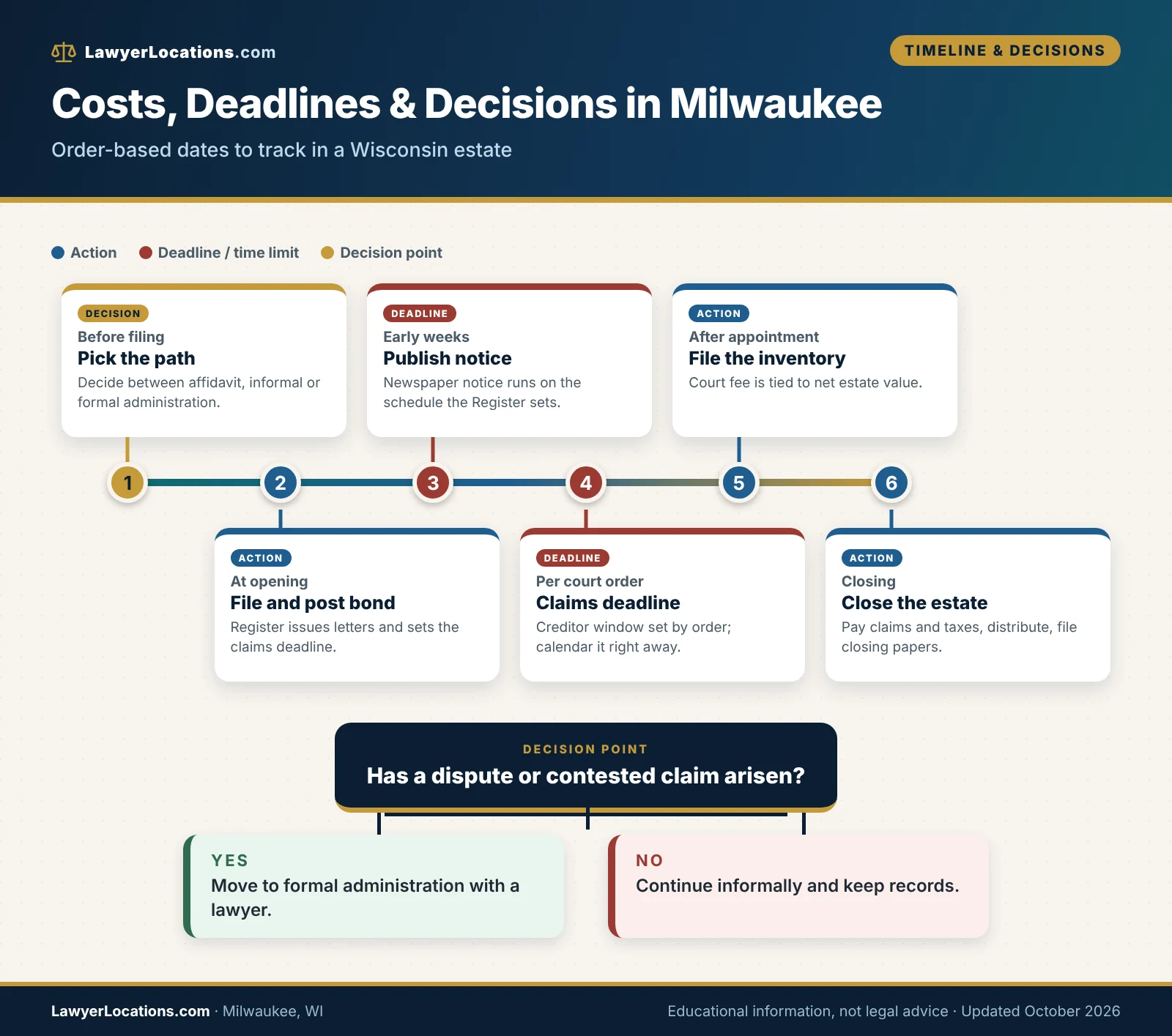
Text version of this graphic
- Before filing: Gather the will and records; decide whether an affidavit, informal or formal case fits.
- Opening: File the application and bond; the Register issues letters and sets the claims deadline.
- Within 15 days of the order: First newspaper notice runs, then weekly for three weeks.
- Claims deadline: Set by order, 3 to 4 months from the order date.
- Within six months of appointment: File the inventory and pay the court fee, unless extended.
- Closing: Pay claims and taxes, distribute, and file the closing statement and receipts within the court’s time limit.
- Decision point: If a dispute arises, switch from informal to formal administration with a lawyer.
Preparing for a Probate Consultation in Milwaukee
A first meeting goes further when you arrive with the documents and the questions already organized. The lawyer can then spend the time on your decisions instead of hunting for paperwork. This section covers what to gather, what to ask, and what usually happens after you decide to hire.
Documents and information to gather
Gather what you can before the first meeting, and say plainly what you cannot find. Gaps are normal, and a good lawyer will tell you which ones matter.
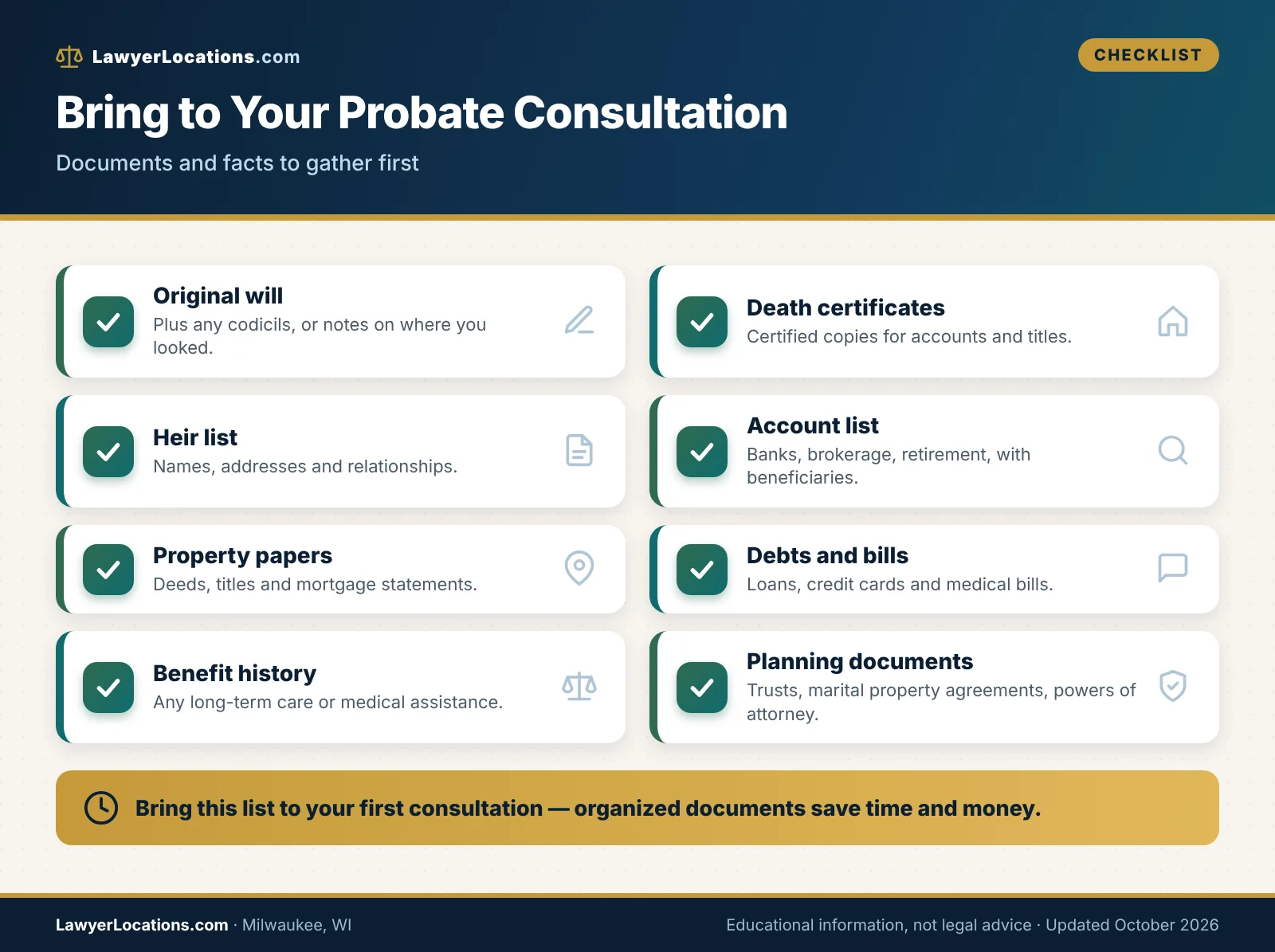
Text version of this graphic
- Original will and any codicils, or notes on where you looked
- Death certificate copies
- List of heirs with addresses and relationships
- List of bank, brokerage and retirement accounts with beneficiary information
- Deeds, vehicle titles and mortgage statements
- Recent bills, loan statements and credit card statements
- Benefit information, including any long-term care or medical assistance
- Marital property agreements, trust documents and powers of attorney
Core documents
Bring the original will if you have it, because the court guide says original wills must be delivered to the court. Also bring the death certificate, a list of heirs with addresses, and any trust, marital property agreement or beneficiary paperwork. If you cannot find a will, tell the lawyer where you have already looked, including a safe deposit box, a home safe, the drafting attorney’s office, and the Register in Probate for wills held for safekeeping.
Asset and debt inventory
Make a simple list of what the decedent owned and how title was held: sole name, joint, marital property, or payable on death. Add approximate values, since the final inventory will list fair market value as of the date of death. Include the debts you know about, including mortgages, credit cards and medical bills, and any benefits the decedent or a spouse received that could involve a state claim.
Questions to ask the lawyer
Write your questions down before the meeting, because the first meeting is usually short. Compare the answers across two or three lawyers and keep notes in the same format.
Questions about scope, timeline and cost
- Is there a charge for the first meeting? The State Bar tells consumers to always ask this when scheduling.
- What is your fee arrangement for this estate: hourly or flat, and what does it include?
- What court fees, bond premium, publication and other costs should I expect?
- Which procedure do you recommend: affidavit, summary, informal or formal administration?
- What are the key dates, and who calendars them?
- Will you give me the fee agreement in writing before I pay a retainer?
Questions about communication and duties
Ask how the lawyer will keep you informed, whether you can reach them directly, and who will attend hearings. Ask what you must do personally as the representative, such as signing sworn documents, keeping records and obtaining receipts from each distributee. The court guide lists duties that include marshaling assets, keeping records, notifying interested persons, paying valid claims, distributing assets and obtaining receipts.
What to expect at and after the first meeting
The first meeting should tell you whether the lawyer understands your situation and whether you trust the person. It should not tie you to an engagement.
The meeting itself
If the Milwaukee Bar Association or State Bar referral service sent you, mention it when you schedule so the lawyer applies the referral terms to the first meeting. Both services say the first half hour costs no more than $20, and regular fees apply afterward.
After you hire
Read the engagement letter before you sign it, and keep a copy. A lawyer will typically prepare the application and notices, advise on bond, help you publish and mail notices, track the claims deadline, and prepare the inventory and closing papers. You remain responsible for decisions as personal representative, and the court guide notes a personal representative can face personal liability if taxes are left unpaid.
Ask for a copy of everything filed and keep a running file of receipts. If you also need planning help for your own estate after this experience, our guide to living trust lawyers explains one way people avoid probate for their own heirs.
Free Help, Common Mistakes and Next Steps
Not every Milwaukee family can hire a lawyer on day one, and some do not need to hire one for the whole process. This closing section lists the verified local resources, the mistakes that most often cause delay, and a short plan for the week ahead.
Free and low-cost help in Milwaukee
Help comes in two flavors: organizations that connect you with a lawyer, and organizations or court offices that give limited help directly. Check each program’s current rules, because eligibility, hours and topics change.
Referral and clinic options
The table lists the options we verified on official pages in October 2026, with what each page does and does not say. A program not listing probate on its page does not mean it will not help, but it does mean you should ask before you plan around it.
| Resource | What it offers | Contact and notes |
|---|---|---|
| Milwaukee Bar Association Lawyer Referral & Information Service | Free phone referral; first half-hour with a referred attorney costs no more than $20.00 | findmilwaukeelawyers.org; a WisLawHelp listing shows (414) 274-6768 and weekday hours |
| State Bar of Wisconsin Lawyer Referral Service | Referral to an attorney by area; first 30-minute consultation no more than $20 | (800) 362-9082 or (608) 257-4666, Mon to Fri 8 a.m. to 5 p.m.; online request has a non-refundable $30 fee |
| Marquette Volunteer Legal Clinics | Free, brief civil legal advice; a mobile clinic lists Estate Planning & Probate sessions | Information line (414) 288-6912; no advice by email; services fill quickly |
| Milwaukee Justice Center | Self-help help with forms; hosts Marquette clinics | Courthouse Room G9; services are for people without an attorney; its family forms clinic does not mention probate |
| Legal Action of Wisconsin | Statewide civil legal aid | Intake (855) 947-2529 or online; its home page does not list probate, so ask |
| Legal Aid Society of Milwaukee | Free services to eligible families; lists estate planning under Health & Wealth | Client intake form at legalaidmke.com; page does not say whether probate is covered |
Court-side help and self-help forms
The Wisconsin court system publishes probate forms free of charge, and its self-help probate page links to a statewide directory of probate offices and the State Law Library’s probate resources. The Milwaukee County Law Library is listed on the county’s court resources page, and Wisconsin Circuit Court Access lets you look up case records online.
Common mistakes and how to avoid them
Most probate problems are quiet ones. A date slips, an asset is sold without authority, or a family argument lands in front of the court. These are the patterns to watch.
Mistakes in the first weeks
- Acting as personal representative before being appointed. The court guide says a will nomination does not confer authority, and only appointment by the Register or judge does.
- Assuming the home or accounts pass outside probate without checking how title is held or whether a transfer-on-death designation was recorded before death.
- Forgetting to ask about the Milwaukee County bond requirement until the day of filing.
Mistakes during administration
- Distributing assets early without reserving enough for taxes, expenses and claims.
- Letting the closing deadline slip. A missed deadline can require the personal representative to appear and show cause why they should not be removed.
- Leaving out the Wisconsin marital property analysis when the decedent was married, which can change what the estate contains.
If you need more time, the court guide describes a petition for extension of time (PR-1833) and an order (PR-1834). Asking before a deadline passes is far easier than explaining afterward.
Quick answers and next steps
These short answers pull the main points together. They are general information, and your case may differ.
Quick answers to common questions
Do I need a probate lawyer in Milwaukee County?
Not always. Informal administration does not require an attorney, but formal administration does, per the State Bar pamphlet. A consultation is worth considering when heirs disagree, the will is unclear, real estate is involved or notice to the state may be required.
What is the small estate limit in Wisconsin?
Transfer by affidavit applies when the decedent’s Wisconsin property subject to administration does not exceed $50,000 in gross value (Wis. Stat. 867.03). Summary settlement also uses a $50,000 figure after secured debts when a spouse, domestic partner or minor children survive.
Does Wisconsin have an estate tax?
The State Bar pamphlet says the Wisconsin estate tax expired December 31, 2007. The IRS lists a federal basic exclusion amount of $15,000,000 for 2026.
Can a lawyer charge a percentage of the estate?
The State Bar pamphlet says no, and Wis. Stat. 851.40 says the value of the estate may not be the controlling factor in a reasonable fee. Ask any lawyer who proposes a percentage how the fee fits that rule.
Is there free help in Milwaukee?
The Marquette Volunteer Legal Clinics offer free, brief civil legal advice and list probate sessions on a mobile clinic. Bar referral services cap the first half-hour at $20.
A short plan for this week
If you are comparing options for a probate lawyer milwaukee wi families can trust to explain the process in plain terms, keep the steps small. Gather the documents, call the Register’s office with your procedural questions, and schedule two or three consultations so you can compare fee terms in writing.
- Locate the original will and note where each asset is titled.
- Call the Register in Probate to ask which forms, bond and hearing steps apply to your situation.
- Check each lawyer’s license and discipline history on the Wisconsin court system’s search.
- Ask for the fee agreement in writing before you pay a retainer.
- Calendar the dates that come from your court order, starting with the claims deadline.
Ready to compare your options?
Use the scorecard questions above to compare two or three Milwaukee probate lawyers side by side. LawyerLocations.com is an educational resource and does not provide legal advice or form an attorney-client relationship; the decision about who to hire stays with you. For the planning side of this topic, see our living trust lawyer guide.
Sources & References
Show all 28 sources
- A Personal Representative’s Guide to Informal Estate Administration in Wisconsin (revised November 2025) — Wisconsin Register in Probate Association, hosted by the Wisconsin Court System — wicourts.gov — accessed October 2026
- Self-Help: Probate — Wisconsin Court System — wicourts.gov — accessed October 2026
- Probate forms list — Wisconsin Court System — wicourts.gov — accessed October 2026
- Probate Court (Register in Probate) — Milwaukee County Courts — county.milwaukee.gov — accessed October 2026
- Informal Probate — Milwaukee County Courts — county.milwaukee.gov — accessed October 2026
- Civil filing fee schedule (general) — Milwaukee County Clerk of Circuit Court — county.milwaukee.gov — accessed October 2026
- Circuit court eFiling FAQ — Wisconsin Court System — wicourts.gov — accessed October 2026
- Wis. Stat. 867.01 and 867.03 (2025 Wisconsin Statutes & Annotations, Justia mirror) — 867.01 and 867.03 — accessed October 2026
- Wis. Stat. 865.02 (informal administration) — Justia mirror — justia.com — accessed October 2026
- Wis. Stat. 859.01 and 859.07 (creditor claims; notice) — Justia mirror — 859.01 and 859.07 — accessed October 2026
- Wis. Stat. 814.66 (probate fees) — Justia mirror — justia.com — accessed October 2026
- Wis. Stat. 851.40 (basis for attorney fees) — Justia and FindLaw mirrors — Justia and FindLaw — accessed October 2026
- Wis. Stat. 857.05 (allowances to personal representative) and chapter 857 section list — Justia mirror — justia.com — accessed October 2026
- Wis. Stat. 852.01 (intestate succession) — Justia mirror — justia.com — accessed October 2026
- Wis. Stat. 705.15 (transfer on death designation) — Justia mirror — justia.com — accessed October 2026
- Wis. Stat. 766.31 and 766.58 (marital property) and 861.02 (elective share) — Justia mirror — 766.31, 766.58, 861.02 — accessed October 2026
- SCR 20:1.5, Fees (effective July 1, 2016) — Wisconsin Supreme Court, Office of Lawyer Regulation — wicourts.gov — accessed October 2026
- Probate (consumer pamphlet, rev. 04/2022) — State Bar of Wisconsin — wisbar.org — accessed October 2026
- Hiring and Working with a Lawyer (consumer pamphlet, rev. 1/2022) — State Bar of Wisconsin — wisbar.org — accessed October 2026
- Wills and Estate Planning — State Bar of Wisconsin — wisbar.org — accessed October 2026
- Lawyer Referral Service and Finding and Hiring a Lawyer — State Bar of Wisconsin — LRS page and I Need a Lawyer — accessed October 2026
- Lawyer Referral & Information Service — Milwaukee Bar Association — findmilwaukeelawyers.org; listing at WisLawHelp — accessed October 2026
- Wisconsin lawyer status and history search — Wisconsin Court System — lawyerhistory.wicourts.gov — accessed October 2026
- Milwaukee Justice Center: services, hours and location — Milwaukee Justice Center — milwaukeejusticecenter.org — accessed October 2026
- Marquette Volunteer Legal Clinics — Marquette University Law School — law.marquette.edu — accessed October 2026
- Legal Action of Wisconsin — Legal Action of Wisconsin — legalaction.org — accessed October 2026
- Legal Aid Society of Milwaukee — Legal Aid Society of Milwaukee — legalaidmke.com — accessed October 2026
- What’s New: Estate and Gift Tax — Internal Revenue Service — irs.gov — accessed October 2026
General information only. This article is educational and is not legal, tax or financial advice. Reading it does not create an attorney-client relationship, and LawyerLocations.com is a legal-education and lawyer-discovery resource, not a law firm. Laws, court fees, forms and local practices change, and statutory text in this guide was checked against published mirrors of the 2025 Wisconsin Statutes. Consult a lawyer licensed in Wisconsin about your situation.
Legal Disclaimer and Limitation of Liability
Informational and illustrative purposes only. This article was prepared by LawyerLocations.com solely on the basis of the information available to us at the time of writing. It is an illustrative, general overview. It is not a complete or authoritative statement of the law, and it has not been reviewed by a lawyer licensed in your state or county.
Not legal advice. Nothing in this article is legal, financial, tax or immigration advice, and reading it does not create an attorney-client relationship between you and LawyerLocations.com or any author, lawyer or firm mentioned. Laws, court rules, fees, filing deadlines and agency procedures differ by state, county and court, and they change often. Some details here may be simplified, incomplete or out of date, and time limits for legal claims can be short.
No warranty. We make no representation or warranty, express or implied, about the accuracy, completeness, timeliness or suitability of this content for your situation. Please do not rely on it to make, delay or skip any legal decision. Check the facts against official sources and speak with a licensed attorney in the relevant jurisdiction before you act.
Limitation of liability. To the fullest extent permitted by law, LawyerLocations.com and its owners, authors and contributors disclaim all liability for any loss, damage, cost or other consequence arising from the use of, or reliance on, this article, including any content on third-party websites we link to. Mentioning a lawyer, firm, organization or service is not an endorsement and is not a promise of any result. If you are in immediate danger, contact your local emergency number.