

A business attorney Maricopa County AZ owners hire is a lawyer licensed in Arizona who handles entity formation, contracts, owner disagreements, employment-adjacent agreements and business disputes. Most Maricopa County business disputes start in Maricopa County Superior Court, which runs a dedicated Commercial Court for larger business cases, or in a justice court for smaller ones. Arizona sets its own contract deadlines, so the limitation period depends on whether the agreement was written, oral or a sale of goods.
This guide explains the local courts, the Arizona statutes that matter most, how lawyers charge, and how to compare candidates before you sign an engagement letter. It is general information, not legal advice, and it does not recommend any lawyer or firm.
What a Business Attorney Does for Maricopa County Companies
A business attorney is a lawyer whose everyday work is the legal side of running a company: choosing and forming the entity, writing and negotiating contracts, resolving disputes between owners or with customers and vendors, and keeping the paperwork in order. In Maricopa County, which covers Phoenix and the surrounding Valley cities, that work usually runs through Arizona state agencies and Maricopa County courts rather than anything federal. Where a federal agency or federal court is involved, a good lawyer will say so up front.
The phrase “business attorney” is a label, not a license category. Arizona does not issue a separate “business lawyer” credential, so the practical question is whether a particular lawyer regularly handles the kind of matter you have.
The matters business owners most often bring to a lawyer
Most calls fall into a few buckets: starting or restructuring a company, putting deals in writing, fixing a dispute that has already started, and planning for a sale or an owner’s exit. Knowing which bucket you are in helps you pick the right lawyer and ask the right questions in the first conversation.
Formation, entity choice and owner agreements
Choosing between a limited liability company (LLC), a corporation or a partnership shapes liability, taxes and how decisions get made. In Arizona, LLCs are governed by the Arizona limited liability company act, A.R.S. Title 29, Chapter 31, whose short title appears in A.R.S. 29-3101. Corporations are formed under a different part of the statutes, and the Arizona Corporation Commission handles filings for both.
A lawyer’s biggest value at this stage is usually the owner agreement, not the state form. An operating agreement or shareholder agreement says who votes on what, what happens when an owner leaves or dies, and how a buyout is priced. Those are the documents people fight over later, and they are far cheaper to write when everyone still gets along.
Contracts, leases and vendor or customer agreements
Contract work ranges from reviewing a vendor’s standard terms to drafting a master services agreement, a commercial lease amendment or a distribution deal. A lawyer reads for the clauses that shift risk: payment terms, indemnity (who pays if something goes wrong), limits on liability, termination rights, dispute-resolution clauses and who pays attorney fees if a fight happens.
That last point matters in Arizona because of a fee-shifting statute discussed in the next section. A contract that says nothing about fees is not the same as one that says each side pays its own, and a lawyer can explain the difference before you sign.
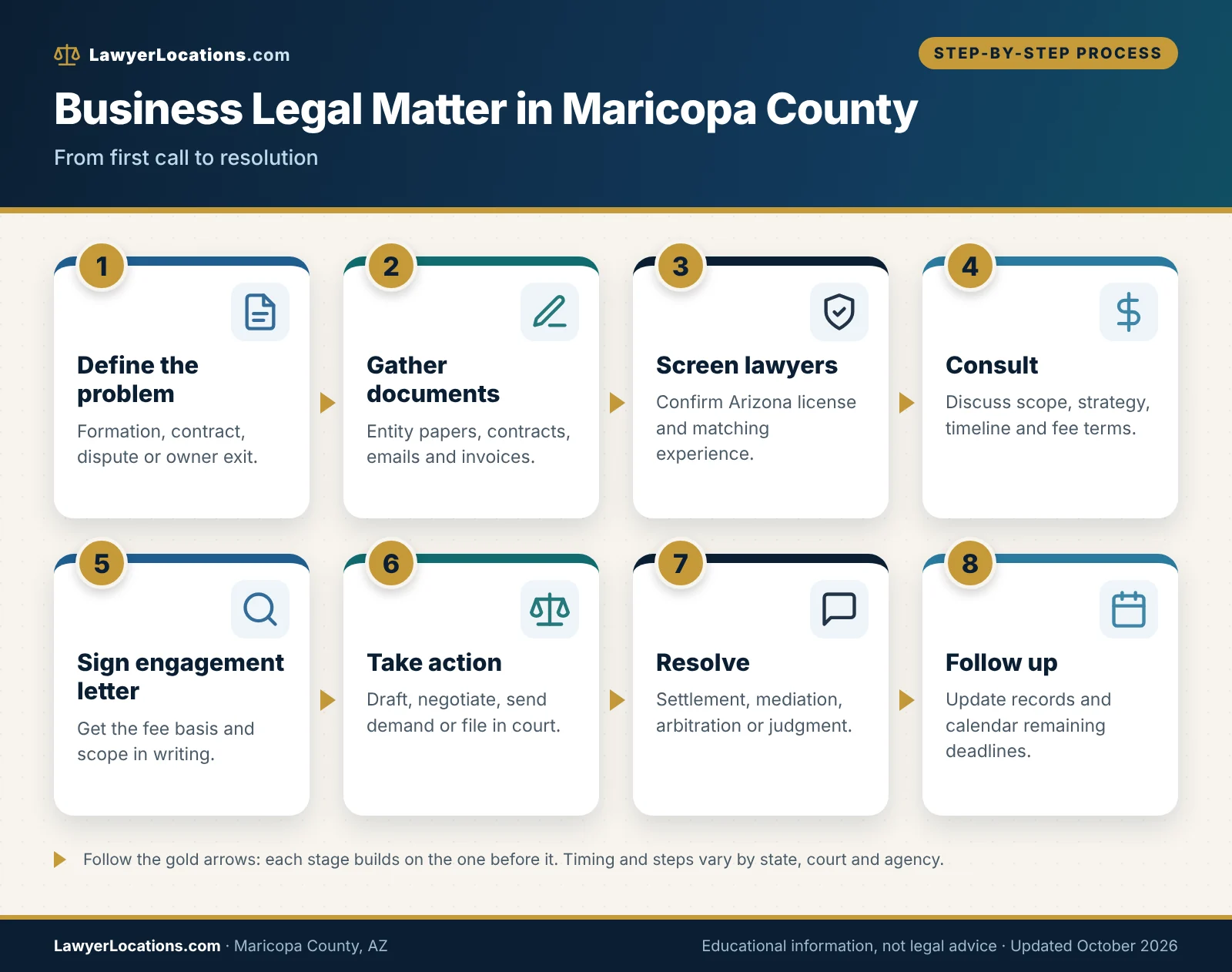
Text version of this graphic
- Define the problem: formation, contract, dispute or exit.
- Gather documents: entity papers, contracts, emails, invoices.
- Screen lawyers: confirm Arizona license and matching experience.
- Hold a consultation: scope, strategy, timeline and fee terms.
- Sign a written engagement letter that states the fee basis.
- Take action: draft, negotiate, demand letter, or file in the proper court.
- Resolve: agreement, mediation or arbitration, judgment or dismissal.
- Follow up: update records, calendar deadlines, close the file.
Engagement letter is the written agreement between you and a lawyer that says what the lawyer will do, who the client is, and how fees and expenses work. In Arizona, the basis of the fee and the scope of the work must be communicated to the client in writing under ER 1.5, with limited exceptions.
When to hire a lawyer and when a simpler route may do
You do not need a lawyer to file a basic Arizona LLC form, and plenty of owners handle small, low-risk tasks themselves. The line moves quickly when money, ownership or deadlines are at stake. A short, early conversation is often cheaper than repairing a bad contract or a missed deadline later.
Signs the stakes justify hiring now
Hire sooner rather than later when any of these apply: you are about to sign something that binds the company for years, an owner wants out, a customer or vendor has threatened a lawsuit or sent a demand letter, you have received court papers, or you are selling or buying a business. Court papers carry response deadlines that run from service, not from when you get around to reading them, so do not let a summons sit.
Also treat these as triggers: a departing employee who knows your customer list, a suspected misuse of company funds by a partner, and any request to sign a personal guarantee. Each one can put personal assets at risk in ways an entity does not always shield.
Limited-scope help and self-help resources
If a full engagement is more than the problem warrants, ask about limited-scope representation, where a lawyer handles only a defined task such as reviewing one contract or coaching you for a hearing. The Arizona courts’ self-service center describes limited scope as one type of legal representation, with cost depending on the services provided.
Maricopa County Superior Court also operates a Law Library Resource Center for public self-help. It cannot give legal advice, but it is a reasonable place to read forms and instructions before deciding how much help you want.
Before the first call, write a five-line timeline: who the parties are, what was agreed, what went wrong, what dates matter, and what outcome you want. A lawyer can often tell you in one short conversation whether the matter is routine or urgent, and your notes keep that conversation inexpensive.
Arizona Business Law Basics That Shape Every Engagement
Arizona state law, not Maricopa County ordinance, sets the rules for forming a company, enforcing a contract and seeking attorney fees. The county matters mainly for where you file and which court hears the case. Understanding the state-law baseline helps you judge whether a lawyer’s advice is sound and whether a deadline is looming.
Forming and registering a business in Arizona
Entity formation happens at the state level, through the Arizona Corporation Commission, while tax and local licensing happen through separate agencies and your city. A lawyer can coordinate the pieces, but owners should know what each office does so no step gets skipped.
Arizona Corporation Commission filings and fees
The Commission publishes separate fee schedules for LLCs and for corporations. As of October 2026, its schedules list $50 for LLC articles of organization on regular processing ($85 expedited) and $60 for for-profit articles of incorporation ($95 expedited). The corporation schedule also lists a for-profit annual report at $45 regular or $80 expedited.
Faster handling is available for most filing types at added cost: next-day service at $100, same-day service at $200 and two-hour service at $400, each with its own cutoff time. Fees and deadlines change, so check the Commission’s current schedule before you file, and ask your lawyer which periodic filings apply to your entity type.
| Filing | Regular processing | Expedited |
|---|---|---|
| LLC articles of organization | $50 | $85 |
| Articles of incorporation (for-profit) | $60 | $95 |
| Corporation annual report (for-profit) | $45 | $80 |
| Articles of amendment (LLC or corporation) | $25 | $60 |
| Next-day / same-day / two-hour service (add-on) | $100 / $200 / $400, with cutoff times set by the Commission | |
Tax registrations, city licenses and ownership reporting
Arizona has no traditional sales tax. Instead, many businesses that sell goods or services must hold a transaction privilege tax (TPT) license from the Arizona Department of Revenue. The Department’s page lists a fee of $12 per license per location, and says businesses typically also need a city TPT or business license where they operate. First-time businesses can start through the state’s Business One Stop portal.
Federal beneficial ownership reporting is a topic owners often ask about. FinCEN’s site states that U.S. companies are exempt from reporting beneficial ownership information under its current rule, so domestic Maricopa County companies generally do not file those reports. Foreign-formed companies registered to do business in the U.S. are treated differently, so confirm your situation with FinCEN’s current guidance.
Contract deadlines and attorney fees under Arizona law
Arizona sets different time limits depending on what kind of promise was broken, and it gives courts discretion to shift attorney fees in contract cases. Both rules can change the strategy of a dispute before anyone files anything.
Limitation periods that commonly come up
Under A.R.S. 12-548, a lawsuit to collect a debt that is evidenced by or founded on a written contract executed in Arizona must be started within six years after the cause of action accrues. Under A.R.S. 12-543, a three-year deadline applies to debts not backed by a written contract, to stated or open accounts, and to claims based on fraud or mistake, where the claim is not treated as accrued until the injured party discovers the facts.
Sales of goods fall under the Uniform Commercial Code. A.R.S. 47-2725 sets a four-year period for breach of a sales contract, and parties may shorten it in their original agreement to no less than one year, but not extend it. The clock generally starts at breach, even if you did not know about it, with a different rule for certain warranties that explicitly cover future performance.
These periods are starting points, not a substitute for advice. Which statute governs depends on the type of claim, where the contract was signed, and whether the agreement shortened the period. If you think a deadline may be close, treat it as urgent and ask a lawyer licensed in Arizona to confirm the date that applies to your facts.
| Type of claim | Statute | Period | Key detail |
|---|---|---|---|
| Debt founded on a written contract executed in Arizona | A.R.S. 12-548 | Six years | Runs from accrual of the cause of action |
| Debt not backed by a written contract; stated or open accounts | A.R.S. 12-543 | Three years | Open-account rule excludes ongoing mutual trade accounts between merchants |
| Fraud or mistake | A.R.S. 12-543 | Three years | Not accrued until the injured party discovers the facts |
| Breach of a contract for the sale of goods | A.R.S. 47-2725 | Four years | Parties may shorten to not less than one year; cannot extend |
Attorney fees in contract disputes and offers of judgment
In a contested action arising out of a contract, express or implied, A.R.S. 12-341.01 allows a court to award reasonable attorney fees to the successful party. It is a “may,” not a “must,” so the result is up to the judge, and it sits alongside any fee clause in your contract.
The same statute addresses written settlement offers. If a party rejects an offer and the final judgment is at least as favorable to the person who made it, that person is treated as the successful party from the date of the offer, and the court may award reasonable fees. That is why lawyers often discuss a well-timed offer as a strategy tool, and why you should not ignore one.
A Mesa landscaping company sues a customer over an unpaid invoice under a signed contract. The customer rejects a written offer to settle for a stated amount, and the judgment later comes in at or above that figure. Under A.R.S. 12-341.01, the court may treat the offering party as the successful party from the offer date and consider an award of reasonable fees. This is an illustration of how the statute works, not a prediction.
Restrictive covenants and owner or employee agreements
Non-compete and non-solicitation clauses are common in business sales and employment arrangements, and they are one of the most litigated parts of small-company agreements. Arizona courts review them for reasonableness instead of treating them as automatically valid.
How Arizona courts evaluate non-competes
In Valley Medical Specialists v. Farber, the Arizona Supreme Court said the law does not favor restrictive covenants and that a covenant is unreasonable if it is broader than needed to protect the employer’s legitimate interest, or if that interest is outweighed by hardship to the employee and likely injury to the public. The party seeking enforcement carries the burden. That case involved physicians, where the court applied especially strict scrutiny, so do not assume every industry gets the same treatment.
The decision also limits what a judge may do with an overbroad clause: courts may strike grammatically severable unreasonable parts but may not add terms or rewrite provisions. In practice, that means a sloppy, one-size-fits-all clause can fail entirely.
Drafting and reviewing agreements with a lawyer
When you are the business asking for a covenant, a lawyer will tie its scope to a specific, defensible interest such as confidential information or customer relationships, and keep the duration and geography narrow. When you are the person being asked to sign one, a lawyer can tell you what it would actually restrict and whether to negotiate before you sign.
Because the law here is shaped by court decisions, ask any lawyer you consult how recent Arizona authority bears on your clause. A sale-of-business covenant and an ordinary employment covenant are not judged the same way, and a lawyer should be able to explain the difference in plain terms.
Wrongful termination and statutory employment claims are generally treated as outside Maricopa’s Commercial Court under its governing rule, though non-compete and non-solicitation agreements are among the case types the rule lists as eligible. A dispute can have both flavors, so the label on your case matters when a lawyer decides where to file.
Where Business Disputes Are Heard in Maricopa County
Most civil business cases in Maricopa County are filed in the Maricopa County Superior Court, with smaller claims handled by justice courts and some cases routed to arbitration. Choosing the wrong forum wastes time and money, so this is one of the first things a local business attorney should help you decide.
Maricopa County Superior Court: the main civil forum
The Superior Court is Arizona’s general-jurisdiction trial court, and its Maricopa County civil department sits primarily in downtown Phoenix at the Central Court Building, 201 W. Jefferson Street. The court also operates regional centers in the Northeast Valley (Phoenix), the Southeast Valley (Mesa), the Northwest Valley (Surprise), the Southwest Valley (Avondale) and the West Valley (Glendale), according to its locations page. Which building handles a given filing can depend on the type of case, so check with the Clerk of the Superior Court or the court’s website before you go.
The Commercial Court and Rule 8.1
Maricopa County has a Commercial Court, a specialty calendar within the civil department that handles business disputes. It began as a pilot on July 1, 2015 and, per the court’s own page, became permanent on January 1, 2019. Eligibility is governed by Ariz. R. Civ. P. 8.1.
Under that rule, a case is a “commercial case” if at least one plaintiff and one defendant are business organizations, or if the primary issues concern a business organization or a business contract or transaction. Business organizations include corporations, LLCs, partnerships and sole proprietorships, but not individuals or family trusts. Eligible case types include owner and officer disputes, dissolutions and sales of businesses, trade-secret and non-compete matters, derivative actions, commercial real estate, franchise, securities and Uniform Commercial Code disputes, and business torts. Personal-injury cases, evictions, domestic relations, wrongful termination and statutory employment claims, and consumer contracts are generally outside the program unless business issues predominate.
Subsection (c) of the rule excludes a case that seeks only monetary relief below $300,000. The court’s page states that this minimum does not apply to cases that were pending before January 1, 2019. Under Maricopa County Administrative Order 2025-040 (March 2025), the designated Commercial Court calendars are CVJ02, CVJ08, CVJ19 and CVJ23, and the court’s page lists four judges who sit downtown.
Under Rule 8.1, a plaintiff asks for Commercial Court assignment at filing by placing the rule’s required notation in the complaint caption, and other parties may file a separate notice within 20 days after appearing. A general civil judge may also ask the presiding judge to transfer an eligible case within 20 days after the first responsive pleading or Rule 12 motion. Ask your lawyer to calendar these dates the day you are served or the day you file.
Complex civil litigation and discovery tiers
Separate from the Commercial Court is Maricopa County’s Complex Civil Litigation Program, created by Local Rule 3.12. Administrative Order 2025-040 names calendars CVJ08, CVJ17, CVJ19 and CVJ23 as complex calendars, and the Commercial Court rule preserves a party’s right to seek reassignment to that program. The administrative order does not set dollar thresholds or case-type criteria, so ask a lawyer how Local Rule 3.12 would apply to your case.
Arizona also sorts civil cases into three tiers under Ariz. R. Civ. P. 26.2, based on the damages claimed. Tier 1 is $50,000 or less, Tier 2 is more than $50,000 and less than $300,000 (or nonmonetary relief only), and Tier 3 is $300,000 or more, excluding punitive damages, interest, attorney fees and costs. The tier controls how much discovery each side gets: for example, 5, 15 or 30 hours of fact-witness depositions per side, and 120, 180 or 240 days to complete discovery after the early meeting. Cases in the Commercial Court are deemed Tier 3 until reassigned after the scheduling conference.
| Item | Tier 1 | Tier 2 | Tier 3 |
|---|---|---|---|
| Amount claimed | $50,000 or less | More than $50,000 and less than $300,000 | $300,000 or more |
| Fact-witness deposition time | 5 hours | 15 hours | 30 hours |
| Interrogatories | 5 | 10 | 20 |
| Requests for production | 5 | 10 | 10 |
| Requests for admission | 10 | 10 | 20 |
| Time to complete discovery | 120 days | 180 days | 240 days |
Smaller disputes: justice courts, small claims and arbitration
Not every business dispute justifies a full Superior Court case. Arizona routes smaller-dollar matters to simpler forums, and a lawyer will often steer a low-value collection toward them.
Justice courts and small claims
Under A.R.S. 22-201, justice courts have exclusive original jurisdiction over civil actions where the amount involved is $10,000 or less, not counting interest, costs and attorney fees awarded where authorized. Under A.R.S. 22-503, the small claims division hears cases of $5,000 or less, not counting interest and costs, and shares authority with the justice court.
Maricopa County is divided into justice court precincts, so the right court depends on venue rules that turn on the facts of your case. Because those rules are technical, confirm the correct precinct with the justice court clerk or a lawyer before filing, since a case filed in the wrong place can be delayed or dismissed.
Compulsory arbitration
Under A.R.S. 12-133, the superior court must send cases to arbitration when the amount in controversy is within the court’s arbitration limit, which the court sets by rule and which may not exceed $65,000. A court can waive the requirement only for good cause and only if all parties file a written stipulation. Parties can also agree in a signed writing to arbitrate any case, with or without a lawsuit pending.
Arbitration clauses in business contracts are common, and they can send a dispute to a private forum instead of any court. A lawyer reading your agreement should flag whether it contains one, who picks the arbitrator, and how fees are allocated.
Do not assume a dollar threshold in an online article applies to your case. Court limits, arbitration limits and local rules are adjusted over time and sometimes differ between justice courts and the Superior Court. Check the current statute or the clerk’s office before you rely on a number.
Other venues a Maricopa County business may need
Some disputes belong in federal court or before an agency instead of a Maricopa County courtroom. Ask early which forum applies, because that choice changes the rules, the timeline and the lawyer you need.
Federal court and agency proceedings
Federal courts hear cases that raise federal questions, such as certain intellectual property, securities or federal statutory claims, and some disputes between citizens of different states. Phoenix is home to a federal courthouse for the District of Arizona, and federal bankruptcy matters are also heard in Arizona’s federal system. Lawyers admitted to practice in Arizona’s state courts are not automatically admitted in federal court, so ask whether your lawyer regularly appears there if your case may end up in that forum.
Business-licensing, tax and corporate-filing disputes may start with an agency, such as the Arizona Corporation Commission or the Arizona Department of Revenue, before any court is involved. A lawyer can tell you whether you must exhaust an agency process first.
Confirming where and how to file
For Superior Court cases, filings go through the Clerk of the Superior Court, and the court’s website links to civil forms and its Law Library Resource Center for public self-help. Emergency requests, such as a temporary restraining order or preliminary injunction for cases filed at a regional facility, are directed to a designated court email address that is posted on the Commercial Court page.
Whatever the forum, keep a record of the exact filing date, the case number, and the service date on every party, because deadlines in civil cases run from those events. A paper trail you can hand your lawyer saves billable time.
| Forum | Typical use | Limits or rule noted | Source |
|---|---|---|---|
| Small claims division | Simple, lower-value money disputes | $5,000 or less, excluding interest and costs | A.R.S. 22-503 |
| Justice court | Civil claims of moderate size | $10,000 or less, exclusive original jurisdiction | A.R.S. 22-201 |
| Superior Court, compulsory arbitration | Cases within the arbitration limit | Limit set by court rule, statutory cap of $65,000 | A.R.S. 12-133 |
| Superior Court, general civil | Larger or more complex disputes | Tiers 1 to 3 control discovery | Ariz. R. Civ. P. 26.2 |
| Superior Court, Commercial Court | Qualifying business-to-business or business-contract cases | Not eligible if only money below $300,000 is sought | Ariz. R. Civ. P. 8.1 |
| Federal court (Phoenix) | Federal-question or other qualifying cases | Federal rules and jurisdiction apply | Federal law |
How to Compare Business Attorneys in Maricopa County
Compare business attorneys on fit, communication and fee clarity, not on advertising. Confirm that a lawyer is licensed in Arizona, ask what share of their work looks like your matter, and get the fee terms in writing before you pay anything. This site does not rank or recommend lawyers, so the framework below is meant to be used with any candidate you find.
Match the lawyer to the matter
Business law is broad. A lawyer who drafts startup documents all day may rarely appear in court, and a litigator may not enjoy rewriting an operating agreement. Say plainly what you need and ask the lawyer how often they handle it.
Transactional work versus litigation
Transactional lawyers handle formation, contracts, financing and deals; litigators handle disputes in court or arbitration. Many firms do both, but individual lawyers often lean one way. If you expect a deal to turn contentious, ask whether the lawyer who drafts the agreement would also handle a dispute, or whether you would need to bring in someone else.
Ask about local court experience too. Familiarity with Maricopa County Superior Court procedures, the Commercial Court and the local discovery tiers matters when a case is likely to be filed here. A lawyer who regularly appears in the court you need can usually describe the process without hedging.
Industry and size fit
Regulated industries such as health care, construction, cannabis-adjacent services, financial services and franchising bring their own rules. Ask whether the lawyer has handled your industry or has a trusted colleague who has. Also consider scale: a solo practitioner, a mid-size firm and a large firm will differ in rates, staffing and availability, and none of those choices is automatically better.
A good test is to ask the lawyer to describe a typical matter like yours, in general terms and without breaking client confidentiality. If the answer is vague, or the lawyer promises a specific result, treat that as a signal to keep looking.
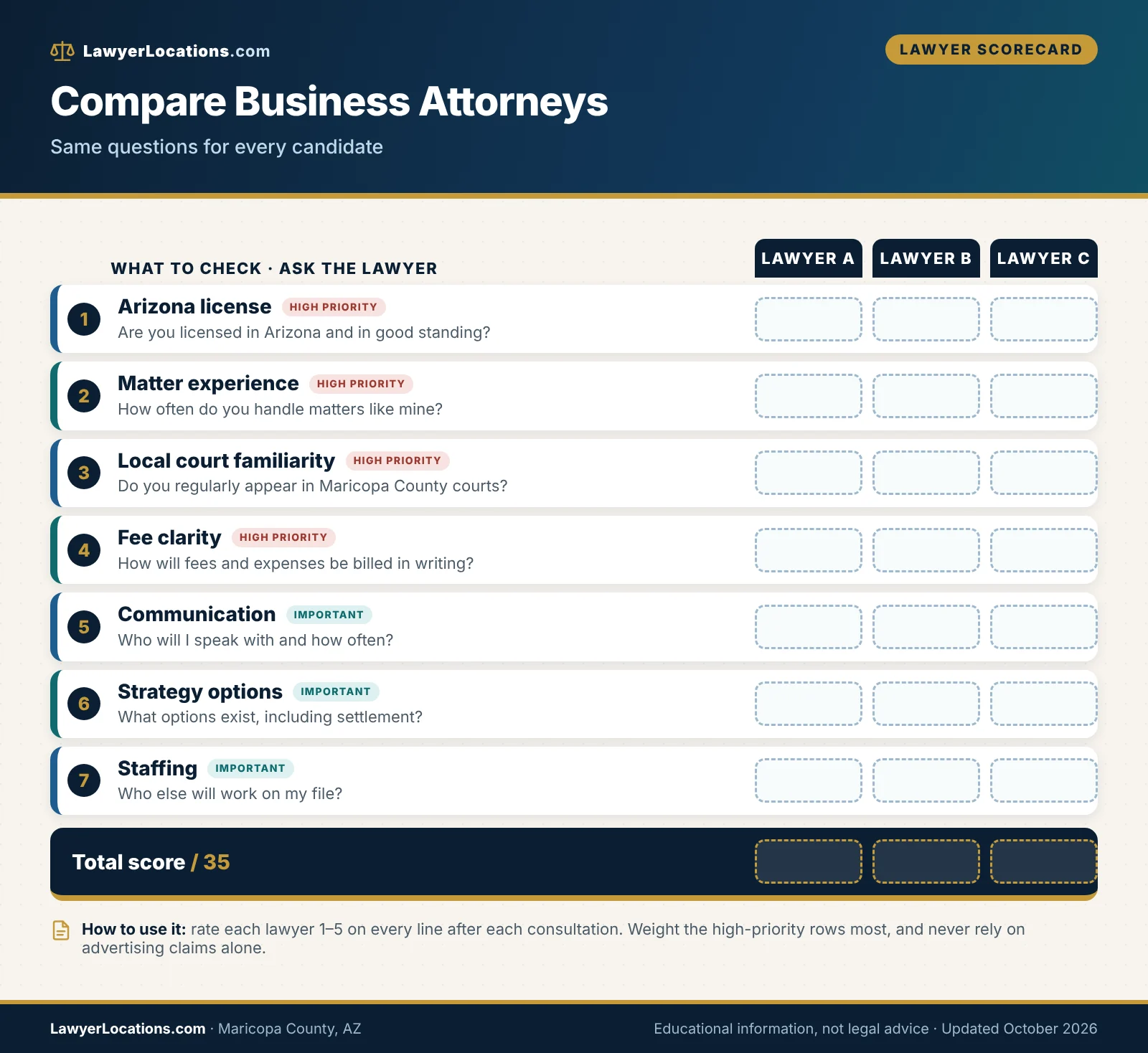
Text version of this graphic
| Criterion | Question to ask |
|---|---|
| Arizona license | Are you licensed in Arizona and in good standing? |
| Matter experience | How often do you handle matters like mine? |
| Local court familiarity | Do you regularly appear in Maricopa County courts? |
| Fee clarity | How will fees and expenses be billed, in writing? |
| Communication | Who will I deal with, and how fast are replies? |
| Strategy | What options do you see, including settlement? |
| Staffing | Who else will work on my file? |
Finding and vetting candidates
Referrals from other business owners, accountants and bankers are common starting points, but they should be checked against objective sources. Treat any directory, including this one, as a place to begin research, not as an endorsement.
Referral services and bar resources
The Arizona courts’ self-service center points to the State Bar of Arizona’s public resources for help finding an attorney, and to the Lawyer Referral Service of the Maricopa County Bar Association, which it notes charges a small consultation fee. A referral service can narrow the field by practice area, but it does not vouch for outcomes, so you still need to interview the lawyer. Legal aid organizations such as Community Legal Services serve people who qualify financially, though they generally focus on individuals rather than operating businesses, so ask what they handle.
Modest-means programs exist for people who earn too much for free legal aid but cannot afford market rates. If you are a sole proprietor or a very small owner-operator, ask whether such a program fits your situation.
Checking standing and asking the right questions
Before you retain anyone, confirm the lawyer is licensed in Arizona and ask whether any public discipline exists. The State Bar of Arizona is the licensing and discipline authority, and its public pages are the place to begin that check. Then use the first meeting to test fit. Useful questions include:
- What is your experience with matters like mine in Maricopa County courts?
- Who will do the day-to-day work, and who will I speak with?
- How do you bill, and what is the estimated range for the first phase?
- What are the realistic options, including settlement or mediation?
- What do you need from me, and by when?
- How will we handle a conflict of interest or a change in scope?
Our guide on how to approach a first consultation is written for criminal matters, but its questions about what a consultation covers, what to bring and what a lawyer should and should not promise apply to business matters, too.
Red flags and judgment calls
The most useful screening tool is skepticism. A business attorney should talk about risk and options, not certainty.
Warning signs during the first conversation
- A promise of a specific outcome or a “sure win”.
- Pressure to sign or pay immediately, or a made-up sense of urgency about a deadline that you cannot verify.
- No written engagement letter, or fee terms that are vague about what is and is not included.
- A fee described as “nonrefundable” or “earned upon receipt” without a written explanation that you may discharge the lawyer and may be entitled to a refund, which Arizona’s fee rule requires.
- Reluctance to say who will actually do the work.
None of these automatically disqualifies a lawyer, but each is a reason to ask follow-up questions and, if the answers are unsatisfying, to talk to someone else.
Conflicts of interest and who the client is
When a lawyer represents a company, the client is generally the company, not each owner individually. That can matter when co-owners disagree: a lawyer who drafted a company’s operating agreement may not be able to advise one owner against another. Ask up front who the lawyer represents, and if two owners want help with the same document, consider whether each needs separate advice.
Conflict rules protect both sides. A lawyer who has previously represented the other party in a related matter may have to decline the work, and a candid conflict check at the start is a sign of good practice.
Reading this page does not create an attorney-client relationship, and LawyerLocations.com is not a law firm. Sharing facts with a lawyer for the first time may or may not be covered by confidentiality depending on the circumstances, so ask about confidentiality at the start of any consultation.
Costs and Fee Structures: What You Will Actually Be Asked to Pay
Business attorney fees in Maricopa County vary with the lawyer’s experience, the complexity of the matter and the fee structure, and this site does not publish averages because no verified official source supports one. What you can control is clarity: Arizona’s ethics rules require a reasonable fee, and fee terms generally must be communicated to you in writing. Ask for a written estimate range for each phase, not just an hourly rate.
The common fee structures
Most business matters are billed in one of a handful of ways. Each shifts risk differently between you and the lawyer, so match the structure to how predictable the work is.
Hourly billing and retainers
Hourly billing is common for disputes and open-ended advice. You pay for time spent, often in small increments, plus expenses such as filing fees and court reporters. Many lawyers ask for an advance deposit, sometimes called a retainer, which they bill against and should account for. Ask how often you will receive itemized invoices, who else bills time on your file, and what rates apply to junior lawyers and paralegals.
Under Arizona’s rule, a lawyer may not charge or collect an unreasonable fee, and the rule lists factors such as time and labor, the difficulty of the questions, the fee customarily charged in the locality, the amount involved and the results obtained, time limits imposed, the length of the relationship, the lawyer’s experience, and the risk the lawyer assumes. Any change in rates must be communicated in writing before the higher amounts are incurred.
Flat fees, limited-scope work and contingency
Flat fees fit predictable work such as forming an entity, reviewing a lease or drafting a standard agreement. Confirm exactly what the flat fee covers, what counts as out of scope, and whether government filing fees are included or billed separately. Limited-scope arrangements apply the same logic to a defined slice of a larger matter.
Contingent fees, where the lawyer is paid a percentage of any recovery, appear in some business-collection and damages cases. Arizona’s rule requires a contingent-fee agreement to be in a writing signed by the client that states how the fee is determined, the percentages for settlement, trial or appeal, and which expenses are deducted and whether before or after the fee is calculated. At the end of the matter, the lawyer must provide a written statement of the outcome and how any recovery was divided. Contingency is not offered for every business dispute, so do not assume it is available.
A fee labeled “nonrefundable” or “earned upon receipt” is prohibited under Arizona’s fee rule unless you are also told in writing that you may discharge the lawyer at any time and may be entitled to a refund of part or all of the fee based on the value of the work done. If you see that label without that explanation, ask about it before paying.
| Structure | Best suited to | What to confirm in writing | Main risk to you |
|---|---|---|---|
| Hourly | Disputes, ongoing advice, uncertain scope | Rates by timekeeper, billing increments, invoice frequency, estimate range | Total cost can grow if the matter does |
| Retainer (advance deposit) | Matters where the lawyer bills against a deposit | How it is held, when it is replenished, refund of unused amounts | Confusion about whether it is a deposit or a fee earned on receipt |
| Flat fee | Predictable tasks such as drafting or review | Exact scope, what is excluded, who pays filing fees | Extra charges for out-of-scope requests |
| Limited-scope | One hearing, one document, coaching | Exactly which tasks are covered and who handles the rest | Gaps between lawyer tasks and your own tasks |
| Contingent | Certain recovery-based claims where offered | Percentages by stage, expenses, signed writing | Expenses may still be owed, and not all cases qualify |
What drives the total cost
Fees are only part of the bill. Court costs, government filing fees, expert witnesses and the other side’s reaction to your approach all shape the final number.
Government fees and court costs
Government charges are predictable once you know the venue. The Arizona Corporation Commission and Department of Revenue figures in the second section are examples for forming and licensing a company. Civil court filing fees and fees for service of process vary by court and by type of filing, so ask your lawyer or the Clerk of the Superior Court for the current schedule rather than relying on a number you saw online.
If you win a contract case, you may be able to ask the court to shift some costs and fees to the other side under Arizona’s contract fee statute, but that is discretionary, and you should treat any recovery as uncertain when you budget.
Ways to keep legal spend under control
Cost control is mostly about preparation and communication. Organize documents before the first call, send questions in batches instead of daily emails, and ask for a short written plan with phases and a decision point at the end of each phase. Consider mediation or a negotiated settlement early if the dispute is mostly about money, since a full trial rarely makes financial sense for a small claim.
Do not hesitate to ask whether a task could be done by a paralegal, whether you can gather records yourself, and whether a limited-scope arrangement would work. A candid conversation about budget at the start is normal and usually welcomed by the lawyer.
Our guide to how legal fee structures work in criminal defense explains retainers, flat fees and payment plans in plain English. The setting differs, but the fee-agreement questions you should ask carry over to business engagements.
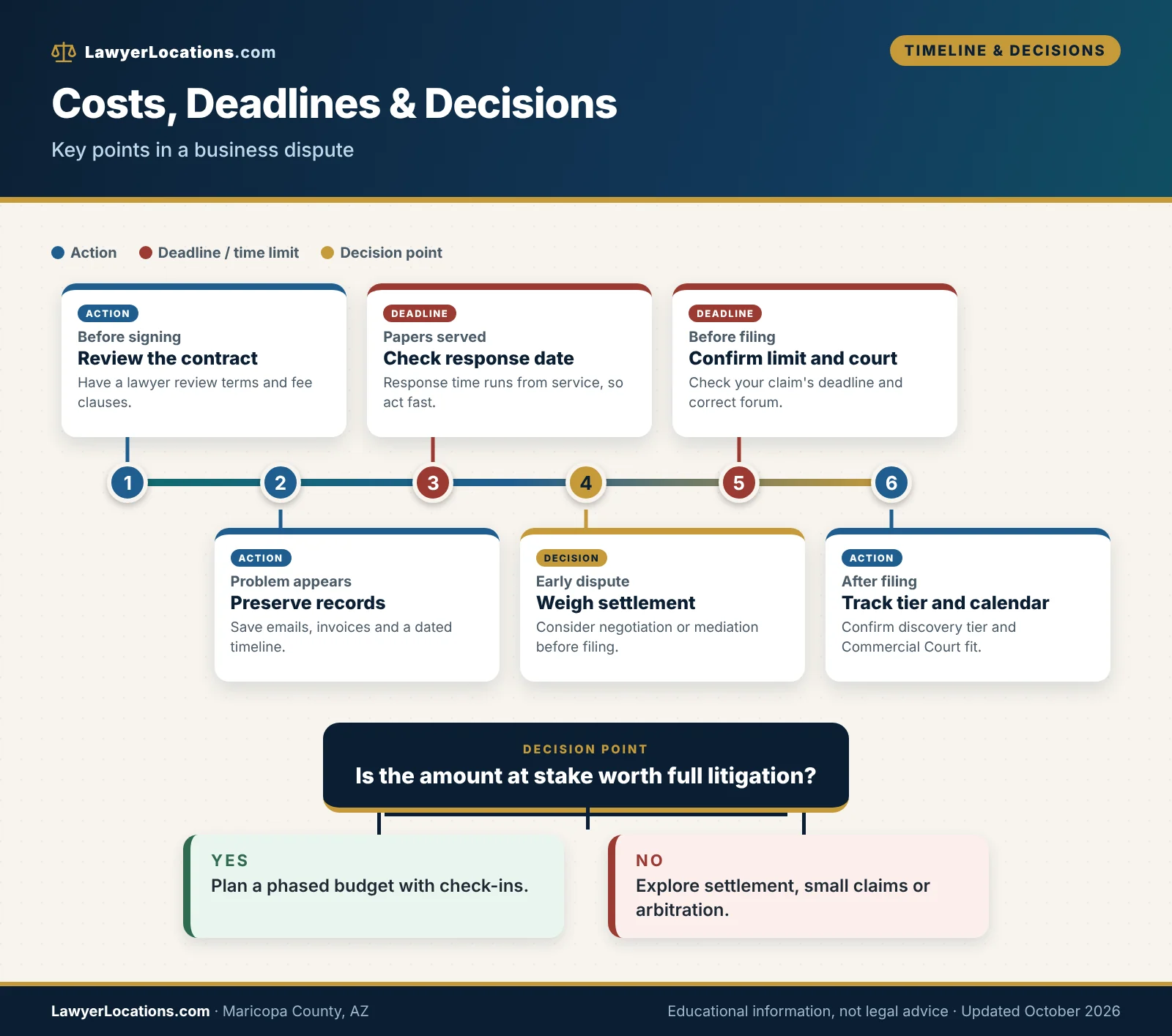
Text version of this graphic
- Before you sign anything: have a lawyer review the agreement and confirm fee terms in writing (action).
- When a problem appears: save records, stop making statements that admit fault, and list key dates (action).
- Within days of a demand or court papers: calendar response deadlines that run from service (deadline).
- Early in a dispute: weigh a negotiated resolution or mediation (decision).
- Before filing: check the limitation period for your type of claim and the correct court (deadline).
- After filing: confirm tier, commercial-court eligibility and discovery deadlines (action).
- Decision point: Is the likely recovery or exposure large enough to justify full litigation? If yes, plan a phased budget; if no, explore settlement, small claims or arbitration.
Preparing for a Consultation and Choosing Your Next Step
Come to a consultation with the key documents, a short timeline and a list of questions. The better organized you are, the faster a lawyer can tell you what the matter involves and what it may cost. After the meeting, compare at least two candidates against the scorecard above before you sign an engagement letter.
Gathering your documents and facts
What you bring depends on whether you are planning something new or responding to a problem. In both cases, copies are better than originals, and a clean folder beats a pile of forwarded emails.
Entity and governance documents
For any engagement, have the basics ready: the articles of organization or incorporation, the operating agreement or bylaws, any shareholder or buy-sell agreement, a list of owners and their percentages, and recent tax and licensing registrations. If a dispute is brewing between owners, include meeting minutes, financial statements and any emails about the issue.
These records tell a lawyer who has authority to sign and who owns what. Missing or outdated documents are common, and a lawyer can often help fix them, but only if you say they are missing.
Dispute and transaction documents
For a contract or payment dispute, gather the signed agreement and all amendments, invoices, purchase orders, delivery records, correspondence, text messages and a summary of what has been paid. For a deal, bring term sheets, drafts and financial statements. For any lawsuit or demand letter you have received, bring the papers and a note of the date and manner of delivery.
Preserve evidence. Do not delete emails or messages, even ones that look unhelpful, because destroying records once a dispute is reasonably expected can lead to serious consequences in litigation. Ask your lawyer how to suspend routine deletion.
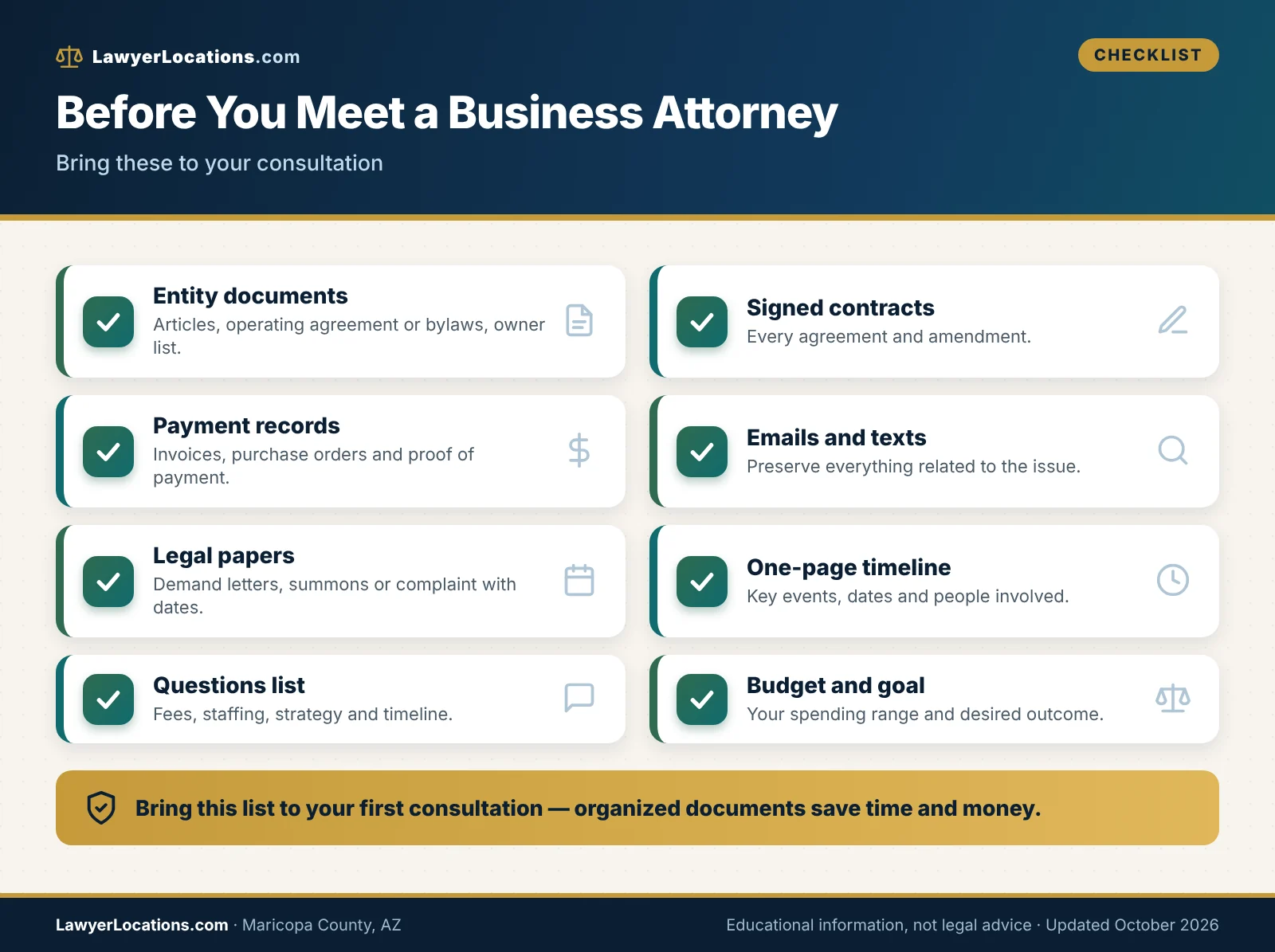
Text version of this graphic
- Entity papers: articles, operating agreement or bylaws, owner list.
- Signed contracts and every amendment.
- Invoices, payment records and purchase orders.
- Emails and texts related to the issue, preserved.
- Any demand letter, summons or complaint, with the date you received it.
- A one-page timeline of key events and dates.
- A list of questions about fees, staffing and strategy.
- Your budget range and what outcome you want.
If you have been served with a summons and complaint, the time to respond starts running from service. Do not wait for the next meeting or the next billing cycle. Contact a lawyer licensed in Arizona right away, or check the summons itself and the Superior Court’s self-service resources for the response period that applies to your case.
Common mistakes and next steps
Most avoidable problems come from waiting too long, signing before reading, or relying on verbal promises. A few habits prevent many of them.
Mistakes that cost Maricopa County owners time and money
- Signing a contract with a personal guarantee without understanding it.
- Operating without a written owner agreement and assuming handshake terms will hold.
- Relying on an oral agreement for a significant deal, then discovering that the deadline and proof rules differ from a written contract.
- Waiting to talk to a lawyer until a limitation period or response date is close.
- Choosing a lawyer on advertising or price alone without confirming experience and fee terms.
- Copying the other side on heated emails or posting about the dispute on social media.
If you recognize one of these, the fix is usually to pause, preserve records and get advice before you act again. Early correction is almost always cheaper than later repair.
Your next steps and quick answers
A sensible sequence is to identify your matter, assemble documents, shortlist two or three Arizona-licensed lawyers, hold consultations, compare fee terms in writing, and then sign an engagement letter with the one that fits. If you also own real estate or are planning for succession, our guides on real estate attorneys in Mesa and living trust lawyers cover adjacent planning questions, and our Arizona personal injury lawyer guide shows how a statewide lawyer-comparison page differs from this county-level one. If a judgment has been entered against you or your business, see how wage garnishment works and how to respond.
Do I need a business attorney in Maricopa County to form an LLC?
No. Arizona lets you file LLC articles with the Arizona Corporation Commission yourself, and the Commission’s fee schedule lists a $50 regular-processing fee as of October 2026. A lawyer is most valuable for the operating agreement, which allocates control and sets what happens when an owner leaves.
Can I sue in Maricopa County Superior Court for any amount?
Cases of $10,000 or less fall within the justice courts’ exclusive original jurisdiction under A.R.S. 22-201, so larger civil cases are generally filed in the Superior Court. Some Superior Court cases are sent to compulsory arbitration under A.R.S. 12-133 if they fall within the court’s arbitration limit.
What is the Maricopa County Commercial Court?
It is a specialty calendar within the Superior Court’s civil department for qualifying business disputes under Ariz. R. Civ. P. 8.1. It became permanent on January 1, 2019, and a case seeking only money below $300,000 is not eligible.
How long do I have to sue over a broken written contract in Arizona?
For a debt founded on a written contract executed in Arizona, A.R.S. 12-548 sets six years from accrual. Other claims and sales of goods have different periods, so confirm the deadline with a lawyer licensed in Arizona before relying on it.
Can the winner of a contract lawsuit recover attorney fees?
Possibly. A.R.S. 12-341.01 lets a court award reasonable attorney fees to the successful party in a contested contract action. A rejected written settlement offer can also affect who is treated as the successful party.
Are non-compete agreements enforceable in Arizona?
Sometimes. Arizona courts view restrictive covenants with disfavor and enforce them only if they protect a legitimate interest and are not broader than necessary. Courts may strike severable unreasonable parts but will not rewrite a clause.
What does a TPT license cost?
The Arizona Department of Revenue lists a $12 fee per license, per location. Many businesses also need a city license where they operate, so confirm local requirements with your city.
Does my company need to file a beneficial ownership report with FinCEN?
FinCEN’s current guidance exempts U.S. companies from reporting beneficial ownership information. Foreign-formed entities registered to do business in the United States are treated differently, so check FinCEN’s website for your situation.
Is a lawyer required in small claims or justice court?
Not necessarily. Small claims is designed for people to handle simple disputes themselves, though the small claims jurisdiction statute does not itself address whether lawyers may appear. Check the court’s current rules or ask the clerk before you file.
Where can I find a lawyer referral in Maricopa County?
The Arizona courts’ self-service center lists the State Bar of Arizona’s public resources and the Lawyer Referral Service of the Maricopa County Bar Association, which charges a small consultation fee. Referral services help you start your search but do not vouch for any lawyer’s results.
Ready to compare your options?
Pick the matter that fits you, gather your documents and interview at least two Arizona-licensed lawyers before you commit. Use the scorecard and fee questions above, and confirm every deadline and fee with the court or agency involved. When you are ready, browse the related guides on this site to see how similar questions play out in other places.
General information only. This article is a general legal-education resource and is not legal advice. LawyerLocations.com is not a law firm, does not recommend or endorse any lawyer, and reading this page does not create an attorney-client relationship. Laws, court rules, fees and deadlines change and depend on your facts, so consult a lawyer licensed in Arizona before acting on anything here.
Sources & References
Show all 22 sources
- A.R.S. 12-548 (debt on written contract or credit card) — Arizona Legislature — azleg.gov — accessed October 2026
- A.R.S. 12-543 (three-year actions) — Arizona Legislature — azleg.gov — accessed October 2026
- A.R.S. 47-2725 (limitation of actions on sales contracts) — Arizona Legislature — azleg.gov — accessed October 2026
- A.R.S. 12-341.01 (attorney fees in contract actions) — Arizona Legislature — azleg.gov — accessed October 2026
- A.R.S. 12-133 (compulsory arbitration) — Arizona Legislature — azleg.gov — accessed October 2026
- A.R.S. 22-201 (justice court jurisdiction) — Arizona Legislature — azleg.gov — accessed October 2026
- A.R.S. 22-503 (small claims jurisdiction) — Arizona Legislature — azleg.gov — accessed October 2026
- A.R.S. 29-3101 (Arizona limited liability company act, short title) — Arizona Legislature — azleg.gov — accessed October 2026
- Commercial Court — Maricopa County Superior Court — superiorcourt.maricopa.gov — accessed October 2026
- Court Locations — Maricopa County Superior Court — superiorcourt.maricopa.gov — accessed October 2026
- Administrative Order 2025-040 (commercial and complex calendars) — Maricopa County Superior Court — superiorcourt.maricopa.gov — accessed October 2026
- Arizona Rule of Civil Procedure 8.1 (commercial cases) — Arizona Rules of Court (text as published) — courtrules.net — accessed October 2026
- Arizona Rule of Civil Procedure 26.2 (case tiers and discovery limits) — Arizona Rules of Court (text as published) — courtrules.net — accessed October 2026
- Administrative Order 2018-64 (experimental Rule 8.1 extension) — Arizona Supreme Court — azcourts.gov — accessed October 2026
- Valley Medical Specialists v. Farber, No. CV-97-0488-PR — Arizona Supreme Court — azcourts.gov — accessed October 2026
- Ethical Rule 1.5 (fees) — Arizona Rules of Professional Conduct (text as published) — courtrules.net — accessed October 2026
- Obtaining Legal Services — Arizona Judicial Branch Self-Service Center — azcourts.gov — accessed October 2026
- LLC fee schedule — Arizona Corporation Commission — azcc.gov — accessed October 2026
- Corporation fee schedule — Arizona Corporation Commission — azcc.gov — accessed October 2026
- Transaction Privilege Tax (TPT) — Arizona Department of Revenue — azdor.gov — accessed October 2026
- Beneficial Ownership Information reporting — FinCEN, U.S. Department of the Treasury — fincen.gov — accessed October 2026
- Maricopa County Superior Court home page — Maricopa County Superior Court — superiorcourt.maricopa.gov — accessed October 2026
Legal Disclaimer and Limitation of Liability
Informational and illustrative purposes only. This article was prepared by LawyerLocations.com solely on the basis of the information available to us at the time of writing. It is an illustrative, general overview. It is not a complete or authoritative statement of the law, and it has not been reviewed by a lawyer licensed in your state or county.
Not legal advice. Nothing in this article is legal, financial, tax or immigration advice, and reading it does not create an attorney-client relationship between you and LawyerLocations.com or any author, lawyer or firm mentioned. Laws, court rules, fees, filing deadlines and agency procedures differ by state, county and court, and they change often. Some details here may be simplified, incomplete or out of date, and time limits for legal claims can be short.
No warranty. We make no representation or warranty, express or implied, about the accuracy, completeness, timeliness or suitability of this content for your situation. Please do not rely on it to make, delay or skip any legal decision. Check the facts against official sources and speak with a licensed attorney in the relevant jurisdiction before you act.
Limitation of liability. To the fullest extent permitted by law, LawyerLocations.com and its owners, authors and contributors disclaim all liability for any loss, damage, cost or other consequence arising from the use of, or reliance on, this article, including any content on third-party websites we link to. Mentioning a lawyer, firm, organization or service is not an endorsement and is not a promise of any result. If you are in immediate danger, contact your local emergency number.
