Searching for a “personal injury lawyer fort worth tx” usually means you were hurt in a crash, a fall, or another incident and want to know who to call, what it costs, and how long you have. Texas is a fault-based state, and the general deadline to file an injury lawsuit is two years under Tex. Civ. Prac. & Rem. Code § 16.003. Most injury lawyers are paid through a written contingent fee, meaning the fee comes out of a recovery rather than up front.
This guide explains the Texas rules that shape a claim, how Tarrant County courts and the District Clerk fit in, how to check a lawyer’s license and compare fee agreements, and what to gather before your first consultation. It is general information for Fort Worth readers, not advice about your situation.
What a Fort Worth Personal Injury Lawyer Does and How a Case Unfolds
A personal injury lawyer helps people hurt by someone else’s carelessness pursue payment for medical bills, lost income, and other harm. In Fort Worth that work runs through Texas law and, if a lawsuit becomes necessary, the courts of Tarrant County. Most cases settle before a jury ever hears them, but the way a lawyer prepares the file from day one affects how the insurance company values it.
Fort Worth sits in a busy corridor of highways, rail lines, industrial sites, and large employers, so injury claims here run from ordinary fender-benders to commercial-truck collisions and workplace-adjacent incidents. This guide is built for the first stage of the decision: figuring out what kind of help you need and how to pick it carefully.
What an injury lawyer actually handles
Claims that commonly fall under personal injury
The label “personal injury” covers car, motorcycle, and pedestrian collisions, falls on unsafe property, dog bites, defective products, and some medical-care errors. It also covers wrongful death, which is a claim by family members when someone dies because of another party’s wrongful act. Many Fort Worth firms concentrate on a few of these categories, so match the lawyer to the type of incident rather than assuming every injury firm handles every claim.
If you were in a crash, our guide on whether you need a lawyer after a car accident walks through when hiring one makes sense and when a straightforward claim can be handled directly with the insurer.
Work a lawyer does before any lawsuit
Most of a claim’s value is built before a petition is filed. That work usually includes collecting medical records and bills, preserving evidence such as photos and video, identifying every insurance policy that could apply, and presenting a written demand to the insurer with supporting documents. A careful lawyer also watches for liens, meaning reimbursement claims from health insurers or medical providers that can take a share of a settlement.
That preparation is also where you can judge a lawyer’s habits. Ask how the firm builds a file, who communicates with you, and how often you will hear updates. Those answers tell you more than a slogan does.
Reading this page does not create an attorney-client relationship, and LawyerLocations.com is a legal-education and lawyer-discovery resource, not a law firm. Use it to prepare questions, then verify any lawyer you are considering with the State Bar of Texas.
How a Fort Worth injury case works from start to finish
Early phase: treatment, evidence, and the insurer
The first weeks are about your health and the paper trail. Get medical care, follow the treatment plan, and keep every bill, discharge sheet, and photo. If police responded, you will want the crash report, and do not give a recorded statement to the other side’s insurer before you understand your rights. A short, factual notice of the claim is usually enough at the start.
Your own insurance matters here too. Medical payments or personal injury protection coverage on your policy, and uninsured or underinsured motorist coverage, can help when the at-fault driver has little or no insurance. Our guide to uninsured motorist claims explains how that coverage works.
Demand, negotiation, and the settlement window
Once treatment stabilizes, the lawyer typically sends a demand package describing fault, injuries, and losses. The insurer responds, and the two sides negotiate. Settling too early is a classic mistake because future care costs may not be known yet. For a realistic view of how long this phase takes, see our walkthrough of the car accident settlement timeline.
Before any settlement is final, medical bills and liens need to be sorted out so the money you receive is not eaten by surprise claims. The article on who pays medical bills after a car accident covers the usual players.
Lawsuit, discovery, mediation, and trial
If negotiations stall or the deadline is near, the lawyer files a petition in a Tarrant County court. Both sides then exchange information in discovery, which includes written questions, document requests, and sworn testimony called depositions. Courts often push the parties toward mediation, a confidential settlement meeting led by a neutral third person.
A small share of cases reach trial, where a judge or jury decides fault and damages. Even then, settlement can happen on the courthouse steps. The point of understanding these stages is to ask a prospective lawyer how often the firm is ready to try a case, because insurers notice that readiness.
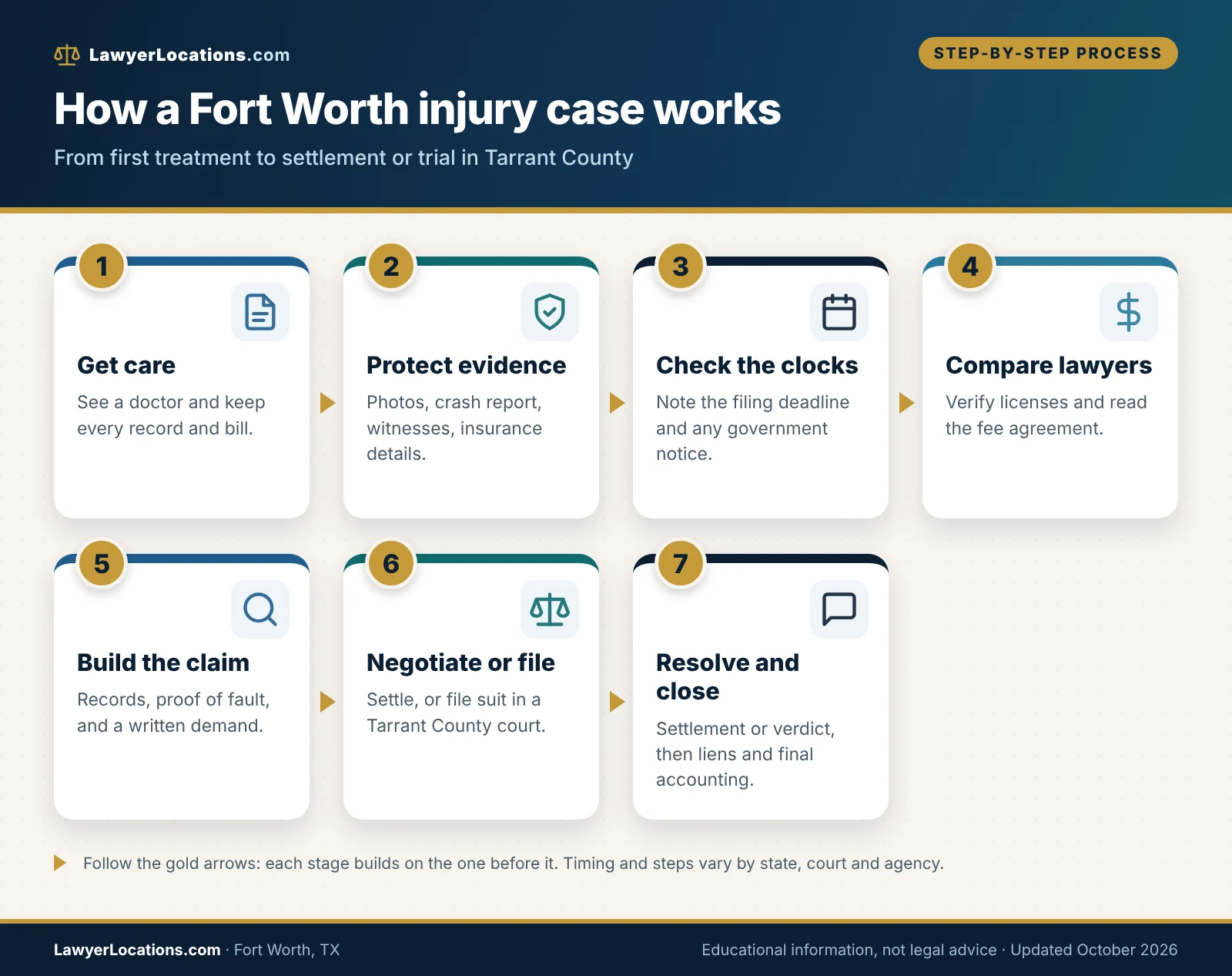
Text version of this graphic
- Get medical care and keep every record and bill.
- Protect the evidence: photos, witnesses, crash report, insurance details.
- Check the clocks: the general two-year rule and any shorter government notice.
- Compare lawyers: verify licenses and read the fee agreement.
- Investigate and demand: records, proof of fault, written demand to the insurer.
- Negotiate or file in a Tarrant County court.
- Resolve by settlement or verdict, then settle liens and fees.
Wrongful death and serious-injury cases in Fort Worth
When the stakes are higher
Catastrophic injuries and deaths raise the complexity. More defendants may be involved, insurance may be layered across several policies, and future-care planning matters. Families dealing with a death should read about how wrongful death lawyers are paid before choosing counsel, because the cost structure and case expenses can be larger.
Commercial-truck crashes are another example of added complexity. Our comparison of a truck accident lawyer versus a car accident lawyer explains why those cases involve federal safety rules and company records that a typical crash does not.
Why early local knowledge helps
A Fort Worth lawyer who regularly appears in Tarrant County courts knows the clerk’s filing practices, how local judges handle scheduling, and which mediators are active in the area. None of that promises any outcome, and you should not hire on a promise of one. It is simply a practical reason many people prefer a lawyer who works in the county where a case will be filed.
Texas Law That Shapes an Injury Claim
Texas applies the same state statutes in Fort Worth that it applies in Houston or El Paso. Three rules do most of the work: the filing deadline, the way fault is divided between the people involved, and the insurance floor for drivers. Knowing them helps you judge whether a lawyer is explaining your case accurately.
The filing deadline and the exceptions to it
The standard two-year rule
Texas generally requires a person to bring a personal injury suit within two years after the day the claim accrues, which is usually the date of the injury. The rule is in Tex. Civ. Prac. & Rem. Code § 16.003. For a death, the same two-year period runs from the date of death.
Filing a lawsuit is different from sending a claim letter to an insurer. Negotiating with an adjuster does not stop the two-year clock. If a case is still unsettled as the date approaches, a petition has to be filed in court. Read our fuller guide on how long you have to file a personal injury claim for how deadlines differ nationwide.
Because the date a claim accrues can be argued in some situations, do not count on an exact day you worked out yourself. Treat the two-year mark as the outer edge and start the lawyer search much sooner.
Minors and people with a legal disability
Under § 16.001, a person younger than 18 or of unsound mind is under a legal disability when the claim arises, and the period of that disability generally is not counted against the deadline. That can matter for an injured child. The rule has limits, including that separate disabilities cannot be stacked and a disability that begins after the clock has started does not pause it.
Even where tolling applies, parents often file earlier to recover medical expenses they paid, so the practical advice is to get a legal opinion on both the child’s claim and the family’s own claim.
Claims against a city, county, or other government unit
If a government vehicle, building, or employee is involved, the Texas Tort Claims Act adds a notice requirement. Under § 101.101, the government unit generally must receive notice of the claim within six months of the incident, describing the injury, the time and place, and what happened. A city charter or ordinance may set its own notice period, and notice is not required if the unit had actual notice of a death or injury.
Because a charter can shorten the window, do not assume six months is safe for a claim against the City of Fort Worth or another local entity. Ask a lawyer to confirm the specific notice rule for the entity involved, and do it quickly.
How Texas divides fault between the people involved
The 51 percent bar and reductions for shared fault
Texas uses proportionate responsibility. Under § 33.001, a claimant may not recover damages if his or her percentage of responsibility is greater than 50 percent. If you are 50 percent or less responsible, the court reduces your recovery by your percentage under § 33.012, and it also subtracts the dollar amount of settlements you have already received from other parties.
A jury finds damages of $100,000 and assigns 20 percent of the responsibility to the injured person for looking at a phone before a lane-change collision. The recovery is reduced by that 20 percent. If the jury had put that person’s share at 51 percent, nothing would be recoverable. The numbers are only an illustration of the arithmetic.
This is why the first statements you make matter. Insurers look for any hint of distraction, speed, or a missed traffic signal because a small shift in the fault split can change the whole claim.
Several defendants and joint liability
When more than one person contributed to an injury, § 33.013 says each defendant is generally liable only for its own percentage. A defendant whose responsibility is greater than 50 percent can be held jointly and severally liable, which means responsible for the full recoverable damages. That threshold is a reason lawyers evaluate every possible defendant, such as a driver, an employer, a vehicle owner, or a property manager.
Defendants can also try to blame people who are not in the lawsuit. § 33.004 allows a defendant to ask the court to designate a responsible third party, generally by motion filed well before trial, and the court must grant it unless an objection succeeds. A designated person is not liable because of the designation, but the jury can assign that person a share of fault, which can lower what the actual defendants owe.
Insurance floors and why they may fall short
Texas requires drivers to carry minimum liability coverage. Under Transp. Code § 601.072, the minimums are $30,000 per person for bodily injury or death, $60,000 per accident for two or more people, and $25,000 for property damage. Those numbers are the minimum, not a prediction of what a claim is worth.
A serious injury can exceed a minimum policy fast. That is when your own uninsured or underinsured motorist coverage, other defendants, or commercial policies come into play, and it is a good reason to ask a lawyer how they will identify every available source of recovery.
Wrongful death and survival claims
Who can bring a wrongful death claim
A wrongful death action arises when an injury caused by someone’s wrongful act or neglect results in an individual’s death, under § 71.002. Under § 71.004, the action is for the exclusive benefit of the surviving spouse, children, and parents of the person who died. One or more of them may bring it for the benefit of all, and if none of them brings it, the executor or administrator must do so unless all of them ask the representative not to.
Siblings and other relatives are not beneficiaries under that section, which can surprise families. If you are unsure who qualifies, raise it in the first consultation.
The survival action and the estate
Separately, § 71.021 provides that the injured person’s own personal injury claim survives death. That claim belongs to the estate and can cover things like the person’s medical costs and suffering before death. Families often face both claims at once, and each has its own rules about who recovers.
Texas also limits medical-expense recovery to what was actually paid or incurred under § 41.0105, a rule that affects how bills are presented in any injury or death case.
| Issue | Texas rule (as of October 2026) | Where it comes from | What it means for you |
|---|---|---|---|
| Filing deadline | Two years from the day the claim accrues; death claims run two years from death | Civ. Prac. & Rem. Code § 16.003 | File suit, not just a claim letter, before the date passes |
| Minor or disabled claimant | Time of legal disability generally not counted | § 16.001 | Child claims may have more time; do not rely on it without advice |
| Government defendant | Notice generally within six months; city charters may set their own period | § 101.101 | Send timely written notice; confirm the entity’s rule |
| Shared fault | Barred above 50 percent; otherwise reduced by your percentage | §§ 33.001, 33.012 | Fault percentages can decide the whole claim |
| Multiple defendants | Several liability, with joint liability above 50 percent | § 33.013 | Who is named and how fault is split changes who pays |
| Wrongful death | Spouse, children, and parents benefit; estate representative may sue | §§ 71.002, 71.004 | Family members outside that list are not beneficiaries |
| Medical expenses | Limited to amounts actually paid or incurred | § 41.0105 | Billed amounts may differ from recoverable amounts |
| Minimum auto liability | $30,000 / $60,000 / $25,000 | Transportation Code § 601.072 | Many serious injuries exceed these limits |
Fort Worth and Tarrant County: Courts, Records and Local Help
Fort Worth is the largest city in Tarrant County, and most Fort Worth injury cases that reach court are filed in Tarrant County. Some addresses in the city’s footprint lie in neighboring counties, so a lawyer should confirm the proper county and venue for your incident rather than assuming. This section covers the courts, the clerk, and the local resources the county itself publishes.
Where an injury case is filed
District courts and county courts at law
According to Tarrant County’s court directory, the county’s civil district courts are the 17th, 48th, 67th, 96th, 141st, 153rd, 236th, 342nd, 348th, and 352nd, and it also lists County Courts at Law No. 1, No. 2, and No. 3. The District Clerk says it manages most of the business operations for the 27 district courts, which hear civil, family, and felony criminal cases. Larger or more contested injury claims commonly belong in a district court, and your lawyer will choose the court based on the amount in controversy and the parties.
You do not choose the specific judge. Cases are assigned under the court’s own procedures, so ask your lawyer how assignment and scheduling usually work in Tarrant County.
Justice courts for smaller claims
Tarrant County has eight Justice of the Peace courts, which hear civil cases up to $20,000 according to the county’s Justice of the Peace page. Precincts 1, 5, 6, and 8 have Fort Worth street addresses, and you can look up your precinct using the county’s precinct lookup. A modest property-damage or minor-injury dispute can fit here, though the streamlined format has its own procedures and limits.
If your injury is serious or the other side has a lawyer and an insurer, a justice court is rarely the right vehicle. Talk with a lawyer before filing anything yourself, because dismissals and judgments can affect your options later.
The District Clerk and the Civil Courts Building
Civil district-court records are kept by the Tarrant County District Clerk. Its Civil/Tax division is in the Tom Vandergriff Civil Courts Building, 100 N. Calhoun, Second Floor, Fort Worth, TX 76196, and the office publishes weekday hours of 8 a.m. to 5 p.m. The clerk charges fees for records research and copies, so check the county’s current fee schedule rather than relying on a number you saw elsewhere.
Many filings today go through the state e-filing system, and lawyers handle that routinely. If you represent yourself, read the District Clerk’s e-filing information page first, because mistakes in service or formatting can delay a case.
| Court or office | What it handles | Local detail from the county | Typical use in an injury matter |
|---|---|---|---|
| Civil district courts | Civil cases, including injury and wrongful death | Ten civil district courts, including the 17th, 48th, 67th, 96th, 141st, 153rd, 236th, 342nd, 348th, and 352nd | Contested or higher-value claims |
| County Courts at Law | Civil matters within their jurisdiction | Courts No. 1, No. 2, and No. 3 | Some mid-range civil disputes; lawyer decides venue |
| Justice of the Peace courts | Civil cases up to $20,000, among other matters | Eight precincts; Precincts 1, 5, 6, and 8 have Fort Worth addresses | Smaller claims |
| District Clerk, Civil/Tax | Custodian of district-court civil records | 100 N. Calhoun, Second Floor; weekdays 8 a.m. to 5 p.m. | Case files, certified copies, filing questions |
| Dell DeHay Law Library | Public law library | Listed at 100 E. Weatherford St., Fort Worth | Reading statutes and court rules |
Getting the records your claim needs
The Texas crash report
Police crash information is compiled on the state’s CR-3 crash report form. TxDOT’s online purchase system for crash reports charges a small fee, reports are not freely viewable by the public, and release is limited to people with a direct connection to the crash. If the system cannot match your information, TxDOT also accepts mailed requests using its request form. Order it early because it lists the officer’s fault notes, the insurance details, and witness names.
Check every field for accuracy. If the report has a factual error, such as the wrong vehicle position or a misspelled insurance carrier, tell your lawyer so it can be addressed with the investigating agency.
Court records and who can see them
The District Clerk lets the public view and copy documents from filed civil cases. Looking up a document yourself at the courthouse is described as free, while a clerk-assisted records search carries a small fee, and copies are charged per page. The clerk also offers a paid subscription service for viewing case-file information from home, so a lawyer or insurer may use that rather than visiting the building.
Anything filed in a lawsuit generally becomes a public record. That is one reason some families prefer settling before suit: medical details in a petition may be visible to anyone who looks.
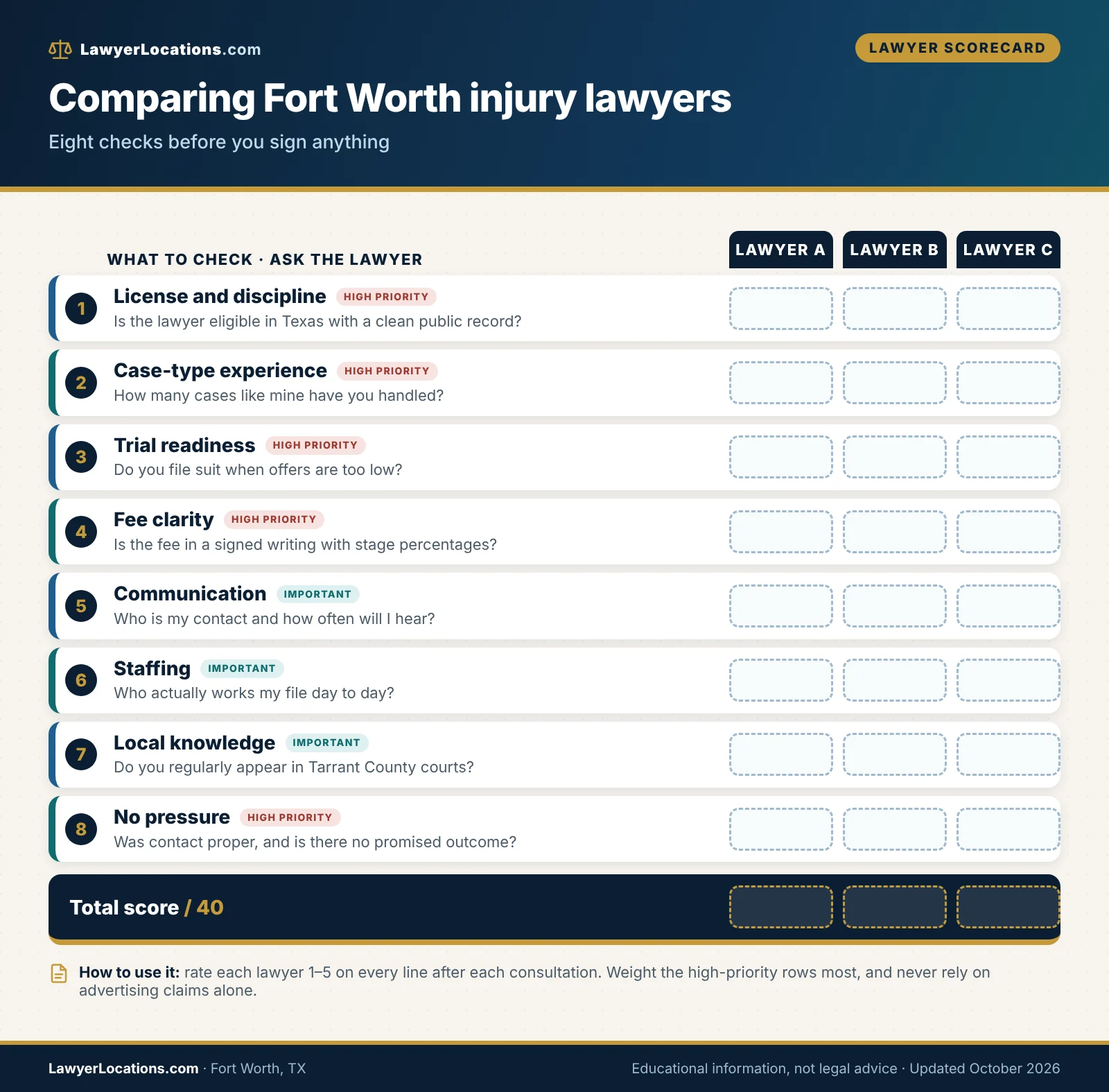
Text version of this graphic
- License and discipline: Is the lawyer eligible to practice in Texas, and is there any public discipline?
- Case-type experience: How many cases like yours has the firm handled, and what happened in general terms?
- Trial readiness: Does the firm file suit and try cases when offers are too low?
- Fee clarity: Is the contingent fee in a signed writing, with percentages and expenses spelled out?
- Communication: Who will answer your calls, and how often will you get updates?
- Staffing: Who actually works the file day to day?
- Local knowledge: Does the lawyer regularly appear in Tarrant County courts?
- No pressure: Does the lawyer avoid promises, urgency tactics, and improper contact?
Before you call anyone, write down the date and location of the incident and the name of every insurer involved. Having those facts ready lets a short first conversation cover far more ground, and it helps a lawyer spot any early deadline right away.
Local resources for finding and checking a lawyer
The Tarrant County Bar Association referral service
The Tarrant County Bar Association runs a Lawyer Referral and Information Service at 1315 Calhoun St., Fort Worth, with its public information at tarrantbar.org. Published descriptions say participating lawyers pay to enroll and meet basic guidelines, and that callers typically pay a modest fee for a short first consultation. Confirm the current terms with the service itself before relying on any fee detail.
Referral services are a convenience, not an endorsement. A lawyer listed through one still needs the same checks you would run on anyone else.
LegalLine, legal aid, and the county law library
Tarrant County’s free and low-cost legal assistance page lists the Bar Association’s LegalLine, where volunteer attorneys answer questions by phone in limited evening slots, along with Legal Aid of NorthWest Texas and law-school clinics. The county page does not say which of these accept injury cases, and legal aid programs usually focus on low-income civil needs, so call and ask before assuming they can take your claim.
The Dell DeHay Law Library, listed at 100 E. Weatherford St., is a place to read statutes and court rules. Reading helps you follow what your lawyer says, but it is not a substitute for advice.
Checking a lawyer on the State Bar of Texas site
The State Bar of Texas posts attorney profiles at texasbar.com. A profile shows license status, bar card number and license date, practice information, courts of admittance, law school, and public disciplinary history. The page notes that much of the information is self-reported and that license status can only be certified by the relevant court or licensing entity, so treat the profile as a starting point and confirm anything important in writing.
Make the profile check part of your routine for every lawyer you consider. It takes minutes and filters out several common problems at the start.
How to Compare Personal Injury Lawyers in Fort Worth
Compare lawyers on things you can check and ask about: license status, experience with your kind of case, how fees are written, and how the firm communicates. Do not rely on advertising claims, billboard slogans, or ranking badges. Ask the same questions of at least two lawyers so you can see differences in approach.
What to verify before you call
License status and disciplinary history
Start with the State Bar of Texas profile described earlier. Confirm the lawyer is eligible to practice in Texas, note the license date, and read any public disciplinary history. A profile cannot tell you how good a lawyer is, but it can tell you when something is wrong.
If the person who answers the phone or sends you a text is not a lawyer, that is normal for a busy firm. Just make sure you know which licensed lawyer is responsible for your file.
Experience with your type of injury and your type of defendant
A claim against a trucking company, a hospital, a landlord, or a city is not run like a two-car collision. Ask how many cases like yours the lawyer has handled, whether the firm has taken similar cases to a verdict, and who in the firm will handle the medical and engineering side. You are looking for specific, honest answers, not a pitch.
For crashes involving motorcycles, pedestrians, or dangerous property conditions, our related guides on Dallas motorcycle accident lawyers and Arlington slip and fall lawyers show how similar questions play out elsewhere in North Texas.
Specialty designations and marketing claims
Texas runs a state program for legal specialization through the Texas Board of Legal Specialization at tbls.org. If a lawyer says they hold a specialty designation, ask which body issued it and verify with that body. Be cautious about words like “top” or “best” in ads, because those are marketing labels, not a licensing finding.
Any lawyer or intake worker who tells you what your case is “worth” before reviewing records, or who promises a result, is giving you a sales pitch rather than a legal evaluation. Outcomes depend on facts, insurance, and fault.
Questions to ask at the consultation
Case-specific questions
Bring the basics and ask pointed questions. Is there a claim, and against whom? Which deadlines apply to my situation, including any government notice? What evidence is missing? What are the realistic risks, including a shared-fault argument? What would you need from me in the first 30 days?
Good lawyers will say what they do not know yet. If the answer is all certainty and no caveats, push for details.
Communication, staffing, and expectations
Ask who your main contact will be, how quickly calls are generally returned, and how you will be told about settlement offers. Ask whether a lawyer or a staff member will attend mediation and whether you must approve any settlement. The answers tell you how involved you will be.
It is fair to ask about the firm’s caseload without expecting a precise figure. You want to understand whether the lawyer will have time for your matter.
| Criterion | How to check it | Question to ask | Warning sign |
|---|---|---|---|
| License and discipline | State Bar of Texas profile at texasbar.com | Are you licensed in Texas and in good standing? | Cannot be found, or reluctance to discuss discipline |
| Case-type experience | Consultation and firm materials | How many cases like mine have you handled? | Vague answers or a generic pitch |
| Trial readiness | Ask about recent filed cases and verdicts | When offers are low, do you file suit and try cases? | Only wants quick settlements |
| Fee agreement | Read the written contract before signing | What percentage applies at each stage, and which expenses come out? | No writing, or unclear percentages |
| Communication | Observe how the intake goes | Who is my contact and how often will I get updates? | No answer on who handles the file |
| Local knowledge | Ask about Tarrant County filings | Do you regularly appear in Tarrant County courts? | No local experience for a local filing |
| Conduct | How the lawyer first contacted you | How did you learn of my accident? | Unsolicited contact in the first month after a crash |
Red flags and Texas solicitation rules
The 30-day rule on contacting accident victims
Texas restricts how lawyers can reach out to people hurt in accidents. Under Penal Code § 38.12(d), an attorney may not provide a written or in-person solicitation, with intent to obtain employment, about an accident or disaster before the 31st day after it occurred, if the person has not sought the lawyer’s services. A violation is a Class A misdemeanor under the statute, and repeat violations can be a felony.
A separate rule, Gov’t Code § 82.065, makes a legal-services contract voidable by the client if barratry procured it. If a stranger shows up at the hospital or sends a mailer within weeks of your crash, treat it as a red flag, keep the material, and consider reporting it to the State Bar of Texas.
Pressure, promises, and cash offers
Walk away from anyone who pressures you to sign on the spot, pays or offers money to a family member to refer you, or says the firm will take care of everything without reading your documents. Be cautious of anyone who asks for a large retainer in a case that is supposed to be on contingency, or who is vague about case expenses.
- Unsolicited visits, calls, or letters shortly after the accident.
- Promises about the amount or speed of a recovery.
- Reluctance to put the fee terms in a signed writing.
- No clear answer about who will handle your file.
- Pressure to sign today or to stop talking to your doctors.
Fees, Case Expenses and What You Take Home
Most Fort Worth injury lawyers work on a contingent fee, which means the lawyer is paid a percentage of what you recover rather than hourly. In Texas that agreement has to be in writing, and it should tell you how fees and expenses are calculated. We do not list average percentages here because they vary by firm and case and no official source sets them.
How contingent fees work in Texas
The writing requirement
Under Gov’t Code § 82.065, a contingent fee contract for legal services must be in writing and signed by the attorney and the client. The Texas Disciplinary Rules of Professional Conduct, Rule 1.04(d), add that the agreement must state the method by which the fee is determined.
Do not sign anything you have not read, and ask for a copy. A clear contract is a sign of a careful firm.
Percentages that change by stage
Rule 1.04(d) says that if the percentage differs for settlement, trial, or appeal, the agreement must state each percentage. In practice, many contingent fee agreements use a higher percentage once a lawsuit is filed or trial begins. Ask exactly when the percentage steps up, and what event triggers it.
Also ask what happens if you fire the lawyer or the case produces no recovery. The answers should be in the contract.
The closing statement
When a contingent matter ends, the rule requires the lawyer to give you a written statement of the outcome. If there is a recovery, it must show the amount paid to you and how it was calculated. Review that statement line by line against the fee agreement and ask about anything that looks different.
Asking detailed fee questions is normal and expected. A lawyer who is comfortable explaining percentages, expenses, and the closing statement in plain English is showing you how the relationship will work once your case is underway.
Case expenses, liens, and consultation costs
Expenses before or after the fee is calculated
Case expenses are costs of pursuing the claim, such as records fees, filing fees, deposition costs, and experts. Rule 1.04(d) requires the agreement to list the litigation and other expenses deducted from your recovery, and to say whether they are deducted before or after the contingent fee is calculated. That one sentence can change your net recovery, so make sure you understand it.
Suppose a settlement is $90,000, the fee is one-third, and expenses are $6,000. If the fee is figured on the gross amount first, the fee is $30,000 and expenses come out of the remaining $60,000, leaving $54,000 before any liens. If expenses are subtracted first, the fee is figured on $84,000, which is $28,000, leaving $56,000. These numbers are for illustration only and are not typical terms.
Ask whether you owe expenses if there is no recovery. The agreement should say.
Medical bills and reimbursement claims
Even after a settlement, money may be owed to health insurers, hospitals, or other payers who paid your bills. Texas also limits recoverable medical expenses to the amount actually paid or incurred, so the numbers used in negotiation may differ from the billed totals. Our guide on who pays medical bills after a car accident explains the usual claims you may need to resolve.
Ask your lawyer how liens are handled and who negotiates them. The answer should be part of the service, with any additional charge disclosed in writing.
Consultation and referral fees
Many injury lawyers offer an initial consultation without charge, but this varies by firm and you should confirm before you go. Bar-run referral services may charge participants and callers modest fees, so confirm current terms with the service. Asking this up front avoids surprises.
| Term | Why it matters | What the Texas rule says | Question to ask |
|---|---|---|---|
| Written agreement | Prevents disputes about what was promised | Contingent fee contract must be in writing and signed by attorney and client (Gov’t Code § 82.065) | May I take the contract home to read? |
| Fee method | Shows how the lawyer is paid | Agreement must state the method by which the fee is determined (Rule 1.04(d)) | What percentage applies now, and when does it change? |
| Stage-based percentages | Costs may rise after suit is filed | Separate percentages for settlement, trial, or appeal must be stated | What triggers the higher percentage? |
| Expenses | Reduce your net recovery | Agreement must list expenses and say if deducted before or after the fee | Do I owe expenses if there is no recovery? |
| Closing statement | Shows where the money went | Lawyer must provide written statement of the outcome and calculation | When will I see the final accounting? |
| Liens and bills | Can take a large share of a settlement | Recoverable medical expenses limited to amounts paid or incurred (§ 41.0105) | Who negotiates liens and is there an added charge? |
Deadlines, Evidence and Decision Points
An injury claim moves faster when the evidence is organized and the deadlines are tracked from the start. This section lays out a practical timeline, an evidence list, and the decisions that tend to arrive along the way. Dates here are planning aids, not legal calculations for your case.
A practical timeline for a Fort Worth injury claim
The first 30 days
Focus on medical care, evidence, and a basic claim notice to the insurers involved. Request the crash report, photograph injuries as they change, and write down what you remember while it is fresh. Be careful about social media, because posts and photos can be read as evidence about your activity level.
This is also the period when unsolicited lawyer contact is restricted by Texas law, so any offer you receive is worth a second look. Begin comparing lawyers during this window, but do not feel rushed into signing.
Months two through twelve
Most people are in treatment, and the lawyer is gathering records. A demand to the insurer usually follows once you reach a stable point in your recovery. If the claim involves a government entity, the notice window may already have closed or be closing, which is why early legal review matters.
Keep a simple log of appointments, missed work, and costs. It is easier to document as you go than to rebuild months later.
Two different clocks can run at once. The general two-year suit deadline applies to most injury claims, while a claim involving a government unit may require written notice much sooner. Ask about both at the first consultation.
The final stretch before the two-year mark
If negotiations have not produced a fair resolution as the two-year date approaches, your lawyer will need to file suit before it passes. Do not wait for the last week, because a petition has to be prepared, filed with the District Clerk, and properly served. Talk to your lawyer about the filing plan months in advance.
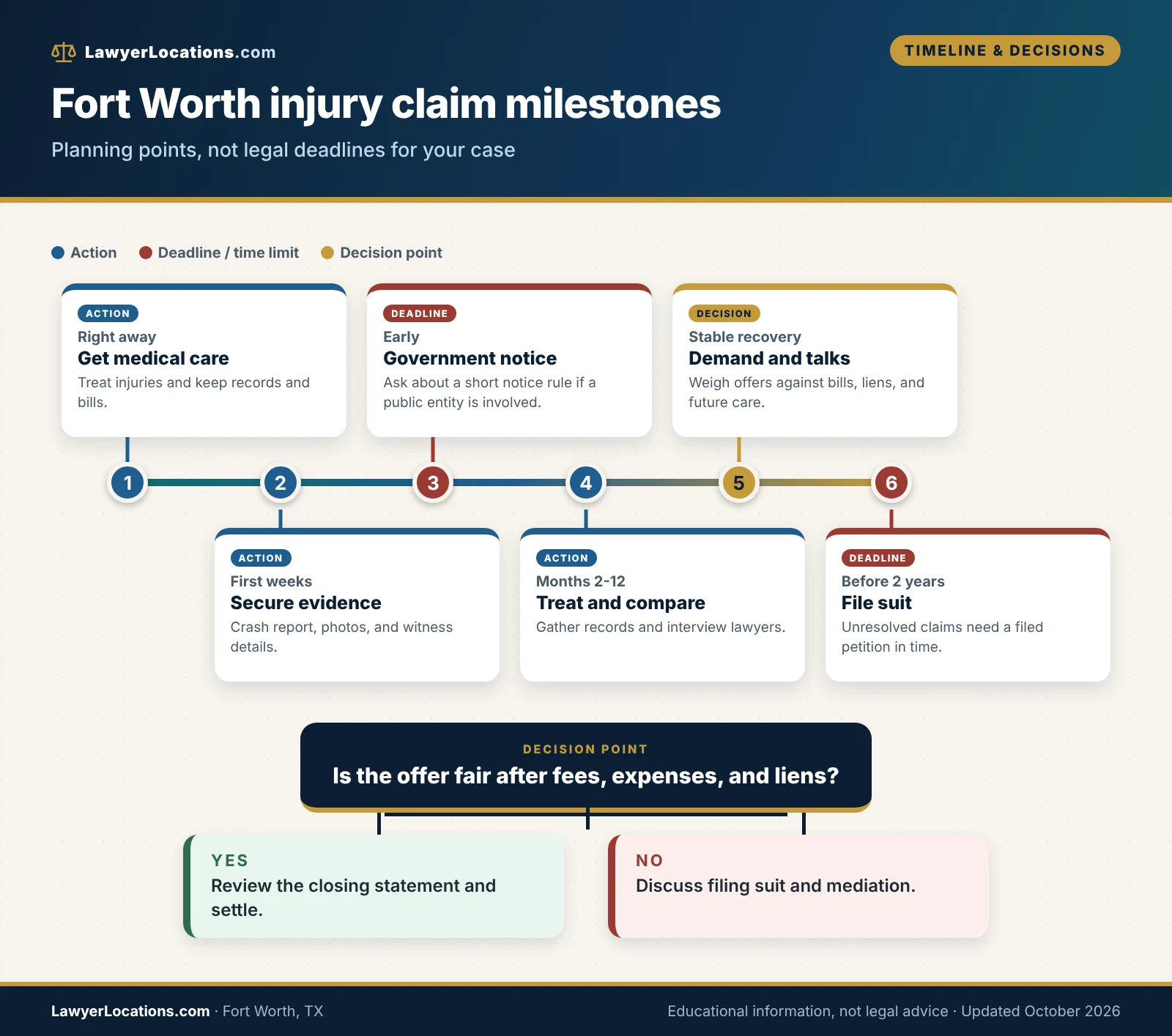
Text version of this graphic
- Right away: get medical care and keep records (action).
- First weeks: secure the crash report, photos, and witness details (action).
- Within about six months: send notice if a government entity may be responsible (deadline).
- Months 2 to 12: treat, gather records, and compare lawyers (action).
- When treatment stabilizes: demand and negotiation (decision).
- Before two years: file suit if the claim is unresolved (deadline).
Decision point: Is the offer fair after fault, bills, and liens? If yes, review the closing statement and settle. If no, discuss filing suit and mediation.
The evidence and documents to gather
Documents that prove fault and injury
Your lawyer will want the crash report, insurance information for every driver, medical records and bills, proof of lost income, and any correspondence from insurers. Hold on to original paperwork and send copies when asked. Keep the names and numbers of anyone who saw what happened.
Evidence on a property claim can vanish fast: surveillance video is often overwritten, and hazards get repaired. If a store or building was involved, ask a lawyer how to send a preservation request quickly.
Photos, video, and digital records
Photographs of the scene, vehicles, and injuries are valuable, as are dash-cam clips and phone data. Do not edit or delete anything, even if it seems unflattering. Back up files in more than one place and note the date and time each was taken.
If your car has an event data recorder or a connected-vehicle system, tell your lawyer before repairs or a total-loss sale, because the data may matter.
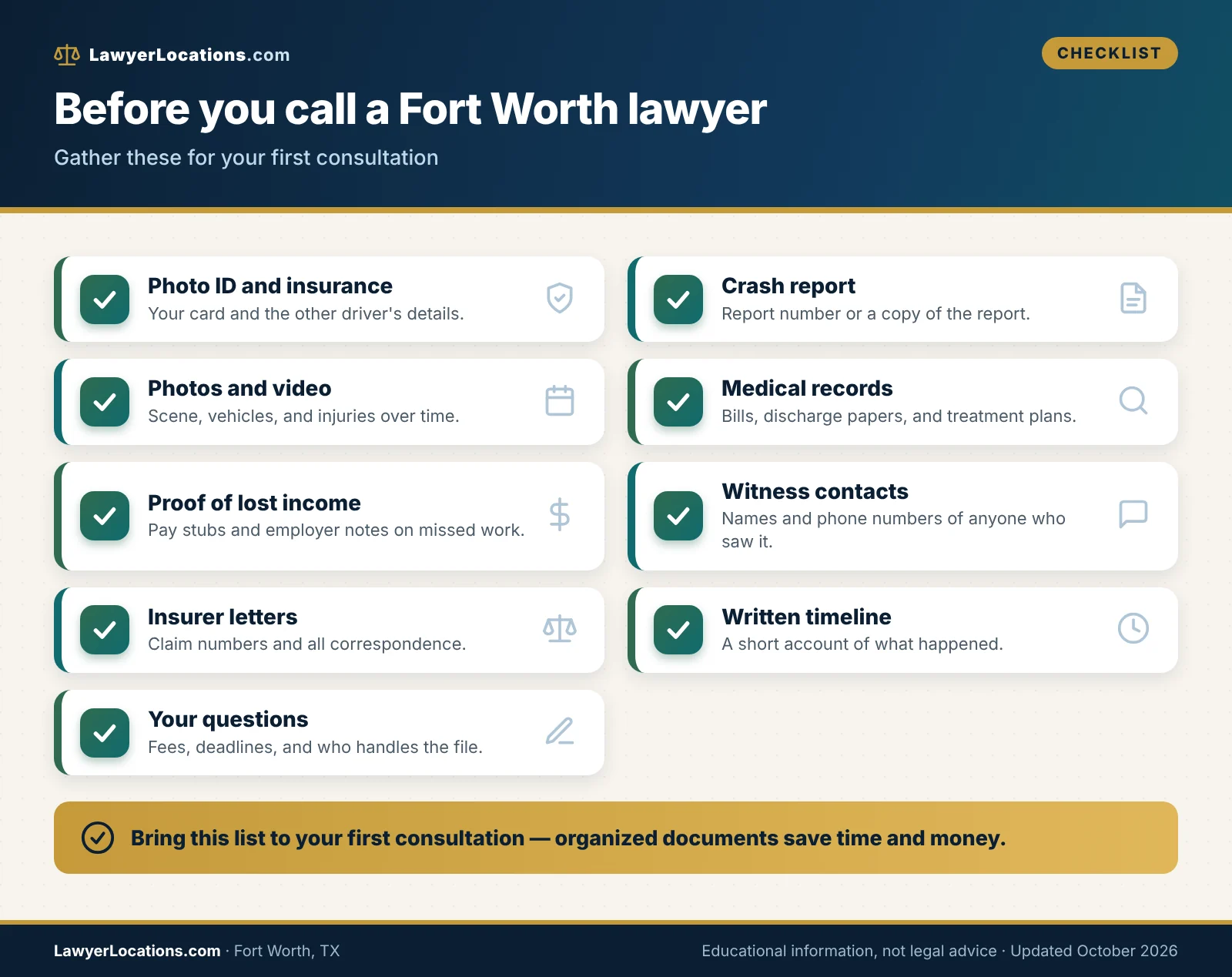
Text version of this graphic
- Photo ID and your insurance card
- Crash report or report number
- Photos and video of scene, vehicles, injuries
- Medical records, bills, and discharge papers
- Proof of missed work and lost income
- Names and contact details of witnesses
- Insurer letters and claim numbers
- A short written timeline of what happened
- Your questions for the lawyer
Decision points that often arrive
Accept an offer or keep going
An insurer’s first offer is a starting position, not a verdict. Weigh the offer against your medical future, your lost income, any liens, and the fault arguments. Ask your lawyer to explain the likely net amount you would receive after fees, expenses, and liens, not just the headline figure.
Once you sign a release, you generally cannot reopen the claim, even if your condition worsens. That finality is why timing a settlement carefully matters.
Changing lawyers or limiting the scope
You can change lawyers, but the contract may address what happens to fees and expenses already incurred, so read it first. Some people also hire a lawyer for limited help, such as reviewing a settlement or a release, rather than full representation. Discuss that option if your claim is small and the other side is cooperative.
If you feel your lawyer is not communicating, raise it directly first and put your concerns in writing. A calm conversation often solves more than a rushed switch.
Mistakes to Avoid, Next Steps and Common Questions
Most avoidable problems in injury claims come from silence, delay, and paperwork. The checklist below is meant to keep you on track, and the questions at the end answer what Fort Worth readers most often ask.
Common mistakes to avoid
Mistakes with insurers and evidence
- Giving a recorded statement to the other side’s insurer without advice.
- Posting about the incident or your activities on social media.
- Skipping medical follow-up, which can look like your injuries were minor.
- Accepting an early offer before your future care is clear.
- Letting repairs or disposal happen before documenting the vehicle.
Each of these is easy to avoid with a little planning. If you already made one, tell your lawyer so they can address it.
Mistakes with lawyers and paperwork
- Signing a fee agreement without reading the percentage, expense, and lien terms.
- Hiring someone who contacted you out of the blue in the first month.
- Missing a government notice window because you assumed the two-year rule covered everything.
- Failing to return calls or paperwork from your own lawyer.
- Relying on a billboard rather than checking the State Bar profile.
Careful paperwork protects you. When in doubt, ask for a copy and keep it.
Your next steps in Fort Worth
A simple one-week plan
- Protect your health. Keep appointments and save every bill and record.
- Gather evidence. Request the crash report and back up photos and videos.
- Write down deadlines. Note the two-year date and ask about any government notice rule.
- Verify two or three lawyers. Check each profile at texasbar.com and note any discipline.
- Prepare questions. Use the comparison worksheet in this guide.
- Read the contract. Take it home, ask questions, and sign only when it is clear.
For a fuller checklist of the first hours after a collision, see what to do after a car accident. A neighboring-city view is available in our guide to finding a personal injury lawyer in Dallas, TX.
When to move faster
Move quickly if a government vehicle or property was involved, if a child or an incapacitated person was hurt, if a death occurred, or if surveillance video may be overwritten. Early contact with a lawyer lets you preserve evidence and calendar the right deadlines. If cost is the barrier, call the Tarrant County Bar Association’s referral or LegalLine services and ask what they offer for injury matters.
Ready to compare your options?
Use the worksheet above to speak with two or three licensed Texas lawyers, verify each at texasbar.com, and ask for the fee terms in writing. If your injury came from a crash, start with our guide on whether you need a lawyer after a car accident. Your first step is simply to get the facts organized.
Quick answers to common Fort Worth questions
Hiring and cost questions
How do I find a personal injury lawyer near me in Fort Worth?
Start with the Tarrant County Bar Association referral service or personal recommendations, then verify every name on the State Bar of Texas site. Compare at least two lawyers using the same questions so the differences are clear.
Does a Fort Worth injury lawyer charge up front?
Many work on contingency, taking a percentage of a recovery, but the structure is set by the written agreement. Ask whether you owe expenses if there is no recovery and when the percentage changes.
Does a lawyer cost more if my case goes to court?
Often the percentage rises once a lawsuit is filed or trial starts, and Texas Rule 1.04(d) requires the agreement to state separate percentages if they differ. Read the stage terms before signing.
Can a lawyer contact me right after my accident?
Texas Penal Code § 38.12(d) restricts written or in-person solicitation about an accident before the 31st day after it occurred. Unsolicited contact in that window is a red flag worth reporting to the State Bar.
Case and timing questions
How long do I have to sue after a Fort Worth car accident?
Generally two years under Civil Practice and Remedies Code § 16.003. Shorter notice rules can apply if a government unit is involved, so ask a lawyer promptly.
What if I was partly at fault?
You can still recover if you are 50 percent or less responsible, but your damages are reduced by your percentage. If you are more than 50 percent responsible, Texas bars recovery.
Where would my lawsuit be filed?
Usually in a Tarrant County civil court, such as a district court or county court at law, and smaller claims can go to a justice court. Your lawyer will confirm the proper county and court.
Who can file a wrongful death claim in Texas?
The surviving spouse, children, and parents benefit from the claim, and any of them may bring it for the benefit of all. The estate’s representative can bring it in some situations.
How do I get my Texas crash report?
Use TxDOT’s crash report purchase system or its mail-in request form. Release is limited to people with a direct connection to the crash.
Sources & References
Show all 19 sources
- Civil Practice and Remedies Code, Chapter 16 (limitations; §§ 16.001, 16.003) — Texas Legislature — tcss.legis.texas.gov — accessed October 2026
- Civil Practice and Remedies Code, Chapter 33 (proportionate responsibility; §§ 33.001, 33.004, 33.012, 33.013) — Texas Legislature — tcss.legis.texas.gov — accessed October 2026
- Civil Practice and Remedies Code, Chapter 71 (wrongful death and survival; §§ 71.002, 71.004, 71.021) — Texas Legislature — tcss.legis.texas.gov — accessed October 2026
- Civil Practice and Remedies Code § 101.101 (notice of claim to governmental unit) — Public.Law statute mirror — texas.public.law — accessed October 2026
- Civil Practice and Remedies Code § 41.0105 (recovery of medical expenses) — Public.Law statute mirror — texas.public.law — accessed October 2026
- Transportation Code § 601.072 (minimum motor vehicle liability coverage) — Public.Law statute mirror — texas.public.law — accessed October 2026
- Penal Code § 38.12 (barratry and solicitation of professional employment) — Public.Law statute mirror — texas.public.law — accessed October 2026
- Government Code § 82.065 (contract for legal services) — Public.Law statute mirror — texas.public.law — accessed October 2026
- Texas Disciplinary Rules of Professional Conduct, Rule 1.04 (Fees) — University of Houston Law Center ethics library — law.uh.edu — accessed October 2026
- District Clerk (Tarrant County) — Tarrant County, Texas — tarrantcountytx.gov — accessed October 2026
- District Clerk Civil/Tax Division — Tarrant County, Texas — tarrantcountytx.gov — accessed October 2026
- District Clerk Court Document Lookup — Tarrant County, Texas — tarrantcountytx.gov — accessed October 2026
- Court Contact (civil district courts and county courts at law) — Tarrant County, Texas — tarrantcountytx.gov — accessed October 2026
- Justice of the Peace Courts — Tarrant County, Texas — tarrantcountytx.gov — accessed October 2026
- Free/Low Cost Legal Assistance — Tarrant County Law Library — tarrantcountytx.gov — accessed October 2026
- Tarrant County Bar Association Lawyer Referral Service — Texas Law Help — texaslawhelp.org — accessed October 2026
- State Bar of Texas attorney profile pages — State Bar of Texas — texasbar.com — accessed October 2026
- Texas Board of Legal Specialization — TBLS — tbls.org — accessed October 2026
- Crash report requests (CRIS purchase site and TxDOT crash records) — Texas Department of Transportation — txdot.gov — accessed October 2026
General information only. This guide is not legal advice, and reading it does not create an attorney-client relationship. LawyerLocations.com is a legal-education and lawyer-discovery resource, not a law firm, and it does not endorse or rank any lawyer. Laws, court rules, fees, and procedures change, and your facts matter. Consult a lawyer licensed in the relevant jurisdiction about your situation.
Legal Disclaimer and Limitation of Liability
Informational and illustrative purposes only. This article was prepared by LawyerLocations.com solely on the basis of the information available to us at the time of writing. It is an illustrative, general overview. It is not a complete or authoritative statement of the law, and it has not been reviewed by a lawyer licensed in your state or county.
Not legal advice. Nothing in this article is legal, financial, tax or immigration advice, and reading it does not create an attorney-client relationship between you and LawyerLocations.com or any author, lawyer or firm mentioned. Laws, court rules, fees, filing deadlines and agency procedures differ by state, county and court, and they change often. Some details here may be simplified, incomplete or out of date, and time limits for legal claims can be short.
No warranty. We make no representation or warranty, express or implied, about the accuracy, completeness, timeliness or suitability of this content for your situation. Please do not rely on it to make, delay or skip any legal decision. Check the facts against official sources and speak with a licensed attorney in the relevant jurisdiction before you act.
Limitation of liability. To the fullest extent permitted by law, LawyerLocations.com and its owners, authors and contributors disclaim all liability for any loss, damage, cost or other consequence arising from the use of, or reliance on, this article, including any content on third-party websites we link to. Mentioning a lawyer, firm, organization or service is not an endorsement and is not a promise of any result. If you are in immediate danger, contact your local emergency number.