If you are searching for an employment attorney San Antonio TX, you are probably dealing with a firing, harassment, discrimination, retaliation or unpaid wages. In Texas, the clocks are short: a state discrimination complaint to the Texas Workforce Commission generally must be filed within 180 days (300 days for sexual harassment), a federal EEOC charge has its own 180- or 300-day window, and a Texas Payday Law wage claim must be filed within 180 days of the date the wages were due.
This guide explains the Texas and federal rules that apply to San Antonio workers, the agencies and Bexar County and federal courts where claims actually land, how employment attorneys are paid, and how to compare two or three of them before you sign anything. It is general information, not advice about your facts.
Employment Attorney San Antonio TX: What You Are Really Shopping For
An employment attorney is a lawyer who handles disputes between workers and employers. In San Antonio the label covers a wide range of problems, from a final paycheck that never arrived to a supervisor’s months-long harassment campaign, so the first job in your search is to work out which kind of problem you actually have. This section explains what these lawyers do, which side they represent, and how a case usually moves.
What an employment attorney does for a worker
Most people picture a lawsuit. In practice, a lot of the work happens before anyone files anything: reading your paperwork, sorting your story into legal claims, picking the right agency or court, and often negotiating. The next three parts walk through the typical categories of work.
Discrimination and harassment claims
Texas and federal law both prohibit treating a worker worse because of protected traits such as race, sex, religion, national origin, age or disability. They also prohibit harassment that is tied to those traits. Whether conduct crosses the legal line depends on facts such as how often it happened, who did it, what you reported and how the employer responded.
A lawyer’s early questions tend to be practical: who said or did what, on which dates, who saw it, and whether you reported it in writing. If your concern is specifically sexual harassment, our guide to a sexual harassment lawyer goes deeper on that claim type.
Wage, overtime and final-paycheck disputes
Wage problems are the most common employment complaint that never needs a courtroom. A missed final paycheck, unpaid commissions or hours worked off the clock can often be pursued through a state or federal agency without a lawyer, although a lawyer can help when the amounts are large or several workers are affected.
Texas handles unpaid wages through the Texas Payday Law, while minimum wage and overtime are federal Fair Labor Standards Act questions. The two systems have different forms, different offices and different time limits, which is why the same unpaid-hours story can end up in both. For a look at how wage-and-hour disputes are framed in another large city, see our New Orleans employment lawyer guide.
Retaliation and wrongful-termination theories
Retaliation means an employer punishes you for doing something the law protects, such as complaining about discrimination, filing a charge or taking part in an investigation. Retaliation claims often survive even when the underlying complaint does not, so they are a frequent focus of a first consultation.
Texas is an at-will employment state, which means an employer can generally end the relationship at any time for any reason that is not illegal. Being fired unfairly is not by itself unlawful; the question is whether the real reason falls into a protected category.
Which side the lawyer represents
Employment lawyers usually work for either employees or employers, rarely both, and the difference matters for your search. This part explains how to tell which side a firm serves and why that affects how it will treat your case.
Worker-side and employer-side practices
A worker-side attorney represents the person who was fired, harassed or underpaid. An employer-side attorney advises companies on policies, investigations and defense. Neither is better in the abstract, but you want a lawyer whose daily work is on your side of the table, because the strategy, the intake questions and the fee model all follow from that.
When you read a firm’s website, look for plain statements about who the firm represents. If it is unclear, ask directly during the first call.
Why conflicts of interest come up early
A lawyer cannot represent you if the firm already represents your employer, your supervisor or a closely related party. Expect to be asked for the names of your employer, any parent company and the people involved before the lawyer discusses details.
That conflict check is routine, and it is also why you should avoid sending long emails full of sensitive detail to a firm before it has confirmed it can take your matter. Share the basics first and let the lawyer ask for more.
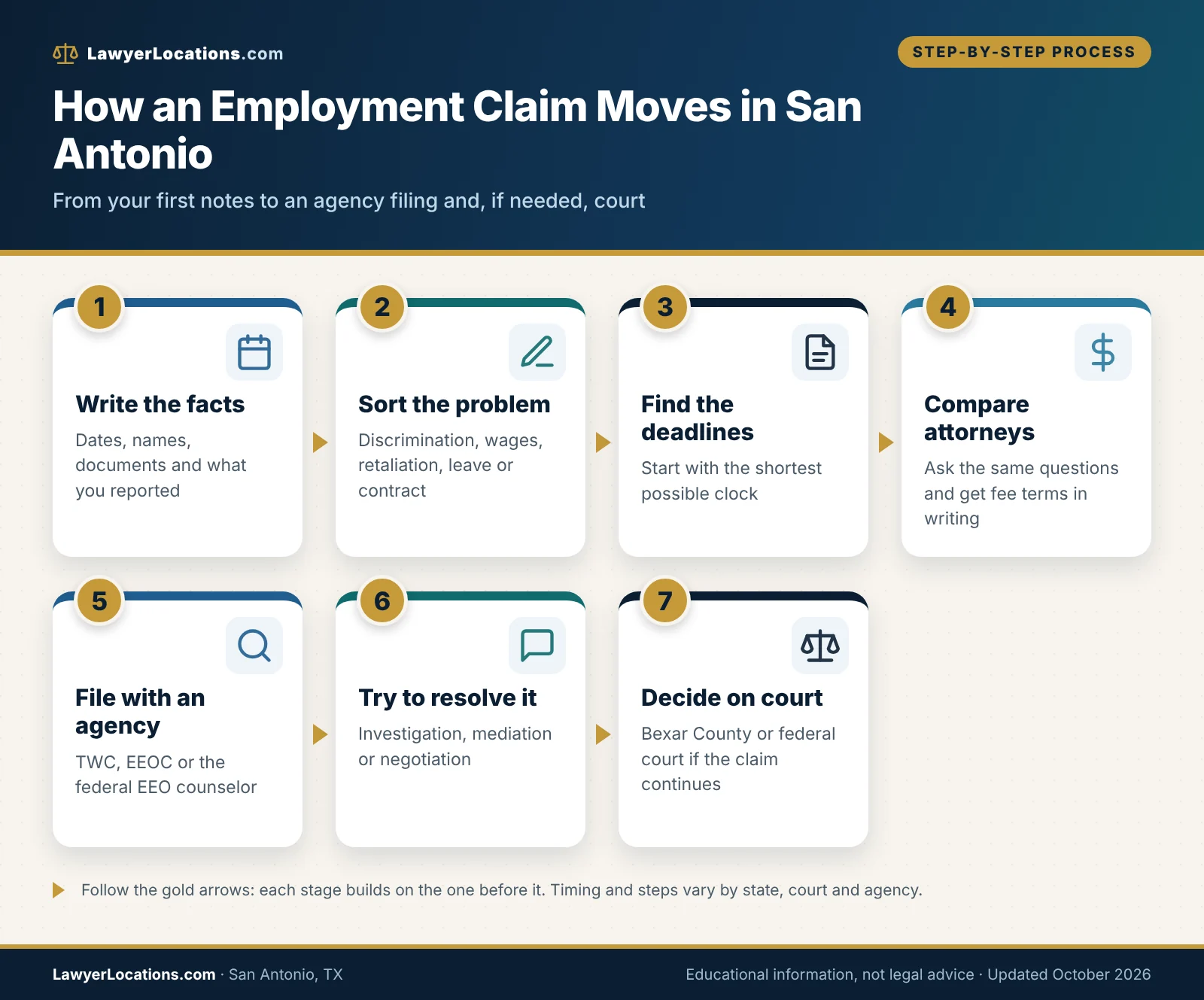
Text version of this graphic
- Write down the facts: dates, names, documents and what you reported.
- Sort the problem: discrimination, wages, retaliation, leave or contract.
- Note every deadline that could apply, starting with the shortest.
- Talk with one or more employment attorneys and compare fee terms.
- File with the right agency, such as the TWC, the EEOC or the Wage and Hour office.
- Try to resolve the matter through investigation, mediation or negotiation.
- If needed, move to a Bexar County court or the federal court in San Antonio.
How a case typically moves in San Antonio
Every case differs, but most follow a recognizable path. Knowing the path helps you judge whether a lawyer’s proposed plan makes sense and helps you plan your own time and money.
From first consultation to agency filing
After a consultation, many discrimination and harassment claims begin with an administrative filing rather than a lawsuit. The Texas Labor Code routes most state discrimination complaints through the Texas Workforce Commission, and federal claims go to the Equal Employment Opportunity Commission, which keeps a San Antonio Field Office.
The agency stage is not a formality. It is a legal prerequisite to suing on most discrimination claims, it starts the clock on later deadlines, and a filing that is late or aimed at the wrong body can end a claim before it starts.
From investigation to settlement or suit
Once a charge or complaint is filed, the agency may investigate, offer mediation or issue a notice that allows you to sue. Many cases end in a negotiated settlement at some point on that path, and some end with a court filing in Bexar County or federal court.
Because outcomes depend on facts, evidence and the other side’s choices, no honest lawyer can promise a result. Treat any promise of a specific outcome or dollar figure as a red flag, which we return to in the lawyer-comparison section.
Before you talk to anyone, write a one-page timeline: the date of each incident, the people involved, what was said or done, and what you reported and to whom. A tight timeline makes a first consultation far more productive and helps a lawyer spot the earliest deadline in minutes.
The Texas and Federal Laws Behind San Antonio Employment Claims
San Antonio workers are protected by a mix of Texas statutes and federal laws. The state discrimination law is Chapter 21 of the Texas Labor Code, the state wage-payment law is Chapter 61, and several federal statutes sit on top. The substantive federal rules do not change when you cross a city line, but the Texas rules and the local offices do matter, and this section maps them.
Texas discrimination law: Labor Code Chapter 21
Chapter 21 of the Texas Labor Code is commonly called the Texas Commission on Human Rights Act. It prohibits employment discrimination and retaliation and sets the procedure for state-law complaints. The next parts explain who it covers and what it says about retaliation.
Who is covered as an employer
Under Tex. Lab. Code 21.002, a private employer is generally covered if it has 15 or more employees for each working day in 20 or more weeks in the current or preceding calendar year. The same section treats a county, municipality, state agency or state instrumentality as an employer regardless of how many people it employs.
So a worker at a small family business may fall outside the state discrimination law, while a worker for a city or county department is covered even if the unit is tiny. If you work for a very small employer, ask any lawyer you consult whether a different law could still apply to your facts.
Retaliation under Chapter 21
Tex. Lab. Code 21.055 makes it an unlawful employment practice to retaliate or discriminate against a person who opposes a discriminatory practice, makes or files a charge, files a complaint, or testifies, assists or participates in an investigation, proceeding or hearing under the chapter.
In plain terms, you are protected for raising a good-faith concern or taking part in the process, and the protection does not depend on whether the original complaint ultimately succeeds. Keep proof of when you complained and when the employer’s treatment changed, because the timing between the two is often central evidence.
Federal laws that overlap with Texas law
Federal statutes cover many of the same problems and some that Texas law does not. San Antonio workers often have a state claim and a federal claim at the same time, and a good lawyer will plan around both.
Federal anti-discrimination statutes and the EEOC
The Equal Employment Opportunity Commission enforces the main federal anti-discrimination laws, including those on race, sex, religion, national origin, age and disability. Each federal law has its own employer-size threshold, so a lawyer will check that early.
The EEOC publishes filing instructions and keeps a San Antonio Field Office that accepts charges by portal, phone or in person. We cover the details in the next section, and the deadline rules in the section after that.
The Fair Labor Standards Act for pay and overtime
The federal Fair Labor Standards Act sets a federal minimum wage of $7.25 per hour, according to the U.S. Department of Labor, and requires covered, nonexempt employees to receive overtime at one and one-half times the regular rate for hours over 40 in a workweek. Where state and federal minimums differ, the higher one applies.
Many workers are mislabeled as “exempt” or as independent contractors, which can hide overtime owed. A lawyer can review how you are paid and what you actually do all day, because job duties, not job titles, usually drive the analysis.
The Texas Payday Law for unpaid wages
Chapter 61 of the Texas Labor Code, the Texas Payday Law, is the state system for claims that you were not paid what you were promised. The Texas Workforce Commission runs the claims process. The next parts cover what it reaches and when final pay is due.
What the Payday Law covers
According to the Texas Workforce Commission, the Payday Law reaches compensation for services however it is calculated, plus commissions, bonuses and certain fringe benefits. The agency’s page does not list overtime under the Payday Law and instead points workers to the U.S. Department of Labor for minimum wage and overtime claims under the FLSA.
That split is why a worker who is owed both a missing paycheck and unpaid overtime may deal with two agencies. A lawyer can sort out which piece belongs where and avoid duplicate or inconsistent filings.
When final pay is due
The Texas Workforce Commission states that a worker who is laid off, discharged or fired is due final pay within six calendar days of the last day, while a worker who quits, resigns or retires is due final pay on the next regularly scheduled payday after the resignation takes effect.
If you miss those dates, do not wait for the employer to “get around to it.” The wage-claim deadline runs from the date the wages were originally due, not from the date you gave up asking, which we explain in the deadlines section.
Exempt and nonexempt describe whether federal overtime rules apply to a job. A nonexempt employee is generally owed overtime for hours over 40 in a week. An employer calling you “salaried” or giving you a manager title does not automatically make you exempt.
Where San Antonio Claims Go: Agencies and Courts
Employment claims in San Antonio do not all land in the same place. Discrimination charges go to the Texas Workforce Commission or the EEOC, wage claims go to the Texas Workforce Commission or the U.S. Department of Labor, and lawsuits are filed in Bexar County courts or in the federal courthouse downtown. Choosing the wrong door wastes time you may not have.
Agencies that take employment complaints
For many claims the agency is the first stop, not the courthouse. These parts describe the agencies a San Antonio worker is most likely to deal with and what each one does.
The EEOC San Antonio Field Office
The EEOC’s San Antonio Field Office is located at Legacy Oaks, Building A, 5410 Fredericksburg Road, Suite 200, San Antonio, TX 78229. The agency lists a national number, 1-800-669-4000, and office hours of 8:00 a.m. to 4:30 p.m., Monday through Friday.
The EEOC recommends scheduling an intake interview through its public portal, where you can choose a telephone, video or in-person appointment, and says appointments get priority. Walk-ins are seen first come, first served, with imminent filing deadlines seen first, though staff may not be able to complete a full interview during a walk-in visit.
The Texas Workforce Commission
The Texas Workforce Commission, usually shortened to TWC, is the state agency named in Chapter 21 for discrimination complaints and the agency that processes Payday Law wage claims. Its Civil Rights Division handles state discrimination complaints, and its Wage and Hour Department handles unpaid-wage claims.
According to the TWC, a wage claim can be filed online through its application or on paper by mail or fax, and it must itemize each type of unpaid wage, explain how you calculated it, list the dates you worked without pay, and be signed under penalty of perjury. Include copies, not originals, of documents such as your most recent pay stub, and file a separate claim for each employer.
Federal-sector and military-adjacent workplaces
San Antonio has a large number of federal workplaces, including military installations and federal offices. Federal employees and applicants follow a different process: they generally must contact an agency EEO Counselor within 45 days, a limit set out in 29 C.F.R. 1614.105, rather than filing a charge with the EEOC first.
The regulation requires an extension of the 45 days in certain situations, such as when the person was not notified of the time limit and was not otherwise aware of it, or when circumstances beyond the person’s control prevented timely contact. Do not count on an extension; contact the counselor as soon as you can.
State courts in Bexar County
When a case reaches a Texas state court in San Antonio, it is a Bexar County court. Which one depends mostly on how much money is at stake and what kind of relief you want.
Justice of the peace courts for small wage claims
Bexar County’s justice of the peace courts handle small claims. A small claim in Texas justice court can be for no more than $20,000, excluding statutory interest and court costs but including attorney fees, if any, under Rule 500.3(a) of the Texas Rules of Civil Procedure, as the State Law Library explains. These civil cases are governed by Rules 500 to 510.
The county’s civil-cases page offers a small claims form, self-help packets and free mediation through the Bexar County Dispute Resolution Center, and it notes that county staff cannot give legal advice. For a modest unpaid-wage dispute that falls outside the Payday Law window or the agency process, this route may be worth asking a lawyer about.
Bexar County district courts
Larger employment lawsuits, including state-law discrimination suits that follow a Texas right-to-sue notice, are generally filed in a Bexar County civil district court. The county lists its Bexar County Courthouse at 100 Dolorosa, San Antonio, TX 78205, and a Civil District Court Administration office for scheduling questions.
District court filings are made electronically by lawyers, and the county publishes attorney instructions for e-filing. If you represent yourself, ask the court clerk what filing method applies to you before you try to submit anything.
Federal court in San Antonio
Federal claims, and many combined state and federal cases, can be filed in the U.S. District Court for the Western District of Texas, San Antonio Division. This part covers where it sits and how it fits with the appeals system.
The San Antonio Division of the Western District of Texas
The court’s website lists the U.S. District Clerk’s Office for the San Antonio Division at 262 West Nueva Street, Room 1-400, San Antonio, Texas 78207. The same site has a “Filing Without an Attorney” section with a pro se manual, FAQs and electronic submission information for people who represent themselves.
Federal court has its own procedural rules, deadlines and costs, and it is usually a harder place to go without a lawyer than a justice court. Many employment lawyers prefer federal court for federal-law claims and state court for state-only claims, but the choice depends on strategy and is worth asking about.
Appeals and why they matter at the start
Most employment disputes never reach an appeals court, but appeal rights shape how a lawyer builds the record from day one. Decisions of the federal trial court in San Antonio are reviewed by the U.S. Court of Appeals for the Fifth Circuit, and decisions of Bexar County trial courts go to the Texas appeals courts.
The practical lesson is that written complaints, dated documents and a clean timeline help at every level. A lawyer who talks about the record early is thinking about more than the next filing.
Why city ordinances rarely change the picture
People sometimes assume the City of San Antonio can add workplace rights for private-sector workers. This part explains why the answer is usually no, and what to rely on instead.
The paid sick leave ordinance
A San Antonio paid sick leave ordinance for private employers drew a legal challenge, and an appellate decision summarized by a national employment law firm affirmed a temporary injunction that barred the ordinance from taking effect. In short, you should not assume that you have a local right to paid sick leave from a private employer.
If your question is about sick time or leave, a lawyer will look first at federal leave law, your employer’s written policy and any contract.
What to rely on instead
For private-sector jobs in San Antonio, state and federal law set the rules, along with your own offer letter, handbook and any signed agreements. Texas law also generally limits local governments from adding their own employment mandates, and that state law has itself been litigated, so ask a lawyer how it affects any local-law theory.
The City of San Antonio does set rules for its own workforce and contractors, so city employees should ask about internal grievance procedures in addition to the state and federal options.
You do not need a lawyer to file a discrimination charge with the EEOC or a wage claim with the TWC. Many workers file on their own and hire a lawyer later. What a lawyer adds is judgment about which agency, which claims and which words matter, plus someone to handle the other side.
| Problem | Usual first stop | Later court option |
|---|---|---|
| Discrimination or harassment at a private employer | Texas Workforce Commission and/or EEOC San Antonio Field Office | Bexar County district court (state claims) or U.S. District Court, San Antonio Division |
| Discrimination by a federal agency employer | Agency EEO Counselor within 45 days | Federal court after the administrative process |
| Missing final paycheck, bonus or commission | Texas Workforce Commission wage claim | Bexar County justice or district court, depending on the amount |
| Unpaid minimum wage or overtime | U.S. Department of Labor, Wage and Hour Division | U.S. District Court, San Antonio Division, or state court |
| Retaliation after a complaint | Same agency that handles the underlying complaint | Same courts as the underlying claim |
The Deadlines That Decide Whether You Can File
Deadlines are the single biggest risk in an employment claim, and the shortest ones are measured in days, not years. In Texas, a state discrimination complaint to the TWC generally must be filed within 180 days of the unlawful act, with a 300-day window for sexual harassment. Federal and wage deadlines run on separate clocks that you should count independently.
Deadlines to file a discrimination complaint or charge
The first clock starts when the discriminatory act happens, not when you decide to act. These parts show how the state, federal and federal-employee deadlines fit together.
The Texas Workforce Commission deadline
Under Tex. Lab. Code 21.202(a), a complaint must be filed not later than the 180th day after the date the alleged unlawful employment practice occurred. Subsection (a-1) says that a complaint alleging sexual harassment must be filed not later than the 300th day after the date the alleged sexual harassment occurred, a change that took effect September 1, 2021 under H.B. 21. Subsection (b) directs the commission to dismiss an untimely complaint.
Because the commission must dismiss late complaints, the safest practice is to treat the 180-day line as the real one unless a lawyer confirms the longer period applies.
The EEOC deadline
The EEOC says that in general you need to file a charge within 180 calendar days from the day the discrimination took place. The deadline extends to 300 days where a state or local agency enforces a law that prohibits employment discrimination on the same basis. The agency also notes that the 300-day extension does not apply for age discrimination if only a local law prohibits it.
Because the TWC enforces a Texas law on many of the same bases as federal law, the longer period often applies in Texas. Do not assume it applies to your claim; ask the EEOC San Antonio Field Office or a lawyer to confirm.
The 180- and 300-day counts run in calendar days from the discriminatory act, and the agencies generally will not extend them because you were waiting for the employer to fix things or for an internal investigation to finish. If you are close to a line, contact the agency or a lawyer the same week.
Deadlines after the agency stage
Filing a complaint is only the first deadline. Once an agency finishes or releases the matter, new clocks start for filing a lawsuit.
Suing under Texas law
Under Tex. Lab. Code 21.254, within 60 days after the date a notice of the right to file a civil action is received, the complainant may bring a civil action against the respondent. And under Tex. Lab. Code 21.256, a civil action may not be brought later than the second anniversary of the date the complaint relating to the action is filed.
These two statutes work together, so read both. The 60-day window runs from receipt of the notice, but the two-year outer limit runs from the date you filed the complaint, so waiting a long time for an agency to act can use up part of the outer limit.
Suing under federal law
The EEOC states that once you receive a Notice of Right to Sue, you must file your lawsuit within 90 days. Missing that deadline can prevent you from pursuing the case.
When a notice arrives, write down the date you received it and the date 90 days later, and calendar both. Employment lawyers often want to see the notice itself, including the envelope or email it came in, because the receipt date can matter.
Wage claim and other clocks
Wage deadlines are shorter than many people expect, and they run separately from the discrimination clocks above.
The Texas Payday Law deadline
The TWC says you must file a wage claim no later than 180 days after the date the wages were originally due to be paid, and that the agency uses the date it receives your claim. If part of your unpaid wages falls outside that window, the agency says to file only for the part inside it, and claims for older wages may still be possible with the U.S. Department of Labor or in court.
In practice, that means every week of delay can put an earlier paycheck out of reach. File promptly, and if you are unsure whether the Payday Law or the FLSA fits, ask a lawyer or the agency.
Other time limits to watch
Other claims have their own clocks: leave-law claims, public-employee whistleblower claims, workers’ compensation retaliation, contract and severance disputes, and unemployment benefit appeals all run separately. Several are shorter than people expect, and some begin with an internal notice rather than a lawsuit.
If your situation involves an on-the-job injury, our guide on whether you need a workers’ comp lawyer explains how that system works. For everything else, let a first consultation produce a written list of the deadlines your lawyer believes apply.
| Claim or step | Time limit | Where it comes from |
|---|---|---|
| Texas discrimination complaint to TWC | 180 days after the act | Tex. Lab. Code 21.202(a) |
| Texas sexual harassment complaint to TWC | 300 days after the act | Tex. Lab. Code 21.202(a-1) |
| Federal EEOC charge | 180 days, or 300 days where a state agency enforces a law on the same basis | EEOC time-limits guidance |
| Federal employee EEO contact | 45 days, subject to listed extensions | 29 C.F.R. 1614.105 |
| Suing after a Texas notice of right to sue | 60 days after receipt; never later than two years after the complaint was filed | Tex. Lab. Code 21.254 and 21.256 |
| Suing after an EEOC Notice of Right to Sue | 90 days after receipt | EEOC filing-a-lawsuit guidance |
| Texas Payday Law wage claim | 180 days after the wages were due | Texas Workforce Commission |
How to Compare Employment Attorneys in San Antonio
Compare at least two employment attorneys before you hire one, and compare them on the same questions. Look at whether the lawyer is licensed in Texas and in good standing, how much of the practice is on the worker side, how the fee works in writing, and how the lawyer talks about risk. This section gives you a repeatable method that does not depend on advertising.
Verify the basics before the first call
A few checks take minutes and can rule out problems early. Do them before you share a detailed story.
License and discipline history
Confirm that the lawyer is licensed to practice in Texas and in good standing using the State Bar of Texas lawyer search, and look for any public discipline. The State Bar also runs a Lawyer Referral Information Service that you can reach at 1-800-252-9690.
A clean record does not make a lawyer a good fit, but a problem with licensing or discipline is something you want to know before you hand over documents. If a lawyer is based out of state, ask who in the firm is licensed in Texas and will actually sign pleadings.
Practice focus and side of the table
Ask what share of the lawyer’s practice is employment law and what share is on the worker side. A lawyer who mostly defends employers may still be competent, but you want someone who handles worker cases regularly and knows the TWC, the EEOC San Antonio Field Office and the local courts.
You can also check whether a lawyer holds a Texas Board of Legal Specialization designation in labor and employment law. A designation is one data point, not a ranking, and the lack of one does not mean a lawyer is unqualified.
Questions that reveal how a lawyer works
Good consultations are conversations, not sales pitches. The questions below are designed to surface the information you need to compare lawyers on substance.
Questions about experience with your type of claim
Ask how often the lawyer handles the type of claim you have, whether those cases usually settle or go to court, and whether the lawyer has filed in Bexar County courts and in the Western District of Texas. Ask who would do the day-to-day work and how often you would hear from the firm.
Listen for specifics. A lawyer who explains what is likely to matter in your facts, what is uncertain, and what the next two steps are is giving you something more useful than a confident story about an outcome.
Questions about strategy and deadlines
Ask the lawyer to identify, in writing if possible, every deadline that might apply to your claim, including the earliest one and the date the lawyer calculates it to fall. Ask whether the lawyer recommends an agency filing first and why.
Also ask whether the lawyer sees any problems, such as an arbitration agreement, a signed release, or a small-employer coverage issue. Lawyers who raise problems early tend to be the ones who plan well.
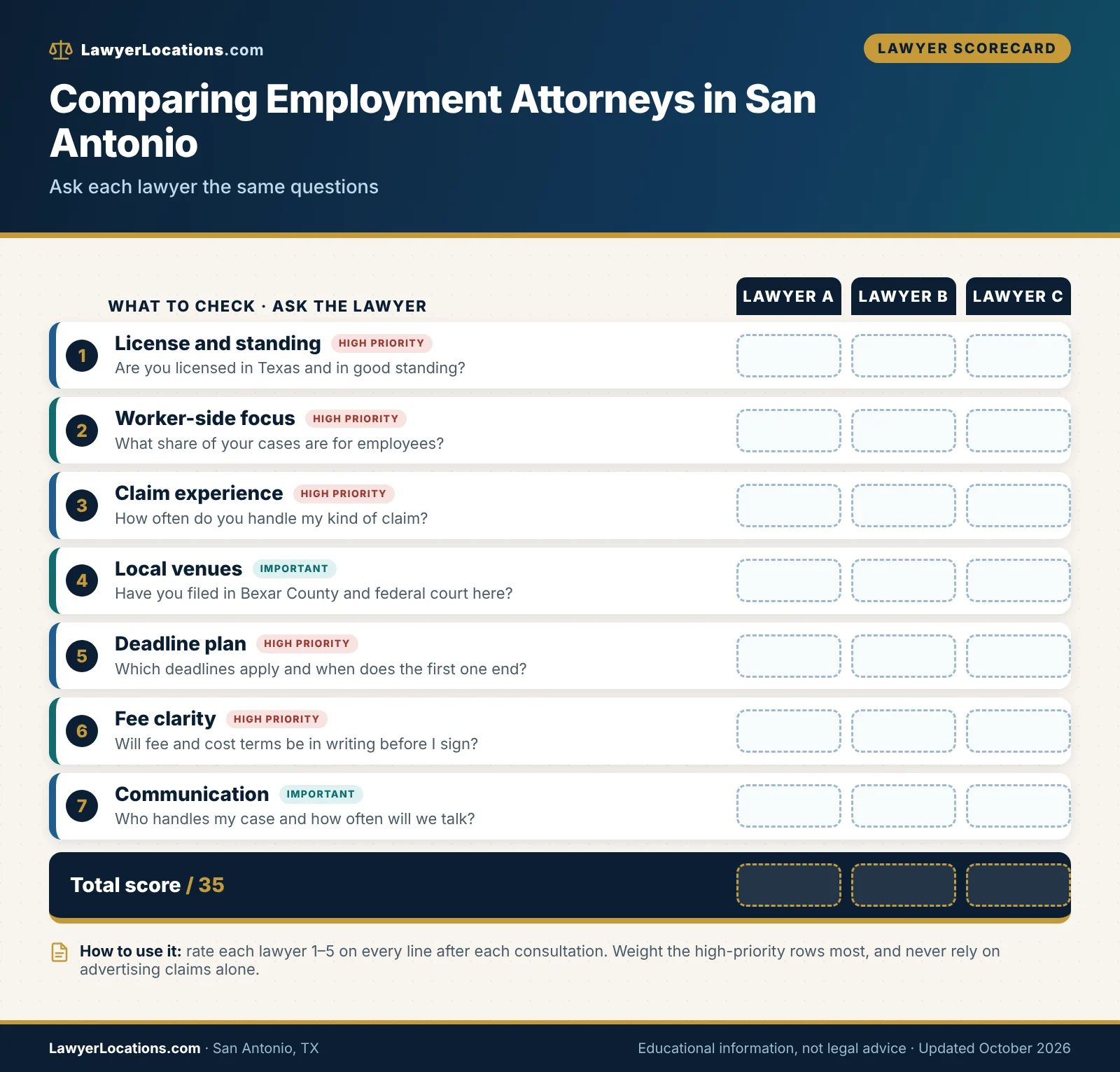
Text version of this graphic
| Criterion | Question to ask |
|---|---|
| License and standing | Are you licensed in Texas and in good standing? |
| Worker-side focus | What share of your cases are for employees? |
| Claim experience | How often do you handle my kind of claim? |
| Local venues | Have you filed in Bexar County and federal court here? |
| Deadline plan | Which deadlines apply, and when does the first one run out? |
| Fee clarity | Will the fee and cost terms be in writing before I sign? |
| Communication | Who will handle my case and how often will we talk? |
Red flags and green flags when you compare
Nobody can promise you a result, so the signals that matter are about honesty, clarity and process. The two lists below help you separate sound practices from pressure tactics.
Red flags in advertising and intake
- A promise of a specific outcome, dollar amount or timeline for your case.
- Pressure to sign a fee agreement the same day, or a refusal to put terms in writing.
- Claims to be the “best” or to have a surefire approach, with no specifics.
- A fee agreement that does not explain who pays case costs if you lose.
- An unwillingness to name the deadlines that apply to you.
Any one of these is a reason to slow down and get a second consultation. Several together are a reason to walk away.
Green flags in a consultation
- The lawyer explains the main claims, the main weaknesses and the next step in plain language.
- Fee and cost terms are offered in writing and explained line by line.
- The lawyer asks for documents and gives you a clear list of what to gather.
- The lawyer tells you honestly when you may not have a claim, or when a free agency process fits better.
Green flags do not predict results, but they suggest a lawyer who treats you as a partner in the process. Compare two or three lawyers on this list rather than choosing the first one who calls back.
Beware of anyone who contacts you first after you file an agency charge or a public complaint and pushes you to hire immediately. A real lawyer will let you compare options, take time to read the fee agreement and consult someone else.
What Employment Attorneys Charge, and Costs and Decision Points on One Timeline
Employment attorneys generally charge in one of four ways: a contingency percentage, an hourly rate, a flat fee for a defined task, or a hybrid. Texas requires a contingent fee agreement to be in writing, and what you owe also depends on case costs. This section explains each model without quoting averages, because fees vary by lawyer and by case.
The common fee models
Fee models differ in who carries the risk. Understanding the differences helps you compare offers on more than a headline percentage.
Contingency fees
Under a contingency fee, the lawyer is paid a percentage of any recovery and nothing if there is none, apart from costs depending on the agreement. Rule 1.04(d) of the Texas Disciplinary Rules of Professional Conduct requires a contingent fee agreement to be in writing and to state the method by which the fee is determined, including different percentages if the lawyer’s share changes between settlement, trial or appeal.
The agreement must also state the litigation and other expenses to be deducted from the recovery and whether those expenses come out before or after the percentage is calculated, and the lawyer must give you a written closing statement at the end. Ask for a sample agreement to read at home before you decide.
Hourly, flat-fee and hybrid arrangements
Hourly billing is common for reviewing severance packages, drafting demand letters, negotiating exits or advising on non-compete terms. Flat fees are sometimes offered for a defined task, such as reviewing a contract or a separation agreement before you sign it.
A hybrid combines a lower hourly or flat component with a contingency share. Ask what the retainer covers, how often you will be billed, and what happens if the work goes beyond the original scope.
Case costs, fee shifting and damages limits
Even when a lawyer is paid on contingency, a case has out-of-pocket costs, and the law also sets limits on certain damages. These parts cover both.
Costs and who pays them
Costs can include filing fees, deposition transcripts, expert witnesses, mediators and records requests. Ask how the lawyer handles them: whether the firm advances them, whether you repay them if you lose, and whether they are deducted before or after the fee percentage.
Courts publish their own fee schedules, so check the clerk’s current fee information rather than relying on a number you saw online.
Attorney’s fees and caps under Texas law
Under Tex. Lab. Code 21.259, in a proceeding under Chapter 21 a court may allow the prevailing party, other than the commission, a reasonable attorney’s fee as part of the costs. That is discretionary, which means a judge is not required to award them.
Texas also caps some damages in Chapter 21 cases. Under Tex. Lab. Code 21.2585, the combined total of future pecuniary losses, nonpecuniary losses and punitive damages is limited, per complainant, based on the respondent’s employee count, and back pay is not part of that cap.
| Respondent’s employee count | Combined limit per complainant |
|---|---|
| Fewer than 101 employees | $50,000 |
| More than 100 and fewer than 201 | $100,000 |
| More than 200 and fewer than 501 | $200,000 |
| More than 500 employees | $300,000 |
These limits cap certain types of damages. They are not predictions of what any case is worth, and they do not include back pay. Punitive damages are not available against a governmental entity under the statute, and the employee count only includes employees employed for at least 20 calendar weeks in the current or preceding calendar year.
A server in San Antonio is fired on a Monday, two weeks after reporting a manager’s repeated comments to HR. She counts 180 days from the firing for a state complaint, books two consultations, and saves her texts and shift schedules. The first lawyer she meets quotes a contingency agreement in writing; the second offers an hourly review. Comparing both on the same questions lets her choose with eyes open. This is an illustration, not a prediction about any real case.
| Fee model | How it works | Works well when | Watch out for |
|---|---|---|---|
| Contingency | Lawyer takes a percentage of any recovery; Texas requires a written agreement stating the method | You cannot pay hourly and the claim has real recovery potential | Costs, percentage steps at trial or appeal, and what happens if you lose |
| Hourly | You pay for time spent, usually against a retainer | You need advice, a demand letter or negotiation of an exit | Unclear estimates and open-ended billing |
| Flat fee | One price for a defined task | Reviewing a contract or severance agreement before you sign | What is outside the defined scope |
| Hybrid | Reduced hourly or flat fee plus a smaller contingency share | You can share risk but not cover full hourly rates | Layered fees that add up |
Costs, deadlines and decision points on one timeline
Seeing the process in order helps you decide when to spend money and when to wait. The timeline below combines the filing deadlines with the points where you decide whether to keep going.
From the incident to the first filing
In the first weeks after an incident, preserve evidence and write down your timeline. Calendar the earliest possible deadline immediately, then book consultations with two or three lawyers while the clock is running.
The first decision point is whether to file an agency complaint yourself or have a lawyer do it. If a lawyer will not be able to meet you before a deadline, file the agency form on your own to protect the date and bring the lawyer in later.
From filing to the decision to sue
After a filing, expect a waiting period, possible requests for information, and possibly mediation. When a notice of the right to sue arrives, the next decision point appears: sue, settle or let the claim go, all with a new deadline.
At that point, ask your lawyer for a written estimate of likely costs and the realistic range of outcomes in plain terms, along with the risks of a loss, including the chance of having to pay certain costs.
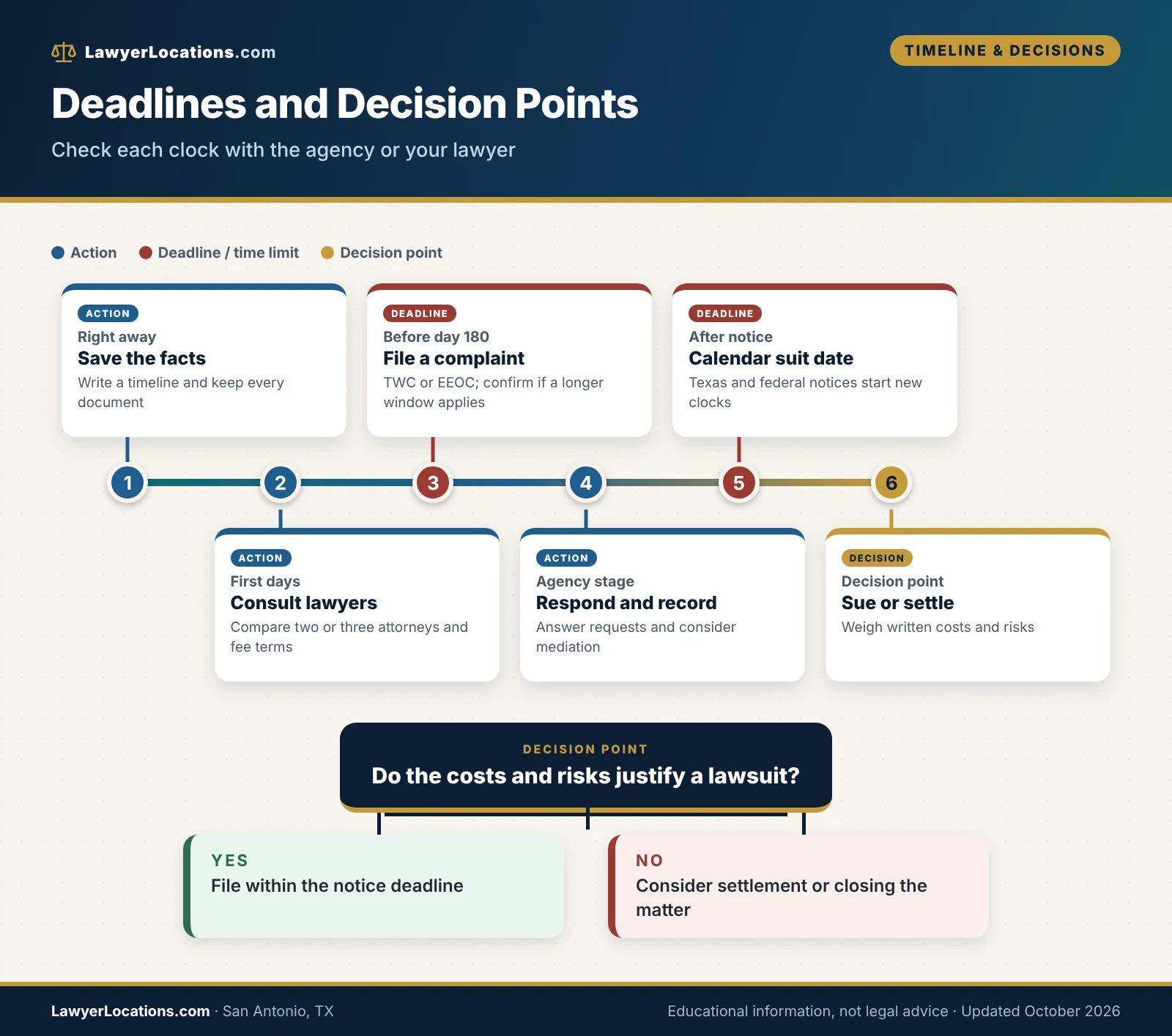
Text version of this graphic
- Right away: write your timeline, save documents and note the earliest deadline.
- Within days: consult two or three employment attorneys and compare written fee terms.
- Before the first deadline: file with the TWC, the EEOC or the federal EEO counselor as appropriate.
- During the agency stage: respond to requests, consider mediation and keep records.
- After a right-to-sue notice: calendar the 60-day Texas or 90-day federal deadline.
- Decision point: file suit, settle, or stop, based on written advice about costs and risks.
Decision question: Does the written estimate of costs and risks make a lawsuit worth it? If yes, file within the deadline; if no, consider settlement talks or ending the matter.
A deadline that falls on a weekend or holiday may not move the way you expect. Do not plan to file on the last day. Aim to file at least a week early so a portal outage, a missing document or a clerk’s question does not cost you your claim.
Free Help, Consultation Prep, Common Mistakes and Next Steps
You have more options than a full-price lawyer or going it alone. San Antonio has bar referral services, legal aid organizations and agency processes that cost nothing to start. Combine them with a prepared consultation and you can make a decision with real information.
Free and low-cost help in San Antonio
Resources vary in what they cover and who qualifies, so ask what each one handles before you spend time on an application. The listings below come from the St. Mary’s University law library’s guide to finding a lawyer.
Referral services and legal aid
The San Antonio Bar Association Lawyer Referral Service can be reached at (210) 227-1853 and its website is salawhelp.org. The State Bar of Texas lists its own service at 1-800-252-9690. Texas RioGrande Legal Aid lists 1-888-988-9996 or (210) 212-3700 for people who want to see whether they qualify for help.
Legal aid programs generally set income limits and focus on certain case types, so ask whether employment problems are within the program’s priorities. A referral to a private lawyer may still involve a fee for the first meeting, so ask what the first meeting costs before you go.
University clinics and community law resources
The same guide lists the St. Mary’s Center for Legal and Social Justice at (210) 431-2596 and the San Antonio Community Law Center at (210) 271-9595 as low-cost options. Clinics and community centers can be a way to get advice or a limited review of documents, though capacity and the types of cases they accept can change.
For small wage disputes, the Bexar County justice courts also offer self-help packets and free mediation through the county’s Dispute Resolution Center, as noted earlier.
Preparing for your consultation
A prepared client gets better advice faster, and often a lower bill if the lawyer is charging hourly. This part describes what to bring and how to organize it.
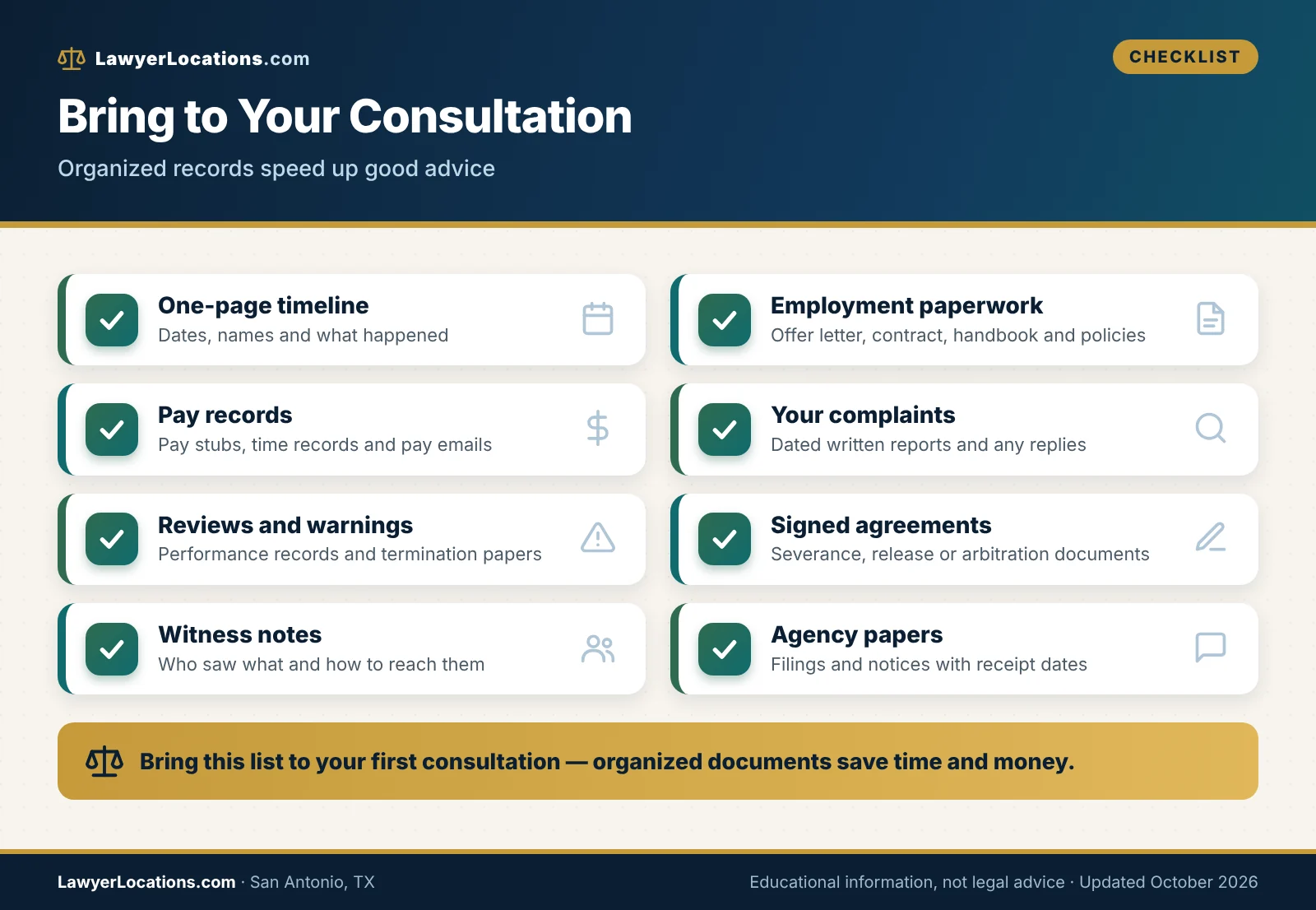
Text version of this graphic
- Your one-page timeline of events with dates and names.
- Offer letter, employment contract and handbook or policies.
- Pay stubs, time records and any pay-related emails.
- Written complaints you made and any responses.
- Performance reviews, warnings and termination paperwork.
- Any severance, release or arbitration agreement you were given or signed.
- Notes on witnesses and how to reach them.
- Copies of any agency filings and notices with the dates you received them.
Documents to gather
- Your offer letter, employment contract, handbook and any policies you signed.
- Pay stubs, time records, schedules and messages about pay.
- Emails, texts and notes showing complaints you made, dated and in order.
- Performance reviews, warnings, termination letter and any severance paperwork.
- Any arbitration agreement or release.
- Agency filings, notices and envelopes showing the dates you received them.
Use copies you are allowed to keep, and avoid taking confidential employer documents that you have no right to take. If you are unsure, tell the lawyer what you have and let the lawyer advise.
Questions to bring
Bring a short list: which claims fit my facts, what is the first deadline, which agency or court should I use, what will this cost, and what could go wrong. Ask the lawyer to repeat the deadline in writing after the meeting.
Take notes and ask about anything in the fee agreement you do not understand. If the lawyer cannot explain a term in plain language, that is useful information too.
Severance, arbitration and mediation
Some of the biggest decisions in an employment dispute happen on paper before anyone files. These parts cover the documents that are often presented right when you are most stressed.
Severance agreements and releases
A severance agreement usually asks you to release legal claims in exchange for pay or benefits. Signing may give up your right to sue, so have a lawyer read it before you sign, and ask how long you have to review it. A short flat-fee review is a common and sensible use of an employment lawyer.
Employers sometimes present these papers on the day of a termination. You can usually ask to take the document home and respond later.
Arbitration agreements and mediation
Many employers require arbitration of employment disputes, which means a private arbitrator decides the case instead of a judge or jury. Whether a given arbitration clause is enforceable depends on its terms and on the law, including a federal law passed in 2022 that limits forced arbitration of certain sexual harassment and assault claims. Ask a lawyer to review any arbitration clause before you assume you cannot sue.
Mediation is a confidential negotiation with a neutral facilitator. It can happen at the agency stage or later, and it can be a faster and cheaper way to resolve a dispute. A lawyer can help you decide whether a settlement offer is reasonable given the risks.
Common mistakes and your next steps
Most avoidable harm in employment cases comes from a few repeating errors. This part names them and gives you a short plan.
Mistakes that cost workers their claims
- Waiting for an internal investigation to finish while a filing deadline passes.
- Signing a severance agreement or release without legal review.
- Deleting texts, emails or social media posts that relate to the dispute.
- Posting about the dispute publicly or venting to coworkers in ways that can be used against you.
- Assuming the employer’s HR department represents your interests.
- Choosing a lawyer from an ad without comparing fee terms in writing.
Each of these is fixable early and hard to fix later. Preserve everything, calendar your deadlines and consider a second opinion before major decisions.
A short plan for the next seven days
- Write your timeline today. Dates, names, what happened and what you reported.
- Calendar the shortest possible deadline. Count 180 days from the earliest act and treat that as your working limit.
- Save documents. Copy pay records, emails and policies to a safe place you control.
- Contact two or three employment attorneys. Use the State Bar lookup and referral services, and ask the scorecard questions.
- Decide on a first filing. If no lawyer can meet in time, consider filing with the TWC or EEOC yourself to protect the date.
If harassment is at the center of your situation, read our sexual harassment lawyer guide. If you have also worked elsewhere in Texas, our Fort Worth employment lawyer guide shows how the same state rules play out in North Texas courts.
How long do I have to file a discrimination complaint in Texas?
A complaint to the Texas Workforce Commission generally must be filed within 180 days of the act, and within 300 days for sexual harassment. A federal EEOC charge is 180 days, or 300 days where a state agency enforces a law on the same basis.
Do I need a lawyer to file with the EEOC or TWC?
No. You can file on your own, and the EEOC San Antonio Field Office accepts appointments through its portal. A lawyer can help you decide what to claim and how to word it.
Does Texas discrimination law cover small employers?
Generally, a private employer is covered if it has 15 or more employees for 20 or more weeks in the current or preceding year. Governments are covered regardless of size. Ask a lawyer whether any other law applies if your employer is smaller.
Can I be fired for any reason in Texas?
Texas is an at-will state, so an employer can usually end employment for any reason that is not illegal. Firing someone because of a protected trait or in retaliation for protected activity is generally unlawful.
What if my employer did not pay my last check?
The TWC says final pay is due within six calendar days for a discharge, and by the next regular payday if you quit. A Payday Law claim must be filed within 180 days after the wages were due.
What is the difference between a Texas and a federal complaint?
Texas Labor Code Chapter 21 is the state law, handled by the TWC, and the federal laws are enforced by the EEOC. Many workers have claims under both, and the deadlines and court options differ.
How much does an employment attorney cost in San Antonio?
It depends on the fee model: contingency, hourly, flat or hybrid. Ask for the terms in writing and compare more than one lawyer. Texas requires contingent fee agreements to be in writing.
Can I sue in Bexar County for unpaid wages?
Possibly. Bexar County justice courts hear small claims up to $20,000 including attorney fees, and larger cases go to district court. Check whether the TWC or Department of Labor route fits first.
What if I work for the federal government in San Antonio?
Federal employees generally must contact an agency EEO Counselor within 45 days, a different process from the EEOC charge used in the private sector.
Ready to compare your options?
Start with your timeline and the shortest deadline, then talk to two or three licensed Texas employment attorneys and compare their fee terms in writing. LawyerLocations.com is a legal-education resource and not a law firm, and nothing here creates an attorney-client relationship.
General information only. This guide is general legal information, not legal advice, and reading it does not create an attorney-client relationship. Laws, agency procedures, court rules and deadlines change and depend on your facts. Consult a lawyer licensed in Texas about your situation, and confirm current deadlines with the relevant agency or court clerk.
Sources & References
Show all 21 sources
- Tex. Lab. Code 21.002, Definitions — Justia (Texas Labor Code) — law.justia.com — accessed October 2026
- Tex. Lab. Code 21.055, Retaliation — Justia (Texas Labor Code) — law.justia.com — accessed October 2026
- Tex. Lab. Code 21.202, Statute of Limitations — Justia (Texas Labor Code) — law.justia.com — accessed October 2026
- Tex. Lab. Code 21.254, Civil Action After Notice — Justia (Texas Labor Code) — law.justia.com — accessed October 2026
- Tex. Lab. Code 21.256, Statute of Limitations — Justia (Texas Labor Code) — law.justia.com — accessed October 2026
- Tex. Lab. Code 21.2585, Compensatory and Punitive Damages — Justia (Texas Labor Code) — law.justia.com — accessed October 2026
- Tex. Lab. Code 21.259, Attorney’s Fees — Justia (Texas Labor Code) — law.justia.com — accessed October 2026
- Texas Payday Law — Texas Workforce Commission — twc.texas.gov — accessed October 2026
- San Antonio Field Office, Location — U.S. Equal Employment Opportunity Commission — eeoc.gov — accessed October 2026
- Time Limits for Filing a Charge — U.S. Equal Employment Opportunity Commission — eeoc.gov — accessed October 2026
- Filing a Lawsuit — U.S. Equal Employment Opportunity Commission — eeoc.gov — accessed October 2026
- 29 C.F.R. 1614.105, Pre-complaint processing — Electronic Code of Federal Regulations — ecfr.gov — accessed October 2026
- Fair Labor Standards Act (FLSA) — U.S. Department of Labor, Wage and Hour Division — dol.gov — accessed October 2026
- Small Claims Maximum — State Law Library of Texas — sll.texas.gov — accessed October 2026
- Civil Cases (Justice of the Peace Courts) — Bexar County — bexar.org — accessed October 2026
- Civil District Courts — Bexar County — bexar.org — accessed October 2026
- San Antonio Division and Filing Without an Attorney — U.S. District Court, Western District of Texas — txwd.uscourts.gov — accessed October 2026
- Texas Disciplinary Rules of Professional Conduct, Rule 1.04 — State Bar of Texas — texasbar.com — accessed October 2026
- Find a Lawyer: referral and low-cost legal resources — St. Mary’s University School of Law Library — lawlib.stmarytx.edu — accessed October 2026
- Appellate Court Affirms Temporary Injunction Barring San Antonio’s Paid Sick Leave Ordinance — Seyfarth Shaw LLP — seyfarth.com — accessed October 2026
- Texas Trial Court Holds Law Preempting Local Employment Practice Ordinances Unconstitutional — Ernst & Young LLP (Tax News) — taxnews.ey.com — accessed October 2026
Legal Disclaimer and Limitation of Liability
Informational and illustrative purposes only. This article was prepared by LawyerLocations.com solely on the basis of the information available to us at the time of writing. It is an illustrative, general overview. It is not a complete or authoritative statement of the law, and it has not been reviewed by a lawyer licensed in your state or county.
Not legal advice. Nothing in this article is legal, financial, tax or immigration advice, and reading it does not create an attorney-client relationship between you and LawyerLocations.com or any author, lawyer or firm mentioned. Laws, court rules, fees, filing deadlines and agency procedures differ by state, county and court, and they change often. Some details here may be simplified, incomplete or out of date, and time limits for legal claims can be short.
No warranty. We make no representation or warranty, express or implied, about the accuracy, completeness, timeliness or suitability of this content for your situation. Please do not rely on it to make, delay or skip any legal decision. Check the facts against official sources and speak with a licensed attorney in the relevant jurisdiction before you act.
Limitation of liability. To the fullest extent permitted by law, LawyerLocations.com and its owners, authors and contributors disclaim all liability for any loss, damage, cost or other consequence arising from the use of, or reliance on, this article, including any content on third-party websites we link to. Mentioning a lawyer, firm, organization or service is not an endorsement and is not a promise of any result. If you are in immediate danger, contact your local emergency number.