A sexual harassment lawyer is an attorney who represents workers (or, on the other side of the table, employers) in claims about unwelcome sexual conduct at work. Under federal law, mainly Title VII of the Civil Rights Act of 1964, most workers have 180 days, or 300 days where a state or local agency also covers the claim, to file a charge with the EEOC, and some state agencies allow far longer. Federal employees have only 45 days to contact an EEO Counselor.
This guide explains what counts as sexual harassment, how to document it, where and when to report it, how retaliation, arbitration clauses and NDAs work, what remedies exist, and how to compare lawyers and fee arrangements. It is general information for the United States, not advice about your situation.
Harassment at work can leave people shaken, angry, ashamed for no good reason, or numb. None of those reactions means you did something wrong, and none of them has to be settled before you ask questions. If you are in immediate danger, contact emergency services first. If you are not, this guide is built so you can read at your own pace and come back to it.
What Counts as Workplace Sexual Harassment Under Federal Law
Federal law treats sexual harassment as a form of sex discrimination. The EEOC explains that it is unlawful to harass an applicant or employee because of that person’s sex, and that unwelcome sexual advances, requests for sexual favors, and other verbal or physical conduct of a sexual nature can all qualify. This section lays out who is covered, the two classic legal theories (often called hostile environment and quid pro quo), and when it makes sense to bring in a lawyer.
The legal definition and who is protected
What the law covers and what it does not
The EEOC’s public guidance says that simple teasing, offhand comments, and isolated incidents that are not very serious are not prohibited. Harassment becomes unlawful when it is frequent or severe enough to create a hostile or offensive work environment, or when it results in an adverse employment decision such as firing or demotion. Conduct does not have to be sexual in nature. Demeaning comments about women in general, or about men in general, can also be harassment because of sex.
The Supreme Court has said Title VII is not a “general civility code,” which is why a rude boss alone does not create a claim. At the same time, the Court has held that harassment does not have to cause a psychological breakdown to be unlawful. In Harris v. Forklift Systems, 510 U.S. 17 (1993), it said the question is whether a reasonable person would find the environment hostile or abusive, and that courts weigh frequency, severity, whether the conduct was physically threatening or humiliating, and whether it interferes with work.
Who can be harassed, who can harass, and employer size
Men and women can both be targets, and the harasser can be of the same sex. In Oncale v. Sundowner Offshore Services, 523 U.S. 75 (1998), a unanimous Court held that same-sex harassment can be actionable under Title VII. In Bostock v. Clayton County, decided June 15, 2020, the Court held that firing someone for being gay or transgender is sex discrimination under Title VII. Reporting on the January 2026 EEOC vote discussed later in this guide notes that Bostock remains the law unless the Court reverses it, though the full reach of those protections is still being worked out in the courts.
The harasser can be a supervisor, a supervisor in another department, a co-worker, or a non-employee such as a customer or client. Title VII applies to employers with 15 or more employees. Many state laws reach smaller workplaces, and some protect contractors or volunteers. California, for example, says its harassment rules apply even in workplaces with fewer than five employees, and its Civil Rights Department accepts harassment complaints from employees, applicants, unpaid interns, volunteers and contractors.
Hostile work environment and quid pro quo claims
Hostile work environment: severe or pervasive conduct
A hostile environment claim asks whether the conduct was unwelcome, because of sex, and severe or pervasive enough to change the conditions of work. Examples can include repeated sexual comments, unwanted touching, sexual images displayed or sent, stalking behavior, or a steady stream of demeaning remarks. One serious incident, such as a sexual assault, can be enough on its own in many cases, because “severe or pervasive” is a test of the whole picture rather than a count of incidents.
Quid pro quo and tangible employment actions
Quid pro quo harassment happens when a person with power over your job ties a decision to sexual compliance, for example by suggesting a promotion, a good schedule, or keeping your job depends on saying yes. In Burlington Industries v. Ellerth, 524 U.S. 742 (1998), the Court described a tangible employment action as a significant change in employment status, such as firing, failing to promote, reassignment with significantly different responsibilities, or a decision causing a significant change in benefits.
Hostile work environment means harassment that is unwelcome, based on sex, and severe or pervasive enough to make the job harder or the workplace abusive. Quid pro quo means a job benefit or penalty was tied to a sexual demand. Many real cases involve both.
| Feature | Hostile work environment | Quid pro quo |
|---|---|---|
| Core question | Was the conduct unwelcome, because of sex, and severe or pervasive? | Was a job benefit or penalty tied to sexual compliance? |
| Who can be the harasser | Supervisor, co-worker, customer, or other non-employee | Usually someone with power over the job |
| Typical evidence | Pattern of messages, comments, witnesses, complaints | Change in pay, schedule, duties, discipline, or firing tied to the demand |
| Employer responsibility | Supervisor: employer may raise a two-part defense; co-worker: negligence standard | Generally the employer is responsible when a tangible employment action results |
| Key cases | Harris (1993); Faragher (1998); Vance (2013) | Ellerth (1998) |
When a sexual harassment lawyer may help
Situations where early legal advice often matters
Advice earlier rather than later is especially useful when a deadline may be close, when you were fired, demoted or had your schedule or pay cut after you refused or reported, when the harasser is an owner or high-level manager, when you have been asked to sign a severance agreement, a non-disclosure agreement, or an arbitration form, or when the conduct involved physical contact. In each of these, a signature or a missed date can limit your options.
Situations you may be able to start on your own
You do not need a lawyer to file with the EEOC. The agency’s own FAQ says its services are free and that you do not need an attorney to file a job discrimination complaint. Some people start with a written report to human resources, a call to a state agency, or a request to a trusted colleague for notes, then bring a lawyer in once they know what they want.
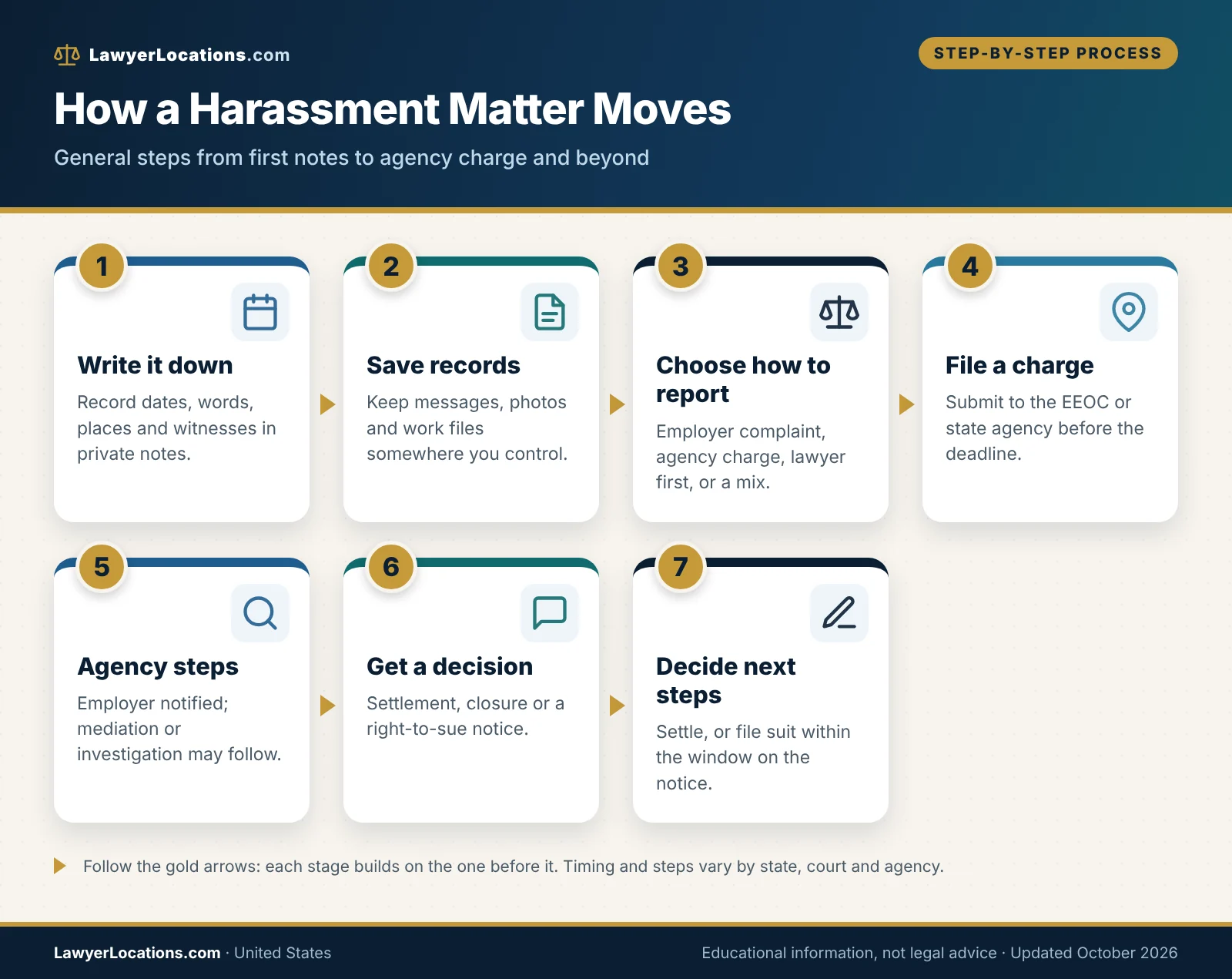
Text version of this graphic
- Notice what is happening and write it down with dates.
- Save messages, photos, and other records in a safe place.
- Decide on reporting: employer complaint, EEOC, state agency, or a lawyer first.
- File an EEOC or state agency charge before the deadline.
- The agency notifies the employer; mediation or investigation may follow.
- Receive a decision or right-to-sue notice.
- Decide whether to file a lawsuit within 90 days of the notice or resolve the matter by agreement.
Documenting What Happened: Evidence That Helps
You do not need a perfect file to speak with an agency or a lawyer, and nobody should expect you to have a perfect memory of a painful event. The most useful records are simple ones: dates, what was said or done, who was there, and what happened next. This section covers what to write down, whom and what can corroborate your account, and a few cautions that can affect how evidence is viewed later.
What to write down and save
A running timeline in your own words
Start a dated note, kept somewhere your employer cannot reach, such as a personal notebook or a personal email account you control. For each incident, record the date, time, place, what the person said or did, how you responded, who saw or heard it, and anything that changed afterward, like a shift, an assignment, or a cold shoulder. Notes made close to the event tend to be more persuasive than recollections written months later, so a few lines the same day beat a long account after the fact.
Messages, images and paperwork
Save texts, emails, chat messages, voicemails, photos, social media messages and gifts, and keep originals instead of only screenshots when you can. Screenshots should show the date, the sender, and the full thread. Also keep your own work records: offer letters, performance reviews, commendations, schedules, pay stubs, and any written warnings, because these help show what changed after you refused or reported.
People and records that can support your account
Witnesses and people you told
Write down who saw or heard something, even if you doubt they would speak up. Also note anyone you told at the time, such as a friend, family member, co-worker or counselor, and roughly when. Those conversations can show that you raised the problem early and that your account has been consistent. The EEOC’s 2016 Select Task Force on harassment found that roughly 70 percent of people who experienced harassment never even talked with a supervisor, so a lack of formal reports is common and is not a sign that nothing happened.
Health, counseling and work records
Medical visits, therapy notes, sick days, and prescriptions can show how the situation affected you, which matters if you later seek compensation for emotional harm. You do not have to share these records with anyone right away, and you can ask a lawyer what sharing them would mean before you agree. Keep a simple list of providers and dates so details are easy to find later.
Cautions: recordings and company files
Recording conversations
Federal law generally allows a person who is a party to a conversation to record it, so long as the purpose is not criminal or tortious, under 18 U.S.C. 2511(2)(d). State laws differ, and some states require every participant’s consent, with criminal and civil penalties for violations. Because the rules vary by state, check with a lawyer before you record anyone, especially if you are in a state different from the other person.
Company documents, devices and accounts
Do not log into someone else’s account, and be cautious about taking confidential company files. Sending yourself a copy of something that clearly relates to your own complaint, such as your own emails about the problem, is different from copying client data or personnel files for other employees. Employers sometimes raise “document theft” in response, and courts have drawn different lines in different situations.
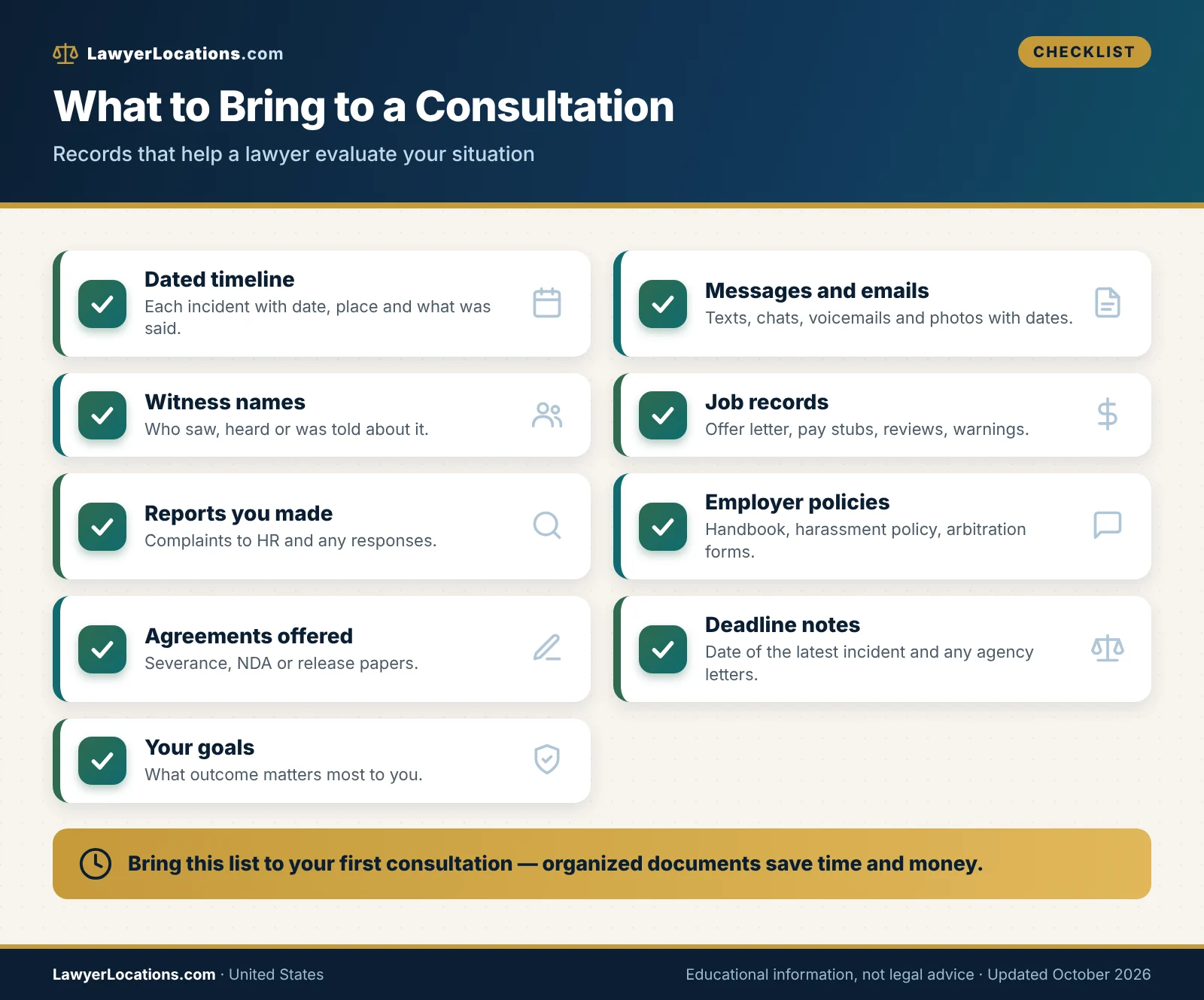
Text version of this graphic
- Dated timeline of each incident
- Texts, emails, chats and voicemails (originals if possible)
- Photos, gifts, notes or images you received
- Names of witnesses and people you told
- Offer letter, pay stubs, reviews and warnings
- Employer policies and any complaint you made
- Medical or counseling dates, if you choose to share
- Any severance, NDA or arbitration paperwork you were given
Do not delete messages, photos or accounts connected to the harassment, even if they are painful to see. Once a dispute is likely, deleting material can create new problems and make it harder to show what happened.
Reporting Options and Deadlines: Employer, EEOC and State Agencies
You have several places to report, and they are not mutually exclusive. A complaint to your employer does not stop the clock on an EEOC or state agency deadline, which is why it helps to learn the dates early. This section covers internal reports, the EEOC charge and its 180/300-day rules, state and local fair employment agencies, and what happens after you file.
Reporting to your employer
Why the employer’s complaint process matters legally
In Faragher v. City of Boca Raton, 524 U.S. 775 (1998), and Burlington Industries v. Ellerth, 524 U.S. 742 (1998), the Supreme Court held that an employer is vicariously liable for a supervisor’s harassment, but may raise an affirmative defense when no tangible employment action occurred. The employer must prove both that it exercised reasonable care to prevent and correct harassment promptly, and that the employee unreasonably failed to use the employer’s preventive or corrective opportunities.
In Vance v. Ball State University, 570 U.S. 421 (2013), the Court held that a “supervisor” for these purposes is someone the employer empowered to take tangible employment actions against the victim, such as hiring, firing or significant reassignment. If the harasser is a co-worker or lacks that power, the employer is generally liable only if it was negligent in letting the harassment continue. These rules explain why many employment lawyers ask whether you reported and how the employer responded.
How to make a report that leaves a record
If you decide to report, put it in writing when you can. An email to human resources or a manager, listing dates, incidents and your request, creates a record with a time stamp. Keep a copy outside the company system, and save any response. If you only report verbally, follow up with a short email recapping the conversation.
Filing an EEOC charge: the 180-day and 300-day rules
An EEOC charge is a signed statement to the Equal Employment Opportunity Commission that an employer engaged in discrimination. Except in rare situations, you must file one before you can sue under Title VII. The deadline is strict, so it is the single most important date in most private-sector cases.
180 calendar days, extended to 300 in many places
The EEOC says that, in general, you must file a charge within 180 calendar days from the day the discrimination took place. That period extends to 300 calendar days if a state or local agency enforces a law prohibiting employment discrimination on the same basis. Statutory text at 42 U.S.C. 2000e-5(e)(1) sets the same two periods. Weekends and holidays count, except that a deadline falling on one moves to the next business day.
Internal complaints, union grievances, arbitration and mediation generally do not extend the EEOC time limit, according to the EEOC. They can run alongside a charge. If you are close to day 180 or day 300, ask the EEOC about an immediate interview and consider speaking with a lawyer the same week.
Ongoing harassment and separate acts
The EEOC says the deadline usually applies to each discriminatory event separately, but there is an exception for ongoing harassment: the deadline runs from the last incident, and earlier incidents still count when the EEOC investigates. The Supreme Court explained this in National Railroad Passenger Corp. v. Morgan, 536 U.S. 101 (2002). A hostile environment claim is not barred if at least one contributing act falls within the filing period, while discrete acts like a firing or demotion each need their own timely charge.
Federal employees: 45 days to contact an EEO Counselor
Federal employees and applicants use a different system. Under 29 C.F.R. 1614.105 a person generally must contact an agency EEO Counselor within 45 days of the discriminatory matter, and the limit can be extended in certain circumstances, such as when the person did not know of the time limit or was prevented by circumstances beyond their control. The counselor must hold a final interview within 30 days unless the parties agree to more time, and then issues a notice of the right to file a formal complaint, which must be filed within 15 days of receiving it.
How to start a charge
The EEOC says you can begin online through the EEOC Public Portal, where you submit an inquiry and schedule an interview, or visit an EEOC office, or call 1-800-669-4000 to start the process. The agency says you cannot file a charge by phone alone, and that a mailed charge needs a signed letter with your contact information, the employer’s information, a short description of what happened, when, and why you believe it was discrimination. If your deadline is close, the Portal gives special directions for people with 60 days or fewer, and the EEOC says you can call for an immediate interview.
State and local agencies and how states differ
Dual filing and why state law can matter
The EEOC explains that a charge filed with a FEPA is automatically dual-filed with the EEOC if federal laws apply. Filing with one therefore usually protects your rights with the other, but the details differ by state, and state agencies sometimes give you a right to go directly to court. State law may also cover smaller employers, a wider group of workers, or a broader definition of harassment, which is why the same incident can be handled very differently from one state to another.
A sample of state filing rules
The table below shows how much the filing windows can vary across seven states we verified against agency pages or statutes. It is an illustration of variation, not a full 50-state list, and state laws can change.
| State | Agency | Agency filing window | Notes |
|---|---|---|---|
| California | Civil Rights Department | 3 years from last harm, for employment cases | Employment cases require a right-to-sue notice from the agency before suing; harassment covered even in very small workplaces |
| New York | Division of Human Rights | 3 years from the most recent incident | Harassment need not be severe or pervasive under state law |
| Illinois | Department of Human Rights | 2 years (effective January 1, 2025) | Replaced a 300-day window for non-housing charges |
| Texas | Workforce Commission Civil Rights Division | 180 days generally; 300 days for sexual harassment complaints | Since September 1, 2021, state law reaches sexual harassment by employers of any size |
| Florida | Commission on Human Relations | 365 days | Punitive damages under state law capped at $100,000; a 2026 bill proposing changes was still in committee at last check |
| Massachusetts | Commission Against Discrimination | 300 days | Court suit generally after 90 days but within 3 years of the agency filing |
| New Jersey | Division on Civil Rights | 180 days | You may instead go directly to Superior Court within 2 years |
The table is a snapshot from official agency pages and statutes read in October 2026. State legislatures amend these periods, and local rules (such as city human rights commissions) can add more options. Confirm the current deadline for your state and city directly with the agency or a licensed attorney.
After you file: what happens next
Notice, mediation, position statement and investigation
According to the EEOC, the agency notifies the employer within 10 days of the filing date. Some charges are offered mediation, where a neutral helps both sides seek a voluntary settlement, and the EEOC says mediation often resolves a charge in under three months. If mediation is not used or does not work, the employer submits a written position statement, and you are asked to respond within 30 days of receiving it.
The EEOC may then investigate by interviewing witnesses, requesting documents, or visiting the workplace. The agency states that the average investigation takes about 10 months. It may also close a charge if the laws it enforces do not apply, the charge is untimely, or it cannot determine whether the law was violated.
The right-to-sue notice and the 90-day deadline
If the EEOC does not sue or settle the charge, it issues a Notice of Right to Sue. You then have 90 days to file a lawsuit, a deadline set by law (42 U.S.C. 2000e-5(f)(1)). The EEOC says a lawsuit may be filed in federal or state court. If 180 days or more have passed since you filed, the EEOC must issue the notice on request, and earlier in some cases if it cannot finish within 180 days.
In Fort Bend County v. Davis (2019), the Supreme Court held that the charge-filing requirement is a mandatory claim-processing rule rather than a jurisdictional bar, meaning an employer can lose the right to object if it waits too long to raise it. That does not make the rule optional for you. Treat the filing steps and dates as firm.
Finding and Comparing a Sexual Harassment Lawyer
The right sexual harassment lawyer for you is a licensed attorney who regularly handles workplace harassment and retaliation matters in your state, explains the fee in writing, and communicates in a way that feels safe to you. LawyerLocations.com is a directory and education resource, not a law firm, and we do not rate or recommend individual lawyers. This section explains what these lawyers do, how to compare them, and how fee arrangements usually work.
What a lawyer can do at each stage
Before anything is filed
At the start, a lawyer can review your timeline and documents, identify the deadlines that apply (federal, state and sometimes city), and explain which forum fits: an internal complaint, an EEOC or state agency charge, a lawsuit, or a negotiated exit. They can also review any agreement your employer has handed you, such as a severance offer, a confidentiality clause or an arbitration form, before you sign.
After a charge or lawsuit begins
Once a charge is filed, a lawyer can prepare you for the EEOC interview, help draft the charge narrative, respond to the employer’s position statement, and represent you in mediation. If you receive a right-to-sue notice, the lawyer can evaluate whether to file in federal or state court within the 90-day window, and what claims to include under federal and state law.
How to find and compare lawyers
Where to look
The EEOC says its offices can provide, on request, a list of local attorneys who have told the agency they practice labor and employment law, but it does not recommend specific attorneys. The agency also points to referral directories from the American Bar Association, the National Employment Lawyers Association (NELA), and Workplace Fairness. Your state or local bar association’s lawyer referral service is another route, and nonprofit legal aid programs listed through LawHelp.org may help if your income is limited.
Confirm any lawyer’s license with your state bar and check for public discipline. For more on what to expect in an initial meeting, see our guide to free legal consultations, which explains how first calls typically work in another practice area.
Questions to ask in a first meeting
Write your questions down beforehand, and bring a support person if that helps. Useful questions include how many harassment and retaliation matters the lawyer handles for employees (as opposed to employers), which deadlines apply to you and when they expire, who will actually work on your case, how you will be updated, and whether the lawyer expects mediation, a lawsuit or a settlement. Ask also how the lawyer handles confidentiality and how they would treat sensitive medical or counseling records.
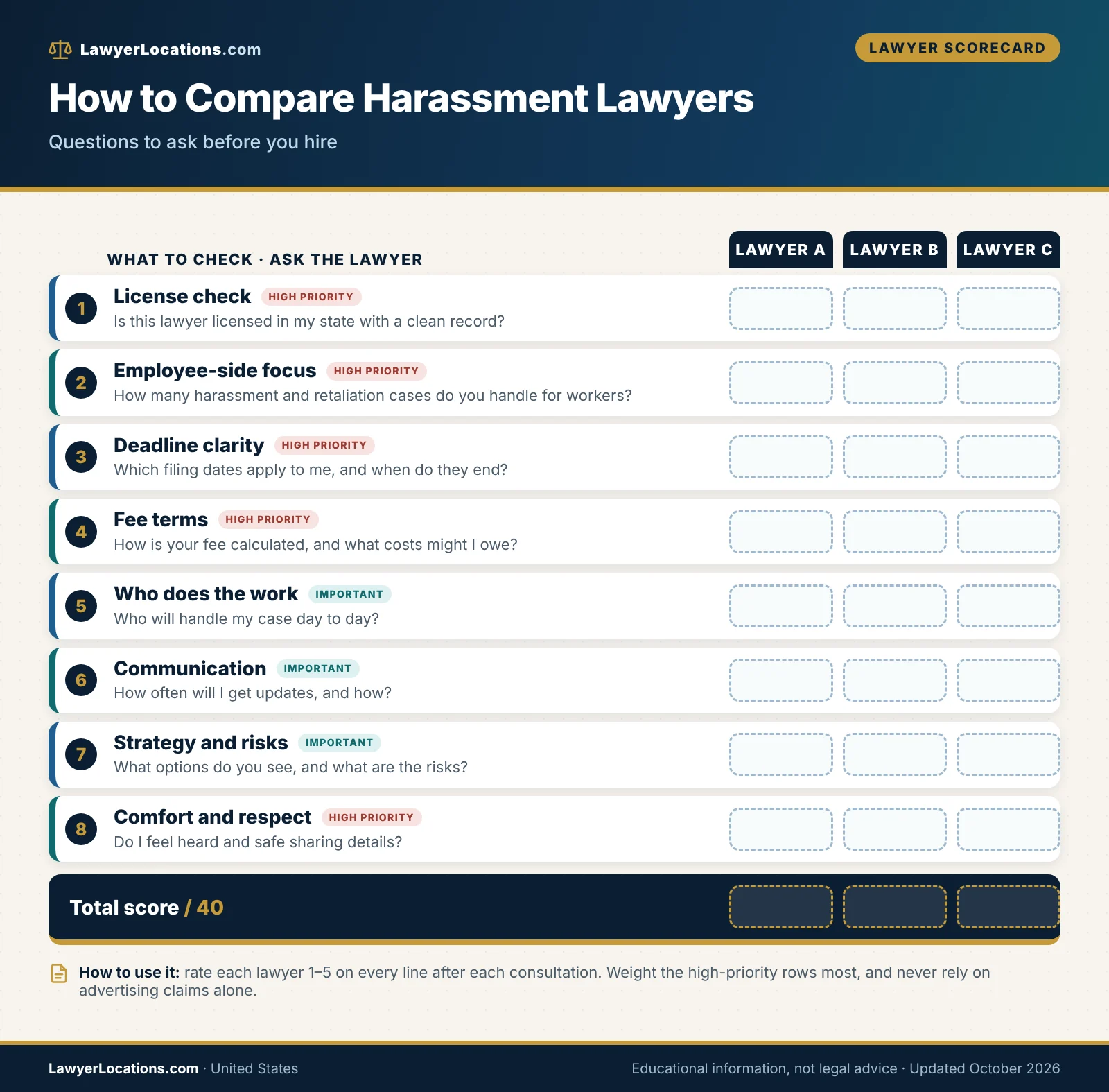
Text version of this graphic
- License: Is the lawyer licensed in my state, with a clean public record?
- Focus: How much of the practice is employee-side harassment and retaliation?
- Deadlines: Which dates apply to me, and when do they expire?
- Fees: How is the fee calculated, and what costs do I owe?
- Communication: Who handles my case, and how often will I hear updates?
- Strategy: What options do you see, and what are the risks?
- Comfort: Do I feel respected and safe sharing details?
Warning signs when hiring
Be cautious if a lawyer guarantees a result or a settlement amount, pressures you to sign the same day, refuses to put the fee in writing, or contacts you uninvited after a news story. Honest lawyers explain risks as well as strengths.
Fee arrangements and costs
Common fee structures
Employee-side lawyers often use a contingency fee, meaning the fee is a percentage of any recovery and the lawyer is paid only if there is one. Others charge hourly rates, a flat fee for a limited task such as reviewing a severance agreement, or a hybrid with a smaller upfront payment plus a percentage. Each has trade-offs, shown in the table below. Compare how other practice areas explain contingency in our guide to wrongful death lawyer costs.
| Structure | How it works | Questions to ask |
|---|---|---|
| Contingency | Fee is a percentage of a settlement or judgment; nothing owed as a fee if there is no recovery | What percentage at settlement vs. trial vs. appeal? Are costs deducted before or after the fee? |
| Hourly | You pay for time spent, often with a retainer deposit | What is the rate? Who bills? What is the estimate for the agency stage? |
| Flat fee for a task | Set price for a limited service, like reviewing a severance agreement or drafting a charge | What is included, and what happens if you need more help? |
| Hybrid | Reduced hourly or upfront payment plus a smaller contingency percentage | How do the two parts interact if the case settles early? |
| Limited-scope or unbundled | Lawyer helps with certain steps while you handle others | Which tasks are yours? Who contacts the agency? |
Costs, fee shifting and the written agreement
Besides attorney fees, cases involve costs such as court filing fees, deposition transcripts, and expert witnesses. Ask whether you are responsible for those costs if the case is lost, and whether they come out of a recovery before or after the lawyer’s percentage. The ABA’s Model Rule 1.5(c), which many states follow in some form, calls for a contingent fee agreement to be in writing and signed by the client, to explain how the fee is calculated, to list expenses, and to say which expenses the client owes even if there is no recovery. Your state’s rule may differ.
Under 42 U.S.C. 2000e-5(k), a court has discretion to award a reasonable attorney’s fee, including expert fees, to a prevailing party other than the EEOC or the United States. The EEOC’s remedies page likewise lists attorney’s fees, expert witness fees and court costs as recoverable by a victim of discrimination. Fee shifting is discretionary and depends on the result, so it should not be treated as a promise that your lawyer’s fees will be covered.
Retaliation, Forced Arbitration and NDAs
Three issues come up again and again in sexual harassment matters: retaliation after someone complains, arbitration clauses that try to keep a dispute out of court, and non-disclosure agreements that try to keep it quiet. Federal law protects against retaliation, and since March 3, 2022 it lets people alleging sexual harassment choose to avoid pre-dispute forced arbitration. This section explains each, including limits that are still being decided.
Retaliation after you speak up
What the law protects
Title VII’s retaliation provision, 42 U.S.C. 2000e-3(a), makes it unlawful to discriminate against an employee or applicant because they have opposed a practice made unlawful by the statute, or because they have made a charge, testified, assisted, or participated in an investigation, proceeding or hearing. The EEOC lists protected activity as including filing or witnessing a charge, telling a manager about harassment, answering questions in an employer investigation, resisting sexual advances, and intervening to protect others.
How courts measure it
In Burlington Northern & Santa Fe Railway Co. v. White, 548 U.S. 53 (2006), the Supreme Court held that retaliation is not limited to actions affecting pay or job title; it covers employer actions a reasonable employee would find materially adverse, meaning conduct that might dissuade a reasonable worker from making or supporting a charge. In that case, a reassignment of duties and a 37-day unpaid suspension qualified.
In University of Texas Southwestern Medical Center v. Nassar, 570 U.S. 338 (2013), the Court held that Title VII retaliation claims must be proved under traditional but-for causation. In plain terms, retaliation has to be the real reason for the action, not merely one of several motives. That standard is one reason a clear timeline of what happened right after your complaint is valuable.
What to do if you think retaliation has started
Add retaliation incidents to your timeline with dates, and save any emails about new assignments, discipline, or schedule changes. Consider reporting the retaliation in writing to the employer’s complaint channel, and tell your lawyer or agency promptly, because a retaliation incident may carry its own filing deadline. If you were fired, the 180- or 300-day period usually runs from the termination date for that act, per the EEOC’s approach to separate events.
Avoid responding in anger by email, quitting abruptly, or taking company files without advice. Those moves are understandable but can complicate things. A lawyer can help you think through whether resignation, a transfer, or continued work makes sense, including how courts treat constructive discharge. In Pennsylvania State Police v. Suders, 542 U.S. 129 (2004), the Court said such a claim requires showing conditions so intolerable that resignation was a fitting response.
Forced arbitration and the 2022 federal law
What the Ending Forced Arbitration Act does
The Ending Forced Arbitration of Sexual Assault and Sexual Harassment Act, signed March 3, 2022 as Public Law 117-90 (its own text uses the “of 2021” short title, but it is widely called the 2022 law), added chapter 4 to the Federal Arbitration Act. Under 9 U.S.C. 402(a), at the election of the person alleging sexual harassment or sexual assault, no predispute arbitration agreement or predispute joint-action waiver is valid or enforceable with respect to a case filed under federal, tribal, or state law that relates to the dispute.
A “predispute” agreement is one signed before the dispute existed, which describes most arbitration clauses tucked into hiring paperwork. A “joint-action waiver” blocks class or collective actions. Under 9 U.S.C. 402(b), a court, not an arbitrator, decides whether the law applies and whether the agreement is enforceable, even if the agreement tries to delegate that question to the arbitrator. The law applies to disputes or claims that arise or accrue on or after March 3, 2022.
Limits and open questions
- Timing. In Olivieri v. Stifel, Nicolaus & Co. (2d Cir. Aug. 12, 2024), the Second Circuit held that a hostile work environment claim can accrue after March 3, 2022 when it is part of a continuing course of conduct that included later acts, and that the law reaches retaliation for reporting harassment.
- Mixed claims. In Bruce v. Adams and Reese, LLP (6th Cir. Feb. 25, 2026), the Sixth Circuit read “case” to mean the whole lawsuit, so that a plausible sexual harassment claim made the arbitration agreement unenforceable for other claims in the same suit, such as disability claims. How other circuits treat this question may differ.
- Your choice. The statute speaks of the election of the person alleging harassment, so a lawyer will advise you on whether to invoke it, and whether doing so is wise in your case.
The law does not erase every confidentiality or dispute-resolution term. Union grievance procedures, post-dispute settlement terms, and agreements signed after a dispute arose raise separate questions. If you have signed an arbitration clause, do not assume it cannot be enforced, and do not assume it can. Bring the document to a lawyer.
NDAs, severance and settlement agreements
The Speak Out Act and pre-dispute NDAs
The Speak Out Act, enacted December 7, 2022 (Pub. L. 117-224), says that with respect to a sexual assault dispute or sexual harassment dispute, no nondisclosure clause or nondisparagement clause agreed to before the dispute arises is judicially enforceable where the alleged conduct violates federal, tribal, or state law (42 U.S.C. 19403). In other words, a clause in your hiring paperwork cannot, by itself, be used in court to stop you from speaking about harassment that violated the law.
Severance offers and confidential settlements
When an employer offers money to resolve a harassment dispute, the agreement may require confidentiality, release of claims, and non-disparagement. Those are lawful in many settings but deserve careful review. Ask a lawyer what you would be giving up, whether exceptions allow you to talk with a government agency, a therapist, your spouse or your lawyer, and what happens if you breach.
| Document | When signed | What federal law provides | Question to bring to a lawyer |
|---|---|---|---|
| Arbitration clause in hiring paperwork | Before any dispute | At the election of the person alleging harassment, it is not enforceable for disputes arising on or after March 3, 2022 (9 U.S.C. 402) | Does my claim qualify, and should I elect to go to court? |
| Class or collective action waiver | Before any dispute | Same election rule for joint-action waivers | Do others have similar claims? |
| NDA or non-disparagement clause in an employment contract | Before any dispute | Not judicially enforceable for sexual harassment disputes (42 U.S.C. 19403) | Does the clause still affect me in other ways, such as for other claims? |
| Severance or settlement agreement | After a dispute arises | Not addressed by those two laws; governed by contract and other law | What am I releasing, and what carve-outs exist? |
Remedies, Caps and What a Case Timeline Can Look Like
If a claim succeeds, federal law allows several kinds of relief, but combined compensatory and punitive damages under Title VII are capped by employer size, from $50,000 to $300,000, while back pay is treated separately. No lawyer can promise an outcome, and many cases settle for less than a maximum or are resolved without any judgment. This section explains the types of relief, how the caps work, and the key dates and decision points that shape a case.
What remedies exist
Back pay, compensatory damages and punitive damages
The EEOC lists these monetary remedies: back pay and benefits where discrimination cost a person pay; compensatory damages, which cover out-of-pocket costs such as job-search or medical expenses and emotional harm such as mental anguish or loss of enjoyment of life; punitive damages, which are meant to punish an especially malicious or reckless act; and attorney’s fees, expert witness fees and court costs. Compensatory and punitive damages under federal law apply to intentional discrimination, including sex discrimination.
Under 42 U.S.C. 1981a(b)(2), compensatory damages do not include backpay or interest on backpay, which is why back pay is not counted toward the cap. If a claimant seeks compensatory or punitive damages, either party may demand a jury trial, and the court must not tell the jury about the caps.
How the federal caps work
The combined amount of future pecuniary losses, emotional pain and other nonpecuniary damages, plus punitive damages, is limited per complaining party. The limit depends on how many employees the respondent had in each of 20 or more calendar weeks in the current or preceding calendar year.
| Number of employees | Maximum combined compensatory and punitive damages |
|---|---|
| 15 to 100 | $50,000 |
| 101 to 200 | $100,000 |
| 201 to 500 | $200,000 |
| More than 500 | $300,000 |
These caps apply to the Title VII claim. Back pay is handled separately, and state-law claims may have different limits or none. Florida’s civil rights statute, for example, provides that total punitive damages awarded to an aggrieved person shall not exceed $100,000 (Fla. Stat. 760.11(5)), so ask a lawyer whether a state claim adds value in your state.
Costs, deadlines and decision points over time
Key dates to track
The most common federal dates are the 180- or 300-day EEOC charge deadline, the 45-day counselor deadline for federal employees, the employer’s notice within 10 days of filing, the 30-day period to respond to the position statement, and the 90-day window to sue after a right-to-sue notice. State agencies and state courts add their own periods.
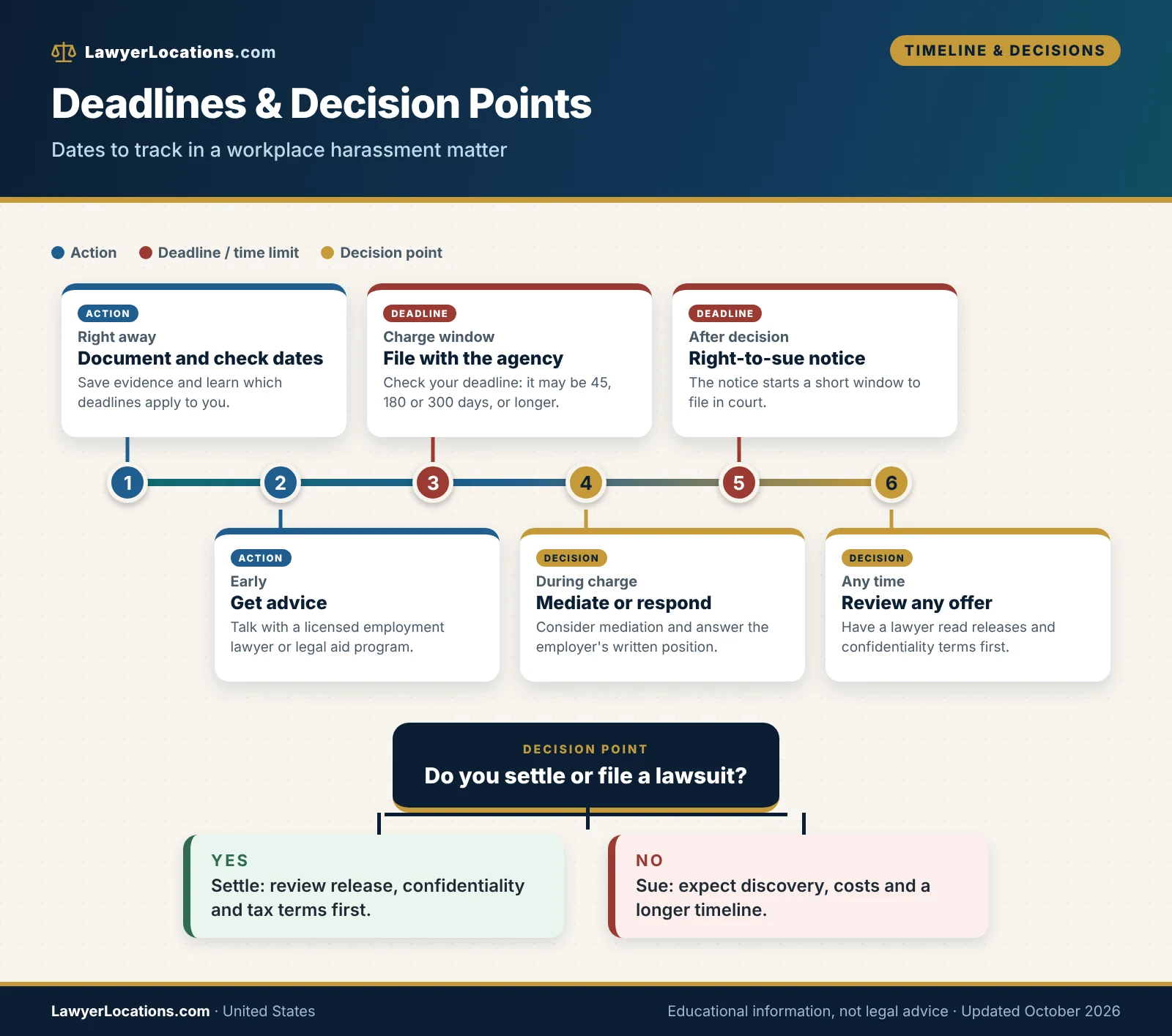
Text version of this graphic
- Right away: write down incidents, save evidence, and check which deadlines apply to you.
- Early: decide whether to report internally and whether to talk with a lawyer.
- Deadline: file with the EEOC or state agency within the 180- or 300-day window (45 days to contact an EEO Counselor for federal employees).
- During the charge: consider mediation, respond to the employer’s position statement, and add any retaliation.
- Decision point: receive a right-to-sue notice or a settlement offer.
- Deadline: file suit within 90 days of a right-to-sue notice, or sign a reviewed agreement.
Decision question: Do you settle or file suit? If you settle, review confidentiality and release terms first. If you sue, expect a longer process with discovery and costs.
Decision points and how to approach them
- Report internally or not. Reporting can stop the behavior and creates a record, but it can also trigger retaliation or an investigation you do not control.
- File a charge. It preserves your rights and starts a formal process, but it brings your employer’s response and time.
- Mediate. Mediation can be faster and private, and you can usually say no to terms you do not accept.
- Sue. A lawsuit offers court remedies but can take longer and ask more of you personally.
- Settle. A negotiated agreement ends the uncertainty, and confidentiality, release and tax terms should be reviewed first.
Common Mistakes, Red Flags and Next Steps
The most costly mistakes are the quiet ones: waiting past a deadline, signing without review, and assuming an informal promise will hold. You do not need to decide everything now, but you can protect your options today. This section lists the mistakes lawyers and agencies see most often, answers common questions, and offers a simple plan for the next week.
Common mistakes to avoid
Waiting without checking the deadline
Hoping the behavior will stop is human, but the EEOC clock keeps running, and internal complaints, union grievances and mediation generally do not extend it. Even if you are not ready to file, find out your date and put it on a calendar. For comparison, deadlines in other civil claims also differ widely, as our guide to personal injury filing deadlines explains.
- Assuming an internal HR process stops the EEOC deadline
- Assuming the 300-day period applies without checking your state
- Waiting until a firing to learn the harassment timeline
Signing documents before review
Employers sometimes present severance papers, confidentiality agreements or “resolution” forms quickly, sometimes at a moment of stress. Ask for time and copies, and have a lawyer read them before you sign. A release signed now can end claims you did not realize you had.
Quick answers to common questions
Do I have to report to HR before I can file a claim?
Federal law does not make an internal complaint a requirement for filing an EEOC charge. However, because of the Faragher and Ellerth defense, whether and how you used the employer’s process can affect the strength of a claim against the employer for a supervisor’s harassment. A lawyer can explain how that applies to you, including why you may have had good reasons not to report.
Can I file if I already quit or was fired?
Yes, in many cases. Title VII covers discharge as well as harassment, and the deadline for a firing generally runs from the date of the firing. If you quit because conditions became intolerable, the law of constructive discharge applies, and a lawyer can assess whether your facts fit. Time limits keep running after you leave, so do not wait.
Does the EEOC’s 2026 change to harassment guidance change my rights?
On January 22, 2026, the EEOC voted 2-1 to rescind its 2024 Enforcement Guidance on Harassment in the Workplace, and its press release states that the Chair said federal laws against discrimination, harassment and retaliation, and relevant Supreme Court precedent, “remain firmly in place.” Law-firm commentary notes that the guidance was non-binding and that courts, not the EEOC, ultimately decide whether conduct violates Title VII. Title VII, its deadlines, and the Supreme Court decisions described in this guide were not changed by that vote.
Your next steps
A simple seven-day plan
- Today. Write down the most recent incident date and the key facts, and store them privately.
- This week. Save messages and records to a personal location, and list witnesses.
- Check dates. Work out your possible deadlines (180 or 300 days, 45 days for federal employees, or your state’s period) and mark them.
- Decide on reporting. Choose whether to report internally, to an agency, or to a lawyer first.
- Get advice. Contact one or two employee-side lawyers or a legal aid program, and bring your timeline.
- Review paperwork. Ask for time before signing any agreement.
- Look after yourself. Consider counseling or support from someone you trust, and tell a lawyer about any safety concerns.
If you are not ready to take action
That is a valid choice, and you can still protect your options by keeping your notes and checking your deadline. You can call the EEOC at 1-800-669-4000 to ask questions about the process, or look up legal aid in your state through LawHelp.org. If conduct involved assault or threats, you can also consider contacting law enforcement or a victim-assistance organization, which is separate from any workplace claim.
Ready to compare your options?
Use the scorecard and fee questions above to speak with two or three sexual harassment lawyers who represent employees and are licensed in your state, and bring your timeline. LawyerLocations.com does not provide legal advice or recommend individual lawyers, but our guides can help you ask better questions. For local differences, start with our California employment lawyer guide, and see our workers’ compensation lawyer guide if a physical injury at work is also part of your situation.
Sources & References
Show all 47 sources
- Sexual Harassment — U.S. Equal Employment Opportunity Commission — eeoc.gov/sexual-harassment — accessed October 2026
- Time Limits For Filing A Charge — U.S. EEOC — eeoc.gov/time-limits-filing-charge — accessed October 2026
- How to File a Charge of Employment Discrimination — U.S. EEOC — eeoc.gov/how-file-charge-employment-discrimination — accessed October 2026
- Filing a Charge of Discrimination — U.S. EEOC — eeoc.gov/filing-charge-discrimination — accessed October 2026
- What You Can Expect After You File a Charge — U.S. EEOC — eeoc.gov/employees/what-you-can-expect-after-you-file-charge — accessed October 2026
- Filing a Lawsuit — U.S. EEOC — eeoc.gov/filing-lawsuit — accessed October 2026
- Remedies for Employment Discrimination — U.S. EEOC — eeoc.gov/remedies-employment-discrimination — accessed October 2026
- Retaliation — U.S. EEOC — eeoc.gov/retaliation — accessed October 2026
- Frequently Asked Questions (Youth) — U.S. EEOC — eeoc.gov/youth/frequently-asked-questions — accessed October 2026
- Select Task Force on the Study of Harassment in the Workplace (2016) — U.S. EEOC — eeoc.gov/select-task-force-study-harassment-workplace — accessed October 2026
- EEOC Commission Votes to Rescind 2024 Harassment Guidance (press release, January 2026) — U.S. EEOC — eeoc.gov/newsroom/eeoc-commission-votes-rescind-2024-harassment-guidance — accessed October 2026
- EEOC Rescinds Enforcement Guidance on Harassment (analysis) — Littler Mendelson — littler.com — accessed October 2026
- 42 U.S.C. 1981a (damages caps) — Cornell Legal Information Institute — law.cornell.edu/uscode/text/42/1981a — accessed October 2026
- 42 U.S.C. 2000e-5 (enforcement, deadlines, attorney’s fees) — Cornell LII — law.cornell.edu/uscode/text/42/2000e-5 — accessed October 2026
- 42 U.S.C. 2000e-3 (retaliation) — Cornell LII — law.cornell.edu/uscode/text/42/2000e-3 — accessed October 2026
- 42 U.S.C. 2000e-2 (unlawful employment practices) — Cornell LII — law.cornell.edu/uscode/text/42/2000e-2 — accessed October 2026
- 9 U.S.C. 401 and 402 (Ending Forced Arbitration of Sexual Assault and Sexual Harassment Act) — Cornell LII — law.cornell.edu/uscode/text/9/402 — accessed October 2026
- Public Law 117-90 — U.S. Government Publishing Office — govinfo.gov — accessed October 2026
- 42 U.S.C. 19403 (Speak Out Act) — Cornell LII — law.cornell.edu/uscode/text/42/19403 — accessed October 2026
- 29 C.F.R. 1614.105 (federal sector pre-complaint processing) — Cornell LII — law.cornell.edu/cfr/text/29/1614.105 — accessed October 2026
- 18 U.S.C. 2511 (interception of communications) — Cornell LII — law.cornell.edu/uscode/text/18/2511 — accessed October 2026
- Faragher v. City of Boca Raton, 524 U.S. 775 (1998) — Justia — supreme.justia.com — accessed October 2026
- Burlington Industries, Inc. v. Ellerth, 524 U.S. 742 (1998) — Justia — supreme.justia.com — accessed October 2026
- Harris v. Forklift Systems, Inc., 510 U.S. 17 (1993) — Justia — supreme.justia.com — accessed October 2026
- Vance v. Ball State University, 570 U.S. 421 (2013) — Justia — supreme.justia.com — accessed October 2026
- Oncale v. Sundowner Offshore Services, Inc., 523 U.S. 75 (1998) — Justia — supreme.justia.com — accessed October 2026
- Bostock v. Clayton County (2020) — Justia — supreme.justia.com — accessed October 2026
- Burlington Northern & Santa Fe Railway Co. v. White, 548 U.S. 53 (2006) — Justia — supreme.justia.com — accessed October 2026
- University of Texas Southwestern Medical Center v. Nassar, 570 U.S. 338 (2013) — Justia — supreme.justia.com — accessed October 2026
- National Railroad Passenger Corp. v. Morgan, 536 U.S. 101 (2002) — Justia — supreme.justia.com — accessed October 2026
- Fort Bend County v. Davis (2019) — Justia — supreme.justia.com — accessed October 2026
- Pennsylvania State Police v. Suders, 542 U.S. 129 (2004) — Justia — supreme.justia.com — accessed October 2026
- Olivieri v. Stifel, Nicolaus & Co., No. 23-658 (2d Cir. Aug. 12, 2024) — U.S. Government Publishing Office — govinfo.gov — accessed October 2026
- Bruce v. Adams and Reese, LLP, No. 25-5210 (6th Cir. Feb. 25, 2026) — U.S. Court of Appeals for the Sixth Circuit — opn.ca6.uscourts.gov — accessed October 2026
- Complaint Process (employment, three-year deadline) — California Civil Rights Department — calcivilrights.ca.gov/complaintprocess — accessed October 2026
- Employment — California Civil Rights Department — calcivilrights.ca.gov/employment — accessed October 2026
- File a Complaint — New York State Division of Human Rights — dhr.ny.gov/complaint — accessed October 2026
- N.Y. Executive Law 296 — New York State Senate — nysenate.gov/legislation/laws/EXC/296 — accessed October 2026
- IDHR Extends Statute of Limitations (December 30, 2024) — Illinois Department of Human Rights — dhr.illinois.gov — accessed October 2026
- Texas Labor Code 21.202 — Justia — law.justia.com — accessed October 2026
- Texas Expands Employer Liability for Sexual Harassment Claims (effective September 1, 2021) — Epstein Becker Green — ebglaw.com — accessed October 2026
- Florida Statutes 760.11 — Florida Senate — flsenate.gov/Laws/Statutes/2025/760.11 — accessed October 2026
- SB 1096 (2026), Remedies for Violations of the Florida Civil Rights Act — Florida Senate — flsenate.gov/Session/Bill/2026/1096 — accessed October 2026
- Massachusetts Law About Sexual Harassment — Mass.gov — mass.gov — accessed October 2026
- File a Civil Rights Complaint — New Jersey Division on Civil Rights — njoag.gov — accessed October 2026
- ABA Model Rule 1.5: Fees — American Bar Association — americanbar.org — accessed October 2026
- LawHelp.org — Pro Bono Net — lawhelp.org — accessed October 2026
General information only. This article is general legal information for readers in the United States. It is not legal advice, and reading it does not create an attorney-client relationship with LawyerLocations.com or any lawyer. LawyerLocations.com is not a law firm and does not recommend or rate individual lawyers. Laws, agency procedures, deadlines and court decisions change and can differ by state and by facts, so consult a lawyer licensed in the relevant jurisdiction about your situation. If you are in immediate danger, contact emergency services.
Legal Disclaimer and Limitation of Liability
Informational and illustrative purposes only. This article was prepared by LawyerLocations.com solely on the basis of the information available to us at the time of writing. It is an illustrative, general overview. It is not a complete or authoritative statement of the law, and it has not been reviewed by a lawyer licensed in your state or county.
Not legal advice. Nothing in this article is legal, financial, tax or immigration advice, and reading it does not create an attorney-client relationship between you and LawyerLocations.com or any author, lawyer or firm mentioned. Laws, court rules, fees, filing deadlines and agency procedures differ by state, county and court, and they change often. Some details here may be simplified, incomplete or out of date, and time limits for legal claims can be short.
No warranty. We make no representation or warranty, express or implied, about the accuracy, completeness, timeliness or suitability of this content for your situation. Please do not rely on it to make, delay or skip any legal decision. Check the facts against official sources and speak with a licensed attorney in the relevant jurisdiction before you act.
Limitation of liability. To the fullest extent permitted by law, LawyerLocations.com and its owners, authors and contributors disclaim all liability for any loss, damage, cost or other consequence arising from the use of, or reliance on, this article, including any content on third-party websites we link to. Mentioning a lawyer, firm, organization or service is not an endorsement and is not a promise of any result. If you are in immediate danger, contact your local emergency number.