Searching for an “employment lawyer fresno ca” usually means one of three things: you were fired or pushed out, you were harassed or treated unfairly, or you were not paid what you earned. In California, a discrimination or harassment complaint to the state Civil Rights Department generally has to be filed within three years of the harm, a federal EEOC charge has a much shorter 180- or 300-day window, and unpaid-wage claims run on their own clocks of one to four years depending on the type.
This guide explains the California rules, the Fresno agencies and courts where claims actually land, how employment lawyers are paid, and how to compare two or three of them before you sign anything. It is general information for Fresno workers, not advice about your facts.
Employment Lawyer Fresno CA: What You Are Really Shopping For
An employment lawyer is a lawyer who handles disputes between workers and employers. The label covers a wide range of problems, from an unpaid final paycheck to a harassment campaign by a supervisor, so the first job in your search is to work out which kind of problem you actually have. This section explains what these lawyers do, which side they represent, and how this guide is built.
What an employment lawyer does for a worker
Most people picture a lawsuit. In practice, a lot of the work happens before anyone files anything: reading your paperwork, sorting out which legal theories fit, deciding where the case belongs, and often negotiating. The next two parts walk through the typical sequence.
Sorting your facts into legal claims
A single workplace story can contain several different legal claims. A worker who complains about unpaid overtime and is fired two weeks later may have a wage claim, a retaliation claim, and a wrongful termination claim, each with its own deadline and its own agency or court. A lawyer’s first task is usually to separate those strands and rank them by strength and by urgency.
This sorting step is also where a lawyer may tell you that part of what happened is unpleasant but not illegal. California is an at-will employment state, and being treated badly is not by itself against the law. A candid early answer on that point saves you months of false hope.
Choosing the forum and the clock
Employment claims do not all go to the same place. Discrimination and harassment claims under California law start with the state Civil Rights Department. Federal discrimination claims start with the Equal Employment Opportunity Commission. Unpaid-wage claims can go to the Labor Commissioner or straight to court. Some claims are pushed into private arbitration by a contract the worker signed.
Each route has its own deadline, and missing the right one can end a claim before anyone looks at the merits. Section 4 of this guide lays out those clocks. A good lawyer will name the deadlines in the first meeting and write them down for you.
Worker-side, employer-side and why the label matters
Many lawyers who say they practice employment law represent employers, not workers. Both are legitimate careers, but you need a lawyer on your side of the table. The two parts below explain how to tell the difference and where employment law ends and neighboring areas begin.
Who the lawyer actually represents
Ask every lawyer a blunt question: “Do you represent workers, employers, or both?” A firm that regularly defends employers may have a conflict of interest if your employer is a past or current client, and the answer will tell you whose playbook the lawyer knows best. Neither answer is automatically good or bad, but it shapes what you can expect.
Also ask whether the lawyer handles your specific type of claim. A lawyer who mostly handles wage-and-hour class actions may not take a single-plaintiff harassment case, and the reverse is just as common.
Neighboring areas that are not the same thing
Several problems that feel like “job problems” belong to other practice areas. An on-the-job injury is generally a workers’ compensation matter with its own system and its own lawyers; our guide on finding a workers’ comp lawyer covers that path in a different California city. Criminal charges, immigration status questions and unemployment appeals are separate again.
The overlap is real, though. Being fired after reporting an injury can create both a workers’ compensation issue and an employment retaliation issue, which is why some lawyers handle both and others refer one half out.
How this guide is built and how to use it
The guide is organized around the decisions a Fresno worker has to make: what kind of claim you have, where it goes, how long you have, who to hire, and what it will cost. You do not have to read it in order.
What was checked, and when
California statutes, agency pages and court pages were reviewed in October 2026, and the sources are listed at the end. Fees, hours, addresses and procedures change, so treat every number here as dated “as of October 2026” and confirm it with the agency or court before you rely on it.
Nothing on this site is a substitute for talking to a lawyer licensed in California. LawyerLocations.com is a legal education and lawyer-discovery resource, not a law firm, and it does not rate or recommend individual lawyers.
A quick map of claim types
The table below is the fastest way to orient yourself. Find the row that sounds like your situation, then jump to the matching section.
| Problem | Main law | Usual first stop | Covered in |
|---|---|---|---|
| Fired for a protected reason | FEHA, Gov. Code 12940 | Civil Rights Department, then court | Sections 2 and 4 |
| Harassment at work | FEHA, all employers regardless of size | Civil Rights Department, then court | Section 2 |
| Fired for reporting something illegal | Labor Code 1102.5 | Court, or Labor Commissioner retaliation complaint | Sections 2 and 4 |
| Unpaid wages or overtime | Labor Code; wage orders | Labor Commissioner (Fresno office) or court | Sections 2, 3 and 4 |
| Final paycheck late or short | Labor Code 201–203 | Labor Commissioner or court | Section 2 |
| Denied medical or family leave | CFRA, Gov. Code 12945.2 | Civil Rights Department, then court | Section 2 |
| Federal discrimination claim | Title VII, ADA, ADEA | EEOC Fresno Local Office | Sections 3 and 4 |
| Arbitration agreement in your hiring papers | Contract law, Federal Arbitration Act | Depends; lawyer review needed | Section 7 |
California Employment Claims a Fresno Worker May Have
California gives workers more protection than most states, and most of it is state law rather than federal law, so it applies the same way in Fresno as in San Diego. The four families below, retaliation and wrongful termination, discrimination and harassment, wage-and-hour, and leave, account for most of what employment lawyers handle.
Wrongful termination and retaliation
Short answer: you can be fired for almost any reason or no reason, but not for an illegal one. The rules below explain the default, the main exceptions, and the two retaliation statutes workers most often rely on.
The at-will rule and its limits
Under Labor Code 2922, employment with no specified term may be ended by either side on notice to the other. That is the at-will rule, and it is the starting point for every termination case. It does not allow a firing that violates a statute, a contract, or public policy.
So the useful question is rarely “was it fair?” It is “was it because of something the law protects?” Race, sex, disability, a protected leave, a wage complaint, a safety report and a refusal to break the law are all examples of protected reasons that can turn a lawful-looking termination into an unlawful one.
At-will employment means that, absent a contract for a set term, either you or the employer may end the job on notice. Exceptions come from statutes, contracts and public policy, which is where wrongful termination claims live.
Firing in violation of public policy
In Tameny v. Atlantic Richfield Co. (1980) 27 Cal.3d 167, the California Supreme Court held that an employee fired for refusing to join an illegal price-fixing scheme could bring a tort action for wrongful discharge. The court reasoned that an employer may not coerce compliance with unlawful directions by discharging an employee. That case is the foundation for what lawyers call a wrongful termination in violation of public policy claim.
Later cases have shaped the details, including which public policies count, so a lawyer will need to match your facts to the case law. The practical point for a worker is that a firing tied to refusing an illegal order, reporting a violation or asserting a legal right can support a lawsuit even when no discrimination is involved.
Whistleblower protection under Labor Code 1102.5
Labor Code 1102.5 bars an employer from retaliating against an employee who discloses information to a government or law enforcement agency, or to a person with authority over the employee or another employee who can investigate, when the employee has reasonable cause to believe the information discloses a violation of law. The statute says the protection applies regardless of whether the disclosure is part of the employee’s job duties, and it also protects an employee who refuses to take part in an activity that would violate a law or rule.
The statute allows a civil penalty of up to $10,000 per employee for each violation, paid to the employee, in addition to other remedies, and it lets a court award reasonable attorney’s fees to a successful plaintiff. Those fee provisions matter later, in the section on how lawyers get paid.
Retaliation for wage complaints and Labor Code rights
Labor Code 98.6 prohibits discharging, discriminating or retaliating against an employee for making a written or oral complaint that they are owed unpaid wages, or for making a bona fide complaint or claim to the Labor Commissioner’s division. The statute says an adverse action taken within 90 days of protected activity creates a rebuttable presumption in the employee’s favor, meaning the employer must come forward with a legitimate explanation.
Remedies listed in the statute include reinstatement and reimbursement for lost wages and work benefits, and a civil penalty of up to $10,000 per employee for each violation. The same statute, in other words, covers the worker who complains about pay and is let go soon afterward, a pattern that comes up often in wage-and-hour disputes.
A warehouse worker asks a manager in writing why her last two paychecks left out overtime. Ten days later she is told her position is “eliminated.” Her lawyer would look at the unpaid overtime, the timing of the termination relative to her written complaint, and whether the employer can show a documented reason that predates the complaint. Real cases turn on the paper trail, which is why dated messages matter.
Discrimination, harassment and accommodation under FEHA
The California Fair Employment and Housing Act, known as FEHA, is the main state law against workplace discrimination and harassment. It is found in Government Code 12900 et seq. and enforced by the California Civil Rights Department (CRD). If your concern is sexual harassment specifically, our guide to documenting and reporting sexual harassment goes deeper on that subject.
Who is covered, and the five-employee line
The CRD’s employment page states that FEHA discrimination and retaliation rules apply to employers with 5 or more employees, and that the same five-employee line applies to California Family Rights Act leave and pregnancy disability leave. The statute’s definition of “employer” in Government Code 12926 reads “any person regularly employing five or more persons,” and it includes the state, its subdivisions and cities.
Harassment is the exception: it is covered in all workplaces, including those with fewer than five employees. The harassment subdivision of Government Code 12940 defines “employer” for that purpose as any person who regularly employs one or more people. CRD also says harassment protections reach applicants, unpaid interns, volunteers and contractors.
Protected characteristics and combinations
The CRD page lists protected categories that include race, religion, sexual orientation, gender identity, medical condition, genetic information, reproductive health decision-making, disability, sex, age 40 and over, and military or veteran status. Government Code 12926 adds that protection extends to a combination of those characteristics, to a perception that a person has one of them, and to association with a person who has or is perceived to have one.
The same section defines race to include traits associated with race, including hair texture and protective hairstyles such as braids, locs and twists. Workers sometimes assume a protected category must be “proven” in some formal way; in practice the question is whether the characteristic, or the employer’s perception of it, played a role in how you were treated.
Harassment and what the employer must do about it
Under Government Code 12940(j), harassment based on a protected characteristic is unlawful, and the statute says a loss of tangible job benefits is not necessary to establish harassment. For harassment by a non-supervisory employee, the employer is liable if it knew or should have known of the conduct and failed to take immediate and appropriate corrective action; employers can also be responsible for harassment by non-employees in the workplace under the same knowledge-and-response approach.
The statute separately makes individual employees personally liable for harassment they commit, and subdivision (k) requires employers to take all reasonable steps to prevent discrimination and harassment. CRD adds that covered employers must provide sexual harassment training: two hours for supervisors and one hour for non-supervisory staff, repeated every two years. A missing or sloppy training program is often one of the first facts a lawyer asks about.
Reasonable accommodation and the interactive process
Subdivision (m) of Government Code 12940 makes it unlawful to fail to make reasonable accommodation for the known physical or mental disability of an applicant or employee, unless the employer shows undue hardship. Subdivision (n) separately makes it unlawful to fail to engage in a timely, good-faith interactive process to identify effective accommodations once one is requested for a known disability or medical condition.
Accommodation cases often hinge on the paper trail: when the request was made, what was proposed, who stopped responding. A worker who asks for a schedule change or a modified duty in writing, and keeps the reply, is far better positioned than one who relies on hallway conversations.
If you ask for an accommodation, a schedule change or leave, put the request in an email or text and save the reply. A dated written request is the single most useful document in an accommodation or leave case, and it costs nothing to create.
Retaliation under FEHA
Subdivision (h) makes it unlawful to discharge, expel or otherwise discriminate against anyone for opposing practices the statute forbids or for filing a complaint, testifying or assisting in a proceeding. The statute reaches employers, labor organizations, employment agencies and any other person. How it applies when the original complaint turns out to be mistaken is a question for a lawyer who has the facts in front of them. Retaliation claims are among the most common reasons workers hire lawyers because the adverse action, such as a firing or demotion, is concrete and dated.
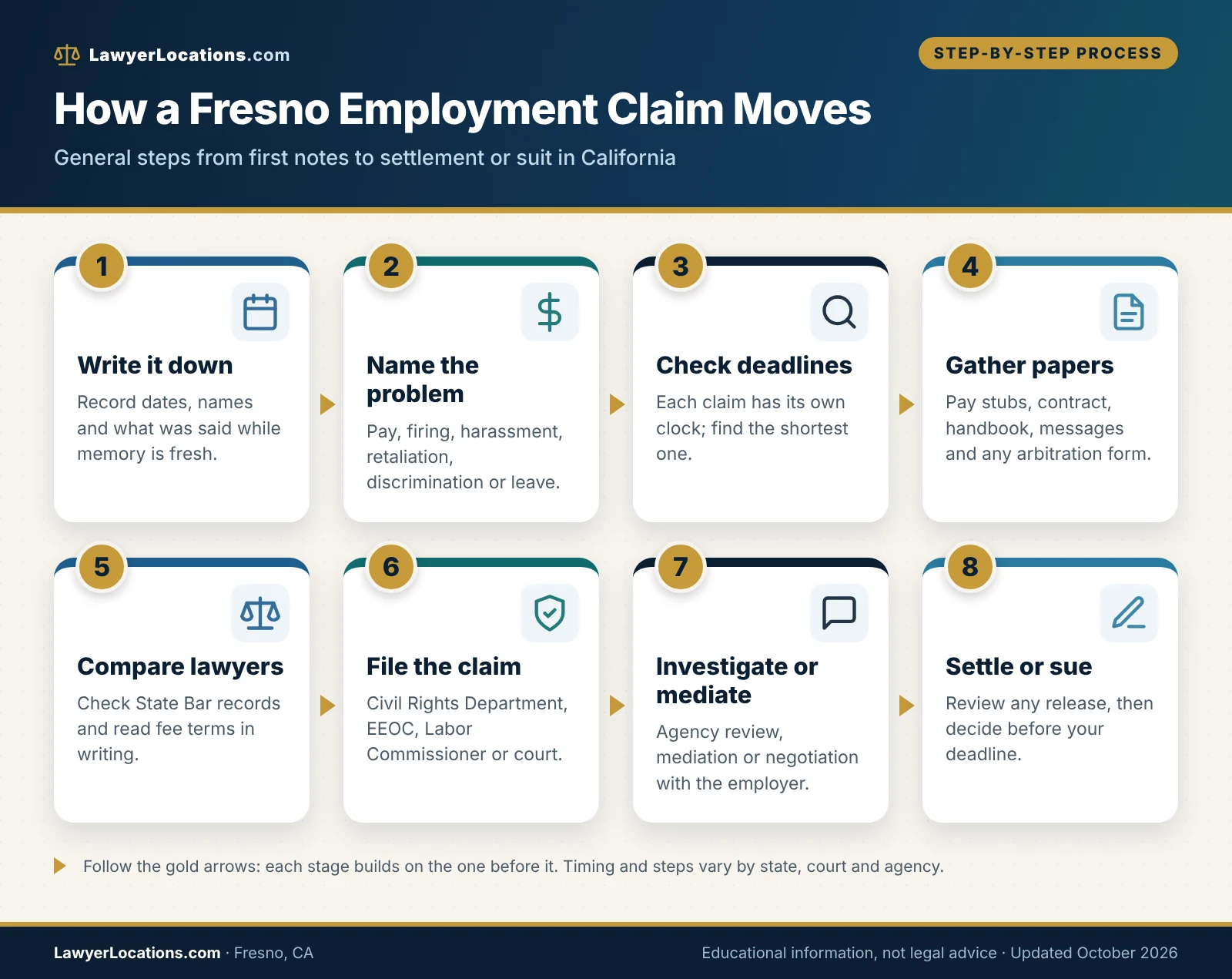
Text version of this graphic
- Write down what happened, with dates, while memories are fresh.
- Identify the problem type: pay, firing, discrimination, harassment, retaliation, leave.
- Check the deadlines for each possible claim.
- Gather pay records, policies, messages and any arbitration or severance papers.
- Compare two or three Fresno-area lawyers and read the fee terms in writing.
- File with the right agency (Civil Rights Department, EEOC, Labor Commissioner) or in court.
- Investigation, mediation or negotiation.
- Settlement, hearing, trial or arbitration, then close out fees and costs.
Wage-and-hour claims
Wage-and-hour claims are the most common employment dispute in California and the one where a worker can sometimes act without a lawyer. They cover minimum wage, overtime, meal periods, final pay, pay stubs, and expense reimbursement. The parts below stick to the rules published by the Labor Commissioner’s Office and the Labor Code text.
Minimum wage and overtime
The Department of Industrial Relations states that California’s statewide minimum wage is $16.90 per hour, effective January 1, 2026, for employers not covered by a higher industry- or locality-specific minimum. The same page notes that some cities and counties set higher rates but does not list them, so ask the Labor Commissioner’s Office whether a local rate applies to your worksite.
For overtime, the Labor Commissioner explains that non-exempt employees 18 or older generally cannot be required to work more than eight hours in a workday or more than 40 hours in a workweek without overtime pay. Hours over eight (up to twelve) in a day, and the first eight hours on a seventh consecutive workday, are paid at 1.5 times the regular rate; hours over twelve in a day and hours over eight on a seventh consecutive day are paid at double the regular rate. A salary does not automatically exempt you; salaried workers must meet the federal and state tests for exempt status.
Agricultural overtime, a Fresno County question
Agricultural workers have their own overtime schedule, which matters for many jobs in Fresno County and the rest of the Central Valley, and the rules changed in recent years. The Labor Commissioner’s agricultural overtime FAQ describes a phase-in schedule: for employers with 26 or more employees, the threshold reached 8 hours a day and 40 hours a week on January 1, 2022; for employers with 25 or fewer employees, it reached the same threshold on January 1, 2025. Double time after 12 hours in a workday followed the same schedule.
The same page says irrigators, sheepherders and licensed commercial fishing crew members, who had been excluded from overtime under Wage Order 14, follow the phase-in timetable too, and that employer size is counted using the method used for the state minimum wage law. If you work for a farm labor contractor or a packing operation, ask which wage order and which employer-size count apply to you, because the answer determines which row of the schedule governs.
Meal periods, final pay and pay stubs
The Labor Commissioner’s meal period page says the first meal period must start no later than the end of the fifth hour of work and must be at least 30 minutes, with a second period for longer shifts. When a required meal period is not provided, the employer owes one additional hour of pay at the regular rate for each affected workday. Rest-break rules are in the wage orders, and a lawyer or the Labor Commissioner can tell you which order covers your job.
On final pay, the Labor Commissioner states that a discharged employee must be paid all wages, including accrued vacation, immediately at termination. An employee who quits with at least 72 hours’ notice is owed final pay on the last day; one who quits without notice is owed final pay within 72 hours. Under Labor Code 203, a willful failure to pay on time can add a daily penalty at the employee’s daily rate for up to 30 calendar days. Pay stubs are governed by Labor Code 226, which lists what each itemized statement must show, including gross wages, total hours, deductions, net wages, pay period dates, and the employer’s legal name and address.
Expense reimbursement, misclassification and group claims
Labor Code 2802 requires an employer to reimburse an employee for necessary expenditures or losses, and the statute includes interest and reasonable attorney’s fees in what can be recovered. Workers who use their own phones, vehicles or tools for the job sometimes have claims here that they never thought of as “wage” claims.
Misclassification is the other recurring theme: an employer calling a worker an independent contractor. The Labor Commissioner says it lacks jurisdiction over true independent contractors but that a worker who believes they were misclassified can still file a wage claim, and a hearing officer may decide the classification question. The Private Attorneys General Act, covered in Section 7, is the tool lawyers use when the same violation affected many workers.
Start a simple log of your hours, breaks and pay today, even if you are still employed. The Labor Commissioner asks claimants for pay stubs and a record of hours including meal and rest breaks, but says you do not need every document in hand to file. A rough, dated log is better than reconstructing months from memory.
Leave, sick time and unemployment
Job-protected leave and paid sick time are where many Fresno workers first run into trouble: a denied request, a write-up for an absence, or a firing after a surgery. Three overlapping systems apply, and each has a different employer-size threshold.
CFRA family and medical leave and pregnancy disability leave
The California Family Rights Act, Government Code 12945.2, applies to employers that directly employ five or more people, plus public employers. An employee needs more than 12 months of service and at least 1,250 hours of service in the previous 12 months, and may take up to 12 workweeks in a 12-month period for the birth or placement of a child, to care for a family member with a serious health condition, for their own serious health condition, or for certain military exigencies.
CRD’s employment page says pregnancy disability leave is also covered at employers with five or more employees. The statute makes it unlawful to refuse to hire, discharge or otherwise retaliate because someone used CFRA leave, and unlawful to interfere with, restrain or deny the exercise of leave rights. The federal Family and Medical Leave Act has its own coverage rules, so a lawyer will often evaluate both laws side by side.
Paid sick leave and retaliation for using it
The Labor Commissioner explains that since January 1, 2024, California employers must generally provide at least 40 hours or five days of paid sick leave per year, whichever is greater, following an amendment in SB 616. Under an accrual plan, workers generally earn one hour for every 30 hours worked, and unused leave carries over, though employers may cap accrual at 80 hours or ten days.
An employer may not deny use of accrued sick days or punish a worker for using them. The Labor Commissioner says a worker can file a retaliation complaint with its office. If you were written up or fired for an illness absence, the sick leave statute, CFRA and FEHA disability rules may all be in play at once.
Unemployment benefits after a firing or resignation
The Employment Development Department (EDD) runs unemployment insurance, which is separate from any lawsuit. EDD’s eligibility page says that if you quit you need to show you had a good reason, and that if you are fired your employer must prove there was misconduct. You must also be out of work through no fault of your own and have earned enough wages in the base period.
Claiming unemployment does not prevent you from pursuing an employment claim, but what you tell EDD can be read later, so answer accurately and consistently. If an employer contests your claim, that dispute can produce early, sworn statements about why you left.
Where Fresno Claims Go: Agencies and Courts
Employment claims from Fresno workers are handled by a small set of state and federal offices and two trial courts. Knowing which door to knock on, and what each one does, helps you judge whether a lawyer’s plan makes sense. The table summarizes the verified contact details; the subsections explain how each office fits into a case.
| Office | Address or access | Phone | Handles |
|---|---|---|---|
| California Civil Rights Department (CRD) | Online intake through the CRD complaint process | 800-884-1684 | FEHA discrimination, harassment, retaliation, CFRA |
| EEOC Fresno Local Office | Robert E. Coyle Federal Courthouse, 2500 Tulare Street, Suite 2601, Fresno, CA 93721 | 559-753-8480 | Federal discrimination charges (Title VII, ADA, ADEA) |
| Labor Commissioner’s Office, Fresno | 770 E. Shaw Avenue, Suite 222, Fresno, CA 93710 | 559-244-5340 | Wage claims, retaliation complaints |
| Fresno County Superior Court, B.F. Sisk Courthouse | 1130 O Street, Fresno, CA 93721 | 559-457-1900 (unlimited civil) | State-court employment lawsuits above $35,000 |
| U.S. District Court, E.D. Cal., Fresno | Robert E. Coyle Federal Courthouse, 2500 Tulare Street, Room 1501, Fresno, CA 93721 | See the court’s site | Federal-law employment lawsuits |
| Fresno County Bar Association | 2444 Main Street, Suite 125, Fresno, CA 93721 | 559-264-2619; referral service 559-264-0137 | Attorney referral service |
State agencies: the Civil Rights Department and the Labor Commissioner
Two California agencies handle most worker complaints. They do different jobs, they have different deadlines, and filing with one does not file with the other. The parts below describe how each works from a Fresno worker’s point of view.
Civil Rights Department intake
CRD’s complaint page says that in employment cases you must submit an intake form to CRD within three years of the date you were last harmed. The intake form starts an interview with a CRD representative, who decides whether a formal complaint can be accepted for investigation; if CRD accepts, it prepares a complaint form for your signature. CRD can investigate only violations of the civil rights laws it enforces, so a purely unpaid-wage dispute does not belong here.
CRD’s page also says that in employment cases you must obtain a right-to-sue notice from CRD before filing your own lawsuit in court, and that you can request it through the California Civil Rights System (CCRS). You do not have to use the CRD investigation process at all. Many workers who have a lawyer ask for the notice early and go straight to court; others let the agency investigate first. CRD’s intake line is 800-884-1684.
The Labor Commissioner’s Fresno office and the wage claim process
The Labor Commissioner’s district-office page lists the Fresno office at 770 E. Shaw Avenue, Suite 222, Fresno, CA 93710, phone (559) 244-5340, with an email address for wage-claim information of [email protected]. The page lists walk-in hours of Monday through Friday, 9:00 a.m. to 12:30 p.m. and 1:30 p.m. to 5:00 p.m., so confirm hours before you make the trip.
A wage claim can be filed online, by email, by mail or in person. After filing, the office investigates, and in most cases a settlement conference between you and the employer is scheduled. If that does not resolve the issue, a hearing is scheduled so a hearing officer can review the evidence and decide. The Labor Commissioner’s information line is 833-526-4636, which can also connect you to a telephone interpreter.
Retaliation complaints at the Labor Commissioner
The Labor Commissioner also takes retaliation complaints, and its retaliation page says complaints generally must be filed within one year of the retaliatory act, with exceptions, and that missing the deadline does not necessarily end a private lawsuit. The page says the office does not ask about immigration status or report it to other agencies, and that discrimination complaints based on characteristics like race, religion, disability or sex generally go to CRD instead.
Whether to use this administrative route or hire a lawyer to sue is a strategic choice with trade-offs. An agency process costs less in the short term but gives you less control over timing and the shape of the remedy, so bring it up in your consultation.
A right-to-sue notice is a written notice from CRD (or the EEOC) that lets you file your own lawsuit. Under California law an employment lawsuit under FEHA generally needs one first; the notice also starts a filing clock, covered in Section 4.
The EEOC Fresno Local Office
The federal Equal Employment Opportunity Commission enforces Title VII, the Americans with Disabilities Act and the Age Discrimination in Employment Act, among other laws. Fresno has a local office, and its coverage area is wider than the city.
What the EEOC covers and which employers count
According to the EEOC’s threshold-issues guidance, Title VII and the ADA apply to employers with 15 or more employees for each working day in each of 20 or more calendar weeks in the current or preceding calendar year, and the ADEA applies to private employers with 20 or more employees, while government employers are covered regardless of headcount. That is a higher bar than California’s five-employee line, which is why small-employer cases usually proceed under state law.
For most federal discrimination claims, the EEOC says you first have to file a charge with the agency before going to court. Equal Pay Act claims are an exception and do not require a charge.
The Fresno office, its nine counties and how to be seen
The EEOC’s Fresno Local Office is in the Robert E. Coyle Federal Courthouse, 2500 Tulare Street, Suite 2601, Fresno, CA 93721, phone 559-753-8480. The EEOC’s page says the office is open 8:00 a.m. to 4:30 p.m., Monday through Friday, that you can schedule a phone, video or in-person interview through the EEOC Public Portal, and that walk-ins are seen first come, first served with urgent filing deadlines seen first. Visitors pass a security check and must show valid state or federal identification.
The office’s jurisdictional area covers the California counties of Fresno, Inyo, Kings, Madera, Mariposa, Merced, Mono, San Benito and Tulare, so a worker in Visalia or Merced is in the same office’s area as a worker in Fresno.
How CRD and the EEOC share complaints
CRD’s employment page says the two agencies have a worksharing agreement: a complaint filed with the EEOC is also filed with CRD, and a complaint filed with CRD that would violate a law the EEOC enforces is also sent to the EEOC. In general, the agency that receives the complaint is the one that investigates. For a Fresno worker, that means the choice of which door to use first matters less than keeping track of the deadline for each set of laws.
Because filing with one agency is generally treated as filing with the other for claims under both sets of laws, a worker who is unsure which agency to use can still protect the filing date. A lawyer will still want to confirm both the state and the federal paperwork before you rely on that.
Fresno County Superior Court
If an employment case is filed under California law and is worth more than $35,000, it belongs in the Superior Court of California, County of Fresno. The court’s pages describe a few local features that affect how a case moves.
Where unlimited civil cases are heard
The court’s civil unlimited page states that unlimited civil cases are heard at the B.F. Sisk Courthouse, 1130 O Street, Fresno, CA 93721, and lists the civil unlimited telephone number as (559) 457-1900. The statewide fee schedule uses a $35,000 line: a case with an amount over $35,000 is an unlimited civil case, and cases up to $35,000 are limited civil cases with lower fees.
The court’s locations page also lists other Fresno courthouses, including the M Street Courthouse at 2317 Tuolumne Street and a downtown location at 1100 Van Ness Avenue. Always check the filing instructions on the court’s civil pages before heading to the courthouse, because different case types are handled at different buildings.
Early deadlines in a Fresno civil case
The court’s civil FAQ states that after a complaint is filed you must serve all named defendants and file proof of service within 60 days (Local Rule 2.1.5), and that a defendant must file an answer within 30 days after personal service under Code of Civil Procedure 412.20(a)(3). Your lawyer handles these steps, but they explain why a case seems to move in bursts.
The court also describes a 2006 case management conference order that requires parties in general civil cases to participate in alternative dispute resolution before trial. The court’s ADR page warns that statutes of limitation continue to run during ADR, so a mediation does not pause your filing deadline.
Tentative rulings and remote appearances
Fresno posts tentative rulings for civil law-and-motion hearings online at 3:00 p.m. the day before the hearing. A party who wants to argue must notify the other parties and the department by 4:00 p.m. on the court day before; otherwise the court says no oral argument will be permitted and the tentative ruling becomes the order. This is a local practice that catches out people who handle their own motions.
For remote appearances, the court’s page identifies CourtCall for telephone appearances and Zoom for video, and says that unlimited civil departments allow Zoom for remote appearances only. Remote-appearance rules changed effective July 1, 2026 for non-trial hearings, and trial-related hearings still require court approval. If you represent yourself, read the current page rather than relying on this summary.
Federal court in Fresno
Some employment cases belong in federal court. Fresno has a federal courthouse, and it is one of the two main divisional offices of the Eastern District of California.
When a case may be in federal court
A case based on a federal statute such as Title VII, the ADA or the ADEA may be filed in federal court after the EEOC process. The EEOC states that the Notice of Right to Sue permits you to file in federal or state court, so federal claims do not have to go to federal court. Lawyers weigh the choice based on the claims, the judges, the pace and the procedural rules.
Claims under California law can sometimes be added to a federal case, and employers sometimes try to move state-court cases to federal court. These are technical strategy questions to raise with a lawyer.
The Coyle Courthouse and the filing fee
The Eastern District of California’s directions page lists the Fresno courthouse as the Robert E. Coyle Federal Courthouse, 2500 Tulare Street, Room 1501, Fresno, CA 93721. The court’s fee schedule lists the fee to file a civil case as $405 ($350 filing fee plus a $55 administrative fee), and the federal fee schedule says the administrative fee does not apply to persons granted in forma pauperis status.
The court states that its main divisional offices are in Sacramento and Fresno. If you represent yourself in a federal case, check the court’s pro se resources, but be aware that the pro se help event listed at the time of review was in Sacramento.
The Deadlines That Decide Whether You Can File
There is no single employment deadline in California. The clock depends on the claim, the agency and the law, and the shortest one on your list is the one that matters first. The table collects the periods published by the agencies and statutes reviewed for this guide; the subsections explain how they fit together.
These are general periods, not a calculation for your case. Exceptions, tolling and the date the clock starts can change the answer. If you are close to any date in the table, speak with a California-licensed lawyer or the relevant agency right away rather than waiting to finish reading.
| Claim or step | General time limit | Where it comes from |
|---|---|---|
| Employment complaint to the Civil Rights Department | 3 years from the date you were last harmed | CRD complaint process page; Gov. Code 12960 |
| Lawsuit after a CRD right-to-sue notice | The notice states one year from its date to bring a civil action | Gov. Code 12965 |
| EEOC charge | 180 days, extended to 300 days where a state or local agency enforces a law on the same basis | EEOC time limits page |
| Federal lawsuit after an EEOC notice | 90 days from receiving the Notice of Right to Sue | EEOC filing-a-lawsuit page |
| Wage claim: minimum wage, overtime, meal and rest breaks, sick leave, illegal deductions, reimbursements | 3 years | Labor Commissioner wage claim page |
| Wage claim: written contract | 4 years | Labor Commissioner wage claim page |
| Wage claim: oral promise above minimum wage | 2 years | Labor Commissioner wage claim page |
| Bounced-check penalties; access to payroll or personnel records | 1 year | Labor Commissioner wage claim page |
| Labor Commissioner retaliation complaint | 1 year from the retaliatory act, with exceptions; Equal Pay Act violations 2 years (3 if willful) | Labor Commissioner retaliation page |
California civil rights clocks
For discrimination, harassment and retaliation under FEHA, the first clock is the time to bring the matter to the Civil Rights Department. The second clock starts when the agency issues a right-to-sue notice. Both are covered below.
The three-year rule for CRD complaints
CRD’s complaint process page states that in employment cases you must submit an intake form within three years of the date you were last harmed, and that other cases generally have a one-year deadline. Assembly Bill 9, chaptered October 10, 2019 as Chapter 709 of the Statutes of 2019, amended Government Code sections 12960 and 12965 to extend the employment deadline from one year to three, and to provide that the verified complaint relates back to the filing of the intake form.
A later law, Senate Bill 477 (Chapter 321, Statutes of 2025), again amended sections 12926, 12960 and 12965. As described in the chaptered text, the bill says “filing a complaint means filing an intake form with the department,” adds a definition of group or class complaints, and expands the tolling provisions for certain written agreements and appeals. The practical lesson is that the filing date is the intake date, so submit the intake form promptly even if you plan to supplement it later.
Right-to-sue notices and the one-year window
Under Government Code 12965, if the department does not bring a civil action within 150 days of a complaint, or decides earlier that it will not, it must tell the complainant in writing that it will issue a right-to-sue notice on request; otherwise it issues one after its investigation, no later than one year after the complaint. The notice must state that the person may bring a civil action within one year of the notice’s date. CRD’s employment page adds that the agency generally has up to one year to complete an investigation.
Group and class complaints and certain other claims have different timing, with notices issued after the investigation and up to two years in group or class matters. Because the one-year period in the notice is firm, put the date on your calendar the day you receive it and tell your lawyer the same day.
Pauses, late discovery and other exceptions
As reproduced in a statute database, Government Code 12960 allows the filing period to be extended by up to 90 days if the person first learned the facts during that 90-day window, extends the period for minors until a year after reaching the age of majority, and allows up to a year after a rebutted presumption about the employer’s identity under section 12928. The same text provides that the time to file a civil action is paused while a complaint is pending with the department.
These exceptions are narrow and fact-specific. Do not plan around them; plan around the ordinary three-year and one-year rules and treat an exception as a rescue that a lawyer may or may not be able to argue.
Federal clocks
Federal discrimination laws have shorter deadlines than California’s, and the shorter clock often controls if you want the federal remedies in addition to the state ones.
The 180-day and 300-day EEOC charge deadlines
The EEOC’s time-limits page states that you need to file a charge within 180 calendar days of the day the discrimination took place, extended to 300 days when a state or local agency enforces a law against employment discrimination on the same basis. California has such an agency in CRD, which is why the longer period commonly applies to California workers, though a lawyer should confirm it for your particular claim. For age discrimination the EEOC says the 300-day extension requires a state law against age discrimination and a state agency enforcing it, and that it does not apply if only a local law prohibits age discrimination.
Because the state three-year period is longer than the federal period, a worker who waits can lose the federal claim while still holding the state claim. A lawyer will usually ask whether federal remedies are worth preserving.
The federal and state clocks run side by side. A worker who waits two years can still be inside the three-year state window while far outside the 180- or 300-day federal window. If federal remedies matter to you, ask a lawyer about them in your first meeting.
Ninety days to sue after the notice
Once you receive a Notice of Right to Sue from the EEOC, you must file your lawsuit within 90 days, and missing that deadline may prevent you from pursuing the lawsuit. The EEOC also explains that you can ask for the notice before the investigation ends: after 180 days it must issue the notice if you request it, and before 180 days it issues one only if it cannot finish the investigation within 180 days.
Requesting the notice ends the EEOC’s investigation, so do not request it if you want the agency to keep investigating. ADEA claims have a separate rule: you can sue 60 days after filing a charge.
Wage, retaliation and other claims
Claims outside FEHA and Title VII run on their own schedules. Several are published by the Labor Commissioner, and some are not published anywhere an ordinary reader can easily find.
Wage claim limitation periods
The Labor Commissioner’s page lists one year for bounced-check penalties and for failure to provide access to or copies of payroll or personnel records, two years for an oral promise to pay more than minimum wage, three years for minimum wage, overtime, unpaid rest and meal breaks, sick leave, illegal deductions and unpaid reimbursements, and four years for a written contract. Waiting-time penalties under Labor Code 203 may be sought before the limitation period on the underlying wage claim runs out.
The longer the delay, the more of your earliest unpaid pay can fall outside the window, so a worker who suspects underpayment should not wait for a convenient moment. Even a few weeks of delay can remove a pay period from reach.
Retaliation, equal pay and whistleblower complaints
The Labor Commissioner’s retaliation page says complaints must generally be filed within one year of the retaliatory act, with exceptions. Whistleblowers retaliated against for raising child day care licensing violations have 90 days, and Equal Pay Act violations carry a two-year deadline, or three if willful. The page adds that if you miss the administrative deadline, you may still be able to file a private lawsuit instead.
Whistleblower claims under Labor Code 1102.5 can be brought in court; the time limit for that route depends on how a court characterizes the claim, which is another reason to bring the facts to a lawyer early.
Claims with no published rule of thumb
Some claims, including a common-law wrongful termination claim, have limitation periods that differ from the FEHA three-year rule and are shorter in many situations. Code of Civil Procedure 335.1 sets a two-year period for assault, battery and injury claims, but the page reviewed does not say whether it governs a wrongful termination claim, and the correct period for your facts should be confirmed by a lawyer.
Our general guide to how long you have to file a personal injury claim shows how widely deadlines vary by claim type, and the same lesson applies here: assume the shortest plausible clock until a lawyer tells you otherwise.
How to Compare Employment Lawyers in Fresno
Compare at least two or three lawyers, check each one’s State Bar record, ask the same questions in the same order, and read the fee terms before you decide. This section covers the verification steps, the questions that separate a good fit from a poor one, and a scorecard you can use to compare answers.
Verify the lawyer before you talk fees
Verification takes minutes and screens out problems that no interview can detect. Do it before the consultation so that you spend your meeting time on the case.
Check the State Bar license and discipline history
The State Bar of California maintains an attorney search that serves as the public record of who is licensed to practice in California. Look up the lawyer by name or bar number, confirm that the license is active, and read any public discipline entries. A clean record is not a recommendation, but a suspended license or a history of discipline is something to ask about before you hand over documents.
Also check that the person you are speaking with is the person who will work on your case. If a firm assigns a different lawyer after you sign, look that lawyer up too.
Lawyer referral services and the State Bar certification list
The State Bar of California certifies lawyer referral services, and its Central Valley listing shows the Attorney Referral and Information Service of the Fresno County Bar Association among the certified services for Fresno County, with the phone number 559-264-0137 and the website fresnocountybar.org. The same listing includes other certified services, some of which are national or limited to a specific subject, so read how each one screens and matches its lawyers before relying on it.
The Fresno County Bar Association’s website says it runs an Attorney Referral Service and displays a certification logo; the page reviewed did not explain consultation fees, so ask the service what the first meeting costs. A referral service is a starting point, not a recommendation of a particular lawyer.
Reading advertising and directory listings critically
Online lists of the “best” lawyers are usually paid placements or popularity contests. LawyerLocations.com does not rate or rank lawyers, and it does not promise that any listed lawyer will take your case. Treat claims of past results, billboard slogans and review counts as marketing, and test them with specific questions instead.
Be wary of anyone who guarantees an outcome or a dollar figure at the first call. Nobody can know a case value before reviewing the records.
Questions that separate a good fit from a poor one
The lawyers you speak with will each give a polished introduction. These questions get past it to the practical details that determine your experience.
Which side, which claims, which forum
Ask what share of the lawyer’s practice is worker-side, and ask which of your claims the lawyer handles regularly. Then ask about the forums: has the lawyer filed in Fresno County Superior Court, in the Eastern District of California, and with the Civil Rights Department, the EEOC and the Labor Commissioner? A lawyer who has done a particular kind of case locally can tell you about the local pace and the tendencies of the courts without promising anything.
If an arbitration agreement is part of your story, ask how the lawyer approaches arbitration, including whether the lawyer will challenge the agreement and how the process works if it is enforced.
Who does the work and how you will hear about it
Ask who will handle your matter day to day: the lawyer you meet, an associate, or a paralegal. Ask how often you will get updates and what the lawyer’s policy is on returning calls and emails. These are not promises of response time, and you should not treat an answer as one, but a lawyer who dodges the question is telling you something.
It also helps to ask what the lawyer will need from you in the first month. A short, specific list suggests an organized practice.
A candid assessment, including the weaknesses
A good first consultation includes bad news. Ask the lawyer to name the two biggest weaknesses in your case, the deadlines that apply, and what would make the lawyer decline it. If a lawyer declines, ask for the reason in writing if possible, and ask whether any deadline is close, because a declination does not stop the clock on your claims.
Be cautious of an immediate, enthusiastic yes before the lawyer has seen your documents. Be equally cautious of a vague no. Both can reflect a sales pitch or a quick brush-off rather than an evaluation.
A scorecard for comparing your options
A scorecard keeps you from choosing the lawyer who talked the most. Fill in one column per lawyer after each consultation and compare the totals along with your gut feeling.
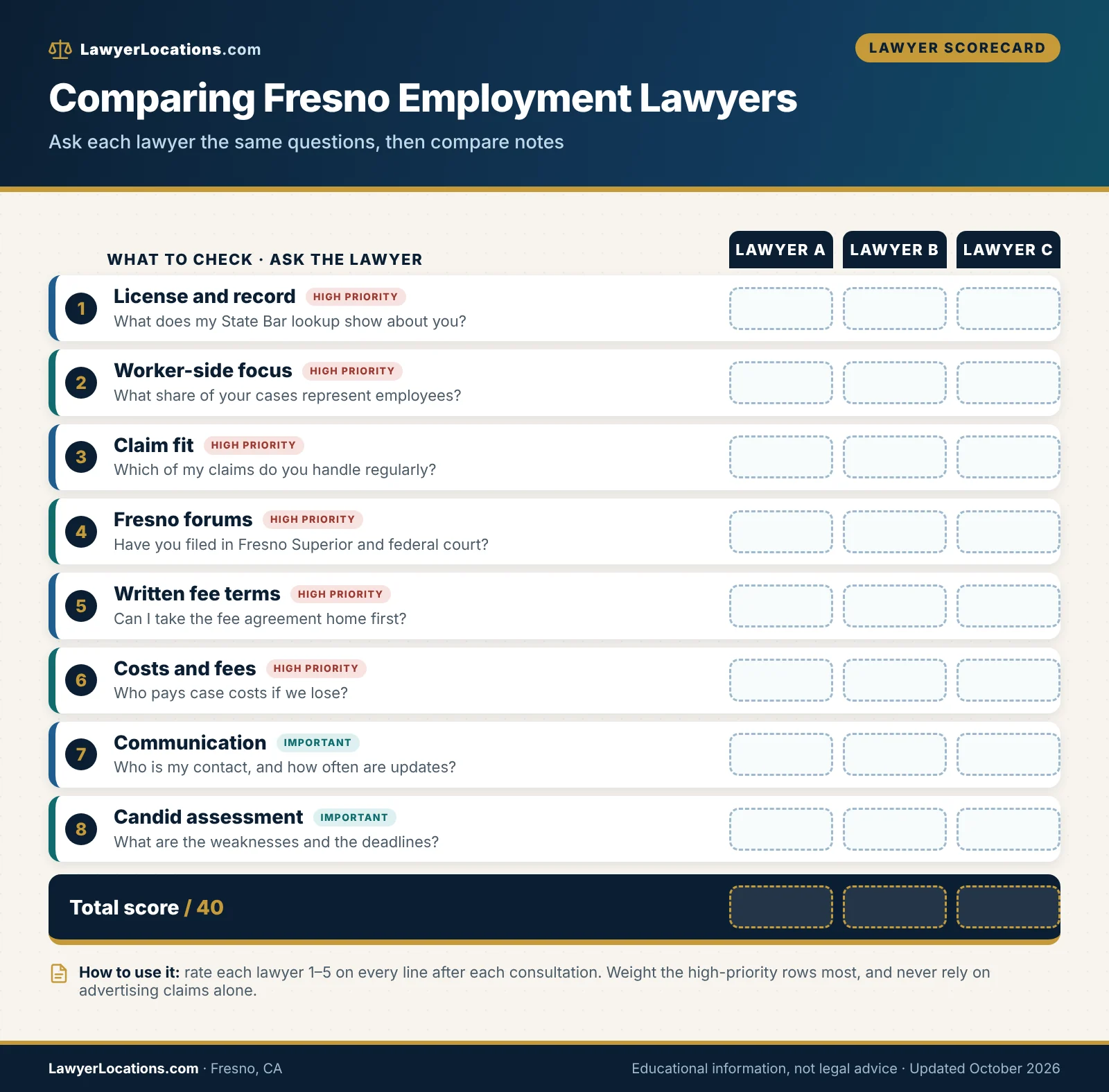
Text version of this graphic
| Criterion | Question to ask | Weight |
|---|---|---|
| License and record | What does my State Bar lookup show about you? | High |
| Worker-side focus | What share of your cases represent employees? | High |
| Claim fit | Which of my claims do you handle regularly? | High |
| Fresno forums | Have you filed in Fresno Superior Court and federal court here? | High |
| Written fee terms | Can I take the fee agreement home before signing? | High |
| Costs and fee-shifting | Who pays case costs if we lose? | High |
| Communication | Who is my contact and how often will I get updates? | Medium |
| Candid assessment | What are the weaknesses and the deadlines? | Medium |
How to score the answers
Score each criterion from zero to three after the meeting, not during it. Give a zero for an evasive answer, a one for an answer that is general but honest, a two for specifics, and a three for specifics that match what the State Bar record and the fee agreement later show. Weight the high-importance criteria double.
Then compare the totals and, just as important, compare the differences. A lawyer who scores lower overall but is far stronger on your type of claim may be the better choice than one with a broader pitch.
Comparing two or three consultations side by side
Keep the same documents and the same short summary of your story for every consultation, so differences in advice come from the lawyers and not from what you told them. Take notes on the deadlines each lawyer names, because disagreement about a deadline is a red flag worth resolving before you sign with anyone. Ask each lawyer how long they need to decide whether to take the case.
Do not feel obligated to sign at the first meeting. A lawyer who pressures you to sign that day, or hints that the case will be lost if you wait, is using false urgency.
Ask each lawyer to name the deadline they see for your case and to say how they calculated it. If two lawyers give different dates, ask both to show their work, and treat the earlier date as the real one until the difference is resolved.
Red flags to watch for
- A promise of a result, a dollar figure, or a quick settlement before reviewing your documents.
- No written fee agreement, or an agreement the lawyer will not let you take home to read.
- Asking for a large up-front payment in a case described as contingency, without explaining in writing exactly what it covers.
- Discouraging you from checking the State Bar record or talking to other lawyers.
- Vague answers about deadlines, or deadlines that do not match what the agencies publish.
- Pressure to sign immediately or to give up the right to talk to another lawyer.
What Employment Lawyers Charge and What the Contract Must Say
Worker-side employment lawyers are commonly paid in one of a few ways: a percentage of what you recover (a contingency fee), an hourly rate against a retainer, a flat fee for a defined task, or a mix. This guide does not quote typical rates because no verified Fresno fee survey was found, and invented averages would mislead you. What California law does require is a written agreement that explains the basis of the fee, which is the document to compare.
| Structure | How it works | Where it tends to fit | Question to ask |
|---|---|---|---|
| Contingency | Lawyer is paid a percentage only if there is a recovery; case costs handled separately | Claims with money damages, such as wrongful termination, harassment, retaliation | Is the percentage taken before or after costs, and does it change if the case is filed or tried? |
| Hourly with retainer | You deposit money up front and the lawyer bills against it at stated hourly rates | Advice, document review, negotiation, or cases without a clear money recovery | What is the rate, who else bills time, and how often will I get bills? |
| Flat fee | One price for a defined service | Reviewing a severance agreement or an arbitration clause | What exactly is included, and what happens if more work is needed? |
| Hybrid | A reduced hourly or flat component plus a smaller percentage | Cases where the lawyer wants some payment for risk or the claim is mixed | Is the up-front part credited against the percentage? |
| Limited scope | Lawyer handles only a defined piece, such as a demand letter or a mediation | Workers who want help but plan to handle other steps themselves | What is excluded, and how do I hand the case back or forward? |
How the fee structures work
The structure tells you who carries the financial risk and how the lawyer is motivated. Each structure has a place, and the same lawyer may offer more than one depending on the claim.
Contingency fees
In a contingency arrangement the lawyer advances the work and is paid out of a settlement or judgment, so the worker may pay little or nothing up front. That makes it the typical route for claims with money damages, and it is how many wrongful termination, harassment and retaliation cases are funded. The trade-off is that lawyers choose cases partly on their economics, so a modest-value case may not be taken even if it is valid. Our guide on wrongful death lawyer costs explains how contingency fees and case expenses are usually structured in a different practice area, and many of the same questions apply.
The key questions are the percentage, whether it steps up as the case advances, whether it is calculated on the gross recovery or after costs, and what the lawyer is paid if you fire the lawyer midway. These must be in the written agreement.
Hourly rates and retainers
Under an hourly agreement, you pay for time. A retainer is money you deposit that the lawyer bills against, and the agreement should say whether unused amounts are refunded. Hourly work is more common for advising, negotiating a severance, or reviewing an arbitration clause than for litigating a full case, because the cost of litigation can escalate quickly.
Ask for a budget range for each phase and what happens if the budget is exceeded. Under Business and Professions Code 6148, you can ask for itemized bills, and the lawyer must provide one within 10 days of a request in most circumstances.
Flat fees, hybrids and limited-scope help
Flat fees fit tightly defined tasks. A lawyer might charge one price to review a severance package or an arbitration agreement before you sign, which can be an efficient way to get advice at the stage where it matters most. Our guide to what a DUI lawyer costs shows how flat and hourly fees are compared in a different field, and the logic of asking what is included carries over.
Hybrid and limited-scope arrangements split the work or the risk. They can make sense when the claim is mixed, for example an unpaid wage claim combined with a retaliation theory, or when the worker plans to attend the Labor Commissioner conference alone and wants help only with preparation.
What California requires in writing
California has specific rules about fee agreements. They protect you by requiring a written record of the terms, and they give you leverage if a lawyer skips them.
Contingency fee agreements under Business and Professions Code 6147
Business and Professions Code 6147 says a contingency fee contract must be in writing and that the lawyer must give the client a duplicate copy signed by both the lawyer and the client at the time the contract is made. The contract must state the contingency fee rate, explain how disbursements and costs will affect the fee and the client’s recovery, say whether the client could owe the lawyer compensation for related matters outside the contingency agreement, and state that the fee is not set by law but is negotiable between lawyer and client.
A contingency contract that does not comply is voidable at the client’s option, and the lawyer is then entitled to a reasonable fee. The statute states that it does not apply to contingency contracts for recovering workers’ compensation benefits, which have their own rules.
Other fee agreements and billing under section 6148
Business and Professions Code 6148 requires a written fee agreement when it is reasonably foreseeable that the total expense to the client, including attorney fees, will exceed $1,000, unless section 6147 applies. The agreement must state the basis of compensation, the general nature of the legal services, and the respective responsibilities of the lawyer and client. Bills must clearly state their basis, and on request the lawyer must provide a bill within 10 days, or within 31 days after the most recent bill if one was issued in the prior 31 days.
There are exceptions, including emergencies, fees implied by prior services of the same kind, and cases where the client states in writing after full disclosure that a written fee agreement is not required. Do not waive the writing; there is little reason to.
The unconscionable-fee rule
California Rule of Professional Conduct 1.5(a) says a lawyer shall not make an agreement for, charge or collect an unconscionable or illegal fee. The rule lists factors that bear on unconscionability, including whether the lawyer used deception or took unfair advantage, whether important information was withheld, how the fee compares with the value of the work, the experience of the lawyer and the client, whether the fee is fixed or contingent, and whether the client gave informed consent.
The rule does not set a percentage, and the statute says the contingency fee is negotiable. Its main use for you is as a reminder that you can ask questions about the fee and that the lawyer must be able to explain it.
Costs, fee-shifting and net recovery
The percentage on the contract is not the whole picture. What you take home depends on case costs, any fee that the other side pays, and any liens or repayment obligations.
Statutes that can shift attorney’s fees
Several California employment statutes let a court order the losing side to pay part of the winner’s attorney’s fees. Under Government Code 12965(c)(6), a court may award reasonable attorney’s fees and costs to the prevailing party, but a prevailing defendant is not awarded fees unless the court finds the action was frivolous. Labor Code 1194 lets a worker who recovers unpaid minimum wage or overtime also recover interest, reasonable attorney’s fees and costs of suit; Labor Code 1102.5(j) lets a court award reasonable attorney’s fees to a successful plaintiff in a whistleblower action; Labor Code 2802(c) includes attorney’s fees in expense reimbursement recoveries; and Labor Code 226(e) awards costs and reasonable attorney’s fees for a knowing and intentional failure to provide proper wage statements.
Fee-shifting is one reason some lawyers take claims that would otherwise be too small, but it does not guarantee that the other side will pay, and the court decides the amount. Ask the lawyer how the contract treats fees that a court awards, because some agreements give the lawyer the greater of the percentage or the court-awarded amount.
Case costs and who pays if the case loses
Costs are different from fees. Costs include court filing fees, deposition transcripts, process servers, mediator charges and similar out-of-pocket items. The contingency contract must explain how they affect the fee and your recovery, and you should ask whether you owe costs if the case produces nothing. Some agreements say no; some say yes. Either can be fair if clearly disclosed, but the answer should not surprise you.
Ask also whether the lawyer will tell you before spending beyond a stated amount, and whether you can approve large expenses such as hiring a consultant or taking out-of-town depositions.
Doing the net-recovery math before you decide
When a lawyer describes a possible settlement, ask for a written breakdown that shows the gross amount, the order in which the lawyer’s percentage and the costs are taken out, any lien or repayment owed from benefits or loans, and what you receive. The order matters. A percentage taken from the gross is larger than the same percentage taken after costs, and agreements differ on this point.
Do this exercise with each lawyer you interview, using the same hypothetical amount, so that you can compare the contracts apples to apples. Avoid choosing solely on the advertised percentage, because a lower percentage with a broader definition of costs can leave you with less.
Two lawyers describe the same possible settlement. One takes the percentage from the gross amount and then deducts costs from your share; the other deducts costs first and then applies the percentage to what is left. Even with the same stated percentage, the second agreement may leave a different amount in your hands. Ask each lawyer to put the order of operations on paper before you compare headline numbers.
No lawyer can ethically promise what you will receive. Treat any guarantee of an outcome, a fee that will not be written down, or a request to sign before you have time to read as reasons to keep interviewing.
Arbitration Agreements, Severance Papers and Mediation
Many employment disputes do not end up in a courtroom. A contract you signed on your first day may require private arbitration, a severance offer may ask you to give up claims, and many courts expect mediation. California law sets some limits on each of these, and federal law adds a limit for sexual harassment claims.
| Rule or event | What it says | Source |
|---|---|---|
| Armendariz requirements | A mandatory employment arbitration agreement covering statutory claims must provide a neutral arbitrator, adequate discovery, a written decision, all relief available in court, and employer payment of costs unique to arbitration | California Supreme Court, 2000 |
| AB 51 (Labor Code 432.6) | Barred requiring waivers of court rights as a condition of employment; a 2023 Ninth Circuit decision held the Federal Arbitration Act preempts it | Ninth Circuit, February 2023 |
| Sexual harassment and assault disputes | At the election of the person alleging, a predispute arbitration agreement or joint-action waiver is not valid or enforceable for those disputes | 9 U.S.C. 402, Public Law 117-90 |
| Out-of-state forum clause | An employer cannot require a California-based employee to litigate or arbitrate California-arising claims outside California or give up California law, unless the employee had a lawyer in negotiating | Labor Code 925 |
| PAGA notice | Written notice to the LWDA through its portal, with a $75 fee, and to the employer by certified mail, before a PAGA lawsuit | LWDA PAGA FAQs |
Arbitration agreements
An arbitration agreement sends a dispute to a private decision-maker instead of a judge and jury. Whether you must follow one depends on what it says, how you came to sign it, and what kind of claim you have.
Finding out whether you signed one
Arbitration clauses hide in onboarding packets, handbooks acknowledged by a click, and separate stand-alone forms. Ask the human resources department for a copy of everything you signed, and search your email for the onboarding portal messages. If you cannot find it, tell the lawyer, because the employer will bring it up.
Bring the whole document, not just the arbitration page. Details such as who pays, which rules apply, the time to start the arbitration, and a delegation clause that assigns certain questions to the arbitrator can matter as much as the headline.
Do not click through an onboarding portal, a handbook acknowledgment or a separate arbitration form without saving a copy. If an employer later says you agreed to arbitrate, the first question will be what you signed, and you will want the document in front of you.
The Armendariz requirements
In Armendariz v. Foundation Health Psychcare Services, Inc. (2000) 24 Cal.4th 83, decided August 24, 2000, the California Supreme Court set minimum requirements for a mandatory employment arbitration agreement covering unwaivable statutory claims. As summarized from the opinion, the agreement must provide neutral arbitrators, adequate discovery, a written decision, all of the types of relief that would otherwise be available in court, and employer payment of costs unique to arbitration. The court also found that an adhesive agreement that binds only one side to arbitrate claims lacks basic fairness and mutuality.
A clause that falls short can be challenged, and a court may refuse to enforce it. Whether that works for you is a fact-specific question for a lawyer who has read the agreement.
AB 51 and the Ninth Circuit’s 2023 decision
California’s AB 51, codified at Labor Code 432.6, prohibits requiring an applicant or employee to waive rights, forums or procedures for FEHA or Labor Code violations as a condition of employment, but the statute also says it does not invalidate a written arbitration agreement enforceable under the Federal Arbitration Act. In Chamber of Commerce v. Bonta (9th Cir. Feb. 15, 2023), a divided panel on rehearing held that the Federal Arbitration Act preempts AB 51, after withdrawing its September 2021 decision. The practical effect, as law-firm summaries describe it, is that California employers may require arbitration agreements as a condition of employment, subject to ordinary contract defenses such as unconscionability.
The status of the statute and any later proceedings should be confirmed before relying on this point, because a lawyer can tell you whether more recent decisions change how your agreement is treated.
The federal law on sexual harassment and assault disputes
The Ending Forced Arbitration of Sexual Assault and Sexual Harassment Act of 2021 (Public Law 117-90) added a provision to the Federal Arbitration Act. It says that, at the election of the person alleging conduct constituting a sexual harassment dispute or sexual assault dispute, no predispute arbitration agreement or predispute joint-action waiver shall be valid or enforceable with respect to a case filed under federal, tribal or state law that relates to the dispute. The law applies to disputes or claims that arise or accrue on or after its enactment.
That means a harassment claim can sometimes proceed in court even though an arbitration clause exists. It does not necessarily free every related claim, such as an overtime claim in the same case, from the clause, so a lawyer will want to analyze which claims remain.
Severance, releases and other signed paperwork
Employers often present paperwork on the way out. Signing without understanding it can end a claim you never had a chance to value.
Before you sign a severance or release
A release is a contract in which you give up legal claims in exchange for something, usually money. Read it for what it covers, what you are promised, what you are required to do, and whether it limits what you can say. Ask in writing for a reasonable period to review it and for any changes you want, and consider paying for a short, flat-fee review by an employment lawyer before you sign.
Do not sign under time pressure from a supervisor or a human resources representative on the day you are told your job is ending. A release that waives claims you did not know you had is exactly where a first meeting with a lawyer saves the most.
Forum and choice-of-law clauses
Labor Code 925 says an employer shall not require an employee who primarily resides and works in California to agree, as a condition of employment, to a provision that requires adjudicating a California-arising claim outside California or that deprives the employee of California law. The employee can void such a term, a court can award reasonable attorney’s fees for enforcing the right, and the section does not apply if the employee was actually represented by their own lawyer in negotiating the terms. It covers contracts entered into, modified or extended on or after January 1, 2017.
If your employer is based elsewhere and your contract says disputes must be handled in another state, bring that clause to the consultation. It may not hold up for a Fresno-based worker.
PAGA claims and the 2024 reforms
The Private Attorneys General Act, Labor Code 2698–2699.8, lets an aggrieved employee bring a lawsuit to recover civil penalties on behalf of the State for Labor Code violations. The Labor and Workforce Development Agency says PAGA reform legislation (AB 2288 and SB 92) was signed July 1, 2024, and that the new rules apply to notices filed on or after June 19, 2024. For those notices, an employee must have personally experienced each of the Labor Code violations alleged, with different treatment for certain nonprofit legal services clients; the employee share of penalties is 35 percent; and the agency’s FAQ describes caps on penalties of 15 percent or 30 percent of the penalty sought if the employer takes certain steps to comply.
The same FAQ describes cure procedures, including a small-employer process for employers with fewer than 100 employees, and says new PAGA claim notices require a $75 fee through the agency’s portal. If your problem affects many coworkers, ask the lawyer whether a PAGA claim, a class claim or an individual claim fits your goals, because each has different costs and trade-offs.
Mediation and settlement conferences
Most employment cases settle. Mediation is a common path to settlement, and Fresno County Superior Court has a formal program that civil litigants should understand.
The Fresno Superior Court ADR options
The court’s alternative dispute resolution page describes a Civil ADR Mediation Panel of trained neutrals, a Neutral Case Evaluator Panel, and arbitration options, including non-binding judicial arbitration. It states that panelists are not court employees, that service, style and expertise vary, and that they work on a fee-for-service basis. For self-represented litigants or people who cannot afford a private mediator, the page says free or low-cost mediation is available through a grant-funded partnership with Better Business Bureau Mediation Services.
The court’s ADR administrators are listed at 1130 O Street, Fresno. The court cautions that participation in ADR does not eliminate the need for timely filing of case documents and that limitation periods continue to run.
Getting ready for a mediation
A mediator is a neutral who helps the parties reach their own agreement. Before a session, ask your lawyer to explain the realistic range of outcomes, the non-money terms you want, such as a neutral reference or a change in your personnel file, and what you will not accept. Ask your lawyer how confidentiality works for your session. You decide whether to settle; the mediator cannot force you to accept anything.
After a deal, the terms are normally written and can become an enforceable contract. Read the written agreement before signing it, including any non-disparagement, confidentiality and tax terms, and ask your lawyer how the payment will be reported.
Costs, Deadlines and Decision Points on One Timeline
A worker with an employment problem faces three questions at once: how much time is left, what will it cost to proceed, and when must a decision be made. This section pulls the filing fees and the key decision points into one view so you can see what is coming before you commit to a lawyer or a forum.
| Item | Amount | Source and notes |
|---|---|---|
| California superior court: complaint in an unlimited civil case (amount over $35,000) | $435 | Statewide Civil Fee Schedule effective January 1, 2026; Fresno is not listed among the counties with local surcharge variations |
| Limited civil case, amount over $10,000 up to $35,000 | $370 | Statewide Civil Fee Schedule |
| Limited civil case, amount up to $10,000 | $225 | Statewide Civil Fee Schedule |
| Advance jury fee (nonrefundable) | $150 | Statewide Civil Fee Schedule; daily jury deposits are set by the court |
| Federal civil case, Eastern District of California | $405 | $350 filing fee plus $55 administrative fee; the administrative fee does not apply to in forma pauperis status |
| New PAGA claim notice | $75 | Paid through the PAGA filing portal |
| Fee waiver in state court | Request using Form FW-001 | California Courts Self-Help; you need to meet one of three tests |
Court costs and how to reduce them
Court fees are only part of a case budget, but they are published, checkable numbers. The fee schedules in the table are the ones in effect at the time of review, and fees change.
State court fees and the $35,000 line
The statewide schedule lists $435 as the fee for a complaint or other first paper in an unlimited civil case where the amount is over $35,000, $370 for limited civil cases over $10,000 up to $35,000, and $225 for limited civil cases up to $10,000. It also lists a nonrefundable advance jury fee of $150, with daily jury deposits set by the court. The Fresno court’s fee-schedule page links to the statewide schedule and says it includes Fresno County miscellaneous fees, effective January 1, 2024.
Ask your lawyer who advances these fees under the contract and whether they are repaid from a recovery. An employment case seeking more than $35,000 is an unlimited civil case; whether yours does depends on the facts, so ask your lawyer which category applies.
Federal fees and fee waivers
The Eastern District of California lists a civil case fee of $405 on its fee schedule page, made up of a $350 filing fee and a $55 administrative fee. For state court, California Courts Self-Help explains that you may ask the court to waive fees by filing Form FW-001 and completing item 1 of Form FW-003, and that you qualify if you meet one of three tests: you receive public benefits such as Medi-Cal or CalFresh, your household income is below a stated amount, or you cannot meet basic needs and pay court fees.
Fee waivers cover court fees, not lawyer fees. They can matter if you are considering representing yourself in a small matter or if your lawyer asks you to advance costs.
The timeline and the settle-or-file decision
The graphic below shows the common sequence of a worker-side employment matter, with the points where a deadline or a decision usually arises. It is a general map, not a prediction of how long your case will take.
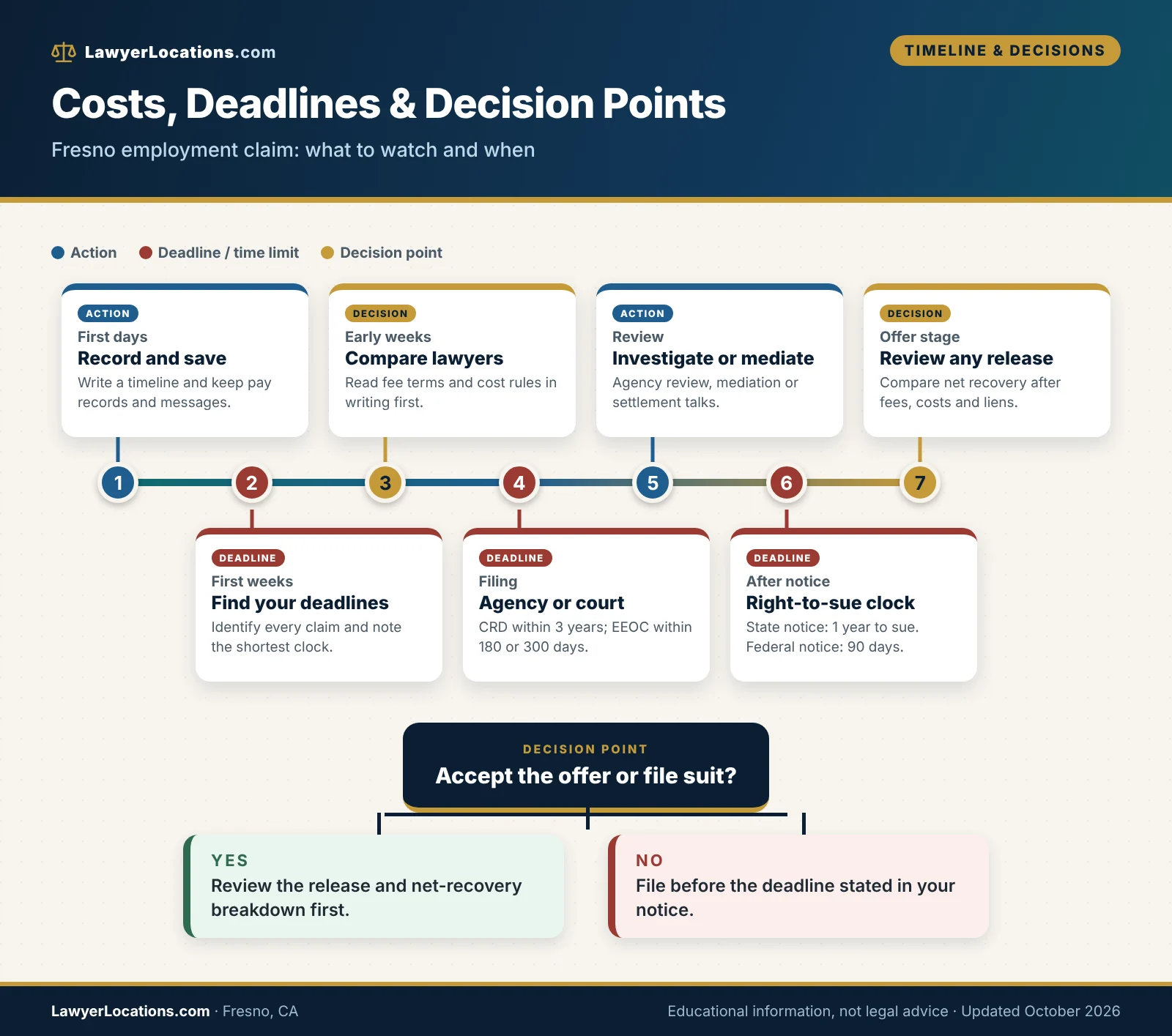
Text version of this graphic
- First days: write down what happened, keep your documents, and note dates (action).
- First weeks: identify each possible claim and its deadline; note the shortest one (deadline).
- Early weeks: compare two or three Fresno-area lawyers and read the fee terms in writing (decision).
- File: Civil Rights Department intake, EEOC charge, Labor Commissioner claim or court complaint (action).
- Investigation or mediation: agency review, ADR or negotiation (action).
- Notice stage: a right-to-sue notice starts a one-year clock (state) or a 90-day clock (federal) (deadline).
- Decision: settle, or file suit or arbitration before the deadline.
Decision question: accept a settlement offer or file? If you accept, review the release and the net-recovery breakdown first. If you file, do it before the deadline stated in your notice.
What happens in the first weeks
The first weeks are about preserving evidence, identifying the shortest deadline, and choosing a lawyer. Write your timeline while it is fresh, save every message in a place the employer does not control, and note any dates that trigger the clocks in Section 4: the day you were fired, the last discriminatory act, the day of the last unpaid check.
If you have not already been given a copy of your personnel file and payroll records, a written request is worth making. The Labor Commissioner’s page notes a one-year period for claims about access to payroll or personnel records, and Labor Code 226(c), as summarized in a statute database, requires employers to provide records within 21 calendar days of a request.
Settle or file: how to think about the decision
Most decisions come down to four questions: the strength of the evidence, the size of the likely recovery compared with the cost and time of continuing, your own tolerance for a drawn-out process, and any non-money outcomes you care about. Your lawyer should walk you through each and put offers in writing. The final choice belongs to you, not the lawyer, as long as you understand the consequences of each.
If a settlement requires you to sign a release, compare the net amount you would receive with what you could receive at the end of a lawsuit minus fees, costs and the chance of losing. Take time to think, and do not let a deadline set by the other side substitute for your own review.
Settlement talks, mediation and agency investigations do not necessarily stop your filing deadline. The Fresno court’s ADR page warns that statutes of limitation continue to run during ADR, and CRD’s statute allows tolling only in specified situations. Ask your lawyer to confirm in writing which date controls.
Free and Low-Cost Help in Fresno, and Preparing for Your Consultation
Not everyone can hire a lawyer on day one, and not every claim needs one. Government agencies, legal aid groups and court programs in and around Fresno offer different kinds of help. Whichever route you choose, a prepared first meeting makes it more productive.
| Resource | What the site says | Contact | Caveat |
|---|---|---|---|
| Labor Commissioner’s Office, Fresno | Accepts wage claims online, by email, mail or in person; investigates and holds conferences and hearings | 770 E. Shaw Ave., Suite 222; 559-244-5340; helpline 833-526-4636 | Wage and retaliation matters; discrimination usually goes to CRD |
| Central California Legal Services | Private, not-for-profit public interest law firm serving low-income people; online application and legal help line | 2115 Kern St., Suite 200; 559-570-1200; 800-675-8001 | Employment is not among the practice areas listed on the page reviewed; ask whether they can help or refer |
| California Rural Legal Assistance | Lists a Fresno location and an Employment help page on its site | 3747 E Shields Ave, Fresno 93726; 559-441-8721 | Eligibility and scope were not confirmed; call before visiting |
| Fresno County Bar Association Attorney Referral Service | State Bar-certified lawyer referral service listed for Fresno County | 559-264-0137 | Ask what the first meeting costs; a referral is not an endorsement |
| Fresno Superior Court Self-Help Service Center | Free general legal information; does not represent anyone | 1130 O Street, first floor; 559-457-2143 | Listed topics focus on family law, civil harassment and similar; ask what it can do for employment matters |
| Court ADR program with BBB Mediation Services | Free or low-cost mediation for self-represented or unable-to-afford litigants | ADR office, 1130 O Street | Applies to mediation, not to legal advice |
Where to look for free or low-cost help
Three categories of help exist: nonprofits that provide legal services to people who meet income tests, public agencies that take complaints from workers directly, and court or bar programs that offer information or referrals. Each has limits.
Legal aid and community organizations
Central California Legal Services describes itself as a private, not-for-profit public interest law firm serving low-income individuals, families and communities, and lists an online client application and a legal help line. The practice areas on its site include benefits, housing, immigration, seniors, small business and veterans; employment was not listed in the version reviewed, so ask directly whether the organization can help with a work problem or can refer you.
California Rural Legal Assistance lists a Fresno location and an employment page; its eligibility rules were not visible in the pages reviewed. The Labor Commissioner’s wage claim page also links to a statewide referral list of community advocate organizations in spreadsheet form, which is another place to look.
Agencies you can approach without a lawyer
You are allowed to file a wage claim with the Labor Commissioner, an intake form with CRD, or a charge with the EEOC without hiring a lawyer. The Labor Commissioner’s claim forms are available in English, Spanish, Chinese, Korean, Vietnamese, Tagalog and Punjabi, and its helpline can connect you to an interpreter. These routes can work well for straightforward wage claims with good records.
The trade-offs are control and complexity. For a claim involving a termination, a disability accommodation or a harassment pattern, even a single consultation with a lawyer before you file can help you choose the right route and avoid wording that hurts you later.
Court-connected and bar-connected help
The Fresno court’s Self-Help Service Center, in the first floor of the courthouse at 1130 O Street, says its staff provide general legal information but cannot give legal advice, do not represent you, and may assist the other party in your case. The topics its page highlights are family law, civil harassment, guardianship and similar matters, so call (559) 457-2143 to ask what it can do for an employment problem. The statewide California Courts Self-Help portal at selfhelp.courts.ca.gov is a second option.
The Fresno County Bar Association’s Attorney Referral Service is certified by the State Bar. Ask the service whether it charges a fee for the first meeting, and what it does to match you with a lawyer who handles your type of claim.
Preparing for your consultation
A good consultation is a two-way exchange: the lawyer evaluates your case, and you evaluate the lawyer. Preparation helps the lawyer give you a more reliable answer in the time available.
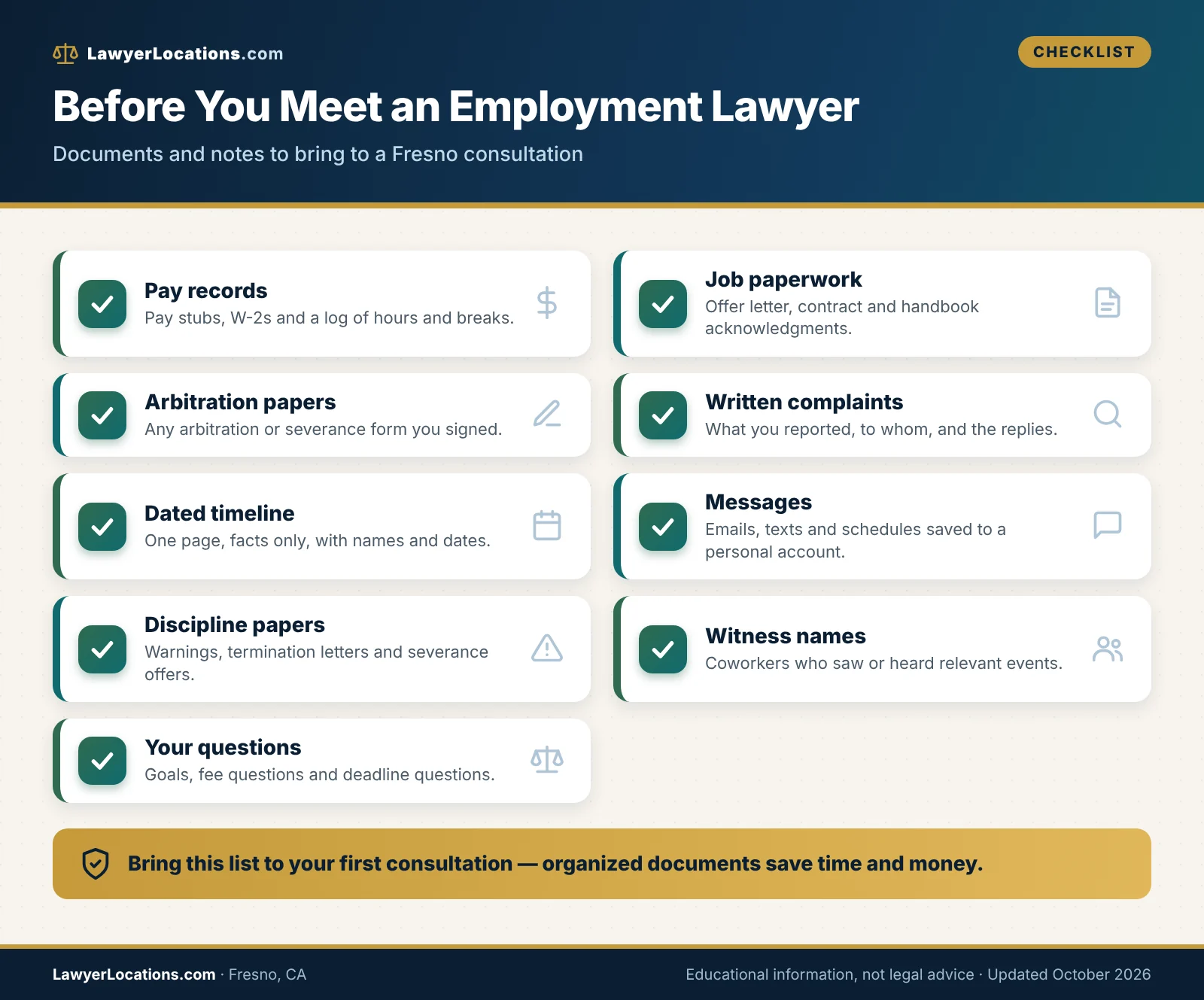
Text version of this graphic
- Pay stubs, W-2s and a record of hours and breaks.
- Offer letter, contract, handbook acknowledgments and any arbitration agreement.
- Written complaints you made and any replies.
- A one-page, dated timeline of events.
- Emails, texts and schedules that show what happened.
- Discipline, termination or severance papers.
- Medical or leave paperwork, if relevant.
- Names and contact details of witnesses.
- Your list of questions for the lawyer.
Documents to bring
- Pay stubs, W-2 forms and any record of hours, including meal and rest breaks.
- Your offer letter, employment contract, handbook acknowledgments and any arbitration agreement you signed.
- Written complaints you made to a supervisor or human resources, and any replies.
- Termination, discipline or severance paperwork, including emails announcing a change in your job.
- Text messages, emails, photos and schedules that show what happened, saved in a form you can print.
- Medical or leave paperwork if your claim involves disability, pregnancy or time off.
- Names and contact details of coworkers who saw or heard relevant events.
If you cannot find a document, bring what you have and tell the lawyer what is missing. The Labor Commissioner itself notes that you do not need every document to file a wage claim.
A one-page timeline and a short question list
Write a single page that lists dates, what happened, who was present and what you did in response. Keep it factual, avoid labels such as “discrimination” in the account itself, and mark what you know firsthand and what you only heard from others. The lawyer will use this timeline to find the deadlines in Section 4.
Add a short list of questions: your top three goals, the deadlines the lawyer sees, how the lawyer would be paid, who would work on the file, and what you should do and avoid in the meantime. Use the scorecard from Section 5.
What to avoid with documents and devices
Do not delete anything, and do not edit or backfill your notes after the fact. Save messages in a personal account, not a company email or phone that the employer controls. Be careful about copying company files you are not authorized to take, because that can create separate problems; instead, tell the lawyer what exists and where, and ask how to handle it.
If you are still employed, avoid posting about the dispute on social media, which can be used to challenge your account.
Language, immigration status and privacy questions
Fear and unfamiliarity keep many workers from asking for help. Some of the most common worries have direct answers from the agencies.
Interpreters and translated forms
The Labor Commissioner offers interpreters by phone at 833-526-4636, and its wage claim forms are available in seven languages. The EEOC page for the Fresno office lists TTY and ASL video phone numbers, 1-800-669-6820 and 844-234-5122. Ask any lawyer you meet whether they or their office can communicate in your preferred language, or whether an interpreter will be used and who pays for it.
If a lawyer relies on a family member to interpret, ask whether that is the best option; the person who interprets can hear sensitive information.
The Labor Commissioner’s helpline, 833-526-4636, can connect you to a telephone interpreter, and its claim forms are available in seven languages. You can start by phone before deciding whether to file.
Immigration status and workplace claims
The Labor Commissioner’s retaliation page says the office will not ask about immigration status or report it to other agencies, and that you do not need a Social Security number or photo ID to file a retaliation complaint. That statement is specific to that process. Rules and risks in other settings, such as a lawsuit, can differ, so raise the question privately with a lawyer before you decide what to file and where.
Immigration questions are a separate field of law. If yours is part of the picture, ask the employment lawyer whether a referral to an immigration lawyer makes sense, since this guide does not cover immigration rules.
Keeping your communications private
Use a personal phone number and personal email address for conversations with a lawyer, not a work device or account the employer can access. Do not forward your lawyer’s advice to coworkers. Sharing the content with others can affect the confidentiality of the communication, which is a good reason to ask the lawyer how to handle it.
If you are worried about safety, retaliation at work, or being watched, tell the lawyer at the start, and ask what steps to take.
Common Mistakes, Red Flags and Your Next Steps
Most claims are lost through avoidable mistakes, not through lack of merit: a missed date, a signature, a deleted message. This closing section lists the most common problems, gives you a short action plan, and answers the questions Fresno workers ask most often.
Mistakes that cost workers their claims
The errors below come up again and again in agency guidance and in the structure of the deadlines themselves. None of them requires a lawyer to avoid.
Waiting, or assuming someone else is watching the clock
The biggest mistake is waiting. Delay shrinks the wage period you can recover, runs down short federal deadlines and weakens evidence as memories fade and records are discarded. Do not assume that an internal investigation, a human resources promise or an unemployment claim protects your legal deadline; none of those is a filing with an agency or a court.
If an employer says “let us look into it,” write down the date and keep going with your own plan. An internal process that takes months can run out the clock on the shortest deadline.
Signing or sending the wrong thing
Workers sometimes sign a severance agreement on the day of the firing, sign an arbitration agreement without reading it, or send a long emotional email to human resources that mixes facts and accusations. A signed release can end claims you did not know you had, and a messy email can be used to contradict you later.
Send short, factual, dated messages. State what happened, what you are asking for, and request a written reply. Keep copies of what you send and receive.
Thin documentation and loose social media
Cases are won on documents. A worker with dated pay stubs, a written accommodation request and the employer’s reply is in a far stronger position than one with a recollection. Posts on social media can contradict your account or reveal something the employer later uses; avoid posting about the dispute.
Also avoid recording conversations or taking company files without first asking a lawyer. The rules about recordings and confidential information can be technical, and a mistake can create problems separate from your claim.
- Waiting for the employer to “fix it” after you complain.
- Signing a release or arbitration agreement before reading it or getting advice.
- Deleting messages, editing notes, or posting about the dispute online.
- Choosing a lawyer from an advertisement without checking the State Bar record.
- Signing a fee agreement you have not been allowed to take home and read.
Your next steps
You do not need to do everything at once. The sequence below is designed to protect your deadlines first, then your evidence, then your choice of lawyer.
A seven-day plan
- Day 1: Write down the dates. Record the day you were fired or last harmed, the last unpaid check, and any complaint you made, then note the shortest deadline from Section 4.
- Day 1–2: Save your records. Copy pay stubs, messages, schedules and policies to a personal account the employer cannot access.
- Day 2–3: Find what you signed. Ask for copies of your contract, handbook acknowledgments and any arbitration or severance papers.
- Day 3: Write a one-page timeline. Facts only, with dates and names.
- Day 3–5: Check your lawyer options. Look up two or three Fresno-area lawyers on the State Bar site, and call the Fresno County Bar Association referral service at 559-264-0137 if you need names.
- Day 5–7: Hold the consultations. Use the scorecard in Section 5 and ask for the fee agreement in writing.
- Day 7: Decide how to file. With or without a lawyer, choose the agency or court route and calendar every deadline.
Put every deadline in two places, such as a phone calendar and a paper note, with a reminder set well before the date. Then send the dates to your lawyer in writing and ask for confirmation. A missed date is far more costly than an extra reminder.
Choosing, then moving forward
Once you pick a lawyer, read the fee agreement in full, confirm the deadlines in writing, and ask what the lawyer needs from you in the next two weeks. If you chose to file on your own, submit the CRD intake form, the EEOC charge or the Labor Commissioner claim promptly and keep a copy of everything you submit.
If you later feel the lawyer is not the right fit, you can usually change lawyers, but do it deliberately and with a plan for the deadlines. A fee agreement should say what happens in that situation.
Ready to compare your options?
If you are looking for an employment lawyer fresno ca workers can compare on equal terms, start with the deadlines in Section 4, check each lawyer’s State Bar record, and put the same questions to each one. LawyerLocations.com does not promise outcomes or recommend individual lawyers, but this guide gives you the questions and the local facts to make the choice on your own terms. For related decisions, see our guides on sexual harassment claims and on what to ask in a free consultation, whose checklist of questions applies to any practice area.
Frequently asked questions
The answers below are short versions of points covered above. Each one is general information for California and Fresno, not advice about your facts.
Fees, lawyers and local help
How much does an employment lawyer cost in Fresno, CA?
It depends on the fee structure. Worker-side lawyers commonly use contingency fees, hourly rates, flat fees for limited tasks, or a hybrid. No verified Fresno fee survey was found, so this guide gives no averages. Compare the written fee agreements from two or three lawyers and ask what is taken first, the percentage or the costs.
Do employment lawyers in Fresno work on contingency?
Some do, particularly for claims with money damages such as wrongful termination, harassment and retaliation. Under California Business and Professions Code 6147, a contingency contract must be in writing, state the rate, explain how costs affect the recovery, and say the fee is negotiable.
How much does it cost to file an employment lawsuit in Fresno County Superior Court?
The statewide schedule effective January 1, 2026 lists $435 for a complaint in an unlimited civil case over $35,000, with a nonrefundable $150 advance jury fee. Fresno is not listed among the counties with local surcharges. Fees change, so confirm with the court.
What if I can’t afford the court filing fee?
You can ask the state court to waive fees using Form FW-001. You qualify if you receive public benefits such as Medi-Cal or CalFresh, if your household income is below the stated limit, or if you cannot meet basic needs and pay court fees. A waiver covers court fees, not a lawyer’s fee.
Should I hire a lawyer or file a Labor Commissioner claim myself?
You can file a wage claim yourself in person, online, by email or by mail. It often works for a plain unpaid-wage dispute with good records. A termination, harassment or accommodation claim usually involves several laws and deadlines, so consider at least one consultation first.
How do I check an employment lawyer’s license in California?
Use the State Bar of California’s attorney search, confirm that the license is active, and read any public discipline. Do this before the first meeting and again for any lawyer who takes over your file.
Is there a State Bar-certified lawyer referral service in Fresno?
Yes. The State Bar’s Central Valley listing shows the Attorney Referral and Information Service of the Fresno County Bar Association among certified services for Fresno County. Its phone number is 559-264-0137. Ask what the first meeting costs and how the service matches lawyers to claims.
Is there free legal help for workers in Fresno?
Some help exists, with limits. The Labor Commissioner’s Fresno office takes wage claims, Central California Legal Services serves low-income clients but did not list employment among its practice areas, and California Rural Legal Assistance lists a Fresno location. Call first to confirm eligibility and scope.
Claims, deadlines and agencies
How long do I have to file a discrimination or harassment complaint in California?
CRD says that in employment cases you must submit an intake form within three years of the date you were last harmed. The EEOC deadline is 180 days, or 300 days where a state agency also enforces a law on the same basis. The shorter federal period can end a federal claim while the state claim remains.
Do I have to file with the Civil Rights Department before suing for harassment?
In employment cases you must obtain a right-to-sue notice from CRD before filing your own lawsuit under FEHA. You can request the notice instead of going through a full investigation. A lawyer can tell you whether an immediate notice or an investigation fits your situation.
What is a right-to-sue notice, and how long do I have to sue after receiving one?
It is CRD’s written notice that you may bring a civil action. Under Government Code 12965, the notice states that you may sue within one year of its date. The EEOC’s federal notice carries a 90-day window instead. Calendar the date the day you receive either notice.
Where is the EEOC office in Fresno, and what counties does it cover?
The Fresno Local Office is in the Robert E. Coyle Federal Courthouse, 2500 Tulare Street, Suite 2601, phone 559-753-8480. It covers Fresno, Inyo, Kings, Madera, Mariposa, Merced, Mono, San Benito and Tulare counties. You can schedule an interview through the EEOC Public Portal.
How do I file a wage claim with the Labor Commissioner in Fresno?
File online, by email, by mail or in person at 770 E. Shaw Avenue, Suite 222, Fresno. Bring pay stubs, your employer’s name and address and any record of hours, but you do not need every document. The office then investigates, usually schedules a settlement conference, and sets a hearing if needed.
What is the minimum wage in California in 2026?
The Department of Industrial Relations lists $16.90 per hour for 2026 statewide, effective January 1, 2026, for employers not covered by a higher industry or local rate. Some cities and counties set higher rates, so ask the Labor Commissioner whether a local rate applies at your worksite.
When must my final paycheck be paid if I am fired or quit?
If you are fired, all wages are due immediately. If you quit with 72 hours’ notice, they are due on your last day; without notice, within 72 hours. A willful failure can add waiting-time penalties of up to 30 days of pay under Labor Code 203.
Is California an at-will state, and can I still sue for wrongful termination?
Yes, it is at-will under Labor Code 2922, but that does not allow a firing for an illegal reason. Discrimination, retaliation, protected leave and firing for refusing an illegal act can all support claims. Courts have recognized wrongful discharge in violation of public policy since Tameny (1980).
Does California harassment law apply to employers with fewer than five employees?
Yes. CRD states that harassment is covered in all workplaces, including those with fewer than five employees, even though FEHA discrimination and retaliation rules apply to employers with five or more.
Can I sue if I signed an arbitration agreement?
Sometimes, but not always. Armendariz sets minimum requirements for a mandatory arbitration agreement covering statutory claims, and a clause that falls short can be challenged. Other limits apply to out-of-state forum clauses and to harassment claims. A lawyer needs to read your actual agreement.
Can my employer force a sexual harassment claim into arbitration?
Under the federal Ending Forced Arbitration of Sexual Assault and Sexual Harassment Act, a predispute arbitration agreement is not enforceable for those disputes at the election of the person alleging the conduct. Related claims may be analyzed differently, so ask a lawyer which parts of your case it affects.
Where do employment lawsuits get filed in Fresno County?
State-law cases above $35,000 are unlimited civil cases heard at the B.F. Sisk Courthouse, 1130 O Street. Federal-law cases may be filed in the Eastern District of California, Fresno courthouse at 2500 Tulare Street. Many claims can go in either court.
Can I get unemployment benefits if I was fired?
Possibly. EDD says that if you are fired, your employer must prove misconduct, and that if you quit you need to show good reason. You must also be out of work through no fault of your own and have enough base-period wages. A claim for benefits does not prevent you from pursuing an employment claim.
Do farmworkers in Fresno County get overtime?
Yes, under a phase-in schedule. The Labor Commissioner says the 8-hour-day, 40-hour-week threshold applied from January 1, 2022 for employers with 26 or more employees and from January 1, 2025 for those with 25 or fewer, with double time after 12 hours in a workday on the same schedule.
What is CFRA leave and who is eligible?
CFRA provides up to 12 workweeks of job-protected leave in a 12-month period for specified family and medical reasons. It applies to employers with five or more employees, and the employee needs more than 12 months of service and at least 1,250 hours in the prior 12 months.
What is PAGA, and can I bring a claim?
The Private Attorneys General Act lets an aggrieved employee bring a claim for civil penalties on the State’s behalf for Labor Code violations. Since June 19, 2024 notices, an employee must have personally experienced each violation alleged, with limited exceptions. Ask a lawyer whether PAGA fits your goals.
Sources & References
Show all 63 sources
- Complaint Process — California Civil Rights Department — calcivilrights.ca.gov — accessed October 2026.
- Employment (discrimination, harassment, retaliation, coverage, EEOC worksharing) — California Civil Rights Department — calcivilrights.ca.gov — accessed October 2026.
- Government Code section 12965 — Public.Law (California codes) — california.public.law — accessed October 2026.
- Government Code section 12960 — FindLaw (reproduction of California code) — codes.findlaw.com — accessed October 2026.
- Government Code section 12940 — Public.Law — california.public.law — accessed October 2026.
- Government Code section 12926 — Public.Law — california.public.law — accessed October 2026.
- Government Code section 12945.2 (CFRA) — Public.Law — california.public.law — accessed October 2026.
- SB 477 (2025), Chapter 321, chaptered text — LegiScan — legiscan.com — accessed October 2026.
- AB 9 (2019), Chapter 709, chaptered text — LegiScan — legiscan.com — accessed October 2026.
- Labor Code section 1102.5 — Public.Law — california.public.law — accessed October 2026.
- Labor Code section 98.6 — Public.Law — california.public.law — accessed October 2026.
- Labor Code section 2802 — Public.Law — california.public.law — accessed October 2026.
- Labor Code section 203 — Public.Law — california.public.law — accessed October 2026.
- Labor Code section 1194 — Public.Law — california.public.law — accessed October 2026.
- Labor Code section 226 — Public.Law — california.public.law — accessed October 2026.
- Labor Code section 2922 — Public.Law — california.public.law — accessed October 2026.
- Labor Code section 925 — Public.Law — california.public.law — accessed October 2026.
- Labor Code section 432.6 — Public.Law — california.public.law — accessed October 2026.
- Code of Civil Procedure section 335.1 — Public.Law — california.public.law — accessed October 2026.
- Business and Professions Code section 6147 — Public.Law — california.public.law — accessed October 2026.
- Business and Professions Code section 6148 — Public.Law — california.public.law — accessed October 2026.
- Rule 1.5 (Fees for Legal Services), California Rules of Professional Conduct — State Bar of California — calbar.ca.gov — accessed October 2026.
- Labor Commissioner’s Office District Offices (Fresno) — California Department of Industrial Relations — dir.ca.gov — accessed October 2026.
- How to File a Wage Claim — Labor Commissioner’s Office — dir.ca.gov — accessed October 2026.
- How to File a Retaliation Complaint — Labor Commissioner’s Office — dir.ca.gov — accessed October 2026.
- Wage Claim Forms — Labor Commissioner’s Office — dir.ca.gov — accessed October 2026.
- Minimum Wage FAQ — Labor Commissioner’s Office — dir.ca.gov — accessed October 2026.
- Paydays, Pay Periods and Final Wages — Labor Commissioner’s Office — dir.ca.gov — accessed October 2026.
- Overtime FAQ — Labor Commissioner’s Office — dir.ca.gov — accessed October 2026.
- Overtime for Agricultural Workers FAQ — Labor Commissioner’s Office — dir.ca.gov — accessed October 2026.
- Meal Periods FAQ — Labor Commissioner’s Office — dir.ca.gov — accessed October 2026.
- Paid Sick Leave — Labor Commissioner’s Office — dir.ca.gov — accessed October 2026.
- Private Attorneys General Act (PAGA) — California Department of Industrial Relations — dir.ca.gov — accessed October 2026.
- PAGA FAQs — California Labor and Workforce Development Agency — labor.ca.gov — accessed October 2026.
- Unemployment Insurance Eligibility — Employment Development Department — edd.ca.gov — accessed October 2026.
- Time Limits for Filing a Charge — U.S. Equal Employment Opportunity Commission — eeoc.gov — accessed October 2026.
- Filing a Lawsuit — U.S. Equal Employment Opportunity Commission — eeoc.gov — accessed October 2026.
- Section 2 Threshold Issues — U.S. Equal Employment Opportunity Commission — eeoc.gov — accessed October 2026.
- Fresno Local Office: Location — U.S. Equal Employment Opportunity Commission — eeoc.gov — accessed October 2026.
- Fresno Local Office: Jurisdictional Area — U.S. Equal Employment Opportunity Commission — eeoc.gov — accessed October 2026.
- Superior Court of California, County of Fresno (home, locations, divisions) — Fresno Superior Court — fresno.courts.ca.gov — accessed October 2026.
- Civil: Unlimited — Fresno Superior Court — fresno.courts.ca.gov — accessed October 2026.
- Civil FAQs — Fresno Superior Court — fresno.courts.ca.gov — accessed October 2026.
- Alternative Dispute Resolution — Fresno Superior Court — fresno.courts.ca.gov — accessed October 2026.
- Remote Appearance Information — Fresno Superior Court — fresno.courts.ca.gov — accessed October 2026.
- Tentative Rulings — Fresno Superior Court — fresno.courts.ca.gov — accessed October 2026.
- Self-Help — Fresno Superior Court — fresno.courts.ca.gov — accessed October 2026.
- Fee Schedules — Fresno Superior Court — fresno.courts.ca.gov — accessed October 2026.
- Statewide Civil Fee Schedule, effective January 1, 2026 — Judicial Council of California — courts.ca.gov — accessed October 2026.
- Fee Waiver — California Courts Self-Help Center — selfhelp.courts.ca.gov — accessed October 2026.
- Court Directions (Fresno courthouse) — U.S. District Court, Eastern District of California — caed.uscourts.gov — accessed October 2026.
- Fee Schedule — U.S. District Court, Eastern District of California — caed.uscourts.gov — accessed October 2026.
- U.S. Eastern District of California (home) — U.S. District Court, Eastern District of California — caed.uscourts.gov — accessed October 2026.
- District Court Miscellaneous Fee Schedule — Administrative Office of the U.S. Courts — uscourts.gov — accessed October 2026.
- Find a Central Valley Area Lawyer Referral Service — State Bar of California — calbar.ca.gov — accessed October 2026.
- Attorney Search — State Bar of California — apps.calbar.ca.gov — accessed October 2026.
- Fresno County Bar Association — Fresno County Bar Association — fresnocountybar.org — accessed October 2026.
- Central California Legal Services — Central California Legal Services — centralcallegal.org — accessed October 2026.
- California Rural Legal Assistance (home and locations) — CRLA — crla.org — accessed October 2026.
- Tameny v. Atlantic Richfield Co. (1980) 27 Cal.3d 167 — Justia — law.justia.com — accessed October 2026.
- Armendariz v. Foundation Health Psychcare Services, Inc. (2000) 24 Cal.4th 83 — Stanford Supreme Court of California archive — scocal.stanford.edu — accessed October 2026.
- Ninth Circuit Holds That Federal Arbitration Act Preempts California’s AB 51 (summary of Chamber of Commerce v. Bonta, Feb. 15, 2023) — DLA Piper — dlapiper.com — accessed October 2026.
- Public Law 117-90, Ending Forced Arbitration of Sexual Assault and Sexual Harassment Act of 2021 — U.S. Government Publishing Office — govinfo.gov — accessed October 2026.
General information only. This article is for general education and is not legal advice. Reading it does not create an attorney-client relationship, and LawyerLocations.com is not a law firm and does not recommend or rate individual lawyers. Laws, fees, deadlines, agency procedures and local court practices change, and facts matter. Consult a lawyer licensed in California about your situation, and verify any deadline with the agency or court before relying on it.
Legal Disclaimer and Limitation of Liability
Informational and illustrative purposes only. This article was prepared by LawyerLocations.com solely on the basis of the information available to us at the time of writing. It is an illustrative, general overview. It is not a complete or authoritative statement of the law, and it has not been reviewed by a lawyer licensed in your state or county.
Not legal advice. Nothing in this article is legal, financial, tax or immigration advice, and reading it does not create an attorney-client relationship between you and LawyerLocations.com or any author, lawyer or firm mentioned. Laws, court rules, fees, filing deadlines and agency procedures differ by state, county and court, and they change often. Some details here may be simplified, incomplete or out of date, and time limits for legal claims can be short.
No warranty. We make no representation or warranty, express or implied, about the accuracy, completeness, timeliness or suitability of this content for your situation. Please do not rely on it to make, delay or skip any legal decision. Check the facts against official sources and speak with a licensed attorney in the relevant jurisdiction before you act.
Limitation of liability. To the fullest extent permitted by law, LawyerLocations.com and its owners, authors and contributors disclaim all liability for any loss, damage, cost or other consequence arising from the use of, or reliance on, this article, including any content on third-party websites we link to. Mentioning a lawyer, firm, organization or service is not an endorsement and is not a promise of any result. If you are in immediate danger, contact your local emergency number.