If you are searching for a DUI lawyer Miami FL, you are really dealing with two cases at once: a criminal charge under Florida Statutes § 316.193, usually heard in Miami-Dade County Court if it is a misdemeanor, and a separate driver-license suspension handled by the state with a 10-day window to ask for review. Those clocks start at the arrest, not at your first court date.
This guide explains the Miami-Dade courts and prosecutors, the penalties the statute sets, how the license process works, how to compare lawyers and fee structures, and what to do in the first week. It is general legal information, not legal advice, and it does not rank or recommend any lawyer.
Which Law, Courts and Prosecutors Handle a DUI Case in Miami
A DUI arrest in Miami is prosecuted under a statewide Florida statute, and most first-time cases are misdemeanors heard by a County Court judge in Miami-Dade County. Felony DUI cases, such as those involving serious injury, death or a long record of prior convictions, move to the circuit court. Knowing which track you are on explains almost everything that follows.
What Florida law means by “DUI”
Two ways the State can prove the charge
The offense is defined in Fla. Stat. § 316.193. A person commits DUI by driving or being in actual physical control of a vehicle in Florida and meeting one of three conditions: being under the influence of alcohol, a listed chemical substance or a controlled substance to the extent that normal faculties are impaired; having a blood-alcohol level of 0.08 or more per 100 milliliters of blood; or having a breath-alcohol level of 0.08 or more per 210 liters of breath.
That means prosecutors have two separate routes. The first is an impairment theory built on driving pattern, officer observations, field exercises and video. The second is a per se theory (Latin for “by itself”) built on a chemical test number. A lawyer will look at both, because weakness in one route does not automatically defeat the other.
“Actual physical control” is broader than driving
The statute reaches people who are in actual physical control of a vehicle, not only people who were seen moving. Whether someone asleep in a parked car with the keys nearby is covered depends on the facts, and that question is a common point of dispute. If the arrest report describes you as “in physical control” rather than driving, tell any lawyer you consult exactly where the car was, where the keys were and who else was present.
The statute also covers drugs, not only alcohol. A prescription medication can support an impairment charge if it affects normal faculties, which is why the question “what did you take and when?” matters in a consultation even when alcohol was never involved.
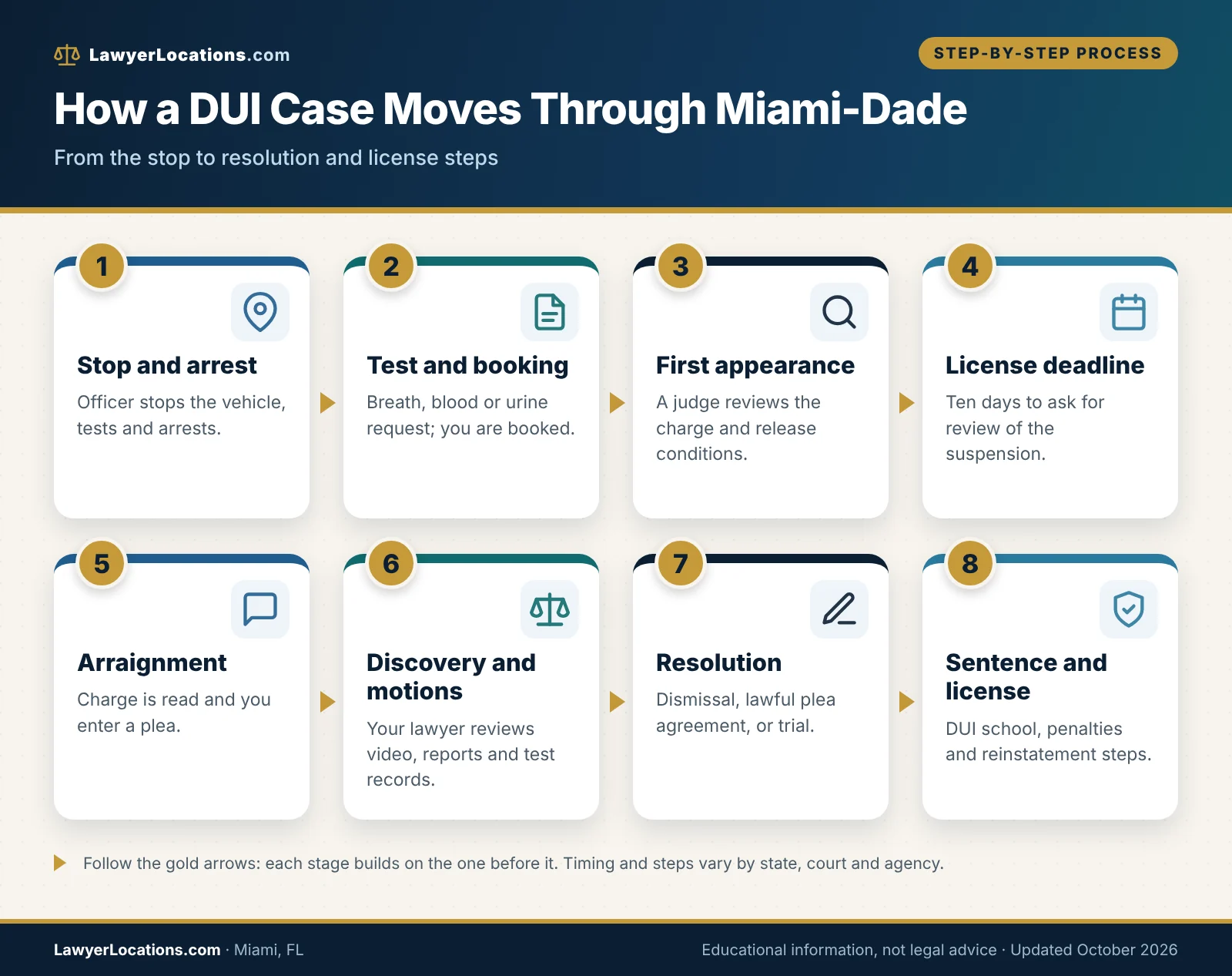
Text version of this graphic
- Stop and arrest. Officer stops the vehicle, runs field exercises and arrests.
- Test and booking. Breath, blood or urine request; you are booked and a notice of suspension may issue.
- First appearance. A judge reviews the charge and sets release conditions.
- License deadline. You have 10 days to ask for review of the administrative suspension.
- Arraignment. The State files its charge and you enter a plea.
- Discovery and motions. Your lawyer reviews video, reports and test records and may file motions.
- Resolution. Dismissal, plea agreement within statutory limits, or trial.
- Sentence and license. Court penalties, DUI school and license reinstatement steps.
The Miami-Dade courts and agencies behind a DUI case
County Court and the State Attorney’s County Court Division
The Eleventh Judicial Circuit’s County Criminal Division handles minor misdemeanors, criminal traffic matters and ordinance violations, and its court page lists DUI among criminal traffic offenses. Those matters are described as handled exclusively by judges. Prosecution belongs to the State Attorney’s Office, whose County Court Division lists criminal traffic misdemeanors such as Driving Under the Influence and Reckless Driving among its cases. The division’s page gives an address at River Landing, 1400 NW North River Drive, Suite 710, Miami, FL 33125, and a main number of (305) 324-2900. Confirm current details with the office before visiting.
The Gerstein Justice Building and the branch courthouses
The main criminal courthouse is the Richard E. Gerstein Justice Building. The Miami-Dade Clerk of the Courts lists it at 1351 NW 12th Street, Miami, FL 33125, with the felony court on the ninth floor and separate listings for misdemeanor and traffic court. The Clerk’s mobile page gives public hours of Monday through Friday, 9:30 a.m. to 3:00 p.m., and notes closures on holidays. The circuit court also lists five branch locations: the Harvey Ruvin Justice Center, the South Dade Justice Center, Miami Beach, Hialeah and Coral Gables.
Which location your case is set in can depend on where the arrest occurred and which agency made it. A stop by a city police department, the county’s police, or the Florida Highway Patrol can all lead to a case in Miami-Dade, so read the court notice rather than assuming the downtown courthouse.
The Public Defender and appointed counsel
If you cannot afford a lawyer, Florida law lets the Public Defender represent an indigent person charged with a misdemeanor the State Attorney can prosecute, including a chapter 316 violation punishable by imprisonment. The statute carves out cases where the court files an order of no imprisonment before trial. Indigence is decided under Fla. Stat. § 27.52. The Miami-Dade Public Defender’s Office lists its address as 1320 NW 14th Street, Miami, FL 33125, and its phone as 305.545.1600.
| Stage or role | Typical body | Practical note |
|---|---|---|
| Misdemeanor DUI | Miami-Dade County Court (County Criminal Division) | Handled by judges; location depends on the notice you received |
| Felony DUI | Circuit Criminal Division, Gerstein Justice Building | Serious bodily injury, DUI manslaughter or qualifying repeat offenses |
| Prosecutor | State Attorney’s Office, Eleventh Judicial Circuit | County Court Division prosecutes criminal traffic misdemeanors |
| Appointed defense | Public Defender, Eleventh Judicial Circuit | Requires a finding of indigence and no order of no imprisonment |
| License suspension review | Florida Department of Highway Safety and Motor Vehicles | Separate from the court case; 10-day request window |
| Records and filings | Miami-Dade Clerk of the Courts | Case numbers, dockets and court records |
Write down your case number, the courtroom or location on your notice, and every date the paperwork lists. case number + court + next date Missing a court date can create new problems on top of the DUI charge.
How a Miami DUI Case Moves From Arrest to Resolution
A typical Miami misdemeanor DUI goes from the traffic stop and test, to booking and release, to a first appearance, then an arraignment, a discovery period, possible motions, negotiation and either a plea or a trial. The order is predictable even though the timing is not, and the earliest steps often decide how strong the State’s evidence will be later.
The first hours: stop, tests, booking and release
The stop, field exercises and the request for a chemical test
Most DUI cases start with a traffic stop for something ordinary: weaving, speeding, a broken taillight, or leaving a crash scene. The officer observes you, may ask about drinking, and may request roadside exercises. Ask a lawyer before your case goes further how roadside exercises are treated in your situation. In the meantime, anything you say can be used, so politeness and brevity matter more than explanations.
After an arrest, Florida’s implied consent law applies. Under Fla. Stat. § 316.1932, a person who drives in Florida is deemed to have consented to an approved breath, urine or blood test after a lawful arrest. The officer must warn you that refusing a lawful test will suspend your driving privilege. A first refusal brings a one-year suspension, or 18 months if there was a prior refusal suspension, and the statute says a refusal is admissible in a criminal proceeding. You may arrange an independent test at your own expense, but the burden of arranging it falls on you.
Refusing the test does not make the case disappear. It adds a license penalty, and the refusal itself can be used as evidence. Ask a lawyer how a refusal changes the strategy in your particular case.
Booking, bond and the release rule
After the test you are booked: fingerprinted, photographed and processed. Florida has a specific release rule for DUI arrests. Under § 316.193(9), an arrested person cannot be released until they are no longer impaired, their blood or breath alcohol is below 0.05, or eight hours have passed since arrest. Practically, that means a DUI arrest often involves a stretch of holding time even for a first offense.
At a first appearance a judge reviews the charge and sets release conditions. Conditions can include staying away from alcohol, not driving, reporting to pretrial services or installing a monitoring device, depending on the facts. Ask your lawyer, or the Public Defender if you qualify, to attend this hearing, because the conditions set here can follow you for months.
From the charging decision to the arraignment
Arraignment and the not-guilty plea
The State Attorney decides what to file. The State files a formal charging document, and the case is set for arraignment, the hearing where the charge is read and you enter a plea. A not-guilty plea at arraignment is routine and does not mean you are fighting every point to the end; it preserves your options while your lawyer reviews the evidence.
If you hire a lawyer, they will typically tell the court they now represent you and ask the State for its evidence. Do not assume you can skip a hearing because you have a lawyer. Follow your written notice until your lawyer confirms in writing that your appearance is excused.
Discovery: what the evidence usually includes
In the discovery stage, the prosecution turns over the evidence it has gathered. In a Miami DUI that commonly means the arrest affidavit, the officer’s narrative, any body-worn camera or dash camera video, breath-test records and the results of any blood analysis. Your lawyer will compare what the officer wrote with what the video actually shows.
- Time of the stop, time of the arrest and time of the breath or blood test
- Reason for the stop and whether the officer’s description matches video
- Whether you were told the implied-consent warnings and when
- Records for the breath-testing instrument used and the person who operated it
- Any crash report, witness statements or 911 audio
Motions, negotiation and trial
Pretrial motions that commonly come up
A motion to suppress asks the judge to exclude evidence the defense argues was obtained unlawfully, such as results from a stop that lacked a legal basis. Other motions can challenge the admissibility of test results or ask for more records. Whether any motion makes sense depends on the facts, and a candid lawyer will tell you which are realistic and which are long shots.
Because motions can take time, they often interact with the license deadlines covered in the next section. A lawyer who is also advising you on the administrative suspension can sometimes use the license hearing to learn more about the State’s evidence earlier.
Plea limits and what trial involves
Florida restricts what can happen in a DUI plea. Under Fla. Stat. § 316.656, a court may not suspend, defer or withhold adjudication of guilt or imposition of sentence for a violation of § 316.193. A judge also may not accept a guilty plea to a lesser offense from a person charged with a breath or blood alcohol result of 0.15 or higher, or from a person charged under § 316.193(3), the crash injury and death provisions. These limits mean negotiations in Miami are narrower than many people expect, and a lawyer can tell you which limits apply to your specific facts.
If the case goes to trial, the State must prove the elements beyond a reasonable doubt. A trial is a significant commitment of time and cost, and it is a decision for you and your lawyer after reviewing the evidence, not a default. For a general look at the broader decision, see our guide on whether you need a lawyer for a DUI.
A DUI is not automatically a felony. A first-time, no-injury case is a misdemeanor under the statute. Felony exposure comes from serious bodily injury, a death, or qualifying repeat convictions, which is why the facts of the arrest matter so much.
Two Cases, Two Clocks: The Criminal Charge and Your Driver License
In Florida, a DUI arrest starts a criminal case in court and a separate administrative case about your license with the state. The license case has its own short deadline, so many people in Miami need to make a decision about it within days, before they have even been arraigned.
The administrative suspension and the 10-day window
What happens to your license at the time of arrest
Under Fla. Stat. § 322.2615, if you are arrested for DUI and have a breath or blood alcohol level of 0.08 or higher, or you refuse a urine, breath or blood test, the officer acts for the Department of Highway Safety and Motor Vehicles and suspends your driving privilege on the spot. The officer takes your license, issues a 10-day temporary permit if you are otherwise eligible, and serves a notice of suspension. If a blood test was given, the agency sends results to the department, and a suspension can follow once the department confirms a level of 0.08 or higher.
The length depends on the trigger. For a breath or blood result of 0.08 or higher, the statute sets six months for a first suspension and one year if you were previously suspended under the same section. For a refusal, it is one year for a first refusal and 18 months for a later one. The suspension starts on the date of the notice.
You have 10 days from the notice of suspension to request a formal or informal review by the department. The statute says a review request does not stay the suspension, so the clock on the suspension keeps running while you challenge it. Put the 10-day date on your calendar the day you are released.
Formal review versus informal review
The statute offers two ways to challenge the suspension. An informal review is decided by a department hearing officer on the written materials only; no officer or witness appears. A formal review is a hearing, which the department must schedule within 30 days of the request. The hearing officer can administer oaths, take testimony and issue subpoenas, and decides issues by a preponderance of the evidence.
For a blood or breath suspension, the issues include probable cause and whether the level was 0.08 or higher. For a refusal, they include probable cause, whether you actually refused, and whether you were warned of the penalty. Many people use the formal hearing for a second purpose too: it can put an officer’s testimony on the record early. If you are found not guilty of the underlying DUI charge, the statute requires the department to invalidate a blood-or-breath-based suspension.
License consequences after a conviction
Revocation periods under § 322.28
A conviction creates a separate court-ordered or statutory revocation of the license. Under Fla. Stat. § 322.28(2)(a), a first DUI conviction brings a revocation of at least 180 days but not more than one year. A second conviction within five years of a prior one brings a revocation of at least five years, and a third conviction within ten years brings at least ten years. A fourth conviction brings permanent revocation, as does a DUI manslaughter conviction. If the court does not set the period within 30 days of sentencing, the department applies the maximum for a first offense.
These periods are a floor set by statute, not a range you negotiate in the abstract. What your lawyer can do is explain which tier you fall into based on your prior record and how dates are counted.
Restricted driving for work and other limited licenses
Florida allows a limited license for business or employment purposes in many cases, governed by Fla. Stat. § 322.271. After a DUI conviction, the department requires proof that you completed the DUI program course and evaluation before granting a business-purposes privilege. For an administrative suspension that is sustained, the waiting period for an employment-only license is 30 days after the last temporary permit expires for a blood or breath suspension, and 90 days for a refusal suspension.
For repeat offenders with a long revocation, the statute sets longer waits. For a revocation of five years or less, a petition can be made 12 months after the revocation was imposed, and for a revocation of more than five years, 24 months, with supervision by a licensed DUI program. The hearing-based route is not available in every situation, so confirm your own tier.
DUI school, insurance and ignition interlock
Licensed DUI programs in Miami-Dade
The state licenses non-profit DUI programs that provide education to DUI offenders. The Department of Highway Safety and Motor Vehicles describes two levels: Level I for first-time offenders with at least 12 hours of classroom instruction, and Level II for multiple offenses with at least 21 hours. Its list shows several licensed programs with locations in Miami-Dade County, and you may attend only a program in your county of residence, county of employment or the county where you attend school.
If you reinstate after the revocation period, the department requires you to complete the course within 90 days, and failure cancels the license until you do. Ask your lawyer to sequence enrollment with the court’s requirements, because the court, the department and your probation officer may all want proof.
FR-44 insurance and the ignition interlock device
For a DUI conviction after October 1, 2007, the department says reinstatement requires an FR-44 form, an insurance certificate that must be maintained for three years. This usually means higher liability coverage and a higher premium, so call an insurance agent before you assume what your costs will be. An ignition interlock device is a breath-testing device wired to a vehicle’s ignition. Under § 316.193, a court may order one for at least six continuous months where the blood or breath level was 0.08 or higher, and the statute requires longer periods for enhanced and repeat cases.
In Miami-Dade specifically, the court system also runs the Drive Legal Program, which the Eleventh Judicial Circuit describes as unique to the county and aimed at helping people with driver-license restoration in cases of driving while license suspended and no valid driver license. The court’s FAQ does not say whether it covers DUI suspensions, so ask about it only after your DUI revocation issues are sorted out.
| Track | Trigger | What the statute provides |
|---|---|---|
| Administrative suspension, test result | Breath or blood level of 0.08 or higher at arrest | Six months for a first suspension; one year if previously suspended under § 322.2615 |
| Administrative suspension, refusal | Refusing a urine, breath or blood test | One year for a first refusal; 18 months if a prior refusal suspension exists |
| Review deadline | Notice of suspension served | 10 days to request formal or informal review; no automatic stay |
| Business-purposes license after sustained suspension | Eligible driver, suspension sustained | Wait of 30 days (test result) or 90 days (refusal) after the last temporary permit expires |
| Revocation on conviction, first offense | Conviction under § 316.193 | Revocation of at least 180 days and not more than one year |
| Revocation on conviction, repeat | Second within five years; third within ten years | At least five years; at least ten years; permanent after a fourth |
Ask any lawyer you consult one direct question: “Who is handling my 10-day license request, and have you already filed it?” license request = separate task A lawyer may be hired for the court case but not for the administrative deadline unless it is in writing.
Penalties and Enhancements Under Florida Law
For a first, no-injury DUI, Florida’s statute sets a fine range, a maximum jail term, probation and community service, but the exact outcome depends on the court, the facts and your record. Higher test results, a minor in the vehicle, a crash and prior convictions each raise the ceiling.
Baseline penalties for a first conviction
Fine, jail ceiling and probation
Under Fla. Stat. § 316.193(2), a first conviction carries a fine of $500 to $1,000, imprisonment of up to six months, and the statute provides for probation of up to one year. These are statutory ranges, not predictions. The statute gives the court room to combine probation, community service and other conditions, and a lawyer is the right person to talk about what is realistic with your judge and facts.
Probation under the statute is monthly reporting probation, and the offender must complete a DUI program course, which can include a psychosocial evaluation and a referral to treatment. Violating probation conditions can create new consequences, so keep proof of every requirement you complete.
Community service, impoundment and immobilization
A first conviction also requires at least 50 hours of community service, and the court orders vehicle impoundment or immobilization for 10 days. The statute says the impoundment period must not run at the same time as any jail term. Owners have 10 days after learning the vehicle’s location to file a complaint, and the statute describes limited circumstances where an owner may seek dismissal, such as a stolen vehicle.
If the car belongs to someone else, such as a spouse or a rental company, tell your lawyer right away, because the owner’s rights are addressed separately.
Enhancements: higher test results, minors, crashes and repeat offenses
A 0.15 reading or a minor in the vehicle
Section 316.193(4) raises the penalties if the breath or blood alcohol level was 0.15 or higher, or if a person under 18 was in the vehicle. For a first conviction, the fine range becomes $1,000 to $2,000, the jail ceiling rises to nine months, and the statute requires an ignition interlock device for at least six continuous months. For a second conviction, the fine range is $2,000 to $4,000, the jail ceiling is 12 months, and interlock is required for at least two continuous years.
This is also where the plea restriction in § 316.656 matters: a judge may not accept a guilty plea to a lesser offense from a person with a test result of 0.15 or higher. If your number is in that range, ask your lawyer how the rule shapes your options.
Crashes, injury and DUI manslaughter
If the DUI causes property damage or injury to another person, the statute makes it a first-degree misdemeanor. If it causes serious bodily injury, it becomes a third-degree felony. A DUI that results in a death is DUI manslaughter, a second-degree felony, which rises to a first-degree felony if the driver knew or should have known of the crash and failed to render aid, or has a qualifying prior. DUI manslaughter carries a mandatory minimum of four years of imprisonment.
These cases move to the circuit court, and anyone facing them needs a lawyer immediately. This guide cannot substitute for advice from a Florida criminal defense lawyer in these situations. See our overview of felony defense from arraignment through trial for how those cases differ.
Repeat convictions: second, third and fourth
For a second conviction, the statute sets a fine of $1,000 to $2,000 and a jail ceiling of nine months, with ignition interlock and longer impoundment periods and mandatory minimum confinement in specified situations. A third conviction within ten years of a prior is a third-degree felony. A third conviction more than ten years after a prior is a misdemeanor with a fine of $2,000 to $5,000 and up to 12 months in jail. A fourth or later conviction is a felony regardless of timing. How “within five years” and “within ten years” are counted is a technical question your lawyer should answer from your records.
| Situation | Fine | Jail ceiling or grade | Other statutory terms |
|---|---|---|---|
| First conviction | $500–$1,000 | Up to 6 months | Probation up to 1 year; at least 50 hours community service; 10-day impoundment |
| First, with 0.15+ or minor in vehicle | $1,000–$2,000 | Up to 9 months | Ignition interlock at least 6 continuous months |
| Second conviction | $1,000–$2,000 | Up to 9 months | Interlock and impoundment terms; minimum confinement in specified cases |
| Second, with 0.15+ or minor in vehicle | $2,000–$4,000 | Up to 12 months | Interlock at least 2 continuous years |
| Third within 10 years of a prior | Felony sentencing | Third-degree felony | Interlock at least 2 years; impoundment of 90 days |
| Third more than 10 years after a prior | $2,000–$5,000 | Up to 12 months | Interlock at least 2 years |
| Fourth or later | At least $2,000 | Third-degree felony | Applies regardless of when the priors occurred |
| Serious bodily injury | Felony sentencing | Third-degree felony | Charged under § 316.193(3) |
| DUI manslaughter | Felony sentencing | Second-degree felony (first-degree in listed cases) | Four-year mandatory minimum |
Consequences beyond the sentence
No withheld adjudication, and what that means for your record
Many criminal cases in Florida can end with a “withhold of adjudication,” where the court does not formally adjudicate guilt. Fla. Stat. § 316.656 says a court may not suspend, defer or withhold adjudication of guilt or imposition of sentence for a violation of § 316.193. In plain English, a DUI conviction is a formal conviction. Whether any record-relief option exists later depends on the facts, so talk with a lawyer; our guide to expungement lawyers and record clearing explains the general process.
That is one reason cost and strategy matter before any plea. A decision that looks small today, such as pleading at arraignment to get it over with, can carry long consequences for jobs, housing and insurance.
Work, driving, insurance and immigration questions
A conviction can affect insurance costs for years, through the FR-44 requirement above. People who drive for a living, hold professional licenses, work in regulated fields or are not U.S. citizens should ask any lawyer about collateral consequences before any plea. Ask directly: “What will this plea do to my job, my professional license and my immigration status?” An honest lawyer may tell you to consult a specialist in another field.
Be cautious if anyone tells you a Florida DUI can be made to “go away” without looking at your facts, or promises a specific outcome. No lawyer can guarantee a result, and Florida’s plea restrictions are written into the statute.
Finding and Comparing a DUI Lawyer in Miami
Start by deciding which route fits your situation: appointed counsel if you cannot afford a lawyer, or a private lawyer you choose and pay. Then compare candidates on the same written questions, because Miami has a large number of lawyers who handle DUI and the differences are in how they will handle your case, not in how their advertising sounds.
Where to look for a DUI lawyer in Miami
Appointed counsel if you cannot afford a lawyer
If you qualify as indigent and the court has not entered an order of no imprisonment, Florida law provides for the Public Defender to represent you on a chapter 316 misdemeanor punishable by imprisonment, which includes DUI. Ask at your first appearance or at the clerk’s office how to apply, and do it early, since the hearing dates move quickly. The Public Defender’s Office also appears at felony stages. The office lists 305.545.1600 as its phone number.
Appointed counsel does not mean you lose your license rights; the administrative review deadline described above still applies, so ask the lawyer you are assigned who will handle it.
The Florida Bar Lawyer Referral Service and member search
The Florida Bar runs a Lawyer Referral Service. Its FAQ says you can call 800-342-8011 on weekdays from 8:00 a.m. to 5:30 p.m. (Spanish is available), or search online at any time. Staff match callers with attorneys experienced in the relevant area of law, and each attorney on the panel must be a member in good standing with no pending probable cause complaints and carry $100,000 in professional liability insurance. The service does not give legal advice, does not decide whether a lawyer will take a case, and has no pro bono lawyers, though staff may refer you to a legal aid organization.
The Bar also offers a public member directory. Use it to confirm that a lawyer you are considering is a Florida Bar member and in good standing. A referral is a starting point, not an endorsement by LawyerLocations.com or the Bar of any particular outcome.
How to compare DUI lawyers fairly
Questions that separate a good fit from a sales pitch
Ask every lawyer the same questions and write the answers down. The goal is to compare how they would handle your case, not to pick the most reassuring voice. Useful questions include:
- Who will actually appear at my hearings: you or someone else in the office?
- How often do you handle DUI cases in Miami-Dade County Court, and which judges or divisions have you appeared before?
- Will you handle the 10-day license request, and is that included in your fee?
- What will you ask for from the State in discovery, and what are the first steps you would take?
- Which statutory limits, such as the plea restrictions in § 316.656, apply to my facts?
- What is your fee, what does it cover, and what costs are extra?
- How and how often will you update me, and who answers my questions?
Credentials, advertising and what not to rely on
Marketing around DUI is crowded. Treat slogans, award badges and “win rate” claims with caution, because they rarely tell you how a particular lawyer will handle your facts. Verify membership and standing in the Florida Bar’s directory yourself. Be cautious about any lawyer who guarantees a result, urges you to decide on the phone before seeing the paperwork, or cannot explain the license deadline.
It is fair to ask for a written fee agreement and a description of services. For more on questions to bring, see our guide on what to ask before hiring a criminal defense lawyer. Note that LawyerLocations.com does not rank lawyers or promise consultations of any kind; terms depend on the lawyer.
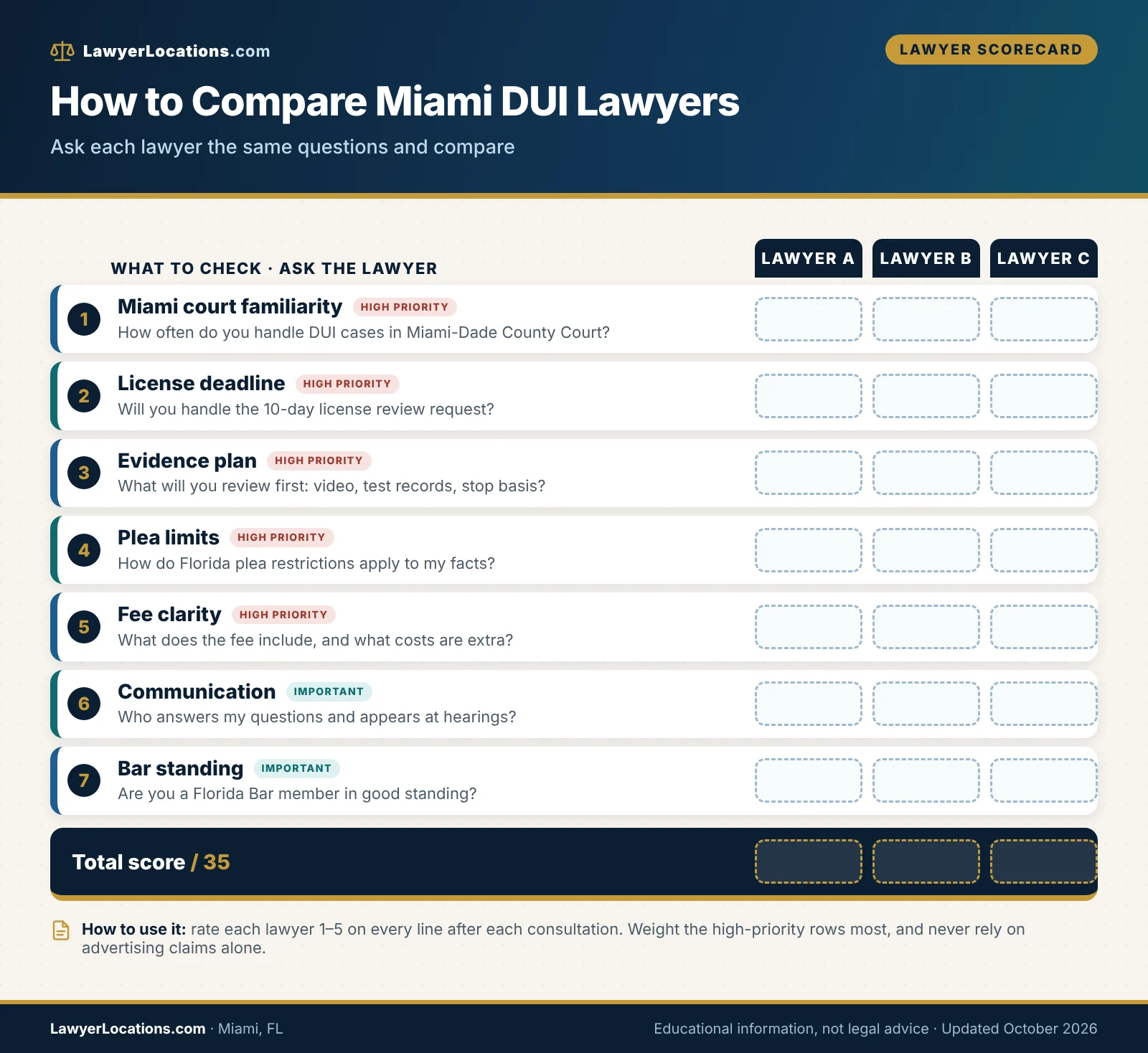
Text version of this graphic
| Criterion | Question to ask |
|---|---|
| Miami court familiarity | How often do you handle DUI cases in Miami-Dade County Court? |
| License deadline | Will you handle the 10-day license review request? |
| Evidence plan | What will you review first: video, test records, stop basis? |
| Plea limits | How do Florida plea restrictions apply to my facts? |
| Fee clarity | What does the fee include, and what costs are extra? |
| Communication | Who will answer my questions and appear at hearings? |
| Standing | Is the lawyer a Florida Bar member in good standing? |
Discovery is the stage when the State must share its evidence with the defense, such as reports, video and test records, so your lawyer can evaluate the case before any decision is made.
Preparing for a consultation
Documents and details to gather
A lawyer can say much more if you bring the actual paperwork. Gather everything you were handed at the stop, the jail or the court, and make copies. Keep the originals in a safe place and bring both.
- Notice of suspension and the 10-day temporary permit, with the date it was issued
- Citation, bond or release paperwork and any court notices with case numbers
- Breath-test or blood-test results you were given
- Names of passengers, witnesses, bars or restaurants, and receipts showing times
- Insurance information and the vehicle’s owner
- Your driving record, including any prior DUI-related suspensions
- A list of medications you take and when you last took them
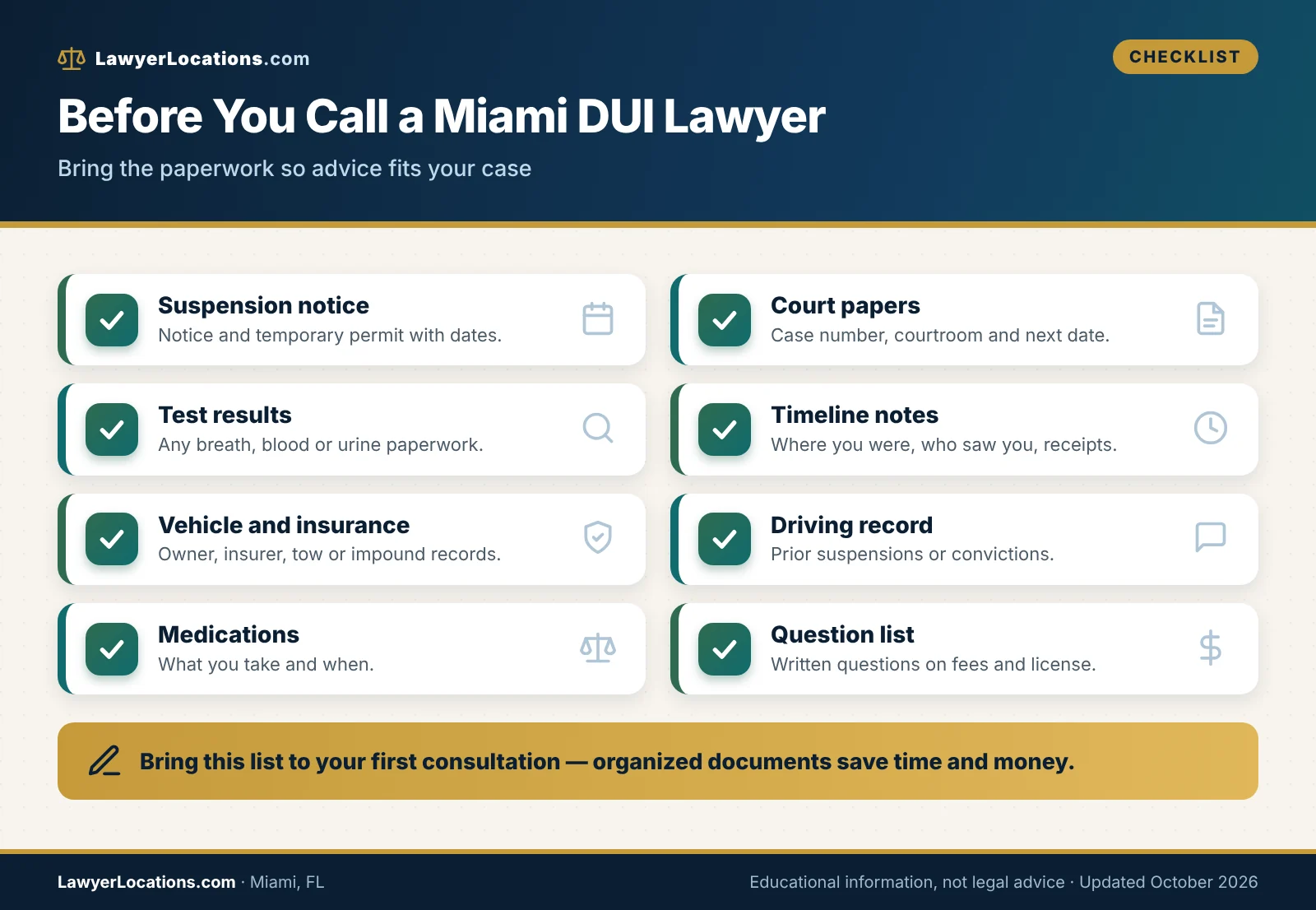
Text version of this graphic
- Suspension notice. Bring the notice and temporary permit with dates.
- Court papers. Case number, courtroom, next date.
- Test results. Any breath, blood or urine paperwork.
- Timeline notes. Where you were, who saw you, receipts.
- Vehicle and insurance. Owner, insurer, tow or impound records.
- Driving record. Prior suspensions or convictions.
- Medications. What you take and when.
- Questions list. Your written questions about fees and license.
What to tell your lawyer, and what to keep off social media
Tell your lawyer the full story, including facts you worry make you look bad. Conversations with a lawyer you are consulting for the purpose of hiring are generally treated as confidential, but check how your lawyer handles that before sharing details, especially in writing. Texts and emails to the Florida Bar’s referral staff may be public records under Florida’s broad public records laws, according to the service’s own FAQ, so keep those contacts short and factual.
Outside the lawyer’s office, say as little as possible. Do not discuss the arrest on social media, do not post about drinking, and do not contact witnesses in ways that could be misread as pressure. Avoid driving if your license is suspended, since a new driving charge makes the situation worse.
What DUI Representation Costs and How Fees Work
There is no single price for a DUI defense in Miami. Fees depend on the lawyer, the complexity of the case, and whether the matter ends at arraignment or goes to trial. This guide does not publish fee averages, because no official source tracks them; the useful approach is to understand fee structures and ask for a written quote.
Common fee structures
Flat fees and phased fees
Many criminal defense lawyers quote a flat fee for a defined scope, such as pretrial work through a plea, with a separate fee if the case goes to trial. Others split the fee into phases. The key is to know exactly what the number covers: the license hearing, the court appearances, motions, expert review and trial preparation can all be treated differently. Ask for a written list of what is and is not included.
Our broader guide, DUI lawyer cost, goes deeper on what drives fees nationally, and how much a criminal defense lawyer costs compares fees by charge and case stage.
Hourly billing and retainers
Some lawyers bill by the hour against a retainer deposited up front. That gives you a running record of time but a less predictable total. If you choose hourly billing, ask for an estimate range, how often you will receive itemized invoices, and who bills at what rate.
A fee that looks lower is not always the better deal. Compare scope, communication and the identity of the person who will do the work, not just the headline number.
Florida’s rules on lawyer fees
No contingent fees in criminal cases
Under Rule 4-1.5 of the Rules Regulating The Florida Bar, a lawyer may not arrange for, charge or collect a contingent fee for representing a defendant in a criminal case. A lawyer who proposes to charge you only if you win, or a percentage of something, on your DUI is not following the rule. That is a clear red flag.
The same rule prohibits an illegal, prohibited or clearly excessive fee or cost. A fee is clearly excessive when a lawyer of ordinary prudence would be left with a definite and firm conviction that it exceeds a reasonable fee to the point of overreaching.
Written terms for nonrefundable fees
The rule also says that the basis or rate of the fee should be communicated to the client, preferably in writing, and that a fee which is nonrefundable in any part must be confirmed in writing, with the parties’ intent about its nature and amount explained. Before you pay, ask: “Is any part of this fee nonrefundable, and where does the agreement say so?” If a dispute arises, the Florida Bar has consumer resources you can ask about.
Do not pay a large amount in cash without a signed written fee agreement and a receipt. If a lawyer will not put the scope and the refund terms in writing, consider that a sign to keep looking.
Two quotes arrive for the same case. One is lower but covers only the first court appearance; the other costs more but includes the license hearing, motions and negotiation. Compare the written scope line by line before deciding which one is actually cheaper.
Costs that are not the lawyer’s fee
Court-ordered and license-related costs
Even with a lawyer, a conviction can bring costs set by the statute and the court: the fine range, probation conditions, a DUI program course, vehicle impoundment or immobilization, ignition interlock if ordered, license reinstatement fees and FR-44 insurance. The Department of Highway Safety and Motor Vehicles says reinstatement involves an administrative fee, a revocation reinstatement fee, applicable license fees and required exams. Check the department’s current fee pages and the clerk’s office for current court costs rather than relying on an old figure.
Experts, records and other case costs
Some cases need outside help, such as a review of breath-test or blood-test records, an independent test, transcripts or investigation. Ask whether those costs are included in a flat fee or billed separately, and whether the lawyer will ask for your approval before spending money.
| Cost | Who sets it | What to ask |
|---|---|---|
| Lawyer’s fee | The lawyer, within Rule 4-1.5 | What is included, what is nonrefundable, and what happens if the case goes to trial? |
| Fine | Statute and the judge | Which statutory range applies to my facts? |
| DUI program course | Licensed DUI program | Which level applies and when must I enroll? |
| Impoundment or immobilization | Court order under § 316.193 | Who owns the vehicle and what are the owner’s rights? |
| Ignition interlock | Statute, court or department | Is it required for my tier, and for how long? |
| License reinstatement | Department of Highway Safety and Motor Vehicles | Which fees and exams apply to my revocation? |
| FR-44 insurance | Insurer, with department requirements | How long must I maintain it, and what will my premium be? |
| Experts or records | Provider or lawyer | Are these included, and do you need my approval? |
Deadlines, Mistakes, Common Questions and Next Steps
The two dates that matter most are the 10-day license window and your first court date. After that, the pace is set by the court, so organization is your best asset. This section maps the decision points, flags the common mistakes and answers the questions people ask most often.
A deadline and decision map
The first ten days
On the day of arrest, you receive a notice of suspension and a 10-day temporary permit. Within that window, decide whether to request a formal review, an informal review, or neither, and make sure someone is responsible for filing it. At the same time, find out whether a court date has already been set, collect your paperwork and decide how you will secure a lawyer. If the arrest involved a crash with an injured person, treat the situation as urgent and talk to a lawyer immediately.
If you were on a business-purposes-only track, mark the dates 30 days or 90 days after the temporary permit expires, depending on whether the suspension followed a test result or a refusal.
From arraignment to resolution
After arraignment, the major decision points arrive in a typical order: what the discovery shows, whether to file motions, whether a negotiated resolution is possible within the statutory limits, and whether to try the case. Each is a choice you make with your lawyer, with a full understanding of the license and cost consequences described above. Do not rush any of them for the sake of speed.
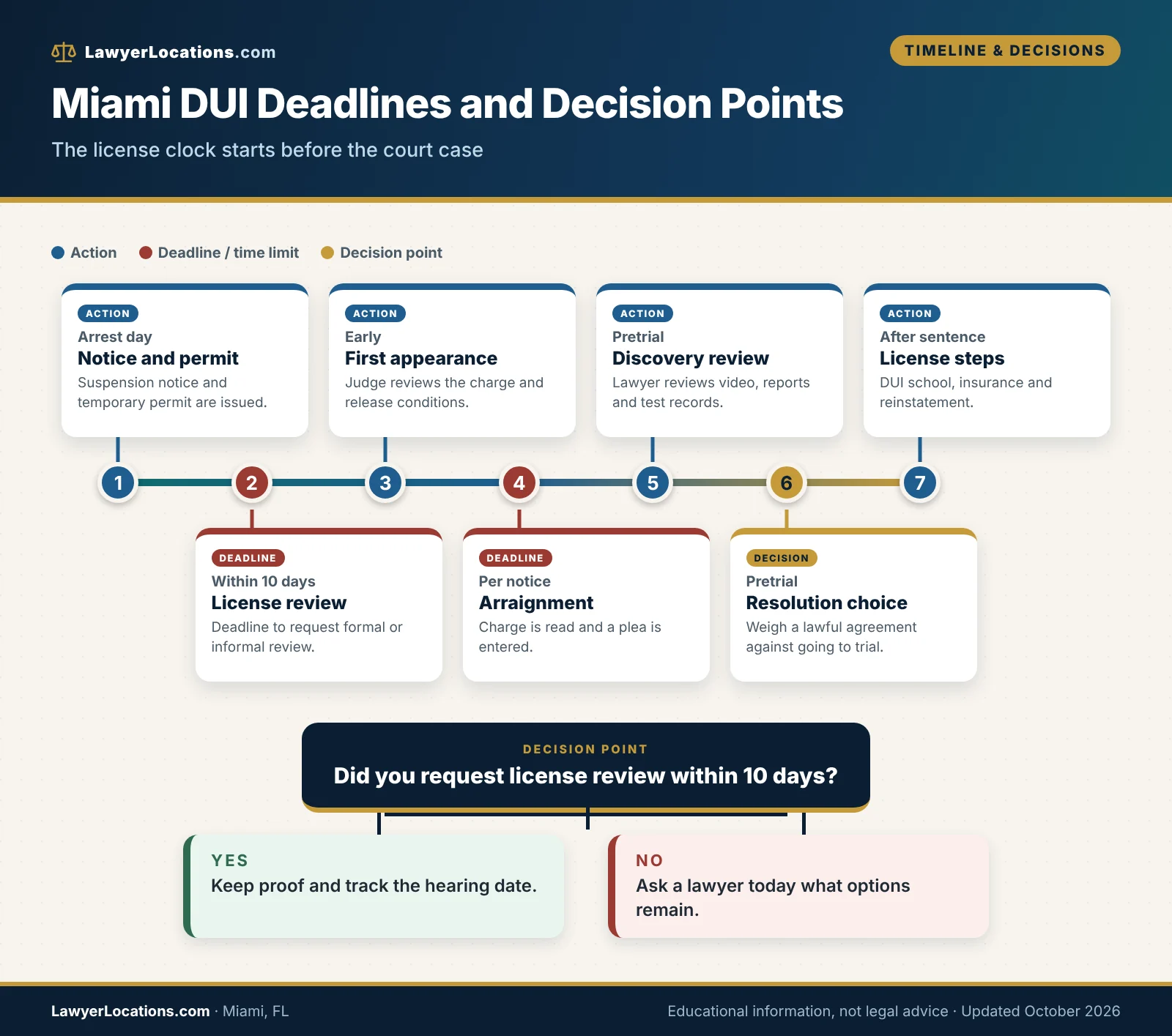
Text version of this graphic
- Arrest day. Notice of suspension and 10-day temporary permit issued.
- Days 1–10. Deadline to request formal or informal license review.
- First appearance. Judge reviews the charge and release conditions.
- Arraignment. Charge read; plea entered.
- Discovery and motions. Review evidence; decide whether to file motions.
- Decision point. Accept a lawful negotiated resolution or proceed to trial.
- After sentence. DUI program, license reinstatement and insurance steps.
Common mistakes and red flags
Mistakes that make cases harder
- Missing the 10-day license review window because you assumed the lawyer or the court would handle it
- Missing a court date or ignoring a notice because you were told a lawyer would handle it
- Posting about the arrest or about drinking on social media
- Driving on a suspended license after the temporary permit expires
- Pleading at arraignment without understanding the license and insurance consequences
- Paying a fee without a written agreement that explains scope and refunds
The common thread is acting before you have the facts. Slow down enough to read your paperwork, then move quickly on the deadlines that are real.
Red flags when hiring
- A promise of a specific result or a statement that your case is a sure win
- Pressure to pay immediately or decide on the first phone call
- A contingent fee proposed for a criminal case, which the Florida Bar rule does not permit
- No written fee agreement, or an unclear explanation of what is nonrefundable
- Inability to explain who will appear at your hearings or who is handling the license request
Quick answers to common Miami DUI questions
About the arrest, tests and license
Can I still drive after a DUI arrest in Miami?
The officer typically takes your license and issues a 10-day temporary permit if you are otherwise eligible. After that, driving may be unlawful unless your suspension was invalidated or you obtained a business-purposes license. Confirm your status with a lawyer or the Department before you drive.
Is refusing the breath test a good idea?
Refusal carries a one-year suspension for a first refusal and 18 months after a prior one, and a refusal is admissible in a criminal proceeding. Whether it helps or hurts depends on the facts, so ask a lawyer how a refusal would affect your case.
What is the legal limit in Florida?
The statute uses 0.08 breath or blood alcohol, but you can also be charged if your normal faculties are impaired at a lower number. The 0.15 level carries enhanced penalties.
How long does a Florida DUI license suspension last?
The administrative suspension is six months for a first test-result suspension and one year for a first refusal. A separate conviction revocation for a first DUI is at least 180 days and not more than one year, and longer for repeat convictions.
About lawyers, cost and the case
Do I need a DUI lawyer for a first offense?
A first offense is a misdemeanor, but the consequences include a possible jail term, a license revocation, DUI school and long-term insurance costs. Many people consult a lawyer to understand the options, and our guide on whether you need a lawyer for a DUI covers that decision.
Can the Public Defender represent me on a DUI?
Florida law provides for the Public Defender to represent an indigent person charged with a chapter 316 misdemeanor punishable by imprisonment, unless the court enters an order of no imprisonment before trial. Indigence is determined under § 27.52.
Can my DUI be reduced to a lesser charge?
Possibly, but Florida limits it. A judge may not accept a guilty plea to a lesser offense where the test result was 0.15 or higher, or in the crash injury and death cases under § 316.193(3). A lawyer can explain whether a lesser plea is available in your situation.
Can a lawyer charge a percentage of a DUI result?
No. Rule 4-1.5 bars contingent fees for representing a defendant in a criminal case.
Can a DUI be withheld so I have no conviction?
Not through a withhold of adjudication. Section 316.656 says a court may not suspend, defer or withhold adjudication of guilt or imposition of sentence for a DUI.
Your next steps
In the first week
- Read the paperwork. Note the date on the notice of suspension and count the 10 days.
- Decide who handles the license request. Make it someone’s written responsibility.
- Find out your court date and location. Check your notice and, if needed, the Clerk of the Courts.
- Choose your route to counsel. Apply for the Public Defender if you qualify, or compare private lawyers with the same questions.
- Gather your documents. Use the checklist in this guide and bring copies.
- Stay off the road and off social media. Follow every release condition.
Using this guide as a starting point
If you are comparing a DUI lawyer in Miami, FL, treat this guide as a map of the questions to ask, the deadlines to protect, and the statutes that frame the case. It does not replace a lawyer licensed in Florida who has reviewed your paperwork, and it does not predict any outcome.
Ready to compare your options?
Write down your 10-day date, your court date and the questions from this guide, then speak with at least two Florida-licensed lawyers or ask the court about appointed counsel. For more on fees, see our DUI lawyer cost guide. Reading this page does not create an attorney-client relationship.
General information only. This guide is legal information, not legal advice, and reading it does not create an attorney-client relationship. LawyerLocations.com is a legal-education and lawyer-discovery resource, not a law firm, and it does not rank, endorse or guarantee any lawyer. Laws, penalties, court procedures, local programs and fees change, and this article reflects sources reviewed in October 2026. Your situation may differ. Consult a lawyer licensed in Florida about your specific charge, and if you cannot afford one, ask the court about appointed counsel.
Sources & References
Show all 16 sources
- Florida Statutes § 316.193, Driving under the influence; penalties — Florida Legislature — leg.state.fl.us — accessed October 2026
- Florida Statutes § 316.1932, Tests for alcohol, chemical substances, or controlled substances; implied consent — Florida Legislature — leg.state.fl.us — accessed October 2026
- Florida Statutes § 316.656, Mandatory adjudication; prohibition against accepting plea to lesser included offense — Florida Legislature — leg.state.fl.us — accessed October 2026
- Florida Statutes § 322.2615, Suspension of license; right to review — Florida Legislature — leg.state.fl.us — accessed October 2026
- Florida Statutes § 322.28, Period of suspension or revocation — Florida Legislature — leg.state.fl.us — accessed October 2026
- Florida Statutes § 322.271, Authority to modify revocation, cancellation, or suspension order — Florida Legislature — leg.state.fl.us — accessed October 2026
- Florida Statutes § 27.51, Duties of public defender — Florida Legislature — leg.state.fl.us — accessed October 2026
- Rule 4-1.5, Fees and Costs for Legal Services, Rules Regulating The Florida Bar (text mirror) — Ruledex — ruledex.com — accessed October 2026
- Criminal Division overview — Eleventh Judicial Circuit of Florida — jud11.flcourts.org — accessed October 2026
- Frequently Asked Questions for the Drive Legal Program — Eleventh Judicial Circuit of Florida — jud11.flcourts.org — accessed October 2026
- Richard E. Gerstein Justice Building (criminal courthouse) — Miami-Dade Clerk of the Courts — miamidadeclerk.gov — accessed October 2026
- County Court Division — Miami-Dade State Attorney’s Office — miamisao.com — accessed October 2026
- About Us — Miami-Dade Public Defender, Eleventh Judicial Circuit — pdmiami.com — accessed October 2026
- Lawyer Referral Service FAQ — The Florida Bar — floridabar.org — accessed October 2026
- Licensed DUI Programs in Florida — Florida Department of Highway Safety and Motor Vehicles — flhsmv.gov — accessed October 2026
- DUI Frequently Asked Questions — Florida Department of Highway Safety and Motor Vehicles — flhsmv.gov — accessed October 2026
Legal Disclaimer and Limitation of Liability
Informational and illustrative purposes only. This article was prepared by LawyerLocations.com solely on the basis of the information available to us at the time of writing. It is an illustrative, general overview. It is not a complete or authoritative statement of the law, and it has not been reviewed by a lawyer licensed in your state or county.
Not legal advice. Nothing in this article is legal, financial, tax or immigration advice, and reading it does not create an attorney-client relationship between you and LawyerLocations.com or any author, lawyer or firm mentioned. Laws, court rules, fees, filing deadlines and agency procedures differ by state, county and court, and they change often. Some details here may be simplified, incomplete or out of date, and time limits for legal claims can be short.
No warranty. We make no representation or warranty, express or implied, about the accuracy, completeness, timeliness or suitability of this content for your situation. Please do not rely on it to make, delay or skip any legal decision. Check the facts against official sources and speak with a licensed attorney in the relevant jurisdiction before you act.
Limitation of liability. To the fullest extent permitted by law, LawyerLocations.com and its owners, authors and contributors disclaim all liability for any loss, damage, cost or other consequence arising from the use of, or reliance on, this article, including any content on third-party websites we link to. Mentioning a lawyer, firm, organization or service is not an endorsement and is not a promise of any result. If you are in immediate danger, contact your local emergency number.