
People who search for a closing attorney Los Angeles County CA are often surprised to learn that Southern California home sales are normally closed by escrow officers at escrow or title companies, not by closing attorneys as in many East Coast states. California does not require a lawyer for an ordinary residential sale. A real estate attorney still earns a place on the team when the deal is unusual: contract problems, title defects, trust or probate sales, LLC or commercial property, 1031 exchanges, unpermitted work or a dispute.
This guide explains who really closes a deal in Los Angeles County, when to add a lawyer, which California and county rules matter, and how to compare your options. It is general information as of October 2026, not advice about your transaction.
Closing Attorney in Los Angeles County, CA: Who Actually Closes a Home Sale?
An escrow officer closes most Los Angeles County home sales. The officer works for a neutral escrow company or the escrow department of a title insurer, follows written instructions signed by both sides, and releases money and the deed only when every condition is met. A lawyer is optional.
How a California escrow closing works
In California, a sale does not close around a conference table with attorneys for each side. Instead, the buyer and seller sign a purchase contract, then both open escrow with a neutral third party. In the plain-English sense, escrow is an arrangement in which a neutral party holds money and documents until the conditions of the deal are met, then delivers them to the right people at the right time.
The paperwork for a typical Los Angeles County sale travels through a small number of hands. Understanding that chain is the quickest way to figure out whether a closing attorney would add anything to your deal.
Escrow instructions and the neutral holder
The escrow officer turns the purchase contract into escrow instructions, a written set of directions both parties sign. They say what must happen before closing: deposit and loan funds arrive, payoffs are satisfied, documents are signed and the title company is ready to insure. The officer is a stakeholder, not an advocate, so no one at the escrow company is looking out for just you.
That neutrality matters. An escrow officer can explain the steps and ask whether you have signed what the contract calls for, but cannot tell you whether a clause is a good idea or how to renegotiate it. Giving that kind of advice would cross into the practice of law, which in California is reserved for licensed attorneys under Bus. & Prof. Code § 6125.
The title company and the preliminary report
Escrow and title are related but separate jobs. A preliminary report (often called a “prelim”) is the title company’s early snapshot of who owns the property and what claims are recorded against it, such as mortgages, liens, easements and restrictions. The buyer’s lender normally requires title insurance, and buyers usually also purchase an owner’s policy.
Read the prelim before your contingency periods run out. Items listed there are the issues that sometimes need a lawyer: an unexpected lien, an easement that blocks a planned addition, or a name on the deed that does not match the person selling.
Signing, funding and recording
Near the end, each side signs at the escrow office or with a mobile notary. The lender funds the loan, the officer collects payoffs, and the deed is sent to the county recorder. Escrow typically does not close until the deed is recorded, which is why you may hear that a sale “records” on a particular day. In Los Angeles County that office is the Registrar-Recorder/County Clerk, discussed below.
The escrow officer handles tasks that a closing attorney would handle elsewhere. The practical question is not “who is my closing attorney” but “which parts of my deal are risky enough that I want advice before I sign?”
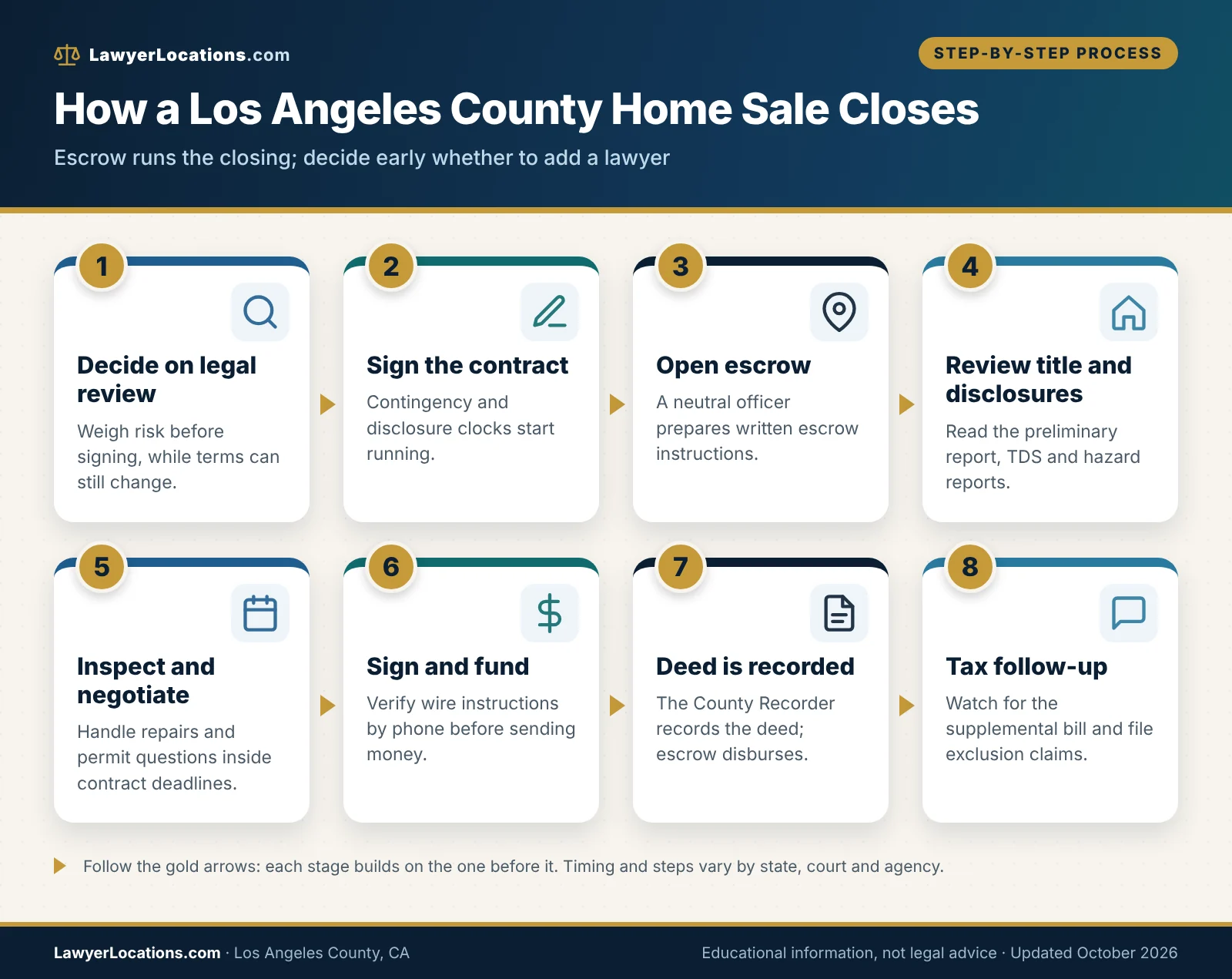
Text version of this graphic
- Decide whether you want legal review before you sign anything.
- Sign the purchase contract; contingency clocks start.
- Open escrow; the escrow officer prepares instructions.
- Order and review the preliminary title report and disclosures.
- Complete inspections and negotiate repairs within the contract periods.
- Sign loan, deed and closing documents; the lender funds.
- The deed is recorded with the county and escrow disburses money.
- Apply for property tax exclusions or file required follow-up forms.
Escrow officer, title officer, real estate agent and attorney: who does what
Four professionals show up most often, and confusing their roles is the most common source of unrealistic expectations.
The typical split in an ordinary sale
The table below sets out who usually handles what in an ordinary Los Angeles County home sale. Treat it as a map, not a rulebook: your contract and escrow instructions control in your deal.
| Role | Typically does | Typically does not do |
|---|---|---|
| Escrow officer | Prepares instructions, collects deposits and payoffs, coordinates signing, disburses funds after recording | Give legal advice, negotiate for either side, decide a dispute |
| Title officer | Researches ownership and recorded claims, issues the preliminary report and the title policy | Guarantee that nothing outside the public record exists, advise on contract terms |
| Real estate agent or broker | Markets or searches, prepares offers on standard forms, advises on market value, coordinates disclosures | Give legal advice or act as a lawyer (licensed by the DRE, not the State Bar) |
| Real estate attorney | Reviews and drafts contracts, advises on title and legal risk, represents a party in disputes, handles trust, probate and entity issues | Replace the escrow officer’s role as neutral stakeholder in a typical sale |
Where the roles overlap
Agents often prepare the contract, escrow officers explain closing mechanics, and each side tends to assume someone else is checking the legal fine print. That is the gap a lawyer fills. If no one on your team is licensed to give legal advice, no one is advising you on legal risk.
In short, a “closing attorney” in California is usually a real estate lawyer hired for advice, with escrow doing the closing. A lawyer and an escrow officer are not competitors. In most California deals that involve both, the lawyer advises one party and the escrow officer stays neutral and runs the closing mechanics. Think of the lawyer as your advocate and the escrow officer as everyone’s stakeholder.
Which agency regulates which professional
Because the roles are split, so is oversight. If something goes wrong, the right complaint goes to a different place depending on who made the mistake.
Department of Real Estate versus State Bar
The California Department of Real Estate (DRE) licenses and disciplines real estate brokers and salespersons; older materials may call it the “Bureau of Real Estate.” The State Bar of California licenses and disciplines attorneys. A broker’s license does not make someone a lawyer, nor the reverse.
If an agent mishandles a disclosure, that is a DRE issue. If a lawyer mishandles your funds or case, that is a State Bar issue. Neither agency can order your sale to close or resolve a contract dispute; that is a job for negotiation, mediation, arbitration or the courts.
Escrow companies, title insurers and notaries
Independent escrow companies in California are licensed and examined by the Department of Financial Protection and Innovation (DFPI) under the Escrow Law, which begins at Financial Code section 17000. The law exempts certain others from that license (Fin. Code § 17006), including insurance companies, firms that search title for insurers, California-licensed attorneys with a bona fide client relationship (subject to limits), and licensed brokers acting within their real estate transactions. Those exemptions are personal to the people listed and cannot simply be delegated. Notaries are commissioned by the Secretary of State. Before you pick an escrow company, ask who regulates it and how to check its status.
When a Real Estate Attorney Is Still Worth Hiring in Los Angeles County
Hire a real estate attorney when the problem is legal rather than logistical. If your deal is a standard purchase of a single-family home or condo with a clean title, an agent and an escrow officer may be enough. If the deal involves a trust, an entity, a title or permit problem, or a dispute, the cost of advice is usually small next to the risk.
Before you sign the purchase contract
The cheapest moment to get legal advice is before you sign, because deadlines and contingencies have not started running. California residential deals typically use standardized forms prepared by trade associations and brokerages, filled in by agents, and amended through counteroffers and addenda.
Contract review and counteroffers
A standard form is only as protective as its blanks. Deposit amounts, contingency periods, repair obligations, possession dates and liquidated damages sit in fill-in fields or checkboxes. An attorney can explain what each choice does and draft a clean addendum when a deal does not fit the form. Under California’s Statute of Frauds, a contract to sell real property generally must be in writing (Civ. Code § 1624), and the statute says texts and instant messages cannot by themselves establish one.
Ask for review before countering. Every counteroffer is a new offer, and a careless one can cancel the previous terms you meant to keep.
Contingencies, deposits and canceling
A contingency is a condition in the contract that lets one side back out or renegotiate, such as a financing, appraisal or inspection contingency. Buyers who remove contingencies early to win a competitive offer take on real risk of losing their deposit if the deal fails. A lawyer can explain which protections you are giving up, what happens to the deposit if you cancel, and how notices must be delivered so the cancellation is valid.
Situations where legal advice is most useful
Some transactions are not routine, and the usual agent-plus-escrow team is not designed to solve their legal problems. The situations below are the ones where Los Angeles County owners most often benefit from a real estate or estate-planning lawyer.
Trust, probate and inherited property
A successor trustee typically proves authority to the title company with a certification of trust (Probate Code § 18100.5), which lets the trustee prove the trust’s existence and powers without handing over the whole document, plus a death certificate where applicable. If an asset was never formally transferred into the trust, a court petition may be needed. Estates administered through the court can require court confirmation of a sale, with its own notice and overbid process. The Los Angeles County Superior Court handles those probate matters. If a home sale is tied to an estate or trust, speak with a lawyer before listing; see our guide to living trust lawyers for how to compare them.
Divorce, LLCs, investment property and 1031 exchanges
When spouses or co-owners disagree about selling, or a divorce judgment orders a sale, family-court rules can control who may sign and who receives the proceeds; see our overview of family law attorneys in California. Entities and investment property raise different issues.
If the seller or buyer is an entity, the title company will want to confirm who can sign for it. Multi-unit and commercial purchases add leases, tenant estoppel letters, environmental questions and zoning issues that are outside the standard residential forms. A 1031 exchange lets an investor defer federal capital gains tax by rolling proceeds from investment real property into like-kind replacement property through a qualified intermediary. Under the IRS Form 8824 instructions, replacement property must be identified within 45 days and received within 180 days (or the tax return due date, if earlier). California taxpayers who exchange into out-of-state property have additional state reporting. Bring in both a real estate lawyer and a tax professional before listing.
A 1031 exchange cannot be fixed after the fact. If sale proceeds touch your own bank account before the exchange is set up, the exchange may fail. Talk to a qualified intermediary and a professional adviser before you accept an offer on the property you plan to exchange out of.
Disputes and court filings in Los Angeles County
Not every problem ends at the closing table. If a buyer backs out, a seller hid a defect or a neighbor claims an easement, the next step may be demand letters, mediation or a lawsuit. The venue for most of those matters is the Superior Court of California, County of Los Angeles.
Where real estate lawsuits are filed
California has one trial court per county, the Superior Court. The Superior Court of Los Angeles County hears civil, probate, family and small-claims matters at courthouses across the county, and its official site is lacourt.ca.gov. Cases that ask a court to decide who owns land, to compel a sale or to cancel a deed are usually filed where the property is located. A case generally counts as “limited civil” only if the amount in controversy is $35,000 or less (Code Civ. Proc. § 85), so larger claims are unlimited civil cases. Small claims has a much lower cap and is a poor fit for title disputes.
A party to a lawsuit who asserts a “real property claim” may record a lis pendens, a notice that litigation affects the property, under Code Civ. Proc. § 405.20. That notice can freeze a sale, which is why early legal advice matters if you are on either end of one.
Time limits that can affect real estate claims
California sets different filing deadlines for different claims, and the clock may start earlier than most people expect. The common periods include four years for a written contract (Code Civ. Proc. § 337), two years for an oral contract (§ 339) and three years for fraud, running from discovery (§ 338). Claims about construction defects, nondisclosure, a lender or a title policy can follow other rules.
| Situation | Usually enough | Consider adding a lawyer when |
|---|---|---|
| Standard purchase of a house or condo | Agent, escrow officer, title company | Contract language is unclear, or a prelim shows a surprise |
| Sale from a living trust | Trustee, escrow officer, title company | Authority is disputed, or the trust is incomplete or old |
| Estate or probate sale | Probate attorney already involved | Court confirmation, heirs or creditors are in play |
| Investment property or LLC | Broker, escrow officer, accountant | Entity signing, leases, financing or 1031 exchange is involved |
| Unpermitted work or ADU | Inspection and permit research | The city has cited the property, or the buyer wants a price or repair deal |
| Deal falls apart | Agents negotiating | Deposit, damages or a lis pendens are in dispute |
How to Compare Real Estate Lawyers and Escrow Providers in Los Angeles County
Compare lawyers on license status, scope, local experience and a written fee agreement, and compare escrow companies on regulation, process and transparent fees. LawyerLocations.com does not rank or recommend individual lawyers; this section shows you how to do the comparing yourself.
Verify the professional before you talk about the deal
A few minutes of checking before the first call can screen out most avoidable problems. The checks are free and use official sources.
Check the attorney’s State Bar record
Every lawyer who practices in California must be an active licensee of the State Bar (Bus. & Prof. Code § 6125). The State Bar’s Attorney Search shows license status and public discipline, and the California courts’ self-help site recommends checking it before you meet a lawyer. Confirm the person is licensed in California, in good standing, and uses the same name on the fee agreement.
Be cautious with titles and labels. The State Bar runs its own formal legal specialization program with set requirements, but advertising slogans, awards lists and online ratings are different things. Ask what a claim is based on and whether you can verify it with the organization that issued it.
Use certified referral services with care
If you do not know where to start, a bar association referral service is one neutral option. California prohibits non-governmental lawyer referral services unless the State Bar has certified them (Bus. & Prof. Code § 6155), and lawyers may not accept referrals from an uncertified service. The Los Angeles County Bar Association lists a SmartLaw Lawyer Referral Service on its site; confirm its current terms, fees and certification directly, because we did not find that stated on the page. Be wary of any service that promises results or says it will pick the “best” lawyer for you.
Questions that separate a good fit from a poor one
Ask every lawyer the same questions and write down the answers. A real estate lawyer who is a good fit will answer plainly and put the important points in writing.
Scope, experience and communication
Start with what the lawyer will actually do. Will the lawyer review only the contract, or also the prelim, disclosures and escrow instructions? Who will you deal with day to day? Can documents be reviewed before your contingency deadlines? Ask how often the lawyer handles your type of matter in Los Angeles County: trust sales, commercial property, mechanics’ liens, HOA disputes or ordinary residential deals.
Fees and the written agreement
California requires a written fee agreement when it is reasonably foreseeable that a client’s total expense, including attorney fees, will exceed $1,000, with listed exceptions (Bus. & Prof. Code § 6148). Ask whether the fee is flat or hourly, what the retainer covers, what happens if the deal changes, and whether costs such as recording or courier charges are billed separately.

Text version of this graphic
- License: Is the lawyer active and in good standing with the State Bar of California?
- Scope: What exactly is included, and what is not?
- Local experience: How often do you handle Los Angeles County matters like mine?
- Fee structure: Is the fee flat, hourly or mixed, and what adds cost?
- Timing: Can you review documents before my contingency deadlines?
- Communication: Who will I talk to and how often will I get updates?
- Written agreement: Will the fee agreement describe the work and costs?
Walk away from anyone who promises a particular result, asks you to wire money to an unfamiliar account, refuses to put the fee in writing or says you do not need to read your disclosures. No lawyer can promise how a deal or dispute will turn out.
Comparing escrow and title providers
Because escrow officers do the closing work, picking the escrow company is its own decision, and the parties can generally agree on a provider (the contract may say who selects it). Ask whether the company is a licensed independent escrow or part of a title insurer, who your officer will be, how wire instructions are delivered and verified, and what the estimated fees are. The Department of Financial Protection and Innovation licenses independent escrow agents and explains the Escrow Law on its escrow law page. A low estimate that omits recording, notary or document fees is not a bargain, so compare line items side by side; your purchase contract controls who pays what.
Preparing for a consultation
A prepared client gets a more accurate answer and a lower bill, because the lawyer spends time on your issue rather than hunting for papers.
Documents to gather
Bring the signed or proposed purchase contract with all addenda, the seller’s disclosures, the preliminary report and exception documents, the escrow instructions if you have them, inspection reports, permit history, HOA documents and any trust, estate or entity documents. If a deadline is close, say so at the start of the call.
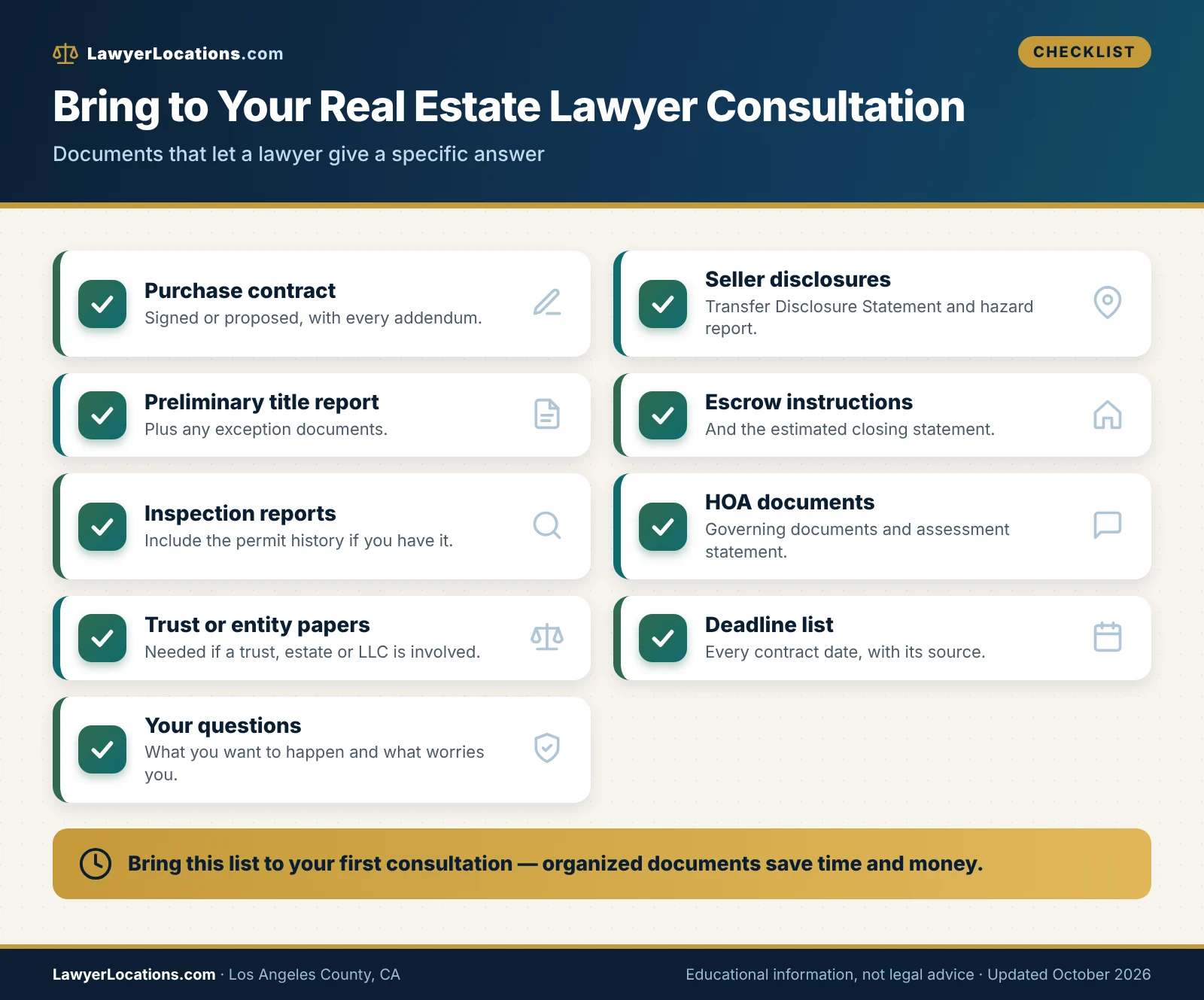
Text version of this graphic
- Purchase contract and every addendum or counteroffer
- Seller disclosures, including the TDS and hazard report
- Preliminary title report and exception documents
- Escrow instructions and estimated closing statement
- Inspection reports and permit history
- HOA documents, if any
- Trust, estate or entity documents, if any
- A list of deadlines and your questions
Questions and goals to write down
Write down what you want: close quickly, back out safely, reduce price, fix a title issue. Note every contract date that could cost you money or rights, and say plainly what worries you so the lawyer can tell whether the problem is legal, practical or best handled by the agent.
California and Los Angeles County Rules That Shape Your Closing
Three layers of rules apply to a Los Angeles County sale: state disclosure and tax law, county recording and assessment practice, and city-specific taxes and permit rules. Knowing which layer a requirement comes from tells you who to ask about it.
Disclosures a seller must make
California is a disclosure state. Sellers of one-to-four-unit residential property must give buyers written information about the property’s condition, and agents have their own duties to disclose what they know or reasonably should have seen. The statutes are in Civil Code sections 1102 and following, and the main forms are described below.
The Transfer Disclosure Statement
The Transfer Disclosure Statement (TDS) is a standardized questionnaire in which the seller reports known defects and conditions, such as past flooding, roof or plumbing problems, room additions, neighborhood noise and boundary or easement issues. The form’s required content is set by Civ. Code § 1102.6. Timing matters: if a disclosure is delivered after the buyer has signed an offer, the buyer may terminate by written notice within 3 days of in-person delivery or 5 days after it is deposited in the mail (Civ. Code § 1102.3). Write down the delivery date and method the day a disclosure arrives.
Buyers should compare the seller’s TDS against the agent’s inspection disclosure, the inspector’s report and the permit history. Gaps between them deserve a lawyer’s attention before you remove contingencies.
Log every delivery date for each disclosure and amendment, and how it was delivered. Those dates decide when a buyer’s cancellation window opens and closes.
Natural hazard and other required notices
Los Angeles County is exposed to earthquakes, wildfires, flooding and landslides, and California requires disclosure of mapped hazards. A Natural Hazard Disclosure Statement reports whether the property lies in a special flood hazard area, an area of potential flooding, a very high fire hazard severity zone, an earthquake fault zone, a seismic hazard zone or a state responsibility (wildland fire) area (Civ. Code § 1103). Sellers typically order this report from a third-party natural hazard company, and the statute says any waiver of the requirements is void.
HOA documents and “as-is” sales
If the property is in a condominium or other common interest development, the seller must provide the association’s governing documents, a statement of current assessments and unpaid fees, the most recent financial documents, any unresolved violation notices and, on request, the prior 12 months of approved board minutes (Civ. Code § 4525). Review them for special assessments, litigation, reserve shortfalls, rental restrictions and renovation rules.
Selling a home “as is” generally means the seller will not pay for repairs, but an “as-is” clause is not a shield against concealing known defects. A buyer who suspects that a seller knew about a problem and said nothing should preserve every document and speak with a lawyer promptly.
Transfer taxes: county, city and Measure ULA
Los Angeles County sales can carry several layers of transfer tax. The base layer is the county’s documentary transfer tax, collected when the deed is recorded. State law lets a county charge $0.55 per $500, which equals $1.10 per $1,000 (Rev. & Tax. Code § 11911), and the taxable amount excludes the value of any lien or encumbrance remaining on the property at sale. The Registrar-Recorder/County Clerk publishes the rules and declaration form at lavote.gov, and says the document preparer, not the recorder, is responsible for the calculation.
City taxes on top of the county tax
Many cities within the county impose their own tax, and the RR/CC lists the rates it collects for them. As of its page in October 2026, the listings include the City of Los Angeles at $2.25 per $500 ($4.50 per $1,000) on top of the county’s tax, Culver City on a graduated scale, Pomona and Redondo Beach at $2.20 per $1,000, and Santa Monica on a tiered scale that rises sharply at higher prices. The escrow officer calculates the tax from the property’s location, but ask for a line-by-line estimate early. Custom in many Southern California deals is that the seller pays transfer tax, but that is a negotiated term, not a legal requirement.
Measure ULA, the City of Los Angeles “mansion tax”
Measure ULA, approved by City of Los Angeles voters in November 2022 and effective April 1, 2023, adds a tax on high-value transfers inside the City of Los Angeles. The RR/CC’s city-rate page lists 4% on sales above $5.3 million and 5.5% at $10.6 million or more, and shows those dollar thresholds rising to $5.4 million and $10.9 million effective July 1, 2026. The thresholds are indexed, so confirm the figures that apply on your closing date. The tax applies to the whole price once a threshold is crossed rather than only the excess, which can make a price just above a threshold far more expensive than one just below it. It affects property inside City of Los Angeles limits, not other cities or unincorporated areas.
Proposals to change or repeal the measure, including statewide ballot activity about local transfer taxes, have been in the news. Read the official voter guide and the City of Los Angeles Office of Finance guidance for what applies on your closing date, and ask escrow to confirm in writing how the tax is calculated and who pays. It is commonly treated as a seller’s cost, but the contract controls.
Proposition 13, Proposition 19 and your property tax bill
Transfer taxes are one-time costs. The property tax bill is a long-term cost, and in California it usually resets when ownership changes. Assume a purchase will be reassessed at the purchase price unless an exclusion clearly applies.
Reassessment and the supplemental bill
Under Proposition 13 (article XIII A of the California Constitution), a property is assessed at its base-year value, with annual increases limited to 2% unless a change in ownership or new construction occurs. After a sale, the Los Angeles County Assessor sets a new base-year value, and the buyer receives a supplemental tax bill for the difference for the rest of the fiscal year. It arrives separately from the regular bill, and a mortgage servicer’s escrow account may not cover it.
The buyer files a Preliminary Change of Ownership Report (PCOR) with the deed so the Assessor can process the change. Escrow usually prepares it. Review the answers about the property’s use and any claimed exclusion before you sign. Buyers who will live in the home should also ask the Assessor about the homeowners’ exemption.
Proposition 19 and family transfers
Proposition 19, whose parent-child changes began February 16, 2021, narrowed the long-standing exclusion for transfers between parents and children. According to the State Board of Equalization, the family home must be the transferor’s principal residence and become the transferee’s principal residence; rental homes do not qualify. A transferee must claim the homeowners’ or disabled veterans’ exemption within 1 year, and the exclusion claim is due within 3 years of the transfer or before a transfer to a third party, whichever is earlier. The exclusion is limited by the property’s factored base-year value plus an adjusted $1 million amount ($1,044,586 for transfers from February 16, 2025 through February 15, 2027, per the BOE page), and any excess is added to the base-year value.
A parent who deeds a rental property or second home to a child, or a child who inherits a house and rents it out, may face a full reassessment at market value. That can add thousands of dollars a year to a tax bill and change whether keeping or selling an inherited house makes sense. Because outcomes depend on occupancy, valuation and timing, talk to a lawyer and tax professional before signing a deed, not after.
Moving a base-year value as a homeowner 55 or older
Proposition 19 also lets homeowners who are 55 or older, severely and permanently disabled, or victims of a wildfire or governor-proclaimed disaster transfer their assessed value to a replacement primary residence anywhere in California. Per the BOE, the replacement must be bought or built within 2 years of selling the original, the claim is due within 3 years of the replacement purchase or completion, and the benefit may be used up to three times. Ask the assessor about deadlines before you close either transaction.
Escrow also collects tax forms. California generally requires withholding on certain real property sales over $100,000 unless an exemption applies, such as a certified sale of the seller’s principal residence (Rev. & Tax. Code § 18662), and federal FIRPTA rules separately cover foreign sellers. Raise any non-resident or foreign-owner issue with escrow on day one, and keep your closing statement and improvement records for your tax adviser.
Title, Liens, Unpermitted Work and Recording Problems
Most Los Angeles County closing problems are found in three places: the title report, the building and permit record, and the recorded documents. A lawyer is most useful when a problem turns up in one of them.
Title defects and liens on the preliminary report
The preliminary report lists the exceptions a title insurer will carve out of its policy unless they are cleared. Not every exception is a problem. Utility easements are common. Unpaid taxes, recorded judgments and open liens are different, because they can follow the property to the buyer unless paid off at closing.
Common liens and who typically resolves them
Several types of liens routinely appear in this county. A judgment lien arises when a creditor records an abstract of a money judgment with the county recorder, and generally lasts 10 years from entry of the judgment unless released or renewed (Code Civ. Proc. § 697.310). A mechanic’s lien is a claim by a contractor, supplier, laborer or design professional who was not paid for work on the property (Civ. Code § 8400 et seq.). Unpaid HOA assessments can lead to a lien, and property tax liens attach by operation of law. Escrow can often pay off a known lien from the seller’s proceeds, but a disputed lien is a legal question.
Special taxes, PACE assessments and old loans
Newer subdivisions often carry Mello-Roos special taxes, and some homes have PACE assessments, which finance energy or similar improvements and are repaid through the property tax bill. A buyer’s lender may require a payoff, and the obligation may stay with the property. Old deeds of trust that were paid but never reconveyed also show up; the usual remedy is a reconveyance from the lender or its trustee, but stubborn cases need legal action.
| Problem | Where it shows up | Usual first step |
|---|---|---|
| Unpaid loan not reconveyed | Preliminary report | Request a reconveyance through the lender or trustee |
| Judgment or tax lien | Preliminary report | Obtain a payoff and pay at closing, or contest in court |
| Mechanic’s lien | Preliminary report or notice | Confirm what work was done, get a release or resolve the claim |
| Name mismatch on the deed | Title review | Correct the record, sometimes with a new deed or court order |
| Easement or boundary dispute | Title report, survey | Review documents; a lawyer may negotiate or sue to quiet title |
| HOA lien or assessment | HOA demand statement | Obtain a payoff figure and resolve before closing |
Unpermitted work, ADUs and city records
Older Los Angeles County homes sometimes have garage conversions, enclosed patios, added rooms or backyard units that were built without permits. Unpermitted work can stall a sale, because lenders, appraisers and insurers care about what the building records show.
Unpermitted additions and conversions
An unpermitted addition can raise safety, insurance and financing issues, and a building department can require the owner to obtain permits, correct the work or sometimes remove it. A seller should disclose known unpermitted work on the TDS. The best time to ask is while inspections are still open: request the permit history from the city or county building department and compare it with what you see on site.
Accessory dwelling units
California has rewritten its ADU laws several times, and the State’s housing department notes that a 2024 bill renumbered the Government Code sections for state ADU and junior ADU law (the chapter now begins at Gov. Code § 66310). Local rules still matter. If you are buying a property with a backyard unit, ask whether it is permitted, whether it can legally be rented, and whether any income figures are supported. If you are selling, ask the local building department about legalization options before listing.
City-specific point-of-sale requirements
Some Los Angeles County cities require inspections, reports or certificates at sale. In the City of Los Angeles, the seller must apply to the Department of Building and Safety for a Residential Property Report (Form 9), covering property records and pending special assessment liens, and deliver it to the buyer before the agreement of sale or before close of escrow (L.A.M.C. § 96.300). LADBS lists the fee at $70.85 per report as of October 2026. Its seller-requirements page also points to other City rules, including smoke and carbon monoxide detectors, water conservation devices and seismic gas shut-off valves. Neighboring cities and unincorporated areas use different rules, so ask your agent which apply to your address and who orders each report.
Recording the deed and avoiding fraud
The Los Angeles County Registrar-Recorder/County Clerk (RR/CC) records deeds and other documents affecting real property, keeps the official records, and collects documentary transfer tax at recording. Recording information is on lavote.gov.
What recording does and does not do
Recording gives public notice of a document. It does not prove that the document is valid or that the signer had the right to sign it, which is why title insurers examine the chain of ownership first. After closing, confirm the deed was recorded, keep a copy of it and the final settlement statement, and watch for the supplemental tax bill.
Deed fraud and wire fraud
Criminals sometimes record forged deeds on homes they do not own, and they impersonate escrow officers or agents to redirect closing funds. The county’s Homeowner Notification Program mails owners copies of documents recorded against their property, such as ownership changes, loans and notices of default, and offers email alerts through the Assessor. Before wiring any money, call the escrow officer at a number you already know to confirm the instructions, and be suspicious of last-minute changes by email. If a wire went wrong, contact your bank and escrow company immediately and report it to law enforcement.
What Closing Help Costs and When the Deadlines Hit
Closing costs in Los Angeles County come from several different payees, and a lawyer is only one of them. This guide does not quote average fees, because no official source sets them and amounts vary with price, property type and complexity. It explains the categories so you can ask for accurate written estimates.
A closing timeline with decision points
Dates drive most of the stress in a closing. Your own contract lists the actual periods, so read it with a calendar.
Before you sign
This is when legal review is cheapest to use. Decide whether you want a lawyer to review the contract, check whether the property is in a trust or estate, and request the disclosure packet. Ask when each contingency clock starts.
During the contingency periods
Order inspections quickly, read the preliminary report and disclosures, and check the permit history. Removing contingencies is the key decision point: once removed, a buyer can lose a deposit by backing out. If a problem appears, ask about a repair request, price reduction, extension or cancellation, and put any agreement in writing.
From signing to recording and afterward
Sign the loan and closing documents, wire funds only after verifying instructions by phone, and confirm that the deed was recorded. Afterward, watch for the reassessment notice and supplemental bill, and file any tax-relief claims on time.
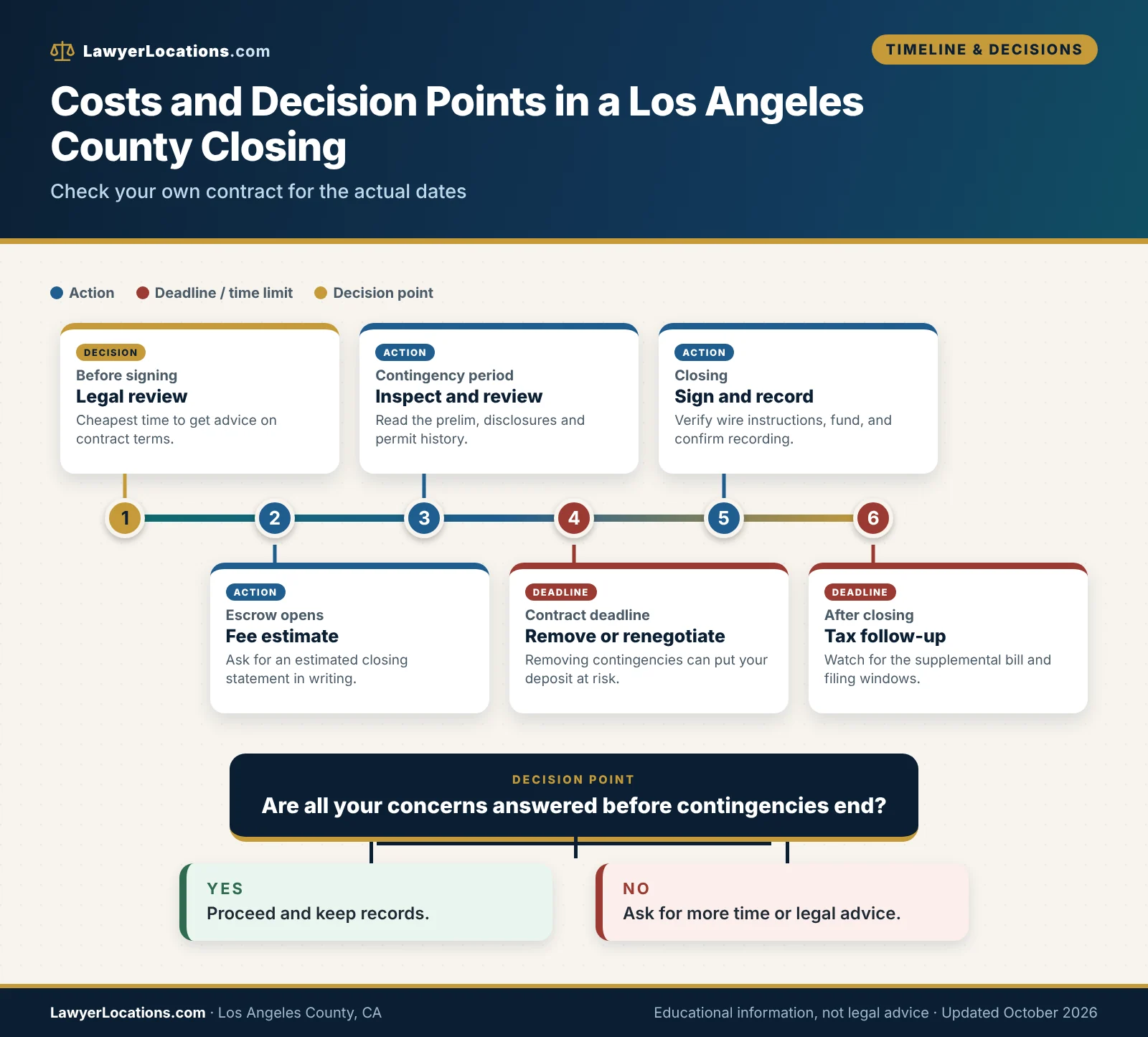
Text version of this graphic
- Before signing: decide on legal review; read the contract and disclosures.
- Escrow opens: confirm instructions and fee estimate.
- Contingency period: inspections, prelim review and repair requests.
- Decision point: remove contingencies, renegotiate or cancel within the contract deadline.
- Closing: sign documents, verify wire instructions, fund and record.
- After closing: file tax forms and claims; watch for the supplemental bill.
Decision question: Is everything you worried about answered before contingencies are removed? If yes, proceed; if no, ask for more time or advice.
Contract contingency periods, notice requirements and tax-claim filing windows are separate clocks. Write down each date and its source document so that no one has to guess which deadline applies.
Do not release a deposit, sign a cancellation or accept a repair credit based on a text message or a verbal promise. Get changes in a signed written document that escrow can follow.
What you pay for and who usually pays
Costs fall into three groups: professional fees, government charges and third-party reports. The purchase contract allocates many of them, and escrow instructions repeat that allocation.
Professional and service fees
Lawyers commonly charge a flat fee for a defined review, an hourly rate for open-ended work, or a retainer against which time is billed. Escrow companies and title insurers charge fees that typically rise with price or complexity. Custom often assigns some charges to the seller and others to the buyer, but the contract can allocate them differently. Ask for an estimated closing statement early.
Taxes, recording and third-party reports
Documentary transfer taxes, any Measure ULA tax, recording charges, natural hazard reports, HOA document fees and inspections are separate lines. On a high-value property, the transfer-tax line can dwarf legal fees, so confirm the math in writing.
| Cost item | Who commonly pays | Where to confirm |
|---|---|---|
| Real estate attorney | The party who hires the lawyer | Written fee agreement |
| Escrow fee | Split or assigned by the contract; local custom varies | Estimated closing statement and contract |
| Title insurance | Owner’s policy and lender’s policy are often paid by different sides | Contract and title company estimate |
| County and city transfer tax | Often the seller, by custom | Contract; RR/CC and city rules |
| Measure ULA tax | Negotiated; commonly treated as a seller cost | Contract; City of Los Angeles tax rules |
| Recording charges | Depends on the document and the contract | Escrow estimate; RR/CC fee schedule |
| Hazard report and HOA documents | Usually the seller | Contract and invoices |
Common Mistakes, Local Resources and Next Steps
The most expensive mistakes in California closings are made early, before anyone has a title report, a permit history or a lawyer’s opinion. Local public offices can answer many factual questions at no cost, and the rest are best handled by a licensed California attorney.
Mistakes to avoid
Most of these come from assuming that someone else is watching a risk that no one is actually covering.
Common buyer mistakes
- Waiving inspection or contingencies to win an offer without understanding the deposit risk.
- Assuming the escrow officer or agent will give legal advice.
- Wiring money based on an emailed instruction without a phone call to a known number.
Common seller mistakes
- Leaving known defects or unpermitted work off the disclosure.
- Ignoring the transfer tax, including any Measure ULA tax, before accepting an offer near a threshold.
- Listing a trust or estate property without confirming who has authority to sign.
Local resources
Public offices cannot give legal advice, but they can tell you what records exist and what forms are required.
Courts, county offices and state agencies
The Superior Court of Los Angeles County publishes court information at lacourt.ca.gov. The Registrar-Recorder/County Clerk handles recording and transfer-tax declarations at lavote.gov. The Los Angeles County Assessor handles reassessment and exclusions (assessor.lacounty.gov). The California Department of Real Estate handles agent and broker licensing, and the DFPI oversees licensed independent escrow companies.
Lawyer referral and legal aid
The Los Angeles County Bar Association lists a referral service, and the State Bar of California publishes its Attorney Search for checking a lawyer’s license and discipline history; the California courts’ self-help site also recommends looking a lawyer up there before meeting. People with limited income who face eviction, foreclosure or deed fraud may qualify for help from legal aid organizations serving Los Angeles County; check each organization’s own site for eligibility and intake rules. Ask what the program covers before you spend time on an application.
Quick answers to common questions
These short answers summarize points made above. Each is general information, not advice about your deal.
About lawyers and escrow
Do I need a closing attorney to buy a house in Los Angeles County?
No. California does not require one for an ordinary residential purchase. An escrow officer handles the closing mechanics. A lawyer is optional, but useful for contract problems, title defects, trusts, entities and disputes.
How do I find a real estate lawyer near me in Los Angeles County?
Use a State Bar certified referral service or personal referrals, then verify the license on the State Bar’s attorney search and compare the same questions across more than one lawyer.
About taxes and paperwork
How much is the Los Angeles County transfer tax?
The county’s documentary transfer tax is $1.10 per $1,000 of value, with city taxes added in some cities, such as $4.50 per $1,000 in the City of Los Angeles. Confirm your city’s rate with escrow.
What is the Los Angeles “mansion tax”?
Measure ULA is an additional City of Los Angeles tax on high-value sales: 4% above $5.4 million and 5.5% at $10.9 million or more from July 1, 2026, per the County Recorder’s city-rate page, on the whole price. Thresholds are indexed, so verify current figures before pricing a sale.
Will my property taxes go up after I buy?
Usually, yes. A purchase typically resets the assessed value to the new price, unless an exclusion such as a qualifying family transfer applies. Expect a supplemental bill.
Next steps
Whether you decide to hire a closing attorney in Los Angeles County, CA, or rely on escrow and your agent alone, a short sequence keeps your closing on track.
A short action plan
- Read the contract and disclosures. Mark every date and every blank.
- Decide if your deal is routine. A trust, entity, title, permit or tax question usually justifies advice.
- Verify the professionals. Check the State Bar record and the escrow provider’s regulator.
- Get fees in writing. Ask for a fee agreement and an estimated closing statement.
- Protect the money. Verify wire instructions by phone before you send funds.
Where to go from here
Ready to compare your options?
If you are weighing legal help for a sale involving a trust, a family transfer or a divorce, our guides to living trust lawyers and family law attorneys in California explain how to compare lawyers. For a contrasting example of how a different state handles attorney involvement at closing, see our Philadelphia real estate attorney guide.
Sources & References
Show all 31 sources
- Documentary Transfer Taxes (county and city rates, declaration rules) — Los Angeles County Registrar-Recorder/County Clerk — lavote.gov — accessed October 2026
- Homeowner Notification Program — Los Angeles County Registrar-Recorder/County Clerk — lavote.gov — accessed October 2026
- Proposition 19 (parent-child exclusion and base year value transfers) — California State Board of Equalization — boe.ca.gov — accessed October 2026
- Requirements When Selling (Residential Property Report, L.A.M.C. § 96.300) — Los Angeles Department of Building and Safety — dbs.lacity.gov — accessed October 2026
- Residential Property Report — Los Angeles Department of Building and Safety — dbs.lacity.gov — accessed October 2026
- California Department of Real Estate home page — California Department of Real Estate — dre.ca.gov — accessed October 2026
- Escrow Law overview — California Department of Financial Protection and Innovation — dfpi.ca.gov — accessed October 2026
- Fin. Code § 17006 (Escrow Law exemptions) — California Legislature (text via California Public Law) — california.public.law — accessed October 2026
- Civ. Code § 1102.3 (disclosure delivery and termination period) — California Legislature (text via California Public Law) — california.public.law — accessed October 2026
- Civ. Code § 1102.6 (Transfer Disclosure Statement) — California Legislature (text via California Public Law) — california.public.law — accessed October 2026
- Civ. Code § 1103 (natural hazard disclosure zones) — California Legislature (text via California Public Law) — california.public.law — accessed October 2026
- Civ. Code § 4525 (common interest development seller documents) — California Legislature (text via California Public Law) — california.public.law — accessed October 2026
- Civ. Code § 1624 (Statute of Frauds) — California Legislature (text via California Public Law) — california.public.law — accessed October 2026
- Civ. Code § 8400 (mechanics lien claimants) — California Legislature (text via California Public Law) — california.public.law — accessed October 2026
- Bus. & Prof. Code § 6125 (practice of law) — California Legislature (text via California Public Law) — california.public.law — accessed October 2026
- Bus. & Prof. Code § 6148 (written fee agreements) — California Legislature (text via California Public Law) — california.public.law — accessed October 2026
- Bus. & Prof. Code § 6155 (lawyer referral services) — California Legislature (text via California Public Law) — california.public.law — accessed October 2026
- Rev. & Tax. Code § 11911 (documentary transfer tax) — California Legislature (text via California Public Law) — california.public.law — accessed October 2026
- Rev. & Tax. Code § 18662 (real property sale withholding) — California Legislature (text via California Public Law) — california.public.law — accessed October 2026
- Code Civ. Proc. § 85 (limited civil cases) — California Legislature (text via California Public Law) — california.public.law — accessed October 2026
- Code Civ. Proc. §§ 337, 338, 339 (time limits) — California Legislature (text via California Public Law) — california.public.law — accessed October 2026
- Code Civ. Proc. § 405.20 (notice of pendency of action) — California Legislature (text via California Public Law) — california.public.law — accessed October 2026
- Code Civ. Proc. § 697.310 (judgment lien on real property) — California Legislature (text via California Public Law) — california.public.law — accessed October 2026
- Probate Code § 18100.5 (certification of trust) — California Legislature (text via California Public Law) — california.public.law — accessed October 2026
- Accessory Dwelling Units — California Department of Housing and Community Development — hcd.ca.gov — accessed October 2026
- Instructions for Form 8824 (like-kind exchanges) — Internal Revenue Service — irs.gov — accessed October 2026
- Like-Kind Exchanges Under IRC Section 1031 — Internal Revenue Service — irs.gov — accessed October 2026
- Hiring a lawyer / certified referral services — California Courts Self-Help Center — selfhelp.courts.ca.gov — accessed October 2026
- SmartLaw Lawyer Referral Service — Los Angeles County Bar Association — lacba.org — accessed October 2026
- Superior Court of Los Angeles County — Superior Court of California, County of Los Angeles — lacourt.ca.gov — accessed October 2026
- Qualified ballot measures, November 3, 2026 — California Secretary of State — sos.ca.gov — accessed October 2026
General information only. This article is legal education, not legal advice, and reading it does not create an attorney-client relationship with LawyerLocations.com or anyone else. LawyerLocations.com is a legal-education and lawyer-discovery resource, not a law firm, and it does not rank or endorse individual lawyers. Laws, tax rates, thresholds and local rules change; figures here are stated as of October 2026 and should be confirmed with the cited agency. Consult a lawyer licensed in California about your situation.
Legal Disclaimer and Limitation of Liability
Informational and illustrative purposes only. This article was prepared by LawyerLocations.com solely on the basis of the information available to us at the time of writing. It is an illustrative, general overview. It is not a complete or authoritative statement of the law, and it has not been reviewed by a lawyer licensed in your state or county.
Not legal advice. Nothing in this article is legal, financial, tax or immigration advice, and reading it does not create an attorney-client relationship between you and LawyerLocations.com or any author, lawyer or firm mentioned. Laws, court rules, fees, filing deadlines and agency procedures differ by state, county and court, and they change often. Some details here may be simplified, incomplete or out of date, and time limits for legal claims can be short.
No warranty. We make no representation or warranty, express or implied, about the accuracy, completeness, timeliness or suitability of this content for your situation. Please do not rely on it to make, delay or skip any legal decision. Check the facts against official sources and speak with a licensed attorney in the relevant jurisdiction before you act.
Limitation of liability. To the fullest extent permitted by law, LawyerLocations.com and its owners, authors and contributors disclaim all liability for any loss, damage, cost or other consequence arising from the use of, or reliance on, this article, including any content on third-party websites we link to. Mentioning a lawyer, firm, organization or service is not an endorsement and is not a promise of any result. If you are in immediate danger, contact your local emergency number.


