

If you were hurt at work in the five boroughs and you are searching for a “workers compensation attorney new york city ny,” start with two facts. New York workers’ compensation is a state system run by the New York State Workers’ Compensation Board, and you must give your employer written notice within 30 days and file a claim within two years. A lawyer is optional, but fees are regulated by statute and approved by the Board, so you do not negotiate them like a typical contract.
This guide explains the New York rules, how claims move through the Board, what attorneys may charge, how to compare lawyers, and what to bring to a first consultation. It is general education, not legal advice, and it does not recommend any firm.
How Workers’ Compensation and Attorneys Fit Together in New York City
New York City workers are covered by a no-fault state insurance system, not by a city program. A lawyer helps most when benefits are denied, cut off, or settled, and the decision to hire one is yours to make at any point in the claim.
How the New York system works for city workers
Workers’ compensation is an insurance arrangement between employers and employees. In exchange for medical care and partial wage replacement regardless of who caused the accident, the worker generally gives up the right to sue the employer for negligence. The rules come from the New York Workers’ Compensation Law (WCL), and the Workers’ Compensation Board administers them statewide.
The no-fault trade-off
You do not need to prove your employer did anything wrong to qualify for benefits. You do need to show the injury or illness arose out of and in the course of your work. That distinction matters in practice, because insurers often dispute whether an injury was really work-related, whether a pre-existing condition is the true cause, or whether a worker was an employee at all.
The trade-off also means that benefits are limited by formula. Wage replacement is a percentage of your average weekly wage, up to a state cap, and pain-and-suffering damages are not part of the system. If someone other than your employer contributed to the accident, such as a negligent driver or a contractor on the same site, a separate injury claim may exist. Read our guide to personal injury lawyers in New York City for how those claims differ.
Who pays your benefits
In most cases the payer is your employer’s insurance carrier, not the employer itself. Some large employers are self-insured, which means they pay claims directly or through an administrator. Either way, the insurer or administrator is called the carrier in Board paperwork, and it is the party that may accept, delay or contest your claim.
The carrier’s interests and yours are not identical. Its adjuster may be polite and still be working to limit what the claim costs. Knowing that early helps you decide how much to say in recorded statements and how carefully to document your own treatment.
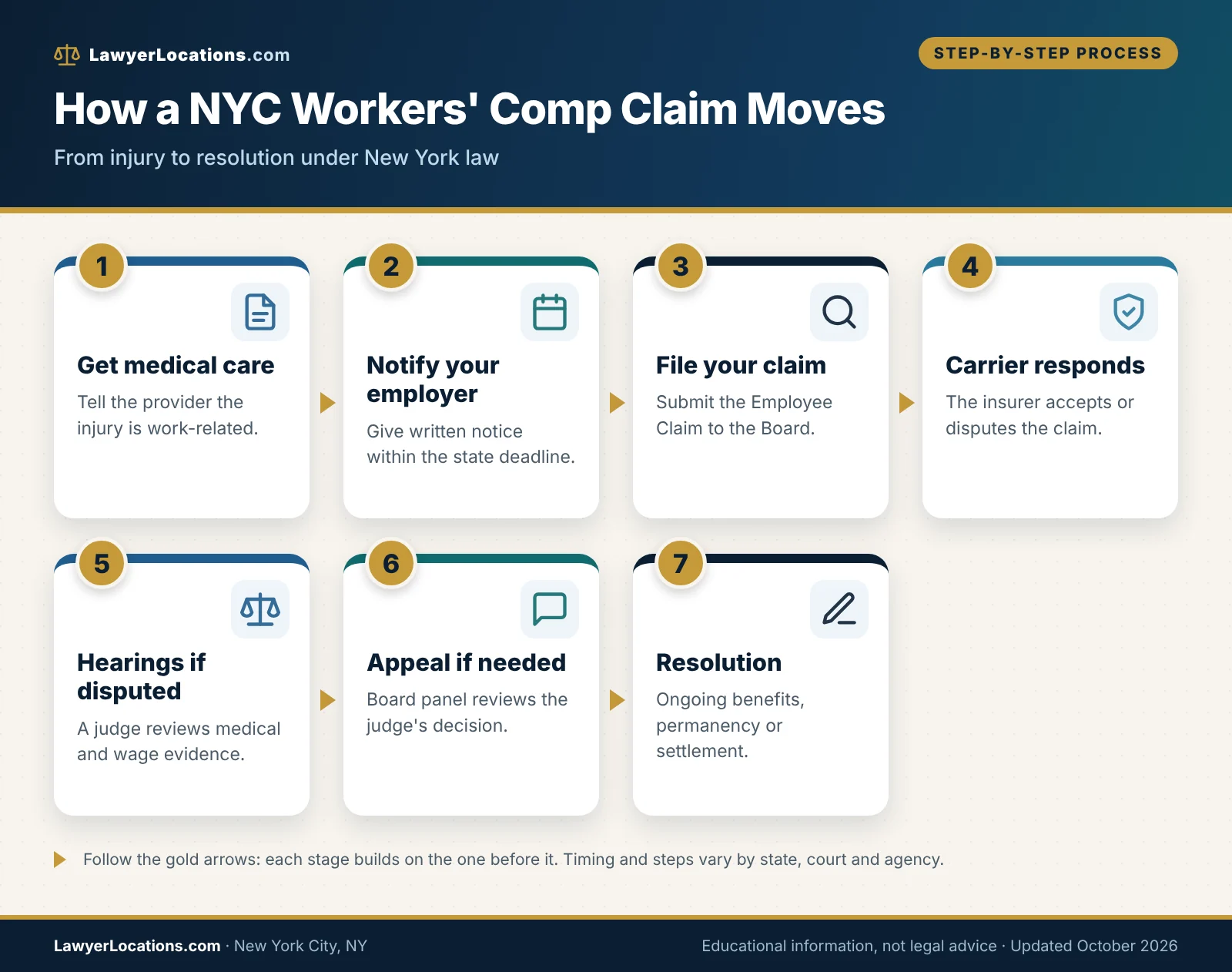
Text version of this graphic
- Get medical care and tell the provider the injury is work-related.
- Give your employer written notice within 30 days.
- File the Employee Claim (Form C-3) with the Workers’ Compensation Board within two years.
- The carrier accepts the claim or disputes it; benefits may start without a hearing.
- If disputed, a Workers’ Compensation Law Judge holds hearings and decides.
- Either side may appeal to a panel of Board members within 30 days of the decision.
- Permanency, settlement or closing of the claim.
What a workers’ compensation attorney does
A lawyer’s job is to protect your rights inside a procedural system. That means filing the right forms, building the medical proof, cross-examining the carrier’s doctors, and negotiating from a position grounded in the Board’s rules.
Before the first hearing
Early work usually includes confirming that the claim was filed correctly, gathering treating-doctor reports, checking that your average weekly wage was calculated properly, and responding to any carrier objections. Attorneys also help clients complete the Board’s filing steps online and keep track of notices. Missing a notice or deadline can cost real money, so this administrative layer is often where representation earns its keep.
At hearings, appeals and settlements
If the carrier contests the claim, a Workers’ Compensation Law Judge reviews medical records, wage information, evidence and testimony. A lawyer prepares your testimony, asks the judge to resolve specific issues, and, if the result is wrong, can file a written appeal. Lawyers also review any proposed lump-sum deal so you understand what rights you would be closing. We explain that process in the settlement section below.
When you may not need a lawyer, and when you probably do
Many routine claims are accepted and paid without a hearing. If the carrier accepted the claim, your treatment is approved, you are back at work, and no one is disputing anything, there may be little for a lawyer to add. Our national explainer on whether you need a workers’ comp lawyer walks through that decision in more detail.
Signs that representation is worth considering
- The carrier denied the claim or questioned whether the injury is work-related.
- Your treatment was denied, delayed or cut off.
- Your employer disputes that you are an employee, or you were paid in cash or off the books.
- You are being asked to return to work against your doctor’s advice.
- The injury caused permanent limitations, or a settlement offer arrived.
- Your employer retaliated, or you fear it will.
Signs you can wait and watch
If benefits are flowing and your doctor expects a full recovery, you can often monitor the claim yourself, save every notice, and speak with a lawyer later if something changes. The Board’s own materials say you may have an attorney or licensed representative at any point, so waiting does not close that door. What waiting does not protect is your deadlines, which keep running either way.
Keep a simple log of every call, notice and appointment, including dates and names. A clear paper trail is useful whether you represent yourself or hire a lawyer later.
The New York Rules That Shape Every Claim
Three rules do most of the work in a New York claim: the 30-day notice rule, the two-year filing window, and a benefit formula that is locked in by your date of injury. These are state rules, so they apply the same way whether you work in Midtown, Jamaica, the South Bronx or on Staten Island.
Deadlines you cannot ignore
New York uses two separate clocks. One runs to your employer and the other runs to the Board. They have different lengths, different consequences and different exceptions.
The 30-day notice to your employer
Under WCL § 18, notice of the injury must be given to the employer within thirty days after the accident. If the injury results in death, the 30 days run from the date of death. The Board’s fact sheet tells workers to notify the employer in writing of when, where and how they were hurt.
The statute also contains a safety valve. The Board may excuse late notice where notice could not have been given for a sufficient reason, where the employer or its supervising agents knew of the accident, or where the employer was not prejudiced. The employer and carrier are treated as having waived a notice objection unless they raise it at the first hearing on the claim. Do not rely on those excuses, though. Written notice inside 30 days removes the fight entirely.
Count the 30 days from the accident, not from the day a doctor tells you the injury is serious. Put the notice in writing, keep a copy, and note the date you handed it over or sent it.
The two-year claim filing window
Under WCL § 28, a claim for compensation is barred unless it is filed within two years after the accident. If death results from the accident, the period runs from the death. For occupational disease, the statute allows a claim filed after two years if it is made within two years after disablement and after the worker knew, or should have known, the disease was due to the employment. A claim is also not barred in a case where an advance payment was made.
Again, the employer and carrier are deemed to waive the statute-of-limitations defense unless they raise it at the first hearing at which all parties are present. The Board’s fact sheet states the practical rule plainly: file within two years, and file as soon as possible. Our broader explainer on injury claim deadlines shows how different the time limits can be for lawsuits against third parties.
| Deadline | Who receives it | Length | Source | What can soften it |
|---|---|---|---|---|
| Notice of injury | Your employer | 30 days after the accident (30 days from death if fatal) | WCL § 18 | Board may excuse for sufficient reason, employer knowledge, or no prejudice; objection waived if not raised at first hearing |
| Claim for compensation | Workers’ Compensation Board | Two years after the accident (or after death) | WCL § 28 | Occupational-disease timing rule; advance payments; waiver if not raised at first hearing |
| Appeal of a Board decision | Workers’ Compensation Board panel | 30 days from the filing date of the decision | Board claimant fact sheet | Check the decision itself for exact instructions |
Benefits and medical care in plain English
New York pays two main kinds of benefits: medical treatment and cash benefits for lost earnings. Cash benefits are tied to your pre-injury wages and to how disabled you are.
How the weekly rate works
The maximum weekly benefit is two-thirds of the New York State Average Weekly Wage for the previous calendar year, and it adjusts each July 1. The minimum is one-fifth of that wage, or your actual wages if they were lower. Importantly, the rate is locked in by your date of injury, so later increases do not raise a benefit that has already been set.
| Date of injury | Maximum weekly rate | Minimum weekly rate |
|---|---|---|
| July 1, 2025 – June 30, 2026 | $1,222.42 | See the Board’s benefit schedule page |
| July 1, 2026 – June 30, 2027 | $1,281.50 | $384.45 |
These figures are caps, not predictions. Your own rate depends on your wages, your degree of disability and how the Board classifies your condition. Combined benefits and reduced earnings cannot exceed what you earned when you were hurt.
Choosing doctors and getting treatment paid
According to the Board’s fact sheet, you can generally use any Board-authorized provider, including physicians, nurse practitioners, physician assistants, and specialists such as physical therapists and psychologists. If your employer’s insurer has a preferred-provider network, your first treatment must be within that network, and any pharmacy or diagnostic networks must also be used. You should not pay out of pocket for covered care, medication or equipment unless the claim is not pursued or the Board finds it invalid.
The fact sheet also recommends seeing your doctor 15 days after the injury and then every 90 days if you have ongoing lost time. For problems with care, the Board’s Medical Director’s Office takes calls at (800) 781-2362. Treating doctors’ reports are often the most important evidence in a disputed claim, so consistent follow-up matters.
When payment is due
Per the Board, lost wage benefits should be paid promptly if the injury keeps you out of work for more than seven days, causes permanent partial disability, or reduces your pay. If the claim is accepted and you missed more than seven days, payment is due within 18 days of the accident or within 10 days after the insurer is notified. If payments are late or stop without explanation, that is a reason to contact the Board or a lawyer.
Permanency, settlements and closing a claim
Many significant claims end in one of two ways: a finding about permanent impairment, or a negotiated lump-sum agreement. Each has long-term consequences.
Permanent partial disability
When a worker is left with lasting limitations, the Board classifies the disability and the cash benefits can continue for a set period. The Board has explained that the 2007 reforms set maximum benefit periods, or caps, of up to ten years for permanent partial disability classifications under WCL § 15(3)(w). A worker whose loss of wage-earning capacity is greater than 75 percent may request a redetermination in the year before those benefits are scheduled to run out, under WCL § 35(3).
Because these classifications turn on medical opinion and wage evidence, they are among the most heavily contested issues in serious cases. Ask any lawyer you interview how they build proof on loss of wage-earning capacity.
Section 32 waiver agreements
A Section 32 waiver agreement is a negotiated deal between the worker and the carrier to settle indemnity benefits, medical benefits, or both. According to the Board, it ends the right to ongoing and future benefits for the settled part of the claim in exchange for a lump sum or annuity, and that part cannot be reopened. The agreement is not binding unless the Board approves it.
The Board requires workers to watch its “Settling Your Claim” video before entering an agreement, and counsel must attest on Form C-32.1 that the agreement was reviewed with the worker. Before settling medical benefits, the Board suggests talking with your treating physician about likely future care, such as surgery, and its cost.
Be cautious about any pressure to sign a settlement before your doctor has described your long-term condition. Once the Board approves a waiver agreement, the settled benefits are closed for good.
Where Your Case Is Handled and What Help Exists in the City
New York City claims are handled by the same statewide Board as the rest of New York, but your day-to-day experience is shaped by local logistics: how hearings are scheduled, how in-person appointments work, and which free or low-cost help is nearby. The city also has a unique 9/11 layer that affects some workers.
The Board, its hearings and how appointments work
The Board has moved much of its work online. For a city worker juggling shifts and commutes, that has changed what a “hearing” looks like.
Virtual hearings are the default
As of October 2026, the Board states that hearings stay virtual unless a party asks the Workers’ Compensation Law Judge for an in-person hearing during a scheduled virtual hearing. If you receive a hearing notice, it will state the reason, date and time. If you cannot attend, tell the Board right away so it can be rescheduled.
Attorneys must accompany their clients to in-person hearings or arrange a substitute. That requirement is worth asking about when you interview a lawyer: who will actually appear for you, and how will you be told?
In-person services by appointment
Most Board offices are open to the public by appointment, and day-of appointments are not accepted. Services by appointment include filing a claim, attending a hearing, meeting with a social worker or vocational rehabilitation counselor, and using computers to view case files. The general line is (877) 632-4996 and the appointment scheduling line is (844) 337-6301, with hours of 8:30 a.m. to 4:30 p.m.
For the Brooklyn and Manhattan offices, the Board has told visitors to check in with building security first and then complete the regular check-in, allowing at least 15 extra minutes. Only visitors with confirmed, pre-scheduled hearings or appointments may enter, companions must be approved when the appointment is booked, and every visitor with an appointment must show a photo ID. Use the Board’s Locations page for the current address of the office assigned to your case.
| Resource | What it helps with | Contact | Notes |
|---|---|---|---|
| Workers’ Compensation Board general inquiries | Claim status, forms, hearing questions | (877) 632-4996 | Hours 8:30 a.m. – 4:30 p.m.; translation and interpreters available through the same number |
| Board appointment scheduling | In-person filing, hearing or computer access | (844) 337-6301 | Cannot be used to request an in-person hearing |
| Board Medical Director’s Office | Problems getting authorized care | (800) 781-2362 | Listed in the Board’s claimant fact sheet |
| Advocate for Injured Workers | Questions from workers about the process | [email protected] | Email contact listed in the Board’s claimant fact sheet |
| NYC Bar Legal Referral Service | Matching with a lawyer experienced in your issue | 212-626-7373 (English); 212-626-7374 (Spanish) | 42 West 44th Street, Manhattan; counselor call is free |
Free and low-cost help in the five boroughs
You do not have to start with a private lawyer. Several resources can help you understand your position before you spend money.
Help inside the Board
The Board lists an Advocate for Injured Workers, a vocational rehabilitation unit for return-to-work support (including light or alternate duty options), and a social services unit for family or financial strain. Free document translation and hearing interpreters are available through the general number. These are not substitutes for legal advice, but they can make the process less confusing.
Lawyer referral through the city bar
The New York City Bar Association’s Legal Referral Service serves all five boroughs. Speaking with a referral counselor costs nothing; the counselor discusses your situation, decides whether hiring a lawyer would be cost-effective, and if so matches you with a network attorney whose experience fits your issue. The service states that the initial consultation with a referred lawyer is $35 for up to 30 minutes, with some consultations free depending on case type.
A referral service is a starting point, not an endorsement of a particular outcome. You should still use the comparison questions in the next section with whoever you meet.
The Board’s claimant materials confirm that you may have an attorney or licensed representative at any point in your claim, so it is never too late to ask for help, even if you started on your own.
World Trade Center-related claims
New York City has a distinctive 9/11 layer: some workers may have both a state compensation path and federal 9/11 programs. If you worked in rescue, recovery or cleanup after September 11, 2001, read this part closely.
The Board’s WTC registry
New York State lists a Workers’ Compensation Board registry for rescue, recovery and cleanup workers. Registering preserves your right to future benefits if you ever need them, even if you were not injured. The state’s 9/11 assistance page states that the deadline to register is September 11, 2030, and the form is Form WTC-12. It applies to people who worked or volunteered at places such as Ground Zero, Fresh Kills Landfill, the barges, the piers or the morgues between September 11, 2001 and September 12, 2002.
Federal 9/11 programs
The same state page describes two federal programs: the World Trade Center Health Program, which provides no-cost medical monitoring and treatment for eligible responders and survivors, and the September 11th Victim Compensation Fund, which provides financial compensation for physical illnesses or deaths related to 9/11. Each requires its own registration, and the state page notes that you do not need a lawyer for either federal program. The page lists 1-888-982-4748 for the Health Program and 1-855-885-1555 for the Victim Compensation Fund.
If this applies to you, a lawyer experienced in 9/11-related matters can explain how the programs interact. Ask any candidate directly how many such matters they have handled, without expecting a promise about results.
How to Compare Workers’ Compensation Attorneys in New York City
Compare lawyers on process, communication and fee clarity, not on advertising volume. In New York the fee itself is regulated, so the meaningful differences are experience with your type of injury, who handles your file, and how clearly the lawyer explains your risks.
Questions that reveal how a lawyer actually works
A consultation is an interview in both directions. You are deciding whether to hire the lawyer, and the lawyer is deciding whether to take the case. Come with a short list and listen for specifics rather than slogans.
Experience and focus
Ask how much of the practice involves New York workers’ compensation, and whether the lawyer regularly appears before the Workers’ Compensation Board. Ask about experience with your situation, such as a denied claim, an occupational disease, a repetitive-stress injury, a construction injury or a 9/11-related illness. Do not expect or accept promises about outcomes, because no lawyer can honestly predict a result.
Also ask who will handle day-to-day work. Some offices assign a paralegal or case manager as your main contact, while another attorney may appear at hearings. Neither arrangement is wrong, but you should know in advance and be comfortable with it.
Communication and workload
Ask how updates are delivered, how quickly messages are usually answered, and who covers when your lawyer is unavailable. Since many hearings are virtual, ask how hearing notices reach you and how the lawyer prepares clients to testify by video. If English is not your first language, ask how interpretation will be handled for meetings and hearings.
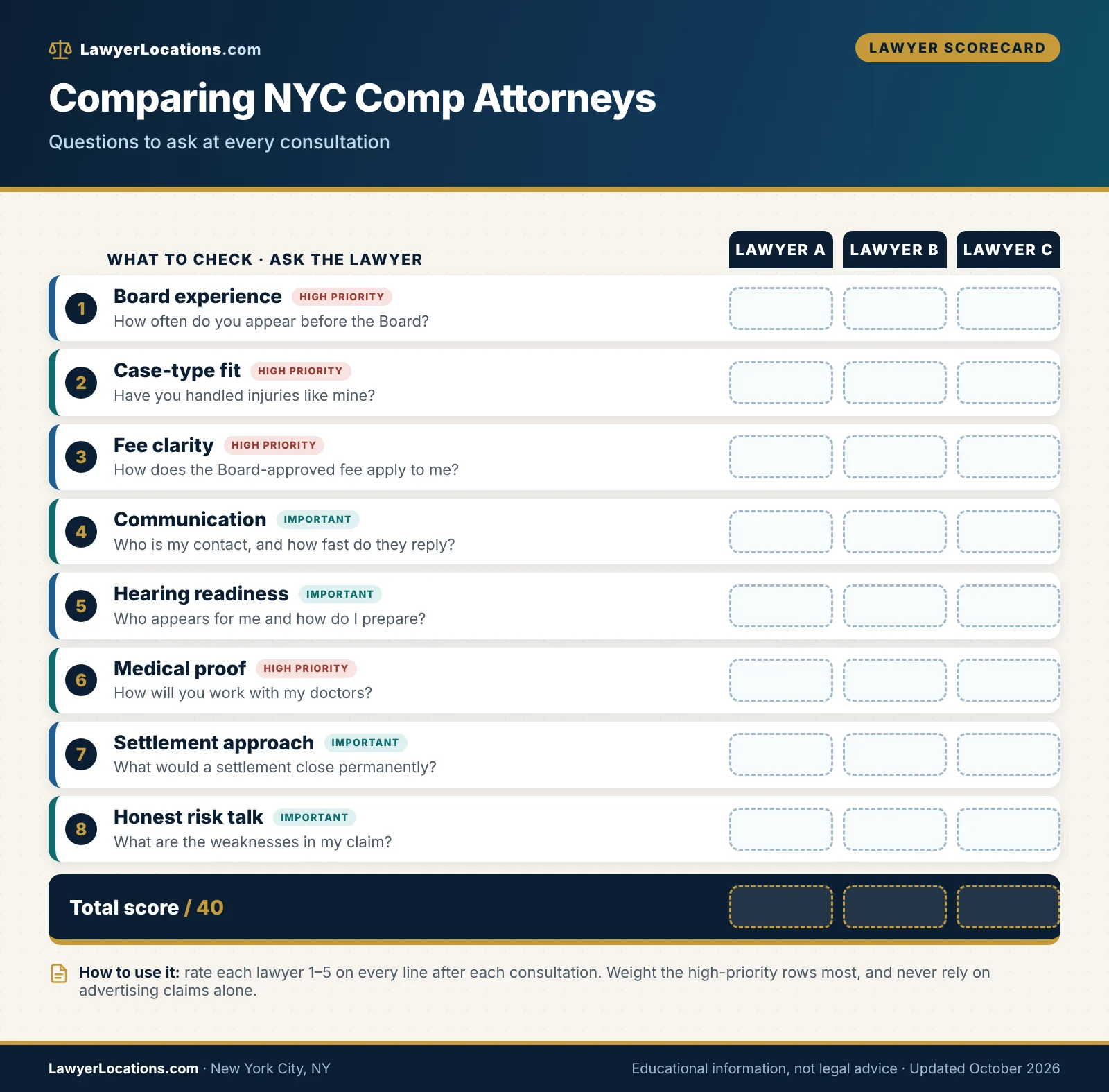
Text version of this graphic
- Board experience: how often does the lawyer appear before the Workers’ Compensation Board?
- Case-type fit: has the lawyer handled injuries or illnesses like yours?
- Fee clarity: can the lawyer explain the statutory fee schedule and Board approval?
- Communication: who is your contact and how fast are messages answered?
- Hearing readiness: who appears at hearings and how are you prepared?
- Medical proof: how will the lawyer work with your treating doctors?
- Settlement approach: how will the lawyer explain what a Section 32 agreement closes?
- Honesty about risk: does the lawyer discuss weaknesses without promising results?
Red flags and green flags in a first meeting
Most problems with lawyer relationships show up in the first conversation. Notice how the lawyer handles uncertainty and money.
Warning signs
- Promises of a specific result, payout or timeline.
- Asking you to pay a fee that has not been approved by the Board, which New York law treats as unenforceable and, for charging an unapproved fee, a misdemeanor.
- Pressure to sign an engagement agreement or a settlement immediately.
- Vague answers about who will work on your file.
- Advice to skip medical treatment or to hide a prior injury from the carrier.
Encouraging signs
A lawyer who describes both strengths and weaknesses of your claim is usually giving you realistic information. Clear explanations of the 30-day and two-year rules, a willingness to describe the fee schedule in plain words, and a written engagement letter are all good signs. Take notes, and consider meeting with two or three lawyers before you decide.
If someone says they can take a fee outside of Board approval, step back. Under WCL § 24, a fee is not enforceable unless the Board approves it.
Checking credentials and using a comparison table
Credentials verification takes a few minutes and is worth doing. A table helps you compare calmly after the meetings are over.
Verify before you sign
Confirm that the person is licensed to practice law in New York through the state court system’s attorney directory, and read any engagement agreement fully. Ask for the agreement in writing, ask what happens if you change lawyers, and keep copies of everything you sign. Remember that this website is a legal-education resource and does not rate, rank or vouch for any lawyer.
A simple side-by-side comparison
Use the grid below after each consultation. Fill it in the same day while the conversation is fresh.
| Factor | What to ask | What a clear answer sounds like | What should concern you |
|---|---|---|---|
| Board experience | How much of your work is New York workers’ compensation? | Specific description of Board practice and hearing types | Vague “we handle all injury cases” with no detail |
| Fee explanation | How does the statutory schedule apply to my case? | Explains the schedule, Board approval and payment from the award | Fees quoted that ignore Board approval |
| Who works on my file | Who is my day-to-day contact and who appears at hearings? | Named roles and a stated back-up | Cannot say who will appear for you |
| Medical strategy | How will you work with my treating doctors? | Describes obtaining reports and addressing carrier medical opinions | Tells you to change doctors without explanation |
| Settlement philosophy | When is a waiver agreement appropriate? | Discusses future medical needs and what closing the claim means | Pushes quick settlement before your condition is clear |
| Language and access | Can I meet in my language and by video or in person? | Describes interpreters and scheduling flexibility | Dismisses access needs |
Attorney Fees, Costs and Decision Points
In New York, attorney fees in workers’ compensation are not freely negotiated. They are set by WCL § 24 and must be approved by the Board, and an approved fee becomes a lien on the compensation awarded.
How the statutory fee schedule works
The statute ties fees to the kind of benefit won. The percentages below are the schedule’s own language, summarized from the statute and the Board’s 2023 notice of the rule changes.
The fee schedule by type of benefit
| Type of benefit | Fee formula |
|---|---|
| Continuing temporary total or partial disability | One-third of one week’s compensation |
| Increase in compensation for a prior period of temporary disability | 15% of the increase |
| Schedule loss of use or permanent facial disfigurement | 15% of compensation due above prior payments |
| Permanent total or certain permanent partial disability | 15% of compensation due above prior payments, plus a sum equal to 15 weeks of compensation |
| Death benefits | Same formula as permanent disability, applied to death benefits |
| Section 32 waiver agreements | 15% of benefits payable under the approved agreement, excluding amounts allocated to future medical expenses |
According to the Board, a written fee application on a Board-prescribed form is required for any fee over $1,000. The Board must approve fees commensurate with the services rendered and the amount awarded, with due regard for the claimant’s financial state. In practice that means you generally do not pay a lawyer out of pocket up front; the fee comes from the compensation awarded, in the manner the Board fixes.
Suppose a hypothetical worker’s weekly compensation rate is $900. The one-third-of-one-week formula would produce a fee of $300 for that continuing-benefits stage. If a separate schedule loss of use award exceeded the carrier’s earlier payments by $20,000, the 15% formula would produce $3,000. These numbers are invented to show the arithmetic and are not a prediction for any real claim.
What the formulas do not tell you
The statute does not describe every cost that can arise in a claim, and a fee approval is not the same as a bill for outside expenses. Ask your lawyer in writing whether any costs, such as medical records or reports, are handled separately, who pays them, and how they are treated if the case does not succeed. Our guide on the cost of hiring a wrongful death lawyer shows how contingency-style arrangements work in a different practice area, which can help you see why workers’ compensation is more regulated.
Approval, liens and what happens if there is a dispute
A lien is a legal claim on money. Here, it means the Board-approved attorney fee is taken from your compensation award, in the manner the Board directs, instead of being billed to you separately.
Board oversight is the main consumer protection in this system. You can use it.
Board approval and the lien
Approved fees become a lien upon the compensation awarded and are paid only in the manner fixed by the Board. When a client changes lawyers, the Board decides how the total fee is divided between the prior and current attorneys. Keep copies of any fee application and any Board decision approving a fee.
If you disagree about a fee
If you think a requested fee is wrong, say so promptly and in writing to your lawyer, and look for the Board’s instructions on how to object to a fee application. The Board’s general line, (877) 632-4996, can direct you to the correct process. Do not simply ignore Board notices about fee requests, because they can have deadlines.
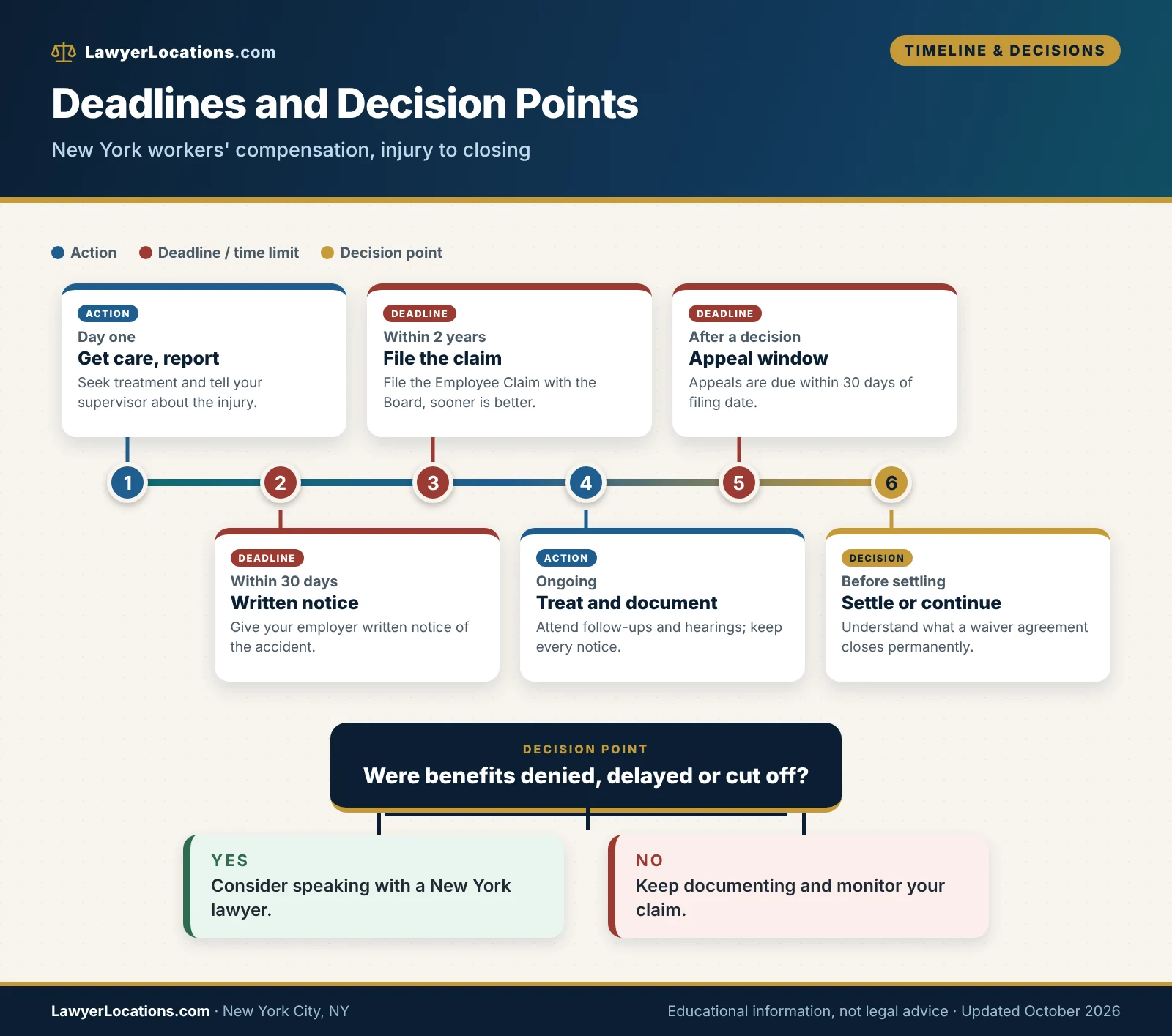
Text version of this graphic
- Day of injury: get medical care and report the injury to your supervisor.
- Within 30 days: give your employer written notice.
- As soon as possible, and within two years: file the Employee Claim (Form C-3).
- Ongoing: attend medical follow-ups and any hearings; keep records.
- Within 30 days of a Board decision: file any appeal.
- Before any settlement: decide whether to accept a Section 32 waiver agreement.
Decision point: Has the carrier denied, delayed or cut off benefits? If yes, consider talking with a lawyer. If no, keep documenting and monitor the claim.
Timeline of decisions from injury to closing
Your money and your rights usually turn on a handful of decision points. Knowing them in advance keeps you from making them under pressure.
Early decisions
The first decisions are simple but time-sensitive: seek treatment, tell the employer in writing, and file the claim. If you wait for the employer to do it, you may discover too late that nothing was filed. The Board notes that filing the Employee Claim yourself is helpful even though your employer must also report the incident.
Mid-claim and late-claim decisions
Later choices include whether to hire or change a lawyer, whether to accept the carrier’s proposed medical examiner or return-to-work plan, whether to appeal, and whether to settle. The Board’s appeal rule is a short clock: a written appeal must be made within 30 days of the filing date of the decision, and a panel of three Board members reviews it. Write that date on a calendar the day any decision arrives.
An appeal of a Board decision is due within 30 days of the filing date. If you are unrepresented and a decision arrives, call the Board number printed on it right away.
Evidence, Common Mistakes and Your Next Steps
The strongest claims are built from simple documents gathered early. Most avoidable losses come from a handful of mistakes, such as missing a notice or settling before the medical picture is clear.
Evidence and documents to gather
Bring organized paper to your consultation. A lawyer can do more with a clean file in thirty minutes than with a memory in two hours.
Core documents
- A copy of your written notice to the employer and any incident report.
- Your claim filing confirmation (Form C-3) and any Board notices or hearing letters.
- Pay stubs, tax forms or other wage records from the period before the injury, including overtime and second jobs.
- Medical records, discharge papers, prescriptions and referrals.
- Names and contact details of any coworkers who saw the accident.
- Any letters from the carrier, including denials, requests for statements or notices of independent medical examinations.
Records of your day-to-day experience
Keep a brief log of symptoms, missed shifts, travel to appointments and out-of-pocket costs. The Board’s fact sheet mentions Form C-257 for reimbursement of travel and other necessary expenses, to be submitted at least every six months. Photographs of the workplace hazard or visible injury can also help, as long as you take them safely and lawfully.
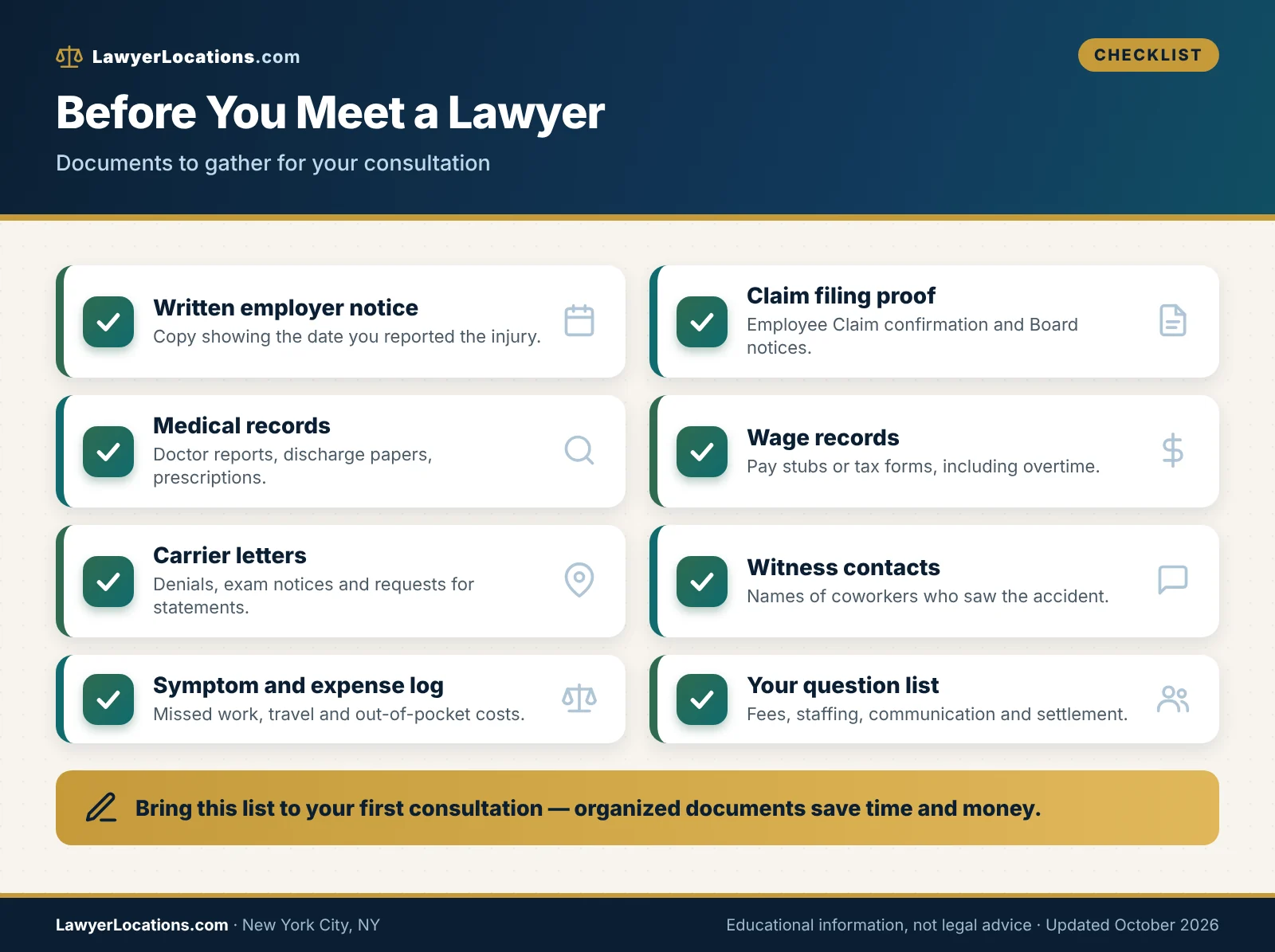
Text version of this graphic
- Written notice to employer with date
- Claim filing confirmation (Form C-3)
- Medical records and doctor reports
- Pay stubs and wage records
- Carrier letters and Board notices
- Witness names and contacts
- Symptom, work and expense log
- List of questions for the lawyer
Common mistakes and how to avoid them
Most of these errors are easy to prevent once you know about them.
Mistakes that damage claims
- Reporting the injury only by phone or in conversation, with no written record.
- Waiting until the claim is denied before filing your own Employee Claim.
- Missing medical appointments or gaps in treatment that a carrier can use against you.
- Being vague or inconsistent about prior injuries to the same body part.
- Signing a settlement or release before you understand what future care you may need.
- Posting about your activities on social media while a claim is disputed.
Honesty matters
Accuracy protects you. The Board’s claim materials note that a form C-3.3 release of health information is required if you previously injured the same body part or had a similar injury. Disclose it. Prior conditions do not automatically defeat a claim, but concealment can create far bigger problems than the condition itself.
If your employer pressures you not to file, threatens your job, or retaliates after you file, write down what was said and when. Tell your lawyer or the Board promptly, and ask a lawyer how New York law protects workers in that situation.
Your next steps
Ask each lawyer to explain, in their own words, what you should do in the next seven days. A concrete answer is a good sign that they have read your facts.
You do not have to do everything at once. A short, ordered list keeps you moving.
A simple action plan
- Protect your health. Get treated and tell the provider the injury is work-related.
- Protect your deadlines. Send written notice to your employer within 30 days and file Form C-3 as soon as you can, within two years.
- Organize your paper. Assemble the documents in the checklist above.
- Talk to the Board or a referral service. Use the numbers in the contact table if you need basic answers or a lawyer referral.
- Interview at least two attorneys. Use the comparison table and compare the fee explanations.
- Decide with full information. Do not settle until you understand your long-term medical needs.
When your search is for a workers compensation attorney in New York City
If you are still deciding how to find a workers compensation attorney in New York City, NY, begin with the questions in this guide and the Board’s own resources. Choose someone who explains the rules clearly, respects the fee approval process and treats you as a partner in the case. If your injury was caused in part by a third party, ask about that as well, and consider reading about motorcycle accident claims in New York City if you were hurt on the road while working. For a comparison with another large-city system, see our guide to workers’ compensation lawyers in Los Angeles.
Ready to compare your options?
Write down your accident date, the date you notified your employer, and the date you filed or plan to file your claim. Then use the scorecard and the comparison table above to interview two or three attorneys licensed in New York. This site does not recommend or rate lawyers, and nothing here promises any result.
Quick answers to common questions
These are the short versions of questions injured New York City workers often ask. They are general information, and your own facts may change the answer.
Deadlines and filing
How long do I have to report a work injury in New York?
Under WCL § 18, notice must go to your employer within 30 days after the accident. Late notice can sometimes be excused, but written notice inside 30 days is the safe course.
How long do I have to file a workers’ compensation claim in New York City?
The general rule under WCL § 28 is two years after the accident, with special timing for occupational disease and death. The Board advises filing as soon as possible.
Do I have to file the claim myself if my employer says they will?
The Board notes that filing the Employee Claim yourself is helpful even though your employer must also report the incident. Keep a copy of whatever you file.
Will I have to go to a hearing in person?
Hearings are virtual unless a party asks the judge for an in-person hearing. In-person visits to Board offices are by appointment only.
Lawyers and fees
Do I need a workers’ compensation attorney in New York City?
Not always. Many routine claims are paid without a dispute, but a lawyer can help when benefits are denied, treatment is cut off, you face a possible permanent injury, or a settlement is proposed.
How much does a workers’ compensation lawyer cost in New York?
Fees follow the statutory schedule in WCL § 24(2) and need Board approval, so there is no negotiated hourly rate. Approved fees come out of the compensation awarded.
Can I switch lawyers during my claim?
Yes, you can change representation. When there is a substitution, the Board decides how the total fee is divided between the prior and current attorneys.
Can I settle my claim and still get medical care later?
It depends on what the agreement covers. A Section 32 agreement may settle indemnity, medical, or both, and the settled portion cannot be reopened, so ask exactly which benefits would be closed.
General information only. This article is educational and is not legal advice. Reading it does not create an attorney-client relationship, and LawyerLocations.com is not a law firm and does not endorse or rank any lawyer. Laws, benefit rates, fees, deadlines and Board procedures change, so check current official sources and consult a lawyer licensed in New York about your situation.
Sources & References
Show all 13 sources
- N.Y. Workers’ Compensation Law § 18 (notice of injury) — NewYork.Public.Law (reproducing state statute text) — newyork.public.law — accessed October 2026
- N.Y. Workers’ Compensation Law § 28 (limitation of time for filing claims) — NewYork.Public.Law — newyork.public.law — accessed October 2026
- N.Y. Workers’ Compensation Law § 24 (approval of attorney fees) — NewYork.Public.Law — newyork.public.law — accessed October 2026
- Board Subject Number 046-1572, attorney fee changes effective January 1, 2023 — New York State Workers’ Compensation Board — wcb.ny.gov — accessed October 2026
- Board Subject Number 046-1805, maximum and minimum weekly benefit rates for July 1, 2026 – June 30, 2027 — New York State Workers’ Compensation Board — wcb.ny.gov — accessed October 2026
- Workers’ Compensation Benefits: maximum weekly benefit schedule — New York State Workers’ Compensation Board — apps.wcb.ny.gov — accessed October 2026
- File a Claim fact sheet — New York State Workers’ Compensation Board — apps.wcb.ny.gov — accessed October 2026
- Board Subject Number 046-938, permanent partial disability caps and redetermination — New York State Workers’ Compensation Board — wcb.ny.gov — accessed October 2026
- Section 32 Waiver Agreements — New York State Workers’ Compensation Board — wcb.ny.gov — accessed October 2026
- Board locations, contact numbers and appointment information — New York State Workers’ Compensation Board — wcb.ny.gov — accessed October 2026
- Important check-in requirements for in-person hearings/appointments in Brooklyn and Manhattan (bulletin, September 25, 2024) — New York State Workers’ Compensation Board — content.govdelivery.com — accessed October 2026
- 9/11 Assistance Programs — New York State — ny.gov — accessed October 2026
- Find a Qualified Lawyer in New York City (Legal Referral Service) — New York City Bar Association — nycbar.org — accessed October 2026
Legal Disclaimer and Limitation of Liability
Informational and illustrative purposes only. This article was prepared by LawyerLocations.com solely on the basis of the information available to us at the time of writing. It is an illustrative, general overview. It is not a complete or authoritative statement of the law, and it has not been reviewed by a lawyer licensed in your state or county.
Not legal advice. Nothing in this article is legal, financial, tax or immigration advice, and reading it does not create an attorney-client relationship between you and LawyerLocations.com or any author, lawyer or firm mentioned. Laws, court rules, fees, filing deadlines and agency procedures differ by state, county and court, and they change often. Some details here may be simplified, incomplete or out of date, and time limits for legal claims can be short.
No warranty. We make no representation or warranty, express or implied, about the accuracy, completeness, timeliness or suitability of this content for your situation. Please do not rely on it to make, delay or skip any legal decision. Check the facts against official sources and speak with a licensed attorney in the relevant jurisdiction before you act.
Limitation of liability. To the fullest extent permitted by law, LawyerLocations.com and its owners, authors and contributors disclaim all liability for any loss, damage, cost or other consequence arising from the use of, or reliance on, this article, including any content on third-party websites we link to. Mentioning a lawyer, firm, organization or service is not an endorsement and is not a promise of any result. If you are in immediate danger, contact your local emergency number.