Anyone searching for a “motorcycle accident lawyer new york city ny” is usually trying to answer three questions: what New York law does differently for riders, what a lawyer will charge, and how to compare one lawyer against another. The biggest rider-specific rule is that New York’s no-fault system generally does not cover people hurt while riding a motorcycle, so medical bills often do not come from a car-style no-fault policy. Fault rules also changed in 2026 for many motor vehicle injury lawsuits, and deadlines run from 90 days to 3 years depending on who is responsible.
This guide covers the New York statutes that matter, the courts and agencies in the five boroughs, how contingency fees are regulated, and a practical way to interview lawyers. It is general information, not advice about your crash.
How a Motorcycle Injury Case Works in New York City
A motorcycle injury claim in New York City is usually a negligence case: you show that a driver, a company or a government body failed to use reasonable care and that the failure injured you. What makes it different from a car crash is the insurance layer on top. A rider generally cannot lean on no-fault benefits, so the claim often rests on health insurance, the at-fault party’s liability policy and any uninsured or underinsured coverage you bought.
If you are mainly shopping for representation, jump ahead to the comparison section.
The path from crash to resolution
Most claims move through the same stages, even though the length of each stage varies a great deal.
Medical care, reports and notice
Everything starts with treatment and with records. Seek medical care promptly, report the crash to police if officers did not come to the scene, and keep every discharge paper. If a city agency, the transit authority or another public body may share fault, a written notice of claim has its own short clock, covered in Section 3.
Investigation and insurance claims
A lawyer typically sends preservation letters, gathers the police report and photographs, identifies every insurance policy that might apply, and opens the claim with the at-fault driver’s insurer. Your own policy matters too, because uninsured and underinsured coverage can be the only realistic source of recovery when the other driver carries minimal limits or none.
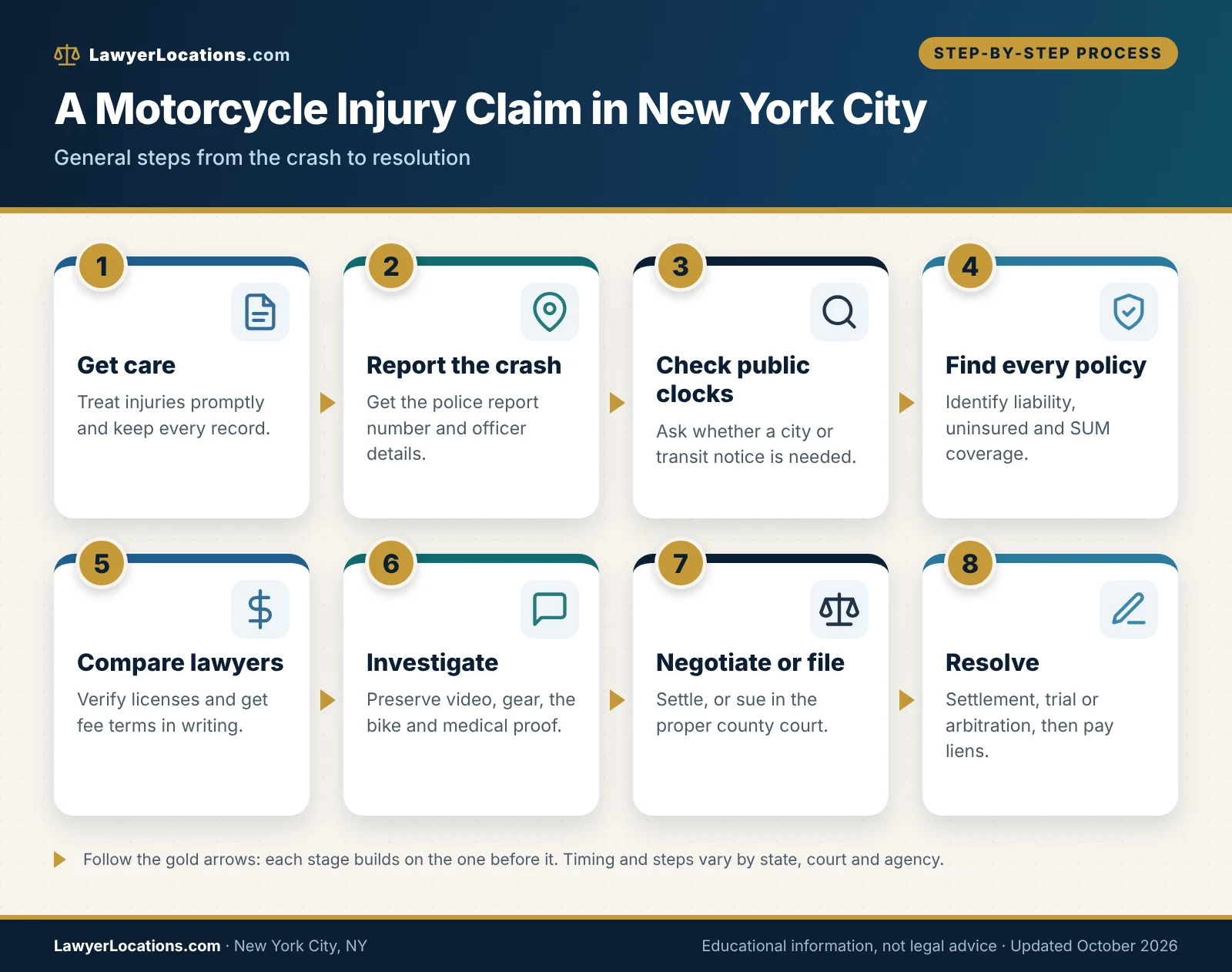
Text version of this graphic
- Get medical care and keep the records.
- Report the crash and get the police report number.
- Note any public-entity deadline (90-day notice of claim).
- Identify every insurance policy that could apply.
- Compare and hire a lawyer in writing.
- Investigate, treat and document the injury.
- Negotiate, or file suit in the right county.
- Resolve by settlement, trial or arbitration.
Who the other side usually is
Who is on the other side shapes both the deadline and the insurance analysis.
Private drivers and commercial vehicles
Most claims involve a private driver’s liability policy. Delivery vans, box trucks, buses, taxis and app-based vehicles may be covered by commercial or fleet policies with different limits and different insurers. A good intake call surfaces every vehicle and every possible employer so that no policy is overlooked.
Public bodies, roads and transit
If a city bus, a city-owned vehicle or a defective roadway played a role, the public-entity rules apply from day one. These claims need a sworn written notice within 90 days and a lawsuit within one year and 90 days, far shorter than the general three-year period.
Why a rider’s case is valued differently
Riders are exposed in ways car occupants are not, and insurers scrutinize a rider’s own conduct.
Injury severity and medical proof
Fractures, road rash, head and spinal injuries and long recoveries are common in motorcycle collisions. Because a claim often covers future care and lost earning ability, thorough medical documentation does a lot of work.
Fault arguments aimed at the rider
Defense insurers often argue that the rider was speeding, lane-splitting, unlicensed or poorly equipped. Under the fault rules covered next, even a partly successful argument can reduce a recovery or, in some motor vehicle cases filed after May 26, 2026, bar it. Early evidence about speed, lane position and visibility matters.
New York Law That Shapes a Rider’s Claim
Four bodies of law do most of the work: Article 51 of the Insurance Law (the no-fault statute), the fault rules in the Civil Practice Law and Rules (CPLR), the Vehicle and Traffic Law (VTL), and the insurance statutes governing uninsured drivers. These are state rules that apply the same way in all five boroughs.
No-fault and the motorcycle exception
New York’s no-fault system pays medical bills and a share of lost earnings regardless of who caused a car crash. Motorcycles are carved out of that system, which surprises many riders who assume their car insurance will help.
Why motorcycle occupants are generally outside no-fault
Under Ins. Law § 5102(f), “motor vehicle” for no-fault purposes does not include a motorcycle as defined in subdivision (m). Under Ins. Law § 5103(a), the coverage grants for the named insured and household members apply to people “other than occupants of a motorcycle,” and the grant for people injured by an insured vehicle applies to people “other than occupants of another motor vehicle or a motorcycle.” Put together, neither your own auto policy nor the policy on the car that hit you generally pays no-fault benefits to a rider or passenger.
What pays the bills instead
Without no-fault, early medical costs usually fall on your health insurance, Medicare or Medicaid where you qualify, workers’ compensation if you were on the job, or any medical-payments coverage your own motorcycle policy may include. Those payers can have repayment rights if you later recover money from someone else. Ask both your lawyer and your motorcycle insurer what your own policy includes, and get the answer in writing.
| Who was hurt | No-fault benefits? | Why, in short |
|---|---|---|
| Rider hit by a car | Generally no | § 5103(a) excludes occupants of a motorcycle from the grants; § 5102(f) excludes motorcycles from “motor vehicle.” |
| Passenger on the motorcycle | Generally no | A passenger is an occupant of the motorcycle, which the same sections exclude. |
| Car occupant hit by a motorcycle | Usually yes, through the car’s own policy | The car is a “motor vehicle” and its occupant is a covered person under § 5102(j). |
| Pedestrian hit by a motorcycle | Depends on the policy and facts | § 5103(f) addresses motorcycle owners’ first-party benefits for people other than occupants of that motorcycle. |
| Rider hit by an unidentified car | Generally no; other routes may exist | MVAIC and uninsured-motorist coverage are separate systems (see below). |
Serious injury, fault and the 2026 changes
The “serious injury” threshold and the rules for how fault reduces a claim matter as much as the no-fault exception. Both were amended in 2026, so older web articles may be out of date.
The serious injury threshold and riders
Under Ins. Law § 5104(a), a person covered by no-fault can sue another covered person for pain and suffering only after proving a “serious injury” as defined in § 5102(d). The statute is written for lawsuits “by or on behalf of a covered person against another covered person.” Because a rider is generally not a covered person, the serious injury threshold generally is not the gatekeeper for a rider’s own claim against a driver, although the defense may still argue about the nature and extent of the injuries. A pedestrian or car occupant suing a motorcyclist is in a different position.
What changed in May 2026
The state budget legislation signed on May 26, 2026 (Chapter 58 of the Laws of 2026, Part EE) amended Ins. Law §§ 5102(d) and 5104 and CPLR 1411, according to a New York Department of Financial Services circular letter. The current text of § 5102(d) no longer lists the old 90/180-day category of serious injury. The circular letter states that the changes apply to actions and proceedings commenced on or after May 26, 2026, so the date a lawsuit is filed, not the crash date, is the trigger.
Many articles still describe New York as a pure comparative fault state for every injury case. Since May 2026, CPLR 1411(b) adds a bar rule for personal injury actions “subject to article fifty-one of the insurance law.” Whether and how that reaches a rider’s own claim is a question to put directly to any lawyer you interview.
Comparative fault under CPLR 1411
New York has long reduced a recovery by the injured person’s share of blame instead of barring it. That general rule remains in place, with a new exception layered on top.
The general rule: pure comparative fault
Under CPLR 1411(a), in a personal injury action the claimant’s own “culpable conduct” does not bar recovery; instead damages are reduced in proportion to the share of fault attributed to the claimant. A rider found 30 percent at fault for a $100,000 verdict would, under that rule, receive $70,000. That arithmetic is only an illustration of the formula, not a prediction about any case.
The new exception in CPLR 1411(b)
Subdivision (b), added in 2026, provides that in an action for personal injury subject to Article 51 of the Insurance Law, a claimant’s culpable conduct bars recovery if it is greater than the defendant’s, or greater than the combined conduct of multiple defendants. In plain English, a claimant found more than 50 percent responsible can lose the claim entirely. Because motorcycles sit awkwardly in Article 51, commentators describe application to injured riders as unsettled, and a lawyer’s analysis should address it.
The general limitation period for a New York personal injury lawsuit is three years under CPLR 214(5). Claims against New York City, the Transit Authority and similar public bodies run on a much shorter track (90 days for notice, one year and 90 days to sue). Longer general-purpose articles on this site, such as how long you have to file a personal injury claim, explain deadlines across states.
Helmets, lane use and licensing rules that insurers raise
Defense insurers read the Vehicle and Traffic Law looking for rider violations. Knowing the main rules helps you talk with a lawyer about how they might be used.
Helmet and eye protection
VTL § 381(6) requires any person who operates or rides on a motorcycle on public highways to wear a helmet that meets the federal standard cited in the statute (FMVSS 218). Subdivision 7 separately requires operators to wear goggles or a face shield of a type approved by the commissioner. A violation of section 381 is punishable by a fine of up to $100 under subdivision 13, and the facts of helmet use can come up when the other side argues about damages or fault.
Lane position and lane splitting
VTL § 1252 lets a motorcycle use a full lane and bars other drivers from depriving it of that lane. It also limits riders to two abreast, prohibits passing within the same lane, and states that no person shall operate a motorcycle between lanes of traffic. Insurers frequently raise lane splitting in stop-and-go city traffic.
Lane splitting is not legal in New York, so a rider who passes between lanes invites a fault argument even if a driver also made a mistake.
License and registration
The New York DMV says you need a Class M or MJ license or learner permit to operate a motorcycle. Riders start with a written test (20 questions, 14 correct required), and an approved Basic Rider Course can waive the road test if other conditions are met. An unlicensed or unregistered rider is not automatically barred from a claim, but those facts invite fault arguments and can affect coverage, so disclose them to a lawyer early.
Uninsured, underinsured and hit-and-run crashes
Because no-fault does not help riders, the other major safety net is coverage for crashes involving drivers with too little insurance or none at all.
Minimum limits and why they are low
The Department of Financial Services states that New York’s minimum liability limits are $25,000 for injuries to one person, $50,000 for injuries to all persons in one accident, and $10,000 for property damage. Those amounts can be exhausted by a single hospital stay. $25,000 per person is therefore a floor, not a measure of what a serious injury is worth.
Uninsured motorist and SUM coverage
The same agency says uninsured motorist coverage is required in auto policies, and that supplementary uninsured/underinsured motorist (SUM) coverage is optional and can be purchased up to the policy’s bodily injury liability limits. Under Ins. Law § 3420(f), SUM payment requires that the other driver’s liability limits be exhausted. Whether and how those coverages appear on a particular motorcycle policy is something to read in the policy and confirm in writing with the insurer.
MVAIC for uninsured and unidentified drivers
The Motor Vehicle Accident Indemnification Corporation (MVAIC) exists for qualified people injured by uninsured or unidentified motorists. Under Ins. Law § 5208, an affidavit generally must be filed within 180 days for a claim against an uninsured motorist, and for an unidentified (hit-and-run) driver the accident must be reported to police within 24 hours and the affidavit filed within 90 days. Late filing can be excused in limited circumstances.
These are among the shortest clocks in the field. A hit-and-run rider should speak with a lawyer or MVAIC quickly.
Courts, Police Reports and Claims Against the City
New York City has five county-level trial courts, one police department that writes most crash reports, and a city government with its own claims process. Knowing which door to knock on, and when, matters.
Where a lawsuit is filed in the five boroughs
Personal injury lawsuits of any size are usually brought in the Supreme Court, which in New York is the main trial-level court despite its name. Each borough is its own county, with its own Supreme Court courthouse and County Clerk.
The Supreme Court in each county
The five counties are New York (Manhattan), Kings (Brooklyn), Queens, Bronx and Richmond (Staten Island). The New York County Supreme Court, Civil Term, is at 60 Centre Street, according to the court’s own page. The Kings County Supreme Court, Civil Term, is at 360 Adams Street in Brooklyn, according to its court page. For Queens, the Bronx and Richmond County, confirm the current civil courthouse address on the New York State Unified Court System website, because courthouses and part locations change.
Which county is proper
New York’s venue rules, found in Article 5 of the CPLR, decide which county can hear a case. A lawyer will usually choose among proper counties, and that choice can affect how quickly a case is reached for trial and how the jury pool looks. Do not assume that the borough where the crash happened is the only option, and do not choose a county yourself without advice.
Filing basics: e-filing and court fees
Most new civil cases in the New York courts are started electronically, and a few fixed fees apply once a case is filed.
NYSCEF electronic filing
The New York County Supreme Court page states that most new civil cases “must be commenced and pursued electronically” through the New York State Courts Electronic Filing System (NYSCEF), with listed exceptions. People who represent themselves may choose to file on paper. In practice, your lawyer handles this, and you can usually follow the docket online.
Fees to start and prepare a case for trial
The state courts’ filing fee page lists the amounts in the table below. They are court charges, separate from any lawyer’s fee, and a contingency-fee lawyer commonly advances them as a case expense that is repaid from a recovery according to the retainer agreement.
| Step | Fee | What it does |
|---|---|---|
| Index number | $210 | Opens the case and assigns the number used on every filing. |
| Request for Judicial Intervention (RJI) | $95 | Asks the court to assign a judge once something needs a judge’s attention. |
| Note of Issue | $30 (listed as $125 where no RJI is required) | Tells the court the case is ready to be placed on the trial calendar. |
| Jury demand | $65 | Requests a jury trial instead of a judge-only trial. |
Civil Court versus Supreme Court
The New York City Civil Court handles smaller claims; the New York County Supreme Court page describes the line as $50,000 or less. Serious motorcycle injury claims often exceed that range.
The NYPD report and the DMV crash report
The police report is often the first neutral document in a motorcycle case, and it frequently contains driver information, insurance details, witness names and an officer’s diagram.
The NYPD collision report
The NYPD refers to its collision report as the MV-104AN in its public collision FAQ. That FAQ describes the Highway District Collision Investigation Squad, which investigates the most serious collisions, and says the MV-104AN is free. It also links to the NYPD’s public-records (FOIL) request page for other materials. If officers came to your crash, write down the officer’s name, the precinct and any report number before leaving the scene or the hospital.
Reporting to the DMV
The same NYPD FAQ states that when a person is injured or killed, all involved motorists and the police must file the collision report with the state DMV within 10 days of the incident. If you were hurt and a report may not have been filed, ask your lawyer or the DMV how to make sure one exists. keep your own copy of whatever you submit.
Claims against the City, the Transit Authority and other public bodies
When a government body may share blame, such as a city vehicle, a city bus or a road defect, New York’s notice-of-claim rules apply. They are strict, and they are the most common reason otherwise sound claims fail.
The 90-day notice of claim
Under General Municipal Law § 50-e, a notice of claim must generally be served “within ninety days after the claim arises.” It must be in writing, sworn to, and state the claimant’s name and address, the nature of the claim, when, where and how it arose, and the injuries claimed so far as practicable. For New York City claims, the Comptroller’s office says notices must be filed within 90 days of the incident through its online eClaim system and that notices of claim cannot be filed by email.
The one-year-and-90-day lawsuit deadline
Under General Municipal Law § 50-i, an injury action against a city, county, town, village, fire district or school district must be started within one year and ninety days after the event, and at least 30 days must pass after the notice of claim is served before suing. The Comptroller’s office also states that it cannot settle a claim after one year and 90 days or after a lawsuit has been filed. For the New York City Transit Authority, Public Authorities Law § 1212 uses the same one-year-and-90-day outer limit and requires a notice of claim under § 50-e. Other MTA agencies and state entities can fall under different statutes, so confirm which entity is involved before relying on any single number.
Count 90 days from the crash date, not from the day you finish treatment or get a diagnosis. If you are unsure whether a public entity is involved, ask a lawyer to evaluate that question first, because the notice window can close long before the ordinary three-year clock does.
Late notice and wrongful death
Section 50-e(5) allows a court, in its discretion, to extend the time to serve a notice of claim, with factors including whether the public body learned the essential facts within the period and whether the delay substantially prejudiced it. The extension cannot go beyond the time allowed to start the lawsuit. In wrongful death cases, the statute runs the 90 days from the appointment of the estate’s representative, while the lawsuit itself must be started within two years of death. A family dealing with a rider’s death should read our guide to wrongful death lawyer costs and then speak with a lawyer quickly.
| Situation | Deadline | Source |
|---|---|---|
| Lawsuit against a private driver or company | Three years from the injury | CPLR 214(5) |
| Wrongful death lawsuit | Two years from the death | EPTL 5-4.1 |
| Notice of claim, City or other public corporation | 90 days after the claim arises | GML 50-e |
| Lawsuit against the City or similar bodies | One year and 90 days; wrongful death two years from death | GML 50-i |
| Lawsuit against the Transit Authority | One year and 90 days, with a 50-e notice | Public Authorities Law 1212 |
| MVAIC claim, uninsured motorist | Affidavit within 180 days of accrual | Insurance Law 5208(a)(1) |
| MVAIC claim, unidentified driver | Police report within 24 hours; affidavit within 90 days | Insurance Law 5208(a)(2) |
| Collision report to DMV when someone is hurt | 10 days | NYPD collision FAQ |
City Crash Hazards and the Evidence That Matters
New York City riders share the road with cars, trucks, buses, bicycles, scooters and pedestrians. The legal question is always who failed to use reasonable care, but the evidence differs by hazard.
Common New York City crash patterns
No two crashes match, yet a few patterns come up often in claims involving riders. The descriptions below are about the legal issues those patterns raise, not statistics.
Left turns, doors and merging vehicles
Drivers who turn across a rider’s path or change lanes without looking are a classic source of liability. For parked cars, VTL § 1214 says no person shall open the door of a motor vehicle on the side available to moving traffic unless it is reasonably safe to do so. A door opened into a rider’s path can therefore support a negligence claim against the person who opened it, subject to the facts.
Trucks, buses, taxis and for-hire vehicles
Large and commercial vehicles bring blind spots, employer liability and often more than one insurance policy. If a driver was working, the employer or a contracting company may share responsibility. Photograph company names and plate numbers if you safely can.
Road defects, potholes and the City’s defenses
Claims about a pothole, a sunken utility cover or a broken pavement edge are among the hardest because the City has special defenses.
Prior written notice requirements
New York City’s prior-written-notice law, Administrative Code § 7-201(c)(2), is often called the Pothole Law. In a 2011 decision, Tucker v City of New York, the Appellate Division, First Department, explained that the law requires a plaintiff to show the City received prior written notice of a defect, with an exception where the City created the defect through an affirmative act of negligence. That decision involved a sidewalk tree well, so a lawyer must analyze how the rule applies to a particular roadway defect.
Acting fast on a road-defect claim
Because of the 90-day notice requirement and the prior-written-notice defense, photograph the defect with a landmark, note the exact location, and tell a lawyer within days, not months. Weather and repairs can erase the evidence quickly.
Evidence to preserve after a crash
Evidence disappears quickly: bikes get repaired, helmets get thrown out, and video gets overwritten.
What to keep and collect
- The police report number, officer name and precinct.
- Photos of the scene, road surface, skid marks, vehicles and your injuries.
- Names and phone numbers of witnesses and every driver.
- Your helmet, gloves, jacket and boots, unwashed and uncleaned.
- The motorcycle itself, until a lawyer or insurer says it may be released.
- Medical records, bills, prescriptions and out-of-pocket receipts.
- Your license, registration and insurance cards.
Video and digital evidence
Nearby businesses, buildings and buses may have cameras, and many systems overwrite footage within days or weeks. A lawyer can send preservation letters, but they work best early. Also save helmet-camera footage and messages about the crash, and avoid posting about it on social media.
Write a dated note about what happened while it is fresh: speed, lane, weather, lights, what the other driver said. Keep it for your lawyer and do not share it with an insurance adjuster before getting advice.
What the available city data does and does not tell you
Public statistics help explain why motorcycle claims in New York City are taken seriously, but they say nothing about whether any single claim will succeed.
City figures on rider deaths and injuries
A May 3, 2024 release from the New York City Department of Transportation reported 55 motorcyclist deaths in 2023, which it called an all-time high, and said injuries were up 33 percent so far in 2024 compared with the same period a year earlier (728 versus 548). Check for newer releases if you need current numbers.
Why statistics do not decide a case
A claim turns on its own facts: who was where, how fast, and what each party did. Gaps in licensing, registration or gear will not decide a case, but they are what defense insurers look for first.
How to Compare Motorcycle Accident Lawyers in New York City
Advertising does not tell you which New York City personal injury lawyer fits your situation. A fair comparison uses the same questions for every candidate, starting with whether the person is actually licensed and ending with how the fee works.
LawyerLocations.com does not rank or recommend individual lawyers, and nothing here should be read as doing so.
Choosing a motorcycle accident lawyer in New York City, NY: the basics
Two checks come before anything about style or reputation: license status and relevant experience.
Verify the license and discipline history
A New York attorney’s registration can be checked through the Office of Court Administration attorney search at iapps.courts.state.ny.us, which the New York State Bar Association points to as the official lookup. Complaints go to the Attorney Grievance Committee for the lawyer’s office location: the First Judicial Department committee for Manhattan and Bronx offices, and the Second, Eleventh and Thirteenth Districts committee for Brooklyn, Queens and Staten Island offices, according to the state courts’ guidance.
Ask about comparable cases, not slogans
Ask how often the firm handles motorcycle cases, claims against the City or the Transit Authority, and uninsured-motorist or MVAIC claims, and whether the lawyer who will work on your file has tried cases or only settled them. Be wary of any lawyer who promises a result. No honest lawyer can know the outcome before reviewing the records, and a good one explains risks as well as strengths.
Referral services and what a directory can and cannot do
Bar association referral services are one way to find lawyers whose basic credentials have been checked, and directories like this one help you learn what to ask.
Bar association referral services
The New York State Courts’ “Find a Lawyer” page names two services. The New York City Bar Legal Referral Service says it provides referrals to screened and qualified lawyers, with a first consultation of $35 or free depending on the type of case, lasting up to 30 minutes. The New York State Bar Association Lawyer Referral and Information Service says its referred lawyers charge $35 or less for a 30-minute meeting and that the meeting is free for certain problems, including personal injury. Terms can change, so confirm them when you call. ask what the referral covers
What a directory cannot tell you
Directories and review sites cannot know whether a lawyer is right for your facts. LawyerLocations.com is a legal-education resource, not a law firm. Use directories to build a short list, then check licenses and ask each lawyer the same questions.
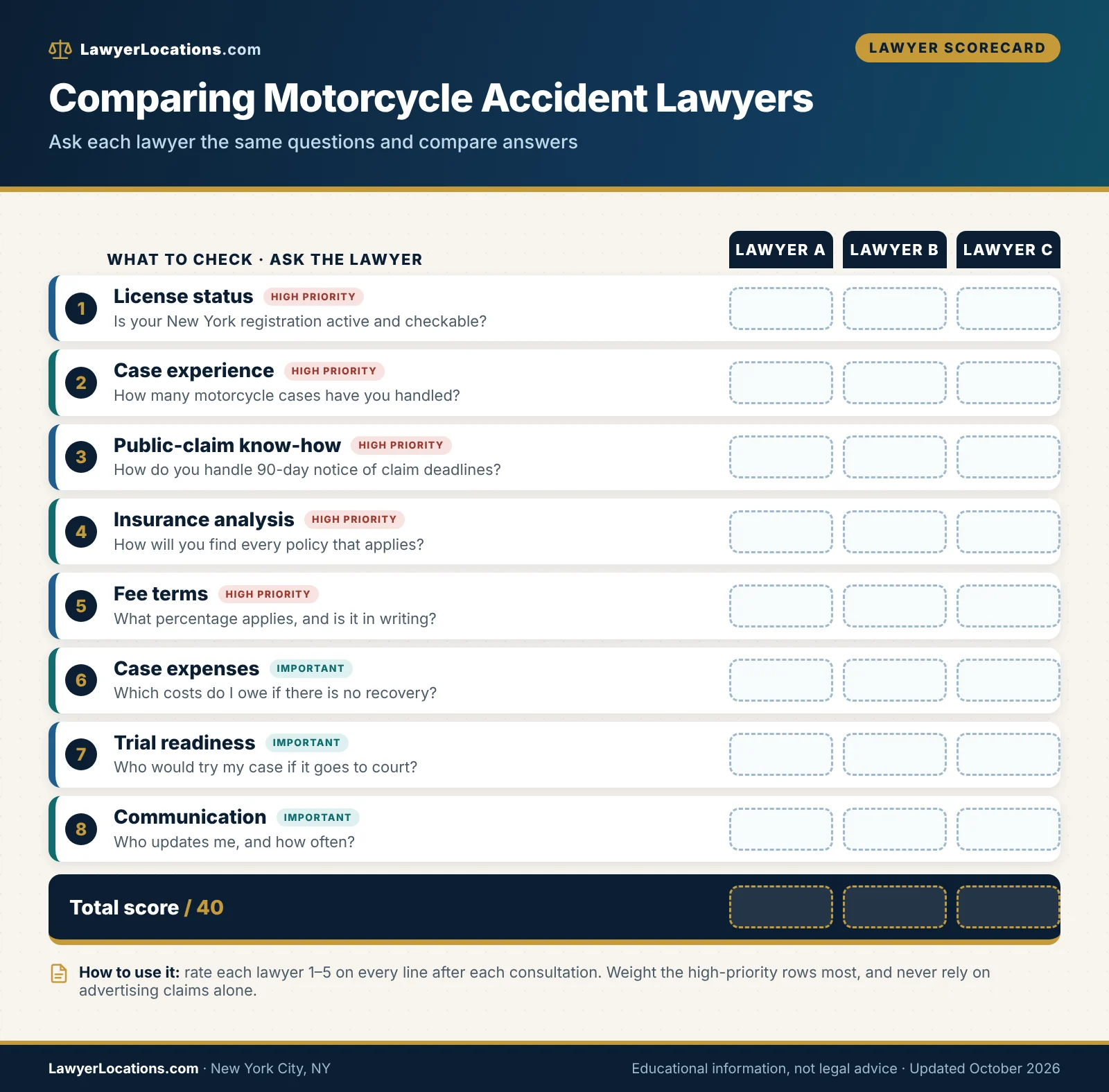
Text version of this graphic
| Criterion | Question to ask | Weight |
|---|---|---|
| License status | Is your New York registration active and checkable? | High |
| Case experience | How many motorcycle cases have you handled? | High |
| Public-entity know-how | How do you handle 90-day notice claims? | High |
| Insurance analysis | How will you find every policy that applies? | High |
| Fee terms | What percentage applies, and is it in writing? | High |
| Case expenses | Which costs do I owe if there is no recovery? | Medium |
| Trial readiness | Who would try my case if it goes to court? | Medium |
| Communication | Who updates me, and how often? | Medium |
| Topic | A useful answer | A worrying answer |
|---|---|---|
| Fault rules | Explains how the 2026 CPLR 1411(b) change might apply to a rider and what is unsettled. | Says New York is simply “pure comparative” without mentioning the 2026 change. |
| Deadlines | Names the 90-day notice, the three-year limit and any MVAIC clock that might apply. | Says there is plenty of time without asking who was involved. |
| Insurance | Plans to identify every liability, uninsured-motorist and SUM policy. | Focuses only on the at-fault driver’s minimum policy. |
| Fees | Quotes the percentage, explains expenses and gives a written agreement. | Is vague or pushes you to sign during the first call. |
Preparing for the first consultation
A prepared client gets more useful answers in a short meeting. Bring or send the items below, and write down your questions in advance.
Documents and facts to bring
Gather the police report number, photographs, medical records and bills, insurance cards for your motorcycle and any other vehicles, your license and registration, and a short written timeline. Include the facts that do not help you, such as speed, gear, lane position or alcohol, because a lawyer who learns them early can plan around them. Do not hide facts from your own lawyer; conversations with a lawyer you are consulting are generally confidential.
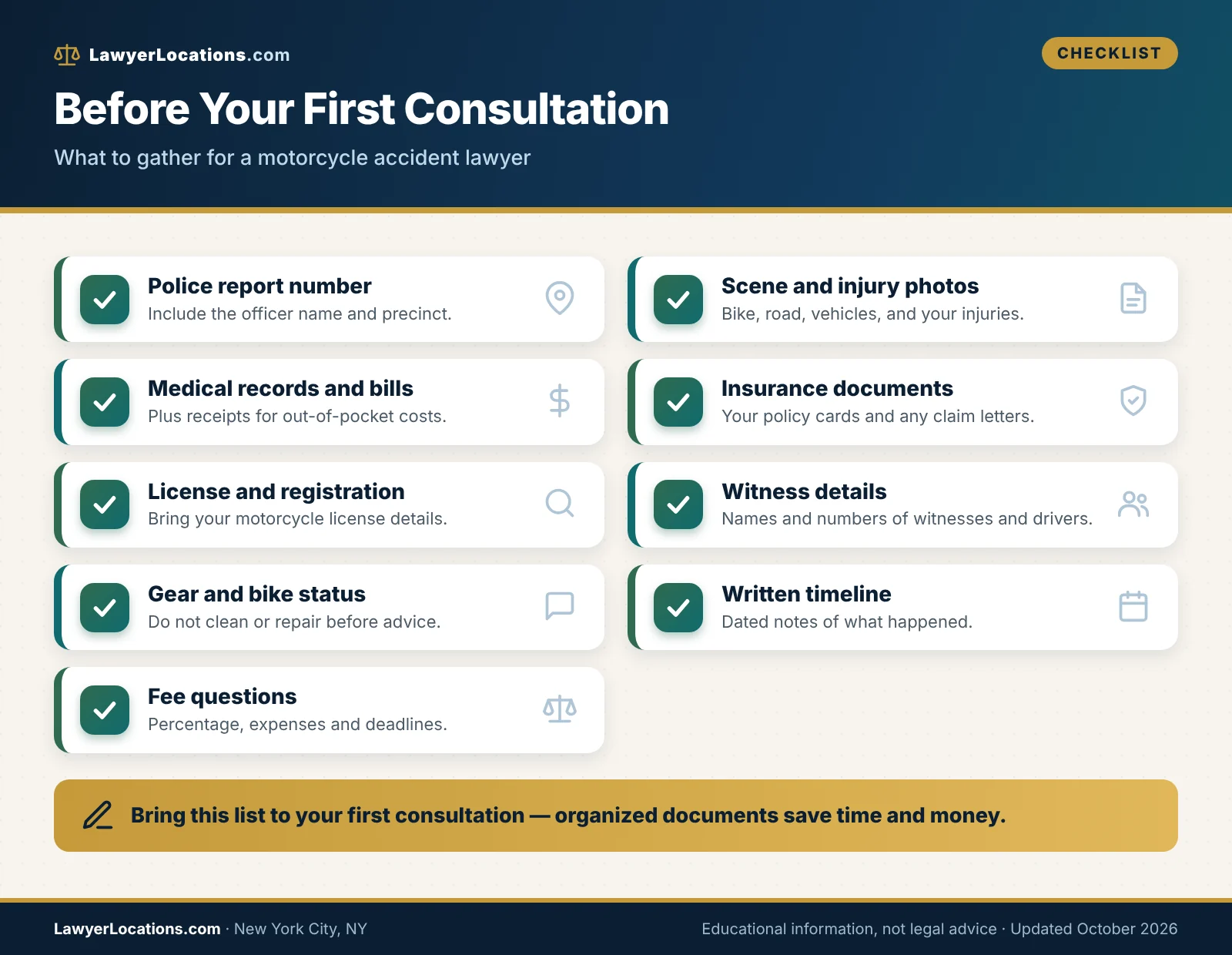
Text version of this graphic
- Police report number and officer details
- Photos of the scene, bike and injuries
- Medical records, bills and receipts
- Your insurance cards and policy documents
- License, registration and inspection details
- Names of witnesses and other drivers
- A dated written timeline of events
- Questions about fees and deadlines
What to avoid before you hire anyone
Avoid giving a recorded statement to the other driver’s insurer without advice, signing a broad medical release, or accepting a quick offer before you know the full extent of your injuries.
Red flags when you compare lawyers
Most lawyers are honest, but a few warning signs are worth knowing.
Pressure and promises
- A lawyer who promises a result or a dollar amount before reviewing records.
- Pressure to sign immediately or sign a blank form (the Second Department fee rule forbids acting under a retainer whose attorney name is left blank).
- Unsolicited contact from someone offering to “handle” your claim right after a crash.
Vague money terms
- No written fee agreement, or a percentage that changes without explanation.
- No clear answer about who pays case expenses if there is no recovery.
- Reluctance to say whether the fee is calculated before or after expenses.
Fees, Costs, Deadlines and Decision Points
Most motorcycle injury lawyers work on contingency, which means the lawyer is paid a percentage of a recovery rather than hourly. New York regulates this by court rule, and the details affect how much of a settlement you keep.
How injury lawyers are paid in New York
New York law lets lawyer and client set the fee, but court rules fix a schedule for most personal injury contingency cases.
The court-rule fee schedule
Under Judiciary Law § 474, a lawyer’s compensation is governed by agreement, express or implied. For personal injury cases, the Second Department’s 22 NYCRR § 691.20(e), which covers Brooklyn, Queens and Staten Island, sets a schedule: 50 percent of the first $1,000, 40 percent of the next $2,000, 35 percent of the next $22,000 and 25 percent of anything over $25,000. A fee at or below the schedule is deemed fair and reasonable, and the lawyer may instead charge up to 33⅓% of the sum recovered if the initial agreement says so. The Manhattan and Bronx counterpart is the First Department’s section 603.7, and the state’s retainer statement form cites both rules, but one online copy of 603.7 lists it as repealed, so confirm the current First Department text.
| Portion of recovery | Maximum fee under the schedule |
|---|---|
| First $1,000 | 50% |
| Next $2,000 | 40% |
| Next $22,000 | 35% |
| Anything over $25,000 | 25% |
| Alternative in the initial agreement | Up to 33⅓% of the sum recovered |
Extraordinary circumstances and the written agreement
If a lawyer believes the schedule would be inadequate because of extraordinary circumstances, the rule allows an application to the court, with notice to the client, and the court must give written reasons for any award above the schedule. The rule also requires an attorney who takes a contingency retainer to file a retainer statement with the Office of Court Administration within 30 days, with a separate statement for each claim. The New York City Bar Association’s consumer guide adds that until you sign a retainer agreement, the lawyer does not work for you, and that the agreement should set out the fee and the expenses you are responsible for.
Expenses, liens and what you actually receive
The percentage is only part of the picture. Expenses, repayment claims and taxes determine your take-home amount.
Case expenses and how the fee is calculated
Expenses are the out-of-pocket costs of a case, such as court fees, medical records, investigators and experts. Under section 691.20(e)(3), the percentage is applied to the net recovery, meaning the amount recovered minus certain expenses and disbursements such as expert medical testimony and investigative services, and the City Bar guide likewise says costs come out before the lawyer takes a percentage.
Ask what you owe if the case is lost. The answer should be spelled out in your written agreement before you sign.
Liens and repayment claims
Under the same rule, liens and claims by hospitals, doctors, self-insurers or insurance carriers are not deducted before the fee is computed. Health plans, Medicare, Medicaid and workers’ compensation carriers may have repayment rights, so ask a lawyer to explain how those claims will be identified and negotiated. Our car accident settlement timeline shows where those steps fall in a typical claim.
If you disagree about a fee
Fee disputes are rare but not unheard of, and New York provides two outside routes.
Fee arbitration under Part 137
The state’s Fee Dispute Resolution Program, 22 NYCRR Part 137, lets clients request arbitration of many fee disputes, and it is mandatory for the lawyer once the client asks. The program has limits: it generally covers amounts between $1,000 and $50,000 unless both sides consent, and it excludes some situations, including fees fixed by statute or rule and allowed as of right by a court. Before a lawyer sues for a fee, a notice of the client’s right to arbitrate is generally required, and the client has 30 days to respond.
Discipline complaints
Complaints about professional misconduct are different from fee disputes. They go to the Attorney Grievance Committee that serves the lawyer’s office, as described in Section 5. A grievance committee investigates conduct; it does not generally resolve who owes whom money.
A timeline of costs, deadlines and decision points
The graphic below and the deadline table in Section 3 summarize the main decision points.
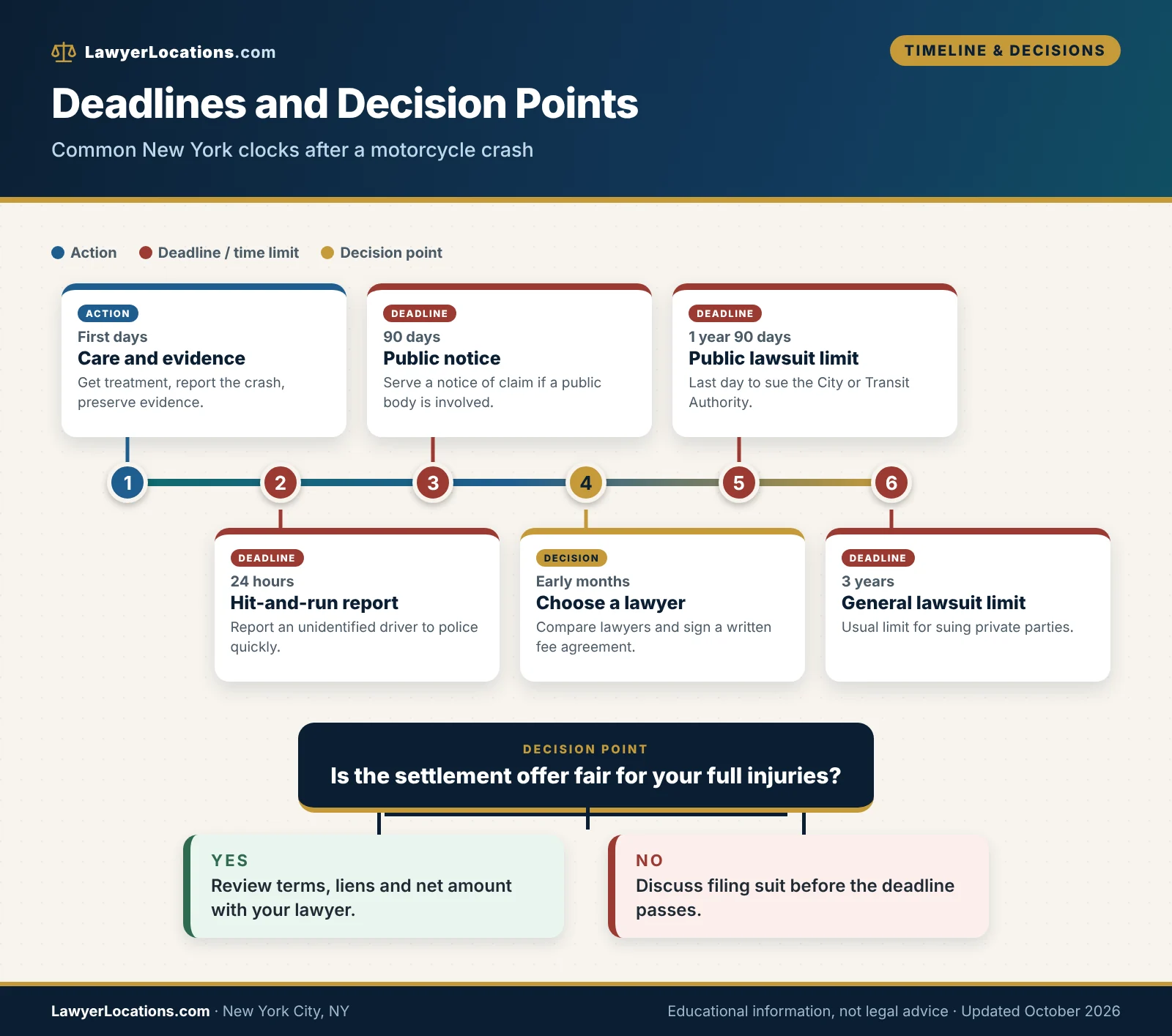
Text version of this graphic
- First days: get care, report the crash, preserve evidence (action).
- Within 24 hours: hit-and-run police report if the driver is unidentified (deadline).
- Within 90 days: notice of claim if a public body may be involved (deadline).
- Months 1–3: choose a lawyer and sign a written agreement (decision).
- Treatment period: document injuries and identify every insurance policy (action).
- Within one year and 90 days: lawsuit against the City or Transit Authority (deadline).
- Within three years: lawsuit against a private defendant (deadline).
- Decision: accept a settlement offer or file and continue toward trial.
The early months
Treatment, evidence collection, insurance identification and the choice of lawyer all happen here, and several of the shortest deadlines expire in this window.
Settle or file suit
Most claims are resolved by negotiation. Settling too early can leave ongoing medical needs unpaid, while waiting too long risks the limitation period. The right moment depends on medical stability, insurance limits, the fault evidence and your own goals.
Common Questions and Next Steps
These answers collect the questions riders ask most often. They are general, and your facts may change the answer.
Questions about coverage and fault
The first group covers insurance and legal rules that are different for motorcycles.
Does no-fault insurance pay for my motorcycle crash injuries?
Generally no. Article 51 excludes motorcycles and their occupants, including passengers, from its main coverage grants. Look to health insurance, any medical-payments coverage on your policy and the at-fault party’s liability insurance.
Do I have to prove a serious injury to sue?
The threshold in Insurance Law § 5104(a) is written for suits between covered persons, and a rider generally is not one. The defense may still dispute the extent of your injuries, and the rules changed in 2026, so ask a lawyer how they apply.
What if I was partly at fault?
Under CPLR 1411(a), partial fault generally reduces damages. For actions filed since May 26, 2026, CPLR 1411(b) can bar recovery when the claimant is more at fault than the defendant in covered motor vehicle cases; its reach to riders is unsettled, so raise partial fault with a lawyer early.
What if the driver fled or had no insurance?
You may have uninsured-motorist coverage under your own policy and may qualify for MVAIC, whose timing is short (see Section 2). Talk to a lawyer promptly.
Questions about lawyers, fees and timing
The second group covers hiring and paying for help.
How much does a motorcycle accident lawyer cost?
Many injury lawyers work on contingency, with a percentage set by written agreement and limited by court rule (see Section 6). Ask what percentage applies, when expenses are deducted and what you owe if there is no recovery.
How long do I have to sue?
Three years for most claims against private parties under CPLR 214(5); 90 days for a notice of claim and one year and 90 days to sue when the City or Transit Authority is involved; two years for wrongful death. Our national guide on personal injury filing deadlines by state compares other states.
Where will my case be filed?
Usually in the Supreme Court of a proper New York City county, filed electronically through NYSCEF. Fees are in the Section 3 table.
Do I need a lawyer if the crash was minor?
Not always; property-damage-only claims can sometimes be handled with an insurer directly. An injury claim with ongoing treatment, disputed fault or a public body involved has hidden deadlines. For a rear-end collision, see our guide to rear-end accident claims.
Your next steps
If you are comparing a motorcycle accident lawyer in New York City, NY right now, a short sequence keeps you organized.
The first week
- Protect your health. Follow treatment advice and keep every record.
- Check the clocks. Ask whether a public entity or an unidentified driver is involved.
- Preserve evidence. Keep the helmet, gear and bike unaltered and save photos and video.
- Collect the reports. Get the police report number and note any DMV filing.
The next few weeks
Build a short list from referral services and directories, verify each license, and ask the same questions. Compare written fee terms, and sign only when you understand them.
Ready to compare your options?
Use the scorecard and checklist above for each call, and ask every lawyer how New York’s 2026 fault changes and the 90-day notice rules apply to your crash. LawyerLocations.com does not provide legal advice or endorse any lawyer.
Sources & References
Show all 35 sources
- Insurance Law § 5102 (definitions: motor vehicle, covered person, serious injury, motorcycle) — New York State Senate (NY Open Legislation) — nysenate.gov — accessed October 2026
- Insurance Law § 5103 (obligations of owners; motorcycle exclusions) — New York State Senate (NY Open Legislation) — nysenate.gov — accessed October 2026
- Insurance Law § 5104 (causes of action for personal injury; non-economic cap) — New York State Senate (NY Open Legislation) — nysenate.gov — accessed October 2026
- Insurance Law § 3420 (uninsured motorist and SUM coverage) — New York State Senate (NY Open Legislation) — nysenate.gov — accessed October 2026
- Insurance Law § 5208 (MVAIC claim filing deadlines) — New York State Senate (NY Open Legislation) — nysenate.gov — accessed October 2026
- CPLR § 1411 (culpable conduct of claimant) — New York State Senate (NY Open Legislation) — nysenate.gov — accessed October 2026
- CPLR § 214 (three-year limitation, subdivision 5) — New York State Senate (NY Open Legislation) — nysenate.gov — accessed October 2026
- EPTL § 5-4.1 (wrongful death action) — New York State Senate (NY Open Legislation) — nysenate.gov — accessed October 2026
- General Municipal Law § 50-e (notice of claim) — New York State Senate (NY Open Legislation) — nysenate.gov — accessed October 2026
- General Municipal Law § 50-i (presentation of tort claims; commencement of actions) — New York State Senate (NY Open Legislation) — nysenate.gov — accessed October 2026
- Public Authorities Law § 1212 (New York City Transit Authority) — New York State Senate (NY Open Legislation) — nysenate.gov — accessed October 2026
- Vehicle and Traffic Law § 381 (motorcycle helmets and eye protection) — New York State Senate (NY Open Legislation) — nysenate.gov — accessed October 2026
- Vehicle and Traffic Law § 1252 (operating motorcycles on laned roadways) — New York State Senate (NY Open Legislation) — nysenate.gov — accessed October 2026
- Vehicle and Traffic Law § 1214 (opening and closing vehicle doors) — New York State Senate (NY Open Legislation) — nysenate.gov — accessed October 2026
- Judiciary Law § 474 (compensation of attorneys) — New York State Senate (NY Open Legislation) — nysenate.gov — accessed October 2026
- Circular Letter No. 3 (2026) (implementation of Chapter 55 and Chapter 58 of the Laws of 2026) — New York State Department of Financial Services — dfs.ny.gov — accessed October 2026
- How much auto insurance must I carry? — New York State Department of Financial Services — dfs.ny.gov — accessed October 2026
- Get a Motorcycle Learner Permit and License — New York State Department of Motor Vehicles — dmv.ny.gov — accessed October 2026
- Collision-related frequently asked questions (PD 101-121) — New York City Police Department — nyc.gov — accessed October 2026
- File a Claim: personal injury — New York City Comptroller — comptroller.nyc.gov — accessed October 2026
- NYC DOT and NYPD expand motorcyclist safety efforts (press release, May 3, 2024) — New York City Department of Transportation — nyc.gov — accessed October 2026
- Tucker v City of New York, 2011 NY Slip Op 04365 (1st Dept) — New York State Unified Court System, Official Reports — nycourts.gov — accessed October 2026
- Filing fees — New York State Unified Court System — nycourts.gov — accessed October 2026
- New York County Supreme Court, Civil Term: General overview — New York State Unified Court System — nycourts.gov — accessed October 2026
- Kings County Supreme Court, Civil Term — New York State Unified Court System — nycourts.gov — accessed October 2026
- Find a Lawyer — New York State Unified Court System — nycourts.gov — accessed October 2026
- Where do I file a grievance against my attorney? — New York State Unified Court System — nycourts.gov — accessed October 2026
- Attorney Verification — New York State Bar Association — nysba.org — accessed October 2026
- 22 NYCRR § 691.20 (Second Department attorney rules, contingent fees) — Cornell Legal Information Institute (reproducing N.Y. Comp. Codes R. & Regs.) — law.cornell.edu — accessed October 2026
- 22 NYCRR § 603.7 (First Department; page lists section as repealed) — Cornell Legal Information Institute (reproducing N.Y. Comp. Codes R. & Regs.) — law.cornell.edu — accessed October 2026
- Retainer Statement (Sliding Scale Terms) form — Justia (New York Appellate Division forms) — forms.justia.com — accessed October 2026
- Contingency Fees (consumer guide) — New York City Bar Association — nycbar.org — accessed October 2026
- Part 137, Fee Dispute Resolution Program — New York State Unified Court System — nycourts.gov — accessed October 2026
- File a Claim — Motor Vehicle Accident Indemnification Corporation (MVAIC) — mvaic.com — accessed October 2026
- New York’s 2026 Tort Reform: Key Changes to New York State Civil Procedure Laws With Respect to Motor Vehicle Accident Litigation — Wilson Elser Moskowitz Edelman & Dicker LLP (secondary commentary) — wilsonelser.com — accessed October 2026
General information only. This article is general legal information about motorcycle injury claims in New York City and New York State, not legal advice, and reading it does not create an attorney-client relationship. LawyerLocations.com is a legal-education and lawyer-discovery resource, not a law firm, and does not recommend or rank individual lawyers. Statutes, court rules, fees, forms and local procedures change, the 2026 amendments are new and still being interpreted, and your facts may change the answer. Consult a lawyer licensed in New York before relying on any of this for your own situation. Information was reviewed as of October 2026.
Legal Disclaimer and Limitation of Liability
Informational and illustrative purposes only. This article was prepared by LawyerLocations.com solely on the basis of the information available to us at the time of writing. It is an illustrative, general overview. It is not a complete or authoritative statement of the law, and it has not been reviewed by a lawyer licensed in your state or county.
Not legal advice. Nothing in this article is legal, financial, tax or immigration advice, and reading it does not create an attorney-client relationship between you and LawyerLocations.com or any author, lawyer or firm mentioned. Laws, court rules, fees, filing deadlines and agency procedures differ by state, county and court, and they change often. Some details here may be simplified, incomplete or out of date, and time limits for legal claims can be short.
No warranty. We make no representation or warranty, express or implied, about the accuracy, completeness, timeliness or suitability of this content for your situation. Please do not rely on it to make, delay or skip any legal decision. Check the facts against official sources and speak with a licensed attorney in the relevant jurisdiction before you act.
Limitation of liability. To the fullest extent permitted by law, LawyerLocations.com and its owners, authors and contributors disclaim all liability for any loss, damage, cost or other consequence arising from the use of, or reliance on, this article, including any content on third-party websites we link to. Mentioning a lawyer, firm, organization or service is not an endorsement and is not a promise of any result. If you are in immediate danger, contact your local emergency number.