A domestic violence lawyer is a licensed attorney who handles cases involving allegations of abuse between spouses, partners, family members or household members. Most people searching this phrase after an arrest or a protective-order petition want a criminal defense or protective-order defense lawyer, and that is the focus of this guide. There is no single national domestic violence crime. Each state defines the charges, the arrest rules and the protective-order process, while federal law adds firearm bans, immigration consequences and cross-state enforcement of orders.
This national guide explains how these cases move through the system, how protective orders work, how five states differ on verified statutes, what federal law adds, how to compare lawyers and read a fee agreement, and which mistakes make a hard situation worse. If you are the person who has been hurt, the National Domestic Violence Hotline is at 800-799-7233, and you can text START to 88788. General information only, not legal advice.
What a Domestic Violence Lawyer Does, and Who Needs One
A domestic violence lawyer represents a person in a case that grows out of an alleged act of abuse in a family, household or dating relationship. The work usually falls on one of two sides: defending a person who has been charged or served with a protective-order petition, or helping a person who is seeking protection. This guide is written mainly for the first group, with notes for the second.
Defense side and protection side: two different jobs
The same search phrase brings very different people to the page. A person who was arrested last night and a person who is afraid to go home are both looking for “a domestic violence lawyer,” and they need different help. Knowing which job you need keeps you from calling the wrong office.
The lawyer who defends a charge or an order
A criminal defense lawyer handles the case the prosecutor brings: arraignment, bail or release conditions, evidence review, motions, plea talks and trial. The same lawyer, or a colleague, may also defend the civil protective-order case, in which a judge decides whether an order should be entered against you. Those two cases run on separate tracks, with separate judges, standards of proof and consequences, and decisions in one can affect the other.
See our guides on criminal defense lawyer consultations and felony lawyers if your charge is serious enough to carry prison time.
The lawyer who helps a person seek protection
A person who has been abused may use a family law attorney or a legal aid advocate to file for a protective order, ask for temporary custody terms and plan for safety. In many courts, a victim advocate or a court self-help center can help with the paperwork at no cost, and the prosecutor’s office often has victim services staff. The prosecutor in a criminal case represents the state, not the person who was hurt, so the victim does not need to hire a lawyer for the criminal case itself, though some choose to have counsel for related civil or family matters.
If you or someone near you is in immediate danger, call 911. The National Domestic Violence Hotline (800-799-7233) offers confidential support, and you can text START to 88788 or use the chat on thehotline.org. Legal questions can wait. Safety cannot.
What “domestic violence” means in the law
The phrase is not one crime. It is a label that states and federal law attach to ordinary offenses such as assault, battery, harassment, stalking, strangulation or criminal damage when the people involved have a defined relationship. The relationship, not the label, usually changes the penalties, the arrest rules and the collateral consequences.
Relationship categories that trigger domestic violence rules
State laws commonly cover current and former spouses, people who share a child, people who live or have lived together, and people in a current or recent dating relationship. Some states also cover parents, children, siblings and other relatives, and some reach roommates or other household members. The list differs from state to state, so a charge that counts as domestic in one state may be an ordinary assault in another.
Federal law uses its own list for the gun ban. A misdemeanor crime of domestic violence under 18 U.S.C. § 921(a)(33) is a misdemeanor with an element of the use or attempted use of physical force, or the threatened use of a deadly weapon, committed by a current or former spouse, parent or guardian of the victim, by a person who shares a child with the victim, by a current or former cohabitant, by a person similarly situated to a spouse, parent or guardian, or by a person in a current or recent former dating relationship with the victim.
Common underlying offenses
Typical charges include simple assault or battery, assault with injury, harassment, criminal threats, stalking, strangulation or “impeding breathing,” unlawful restraint, property destruction, violation of a protective order and interference with an emergency call. Many are misdemeanors on a first offense and become felonies with a prior conviction, a serious injury, a weapon or strangulation.
Because the underlying offense is often an ordinary assault statute with a relationship enhancement, the first thing a defense lawyer reads is the exact statute named on your charging document, not the news-style label on the arrest report.
Signs you should speak with a lawyer
You do not need to wait for a formal charge. Contact with police, a protective-order petition, a no-contact condition at release or a call from a prosecutor’s office are all moments when legal advice can matter. The earlier a lawyer sees the paperwork, the more options remain.
Situations that call for prompt legal advice
- You were arrested, cited or told you are “being investigated” for an incident involving a partner or family member.
- You were served with a temporary or emergency protective order and a hearing date.
- You were released with a no-contact or stay-away condition and you share a home, a child or a workplace with the other person.
- You hold a firearm, a professional license, a security clearance or a commercial driver’s license, or you are not a U.S. citizen.
- You are in a custody dispute or a divorce that overlaps with the allegation. See our guides on legal separation versus divorce and how long a divorce takes for the family-court side.
Situations where help may be available without a private lawyer
If you cannot afford a lawyer, ask the court at your first appearance about appointed counsel. A public defender’s office or an assigned lawyer may represent you in the criminal case if you qualify under your state’s rules. Protective-order cases are civil in most states, and appointed counsel is less common there, so legal aid organizations and court self-help centers are worth a call.
Bring every piece of paper you received to the first conversation: the citation or complaint, the release conditions, the protective order and any hearing notice. A lawyer can read a one-page release order and tell you in minutes what you are not allowed to do.
How a Domestic Violence Criminal Case Works, Step by Step
Most domestic violence criminal cases follow the same arc as other criminal cases, with a few features that are unique to this area: pro-arrest policies, no-contact release conditions and prosecutors who may proceed even if the complaining witness asks to drop the case. The details differ by state, but the stages below are common.
The scene: calls, police response and arrest
Most cases begin with a 911 call or a report to police, sometimes from a neighbor or a hospital rather than the person who was hurt. What officers see, hear and write down in the first hour often becomes the backbone of the case.
Pro-arrest and mandatory-arrest policies
Many states have laws or policies that push officers toward making an arrest when they have probable cause that a domestic offense occurred. New York’s criminal procedure law, for example, says an officer “shall arrest” for a felony against a family or household member and, absent a request from the victim, for a misdemeanor family offense. Florida’s statute says the decision to arrest does not require the consent of the victim. Washington’s statute tells officers to exercise arrest powers by reference to the criteria in RCW 10.31.100. The point for you: an arrest does not mean the other person wanted one, and it does not mean a conviction will follow.
Who counts as the primary aggressor
When both people have injuries or both blame the other, officers in many states must try to identify one primary aggressor instead of arresting everyone. Florida’s statute calls arrest “the preferred response only with respect to the primary aggressor” and tells officers that a person who acted reasonably to defend themselves or a household member is not the preferred arrest target. New York’s statute lists factors such as injuries, threats of future harm, prior domestic violence history and whether a person acted defensively. If you acted to protect yourself, say so clearly and early, and make sure your lawyer knows.
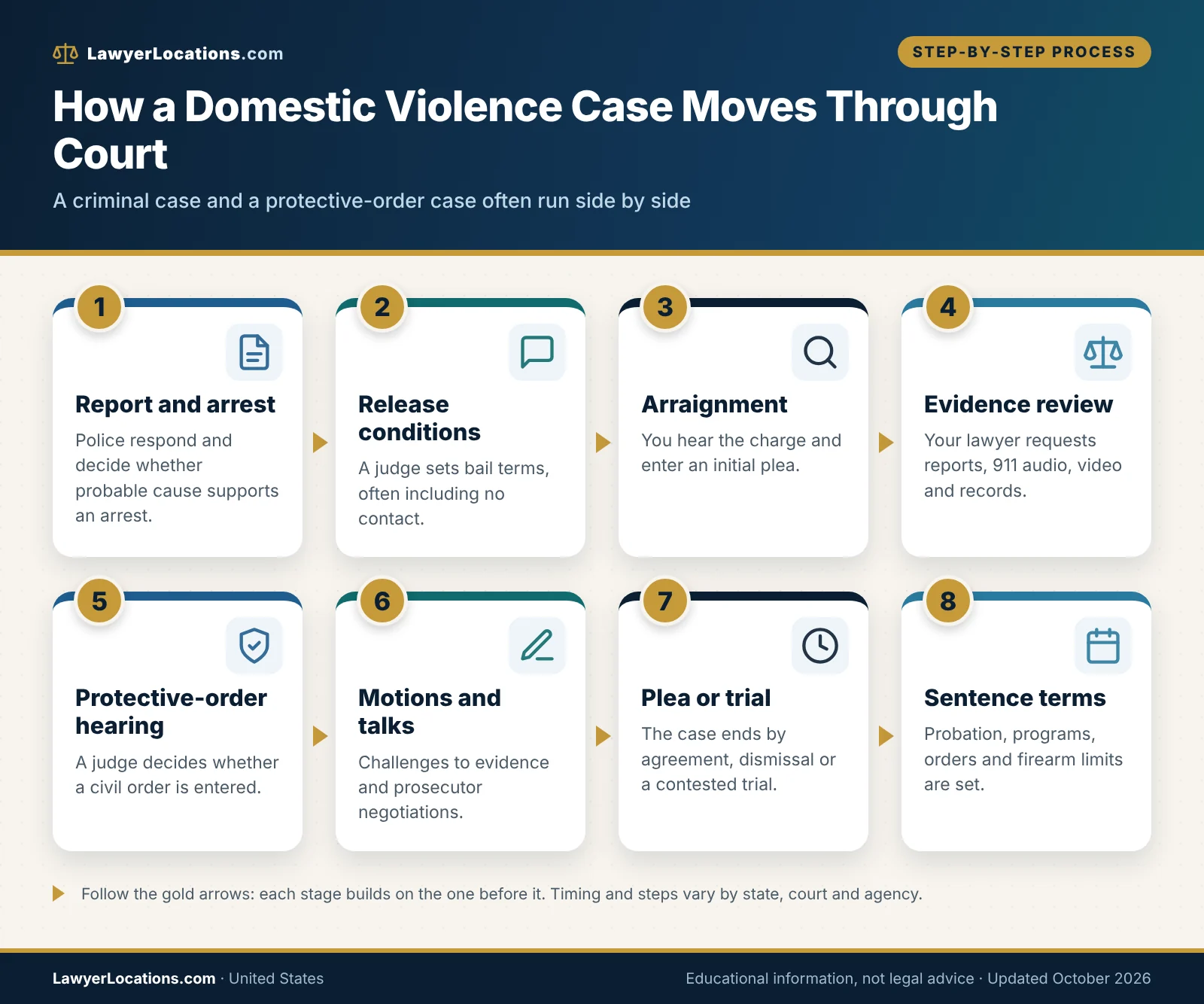
Text version of this graphic
- Report and response. A call or report brings officers to the scene.
- Arrest or citation. Officers decide based on probable cause and local policy.
- Release conditions. A judge or magistrate sets bail or release terms, often with no contact.
- Arraignment. You hear the charge and enter an initial plea.
- Evidence review. Your lawyer requests police reports, 911 audio, photos and records.
- Motions and negotiation. Challenges to evidence and talks with the prosecutor.
- Plea or trial. The case ends by agreement, dismissal or a contested trial.
- Sentence and conditions. Probation, classes, protective orders and any firearm limits.
From first appearance to arraignment
Within a short time after an arrest, usually a day or two, a judge or magistrate reviews the case and decides whether you stay in custody and on what terms. This is often the first time any lawyer speaks for you.
Bail, release and no-contact conditions
Release in a domestic case typically comes with conditions: no contact with the complaining witness, a stay-away order from the home or workplace, surrender of firearms, alcohol limits or electronic monitoring in some courts. These conditions bind you even if the other person wants contact and even if you live together. Florida’s statute, for example, makes willful violation of a pretrial release condition a first-degree misdemeanor when the original arrest was for domestic violence, and says the person is held in custody until first appearance.
The other person cannot waive a court-ordered no-contact condition. A text, call or visit that the other person invites can still be charged as a violation because the order binds you, not them. Ask the judge or your lawyer to modify the order in court if it needs to change.
What happens at arraignment
At arraignment you are told the formal charge, you hear your rights and you enter a plea, which is usually “not guilty” at this stage. If you lack a lawyer, the court may ask about appointed counsel here. Your lawyer may also ask the court to change release conditions, request discovery (the prosecution’s evidence) and set a schedule for motions.
Investigation, discovery and motions
Between arraignment and trial, most of the real work takes place on paper. The prosecution must share certain evidence, and the defense decides what to challenge.
What discovery usually includes
Discovery commonly includes the police report, body-camera or dash-camera video, 911 audio and dispatch logs, photographs of injuries or property, medical records, written statements from witnesses, text messages or social media posts, and any prior reports involving the same people. Rules about timing and scope differ by state, so ask your lawyer which materials are due and when.
Motions that can narrow or end a case
Defense motions can challenge the legality of a stop, search or arrest, ask the court to exclude statements taken without proper warnings, argue that hearsay should not come in, or seek dismissal for lack of probable cause. Some courts also hear motions about the scope of a protective order or the use of prior incidents. Whether a motion is worth filing depends on the facts and on the cost of litigating it, which ties directly to the fee stages discussed later.
Resolution: dismissal, plea, diversion or trial
Cases end in several ways. A prosecutor can dismiss, a judge can dismiss, the parties can reach a plea agreement, you can enter a diversion or deferred-sentence program where your state offers one, or the case can go to trial.
Plea agreements and what they require
A plea agreement commonly includes a plea to a lesser charge or to the charged offense with a sentence recommendation, a period of probation, a batterer-intervention or counseling program, a protective order and sometimes restitution. Before you accept any offer, ask what the plea means for firearms, immigration status, professional licensing, custody and future sentencing. A plea that looks mild on paper can carry heavy consequences outside the courtroom.
Trial and the burden of proof
In a criminal trial, the prosecution must prove each element of the charge beyond a reasonable doubt. A jury is available in many but not all misdemeanor cases, depending on the state and the potential penalty. The federal gun-ban definition looks at whether you had a lawyer and, where a jury trial was available, whether the case was tried by a jury or you knowingly and intelligently waived that right, so these choices have lasting effects.
Protective Orders: Emergency, Temporary and Final
A protective order is a civil court order that restricts contact and conduct, usually between people with a domestic relationship. It is separate from a criminal no-contact condition, although the two can overlap and a violation of either can lead to arrest. Names vary: restraining order, order of protection, protection from abuse order, injunction.
The three stages most states use
Most states use a staged process: a short-term emergency or ex parte order, a temporary order that lasts until a full hearing, and a final order after a hearing. State terms and durations differ, so read the dates printed on your own paperwork.
Emergency and ex parte orders
An ex parte order is issued after hearing only one side, usually the petitioner’s, because of claimed urgency. You may learn about it only when a process server or officer hands you the paper. These orders are short-lived and are typically followed by a hearing at which you can respond. Federal law treats the notice-and-hearing stage seriously: a cross-state order qualifies for full faith and credit only if the person against whom it is sought received reasonable notice and an opportunity to be heard, and for ex parte orders notice and a hearing must follow within the time set by the issuing jurisdiction’s law and, in any event, within a reasonable time after issuance (18 U.S.C. § 2265(b)).
Temporary orders and the full hearing
At the full hearing, the judge hears testimony and evidence from both sides and decides whether to enter a final order and for how long. Standards of proof are lower than in criminal court in most states. You may be asked to give testimony that could be used in a criminal case, which is one reason to speak with a lawyer before the hearing, not after.
What an order can say
Orders are not boilerplate. Courts can add or omit terms, and your obligations are only what the document says. A lawyer reads the order line by line with you.
Common terms
- No contact of any kind: in person, by phone, text, social media, email, or through third parties.
- Stay-away distances from the home, workplace, school or child care.
- Move-out or exclusive-use-of-residence terms.
- Temporary custody and parenting-time terms, including supervised exchanges.
- Surrender or transfer of firearms and ammunition.
- Counseling or intervention programs.
- Duration, including whether a final order is renewable.
Exceptions and carve-outs
Some orders allow limited contact about children through a lawyer, a parenting app or a neutral exchange site. These carve-outs are narrow. If the order does not expressly allow a type of contact, assume it is prohibited and ask the court for written clarification before you act.
Defending the order case
A protective-order hearing can feel informal, but the result can reach into your housing, your parenting time, your job and your right to own a firearm. Treat it seriously.
Preparing for the hearing
Gather messages, photographs, calendars, witness names and records that address the specific allegations in the petition. Do not alter or delete anything, and do not contact the petitioner to ask them to drop the case. Your lawyer can decide whether to seek a continuance, negotiate agreed terms or proceed to a full hearing. Agreed orders “without findings” exist in some states and can avoid certain consequences, but whether they do depends on state law and on the exact wording of the order.
Why consent orders need a careful read
Agreeing to an order can feel like a quick way to end the stress. Yet the wording matters. Under federal law, a protective order triggers the firearm ban only if it was issued after a hearing of which you received actual notice and at which you had an opportunity to participate, and it either includes a finding that you represent a credible threat to the physical safety of an intimate partner or child or by its terms explicitly prohibits the use, attempted use or threatened use of physical force that would reasonably be expected to cause bodily injury (18 U.S.C. § 922(g)(8)). A consent order can still contain those terms. Ask your lawyer exactly which sentences in the order do that work.
Two people agree to a mutual no-contact order to end a bitter dispute. One of them later finds the order includes language prohibiting the threatened use of physical force. That sentence, not the word “mutual,” is what a federal prosecutor or a gun dealer’s background check would focus on. Read the order, not the nickname.
How Five States Differ: Arrest Rules, Charges and Penalties
Because domestic violence law is mostly state law, the quickest way to see the variation is to read real statutes side by side. The table below summarizes one provision each from California, Florida, New York, Texas and Washington, based on the statutory text reviewed in October 2026. It is a sample, not a 50-state survey, and it covers one section per state, so it leaves out many related rules.
Five statutes side by side
Each row names the statute, says what it does in plain English and points out one practical consequence. Use it to understand the kinds of differences you may meet, not to predict the result in a specific case.
| State | Provision | What it says in plain English | Practical point |
|---|---|---|---|
| California | Penal Code § 273.5 | Willfully inflicting corporal injury that results in a “traumatic condition” on a current or former spouse, cohabitant, fiancé or dating partner, or the parent of the person’s child. The base offense is punishable by state prison for 2, 3 or 4 years, or county jail for up to one year, or a fine of up to $6,000, or both. A prior qualifying conviction within seven years raises the exposure, and subdivision (j) lets the court issue a restraining order of up to 15 years. | Probation in these cases must follow Penal Code § 1203.097. Subdivision (d) says a traumatic condition includes injuries from strangulation or suffocation. Check the current text on the state’s official code site. |
| Florida | Fla. Stat. § 741.29 | An officer with probable cause may arrest and charge the suspected person, and the decision “shall not require consent of the victim.” Officers must file a written report identifying the incident as domestic violence, and must try to identify the primary aggressor when more than one person complains. Willfully violating a pretrial release condition under § 903.047 is a first-degree misdemeanor when the original arrest was for domestic violence. | A person who willfully violates a pretrial release condition after a domestic violence arrest is held in custody until first appearance, and release conditions carry their own criminal penalty. |
| New York | CPL § 140.10(4) | An officer “shall arrest” for a felony against a family or household member, for a violation of a stay-away provision of a valid order of protection, and, unless the victim requests otherwise, for a misdemeanor family offense. When more than one person may have committed an offense, the officer should attempt to identify and arrest the primary physical aggressor. | The statute says the decision cannot depend on the willingness of a person to testify, and exempts arrests where the officer reasonably believes the conduct was justified under Penal Law article 35. The page we reviewed carries a notation about a future change to this subdivision, so read the current text. |
| Texas | Penal Code § 22.01 | Assault by causing bodily injury, including to the person’s spouse, is a Class A misdemeanor. It becomes a third-degree felony when committed against a person in a specified family, dating or household relationship and either the defendant has a qualifying prior conviction involving such a person or the offense involves impeding normal breathing or blood circulation by pressure on the throat or neck or by blocking the nose or mouth. A relationship offense with both a prior and the breathing element is a second-degree felony. | The statute cross-references the Family Code for the meaning of “family violence,” so the relationship definitions sit in a different chapter than the offense. |
| Washington | RCW 10.99.030 | When officers have probable cause that a crime occurred, they “shall exercise arrest powers with reference to the criteria in RCW 10.31.100.” If they do not arrest, they must tell the victim about the right to start a criminal proceeding, take a complete offense report and, with probable cause, seize firearms and ammunition used or threatened in the offense and those in plain sight or found in a lawful search. | Firearm seizure and a written protective-order notice are built into the response. Officers must also ask the victim about firearms access. |
Reading the table without over-reading it
The table shows that states reach similar goals by different routes. California defines a specific injury-based offense. Florida and New York spell out how officers should think about arrest. Texas builds domestic assault into a general assault statute and uses relationship and strangulation facts to raise the level. Washington connects police response to firearm seizure.
It does not tell you what charge you face, because the charge depends on the facts alleged and the prosecutor’s choices. It also does not cover sentencing ranges for every offense, bail rules, diversion programs or the protective-order statutes, each of which has its own chapter or code title.
What the table leaves out
Many states also have separate statutes for stalking, strangulation, violation of a protective order, interference with an emergency call and child endangerment in the presence of a child. Some states require batterer-intervention programs as a condition of probation. Some bar certain plea terms or limit deferred-adjudication options in domestic cases. Your lawyer can map the offenses that apply where you are charged.
The differences that matter most
Across states, the differences that most often change a person’s choices fall into three groups: how police decide to arrest, how charges are enhanced and how the court handles the case after the first hearing.
Arrest policy and the role of the victim’s wishes
New York lets the victim’s request displace an arrest for a misdemeanor family offense but not for a felony or a violated order. Florida says the arrest decision does not require the victim’s consent. Washington directs officers by reference to criteria in a separate arrest statute. In practice, if police arrive and see evidence of an offense, an arrest is common, and the person who called does not control what happens next.
Enhancements, priors and strangulation
Three themes recur: prior domestic convictions raise a misdemeanor to a felony or raise the sentence range (Texas and California both show this), strangulation or impeding breathing is treated as an aggravating fact (Texas and California both name it in the statutes above) and proximity in time matters, such as California’s seven-year look-back for priors in subdivision (f). If you have a prior case anywhere, tell your lawyer on day one.
Protective-order hearing dates, release-condition review dates and court appearance dates are printed on your paperwork. Missing a court date can lead to a warrant and new charges regardless of the strength of the underlying case. Put every date in a calendar with an alert.
How to research your own state
You do not have to rely on a summary like the one above. Your state’s legislature, court system and clerk publish the primary sources, and many courts have self-help pages written for people without lawyers.
Find the statute and the exact charge
Start with the charging document. It names the statute. Look up that section on your state legislature’s official website, read the elements, the penalty range and any enhancement language, and note the date of the version you are reading. Then search the same code for “domestic violence,” “family violence” or “household member” definitions, which may sit in a different title. Mirror sites can help you find the section, but confirm the current text on the official site.
Find the court, clerk and self-help resources
Your charging paperwork also names the court. Its clerk’s office handles filings, certified copies and hearing schedules. Many state court websites list self-help centers, forms for protective-order cases and information about interpreters and accessibility. If your case is in a rural county, the nearest courthouse may also be the only one with a self-help staff member, so call ahead. For a Los Angeles-specific discussion, see our guide to a domestic violence lawyer in Los Angeles, and for state-level criminal practice in a smaller state see our guide to a criminal defense lawyer in Idaho.
Evidence, the Victim’s Role and Common Defense Issues
Domestic violence prosecutions have some unusual evidence problems. Incidents happen in private, the complaining witness may be unwilling or unable to testify, and the first statements to police or a 911 operator can be powerful. The legal rules about those statements shape both the prosecutor’s choices and the defense strategy.
Evidence in a domestic case
Evidence in these cases usually comes from five places: what the responding officers saw, what was said on the phone or at the scene, physical evidence, digital evidence and medical records. Each has strengths and weaknesses that a defense lawyer examines.
| Evidence type | What it can show | Questions a defense lawyer tends to ask |
|---|---|---|
| 911 audio and dispatch logs | Who called, what was said, tone, timing and the stated emergency. | Was the statement made during an ongoing emergency? Is it hearsay? Who was the caller? |
| Officer observations and body-camera video | Injuries, damaged property, demeanor, statements at the scene and the arrest decision. | Does the video match the written report? Were the parties separated and questioned fairly? |
| Photographs | Visible injuries or damage, sometimes taken days later. | When and by whom were they taken? Do they show what the report says they show? |
| Medical records | Treatment, history given to providers and documented injuries. | Do the records support the allegation, a different cause or a delay in treatment? |
| Texts, emails and social media | Threats, apologies, context or conflict between the parties. | Are they complete, authenticated and in context? Do any support the defense? |
| Witness statements | What neighbors, family members or children saw or heard. | Were they present? Were they interviewed separately? Do their accounts differ? |
| Prior incidents or reports | Pattern, history or earlier calls to police. | Can prior incidents be admitted? Did they result in findings or only reports? |
911 calls and the confrontation right
The Sixth Amendment gives a defendant the right to confront witnesses. In Davis v. Washington, 547 U.S. 813 (2006), the Supreme Court held that statements made to police are nontestimonial when the circumstances objectively indicate that the primary purpose is to enable police to meet an ongoing emergency, and testimonial when there is no ongoing emergency and the primary purpose is to establish or prove past events relevant to a later prosecution. The Court found a 911 caller’s statements identifying her assailant nontestimonial because she described events as they happened and faced an ongoing threat. In the companion case, statements to officers at a home, where the woman said things were fine and there was no emergency, were testimonial.
In plain terms, a frantic 911 call can often come in at trial even if the caller does not testify, while a calm account given to an officer after the danger has passed may not. How a judge classifies a particular statement is a fact-heavy question your lawyer will research under your state’s case law.
Photos, messages and digital records
Preserving digital records matters for both sides. Text threads, call logs, location history and photos can corroborate or contradict an account. Do not delete anything, even material that looks bad for you, because deletion after an arrest can be treated as destroying evidence and can harm credibility. Give your lawyer a full copy and let the lawyer decide what to use.
When the complaining witness does not want to proceed
It is common for the person who called police to later say they want the case dropped, to refuse to testify or to recant. This is the point at which many people misunderstand how the system works, and where well-meant actions create new charges.
The prosecutor decides, not the complaining witness
In a criminal case the prosecutor brings the charge on behalf of the state. A complaining witness can express a wish to end the case, and prosecutors may weigh that wish, but they are not required to dismiss. Some offices proceed with other evidence such as 911 audio, photos, officer testimony and medical records. Others may offer a resolution that includes counseling or a protective order. Policies vary widely by office, and you should not assume your case will end because the other person asks.
Why you should not contact the complaining witness yourself
Contacting the person to ask them to drop the case, to change their story or to avoid court can violate a no-contact order and can lead to new charges such as witness tampering, intimidation or obstruction. Even a kind message can be portrayed as pressure. If the complaining witness wants to talk to the prosecutor, they can do so through the prosecutor’s victim services staff, and a lawyer can communicate through proper channels.
Anyone who tells you to “just get her to sign an affidavit” or “have him say it was a misunderstanding” is steering you toward a new and often more serious charge. Route every communication about the case through your lawyer.
Common defense themes
Defenses depend entirely on the facts and the law of your state. The themes below are the common headings a lawyer discusses, not a menu to choose from.
Self-defense and the primary-aggressor question
Self-defense is a legal justification for using reasonable force to protect yourself or another person. Statutes such as New York’s arrest provision recognize it by exempting arrests where the officer reasonably believes the conduct was justified under Penal Law article 35, and Florida’s statute tells officers that a person acting reasonably to defend themselves is not the preferred arrest target. Evidence supporting self-defense includes your injuries, photographs of them taken promptly, medical records, messages before and after the incident and witnesses. Say what happened as soon as your lawyer is in place, not before, and avoid long statements to police without advice.
Disputes about what happened, who did it and how it started
Other common themes include: the injury was accidental, the contact did not occur, the account is inconsistent with physical evidence or messages, the statements were made in anger or under the influence, or the accuser had a motive such as a custody or divorce dispute. A lawyer will test these themes against the discovery before relying on any of them. Fabricated defenses and pressure on witnesses harm credibility and can create criminal exposure of their own.
Write a private, dated timeline of the events leading up to the incident, the incident itself and what followed, and give it only to your lawyer. Do not post about the case, and do not discuss it with friends or family who might later be called as witnesses.
How to Compare Domestic Violence Lawyers
Choosing a domestic violence lawyer is mostly about fit, scope and clarity: whether the lawyer handles cases like yours in your court, what exactly the fee covers and how you will communicate. No ranking or label replaces your own comparison. This section gives you a method you can use with any lawyer in any state.
What to look for before you call
A few minutes of checking before the first conversation saves time and helps you ask better questions. Start with the basics: license status, practice focus and the courts the lawyer appears in.
License status and discipline history
Every state bar publishes a lawyer directory where you can confirm that a lawyer is licensed in that state and see whether any public discipline exists. The lawyer must be licensed in the state where your case is pending. A lawyer licensed only in another state may not appear in your court without special permission. Check the lawyer’s name against the state bar’s directory and read any discipline notes with care.
Practice focus and local court familiarity
Domestic cases involve local prosecutors, local judges and local habits about bail, no-contact terms and diversion. Ask how often the lawyer handles domestic charges in the specific court where you are charged. Marketing words such as “aggressive” or “experienced” tell you nothing. A direct answer about recent case types, the courthouse and the prosecutor’s office tells you much more. Avoid any lawyer who describes themselves as the “best” or promises an outcome, because no honest lawyer can.
Questions to ask at the consultation
A consultation is a two-way interview. You are deciding whether to hire the lawyer, and the lawyer is deciding whether to take the case. Come with the same list of questions for every lawyer so you can compare answers side by side.
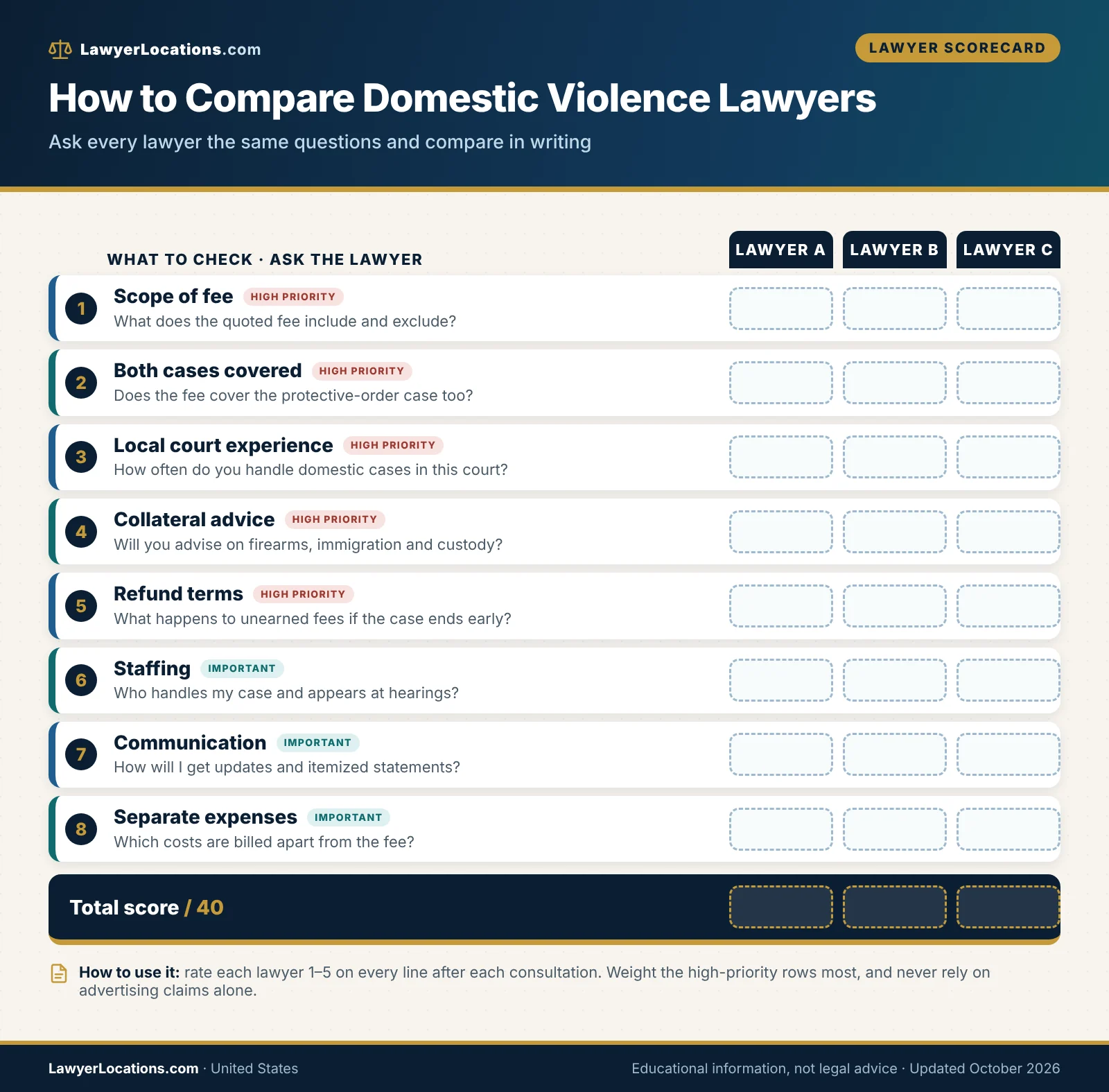
Text version of this graphic
| Criterion | Question to ask | Weight |
|---|---|---|
| Scope of fee | What does the quoted fee include and exclude? | High |
| Both cases | Does the fee cover the protective-order case as well as the criminal case? | High |
| Local court experience | How often do you handle domestic cases in this court? | High |
| Collateral advice | Will you advise on firearms, immigration and custody effects? | High |
| Refund terms | What happens to unearned fees if the case ends early? | High |
| Staffing | Who handles my case and appears at hearings? | Medium |
| Communication | How will I get updates and itemized statements? | Medium |
| Separate expenses | Which costs are billed apart from the fee? | Medium |
| Question | Why it matters | What a clear answer sounds like |
|---|---|---|
| What exactly does the fee cover? | Scope drives total cost more than the headline number. | A written list of stages or services included, and a list of what is excluded. |
| Is the protective-order case part of the fee? | The criminal case and the civil order case run on separate tracks. | A direct yes or no, with a separate price if no. |
| Which court and prosecutor’s office will handle my case? | Local practice varies by court and office. | Names the court and describes recent, similar matters without disclosing client details. |
| What happens to my firearms, and what do I do with them? | Orders and release conditions often require surrender or transfer. | Explains the legal process for lawful transfer and storage, and warns against handing them to a friend informally. |
| Will you advise me on immigration, licensing and custody consequences? | A plea can have effects outside criminal court. | Says who will advise, and offers to coordinate with an immigration or family lawyer when needed. |
| How do fees work if the case goes to trial? | Some agreements add large new charges at the trial stage. | Spells out when the next stage begins and how it is priced, in writing. |
| Who will I talk to and how often will I hear from you? | Communication problems are among the most common complaints about lawyers. | Names the lawyer and staff, and describes a realistic update routine. |
| What are the realistic risks, in your view? | A lawyer who promises results is a red flag. | Describes risks and options candidly, without promising an outcome. |
Questions about fees and scope
Ask for the fee agreement in writing before you pay anything. ABA Model Rule 1.5(b) says the scope of the representation and the basis of the fee and expenses should be communicated to the client, preferably in writing, before or within a reasonable time after the representation begins. Your state’s version of the rule controls, but the principle holds almost everywhere. For a broader look at the first conversation, see our guide to criminal defense lawyer consultations.
Questions about strategy and the first thirty days
Ask what the lawyer would do first. A useful answer often includes obtaining the charging documents and release conditions, requesting discovery, preserving video and 911 audio, advising you about contact with the other person and checking whether any firearm, immigration or custody issues need urgent attention. If a lawyer says only “come in and we will talk,” that is not an answer.
You can meet with more than one lawyer. Many people schedule two or three conversations before choosing. Be careful about what you say in each: statements to a lawyer you are considering are generally confidential, but sharing facts with friends or posting online is not.
Red flags and green flags
Some patterns are common enough to be worth listing. None is proof of anything alone, but several together should make you pause.
Red flags
- A promise or prediction of a particular result, such as “I can get this dismissed.”
- Pressure to sign a retainer or pay immediately because “the window is closing.”
- No written fee agreement, or an agreement with vague scope.
- A suggestion that you contact the complaining witness or have them change their account.
- A fee that depends on the outcome of a criminal case. ABA Model Rule 1.5(d)(2) says a lawyer may not charge a contingent fee for representing a defendant in a criminal case; confirm your state’s version of the rule.
- Refusal to say who will actually handle your hearings.
Green flags
- The lawyer explains the charge, the process and the realistic range of outcomes in plain language.
- The fee agreement lists stages, exclusions and refund terms.
- The lawyer raises firearm, immigration, licensing and custody issues without being asked.
- The lawyer tells you what not to do, including not contacting the other person.
- The conversation is mostly about how tough or well known the lawyer is.
- You leave the meeting unsure what you are paying for.
- Questions about scope or refunds are met with irritation.
- The lawyer cannot say which court or prosecutor’s office handles your case.
Domestic Violence Lawyer Cost, Fee Structures and Appointed Counsel
There is no honest national price list for a domestic violence lawyer. Fees depend on the state, the court, the charge, the stage and the lawyer’s billing method. This guide does not print a national “average” because we found no official source that publishes one; instead it explains how fees work and what moves them. For a wider view, see our guide on how much a criminal defense lawyer costs.
How lawyers charge
Most criminal defense lawyers use one of three structures, sometimes in combination. The right one for you depends on how predictable your case is and how comfortable you are with open-ended billing.
| Structure | How it works | Works well when | Watch out for |
|---|---|---|---|
| Flat fee | One price for a defined set of tasks or a defined stage. | The case is likely to follow a predictable path. | Exclusions: motions, trial, the protective-order case, appeals and expert fees may be extra. |
| Hourly rate with retainer | You deposit an advance; the lawyer bills time against it. | The scope is uncertain and you want to pay only for work done. | Open-ended totals. Ask for itemized statements and a cap or alert threshold. |
| Phased or staged fee | A separate price for each stage: pretrial, motions, trial. | You want cost control with defined decision points. | Make sure the agreement says when each new stage begins and what triggers it. |
| Hybrid | A flat fee for part of the work, hourly for the rest. | Parts of the case are predictable and parts are not. | Clarify which tasks fall in which bucket. |
| Contingent fee | The lawyer is paid only if a result is achieved. | Not applicable to criminal defense. | Model Rule 1.5(d)(2) bars contingent fees for defending a criminal case; confirm your state’s rule. |
Reading the written fee agreement
The fee agreement is the most important document you will sign. Look for the scope of representation, the fee and when it is due, how unearned money is handled if the case ends early, what expenses are billed separately, who will do the work, how you will be updated and how to end the relationship. If a term is unclear, ask for it to be rewritten in plain words before you sign.
What the quote usually does not include
Even a clean flat fee often leaves out items that a domestic case may involve: the protective-order hearing, expert witnesses, investigators, transcripts, record fees, interpreters and any appeal. Ask for a list of exclusions and, if possible, a range for each. A lower quote that excludes the order hearing and trial can cost more in the end than a higher quote that includes them.
Compare scopes, not just totals. Put two quotes side by side and mark which stages and tasks each one includes. The gaps are where surprise bills come from.
What drives the cost
The variables below do more to move a quote than any posted rate. They are the right topics to raise when you ask a lawyer why a price is higher or lower than another.
Case factors
- Misdemeanor versus felony, and the potential penalty.
- Whether there is a parallel protective-order case or a family-court case.
- How much discovery there is: video, photographs, medical records, messages.
- Whether motions to exclude evidence are likely to be filed.
- Whether the case is likely to resolve by agreement or go to trial.
- Whether experts, such as a medical or digital forensics expert, are needed.
Costs outside the lawyer’s fee
Fees paid to your lawyer are not the only costs. A conviction or a plea can bring fines, court costs, probation fees, program fees for counseling or batterer-intervention classes, victim restitution and monitoring costs. These vary by state and court, so ask the clerk for the current schedule and ask your lawyer which are likely in your case. Courts often have payment plans or fee-waiver procedures for people who cannot pay, so ask before a due date passes.
Appointed counsel and low-cost options
If you cannot afford a lawyer, you may qualify for a court-appointed lawyer in the criminal case. The rules turn on your income, the charge and whether jail is a possible penalty, and they vary by state.
The right to appointed counsel
The Supreme Court has tied the Sixth Amendment right to appointed counsel in misdemeanor cases to actual imprisonment. In Alabama v. Shelton, 535 U.S. 654 (2002), the Court held that a suspended jail sentence that may end up in the actual deprivation of a person’s liberty cannot be imposed on an indigent misdemeanor defendant who was not offered appointed counsel. The Court described Scott v. Illinois as drawing the line at actual imprisonment, so a fine-only sentence does not trigger the right. States may give more protection than the federal floor, and many do.
In plain terms: if jail is a realistic possibility, ask the judge at your first appearance about appointed counsel and complete any financial affidavit honestly. Do not plead guilty at arraignment without a lawyer because you assume you cannot afford one.
Legal aid, bar referral services and law school clinics
Legal aid organizations often handle protective-order and family cases for eligible clients. State and local bar associations run lawyer referral services that connect callers to licensed lawyers, and some offer reduced-fee programs. Law school clinics sometimes accept domestic cases under faculty supervision. Online legal-aid directories and court self-help centers can point you to what exists where you live. A referral service is a starting point, not an endorsement, and the same comparison questions apply.
Be wary of anyone who offers to “handle” a case for cash with no written agreement, or who asks you to pay a bail bond agent or a court official outside normal channels. Always get a receipt and a written agreement.
Consequences Beyond the Courtroom, and the Deadlines That Matter
The sentence a judge imposes is only part of what a domestic violence case can do. Firearm rights, immigration status, custody, employment and professional licenses can all be affected, sometimes by the mere entry of a protective order and sometimes only by a conviction. Federal law sets several of these consequences, which is why a lawyer’s advice about them should come before you accept any offer.
Firearms: two federal triggers
Federal law restricts firearm and ammunition possession for two categories of people tied to domestic violence: some people subject to protective orders, and some people convicted of misdemeanor crimes of domestic violence. State law often adds its own restrictions, including surrender requirements in orders and release conditions.
Protective orders and 18 U.S.C. § 922(g)(8)
The statute covers a person subject to a court order that was issued after a hearing of which the person received actual notice and at which the person had an opportunity to participate, that restrains the person from harassing, stalking or threatening an intimate partner or the partner’s child, or engaging in other conduct that would place them in reasonable fear of bodily injury, and that either includes a finding that the person represents a credible threat to the physical safety of the partner or child or by its terms explicitly prohibits the use, attempted use or threatened use of physical force that would reasonably be expected to cause bodily injury.
In United States v. Rahimi, decided June 21, 2024, the Supreme Court upheld the statute in an 8-1 decision written by Chief Justice Roberts. The Court held that a person whom a court has found to pose a credible threat to the physical safety of another may be temporarily disarmed consistent with the Second Amendment. Because Rahimi brought a facial challenge, he had to show the law was unconstitutional in all of its applications. The ruling leaves room for individual challenges to how the law is applied, which is a question for a lawyer who handles those cases.
Misdemeanor convictions and 18 U.S.C. § 922(g)(9)
A person convicted of a misdemeanor crime of domestic violence may not possess firearms or ammunition. The definition in § 921(a)(33) requires an element of the use or attempted use of physical force, or the threatened use of a deadly weapon, and a qualifying relationship. In Voisine v. United States (2016), the Supreme Court held that a misdemeanor domestic assault conviction based on recklessness counts, so the ban applies even when the state statute covers reckless conduct.
Two features of the definition matter in plea talks. First, a person is not treated as convicted unless the person was represented by counsel or knowingly and intelligently waived counsel and, where a jury trial was available, the case was tried by a jury or the person knowingly and intelligently waived a jury, by guilty plea or otherwise. Second, a conviction that has been expunged or set aside, or for which the person has been pardoned or had civil rights restored, does not count unless the relief expressly provides that the person may not possess firearms. The statute also has a separate provision for a single dating-relationship conviction, which may be disregarded after five years if there is no later qualifying conviction and the person is not otherwise prohibited, but that relief is not available for spouses, parents, guardians, co-parents, cohabitants or similarly situated persons.
| Trigger | Statute | Key requirements | Questions to ask a lawyer |
|---|---|---|---|
| Protective order | 18 U.S.C. § 922(g)(8) | Order issued after a hearing with actual notice and an opportunity to participate; restrains harassing, stalking or threatening an intimate partner or child; and includes a credible-threat finding or explicitly prohibits the use or threatened use of physical force. | Does my order contain either of those two features? Was there a hearing I could attend? |
| Misdemeanor conviction | 18 U.S.C. § 922(g)(9) and § 921(a)(33) | Misdemeanor with a force element or threatened use of a deadly weapon, and a qualifying relationship; counsel and jury conditions; expungement or restoration may remove it unless the relief preserves the ban. | What does the plea say about force? Does the relationship fit the federal list? What relief might be available later? |
| Reckless conduct | Voisine v. United States (2016) | A conviction based on reckless assault can qualify. | Does my state statute cover reckless conduct, and does that matter for my plea? |
| Selling or giving a firearm to a prohibited person | 18 U.S.C. § 922(d)(8), (9) | It is unlawful to sell or dispose of a firearm to a person the seller knows or has reasonable cause to believe is covered. | How do I lawfully transfer or store firearms while this is pending? |
Do not hand firearms to a friend or relative without legal advice. An informal transfer can create separate problems for both of you, and your order or release conditions may require a particular process. Ask your lawyer how to transfer or store firearms lawfully before you act.
Immigration consequences for noncitizens
If you are not a U.S. citizen, a domestic violence case can carry consequences that are more serious than the criminal sentence. This is a point where criminal defense advice and immigration advice must be coordinated.
What federal immigration law says
Under 8 U.S.C. § 1227(a)(2)(E)(i), a noncitizen who at any time after admission is convicted of a crime of domestic violence, a crime of stalking or a crime of child abuse, child neglect or child abandonment is deportable. The statute defines a “crime of domestic violence” as a crime of violence, as defined in 18 U.S.C. § 16, against a person committed by a current or former spouse, by an individual with whom the person shares a child, by a cohabitant or former cohabitant as a spouse, by an individual similarly situated to a spouse under the domestic or family violence laws of the jurisdiction, or by any other individual against a person who is protected from that individual’s acts under the domestic or family violence laws of the United States or any state, Indian tribal government or unit of local government.
A separate ground, 8 U.S.C. § 1227(a)(2)(E)(ii), makes a noncitizen deportable who is enjoined under a protection order issued by a court and whom the court determines has engaged in conduct that violates the portion of the order that involves protection against credible threats of violence, repeated harassment or bodily injury. No conviction is required for that ground. The statute’s paragraph (7)(A) contains a waiver mechanism for certain battered or abused individuals who are not the primary perpetrator of violence in the relationship, which is a question for an immigration lawyer.
Why the plea wording matters
In Padilla v. Kentucky, 559 U.S. 356 (2010), the Supreme Court held that defense counsel must tell a noncitizen client whether a guilty plea carries a risk of deportation. When the law plainly mandates deportation, the duty to give correct advice is clear. When the law is uncertain, counsel need only warn that charges may carry adverse immigration consequences. The practical lesson is to ask your criminal defense lawyer in writing what a proposed plea means for your status, and to speak with an immigration lawyer before you plead if you are not a citizen. A plea that looks light in criminal court can be very heavy in immigration court.
Family, work and licensing
Beyond firearms and immigration, domestic cases can affect family arrangements and livelihoods in ways people do not expect at the start.
Custody, parenting time and divorce
Courts deciding custody and parenting time consider allegations of domestic violence, and a protective order or a conviction can shape temporary and long-term arrangements. A no-contact order can interfere with exchanges and communication about children unless the order or a separate family-court order says how to handle them. If you are separating or divorcing, coordinate the criminal and family cases rather than treating them as unrelated. For the family-law side, see our guides on legal separation versus divorce and child custody lawyers in Jacksonville.
Jobs, licenses, housing and record relief
Employers, licensing boards, landlords and schools may ask about arrests or convictions, and some professions require reporting. A conviction can complicate a commercial driver’s license, a security clearance, a teaching or health-care license or a public-housing application. After a case ends, some states allow records to be sealed, expunged or set aside, though domestic offenses are often excluded or subject to longer waiting periods. Our guide to an expungement lawyer explains how record relief works in general, and your state’s rules control the details.
Orders that travel: full faith and credit
Federal law requires states, tribes and territories to enforce each other’s protection orders in many cases. That means an order issued in one state can be enforced where you travel or move, and a violation can lead to arrest wherever you are.
What 18 U.S.C. § 2265 requires
Under 18 U.S.C. § 2265, a protection order issued by a state, tribe or territory must be accorded full faith and credit by the court of another jurisdiction if the issuing court had jurisdiction and the person against whom the order is sought received reasonable notice and an opportunity to be heard. The order is enforced as if it were the enforcing jurisdiction’s own, and it is entitled to that treatment even if it was not registered or filed there.
Limits on mutual orders
The statute limits full faith and credit for an order against a person who sought protection from abuse by a spouse or intimate partner if no cross or counter petition was filed seeking such an order, or if a cross petition was filed but the court made no specific findings that each party was entitled to an order. This limit can matter when both parties received orders. Your lawyer can check whether an order issued against you meets the federal conditions.
Deadlines and decision points
Few cases follow a neat calendar, but the same decision points come up again and again. Planning for them lets you spend your effort where it counts.
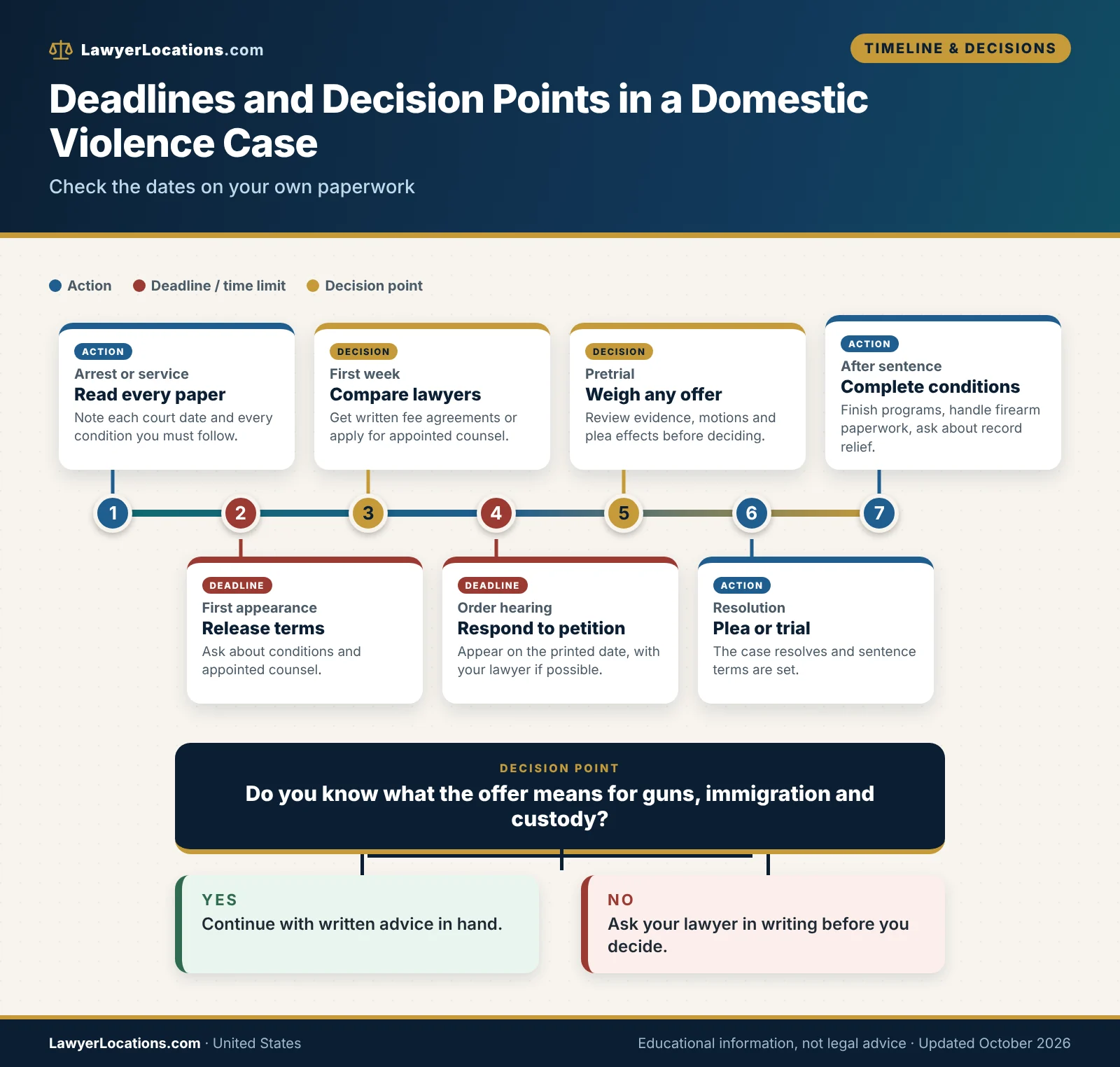
Text version of this graphic
- Arrest or service (action). Read every paper you receive and note each date.
- First appearance (deadline). Attend; ask about release terms and appointed counsel.
- First week (decision). Compare lawyers and get written fee agreements, or apply for appointed counsel.
- Protective-order hearing (deadline). Appear on the date printed on the notice, with your lawyer if you have one.
- Pretrial (decision). Review discovery, decide whether to file motions and weigh any offer.
- Plea or trial (action). The case resolves and sentence terms are set.
- After sentence (action). Complete conditions, deal with firearm paperwork and ask about record relief.
Decision question: Do you understand what the offer means for firearms, immigration, custody and licensing? If yes, continue. If no, ask for written advice before you decide.
Key decision points
| Stage | Decision | Ask before deciding |
|---|---|---|
| First appearance | Request appointed counsel or hire a lawyer; respond to release terms. | What are the release conditions, and what happens if I breach one? |
| Protective-order hearing | Contest, negotiate or consent. | What does each version of the order say about firearms, children and housing? |
| Discovery review | File motions or not. | What are the cost, odds and risks of each motion? |
| Plea offer | Accept, counter or go to trial. | What are the effects on firearms, immigration, custody, licensing and future sentencing? |
| After the case | Comply with conditions; seek record relief if available. | When can the order end or be modified? Is expungement or sealing allowed for this offense? |
Deadlines you can control
Some deadlines are set by statute or court rule and differ by state, such as the time to appeal, to seek a hearing or to respond to a petition. Others are set by your own paperwork, such as hearing dates, program enrollment dates and payment dates. Ask your lawyer for a list of dates and write them in a calendar with reminders. If something is unclear, call the clerk’s office; clerks cannot give legal advice but can tell you what the court’s records show.
Preparing for a Consultation, Mistakes to Avoid and Next Steps
Preparation makes a first consultation more useful and often less expensive, because the lawyer can spend the meeting on analysis instead of gathering basics. A short list of papers, a written timeline and a list of questions go a long way.
Documents and information to gather
Bring original paperwork if you can, and copies if the originals must stay with you. Do not create new records of the incident outside of what your lawyer asks, and do not ask others to write statements for you.
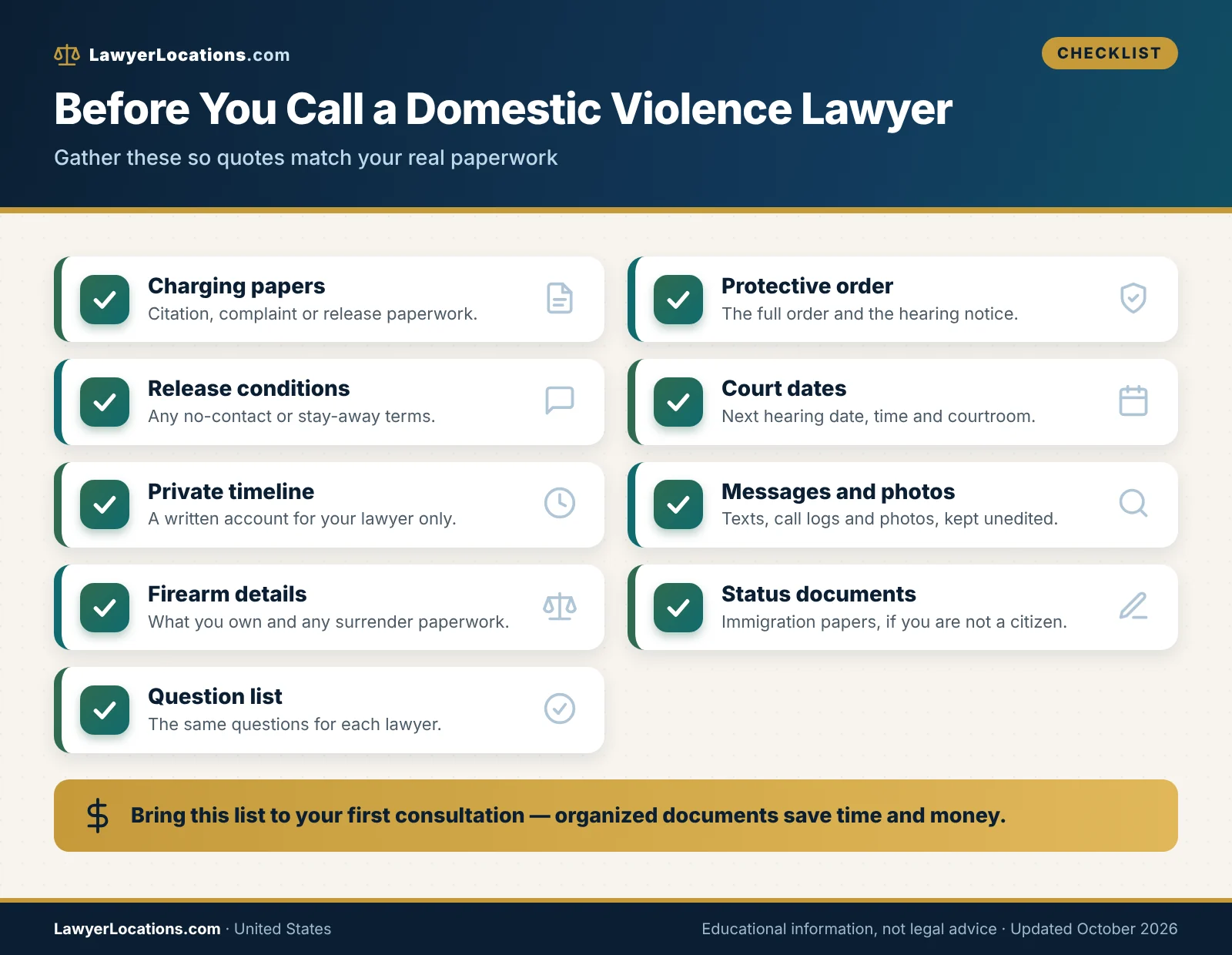
Text version of this graphic
- Charging papers. Citation, complaint or release paperwork.
- Protective order. The full order and the hearing notice.
- Release conditions. Any no-contact or stay-away terms.
- Court dates. The next hearing date, time and courtroom.
- Written timeline. A private account for your lawyer only.
- Messages and records. Texts, call logs, photos and medical records.
- Firearm details. What you own, where it is stored and any surrender paperwork.
- Immigration papers. Status documents, if you are not a citizen.
- Questions list. The same questions for each lawyer.
| Document | Why it helps | Where to get it |
|---|---|---|
| Citation, complaint or charging document | Names the statute, the court and the alleged dates. | Your arrest paperwork or the court clerk. |
| Protective order and hearing notice | Shows what you must and must not do, and when the hearing is. | The person who served you, or the clerk. |
| Release or bail conditions | Sets your no-contact, stay-away and firearm terms. | Your release paperwork or the court. |
| Your private timeline | Helps your lawyer see sequence, witnesses and gaps. | You write it, for your lawyer only. |
| Messages, photos and call logs | May corroborate or contradict accounts. | Your own devices and accounts; keep originals. |
| Medical records | Document injuries to anyone and their timing. | The treating provider’s records office. |
| Immigration documents | Lets a lawyer judge the effect of any plea on status. | Your own records; do not travel abroad without advice. |
Papers from the court
Collect every item you received from police, jail staff, the court and any process server. Put them in one folder and keep the order in which you received them. If something is missing, such as the second page of an order, ask the clerk for a copy before the hearing. Pages and attachments often hold the exact language that matters.
Your own records and questions
Write your timeline in plain language and mark what you know directly versus what you heard from others. List witnesses and their contact details, including people who saw you before and after the incident. Add your questions about fees, scope, firearms, immigration and custody. Bring them to every consultation so you can compare answers.
Common mistakes to avoid
Most of these mistakes are made by people trying to fix things quickly. They are understandable, and avoidable.
Mistakes about contact and communication
- Contacting the other person despite a no-contact condition, even if they invite you.
- Asking friends or family to contact the other person for you.
- Posting about the case, the other person or the police on social media.
- Giving a long statement to police or investigators without advice.
- Deleting messages or photos after an arrest.
Mistakes about process and paperwork
- Missing a court date because you assume the case is over.
- Signing a consent order without reading what it says about force, firearms and children.
- Pleading to something minor-sounding without asking about federal firearm and immigration effects.
- Transferring firearms informally.
- Paying a lawyer with no written fee agreement.
- Waiting weeks to look for a lawyer because you hope the matter will fade.
Hearing dates, program enrollment dates and payment dates are enforced by courts. If you cannot make one, ask the court for a change before the date passes, in writing or through your lawyer. Do not simply skip it.
Clear next steps
If you are facing a domestic violence charge or order, you can take practical steps today that protect your position and keep you within the law.
The first forty-eight hours
- Read your paperwork. Find the charge, the release conditions, any protective order and the next court date.
- Follow every condition. Treat no-contact and stay-away terms as absolute.
- Secure your records. Keep messages, photos and documents; do not delete anything.
- Ask about firearms. If you own any, ask a lawyer how to handle them lawfully.
- Start the lawyer search. Compare at least two written fee agreements, or ask the court about appointed counsel.
The first two weeks
Meet with a lawyer, sign a written fee agreement, get a calendar of dates and ask about the protective-order case. If you are not a citizen, ask for immigration advice before any plea. If you have children, ask how to handle exchanges lawfully. Keep notes of each conversation with your lawyer and ask for written confirmation of important advice.
Ready to compare your options?
Use the scorecard and the consultation questions above to speak with at least two licensed lawyers in the state where your case is pending. Ask each for the scope and price in writing, then choose on fit, clarity and communication. For more on costs, read our guide to criminal defense lawyer costs. If you are the person who was hurt, call the National Domestic Violence Hotline at 800-799-7233.
Quick Answers to Common Questions
These are short answers to questions people often ask about domestic violence lawyers, charges and orders. Each is general information, and your state’s law and the facts of your case may change the answer.
Charges, arrests and court dates
This group covers what happens from arrest through the first hearings.
Before and after an arrest
Can I be arrested for domestic violence even if the other person does not want me arrested?
Yes. In many states the arrest decision belongs to the officer, based on probable cause. Florida’s statute says the decision does not require the victim’s consent, and New York’s provision requires arrest for felonies and violated orders regardless of the victim’s wishes. In New York, a victim’s request can affect a misdemeanor family-offense arrest only.
What should I do right after being arrested for domestic violence?
Say as little as possible about the facts, ask for a lawyer, follow every release condition and keep all paperwork. Do not contact the other person. Write down your own timeline later, for your lawyer only.
What does “primary aggressor” mean?
It is the person an officer concludes was the main source of violence when both people claim injury. Statutes in states such as Florida and New York direct officers to identify one primary aggressor rather than arrest both people automatically, and to consider self-defense.
Can a domestic violence charge be a felony?
Yes. A first offense is often a misdemeanor, but serious injury, a weapon, strangulation or a prior conviction can raise it to a felony. Texas, for example, makes a bodily-injury assault against a family or household member a third-degree felony with a qualifying prior or an offense involving impeding breathing or circulation.
In court
Will the case be dropped if the other person recants?
Not automatically. The prosecutor decides whether to proceed and may rely on 911 audio, photos, officer testimony and other evidence. The complaining witness’s wishes are one factor, not a switch.
Can a 911 call be used against me if the caller does not testify?
Sometimes. Under Davis v. Washington, statements made to enable police to meet an ongoing emergency are nontestimonial, so they may come in, while statements made to prove past events are testimonial and raise confrontation problems. The classification depends on the facts.
Do I have to go to court if my lawyer is handling the case?
Usually yes, at least for key hearings. Some misdemeanor courts allow a lawyer to appear for you at certain stages, but you should assume you must attend unless your lawyer and the court confirm otherwise in writing.
Is a plea bargain a good idea in a domestic violence case?
That depends on the evidence, the offer and your circumstances. Before accepting, ask what the plea means for firearms, immigration, custody, licensing and future charges, and get that advice in writing if possible.
Orders, firearms and family
These answers cover protective orders and their side effects.
Protective orders
What is the difference between a criminal no-contact order and a protective order?
A criminal no-contact order is a condition of release in the criminal case. A protective order is a civil order, often requested by the other person. Both can lead to arrest if violated, and they can exist at the same time with different terms and end dates.
Can the other person cancel a protective order?
Usually not on their own. Only the court can change or end an order, so a request to modify must be filed and decided by the judge. The other person’s agreement to contact does not make contact lawful.
Does a protective order follow me to another state?
Often yes. Under 18 U.S.C. § 2265, states, tribes and territories must give full faith and credit to a valid protection order that meets the notice and jurisdiction conditions, even if it was not registered where you are.
What if I am served with a protective order that I think is false?
Do not contact the petitioner. Appear at the hearing, bring documents and witnesses, and speak with a lawyer beforehand if you can. The hearing is where you can respond.
Firearms, immigration and custody
Can I own a gun if I have a domestic violence protective order against me?
Not if the order meets the federal conditions in 18 U.S.C. § 922(g)(8): issued after a hearing with notice, with a credible-threat finding or an explicit prohibition on the use of force. State law and your order’s own terms may also require surrender. Ask a lawyer about your specific order.
Does a misdemeanor domestic violence conviction affect gun rights?
It can. Federal law bars possession by a person convicted of a misdemeanor crime of domestic violence as defined in 18 U.S.C. § 921(a)(33), and Voisine held that reckless conduct counts. Expungement or restoration of rights may change the result unless the relief preserves the ban.
Can a domestic violence case lead to deportation?
Potentially. A conviction for a crime of domestic violence, stalking or child abuse after admission can make a noncitizen deportable, and so can a court finding that the person violated certain parts of a protection order. Get immigration advice before any plea.
Will a domestic violence charge affect child custody?
It can. Family courts consider allegations of domestic violence when deciding custody and parenting time, and orders can limit contact. Coordinate your criminal and family lawyers so advice in one case does not undercut the other.
Lawyers and money
The last group covers choosing and paying for a lawyer.
Choosing a lawyer
How do I find a domestic violence lawyer near me?
Use your state bar’s lawyer directory or referral service, ask legal aid or the court self-help center for names, and confirm each lawyer’s license on the state bar site. Then compare at least two lawyers with the same questions.
Should I hire a lawyer for the protective order as well as the criminal case?
Often yes, because testimony in one case can be used in the other and the order can affect firearms and custody. Ask any lawyer whether the fee covers both.
How do I know if a lawyer is the right fit?
Look for clear answers about scope, fees, communication and local court experience, and for candor about risks. Avoid promises of outcomes and pressure to pay immediately.
Can I switch lawyers if I am unhappy?
Generally yes, though the court may need to approve a substitution, and your fee agreement should say how unearned fees are handled. Do it before key deadlines if possible.
Paying for a lawyer
How much does a domestic violence lawyer cost?
It varies by state, court, charge and fee structure, and there is no reliable national figure. Ask for a written fee agreement that lists scope and exclusions. Our guide on criminal defense lawyer costs explains the factors.
Can a domestic violence lawyer work on contingency?
Not in a criminal defense case. ABA Model Rule 1.5(d)(2) says a lawyer may not charge a contingent fee for representing a defendant in a criminal case. Confirm your state’s rule.
Can I get a free lawyer for a domestic violence charge?
If you cannot afford a lawyer and jail is possible, you may qualify for appointed counsel. Alabama v. Shelton extends the right to a suspended sentence that could result in imprisonment. Ask at your first appearance.
Are there low-cost options if I do not qualify for a public defender?
Possibly. Legal aid groups, bar referral services, law school clinics and court self-help centers may help, and some lawyers offer payment plans. Ask for any plan in writing.
General information only. LawyerLocations.com is a legal-education and lawyer-discovery resource, not a law firm, and nothing here is legal advice or creates an attorney-client relationship. Domestic violence laws, protective-order procedures, court fees and deadlines change and differ by state and court, so verify current rules with the court clerk, the legislature’s official site or your state bar. Consult a lawyer licensed in the relevant jurisdiction about your situation. If you are in danger, call 911.
Sources & References
Show all 16 sources
- 18 U.S.C. § 922, Unlawful acts (firearms) — Legal Information Institute, Cornell Law School — law.cornell.edu — accessed October 2026
- 18 U.S.C. § 921, Definitions (misdemeanor crime of domestic violence) — Legal Information Institute, Cornell Law School — law.cornell.edu — accessed October 2026
- 18 U.S.C. § 2265, Full faith and credit given to protection orders — Legal Information Institute, Cornell Law School — law.cornell.edu — accessed October 2026
- 8 U.S.C. § 1227, Deportable aliens — Legal Information Institute, Cornell Law School — law.cornell.edu — accessed October 2026
- United States v. Rahimi, 602 U.S. ___ (2024) — Justia U.S. Supreme Court Center — supreme.justia.com — accessed October 2026
- Voisine v. United States, 579 U.S. 686 (2016) — Justia U.S. Supreme Court Center — supreme.justia.com — accessed October 2026
- Davis v. Washington, 547 U.S. 813 (2006) — Justia U.S. Supreme Court Center — supreme.justia.com — accessed October 2026
- Padilla v. Kentucky, 559 U.S. 356 (2010) — Justia U.S. Supreme Court Center — supreme.justia.com — accessed October 2026
- Alabama v. Shelton, 535 U.S. 654 (2002) — Justia U.S. Supreme Court Center — supreme.justia.com — accessed October 2026
- Model Rules of Professional Conduct, Rule 1.5: Fees — American Bar Association — americanbar.org — accessed October 2026
- California Penal Code § 273.5, Corporal injury to spouse, cohabitant or other qualifying partner — Justia (state code compilation) — law.justia.com — accessed October 2026
- Florida Statutes § 741.29, Domestic violence: investigation of incidents; notice to victims of legal rights and remedies; reporting — Florida Legislature — leg.state.fl.us — accessed October 2026
- New York Criminal Procedure Law § 140.10, Arrest without a warrant — New York State Senate — nysenate.gov — accessed October 2026
- Texas Penal Code § 22.01, Assault — Texas.Public.Law (state statute mirror) — texas.public.law — accessed October 2026
- RCW 10.99.030, Peace officers — powers and duties — Washington State Legislature — app.leg.wa.gov — accessed October 2026
- National Domestic Violence Hotline — National Domestic Violence Hotline — thehotline.org — accessed October 2026
Legal Disclaimer and Limitation of Liability
Informational and illustrative purposes only. This article was prepared by LawyerLocations.com solely on the basis of the information available to us at the time of writing. It is an illustrative, general overview. It is not a complete or authoritative statement of the law, and it has not been reviewed by a lawyer licensed in your state or county.
Not legal advice. Nothing in this article is legal, financial, tax or immigration advice, and reading it does not create an attorney-client relationship between you and LawyerLocations.com or any author, lawyer or firm mentioned. Laws, court rules, fees, filing deadlines and agency procedures differ by state, county and court, and they change often. Some details here may be simplified, incomplete or out of date, and time limits for legal claims can be short.
No warranty. We make no representation or warranty, express or implied, about the accuracy, completeness, timeliness or suitability of this content for your situation. Please do not rely on it to make, delay or skip any legal decision. Check the facts against official sources and speak with a licensed attorney in the relevant jurisdiction before you act.
Limitation of liability. To the fullest extent permitted by law, LawyerLocations.com and its owners, authors and contributors disclaim all liability for any loss, damage, cost or other consequence arising from the use of, or reliance on, this article, including any content on third-party websites we link to. Mentioning a lawyer, firm, organization or service is not an endorsement and is not a promise of any result. If you are in immediate danger, contact your local emergency number.