If you typed citizenship lawyer Atlanta GA into a search bar, start with one fact: naturalization is decided under federal law, so the rules for eligibility, the N-400 application and the interview are the same in Atlanta as in any other city. What is local is where your case is handled (the USCIS field office in the Atlanta area and the federal courthouse that hosts oath ceremonies), how Georgia regulates people who offer immigration help, and which nonprofits and bar programs you can reach.
This guide explains when hiring an attorney is worth considering, how fees work, what to ask before you sign, and how to spot unlicensed “immigration consultants.” It is general legal education, not legal advice, and LawyerLocations.com is not a law firm.
What a Citizenship Lawyer Does for Atlanta Applicants
A citizenship lawyer helps a lawful permanent resident (someone with a green card) apply to become a U.S. citizen through naturalization. The attorney reviews whether you qualify, prepares and files the application, readies you for the interview and, if something goes wrong, handles the response. Many straightforward cases are filed without a lawyer, but some are risky enough that a short consultation before filing can prevent a costly mistake.
The legal basis is federal, not Georgia law
Why the city does not change the eligibility rules
Congress wrote the naturalization requirements, and U.S. Citizenship and Immigration Services (USCIS) applies them uniformly. An applicant in Atlanta meets the same residence, physical-presence, good-moral-character, English and civics standards as an applicant in Houston or Boston. If a website promises “Georgia citizenship law,” treat that as marketing, not a legal category.
What a local lawyer adds is practical knowledge: how the Atlanta-area office schedules interviews, what the court calendar looks like for oath ceremonies, and which community resources fit your situation. If you want the broader picture of how legal help fits into the green card stage that comes before citizenship, see our guide to when a green card lawyer can reduce delays and mistakes.
What stays state-specific
Georgia law matters in a narrower way. The state licenses and polices people who sell immigration-related help, and it governs the family, criminal and tax-adjacent events that can show up in your history. A Georgia family court order, a Georgia criminal disposition or a Georgia tax problem can all become evidence the officer reads. We cover the licensing rules in the Atlanta and Georgia section.
What the attorney actually does
Before filing: eligibility screening
The most valuable hour in a citizenship case is often the first one. A lawyer asks about your trips abroad, any arrests or citations (even old or dismissed ones), your tax filings, your child support and Selective Service history, and every address and job. The goal is to find the issue that could sink the application before you pay the government fee, because filing fees are generally not refunded when an application is denied.
Screening can end with a simple answer: “You qualify, file now.” It can also end with “wait six months,” “gather court records first,” or “talk to a criminal defense lawyer before anything else.” Each of those outcomes saves money compared with a rushed filing.
During the case: preparation and representation
Once you file, the lawyer typically prepares the N-400, assembles supporting documents, tracks notices, prepares you for the English and civics portions, and attends the interview with you if you hire representation for it. Ask whether interview attendance is included in the quoted fee. Some flat fees cover it; others bill it separately.
If USCIS sends a request for more evidence, a lawyer can help you answer precisely and on time. Missing a response deadline can lead to a denial that a cleaner response would have avoided.
When you may not need a lawyer
Clean, simple histories
If you have held a green card for the full required period, have not left the country for long stretches, have no arrests or citations, have filed taxes on time, and can read, write and speak basic English, many applicants file on their own using the official USCIS instructions. There is no legal requirement to hire an attorney for a naturalization application.
Even so, a one-time consultation, sometimes called “unbundled” help, can confirm your read of the form without paying for full representation. Ask lawyers whether they offer a limited-scope review.
Nonprofit and accredited help
In the Atlanta area, several nonprofits help eligible people with naturalization applications at low or no cost, and some use staff recognized by the U.S. Department of Justice to give immigration legal advice. We list how to find them in the free and low-cost help section. Capacity is limited, so apply early.
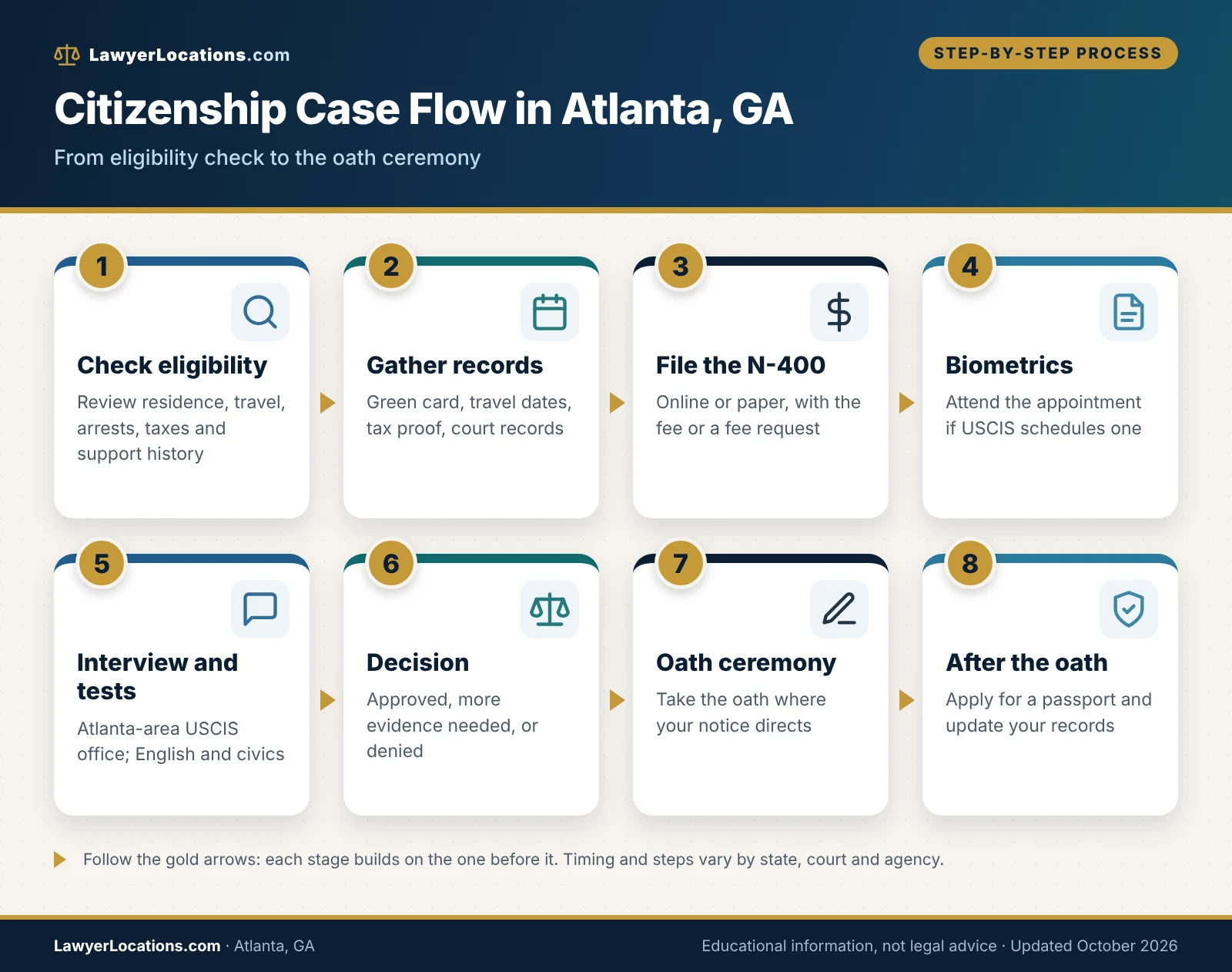
Text version of this graphic
- Screen eligibility: permanent residence period, time in the U.S., travel, arrests, taxes.
- Gather documents: green card, travel history, tax transcripts, court records if any.
- File the N-400 online or on paper and pay the fee, or request a reduced fee or fee waiver.
- Attend the biometrics appointment if USCIS schedules one.
- Interview and English/civics tests at the USCIS field office.
- Receive a decision: approved, more evidence needed, or denied.
- Take the Oath of Allegiance at the scheduled ceremony.
- Apply for a passport and update Social Security records.
Reading this page does not create an attorney-client relationship. It is a map for comparing options, and the final call on your own case belongs with a lawyer licensed in the relevant jurisdiction who has reviewed your documents.
How a Naturalization Case Works in Atlanta, GA
A naturalization case moves from eligibility check to application, biometrics, interview, decision and oath. The sequence is federal, but you will deal with the Atlanta-area USCIS office and, for many applicants, a ceremony hosted by the federal court in downtown Atlanta. Timelines vary by caseload, so use official USCIS processing information rather than any city-specific estimate you see in an ad.
The eligibility checklist in plain English
Time as a permanent resident and time in the U.S.
Most applicants must have been a lawful permanent resident for a set period before filing, with a shorter period for certain spouses of U.S. citizens. You must also show continuous residence (you did not break your ties to the U.S.) and physical presence (you were actually inside the country for a minimum share of that time). Long trips abroad are the most common reason a lawyer review changes the filing date.
You must also have lived for a period in the state or USCIS district where you file. Someone who recently moved to Georgia should count the months before filing in Atlanta.
Good moral character and attachment to the Constitution
Good moral character is a legal standard, not a personality test. Officers look at criminal history, honesty in past immigration filings, tax compliance, support obligations and similar conduct during the statutory period. A minor, old matter may not block you, but certain offenses can permanently or temporarily bar approval. This is the area where an attorney’s read of your specific records matters most.
You also take an oath that includes support for the Constitution, and you answer questions about your history, memberships and past conduct on the form under penalty of perjury.
English and civics
At the interview, an officer tests your ability to read, write and speak basic English and asks civics questions from the official USCIS study materials. Exceptions and accommodations exist for age, long permanent residence and medical conditions, but they require the right paperwork. Use only the official USCIS study materials, since third-party apps sometimes lag behind updates.
From filing to interview
Filing the N-400
You can file on paper or through a USCIS online account. The official fee fact sheet lists a lower price for online filing than for paper. Paper is required in some situations, such as when you request a reduced fee. Keep a complete copy of everything you send, plus proof of delivery.
After filing, USCIS mails a receipt notice. Check every name, date of birth and A-number on it right away, since a typo can cause delays later.
Biometrics and background checks
USCIS may schedule a short appointment to collect fingerprints and a photo, or it may reuse prior biometrics. Background checks run in the meantime, so an old arrest can surface even if you forgot to mention it. Always answer every question on the form truthfully, and gather court records for any incident before the interview.
Missing a biometrics appointment is a common cause of avoidable delay, so reschedule through the instructions on the notice if you cannot attend.
The interview at the field office
You attend an interview at a USCIS field office, where an officer goes through your application under oath. The court’s own naturalization page lists USCIS’s Atlanta-area scheduling contact as 2150 Parklake Drive, NE, Atlanta, GA 30345, but always go to the address printed on your interview notice, since offices and assignments can change.
Bring the original documents the notice asks for, your green card and a government photo ID. If you hired a lawyer for the interview, the attorney files a notice of appearance so USCIS recognizes the representation.
Decision and oath
Possible outcomes
The officer may approve the application, continue the case to ask for more evidence or a retest, or deny it. A continuance is not a denial, but it comes with a deadline. A denial comes with a written explanation and instructions for challenging it, which we discuss in the section on special situations.
Do not make travel plans or major life decisions that depend on approval until you have the written notice in hand.
The Oath of Allegiance in the Atlanta area
You become a citizen only when you take the oath. The U.S. District Court for the Northern District of Georgia states that it hosts ceremonies on behalf of USCIS and publishes a calendar of dates in Atlanta and other Georgia cities. The court’s page lists ceremonies at 11:00 a.m. in the Ceremonial Courtroom on the 23rd floor of the Richard B. Russell Federal Building and U.S. Courthouse, and says cell phones and other devices with cameras are not allowed past security.
The same page lists 2026 ceremonies in Atlanta, Rome, Gainesville and Newnan. Your own USCIS notice controls the date, time and place, so treat the court calendar as background, not as a substitute for your letter.
Every USCIS notice has its own response date: biometrics, evidence requests, interview and oath. Missing one can cost you the application. Put each date on a calendar the day the notice arrives and tell your lawyer immediately if you cannot attend.
Atlanta Venues and Georgia Rules That Matter
For a federal process, the local layer is smaller than most ads suggest, but it is real. Your interview happens at the USCIS office serving metro Atlanta, your oath is often hosted by the federal court in downtown Atlanta, any court challenge after a denial would go to the Northern District of Georgia, and Georgia has its own licensing statute for people who offer immigration help for pay. Knowing these four anchors helps you check whether a provider is who they claim to be.
The places your case touches
USCIS field office for the Atlanta area
USCIS runs the Atlanta-area field office where most naturalization interviews take place. The federal court’s naturalization page gives the USCIS scheduling address as 2150 Parklake Drive, NE, Atlanta, GA 30345 and a phone number of 1-800-375-5283. Use the USCIS website’s office locator and your own appointment notice to confirm the location before you travel, since interview sites and assignments are set by USCIS.
Plan for parking, security screening and a long morning. Arrive early, bring every document listed on the notice, and bring an interpreter only if the notice or your lawyer says it is allowed in your situation.
The federal courthouse that hosts oath ceremonies
The U.S. District Court for the Northern District of Georgia says it hosts naturalization ceremonies on behalf of USCIS. Unless noted otherwise, it holds them in the Ceremonial Courtroom, Room 2306, on the 23rd floor of the Richard B. Russell Federal Building and U.S. Courthouse, with an 11:00 a.m. start. You check in and review paperwork with USCIS representatives before the ceremony begins.
The court’s published list for 2026 includes Atlanta dates, plus ceremonies in Rome, Gainesville and Newnan, which is useful if you live outside the core of the metro area. Bring a government-issued photo ID and leave phones and other camera-equipped devices out of the security line, as the court instructs.
| Stage | Who handles it | Where or how | What to do |
|---|---|---|---|
| Application filing | USCIS | Online account or paper filing as the form instructions direct | Keep a full copy and proof of delivery |
| Biometrics (if scheduled) | USCIS | Appointment location printed on your notice | Attend on the date given or reschedule per the notice |
| Interview and tests | USCIS officer | Field office serving Atlanta; court page lists 2150 Parklake Drive NE | Bring originals and ID; confirm the address on your notice |
| Oath ceremony | USCIS, hosted by the N.D. Ga. court at some ceremonies | Often Room 2306, Richard B. Russell Federal Building and U.S. Courthouse, Atlanta | Arrive per your notice; no camera-equipped devices through security |
| Court review after certain denials or delays | U.S. District Court | Northern District of Georgia | Talk to a lawyer promptly; deadlines are strict |
Georgia’s licensing law for immigration helpers
What Chapter 20A says about who may help
Georgia regulates people who provide immigration assistance for pay. The Registration of Immigration Assistance Act is Chapter 20A of Title 43 of the Georgia Code and is administered by the Secretary of State. Under O.C.G.A. § 43-20A-4, a person may not provide immigration assistance in Georgia without a license, and applicants must be at least 18, show a clean background report for the prior five years (traffic violations aside) and post a $5,000 performance bond.
The Act defines immigration assistance narrowly: it excludes legal advice, recommending a course of legal action and anything that requires legal analysis or judgment. In other words, a licensed immigration assistance provider is not allowed to tell you whether you qualify or how to answer a sensitive question. Only a lawyer or an accredited nonprofit representative can do that.
Who is exempt, and who must put up warnings
The Act exempts attorneys licensed in Georgia, legal interns, law clerks and paralegals working under a licensed attorney’s direct supervision, and nonprofit organizations recognized by the Board of Immigration Appeals (with their accredited employees). Non-attorney providers must post a sign in English and the other languages they use stating that they are not attorneys and cannot give legal advice, and similar notices apply to their advertising. They also may not translate words like “notary public,” “attorney” or “lawyer” into another language in documents identifying their services, which targets the classic notario scam.
The contract rule sits in O.C.G.A. § 43-20A-5 and the exemptions and signage rules in § 43-20A-6. A provider’s contract must clearly state the obligations of both sides. If a provider will not put the services and price in writing, that alone is a reason to walk away.
Consequences for unlicensed practice
The Act provides for civil penalties of up to $1,000 per violation, capped at $50,000, and lets a person harmed by unlawful immigration assistance bring a private lawsuit. First-offense unlicensed practice is a misdemeanor under the criminal provision, with more serious treatment for repeat offenses within five years. These are the enforcement tools, but they only work if you spot the problem and report it, so keep contracts, receipts and screenshots of advertising.
To check a provider, look up the license status with the Georgia Secretary of State’s immigration assistance providers page. To check an attorney, use the State Bar of Georgia’s member lookup, discussed in the lawyer-comparison section.
A person who says “I can handle your citizenship case” but is not a lawyer or an accredited representative of a recognized nonprofit may be breaking Georgia law if unlicensed, and even a licensed immigration assistance provider cannot give legal advice. Ask for a bar number or a license number before you hand over documents or money.
| Type of helper | Can give legal advice on your case? | How to check | Watch for |
|---|---|---|---|
| Attorney licensed in Georgia | Yes | State Bar of Georgia member lookup | Vague fee agreements; no written scope |
| Attorney licensed in another state | Ask the attorney to explain how they are authorized to represent you before USCIS | Ask which state bar they belong to, then check that bar’s public lookup | Unclear answers about licensing or who is responsible for your file |
| Nonprofit recognized by DOJ, with accredited representatives | Yes, within the scope of recognition | DOJ list of recognized organizations and accredited representatives | Waitlists; scope limits |
| Licensed immigration assistance provider (non-attorney) | No | Georgia Secretary of State license lookup | Anyone who offers advice on how to answer form questions |
| Unlicensed “consultant” or notary | No, and unlicensed assistance is unlawful in Georgia | No license to find | Promises, pressure, pay-first demands |
Accredited representative: a non-lawyer employee of a Department of Justice–recognized nonprofit who has been authorized to give immigration legal advice within that organization. Georgia’s licensing statute carves these nonprofits out of its licensing requirement.
Federal court review in Atlanta
When a case can leave USCIS
Most citizenship cases never go near a courtroom. If USCIS denies an application, the notice explains the administrative way to ask for a review, and that request has a short deadline printed on the notice. If USCIS does not decide within the period Congress set after your interview, federal law allows a court action, which is a lawyer-only decision with strategic downsides.
Any such lawsuit would be filed in the federal district court for the district where you live, which for the Atlanta area is the Northern District of Georgia. Because strict time limits apply, anyone who receives a denial should speak to a lawyer immediately, not months later.
Why local federal practice matters
A lawyer who regularly appears in the Northern District of Georgia knows its filing rules, judges’ standing orders and the U.S. Attorney’s Office practices that apply to these cases. Ask a lawyer whether they have handled federal court naturalization matters, not only USCIS applications. The two skill sets overlap, but they are not the same.
What Citizenship Help Costs in Atlanta
You will pay two kinds of costs: a government filing fee and, if you hire help, a legal fee. The government fee is the same in every city. Legal fees are set by each firm, and this site does not publish averages because no official source tracks them.
The government filing fee
What USCIS lists for the N-400
USCIS’s fact sheet on naturalization fees, which describes the fee rule that took effect April 1, 2024, lists $760 for a paper N-400 and $710 for an online N-400, with no separate biometrics fee. It lists a $380 reduced fee for applicants whose household income falls between 150% and 400% of the federal poverty guidelines, and a full fee waiver for those who meet one of three criteria: a means-tested benefit, income at or below 150% of the guidelines, or extreme financial hardship. Military service members filing under the special provisions pay nothing.
Fees are set by federal rule and can change, so check the current USCIS fee schedule on the day you file and use the fee your form edition requires. Never pay a third party to “reserve” a fee level.
Reduced fee and fee waiver mechanics
The fact sheet says a reduced-fee request must be made on a paper N-400 with the relevant part completed, and that fee waivers go on a paper fee waiver form or a written request attached to the application. It also warns not to send a payment with a waiver request: if USCIS receives a payment, it processes the payment instead of the waiver. A lawyer or accredited representative can help you pick the right route.
Keep income evidence ready, such as recent tax transcripts, benefit letters or pay records, since USCIS may ask for proof.
| Option | Amount listed | Who it fits | How to request |
|---|---|---|---|
| Paper filing | $760 | Applicants who file by mail at the full fee | Paper N-400 with payment |
| Online filing | $710 | Applicants filing through a USCIS online account | Online N-400 |
| Reduced fee | $380 | Household income between 150% and 400% of poverty guidelines | Paper N-400 with the reduced-fee part completed |
| Fee waiver | $0 | Means-tested benefit, income at or below 150% of guidelines, or extreme financial hardship | Paper fee waiver form or written request; no payment attached |
| Military filers | $0 | Service members filing under the military provisions | Follow the military filing instructions |
What lawyers charge and how
Common fee structures
Citizenship matters are often quoted as a flat fee that covers a defined set of tasks, because the work is predictable. Hourly billing and retainers show up when a case involves complications, such as criminal history analysis or a denial appeal. Some lawyers offer payment plans or a limited-scope review at a lower price.
Whatever the model, the key question is the same: what exactly is included, and what costs extra? Ask for the answer in writing before you pay anything.
Questions that expose hidden costs
Ask whether the quote includes the government fee or adds it on top, whether interview attendance is included, whether answering a request for evidence costs more, whether an appeal is included and what happens to the fee if you withdraw. Also ask whether paralegals do part of the work and whether they are supervised by the attorney.
The Georgia immigration assistance statute requires contracts for covered services to state the obligations of both sides, and a lawyer’s own fee agreement should do the same.
| Structure | How it works | Works well when | Ask about |
|---|---|---|---|
| Flat fee | One price for a defined scope | Your history is clean and the task is clear | Interview attendance, evidence requests, appeal |
| Hourly rate | Billed by time against a deposit | The issue is uncertain, such as old criminal records | Estimate of hours, billing increments, cap |
| Limited-scope review | One-time consult or form check | You want to file yourself with a professional check | Whether follow-up questions are included |
| Payment plan | Fee split into installments | You cannot pay a lump sum | Interest, what happens if you miss a payment |
| Nonprofit sliding scale | Fee based on income, or free | Your income is limited and you qualify | Eligibility, waitlist, scope of services |
Other costs people forget
Documents, records and translations
Certified court records, police clearance letters, translations of foreign-language documents and copies of tax transcripts can add cost and, more importantly, time. Order court dispositions early because courts and agencies have their own processing times. A certified translation must come with a translator’s statement of competence, so use a qualified service, not a friend who gives a loose English summary.
If you have a medical condition that affects the English or civics requirement, a doctor completes a form for you. Ask the doctor about fees ahead of time.
Time off work and travel
Interviews and oath ceremonies happen on weekdays. Plan for time off, childcare and transportation to the field office or courthouse. Parking and security lines in downtown Atlanta can take longer than expected, so build in extra time.
After the oath, you will likely want a U.S. passport. Check the State Department’s current fee schedule at that point, since passport fees are separate from naturalization.
Ask each lawyer for a written scope-and-fee summary and compare them side by side. Compare scope, not just price. A lower quote that excludes the interview can cost more in the end.
How to Compare Citizenship Lawyers in Atlanta
Compare lawyers on license status, relevant experience, fee clarity, communication and fit with your situation, not on advertising volume or promises. A good consultation leaves you with a clearer picture of your own case and a written scope, even if you do not hire that lawyer. LawyerLocations.com does not rank or recommend attorneys, so use the framework below on any firm you find.
Verify the basics first
License and standing
Confirm that the person is an active member of the State Bar of Georgia, or if they are licensed elsewhere, ask where and how they are authorized to represent clients before USCIS. A bar number is a public record and a real lawyer will provide it without hesitation. Ask whether there is any public discipline.
Do the same check for the individual who will actually handle your file. A well-known firm name does not tell you who will prepare your application or attend your interview.
Experience that matches your facts
Citizenship is a narrow slice of immigration law, and your facts may call for a specific skill. A clean, long-term green card holder needs efficient preparation. Someone with an arrest history needs a lawyer who understands how immigration law reads criminal records, and often a criminal defense lawyer as well. Ask how often the firm handles naturalization applications with issues like yours, without asking for outcomes or promises.
Lawyers cannot ethically promise approval, and any pitch that suggests inside connections at USCIS is a red flag.
The consultation conversation
Questions to ask on the first call
Use the first call to test clarity. A strong consultation usually covers the following topics, and you should note whether the lawyer answers directly or dodges.
- Who will do the work, and who will attend my interview?
- What is included in the fee and what costs extra?
- What do you see as the biggest risk in my history?
- What is the plan if USCIS asks for more evidence or denies the application?
- How and how often will you update me, and in what languages?
- Do you return original documents on request?
The last question echoes a Georgia statutory rule for licensed attorneys providing immigration assistance, who may not refuse to return client documents on request, even during a fee dispute.
How to prepare so the consult is worth it
Bring a one-page timeline of your trips abroad, addresses and jobs, plus your green card, any past immigration notices and a list of every arrest, citation or court date, however minor. The more complete your timeline, the sooner the lawyer can give a straight answer. If you do not have an item yet, say so and ask how to get it.
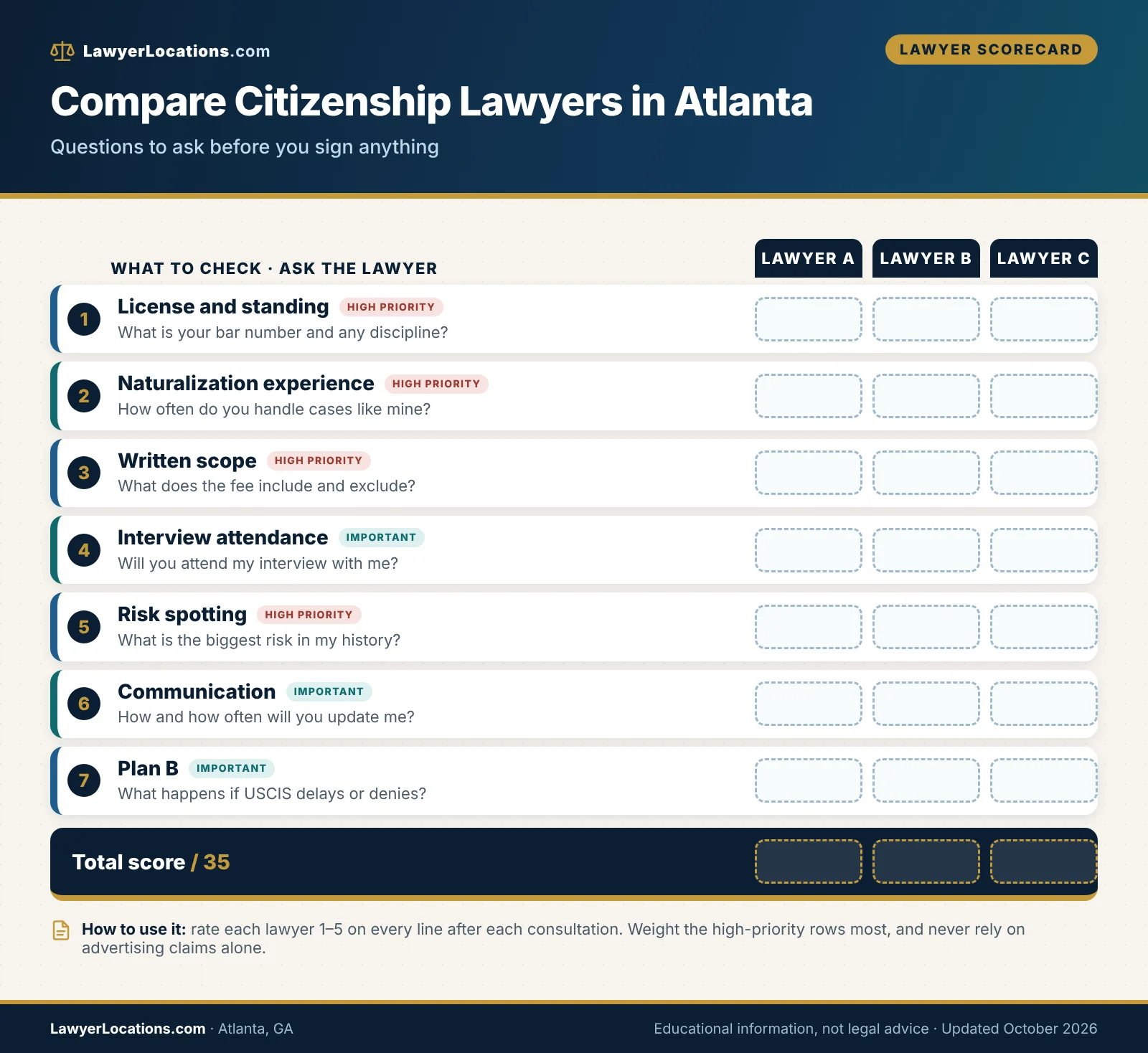
Text version of this graphic
| Criterion | Question to ask |
|---|---|
| License and standing | What is your bar number, and any public discipline? |
| Naturalization experience | How often do you handle N-400 cases like mine? |
| Written scope | What exactly does the fee include? |
| Interview attendance | Will you attend my interview with me? |
| Risk spotting | What is the biggest risk you see in my history? |
| Communication | How will you update me, and in what language? |
| Plan B | What happens if USCIS denies or delays? |
Book two consultations if you can. Compare written scope side by side and notice which lawyer asked the sharper questions about your travel, arrests and taxes.
Red flags and good signs
Signs a provider is not who they claim to be
Unlicensed “immigration consultants,” notarios and visa-mill websites often copy the look of law offices. Georgia’s Chapter 20A signage and advertising rules exist because of this pattern. If an office has no required notice that it is not a law firm and still gives advice, treat it as suspect.
- Promises that approval is certain, or claims of a special relationship with USCIS.
- Pressure to pay immediately in cash, with no written agreement.
- Refusal to give a bar number or license number.
- Advice to leave troubling facts off the form or “fix” your history.
- Holding your original documents as leverage in a fee dispute.
Signs of a careful practice
Good lawyers ask hard questions up front, tell you when you should wait, explain the scope in writing and are comfortable with you consulting more than one firm. They also say plainly what they do not know yet and what they need to see. A lawyer who talks you out of filing too early is protecting your fee and your case.
If your English is limited, ask about interpreter support. A consultation you cannot fully understand is not much of a consultation.
- The lawyer reads your documents before quoting a fee.
- The scope and costs are in a signed agreement.
- You get a clear next step, even if you do not hire the firm.
- The quote arrives before anyone asks about your history.
- You are promised a sure approval or a faster line at USCIS.
- The firm will not name the person handling your case.
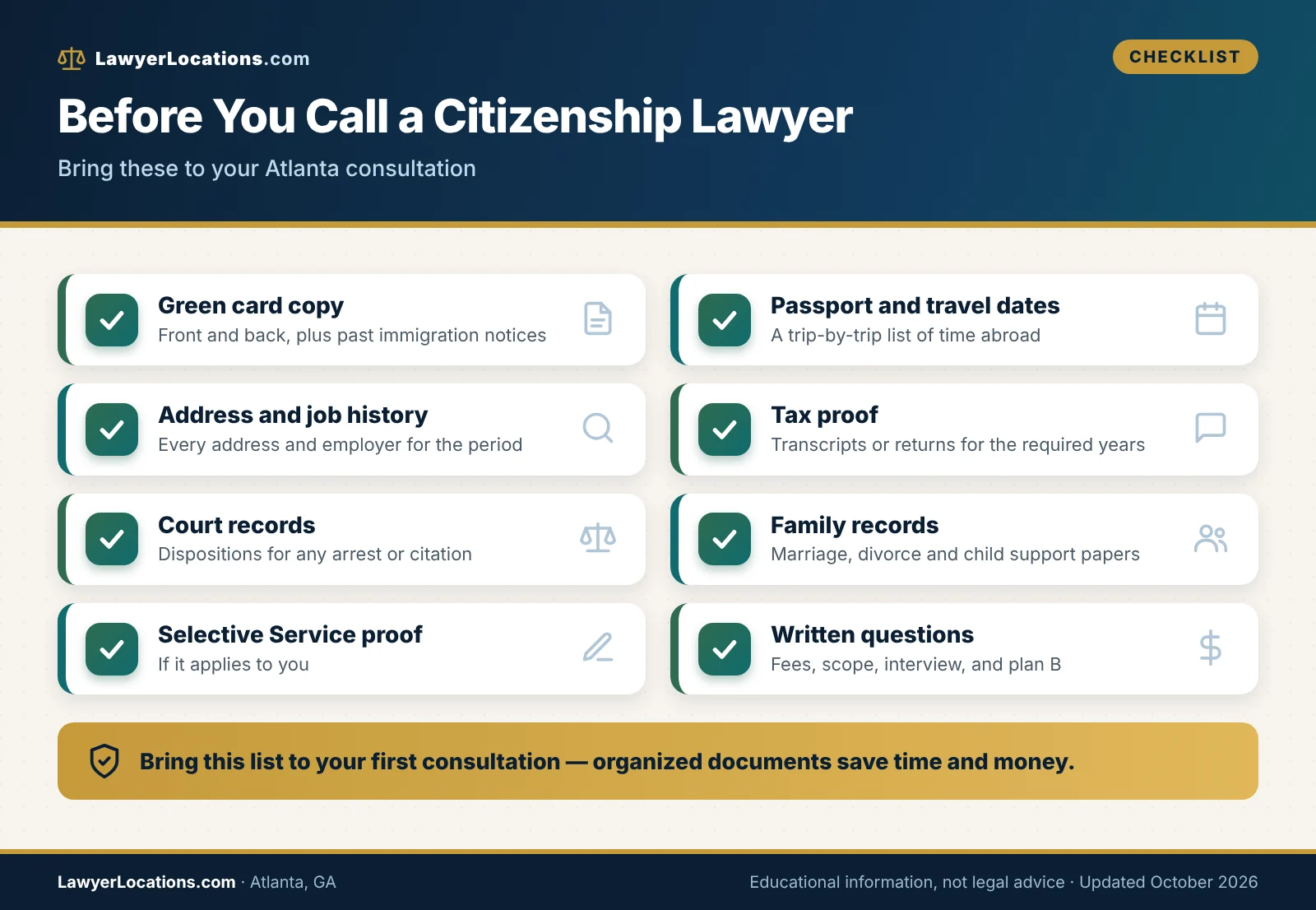
Text version of this graphic
- Green card (front and back) and any other immigration documents.
- Passport and a trip-by-trip travel history.
- Five-year list of addresses and employers.
- Tax filing proof for the required period.
- Court records for any arrest or citation.
- Marriage, divorce and children’s records if they apply.
- Selective Service proof if it applies.
- A written list of questions for the lawyer.
A short document and evidence checklist
Core documents
Most applicants should gather the green card, passport and past passports, a trip-by-trip travel record, proof of tax filing, and records of addresses and employers across the statutory period. A lawyer will tell you which are essential for your facts. Do not send originals to USCIS unless the instructions say to.
Photocopy everything and keep digital scans in one folder with a clear file-naming system, since you may need them at the interview.
Records people forget
Court dispositions for any arrest, even if it ended in dismissal; documents about child support if you are subject to a support order; Selective Service registration if it applies to you; and divorce decrees or name-change records. These are the items that most often slow a case when they are missing at the interview.
If any record is hard to get, tell your lawyer early. They may know a faster route or a way to document an unavailable record.
Special Situations, Mistakes and Red Flags
Some facts turn a routine application into one where legal advice is worth the cost. If any of the situations below describes you, schedule a consultation before you file and, where it applies, before you talk to any officer about it.
Facts that should send you to a lawyer first
Arrests, charges and convictions
Any arrest, citation or conviction, in Georgia or anywhere else, can affect the good-moral-character analysis and the truthful answers you must give on the form. Dismissed charges and cleared records may still need to be disclosed and documented. A state record cleanup does not always erase the matter for immigration purposes, so do not assume an old case is irrelevant.
If you are facing a pending charge, speak to a criminal defense lawyer first, ideally one who coordinates with an immigration lawyer. Our guides on drug crime lawyers in Atlanta, expungement lawyers and felony lawyers explain how those lawyers work, and what criminal defense costs helps you budget.
Long trips abroad and moving away
Spending long stretches outside the U.S. can break continuous residence or leave you short on physical presence. Moving your home to another country, even temporarily, can raise abandonment questions. A lawyer can calculate your dates against the legal thresholds and tell you whether to wait.
Bring your passport stamps, boarding passes and any record that proves how long each trip lasted.
Money, family and registration issues
Taxes and support obligations
USCIS may ask whether you have filed tax returns and whether you owe past-due taxes or support. A payment plan with a tax authority may help, but you should document it and ask a lawyer how it affects timing. Child support arrears, court-ordered or not, are the kind of fact a lawyer should review before you file.
Georgia family court orders sometimes become exhibits in a naturalization file. If divorce or custody is involved, our guide to family law attorneys in Atlanta explains how to compare those lawyers.
Selective Service and other registrations
Men who lived in the U.S. in the age range covered by the registration requirement may be asked to prove they registered. If you did not, a lawyer can explain how that interacts with your age and your timeline. Do not guess or sign a statement you cannot support.
Also be careful with any past voting or false claims to citizenship, which can carry severe immigration consequences. Stop and see a lawyer before you file if either could apply.
If something goes wrong
A request for evidence or a continued interview
If USCIS asks for more documents or schedules a second interview, read the notice closely and note the response date. Answer exactly what is requested, label your documents, and keep proof of delivery. Late or partial responses are a leading cause of avoidable denials.
A lawyer can also tell you whether the officer is signaling a concern you should address with a short explanation letter.
A denial and what follows
A denial letter explains the reasons and the option to request a review, with a short deadline stated on the letter. That is a time to hire a lawyer immediately. You may also be able to re-apply later, depending on the reason, so ask about both paths. Do not ignore a denial or assume you can fix it next year without checking the effect on your green card status.
If your case also involves the green card itself, such as a lost card or a question about status, read our green card lawyer guide and our overview of when a visa lawyer can help with a denial or delay for related background.
| Problem | Why it matters | Usual first step |
|---|---|---|
| Arrest or citation, even old | May affect good moral character and must be answered truthfully | Get court records; consult a lawyer before filing |
| Long time abroad | Can disrupt continuous residence or physical presence | Build a dated travel timeline; ask a lawyer when to file |
| Unfiled taxes or owed taxes | Raises questions about honesty and compliance | Get tax transcripts; discuss a plan with a tax professional and a lawyer |
| Child support arrears | May be read as a failure of a legal obligation | Gather payment history and court orders |
| Missed Selective Service registration | Can matter for men in the covered age range | Ask a lawyer how it applies to your age and dates |
| Prior immigration violations or false statements | May bar approval or raise fraud concerns | Consult a lawyer before any filing |
Maria has held a green card for years and lives in Decatur. During the lookback period she spent a long stretch caring for a parent abroad and has an old citation she thought was dismissed. She books a consultation before filing. The lawyer maps her trip dates against the physical-presence rule and orders the court record, which shows exactly what happened. They decide the timing of her filing based on those facts. This is a hypothetical illustration, not a prediction for any real case.
Free and Low-Cost Help, Deadlines and Next Steps in Atlanta
If cost is the obstacle, start with nonprofit and bar programs before assuming you must pay a private firm. The right next step depends on your history: clean cases can move straight to filing, complicated ones should see a lawyer first, and anyone who has already paid a questionable provider should document what happened and report it.
Where to look for lower-cost help
Nonprofits and accredited representatives
Some Atlanta-area nonprofits provide immigration legal services at low or no cost, and the national ImmigrationLawHelp.org directory lets you search by city and type of service. Catholic Charities Atlanta and the Latin American Association are among the Atlanta organizations listed in that directory, so check each organization’s current citizenship services, eligibility rules and waitlists directly. Service areas, languages and capacity change, and we do not endorse any organization.
The U.S. Department of Justice maintains a list of recognized organizations and accredited representatives, which is the best way to confirm that a nonprofit’s staff are authorized to give immigration legal advice. Georgia’s licensing law recognizes the same federal category in its exemptions.
Bar referral and attorney lookups
The State Bar of Georgia publishes information on how to get an attorney referral and offers an online member directory for checking whether a lawyer is licensed. A bar referral can help you find a lawyer who handles immigration matters, but it is a starting point, not an endorsement. Ask any referred lawyer the questions from the comparison section.
If you cannot afford a lawyer and do not qualify for a nonprofit, ask private firms about limited-scope review or a payment plan.
Deadlines and decision points
What to track once you file
Your deadlines are the ones printed on your USCIS notices, and they differ by case. There is no single statewide date to memorize. Create one document that lists each notice, its date and what you must do, and share it with your lawyer.
The most common deadlines are for biometrics, evidence requests, the interview and any review request after a denial. Treat every date as firm.
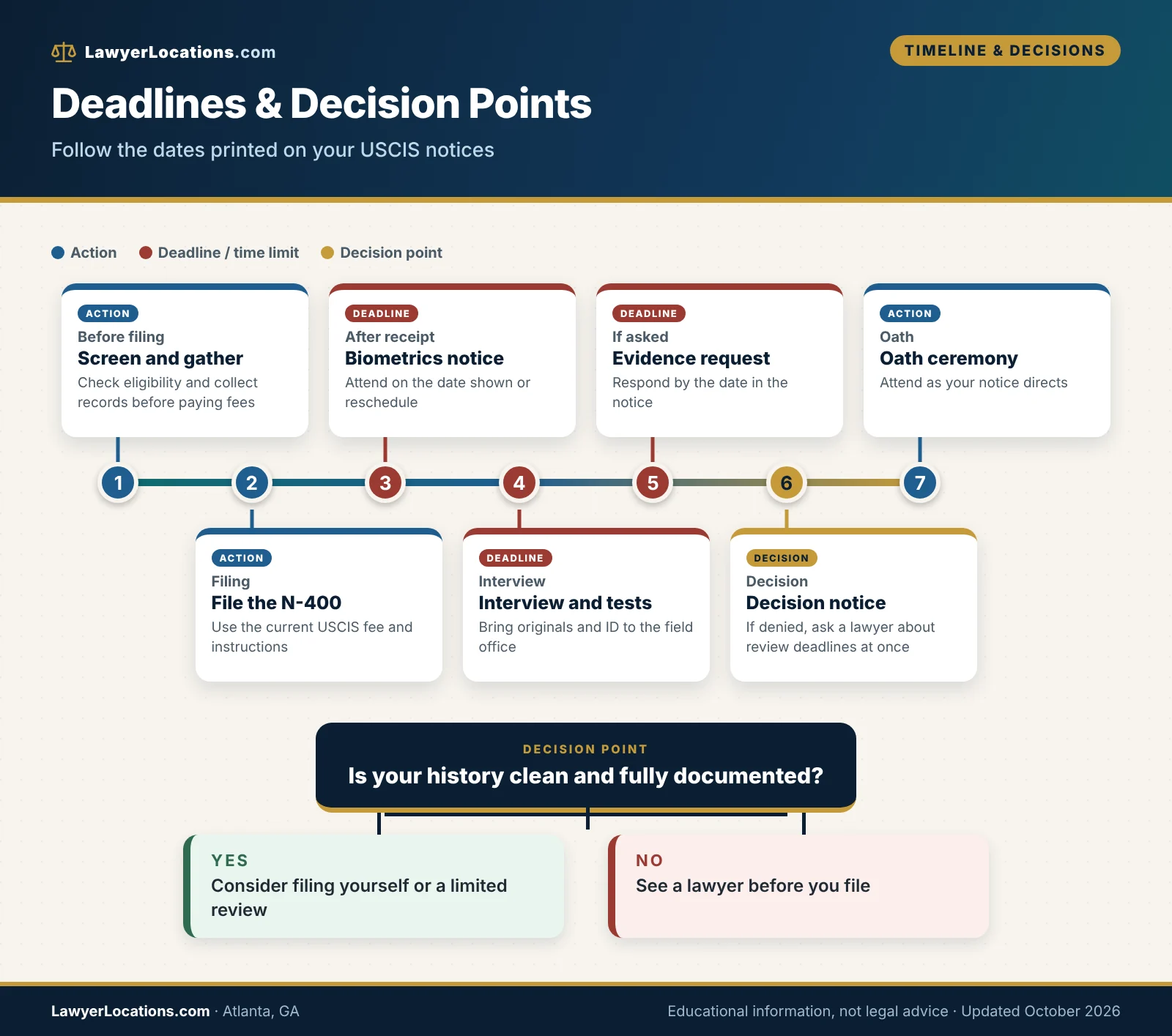
Text version of this graphic
- Before filing (action): screen eligibility and gather records.
- Filing (action): file the N-400 with the correct fee or fee request.
- After receipt (deadline): follow the biometrics notice date.
- Interview (deadline): attend at the field office with originals.
- Evidence request (deadline): respond by the date in the notice.
- Decision (decision): if denied, ask a lawyer immediately about review deadlines.
- Oath (action): attend the ceremony and receive your certificate.
Decision point: Is your history clean and complete? If yes, you may consider filing on your own or with a limited review. If not, see a lawyer before filing.
Georgia gives you tools if an unlicensed provider misleads you: O.C.G.A. § 43-20A-7 provides civil penalties and a private right of action, and O.C.G.A. § 43-20A-21 addresses criminal penalties. Keep your contract, receipts and ads.
Deciding whether to hire a lawyer
Use this rule of thumb: the more complicated your travel, criminal, tax or family history, the more a lawyer can add. The simpler it is, the more you can consider a limited review or a nonprofit. If you are unsure which category you are in, a short consult is the cheapest way to find out.
Whatever you decide, do not file just to “get in line” if you may not qualify yet. The fee is generally not refunded when an application is denied for not meeting requirements.
| Your situation | Likely path | Why |
|---|---|---|
| Simple history, comfortable with forms | File yourself, optionally with a limited-scope review | Lower cost; the official instructions are detailed |
| Limited income, simple history | Nonprofit or accredited representative; consider fee reduction or waiver | Lower cost, authorized help |
| Arrests, long trips or tax issues | Private immigration attorney before filing | Risk spotting and timing advice |
| Denial or long delay | Private immigration attorney promptly | Strict deadlines and possible federal court review |
| Already paid someone unlicensed | Document everything; consult a lawyer; report to the Secretary of State | Georgia law provides penalties and a private right of action |
If you were misled by a provider
Steps to take
Gather contracts, receipts, text messages and copies of anything you signed. Do not sign more documents until a licensed attorney or accredited representative has reviewed them. The Department of Justice’s executive office for immigration review publishes a national notice about notario fraud, and Georgia’s Secretary of State handles immigration assistance provider licensing complaints.
Georgia’s Chapter 20A also gives people harmed by unlawful immigration assistance a right to sue. Whether that makes sense for you is a question for a lawyer.
Protecting your own application
If a bad provider filed something in your name, find out what was submitted, including any false statements. A lawyer can obtain your file and plan a correction. Honest correction early is almost always better than waiting for USCIS to discover a problem.
Do not travel abroad until you know whether the earlier filing created a risk for you.
Your next steps
A simple action plan
- Write your timeline. List trips abroad, addresses, jobs, and any arrests or citations.
- Order key records. Court dispositions, tax transcripts and your green card copy.
- Pick two or three providers to compare. Verify licenses with the State Bar of Georgia or the DOJ list.
- Get scope and fees in writing. Compare what is included, not only the price.
- Decide, then file. Use the current USCIS fee and instructions on filing day.
When you are ready to find a citizenship lawyer in Atlanta, GA, use the scorecard above and bring your timeline to every consult. If your situation involves a green card issue first, start with our green card lawyer guide. People in other metro areas may want the Harris County citizenship lawyer guide for a comparison of how local logistics differ for the same federal process.
Study and test preparation
USCIS publishes its own study materials, including a 2025 version of the civics questions. Study from the USCIS site only, and read your interview notice to see which version applies to you. If you have a disability or medical condition that affects testing, ask your lawyer or accredited representative about the right accommodation request before the interview.
Practice speaking English aloud with a friend or in a free community class, since the interview is conversational and the officer will listen for comprehension, not perfect grammar.
Ready to compare your options?
Write your timeline, collect your records and speak with two or three providers before you decide. Choose a lawyer or accredited representative whose license you have confirmed, whose scope is in writing and who explains risk plainly. LawyerLocations.com is a legal-education resource, not a law firm, and does not recommend or rate individual attorneys.
Frequently asked questions
Core questions about eligibility, fees and logistics
Do I need a lawyer to become a citizen?
No law requires you to hire one. Many people with clean histories apply on their own. A lawyer is most useful when your history includes arrests, long trips abroad, tax or support problems, or a prior denial.
Is citizenship law different in Georgia?
No. Naturalization is federal. Georgia law matters for licensing of immigration helpers, for family and criminal records that may appear in your file, and for the state courts that created those records.
Where is my naturalization interview held?
At the USCIS field office your notice names, which for most metro Atlanta residents is the Atlanta-area office. The federal court lists 2150 Parklake Drive, NE, Atlanta, GA 30345 as USCIS’s scheduling address, but follow the address on your own notice.
Where is the oath ceremony?
It depends on your notice. The Northern District of Georgia hosts ceremonies for USCIS, often in the Ceremonial Courtroom at the Richard B. Russell Federal Building and U.S. Courthouse in Atlanta, with other 2026 dates listed in Rome, Gainesville and Newnan.
How much does the N-400 cost?
USCIS’s fee fact sheet lists $760 for paper and $710 for online filing, with a $380 reduced fee and a fee waiver for eligible applicants. Confirm the current fee on the USCIS fee schedule before you file.
How can I tell if someone is a real immigration lawyer?
Ask for a bar number and look the person up with the State Bar of Georgia. For a nonprofit, check the Department of Justice list of recognized organizations and accredited representatives.
Providers, affordability and problems
These answers cover the situations where people most often need to slow down and check who they are dealing with.
Can a notary or “consultant” help with my citizenship application?
Not with legal advice. Georgia requires immigration assistance providers to be licensed, and the statute excludes legal advice from what they may do. A notary public in the U.S. is not a lawyer.
What if I cannot afford a lawyer?
Ask about nonprofits, accredited representatives, a limited-scope consultation, a payment plan, and a reduced fee or fee waiver for the government charge if you qualify.
Should I talk to a lawyer if I have an old arrest?
Yes, before filing. Even dismissed or old cases may need to be disclosed and documented, and the way immigration law treats a record can differ from how a Georgia court treated it.
What happens if my application is denied?
The denial notice explains the reasons and the review option, with a deadline. Contact a lawyer right away, because the time limits are short and strict.
General information only. This article is for general legal education and is not legal advice. Reading it does not create an attorney-client relationship, and LawyerLocations.com is not a law firm and does not recommend or rate individual attorneys. Immigration laws, fees, forms and local procedures change, so confirm current rules with USCIS and the court, and consult a lawyer licensed in the relevant jurisdiction about your own situation.
Sources & References
Show all 9 sources
- Naturalization Fees fact sheet (fees effective April 1, 2024) — U.S. Citizenship and Immigration Services — uscis.gov — accessed October 2026
- Naturalization (ceremony locations, schedule and USCIS contact) — U.S. District Court, Northern District of Georgia — gand.uscourts.gov — accessed October 2026
- Registration of Immigration Assistance Act, O.C.G.A. Title 43, Chapter 20A — Georgia Secretary of State — sos.ga.gov — accessed October 2026
- O.C.G.A. § 43-20A-4, Licensing of immigration assistance providers — Justia (Georgia Code) — law.justia.com — accessed October 2026
- Immigration Assistance Providers: About the Department — Georgia Secretary of State — sos.ga.gov — accessed October 2026
- Study for the Test and 2025 Civics Test resources — U.S. Citizenship and Immigration Services — uscis.gov — accessed October 2026
- Where can I get an attorney referral? (FAQ) — State Bar of Georgia — gabar.org — accessed October 2026
- Notario national notice — U.S. Department of Justice, Executive Office for Immigration Review — justice.gov — accessed October 2026
- Immigration legal services directory (Atlanta listings) — ImmigrationLawHelp.org — immigrationlawhelp.org — accessed October 2026
Legal Disclaimer and Limitation of Liability
Informational and illustrative purposes only. This article was prepared by LawyerLocations.com solely on the basis of the information available to us at the time of writing. It is an illustrative, general overview. It is not a complete or authoritative statement of the law, and it has not been reviewed by a lawyer licensed in your state or county.
Not legal advice. Nothing in this article is legal, financial, tax or immigration advice, and reading it does not create an attorney-client relationship between you and LawyerLocations.com or any author, lawyer or firm mentioned. Laws, court rules, fees, filing deadlines and agency procedures differ by state, county and court, and they change often. Some details here may be simplified, incomplete or out of date, and time limits for legal claims can be short.
No warranty. We make no representation or warranty, express or implied, about the accuracy, completeness, timeliness or suitability of this content for your situation. Please do not rely on it to make, delay or skip any legal decision. Check the facts against official sources and speak with a licensed attorney in the relevant jurisdiction before you act.
Limitation of liability. To the fullest extent permitted by law, LawyerLocations.com and its owners, authors and contributors disclaim all liability for any loss, damage, cost or other consequence arising from the use of, or reliance on, this article, including any content on third-party websites we link to. Mentioning a lawyer, firm, organization or service is not an endorsement and is not a promise of any result. If you are in immediate danger, contact your local emergency number.