An expungement lawyer helps you find out whether a criminal record can be erased, sealed, set aside or dismissed, and then handles the petition, the paperwork and the hearing if there is one. Whether you qualify depends almost entirely on your state, the type of offense, how much time has passed and your record since. There is no single national expungement law, and federal convictions have very few routes to clearing.
This national guide explains the vocabulary (expungement, sealing, set-aside, clean slate), the eligibility factors that matter, typical waiting-period ranges, what a cleared record still can’t fix, what costs look like, and when paying for a lawyer makes sense. It is general information, not legal advice.
Expungement Lawyer Basics: What Record Clearing Is and the Words You Will See
Record clearing is a set of legal tools that limit what the public, and sometimes the government, can see about an arrest or conviction. The tools carry different names in different places, and the same word can mean different things in two neighboring states. Before you hire an expungement lawyer or file anything yourself, it helps to know which tool your state actually offers.
Expungement, sealing, set-aside and clean slate: the main tools
The Collateral Consequences Resource Center, a national research group that tracks these laws, warns that terminology and procedure “differ significantly from state to state.” In some states “expungement” means a record is destroyed. In others it means the record is closed to the public but still exists. Read the definition in your own state’s law, not just the label.
Expungement
Expungement is a court process that removes a charge or conviction from your record. The Clean Slate Initiative, a national advocacy group, describes it as a process after which a conviction is treated, in most cases, as if it never happened, with the record either deleted or sealed from public view. How complete the “erasure” is depends on state law, and some states let certain employers or licensing agencies still see an expunged record.
Sealing
Sealing hides a record from public view, but the record still exists. Law enforcement, courts and some government agencies may be able to see it, and you can usually get your own sealed record by request or court order. In many states a sealed record does not have to be disclosed on a private job or rental application, but the exceptions are important and vary.
Set-aside, dismissal, vacatur and certificates of relief
A set-aside or dismissal changes the status of a conviction, often after you finish probation, without necessarily hiding the file. California’s court self-help site, for example, describes a petition to dismiss a conviction rather than a petition to destroy it. A vacatur is different again: it usually means a court has found a legal defect in the original case. Some states also issue a “certificate of rehabilitation” or “certificate of relief” that does not seal anything but signals to employers and licensing boards that a court has reviewed your progress.
Automatic or “clean slate” clearing
Clean slate laws clear eligible records without a petition. The National Conference of State Legislatures notes that making clearing automatic removes the need for a petition and is often done free of charge, and it defines “clean slate” states as those with both automatic clearing and an automated process to carry it out. Automatic laws usually cover arrests that never led to conviction and lower-level older offenses, and they usually exclude serious violent and sex offenses.
expungement usually means a court order that removes or closes an arrest or conviction record. sealing hides the record from public view while it still exists. set-aside or dismissal changes the legal status of a conviction. clean slate laws do the clearing automatically. Your state may use any of these words differently.
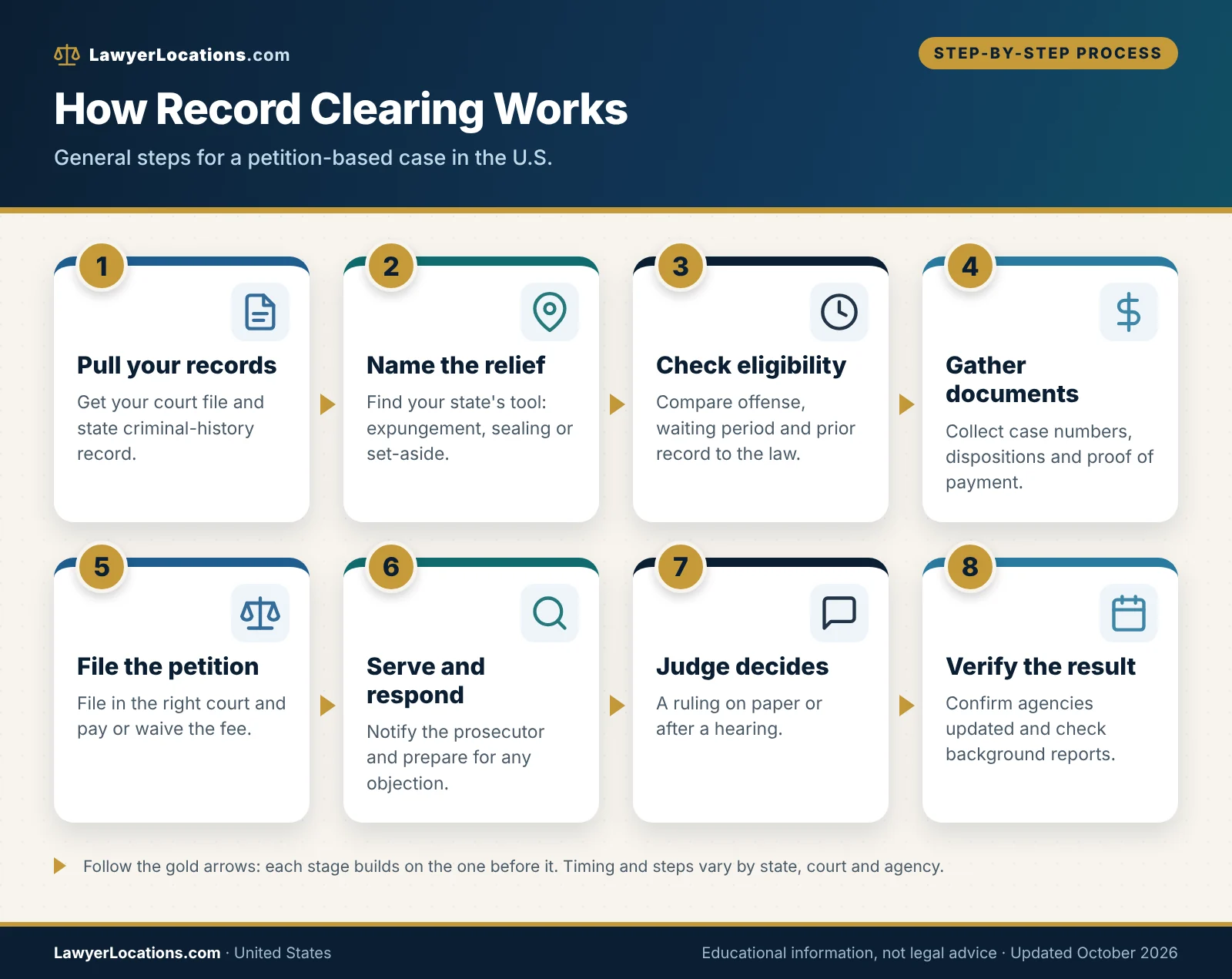
Text version of this graphic
- Pull your record. Get your state court and state police record, plus a federal check if relevant.
- Name the relief. Find out whether your state offers expungement, sealing, set-aside or automatic clearing.
- Check eligibility. Compare offense type, waiting period, sentence completion and prior record to the law.
- Gather documents. Collect case numbers, dispositions, proof of fines and probation completion.
- File the petition. File with the proper court and pay the fee or request a waiver.
- Serve and wait. Notify the prosecutor and other required parties; the prosecutor may object.
- Attend a hearing if set. A judge decides, sometimes without a hearing.
- Follow up. Confirm the order reached the state police and other agencies, and check background reports.
What a cleared record does and does not do
Clearing changes what appears in official databases and what you may say when asked. It does not rewind the calendar. Think of it as limiting access and legal effect, not as a guarantee that nobody will ever see the history.
What it usually changes
In most states a successful order means courts and state repositories stop releasing the record to the public, and private employers and landlords who rely on official records generally can’t see it. Many states also allow you to answer “no” to a private-sector question about the cleared offense, with carve-outs. Always ask your lawyer or the court clerk what your state allows you to say, because a wrong answer on an application can create a new problem.
What it usually does not change
Sealed records often remain available to courts, prosecutors and law enforcement, and sometimes to licensing boards and agencies that hire for sensitive jobs. Texas’s legal-aid portal TexasLawHelp, for instance, notes that certain state agencies and licensing boards may still obtain information about a sealed offense. Clearing a record also does not undo immigration consequences, which we cover below.
Arrests, dismissals, convictions and juvenile cases
The type of record usually decides how easy clearing is. In general, records that did not end in conviction are the easiest to clear, and serious convictions are the hardest. The categories below are the ones most laws use.
Arrests and charges that did not lead to conviction
Most states let you petition to clear an arrest that ended in dismissal, acquittal or a decision not to charge, and some do it automatically. Pennsylvania, for example, mandates sealing for non-conviction records within 30 days of disposition, according to the Collateral Consequences Resource Center’s state profile. Even where the law is generous, you may still need to petition to reach the arrest data held by the state police or by private companies.
Misdemeanor and felony convictions
Convictions are covered by narrower rules that vary by seriousness. The Collateral Consequences Resource Center’s July 2024 comparison placed 17 jurisdictions plus D.C. in a “broader felony and misdemeanor relief” category and 21 in a “limited” category. Several states offer relief only for misdemeanors or for pardoned felonies. That makes the state you were convicted in, not the state you live in now, the starting point.
Juvenile records
Juvenile cases often follow separate, more generous rules, and some states seal or expunge them automatically at a certain age. Pennsylvania’s profile, for example, allows juvenile record expungement six months after discharge on a consent decree or, otherwise, five years after an adjudication. If you had both juvenile and adult cases, ask about each separately because they are usually handled in different courts under different statutes.
Who May Qualify: The Eligibility Factors That Decide Most Cases
You are more likely to qualify if your offense was minor, your sentence is fully finished, enough time has passed and you have stayed out of trouble. Each of those four pieces is set by your state’s statute, and any one can block relief on its own. This section walks through the factors a lawyer checks first.
The factors that matter most
Eligibility is rarely a single yes-or-no rule. It is a stack of conditions, and you have to meet all of them. The table below summarizes the factors that nearly every state considers in some form.
| Factor | What the law usually asks | Why it matters |
|---|---|---|
| Type of record | Arrest only, dismissal, misdemeanor, felony or juvenile case | Non-conviction records are cleared most easily; felonies face the narrowest rules. |
| Offense category | Nonviolent vs. violent; drug, property, sex or traffic offense | Violent, sex and some other offenses are commonly excluded from relief. |
| Waiting period | A set time after sentence, probation or release | Filing too early usually means denial and a wasted fee. |
| Sentence completion | Probation, parole, fines, restitution and court costs finished | Unpaid financial obligations can block a petition in many places. |
| Prior and later record | Number of other convictions; new arrests during the wait | A new conviction can restart or end eligibility. |
| Lifetime limits | Some states allow only one clearing per person | Using your one chance on the wrong case can be costly. |
| Prosecutor and judge discretion | Automatic grant vs. a hearing where the court weighs the request | Your reasons, work history and community ties may matter in discretionary states. |
Type of record and offense category
Start with exactly what is on your record and how each case ended. A case that ended in a dismissal is treated very differently from a case that ended in a guilty plea, even if both began with the same charge. The offense category then decides whether relief is available at all, since many laws list specific offenses that can never be cleared.
Sentence completion and financial obligations
Most laws require you to finish every part of the sentence before you can petition. That includes probation and parole, and often fines, restitution and court costs. If you still owe money, ask the court clerk for a payoff figure or a payment plan, because the debt itself may be what is standing between you and eligibility.
Your record before and after the case
Other convictions can disqualify you, and so can a new arrest during the waiting period. Some states limit eligibility to people with a single conviction or restrict how many convictions can be cleared. Texas’s nondisclosure rules, as summarized by TexasLawHelp, say you are ineligible if you are convicted of or placed on deferred adjudication for another offense, other than a fine-only traffic ticket, during the waiting period.
Typical waiting periods, as ranges
Waiting periods run from a few months to a decade or more, and they typically start from the end of your sentence or probation rather than from the date of arrest. Treat any range you see online, including this one, as a starting point and check your state’s statute.
Short waits for lower-level cases
Some of the shortest waiting periods apply to minor cases and cases that ended without a conviction. In California, for example, the state court self-help site says a person who was never given probation must wait at least one year from the date of conviction to ask for dismissal. In Texas, the legal-aid portal says waiting periods for the various nondisclosure orders range from 180 days to five years.
Longer waits for serious or older convictions
Longer waits are typical for higher-level offenses. Pennsylvania’s automatic sealing law, as summarized by the Collateral Consequences Resource Center, uses a 7-year conviction-free wait for second- and third-degree misdemeanors and a 10-year wait for single less serious drug felonies. Michigan’s State Police program lists 7 years for qualifying misdemeanors and 10 years for qualifying felonies. These examples are not predictions for your state.
Waiting periods are not statutes of limitation, but they act like clocks. Mark the date your waiting period ends, and do not file before it, since an early petition is usually denied and you may forfeit the fee. Also confirm what restarts the clock: a new arrest, a probation violation or a new conviction can reset it in some states.
Offenses that are commonly excluded
Almost every state excludes some offenses from clearing. The exclusions differ, but the same groups come up again and again. A lawyer will check the exclusion list before anything else, since a single excluded conviction can disqualify an otherwise clean record.
Violent, sexual and certain child-related offenses
Sex offenses that require registration and many violent felonies are excluded from relief in most states. Texas’s nondisclosure rules, for instance, bar relief for people with certain convictions or deferred adjudications, including sex-offender-registration offenses, murder and capital murder, aggravated kidnapping and certain family-violence offenses, according to TexasLawHelp. Always read the statute’s list, because the details differ from state to state.
Driving offenses, DUI and commercial licenses
Some states exclude DUI or restrict relief for people who held a commercial driver’s license. Others treat DUI like any other misdemeanor after a longer wait. If a DUI is on your record, read our guide to DUI lawyer costs and what you are paying for and ask any lawyer you consult how your state treats that offense in record-clearing law.
Drug offenses and recent reforms
Drug cases are among the most common reasons people seek clearing, and many recent reforms target low-level drug possession. Pennsylvania’s automatic sealing covers single less serious drug felonies after a 10-year wait, and Missouri enacted a 2026 law on automatic expungement of certain nonviolent drug possession records, according to an industry legislative update. If your record involves drugs, you may also want to read how a drug crime lawyer approach works in a Georgia city for a sense of how criminal-defense and record-clearing work connect.
How Expungement and Sealing Rules Vary by State
Every state has some way for certain people to clear certain records, but the tools, the waiting periods and the offenses covered differ sharply. The record is governed by the law of the state (or the federal system) where the case was heard, not by where you live now. If you moved after a conviction, you generally have to go back to the original state’s rules.
Petition-based systems versus automatic clearing
The biggest divide is whether you must ask. In a petition-based system you file in court and a judge decides. In an automatic system the state identifies eligible records and clears them. Most states still run mainly on petitions, with a growing number adding automatic layers.
How petition-based relief works
Under a petition system you, or a lawyer on your behalf, file with the court that handled the case, pay any fee (or ask for a waiver) and notify the prosecutor. Every state has such a procedure, as the National Conference of State Legislatures notes: “Every state has a procedure that allows some people with criminal records to clear them by petitioning a judge or court.” The petition model rewards people who can afford the time and the filing costs, which is one reason advocates have pushed for automation.
How automatic clearing works
In an automatic system the courts and state police run the records against the statute and clear what qualifies, usually without a hearing. NCSL reported in its database, last updated February 2025, that 26 states and Puerto Rico had at least one automatic clearing provision and that 12 states had automated the process: California, Colorado, Connecticut, Delaware, Michigan, Minnesota, New Jersey, New York, Oklahoma, Pennsylvania, Utah and Virginia. The Clean Slate Initiative’s website in October 2026 said 14 states and Washington, D.C. had passed legislation meeting its minimum standards.
Even in an automatic state, do not assume your record has been cleared. Automatic systems can miss records from older cases, out-of-state filings or cases with missing data. Request a fresh copy of your state record after the rollout date and compare it to the law.
A state snapshot: five examples, five approaches
The five states below were chosen to show how different the systems can be, not because they are the biggest or the best. Each row comes from an official or well-established source we opened for this guide. Details change as legislatures amend the statutes, so use the table to understand the range of approaches, not to decide your own case.
| State | Main tools | How it starts | Waiting-period or eligibility detail reported |
|---|---|---|---|
| California | Dismissal of a conviction (Penal Code 1203.4); automatic relief by the state Department of Justice (Penal Code 1203.425); reduction to an infraction for some offenses | Petition (Form CR-180) or automatic | If probation was completed, the court “must grant” dismissal; if no probation was given, wait at least one year from conviction; still on probation requires asking for early termination first |
| Texas | Orders of nondisclosure (Government Code 411.072 to 411.0736); expunction is a separate remedy | Petition to the court that handled the case | Waiting periods for various orders range from 180 days to five years; certain serious and family-violence offenses are excluded |
| Pennsylvania | Automatic “Clean Slate” sealing; petition-based sealing; expungement for narrower categories | Automatic for qualifying records; petition for broader sealing | 7-year conviction-free wait for second- and third-degree misdemeanors and ungraded offenses; 10 years for single less serious drug felonies; non-conviction records sealed within 30 days of disposition; restitution must be paid |
| Michigan | Automatic set-aside by the State Police; traditional application for convictions that do not qualify | Automatic since April 11, 2023, or application | Misdemeanors: 7 years from sentencing; felonies: 10 years from sentencing or from completing any prison term, whichever is later; limits on how many convictions qualify |
| Florida | Court-ordered sealing or expunction (Fla. Stat. 943.0585 and 943.059) after a certificate of eligibility from the Florida Department of Law Enforcement | Application to FDLE first, then petition | Only one court-ordered sealing or expungement in a lifetime; $75 nonrefundable fee for the certificate; the Collateral Consequences Resource Center chart reports no general sealing or set-aside of convictions |
What this comparison shows
Two people with the same offense and the same sentence can have very different options depending on the state. One may have a relief that happens without a form, another a lifetime limit of one case, and a third a menu of orders each with its own waiting period. That is why national “can I expunge a DUI?” or “can I expunge a felony?” answers are rarely reliable.
Why you should not copy another state’s timeline
It is common to hear that “everybody can clear a misdemeanor after five years” or “felonies are never eligible.” Neither statement is true everywhere. A lawyer who practices in the court that handled your case will know the statute, the local forms and how the local judges and prosecutors respond.
Where clean slate laws stand in 2026
Clean slate laws are moving quickly, and implementation often lags enactment by years. A law may be on the books while the actual clearing has not begun. The table summarizes recent developments reported in a July 2026 industry legislative update and in the Clean Slate Initiative’s updates; confirm the status in your state before relying on it.
| State | Reported status | Timing noted in the reports |
|---|---|---|
| Pennsylvania | Automatic sealing in operation | Law took effect June 28, 2019, per the state court administrator’s office |
| Michigan | Automatic set-aside in operation | Began April 11, 2023, per the Michigan Attorney General’s site |
| Virginia | Automatic sealing framework in effect | July 1, 2026 |
| Illinois | Clean Slate Act in effect | June 1, 2026; automated sealing not scheduled to begin until 2029 |
| New York | Clean Slate Act with phased implementation | Automatic sealing scheduled to begin in November 2027 |
| Oklahoma | Revised implementation timeline | Free online expungement portal by November 1, 2026; automated expungement by November 1, 2027 |
| Missouri | Law on automatic expungement of certain nonviolent drug possession records signed | Signed July 9, 2026; effective date not yet set |
What to take from the rollout
If your state has a clean slate law, ask whether it is already clearing records, how it handles cases older than the law, and whether you still need to file a petition for anything the automatic process leaves out. A rollout date years away does not stop you from filing a petition now if your state allows it.
How to look up your own state
The National Reentry Resource Center runs the Clean Slate Clearinghouse, a database of record-clearance policies in every state and territory, with a state comparison tool and a find-a-lawyer feature. The Collateral Consequences Resource Center publishes a state-by-state chart of judicial expungement, sealing and set-aside laws. Both give you a starting point before you read the statute itself or talk to a lawyer.
When an Expungement Lawyer Helps and How to Compare One
You do not always need a lawyer to clear a record, but a lawyer is worth considering when eligibility is unclear, the offense is serious, you have several cases, or immigration, licensing or a federal record is involved. The rest of this section helps you decide, then shows how to compare lawyers without relying on advertising claims.
Do you need a lawyer, or can you file on your own?
Many courts publish forms and self-help pages, and automatic systems need no filing at all. California’s court self-help site, for example, walks people through a petition for dismissal using a standard form. A simple, clearly eligible case can sometimes be handled without counsel; a case with a gray area usually cannot.
Cases that people commonly handle on their own
A single older misdemeanor in a state with a standard form, a clear statute and a completed sentence is the typical do-it-yourself case. The same goes for a dismissed charge in a state with a short, well-documented procedure. If the court’s self-help center, a legal aid clinic or a records clinic offers help, using that free help first makes sense.
Cases where a lawyer’s help is usually worth considering
Consider a lawyer when you have several cases or counties involved, when a conviction is near the edge of a waiting period or exclusion list, when the prosecutor is likely to object, or when the record is a felony. Also consider one if you hold or want a professional license, if you are not a U.S. citizen, if the case was federal, or if you were denied before. A mistake in these situations can cost a filing fee, delay your timeline, or use up a one-time limit.
| Situation | Self-help may be enough when | A lawyer is worth considering when |
|---|---|---|
| Eligibility | The statute clearly covers your offense and the wait is over | Eligibility depends on interpreting priors, exclusions or counting dates |
| Number of cases | One case in one court | Multiple cases, counties or states |
| Prosecutor response | The prosecutor rarely objects or the process is automatic | An objection or a contested hearing is likely |
| Collateral issues | No immigration, licensing or firearms question | Immigration status, a professional license, firearms rights or a federal record is involved |
| Prior denial | Not applicable | A petition was denied and you need a better approach or an appeal |
| Your time and comfort | You can gather certified records and track deadlines | Records are hard to get or you want someone to handle service and court dates |
What an expungement lawyer actually does
A lawyer typically pulls your records, confirms eligibility against the current statute, prepares and files the petition, serves the prosecutor, appears at any hearing and checks that the order is carried out by the agencies involved. Some lawyers also help you correct private background reports afterward. The scope varies, so insist on a written description of what is and is not included.
How to compare expungement lawyers
Treat the first call as an interview. You are checking license status, state-specific experience with record clearing, a clear fee structure and honesty about your odds. Our guide on what to ask a criminal defense lawyer before hiring lists questions that carry over, and if you want an example of a state-specific hiring guide, see what to know before you hire a criminal defense lawyer in Idaho.
Questions to ask on the first call
Ask whether the lawyer handles record-clearing in your state and in the court that heard your case, how often they file these petitions, and what would make your case uncertain. Ask what documents they need, whether they will talk to the prosecutor before filing, and how long matters like yours have taken in that court. A good answer is specific and honest about risk; a vague promise that “you’ll be cleared” is not.
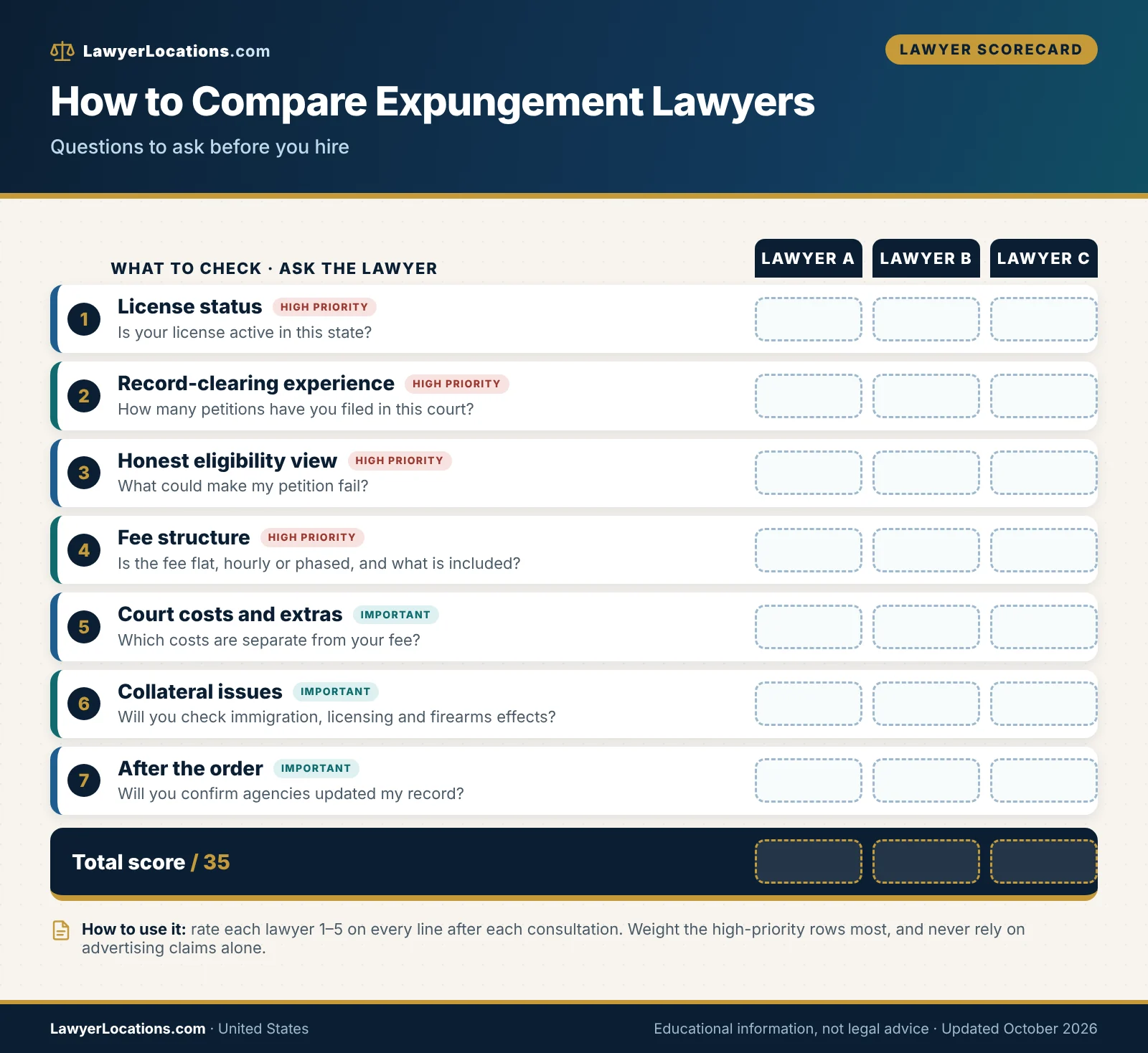
Text version of this graphic
| Criterion | Question to ask |
|---|---|
| License status | Is your license active in this state, and can I check it on the state bar site? |
| Record-clearing experience | How many expungement or sealing petitions have you filed in this court? |
| Honest eligibility view | What could make my petition fail or be denied? |
| Fee structure | Is the fee flat, hourly or phased, and what does it include? |
| Court costs and extras | Which filing, record and fingerprint costs are separate from your fee? |
| Collateral issues | Will you check immigration, licensing and firearms effects? |
| After the order | Will you confirm that agencies and background companies updated my record? |
Fee structures and the written fee agreement
Record-clearing work is commonly priced as a flat fee per case or per petition, as an hourly fee against a retainer, or in phases. Under ABA Model Rule 1.5, a lawyer may not charge an unreasonable fee, and the scope of the representation and the basis of the fee should be communicated to you, preferably in writing; the same rule bars contingent fees in criminal defense. Because state rules differ, ask your lawyer how your state’s version treats record-clearing work and get the answer in the fee agreement.
Checking a license and avoiding misleading claims
Confirm the lawyer’s license through your state bar’s public lookup before paying anything. Be cautious about advertising that promises results, uses words like “guaranteed” or claims to be the best, since a lawyer cannot promise how a judge or prosecutor will respond. LawyerLocations.com is not a law firm and does not rate, endorse or refer lawyers; use bar referral services, court self-help centers and the sources below to find help.
Be wary of anyone who guarantees an outcome, asks for full payment before reviewing your record, or says they can “erase” a record from every database. No one can promise that a court, a prosecutor or a private background company will act a certain way. If you are told your federal record can be expunged, ask exactly which statute or case allows it.
Free and low-cost help
You may qualify for free help. Legal aid organizations, court self-help centers, law school clinics and some public defender offices help with record clearing in some places. Availability and eligibility vary widely, so call before you assume you qualify or don’t.
Legal aid and court self-help
The Legal Services Corporation funds 129 independent nonprofit legal aid organizations across all states, D.C. and U.S. territories, and offers an online tool to find the one that serves your address. LawHelp.org, which the LSC page also points to, offers legal information and free forms. Many state courts also run self-help centers with record-clearing guides.
Bar referral programs and clearing databases
State and local bar associations typically run lawyer referral services where you can request a lawyer licensed in your state. The Clean Slate Clearinghouse at the National Reentry Resource Center includes a find-a-lawyer tool for people with records. Use these to build a short list, then compare two or three lawyers using the scorecard above.
Federal Records and What Clearing Still Can’t Fix
Federal convictions have almost no route to expungement, and even a perfect state order has limits. A state court cannot erase a federal case, change what a federal agency knows, or rewrite immigration law. Knowing these limits upfront helps you set realistic goals before you spend money.
Federal convictions: narrow doors
Federal law has no general statute that lets a person expunge a federal conviction. The options that exist are limited and uncommon. The Clean Slate Initiative says there is no standard process for sealing federal records and that the avenues are comparatively rare.
The statutory exception for first-time drug possession
A federal statute, 18 U.S.C. § 3607, lets a court place certain first-time simple drug possession offenders on probation for up to one year without entering a judgment of conviction, and then dismiss the case if probation is completed. If the person was under 21 at the time of the offense, the court must enter an expungement order on application. The person must not have a prior drug conviction, and the section applies only to offenses after November 1, 1987. A nonpublic record is kept by the Department of Justice for limited use by courts.
Courts’ limited power to expunge on equitable grounds
Some people ask a federal judge to expunge a record “in fairness,” even without a statute. A Congressional Research Service report explains that federal courts’ authority here depends on a narrow doctrine called ancillary jurisdiction, and that most courts have concluded they lack a general expungement power. According to that report, eight circuits (the First, Second, Third, Sixth, Seventh, Eighth, Ninth and Tenth) hold that federal courts lack jurisdiction over equitable expungement, while the Fourth, Fifth and D.C. Circuits allow it only in unusual or extreme circumstances, and the Supreme Court has declined to resolve the split. That report is dated 2020, so ask a federal criminal practitioner about the current rule in your circuit.
Presidential pardons are not expungements
The Department of Justice’s pardon petition instructions say a pardon “will not erase or expunge the record of your conviction” and is not a sign of vindication. It can restore some rights lost because of the conviction and may lessen the stigma. The instructions also say no petition should be filed until a waiting period of at least five years has passed, that the president can pardon only federal convictions (and D.C. Superior Court and court-martial convictions), and that state convictions require a state governor or pardon board.
| Route | What it can do | Main limit |
|---|---|---|
| 18 U.S.C. § 3607 | Probation without conviction and, for people under 21 at the offense, expungement of references to the arrest and proceedings | First-time simple drug possession only; prior drug convictions disqualify |
| Equitable expungement request | A few circuits may allow it in unusual circumstances | Most circuits say courts lack the power; courts cannot generally order executive agencies like the FBI to expunge |
| Presidential pardon | Forgives the offense and may restore some rights | Does not erase the record; five-year waiting guidance; federal convictions only |
| Privacy Act correction | Corrects inaccurate information in some federal records | Fixes errors only; does not clear accurate records |
What a state order does not reach
Even when a state judge signs an order, the effects ripple outward unevenly. Some records have already been copied by private companies, and some systems follow different rules than the state court system. The sections below cover the most common gaps.
Background-check companies and the paper trail already out there
Private background-screening companies buy and store court data, and an order does not automatically purge their copies. Under the Fair Credit Reporting Act, 15 U.S.C. § 1681c bars consumer reports from including arrest records more than seven years old (or beyond the statute of limitations, whichever is longer), but the statute sets no time limit on reporting convictions. A January 2024 CFPB advisory opinion said reporting agencies lack reasonable procedures if they cannot prevent reporting of records that are expunged, sealed or otherwise legally restricted; an industry report says the CFPB withdrew that opinion on May 12, 2025, along with dozens of other guidance documents. Practically, after your order, order your own background reports and dispute outdated entries in writing.
Texas’s legal-aid portal notes that the Foundation for Continuing Justice can send a nondisclosure order, at no cost, to private companies that may hold the record. Ask your lawyer or local legal aid office whether a similar notice program exists in your state.
Immigration consequences
Clearing a record does not necessarily remove a conviction for immigration purposes. In Matter of Roldan (a 1999 en banc decision of the Board of Immigration Appeals), the Board held that a conviction expunged through state rehabilitative relief remains a conviction, and in Matter of Pickering (2003) it distinguished between a vacatur based on a legal defect in the case, which can eliminate the conviction for immigration purposes, and one granted for rehabilitation or hardship, which does not. An advocacy resource from the Immigrant Defense Project notes that these remain BIA precedent and that federal circuits have generally deferred to them. If you are not a U.S. citizen, talk to an immigration lawyer before filing anything; see our guide on when a green card lawyer can help reduce delays and mistakes.
Firearms, licensing and government jobs
Federal firearms law defers to state law on whether something is a conviction: under 18 U.S.C. § 921(a)(20), an expunged or set-aside conviction, or one that was pardoned or had civil rights restored, is not considered a conviction for the chapter unless the order expressly says the person may not possess firearms. State firearms rules can differ, though, so ask. Licensing boards, law enforcement agencies and federal employers can also have access to or ask about cleared records, and some security-clearance forms may ask about sealed or expunged matters, so read each form’s instructions closely.
Employer use of records and your rights
Where a record remains visible, federal anti-discrimination law still limits how employers may use it. The EEOC’s 2012 enforcement guidance says an arrest alone does not establish that criminal conduct occurred, and that a blanket criminal-record exclusion can violate Title VII if it has a disparate impact and is not job related and consistent with business necessity. The guidance points employers to the seriousness of the offense, the time that has passed and the nature of the job. It is not a cure-all, but it can matter if you are rejected over an old record.
The Process, the Costs and the Timeline
Most petition-based clearing follows the same arc: confirm eligibility, collect records, file, serve the prosecutor, wait for a decision and then confirm that agencies updated their files. The exact forms, fees and timing depend on your state and county, so use this section as a map, not a script.
A typical petition from start to finish
The steps below fit most petition systems, with variations. In an automatic system you may skip straight to the last stage, which is verifying the result.
- Get your records. Request your court file and your state criminal-history record so you know exactly what is on file and what each case’s disposition says.
- Identify the right relief. Match your case to your state’s tools: expungement, sealing, set-aside, nondisclosure or an automatic program.
- Confirm the clock. Calculate the waiting period from the correct date and check that fines, restitution and supervision are complete.
- File and serve. File in the court that handled the case, pay or waive the fee and notify the prosecutor and any other required party.
- Prepare for a response. If the prosecutor objects or a hearing is set, gather proof of rehabilitation, work history and community ties.
- Follow the order through. Confirm the order reached the state police and other agencies, then order a new copy of your record.
Before you file: records, dates and the right court
File in the court where the case was heard, which may not be where you live today. Dates matter, so find the sentencing date, the end of probation or parole, and the date of your last payment. If your paperwork is incomplete, the court clerk can usually tell you what is in the file, and the state police can provide the criminal-history record.
Filing, service and the prosecutor’s role
The petition typically names the case, states why you qualify and attaches proof. Most systems require you to notify the prosecuting office and sometimes the arresting agency, which can object. In some states a judge decides on paper; in others there is a hearing where you may speak.
After the order: making sure it worked
A signed order is not the finish line. In the Texas process described by TexasLawHelp, for example, the clerk sends the order to the state Department of Public Safety and listed agencies, and the department then seals the offense and notifies required federal agencies. Check your state record and any commercial background reports after a reasonable time, and keep a certified copy of the order for your files.
Documents to gather before you call a lawyer
Walking into a consultation with records saves time and may lower your cost, since the lawyer spends less time chasing paperwork. Bring what you have, and write down what you cannot find.
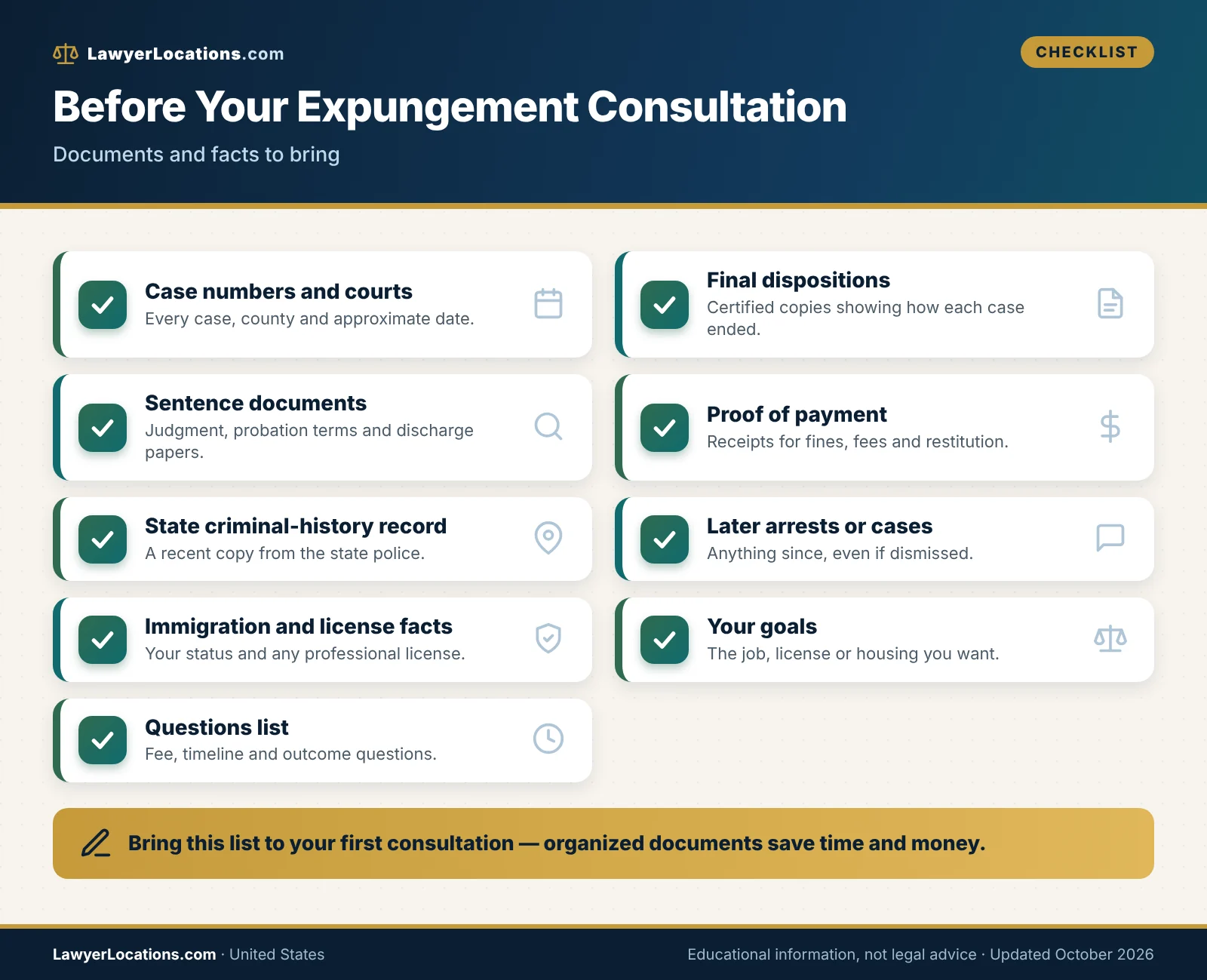
Text version of this graphic
- Case numbers and courts. Every case you want cleared, with county and approximate dates.
- Final dispositions. Certified copies showing how each case ended.
- Sentence documents. Judgment, probation or parole terms and discharge papers.
- Payment proof. Receipts for fines, fees and restitution.
- State criminal-history record. A recent copy from the state police or equivalent.
- Later arrests or cases. A list of anything since, even if dismissed.
- Immigration and license facts. Your status and any professional licenses you hold or want.
- Your goals. The job, license, housing or other reason you want the record cleared.
- Questions list. Fee, timeline and outcome questions for the lawyer.
Court and law-enforcement records
Gather the court records for each case and a copy of your state criminal-history record. Where records are old or from another state, ask the clerk how to request them, since archived files can take longer to retrieve. Having the case number for each matter is the fastest way to speed this up.
Proof of completion and personal facts
Collect proof that every part of the sentence is done, including payment receipts and discharge letters. Also write down your reason for seeking relief and any facts a judge may weigh, such as steady employment, school, treatment or volunteer work. These points can matter in discretionary systems and are good material for a lawyer to organize.
What expungement costs
No reliable national price exists for clearing a record, and we do not publish an “average” because we found no official source that tracks one. Costs depend on the state, the court, the number of cases and whether you hire help. Plan around the components below and ask for each in writing.
| Cost component | Who sets or charges it | What drives the amount | Ways to manage it |
|---|---|---|---|
| Court filing fee | The court | State, county and type of petition; some courts charge per case | Ask the clerk whether a fee waiver or reduced fee applies |
| State record check or eligibility certificate | State police or similar agency | Florida’s FDLE, for example, charges a $75 nonrefundable fee for its certificate of eligibility | Confirm the current fee on the agency site before paying |
| Fingerprints and certified copies | Agencies, clerks and vendors | Number of cases and agencies; certified copies may be priced per page | Request only what the petition requires |
| Attorney fee | The lawyer, under a written agreement | Number of cases, complexity, hearings, prosecutor objections | Compare written scopes; ask about flat fees and payment plans |
| Fixing financial obligations | The court or collections office | Unpaid fines, restitution and court costs that must be paid first | Ask about payment plans or modification before filing |
| Follow-up on private records | Background companies or free programs | How widely your record was sold or posted | Use any free notice program your state offers; dispute errors in writing |
Court and agency fees
Filing fees vary by court, and many courts allow a waiver if you cannot afford them. The one verified dollar figure we can share is Florida’s $75 nonrefundable FDLE fee for a certificate of eligibility, which comes before any court filing fee in that state. Ask the clerk of the court that heard your case for the current schedule rather than relying on an online list.
Lawyer fees and how to compare quotes
Compare lawyers on scope as much as on price. A lower quote that leaves out the hearing, service on the prosecutor or the follow-up may cost more in the end than a higher quote that includes them. See our guide to what DUI lawyer fees cover for an example of how scope and structure change the price of criminal-law work.
Ways to reduce what you pay
Start with free options: court self-help, legal aid and clinics. If you hire a lawyer, bring complete records, ask for a flat fee in writing and ask about a payment plan. Resolve any outstanding fines early, since a cleared balance can be the only thing blocking a petition.
Timeline and decision points
Timing varies from weeks to many months, depending on the court’s docket, whether a hearing is needed and how quickly agencies update files. We do not publish a national average because no official source tracks one. What you can control is the order of the work.
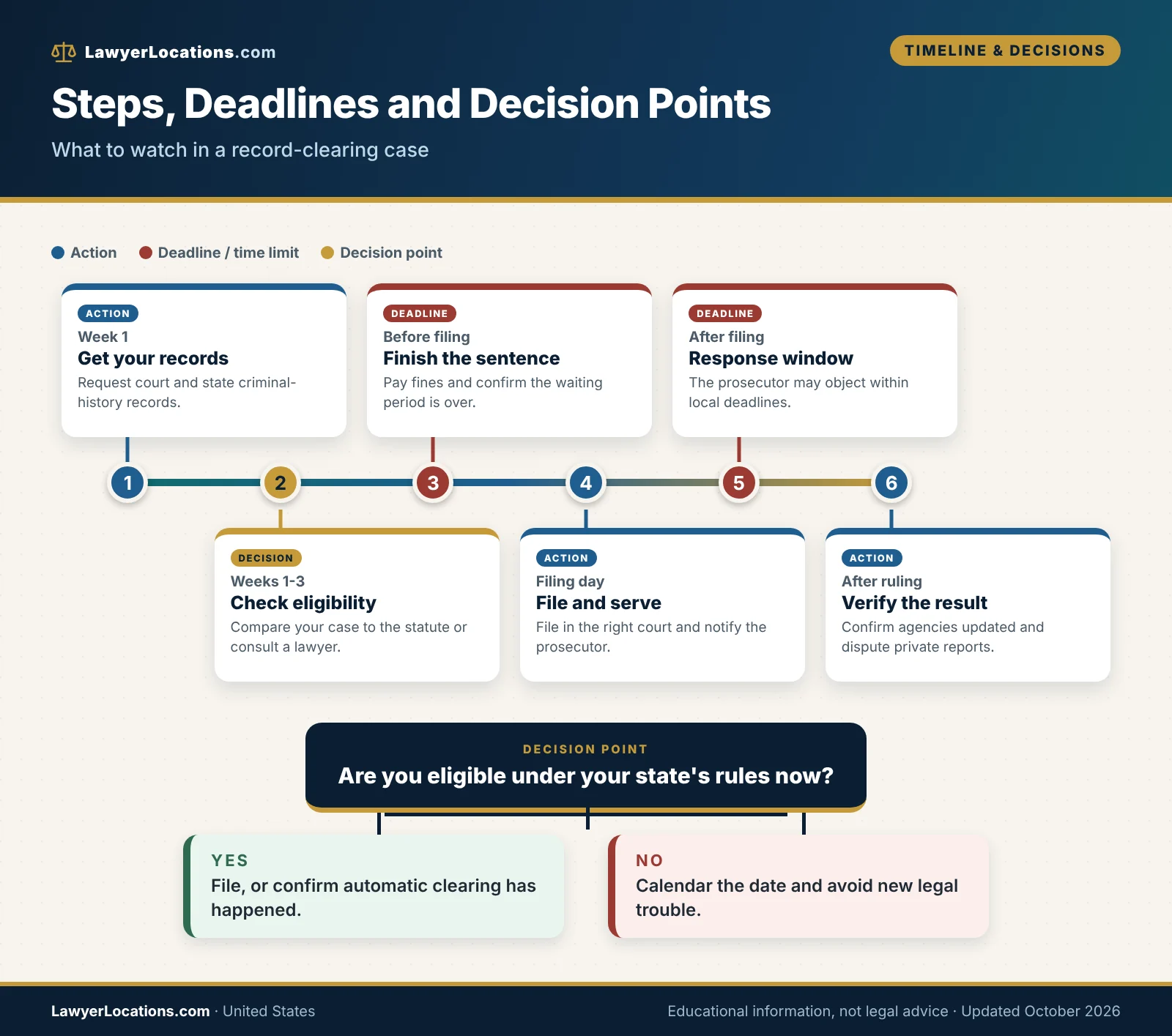
Text version of this graphic
- Week 1: Get records (action). Request your court and state criminal-history records.
- Weeks 1 to 3: Check eligibility (decision). Compare your case to the statute or consult a lawyer.
- Before filing: Finish your sentence (deadline). Pay fines and confirm the waiting period is over.
- Filing day: File and serve (action). File in the right court and notify the prosecutor.
- After filing: Response window (deadline). The prosecutor may object within the time set by local rules.
- Decision: Hearing or paper ruling (decision). The judge grants, denies or sets a hearing.
- After the order: Verify (action). Confirm agencies updated records and dispute private reports.
Decision point: Are you eligible now? If yes, file. If no, find out when you will be and what could restart the clock.
Should you file now or wait?
If you are eligible now, there is often little reason to wait, except where your state allows only one clearing per lifetime or where a clean slate rollout is close. If you are not yet eligible, calendar the date, avoid new legal trouble and ask a lawyer whether any other relief, such as a reduction or certificate, is available in the meantime. If your state has a clean slate program, ask whether your record will be cleared automatically before you pay for a petition.
What can delay or derail a petition
Common delays include missing certified records, unpaid balances, a record that is in a different court than you thought and prosecutor objections. A denial is not always final; ask what the judge cited and whether a re-filing or appeal is allowed. The cause of a denial usually decides whether a lawyer’s help is worthwhile the second time.
Common Mistakes, Red Flags and Next Steps
The most common mistakes are filing too early, ignoring unpaid obligations and assuming a cleared record is invisible everywhere. Avoiding those three, and checking your results after the order, puts most people in a better position. The sections below list the traps and give you a short plan.
Mistakes and red flags to avoid
These problems come up often enough that they are worth a checklist. None of them is fatal if you catch them early, but each can cost time or money.
Filing mistakes
- Filing before the waiting period ends, or counting from the wrong date.
- Filing in the wrong court, or in the state where you live instead of where the case was heard.
- Leaving out a related case, an arrest or a later conviction that affects eligibility.
- Ignoring unpaid fines, restitution or court costs that must be resolved first.
- Using up a one-time-only relief on a minor case when a more important case needed it.
Most of these come from not reading the statute’s exact wording. A short consultation before filing can be cheaper than refiling.
After-order and scam red flags
Do not assume you may deny a record everywhere; ask what you can legally say on each application. Be cautious of websites or callers who promise to wipe your record nationwide, charge in full upfront or ask for sensitive information before explaining what they do. Verify the person is a licensed lawyer through the state bar before you pay, and keep copies of the order and every receipt.
A person with a decade-old misdemeanor in one state and a more recent case in another may be eligible for relief in the first state but not the second. A lawyer reviewing both records can tell them which petition to file first, whether the later case resets any clock, and what to say on a job application that asks about convictions in the meantime.
Your next steps
You do not need to decide everything today. A short sequence of steps will tell you whether you qualify, what it would cost and whether to hire help.
A three-step plan for this week
- Pull your records. Get your court file and your state criminal-history record for each case.
- Look up your state’s rules. Use the Clean Slate Clearinghouse and your state court’s self-help page to see which relief tools exist and what the waiting periods are.
- Book one or two consultations. Use the scorecard above and write down the fee, scope and timeline you are quoted.
Where to go from here
If your case involves a recent arrest or open charge, deal with the defense first, because pending cases usually block clearing. For hiring questions that apply to any criminal matter, read our guide on what to ask a criminal defense lawyer before hiring. A lawyer licensed in the state where your case was heard can tell you what applies to your facts.
Ready to compare your options? Collect your records, confirm your state’s waiting period and compare two or three written fee agreements side by side before you hire anyone. Free legal aid and court self-help centers are worth trying first.
Sources & References
Show all 24 sources
- 50-State Comparison: Judicial Expungement, Sealing and Set-Aside — Collateral Consequences Resource Center — ccresourcecenter.org — accessed October 2026
- 50-state guide to expungement and sealing laws — Collateral Consequences Resource Center (2016 background article) — ccresourcecenter.org — accessed October 2026
- Pennsylvania Record Relief profile — Collateral Consequences Resource Center — ccresourcecenter.org — accessed October 2026
- Frequently Asked Questions — The Clean Slate Initiative — cleanslateinitiative.org — accessed October 2026
- The Clean Slate Initiative home page — cleanslateinitiative.org — accessed October 2026
- Automatic Criminal Record Clearing Database — National Conference of State Legislatures (updated February 2025) — ncsl.org — accessed October 2026
- Clean Slate Laws: 2026 Mid-Year Update — Accurate (industry legislative update, July 2026) — accurate.com — accessed October 2026
- Clean Slate Clearinghouse — National Reentry Resource Center — nationalreentryresourcecenter.org — accessed October 2026
- Over 34 Million Cases Sealed From Public View Under Pennsylvania’s Clean Slate Law — Administrative Office of Pennsylvania Courts (June 2020) — pacourts.us — accessed October 2026
- Automatic Expungements: Michigan Clean Slate — Michigan Department of Attorney General — michigan.gov — accessed October 2026
- Record cleaning: Misdemeanors — California Courts Self-Help Guide, Judicial Council of California — selfhelp.courts.ca.gov — accessed October 2026
- Nondisclosure Orders and Sealing Your Criminal Record in Texas — TexasLawHelp.org (reviewed September 2025) — texaslawhelp.org — accessed October 2026
- Certificate of Eligibility Instructions — Florida Department of Law Enforcement — fdle.state.fl.us — accessed October 2026
- 18 U.S.C. § 3607, Special probation and expungement for drug possessors — Legal Information Institute, Cornell Law School — law.cornell.edu — accessed October 2026
- Record Scratch: Expunging Federal Criminal Records and Congressional Considerations (LSB10413) — Congressional Research Service, February 2020 — everycrsreport.com — accessed October 2026
- Pardon petition instructions — U.S. Department of Justice, Office of the Pardon Attorney — justice.gov — accessed October 2026
- 15 U.S.C. § 1681c, Requirements relating to information contained in consumer reports — Legal Information Institute, Cornell Law School — law.cornell.edu — accessed October 2026
- Fair Credit Reporting; Background Screening advisory opinion (January 23, 2024) — Consumer Financial Protection Bureau — consumerfinance.gov — accessed October 2026
- CFPB Withdraws Several Guidance Documents for FCRA and Consumer Reporting Agencies — ClearStar (industry report) — clearstar.net — accessed October 2026
- Beyond Roldan and Pickering — Immigrant Defense Project — immigrantdefenseproject.org — accessed October 2026
- 18 U.S.C. § 921(a)(20), Definitions — Legal Information Institute, Cornell Law School — law.cornell.edu — accessed October 2026
- Enforcement Guidance on the Consideration of Arrest and Conviction Records in Employment Decisions Under Title VII (April 25, 2012) — U.S. Equal Employment Opportunity Commission — eeoc.gov — accessed October 2026
- Model Rule 1.5: Fees — American Bar Association — americanbar.org — accessed October 2026
- Get Legal Help — Legal Services Corporation — lsc.gov — accessed October 2026
General information only. This article is a general educational resource from LawyerLocations.com, which is a legal-education and lawyer-discovery resource and not a law firm. It is not legal advice, and reading it does not create an attorney-client relationship. Expungement, sealing and related laws change, and they differ by state, county and offense. Verify current rules with the court that handled your case and consult a lawyer licensed in the relevant jurisdiction about your situation.
Legal Disclaimer and Limitation of Liability
Informational and illustrative purposes only. This article was prepared by LawyerLocations.com solely on the basis of the information available to us at the time of writing. It is an illustrative, general overview. It is not a complete or authoritative statement of the law, and it has not been reviewed by a lawyer licensed in your state or county.
Not legal advice. Nothing in this article is legal, financial, tax or immigration advice, and reading it does not create an attorney-client relationship between you and LawyerLocations.com or any author, lawyer or firm mentioned. Laws, court rules, fees, filing deadlines and agency procedures differ by state, county and court, and they change often. Some details here may be simplified, incomplete or out of date, and time limits for legal claims can be short.
No warranty. We make no representation or warranty, express or implied, about the accuracy, completeness, timeliness or suitability of this content for your situation. Please do not rely on it to make, delay or skip any legal decision. Check the facts against official sources and speak with a licensed attorney in the relevant jurisdiction before you act.
Limitation of liability. To the fullest extent permitted by law, LawyerLocations.com and its owners, authors and contributors disclaim all liability for any loss, damage, cost or other consequence arising from the use of, or reliance on, this article, including any content on third-party websites we link to. Mentioning a lawyer, firm, organization or service is not an endorsement and is not a promise of any result. If you are in immediate danger, contact your local emergency number.