A green card lawyer is a licensed attorney who helps you choose the right path to permanent residence, files the forms correctly, and answers when USCIS or a consular officer pushes back. Green cards are governed by federal immigration law, so the rules are the same in every state. What is not stable is the policy around them: in 2026 USCIS issued a memo describing adjustment of status as “extraordinary” discretionary relief, a new public charge rule took effect on September 18, 2026, and several holds and pauses are being fought in court.
You are not legally required to hire anyone, but a missed bar, a wrong form edition or an inconsistent answer can cost months or years. This guide covers the main pathways, the paperwork, current fees, the Visa Bulletin, when a green card lawyer is worth paying for, and how to spot notario fraud. It is general information as of October 2026, not advice about your case.
What a Green Card Lawyer Does and Who Can Legally Help
A green card lawyer matches your facts to a pathway, screens you for problems before you file, prepares and submits the case, and represents you if something goes wrong. A “green card” is the common name for lawful permanent resident status, which lets you live and work in the United States indefinitely. This section explains the job in plain terms and who is actually allowed to do it.
The work a lawyer actually does in a green card case
The forms are the easy part. The value is in deciding which forms, in what order, and whether filing is safe at all.
Choosing the pathway and the order of filing
Many people qualify through more than one door, each with different wait times and risks. A person married to a U.S. citizen may also have an employer who could sponsor them. A lawyer compares the options against your history and timeline. Choosing the wrong category or filing at the wrong moment can be hard to undo, because USCIS filing fees are generally non-refundable and a denial leaves a record.
Screening for bars, waivers and discretion problems
A careful lawyer looks for the issues that sink cases: overstays, unauthorized work, prior removal orders, arrests, old applications with errors, and anything that could be called misrepresentation. Each has its own rule, and some have waivers. In 2026 the screening also covers how an officer may weigh discretion, covered in section 5.
Which professionals are legally allowed to give immigration advice
Immigration is one of the few areas where a non-lawyer can sometimes be authorized to represent you, and the list is short.
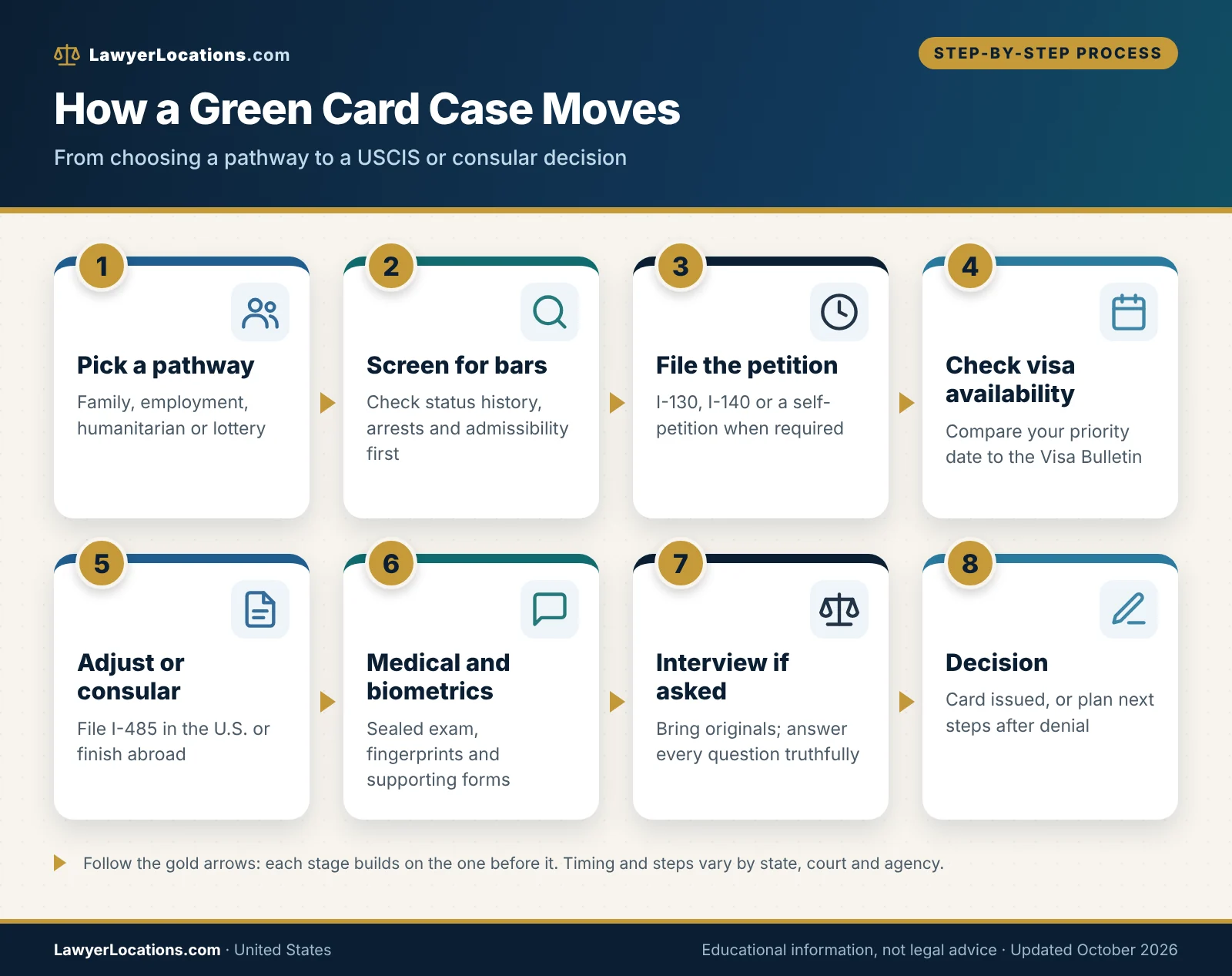
Text version of this graphic
- Free first screening: confirm your goal and any urgent deadline.
- Pick a pathway: family, employment, humanitarian or lottery.
- Check admissibility and eligibility: status history, bars, public charge.
- File the petition (I-130 or I-140) or the self-petition, when one is needed.
- Wait for visa availability, using the Visa Bulletin and priority date.
- File Form I-485 in the United States, or complete consular processing abroad.
- Biometrics, medical exam, possible interview and any request for evidence.
- Decision, then green card issuance or a plan for denial and appeal options.
Attorneys: licensed anywhere in the United States
USCIS states that an attorney must be in good standing, eligible to practice before the highest court of a U.S. state, territory or the District of Columbia, and not under a court order restricting practice. The attorney does not need a license in the state where you live, because immigration benefits are decided under federal law. For a “near me” search, that means a lawyer licensed in another state can handle a USCIS case, though you may prefer someone local for an interview. Check standing with the licensing agency of the state where the lawyer is admitted and with the Executive Office for Immigration Review (EOIR) list of disciplined practitioners. LawyerLocations does not rank or recommend individual lawyers.
Accredited representatives of DOJ-recognized organizations
An accredited representative is a non-attorney who works for a nonprofit that the Department of Justice has “recognized.” Under 8 C.F.R. 1292.1(a)(4), these representatives may appear before DHS (including USCIS) and before the immigration courts and the Board of Immigration Appeals, but only through the recognized organization. USCIS describes these groups as usually nonprofit or social service organizations that mainly serve low-income clients.
Accreditation lasts three years, so check the DOJ roster at justice.gov/eoir.
Doing it yourself versus hiring help
The government does not require representation. The question is how much risk your facts carry.
Cases that are often manageable without a lawyer
A clean case with a clear category and no violations is the best candidate for self-filing, such as the spouse of a U.S. citizen who entered legally, never overstayed and has no criminal history. Even then, read each form’s instructions line by line, use the current edition, and consider a limited-scope paid review before you file.
Cases where a lawyer is hard to replace
Risk climbs fast with time in the United States without status, work without authorization, a prior removal order, arrests or convictions (even old or dismissed), prior denials, or a gap in status in an employer case. In removal proceedings an immigration judge, not USCIS, may decide. Consult a criminal defense lawyer about any charge, because convictions can have immigration consequences that the criminal court will not explain.
talk before you file Do not submit an I-485 or any application “just to see what happens” if you have any negative history. Filing gives the government your address, your fingerprints and your account of your history. Ask a licensed attorney or accredited representative whether filing is safe first.
The Main Green Card Pathways
There are five broad ways to get a green card: through family, through a job, through humanitarian protection, through special immigrant or victim categories, and through the diversity lottery. Each has a different sponsor, a different form and a different wait. The table below gives the map, and the subsections explain the rules that matter most.
Family-based green cards
Family is the largest pathway. The key split is between immediate relatives of U.S. citizens, who face no visa-number queue, and everyone else, who must wait in a numbered preference line.
Immediate relatives of U.S. citizens
Under 8 U.S.C. 1151(b)(2)(A)(i), immediate relatives are the children, spouses and parents of a U.S. citizen; the citizen must be at least 21 to petition for a parent, and a child is an unmarried child under 21. They are not held back by the annual preference limits, so timing depends on agency workload, not the Visa Bulletin.
The citizen files Form I-130, Petition for Alien Relative. If the relative is in the United States and eligible to adjust, Form I-485 can generally be filed at the same time. If the relative is abroad, the case moves to the National Visa Center and a consular interview.
Family preference categories and backlogs
Relatives who are not immediate relatives fall into four numbered preferences under 8 U.S.C. 1153(a): unmarried sons and daughters of citizens (first), spouses and unmarried children of green card holders (second), married sons and daughters of citizens (third), and brothers and sisters of citizens (fourth). Demand exceeds supply, so each category has a priority date queue. The family preference limit has a statutory floor of 226,000 visas a year, and no country may take more than about 7 percent of the total, so some countries wait much longer. Section 3 shows the current queue.
A U.S. citizen’s spouse is an immediate relative and does not wait for a visa number. The same citizen’s unmarried 25-year-old son falls in the first preference (F1) and waits by priority date, even though both are close family.
Employment-based green cards
Employment-based (EB) green cards are divided into five preferences under 8 U.S.C. 1153(b). The worldwide level is 140,000 plus unused family numbers carried over from the prior year.
EB-1, EB-2 and EB-3: the workhorse categories
EB-1 (priority workers) covers people with extraordinary ability, outstanding professors and researchers, and certain multinational executives and managers. EB-2 covers members of professions holding advanced degrees and people of exceptional ability; a job offer is normally required, but the law lets the government waive it in the national interest, which is the basis of the “national interest waiver.” EB-3 covers skilled workers (at least two years of training or experience), professionals with bachelor’s degrees, and “other workers,” with a labor certification from the Department of Labor generally required.
The employer, or in a few categories the worker, files Form I-140. The labor certification step can take a long time before the I-140 is even filed.
EB-4, EB-5 and the new “Gold Card” track
EB-4 is for certain special immigrants such as religious workers. The October 2026 Visa Bulletin says the religious worker (SR) program is extended through December 11, 2026, so timing there is sensitive. EB-5 is for investors who put capital into a new commercial enterprise and create at least 10 full-time jobs; the statute lists $1,050,000, or $800,000 in a targeted employment area or infrastructure project, and sets aside visas for rural, high-unemployment and infrastructure projects.
A 2025 executive order also created a “Gold Card” program that is filed within the EB-1 and EB-2 categories using Form I-140G, with a very large required gift and a separate non-refundable processing fee. Its legal footing, fees and litigation status are unsettled, and senators have asked USCIS whether the nationality-based holds described in section 5 apply to Gold Card applicants, so this is a track to explore only with a lawyer.
Humanitarian, special immigrant and victim-based paths
Some green cards do not depend on a family or employer sponsor. They depend on a status you already hold or on harm you suffered.
Asylees and refugees
A refugee may apply for permanent residence after one year of physical presence in the United States, and an asylee may apply after one year from the asylum grant, provided they remain a refugee (or the spouse or child of one), are not firmly resettled elsewhere and are admissible (8 U.S.C. 1159). Admissibility is judged at adjustment, so past arrests or health findings still matter. An asylum lawyer usually handles the asylum case; the green card step is a separate filing. Some 2025–2026 USCIS holds and re-reviews touched asylum cases (section 5), so confirm current policy before assuming a normal timeline.
VAWA, special immigrant juveniles, T and U visa holders
People abused by a U.S. citizen or green card holder spouse, parent or child can self-petition under the Violence Against Women Act (VAWA) using Form I-360, without the abuser’s knowledge or signature. The I-360 is also the form for special immigrant juveniles (SIJ) and several other special immigrant groups. Under 8 U.S.C. 1255(a), an approved VAWA self-petition also removes the usual inspection requirement for adjustment.
T nonimmigrants (trafficking survivors) and U nonimmigrants (certain crime victims) may seek adjustment after three years of continuous presence, with conditions set out in 8 U.S.C. 1255(l) and 1255(m). These cases involve safety planning, so a nonprofit or accredited representative is worth considering alongside a private lawyer.
The diversity visa lottery
The Diversity Visa (DV) program offers a limited number of immigrant visas to people from countries with low recent U.S. immigration. It is the one pathway here that needs no sponsor, and the one most attractive to scammers.
How the lottery works and where 2027 stands
Entries are submitted online during a registration window, one per person, and selection does not guarantee a visa because numbers can run out. The State Department tells entrants to submit their own entries and warns against paid intermediaries. For DV-2027 it announced in November 2025 that the entry process would change, and later reporting describes an October 2026 court order requiring registration to open by November 1. Confirm every date, fee and rule on dvprogram.state.gov before entering.
Why a lawyer matters after selection, not before
A lawyer adds little to a short online entry. After selection the case has a hard deadline: the DV fiscal year ends September 30, and an unfinished case expires. Selectees with immigration violations or arrests benefit most from a consultation.
Anyone who charges you to “guarantee” selection, sells a “winning” entry or asks for your confirmation number is not offering a legitimate service.
| Pathway | Who qualifies | Starting form | What limits speed |
|---|---|---|---|
| Immediate relative | Spouse, unmarried child under 21, or parent of a U.S. citizen | I-130 (I-485 may be filed with it if eligible) | Agency workload and interview scheduling, not visa numbers |
| Family preference (F1–F4) | Other relatives of citizens, and spouses and unmarried children of permanent residents | I-130 | Priority-date queue and per-country limits |
| EB-1 / EB-2 / EB-3 | Extraordinary ability, advanced degree or exceptional ability, skilled and professional workers | I-140 (labor certification first for most EB-2 and EB-3) | Queue, especially for China and India |
| EB-4 / EB-5 | Special immigrants; qualifying investors | I-360 (EB-4) or I-526 (EB-5) | Queue; EB-5 set-aside categories are current for all countries in October 2026 |
| Asylee or refugee | One year after asylum grant, or one year after refugee admission | I-485 | Background checks, policy holds, admissibility |
| VAWA, SIJ, T, U | Abuse, juvenile court findings, trafficking or qualifying crime victims | I-360, or the T or U status first | Evidence, safety and confidentiality, status-specific waiting periods |
| Diversity lottery | Selected entrants from eligible countries | Online entry, then consular processing or I-485 | Fiscal-year deadline of September 30 |
Adjustment of Status, Consular Processing, the Visa Bulletin and the Forms
You become a permanent resident in one of two ways: adjustment of status inside the United States, or consular processing through a U.S. embassy or consulate abroad. Which one you can use, and when you can file, depends on your category, your history and the Visa Bulletin. Both routes are federal and identical in every state.
Adjustment of status versus consular processing
Adjustment lets you stay with your family while you wait, but it is stricter about how you entered and what you did afterward.
Adjustment of status inside the United States
Under 8 U.S.C. 1255(a) (INA 245), a person may adjust if they were inspected and admitted or paroled (or have an approved VAWA self-petition), have applied, are eligible for an immigrant visa and admissible, and have an immigrant visa immediately available when they file. Subsection (c) then bars many people who worked without authorization or fell out of status, but immediate relatives are excepted from the status and work bars, and some employment-based applicants can use subsection (k), which tolerates up to 180 days of status problems in total.
Section 245(i) is a limited grandfather clause for people who are the beneficiaries of a qualifying petition or labor certification filed on or before April 30, 2001; it carries a $1,000 penalty payment in addition to the regular fee for most applicants. Whether an exception applies turns on dates and documents, a classic reason to consult a lawyer.
Consular processing and the unlawful-presence bars
If you live abroad, or cannot adjust, USCIS approves the petition and the case moves to the State Department’s National Visa Center and a consular interview. A panel physician, not a USCIS civil surgeon, performs the medical exam, and the consular officer decides whether to issue the visa. There is no inspection requirement like adjustment has, and the interview is the normal last step.
The main trap is the unlawful presence bars under INA 212(a)(9)(B). A person who accrues more than 180 days but less than a year of unlawful presence and then leaves the country is barred from returning for three years; more than a year means ten years. A waiver exists for some people who can show “extreme hardship” to a U.S. citizen or permanent resident spouse or parent, and hardship to the applicant or the applicant’s children does not count. USCIS also offers a provisional waiver, Form I-601A, that lets some people request the waiver before leaving for the interview. Never leave the country to “fix” your status without a lawyer’s analysis, because departure is what triggers the bar.
Unlawful presence generally starts counting when you overstay or enter without inspection. The three-year and ten-year bars are triggered by leaving the United States, so a person with a long overstay can make their situation worse by departing before a waiver strategy is in place.
The status and work-authorization bars in subsection (c) do not apply to immediate relatives. Immediate relatives still must be admissible, though, and officers still exercise discretion, so a clean filing history remains important.
The Visa Bulletin and priority dates
Every preference case has a priority date, usually the day the petition (or labor certification) was properly filed. The State Department’s monthly Visa Bulletin shows which priority dates may move forward. Immediate relatives skip this step.
How to read the bulletin
The bulletin has two charts. Final Action Dates show when a visa number can actually be assigned. Dates for Filing show when you may start paperwork. A “C” means current and a “U” means unavailable. For adjustment cases, USCIS uses the Final Action Dates chart unless its own website says the Dates for Filing chart may be used that month, so always check uscis.gov/visabulletininfo before you file early.
If your date retrogresses (moves backward) after you file, USCIS can hold the case until it is current again.
A snapshot of the October 2026 bulletin
The October 2026 bulletin begins fiscal year 2027. It notes that some “Rest of World” employment categories retrogressed to stay within the new limits. The table shows selected Final Action Dates as the bulletin lists them.
| Category | All other countries | China (mainland born) | India | Mexico | Philippines |
|---|---|---|---|---|---|
| F1 (unmarried adult children of citizens) | 22 JAN 2020 | 22 JAN 2020 | 22 JAN 2020 | 08 SEP 2008 | 01 NOV 2013 |
| F2A (spouses and minor children of permanent residents) | 22 SEP 2026 | 22 SEP 2026 | 22 SEP 2026 | 22 MAR 2026 | 22 SEP 2026 |
| F2B | 22 AUG 2019 | 22 AUG 2019 | 22 AUG 2019 | 15 MAY 2010 | 01 OCT 2013 |
| F3 | 22 OCT 2014 | 22 OCT 2014 | 22 OCT 2014 | 01 JUL 2001 | 22 JUL 2006 |
| F4 (siblings of citizens) | 22 OCT 2011 | 22 OCT 2011 | 15 DEC 2006 | 22 APR 2001 | 15 MAY 2008 |
| EB-1 | C | 01 JUL 2023 | 01 FEB 2023 | C | C |
| EB-2 | 01 JAN 2025 | 01 OCT 2021 | 01 NOV 2013 | 01 JAN 2025 | 01 JAN 2025 |
| EB-3 | 15 MAY 2024 | 08 JAN 2022 | 01 JAN 2014 | 15 MAY 2024 | 15 AUG 2023 |
| EB-5 unreserved | C | 01 DEC 2016 | 01 DEC 2023 | C | C |
A priority date earlier than the listed date can generally be assigned a number now; a later date means waiting. Notice the spread: an Indian-born EB-2 applicant faces a 2013 date while a Rest of World EB-2 applicant sees January 2025. That gap is why advice can differ by country of birth.
The forms, the steps and the current fees
The usual form sequence
- Petition. Form I-130 (family) or Form I-140 (employment) establishes the basis for the case. Some people self-petition, such as VAWA applicants (Form I-360) and some EB-1 and EB-2 national interest waiver applicants.
- Visa availability. Confirm your priority date against the bulletin, unless you are an immediate relative.
- Form I-485. Adjustment applicants file the Application to Register Permanent Residence or Adjust Status. Some categories allow filing with the petition; most require approval or a current date first.
- Supporting forms. These can include the affidavit of support (Form I-864), the medical report (Form I-693), a work permit application (Form I-765) and a travel permission application (Form I-131).
- Biometrics and interview. USCIS schedules fingerprints and a photo at an Application Support Center, then decides whether an interview is needed.
- Decision. Approval typically comes by notice with the card to follow; denials explain the reasons and say whether appeal is allowed.
Report a new address to USCIS within 10 days of moving. Answer any request for evidence by the date on the notice, because failure to respond on time can lead to denial.
What USCIS charges, and what changed in 2025–2026
The fees below come from the USCIS fee schedule effective April 1, 2024, as reproduced in law-firm summaries; the I-485 fee includes biometrics. Fees can change, so confirm every amount on USCIS Form G-1055 or the Fee Calculator on the day you file, and expect USCIS to reject filings with the wrong amount.
| Form | Purpose | Fee |
|---|---|---|
| I-130 | Petition for a relative | $675 paper; $625 online |
| I-140 | Immigrant petition for a worker | $715 |
| I-485 | Adjustment of status (biometrics included) | $1,440; $950 for a child under 14 filing with a parent, under conditions |
| I-765 | Work permit filed with an I-485 | $260 |
| I-131 | Travel document (advance parole) | $630 standard category |
| I-751 | Removing conditions on a marriage-based green card | $750 |
| I-526 / I-526E | Immigrant petition by investor | $11,160 |
| I-864 review | State Department fee when filed from the U.S. | $120 per case, paid online |
Two 2025–2026 changes matter. First, H.R. 1 created new fees for asylum, parole and TPS filings and indexed several to inflation; for requests postmarked on or after October 16, 2026, the annual asylum fee rises from $102 to $105 and the initial asylum, parole and TPS work permit fee from $560 to $570. These do not apply to most green card filings. Second, an immigration-industry summary reports USCIS stopped accepting checks and money orders on October 28, 2025, and takes credit card (Form G-1450) or ACH debit (Form G-1650).
Premium processing is available for some petitions such as the I-140 for an extra fee. It speeds the first decision but does not move your priority date.
When a Green Card Lawyer Is Worth It and How to Compare Them
A green card lawyer is most valuable when your case has a risk that can be seen in advance, or a decision that is hard to reverse. Below is a decision rule and a method for comparing lawyers that does not rely on advertising.
The moments when legal help earns its cost
Think in terms of what a mistake costs rather than what the lawyer costs. A $1,440 filing fee is a small number next to a denial that triggers a ten-year bar or sends you into removal proceedings.
High-value moments
- Any time in the United States without status, or any work without authorization.
- Any arrest, charge or conviction, including juvenile, dismissed or expunged matters.
- A prior removal order, immigration court case, or voluntary departure.
- Past misrepresentation, a prior visa refusal, or an application with errors.
- Employer cases with gaps in status, job changes or a Visa Bulletin retrogression.
- Nationality-based or 2026 policy issues: holds, extra vetting or discretion concerns.
- A waiver of any kind, because waivers are won or lost on the written record.
In removal proceedings a lawyer is especially important because rules and deadlines differ from USCIS. City-level immigration attorney guides explain local logistics once you know you need representation.
Lower-value moments
If your case is clean and routine, a limited-scope review may be enough, such as an I-130 for a spouse who entered legally. The test is whether any document or fact in your file could be read two ways. A good lawyer will tell you which tasks you can safely handle yourself.
How to compare green card lawyers
Judge a lawyer by how clearly they explain your options and risks, and whether they are straight about what they do not know, not by a slogan.
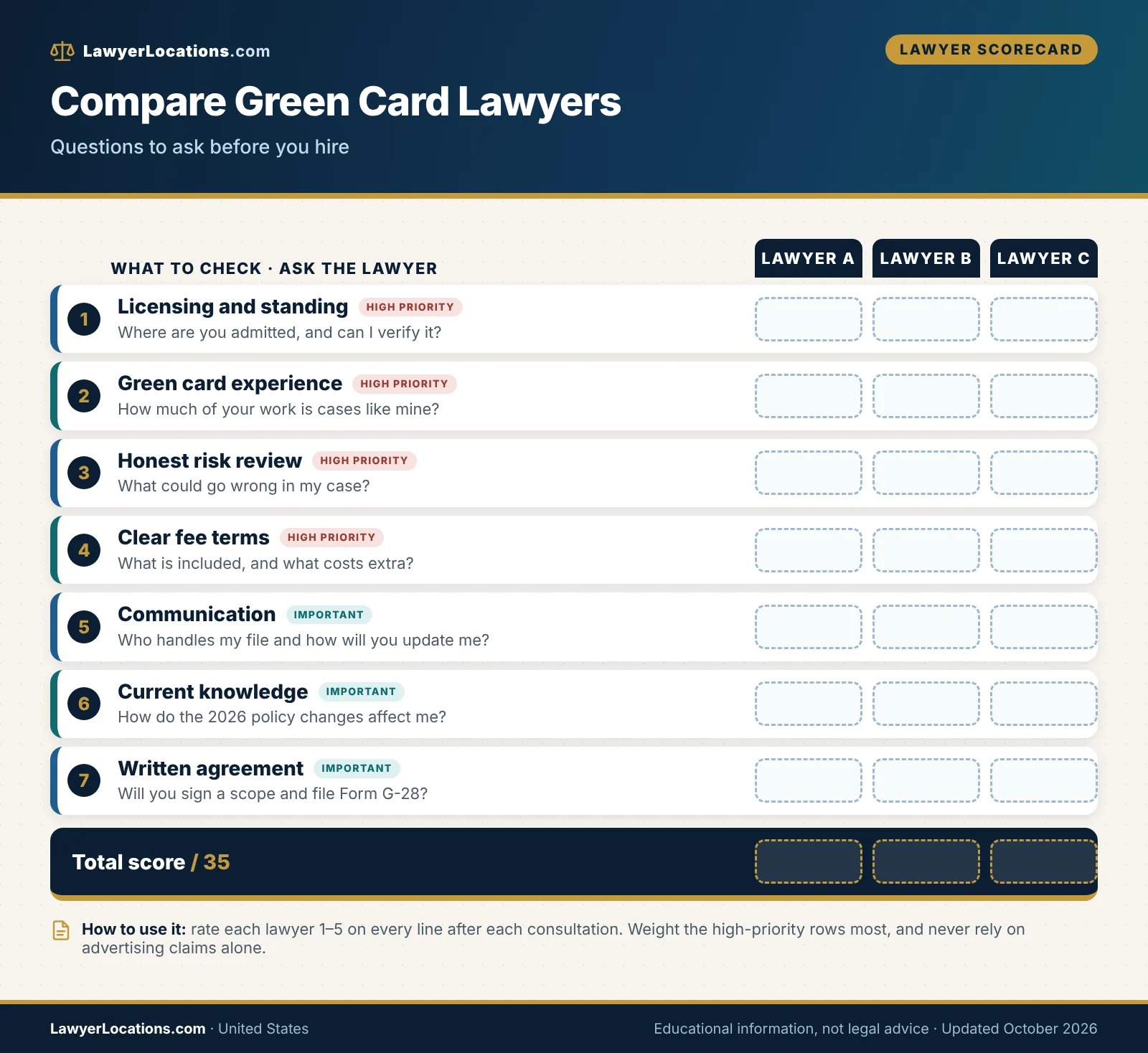
Text version of this graphic
| Criterion | Question to ask |
|---|---|
| Licensing and standing | Where are you admitted, and can I verify your good standing? |
| Green card experience | How much of your practice is my kind of case? |
| Honest risk assessment | What could go wrong in my case, and how likely is it? |
| Clear fee agreement | What does the fee include, and what costs extra? |
| Communication | Who will handle my case, and how will you update me? |
| Current knowledge | How are the 2026 policy changes affecting cases like mine? |
| Written scope | Will you sign a written agreement and file Form G-28? |
Questions that reveal substance
Ask where the lawyer is admitted, how often they handle your category, who actually does the work, and what could go wrong in your case. Strong answers are specific and include limits. Ask how they are handling the 2026 changes, including the adjustment-of-status memo and the new public charge approach. A lawyer who promises approval, a timeline or “special connections” is giving you a reason to walk away, because no one controls USCIS or consular decisions.
ask for the engagement letter first Read the fee agreement before paying. It should describe the scope of work in plain language, and you should be able to take it home and review it before signing.
Fee structures and what to put in writing
Lawyers may quote flat fees for stages or hourly rates, but no official source publishes typical amounts, so this guide quotes no averages. Ask for a written agreement listing what is included (forms, interview preparation, responses to requests for evidence, appeals), what is excluded, how government and medical costs are handled, and what happens if the case is denied.
The lawyer files Form G-28, Notice of Entry of Appearance, which both you and the representative must sign. Keep a complete copy of everything filed. For the step after a green card, choosing a citizenship lawyer follows a similar comparison approach.
2025–2026 Policy Shifts, Public Charge and Inadmissibility
Several federal policies changed between late 2025 and October 2026, and many are in litigation. Use this section to know what to ask, not to predict how your case will be decided; the situation can change within days.
Discretion, holds and pauses
The May 2026 adjustment-of-status memo
On May 21, 2026, USCIS issued Policy Memorandum PM-602-0199, “Adjustment of Status and Discretion.” Adjustment is discretionary under the statute, which says status “may” be adjusted. Analyses of the memo say it treats adjustment as “extraordinary” relief and “administrative grace,” says a lack of negative factors is not enough, and lists overstays and failure to maintain status as highly relevant negatives. A USCIS spokesperson said applicants must generally return home to apply except in extraordinary circumstances, while other statements said decisions remain case by case. Its reach for pending cases, immediate relatives and employment cases has not been clarified in public guidance I could confirm.
On October 5, 2026, a coalition filed American Association of University Professors v. Mullin in the U.S. District Court for the District of Massachusetts challenging this memo and an August 5, 2026 memo (PA-2026-05) that reportedly lets officers deny cases without first issuing a request for evidence. A published report said there was no ruling as of October 6 and that the memos remained in effect.
Nationality-based holds and the immigrant visa pause
USCIS memos PM-602-0192 (December 2, 2025) and PM-602-0194 (January 1, 2026) placed holds on pending and future benefit requests, including green card applications, for nationals of 39 countries named in presidential proclamations, and ordered re-review of benefits approved since January 20, 2021. In June 2026 a federal court in Rhode Island vacated those hold policies in Dorcas v. USCIS, and USCIS announced on June 12 it would comply “pending further litigation.”
Separately, the State Department paused immigrant visa issuance for nationals of 75 countries in January 2026. A federal court in New York vacated that policy on August 21, 2026 in CLINIC v. Rubio; the government has appealed, and plaintiffs say a new global pause is a workaround. If your country appears on any list, a lawyer should confirm the live status before you pay fees or travel.
| Change | Date | Status as reported | Question to ask |
|---|---|---|---|
| AOS discretion memo (PM-602-0199) | May 21, 2026 | In effect; challenged in D. Mass. since October 5, 2026 | Does my history raise negative discretion factors? |
| New public charge rule and I-485 edition 09/18/26 | Effective Sept. 18, 2026 | In effect for AOS filings on or after that date | Which benefits have I or my household received? |
| 39-country USCIS holds | Dec. 2025–Jan. 2026 | Vacated in D.R.I. in June 2026; litigation continues | Is my case moving or on hold? |
| 75-country immigrant visa pause | Jan. 21, 2026 | Vacated Aug. 21, 2026; appealed; enforcement dispute | Will my consulate schedule an interview? |
| H.R. 1 fees (asylum, parole, TPS) | Jan. 2026; adjusted Oct. 16, 2026 | In effect | Do these fees apply to my related filings? |
| DV-2027 entry changes | Nov. 2025; court order Oct. 2026 | Reported registration opening by Nov. 1 | What do official instructions require? |
Public charge and the affidavit of support
A person likely to become a public charge is inadmissible. 8 U.S.C. 1182(a)(4) tells officers to look at age, health, family status, assets and financial status, and education and skills, and most family-based and some employment-based immigrants need an affidavit of support.
The September 18, 2026 change
DHS issued a final rule rescinding the 2022 public charge regulation, effective September 18, 2026. USCIS says officers will assess all pertinent facts case by case, and older versions of Form I-485 will not be accepted if postmarked or submitted electronically on or after that date. A legal-services summary reports the required edition is 09/18/26 with no grace period, that filings from December 23, 2022 through September 17, 2026 fall under the 2022 rule, and that benefits received before September 18 are judged more narrowly than later ones. Check the edition printed at the bottom of every page, because mixed editions can be rejected.
Form I-864 and what officers look for
The sponsor must show income of at least 125 percent of the federal poverty guideline for the household (100 percent for an active-duty military sponsor of a spouse or child) or use a joint sponsor, and the obligation lasts until citizenship or 40 qualifying quarters of work, with limited exceptions (8 U.S.C. 1183a). Before changing any benefits your household receives, ask an attorney or accredited representative how the rule applies, because the answer can depend on who received what.
Inadmissibility: the problems lawyers screen for
Even a perfect petition fails if the applicant is inadmissible. The grounds sit in 8 U.S.C. 1182(a) and are broader than most people expect.
The main grounds
- Health: communicable diseases of public health significance, missing required vaccinations, certain disorders with threatening behavior, and drug abuse or addiction.
- Criminal: crimes involving moral turpitude, controlled substance violations and other offenses, including some old or minor-seeming matters.
- Security: terrorism-related and certain other national-security grounds.
- Fraud or misrepresentation: willfully misrepresenting a material fact to get a visa or benefit, and false claims to U.S. citizenship.
- Unlawful presence and prior removal: the three-year and ten-year bars and removal-related bars.
- Documentation and labor certification: missing travel documents, or lacking a required labor certification.
On adjustment cases, health is screened with the Form I-693 medical exam, signed by a USCIS-designated civil surgeon and returned to you sealed. An industry summary says it should be submitted with the I-485 and that signatures on or after July 3, 2025 must use the 01/20/25 edition. Never open the sealed envelope.
Waivers: possible for some grounds, not all
The statute provides waivers for particular grounds, such as health (subsection g), certain criminal grounds (subsection h) and fraud or misrepresentation (subsection i). Each has its own rules, usually involving a qualifying relative and hardship, and each is discretionary. A waiver is only as strong as the written record behind it.
Costs, Timelines, Free Help and Immigration Fraud
The total cost of a green card case is government fees plus medical and document costs plus any professional fees. This section helps you budget without made-up averages.
Budgeting and timing
What makes up the total cost
- USCIS filing fees for each form (see the fee table above).
- Medical exam costs for each family member; USCIS does not set the civil surgeon’s price.
- Document costs: certified copies, translations, police certificates and mailing.
- Professional fees, if any, and whether responses to evidence requests or interview preparation cost extra.
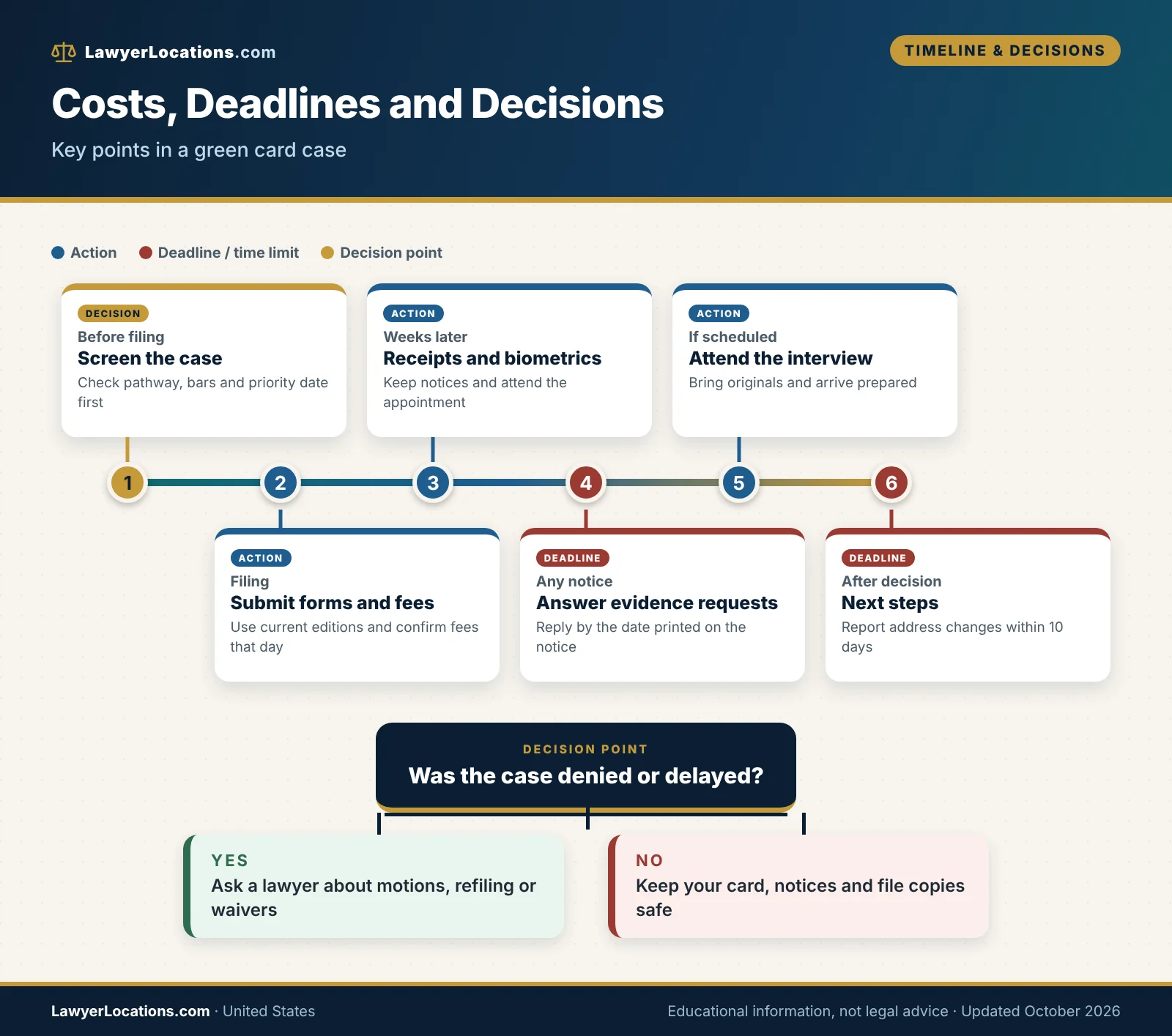
Text version of this graphic
- Before filing: decide pathway, check bars and priority date (decision point).
- Filing: petition and, where allowed, Form I-485 with medical exam and affidavit of support.
- Weeks after filing: receipt notices and biometrics appointment.
- Waiting period: respond to any request for evidence by the date on the notice (deadline).
- Interview, if scheduled: bring originals and answer under oath.
- Decision: approval and card, or denial with next steps; report address changes within 10 days.
- Decision point: if denied or delayed, ask a lawyer about a motion, refiling, or a waiver strategy.
Reading processing times honestly
USCIS publishes processing times in an online tool showing how long most recent cases took for a form and office. The figures do not account for requests for evidence, a priority date that is not current, a retrogression, a transfer or a hold, and secondary sources report very different ranges for the same form, so use the USCIS tool on the day you check.
USCIS decides whether to interview, and commentary in 2026 describes more adjustment interviews, especially in marriage cases. Plan to attend with original documents.
Because green card law is federal, a lawyer or accredited representative does not need to live in your state. Distance matters mainly for in-person interviews, so ask how the office handles those.
Free and low-cost help
DOJ-recognized organizations and accredited representatives
Start with the DOJ roster. USCIS says these organizations usually serve low-income clients, and DOJ requires recognized organizations to be nonprofit and federally tax-exempt. Ask whether your case type is in scope. Someone who claims accreditation but works for a private business that is not recognized is a red flag.
EOIR lists, bar referral services and legal aid
USCIS points people to EOIR’s lists of attorneys offering free or low-cost services by state, to the American Bar Association, and to state bars for confirming a license. A bar referral service may help; ask what any initial consultation costs before you book, and do not assume it is free.
Notarios, consultants and immigration fraud
In many countries a notario is a lawyer. In the United States a notary public is not, and notarios are not authorized to give immigration advice.
| Type of helper | May advise and represent? | How to verify |
|---|---|---|
| Attorney in good standing | Yes, in any U.S. state or DC license | State licensing agency; EOIR disciplined practitioners list |
| DOJ-accredited representative | Yes, only through a recognized organization | DOJ roster; accreditation lasts three years |
| Notario, notary public, consultant | No; may translate or copy information onto forms | Not applicable; do not hire for advice |
| Law student or graduate | Only through an attorney or accredited representative | Ask who supervises the case |
| Friend, relative, clergy | May accompany you as a reputable individual if unpaid | Statement required; cannot regularly practice immigration law |
Red flags
- Promises of approval, fast results, or inside contacts at USCIS.
- Offers to sell a green card, a “winning” lottery entry or a fake job offer.
- Asks you to sign blank forms, or refuses to give you copies of what was filed.
- Takes your original passport or documents and keeps them.
- Tells you to lie about your history or to leave out an arrest.
- Calls themselves a “notario,” “immigration consultant” or “visa specialist” and charges for legal advice.
How to verify and where to report
Get the license number or accreditation details, then confirm them yourself with the state licensing agency or the DOJ roster. If you were defrauded, keep every receipt and message and see a licensed attorney or accredited representative promptly, because filings made in your name still bind you. Your state attorney general, state bar and the Federal Trade Commission are usual places to report fraud or unauthorized practice.
If a preparer who signed your application cannot be reached after filing, have a licensed immigration lawyer review your file at once. A bad filing can cost far more than the original fee.
Getting Ready to Talk to a Lawyer and Next Steps
You will get far more from a first meeting if you bring your history in order.
Preparing for the first consultation
Lawyers can only advise on the history you give them, and a missing detail is more dangerous than an unflattering one.
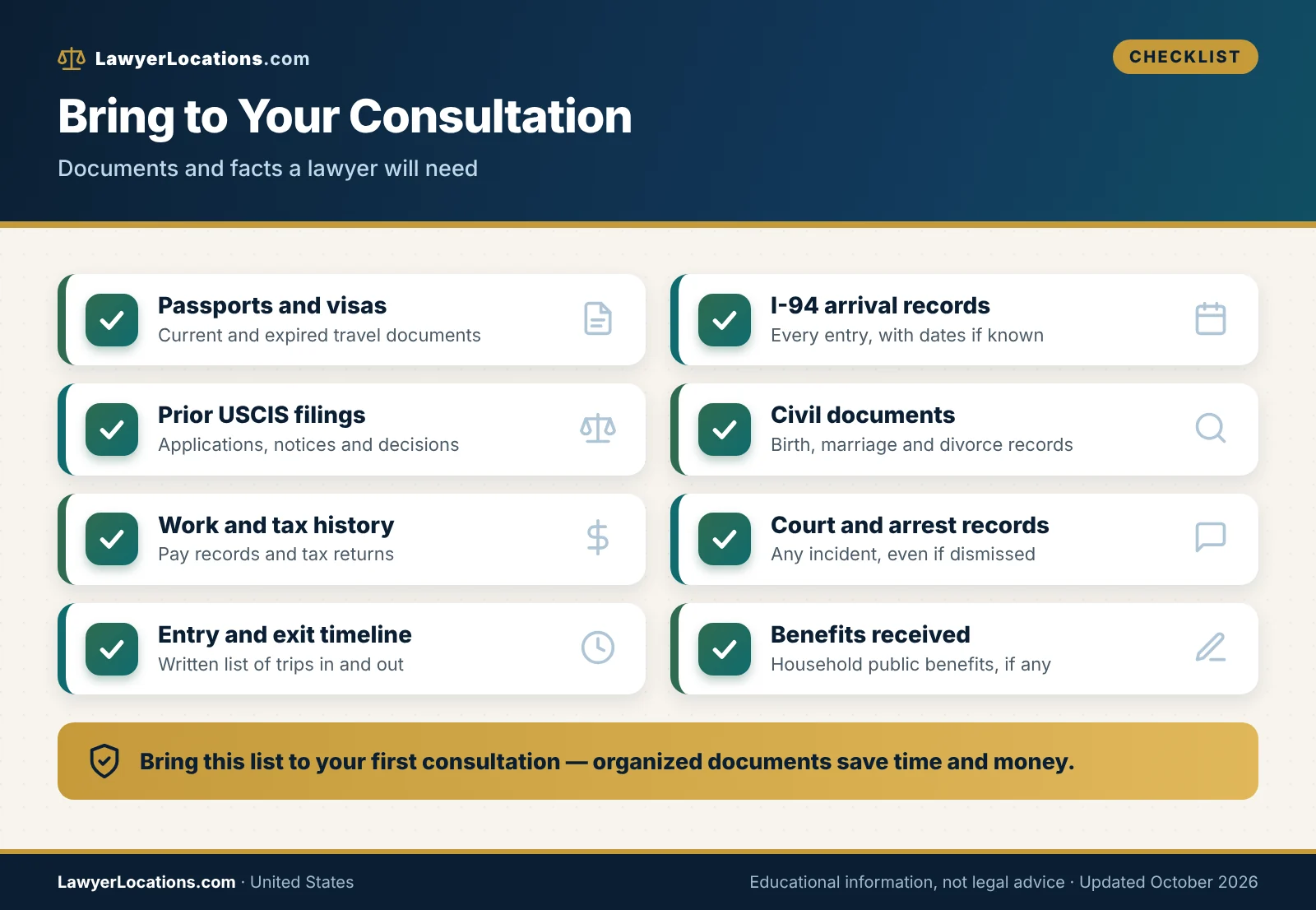
Text version of this graphic
- Passports and travel documents.
- All I-94 records and visas.
- Prior immigration applications and notices.
- Marriage, birth and divorce records.
- Employment history with dates.
- Tax returns and income proof.
- Arrest and court records for any incident.
- A written timeline of entries and exits.
Documents and facts to bring
- Passports, visas, I-94 arrival records and any prior immigration notices or applications.
- Birth, marriage, divorce and death certificates for you and your qualifying relatives.
- A dated list of every entry to and exit from the United States.
- Employment history, pay records and tax returns for you and any sponsor.
- Records for every arrest, citation or court case, even if dismissed or sealed.
- Information about public benefits anyone in the household has received.
Be candid; the lawyer cannot protect you from a problem they do not know about.
Questions to bring to the meeting
Ask which pathways exist, which is safest, the biggest risk, the realistic range of timing and why, and what to avoid in the meantime. Leaving the country while an application is pending can have serious consequences, so ask before booking a trip.
Your next steps
keep a paper trail Save every receipt notice, appointment notice and mailing confirmation in one folder, and ask your representative for the complete filed package. Missing a notice date is one of the easiest ways to lose a case.
A practical order of operations
- Identify your possible pathway and check the Visa Bulletin if you are not an immediate relative.
- Verify the helper. Confirm a lawyer’s license or a representative’s accreditation.
- Get a written scope and fee agreement and a copy of everything filed.
- Use current form editions and confirm fees on the USCIS fee schedule on the day you file.
- Calendar every notice date and report address changes within 10 days.
Frequently asked questions
Do I need a green card lawyer to apply?
No. The law does not require representation, and many straightforward cases are filed without a lawyer. Representation is most useful when your history includes status problems, arrests, prior denials, waivers or removal proceedings.
How much does a green card lawyer cost?
It varies widely by case and by lawyer, and there is no official fee schedule, so this guide does not quote averages. Government fees are separate. Ask for a written, itemized agreement.
What is the difference between an immediate relative and a preference category?
Immediate relatives of U.S. citizens (spouses, unmarried children under 21, and parents of adult citizens) are not subject to the annual preference limits, so they do not wait in the Visa Bulletin queue. Other relatives wait by priority date.
Can I stay in the U.S. while my green card is processed?
Adjustment applicants generally stay in the United States, but eligibility depends on how you entered and your history. Ask a lawyer before traveling, because leaving can affect a pending application.
What is public charge?
It is a ground of inadmissibility for people likely to depend on the government for support. A new rule took effect on September 18, 2026; see section 5.
Can USCIS deny me even if I meet the requirements?
Adjustment is discretionary under the statute, and a May 2026 USCIS memo emphasizes that discretion. A lawyer can assess how your positive and negative factors may be weighed.
Ready to compare your options?
Use the scorecard and checklist above to compare two or three licensed attorneys or recognized organizations before you file anything. If you are researching an immigration lawyer in a specific city, the Oklahoma City immigration attorney guide shows how a local comparison works. LawyerLocations does not rank or recommend individual lawyers.
Sources & References
Show all 30 sources
- 8 U.S.C. 1151, Worldwide level of immigration — Legal Information Institute, Cornell Law School — law.cornell.edu/uscode/text/8/1151 — accessed October 2026.
- 8 U.S.C. 1153, Allocation of immigrant visas — Legal Information Institute, Cornell Law School — law.cornell.edu/uscode/text/8/1153 — accessed October 2026.
- 8 U.S.C. 1159, Adjustment of status of refugees and asylees — Legal Information Institute — law.cornell.edu/uscode/text/8/1159 — accessed October 2026.
- 8 U.S.C. 1182, Inadmissible aliens — Legal Information Institute — law.cornell.edu/uscode/text/8/1182 — accessed October 2026.
- 8 U.S.C. 1183a, Requirements for sponsor’s affidavit of support — Legal Information Institute — law.cornell.edu/uscode/text/8/1183a — accessed October 2026.
- 8 U.S.C. 1255, Adjustment of status — Legal Information Institute — law.cornell.edu/uscode/text/8/1255 — accessed October 2026.
- Visa Bulletin for October 2026 — U.S. Department of State — travel.state.gov — accessed October 2026.
- Adjustment of Status — U.S. Citizenship and Immigration Services — uscis.gov — accessed October 2026.
- Find Legal Services — U.S. Citizenship and Immigration Services — uscis.gov/avoid-scams/find-legal-services — accessed October 2026.
- Form G-28, Notice of Entry of Appearance — USCIS — uscis.gov/g-28 — accessed October 2026.
- Form I-360 and Form I-601A pages — USCIS — uscis.gov/i-360; uscis.gov/i-601a — accessed October 2026.
- Recognition and Accreditation Program — Executive Office for Immigration Review, U.S. Department of Justice — justice.gov/eoir — accessed October 2026.
- US Citizenship and Immigration Services Rescinds 2022 Public Charge Regulation (July 16, 2026) — USCIS via GovDelivery — content.govdelivery.com — accessed October 2026.
- USCIS Announces FY 2027 Inflation Increase for Certain Immigration-Related Fees — USCIS via GovDelivery — content.govdelivery.com — accessed October 2026.
- Federal Register, Vol. 90, No. 223 (Nov. 21, 2025), H.R. 1 immigration fee inflation adjustments — U.S. Government Publishing Office — govinfo.gov — accessed October 2026.
- Letter to DHS and USCIS on adjudication holds and adjustment of status (June 4, 2026) — Office of Sen. Mark Warner — warner.senate.gov — accessed October 2026.
- Featured Issue: New Policy on Adjustment of Status as Act of Extraordinary Discretion — American Immigration Lawyers Association — aila.org — accessed October 2026.
- New USCIS Memo May Force More Green Card Applicants to Apply from Abroad — American Immigration Council — americanimmigrationcouncil.org — accessed October 2026.
- USCIS Upends the Status Quo for Adjustment of Status — Center for Immigration Studies — cis.org — accessed October 2026.
- Lawsuit Challenging USCIS Green Card Policies Filed (Oct. 7, 2026) — International Legal and Business Services Group — bizlegalservices.com — accessed October 2026.
- USCIS Announces Compliance with Court Order Vacating Hold Policies (Dorcas v. USCIS) — AILA — aila.org — accessed October 2026.
- CLINIC v. Rubio, 75-country visa pause vacated — Catholic Legal Immigration Network (CLINIC); and emergency motion release, Center for Constitutional Rights — cliniclegal.org; ccrjustice.org — accessed October 2026.
- New Public Charge Rule: File for Adjustment Before Sept. 18, 2026 — CLINIC — cliniclegal.org — accessed October 2026.
- USCIS Now Requires the 09/18/26 Form I-485 — WeGreened — wegreened.com — accessed October 2026.
- New USCIS Fees Starting April 1, 2024 — AG Immigration Law — agimmigration.law; USCIS Fees — CitizenPath — citizenpath.com — accessed October 2026.
- Form I-693 Immigration Medical Exam requirements — Beyond Border Global — beyondborderglobal.com — accessed October 2026.
- The Three- and Ten-Year Bars (fact sheet, Oct. 28, 2016) — American Immigration Council — americanimmigrationcouncil.org — accessed October 2026.
- Diversity Visa Program entry; Changes to Entry Period for 2027 DV Program — U.S. Department of State — travel.state.gov; travel.state.gov/news — accessed October 2026.
- DV-2027 Green Card Lottery: Court Orders Opening by Nov 1 — Grape Law — grapelaw.com — accessed October 2026.
- Trump Gold Card overview — Gozel Law — gozellaw.com — accessed October 2026.
General information only. LawyerLocations.com is a legal-education and lawyer-discovery resource, not a law firm. Nothing on this page is legal advice, and reading it does not create an attorney-client relationship. Immigration laws, fees, forms and policies change frequently and are the subject of ongoing court cases. Consult an attorney licensed in the United States, or an accredited representative of a DOJ-recognized organization, about your specific situation.
Legal Disclaimer and Limitation of Liability
Informational and illustrative purposes only. This article was prepared by LawyerLocations.com solely on the basis of the information available to us at the time of writing. It is an illustrative, general overview. It is not a complete or authoritative statement of the law, and it has not been reviewed by a lawyer licensed in your state or county.
Not legal advice. Nothing in this article is legal, financial, tax or immigration advice, and reading it does not create an attorney-client relationship between you and LawyerLocations.com or any author, lawyer or firm mentioned. Laws, court rules, fees, filing deadlines and agency procedures differ by state, county and court, and they change often. Some details here may be simplified, incomplete or out of date, and time limits for legal claims can be short.
No warranty. We make no representation or warranty, express or implied, about the accuracy, completeness, timeliness or suitability of this content for your situation. Please do not rely on it to make, delay or skip any legal decision. Check the facts against official sources and speak with a licensed attorney in the relevant jurisdiction before you act.
Limitation of liability. To the fullest extent permitted by law, LawyerLocations.com and its owners, authors and contributors disclaim all liability for any loss, damage, cost or other consequence arising from the use of, or reliance on, this article, including any content on third-party websites we link to. Mentioning a lawyer, firm, organization or service is not an endorsement and is not a promise of any result. If you are in immediate danger, contact your local emergency number.