If you are looking for a deportation defense lawyer Phoenix AZ residents can compare with confidence, start with the fact that deportation (formally called removal) is a federal process, so the law is the same in Phoenix as anywhere else, but the court, the detention centers, the bar rules and the free-help options are local. People who are not in custody are generally scheduled before the Phoenix Immigration Court at 250 N. Seventh Avenue, while people held by ICE may be heard inside detention facilities in Eloy or Florence.
This guide, current as of October 2026, explains how a removal case moves through those venues, what the government charges to file key papers, how Arizona lawyers may structure fees, how to compare lawyers, what to bring to a consultation and which deadlines to protect. It is general legal information, not advice for your case.
What Deportation Defense Means and Where Phoenix Cases Are Heard
A deportation defense lawyer represents a person who the federal government is trying to remove from the United States. The work happens in an immigration court, the cases are decided under federal law, and the Phoenix-area details (which courtroom, which detention center, which local nonprofit) decide how practical your options are.
What “deportation defense” actually covers
People use “deportation” and “removal” to mean the same thing. The government’s term is removal proceedings, and the law that governs them is section 240 of the Immigration and Nationality Act, codified at 8 U.S.C. § 1229a. A lawyer’s job is to test the government’s case and to identify any legal route that lets you stay or leave on better terms.
The Notice to Appear and the charges against you
Removal proceedings start when the Department of Homeland Security (DHS) serves a charging document called a Notice to Appear and files it with an immigration court. The notice lists factual allegations (for example, how and when you entered, or what conviction the government relies on) and the legal grounds it says make you removable. The statute defines “removable” as inadmissible if you were never admitted, or deportable if you were admitted and later fell into a listed ground.
A careful lawyer reads those allegations line by line. Mistakes in dates, names, or the description of a conviction sometimes matter, and the government carries the burden on parts of its case. Do not assume the notice is correct just because it looks official.
Defenses versus relief: two different kinds of arguments
A defense argues that the government cannot lawfully remove you at all, for example because you are a U.S. citizen, or because the charge does not fit your facts. Relief assumes you are removable but asks the judge to let you stay anyway, such as cancellation of removal, asylum, or another application. Most cases involve some of each.
This distinction affects cost and timing. Challenging charges can happen early, while relief applications need evidence, witnesses and sometimes months of preparation before a final hearing.
Respondent is the immigration court’s word for the person facing removal. Immigration judge (IJ) is an employee of the Justice Department’s Executive Office for Immigration Review (EOIR), not a judge in the Arizona state court system. Their decisions can be appealed to the Board of Immigration Appeals (BIA).
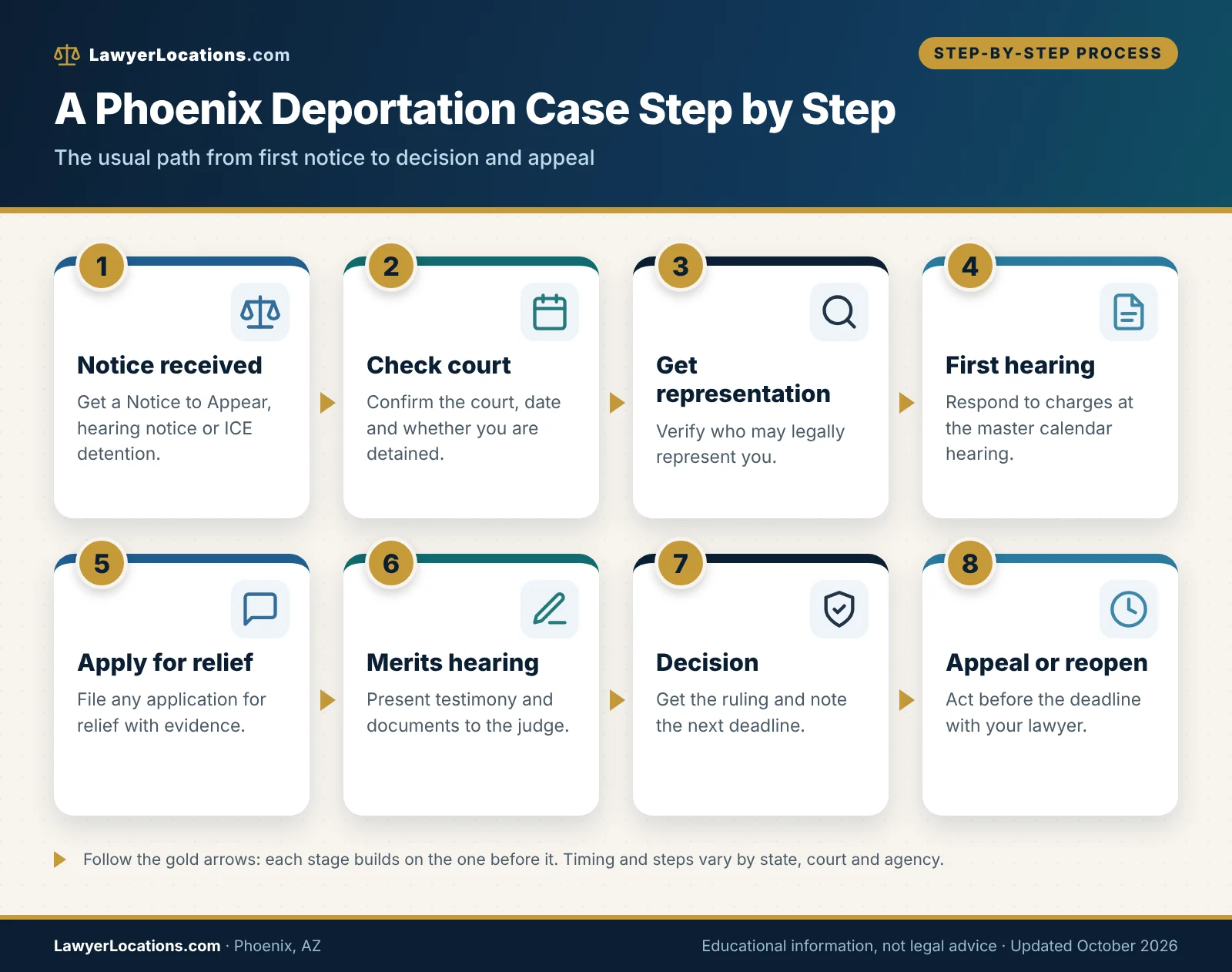
Text version of this graphic
- Receive a Notice to Appear, a hearing notice, or an ICE detention.
- Check the hearing date, the court, and whether you are detained.
- Confirm who may legally represent you and gather documents.
- Attend the first (master calendar) hearing and respond to the charges.
- Identify and file any application for relief.
- Prepare evidence and attend the individual (merits) hearing.
- Receive the judge’s decision.
- Appeal, ask to reopen, or plan the next step before deadlines pass.
The Phoenix-area venues you need to know
Your hearing notice controls which courtroom you attend, so always follow the notice over any general description. With that caution, three EOIR courts matter most for Phoenix-area residents, and one ICE office supervises enforcement for the whole state.
The Phoenix Immigration Court
According to EOIR, the Phoenix Immigration Court is at 250 N. Seventh Ave., Suite 300, Phoenix, AZ 85007, phone 602-640-2747. Public hours are 8 a.m. to 4:30 p.m., Monday through Friday except federal holidays, and window filing closes at 4 p.m. The court does not accept faxes or other electronic submissions unless staff or the judge asks for them, so ask your lawyer how filings will actually reach the court.
Hearings are open to the public with limited legal exceptions. Visitors pass a metal detector and bag screening, and cameras and recording devices are prohibited. The court can close unexpectedly, and EOIR posts closures on its Operational Status page.
Eloy and Florence: courts inside detention facilities
If ICE holds you in custody, your case may be assigned to a court located inside a detention facility. EOIR lists the Eloy Immigration Court at 1705 E. Hanna Road, Suite 366, Eloy, AZ 85131 and the Florence Immigration Court at 3260 N. Pinal Parkway Avenue, Florence, AZ 85132. EOIR describes both as located in Department of Homeland Security controlled detention facilities.
These courts are in Pinal County towns south of the Phoenix metro area, and they follow facility security rules. A lawyer who takes detained cases should be able to explain how visits, calls and document exchange work at the facility where you are held.
| Venue | What it is | Details EOIR or ICE lists | What to confirm |
|---|---|---|---|
| Phoenix Immigration Court | EOIR court for the Phoenix area | 250 N. Seventh Ave., Suite 300, Phoenix, AZ 85007; 602-640-2747; window filing 8 a.m. to 4 p.m. | Your exact courtroom, date and time on the hearing notice |
| Eloy Immigration Court | EOIR court inside a DHS detention facility | 1705 E. Hanna Road, Suite 366, Eloy, AZ 85131; 520-466-3671 | Visitor entry rules through the facility |
| Florence Immigration Court | EOIR court inside a DHS detention facility | 3260 N. Pinal Parkway Avenue, Florence, AZ 85132; 520-868-3341 | Whether your case is on this court’s calendar |
| ICE Phoenix Field Office | Immigration enforcement office for Arizona | 2035 N. Central Avenue, Phoenix, AZ 85004; (602) 257-5900; ICE lists it as not a check-in office | Your own check-in instructions, if you have any |
The ICE Phoenix Field Office and DHS’s lawyers
ICE’s page for the Phoenix Field Office lists Arizona as its area of responsibility and the street address above. It states that this location is not a check-in office, so do not show up there unless a notice tells you to. Immigration enforcement decisions, including detention, come from ICE. A separate group of DHS attorneys appears in immigration court to argue the government’s side of the case.
That arrangement explains a frequent surprise: no one on the government side is there to protect your interests, and the court does not assign you a lawyer. The statute says you may be represented by counsel of your choosing, at no expense to the government.
Why representation changes how this process feels
Immigration court is a legal system with its own deadlines, evidence rules and forms. Many people appear without a lawyer, and some succeed, but a mistake can be costly because some orders are very hard to undo.
What a lawyer can do that is hard to do alone
A lawyer can review the Notice to Appear, request your file, screen for every form of relief you might qualify for, gather and organize evidence, prepare you to testify, and file the right motions on time. A lawyer can also negotiate with DHS counsel on issues the government is willing to narrow.
None of that makes an outcome certain. Legal help improves preparation, but the judge decides, and the law in some categories leaves little room.
When a short consultation may be enough
Some situations only need a limited review, such as a one-time check of a hearing notice, a second opinion on whether a charge fits, or help deciding whether to appeal. Ask lawyers whether they offer limited-scope help and put the scope in writing. We cover how fee agreements work in the cost section.
How a Removal Case Works From the First Notice to the Final Decision
A typical removal case moves from a first “master calendar” hearing to an individual hearing on the merits, then to a decision and possible appeal. Each stage has its own tasks, and the order below is the usual path, though your case can differ.
Stage one: the Notice to Appear and the first hearing
The first hearing is short, but decisions made there shape the whole case. Ask your lawyer to explain what will be asked of you before you walk in.
The master calendar hearing
A master calendar hearing is a brief, scheduling-style hearing where many cases are called on the same docket. The judge confirms your name and address, checks whether you have a lawyer, and asks you to respond to the government’s allegations. If you need more time to find representation, the judge may continue the case, so tell the court early.
EOIR’s court directory notes that respondents without a representative of record default to in-person hearings, and that anyone unsure whether a hearing is in person or internet-based should contact the court that has the case. Do not guess about the format.
A person moves apartments and forgets to file a new address with the court. A hearing notice goes to the old address, the person misses the hearing, and the judge enters an in absentia order. A change-of-address filing made on time would have prevented the problem.
Pleadings and what you say on the record
“Pleading” means admitting or denying each factual allegation and the charge of removability. What you say can affect later options, so the usual safe approach is to let a lawyer advise you before you admit anything. If you are unrepresented and the judge asks you to plead, you can ask for time to speak with a lawyer.
Never skip a hearing. If you fail to appear after proper written notice, the statute directs that you “shall be ordered removed in absentia” when the government proves its case. Notice mailed to your most recent address on file is generally enough, so keep your address current with the court.
Stage two: applying for relief
Relief is the heart of many Phoenix removal cases. Which kind fits depends on your history, family, time in the United States and the facts of any conviction. The table below summarizes common federal forms of relief and the statute that creates them, so you can ask informed questions.
| Relief | Statute | Core requirements in the statute | Key limits |
|---|---|---|---|
| Cancellation of removal for lawful permanent residents | 8 U.S.C. § 1229b(a) | At least 5 years as an LPR; 7 years of continuous residence after admission in any status | Not available after an aggravated felony conviction |
| Cancellation of removal for non-permanent residents | 8 U.S.C. § 1229b(b)(1) | 10 years of continuous physical presence; good moral character; no disqualifying offenses; “exceptional and extremely unusual hardship” to a U.S. citizen or LPR spouse, parent or child | Annual cap of 4,000 grants nationwide |
| Voluntary departure | 8 U.S.C. § 1229c | Before proceedings end: up to 120 days. At the end: up to 60 days, with presence, good-character and means-to-leave requirements and a bond | Civil penalty of $1,000 to $5,000 and a 10-year bar on certain relief if you fail to leave on time |
| Asylum | 8 U.S.C. § 1158 | Generally filed within one year of arrival, with exceptions for changed or extraordinary circumstances | Work permission generally not before 180 days after filing |
Cancellation of removal
Cancellation of removal for lawful permanent residents looks at years as a green card holder, years of continuous residence, and criminal history. The non-permanent resident version is harder, because the hardship standard is “exceptional and extremely unusual” and the hardship must be to a qualifying relative, not to the applicant.
These cases are evidence-heavy. Expect to document years of residence, family relationships, medical or school needs, taxes and character. Start gathering records early.
Asylum and related protection
Asylum has a general one-year filing deadline measured from arrival, with statutory exceptions for changed circumstances or extraordinary circumstances. Whether an exception applies is a legal question worth taking to a lawyer quickly. Our guide to an asylum lawyer in Arizona goes deeper on protection-based cases.
EOIR’s fee page also lists an annual asylum fee of $105 for pending asylum applications, with no waiver or reduction permitted. Ask your lawyer how that fee applies to your filing.
Voluntary departure and its traps
Voluntary departure lets a person leave the country within a set time instead of receiving a removal order, which can avoid some consequences of a formal order. But the statute attaches a civil penalty and a ten-year bar on several forms of relief if you do not leave on time, and it requires a bond at the end of proceedings.
Be cautious of any representative who recommends voluntary departure or “signing papers” without explaining the penalties and the bars in writing. An agreement made under pressure in detention can be hard to reverse.
Stage three: the merits hearing, the decision and what comes after
The individual hearing, often called the merits hearing, is where evidence and testimony are presented. It may be scheduled many months after the first hearing for non-detained cases, and faster for detained ones. Your calendar will be on your hearing notice.
Preparing for the individual hearing
A lawyer typically files evidence in advance, prepares you for direct and cross-examination, lines up witnesses and organizes exhibits. You have the right to review the government’s evidence, present your own and question government witnesses, with a limited exception for national-security information.
The judge may decide at the end of the hearing or issue a written decision later. Either way, ask your lawyer to explain the decision in plain words and to identify the next deadline that same day.
Appeals to the Board of Immigration Appeals
A decision from the immigration judge can be appealed to the BIA by filing a Notice of Appeal (Form EOIR-26) directly with the Board. The regulation requires either the filing fee or a fee waiver request (Form EOIR-26A) within the deadline, or the appeal is not treated as properly filed and the judge’s decision becomes final.
The appeal deadline has been in flux in 2026. A rule that took effect in March 2026 shortened the time to file for many appeals, and a federal court blocked that change, so the older timeline was still in effect in the ILRC summary we reviewed. Because litigation continues, ask your lawyer which deadline applies on the day of your decision, and treat the shortest possible date as your working date.
Motions to reopen and orders entered when you missed court
If you already have a final order, a motion to reopen may be possible. The statute generally allows one motion, filed within 90 days of the final order, supported by new facts and evidence, with exceptions such as certain asylum claims based on changed country conditions.
If you missed a hearing, there are two separate paths. You may file within 180 days if you can show exceptional circumstances (for example, serious illness), or at any time if you never received proper notice or you were in federal or state custody through no fault of your own. Filing either motion stays removal while it is pending.
Detention and bond in Arizona
Detention is the issue most likely to change your case strategy. Arizona sits within the Ninth Circuit, and that matters for bond.
Eloy, Florence and where detained cases are heard
Detained cases generally move faster, and the hearing location may be inside the facility. Free help for detained people is limited and is often delivered through legal orientation or pro se assistance rather than full representation. EOIR’s Arizona pro bono list says the Florence Project and the ABA’s detention commission program serve detained respondents, mostly with pro se case assistance.
If a family member is detained, gather their A-number (the alien registration number printed on immigration papers) so a lawyer can pull the case record. The EOIR Automated Case Information System asks for the A-number and nationality.
Bond hearings and the mandatory-detention fight
Whether a person who entered without inspection can ask an immigration judge for bond has been hotly contested. A Congressional Research Service sidebar updated in September 2026 reports that the Ninth Circuit ruled in a divided decision on July 30, 2026 that the mandatory-detention provision in section 1225(b)(2)(A) does not reach people present without admission. Other circuits are split, and the executive branch and a petitioner have asked the Supreme Court to review.
In plain terms: a Phoenix-area immigration judge is bound by the Ninth Circuit, but the law could change again. Ask any lawyer you consult whether a bond hearing is available in your situation, what evidence they would present, and how they track new rulings. Our guide on criminal defense lawyer costs is also useful if a pending criminal case is part of why you are detained.
Arizona Context and Who May Legally Represent You
Arizona does not rewrite federal removal law, but it adds state criminal statutes, state bar rules and a local support network that change how a Phoenix case plays out. It is also the state where unlicensed “immigration consultants” can do the most damage, so this section starts with who is allowed to help.
Arizona laws and local developments that touch immigration cases
Two state-level topics come up most in Phoenix consultations: state immigration-related crimes and the immigration consequences of ordinary criminal charges.
Proposition 314 and state-level enforcement
Arizona voters approved Proposition 314 in 2024. According to KJZZ’s reporting on a September 10, 2026 Arizona Court of Appeals ruling, the measure lets state and local police arrest people who enter Arizona from Mexico outside a port of entry, treats that as a misdemeanor heard by a local judge, and allows charges to be dropped for people who agree to leave. The same report says the arrest and deportation sections are modeled on Texas SB 4 and cannot be enforced until a final federal court ruling on the Texas law.
The court rejected one challenge because the challengers lacked standing, and a federal judge dismissed a separate challenge brought by the Florence Project in July 2026 for similar reasons. Litigation may continue, so treat this as a developing area. If a state charge is filed against you, tell your immigration lawyer before you speak to anyone about the case.
Criminal cases in Maricopa County and immigration consequences
A plea in a state or municipal criminal case can create a ground of removal or bar relief, even when the sentence seems light. If you are charged with a crime and you are not a U.S. citizen, ask the criminal defense lawyer in writing whether they have analyzed the immigration consequences before any plea. Many immigration lawyers will review a plea offer on a limited-scope basis.
Our overview of criminal defense lawyer consultations explains what to ask a criminal lawyer, and the immigration-specific questions in this guide should be added to that list.
Who is allowed to represent you in an immigration court case
Federal regulations limit who may appear for you. The categories below are the ones to verify before you pay anyone.
Licensed attorneys and accredited representatives
A licensed attorney in good standing may represent you in immigration court. The State Bar of Arizona keeps a public member directory and a professional discipline check which you can reach at 602.252.4804. Check the license and any discipline history before you sign an agreement.
The other category is an accredited representative who works for a Department of Justice-recognized organization. Under 8 C.F.R. § 1292.11, a recognized organization must be a nonprofit, federally tax-exempt group that mainly serves low-income and indigent clients, and one that charges fees must have a written policy for clients who cannot pay. Ask to see proof of recognition.
Notarios, consultants and other unlicensed helpers
In many Latin American countries a notario is a licensed lawyer, but in the United States a notary public is only authorized to witness signatures. Storefront “immigration consultants” and form preparers cannot represent you in immigration court unless they are licensed attorneys or accredited representatives. Using one can lead to wrong filings, lost deadlines and even removal orders.
Walk away from anyone who promises you will win, asks for cash only without a receipt, keeps your original passport or birth certificate, says they have a “special contact” at the court, or tells you to sign a blank form. Never sign anything you do not understand, and ask for a copy of every document filed on your behalf.
Local help beyond private lawyers
Not everyone needs or can afford a private lawyer. Phoenix has nonprofit and volunteer options, though capacity is limited and priorities vary.
The Florence Project and other nonprofit providers
EOIR’s Arizona pro bono list names the Florence Immigrant and Refugee Rights Project and an ABA detention program, both with a mailing address of P.O. Box 32670, Phoenix, AZ 85064. The list is dated April 2025 and describes pro se case assistance for detained respondents and services for children’s cases, including juvenile dockets in Phoenix and Tucson that take appointments by phone only, with no walk-ins.
The same list says some programs do not serve people who only have a credible fear interview scheduled. Check the current list on EOIR’s site before you call, because services and eligibility change.
Free providers and private lawyers are not either-or. Many people use a nonprofit for orientation and a limited-scope private lawyer for one hearing or one filing.
What free help usually cannot do
Free programs often help with information, orientation, forms and limited representation, and they prioritize by detention status, age, vulnerability or case type. They may not be able to take every case. If you are turned away, ask for other referrals and keep calling, because capacity changes from month to month.
You can also compare private lawyers who offer a paid consultation or a sliding fee. The next sections explain how to evaluate those offers.
Government Fees, Attorney Fees and Free Help
You will pay two different kinds of cost: fees charged by the government for certain filings, and fees charged by your lawyer. Government fees are set by EOIR and change by rule. Lawyer fees are negotiated, so this guide gives you a framework instead of an average.
What the government charges
EOIR publishes a fee page for appeals and motions. As of its latest update in October 2026, it lists the amounts in the table below. Check the page again on the day you file, because these numbers can change by rule.
| Filing | Fee listed by EOIR | Notes from EOIR |
|---|---|---|
| Appeal of an immigration judge’s decision to the BIA (EOIR-26) | $1,060.00 | Bond appeals have no fee |
| Appeal from a DHS officer decision (EOIR-29) | $1,060.00 | Filed with and paid to the DHS office, not EOIR |
| Motion to reopen or reconsider before the BIA | $1,060.00, or $950 if based only on a fee-free application | No filing fee for certain motions based on lack of notice of the hearing |
| Motion to reopen or reconsider before the immigration judge | $1,095.00, or $950 if based only on a fee-free application | Same exception for lack-of-notice motions |
| Annual asylum fee | $105 | EOIR states no waiver or reduction is permitted |
How and when to pay
EOIR states that since February 23, 2026 it no longer accepts checks or money orders for immigration fees, and payment must be made electronically through the EOIR Payment Portal. An attorney or accredited representative can pay BIA filing fees through ECAS, the EOIR Courts and Appeals System.
Fee waivers for BIA appeals use Form EOIR-26A, and the regulation says it must be submitted by the deadline along with the notice. Ask your lawyer to explain what proof of income the form requires. A late or incomplete waiver can mean the appeal is not properly filed.
Other costs you may see
Additional costs may include certified translations, document copies, expert evaluations, medical or psychological reports and travel to detention facilities. These are not set by EOIR. Ask a lawyer for a written list of expected out-of-pocket costs, and whether they are included in the fee or billed separately.
How deportation defense lawyers usually charge
Lawyers set their own prices, and the structure matters as much as the number. We do not publish an average because no verified official source tracks Phoenix immigration fees. Use the structures below to compare quotes on equal terms.
Common fee structures
Most immigration lawyers use a flat fee for a defined stage or case, or an hourly rate with a retainer (an up-front deposit placed against future work). Some break a case into phases, such as bond, first hearings, a merits hearing and an appeal.
The key question is what the fee covers. A flat fee that covers only the first hearing will be very different from one that covers the entire case through the immigration judge.
| Structure | How it works | Benefit | Questions to ask |
|---|---|---|---|
| Flat fee for the whole case at the immigration judge level | One price for a defined scope | Predictable budget | Does it include bond, detention visits, evidence preparation, the merits hearing and any continued hearings? |
| Phased flat fees | Separate prices for stages | Lower up-front payment | What triggers the next payment, and what happens if the case takes more hearings than planned? |
| Hourly with retainer | Deposit is billed down at an hourly rate | Pay for the time actually used | What is the hourly rate, who bills at what rate, and when do you replenish the retainer? |
| Limited-scope consultation or document review | Fixed price for a defined task | Useful for second opinions or plea review | What exactly will you receive in writing? |
| Appeal or motion only | Separate agreement for BIA work | Lets you hire a different lawyer for the appeal | Does the fee include the government filing fee, or is it extra? |
Arizona’s rules on fee agreements
The State Bar of Arizona’s guidance on ethical rule ER 1.5 says a lawyer’s fees must be reasonable and that the scope of the representation and the rate must be communicated to the client in writing. Any change in rate must also be communicated in writing before the higher rate is billed. Contingent fees must be signed by the client and are not allowed in most family law or criminal defense matters.
If a fee is designated nonrefundable or earned on receipt, the State Bar says the lawyer must advise the client in writing that the client may discharge the lawyer at any time and may be entitled to a refund. For disputes, the State Bar offers a free, fast and binding fee arbitration process after informal resolution fails.
A written fee agreement protects you. Ask for the scope, the price, what is not included and what happens if you stop before you pay a deposit.
Free, low-cost and payment-plan options
If cost is a barrier, try these steps in order. The order matters because some programs only help people at particular stages.
Steps to try before you decide you cannot afford help
- Check EOIR’s Arizona pro bono list and call providers during their stated intake hours.
- Ask private lawyers whether they offer payment plans in writing or limited-scope help for the most time-sensitive piece.
- Ask whether a recognized organization with an accredited representative serves your case type.
- Ask at your first hearing for time to find a lawyer, and use that time.
- Keep records of every call so you can show the judge you tried.
Judges often allow reasonable time to find counsel, but they do not have to continue the case forever, so use the time well.
What to ask a free provider
Ask whether they can represent you in court or only advise, whether they serve your court and detention status, and how they decide which cases to accept. Ask what they need from you to evaluate the case and how long a response normally takes. Do not assume a “no” for one case type means “no” for another.
How to Compare Deportation Defense Lawyers in Phoenix
Choosing a lawyer is the highest-leverage decision you can control. Compare two or three, ask the same questions, and decide based on fit, clarity and communication rather than the loudest advertising.
Questions to ask in the consultation
A consultation is a chance to see how a lawyer thinks. Prepare a short list and take notes on the answers.
Experience and approach
Ask how much of the lawyer’s practice is removal defense, whether they regularly appear before the Phoenix, Eloy or Florence courts, and what they see as the main issues in your case. Ask what relief options they would screen for and what facts they would need to verify. A good lawyer explains tradeoffs and risks, and does not promise a result.
Ask who will handle your case day to day, who attends hearings and whether other attorneys or paralegals will work on it. A firm may be well organized, but you should know who is accountable.
Communication, language and access
Ask how the office handles questions, how quickly you can expect updates and whether staff speak your language. If an interpreter is used, ask whether the lawyer personally reviews key documents with you. In detention cases, ask how often they visit or call and how they exchange documents.
Ask for the agreed contact methods in writing. If you are detained, a family member may need to be your point of contact, and the lawyer should explain what privacy rules apply.
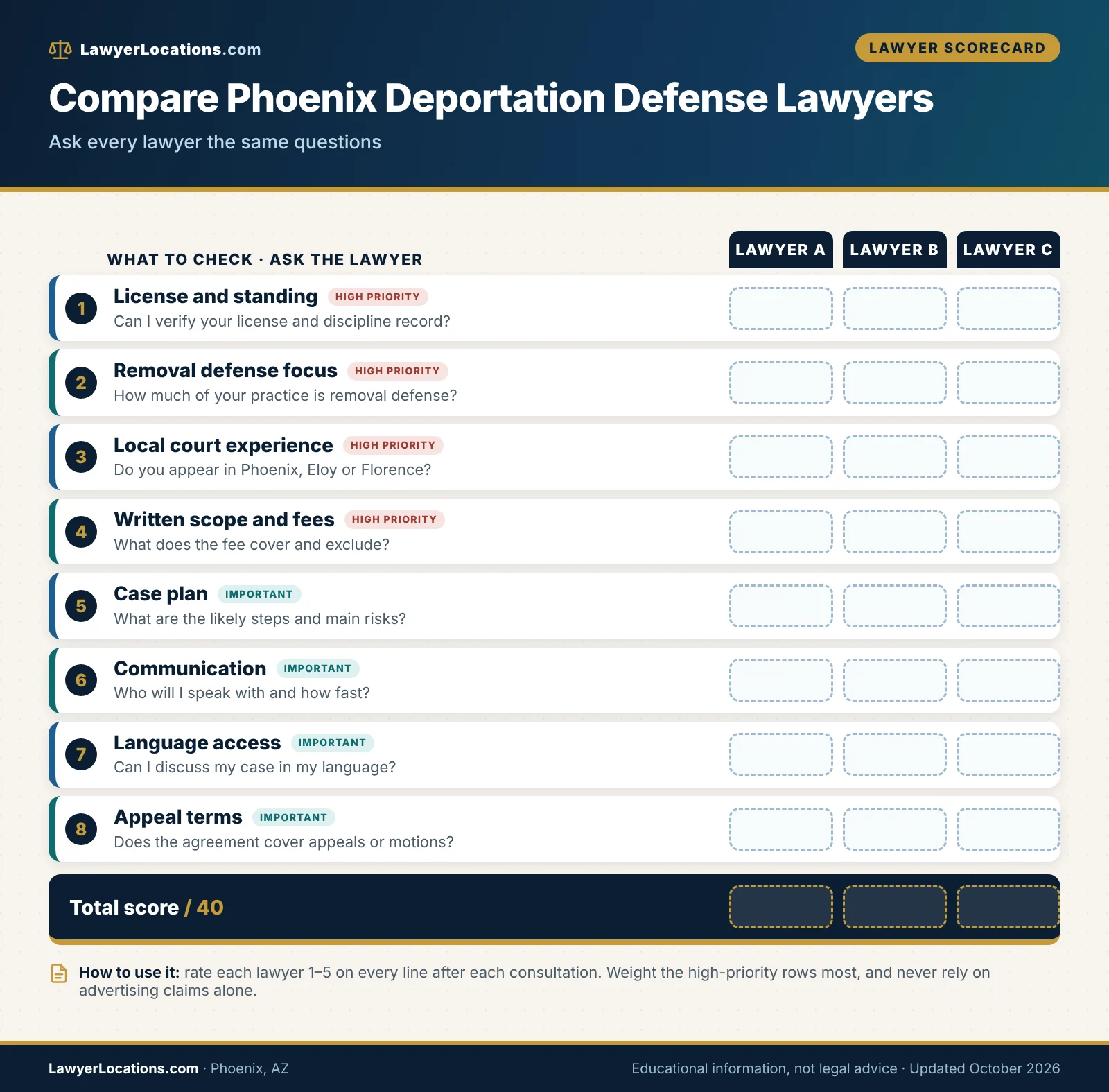
Text version of this graphic
| Criterion | Question to ask |
|---|---|
| License and standing | Can I verify your license and discipline record? |
| Removal defense focus | How much of your practice is removal defense? |
| Local court experience | Do you appear regularly in Phoenix, Eloy or Florence? |
| Written scope and fees | What does the fee cover and exclude? |
| Case plan | What are the likely steps and the main risks? |
| Communication | Who will I speak with and how fast? |
| Language access | Can I discuss my case in my language? |
| Appeal planning | Does your agreement cover an appeal or motion? |
Red flags and verification steps
Verification takes about ten minutes and prevents most of the worst outcomes.
Check the license before you pay
Use the State Bar of Arizona member directory and its discipline check, or the equivalent for the state where the lawyer is licensed. A lawyer licensed in another state may be able to appear in federal immigration court, but you should still confirm an active license and ask how they are authorized to practice before the immigration court. Make sure the name on the agreement matches the person you met.
Check the office address and whether the lawyer will actually appear at your hearings. Be wary of firms where you never meet the person who signs the filings.
Bring the same one-page timeline to every consultation. Same facts, same questions make the answers easy to compare.
Red flags in advertising and sales
- Promises of a result, a “100% success rate,” or claims of special influence with judges or ICE.
- Pressure to sign today, or fear-based messages that create false urgency.
- Refusal to give a written fee agreement or explain what is not covered.
- Requests for large cash payments with no receipt.
- Advice to ignore a hearing notice or to leave without a plan.
- No explanation of the downside of voluntary departure or a stipulated order.
Advertising can be informative, but it is not evidence of quality. A prominent ad tells you about a firm’s marketing budget, not its legal skill, so treat polish as a starting point for questions and not as proof of quality.
A simple decision framework for choosing
Use a short scorecard after each consultation and compare the results the same day, while your notes are fresh.
Weighing price against scope and fit
A lower price can cost more if it excludes the hearings you will actually need. Compare quotes by the work covered: bond, first hearing, evidence, merits hearing, appeals, motions and detention visits. If two quotes differ, ask each lawyer to explain what the other might leave out.
Consider whether the lawyer’s plan seems realistic for your facts. A sound plan names the legal theory, the evidence needed and the next date to protect.
| What to compare | Lawyer A | Lawyer B | Lawyer C |
|---|---|---|---|
| License verified and discipline checked | Yes / No | Yes / No | Yes / No |
| Written scope and fee | Included / excluded items | Included / excluded items | Included / excluded items |
| Relief options named for my facts | List | List | List |
| Appeal and motion terms | Covered / extra | Covered / extra | Covered / extra |
| Who attends hearings | Name | Name | Name |
| Communication plan | Method / speed | Method / speed | Method / speed |
If you or a family member is detained
Time is short, so shorten the process. Ask each lawyer how soon they can speak with the detained person, whether they will request a bond hearing and what evidence they would use. Ask whether they handle Eloy or Florence cases and how they will manage logistics.
If you cannot afford a lawyer right away, call the providers on EOIR’s pro bono list while you continue to look for paid counsel. You can switch to a paid lawyer later if the agreement allows it.
Documents and Preparation Before You Call a Deportation Defense Lawyer
You do not need a perfect file to book a consultation, but a well-organized folder makes the meeting more useful and may lower the time a lawyer spends sorting papers. Start with what the government has already sent you, then add your own records.
The papers to gather first
Begin with anything that has a date, a court name or an A-number on it. Those documents control your deadlines.
Government papers and court notices
- The Notice to Appear and every hearing notice, including envelopes with postmarks.
- Any order from an immigration judge, written or on a form.
- ICE paperwork: custody or bond papers, check-in instructions, a Notice of Custody Determination.
- Prior immigration applications, receipt notices, approval notices and denial letters.
- Your passport, visa, I-94 record and any prior removal or departure documents.
Make copies and keep the originals in a safe place. Do not give original documents to anyone unless a licensed lawyer or accredited representative asks and gives you a written receipt.
Personal, family and community records
Collect birth and marriage certificates, children’s birth certificates and proof of the immigration status of qualifying relatives. Add records that show how long you have lived in the United States, such as leases, tax returns, pay records, school and medical records, and letters from employers, faith leaders or community members.
For any criminal history, gather the charging document, plea agreement, sentencing order and proof of completion for every case, including dismissed ones. Lawyers need the exact language of the record, not just your memory of it.
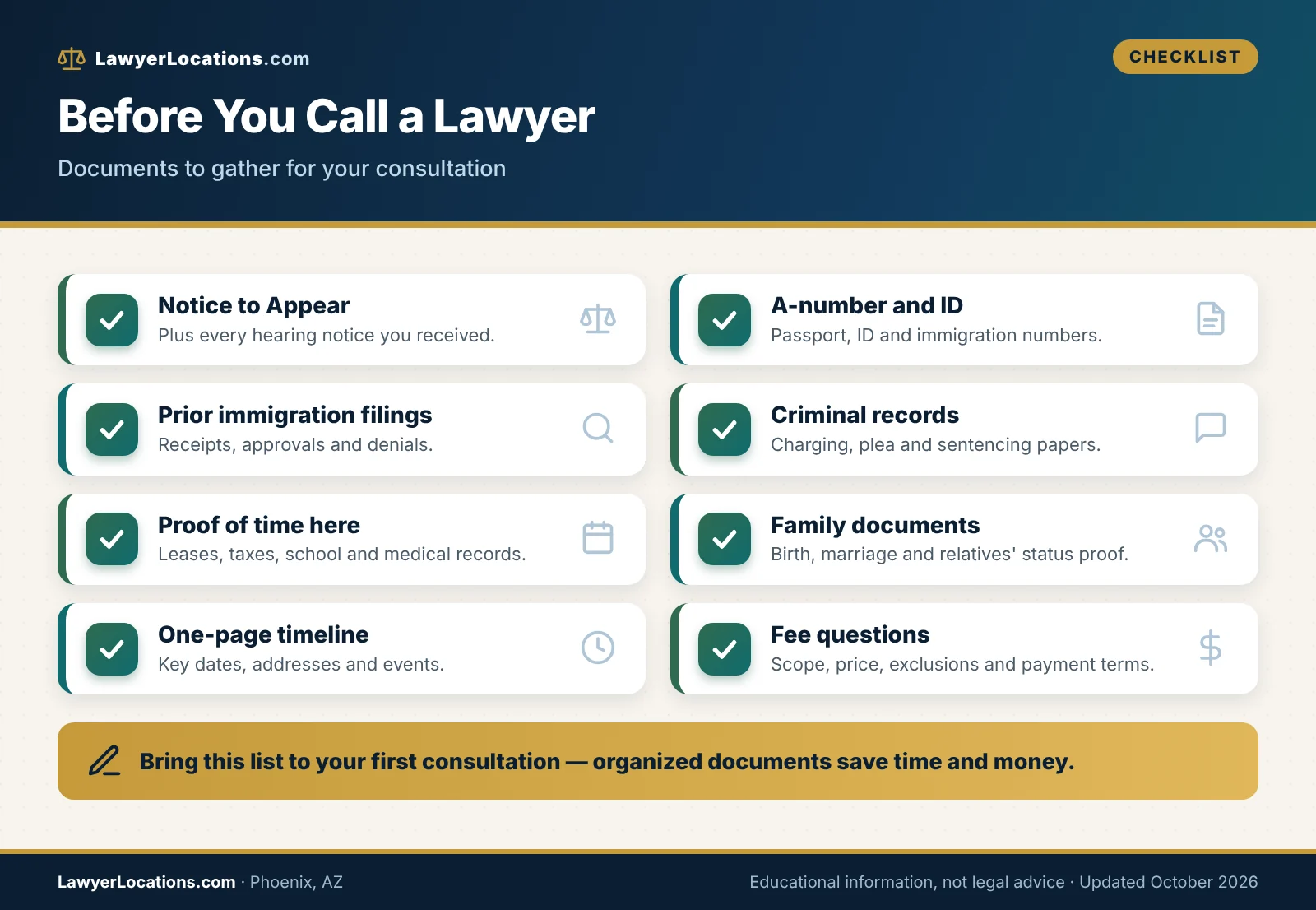
Text version of this graphic
- Notice to Appear and all hearing notices.
- A-number and ID documents.
- Prior immigration filings and decisions.
- Criminal records for every case, including dismissed ones.
- Proof of time in the United States.
- Family relationship and status documents.
- Fee agreement questions and a list of deadlines.
- A one-page timeline of key events.
Preparing yourself for the consultation
A good consultation is a two-way conversation. You give facts honestly, and the lawyer explains the law and the risks.
Write a one-page timeline
List your entries and exits, addresses, jobs, family events, arrests, court dates and any interaction with immigration officials. Use dates where you know them and say “approximate” where you do not. Do not guess in a way that could later conflict with records.
Share the whole story, including the parts you are worried about. Conversations with your own lawyer are generally confidential, and a surprise in court is far worse than a hard conversation in the office.
What to avoid before you have advice
Do not sign documents you do not understand, do not give false information to any official, and do not leave the country without legal advice if you have a pending case. Leaving while a case or an application is pending can have serious consequences. If you receive a new notice, take a photo of it right away and send a copy to your lawyer or a trusted person.
Photograph every page of every notice the day you receive it. Mail gets lost, and a clear picture of the deadline, the court name and the A-number is useful to any lawyer you consult.
Deadlines, Common Mistakes, Quick Answers and Next Steps
Most removal-case problems come from missed dates and misunderstood paperwork, not from exotic legal questions. This final section collects the dates to protect, the mistakes to avoid and the questions people ask most often.
Deadlines and decision points to protect
Calendar every date the day you receive it. The table summarizes the time limits discussed in this guide and the source behind each.
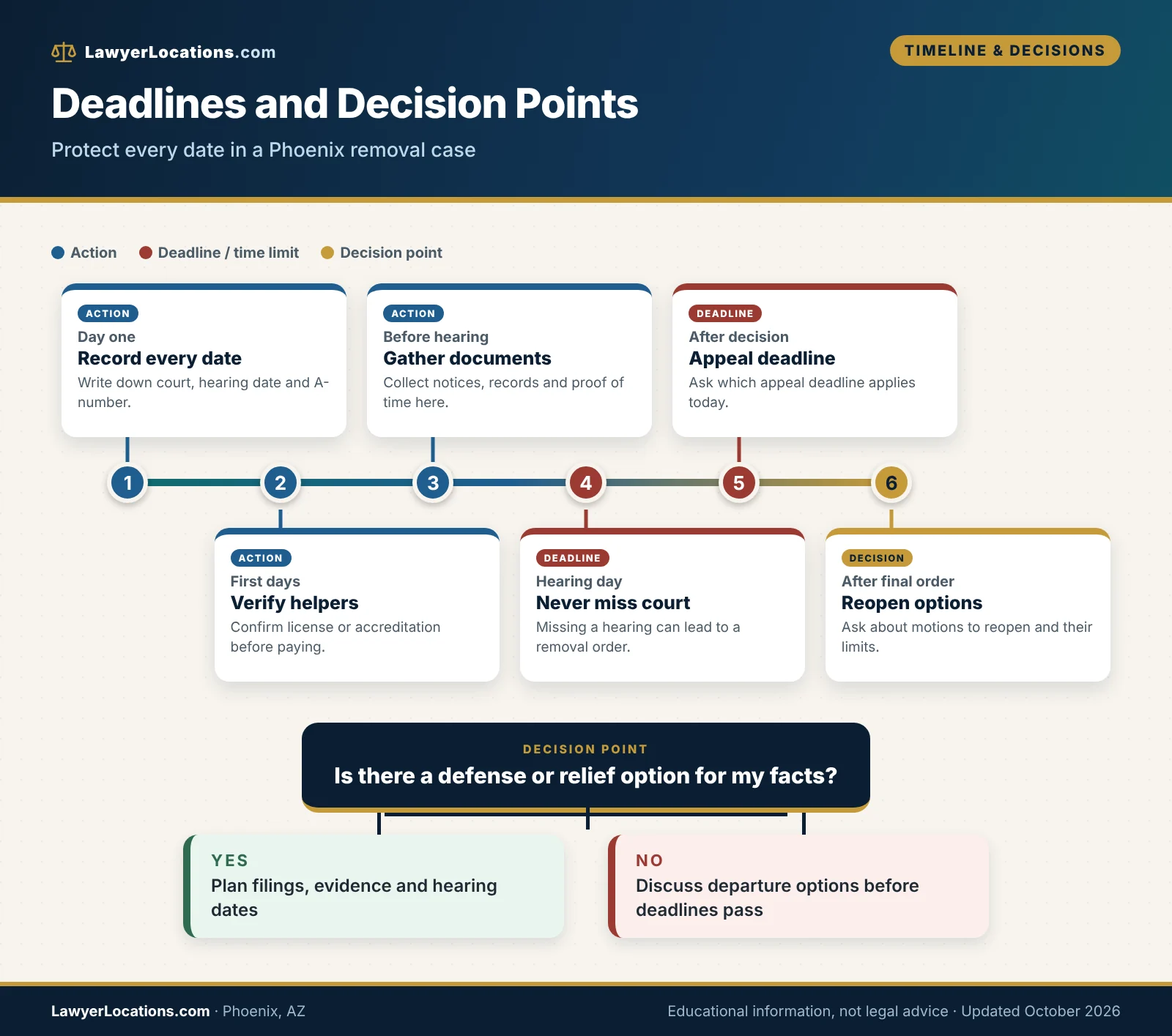
Text version of this graphic
- Day you get a notice or are detained: write down every date and the court name.
- First days: find a lawyer or free provider and confirm who is legally allowed to represent you.
- Before the first hearing: gather identity, status and family documents and decide on the plea approach.
- Before the merits hearing: file evidence and complete preparation for testimony.
- Decision day: ask for the appeal deadline in writing and calendar the shortest possible date.
- After a final order: ask whether a motion to reopen, a stay or another option exists.
Decision point: Is there a legal relief option, or a defense to the charge? If yes, plan filings and evidence. If no, discuss departure options and consequences before any deadline passes.
| Situation | Time limit or rule | Source | Ask your lawyer |
|---|---|---|---|
| Hearing date on your notice | Attend; failure to appear after proper written notice can lead to an in absentia order | 8 U.S.C. § 1229a(b)(5) | Is the address on file with the court correct? |
| Appeal of an immigration judge decision | Short and recently changed; a 2026 shortening was blocked by a federal court and litigation continues | 8 C.F.R. § 1003.38; ILRC summary | What date do we treat as the deadline? |
| Motion to reopen a final order | Generally one motion within 90 days of the final order, with exceptions | 8 U.S.C. § 1229a(c)(7) | Do any exceptions apply to my facts? |
| Order entered after a missed hearing | 180 days for exceptional circumstances; any time for lack of notice or custody | 8 U.S.C. § 1229a(b)(5)(C) | Which basis fits what happened? |
| Asylum application | Generally within one year of arrival, with exceptions | 8 U.S.C. § 1158(a)(2) | Does an exception apply? |
| Voluntary departure period | Up to 120 days before proceedings end; up to 60 days at the end | 8 U.S.C. § 1229c | What are the penalties if plans change? |
The decision point after a ruling
When an immigration judge issues a decision, you generally choose among accepting it, appealing, asking for a different kind of relief if available, or discussing departure. Each path has its own cost and risk. Ask your lawyer to lay out the options in writing and mark the first deadline on the calendar before you leave the building.
If you cannot reach a decision in time, ask whether a protective filing is possible, such as a timely notice of appeal that preserves your options while you decide.
Using EOIR’s online tools
EOIR’s Automated Case Information System lets you look up basic case status with your A-number and nationality, though it shows the primary case only and may not show everything. Unrepresented respondents can also use the Respondent Access Portal, through a phased enrollment that starts when the court sends an official notice. Lawyers file through ECAS, which has been mandatory since February 2022.
Common mistakes to avoid
These patterns show up across immigration court. Avoiding them is free.
Mistakes in your case
- Missing a hearing because an address changed and the court was never told.
- Signing a voluntary departure or stipulated order without understanding the penalties.
- Waiting to look for a lawyer until days before the merits hearing.
- Filing a form without checking whether it creates a new deadline or risk.
- Assuming a state criminal plea has no immigration effect.
- Relying on advice from a friend or form preparer who cannot appear in court.
Most of these are preventable with early legal advice and organized records.
If you receive a final order, ask the same day about the appeal deadline and the 90-day motion to reopen window. Write both dates down before you leave the courthouse.
Mistakes when hiring help
Do not pay a large deposit before you have a written scope, do not hand over original documents without a receipt, and do not rely on a verbal promise about what is included. Check licensure, ask who will appear at hearings, and save copies of everything you sign. If a fee dispute arises with an Arizona lawyer, the State Bar’s fee arbitration process is one place to start.
Quick answers to common questions
These short answers are general. Your facts may change them.
Hiring and cost questions
How much does a deportation defense lawyer cost in Phoenix?
It varies by case, stage and detention status, and no verified official source publishes a Phoenix average. Compare written quotes for the same scope, and ask separately about government filing fees, which EOIR lists on its public fee page.
Can the court appoint me a lawyer if I cannot afford one?
The statute lets you choose counsel at no expense to the government, which means the immigration court does not generally provide one. Nonprofit and pro bono programs may help, starting with EOIR’s Arizona list.
Does my lawyer have to be licensed in Arizona?
Immigration court is a federal forum, so the question is whether the person is authorized to practice there. Still, verify a license and discipline record wherever the lawyer is admitted, and use the State Bar of Arizona directory for Arizona attorneys.
What if I cannot pay all at once?
Ask about phased fees, payment plans or a limited-scope engagement for the most urgent step. Get any plan in writing before you pay.
Hearings, detention and follow-up questions
Where will my hearing be if I am not detained?
Follow the hearing notice. People who are not in custody are generally scheduled at the court named on the notice, which for many Phoenix-area residents is the Phoenix Immigration Court. Call the court if the notice is unclear.
Can someone detained in Eloy or Florence ask for bond?
It depends on your facts and on current law. The Ninth Circuit ruled in July 2026 against the broad mandatory-detention reading for people present without admission, but the question may reach the Supreme Court, so ask a lawyer about the current rule.
What happens if I miss my hearing?
The judge can order you removed in your absence. Motions to rescind that order exist, but they have strict limits, so act at once and speak to a lawyer.
Can I look up my case online?
Yes, EOIR’s Automated Case Information System uses your A-number and nationality for basic status. It may not show everything, so check your hearing notice and confirm with the court.
Clear next steps
If you are comparing options for a deportation defense lawyer Phoenix AZ has available, the next week matters more than the next year. Focus on three goals: protect your dates, verify who can help and gather your documents.
A practical first-week plan
- Write down every date. Put the hearing date, court and A-number in one place and share it with a trusted person.
- Update your address with the court if it changed. Ask your lawyer or the court how to do it correctly.
- Verify two or three helpers. Use the State Bar of Arizona directory, ask about recognized organizations and call providers on EOIR’s pro bono list.
- Gather the document folder. Use the checklist above.
- Compare in writing. Ask each helper for the scope, fee and communication plan.
If your situation also involves a green card, family petition or protection claim, our guides to a green card lawyer, a visa lawyer and an immigration attorney in a city far from its court explain how those paths connect to enforcement risk.
Where to go from here
LawyerLocations.com is an education and discovery resource, not a law firm, and reading this page does not create an attorney-client relationship. Use it to prepare, then speak with a lawyer licensed to practice before the immigration court who can review your documents.
Ready to compare your options?
Write down your dates, gather your papers and ask each lawyer the same questions about scope, fees and hearings. Decide only after you have the answers in writing.
General information only. This article is for general educational purposes and is not legal advice. Reading it does not create an attorney-client relationship with LawyerLocations.com or anyone else. Immigration laws, court procedures, deadlines and fees change, and the facts of each case differ. Consult a lawyer who is authorized to practice before the immigration court about your situation.
Sources & References
Show all 20 sources
- Phoenix Immigration Court — U.S. Department of Justice, Executive Office for Immigration Review — justice.gov — accessed October 2026
- Eloy Immigration Court — U.S. Department of Justice, Executive Office for Immigration Review — justice.gov — accessed October 2026
- Florence Immigration Court — U.S. Department of Justice, Executive Office for Immigration Review — justice.gov — accessed October 2026
- EOIR Immigration Court Listing — U.S. Department of Justice, Executive Office for Immigration Review — justice.gov — accessed October 2026
- Types of Appeals and Required Fees — U.S. Department of Justice, Executive Office for Immigration Review — justice.gov — accessed October 2026
- Arizona Pro Bono Legal Service Providers List — U.S. Department of Justice, Executive Office for Immigration Review — justice.gov — accessed October 2026
- EOIR Courts & Appeals System (ECAS) — U.S. Department of Justice, Executive Office for Immigration Review — justice.gov — accessed October 2026
- Automated Case Information System — U.S. Department of Justice, Executive Office for Immigration Review — acis.eoir.justice.gov — accessed October 2026
- ICE Phoenix Field Office — U.S. Immigration and Customs Enforcement — ice.gov — accessed October 2026
- 8 U.S.C. § 1229a, Removal proceedings — Legal Information Institute, Cornell Law School — law.cornell.edu — accessed October 2026
- 8 U.S.C. § 1229b, Cancellation of removal — Legal Information Institute, Cornell Law School — law.cornell.edu — accessed October 2026
- 8 U.S.C. § 1229c, Voluntary departure — Legal Information Institute, Cornell Law School — law.cornell.edu — accessed October 2026
- 8 U.S.C. § 1158, Asylum — Legal Information Institute, Cornell Law School — law.cornell.edu — accessed October 2026
- 8 C.F.R. § 1003.38, Appeals to the Board — Legal Information Institute, Cornell Law School — law.cornell.edu — accessed October 2026
- 8 C.F.R. § 1292.11, Representation by accredited representatives — Legal Information Institute, Cornell Law School — law.cornell.edu — accessed October 2026
- Critical New Changes to the Immigration Appeals Process — Immigrant Legal Resource Center — ilrc.org — accessed October 2026
- Mandatory Detention During Removal Proceedings: Circuit Split (LSB11438) — Congressional Research Service, via EveryCRSReport — everycrsreport.com — accessed October 2026
- ER 1.5 Fees — State Bar of Arizona — azbar.org — accessed October 2026
- For the Public — State Bar of Arizona — azbar.org — accessed October 2026
- Arizona Court of Appeals upholds Prop 314 — KJZZ — kjzz.org — accessed October 2026
Legal Disclaimer and Limitation of Liability
Informational and illustrative purposes only. This article was prepared by LawyerLocations.com solely on the basis of the information available to us at the time of writing. It is an illustrative, general overview. It is not a complete or authoritative statement of the law, and it has not been reviewed by a lawyer licensed in your state or county.
Not legal advice. Nothing in this article is legal, financial, tax or immigration advice, and reading it does not create an attorney-client relationship between you and LawyerLocations.com or any author, lawyer or firm mentioned. Laws, court rules, fees, filing deadlines and agency procedures differ by state, county and court, and they change often. Some details here may be simplified, incomplete or out of date, and time limits for legal claims can be short.
No warranty. We make no representation or warranty, express or implied, about the accuracy, completeness, timeliness or suitability of this content for your situation. Please do not rely on it to make, delay or skip any legal decision. Check the facts against official sources and speak with a licensed attorney in the relevant jurisdiction before you act.
Limitation of liability. To the fullest extent permitted by law, LawyerLocations.com and its owners, authors and contributors disclaim all liability for any loss, damage, cost or other consequence arising from the use of, or reliance on, this article, including any content on third-party websites we link to. Mentioning a lawyer, firm, organization or service is not an endorsement and is not a promise of any result. If you are in immediate danger, contact your local emergency number.