Finding an immigration attorney in Delaware (or an immigration attorney Delaware families can verify and afford) starts with one fact: immigration law is federal, so the rules are the same in Wilmington, Dover and Georgetown as they are anywhere else in the country. What changes in Delaware is the practical side, meaning which immigration court hears your case, which federal offices handle your paperwork, and which local lawyers and nonprofits you can actually reach.
This guide explains how Delaware cases move through the system, which deadlines tend to matter most, how lawyers usually charge, how to compare them, and where low-cost and free help exists. It is education, not legal advice, and it does not recommend any particular lawyer.
How an immigration case works for Delaware residents
An immigration case in Delaware is a federal case with a local address. The same federal statute and regulations apply no matter which state you live in, so a good Delaware lawyer is mostly valuable for knowing the people, offices and routines that your case will run through.
Why Delaware does not have its own immigration law
Federal law controls who may enter, stay and work
The rules about visas, green cards, asylum, citizenship and removal come from the Immigration and Nationality Act and the regulations written under it. Congress and federal agencies set those rules, and Delaware lawmakers cannot rewrite them. That is why a Delaware immigration attorney and a lawyer in Texas are applying the same underlying law to different clients.
It also means a federal-law topic like this one should not be judged by state law headlines. A new state program may affect driver’s licenses or local services, but it does not change whether you qualify for a green card.
What Delaware does influence
State and local practice still shapes everyday outcomes. State courts decide family-law questions that federal immigration forms sometimes depend on, such as guardianship or custody orders for a child. Criminal cases in Delaware courts can carry immigration consequences, which is why a criminal defense lawyer and an immigration lawyer often need to compare notes before a plea.
Delaware also decides which nonprofits, bar programs and legal aid offices serve you nearby. Those local resources, covered in later sections, are often the difference between having a lawyer and filing alone.
The usual path of a case, step by step
Most matters follow a recognizable pattern, even though the details differ between a family petition, an asylum claim and a defense against removal. Knowing the pattern helps you ask better questions at a first meeting.
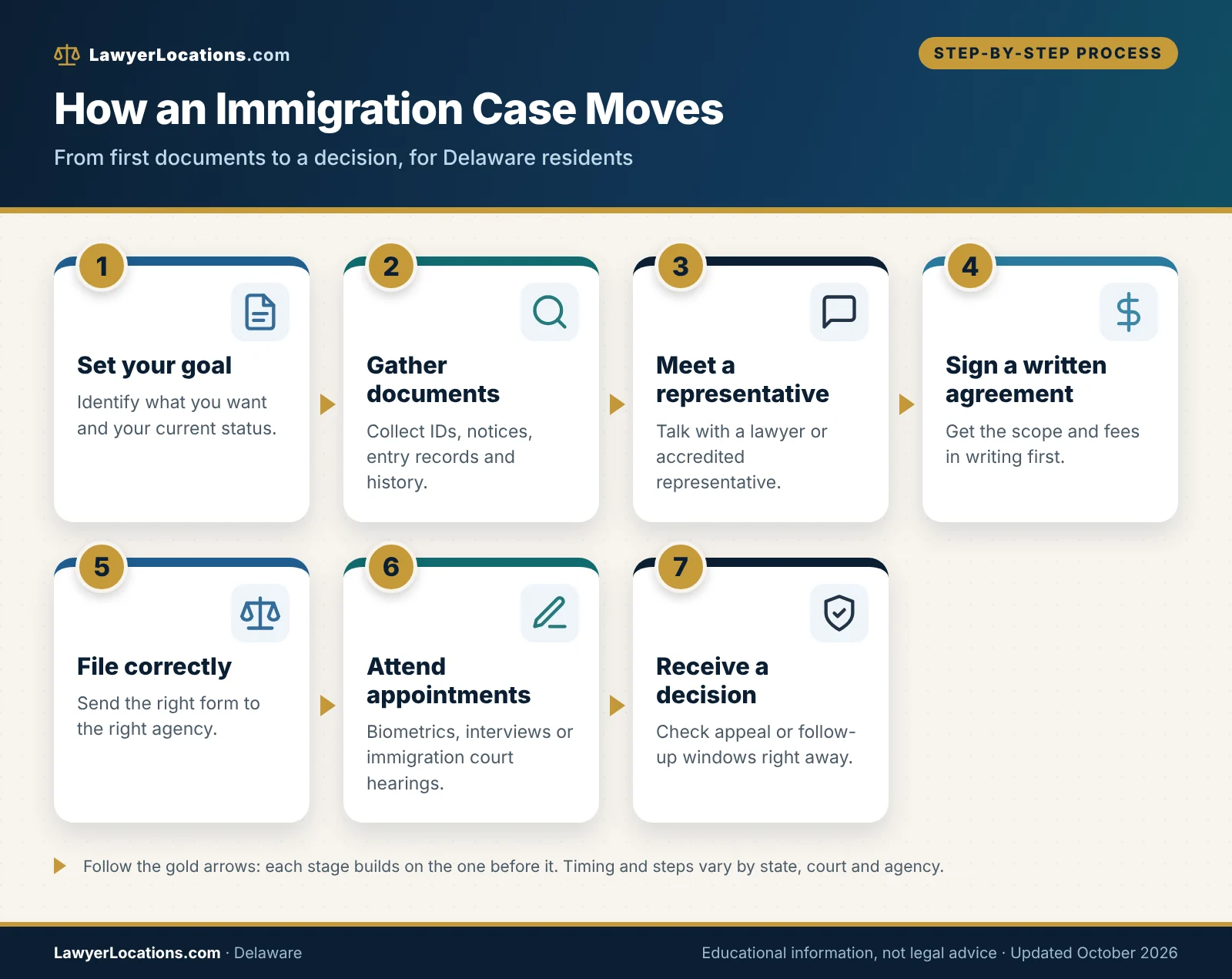
Text version of this graphic
- Identify your goal and your current status.
- Gather identity, entry and history documents.
- Meet with a lawyer or accredited representative.
- Sign a written fee agreement and notice of appearance.
- File the right form with the right agency.
- Attend biometrics, interviews or hearings.
- Receive a decision and plan any appeal or next filing.
Applications filed with USCIS
If you are asking the government for a benefit, such as a family-based green card, a work permit or naturalization, you generally file with U.S. Citizenship and Immigration Services (USCIS). USCIS reviews the paper file, may schedule fingerprinting and may call you to an interview. A lawyer typically appears by filing a Form G-28 (notice of entry of appearance) so USCIS knows to communicate with them.
The key habit here is accuracy. Small errors in dates, addresses or prior-entry history can cause delays or a request for evidence, so many people hire a lawyer mainly to review the file before it is sent.
Proceedings in immigration court
If the government starts removal proceedings, the case moves to the immigration court run by the Executive Office for Immigration Review (EOIR), which is part of the Department of Justice. The process usually begins with a charging document called a Notice to Appear. You then attend hearings before an immigration judge, who decides whether you can be removed and whether you qualify for any form of relief.
In this setting a lawyer files a different form, the EOIR-28, to enter an appearance. Missing a hearing can lead to an order of removal in your absence attend every date, so keeping your address current with the court and attending every date is not optional.
Written notices from USCIS, ICE and the immigration court carry their own response dates, and those dates can be short. Read every notice the day it arrives, put the date on a calendar, and bring it to a lawyer or accredited representative quickly if you are unsure what it asks for.
Who is allowed to represent you
Licensed attorneys
A licensed attorney in good standing may represent you before USCIS, the immigration courts and the Board of Immigration Appeals. A lawyer who handles immigration cases in Delaware does not have to be licensed in Delaware to do federal immigration work, because the forum is federal. Still, a Delaware-licensed lawyer is easier to verify through the Delaware Supreme Court’s attorney lists and the Office of Disciplinary Counsel.
When you check a lawyer, look at where they are licensed, whether the license is active and whether any discipline appears on the record. The Delaware State Bar Association points the public to these resources.
Accredited representatives and other limited roles
Federal regulations at 8 C.F.R. 1292.1 also allow non-attorneys in narrow roles. Accredited representatives work for nonprofit organizations that the Department of Justice has formally recognized, and they may practice only through that organization. Supervised law students and, in rare single-case situations, a “reputable individual” with a prior relationship to you may appear without pay.
These categories are strict. A paid “consultant,” notary or document preparer who is not an attorney or an accredited representative generally cannot represent you, a point that comes up again in the section on scams.
accredited representative means a trained non-attorney who works for a nonprofit that the Department of Justice has recognized, and who may represent clients only through that nonprofit. It is a formal status, not a job title anyone can claim.
Delaware’s immigration forums: courts, agencies and local offices
Delaware is a small state with three counties, New Castle, Kent and Sussex, and very few federal immigration offices inside its borders. Most Delaware immigration matters are handled by offices and judges located elsewhere, so one of the most useful things a local lawyer offers is a working knowledge of those out-of-state venues.
Immigration court and enforcement
Which immigration court hears Delaware cases
Delaware does not have an immigration court of its own. Cases involving Delaware residents are generally assigned to the Philadelphia Immigration Court, which is part of EOIR. The court named on your Notice to Appear or hearing notice is the one that controls your case, and some hearings may be held remotely, so read the notice carefully for the date, time and format.
You can check your case information through EOIR’s automated case status tools using your nine-digit A-number. If your notice and the information you find ever seem to disagree, ask the court clerk or your lawyer before the hearing date, not after.
ICE and the Philadelphia Field Office
Immigration and Customs Enforcement (ICE) handles arrests, detention and removal. According to ICE’s own field office page, the ICE Philadelphia Field Office has an area of responsibility that covers Delaware, Pennsylvania and West Virginia, and its listed address is in Philadelphia. The page does not list a sub-office in Delaware.
For a family, that has a practical consequence. If a relative is detained, the location can be outside Delaware, and a lawyer who can work across state lines becomes more important. Keep the person’s full name, date of birth, country of birth and A-number written down so you can locate them quickly.
If someone contacts you claiming to be from an immigration agency and demands immediate payment by gift card, wire or app, treat it as a scam. Real agencies do not collect fees that way. Verify through an official website or a lawyer before paying anything.
USCIS, federal courts and review
USCIS offices and appointments
USCIS assigns your case to an office based on where you live and the type of filing. Your appointment notice for fingerprints or an interview will name the exact location, and it is not unusual for that location to be outside the state you live in. Use the USCIS office locator on the official site, and plan travel time, childcare and time off work well in advance.
Because the notice controls, never rely on a friend’s experience about “where people go.” Offices and assignments change, and your own notice is the only reliable instruction.
Federal court review
Most immigration decisions are reviewed inside the immigration system first, through the Board of Immigration Appeals. Only after that do federal courts get involved. Delaware sits in the Third Circuit federal court of appeals, and the U.S. District Court for the District of Delaware sits in Wilmington, but which federal court can review a particular decision depends on the type of case and where the immigration judge finished the proceedings.
Federal court review is narrow, expensive and slow. A lawyer should explain, before you file anything, whether any court review is even available for your situation and how short the time limits are.
Delaware state courts and where they touch immigration
Family-court orders that feed federal applications
Some federal immigration paths depend on a state court order. A well-known example is Special Immigrant Juvenile Status, which is available to certain young people and requires findings from a state court about the child’s circumstances. Community Legal Aid Society lists this status among the services its Delaware offices provide, which shows that the connection between family court and immigration is a live part of local practice.
If a state court order is part of your plan, timing matters. The federal filing and the state order often need to line up, and a lawyer should map out the sequence at the beginning.
Criminal cases and immigration consequences
A Delaware arrest, charge or plea can affect immigration status even when the sentence seems small. Many conduct-based grounds for removal and for denying benefits turn on exactly how a charge is worded and what a person admitted. That is why immigration lawyers often ask for the court record and the plea paperwork, not a summary from memory.
If you or a family member has any criminal charge, ask the defense lawyer directly whether they have reviewed the immigration consequences, and consider a separate consultation with an immigration lawyer before any plea is entered. For related background, see our guide to deportation defense lawyers, which explains how criminal and removal issues connect in another jurisdiction.
one folder for every notice Keep a single folder, paper or digital, for every government notice, receipt and decision you have ever received. Receipt numbers, A-numbers and dates are the first things a lawyer asks for, and recreating them from memory is the most common source of delay.
Deadlines and common case types
Immigration deadlines are strict, and they come from many different sources: statutes, regulations, form instructions and individual notices. The date that controls your case is the one in the law or on the notice that applies to you, so use the tables here to understand the landscape, then confirm your own dates with a lawyer or the agency.
Time limits that surprise people
The one-year asylum filing rule
Under federal law at 8 U.S.C. 1158(a)(2)(B), a person applying for asylum must show by clear and convincing evidence that the application was filed within 1 year after arriving in the United States. The statute allows exceptions for changed circumstances that materially affect eligibility, or for extraordinary circumstances that explain the delay.
These exceptions are fact-heavy and not automatic. If you think the one-year mark is close or already past, speak to a lawyer or accredited representative promptly, because how you document the reason can decide the outcome. For a deeper look at asylum work in another state, see our guide to finding an asylum lawyer.
Work permits that depend on a pending case
A person with a pending asylum application cannot receive work authorization until 180 days after filing, according to 8 U.S.C. 1158(d)(2). Other work-permit categories have their own timing rules and filing windows, and some policies in this area have changed in recent years.
Because policies and fees move, treat any number you read online, including numbers on social media, as a lead to check, not an answer. Verify against the USCIS page for the specific form.
An appeal from an immigration judge’s decision has a short window that is measured in days, not months, and the exact period is stated in the decision paperwork and the governing regulations. If you receive a decision, do not wait for a “good time” to talk to a lawyer. Ask the same day who can review it.
Notices, address changes and missed hearings
Non-citizens in most categories must report address changes to the government, usually using Form AR-11. If you are in immigration court, you must also tell the court separately of an address change. Notices sent to your last known address count as notice, even if you never received them.
People get into serious trouble not because they chose to ignore the court but because mail went to an old address. After any move, update every agency and confirm in writing.
Case types Delaware residents commonly bring
Nonprofit directories give a window into what local providers handle. In the national legal directory ImmigrationLawHelp.org, Delaware organizations list services such as green card adjustment, consular processing, DACA, work permits, family petitions, naturalization, TPS, asylum, removal defense, Special Immigrant Juvenile Status, T and U visas and VAWA petitions.
| Matter | Usual decision-maker | Where a lawyer often adds value |
|---|---|---|
| Family-based green card | USCIS, or a U.S. consulate abroad | Choosing the right category, assembling relationship proof, avoiding errors in prior-entry history |
| Naturalization (citizenship) | USCIS | Screening for arrests, long trips abroad and tax or support issues before filing |
| Asylum | USCIS asylum office or an immigration judge | Meeting the one-year rule, building the written declaration and country evidence |
| Defense against removal | Immigration judge, then the Board of Immigration Appeals | Identifying every form of relief, court deadlines, evidence and cross-examination |
| Work permits and DACA | USCIS | Confirming eligibility, renewal timing and current policy |
| VAWA, T and U visas | USCIS | Sensitive evidence, safety planning and certifications from law enforcement or others |
| Special Immigrant Juvenile Status | State court findings, then USCIS | Coordinating the state-court order with the federal petition |
Family and status cases
Family-based cases are the bread and butter of many practices. They can look simple on paper, but a prior unlawful presence, a past visa overstay or an old removal order can change the whole plan. A lawyer’s first job is often screening the history for problems the family did not know about.
If you are exploring a green card path, read our overview of when a green card lawyer can reduce delays and mistakes, and for visa denials see our guide to a visa lawyer.
Protection and humanitarian cases
Asylum, VAWA, T and U visas and Special Immigrant Juvenile Status exist to protect people in specific danger. They involve sensitive details of a person’s past, and they require careful evidence. An experienced practitioner will explain how your story is told, what proof helps and which parts could create risk, and will slow down if you are not ready to share everything at once.
If safety is a concern, local domestic-violence programs and the nonprofits listed later in this guide often have advocates who understand both the legal and the personal side.
Why “just filing it yourself” can backfire
Forms are public, but strategy is not on the form
USCIS forms and instructions are free and many people complete them successfully. What the form cannot tell you is whether it is the right form for your facts, whether a filing could expose a weakness, or whether a different route exists. The risk is highest when you have any history of arrests, prior applications, prior removal orders or unlawful presence.
A short consultation before you file can be a sensible middle path. Even when you decide to file without a lawyer, an hour of review can spot problems early.
Some filings cannot be undone
Applying for a benefit places your name, address and history in front of the government. In some situations that can start an enforcement conversation rather than end an immigration problem. That is not a reason to avoid every application, but it is a reason to get tailored advice first when your status is uncertain.
Also be wary of filing the same type of case repeatedly after a denial, since some prior decisions have lasting consequences.
How to compare immigration attorneys in Delaware
There is no official ranking of immigration lawyers, and you should be skeptical of any site or ad that claims to name the “best” one. Compare lawyers on verifiable licensing, relevant experience, fee clarity and communication, not slogans.
Verify before you compare
License and discipline
Start with the basics: is the person a licensed attorney, and in which state? The Delaware State Bar Association’s public resources page directs people to the Delaware Supreme Court’s list of active attorneys and to the Office of Disciplinary Counsel for complaints. For lawyers licensed in other states, check that state’s bar.
The DSBA notes that its own public attorney search is not a comprehensive directory, so use it as one tool, not the final word. At the federal level, 8 C.F.R. 1003.102 lists grounds on which EOIR can discipline practitioners, including grossly excessive fees, false statements and neglect.
Experience with your kind of case
Immigration is a broad field. A lawyer who handles employment visas all day may not regularly try removal cases in front of a judge, and the reverse is also true. Ask what share of the work is the type of matter you have, and whether they regularly appear before the Philadelphia Immigration Court if you may end up there.
Avoid relying on titles. Do not treat words such as “specialist” or “expert” in an ad as a credential, and ask what the lawyer has actually handled recently, without asking them to promise a result.
Questions to ask at a first meeting
Questions about your case
A useful consultation sounds like a conversation, not a sales pitch. You should leave with a plain-language picture of the options, the risks and the likely steps. Ask these questions and write down the answers:
- What are the possible paths for my situation, and what are the risks of each?
- Who will actually work on my file, the lawyer, an associate or a paralegal?
- Which agency or court will decide this, and where will any hearing or interview take place?
- What documents do you need from me, and by when?
- What are the known deadlines, and how will you track them?
- How will you update me, and how quickly do you normally respond to messages?
A lawyer who cannot tell you what they do not know yet, or who gives a guarantee about the outcome, is signaling a problem. Honest answers include phrases like “it depends on” followed by the specific facts.
Questions about money and process
Ask for the fee structure in writing before you pay anything. Request a breakdown of what the fee includes, what costs are extra and what happens if the case needs to continue after a denial. Ask how the lawyer handles a refund if the engagement ends early.
Also ask about language access. If you are more comfortable in Spanish, Haitian Creole or another language, find out whether the lawyer or staff speak it, or how interpreters are handled, since miscommunication is a common source of mistakes.
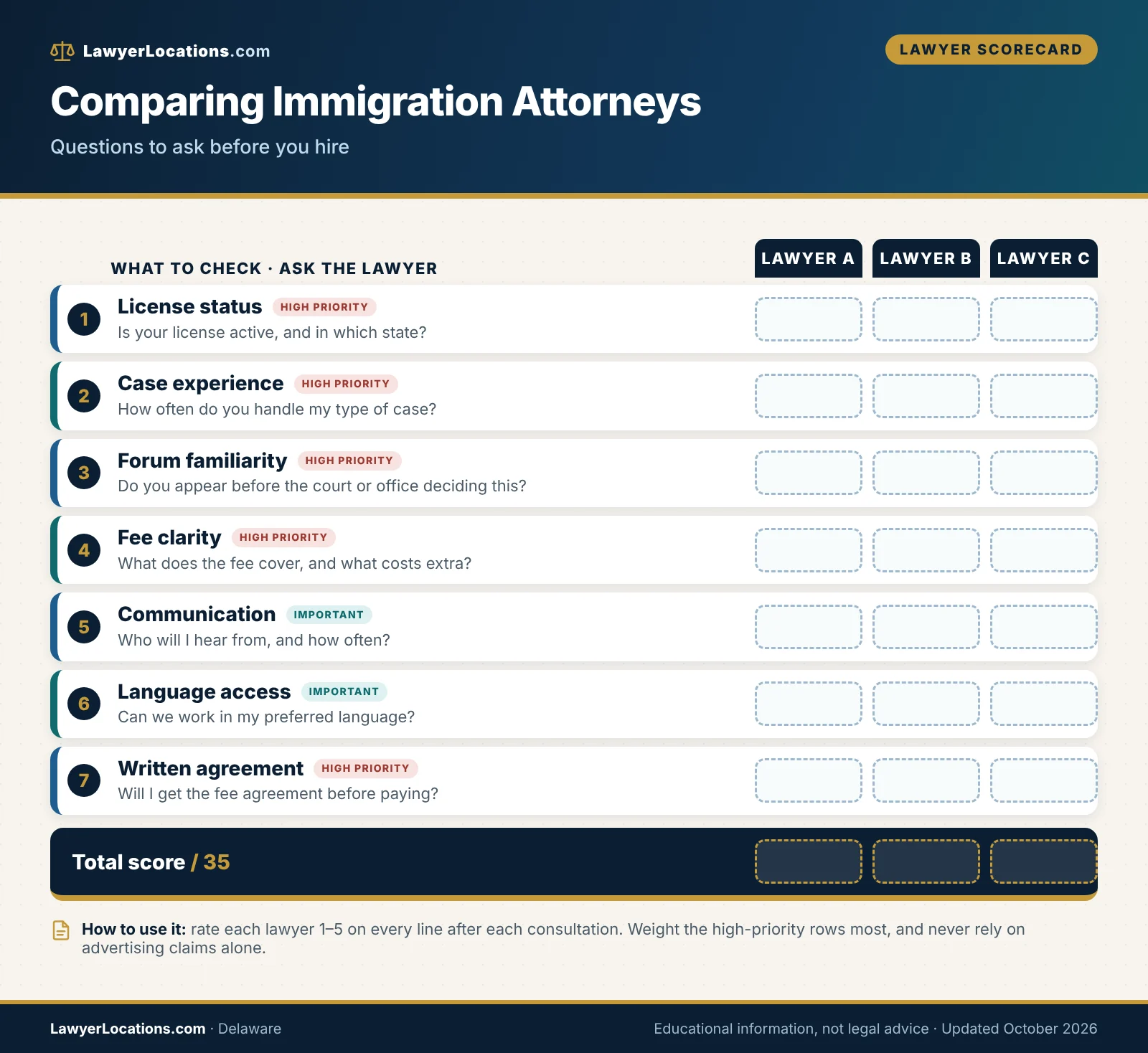
Text version of this graphic
| Criterion | Question to ask |
|---|---|
| License status | Is your license active, and where? |
| Case experience | How often do you handle my kind of case? |
| Forum familiarity | Do you appear before the court or office that decides it? |
| Fee clarity | What is covered, and what costs extra? |
| Communication | Who will I hear from, and how often? |
| Language access | Can we work in my preferred language? |
| Written agreement | Will I receive the fee agreement before paying? |
Red flags and good signs
Warning signs
Some patterns should make you pause, even if the person sounds friendly or comes recommended. Pressure to decide on the spot, guarantees about winning or speed, and requests for cash without a receipt are common examples.
- A promise of a specific result or processing time.
- Claims of a special connection or “inside contact” at an agency.
- Refusing to put the fee agreement in writing or to give you a copy.
- Asking you to sign blank forms, or to sign forms you cannot read.
- Not explaining what happens if a deadline is missed or the application is denied.
- Holding your original documents and refusing to return them.
Signs of a careful practice
On the positive side, a careful practice sends you a written engagement letter, explains the scope of work and gives you copies of everything that is filed on your behalf. They tell you what you must do and by when, and they say so plainly when your case is weak or when you should talk to a different type of lawyer.
They also talk about deadlines and about what is outside their role, such as criminal defense or tax advice, and suggest coordinating with those lawyers.
| Resource | What it does | Limits to keep in mind |
|---|---|---|
| Delaware State Bar Association online referral service | Matches your answers to participating attorneys and gives you a reference number | Referral only; lawyers choose whether to respond, and no one is guaranteed to contact you |
| Delaware Supreme Court attorney list | Shows whether a lawyer is an active member of the Delaware bar | Does not rate quality or experience |
| Office of Disciplinary Counsel | Handles complaints about attorney conduct in Delaware | A complaint process, not a way to shop for lawyers |
| EOIR recognition and accreditation rosters | Lists recognized nonprofit organizations and accredited representatives | Covers only non-attorney representatives working through nonprofits |
| ImmigrationLawHelp.org | National directory of nonprofit and low-cost immigration providers, searchable by state | Listings can change; confirm with each organization |
The Delaware State Bar Association describes its online referral service as “strictly a referral service.” Participating attorneys may offer a 30-minute initial interview for a $35 fee, but they are not required to, and later fees are negotiated directly between you and the lawyer.
Costs, deadlines and decision points
Immigration legal costs have two layers: what you pay the lawyer or organization, and what you pay the government. Ask for both numbers in writing, separately, because the government fees change by form and by year and are not part of the lawyer’s fee unless the agreement says so.
How immigration lawyers commonly charge
Flat fees and hourly rates
Many immigration practices quote a flat fee for a defined task, such as preparing and filing a specific application. Hourly billing is more common for matters whose length is hard to predict, such as contested removal defense. Neither model is automatically better. A flat fee gives you a ceiling to plan around, while hourly billing can make sense when the scope truly cannot be fixed in advance.
Get fees in writing This guide does not publish fee averages, because reliable, current, Delaware-specific figures from an official source are not available. Instead, ask for a written quote and compare the scope, not just the price.
What the fee should and should not include
A clear agreement lists the specific forms and services, the hearings or interviews covered, and what happens if the government asks for more evidence or denies the application. Ask whether interpreter costs, translations, couriers and travel to the Philadelphia area are included or billed separately.
Also ask whether a fee that is tied to winning is part of the arrangement. Ethics rules limit certain outcome-based fees, so if a lawyer proposes one, ask them to explain exactly how it works and put it in writing.
| Fee structure | How it works | Question to ask |
|---|---|---|
| Flat fee | One agreed price for a defined task, such as one application | What happens if the government requests more evidence or denies the case? |
| Hourly | You pay for time actually spent, often against an advance deposit | What is the hourly rate, and can you estimate the total range? |
| Staged flat fees | Separate fees for each phase, such as filing, interview and appeal | Which phases are covered now, and which would need a new agreement? |
| Limited-scope help | A defined service, such as reviewing a form you prepared yourself | What will you check, and what will remain my responsibility? |
| Free or sliding-scale nonprofit help | Services from legal aid or recognized organizations, usually with eligibility rules | Do I qualify, and is there a waiting list? |
Government fees and related expenses
Filing fees change often
USCIS and EOIR charge fees for many filings, and the amounts have changed several times in recent years, including through newer federal legislation. Because a wrong fee can lead to a rejected package, always get the amount from the form’s own page and the official USCIS fee schedule on the day you file, and ask your lawyer to confirm it again.
Some applicants qualify for a fee waiver or exemption for certain forms, but eligibility is limited and rules differ by form. The USCIS page for your specific form states whether a waiver is available.
Out-of-pocket extras
Beyond fees, expect expenses for certified translations, passport-style photos, copies of records from other countries, medical examinations for some green card cases and postage or courier charges. If a relative abroad needs to send documents, allow weeks for delivery.
Travel to a hearing or interview outside Delaware can also be a real cost. Add gas, tolls or train fare, parking and time away from work to your budget, and ask if your lawyer can arrange a remote appearance when the court allows it.
Maria, a hypothetical Delaware resident, collects three quotes for a family petition. One lists a low flat fee but excludes translations and interviews. Another costs more but includes both and says what happens if USCIS requests more evidence. When she compares what each one covers, the higher quote is not clearly more expensive for the work she actually needs.
Decision points on the way
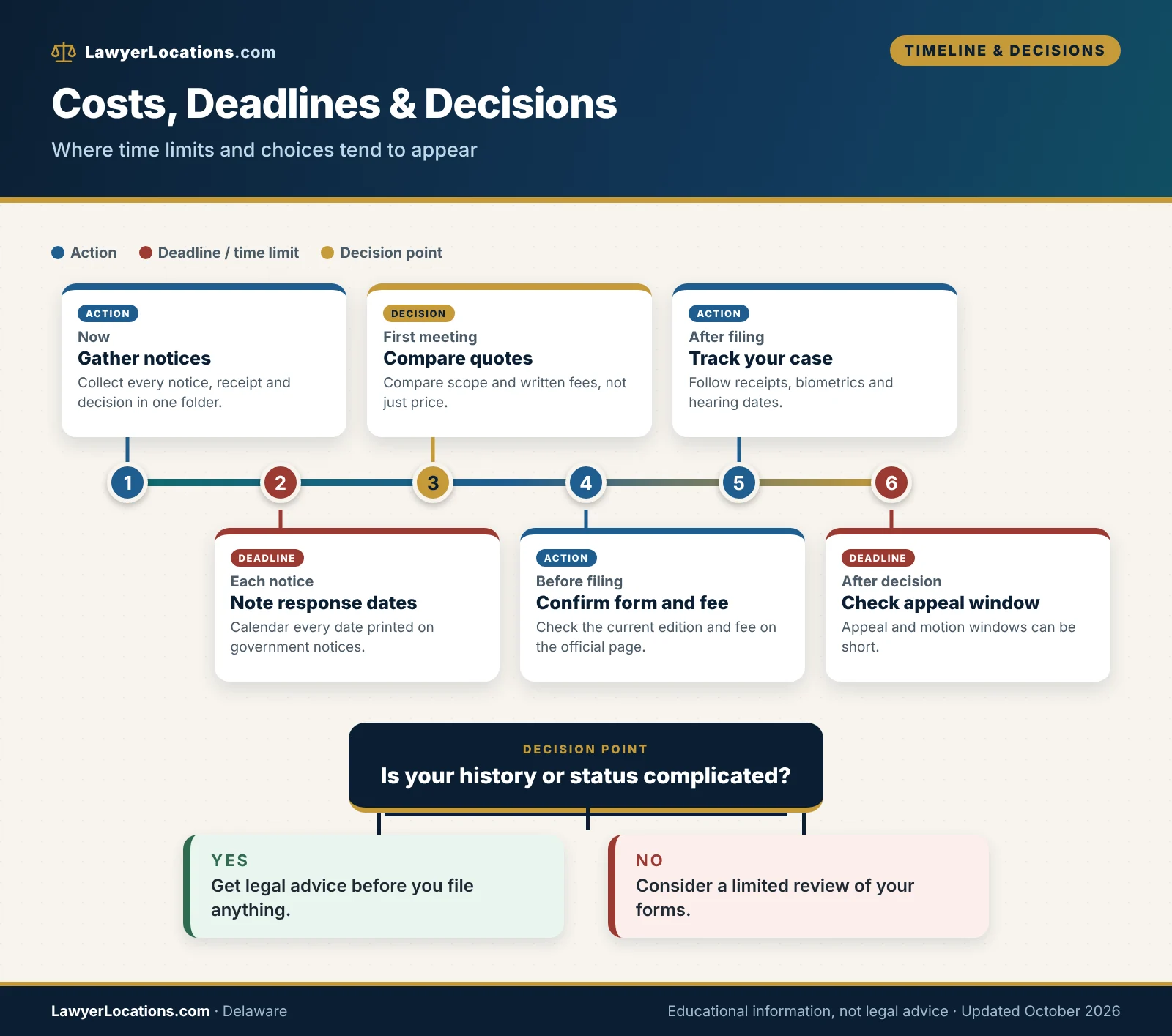
Text version of this graphic
- Now: Gather notices and identity documents (action).
- Within days of any notice: Note every response date (deadline).
- First meeting: Compare options and written fee quotes (decision).
- Before filing: Confirm the current form edition and fee (action).
- After filing: Track receipts, biometrics and hearing dates (action).
- After a decision: Check the appeal or motion window immediately (deadline).
Decision: Is your status or history complicated? If yes, get legal advice before filing. If no, consider a limited review of your forms.
Whether to hire full representation
Full representation makes the most sense when the stakes are high or the history is complicated: a removal case, a prior order, past arrests, a protection claim or a gap in status. It can be less necessary for a straightforward renewal where the facts are unchanged, though even then a quick review can catch mistakes.
If cost is the barrier, ask first about limited-scope help and nonprofit services before deciding to go without advice.
Changing lawyers midstream
You are generally free to end a relationship with a lawyer, but the timing matters. Before switching, ask for your complete file, confirm who has filed notices of appearance with the agency or court and make sure there is no gap in coverage before the next deadline or hearing.
If you believe a lawyer has been dishonest or has seriously neglected your case, the Delaware Office of Disciplinary Counsel handles complaints about Delaware attorneys, and EOIR has its own disciplinary process for practitioners who appear before it.
Free and low-cost help, and how to avoid immigration scams
You do not have to pay a private lawyer to get reliable help. Delaware has several nonprofits that provide immigration legal services, though each has eligibility rules, limits on the types of cases it takes and sometimes waiting lists.
Free and low-cost providers in Delaware
The organizations below appear in the Delaware listings on ImmigrationLawHelp.org. The descriptions summarize what each organization reports there. Confirm services, languages and intake rules directly, because they can change.
| Organization | Location | Services reported in the directory |
|---|---|---|
| Catholic Charities, Inc., Diocese of Wilmington | Wilmington | Green card adjustment, consular processing, DACA, work permits, family petitions, naturalization, TPS, and representation before the Board of Immigration Appeals |
| Community Legal Aid Society, Inc. | Wilmington, Dover and Georgetown offices | Special Immigrant Juvenile Status, T and U visas, VAWA petitions, with help on forms, USCIS filings, immigration court and appeals |
| Delaware Alliance for Community Advancement | Wilmington | Green card adjustment, consular processing, DACA, work permits, family and employment petitions, naturalization, TPS |
| La Esperanza, Inc. | Georgetown | A broad list including asylum, DACA, family petitions, naturalization, removal hearings, T and U visas, VAWA and representation at asylum interviews and immigration court |
Nonprofit immigration programs
Catholic Charities in Wilmington, Community Legal Aid Society (with offices in Wilmington, Dover and Georgetown), the Delaware Alliance for Community Advancement and La Esperanza in Georgetown are the Delaware organizations listed in the directory. Their service areas and case types differ, so call before assuming a match.
If a nonprofit cannot take your case, ask for a referral. Staff at these organizations often know which other provider has openings or handles a similar matter.
Legal HelpLink and the bar referral service
The Delaware State Bar Association points people to Legal HelpLink, a free legal aid intake available online at delegalhelplink.org, for those who meet eligibility standards, including federal poverty income guidelines. Completing an intake does not guarantee representation. People who do not qualify may be directed to the bar association’s online lawyer referral service.
The bar association asks the public not to call its office for legal assistance. Use the online forms, and choose your case category carefully, since selecting more categories can reduce the number of attorneys who are notified.
When you call a nonprofit, have your name, date of birth, country of birth, A-number if you have one, a list of the notices you have received and the dates on them ready. A clear summary helps staff decide quickly whether they can help or should refer you elsewhere.
Recognizing and avoiding immigration fraud
How “notario” and consultant schemes work
In some countries a “notario” is a licensed legal professional, but in the United States a notary public usually only verifies signatures. Scammers use the word to imply legal authority they do not have, collect payment for forms and then file nothing or file the wrong thing. Under 8 C.F.R. 1292.1, representation before DHS and EOIR is limited to defined categories, and an ordinary paid consultant is not one of them.
Preparing a form for a fee is not always illegal, but advising you which form to file, or acting on your behalf, may cross a line. If you are unsure about a person’s role, ask whether they are an attorney or an accredited representative and verify through the Delaware Supreme Court list or the EOIR rosters.
What to do if you think you were scammed
Do not assume your case is lost. Keep every receipt, message, form copy and notice, write a timeline of what happened and speak with a licensed immigration lawyer or recognized nonprofit quickly. Some mistakes can be repaired, and the fastest path is to let someone qualified review exactly what was filed.
Fear of immigration consequences stops many people from reporting fraud. A lawyer or legal aid organization can explain the risks and options before you contact any authority.
Never give your original passport, birth certificate or other irreplaceable documents to anyone who is not your lawyer or an accredited representative, and never pay in cash without a signed receipt. If a person promises a work permit or green card by a specific date, step back and verify who they are.
Preparing for your first consultation
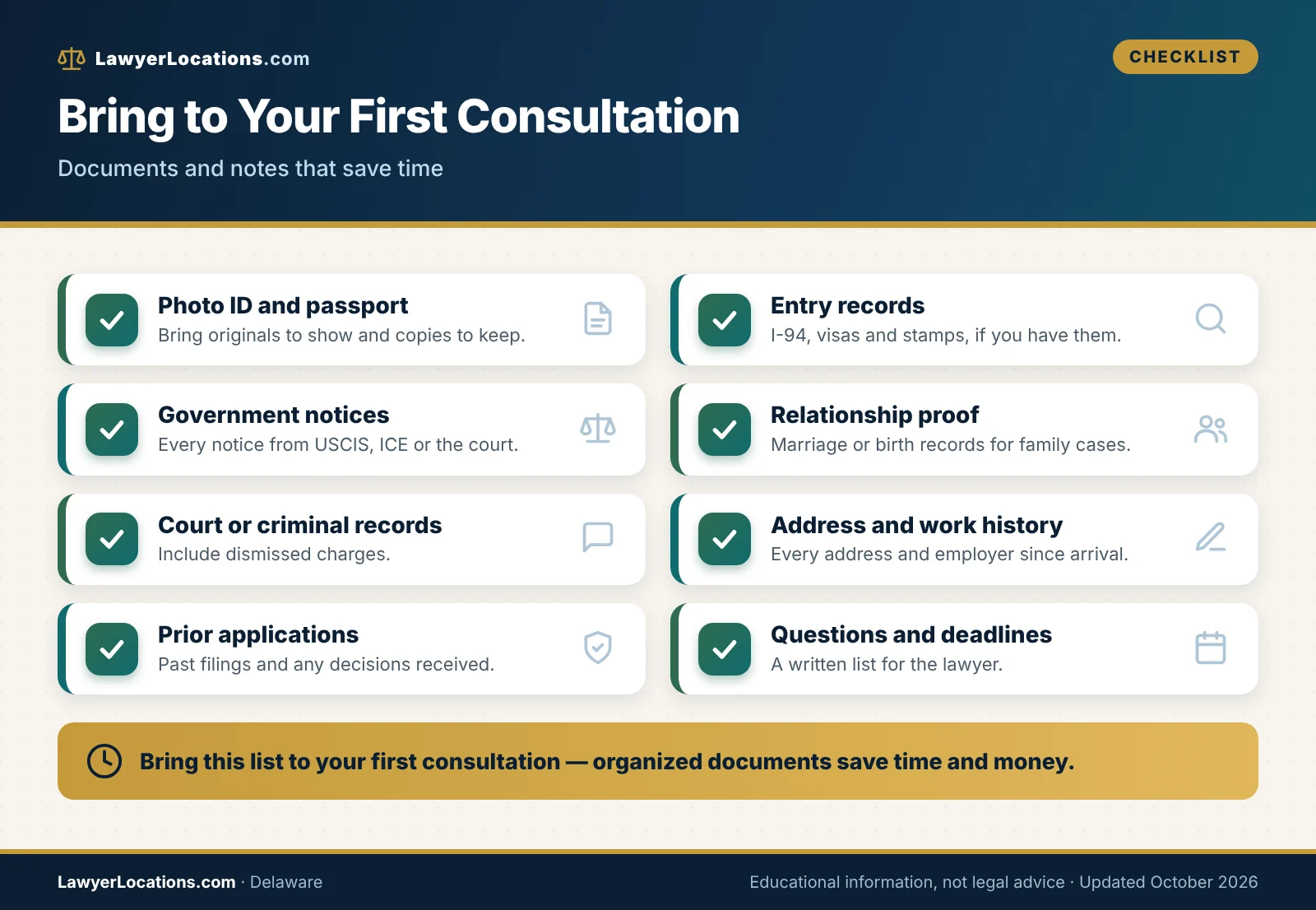
Text version of this graphic
- Government-issued photo ID and passport
- Entry records (I-94, visas, stamps) if you have them
- Every notice from USCIS, ICE or the court
- Proof of relationships (marriage or birth records)
- Criminal or court records, if any
- Address history and employment history
- Prior applications and decisions
- A written list of questions and deadlines
Documents to gather
Bring originals to show and copies to keep, or photograph each document clearly. The checklist above groups what most lawyers ask for first. If something is missing, say so; lawyers can often request records from agencies, but doing so takes time.
- Passport and any other identity documents
- Notices, receipts and decisions from any agency or court
- Proof of your relationship to any petitioner or family member
- Records of any arrest, charge or court case, even if dismissed
- A list of every address and employer since you arrived
Telling your story clearly
Write a short timeline before the meeting: when you arrived, how, what happened since and what you hope to achieve. Include things you worry about, such as an old arrest or a missed hearing. Conversations with a lawyer are confidential under attorney-client privilege once the relationship exists, and lawyers rely on complete facts to protect you.
If you speak another language, ask in advance for an interpreter. Do not rely on a child or relative to interpret for sensitive details.
Delaware immigration questions, answered
These are the questions people most often ask when searching for an immigration attorney in Delaware. The answers are general information, so apply them to your own facts only with qualified advice.
Questions about hiring and cost
Hiring questions
Start with the basics people ask before booking a first meeting.
Do I need a lawyer licensed in Delaware for an immigration case?
Not necessarily. Immigration is federal law, so an attorney licensed in any state may generally represent you before USCIS or the immigration court. A Delaware license does make it easier to verify the lawyer locally, and local knowledge can help with logistics.
How do I find an immigration attorney near me in Delaware?
Options include the Delaware State Bar Association’s online referral service, nonprofit directories such as ImmigrationLawHelp.org, and recommendations from community organizations. Verify any name you receive through the Delaware Supreme Court’s attorney list before you pay.
Is the first meeting free?
It depends on the lawyer. Some offer a free or reduced-cost first meeting, some charge a set consultation fee, and some nonprofits do an intake screening instead. Through the bar association’s referral service, a responding attorney may offer a 30-minute interview for $35 but is not required to. Ask about the fee when you schedule.
Can a notary or consultant handle my immigration case?
Generally no. Only attorneys, accredited representatives working through recognized nonprofits and a few narrow categories may represent you before DHS and the immigration courts. A person who only fills out forms should not claim to give legal advice.
What if I cannot afford a lawyer?
Contact the Delaware nonprofits listed above, try Legal HelpLink, and ask private lawyers about payment plans or limited-scope help. Remember that non-citizens in immigration court generally do not have a government-appointed lawyer, which is why early outreach matters.
Can I speak with a lawyer if I am afraid of immigration enforcement?
Yes. Conversations with a lawyer or legal aid intake staff are confidential once you are a client or prospective client. A lawyer can explain risks before you decide whether to file anything or attend an appointment.
Cost questions
Cost is the question that stops many people from calling, so it helps to separate the pieces. Lawyer fees vary widely by task and by practice, government fees are set by agencies and can change, and nonprofit services may cost little or nothing for people who qualify.
When you collect quotes, ask each provider to list the forms, hearings and extras covered. A cheaper quote that omits a major stage may cost more in the end. For another look at how cost conversations work, see our guide to hiring an immigration attorney in Oklahoma City, which walks through similar questions in a different state.
Questions about courts, offices and deadlines
Court and office questions
Delaware’s small size can make people assume everything happens close to home. In practice, several steps happen elsewhere.
Where will my immigration court hearing be if I live in Delaware?
Delaware does not have its own immigration court, and its cases are generally heard by the Philadelphia Immigration Court. Your hearing notice states the court, date, time and whether the hearing is in person or remote, so follow the notice exactly.
Which ICE office covers Delaware?
According to ICE, the Philadelphia Field Office covers Delaware, Pennsylvania and West Virginia. ICE’s page for that office lists no sub-office in Delaware.
How long do I have to apply for asylum?
The general rule is one year after arrival in the United States, with exceptions for changed or extraordinary circumstances under federal law. Do not wait to see whether an exception applies; get advice as soon as you can.
Can I work while my asylum case is pending?
Not immediately. Federal law says work authorization cannot be granted before 180 days after the asylum application is filed, and the rest of the process is governed by regulations and current policy. Ask a representative about the current steps.
Questions about status, family and criminal history
People also ask whether a Delaware arrest, a past order or a family member’s status changes their options. Often it does, which is why a full history review should come before any filing. A lawyer can tell you whether a past event is a minor detail or a central problem.
If you are comparing local guides, our pages on citizenship lawyers in Harris County and asylum lawyers in Arizona explain how the federal process looks from other forums.
Your next steps
In the next week
Collect your notices and identity documents, write down every deadline that appears on them and decide whether your situation is straightforward or complicated. If any notice has an upcoming date, make contacting a lawyer or nonprofit the first priority.
Then use two or three sources to find help: the Delaware State Bar Association’s online referral, the nonprofits listed above and any trusted community organization.
Before you sign anything
Confirm the person’s license or accreditation, ask for the fee agreement in writing, make sure it states what is and is not covered and keep copies of everything. If you feel pressured, leave and think it over. A responsible lawyer expects you to ask questions and compare options.
Searching for an immigration attorney in Delaware can feel urgent and confusing at the same time. A calm, documented approach protects you from the biggest risks: missed deadlines and unqualified advice.
Ready to compare your options?
Use the questions and checklists above to prepare, then contact the Delaware State Bar Association’s referral service or a nonprofit provider. For a closer look at how an immigration lawyer can help with common applications, read our guide to a green card lawyer.
General information only. This article is for education and does not constitute legal advice or create an attorney-client relationship. LawyerLocations.com is not a law firm and does not recommend or rank individual lawyers. Immigration laws, fees, policies and local procedures change often. Consult a lawyer licensed in the relevant jurisdiction, or an accredited representative, about your own situation.
Sources & References
Show all 10 sources
- 8 U.S.C. 1158 — Asylum — Legal Information Institute, Cornell Law School — law.cornell.edu — accessed October 2026
- 8 C.F.R. 1292.1 — Representation of others — Legal Information Institute, Cornell Law School — law.cornell.edu — accessed October 2026
- 8 C.F.R. 1003.102 — Grounds for disciplining practitioners — Legal Information Institute, Cornell Law School — law.cornell.edu — accessed October 2026
- ICE Philadelphia Field Office — U.S. Immigration and Customs Enforcement — ice.gov — accessed October 2026
- Recognition and Accreditation Program — Executive Office for Immigration Review, U.S. Department of Justice — justice.gov — accessed October 2026
- Immigration Court Listing — Executive Office for Immigration Review, U.S. Department of Justice — justice.gov — accessed October 2026
- Public Resources (Online Lawyer Referral Service, Legal HelpLink) — Delaware State Bar Association — dsba.org — accessed October 2026
- Delaware immigration legal help organizations — ImmigrationLawHelp.org — immigrationlawhelp.org — accessed October 2026
- Delaware immigration court coverage — Border Crossing Law — bordercrossinglaw.com — accessed October 2026
- USCIS filing fees overview — U.S. Citizenship and Immigration Services — uscis.gov — accessed October 2026
Legal Disclaimer and Limitation of Liability
Informational and illustrative purposes only. This article was prepared by LawyerLocations.com solely on the basis of the information available to us at the time of writing. It is an illustrative, general overview. It is not a complete or authoritative statement of the law, and it has not been reviewed by a lawyer licensed in your state or county.
Not legal advice. Nothing in this article is legal, financial, tax or immigration advice, and reading it does not create an attorney-client relationship between you and LawyerLocations.com or any author, lawyer or firm mentioned. Laws, court rules, fees, filing deadlines and agency procedures differ by state, county and court, and they change often. Some details here may be simplified, incomplete or out of date, and time limits for legal claims can be short.
No warranty. We make no representation or warranty, express or implied, about the accuracy, completeness, timeliness or suitability of this content for your situation. Please do not rely on it to make, delay or skip any legal decision. Check the facts against official sources and speak with a licensed attorney in the relevant jurisdiction before you act.
Limitation of liability. To the fullest extent permitted by law, LawyerLocations.com and its owners, authors and contributors disclaim all liability for any loss, damage, cost or other consequence arising from the use of, or reliance on, this article, including any content on third-party websites we link to. Mentioning a lawyer, firm, organization or service is not an endorsement and is not a promise of any result. If you are in immediate danger, contact your local emergency number.