If you are comparing a prenup lawyer Los Angeles CA couples can hire, start with one fact: a premarital agreement signed in California is judged under the state’s Uniform Premarital Agreement Act (Family Code §§ 1600–1617), and the two biggest tests are whether each person signed voluntarily and whether the financial disclosure was fair and complete. For agreements signed on or after January 1, 2020, the person being asked to sign must have at least 7 calendar days with the final agreement before signing.
This guide explains what a prenup can and cannot do in California, how the process usually runs in Los Angeles, which local courts and referral resources matter, how lawyers charge, and how to compare them without relying on ads or ratings. It is general legal education, not legal advice.
How a Prenup Lawyer Case Works in Los Angeles, CA
A prenup matter is not a lawsuit. It is a negotiation and drafting project that happens before a wedding, usually with a lawyer for each person, and it ends with a signed contract that sits in a drawer until a divorce, a separation or a death makes it relevant. The work in Los Angeles follows California law, which is the same in every county, but the practical details (who you meet, which courthouse would eventually hear a dispute, how you find a lawyer) are local.
What a premarital agreement is under California law
Think of a prenup as a private rulebook for money and property that the two of you write while you are still engaged. California’s statute gives that rulebook a precise definition and a precise list of things it can address. Knowing both helps you judge whether a lawyer’s proposal is realistic.
The statutory definition and when it takes effect
Under Fam. Code § 1610, a “premarital agreement” is an agreement between prospective spouses made in contemplation of marriage and to be effective upon marriage. Fam. Code § 1611 requires that it be in writing and signed by both parties, and it is enforceable without consideration (meaning nobody has to give the other a payment or gift in exchange). Fam. Code § 1613 adds that the agreement becomes effective upon marriage, so if the wedding never happens, the agreement does nothing.
Two practical points follow. First, an oral deal (“we agreed my business stays mine”) is not a premarital agreement under the statute. Second, a signed prenup does not need to be filed with a court to exist. The statute asks for a signed writing, not a court filing, which is why most prenups never reach a courthouse unless there is a later dispute.
What the agreement can cover
The statute’s list in Fam. Code § 1612(a) is broad. Parties may contract about their rights and obligations in the property of either or both of them, whenever and wherever acquired or located. They may address the right to buy, sell, use, transfer, lease, mortgage or otherwise manage property, and what happens to property on separation, marital dissolution, death, or “the occurrence or nonoccurrence of any other event.” They may also arrange a will, trust or other document to carry out the agreement, decide who owns the death benefit from a life insurance policy, choose the law that governs the contract, and address any other matter not in violation of public policy or a criminal statute.
In everyday terms, a Los Angeles couple might use a prenup to keep a home bought before the marriage as separate property, protect an ownership stake in a company, set rules for retirement accounts or inheritances, or decide how a future sale of a jointly bought house would be split. Which of those choices make sense for you is exactly what a consultation with a family lawyer is for.
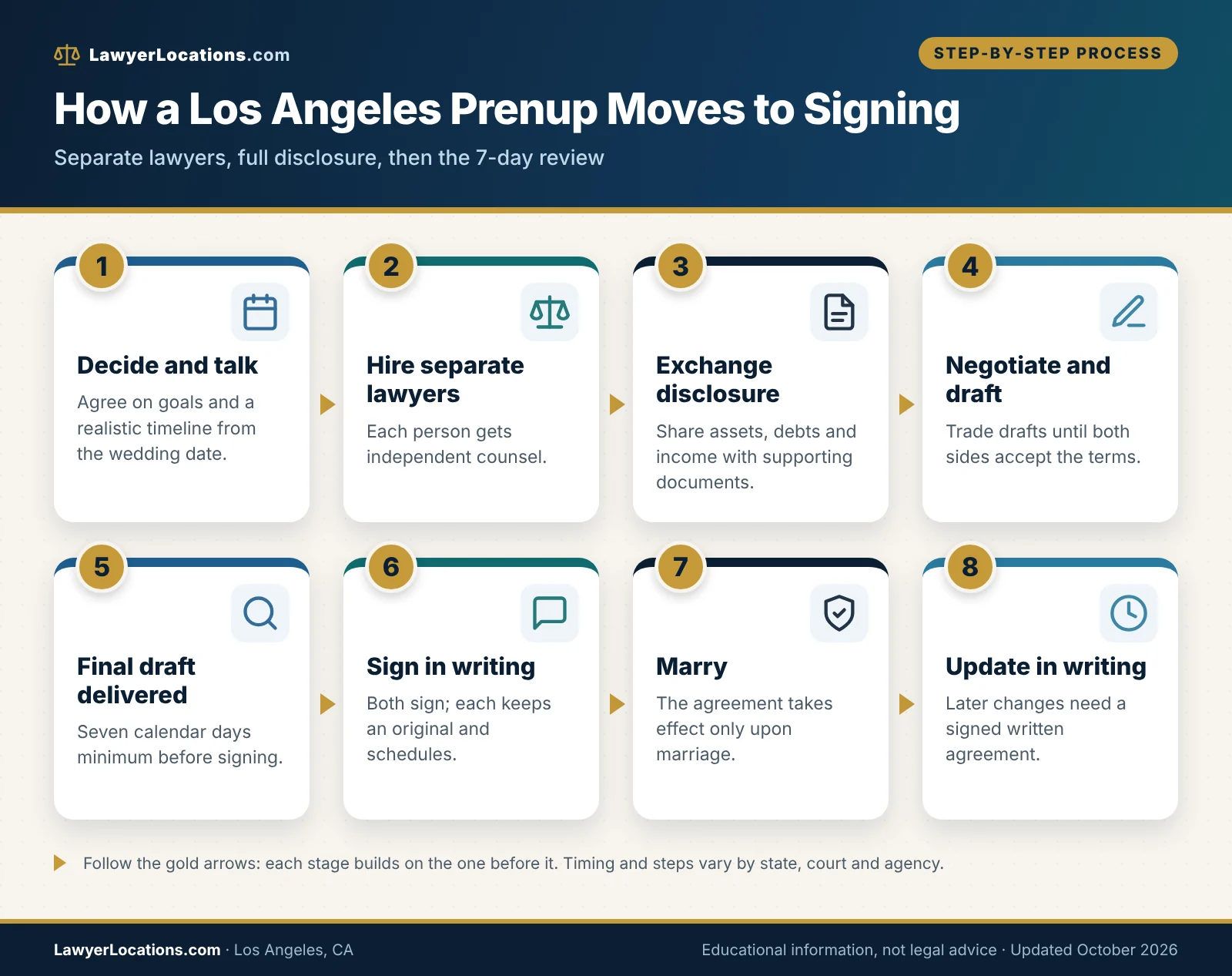
Text version of this graphic
- Decide you want a prenup. Talk early, well before invitations go out.
- Hire separate lawyers. Each person should have independent counsel.
- Exchange financial disclosure. Assets, debts, income and expected inheritances.
- Negotiate and draft. Trade drafts until both sides accept the terms.
- Start the 7-day review. The final version must be in hand at least 7 calendar days before signing.
- Sign in writing. Both parties sign; keep originals safe.
- Marry. The agreement takes effect only upon marriage.
- Revisit when life changes. Changes after marriage need a signed written agreement.
What a prenup cannot do
Some limits are written into the statute itself. A lawyer who promises you can contract around everything is not describing California law accurately.
Child support is protected
Fam. Code § 1612(b) states that the right of a child to support may not be adversely affected by a premarital agreement. A clause saying “neither of us will ever pay child support” would not bind a court. For the same reason, prenups are not a good place to try to settle parenting arrangements for children who may not exist yet; those decisions are made by a court later based on the family’s actual circumstances. If you already have children from an earlier relationship, tell your lawyer at the first meeting, because that affects how the agreement and your estate plan should fit together.
Spousal support waivers face extra rules
California treats spousal support clauses with more caution than property clauses. Under Fam. Code § 1612(c), a spousal support provision, including a waiver, is not enforceable if the person it is enforced against was not represented by independent counsel when the agreement was signed, or if the provision is unconscionable at the time of enforcement. The statute adds that an otherwise unenforceable support provision does not become enforceable merely because that person had a lawyer.
The California Supreme Court has held that a spousal support waiver in a premarital agreement is not automatically unenforceable. In In re Marriage of Pendleton & Fireman (2000) 24 Cal.4th 39, it held that a waiver voluntarily entered into by parties who understand its effect does not violate current public policy, while leaving room for the question of whether circumstances at the time of enforcement could make a waiver unjust. In plain terms: support waivers can work, but they are the clauses most likely to be examined closely.
Typical steps from first call to signing
No two matters run on an identical schedule, but the sequence below is the usual shape. The timing depends far more on how organized your finances are and how far apart the two sides start than on the lawyer’s calendar.
Early steps: consultation, goals and disclosure
The first step is a consultation in which you describe what you own, what you owe, what you expect to earn or inherit, and what you want to protect. The lawyer explains how California would treat those assets without a prenup and where a written agreement would change the outcome. After you decide to proceed, the lawyer helps you put together a financial disclosure: a list of assets, debts and income that your future spouse’s lawyer can review. Full disclosure matters because, as explained below, a prenup can be challenged when one side did not receive a fair and reasonable disclosure.
Drafting, review, signing and storage
One lawyer typically prepares a first draft, and the other side’s lawyer responds with comments. Drafts go back and forth until both people are comfortable. Once a final version exists, the 7-calendar-day clock matters, because the statute measures time from when the other party first receives the final agreement (more on this below). After signing, keep an original with each person and each lawyer, and keep the disclosure schedules attached. A prenup that nobody can find in year twelve is of little use.
California Rules That Decide Whether a Prenup Holds Up
A California prenup is enforceable unless the person fighting it proves one of two grounds: it was not signed voluntarily, or it was unconscionable when signed and the person lacked fair disclosure and knowledge of the other’s finances. The statute then defines voluntariness through a checklist, which is why process matters as much as drafting.
Voluntariness and the seven-day rule
Under Fam. Code § 1615(c), a premarital agreement is deemed not to have been signed voluntarily unless the court finds, in writing or on the record, that several conditions were met. This is the heart of the process a Los Angeles lawyer will build around.
Seven calendar days with the final agreement
For agreements signed on or after January 1, 2020, the party against whom enforcement is sought must have had not less than seven calendar days between the time they were first presented with the final agreement and the time they signed, whether or not they have a lawyer. Calendar days include weekends and holidays. Nonsubstantive amendments that do not change the terms do not restart the clock, but a change to a number, a clause or an asset schedule is a different story.
Count the 7 calendar days from the day the final version reaches the other person, not from the first rough draft. If a substantive change arrives on day six, ask your lawyer whether the safer course is to restart the count. Build a buffer of several weeks before the wedding date so nobody is signing under time pressure.
Independent counsel, or a separate written waiver
The statute also asks whether the person was represented by independent legal counsel at signing or, after being advised to seek counsel, expressly waived representation in a separate writing. If a person goes without a lawyer, the statute requires that they were fully informed of the terms and basic effect of the agreement and the rights they were giving up, that they were proficient in the language of the explanation and the agreement, that the explanation was put in writing and delivered before signing, and that they signed a document stating they received that information and who provided it. The court also looks at whether the agreement was signed under duress, fraud or undue influence, whether anyone lacked capacity, and any other relevant factors.
Be cautious if one lawyer offers to “represent both of you” on a prenup. The interests in a prenup are opposed by nature, and the voluntariness test is built around independent counsel. Ask any lawyer you consult how they handle the other person’s representation.
Disclosure and unconscionability
The second route for challenging a prenup combines two things: the agreement was unconscionable (grossly one-sided) when signed, and the challenger did not have fair disclosure. Understanding how the two work together explains why lawyers insist on detailed financial schedules.
What fair disclosure looks like
Under Fam. Code § 1615(a)(2), an agreement can be refused enforcement if it was unconscionable when executed and, beforehand, the challenging party (A) was not given a fair, reasonable and full disclosure of the other’s property or financial obligations, (B) did not voluntarily and expressly waive, in writing, any right to disclosure beyond what was provided, and (C) did not have, and reasonably could not have had, adequate knowledge of those finances. All of those must apply. In practice, a clear schedule of assets, debts and income, with account statements or valuations where possible, is the best protection for the person who wants the agreement to hold.
Unconscionability is a judge’s decision
Fam. Code § 1615(b) provides that unconscionability is decided by the court as a matter of law. That means a judge, not a jury, examines whether the terms were so one-sided at signing that enforcing them would be unfair. A balanced agreement, with real consideration of both sides’ interests, is the strongest defense. A separate rule applies to spousal support, which is also tested for unconscionability at the time of enforcement under § 1612(c).
Property defaults and what happens after the wedding
To judge whether you need a prenup at all, you need to know what California does without one. The default rules explain why many people with premarital assets, businesses or family property ask about agreements.
California’s community property default
California is a community property state. In general, property acquired by a person during the marriage while domiciled in California is community property under Fam. Code § 760, which is the starting point for defining community property. Separate property under Fam. Code § 770 includes property owned before marriage, property acquired after marriage by gift, bequest, devise or descent, and the rents, issues and profits of that separate property. Real life is messier: mixing separate money with community money, or working on a spouse’s separate business, can raise tracing and reimbursement questions that a prenup can address in advance.
Changing the agreement later and death-related waivers
After marriage, Fam. Code § 1614 says a premarital agreement may be amended or revoked only by a written agreement signed by the parties, which is enforceable without consideration. Verbal “we changed our minds” understandings do not count. Separately, Fam. Code § 1617 provides that any statute of limitations on a claim under a premarital agreement is tolled (paused) during the marriage, although equitable defenses like laches (unreasonable delay) and estoppel remain available.
If a prenup is meant to address what a surviving spouse can claim from the other’s estate, California’s probate rules apply too. A waiver of a surviving spouse’s rights must be in writing and signed by the spouse who is waiving them, and it is enforceable only if it also meets the additional rules in Prob. Code §§ 142–144; ask both a family lawyer and an estate-planning lawyer how the pieces fit together. If estate planning is a main driver for you, our guide to living trust lawyers explains how those documents work alongside marital agreements.
| Rule | What the statute says | Practical takeaway |
|---|---|---|
| § 1611 | Agreement must be in writing and signed by both parties; no consideration needed. | No verbal prenups. Both people sign the same final version. |
| § 1612(a) | Parties may contract about property rights, management, disposition on separation, divorce or death, wills and trusts, life insurance proceeds, choice of law and other lawful matters. | Broad freedom on property; your lawyer should map your assets to specific clauses. |
| § 1612(b) | A child’s right to support cannot be adversely affected. | Do not rely on a child-support waiver; it will not bind a court. |
| § 1612(c) | Spousal support provisions are unenforceable without independent counsel at signing or if unconscionable at enforcement. | If you want a support waiver, both sides need their own lawyers. |
| § 1613 | Agreement is effective upon marriage. | If there is no wedding, there is no prenup. |
| § 1614 | After marriage, amend or revoke only by signed written agreement. | Document every change; informal promises do not count. |
| § 1615(a)–(b) | Not enforceable if involuntary, or unconscionable plus no fair disclosure; unconscionability decided by the court as a matter of law. | Exchange complete financial schedules and keep them with the agreement. |
| § 1615(c) | Voluntariness requires findings on independent counsel (or separate written waiver), 7 calendar days for agreements signed on or after Jan. 1, 2020, no duress, fraud or undue influence. | Start early and keep a dated paper trail showing when the final draft was delivered. |
| § 1617 | Limitations periods are tolled during marriage; laches and estoppel remain available. | Do not assume a very old prenup is immune from challenge or from delay arguments. |
Los Angeles Courts, Referral Services and Local Resources
Because a prenup is a private contract, Los Angeles shows up in three places: the Superior Court that would hear a future dispute, the referral services that help you find a lawyer, and the legal-aid and self-help organizations that serve people who cannot afford private counsel. California law is the same statewide; these local pieces are what change when you move from Los Angeles to San Diego or Sacramento.
Where prenup disputes are heard
Most couples never see a courtroom over their prenup. When a disagreement does arise, it usually appears inside a divorce or legal separation case rather than as a stand-alone lawsuit, and the agreement is put in front of a family law judge.
Los Angeles County Superior Court, family law
California’s trial courts are organized by county. For Los Angeles, that means the Superior Court of Los Angeles County (lacourt.org). According to the court’s family law departments directory, all Central District family law departments sit in the Stanley Mosk Courthouse, 111 North Hill Street, Los Angeles, CA 90012. The same directory lists family law courthouses in other districts across the county, including Van Nuys, Santa Monica, Torrance and Long Beach, among others. The directory is dated, so confirm the current courthouse and department for your case with the court or your lawyer before you plan a trip.
Which courthouse handles a future case depends on the court’s venue and assignment rules and on where the spouses live, so the city address on your lease is not the whole story. The prenup does not choose the courthouse for you, but it can include a choice of governing law (§ 1612(a)(6)), which is a different question from where the case is filed.
What a judge looks at when a prenup is challenged
If one spouse asks the court to set aside or enforce the agreement, the judge looks at the statutory tests described above: voluntariness under § 1615(c), disclosure and unconscionability under § 1615(a)–(b), and for support provisions the additional rules in § 1612(c). That is why a careful lawyer in Los Angeles builds a record at signing: dated cover emails showing when the final draft was delivered, signed acknowledgments, attached asset schedules and a list of who represented whom.
Ask your lawyer to keep a simple signing file: the date the final draft was sent, the date it was signed, who attended, and copies of the disclosure schedules. If the agreement is ever tested, that file is evidence of a voluntary, informed signing.
Finding a lawyer through local referral services
Los Angeles has no shortage of law offices, and a quick search will show plenty of ads. A referral service is a different starting point because the service itself is regulated. The State Bar of California publishes a list of certified lawyer referral services for the Los Angeles area.
The Los Angeles County Bar Association referral service
The Los Angeles County Bar Association (LACBA) runs a lawyer referral service called SmartLaw (lacba.org). LACBA’s page states that the service is certified by the State Bar of California and the American Bar Association, that referrals can be arranged online or by phone (phone referrals in English and Spanish), and that there is no fee for the referral itself. The page also says each referred client receives a consultation of up to 20 minutes with the attorney, after which the attorney charges for services. Treat that as a service description, not a promise about any particular lawyer, and confirm the current terms when you contact them.
Other certified referral services in the area
The State Bar’s Los Angeles-area list (calbar.ca.gov) names more than a dozen certified services, including bar-association programs such as the Attorney Referral Service of the San Fernando Valley Bar Association, the Lawyer Referral Service of the South Bay Bar Association, the San Gabriel Valley Lawyer Referral Service, and community-based services such as the Los Angeles LGBT Center’s referral program and the Mexican American Bar Association’s service. Some listed services are commercial platforms rather than bar-association programs. A certification means the service has met State Bar standards for operating a referral service; it is not a ranking of the lawyers on its panel.
The California Courts Self-Help Guide recommends starting with your county’s lawyer referral service, your local bar association, or LawHelpCalifornia.org to reach State Bar-certified referral services, and suggests checking a lawyer’s license and discipline record on the State Bar’s Attorney Search before you meet.
Legal aid and self-help for people on a tight budget
A prenup is often assumed to be a luxury product, but there are public and nonprofit resources in Los Angeles for people who need some form of legal help. It helps to know in advance what those groups do and what they typically do not.
Nonprofit legal aid organizations
Two long-standing Los Angeles legal aid organizations are the Legal Aid Foundation of Los Angeles (lafla.org) and Neighborhood Legal Services of Los Angeles County (nlsla.org). LAFLA describes its family law practice as focused on domestic violence survivors and lists restraining orders, divorce, child custody, paternity and child support, and it directs people to its Apply for Legal Aid page to check eligibility. Its family law page does not mention premarital agreements, so do not assume a legal aid office will draft a prenup. NLSLA operates self-help legal access centers that help people with court paperwork. Eligibility and services change, so call or check the organization’s current pages before relying on them.
Court self-help and limited-scope help
The California Courts Self-Help Guide (selfhelp.courts.ca.gov) offers a locator for court self-help centers by city, county or ZIP code and explains how to find free or low-cost legal help. It also explains that you can hire a lawyer for only part of a matter (“limited-scope” help), with the lawyer handling some tasks while you handle others. For a prenup, one realistic use is paying a lawyer to review a draft the two of you negotiated, rather than hiring for the whole negotiation. Remember that the statute’s independent-counsel rule for spousal support waivers (§ 1612(c)) means that going without any lawyer may limit what can be enforced.
| Resource | What it is | Good for | Limits to keep in mind |
|---|---|---|---|
| LACBA SmartLaw referral service | Bar-association lawyer referral service certified by the State Bar of California | A starting point for a consultation with a participating lawyer | Referral is not an endorsement; fees after the short initial consultation are set by the lawyer |
| Other State Bar-certified referral services | Regional bar and community referral programs for the Los Angeles area | Finding lawyers by region or community; language or cultural fit | Some listed services are commercial; read how each one selects and charges |
| State Bar Attorney Search | Official license and discipline lookup | Checking license status and discipline record before you meet | Does not tell you whether a lawyer’s style or fees suit you |
| Court self-help centers | Court-linked help with forms and procedure | Understanding court process if a dispute later reaches court | Staff provide information, not legal advice or drafting of negotiated agreements |
| Legal aid organizations (LAFLA, NLSLA) | Nonprofit programs for people with limited income | Income-eligible people facing family law problems; self-help workshops | Eligibility rules apply; prenup drafting is not listed on LAFLA’s family law page |
If you later move or marry in another part of California, the statewide rules above stay the same while the local courts and referral services change. For a neighboring example, see our guide to family law attorneys in San Diego, CA, and for a statewide view, read the California family law attorney guide.
How to Compare Prenup Lawyers in Los Angeles, CA
The most reliable comparison is not a ranking but a short list of questions you ask every lawyer you speak with, then compare the answers side by side. LawyerLocations.com is a legal-education and lawyer-discovery resource, not a law firm, and nothing here recommends any individual lawyer. The aim is to make you a more confident shopper.
Verify credentials and fit before you meet
Two checks take ten minutes and screen out most avoidable problems: confirm the license, and confirm that the lawyer actually does premarital agreements as a regular part of their practice.
License status and discipline record
Look up the lawyer on the State Bar of California’s Attorney Search to confirm the person is licensed and in good standing, and to see any public discipline. The California Courts Self-Help Guide recommends doing this before you meet. Write down the bar number from the lawyer’s website so you can search the right person; names are common in a county the size of Los Angeles.
Relevant experience and the specialization program
Family law is one of the practice areas in which the State Bar’s Board of Legal Specialization certifies specialists, and the State Bar provides tools to look up specialist status. That credential is optional; many capable family lawyers do not hold it, and holding it does not tell you whether the lawyer is a good match for your situation. A more useful question is concrete: how many premarital agreements does the lawyer handle in a typical year, and have they worked with assets like yours (a closely held business, stock compensation, royalties, rental property, a family trust)?
Be wary of any lawyer or website that promises a specific outcome, says a prenup will be “bulletproof,” or pressures you to sign quickly. California’s voluntariness rules reward a slower, documented process.
Questions that separate one lawyer from another
Take the same list into every consultation. Write down answers, not impressions, and compare them afterward.
Questions about process and timeline
Ask how the lawyer would handle the seven-calendar-day review period for your wedding date, who drafts the first version, how many rounds of revision are typical, and how disclosure schedules are prepared. Ask how the lawyer handles the other side being represented by a different firm, and what happens if the other person decides not to hire a lawyer. A lawyer who has done this often will answer these quickly and specifically.
Questions about fees and who does the work
Ask whether the work is billed as a flat fee, by the hour or against a retainer; what the fee includes and excludes; whether you will be billed for emails and calls; who will actually draft and who will attend negotiations; and how the lawyer prefers to communicate. Ask for the fee arrangement in writing. California requires a written fee agreement in many matters (see the costs section below), but even when the law does not require one, a written estimate protects you.
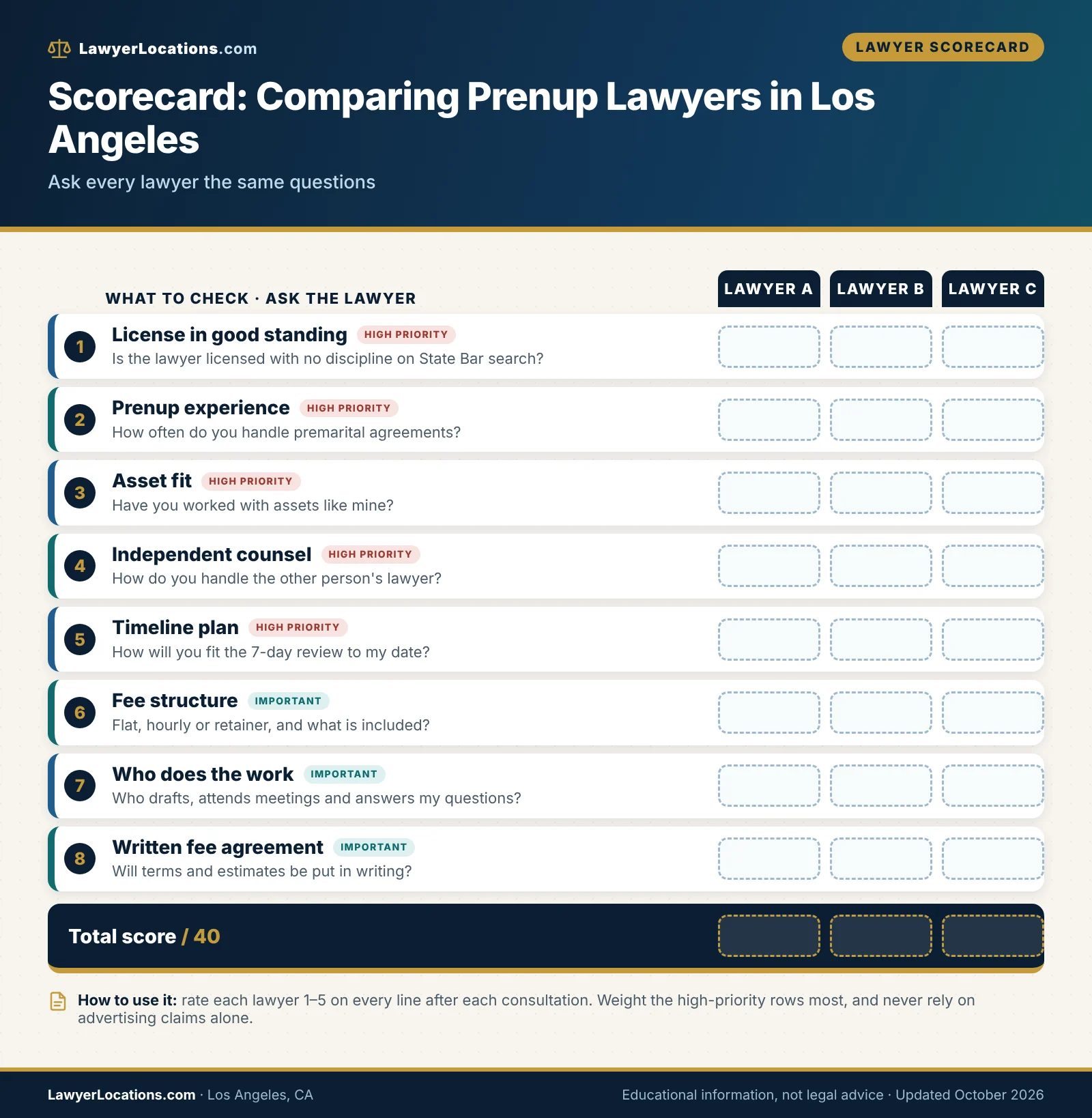
Text version of this graphic
- License and discipline record. Is the lawyer in good standing on the State Bar’s Attorney Search?
- Prenup experience. How often does the lawyer handle premarital agreements?
- Asset fit. Has the lawyer worked with assets like yours (business, stock, property)?
- Process and timing. How will the 7-day review fit your wedding date?
- Fee structure. Flat fee, hourly or retainer, and what is included?
- Who does the work. Who drafts, who attends meetings, who answers questions?
- Communication. How and how quickly will you get updates?
- Written fee agreement. Will terms and estimates be put in writing?
Preparing for your consultation
A consultation goes further when you arrive with organized information. You do not need every document on day one, but a short package lets the lawyer give concrete advice instead of general information.
Documents and information to gather
Start with a one-page summary of what you own and owe, then add backup. The checklist below is a starting point; your lawyer will tell you what else is needed.
- Recent statements for bank, brokerage and retirement accounts
- Property deeds, mortgage statements and any recent valuations
- Business documents: ownership agreements, recent tax returns, any valuation reports
- Pay stubs, equity or stock-option agreements, and bonus or royalty arrangements
- A list of debts, including student loans, credit cards and personal loans
- Existing wills, trusts or beneficiary designations
- Prior divorce judgments or support orders, if either person was married before
- Your wedding date and any planned moves or job changes
Your goals, worries and non-negotiables
Write down what you hope the agreement accomplishes before the meeting: protecting a premarital home, keeping a business in the family, preparing for children from a prior relationship, or simply making the financial rules clear. Mark which points are non-negotiable and which are flexible. Prenup negotiations are easier, and more likely to leave the relationship intact, when each person knows their own priorities before the first draft goes out.
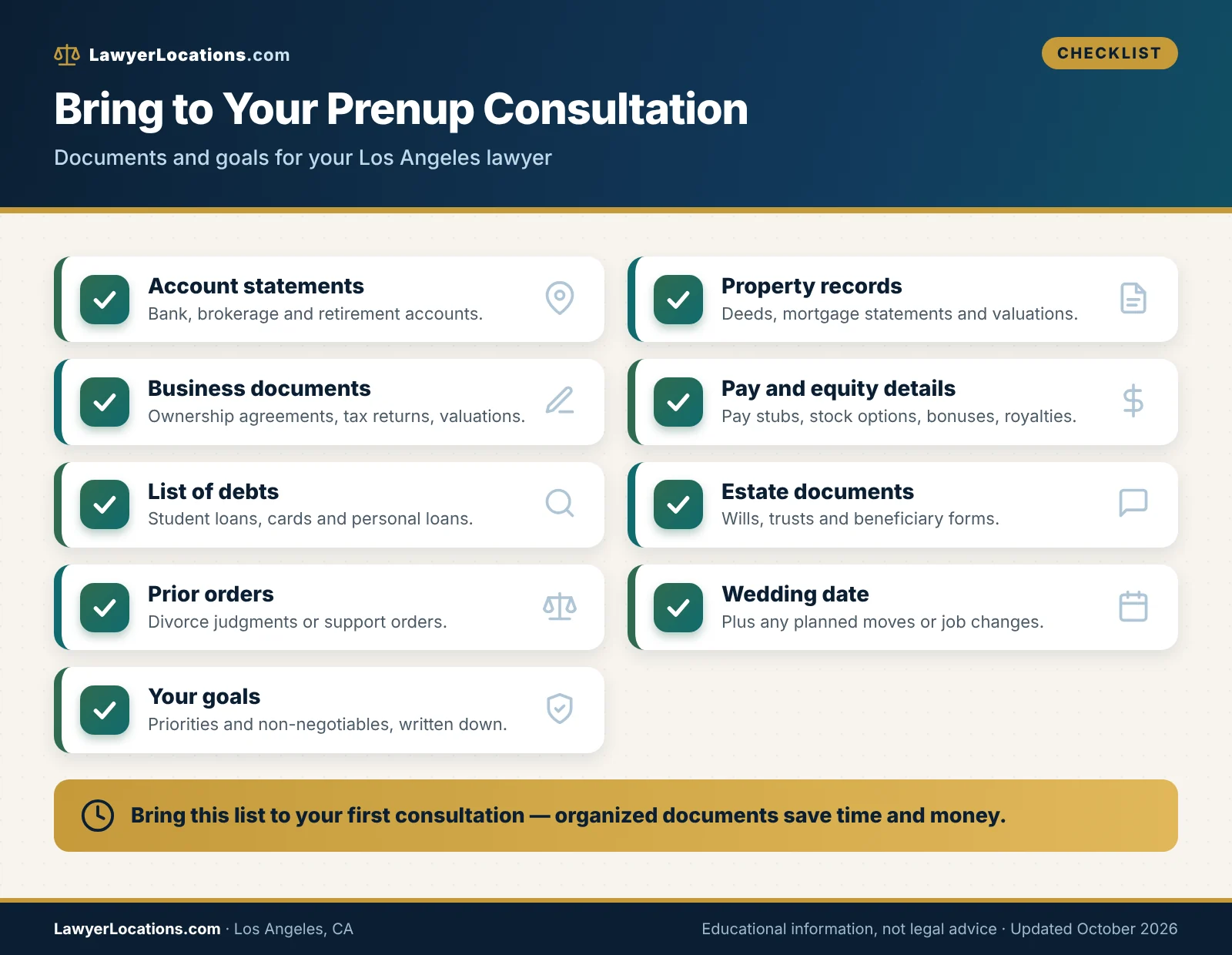
Text version of this graphic
- Account statements (bank, brokerage, retirement)
- Deeds, mortgage statements and valuations
- Business documents and tax returns
- Pay, equity and bonus information
- List of debts
- Existing wills, trusts and beneficiary forms
- Prior divorce or support orders
- Your goals and non-negotiables
| Question | What a clear answer sounds like | What should give you pause |
|---|---|---|
| Do you represent both of us? | No; each person has independent counsel, and the lawyer explains why. | Offering to represent both people on the same prenup. |
| How will you handle the 7-day period? | Specific plan tied to your wedding date, with the final draft delivered early. | Vague answers or suggestions to “sign closer to the wedding.” |
| How do you charge? | Clear flat, hourly or retainer terms with a written estimate and list of exclusions. | Unclear billing, refusal to put anything in writing. |
| What experience fits my assets? | Concrete examples (described generally, without client names) of similar asset types. | Generic claims with no specifics. |
| What will you ask me to disclose? | A structured list of assets, debts and income with supporting documents. | “We can skip disclosure” or encouragement to hide assets. |
| What could make the prenup fail? | An honest list: process mistakes, incomplete disclosure, unfair terms, support clauses. | Promises that the agreement will be unbreakable. |
Before you commit, it can help to read how the same issue looks from nearby practice areas. If you are also buying property together, our guide to real estate lawyers in Los Angeles, CA covers how to compare closing professionals, and the Los Angeles County property dispute guide shows what property conflicts look like when they do arise.
Costs, Deadlines and Decision Points
Prenup fees in Los Angeles vary widely, and no reliable official figure exists, so this guide does not quote an “average.” What you can know in advance is how lawyers structure their charges, what drives the total, and which California rules protect you if the fee arrangement goes wrong. Always get the actual numbers from the lawyer in writing.
How prenup lawyers typically charge
The California Courts Self-Help Guide lists the common arrangements lawyers use: fixed (flat) fees, hourly billing, retainers (an upfront payment drawn down as work is done), contingency fees (paid from a recovery; not a fit for a prenup because there is no recovery) and statutory fees set by law. For premarital agreements, the first three are the ones you will actually meet.
Flat fee, hourly rate and retainer
A flat fee covers a defined scope, such as drafting an agreement and a set number of revisions. It gives predictability but may exclude extra negotiation rounds or complex asset schedules. An hourly rate bills time spent, which can be efficient for a simple agreement and expensive for a contested one. A retainer is an advance deposit that the lawyer bills against; ask what happens to any unused balance. Costs such as filing fees, valuation experts or notary charges, where they apply, are usually separate from the lawyer’s fee.
California’s written fee agreement rule
Under Bus. & Prof. Code § 6148, a lawyer must provide a written fee contract when it is reasonably foreseeable that total expense to the client, including attorney fees, will exceed $1,000. The contract must state the basis of compensation, the general nature of the legal services and the responsibilities of each party, and the client must receive a copy signed by both. If the contract does not comply, the client may void it, in which case the lawyer may collect a reasonable fee. Exceptions exist, including emergencies, services of the same kind previously rendered and paid for, a knowing written waiver after full disclosure, and corporate clients.
A prenup involving real assets will usually be expected to cost more than $1,000 across drafting, disclosure and negotiation, so a written fee agreement is the normal starting point. If a lawyer proposes to start work without one, ask why and ask for the terms in writing first.
What drives the total cost
Two couples in the same Los Angeles zip code can end up with very different bills. The difference rarely comes from the lawyer’s hourly rate alone; it comes from how complicated the facts are and how long the negotiation lasts.
Asset complexity and the number of drafts
Straightforward agreements, such as “what I owned before the marriage stays mine, and a jointly bought home is split in set shares,” take less drafting than agreements covering a closely held business, stock options, royalties, trusts or property in more than one state. Each additional asset class tends to add disclosure schedules, definitions and tracing rules. More drafts and more calls also add up, so a clear list of priorities at the start often saves money later.
Two lawyers, two bills
Because the statute rewards independent counsel (§§ 1612(c) and 1615(c)), a well-run prenup normally involves a lawyer for each person. Couples often discuss in advance whether one side will contribute to the other side’s legal fees; if so, write that down and let each lawyer review how that arrangement is described, since the person receiving help should still be able to choose their own lawyer freely. Agreeing early who pays what avoids one of the most common sources of friction.
Deadlines and decision points before the wedding
The key legal deadline is the seven-calendar-day review period, but several practical deadlines sit around it. Work backward from the wedding date rather than forward from today.
Working backward from the wedding date
A realistic plan sets aside time for lawyer selection, disclosure gathering, at least one round of negotiation, the 7-calendar-day review, a signing meeting, and a safety buffer for travel, illness or a last-minute change. Many lawyers prefer to start well ahead of the wedding because rushed timelines are exactly what the voluntariness test examines. If your date is close, tell the lawyer in the first call, and ask what is realistic.
When to pause, postpone or walk away
If you are being told to sign without time to read, without a lawyer, or without seeing the other person’s finances, those are signs to slow down. A person who feels pressured can ask for a postponement of the signing, or in some cases the wedding date, rather than signing a document they do not understand. Pressure close to the wedding is also what a court may later treat as evidence that the agreement was not voluntary.
If the final version changes in a substantive way after you received it, ask your lawyer whether the 7-calendar-day review should restart. Do not assume that a tweak to a number, a clause or an asset schedule is “nonsubstantive.”
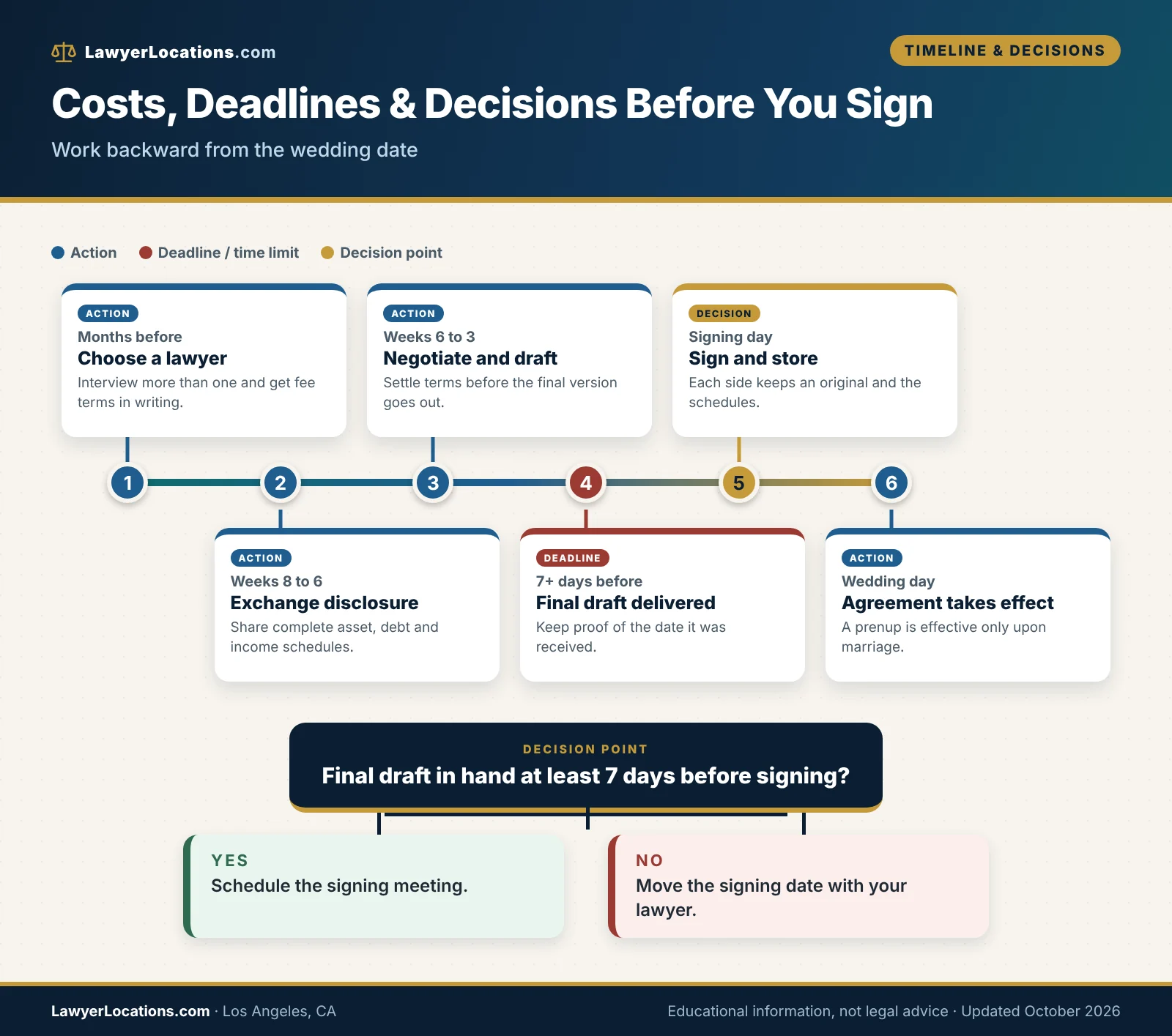
Text version of this graphic
- Months before the wedding: choose a lawyer. Interview more than one and ask for fee terms in writing.
- Weeks 8 to 6 before: exchange disclosure. Share asset, debt and income schedules.
- Weeks 6 to 3 before: negotiate and draft. Trade drafts until the terms settle.
- At least 7 calendar days before signing: final version delivered. Keep proof of the delivery date.
- Signing meeting. Both parties sign; each keeps an original and the schedules.
- Wedding. The agreement takes effect upon marriage.
Decision point: Is the final version in everyone’s hands at least 7 calendar days before signing? If yes, schedule the signing. If no, move the signing date and, if needed, talk with your lawyer about the wedding timeline.
| Structure | How it works | Best suited to | Ask about |
|---|---|---|---|
| Flat fee | One price for a defined scope of work | Straightforward assets, clear priorities, limited negotiation | How many drafts and meetings are included; what counts as extra |
| Hourly billing | Time is billed at an hourly rate for each lawyer and staff member | Uncertain scope or ongoing negotiation | Billing increments, who bills, monthly statements, estimate of total |
| Retainer | Upfront deposit applied against hourly charges | Matters where work will continue for weeks | Refund of unused funds, replenishment terms, trust account handling |
| Limited-scope review | Lawyer reviews or advises on part of the work while you handle the rest | Couples who have already negotiated terms and need an independent review | Exactly what the lawyer will and will not do, and in writing |
| Stage | Task | Why it matters |
|---|---|---|
| Start | Interview lawyers; confirm each person will have independent counsel | Supports voluntariness and the support-waiver rule |
| Early | Gather and exchange financial disclosure | Reduces risk of a later disclosure challenge |
| Middle | Negotiate, redraft, resolve open issues | Avoids last-minute changes that could restart the review period |
| Final version | Deliver the final agreement and record the date | Starts the 7-calendar-day period for agreements signed on or after Jan. 1, 2020 |
| Signing | Sign, exchange originals, store schedules | A signed writing is required; schedules prove what was disclosed |
| After | Calendar a review after major life events | Changes after marriage must be in a signed writing (§ 1614) |
Common Mistakes, Special Situations and Next Steps
Most prenup problems are process problems: too little time, too little disclosure, one lawyer for two people, or a casual change that was never written down. This section collects the mistakes to avoid, a few situations that deserve special attention, and the next steps to take this week.
Mistakes that weaken a prenup
These are practical errors that lawyers see repeatedly. None of them is a legal conclusion about your situation; they are patterns to check against.
Timing and pressure mistakes
The most common mistake is leaving the prenup until the last two weeks before the wedding. That risks missing the seven-calendar-day period, rushing disclosure and creating the impression of pressure, which is the heart of a voluntariness challenge. Another is delivering a “final” draft and then sending a handful of substantive changes the day before signing.
- Signing within days of receiving the final version
- Making substantive edits shortly before signing without re-starting the review time
- Telling the other person the wedding will be canceled unless they sign immediately
- Treating verbal side promises as part of the deal
Documentation and representation mistakes
Using a downloaded template with no review, skipping disclosure because “we already know each other’s finances,” or having one lawyer work for both people all weaken the record. The same goes for a prenup that refers to schedules that were never attached. Another quiet problem is failing to update the agreement after major changes, such as a new business, an inheritance or a move, without a signed written amendment as § 1614 requires.
Special situations to raise with your lawyer
Some couples face issues that go beyond a standard agreement. Raise them early, since they often affect both the drafting and the estate-planning side.
Second marriages, children and estate plans
If either person has children from an earlier relationship, the prenup, wills, trusts and beneficiary forms need to work together. A waiver of rights in a spouse’s estate has its own formal requirements under the Probate Code, and a prenup alone may not change beneficiary designations on retirement accounts or life insurance. Ask your family lawyer and an estate-planning lawyer how to coordinate, and read about living trusts if you want a primer.
Business owners and complex compensation
Owners of closely held businesses, people with stock options, and those with royalties or deferred compensation often need valuation help, careful definitions of “separate” and “marital” growth, and rules about the spouse’s role in the business. Those clauses are specific, so ask whether the lawyer coordinates with a business valuator or tax adviser, and who pays for that expert.
Next steps and short answers
You do not have to resolve everything at once. The sequence below turns the guide into a week-by-week plan, followed by short answers to questions that readers often ask.
Your next steps in order
- Talk to your partner. Agree on goals and who will hire which lawyer, and set a rough timeline from the wedding date.
- Check licenses. Use the State Bar’s Attorney Search for every lawyer on your list.
- Book two or three consultations. Use a referral service or personal referral, and ask the same questions each time.
- Get a written fee agreement. Read it before you sign; confirm scope, billing and what happens if the wedding is postponed.
- Gather disclosure documents. Start with the checklist above.
- Protect the review period. Aim to deliver the final version well before the 7-calendar-day minimum, and keep proof of the date.
Ready to compare your options?
Use the questions and the comparison sheet in this guide for every consultation, and verify each lawyer’s license on the State Bar’s Attorney Search. If your situation also involves divorce planning or children, read our California family law attorney guide and the overview of legal separation versus divorce before you decide what to put in writing.
Short answers to common questions
The answers below summarize California law as of October 2026 and are general information, not advice for your case.
Do I need a prenup lawyer in Los Angeles, or can we use a template?
California does not require a lawyer to create a premarital agreement, only a signed writing. But the voluntariness rules reward independent counsel, and a spousal support waiver is not enforceable against someone who had no independent lawyer when signing (Fam. Code § 1612(c)). A template with no review leaves those gaps open.
How much notice does the other person need before signing?
For agreements signed on or after January 1, 2020, at least seven calendar days between when the person first receives the final agreement and when they sign, whether or not they have a lawyer (Fam. Code § 1615(c)).
Can a prenup say who gets custody or waive child support?
No. A child’s right to support cannot be adversely affected by a premarital agreement (Fam. Code § 1612(b)), and courts decide parenting questions based on the family’s actual circumstances, not a pre-wedding contract.
Can a prenup waive spousal support?
It can, but the clause is only enforceable if the person it is enforced against had independent counsel at signing and the provision is not unconscionable at the time of enforcement (Fam. Code § 1612(c)). The California Supreme Court held in 2000 that such waivers are not automatically void.
Do we have to file the prenup with the Los Angeles court?
The statute requires a signed writing, not a court filing. Most prenups stay private until a divorce, legal separation or other dispute puts them in front of the Superior Court’s family law judge.
What if one of us did not fully disclose assets?
Incomplete disclosure can matter. An agreement may be refused enforcement if it was unconscionable when signed and the challenging party was not given fair, reasonable and full disclosure, did not waive it in writing and could not reasonably have known the other’s finances (Fam. Code § 1615(a)(2)).
Can we change the prenup after we are married?
Yes, but only by a written agreement signed by both spouses (Fam. Code § 1614). Informal understandings do not count.
How do I find a prenup lawyer near me in Los Angeles?
Start with State Bar-certified referral services such as the Los Angeles County Bar Association’s SmartLaw service, or ask people you trust. Then verify each lawyer’s license and discipline record on the State Bar’s Attorney Search and compare answers to the same questions.
What does a prenup lawyer cost in Los Angeles?
It varies by complexity, the number of drafts, and whether you pay a flat fee, an hourly rate or a retainer. Ask for a written estimate; California generally requires a written fee contract when expected expenses exceed $1,000 (Bus. & Prof. Code § 6148).
Does a prenup control what happens when someone dies?
It can address death-related property rights (Fam. Code § 1612(a)(3)–(5)), but waivers of a surviving spouse’s rights have formal requirements under Probate Code §§ 142–144, and beneficiary designations on accounts may need separate updates. Coordinate with an estate-planning lawyer.
Is legal aid available for a prenup?
Possibly limited. Los Angeles legal aid organizations focus on income-eligible clients, and LAFLA’s family law page highlights domestic violence cases rather than premarital agreements. Court self-help centers can help with procedure but do not draft negotiated agreements. Check eligibility directly.
General information only. This guide is general legal education, not legal advice, and reading it does not create an attorney-client relationship. LawyerLocations.com is not a law firm and does not recommend or rank individual lawyers. Laws, court rules, fees and local procedures change; confirm current requirements with the court or a lawyer licensed in California before acting.
Sources & References
Show all 16 sources
- California Family Code §§ 1610–1617 (Uniform Premarital Agreement Act), text as reproduced — Justia — law.justia.com — accessed October 2026
- California Family Code § 1615 (current text and 2020 seven-day rule) — California Public.Law (mirror of the Legislature’s code) — california.public.law — accessed October 2026
- California Family Code § 1612 (spousal support, child support) — California Public.Law — california.public.law — accessed October 2026
- California Family Code § 770 (separate property) — California Public.Law — california.public.law — accessed October 2026
- California Family Code § 760 (community property) — Thurman Arnold Law family law statutes page — thurmanarnold.com — accessed October 2026
- California Probate Code § 142 (surviving spouse’s waiver) — California Public.Law — california.public.law — accessed October 2026
- California Business and Professions Code § 6148 (written fee contracts) — California Public.Law — california.public.law — accessed October 2026
- In re Marriage of Pendleton & Fireman (2000) 24 Cal.4th 39 — Supreme Court of California opinion archive — scocal.stanford.edu — accessed October 2026
- Find and Work with a Lawyer — California Courts Self-Help Guide, Judicial Council of California — selfhelp.courts.ca.gov — accessed October 2026
- Getting Legal Help and self-help center locator — California Courts Self-Help Guide — selfhelp.courts.ca.gov — accessed October 2026
- Family Law Departments Directory (Central district; revised April 2022) — Superior Court of California, County of Los Angeles — lacourt.org — accessed October 2026
- Find a Los Angeles Area Lawyer Referral Service — State Bar of California — calbar.ca.gov — accessed October 2026
- LACBA SmartLaw Lawyer Referral Service — Los Angeles County Bar Association — lacba.org — accessed October 2026
- Legal Specialty Areas — State Bar of California, Board of Legal Specialization — calbar.ca.gov — accessed October 2026
- Domestic Violence / Family Law — Legal Aid Foundation of Los Angeles — lafla.org — accessed October 2026
- Self-Help Centers — Neighborhood Legal Services of Los Angeles County — nlsla.org — accessed October 2026
Legal Disclaimer and Limitation of Liability
Informational and illustrative purposes only. This article was prepared by LawyerLocations.com solely on the basis of the information available to us at the time of writing. It is an illustrative, general overview. It is not a complete or authoritative statement of the law, and it has not been reviewed by a lawyer licensed in your state or county.
Not legal advice. Nothing in this article is legal, financial, tax or immigration advice, and reading it does not create an attorney-client relationship between you and LawyerLocations.com or any author, lawyer or firm mentioned. Laws, court rules, fees, filing deadlines and agency procedures differ by state, county and court, and they change often. Some details here may be simplified, incomplete or out of date, and time limits for legal claims can be short.
No warranty. We make no representation or warranty, express or implied, about the accuracy, completeness, timeliness or suitability of this content for your situation. Please do not rely on it to make, delay or skip any legal decision. Check the facts against official sources and speak with a licensed attorney in the relevant jurisdiction before you act.
Limitation of liability. To the fullest extent permitted by law, LawyerLocations.com and its owners, authors and contributors disclaim all liability for any loss, damage, cost or other consequence arising from the use of, or reliance on, this article, including any content on third-party websites we link to. Mentioning a lawyer, firm, organization or service is not an endorsement and is not a promise of any result. If you are in immediate danger, contact your local emergency number.