
People who type “child support lawyer louisville ky” into a search bar are usually dealing with one of four problems: setting a first support order, changing an order that no longer fits, collecting support that is not being paid, or defending against a motion. In Louisville, those cases are heard by Jefferson Family Court under Kentucky’s income-shares guidelines, KRS 403.210–403.213 and the shared parenting time credit in KRS 403.2122. A lawyer is optional, because a state-run child support agency also handles many cases, but that agency does not represent either parent.
This guide explains how the Kentucky formula works, where the Jefferson County Attorney’s Child Support Division and the Attorney General’s child support department fit in, when a court can depart from the guidelines or modify an order, what enforcement looks like, and how to compare lawyers and low-cost options in Louisville. It is general information as of October 2026, not advice about your case.
How child support works in Louisville and Jefferson County
Child support cases in Louisville start in one of two places: Jefferson Family Court or a state child support agency office. Both apply the same Kentucky guidelines. What differs is who does the work, who speaks for you, and how much control you keep over the strategy.
The two doors into the system
Kentucky law lets a parent, a custodian or an agency that is substantially contributing to a child’s support bring a support action, and the action may be filed in the county where the child lives or where the other parent lives (KRS 403.211). For most Louisville families that means Jefferson County. From there you can go through the court on your own or with a private lawyer, through the agency, or sometimes both in sequence.
Jefferson Family Court
Family Court is a division of Circuit Court built around a “One Family, One Judge, One Court” model, so one judge hears the related matters for a family. Jefferson County’s Family Court began as a pilot in 1991 and has ten divisions, and the Kentucky Court of Justice lists its jurisdiction under KRS 23A.100 and 23A.110 as including divorce, custody, parenting time, child support, paternity, domestic violence and related family matters.
The Family Court clerks are in the Judicial Center, first floor, Room 105, and the Jefferson Circuit Court Clerk’s main office is in the Louis D. Brandeis Hall of Justice, 600 West Jefferson Street, Suite 2008. The clerk’s Family Court page lists weekday hours of 8:30 a.m. to 4:30 p.m. and (502) 595-3025. Confirm hours with the clerk before you travel with paperwork.
The Jefferson County Attorney’s Child Support Division and the Attorney General’s department
The Jefferson County Attorney’s Child Support Division is a government office at 1930 Bishop Lane, Suite 100, with a main number of 502-574-8300. Its page says it locates parents, helps establish paternity, establishes financial and medical support, enforces and collects payments, and reviews and modifies orders, and that it charges no fee for those services. It describes this work as being done “through the Office of Attorney General.”
That wording reflects a recent change. Under 2025 Ky. Acts ch. 59 (Senate Bill 244), Kentucky’s Title IV-D child support program moved from the Cabinet for Health and Family Services to a new Department of Child Support Services in the Attorney General’s office, effective July 1, 2025. Older web pages and forms may still say “Cabinet for Health and Family Services,” so treat them as out of date.
The Attorney General’s child support page states that the department does not represent the child or either parent, and that either parent may hire a private attorney. Applying to the agency is not the same as hiring a lawyer for your side of the case.
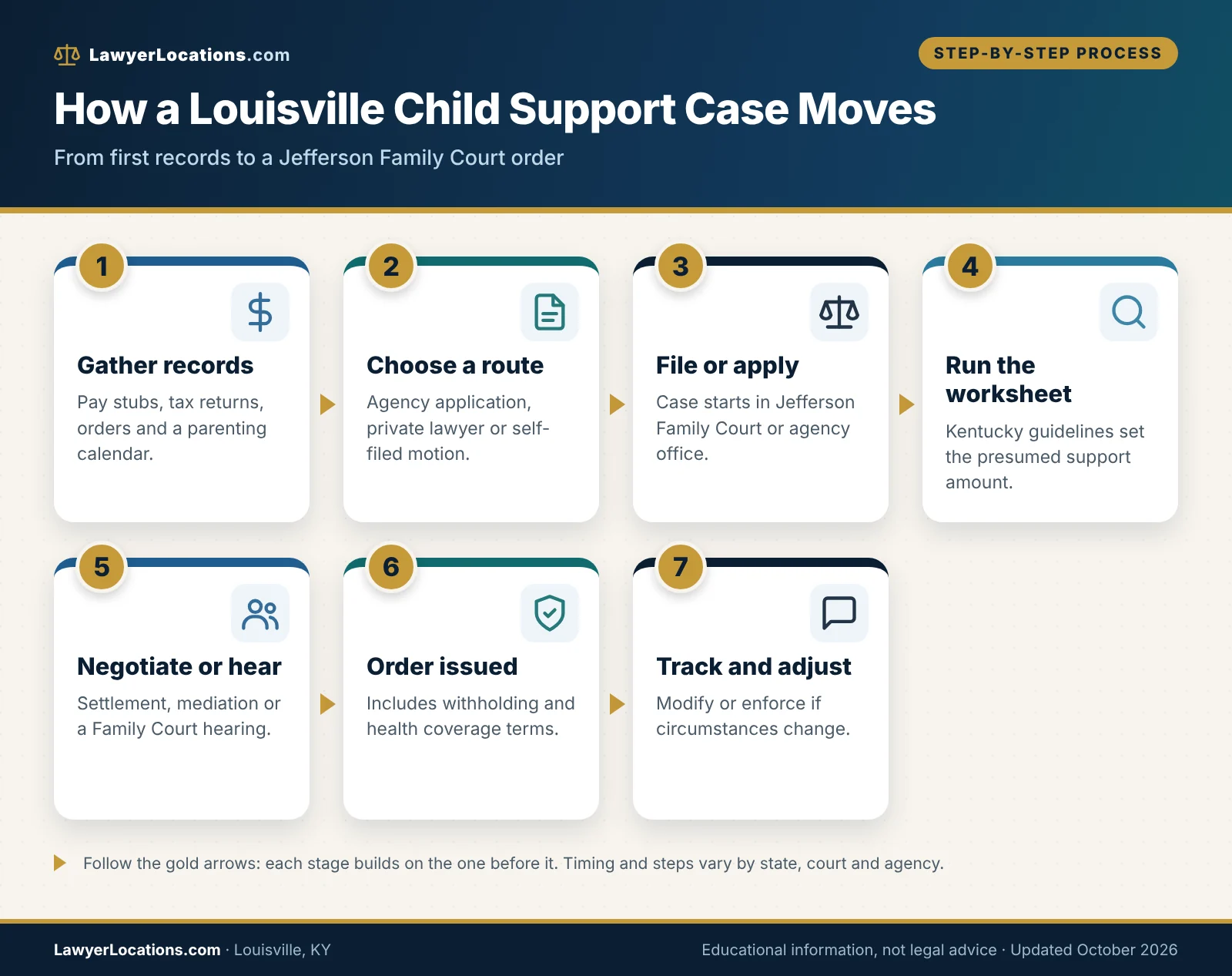
Text version of this graphic
- Gather income records, existing orders and parenting-time facts.
- Choose a route: agency application, private lawyer, or self-filed motion.
- File in Jefferson Family Court (or have the agency file and serve).
- Exchange income information and run the guidelines worksheet.
- Negotiate, mediate or go to a hearing before the Family Court judge.
- Receive an order with wage withholding and health-coverage terms.
- Track payments; return to court to modify or enforce if circumstances change.
Which route fits which problem
No route is right for everyone. The agency is built for volume and routine tasks like locating a parent, setting a guideline amount and collecting through withholding. A private lawyer is built for your specific facts, disputes and strategy. The table below sets out the differences as they appear in official descriptions.
| Question | Child support agency route | Private lawyer route |
|---|---|---|
| Who does it represent? | The Attorney General’s department states it does not represent the child or either parent. | The lawyer represents you under a written fee agreement and owes you duties of loyalty and confidentiality. |
| Cost to apply | The Jefferson County Attorney’s page states no fee for its services; fees apply to some payment methods. | Hourly, flat or other fee structures; see the fees section below. |
| Typical tasks | Locating a parent, paternity, establishing support, withholding, enforcement tools, review and modification on request. | Custody and parenting-time strategy, negotiating, deviation arguments, contempt motions, appeals, settlement drafting. |
When the agency route can be enough
If the other parent has steady wage income, the facts are not contested and you mainly need a guideline order and payroll withholding, the agency route may meet your needs. K-TAP recipients are referred to child support services automatically, according to the Attorney General’s page, and everyone else can apply online or with the paper application. Gather the other parent’s address, employer and identifying information, because the county’s own FAQ says locating a parent can take months when information is thin.
When a private lawyer is worth comparing
A private lawyer is worth comparing when something is contested or complicated. Common triggers include self-employment income, a dispute about how many days each parent has the children, a request for a deviation from the guidelines, a possible contempt motion, or a support question tangled up with custody or a protective order. Lawyers also help when the stakes are asymmetric, for example when one side faces a large arrearage or a license suspension.
Kentucky’s income-shares guidelines: how the number is built
Kentucky uses an income-shares model: the court adds both parents’ adjusted gross incomes, finds the guideline support for that combined figure in a statutory table, and divides it between the parents by income. The table and definitions are in KRS 403.212, and the shared-time credit is in KRS 403.2122. The guideline amount is a rebuttable presumption in every initial order and modification.
The basic formula
The legislature’s own statute page for KRS 403.212 carries an effective date of July 1, 2025 and a history note citing 2024 Ky. Acts ch. 219, which also created the shared parenting time credit and updated the agency references. Check the current statute and worksheet before relying on any figure in an article, including this one.
Gross income and imputed income
The statute defines “income” as the parent’s actual gross income if employed to full capacity, or potential income if unemployed or underemployed. Gross income includes income from any source except as the statute excludes it. For self-employed parents it is generally gross receipts minus ordinary and necessary business expenses.
If a court finds a parent is voluntarily unemployed or underemployed, support can be calculated on potential income. The statute lists exceptions, including a parent who is incarcerated, incapacitated, or caring for a child age three or younger for whom the parents share joint legal responsibility. Factors include job skills, education, health and the local labor market.
The guidelines table and the worksheet
Combined monthly adjusted parental gross income is both parents’ monthly gross income, less certain payments such as maintenance for a prior spouse and support for prior-born children. The table in KRS 403.212 runs from $0 to $30,000 of combined monthly income and covers one to six or more children. The minimum order is $60 a month, and above the top of the table a court may use its judicial discretion.
The statute directs the Attorney General’s office to promulgate the child support worksheet and post a manual with examples on its website.
| Combined monthly adjusted income | One child | Two children | Three children |
|---|---|---|---|
| $2,000 | $322 | $472 | $570 |
| $3,000 | $472 | $692 | $837 |
| $4,000 | $621 | $912 | $1,102 |
| $5,000 | $751 | $1,103 | $1,332 |
| $6,000 | $831 | $1,200 | $1,439 |
| $8,000 | $996 | $1,426 | $1,704 |
| $10,000 | $1,099 | $1,533 | $1,844 |
| $15,000 | $1,430 | $1,966 | $2,364 |
These rows are the combined obligation for both parents, before it is divided by income share and before any shared-time credit, child care or health-insurance adjustments. The figure on the table is not what one parent will necessarily pay. Treat it as a reference point, not a prediction.
The shared parenting time credit
KRS 403.2122, created by 2024 Ky. Acts ch. 219 and effective July 15, 2024, gives a defined credit against the guideline obligation when a parent has the child at least 88 days a year. It is available only on motion by the parent seeking it, so a parent who never asks may not get it.
The 88-day threshold and the percentage chart
The statute counts a “day” as more than twelve consecutive hours in a 24-hour period under one parent’s care, so the count is not simply overnights. Only court-ordered parenting time, or time the parents actually exercise by agreement, counts. Parenting time starts at the exchange, and when the exchange happens at school or with a caregiver, the receiving parent’s time begins at pickup unless the court orders otherwise.
| Obligor’s parenting days per year | Adjustment percentage |
|---|---|
| 88–115 | 15% |
| 116–129 | 20.5% |
| 130–142 | 25% |
| 143–152 | 30.5% |
| 153–162 | 36% |
| 163–172 | 42% |
| 173–181 | 48.5% |
| 182–182.5 | 50% |
The statute adds discretionary factors, including the obligor’s ability to provide for the child, whether either parent consistently uses the schedule, whether all children follow the same schedule, geographic distance, military deployment, and who provides health insurance or medical care. If the parent receiving support gets KCHIP, K-TAP, SNAP or Medicaid benefits for the child, the court has discretion over whether to award the credit.
A worked example, and how it interacts with the self-support reserve
The example below follows the statute’s steps and is illustrative only.
Two parents have combined adjusted income of $6,000 a month and one child. The table figure is $831. If Parent A earns $4,000 of the $6,000, A’s income share is about two-thirds, or roughly $554, before any credit. If A has 130–142 parenting days, the 25% credit is about $208 (25% of $831), leaving roughly $346. Child care, health insurance and uninsured medical costs would be allocated separately, so a real worksheet will differ.
The self-support reserve is a separate floor-protecting mechanism. Under KRS 403.212, the reserve is $915 a month, and parents whose adjusted income is at or below the listed amounts ($1,100 for one child, $1,300 for two, $1,400 for three, $1,500 for four or five, $1,600 for six or more) use a special calculation. The reserve and the shared-time credit cannot be stacked: the obligor pays the lesser of the amounts the statute produces. Ask any lawyer you consult how they would run both calculations and compare.
Add-ons: child care, health coverage and medical costs
The guideline number is only part of the monthly picture. KRS 403.211 requires the court to address child care and health care in addition to the table amount, and it sets specific thresholds for each.
Child care costs
Reasonable and necessary child-care costs a parent incurs because of employment, job search or education leading to employment are allocated between the parents in proportion to their combined adjusted income, in addition to the guideline amount. Keep receipts, since the worksheet depends on actual numbers.
Health coverage, the $250 rule and extraordinary medical expenses
The court must order health coverage if it is reasonable in cost and accessible. The statute treats coverage as reasonable when it does not exceed 5% of the parent’s gross income, and as accessible when providers are within 60 minutes or 60 miles of the child’s primary residence, though the parties can agree otherwise or the court can find good cause. If coverage fails the test, the order should include cash medical support.
The parent who maintains the insurance covers the first $250 of the children’s uninsured medical expenses each calendar year, unless the parents agree differently. Uninsured costs above that, such as dental, orthodontic, optometric, hospital, counseling and prescriptions, are generally split in proportion to income. Coverage under a parent’s plan can extend to an unmarried, full-time student up to age 25 who depends on that parent, if the plan covers dependents beyond the age of majority.
Deviations, modification and starting from scratch
A Jefferson Family Court judge can depart from the guideline amount only on specific findings, and can change an existing order only after a substantial, continuing change in circumstances. A change of 15% or more in the monthly guideline result is presumed to meet that test. Both rules are presumptions, so the evidence you bring decides most outcomes.
When a judge can depart from the guidelines
KRS 403.211 makes the guideline figure a rebuttable presumption for every initial order, temporary or permanent, and every modification. A court may adjust the amount if applying the guidelines “would be unjust or inappropriate,” and it must say why, in writing or on the record.
The listed deviation grounds
If the court’s finding rests on one or more listed criteria, the presumption is rebutted and the court may adjust the award. The word “extraordinary” is left to the court’s discretion, which is one reason deviation requests are fact-heavy, so expect to bring documents such as bills, evaluations and account statements.
| Statutory ground | What it covers |
|---|---|
| Child’s extraordinary medical or dental needs | Costs beyond ordinary care |
| Child’s extraordinary educational, job-training or special needs | Specialized schooling or services |
| A parent’s extraordinary needs | For example a parent’s significant medical expenses |
| The child’s independent financial resources | Income or assets belonging to the child |
| Combined income above the table | Income over the guideline schedule |
| Parents knowingly agree to a different amount | An informed agreement; not usable where public assistance is paid for the child under Title IV-D |
| Failure to consistently use the timesharing schedule | Added to the statute in 2024 |
| Similar extraordinary factor the court identifies | A catch-all requiring a specific finding |
Written findings and agreements between parents
Any deviation must come with a written finding, or a specific finding on the record, stating the reason. This requirement is practical protection: if a judge departs from the guidelines without explaining, that gap is something a lawyer can raise.
If you are negotiating a number different from the table, ask the lawyer or agency to run the worksheet first, so you see the difference you are agreeing to.
Changing an existing order
KRS 403.213 sets the standard for modification, and the history note on the legislature’s site shows its last amendment was in 2005. Support may be modified only on a showing of a material change in circumstances that is substantial and continuing.
The 15% presumption
If applying the guidelines to your current circumstances produces a change of 15% or more in the amount of support due per month, that change is rebuttably presumed to be a material change in circumstances. A change under 15% is rebuttably presumed not to be material. Typical triggers include a job loss, a raise, higher child care or insurance costs, or a lasting change in the parenting schedule.
Because the presumption turns on what the guidelines would produce today, the first practical step is to run a worksheet with current numbers. If the result is within a few percent of the old figure, a filing may cost more than it gains. If it is far over 15%, a motion is likely worth discussing with a lawyer or the agency.
The filing date controls how far back relief goes
The statute allows modification only as to installments accruing after the motion for modification is filed.
Support that came due before you filed a motion to modify generally cannot be changed afterward. If your income dropped or the parenting schedule changed, file or ask for a review promptly rather than waiting months for the situation to “settle.” Waiting does not stop old installments from becoming fixed.
When support ends, and what survives
Support ends at emancipation unless the parties agreed otherwise in writing or the decree provides otherwise. For a child who reaches 18 while still in high school, support can continue while the child is a high school student, but not beyond the end of the school year in which the child turns 19. A parent’s death does not end the obligation; the amount may be modified, revoked or converted to a lump sum as the court finds just.
Arrears that built up while the child was an unemancipated minor survive emancipation.
Starting from scratch: paternity and first orders
Many Louisville families begin without any order. If the parents were married, the divorce decree usually sets support. If they were not, the first step may be legally establishing who the father is.
Paternity and acknowledgment
The Jefferson County Attorney’s Child Support Division lists establishing paternity among its services and says either parent can request it. The Attorney General’s child support page lists a paternity acknowledgment program and a number for it, (502) 564-2285, alongside the department’s other hotlines.
If there is any doubt about parentage, ask a lawyer before signing anything. The county’s FAQ notes that paternity carries rights for the child, such as insurance, Social Security and inheritance benefits.
Default orders, income evidence and what the first order must include
If a parent defaults or income cannot be determined, KRS 403.211 lets the court set support based on the child’s needs or previous standard of living, whichever is greater. If proof of income surfaces within two years, the order may be raised, with arrears from the original order date.
New orders must include wage assignment, which begins immediately unless good cause is shown, and must carry the parties’ Social Security numbers under KRS 403.135. In Family Court, the Supreme Court’s FCRPP 9, as adopted in 2017, says a motion to establish or modify support must come with a completed guidelines worksheet, three recent pay stubs or proof of self-employment income, the latest federal and state tax returns, and the child’s health-insurance cost. The Court has also circulated a proposed replacement set of family court rules with a 2027 effective date left blank, so confirm which version applies when you file.
Build your income file before you call anyone: three recent pay stubs, last year’s tax returns, proof of health-insurance cost for the child alone, and child-care receipts. The same pile satisfies an agency intake, a lawyer’s first review and the FCRPP 9 documents.
A 2026 bill, House Bill 707, would amend KRS 403.211 and 403.213. The legislature’s record page, last updated in August 2026, shows it was introduced in February 2026 and referred to House Judiciary in March, with no later action. Nothing in it changes the rules above unless it becomes law.
How to compare child support lawyers in Louisville
Compare lawyers on four things you can check or ask about: an active Kentucky license, experience with the kind of support problem you have, a clear written fee agreement, and how the office will communicate. This site does not rank or recommend individual lawyers, and nothing in a directory listing replaces your own due diligence.
Verify the person before you compare
Two Louisville-area resources help with the basics: the state bar’s lawyer roster and the Louisville Bar Association’s referral program. Neither is a ranking system.
The Kentucky Bar Association roster
The Kentucky Bar Association keeps an online roster of lawyers licensed in the state. A 2018 news report described it as showing each lawyer’s year of admission and linking to disciplinary orders, but features can change, so look at the current site at kybar.org and confirm what it shows today. Check that the name, firm and license status match what the lawyer’s website says.
A clean record does not prove quality, and a complaint does not prove misconduct. Read any disciplinary order for what it says.
The Louisville Bar Association’s Kentucky Lawyer Referral Service
The Louisville Bar Association runs the Kentucky Lawyer Referral Service, reachable at (502) 583-1801 on weekdays from 8:30 a.m. to 4:30 p.m. or through an online form on its “Need a Lawyer?” page. Staff ask questions to match you with a suitable attorney, then give you that attorney’s contact information. The page says the attorney will not contact you first, so you need to make the call.
The page describes the initial consultation as free for up to 30 minutes, with fees after that agreed between you and the attorney, and says reduced-fee attorneys are available to people who qualify under federal poverty guidelines. It also says the service does not provide pro bono attorneys. Terms like these change, so ask what applies when you call.
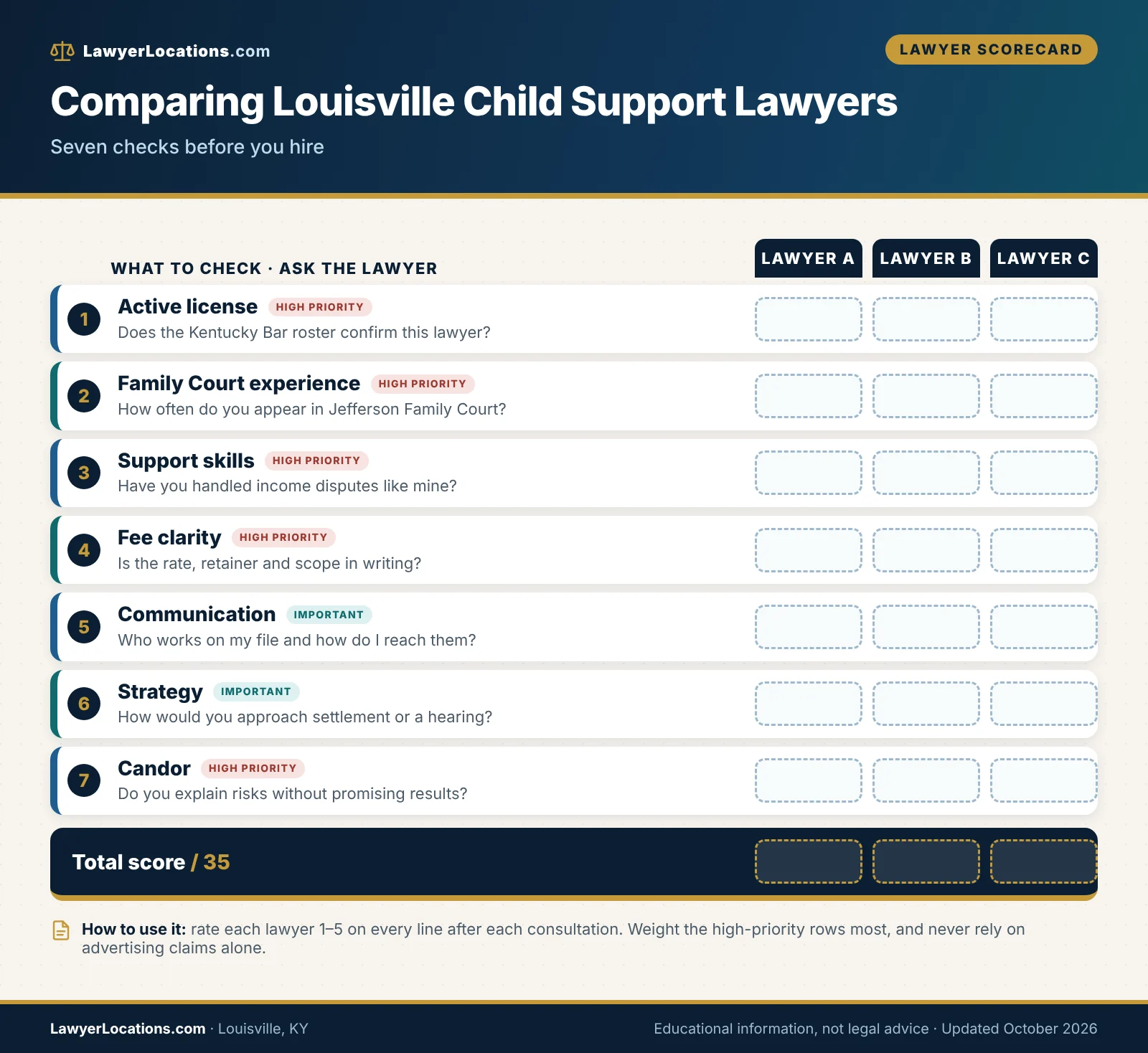
Text version of this graphic
- Active Kentucky license: confirm on the Kentucky Bar Association roster.
- Family Court experience: ask how often they appear in Jefferson Family Court.
- Support-specific skills: income disputes, imputation, shared parenting credit.
- Fee clarity: written hourly rate, retainer, flat fee or limited scope.
- Communication: who handles the file and how questions are answered.
- Strategy: settlement, mediation and hearing approach explained plainly.
- Candor: no promises about results.
Questions that separate a good fit from a poor one
A first meeting is a two-way interview. Your goal is to learn how the lawyer works, what the plan might look like and what it might cost, without expecting a prediction of the result.
Experience with your type of support problem
Child support is a category, not a single skill. Ask whether the lawyer regularly handles contested incomes, self-employment, imputed income, shared-time credit calculations, contempt motions and arrearage cases, and how much of their practice is in Jefferson Family Court. A lawyer who mostly handles other kinds of cases may still be a fine fit, but you should know that going in.
Do not expect a promise about how a particular judge will rule, and treat a confident prediction as a reason for caution.
Communication, staffing and strategy
Ask who will actually work on your file, whether a paralegal handles routine tasks, how questions are answered and how often you will receive updates.
| Criterion | What to ask or check | Reason to pause |
|---|---|---|
| License | Kentucky Bar Association roster | Cannot be found or details do not match |
| Local court experience | How often do you appear in Jefferson Family Court? | Vague claims or name-dropping judges |
| Case fit | Have you handled income disputes or shared-time credits like mine? | Treats every case the same |
| Fees | Hourly or flat? What is the retainer? What is excluded? | Verbal only, or shifting numbers |
| Communication | Who works on my file? How do I reach you? | No clear contact point |
| Candor | What are the risks? | Promises a result |
A short first meeting is for fit and a rough plan, not full advice. Our guide to what a first consultation can and cannot do covers how to use that time.
Red flags when hiring
Most lawyers in family court are careful professionals. A few warning signs, though, are worth knowing before you hand over a retainer.
Promises and pressure
Be wary of anyone who promises a particular amount, an assured reduction or a quick fix. Child support turns on documents and a judge’s findings, so no honest lawyer can control the result. Pressure to sign the same day is also a reason to slow down.
Fee and trust problems
- No written fee agreement, or one that does not explain what is covered.
- A request to hold large sums in cash or to pay outside the firm’s normal billing.
- Advice to stop paying support, hide income or ignore court papers.
If something feels wrong, you can consult a different lawyer for a second look before you sign. A concern about a lawyer’s conduct can also be raised with the Kentucky Bar Association.
Enforcement: contempt, collection tools and criminal nonsupport
When support goes unpaid, Kentucky offers three layers: administrative tools run through the child support agency, contempt and judgment remedies in Family Court, and, in serious cases, criminal nonsupport charges. The right layer depends on the amount owed, the other parent’s situation and whether you want to work through the agency or hire a lawyer.
Administrative collection tools
The Department of Child Support Services administers Title IV-D duties under KRS 15.802, which took effect July 1, 2025 for the transferred program. Jefferson County cases are handled through the county’s own Child Support Division, which describes enforcement and collection among its services.
Income withholding
KRS 403.215 requires new or modified orders to include a wage assignment that starts immediately unless the court finds good cause. If good cause is shown, withholding begins once an arrearage equal to one month’s support accrues. Employers receive the federal Income Withholding for Support form, and payments flow through the state disbursement unit.
Withholding works less well for self-employed parents or people who change jobs often, where other tools matter more.
Licenses, passports and subpoenas
KRS 15.802 lists further tools. The table below summarizes them, with the thresholds the statute states.
| Tool | Legal source | Threshold or condition stated |
|---|---|---|
| License denial, suspension or revocation | KRS 15.802 | Arrears equal to or exceeding the amount owed after six months of nonpayment, or failing to comply with a paternity or support subpoena or warrant |
| Passport denial or revocation | KRS 15.802 | Arrears of at least $2,500, after notice to the obligor |
| Administrative subpoenas | KRS 15.802 | Records from financial institutions, utilities and other entities; penalties for noncompliance |
| Financial institution data match | KRS 15.802 | Run by the department against accounts |
| Tort settlement match | KRS 15.802 | Settlements owed to people with arrears are matched against the child support database |
| Contempt in Family Court | KRS 403.240 | Failure to comply with a decree or temporary order without good cause |
License and passport actions can be contested. The statute says disputes follow KRS 405.450, and the only basis for a hearing is a mistake of fact. In other words, an inability-to-pay argument is usually not the topic of that hearing, which is one reason to address a payment problem by motion before it escalates.
A notice about a license or passport is time-sensitive. Read it the day it arrives, because the hearing right is narrow and limited to mistakes of fact.
Court enforcement
Court remedies are available whether or not an agency is involved. In Jefferson County, a motion goes to the Family Court division handling the case.
Contempt under KRS 403.240
KRS 403.240 provides that a failure to comply with a decree or temporary order without good cause, including child support provisions, constitutes contempt, and the court shall remedy it. It also states that one party’s violation does not suspend the other party’s duty to pay support or allow visitation. That sentence matters for anyone tempted to withhold payments over a parenting-time dispute, or the reverse.
Because the statute turns on a failure to comply “without good cause,” a documented change in circumstances matters. If your income fell, the safer course is to file a motion to modify immediately and keep records of your efforts, instead of simply paying less.
Arrears, interest and time limits
Under KRS 413.090(5), an action to recover unpaid child support may be brought as one cumulative action, and the time limit is tolled until all current child support obligations end for the last child covered by the order. A general Kentucky statute on judgment interest, KRS 360.040, lists a 12% rate for judgments on unpaid child support, compounded annually, but how that applies to a particular arrearage depends on the order and how the amount was reduced to judgment.
Ask any lawyer how they would calculate your total and what time limits apply to your order.
Criminal nonsupport
Kentucky also criminalizes serious nonpayment. It is not a first resort for most families, but it explains why ignoring an order is risky.
What the statute covers
Under KRS 530.050, nonsupport includes persistently failing to provide support one can reasonably provide, or being delinquent on a court-ordered child support amount for at least two months. Flagrant nonsupport adds an arrearage of at least $2,500, six consecutive months without payment, or leaving the dependent in destitute circumstances. Nonsupport is a Class A misdemeanor, and flagrant nonsupport is a Class D felony.
How it plays out in practice
A criminal case is run by prosecutors, not by the parent owed support. If you are facing a nonsupport threat or charge, that is a criminal-defense matter; consult a lawyer licensed in Kentucky about the charge itself rather than relying on a family-law guide.
Fees, who pays them and free or low-cost help
Kentucky law does not set a standard price for a child support lawyer, so the cost depends on the fee structure, how contested the case is and how long it runs. This guide does not give price averages, because no official Kentucky source publishes them. What you can do is ask the right questions and know the free and low-cost doors that exist in Louisville.
How lawyers charge for child support work
Kentucky’s Rule of Professional Conduct 1.5 (SCR 3.130(1.5)) requires lawyers to charge reasonable fees and to communicate the basis or rate of the fee, preferably in writing, early in the representation. A written agreement is therefore both normal and in your interest.
Hourly rates and retainers
Many family lawyers charge by the hour against an advance deposit called a retainer. Ask for the hourly rates of everyone who may work on your file, how the retainer is held and applied, when you will be asked to replenish it, and how often you will get itemized bills.
Our guide to how flat fees, hourly rates and retainers compare in another practice area can help you read a fee agreement.
Flat fees and limited-scope help
Some lawyers offer a flat fee for defined tasks, such as preparing a motion to modify, running the guidelines worksheet or appearing at a single hearing. The key is the written scope: what is included, what happens if the other side files a response, and what an additional hearing would cost. Understand the gaps in coverage before you sign.
Contingent fees and why child support is different
A contingent fee means the lawyer is paid only if you recover money, as in many injury cases (see our explanation of how contingency fees work in injury cases). In family matters, Kentucky’s version of Rule 1.5 restricts fees that depend on securing a divorce or on the amount of support, with commentary distinguishing already-liquidated arrearage amounts. Ask any lawyer who proposes a percentage of back support to explain the rule they are relying on and put the terms in writing.
Who pays the lawyer: fee-shifting and other costs
You usually pay your own lawyer first. In some cases a Kentucky court can order the other parent to contribute.
Fee awards under KRS 403.220
KRS 403.220 allows a court, after considering the financial resources of both parties, to order one party to pay the other’s reasonable costs and attorney fees in a proceeding under Chapter 403. It may cover services before or after a judgment, and the court may order payment directly to the attorney. The statute is discretionary, so an award is possible but never promised. Whether it reaches a stand-alone support dispute depends on the nature of the proceeding, so ask your lawyer how the court has treated similar requests.
Court and payment costs
Besides legal fees, expect filing fees, service costs and copies. Ask the Jefferson Circuit Court Clerk’s Family Court office for the current fee schedule instead of relying on an older number. The Attorney General’s child support page notes that a fee applies to payments made online or by phone.
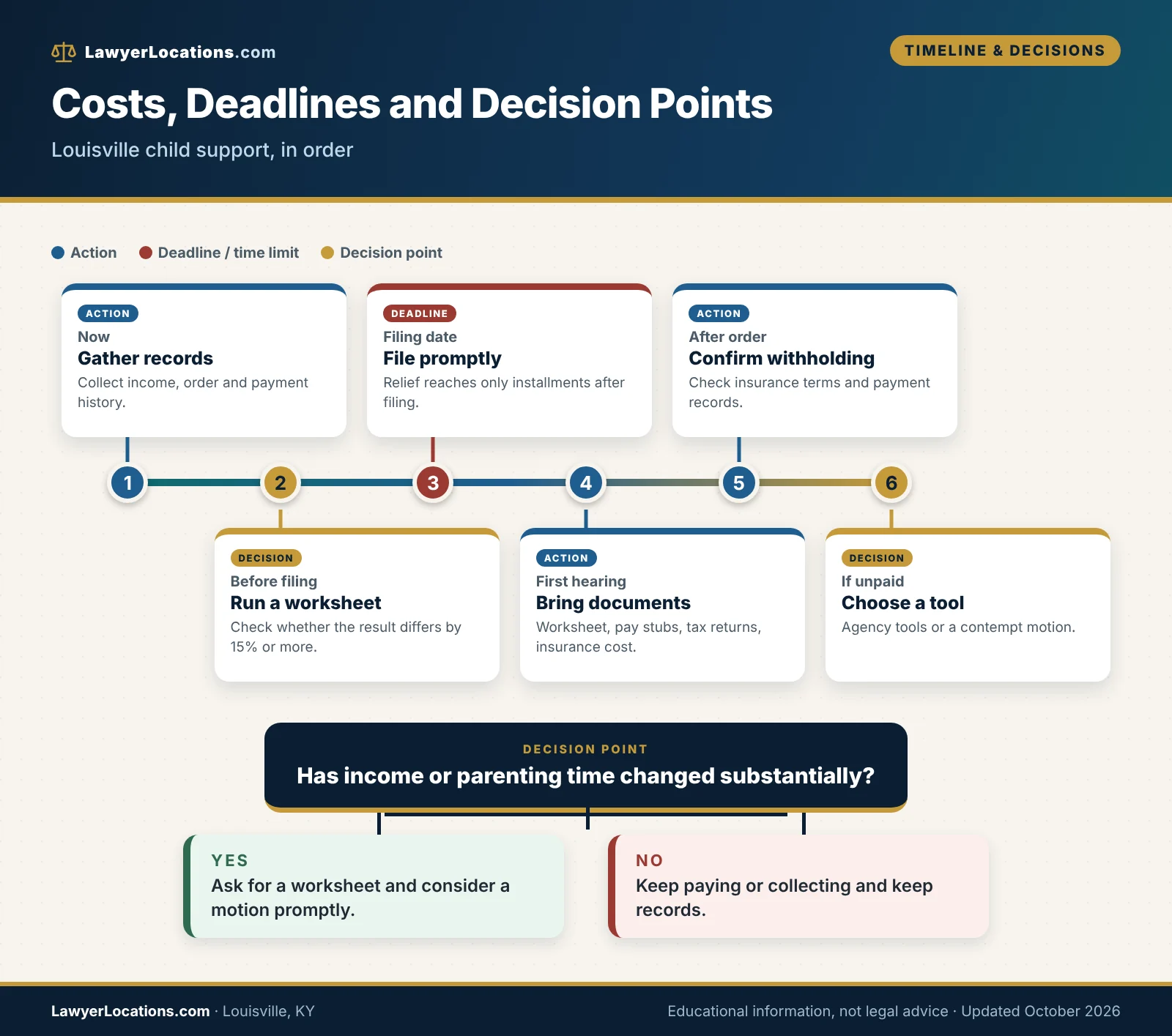
Text version of this graphic
- Now: gather income records and decide whether to use the agency, a lawyer or both.
- Before filing: run a worksheet and check whether the result is at least 15% different from your current order.
- Filing date: the date a modification motion is filed controls how far back relief can reach.
- First hearing: bring documents and be ready to discuss shared parenting days.
- After the order: confirm wage withholding, insurance terms and payment records.
- Decision point: if payments stop, choose between agency tools and a contempt motion.
Decision: Has your income or the parenting schedule changed substantially? If yes, ask for a worksheet and consider a motion promptly. If no, keep paying and keep records.
Free and low-cost help in Louisville
Not everyone needs a private lawyer, and not everyone can afford one. Several Louisville resources exist for people with limited means, each with a different job.
The Jefferson County Attorney’s Child Support Division
The county’s page states that the division charges no fee for its services and lists the 1930 Bishop Lane office, 502-574-8300, and payment windows at Bishop Lane and in the Hall of Justice at 600 West Jefferson Street. The page gives office hours of 8:00 a.m. to 5:00 p.m. but phone hours that differ, so confirm before you go.
Remember that these offices do not act as your personal lawyer.
Legal Aid Society and reduced-fee referrals
The Legal Aid Society in Louisville is a nonprofit that provides free civil legal help to eligible low-income residents across Louisville and surrounding counties. The Kentucky Court of Justice lists its address as 416 West Muhammad Ali Boulevard, Suite 300, and its phone as 502-584-1254. Whether it can take a particular support case depends on income, case type and capacity, so call to ask; the public pages do not describe each family-law service.
The Louisville Bar Association’s referral service also notes that reduced-fee attorneys are available for people who qualify under federal poverty guidelines. Both options are worth checking before you assume you cannot afford help.
Court self-help tools
The Kentucky Court of Justice runs a Self-Help Portal and posts legal forms. The Jefferson Family Court website links to remote appearance information, a pro se motion form and the court’s schedules. If you file on your own, read FCRPP 9’s document requirements carefully.
If cost is your main barrier, try this order: ask the child support division what it can do, call Legal Aid, ask the Lawyer Referral Service about reduced fees, then ask private lawyers whether a limited-scope arrangement fits. Keep notes of every call.
Preparing for a first meeting and choosing next steps
The best preparation for any child support meeting is a small, organized file and a short list of questions. Whether you meet an agency worker, a legal aid screener or a private lawyer, the same documents save time and money.
What to bring to a first meeting
Copies are fine, and gaps are better flagged than guessed at.
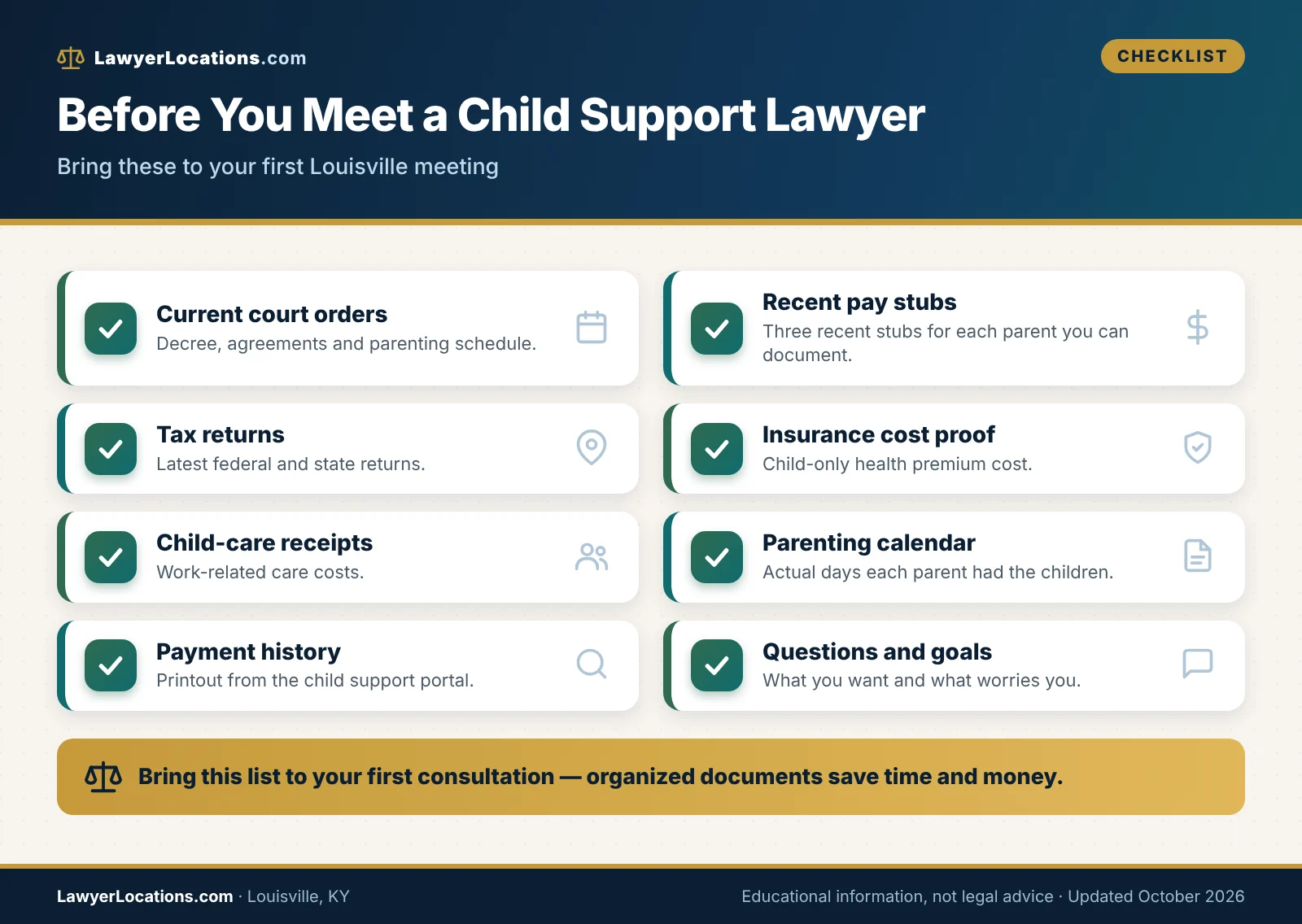
Text version of this graphic
- Current court orders and any agreements.
- Three recent pay stubs for each parent you can document.
- Last two years of tax returns.
- Proof of the child’s health-insurance cost.
- Child-care receipts.
- Calendar of actual parenting days.
- Payment history from the child support portal.
- List of questions and goals.
Income and expense records
- Three recent pay stubs and the most recent federal and state tax returns, matching what FCRPP 9 asks for.
- For self-employment: profit-and-loss records and business tax filings.
- Proof of health-insurance cost for the children alone, not the whole family plan.
- Child-care and uninsured medical receipts.
If you do not have the other parent’s documents, say so. A lawyer or the agency can use legal tools to request them.
Order, parenting-time and payment records
- The existing order or decree, including any parenting-time schedule.
- A calendar showing the days each parent actually had the children, which matters for the 88-day credit.
- A payment history from the Kentucky Child Support interactive website or the disbursement unit.
- Messages that show agreements about schedules or expenses.
Mistakes that cost families money
Most avoidable losses come from timing and informal arrangements, not from complicated legal arguments.
Informal side deals
Parents sometimes agree to pay in cash, skip payments for a month or swap support for other favors. A private understanding does not generally change a court order, and KRS 403.213 limits modification to installments after a motion is filed. If you want a change, put it to the court or the agency in writing and get a new order.
Waiting, stopping payments or missing hearings
Do not stop paying because the other parent is blocking parenting time; KRS 403.240 says one violation does not suspend the other party’s duty. Do not ignore court papers, which can produce an order in your absence. Do not understate income, since a default or incomplete record can be revisited, with arrears, if evidence emerges within two years.
Next steps, in order
Use the list below as a starting point and adjust it to your situation.
A 30-day plan
- Week 1: collect records. Build the income, order and payment file described above.
- Week 1: run a worksheet. Use the Attorney General’s worksheet and the current guidelines to see roughly what the formula produces, then compare it to your current order. A 15% difference matters under KRS 403.213.
- Week 2: choose a route. Apply to the child support agency, call the referral service or Legal Aid, or contact private lawyers you have checked on the Kentucky Bar Association roster.
- Week 3: meet and compare. Use the scorecard questions and get fee terms in writing.
- Week 4: file or negotiate. If a change is warranted, file promptly, because relief reaches only installments after filing.
When something is urgent
If a protective order or safety issue is part of the picture, Jefferson County has a Domestic Violence Intake Center at the Hall of Justice, 600 West Jefferson Street, and the county attorney’s Family Court page lists its phone as (502) 595-0853. In an emergency, call 911. Support questions can wait a day; safety cannot.
Do I need a lawyer to get child support in Louisville?
No. You can apply to the child support agency, or file on your own in Jefferson Family Court. A lawyer helps most when incomes, parenting time or enforcement are disputed. The agency does not act as your personal lawyer.
How much will I pay or receive?
The guidelines table in KRS 403.212 sets a combined amount based on both parents’ income and the number of children, then splits it by income share. Add-ons for child care, health coverage and medical costs are separate, and a shared-time credit may apply from 88 days a year.
What if the other parent does not pay?
Options include wage withholding, agency tools like license and passport actions, a contempt motion in Family Court, and, in serious cases, a criminal nonsupport referral. A lawyer or the agency can help choose.
Is it legal to refuse parenting time because support is unpaid?
Generally no. KRS 403.240 says a violation by one party does not suspend the other party’s duty to pay support or permit visitation. Use court remedies instead of self-help.
Ready to compare your options?
If you are weighing a child support lawyer in Louisville, KY, start with your records, check each license on the Kentucky Bar Association roster, and use the scorecard questions above. Choosing a lawyer from a directory is a first step, not a relationship, and no listing here is a recommendation. If your situation also involves ending a marriage, our guide on legal separation versus divorce may help you frame the next question.
Sources & References
Show all 32 sources
- KRS 403.212, Child support guidelines — Kentucky Legislature — apps.legislature.ky.gov — accessed October 2026
- KRS 403.2122, Shared parenting time credit — Kentucky Legislature — apps.legislature.ky.gov — accessed October 2026
- KRS 403.213, Modification of child support — Kentucky Legislature — apps.legislature.ky.gov — accessed October 2026
- KRS 403.240, Failure to comply with decree — Kentucky Legislature — apps.legislature.ky.gov — accessed October 2026
- KRS 403.215, Wage assignment — Kentucky Legislature — apps.legislature.ky.gov — accessed October 2026
- KRS 15.802, Duties of the Department of Child Support Services — Kentucky Legislature — apps.legislature.ky.gov — accessed October 2026
- KRS 413.090, Fifteen-year limitation; child support arrearages — Kentucky Legislature — apps.legislature.ky.gov — accessed October 2026
- KRS Chapter 403 index (section list) — Kentucky Legislature — apps.legislature.ky.gov — accessed October 2026
- 2024 Ky. Acts ch. 219 (HB 244), An Act relating to children — Kentucky Legislative Research Commission — apps.legislature.ky.gov — accessed October 2026
- 2025 Ky. Acts ch. 59 (SB 244), An Act relating to the operations of the Department of Law — Kentucky Legislative Research Commission — apps.legislature.ky.gov — accessed October 2026
- House Bill 707 (2026 Regular Session), bill record — Kentucky Legislature — apps.legislature.ky.gov — accessed October 2026
- KRS 403.211, Action to establish or enforce child support — Justia (unofficial copy of the Kentucky Revised Statutes) — law.justia.com — accessed October 2026
- KRS 403.220, Costs and attorney fees — Justia — law.justia.com — accessed October 2026
- KRS 530.050, Nonsupport and flagrant nonsupport — Justia — law.justia.com — accessed October 2026
- KRS 360.040, Interest on judgments — Justia — law.justia.com — accessed October 2026
- Child Support Division — Jefferson County Attorney, Louisville Metro Government — louisvilleky.gov — accessed October 2026
- Family Court (Jefferson County Attorney) — Louisville Metro Government — louisvilleky.gov — accessed October 2026
- Child Support — Kentucky Office of the Attorney General — ag.ky.gov — accessed October 2026
- Child Support Enforcement (transition notice) — Kentucky Cabinet for Health and Family Services — chfs.ky.gov — accessed October 2026
- Attorney General Coleman appoints Amy Burke as Chief of Child Support Services — WEKU — weku.org — accessed October 2026
- Jefferson County court information — Kentucky Court of Justice — kycourts.gov — accessed October 2026
- Family Court overview — Kentucky Court of Justice — kycourts.gov — accessed October 2026
- Civil Legal Aid Programs — Kentucky Court of Justice — kycourts.gov — accessed October 2026
- Order 2017-14 amending the Family Court Rules of Procedure and Practice (FCRPP 9) — Supreme Court of Kentucky — kycourts.gov — accessed October 2026
- Proposed replacement FCRPP, public comment draft (March 2026) — Kentucky Bar Association — kybar.org — accessed October 2026
- Family Court (Office of the Jefferson Circuit Court Clerk) — Jefferson Circuit Court Clerk — jeffersonkycourtclerk.com — accessed October 2026
- Jefferson Family Court (judges’ site) — Jefferson Family Court — jeffersonfamilycourt.com — accessed October 2026
- Need a Lawyer? (Kentucky Lawyer Referral Service) — Louisville Bar Association — loubar.org — accessed October 2026
- Who We Are — Louisville Bar Association — loubar.org — accessed October 2026
- Legal Aid Society, Louisville — Kentucky Justice Resource — kyjustice.org — accessed October 2026
- Kentucky Rule of Professional Conduct 1.5 (committee report with current and proposed text) — Kentucky Bar Association — kybar.org — accessed October 2026
- Want to know if your lawyer is in trouble? (reprint of Courier Journal article, Feb. 2018) — Kentucky Attorneys’ Rights and Discipline resource — ardfky.org — accessed October 2026
General information only. This article is legal information, not legal advice, and reading it does not create an attorney-client relationship. LawyerLocations.com is a legal-education and lawyer-discovery resource, not a law firm, and it does not rank or endorse individual lawyers. Statutes, court rules, agency procedures, phone numbers and fees change, and the facts of your case matter. Confirm current rules with the court, the agency or a lawyer licensed in Kentucky before you act.
Legal Disclaimer and Limitation of Liability
Informational and illustrative purposes only. This article was prepared by LawyerLocations.com solely on the basis of the information available to us at the time of writing. It is an illustrative, general overview. It is not a complete or authoritative statement of the law, and it has not been reviewed by a lawyer licensed in your state or county.
Not legal advice. Nothing in this article is legal, financial, tax or immigration advice, and reading it does not create an attorney-client relationship between you and LawyerLocations.com or any author, lawyer or firm mentioned. Laws, court rules, fees, filing deadlines and agency procedures differ by state, county and court, and they change often. Some details here may be simplified, incomplete or out of date, and time limits for legal claims can be short.
No warranty. We make no representation or warranty, express or implied, about the accuracy, completeness, timeliness or suitability of this content for your situation. Please do not rely on it to make, delay or skip any legal decision. Check the facts against official sources and speak with a licensed attorney in the relevant jurisdiction before you act.
Limitation of liability. To the fullest extent permitted by law, LawyerLocations.com and its owners, authors and contributors disclaim all liability for any loss, damage, cost or other consequence arising from the use of, or reliance on, this article, including any content on third-party websites we link to. Mentioning a lawyer, firm, organization or service is not an endorsement and is not a promise of any result. If you are in immediate danger, contact your local emergency number.