Couples who type prenup lawyer miami-dade county fl into a search bar usually want to know three things: what Florida lets a prenup do, what makes one hold up in court, and how to pick a lawyer without guessing. Florida’s Uniform Premarital Agreement Act, Fla. Stat. 61.079, requires a written agreement signed by both people, and a judge can refuse to enforce it if it was signed involuntarily, was the product of fraud, duress, coercion or overreaching, or was unconscionable and signed without fair financial disclosure.
A prenup is a private contract, so nothing is filed with the Miami-Dade Clerk when you sign it. The Eleventh Judicial Circuit family division only sees it if the marriage ends or the agreement is later challenged. This guide covers the Florida rules, the local courts and resources, the 2023 alimony changes, Miami-specific issues for international couples and business owners, and how to compare lawyers. It is general information, not advice about your situation.
Florida Premarital Agreement Law: What Fla. Stat. 61.079 Requires
A Florida prenup is valid when it is in writing, signed by both future spouses, and takes effect on the wedding day. It holds up in court unless the person challenging it proves one of the grounds listed in the statute. Everything a Miami-Dade lawyer drafts is measured against Fla. Stat. 61.079, which Florida enacted in 2007 as its version of the Uniform Premarital Agreement Act.
What a premarital agreement is and what it can cover
The statute defines a premarital agreement as an agreement between prospective spouses, made in contemplation of marriage and effective on marriage. It is a contract, so ordinary contract ideas such as clear terms, real consent and honest dealing carry a lot of weight. The Act also says the agreement is enforceable without any consideration other than the marriage itself, so neither side needs to “pay” for the other’s promises.
Subjects the statute lets couples address
Section 61.079(4) lets the parties contract about property rights and management, what happens to property on separation, divorce, death or other events, spousal support, wills and trusts, life insurance death benefits, and the choice of law that governs the agreement. It also allows other personal rights and obligations, as long as they do not violate Florida public policy or criminal law.
| Topic | What the statute allows | Limit to keep in mind |
|---|---|---|
| Property rights | Ownership, management and control of present or future property, including income and earnings | Must be signed voluntarily and, if one-sided, backed by fair disclosure |
| Property at divorce or death | Disposition of property on separation, dissolution, death or another event | A court can still examine fraud, duress, coercion or overreaching |
| Spousal support | Modify, waive or set alimony in advance | A court may require support to the extent needed to keep a spouse from qualifying for public assistance |
| Wills, trusts and insurance | Agreement to make or not make a will or trust; who receives life insurance death benefits | Waivers of death-related spousal rights have their own formalities in Fla. Stat. 732.702 |
| Governing law | Choice of the law that governs the agreement’s construction | Does not override the statute’s enforceability grounds in a Florida proceeding |
| Children | Nothing that reduces a child’s right to support | A child’s right to support may not be adversely affected |
Subjects a prenup cannot control
The statute says a child’s right to support cannot be adversely affected by a premarital agreement. A clause that tries to cap or waive child support is therefore a red flag in any draft you receive. Custody and time-sharing decisions also remain with the court, which decides based on the child’s interests at the time of the case rather than on what two adults wrote before the wedding. Treat any prenup clause that tries to pre-decide parenting questions as unreliable.
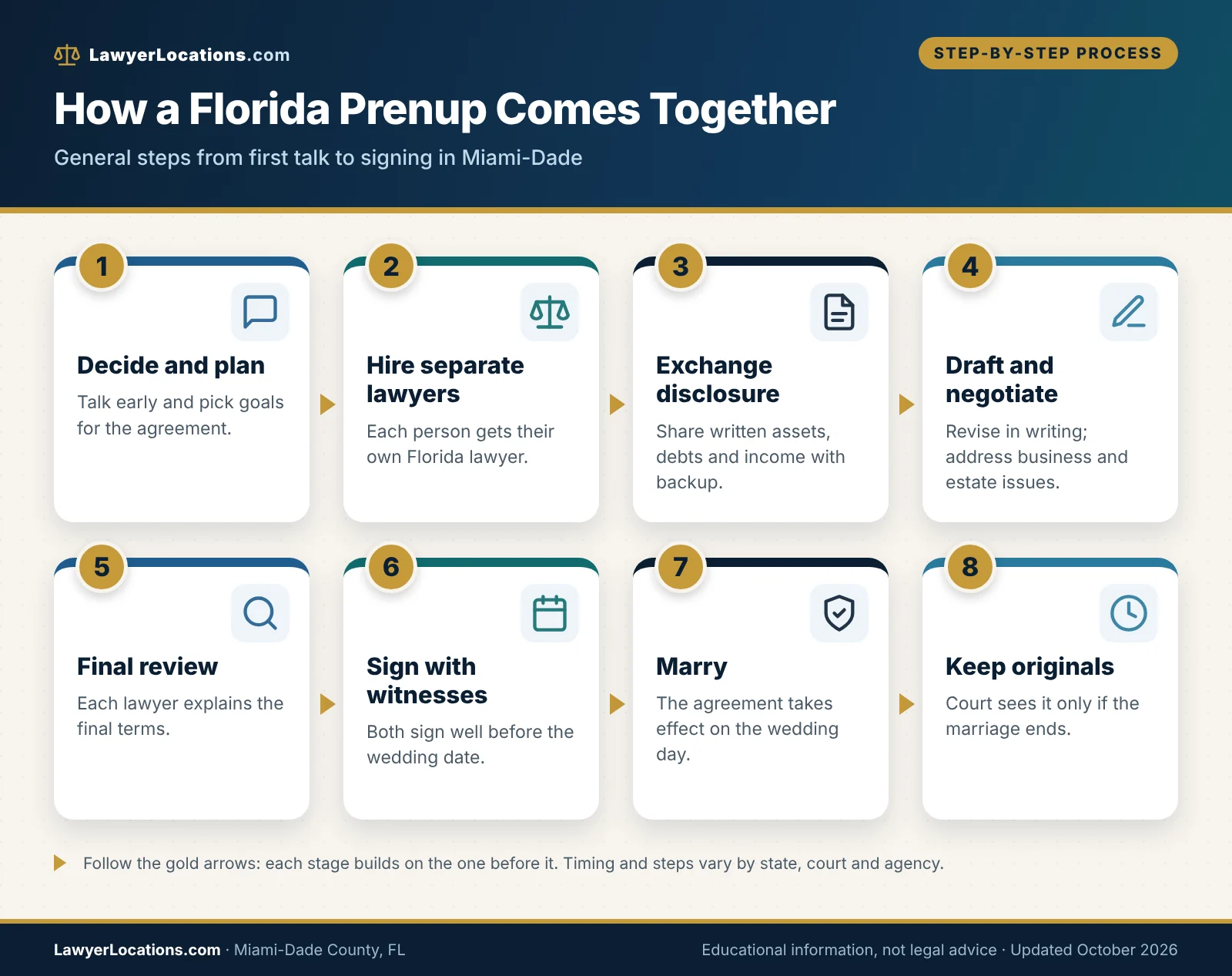
Text version of this graphic
- Decide whether a prenup fits your situation and gather financial documents.
- Each person hires their own Florida lawyer.
- Exchange written financial disclosure.
- Negotiate and draft the agreement in writing.
- Review the final draft well before the wedding day.
- Both people sign (add two witnesses if death-related rights are waived).
- Marry; the agreement takes effect on the wedding day.
- Keep originals safe. A Miami-Dade court sees the agreement only if the marriage ends or it is challenged.
Unconscionable means so one-sided that it shocks the conscience of the court. Under the Florida Act it is a question the judge decides as a matter of law, not a jury question, and it matters only together with the disclosure failures described below.
How Florida decides whether a prenup is enforceable
Voluntariness, fraud, duress, coercion and overreaching
An agreement fails if the challenger proves they did not sign voluntarily, or that it was the product of fraud, duress, coercion or overreaching. Overreaching is the broadest term. It covers pressure and unfair advantage that stop short of an outright lie, such as presenting the document for the first time on the eve of the wedding with guests already flying in.
Unconscionability plus inadequate disclosure
The second ground has three parts that must all be present. The agreement must have been unconscionable when signed, the challenger must not have received fair and reasonable disclosure of the other person’s property or financial obligations, and the challenger must not have waived disclosure in writing or had adequate knowledge of the other person’s finances.
This structure means a lopsided deal alone is not enough. A prenup that gives one spouse most of the assets can survive if the other spouse knew the numbers, or knowingly waived disclosure in writing, and signed freely. For Miami couples with real estate, businesses or foreign holdings, the disclosure schedule is often the most important attachment to the agreement.
The public-assistance backstop and who decides
If a support waiver would leave a spouse eligible for public assistance, section 61.079(7)(b) lets a court require the other spouse to provide support to the extent needed to avoid that result, notwithstanding the agreement.
Prenups, postnups and agreements during a marriage
Changing a prenup after the wedding
Once the couple is married, a premarital agreement can be amended, revoked or abandoned only by a written agreement signed by both spouses, and no new consideration is needed. A casual verbal understanding, an email exchange or years of acting differently will not rewrite the document.
That rule cuts both ways. It protects the person who relied on the original terms, but it also means a couple who wants to update an agreement after major changes has to do it the formal way, and should have each spouse advised again.
Postnuptial agreements and the Casto standard
In Casto v. Casto, 508 So. 2d 330 (Fla. 1987), the Florida Supreme Court dealt with an agreement signed during the marriage. As summarized on FindLaw, the case lets a spouse set aside or modify an agreement reached through fraud, deceit, duress, coercion, misrepresentation or overreaching, or one that makes an unfair or unreasonable provision for that spouse. In the second situation, a presumption of concealment or lack of knowledge arises, and the other spouse must rebut it by showing full disclosure or general knowledge of the finances.
What a Prenup Changes: Property, Alimony and Estate Rights in Florida
A prenup lets a couple replace Florida’s default rules for dividing property, awarding alimony and protecting a surviving spouse with terms they chose. To see what you would be trading away or protecting, you first need to know what the default rules say. Florida is an equitable distribution state, not a community property state, and alimony law changed substantially for cases filed after July 1, 2023.
Equitable distribution under Fla. Stat. 61.075
One partner founded a Miami company before the engagement and keeps running it after the wedding. Without a prenup, growth in the company’s value during the marriage can be argued to be marital. With a prenup that names the company and its growth as separate, the argument is mostly settled in advance.
Marital and nonmarital assets
As described in the 2025 statute, marital assets include property acquired during the marriage by either spouse or both, retirement benefits accrued during the marriage, and interests in closely held businesses valued at fair market value. Nonmarital assets include property acquired before the marriage, most gifts and inheritances from third parties, and assets excluded by a valid written agreement of the parties.
The equal-division starting point and the factors
Section 61.075(1) tells the court to begin with the premise that the distribution should be equal, then permits an unequal division based on listed factors. Those factors include each spouse’s contributions, including childcare and homemaking, the economic circumstances of each, the length of the marriage, interrupted careers or education, whether keeping an asset such as a business intact is desirable, and any intentional waste of assets.
A prenup that sets different shares avoids a contested battle over these factors. A couple without one is trusting a judge to weigh them after the fact.
Alimony after the 2023 reform
Types of alimony and the caps
The current section allows temporary, bridge-the-gap, rehabilitative and durational alimony. Permanent alimony is no longer among the listed types. The court must first find an actual need and an ability to pay, then apply the statute’s limits, summarized below.
| Type | Key limit in the statute | Why it matters for a prenup |
|---|---|---|
| Bridge-the-gap | Up to 2 years; not modifiable in amount or duration | Short transition support is already capped by law |
| Rehabilitative | Requires a defined plan; may not exceed 5 years | A prenup can add or remove this option |
| Durational | Not available after a marriage under 3 years; length capped at 50% of a short-term, 60% of a moderate-term, or 75% of a long-term marriage | Couples can set stricter or looser terms by contract |
| Amount limit (durational) | Lesser of the recipient’s reasonable need or 35% of the difference in net incomes | A fixed prenup figure replaces this calculation |
Marriage-length categories and why a prenup still matters
The statute treats a marriage under 10 years as short-term, 10 to 20 years as moderate-term, and 20 years or more as long-term, as rebuttable presumptions measured from the wedding to the filing of the petition. Courts may also look at adultery and its economic impact when deciding an award.
The reform narrowed the range of outcomes but did not remove uncertainty. A lawyer drafting a prenup can still waive alimony, limit it, or set an agreed schedule, and Florida’s Uniform Act specifically allows that, subject to the public-assistance backstop. Do not assume the 2023 law makes an alimony clause unnecessary, since the statute leaves room for need-based awards, and the Legislature can change the rules again. The Florida Senate’s own bill summary also describes new provisions on retirement and supportive relationships, so anyone with an existing award should ask a lawyer how the reform applies to it.
We reviewed the 2025 edition of Fla. Stat. 61.08 and 61.075 and the 2026 edition of 61.079 and 732.702. Florida’s Legislature meets every year, so confirm the current wording on the Legislature’s website before relying on a specific cap.
Death-related rights: elective share, homestead and Fla. Stat. 732.702
The elective share
Florida’s elective share is an amount equal to 30 percent of the elective estate, under Fla. Stat. 732.2065. A surviving spouse can claim it even if the will leaves them nothing. A properly drafted waiver in a prenup can give that right up, which is why estate lawyers often work alongside the family lawyer who drafts the agreement.
If you are also planning a trust, read our guide on when a living trust lawyer can help, because trusts and prenups should be drafted to fit together.
Waiver formalities under section 732.702
Under Fla. Stat. 732.702, rights such as the elective share, intestate share, homestead, exempt property and family allowance may be waived before or after marriage by a written contract, agreement or waiver signed by the waiving party in the presence of two subscribing witnesses. The statute was amended in 2024 (ch. 2024-238), and as we read the 2026 text, the witness requirement is tied to Florida residents, while a nonresident’s waiver can be valid if it was valid where it was signed.
Disclosure works differently here. Subsection (2) says a spouse must make fair disclosure of their estate when a waiver is signed after the wedding, and no disclosure is required for an agreement signed before marriage. Section 61.079(7) still applies to the prenup itself, so most lawyers disclose finances anyway. The practical takeaway is to have two witnesses at signing, whatever the residency of the signers.
| Issue | Default Florida rule | What a prenup can do |
|---|---|---|
| Property division | Equitable distribution; equal-division premise under Fla. Stat. 61.075(1) | Define separate and shared property and set a division formula |
| Business growth | Appreciation from either spouse’s efforts, or marital funds, can be marital | Keep a business and its growth nonmarital, with a valuation method |
| Alimony | Need and ability to pay; caps under Fla. Stat. 61.08 | Waive, limit or fix support, subject to the public-assistance backstop |
| Elective share | 30 percent of the elective estate (Fla. Stat. 732.2065) | Waive or reduce, with 732.702 formalities |
| Child support | Set by statute and guidelines | Nothing; a child’s right to support cannot be adversely affected |
Miami-Dade County Courts, Clerk and Local Resources
In Miami-Dade County, a prenup is signed privately and reaches the Eleventh Judicial Circuit only if the marriage ends or someone challenges the agreement. The court that decides those disputes is the circuit court’s Family Division in downtown Miami. Knowing where the agreement would eventually land helps you ask better questions when you interview lawyers.
Why nothing is filed when you sign
Many couples expect to “file” a prenup with the county the way they file a marriage license. That is not how it works. As we read Fla. Stat. 61.079, it describes a private contract and sets no requirement to record it or lodge it with the clerk. Keep that distinction in mind when a website promises that a prenup is “filed” or “registered” in Miami-Dade.
Signing is a private act
Each person signs the agreement, usually with their own lawyer reviewing it, and each side keeps a signed original. If the agreement waives death-related spousal rights, two witnesses should watch the waiving person sign, as discussed above. Many firms also have a notary acknowledge the signatures, which helps prove authenticity later, though section 61.079 itself only requires a writing signed by both parties.
When the agreement reaches the court
The agreement enters the court file when one spouse files for dissolution of marriage, when the surviving spouse or an estate disputes it after death, or when someone asks a court to interpret or enforce it. In a divorce, the Florida Family Law Rules of Procedure require each spouse to produce all written premarital or marital agreements between them as part of mandatory disclosure under Rule 12.285(e)(15).
The Eleventh Judicial Circuit family division and the Clerk
Miami-Dade County makes up Florida’s Eleventh Judicial Circuit. According to the circuit’s website, its Family Division hears dissolutions of marriage, child custody and support matters, paternity, modifications and related cases, and the judges and support staff sit at the Lawson E. Thomas Courthouse Center at 175 NW 1st Avenue in Miami.
The Lawson E. Thomas Courthouse Center
The courthouse is at the corner of NW 2nd Street and NW 1st Avenue and has limited street and off-street parking; the court recommends Metrobus or Metrorail to the Government Center station. The Family Division’s page lists the Family Division Clerk on the 12th floor and states that self-represented litigants can use the e-filing portal. It lists office hours of 8:00 a.m. to 5:00 p.m. on weekdays, excluding holidays.
The Clerk of the Court and Comptroller publishes its own hours for the Family Court Division at the same address, listed as 9:00 a.m. to 4:00 p.m. on weekdays. Because the two sources differ, call before you go.
The Miami-Dade Clerk and e-filing
The Clerk describes family court as covering domestic relations, probate and domestic violence, and offers online searches of family cases, certified copies of pleadings and orders, and links to Florida Supreme Court-approved family law forms. The Clerk also states that it cannot provide legal counsel or help complete forms, and it recommends that you consult a qualified attorney.
Self-help and lower-cost local help
The Family Court Self-Help Program
The Eleventh Circuit’s Family Court Self-Help Program helps people without lawyers in family court. Its page lists offices at the Lawson E. Thomas Courthouse Center, 175 NW 1st Avenue, Room 2441, and at the South Dade Justice Center in Cutler Bay, with a shared phone number of (305) 349-7800 and weekday hours of 8:30 a.m. to noon and 1:00 to 4:00 p.m. It provides forms packets, orientation and document review, and it says it “does not give legal advice.”
Legal aid and referral services
Legal Services of Greater Miami says it provides free civil legal services to low-income communities in Miami-Dade and Monroe Counties, and its site lists (305) 576-0080 for Miami-Dade. Legal aid offices set their own priorities, so ask whether they handle premarital agreements when you call.
For paid representation, two referral services are covered below in the lawyer-comparison section. The table summarizes the local resources we verified.
| Resource | What it does | Where or how to reach it |
|---|---|---|
| Eleventh Judicial Circuit, Family Division | Hears dissolutions, custody, support and related family cases | Lawson E. Thomas Courthouse Center, 175 NW 1st Avenue, Miami; Family Division Clerk, 12th floor |
| Miami-Dade Clerk of the Court, Family Court | Case records, certified copies, family forms links, no legal advice | miamidadeclerk.gov; Family Court Division at 175 NW 1st Avenue |
| Family Court Self-Help Program | Forms packets and procedural help for people without lawyers | Room 2441, 175 NW 1st Avenue; (305) 349-7800 |
| Legal Services of Greater Miami | Free civil legal services for low-income residents | 4343 West Flagler Street, Suite 100; (305) 576-0080 |
| Miami-Dade Bar Lawyer Referral Service | Referral to a lawyer in the area of law you need | 1-888-305-5291; 150 W. Flagler Street, Suite 1675 |
| The Florida Bar Lawyer Referral Service | Statewide referral to a licensed lawyer | 1-800-342-8011; floridabar.org |
Miami Situations: International Couples, Business Owners and High-Asset Estates
Miami-Dade is not a typical county for premarital planning. Many couples here have ties to other countries, own businesses, or hold real estate and investments in more than one place. Those facts raise questions a form-based prenup does not answer. This section explains the issues to raise with a lawyer, using general Florida rules rather than assumptions about any one family.
International and cross-border couples
The Census Bureau reports that 54.5 percent of Miami-Dade residents were foreign-born and 75.3 percent of residents age five and older spoke a language other than English at home (2020 to 2024 American Community Survey estimates).
Language, translation and understanding
A person who cannot comfortably read English should not sign a prenup in English alone. Voluntariness and adequate knowledge are the heart of the enforceability test, and a challenger can argue that they did not understand what they signed. Lawyers often arrange a certified translation or a bilingual explanation session and record that it happened.
Foreign assets, choice of law and divorce abroad
Section 61.079(4) allows the parties to choose the law that governs the agreement’s construction. Couples who may marry or divorce in another country, or who hold property abroad, often ask whether a Florida prenup will be recognized there, and whether a foreign agreement will be honored in Miami. The answer depends on the other country’s law and cannot be answered from Florida statutes alone, so a lawyer may recommend consulting counsel in the other jurisdiction.
Business owners and professionals
For a business owner, the main prenup question is usually whether the business and its growth will be treated as marital property. Florida’s equitable distribution statute says appreciation of a nonmarital asset can become marital when it results from the efforts of either spouse during the marriage or from marital funds. That is a real risk for a founder who keeps working on the company after the wedding.
Closely held businesses and goodwill
The 2025 text of Fla. Stat. 61.075 treats interests in closely held businesses as marital to the extent acquired during the marriage, values them at fair market value, and states that enterprise goodwill is marital. A business started before the wedding may remain nonmarital in principle, but growth during the marriage is a point of dispute unless the prenup says otherwise.
A prenup can address this directly by identifying the business, saying whether growth is separate, and fixing a valuation method such as an agreed formula or an independent appraiser.
Partners, shareholders and professional practices
The financial disclosure for an owner should include entity documents, recent financial statements and a description of any pending sale or investment. Leaving out a known deal is the sort of omission that can support a later claim of unfair disclosure.
High-asset estates, real estate and trusts
Real estate and the marital home
Under Fla. Stat. 61.075, paying down the mortgage on a nonmarital home with marital funds and passive appreciation of that home can create a marital share, and property held as tenants by the entireties is presumed marital. Couples who plan to live in a home one of them owned before the wedding should decide in the prenup how it will be treated if the marriage ends.
Death-related homestead rights are a separate topic. Section 732.702 lists homestead among the rights that can be waived, but homestead law is technical, and a lawyer should explain the interaction before anyone signs a waiver.
Trusts, family wealth and digital assets
If one partner expects family money, a prenup can say that inheritances and gifts stay separate and that commingling will not change that. Florida’s statute already treats noninterspousal gifts and inheritances as nonmarital, but mixing them into a joint account can create arguments. Written terms about how trust distributions and family-company interests are handled can reduce those disputes.
Digital assets are increasingly part of disclosure. Florida’s mandatory disclosure rule lists virtual currency statements and holdings among the required documents in a divorce, so listing them in a prenup schedule now avoids later fights over whether they were disclosed.
How to Compare Prenup Lawyers in Miami-Dade County
Compare prenup lawyers by verifying each license, asking how often they draft and defend premarital agreements, and getting the fee terms in writing before you pay anything. Each person needs a separate lawyer, so you are really choosing counsel for one side of a negotiation. This section covers how to find candidates, what to ask, and how fee structures work under Florida’s lawyer rules.
Finding and verifying lawyers
You can start with referrals from friends, an estate planner or an accountant, with a bar association referral service, or with an online search. Whatever the source, verify the license yourself and treat advertising as marketing, not as proof of skill. LawyerLocations.com does not rank or recommend individual lawyers.
Referral services in Miami-Dade
The Florida Bar Lawyer Referral Service says it has operated since 1972 and states that a consumer can get a 30-minute consultation for no more than $25; its number is 1-800-342-8011. The Miami-Dade Bar’s service lists a $50 non-refundable referral fee that entitles you to a consultation at no further cost, and a further referral if the first lawyer does not take the matter, with family law listed among its practice areas. Both pages show terms that can change, so confirm current fees when you call.
Checking licenses, discipline and credentials
The Florida Bar’s member directory can be searched by name, law firm, city or practice area and includes an “eligible lawyers only” filter, so start there to confirm the person you are meeting appears as an eligible lawyer, and ask the lawyer directly about any disciplinary history. The Bar also offers a “Find a Board Certified Lawyer” tool. Board certification is a program the Florida Supreme Court established in 1982 that recognizes special knowledge in areas that include Marital and Family Law. It is one credential you can verify, but it does not replace asking about actual prenup experience.
What to ask a prospective prenup lawyer
Interview at least two lawyers and ask each for the same fee terms in writing. Comparing quotes line by line shows what is included and what is extra.
The first consultation is your chance to judge how the lawyer thinks. Good questions are specific to prenups, because drafting a premarital agreement is a different skill from litigating a divorce.
Experience and approach
Ask how many premarital agreements the lawyer drafts in a typical year, whether they have defended one in a challenge, and how they handle disclosure schedules. Ask which part of the agreement tends to cause the most disagreement in their experience and how they suggest handling it. A lawyer who explains tradeoffs in plain English is more useful than one who recites statutes.
Communication, language and logistics
Ask who will do the work, who answers questions, and how fast revisions usually come back. If English is not your first language, ask whether the lawyer or staff can communicate in yours, or how translation would be handled. Find out whether the lawyer can meet in person or remotely, and how they handle documents with a partner who lives abroad.
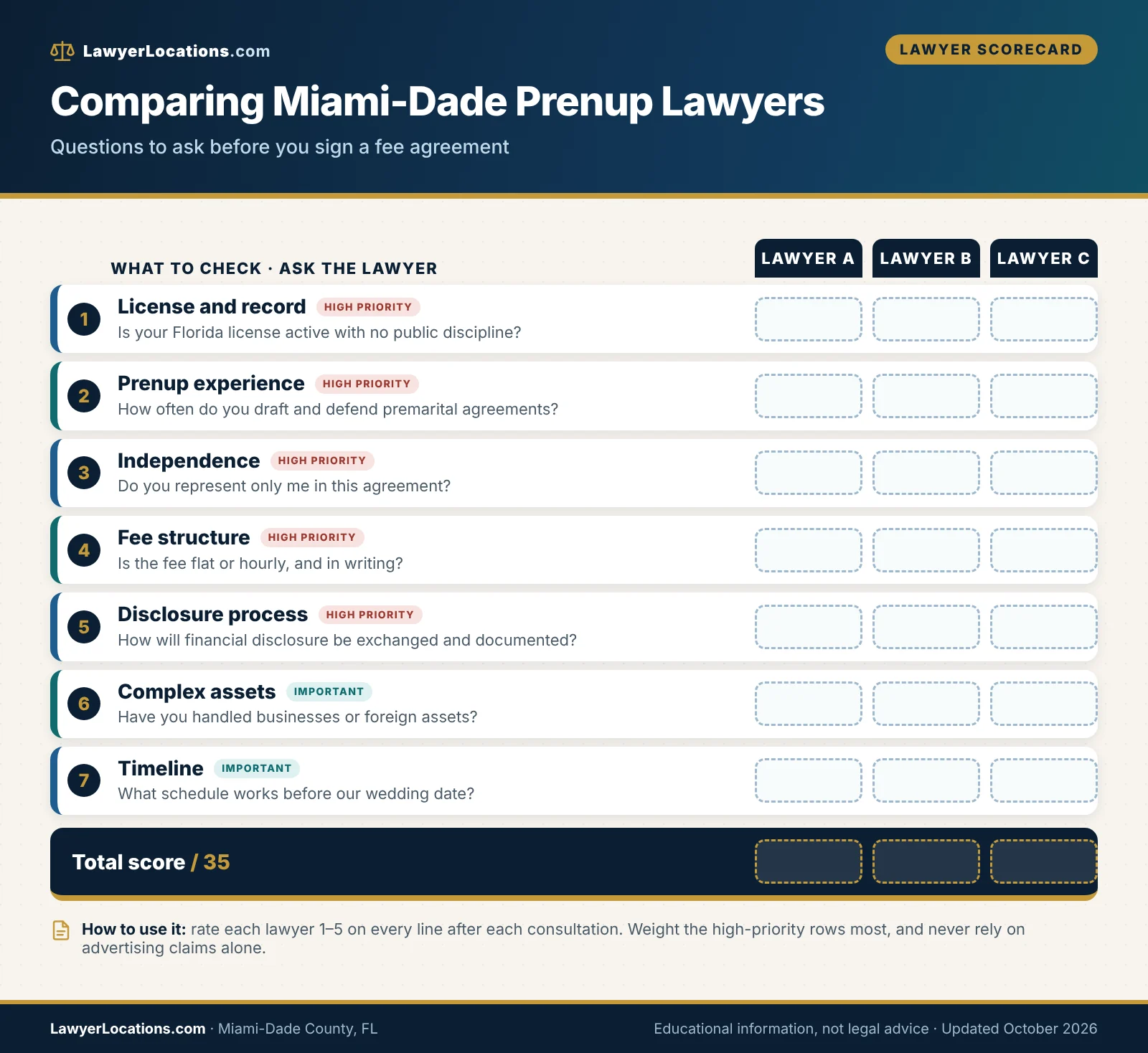
Text version of this graphic
| Criterion | Question to ask |
|---|---|
| Florida license and record | Is your Florida license active, with any public discipline? |
| Prenup drafting experience | How often do you draft and defend premarital agreements? |
| Independence | Do you represent only me, with no tie to my partner? |
| Fee structure | Is the fee flat or hourly, and is it in writing? |
| Disclosure process | How will financial disclosure be exchanged and documented? |
| Your situation | Have you handled businesses, foreign assets or second marriages? |
| Timeline | What schedule works before our wedding date? |
Fee structures and Florida’s fee rules
Florida’s Rules of Professional Conduct govern how lawyers charge. The Florida Bar’s Rule 4-1.5 says the basis or rate of the fee and costs must be communicated to the client, preferably in writing, before the representation begins or within a reasonable time after it starts. A fee that is nonrefundable in any part must be confirmed in writing.
Flat fee, hourly rate or retainer
Prenup work is usually billed either hourly against a retainer, which is an advance deposit the lawyer bills against, or as a flat fee for a defined scope such as one draft and one round of revisions. We do not list typical dollar amounts here, because we found no official Florida source that publishes average prenup fees, and prices vary with the complexity of the assets.
| Structure | How it works | Questions to ask |
|---|---|---|
| Flat fee | One price for a defined package, often a review or a draft plus revisions | What is included? What triggers extra charges? |
| Hourly with retainer | You deposit money and the lawyer bills time against it | What are the hourly rates, who bills, and how often are statements sent? |
| Hybrid | A flat fee for drafting plus hourly billing for negotiation or special issues | Where does the flat portion end? |
| Costs outside the fee | Appraisals, translations, notary and witness arrangements | Who pays for them and who selects the vendor? |
Fees that a Florida lawyer cannot charge
Rule 4-1.5(f)(3) prohibits a fee in a domestic relations matter whose payment or amount is contingent on securing a divorce or on the amount of alimony, support or a property settlement. The rule is aimed at divorce cases, but it signals a general principle: a fee tied to how much a client “wins” from a spouse is out of bounds. This differs from injury work, where contingency fees are common, as described in our wrongful death lawyer cost guide.
Be wary of a lawyer who offers to represent both of you. Florida Rule 4-1.7 says a lawyer must not represent a client when the representation will be directly adverse to another client, with a narrow informed-consent exception. In a prenup, the two future spouses’ interests are typically opposed on money, so each should have separate counsel.
Timing, Disclosure and Independent Counsel: Getting a Prenup That Holds Up
A prenup is easiest to defend when it was started early, supported by complete financial disclosure, and negotiated with each person advised by their own lawyer. None of these steps is a magic formula, but each one answers an argument a challenger would otherwise make. The statute turns on voluntariness, fraud or overreaching, and fair disclosure, and the habits below respond directly to those grounds.
Timing before the wedding
The statute contains no minimum waiting period. As a result, timing is judged by circumstances, which is why prudent lawyers plan backward from the wedding date.
Starting early and avoiding a last-minute signing
Raise the topic as soon as the wedding date is set, and decide on lawyers before invitations go out. An agreement delivered the week of the wedding invites an argument that the other person felt pressure, especially if deposits have been paid and guests have traveled. Allow enough time for disclosure, a draft, revisions and a pause between the final draft and signing.
The table below shows a planning sequence that many lawyers use. It is practical advice, not a legal deadline.
| Stage | What happens | Why it helps |
|---|---|---|
| Early planning | Discuss goals, choose separate lawyers, gather financial records | Shows voluntariness and avoids time pressure |
| Disclosure | Exchange written schedules of assets, debts and income with backup documents | Answers the “fair disclosure” element |
| Drafting and negotiation | Draft, review, comment, revise; address business, estate and foreign assets | Builds a record of real negotiation |
| Final review | Each lawyer explains the final terms to their client | Supports knowing, informed consent |
| Signing | Sign with witnesses and, often, a notary; keep originals | Meets the writing rule and the 732.702 witness formality |
| After the wedding | Follow the agreement; update formally if circumstances change | Avoids informal changes that do not count |
Special timing issues in Miami
Destination weddings and ceremonies abroad are common among Miami couples. The prenup takes effect on marriage, so it must be signed before the ceremony wherever that takes place. If one partner will be travelling or living abroad during the process, plan for the extra time needed for remote signing, translation and, where relevant, any formalities required in another country.
Financial disclosure
Complete disclosure helps both people. The person receiving it makes an informed choice, and the person giving it removes the strongest argument against the agreement later.
Disclosure is the center of the enforceability test. The statute asks whether the challenger received fair and reasonable disclosure of the other party’s property and financial obligations, waived disclosure in writing, or otherwise had adequate knowledge of them.
What to disclose
A good disclosure schedule lists assets with approximate values, debts, income sources, and ownership interests in businesses and trusts, and attaches supporting statements. Florida’s mandatory disclosure rule for divorce, Rule 12.285, gives a sense of what judges later expect to see: tax returns, bank and brokerage statements, retirement plan statements, business tax returns, deeds and virtual currency holdings.
- Bank, brokerage and retirement account statements
- Recent personal and business tax returns
- Real estate deeds and mortgage statements, including property abroad
- Business ownership documents and recent financial statements
- Trust documents and expected inheritances, if known
- Digital assets and virtual currency holdings
- Debts, student loans and co-signed obligations
Written waivers and why they are risky
The statute lets a person waive disclosure in writing, and some agreements include a waiver. A waiver is not a substitute for knowing the numbers. If the person who waived later says they did not understand what they gave up, they may argue unconscionability and overreaching in addition. If you are the person asked to waive disclosure, ask your own lawyer to explain the risk first.
Independent counsel and conflicts
The Florida Act does not use the phrase “independent counsel,” but the grounds of voluntariness, overreaching and knowledge all point toward each person having a lawyer. Courts looking back often ask whether each side had advice. Separate lawyers also reduce the conflict problems discussed in Rule 4-1.7.
Why each person needs a separate lawyer
A lawyer represents a client’s interests, not the couple’s. One lawyer cannot properly negotiate against themselves. If the lawyer drafts for one partner, the other partner should not rely on that lawyer for advice. Some couples use a single neutral mediator to settle terms, then each takes the draft to their own lawyer for review.
Some couples wonder whether one side can pay for the other’s lawyer to even out resources. If that is on the table, ask your own lawyer how it should be documented, and make sure the lawyer who is paid by someone else still answers only to the client.
What lawyers should explain before you sign
Before signing, a good lawyer explains what you would receive without the prenup, what you are giving up, how the agreement treats income, appreciation and debts, and what happens at death.
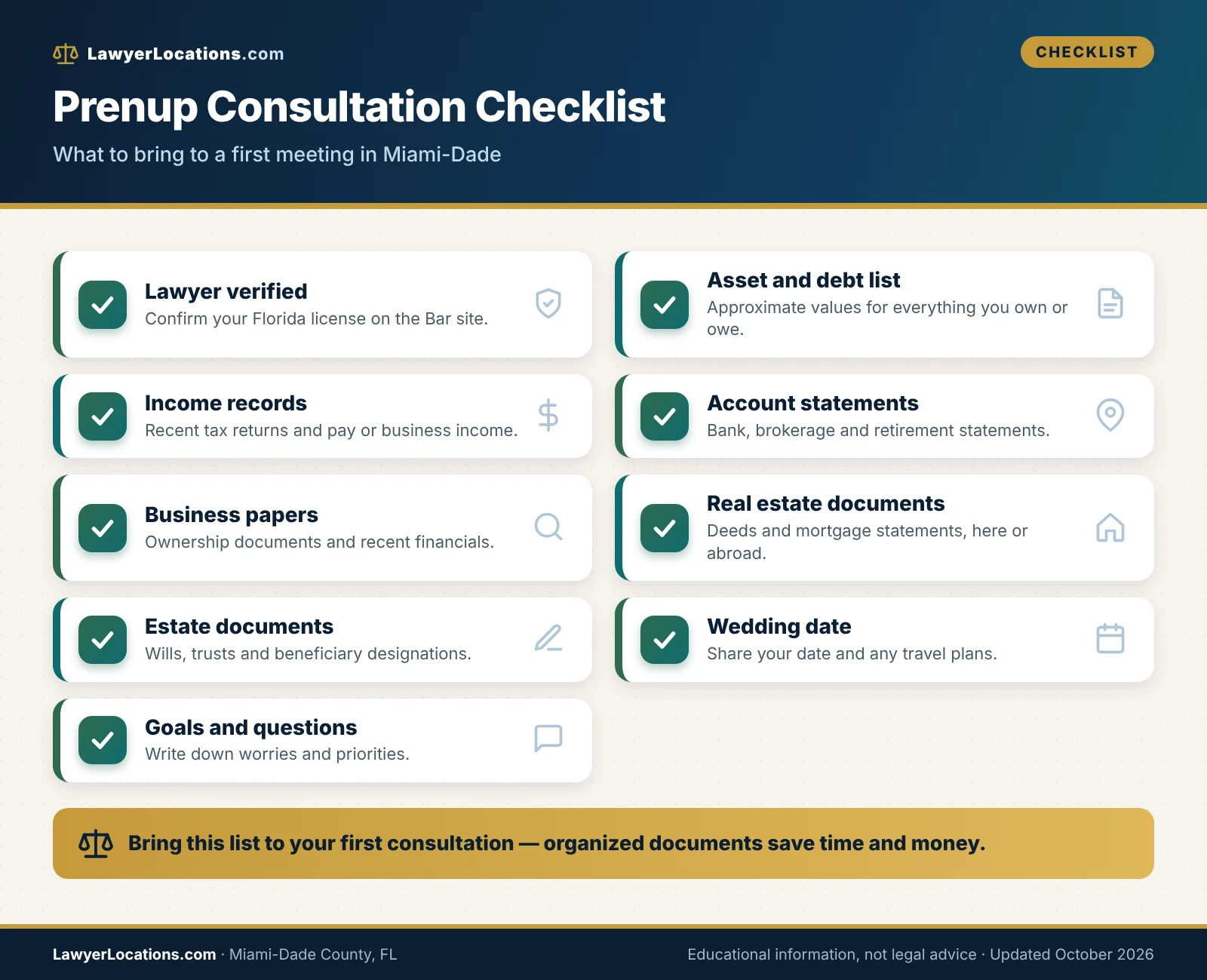
Text version of this graphic
- Your own Florida lawyer, verified on the Florida Bar site
- Photo ID and your fiance’s full legal name
- List of assets, debts and income with approximate values
- Recent tax returns and account statements
- Business, trust and real estate documents
- Foreign assets and any existing agreements
- Your estate plan and beneficiary designations
- Your wedding date and any travel plans
- Your goals, worries and questions
Costs, Deadlines, Decision Points and Next Steps for a Miami-Dade Prenup
The cost of a prenup depends mostly on how complicated your finances are and how much negotiation is needed, and the real deadline is your wedding date. Florida law sets no fixed waiting period or filing deadline for signing, but several dates and rules shape your planning. This section pulls together costs, time limits, decisions, mistakes to avoid and the next steps to take.
What drives the cost of a prenup
We did not find an official Florida source that publishes typical prenup fees, so we do not quote averages. Instead, consider the factors that lawyers say push the work up or down, and ask each candidate to price them in writing.
Complexity of assets and negotiation
A couple with modest assets and agreement on basic terms generally needs less lawyer time than a couple with a business, multiple properties, trusts or foreign holdings. Disputes over alimony waivers or business valuation tend to add the most time.
Costs outside the lawyer’s fee
Other costs can include appraisals of real estate or a business, accountant review, certified translations, notary services and the cost of coordinating estate documents. If a later dispute reaches court, litigation costs are a different order of magnitude, which is why careful drafting up front is often described as an investment in avoiding a fight.
Deadlines and decision points
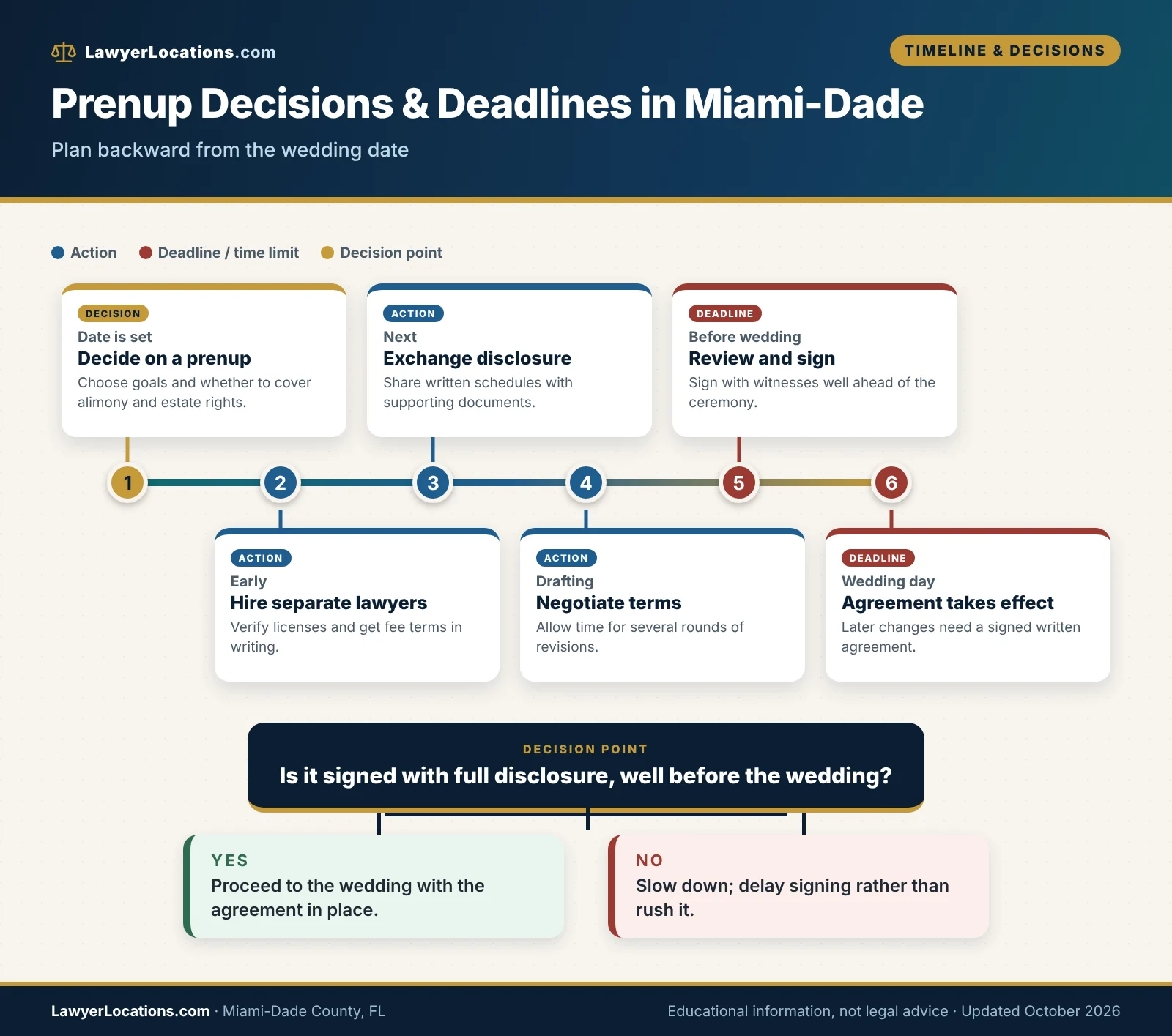
Text version of this graphic
- As soon as the wedding date is set: decide whether to pursue a prenup (decision).
- Early planning: choose separate Florida lawyers (action).
- Next: exchange written financial disclosure (action).
- Drafting: negotiate terms; allow time for revisions (action).
- Before the wedding: final review and signing (deadline).
- Wedding day: the agreement takes effect (deadline).
- If the marriage ends: the agreement is produced in a Miami-Dade family case, and mandatory disclosure runs on the court’s schedule (action).
Decision point: Is the agreement signed, with disclosure complete, well before the wedding? If yes, proceed. If no, delay the signing or the wedding date rather than rush.
Dates and time limits that matter
Your practical deadline is the wedding day: before the wedding. A premarital agreement is effective only upon marriage, and Florida’s statute contains no waiting period, so leave time to avoid any argument that you were rushed.
In a divorce, Florida Family Law Rule 12.285 requires financial documents, including any premarital agreement, to be served within 45 days of service of the initial pleading, with shorter windows for temporary relief hearings. Under Fla. Stat. 61.079, limitation periods on claims under the agreement are tolled during the marriage, though laches and estoppel defenses remain.
The 2023 alimony reform applies to initial petitions pending or filed on or after July 1, 2023, so the age of an existing order matters. A spouse with an older judgment should not assume the new caps apply to it.
Decisions to make, in order
- Decide whether you need a prenup. Consider a business, prior children, inheritances, debts and each person’s income gap.
- Choose how much to cover. Property only, or property plus alimony and estate rights?
- Pick lawyers. Verify licenses, compare fee terms and decide who pays for what.
- Decide how to handle disclosure. Plan for real exchange of documents rather than written waivers.
- Set a signing date. Choose one well before the wedding, with witnesses arranged.
Mistakes and red flags
Mistakes couples make
- Waiting until the last week, which invites a claim of pressure
- Skipping financial disclosure or relying on a casual waiver
- Using a template or an online form that does not fit Florida law or your assets
- Sharing one lawyer between both partners
- Ignoring estate documents, so wills, trusts and beneficiary forms contradict the prenup
- Treating a signed original as optional and losing track of it
- Changing terms informally after the wedding instead of in a signed writing
Red flags in a lawyer or a draft
Walk away or ask for a second opinion if a lawyer pressures you to sign quickly, refuses to put fees in writing, promises a particular result or offers a fee that depends on how much you receive from your spouse. In the draft, watch for clauses that try to waive child support, that leave out financial schedules, or that you cannot explain in your own words.
Common questions about a prenup lawyer in Miami-Dade
Questions about enforceability and drafting
Is a prenup enforceable in Florida?
Yes, if it meets the Florida Uniform Premarital Agreement Act. It must be in writing and signed by both people, and it can be set aside if the challenger proves it was not voluntary, was the product of fraud, duress, coercion or overreaching, or was unconscionable and signed without fair disclosure, a written waiver or adequate knowledge.
Does a Florida prenup have to be notarized?
Section 61.079 requires a writing signed by both parties and does not mention a notary. Many lawyers notarize anyway, and waivers of death-related spousal rights have their own witness formalities under Fla. Stat. 732.702.
Questions about hiring and local logistics
How much does a prenup lawyer cost in Miami?
We found no official source for average fees. Costs depend on complexity and whether the lawyer uses a flat fee or hourly billing. Get the fee basis in writing, as Rule 4-1.5 contemplates, and ask what is not included.
Where would a prenup dispute be heard in Miami-Dade?
In the Family Division of the Eleventh Judicial Circuit, at the Lawson E. Thomas Courthouse Center, 175 NW 1st Avenue, Miami.
Next steps
If you are looking for a prenup lawyer in Miami-Dade County, FL, treat the project as a process with early milestones: decide what you want to protect, gather documents, interview more than one lawyer, and get fees in writing. Use the verification tools above, and keep your timeline comfortably ahead of the wedding date.
A short plan for this week
- Write down your top three goals for the agreement
- Start a folder of financial documents
- Call a referral service or ask a trusted professional for names
- Verify each lawyer in the Florida Bar directory
- Prepare questions about fees, scope and timing
Related guides
If you are weighing options other than a prenup, read our comparison of legal separation versus divorce. For coordinating trusts and estate documents with a premarital agreement, see our living trust lawyer guide.
Ready to compare your options?
Use the scorecard and checklist above to interview at least two Florida lawyers about a premarital agreement, and ask each to put fees and scope in writing. Reading this page does not create an attorney-client relationship, and LawyerLocations.com does not rank or recommend individual lawyers.
Sources & References
Show all 22 sources
- Fla. Stat. 61.079, Premarital agreements (2026 edition) — Florida Legislature — leg.state.fl.us — accessed October 2026
- Fla. Stat. 61.079 (2025 edition) — The Florida Senate — flsenate.gov — accessed October 2026
- Fla. Stat. 61.075, Equitable distribution (2025 edition) — The Florida Senate — flsenate.gov — accessed October 2026
- Fla. Stat. 61.08, Alimony (2025 edition; ch. 2023-315) — The Florida Senate — flsenate.gov — accessed October 2026
- CS/SB 1416 (2023) bill summary, Dissolution of Marriage — The Florida Senate — flsenate.gov — accessed October 2026
- Fla. Stat. 732.702, Waiver of spousal rights (2026 edition) — The Florida Senate — flsenate.gov — accessed October 2026
- Fla. Stat. 732.2065, Amount of the elective share (2026 edition) — The Florida Senate — flsenate.gov — accessed October 2026
- Casto v. Casto, 508 So. 2d 330 (Fla. 1987) — Supreme Court of Florida, via FindLaw — caselaw.findlaw.com — accessed October 2026
- Florida Family Law Rule of Procedure 12.285, Mandatory Disclosure — text as reproduced from The Florida Bar — floridajustice.com — accessed October 2026
- Rule 4-1.5, Fees and Costs for Legal Services — Rules Regulating The Florida Bar, as reproduced — floridajustice.com — accessed October 2026
- Rule 4-1.7, Conflict of Interest; Current Clients — Rules Regulating The Florida Bar, as reproduced — floridajustice.com — accessed October 2026
- Family Division — Eleventh Judicial Circuit of Florida — jud11.flcourts.org — accessed October 2026
- Family Court Self-Help Program — Eleventh Judicial Circuit of Florida — jud11.flcourts.org — accessed October 2026
- Lawson E. Thomas Courthouse Center — Eleventh Judicial Circuit of Florida — jud11.flcourts.org — accessed October 2026
- Family Court — Miami-Dade Clerk of the Court and Comptroller — miamidadeclerk.gov — accessed October 2026
- Lawson E. Thomas Courthouse location and hours — Miami-Dade Clerk of the Court and Comptroller — miamidadeclerk.gov — accessed October 2026
- Lawyer Referral Service — The Florida Bar — floridabar.org — accessed October 2026
- Board Certification — The Florida Bar — floridabar.org — accessed October 2026
- Member Directory — The Florida Bar — floridabar.org — accessed October 2026
- Lawyer Referral Service — Miami-Dade Bar — miamidadebar.org — accessed October 2026
- Legal Services of Greater Miami — legalservicesmiami.org — accessed October 2026
- QuickFacts: Miami-Dade County, Florida — U.S. Census Bureau — census.gov — accessed October 2026
General information only. This article is a legal-education resource from LawyerLocations.com, which is not a law firm and does not provide legal advice. Reading it does not create an attorney-client relationship. Laws, court rules, fees and local procedures change, and your facts matter. Consult a lawyer licensed in Florida before signing or challenging a premarital agreement.
Legal Disclaimer and Limitation of Liability
Informational and illustrative purposes only. This article was prepared by LawyerLocations.com solely on the basis of the information available to us at the time of writing. It is an illustrative, general overview. It is not a complete or authoritative statement of the law, and it has not been reviewed by a lawyer licensed in your state or county.
Not legal advice. Nothing in this article is legal, financial, tax or immigration advice, and reading it does not create an attorney-client relationship between you and LawyerLocations.com or any author, lawyer or firm mentioned. Laws, court rules, fees, filing deadlines and agency procedures differ by state, county and court, and they change often. Some details here may be simplified, incomplete or out of date, and time limits for legal claims can be short.
No warranty. We make no representation or warranty, express or implied, about the accuracy, completeness, timeliness or suitability of this content for your situation. Please do not rely on it to make, delay or skip any legal decision. Check the facts against official sources and speak with a licensed attorney in the relevant jurisdiction before you act.
Limitation of liability. To the fullest extent permitted by law, LawyerLocations.com and its owners, authors and contributors disclaim all liability for any loss, damage, cost or other consequence arising from the use of, or reliance on, this article, including any content on third-party websites we link to. Mentioning a lawyer, firm, organization or service is not an endorsement and is not a promise of any result. If you are in immediate danger, contact your local emergency number.