
If you are looking for a white collar crime lawyer Tennessee courts will recognize, the first thing to sort out is whether the government is looking at you under state law, federal law, or both. Tennessee prosecutes theft, forgery, identity theft, money laundering and securities fraud through its district attorneys general, while the three U.S. Attorney’s Offices in the state handle federal mail, wire, bank and health care fraud. Theft is graded by dollar value, from a Class A misdemeanor at $1,000 or less up to a Class A felony at $250,000 or more.
This guide explains how Tennessee grades and punishes financial crimes, the state and federal time limits, how a case moves through the courts, what lawyers charge for, and how to compare them before you sign a fee agreement. It is general information about Tennessee, not advice about your situation.
What a White Collar Crime Lawyer Does in Tennessee
A white collar crime lawyer defends people and businesses accused of financial or deception-based offenses. These are crimes committed without violence, usually involving money, records, or a position of trust. In Tennessee the work covers both the state courts and the federal courts, and the best first step is often figuring out which system is actually investigating you.
What counts as white collar crime in Tennessee
“White collar crime” is a label, not a single statute. Tennessee’s criminal code does not have a chapter with that name. Instead, the conduct is spread across theft, fraud, forgery, identity theft, money laundering, securities and tax laws, plus a long list of federal statutes.
Common state-level charges
Most Tennessee financial cases are charged under Title 39, Chapter 14 of the Tennessee Code. That chapter covers theft of property or services (§ 39-14-103 and the grading rule in § 39-14-105), forgery (§ 39-14-114) and identity theft (§ 39-14-150), and Part 9 of the same chapter covers money laundering (§ 39-14-903).
Embezzlement, check fraud, payroll or bookkeeping schemes, and misuse of a company credit card are often charged as theft, with the dollar value driving the felony class. Securities violations and tax offenses follow their own statutes, which this guide covers in Section 2.
Common federal charges
Federal cases usually involve mail fraud, wire fraud, bank fraud, health care fraud, tax offenses or money laundering, often alleged as part of a conspiracy. Federal prosecutors tend to use these statutes when a scheme crossed state lines, used the internet or phone system, touched a bank, or involved a federal program such as Medicare.
The same conduct can sometimes be charged by both a district attorney general and a U.S. Attorney. That overlap is one reason a lawyer who handles only local misdemeanor cases may not be the right fit for a federal investigation.

Text version of this graphic
- Warning signs: a subpoena, target letter, search warrant, audit notice or call from investigators.
- Hire a lawyer and route all contact through counsel.
- Investigation: records review, interviews, and a possible grand jury.
- Charge: a state indictment or presentment, or a federal indictment.
- Arrest or summons, initial appearance, and release conditions.
- Discovery, motions and plea negotiation.
- Trial or plea, then sentencing and restitution.
- After judgment: appeal, probation compliance, and later record questions.
When to call a lawyer
The right moment is usually earlier than people expect. You do not have to be charged to talk to a lawyer, and white collar investigations often run for months or years before anyone is arrested.
Before any charge is filed
Call a lawyer if you receive a grand jury subpoena, a letter saying you are a target or subject of an investigation, a search warrant, or a request for an interview from an agent. A target is someone prosecutors believe may be charged; a subject is someone whose conduct falls within the investigation.
You may also hear from an employer’s internal investigators or outside auditors. Those conversations are not protected the way conversations with your own lawyer are, and what you say can be passed to prosecutors.
An agent who says “this is just routine, we only need a quick chat” is still building a case. Politely say you would like to speak with a lawyer first, then do exactly that.
After charges or an arrest
If you have been arrested or charged, the early hearings matter: release conditions, the preliminary hearing in a state felony, and the first federal court appearance all happen quickly. A lawyer can argue for bond terms you can live with and begin asking for the evidence.
If you cannot afford a lawyer, you can ask the court at your first appearance to appoint one. Section 5 explains how that works in Tennessee.
What the work looks like day to day
Most of a white collar defense happens on paper. These cases tend to turn on records, intent and money trails rather than on a single dramatic moment, so the lawyer’s job is part investigator, part accountant’s translator and part negotiator.
Reviewing records and the money trail
Expect your lawyer to ask for bank statements, contracts, emails, invoices, tax filings, payroll records and any internal policies. Many of these cases depend on intent: whether the government can prove you meant to deceive, rather than made an honest mistake or followed a supervisor’s instructions. Good records can establish an innocent explanation, and bad ones can sink one, so your lawyer will want everything before drawing conclusions.
In larger cases, a defense team may hire a forensic accountant to rebuild the transactions independently. That is an added expense, discussed in Section 5.
Negotiating with prosecutors and agencies
Many white collar matters resolve before trial through negotiation. That can mean a reduced charge, a different grading of the offense, an agreement on restitution, or in some cases a decision not to charge at all. Your lawyer should explain each offer in plain language, including how a plea would affect your job, professional license, immigration situation if it applies, and ability to hold certain positions.
Ask your lawyer to put any plea offer’s consequences in writing: the charge, the sentencing range, restitution, and collateral effects such as licensing. A clear one-page summary makes a major decision easier to think through.
Tennessee White Collar Offenses, Grading and Penalties
Tennessee ties the seriousness of most financial crimes to the dollar amount involved. A small theft is a misdemeanor, and a large one can be a Class A felony carrying a sentence range of 15 to 60 years. This section lays out the grading rules and sentencing ranges as published in the Tennessee Code, as of October 2026.
Theft and value-based grading
Theft is the backbone of many Tennessee fraud and embezzlement cases. The grading statute, Tenn. Code Ann. § 39-14-105, sets the offense class by the value of the property or services obtained.
The grading table
The table below summarizes the value tiers in the statute. A separate rule applies to firearms, which is not reproduced here.
| Value obtained | Offense class | Sentence range or maximum |
|---|---|---|
| $1,000 or less | Class A misdemeanor | Up to 11 months, 29 days; fine up to $2,500 |
| More than $1,000 but less than $2,500 | Class E felony | 1 to 6 years; fine up to $3,000 |
| $2,500 or more but less than $10,000 | Class D felony | 2 to 12 years; fine up to $5,000 |
| $10,000 or more but less than $60,000 | Class C felony | 3 to 15 years; fine up to $10,000 |
| $60,000 or more but less than $250,000 | Class B felony | 8 to 30 years; fine up to $25,000 |
| $250,000 or more | Class A felony | 15 to 60 years; fine up to $50,000 |
The sentence column uses the class ranges from § 40-35-111, covered in more detail below. Which part of a range applies to a particular person depends on their prior record and the facts, so the table is a map of the possibilities, not a prediction.
Combining many small acts into one big charge
Under subsection (b) of the grading statute, the State may charge several acts as a single count when they arise from a common scheme or continuing course of conduct, and the values are added together. An employee who took $900 a month over two years, for instance, is not necessarily facing twenty-four misdemeanors. The State may argue the whole total belongs in one charge graded by that sum.
A bookkeeper is accused of writing small unauthorized checks to herself over several years. If the State can show a single ongoing scheme, the combined total, not each check, determines the felony class. That is why the accounting of what was actually taken becomes the center of the defense.
Fraud, forgery, identity theft and money laundering
Beyond theft, Tennessee has specific statutes for other common financial crimes. They carry their own elements and penalties, and prosecutors often stack them with theft counts.
Forgery and identity theft
A person commits forgery by forging a writing with intent to defraud or harm another. “Forge” reaches well beyond signing someone else’s name: it includes altering a document, making false entries in business books or records, and knowingly passing a forged writing. Under § 39-14-114, forgery is punished as theft under the same value tiers, and it can never be graded below a Class E felony.
Identity theft under § 39-14-150(b) is a Class D felony. It requires that the person knowingly acquired, held or used another person’s identifying information with intent to commit an unlawful act, such as obtaining credit, goods or services, without consent or lawful authority. The statute treats identity theft as a continuing offense, and venue can be in any county where an essential element occurred, including where the victim lives.
Money laundering and securities violations
Tennessee’s money laundering statute, § 39-14-903, makes it a Class B felony to knowingly use the proceeds of specified unlawful activity to conceal their nature, location, source or ownership, or to promote the underlying activity. The statute also reaches “sting” transactions in which an officer represents that property is criminal proceeds. Separate subsections address businesses that knowingly handle criminal proceeds.
The Tennessee Securities Act makes a willful violation a Class D felony under § 48-1-123. The securities commissioner may refer evidence to the attorney general or to the district attorney general for the county where the violation occurred, and either official may bring a prosecution with or without a referral. In practice, many investment-fraud matters begin as regulatory inquiries from the Department of Commerce and Insurance before any criminal case.
Regulatory and criminal tracks can run side by side. Statements you make to a regulator, an employer’s auditor or an insurer may later be used in a criminal case, so ask a lawyer to coordinate your response to every request.
Sentencing ranges, fines and restitution
Tennessee sorts felonies into Classes A through E, and each class has a sentencing range set by statute. The numbers below come from Tenn. Code Ann. § 40-35-111 as published.
Felony and misdemeanor ranges
The ranges are broad, and the court decides where a particular sentence falls based on the defendant’s criminal history, the facts, and statutory factors. A lawyer will tell you which range applies to you, which may differ from the headline numbers.
| Class | Imprisonment | Maximum fine |
|---|---|---|
| Class A felony | 15 to 60 years | $50,000 |
| Class B felony | 8 to 30 years | $25,000 |
| Class C felony | 3 to 15 years | $10,000 |
| Class D felony | 2 to 12 years | $5,000 |
| Class E felony | 1 to 6 years | $3,000 |
| Class A misdemeanor | Up to 11 months, 29 days | $2,500 |
| Class B misdemeanor | Up to 6 months | $500 |
| Class C misdemeanor | Up to 30 days | $50 |
Fines in the table are the general maximums; another statute can set a different figure for a particular offense. The jury may assess a fine within these limits unless a specific law provides otherwise.
How restitution works
In theft and fraud cases, restitution (repaying the victim’s financial loss) is often the most important sentencing issue. Under § 40-35-304, a court may require restitution as a condition of probation. The court sets the amount at sentencing, may consider the defendant’s financial resources and future ability to pay, and can allow installments.
The payment schedule generally cannot extend beyond the maximum probation term available for the offense. Either side can ask the court to adjust the schedule later if circumstances change, and a victim who is still unpaid may be able to convert the remaining balance to a civil judgment by filing within 12 months after the schedule ends. Restitution is a debt that follows you, so the number your lawyer negotiates matters as much as the jail term.
Time Limits for State and Federal Charges
Both Tennessee and the federal government set deadlines, called statutes of limitation, for starting a criminal prosecution. In Tennessee the deadline depends on the felony class; federally it is usually five years. These periods can be longer than people assume, because white collar schemes are often discovered long after they end.
Tennessee limitation periods
Tennessee sets its general limits in two statutes: § 40-2-101 for felonies and § 40-2-102 for misdemeanors. Both are published in the Tennessee Code, and the periods below reflect the text as of October 2026.
Felonies and misdemeanors
For most felonies, the State has to begin the prosecution within a period tied to the class of the offense. Because theft is graded by value, a bigger theft not only carries a heavier sentence but also leaves the State more time to bring charges.
| Offense | General period | Typical white collar example |
|---|---|---|
| Class A felony | 15 years | Theft of $250,000 or more |
| Class B felony | 8 years | Money laundering; theft of $60,000 to under $250,000 |
| Class C felony | 4 years | Theft of $10,000 to under $60,000 |
| Class D felony | 4 years | Identity theft; securities violation; theft of $2,500 to under $10,000 |
| Class E felony | 2 years | Theft of more than $1,000 and under $2,500 |
| Misdemeanor | 12 months | Theft of $1,000 or less |
Section 40-2-101 itself contains no general discovery rule, so do not assume the clock stops simply because a victim was slow to notice a loss. Your lawyer will check precisely which event under Tennessee law starts and stops the period in your situation, because charging documents, amended charges and sealed indictments can complicate the picture.
Tax and government-related offenses
Section 40-2-101(c) gives revenue and tax offenses a general three-year period, extended to six years for certain conduct. That includes defrauding or attempting to defraud the State or a state agency, willfully evading a tax, willfully aiding a false return or document, and willfully failing to file or pay.
The statute also sets a six-year period for destroying or tampering with governmental records and for official misconduct, overriding the felony-class periods. If your case involves state money, a state agency or public records, expect the State to point to these longer periods.
A limitation period protects you only if you know exactly which one applies. Do not assume that a charge is “too old.” Have a Tennessee lawyer calculate the period from the statute, the charging document and the date of the last act in the alleged scheme.
Federal limitation periods
Federal law has its own clock, and it runs separately from Tennessee’s. A federal prosecutor can bring a case that Tennessee’s own deadlines would block, as long as a federal statute covers the conduct.
The five-year general rule
Under 18 U.S.C. § 3282(a), a person cannot be prosecuted for a non-capital federal offense unless an indictment or information is filed within five years after the offense was committed, unless another statute provides otherwise. Many federal fraud, false statement and conspiracy charges fall under this general period.
Conspiracy cases raise a recurring question about when the last act occurred, since the period may run from the last act in furtherance of the conspiracy. Your lawyer should map every date in the government’s theory.
The ten-year rule for bank-related fraud
A longer period applies to a set of offenses involving financial institutions. 18 U.S.C. § 3293 sets a ten-year period for bank fraud (§ 1344), several bank-related offenses, and mail or wire fraud (§§ 1341 and 1343) when the offense affects a financial institution.
That “affects a financial institution” language has been argued in many federal cases, so it is a point a defense lawyer will examine closely. If a scheme touched a lender or bank, assume the longer period may be in play until your lawyer says otherwise.
How a White Collar Case Moves Through Tennessee Courts
A Tennessee financial case may travel through the state courts, the federal courts, or both. The state path usually starts in a general sessions court and continues to a grand jury and a trial court; the federal path usually runs through a grand jury to a U.S. District Court. Knowing the route helps you understand what each hearing is for.
The state court path
Tennessee’s trial courts include general sessions courts, circuit courts and, in some counties, separate criminal courts. County practice varies, so ask your lawyer which court will hear your case.
Arrest, initial appearance and the preliminary hearing
After an arrest, the person must be brought before a magistrate “without unnecessary delay” under Tenn. R. Crim. P. 5. The magistrate explains the charge and rights. In a felony case, that includes the right to counsel (and appointed counsel if you cannot afford one), the right to remain silent, release conditions, and the right to a preliminary hearing.
The preliminary hearing is a limited hearing where a judge decides whether there is probable cause to send the case to the grand jury. As published, the rule calls for it within 14 days if the defendant is in custody and 30 days if released, though it can be extended or waived. Your lawyer may use this hearing to question witnesses early, so waiving it should be a deliberate decision, not a default.
Grand jury, trial court and resolution
In a felony, the case is presented to a grand jury, which can return an indictment (a formal charge) or a presentment. Tennessee’s elected prosecutors are called district attorneys general, and each handles cases in a judicial district made up of one or more counties.
After charging, the case moves into discovery, motions, negotiations and, if there is no agreement, a jury trial. A conviction leads to a sentencing hearing where restitution is usually decided, as described in Section 2.
Ask your lawyer to explain what happens at each hearing and what decisions you must make before it. White collar cases often have long quiet stretches, and knowing the next milestone makes the waiting easier.
The federal court path
Tennessee is divided into three federal judicial districts, each with its own U.S. Attorney’s Office. Which one handles a case depends on where the conduct occurred, so a multi-county scheme could be touched by more than one.
The three Tennessee federal districts
The Middle District office is headquartered in Nashville. The Eastern District office is headquartered in Knoxville, with offices in Chattanooga and Greeneville, and its criminal division lists corporate and financial institution fraud, bankruptcy fraud, mail fraud, health care fraud and computer fraud among the cases it handles. The Western District office is in Memphis, with a branch office in Jackson, and its criminal division prosecutes fraud and public corruption cases.
Each district’s U.S. Attorney’s Office publishes its own contact page on justice.gov. Use that page, not a search-engine listing, if you need to confirm an address.
From investigation to indictment
Federal white collar cases are typically investigated for a long time before charges. Agents may serve grand jury subpoenas for documents, interview witnesses, and execute search warrants. A person may be told they are a witness, a subject or a target, and those labels can change.
If an indictment is returned, the defendant is arrested or summoned, appears before a magistrate judge, and the case proceeds to arraignment and discovery. Federal cases move under their own rules and a fixed schedule, and most end in a negotiated plea, so the early strategy conversation with your lawyer matters.
Never destroy, delete or alter records once you know of an investigation, even records you think are harmless. Tennessee punishes tampering with governmental records, and federal law has obstruction statutes. The cover-up can create a worse problem than the original issue.
Parallel civil and regulatory proceedings
A criminal case is often not the only proceeding. The same facts can lead to a civil lawsuit, an agency action, a professional license complaint or an employment termination.
When a regulator is involved
Securities, insurance, tax and health care matters often start with an agency. For securities, the Tennessee Securities Act lets the commissioner refer evidence to the attorney general or a district attorney general. Anything you say to an agency may reach a prosecutor, so ask a lawyer before responding to a regulator’s letter or subpoena.
Some agencies also have their own deadlines for responding. Missing a response date can cause an administrative default even if no criminal case exists yet.
When victims or employers sue
Victims or former employers may file civil suits seeking to recover money. A civil case can run alongside the criminal one, and testimony in one can affect the other. Your lawyer may ask the civil court to pause the civil case while the criminal case is pending, or to limit what you must disclose, because the right against self-incrimination can complicate civil discovery.
Coordinating the two matters is a strong reason to hire one lawyer, or a closely working team, who sees the whole picture from the start.
Public Defenders, Private Lawyers and What They Cost
If you cannot afford a lawyer for a criminal charge, the court can appoint one. If you hire privately, Tennessee’s ethics rules shape how fees can be structured, including a flat ban on contingent fees in criminal defense. This guide does not quote typical white collar legal fees because no reliable official figure exists; the factors that drive cost are covered below.
Appointed counsel and public defense
The right to counsel applies to anyone facing jail time, whether the charge is financial or violent. Appointment is based on financial need, and a judge makes the decision.
State court appointments
At the initial appearance on a felony, the magistrate advises you of the right to appointed counsel if you are indigent. Tennessee Supreme Court Rule 13 governs how counsel is appointed and compensated in these cases. Whether your county is served by a district public defender’s office or by appointed private counsel depends on the county.
Ask the clerk or the court at your first appearance how to apply. If you are turned down for appointed counsel, ask what you can do to renew the request if your finances change.
Federal court appointments
Federal courts also appoint lawyers for defendants who cannot afford one, either from a federal defender office or from a panel of private lawyers. The process begins with a financial affidavit at your first federal court appearance. Federal white collar cases can be document-heavy, and appointed lawyers can often request approval for expert help, so ask your lawyer how expert resources are handled.
Civil legal aid organizations in Tennessee often focus on civil matters such as housing, family and benefits. If you need help finding who handles what, the Tennessee court system’s “Find a Lawyer” page is a place to start.
Hiring a private lawyer: how fees work
Private criminal defense lawyers set their own rates, and white collar cases range widely. The structure of the fee matters as much as the amount.
Fee structures and the Tennessee rules
Under Tenn. Sup. Ct. R. 8, RPC 1.5, a lawyer may not charge an unreasonable fee or expense. The rule lists factors such as the time and labor required, the difficulty of the questions, the customary fee in the locality, the result obtained, and whether the fee is fixed or contingent. The scope of the representation and the basis of the fee should be communicated to the client, preferably in writing.
A key rule for this practice area: RPC 1.5(d)(2) bars a contingent fee for representing a defendant in a criminal case. A lawyer cannot take a percentage of an outcome or tie the fee to an acquittal or reduced charge. Be cautious about any offer that sounds like one.
| Structure | How it works | Questions to ask |
|---|---|---|
| Flat fee | One agreed price for a defined stage or scope of work | What stages are included? What happens if the case goes to trial? |
| Hourly rate | Billed for time spent, usually against a deposit | What is the rate for each person? How often will I get invoices? |
| Advance retainer | Money paid up front and drawn down as work is done | Is any unused portion refunded? Where is it held? |
| Nonrefundable fee | A fee earned when paid, allowed only with a signed writing explaining its nature | What exactly am I paying for? What services are covered? |
| Contingent fee | Percentage of an outcome | Not allowed in Tennessee criminal defense (RPC 1.5(d)(2)) |
Under paragraph (f) of the rule, a nonrefundable fee in whole or part requires a writing signed by the client that explains the parties’ intent about its nature and amount. The comments also say a lawyer who takes an advance payment must return any unearned portion when the representation ends, unless the fee is a reasonable nonrefundable one.
Costs beyond the lawyer’s fee
Besides legal fees, white collar cases can involve out-of-pocket costs. These may include a forensic accountant, document-review services, investigators, expert witnesses, transcripts, and copying or technology charges for large document sets.
Ask whether these costs are billed separately, whether you must approve them in advance, and who pays if you hire experts. For a broader look at costs across criminal charges, see our guide on how much a criminal defense lawyer costs.
Court fines, restitution, and the cost of a defense are separate things. Ask your lawyer to estimate your exposure to each, and to explain how restitution could continue after a case ends.
How to Compare Tennessee White Collar Crime Lawyers
Compare lawyers on license status, relevant experience in the right court system, a clear written fee agreement, and how well they explain your situation. This guide does not rank or recommend any lawyer. It shows you how to check credentials and what to ask, so your decision rests on facts you verified yourself.
Check credentials and fit
Start with the basics before you spend time on a long consultation. A short round of verification can screen out lawyers who are not licensed, who have a public disciplinary record, or who do not handle your type of case.
License status and discipline in Tennessee
The Board of Professional Responsibility of the Supreme Court of Tennessee runs an online attorney directory. As of October 2026 it shows each lawyer’s name, office address, license status and any public informational releases the Board has issued. It discloses only public discipline; private reprimands and admonitions stay confidential under the Board’s rules, so a clean listing is useful but not complete.
Search the lawyer’s exact name, confirm the status is active, and read any public notices. If the lawyer will appear in federal court, ask whether they are admitted to practice in that federal district.
State court versus federal court experience
The two systems use different rules, different timelines, and different prosecutors. A lawyer who regularly defends financial cases in Tennessee state courts may or may not have federal trial experience, and the reverse is also true.
Ask directly: “How many cases like mine have you handled in this court, and what did your role involve?” Avoid lawyers who speak in guarantees. Honest lawyers explain risks and describe what they do, not what they promise.
Be wary of anyone who promises a particular result, claims a personal relationship that can “make this go away,” or pressures you to sign a fee agreement on the spot. Ethical rules limit how lawyers describe their services, and a confident explanation is better than a sales pitch.
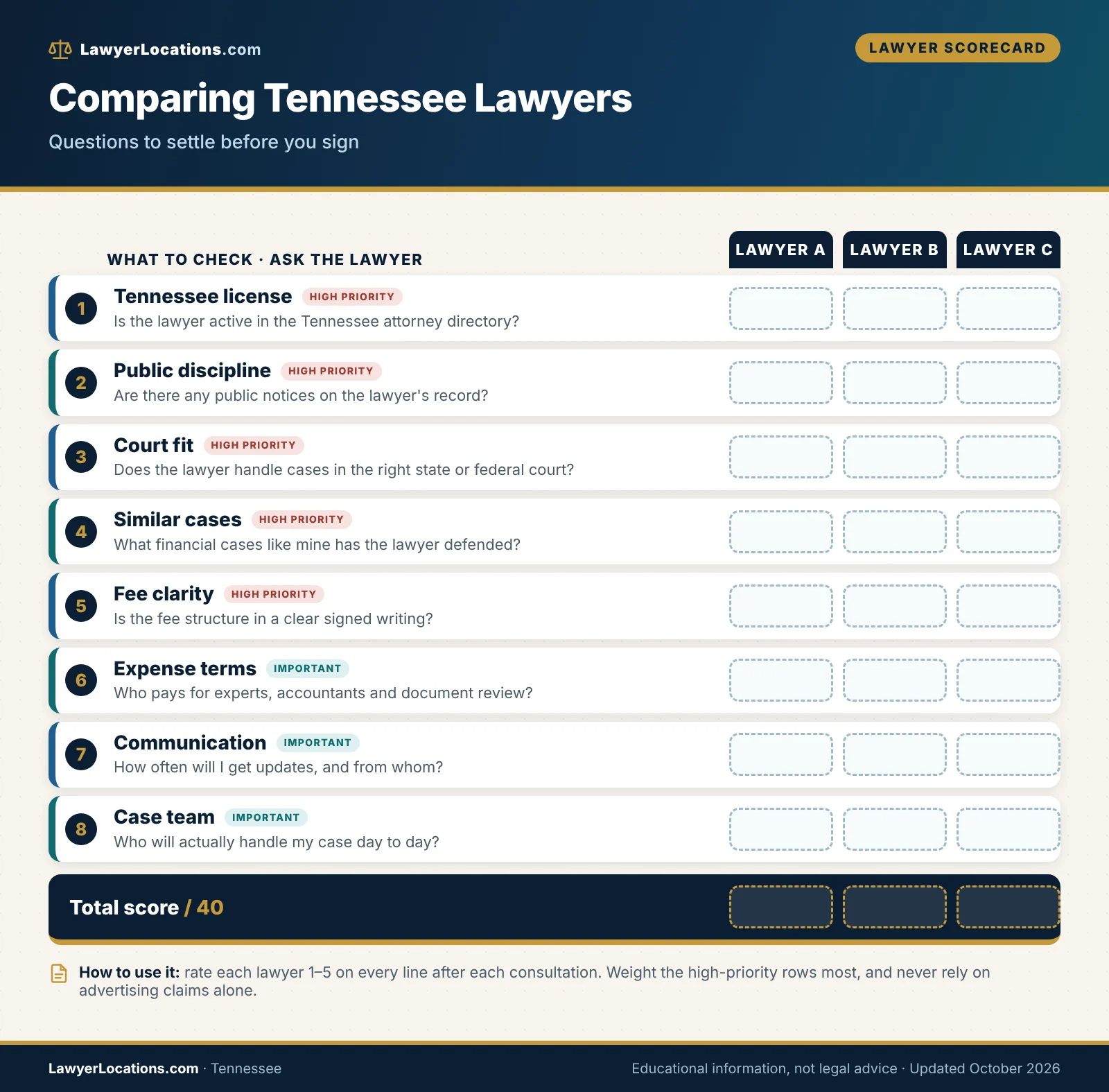
Text version of this graphic
- Tennessee license: is the lawyer active in the Board of Professional Responsibility directory?
- Public discipline: are there any informational releases?
- Court fit: does the lawyer handle cases in the state or federal court that matters here?
- White collar experience: what similar financial cases has the lawyer defended?
- Fee clarity: is the fee structure in a clear writing, including nonrefundable terms?
- Expenses: who pays for experts, accountants and document review?
- Communication: how and how often will the lawyer update you?
- Team: who will actually handle your case day to day?
Prepare for the consultation
A first meeting goes better when you arrive organized. Because white collar cases turn on documents, the more you can bring, the sooner a lawyer can give you a realistic picture.
Documents to gather
Bring anything you received from investigators or the court, plus the records that tell the financial story. Do not alter or reorganize original documents; make copies and keep the originals safe.
- Any subpoena, target or subject letter, search warrant, summons, charging document or court notice.
- Names and contact information of agents or investigators who contacted you, with dates.
- Bank, credit card and payment-app statements relating to the issue.
- Contracts, invoices, expense reports, payroll or bookkeeping records.
- Emails and messages about the transactions (do not delete anything).
- Company policies, job descriptions and approval chains.
- Tax returns and accountant correspondence for the relevant years.
- A written timeline of events, written for your lawyer only.
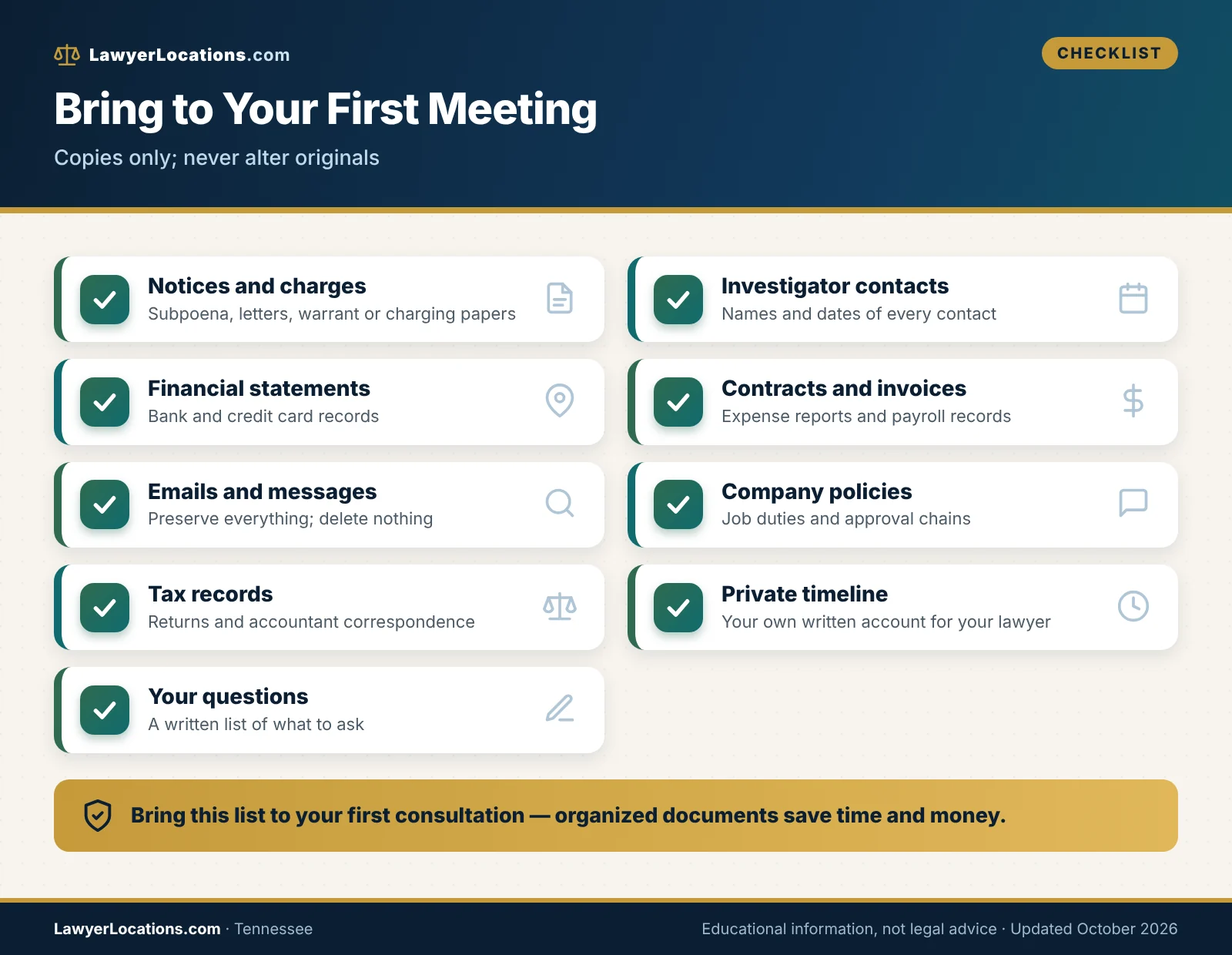
Text version of this graphic
- Subpoena, letter, warrant or charging document.
- Investigator names and contact dates.
- Bank and credit card statements.
- Contracts, invoices and expense reports.
- Emails and messages (preserve, do not delete).
- Company policies and approval chains.
- Tax returns and accountant correspondence.
- Your private timeline of events.
- A list of questions for the lawyer.
Questions to ask
Use the consultation to learn how the lawyer works, not only what they charge. The following questions help you compare lawyers on the same footing.
- Do I need a lawyer who handles state cases, federal cases, or both?
- What are the likely first steps and the next hearing date?
- How will you structure your fee, and what does it cover?
- Are expert and investigator costs included or billed separately?
- Who on your team will work on my case, and who will I talk to?
- Could my statements to an employer, auditor or regulator affect the case?
- What would a plea mean for my job, license and restitution?
Our guide to a criminal defense lawyer consultation offers a broader question list, and our overview of felony defense from arraignment through trial explains the court stages in more depth.
Red flags and good signs
Few decisions feel as high stakes as choosing a lawyer when your livelihood is at risk. A short list of signals can help you tell a thorough lawyer from a hasty one.
Warning signs
These patterns suggest you should keep looking or at least ask more questions.
- A promise of a specific outcome or a guaranteed result.
- An offer to work for a percentage of the result in a criminal case, which Tennessee RPC 1.5(d)(2) does not allow.
- No written fee agreement, or one that does not explain nonrefundable amounts.
- Advice to ignore a subpoena or to “handle it yourself” with investigators.
- Refusal to say who will do the work or how you will be updated.
Good signs
- The lawyer explains both the best and worst realistic outcomes.
- The fee agreement is in writing and you understand each term.
- The lawyer asks detailed questions about the documents and timeline.
- You know who your contact is and when you will hear back.
- The lawyer dismisses the case before reviewing the records.
- You feel pushed to decide the same day.
- Costs for experts and accountants are left vague.
- The lawyer has no stated experience in the relevant court.
A good lawyer is also honest about what they do not yet know. Expect “I need to see the documents” before any strategy.
Deadlines, Mistakes to Avoid and Next Steps
The most useful next steps are to stop discussing the matter with investigators, preserve every record, and get a consultation with a Tennessee lawyer licensed for the right court. The sections above explain the deadlines; this section ties them to decisions you will face and the mistakes that most often make a hard situation worse.
Key decision points
Most white collar matters have a handful of moments where a decision shapes everything that follows. Knowing them in advance lets you prepare rather than react.
Early investigation decisions
If you get a subpoena or request for an interview, the early decisions are whether to respond, how, and through whom. A lawyer may arrange a lawyer-led presentation, negotiate the scope of a document request, or advise you not to answer questions at all. Making those choices before any statement is given keeps your options open.
If a company is involved, ask whether the company’s lawyer represents you personally or only the company. The answer can change how you should handle internal interviews.
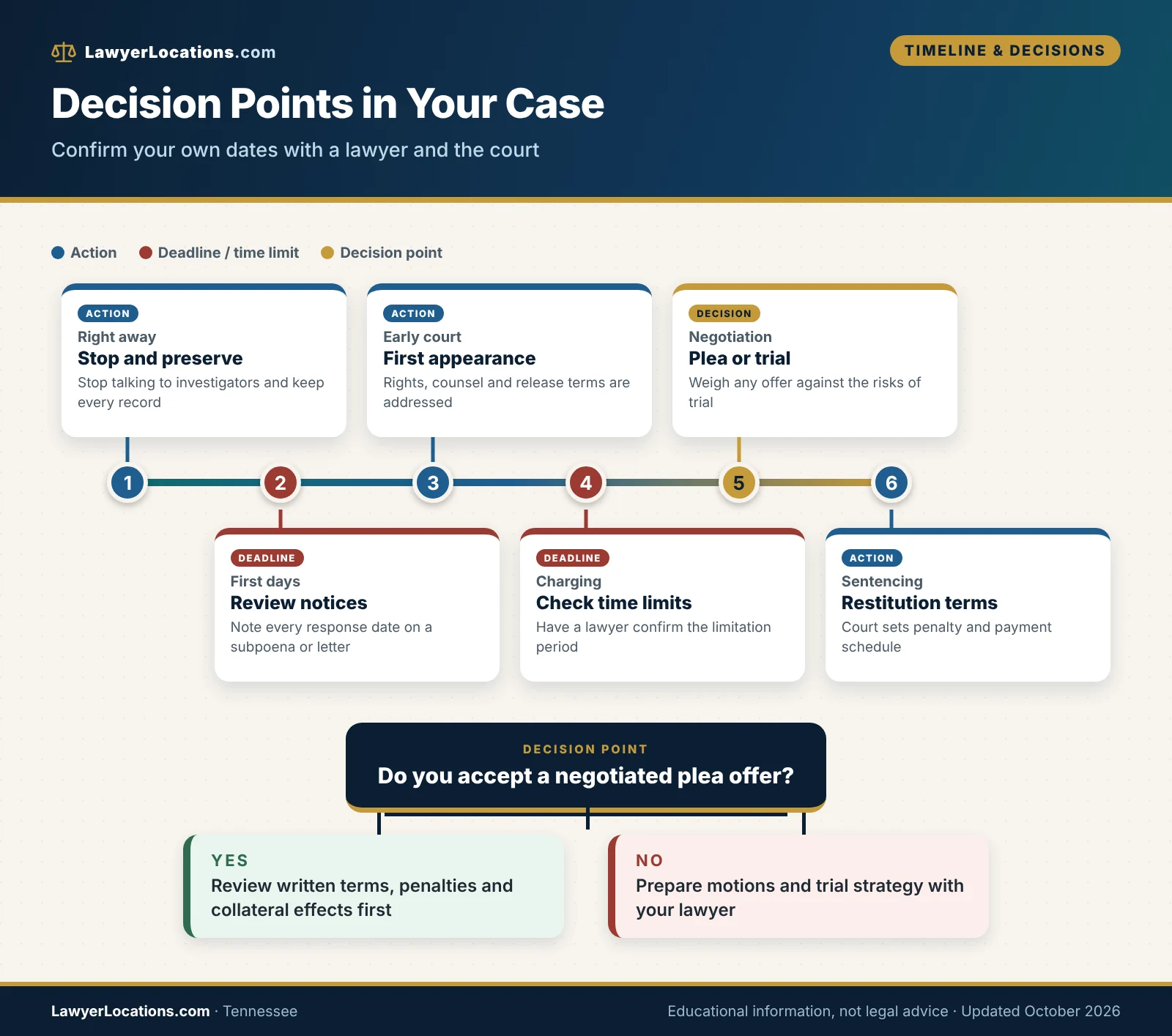
Text version of this graphic
- Right away: stop talking with investigators, preserve records, and call a lawyer.
- Days 1 to 14: consult a Tennessee lawyer and review any subpoena or notice for response dates.
- Early court stage: initial appearance, release conditions, and (for state felonies) a preliminary hearing within the rule’s timeframe.
- Charging stage: a grand jury may return an indictment; confirm the limitation period for your offense.
- Negotiation stage: decide whether to accept a plea offer or prepare for trial.
- Sentencing stage: restitution and sentence are set.
- Decision point: do you accept a negotiated plea or go to trial?
Plea or trial
If the State or the federal government makes a plea offer, you decide whether to accept it. A lawyer should explain the charge, the sentencing range, the restitution amount, and the collateral effects, and then leave the decision to you.
Take the time you need within the offer’s deadline, and ask for the deadline in writing. A rushed plea is one of the more common regrets in these cases.
Common mistakes
Some mistakes are small on their own but add up. Avoiding them is usually free.
What not to do
- Talking to agents, auditors or company investigators without a lawyer.
- Deleting emails, shredding papers or “cleaning up” accounts after you learn of a problem.
- Contacting witnesses or co-workers to compare stories.
- Moving money or transferring assets in a way that looks like hiding it.
- Posting about the matter on social media.
- Assuming that repaying the money ends the criminal case.
Repayment can help in negotiations and at sentencing, but it does not by itself erase a criminal charge. Talk with your lawyer before sending any money to a victim or an employer.
What to do instead
Preserve everything, write down what happened while it is fresh, and keep that account for your lawyer alone. Direct all inquiries to counsel, keep a calendar of every court or response date, and keep copies of every letter you receive.
If you were the one who spotted a problem at work and are worried about being blamed, a lawyer can also advise on whether and how to report it. Do not assume that a silent file is a closed file.
Next steps and where to look
You can move from worry to a plan in a few concrete steps. None of them require you to commit to a lawyer before you are ready.
A short action plan
- Stop and preserve. Do not discuss the matter with investigators, and keep all records exactly as they are.
- Read what you received. Note every date, agency name and response deadline on a subpoena or notice.
- Check licenses. Verify any lawyer you are considering in the Board of Professional Responsibility directory.
- Compare two or three lawyers. Use the scorecard questions and ask for the fee terms in writing.
- Ask about appointed counsel if needed. Raise it at your first court appearance, state or federal.
- Calendar the deadlines. Put hearing dates, response dates and plea deadlines in one place.
Resources to know about
The Tennessee court system’s website maintains a “Find a Lawyer” page that points to lawyer-finding and legal-help options. The Board of Professional Responsibility handles license verification. For federal matters, each U.S. Attorney’s Office posts its contact details on justice.gov.
If your matter also involves record clearing down the road, our overview of expungement lawyers and how record clearing works explains the general process. Eligibility depends on the offense and state law, so confirm with a Tennessee lawyer. To see how another state sorts crimes by class, compare our Idaho criminal defense lawyer guide.
Ready to compare your options?
Gather your documents, write down your questions, and speak with at least two Tennessee lawyers who handle the kind of court your case is in. A white collar crime lawyer in Tennessee should be able to explain, in plain language, which system is involved, what the deadlines are, and how the fee works, before you sign anything.
Frequently asked questions
These short answers cover questions people often ask when they search for a white collar crime lawyer in Tennessee. They are general information, not advice for your case.
Charges and investigations
Is white collar crime a separate charge in Tennessee?
No. Tennessee charges the underlying conduct, such as theft, forgery, identity theft, money laundering or a securities violation. The label describes a type of case rather than a specific statute.
What makes a theft a felony in Tennessee?
Value. Under § 39-14-105, theft of $1,000 or less is a Class A misdemeanor, and anything above that is a felony, graded from Class E up to Class A at $250,000 or more.
Can small thefts be added together?
Yes, if they arise from a common scheme. The statute allows the State to charge them as one count and add up the values.
How long can Tennessee wait to charge a felony?
The general periods run from two years for a Class E felony to 15 years for a Class A felony under § 40-2-101, with longer or special periods for some offenses. A lawyer can calculate the period for your situation.
Does the federal government have a different time limit?
Yes. The general federal period is five years, and certain bank-related fraud offenses have a ten-year period under 18 U.S.C. § 3293.
What is the difference between a target and a subject?
A target is someone prosecutors believe may be charged. A subject is someone whose conduct is within the scope of the investigation. These labels can change as the case develops.
Should I answer an investigator’s questions?
Speak with a lawyer first. You can politely decline an interview until you have counsel, and a lawyer can decide whether any statement helps you.
Lawyers and costs
Can a lawyer charge a percentage of my result in a criminal case?
No. Tennessee RPC 1.5(d)(2) bars a contingent fee for representing a defendant in a criminal case.
What is a nonrefundable fee?
It is a fee treated as earned when paid. Under RPC 1.5(f), it requires a writing signed by the client that explains its nature and amount.
How do I check that a lawyer is licensed in Tennessee?
Use the online attorney directory from the Board of Professional Responsibility. It shows license status and any public informational releases.
What if I cannot afford a lawyer?
Ask the court to appoint one at your first appearance. The magistrate must advise you of this right in a felony case, and federal courts have their own appointment process.
Will restitution end my case?
Not by itself. Repayment may help in negotiations and sentencing, but the court can still order restitution as part of a sentence, so coordinate with your lawyer before paying.
Can I have a conviction removed later?
Possibly, but eligibility depends on the offense and Tennessee law, and some offenses are excluded. Ask a Tennessee lawyer about record clearing before you accept a plea, not after.
General information only. LawyerLocations.com is a legal-education and lawyer-discovery resource, not a law firm. Reading this page does not create an attorney-client relationship, and nothing here is legal advice about your situation. Tennessee statutes, court rules and federal law change; confirm current law and local procedure with the court clerk and with a lawyer licensed in Tennessee before you act.
Sources & References
Show all 20 sources
- Tenn. Code Ann. § 40-2-101 (Limitations on felony prosecutions) — Justia (Tennessee Code) — law.justia.com — accessed October 2026
- Tenn. Code Ann. § 40-2-102 (Limitations on misdemeanor prosecutions) — Justia (Tennessee Code) — law.justia.com — accessed October 2026
- Tenn. Code Ann. § 39-14-105 (Grading of theft) — Justia (Tennessee Code) — law.justia.com — accessed October 2026
- Tenn. Code Ann. § 39-14-114 (Forgery) — Justia (Tennessee Code) — law.justia.com — accessed October 2026
- Tenn. Code Ann. § 39-14-150 (Identity theft) — Justia (Tennessee Code) — law.justia.com — accessed October 2026
- Tenn. Code Ann. § 39-14-903 (Money laundering) — Justia (Tennessee Code) — law.justia.com — accessed October 2026
- Tenn. Code Ann. § 48-1-123 (Criminal prosecution under the Tennessee Securities Act) — Justia (Tennessee Code) — law.justia.com — accessed October 2026
- Tenn. Code Ann. § 40-35-111 (Sentences for felonies and misdemeanors) — Justia (Tennessee Code) — law.justia.com — accessed October 2026
- Tenn. Code Ann. § 40-35-304 (Restitution) — Justia (Tennessee Code) — law.justia.com — accessed October 2026
- 18 U.S.C. § 3282 (Offenses not capital) — Cornell Legal Information Institute — law.cornell.edu — accessed October 2026
- 18 U.S.C. § 3293 (Financial institution offenses) — Cornell Legal Information Institute — law.cornell.edu — accessed October 2026
- Tennessee Rules of Professional Conduct, Rule 1.5 (Fees) — Court Rules (Tennessee Supreme Court Rule 8) — courtrules.net — accessed October 2026
- Tennessee Rules of Criminal Procedure, Rule 5 (Initial appearance) — Court Rules — courtrules.net — accessed October 2026
- Online Tennessee Attorney Directory — Board of Professional Responsibility of the Supreme Court of Tennessee — tbpr.org — accessed October 2026
- Tennessee Supreme Court Rule 13 (indigent defense) materials — Tennessee Administrative Office of the Courts — tncourts.gov — accessed October 2026
- Find a Lawyer — Tennessee State Courts — tncourts.gov — accessed October 2026
- Criminal Division — U.S. Attorney’s Office, Eastern District of Tennessee — justice.gov — accessed October 2026
- Office page — U.S. Attorney’s Office, Middle District of Tennessee — justice.gov — accessed October 2026
- Divisions — U.S. Attorney’s Office, Western District of Tennessee — justice.gov — accessed October 2026
- Court System (trial court overview) — Williamson County, Tennessee — williamsoncounty-tn.gov — accessed October 2026
Legal Disclaimer and Limitation of Liability
Informational and illustrative purposes only. This article was prepared by LawyerLocations.com solely on the basis of the information available to us at the time of writing. It is an illustrative, general overview. It is not a complete or authoritative statement of the law, and it has not been reviewed by a lawyer licensed in your state or county.
Not legal advice. Nothing in this article is legal, financial, tax or immigration advice, and reading it does not create an attorney-client relationship between you and LawyerLocations.com or any author, lawyer or firm mentioned. Laws, court rules, fees, filing deadlines and agency procedures differ by state, county and court, and they change often. Some details here may be simplified, incomplete or out of date, and time limits for legal claims can be short.
No warranty. We make no representation or warranty, express or implied, about the accuracy, completeness, timeliness or suitability of this content for your situation. Please do not rely on it to make, delay or skip any legal decision. Check the facts against official sources and speak with a licensed attorney in the relevant jurisdiction before you act.
Limitation of liability. To the fullest extent permitted by law, LawyerLocations.com and its owners, authors and contributors disclaim all liability for any loss, damage, cost or other consequence arising from the use of, or reliance on, this article, including any content on third-party websites we link to. Mentioning a lawyer, firm, organization or service is not an endorsement and is not a promise of any result. If you are in immediate danger, contact your local emergency number.