

If you are searching for a surgical error lawyer Missouri patients can trust to explain the rules before anyone signs anything, start with the clock. Under RSMo 516.105, most claims against Missouri surgeons, hospitals and other health care providers must be filed within two years of the act of neglect complained of, with narrow exceptions for retained foreign objects, missed test results and minors, and an outer limit of ten years.
This guide explains what counts as a surgical error in Missouri, the early court filing requirements, how damages caps work, what lawyers typically charge, and how to compare them. It is general information for Missouri readers, not advice about your situation.
What Missouri Law Treats as a Surgical Error
A surgical error claim in Missouri is a claim that a health care provider fell short of the accepted standard of care and that the shortfall caused harm. A disappointing result, a known complication or a surgery that simply did not work is not automatically an error. The legal question is what a careful provider would have done, and whether that was done.
Negligence, not just a bad outcome
Medical negligence is the legal label for care that falls below the standard of a reasonably careful provider. Missouri’s health care liability statute, RSMo 538.210, describes a statutory cause of action against a health care provider for personal injury or death, and its elements turn on whether the provider failed to use the degree of skill and learning ordinarily used in similar circumstances. That is a measured, evidence-driven test.
Why complications are not the same as errors
Every operation carries risks that can happen even when everyone does everything right: bleeding, infection, scarring, a reaction to anesthesia. If a patient was told about a risk in advance and it occurred despite proper technique, that alone generally does not make a case. A lawyer reviewing your situation will be looking for a departure from accepted practice, not simply an unwelcome result.
The two things a claim must connect
A viable claim links two points: the care was below standard, and that care caused the harm you are describing. The affidavit Missouri requires early in the case mirrors this by asking a qualified provider to say both that the defendant failed to use reasonable care and that the failure directly caused or contributed to the damages claimed.
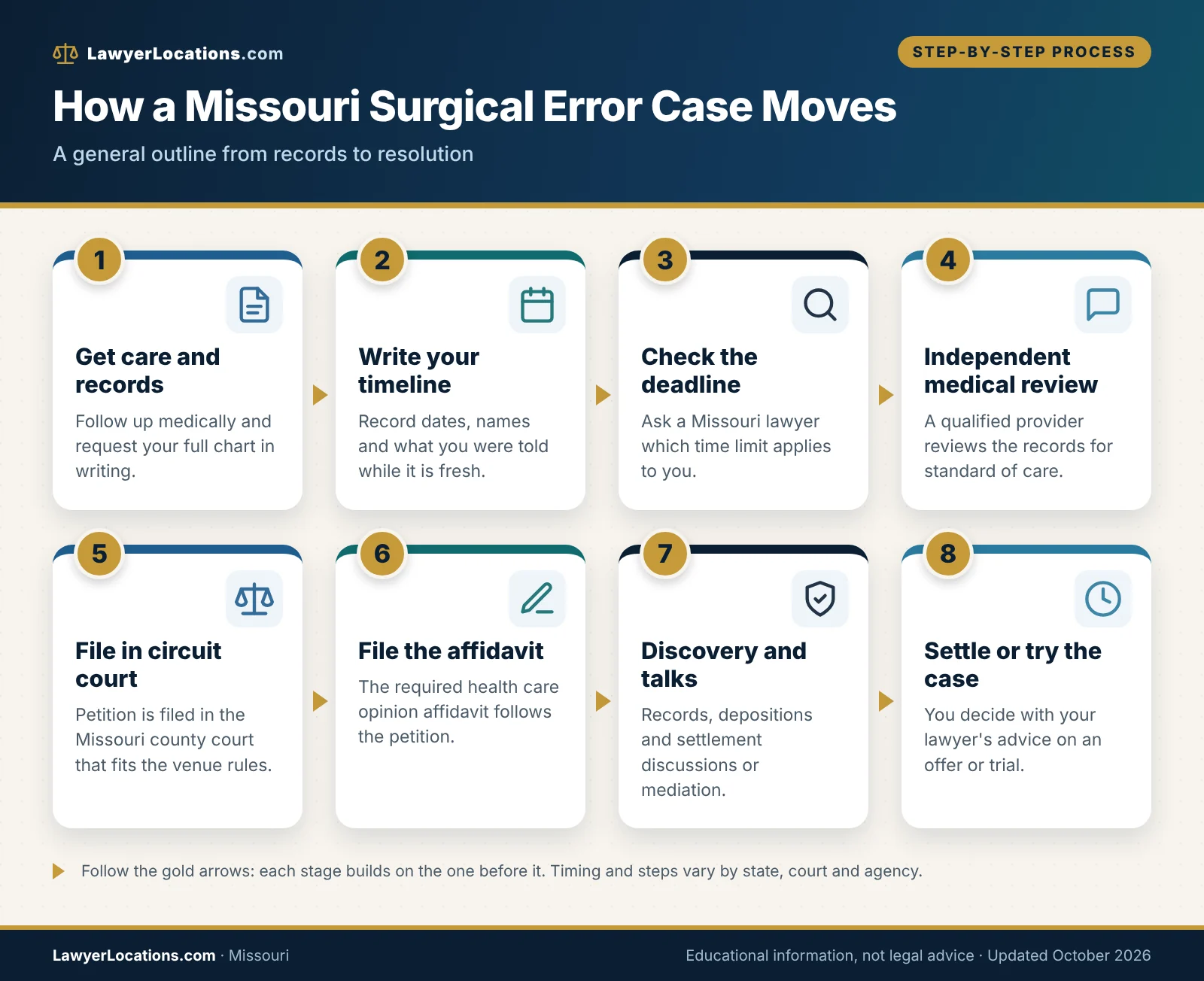
Text version of this graphic
- Get medical care and ask for your records.
- Write down what happened and when, while it is fresh.
- Talk with lawyers about a case review and the filing deadline.
- Independent medical review of the records by a qualified provider.
- File in a Missouri circuit court if the case moves forward.
- File the required health care affidavit within 90 days of the petition.
- Exchange evidence, take depositions and consider mediation.
- Settlement or trial.
standard of care means the level of skill and caution a reasonably careful provider in the same field would use in the same situation. It is judged against what was known and expected at the time, not with hindsight.
Who counts as a health care provider
The statute covers far more than the surgeon in the operating room. In Missouri, the definition in RSMo 538.205 reaches physicians, hospitals, ambulatory surgical centers, nurses, dentists, long-term care facilities and others who provide health care services under a license or certificate, including physicians-in-training. Knowing who falls inside the definition matters because it controls which special rules apply.
Surgeons, anesthesia teams and facilities
A single surgery can involve a lead surgeon, an assistant, an anesthesia provider, nurses, a surgical technician and a facility that employs some of them and not others. Each may have a different employer, a different insurer and a different role in what went wrong. A careful case review sorts out who did what before anyone decides whom to name.
Employees versus independent professionals
Missouri’s statute addresses vicarious liability: a provider whose liability is limited by Chapter 538 is generally not liable for the actions or omissions of another entity or individual who is not its employee. That makes the employment relationship a real issue when, for example, a surgeon is not a hospital employee. It is one of the first questions to raise with a lawyer.
Informed consent, wrong-site surgery and other serious events
Some surgical error claims are about what happened on the table. Others are about what was said, or not said, beforehand. Both can matter in Missouri, but they are proved differently.
Informed consent claims
A Missouri appellate court has explained that a claim of negligence in obtaining informed consent presupposes that the patient did consent to the procedure, and that such a claim ordinarily requires expert testimony about what risks a reasonable medical practitioner would disclose. A plaintiff must also show that a reasonable person in the patient’s position would not have agreed had the risks been properly disclosed. If a procedure was done with no consent at all, the legal theory is different.
Wrong patient, wrong body part and wrong procedure
Some errors are so clear that federal health insurance has a policy about them. The Centers for Medicare & Medicaid Services issued national coverage determinations (NCD 140.6, 140.7 and 140.8), originally effective in January 2009, stating that Medicare does not cover a wrong procedure, a procedure on the wrong body part or a procedure on the wrong patient. These are billing policies, not malpractice rules, but they show how seriously the system treats such events.
A hospital or surgeon admitting that a mistake happened does not erase your rights. Missouri’s RSMo 538.229 makes parts of statements expressing sympathy or benevolence inadmissible as an admission of liability, but a statement of fault can still be used. Kindness from a care team is not a sign a claim is weak, and it is not a waiver.
Missouri Deadlines: The Two-Year Clock and Its Exceptions
For most surgical error claims, Missouri gives you two years from the date of the act of neglect, not from the date you realized something was wrong. Exceptions exist, but they are narrow, and a ten-year outer limit applies in every case. This is the area where waiting costs people the most.
Under RSMo 516.105 the general period is two years from the date of the act of neglect complained of. Do not assume the clock starts when you discover a problem. If you think a deadline may be close, speak with a Missouri lawyer promptly, because a missed deadline usually ends the claim.
The general two-year rule
Section 516.105 applies to actions against physicians, hospitals, dentists, nurses, pharmacists, therapists, mental health professionals, other entities providing health care services and their employees. For a surgery, the clock typically points back to the date of the surgery or the specific act complained of.
What “act of neglect complained of” means
The statute measures the two years from the date of occurrence of the act of neglect complained of. In a case about a single mistake on one day, that date is usually clear. In a case about repeated visits or a course of treatment, the date can be harder to pin down, and courts have addressed how a continuing course of care affects the timing, so this is a point to review with a lawyer who handles these cases.
Why discovery usually does not move the date
Many people expect a “discovery rule,” meaning the clock starts when you learn of the injury. Missouri’s statute provides that kind of rule only in specific situations, listed in the next section. For other kinds of surgical mistakes, learning about the problem late can leave very little time.
Exceptions: foreign objects, test results and minors
Section 516.105 spells out three exceptions. They are written narrowly, and each has its own measuring point.
Retained foreign objects
When the claim is that a provider negligently allowed a foreign object, such as a sponge or instrument, to remain in a patient’s body, the two years run from the date the patient discovered the negligence or in the exercise of ordinary care should have discovered it, whichever is earlier. This is different from the general rule and is tied to the object being left inside.
Failure to inform a patient of test results
The statute also extends the period for claims that a provider negligently failed to inform a patient of the results of medical tests, measured from discovery or from when the patient should have discovered it, whichever is earlier. Special limits apply to tests performed before August 28, 1999. This exception is rare in surgical cases, but it can arise with pre-operative or biopsy results.
Minor patients
For a plaintiff younger than eighteen, the statute gives time until the twentieth birthday to bring the action. Parents and guardians should not assume this resets every other rule, and the ten-year outer limit has its own minor-related language, so a child’s case still deserves a prompt review.
| Situation | Time limit stated in the statute | Measured from |
|---|---|---|
| General surgical or hospital negligence | Two years | The date of occurrence of the act of neglect complained of |
| Foreign object left in the body | Two years | Discovery, or when the patient should have discovered it, whichever is earlier |
| Failure to tell a patient test results | Two years | Discovery, or when the patient should have discovered it, whichever is earlier |
| Patient under 18 | Until age 20 | The patient’s twentieth birthday |
| Outer limit for any claim | Ten years | The date of the act of neglect, with minor-related language in the statute |
The ten-year outer limit and wrongful death
Even the discovery exceptions run into a hard stop. Missouri’s statute says no health care malpractice action may be commenced after ten years from the act of neglect complained of.
The ten-year limit is strict
In Ambers-Phillips v. SSM DePaul Health Center, No. SC94322 (Mo. banc, April 28, 2015), the Missouri Supreme Court held that the ten-year period in section 516.105 is a statute of repose, meaning an absolute cutoff, and that it was not subject to equitable tolling. The plaintiff in that case sued within two years of finding foreign objects in her abdomen, but nearly fourteen years after the earlier surgery, and the case was dismissed. A dissenting judge disagreed, but the majority view is what governs.
Deaths after surgery
If a patient dies, Missouri’s wrongful death statute, RSMo 537.080, lists who may sue in priority order: first the spouse, children and parents, then siblings if no one in the first class can sue, and then a court-appointed plaintiff ad litem. The wrongful death limitations statute, RSMo 537.100, sets its own period, but how it interacts with section 516.105 for a death caused by medical negligence is a point to confirm with a lawyer. Until you have that answer, treat the two-year date as the safest working assumption. Families weighing costs can read our guide to wrongful death lawyer costs.
Write down three dates today: the date of the surgery, the date you first suspected a problem, and the date a provider first told you something went wrong. Those three dates are what a lawyer uses to start measuring deadlines. For a broader look at how state limits differ, see our guide to personal injury filing deadlines by state.
How a Missouri Claim Is Proven: Affidavit, Experts, Fault and Damages Caps
A Missouri surgical error case is built on qualified medical opinion, and the law asks for it almost immediately. After the affidavit, the case turns on expert testimony, how fault is divided among those involved, and a statutory limit on one category of damages.
The health care affidavit under RSMo 538.225
Missouri asks for qualified medical support almost at the outset of a case. The rule is in RSMo 538.225, and it applies to actions against health care providers for damages for personal injury or death.
What the affidavit must say
The plaintiff or the plaintiff’s attorney must file an affidavit with the court stating that they have obtained the written opinion of a legally qualified health care provider. That opinion must say the defendant failed to use the care a reasonably prudent and careful provider would have used, and that the failure directly caused or directly contributed to cause the damages claimed. The statute requires the affidavit to name the provider and describe their qualifications, and a separate affidavit is required for each defendant.
Who counts as a qualified provider
The statute describes a legally qualified provider as someone licensed in Missouri or another state, in the same profession as the defendant, and either actively practicing or retired within the last five years, with a specialty substantially the same as the defendant’s. This is why early record review by the right kind of clinician matters. A general opinion from someone in a different specialty may not satisfy the statute.
The affidavit is due within 90 days after the petition is filed. For good cause shown, a court may extend that by up to another 90 days. If the affidavit is not filed, the court must dismiss the action against the moving party on that party’s motion.
Missing the affidavit and the early review
The consequences of the affidavit rule are practical, and they affect how a lawyer sequences the work before filing.
What happens if it is late
Under the statute, dismissal for a missing affidavit is without prejudice, meaning the case can be refiled in principle. A dismissal without prejudice can still be a serious setback, though, if the time limits in section 516.105 have run in the meantime. The Missouri Supreme Court has held the 90-day affidavit requirement constitutional (Mahoney v. Doerhoff Surgical Service, 1991) and, in Giudicy v. Mercy Hospitals East Communities (2022), held that the requirement is not an affirmative defense that is waived if not pleaded in an answer, both as noted in the official annotations to the statute.
Judicial review of the opinion
A defendant may ask the court, within 180 days of the petition, to review the opinion privately. If the opinion is found deficient, a hearing follows. If the court finds no probable cause that a qualified provider would testify to medical negligence, it can dismiss the petition and may order the plaintiff to pay the defendant’s reasonable attorney fees and costs. That is another reason lawyers tend to obtain a full independent review before filing, not after.
Expert testimony and the standard of care
Most surgical questions are not within ordinary experience. Jurors cannot decide on instinct whether a surgeon should have chosen a different incision or whether a monitoring protocol was met. Expert witnesses fill that gap.
Why experts carry most cases
Beyond the affidavit, a Missouri surgical case is generally built on testimony from a clinician in the same field who can explain what the standard of care required and how the care in question differed. Retaining such a witness takes time and money, which is why case costs deserve a direct conversation with any lawyer you consider. Our overview of questions to ask before hiring a lawyer covers general consultation basics, and later sections here cover the surgical specifics.
Missouri’s reliability test for expert evidence
In most civil cases, RSMo 490.065 allows expert testimony from a qualified witness if it will help the trier of fact, rests on sufficient facts or data, is the product of reliable principles and methods, and reflects a reliable application of those methods to the facts. The 2017 version of the statute is the current one as of October 2026. A court can exclude an opinion that does not meet this test, so how an expert reached a conclusion matters as much as the conclusion.
Fault, apportionment and the patient’s own role
Few cases involve a single decision by a single person. Missouri law spells out how responsibility is divided.
Comparative fault
Missouri follows a comparative fault system created by the Missouri Supreme Court in Gustafson v. Benda, 661 S.W.2d 11 (Mo. banc 1983), under which a plaintiff’s own fault reduces recovery rather than automatically barring it. In Love v. Park Lane Medical Center, 737 S.W.2d 720 (Mo. 1987), a jury assessed 49 percent of the fault to a patient who allegedly failed to seek timely treatment after discharge, and damages were reduced accordingly. Following discharge instructions and attending follow-up visits protects both your health and your claim.
Several liability and the 51 percent line
Under RSMo 537.067, a defendant found to bear 51 percent or more of the fault can be held liable for the whole judgment against the defendants, while a defendant under 51 percent is liable only for the percentage the trier of fact assigns. The statute also says that no party may tell the trier of fact about this effect. In a case with a surgeon, an anesthesia provider and a facility, how that line applies is a question for the lawyer who knows the file.
Damages and the noneconomic damages cap
Missouri separates damages into economic and noneconomic categories, and only one of them is capped.
Economic and noneconomic damages
Under RSMo 538.205, economic damages are pecuniary harm, including medical costs, lost wages and lost earning capacity. Noneconomic damages are nonpecuniary harm such as pain, suffering, mental anguish, disfigurement and loss of consortium. The cap applies to noneconomic damages, not to economic damages, and punitive damages are defined separately.
The caps and what they are as of 2026
The Missouri Department of Commerce and Insurance publishes the adjusted figures. Senate Bill 239 (2015) set the starting amounts at $400,000 and $700,000, and the statute increases them by 1.7 percent each January. For 2026, the department lists the following.
| Type of claim | Starting amount (2015 law) | 2026 figure |
|---|---|---|
| Standard injury claim | $400,000 | $481,493 |
| Catastrophic personal injury | $700,000 | $842,614 |
| Death (wrongful death claim) | $700,000 in the statute | The statute applies the higher cap to actions for death; confirm the current figure with the department listing |
The statute defines catastrophic personal injury as a physical injury resulting in quadriplegia, paraplegia, loss of two or more limbs, certain permanent cognitive injury, irreversible failure of one or more major organ systems, or specified severe vision loss. After a verdict above the base cap, the trial court decides which limit applies based on the severity of the most severe injuries. Juries are not told about the cap.
How the cap reached its present form
This area has changed more than once. In Watts v. Lester E. Cox Medical Centers, 376 S.W.3d 633 (Mo. banc 2012), the Missouri Supreme Court held the earlier cap violated the right to a jury trial in Article I, Section 22(a) of the Missouri Constitution. In 2015 the legislature re-enacted caps by declaring a statutory cause of action for health care negligence. In Velazquez v. University Physician Associates, No. SC98977 (Mo. banc, July 22, 2021), the Court held that the statutory caps do not violate that provision, reasoning that Watts does not control a statutory claim. One judge dissented. We did not find a later Missouri Supreme Court decision changing that result as of October 2026, but caps are a well-litigated area, so ask your lawyer to confirm the current status.
A noneconomic damages cap limits how much a court will award for pain, suffering and similar losses, regardless of what a jury decides. It does not limit awards for medical bills or lost income.
If a judgment exceeds $100,000 in total, RSMo 538.220 lets a party ask that future damages be paid periodically rather than as a lump sum. In Williams v. Mercy Clinic Springfield Communities (Mo. 2019), the Supreme Court found that statute unconstitutional as applied to the patient in that case. Lawyers will address this when a case reaches settlement or judgment.
First Steps: Records, Evidence and Official Complaints
If you suspect a surgical error, your health comes first, and the paper trail comes second. The practical steps below keep your options open without committing you to anything.
Getting your medical records
Records are the backbone of any review. A lawyer and an independent reviewer will want the whole chart, not a summary.
Your right to see and copy your chart
Missouri’s RSMo 191.227 requires a provider to furnish a patient’s health history and treatment record on written request within a reasonable time of receiving the request. The statute caps what providers may charge for search, retrieval, copying and similar services and adjusts those fees annually. Federal health privacy rules also give patients a right to see and get a copy of their health records; the U.S. Department of Health and Human Services describes that right on its consumer pages.
What to request
Ask for the entire record, written in a request you date and keep a copy of. For a surgery, that usually means the following.
- The consent forms and any pre-operative education materials you were given.
- The operative report, anesthesia record, nursing notes and the surgical count record.
- Imaging, pathology and lab results before and after the procedure.
- Discharge instructions, follow-up notes and records from any later hospital or clinic that treated the problem.
- Billing records, which can help date and describe each service.
Evidence beyond the chart
The chart tells one side of the story. Your own notes, photos and costs tell the other.
Your own timeline
Write down who said what, on what day, and what you were told about risks, recovery and what went wrong. Memory fades faster than people expect, and a dated note made close to the event is easier for everyone to rely on. Do not edit it later; add new entries instead.
Photos, costs and the effect on daily life
Photograph visible injuries and surgical sites over time, keep receipts for out-of-pocket costs and travel, and keep a short log of missed work and daily limits. These details support the economic side of a claim, and they remind you later of how things actually were.
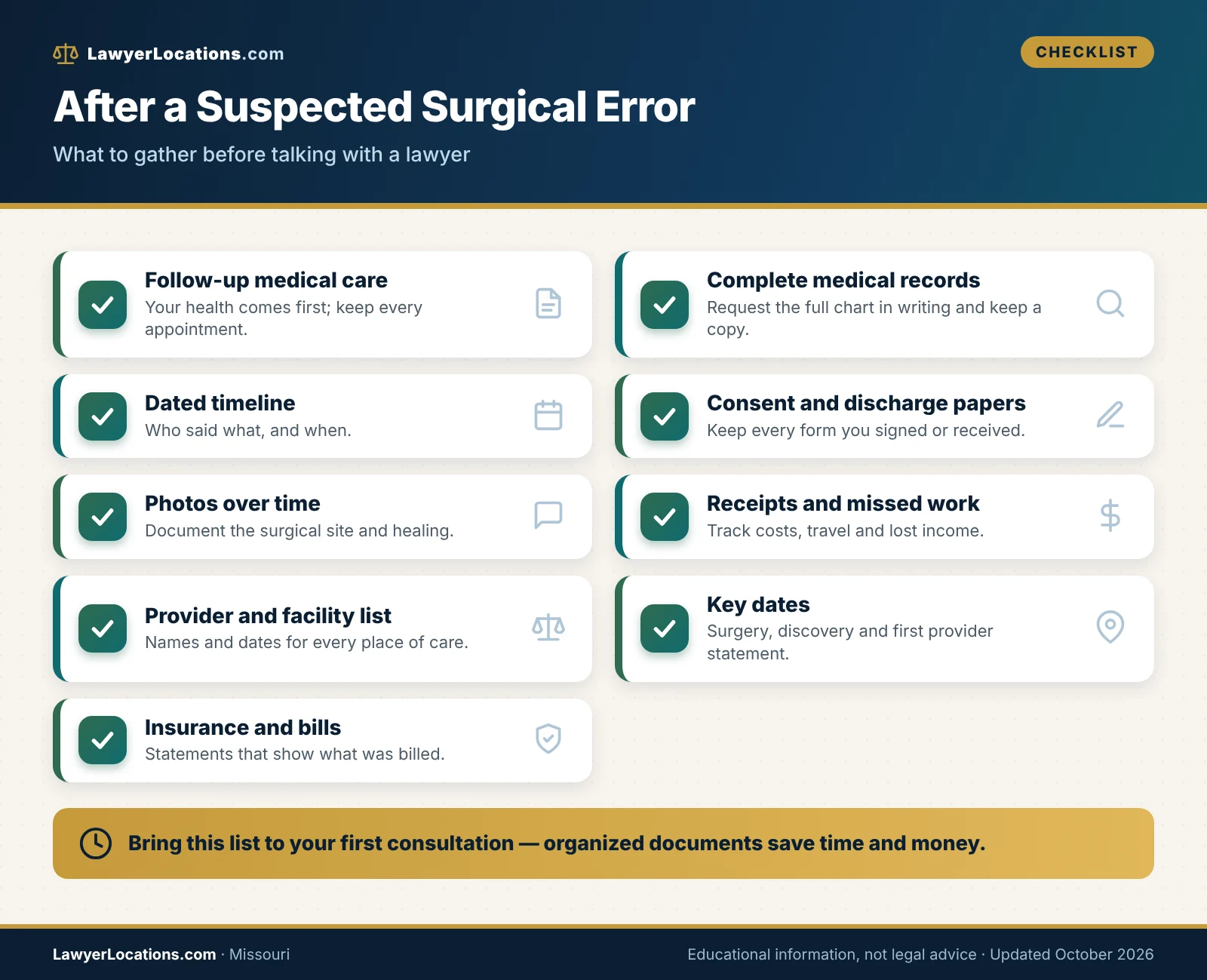
Text version of this graphic
- Get follow-up medical care first.
- Request your complete records in writing.
- Write a dated timeline of events.
- Save consent forms and discharge papers.
- Photograph injuries over time.
- Keep receipts and a missed-work log.
- List every provider, facility and date of care.
- Note the key dates for deadline questions.
- Gather your insurance and billing records.
Official complaints that run alongside a lawsuit
Missouri has several agencies that oversee providers. None of them awards money, and each answers a different question than a civil lawsuit does.
The Board of Registration for the Healing Arts
The Missouri State Board of Registration for the Healing Arts, part of the Division of Professional Registration, handles complaints about physicians and other licensees in its jurisdiction. Its complaint form states that the Board protects the public by taking disciplinary action against licensees, cannot award money or impose civil remedies, cannot give legal advice or help file a civil suit, and that filing a complaint does not preclude a separate legal action. A copy of your complaint goes to the licensee, so think about timing and ask your lawyer before you file.
Hospital and surgical center complaints
The Missouri Department of Health and Senior Services takes complaints about hospitals. Its page tells patients to bring a concern to the hospital first, through a patient care advocate or administration, and then to the department if the hospital does not resolve it. It does not address billing or payment disputes. Ask a lawyer how any complaint might interact with a lawsuit before you file it.
| Concern | Where it goes | What it can and cannot do |
|---|---|---|
| A physician’s conduct or competence | Missouri State Board of Registration for the Healing Arts | Can discipline a license; cannot award compensation or help you sue |
| Hospital care or safety | The hospital first, then Missouri Department of Health and Senior Services | Reviews complaints; does not address billing or payment disputes |
| Money for injuries and losses | Missouri circuit court, usually with a private lawyer | Only a civil case can seek damages, subject to the rules in this guide |
| A lawyer’s conduct | Missouri Office of Chief Disciplinary Counsel | Part of the Supreme Court’s lawyer discipline system |
Before you check a physician’s license status, note that the Division of Professional Registration directs licensee verifications through its MOPRO portal. A lawyer’s office can usually run these checks for you.
How to Compare Surgical Error Lawyers in Missouri
Choosing a lawyer for a surgical error case comes down to three things you can check: whether the lawyer is licensed and in good standing, whether they handle medical negligence cases and can fund the expert work, and whether the fee agreement is clear. LawyerLocations.com is not a law firm and does not rank or recommend lawyers, so the tools below are meant to help you do your own comparison.
Where to find and verify Missouri lawyers
Start with official or bar-run directories, then verify what you find. Anyone can buy an advertisement, but only the Supreme Court of Missouri decides who is licensed.
Bar and court resources
The Missouri Judiciary’s “Finding a Lawyer” page lists several starting points: The Missouri Bar’s LawyerSearch tool, which is searchable by practice area or location and lists lawyers in good standing who are accepting new clients, as well as local bar association referral resources, including the Bar Association of Metropolitan St. Louis, the Kansas City Metropolitan Bar Association and the Springfield Metropolitan Bar Association. It also lists MissouriLawyersHelp.org for free searching and information about low-cost options.
Confirming license and discipline
The Official Missouri Directory of Lawyers shows each lawyer’s name, city and bar number, lists lawyers in good standing, and also lists inactive lawyers, who are not eligible to practice law in Missouri. It does not show discipline history. Discipline is handled through the Office of Chief Disciplinary Counsel, and the Supreme Court posts its discipline orders and opinions online dating back to 2006; informal resolutions such as diversions and admonitions do not go to the Court and produce no public orders.
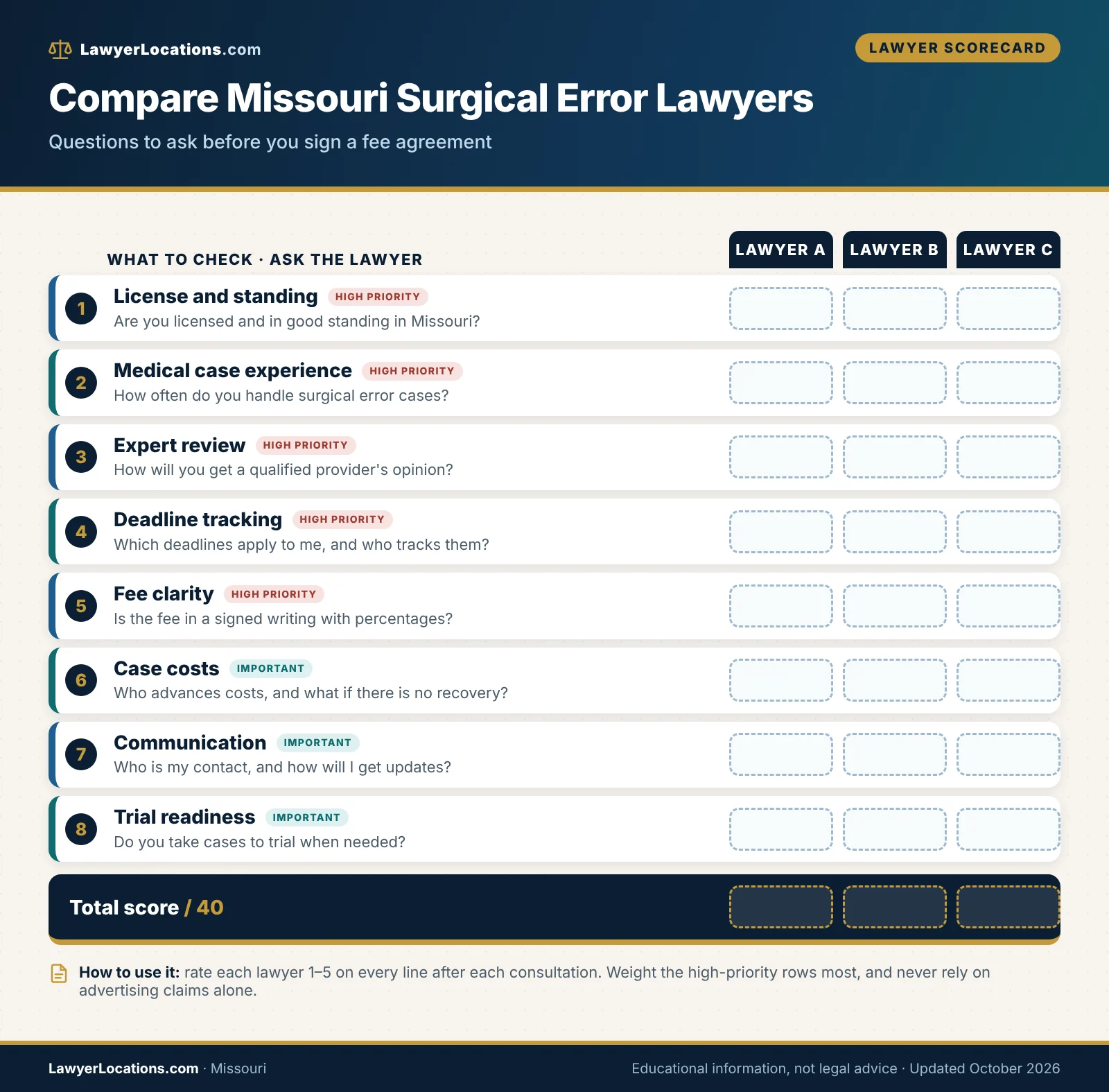
Text version of this graphic
- License and standing: Is the lawyer in good standing in the Official Missouri Directory of Lawyers?
- Medical negligence experience: How many surgical or medical cases has the firm handled, and what stage did they reach?
- Expert review: How will the firm get an independent clinician’s opinion before filing?
- Deadline awareness: Which deadlines apply to my situation, and who tracks them?
- Fee clarity: Is the fee in a signed writing with percentages and expenses explained?
- Case costs: Who advances costs, and what happens to them if there is no recovery?
- Communication: Who will I talk to, and how often will I get updates?
- Trial readiness: Does the firm try cases, or only settle them?
What to look for in a medical negligence lawyer
Surgical cases are document-heavy, expert-driven and expensive to prepare. These are not the cases that every injury lawyer takes, and it is fair to ask direct questions.
Experience with this kind of case
Ask how many medical negligence cases the lawyer has handled, whether surgical cases are a regular part of the practice, and what stages those cases reached. A confident lawyer can describe the process without bragging about results. Be wary of any answer that treats a surgical case like a car accident claim.
Ability to fund and use expert review
Because Missouri requires a qualified provider’s written opinion early in the case, ask how the firm obtains that review, what it costs, and who pays if the reviewer says there is no case. A lawyer who tells you plainly when a case is not viable is doing you a favor, even if it is disappointing.
Communication and who works the file
Find out who will be your day-to-day contact, how quickly questions get answered, and whether the lawyer you meet at the consultation will be the lawyer handling your case. Avoid promises about timing, and expect honest ranges instead.
| Topic | Question to ask | A clear answer sounds like |
|---|---|---|
| Standing | Are you licensed in Missouri and in good standing? | A bar number you can check yourself |
| Case type | Do you handle surgical error cases regularly? | A plain description of past work without promises about yours |
| Deadlines | What deadlines apply to my case, and when? | A specific date range tied to the surgery date, and who tracks it |
| Experts | How will you get the required medical opinion? | A process, a likely timeline and who pays for the review |
| Fees | What percentage applies at each stage? | A written percentage for settlement, trial and appeal |
| Costs | Are expenses deducted before or after your fee? | A direct answer that matches the written agreement |
| Updates | How will I hear about progress? | A named contact and a realistic schedule |
Reading advertising and specialization claims
Marketing for medical negligence work can be loud. A few rules help you read it.
What Missouri’s rule says about “specialist”
Under Rule 4-7.4 of the Missouri Rules of Professional Conduct, a lawyer may state that they practice in particular fields of law. A lawyer may not state or imply that they are a specialist unless the communication includes a disclaimer that neither the Supreme Court of Missouri nor The Missouri Bar reviews or approves certifying organizations or specialist designations. Exceptions apply for patent attorneys and admiralty practice. In short, a badge or board name does not mean the state has vetted it.
Red flags to take seriously
The flags below do not prove bad intent, but each deserves a second look before you sign.
- Pressure to sign at the first meeting, or a claim that you must decide today.
- A promise of a result, a case value or a timeline.
- A fee that is only described aloud, or an agreement you cannot take home to read.
- No clear answer about who pays for expert review and case costs.
- A firm that cannot explain the 90-day affidavit rule or the two-year deadline in plain terms.
- An outreach call or message from someone you did not contact, shortly after your surgery.
Preparing for the consultation
A focused first meeting makes the review faster and keeps costs down.
What to bring
Bring a one-page timeline, the key dates (surgery, discovery, first provider statement), your list of providers and facilities, and any records you already have. If you are unsure what to include, a partial set is fine; a lawyer can request the rest with your written permission. For a broader checklist, see our guide to questions to ask before hiring a lawyer, which applies to any practice area.
What to avoid saying and signing
Do not sign a broad medical-records authorization for a hospital or insurer before you understand what it covers. Be cautious about posting on social media, and keep your own notes factual. The apology statute, RSMo 538.229, protects only expressions of sympathy or benevolence, so statements about fault may still be used.
Fees, Case Costs and Decision Points
Many injury lawyers, including those who handle surgical error claims, work on a contingent fee, meaning the lawyer is paid from a recovery. Missouri’s professional conduct rules govern how that agreement must look, but they do not set a percentage.
How contingent fees work in Missouri
A contingent fee depends on the outcome. In a surgical error case, that can mean a long time before any recovery, which is part of why the paperwork matters.
What Rule 4-1.5(c) requires
Missouri’s Rule 4-1.5(c) requires that a contingent fee agreement be in a writing signed by the client. The writing must state the method by which the fee is determined, including the percentage that goes to the lawyer in the event of settlement, trial or appeal, which litigation and other expenses will be deducted from the recovery, and whether expenses are deducted before or after the fee is calculated. It must also tell the client about expenses they could owe whether or not they win.
Reasonableness and the closing statement
Under Rule 4-1.5(a), any fee must be reasonable, and the rule lists non-exclusive factors for deciding that. When the matter concludes, the lawyer must give the client a written statement of the outcome that, if there is a recovery, shows the client’s remittance and how it was calculated. Keep it with your records. Rule 4-1.5(d) bars contingent fees in certain domestic relations and criminal matters, but not in a civil injury claim.
No amounts or percentages in this guide are Missouri “averages.” We have not found an official source for typical fee percentages, so any figure you see online should be treated as marketing. Compare written agreements instead.
Case costs in surgical cases
Fees and costs are different, and in medical cases the costs can be large.
What expenses often include
Costs commonly include fees for copying records, independent clinicians who review the file and testify, court filing and service charges, depositions and transcripts, and exhibits. The exact list and the amounts depend on the case. Ask for a written list of what the firm typically advances and how it handles unusually large expenses.
Before or after the fee
The order matters. If expenses are deducted before the fee is calculated, the lawyer’s percentage applies to a smaller number; if they are deducted afterward, the percentage applies to the gross recovery and expenses come out of what remains. Missouri’s rule requires the agreement to say which applies, so look for that sentence before signing.
| Term | Why it matters | Where to find it |
|---|---|---|
| Signed writing | The rule requires the client to sign the agreement | The first or last page of the agreement |
| Percentages by stage | Different percentages may apply to settlement, trial and appeal | The fee section |
| Expense list | Shows what the firm will advance and deduct | The costs section |
| Order of deductions | Changes the amount you receive | Look for “before” or “after” the fee |
| Expenses if no recovery | Rule requires disclosure of what you may owe even if you lose | The costs section |
| Closing statement | The rule requires a written statement at the end | Ask how it will be provided |
Fee disputes and decision points
A signed agreement is not the end of your options, and the case itself will bring several decisions.
If you disagree with a lawyer about fees
The Missouri Judiciary’s “Finding a Lawyer” page points to a Missouri Bar fee dispute resolution program for disagreements with a lawyer about fees. Start by asking for an itemized explanation in writing. If you have a conduct concern, rather than a fee disagreement, that is a matter for the Office of Chief Disciplinary Counsel.
Decision points as the case moves
Expect to make decisions at a handful of points: whether to hire after the consultation, whether to proceed once the independent review comes back, whether to file, whether to accept a settlement offer, and whether to go to trial or appeal. You are entitled to understand the reasoning before you decide at each one.
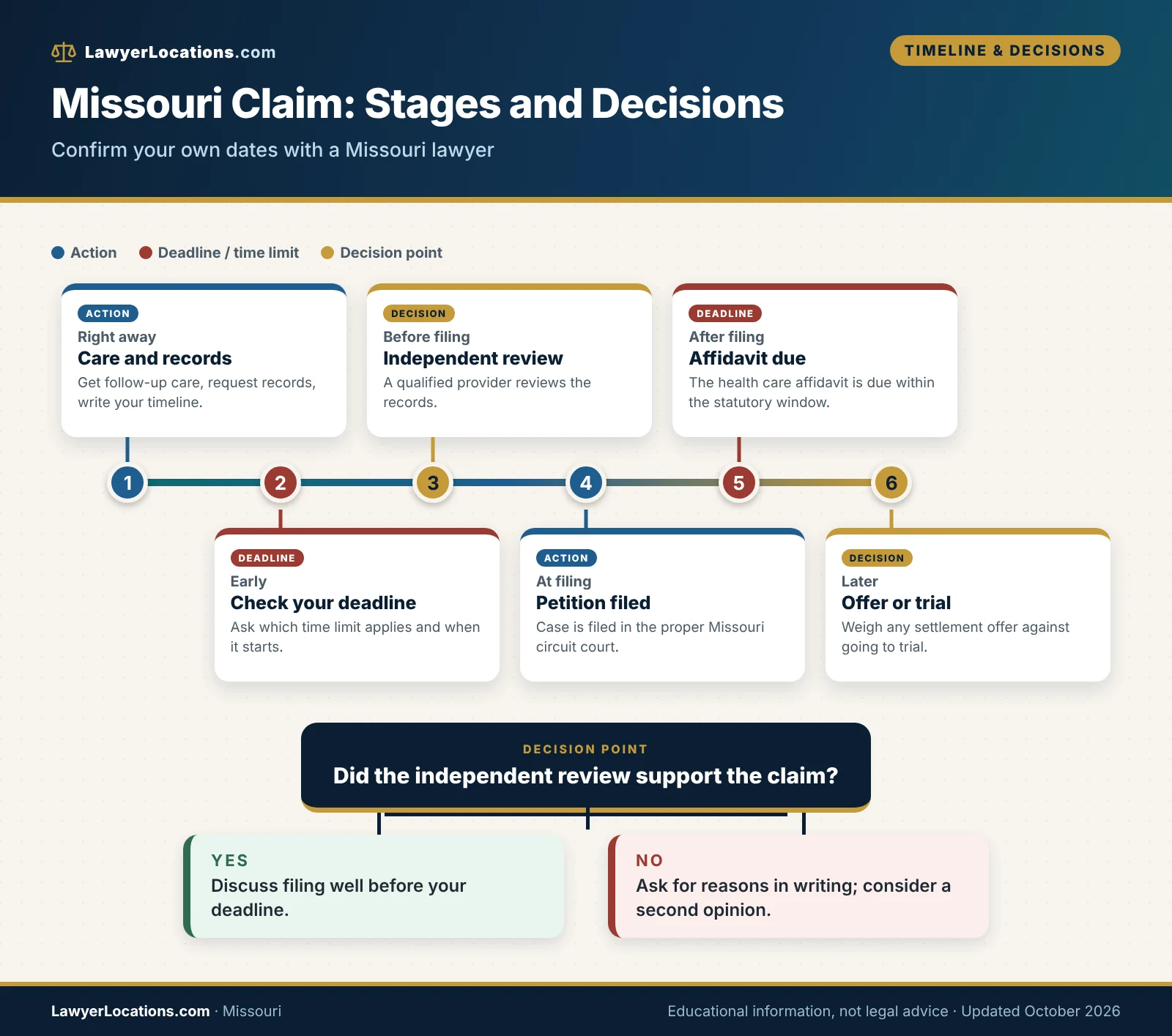
Text version of this graphic
- Right after surgery: get care, request records, write the timeline.
- Early: consult with lawyers and ask about the filing deadline for your situation.
- Before filing: independent review by a qualified provider.
- Filing: petition in a Missouri circuit court within the deadline.
- Within 90 days of filing: the health care affidavit is due (extension possible).
- Discovery and negotiation: records, depositions, mediation.
- Decision: accept a settlement offer or go to trial.
Decision question: has the independent review supported the claim? If yes, discuss filing before the deadline; if no, ask for the reasons in writing and consider a second opinion.
Missouri Courts, Major Cities and Next Steps
Surgical error claims in Missouri are filed in the state’s circuit courts, usually in the county where the patient was first injured. The big three metro areas each have their own circuit, and the details differ enough that it helps to know which one matters for you.
Where Missouri surgical error cases are filed
Missouri has a statewide system of circuit courts organized by judicial circuit, with each of the courts below covering a county or city. A health care negligence case is a civil case in that system.
Venue: the county where the injury happened
Under RSMo 508.010, when a tort is alleged and the plaintiff was first injured in Missouri, venue lies in the county where the plaintiff was first injured by the alleged acts or conduct. That ties many surgical cases to the county of the hospital or surgical center. The statute has separate rules for injuries that occur outside Missouri, and venue disputes are common enough that a lawyer should confirm where your case belongs.
Searching court records on Case.net
Case.net is the Missouri Judiciary’s public case search, at courts.mo.gov/cnet. You can look up cases by litigant name, case number or filing date, and the court states that it offers searching with no fees beyond Internet charges. The information is not considered an official court record, and confidential cases are not available. Reading prior filings in other cases can be informative, but it does not tell you how yours will go.
Kansas City, St. Louis and Springfield
The three largest metro areas sit in three different circuits. Each has its own courthouse and clerk, and each posts different information online.
Kansas City and Jackson County
Jackson County is the 16th Judicial Circuit. According to the circuit’s website, its courthouses include the Kansas City Courthouse and the Eastern Jackson County Courthouse in Independence, and the site links to civil records, forms, fees and an electronic filing portal for attorneys. A case in a Kansas City hospital would generally follow the venue rule above, which is why the county of the surgery matters more than where you live.
St. Louis city and St. Louis County
The City of St. Louis is the 22nd Judicial Circuit, and St. Louis County is the 21st Judicial Circuit; they are separate courts. The Missouri Judiciary’s page for the 22nd Circuit lists the Civil Courts Building and the Courts Building, and notes that civil cases pending as of June 5, 2006 or later are on Case.net, with older judgments checked at the Circuit Clerk’s Office. Because a hospital sits in either the city or the county, this is a real difference, not a technicality.
Springfield and Greene County
Greene County is the 31st Judicial Circuit. The Missouri Judiciary’s page for the circuit says the Circuit and Probate Divisions are at the Greene County Courthouse in Springfield and gives the Circuit Clerk’s office number for case information questions as 417-868-4074. Civil case information is online for public cases converted from the older system or filed on or after April 14, 2008.
| Metro area | Circuit | What the official pages confirm |
|---|---|---|
| Kansas City | 16th Judicial Circuit (Jackson County) | Kansas City and Independence courthouses; civil records, forms and e-filing pages |
| St. Louis (city) | 22nd Judicial Circuit (City of St. Louis) | Civil Courts Building and Courts Building; Circuit Clerk’s Office handles older civil judgments |
| St. Louis (county) | 21st Judicial Circuit (St. Louis County) | Separate circuit; included in the Missouri Judiciary’s remote public access schedule |
| Springfield | 31st Judicial Circuit (Greene County) | Greene County Courthouse; Circuit Clerk phone for case questions on the circuit page |
Common mistakes and next steps
Most of the avoidable trouble in surgical error matters comes from timing and paperwork, not from the medicine.
Mistakes to avoid
These are the missteps that cost people the most, based on the rules covered in this guide.
- Assuming the two-year clock starts when you learned of the problem, rather than on the date of the act complained of.
- Waiting for a hospital to “make it right” while time passes.
- Signing a release, settlement or broad records authorization before you understand it.
- Skipping follow-up care or discharge instructions, which can affect fault later.
- Treating a Board or Health and Senior Services complaint as a substitute for a lawsuit.
- Signing a fee agreement that does not state percentages, expenses and the order of deductions.
Questions people ask
Can a hospital be responsible for a surgeon who is not its employee?
Possibly, but it depends on the relationship. Missouri’s statute says a provider whose liability is limited by Chapter 538 is generally not liable for the actions of a non-employee, so the employment details matter. Ask a lawyer to sort out who employed whom.
Do I need a medical expert to start a case in Missouri?
Yes, in practice. RSMo 538.225 requires an affidavit that a legally qualified health care provider has given a written opinion supporting the claim, due within 90 days of filing the petition.
What if my family member died after surgery?
RSMo 537.080 lists who may bring a wrongful death claim, in order of priority. The deadline that applies to a death from medical negligence is worth confirming immediately with a lawyer.
What does it mean if a lawyer calls themselves a specialist?
Under Rule 4-7.4, the communication must carry a disclaimer that neither the Supreme Court of Missouri nor The Missouri Bar reviews or approves certifying organizations or specialist designations, except for patent and admiralty practice.
A practical path forward
If you are looking for a surgical error lawyer Missouri residents can compare on facts, work through the steps below in order. None of them commits you to hiring anyone.
- Get care and the records. Follow up with a provider you trust and request your full chart in writing.
- Write down the dates. Note the surgery date, the date you first suspected a problem and who told you what.
- Check the deadline. Assume the two-year period runs from the act complained of until a lawyer tells you otherwise.
- Verify lawyers. Use the Missouri Bar’s tools and the Official Directory of Lawyers to confirm good standing.
- Compare in writing. Ask for the fee agreement to take home, with percentages, expenses and the order of deductions.
- Decide at your own pace within the deadline. Do not sign anything you do not understand.
Ready to compare your options?
Gather your timeline and records, confirm the key dates, and compare more than one Missouri lawyer using the questions in this guide. Reading a page is not the same as hiring a lawyer, and nothing here creates an attorney-client relationship.
Sources & References
Show all 30 sources
- RSMo 516.105, Actions against health care providers: limitations — Missouri Revisor of Statutes — revisor.mo.gov — accessed October 2026.
- RSMo 538.205, Definitions (health care provider, damages terms) — Missouri Revisor of Statutes — revisor.mo.gov — accessed October 2026.
- RSMo 538.210, Statutory cause of action; noneconomic damages limits — Missouri Revisor of Statutes — revisor.mo.gov — accessed October 2026.
- RSMo 538.220, Periodic payment of future damages — Missouri Revisor of Statutes — revisor.mo.gov — accessed October 2026.
- RSMo 538.225, Affidavit of qualified health care provider — Missouri Revisor of Statutes — revisor.mo.gov — accessed October 2026.
- RSMo 538.229, Statements of apology or sympathy — Missouri Revisor of Statutes — revisor.mo.gov — accessed October 2026.
- RSMo 537.067, Several and joint liability — Missouri Revisor of Statutes — revisor.mo.gov — accessed October 2026.
- RSMo 537.080 and 537.100, Wrongful death — Missouri Revisor of Statutes — revisor.mo.gov — accessed October 2026.
- RSMo 490.065, Expert witnesses — Missouri Revisor of Statutes — revisor.mo.gov — accessed October 2026.
- RSMo 508.010, Venue in tort actions — Missouri Revisor of Statutes — revisor.mo.gov — accessed October 2026.
- RSMo 191.227, Patient access to medical records — Missouri Revisor of Statutes — revisor.mo.gov — accessed October 2026.
- Medical Malpractice Limits (noneconomic damages caps by year) — Missouri Department of Commerce and Insurance — insurance.mo.gov — accessed October 2026.
- Velazquez v. University Physician Associates, No. SC98977 (Mo. banc July 22, 2021) — Supreme Court of Missouri — courts.mo.gov — accessed October 2026.
- Ambers-Phillips v. SSM DePaul Health Center, No. SC94322 (Mo. banc April 28, 2015) — Supreme Court of Missouri (opinion text) — ott.law — accessed October 2026.
- Wuerz v. Huffaker, No. ED77427 (Mo. Ct. App. E.D. 2001) (informed consent) — Missouri Court of Appeals (opinion text) — ott.law — accessed October 2026.
- Love v. Park Lane Medical Center, 737 S.W.2d 720 (Mo. 1987), citing Gustafson v. Benda, 661 S.W.2d 11 (Mo. banc 1983) (comparative fault) — vLex case law summary — case-law.vlex.com — accessed October 2026.
- Rule 4-1.5, Fees — Supreme Court of Missouri, Rules of Professional Conduct — courts.mo.gov — accessed October 2026.
- Rule 4-7.4, Communication of Fields of Practice and Specialization — Supreme Court of Missouri — courts.mo.gov — accessed October 2026.
- Finding a Lawyer — Missouri Courts — courts.mo.gov — accessed October 2026.
- The Official Missouri Directory of Lawyers — The Missouri Bar — mobar.org — accessed October 2026.
- Ethics and Discipline — Missouri Courts — courts.mo.gov — accessed October 2026.
- Board of Registration for the Healing Arts complaint form — Missouri Division of Professional Registration — pr.mo.gov — accessed October 2026.
- Verification of Licensure — Missouri Division of Professional Registration — pr.mo.gov — accessed October 2026.
- Complaints Regarding Missouri Hospitals — Missouri Department of Health and Senior Services — health.mo.gov — accessed October 2026.
- Case.net and Case.net Public Inquiry — Missouri Courts — courts.mo.gov/cnet and courts.mo.gov — accessed October 2026.
- 16th Judicial Circuit (Jackson County) — Circuit Court of Jackson County — 16thcircuit.org — accessed October 2026.
- 22nd Judicial Circuit (City of St. Louis) and 31st Judicial Circuit (Greene County) pages — Missouri Courts — 22nd, 31st — accessed October 2026.
- Remote Public Access Implementation Schedule (circuit and county list) — Missouri Courts — courts.mo.gov — accessed October 2026.
- NCD 140.6, 140.7 and 140.8 (wrong surgical procedure, body part, patient) — Centers for Medicare & Medicaid Services — cms.gov — accessed October 2026.
- Guidance for consumers on the right to access health information — U.S. Department of Health and Human Services — hhs.gov — accessed October 2026.
General information only. This article is a legal-education resource from LawyerLocations.com, which is not a law firm and does not provide legal advice. Reading it does not create an attorney-client relationship. Laws, court rules, caps and agency procedures change, and your facts matter. Consult a lawyer licensed in Missouri about your situation, and confirm all deadlines yourself.
Legal Disclaimer and Limitation of Liability
Informational and illustrative purposes only. This article was prepared by LawyerLocations.com solely on the basis of the information available to us at the time of writing. It is an illustrative, general overview. It is not a complete or authoritative statement of the law, and it has not been reviewed by a lawyer licensed in your state or county.
Not legal advice. Nothing in this article is legal, financial, tax or immigration advice, and reading it does not create an attorney-client relationship between you and LawyerLocations.com or any author, lawyer or firm mentioned. Laws, court rules, fees, filing deadlines and agency procedures differ by state, county and court, and they change often. Some details here may be simplified, incomplete or out of date, and time limits for legal claims can be short.
No warranty. We make no representation or warranty, express or implied, about the accuracy, completeness, timeliness or suitability of this content for your situation. Please do not rely on it to make, delay or skip any legal decision. Check the facts against official sources and speak with a licensed attorney in the relevant jurisdiction before you act.
Limitation of liability. To the fullest extent permitted by law, LawyerLocations.com and its owners, authors and contributors disclaim all liability for any loss, damage, cost or other consequence arising from the use of, or reliance on, this article, including any content on third-party websites we link to. Mentioning a lawyer, firm, organization or service is not an endorsement and is not a promise of any result. If you are in immediate danger, contact your local emergency number.