
There is no single car accident settlement timeline that fits every crash. A small, clear-fault claim can resolve in a matter of months, while a serious-injury claim with a fault dispute can run for years. The biggest drivers are how long your medical treatment takes, whether fault is disputed, how much insurance is available, and whether the case has to go through a lawsuit. Rules about how fast insurers must respond, and how long you have to sue, are set by each state.
This national guide, current as of October 2026, walks through every phase from the crash to the check, explains liens, disbursement and taxes, and shows when a personal injury lawyer may be worth a conversation. It is general legal information, not advice for your claim.
The Car Accident Settlement Timeline at a Glance
A car accident settlement timeline runs from the crash through medical treatment, a demand to the insurer, negotiation, and (if talks fail) a lawsuit, until a release is signed and money is paid. Most of the calendar time is usually spent on treatment and negotiation, not on court. No official source publishes a single national average, so treat every duration you see online as a rough range.
Why no two timelines look alike
Each claim moves at the speed of its slowest part. Often that part is medical recovery, because a claim generally should not be valued until the doctors know how the injury will turn out. Other bottlenecks include a disputed version of the crash, limited insurance, several injured people sharing one policy, and the insurer’s own pace.
Settlement versus judgment
A settlement is an agreement between you and the at-fault side, usually paid by that driver’s liability insurer, in exchange for a signed release of the claim. A judgment is a court order after trial. Settlements are usually faster and more predictable, but you give up the right to ask for more once you sign.
Typical duration ranges by phase
The table below gives commonly described ranges, not official statistics. Real cases can fall outside every range shown. The duration column reflects general industry experience and should be checked against a current published source before this page goes live.
| Phase | What happens | Rough duration range |
|---|---|---|
| 1. Crash and claim opening | Report the crash, notify insurers, collect evidence, get first medical care | Days to a few weeks |
| 2. Treatment and recovery | Doctors treat the injury until you recover or reach a plateau | Weeks to many months; longer for surgery or permanent injury |
| 3. Demand package | Records, bills and wage proof are gathered and sent with a settlement demand | Several weeks after treatment ends |
| 4. Negotiation | Offers and counteroffers with the adjuster | Weeks to several months |
| 5. Lawsuit (if needed) | Filing, discovery, mediation, possible trial | Often a year or more; varies widely by court |
| 6. Release and payment | Sign release, insurer issues payment, lien payoff, disbursement | Roughly weeks; liens can add time |
The phases in order, from crash to check
Understanding the order helps you spot where a claim is stuck. Some steps overlap, such as gathering records while you are still treating.
- Get safe and get care. Medical attention comes first, and it also creates the earliest records linking injuries to the crash.
- Report and preserve. Report the crash as your state and policy require, photograph the scene and vehicles, and save everything.
- Treat until your doctors can describe the outlook. Valuing a claim before that point risks leaving out future care.
- Send a demand. A written package asks the insurer to pay a stated amount, backed by records.
- Negotiate. Offers move up and down until the sides agree or talks stall.
- Sue if talks fail or time is running short. A filed lawsuit opens formal discovery and a court schedule.
- Sign the release, resolve liens and receive funds. Reimbursement claims are paid before you see the remainder.
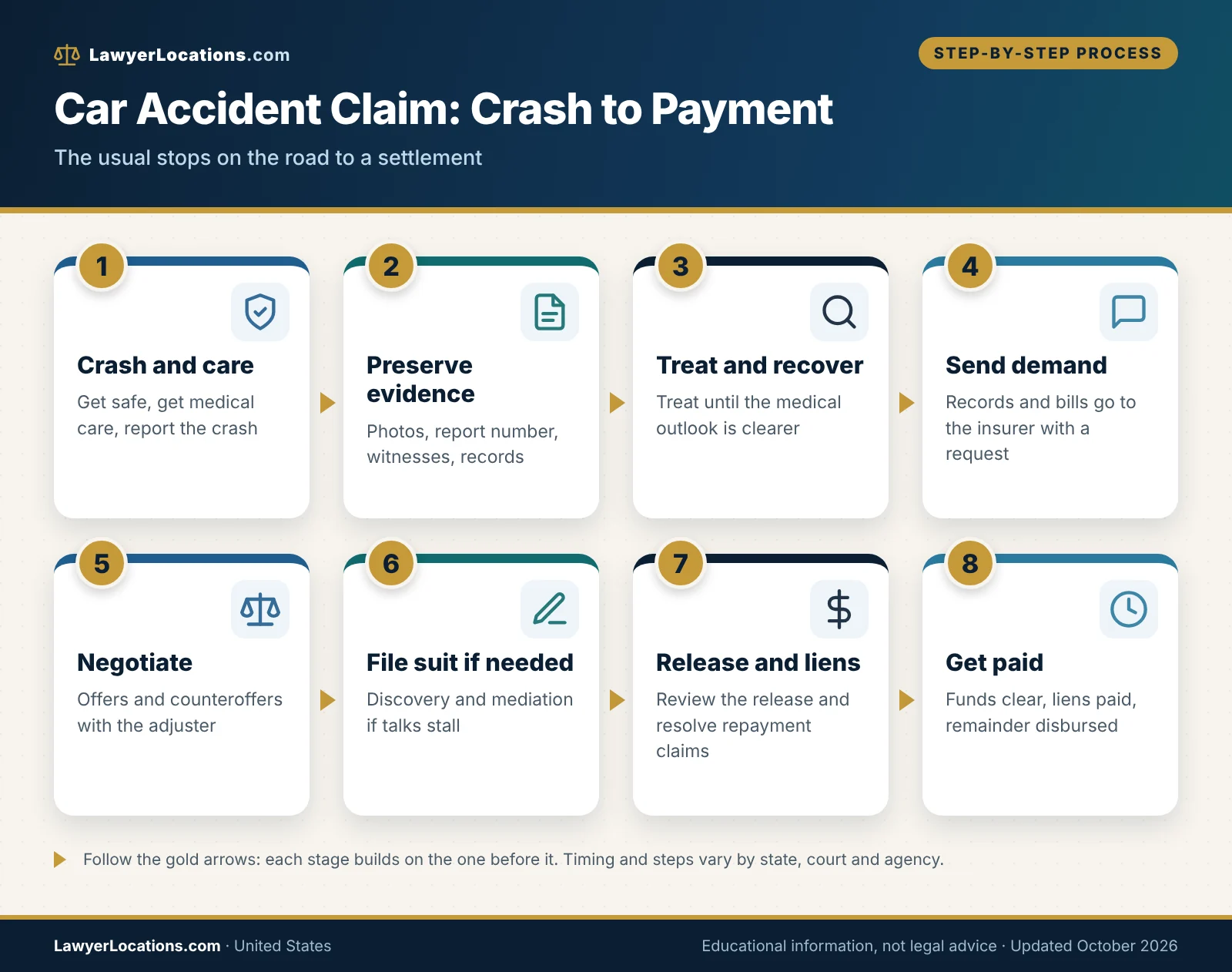
Text version of this graphic
- Crash, safety and first medical care
- Report the claim and preserve evidence
- Treatment until the outlook is clearer
- Demand package sent to the insurer
- Negotiation of offers
- Lawsuit, discovery and mediation if needed
- Release signed, liens resolved, funds disbursed
The pre-suit track
The pre-suit track is everything that happens before a court case is filed: claim notice, treatment, demand and negotiation. It is the quickest and cheapest route when the insurer accepts fault and the injuries are well documented. If the insurer pays a fair amount here, the case ends without discovery or a courtroom.
The lawsuit track
The lawsuit track starts when someone files a complaint in court. The insurer must then assign defense counsel, and the case follows a schedule: pleadings, discovery, mediation and, if needed, trial. Many cases still settle along the way, often after key depositions or a mediation session.
Every state sets a time limit for filing a car accident lawsuit, called a statute of limitations. It is not the same everywhere, and some situations (a government vehicle, a minor, a fatality) can change it. Do not let settlement talks run past the deadline in your state without confirming how much time is left.
A quick map of who pays and who decides
Knowing the players explains many delays. Several different payers can be involved in one crash, and each follows its own rules.
Liability, collision and first-party coverages
The at-fault driver’s liability insurance pays for injuries and damage that driver caused, up to the policy limit. Your own policy may add medical payments coverage, personal injury protection (PIP) in some states, collision coverage for your vehicle, and uninsured or underinsured motorist coverage. The mix differs by state, and some states use a no-fault system for the first layer of medical bills.
Adjusters, defense lawyers and your side
An adjuster is the insurance company employee who investigates and values a claim. Before a lawsuit, you deal with the adjuster. After filing, communication usually runs through defense counsel hired by the insurer. Their job is to resolve the claim for a figure the insurer finds acceptable, not to look out for you.
Treatment, Evidence and Maximum Medical Improvement
The first stretch of a claim is usually the longest, because it is controlled by your recovery rather than by paperwork. Most legal guides recommend waiting until your doctors can describe your outlook before putting a final number on a claim.
The first days and weeks
What you do early shapes the evidence that supports the claim later. The goal is a clear paper trail of what happened and how you were hurt.
Reporting the claim and talking to insurers
Policies and state laws generally expect you to tell your own insurer about a crash promptly. You may also be contacted by the other driver’s adjuster, who can ask for a recorded statement. You are generally not required to give one to the other side’s insurer, and a casual comment such as “I’m fine” can be quoted back if symptoms appear later.
Evidence worth saving right away
Evidence fades quickly: skid marks wash away, cameras overwrite footage, and memories blur. Save what you can while it is fresh.
- Photos and video of vehicles, the scene, road conditions and visible injuries
- The police report number and the other driver’s insurance details
- Names and contact information for witnesses
- Medical records, bills and a short symptom journal
- Proof of missed work and lost income
- Repair estimates and, if relevant, your phone and car data
Treatment and maximum medical improvement
Medical treatment is both the center of the injury claim and the main clock for the settlement timeline. The question the insurer and your lawyer are both asking is how bad the injury ultimately is and what it will cost over time.
What maximum medical improvement means
Maximum medical improvement (MMI) is the point where your condition has stabilized and further treatment is not expected to improve it much. It does not mean you are pain-free. It means your doctor can describe permanent effects, future care and work limits with some confidence. Not every injury reaches a formal MMI statement, and a minor soft-tissue injury may simply resolve.
When treatment is ongoing, many lawyers and adjusters wait to evaluate a claim. A settlement fixed too soon can leave you paying for surgery, therapy or medication out of your own pocket.
Why settling before treatment ends is risky
A release usually closes the claim for good, including problems you did not know about at signing. If a back injury later needs surgery, you generally cannot reopen a signed settlement. That is the main reason experienced advisers caution against accepting an early “quick” offer while symptoms are still changing.
An adjuster who offers a fast payment before you have finished treatment, or who asks you to sign a release “just to get your car paid,” may be asking you to close more than you realize. Read exactly which claims the paper releases before signing.
The flip side is real too. Gaps in care, or long delays between the crash and your first visit, give the insurer room to argue that something else caused your symptoms. Follow your doctor’s plan, keep appointments, and tell providers honestly how you feel.
Property damage, PIP and medical bills run on separate tracks
A crash often produces several claims at once, and they do not all move at the same speed. Keeping them apart avoids confusion and avoids releasing the wrong thing.
Vehicle damage usually resolves first
A property damage claim for repairs or a total loss is typically handled by an adjuster separate from the injury claim and often finishes within weeks. Resolving it does not normally end your injury claim, but check any paper you sign to confirm it covers only the vehicle.
Medical payments, PIP and health insurance
Some policies pay your early medical bills regardless of fault through medical payments or PIP coverage. In other places, your health insurance pays first. Those payers may later ask to be reimbursed from your settlement, which is covered in the lien section below.
The Demand Letter, Negotiation and Insurer Response Rules
Once treatment is complete or the outlook is clear, the claim shifts to a demand and negotiation. Insurers are bound by state claims-handling rules, but those rules vary by state and mostly set outer limits, not a promise of speed.
The demand package
The demand letter is the formal request to settle for a stated sum. It lays out the facts, the evidence of fault, your injuries and the money you have lost or will lose. A well-supported package gives the adjuster what they need to evaluate and makes it harder to delay on the ground that information is missing.
What a demand package usually includes
Packages vary, but most contain the same building blocks. Gathering them takes time, and waiting on a provider’s records is one of the most common causes of delay.
- A summary of how the crash happened and why the other driver is responsible
- Complete medical records and itemized bills
- Proof of lost wages and reduced earning ability
- Photos, repair records and witness statements
- A description of pain, limits on daily life and future care needs
- A stated amount and a reasonable time for the insurer to respond
Policy limits and time-limited demands
A policy limit is the most the insurer will pay on a coverage. If your damages clearly exceed the limit, a demand for the limit may be used, sometimes with a short response window. In some states, an insurer that unreasonably refuses a limits demand can face added exposure. The rules on that vary a great deal, so it is a question for a lawyer in your state.
How negotiation actually unfolds
Negotiation is usually a series of phone calls or letters over weeks to months. The first offer is often below what a claim is worth, and the process is expected.
Offers, counteroffers and insurer tactics
Adjusters commonly question medical necessity, point to gaps in treatment, argue that pre-existing conditions explain your symptoms, or suggest that you share fault. Some of these arguments are legitimate; some are bargaining positions. Ask for any denial or reduction in writing and ask what documents would change the evaluation.
Keep a simple claim log with date, person, and what was said or promised. If the insurer later says it never received something, your log and sent-message records answer the question.
Comparing coverage sources before you accept
Before you settle with the at-fault driver’s insurer for its policy limit, check whether your own underinsured motorist coverage may add to the recovery. Many policies require you to notify your insurer, and sometimes to get consent, before settling with the other driver. Skipping that step can put the extra coverage at risk.
Insurer response deadlines and prompt-pay rules
Many states have unfair claims practices laws and regulations that tell insurers how quickly they must acknowledge, investigate and pay. The details differ, and some apply differently to your own insurer than to the other driver’s insurer. The table shows two verified examples.
California’s fair claims regulations
California’s Fair Claims Settlement Practices Regulations, 10 CCR § 2695.1 et seq., set specific time limits. Under the regulations, an insurer generally must acknowledge a notice of claim within 15 calendar days, accept or deny a claim within 40 calendar days after receiving proof of claim, and, if it needs more time, send a written notice every 30 calendar days. After accepting a claim, it must tender payment within 30 calendar days. The regulations define “claimant” to include third-party claimants, and they bar an insurer from making an unreasonably low offer.
These are regulatory standards enforced by the state insurance department. Whether and how an individual claimant can enforce them is a separate legal question that a California lawyer can answer.
Florida’s settlement-payment statute
Florida Statutes § 627.4265 speaks to the end of the process. Once a settlement is reached, the insurer must pay no later than 20 days after the agreement, and a payment made late bears interest at 12 percent per year from the date of the agreement. If the insurer conditions payment on a release, interest starts when the executed release is tendered to the insurer.
The statute does not tell an insurer how fast it must make an offer in the first place. It covers the gap between “we agreed” and “the check arrives.”
| Topic | California (10 CCR § 2695.5, 2695.7) | Florida (Fla. Stat. § 627.4265) | Other states |
|---|---|---|---|
| Acknowledge claim | Within 15 calendar days of notice of claim | Not addressed in this statute | Varies; check your state insurance department |
| Accept or deny | Within 40 calendar days after proof of claim | Not addressed in this statute | Varies |
| More time needed | Written notice every 30 calendar days | Not addressed | Varies |
| Pay after agreement | Within 30 calendar days of acceptance | Within 20 days of settlement, or interest at 12 percent per year | Varies; some states set no fixed number |
| Release condition | Payment clock runs after a proper release where one is needed | Interest starts when executed release is tendered | Varies |
Prompt-pay rules do not set a maximum time for a whole claim, and they do not force an insurer to offer any particular amount. They mainly stop a claim from sitting untouched. If you believe an insurer is ignoring a deadline, you can usually file a complaint with your state’s department of insurance.
What Speeds Up or Slows Down a Settlement
A handful of factors explain most of the difference between a three-month claim and a three-year claim. Some are in your control, such as organized records and consistent treatment. Others, such as the insurer’s staffing or a court’s calendar, are not.
Injury and treatment factors
The nature of the injury sets the floor for how long a claim takes, because valuation depends on a medical picture that may take time to develop.
Injury severity and length of recovery
A minor injury that heals in weeks can often be valued once the bills are in. A fracture needing surgery, a spinal injury, a head injury or anything with lasting limits requires a longer view, including a doctor’s opinion about future care and work capacity. Children and teens raise special issues, since long-term effects may not show up for years, and court approval of a minor’s settlement is often required.
Treatment gaps, pre-existing conditions and records
Insurers pay close attention to a pre-existing condition, meaning a problem you had before the crash. Having one does not bar a claim; the law generally allows recovery when a crash aggravates an earlier condition. But it makes clear medical records more important, including records showing what your baseline was before the crash.
Liability, coverage and insurer factors
Even a well-documented injury can stall if the other side disputes fault or if there is not enough insurance to go around.
Disputed fault and shared fault
If both drivers may share blame, the claim usually takes longer, because the insurer will try to assign you a percentage of fault. States use different comparative negligence or contributory negligence rules, and under those rules a share of fault can reduce, or in a few places bar, a recovery. Which rule applies depends on where the crash happened.
Clear evidence helps most here: video, independent witnesses, traffic citations and vehicle data. For a common fault pattern, see our guide to rear-end collision claims.
Policy limits, multiple claimants and underinsured drivers
When several people are hurt and the at-fault driver’s coverage is limited, the insurer may need to sort out how to divide it, which can delay every claim. Likewise, a driver with minimum coverage and a seriously injured claimant often pushes the case toward underinsured motorist coverage and a second insurer. That means a second claim, with its own investigation and timeline.
| Factor | Tends to speed things up | Tends to slow things down |
|---|---|---|
| Injury | Minor injury, full recovery, clear records | Surgery, permanent limits, long rehab, uncertain future care |
| Fault | Clear liability, police report, video, admission | Disputed fault, conflicting witnesses, shared-fault arguments |
| Insurance | Adequate limits, one insurer, one claimant | Low limits, multiple claimants, underinsured or uninsured driver |
| Paperwork | Organized records sent in one package | Missing records, slow providers, repeated information requests |
| Insurer approach | Prompt evaluation and reasoned offers | Low first offers, repeated requests, delay while records are “reviewed” |
| Court | Case settles before filing or early in discovery | Crowded court calendar, many witnesses, expert disputes |
| Liens | Few or no reimbursement claims | Medicare, Medicaid, health plan or hospital liens that need payoff letters |
Waiting for money: advance funding cautions
Long timelines strain household budgets, and some companies offer cash against a pending claim. The offer can look like a lifeline. It also deserves a slow, careful read.
How pre-settlement funding works and what it can cost
Pre-settlement funding, sometimes called a lawsuit advance, is typically a non-recourse transaction. The company advances cash, and you repay it from any recovery; if the claim fails, you generally owe nothing. Because the company takes the risk, the charges can be high and may compound over time, so the repayment amount can grow quickly the longer the case takes. It is not a bank loan, and the pricing is not standardized.
Be cautious about any funding contract that does not state, in plain figures, the total you will owe at six months, twelve months and later. Ask for the full repayment schedule and the effective annual rate before you sign, and have a lawyer read the contract first.
State rules are changing
States regulate this industry unevenly. Some have disclosure and cancellation rules, some cap charges or require attorney acknowledgment, and others have little. As one example, Ohio’s older consumer litigation advance statute, R.C. 1349.55, required front-page disclosure of the amount advanced, the total repayable and the annual percentage rate, plus a five-business-day right to cancel. Ohio’s House Bill 105 repeals that section effective October 6, 2026 and enacts new rules in R.C. 1357.01 to 1357.10. The scope and consumer protections in Ohio’s new chapter should be confirmed against the enrolled text.
When a Lawyer Helps and How to Compare One
You are allowed to handle a straightforward claim yourself, and many people do. A lawyer tends to matter most when injuries are serious, fault is disputed, liens are large or the insurer stops responding. The right choice depends on the stakes and your comfort level, not on a rule.
When you may not need a lawyer, and when one can matter
The question is less about whether you are capable and more about what a mistake would cost. Release language, lien math and valuation of future care are the places mistakes are hardest to undo.
Claims people often handle on their own
A modest property damage claim, or a minor injury that fully resolved with a few weeks of treatment and no permanent effects, may be manageable directly with the insurer. Keep records, put requests in writing, and read any release carefully. If an offer covers your documented bills and lost time and you are comfortable with it, a lawyer’s fee may not add much value.
Situations where help can matter most
A consultation is worth considering in the following circumstances.
- Surgery, hospitalization, permanent impairment or a long absence from work
- Fault is disputed or the other side blames you
- The at-fault driver is uninsured, underinsured or was working at the time
- Medicare, Medicaid or a health plan is asking to be repaid
- The insurer has denied the claim, gone silent, or pressed you for a recorded statement or broad medical releases
- A death, or an injured child, is involved
When a crash causes a death, the rules on who can sue and for what are different; see our guide to wrongful death lawyer cost and what families should ask.
How personal injury lawyers are paid
Most car accident lawyers work on a contingency fee, meaning the fee is a percentage of the recovery and is owed only if there is one. That structure is common, but the percentage, the treatment of case expenses and what happens if the case goes to trial vary by lawyer and state. Do not assume.
What the fee agreement should say
The ABA Model Rules of Professional Conduct, which many states follow in some form, say that a contingent fee agreement must be in a writing signed by the client. It should state how the fee is calculated, including the percentage for settlement, trial or appeal, and which expenses are deducted from the recovery, and whether expenses come out before or after the fee is calculated (ABA Model Rule 1.5(c)). At the end of the case, the lawyer should give a written statement showing the outcome and how the client’s share was figured.
Fee math, with a plain example
The order in which fees and expenses are subtracted changes your net. The same gross settlement can leave you with different amounts depending on whether expenses are deducted before or after the percentage fee. Ask the lawyer to show you a worked example using round numbers.
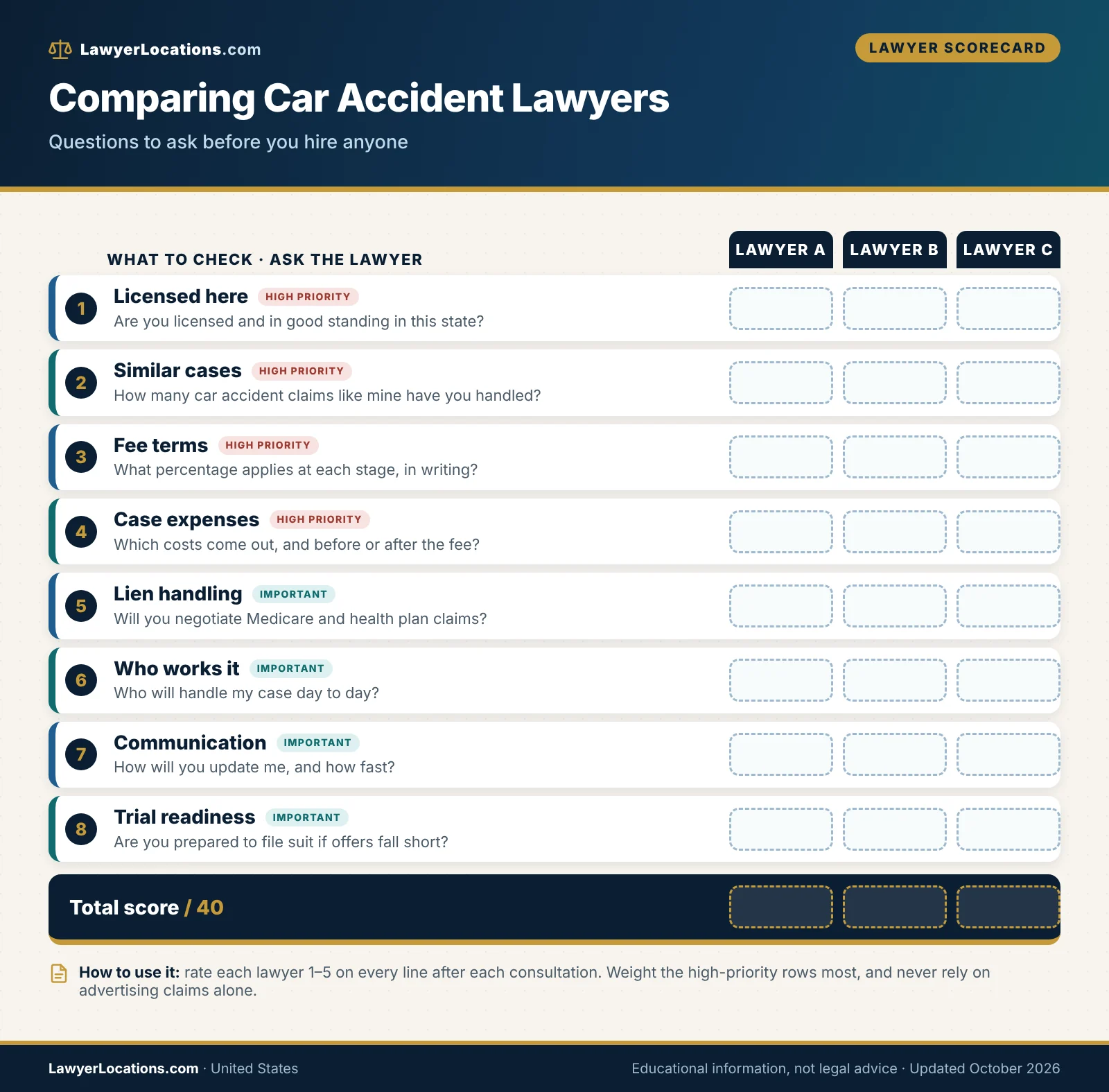
Text version of this graphic
- License: is the lawyer licensed in the state where the case would be filed? (verify with the state bar)
- Experience: how many car accident claims like yours has the lawyer handled?
- Fee: what percentage applies at each stage, and when does it change?
- Expenses: which costs are advanced, and are they deducted before or after the fee?
- Communication: who will handle my case, and how will updates be shared?
- Lien handling: will the lawyer negotiate Medicare, Medicaid and health-plan claims?
- Trial readiness: is the lawyer prepared to file suit if the offer is inadequate?
Comparing lawyers before you hire
Choose on fit and clarity, not on advertising. LawyerLocations is an educational resource and does not rank or recommend lawyers; it helps you ask better questions.
Questions to ask at a consultation
Many lawyers offer an initial consultation without charge, but practices differ, so ask about it up front. Bring your records, and come ready to compare more than one lawyer.
- Are you licensed in this state, and are you in good standing? (confirm with the state bar)
- Who will actually work on my case day to day?
- What is your fee, and how are case expenses handled?
- How do you handle medical liens and reimbursement claims?
- What is your view of how long my case might take, and what would change that?
- When would you recommend filing suit?
- How will you keep me informed, and how fast do you normally return calls?
Red flags when choosing
- Promises of a specific result or dollar figure before reviewing your records
- Pressure to sign immediately or to decide the same day
- Unwillingness to put the fee terms in writing
- A runner, tow-truck driver or caller who contacted you first, uninvited, about the crash
- Vague answers about who will handle the case
For a city-level example of how to compare lawyers, see our practical guide to finding a personal injury lawyer in Chicago. If you were hurt on a motorcycle or a bike, see the guides on motorcycle accident lawyers in New York City and bicycle accident lawyers in New Orleans.
If the Claim Does Not Settle: Lawsuit, Discovery, Mediation and Trial
When negotiation stalls or time is running out, the next step is a lawsuit. Filing adds structure and deadlines, and it usually adds many months, but it also gives you tools to obtain evidence and puts the claim in front of a court.
Filing suit and the deadline question
Whether to file, and when, is one of the most consequential choices in the timeline. The answer depends on the deadline, the insurer’s behavior and the strength of the evidence.
Why many lawsuits are filed to protect a deadline
Your state’s statute of limitations is a hard stop. If it passes without a filed lawsuit, the court will usually dismiss the claim no matter how strong it was, and insurers know this. Some people therefore file even while still negotiating, to preserve the right to sue. Filing does not end settlement talks.
The length of the deadline, and the rules that pause or shorten it, differ by state and by type of defendant. A claim against a city or state agency, for example, may require a written notice within a much shorter window. Confirm the rules for your state and facts early.
Notice requirements for claims involving a government vehicle can be far shorter than the ordinary lawsuit deadline. If a bus, police car or other public vehicle was involved, ask about the notice deadline right away rather than waiting for treatment to end.
What happens right after filing
The plaintiff (the injured person) files a complaint, and the defendant (the at-fault driver) is formally served. The defendant answers within a period set by court rules. The insurer typically provides a defense lawyer, and the court issues a schedule.
Discovery: exchanging evidence
Discovery is the formal exchange of information before trial. It is usually the longest stretch of a lawsuit, and it is where many cases are won, lost or settled.
Written requests and records
Each side serves written questions called interrogatories, requests for documents, and requests to admit certain facts. Expect to produce medical records, bills, tax or wage records, photos, social media content relevant to the injuries, and phone records tied to the crash. Answers are given under oath, so accuracy matters.
Depositions and medical exams
A deposition is sworn testimony outside the courtroom, recorded by a court reporter. You, the other driver, witnesses and doctors may all be deposed. The defense may also request an independent medical examination by a doctor it selects, which can produce an opinion that differs from your treating physicians.
Mediation, offers and trial
Most lawsuits face pressure to settle before trial. Courts commonly encourage or order mediation, and the insurer’s view of the case often changes after discovery.
Mediation and settlement conferences
Mediation is a confidential meeting where a neutral mediator helps both sides explore a deal. The mediator does not decide anything. Sessions often last a day, and each side moves incrementally, often with the lawyers carrying proposals between rooms.
If a deal is reached, it is usually put in writing that day in a short term sheet and followed by a longer release. That signing starts the payment phase described in the next section.
Trial, verdict and appeals
If no settlement is reached, the case goes to trial before a judge or a jury, depending on the state and claim. Trial may last days, and the court’s schedule can push the date out many months. After a verdict, the losing side may file post-trial motions or an appeal, each adding more time before payment.
Getting Paid: Release, Liens, Disbursement and Taxes
An agreement to settle is not the same as having money in hand. After you agree on a number, the release must be signed, liens must be resolved and funds must flow through a lawyer’s trust account (if you have a lawyer) before you receive your share.
The release and the check
The final stretch is mostly administrative, but it is where small mistakes can cost real money. Read every page before signing.
What a release does
A release is a signed document in which you give up all claims arising from the crash against the people and insurer named, in exchange for payment. Some releases are broad and cover unknown future claims, some name additional parties, and some include confidentiality or indemnity clauses requiring you to cover certain third-party claims, such as a lien. Ask what each clause means before you sign.
How long the check takes and where it goes
Timing is set by state law, the agreement and the insurer’s own process. California’s regulations require payment within 30 calendar days of acceptance. Florida’s statute sets 20 days after settlement or interest at 12 percent per year, as described earlier. Many states have no fixed number, so the settlement papers should state a payment date. Most insurers issue the check to the lawyer’s trust account, not to you personally.
Liens and reimbursement claims
A lien or reimbursement claim is a payer’s legal right to be repaid from your recovery for bills it covered. They are paid from the settlement, usually before you receive your share, so they can change what the settlement is worth to you. Resolving them is frequently the slowest step after the deal is struck.
Medicare conditional payments
If Medicare paid for crash-related care, it generally has a right to be repaid. The Centers for Medicare & Medicaid Services (CMS) calls these conditional payments, meaning payments Medicare makes for services where another payer may be responsible. According to CMS guidance, an initial conditional payment letter is generated automatically within 65 days after a Rights and Responsibilities Letter is issued, updates are processed about every 90 days, and an updated letter can be requested when a settlement is expected within 30 days.
After the case resolves, the settlement documents go to Medicare’s recovery contractor, which issues a final demand. Payment is due within 60 days of the date of the demand letter, and interest is charged from the demand date if it is not paid in that window. The beneficiary is responsible for making sure Medicare is repaid. Review the conditional payment list for charges unrelated to the crash and raise errors in writing.
If you receive a Medicare final demand letter, calendar the 60-day date from the letter itself and ask your lawyer or the recovery contractor about the process for disputing or requesting a reduction before it passes.
Medicaid, health plans and hospital liens
State Medicaid agencies also seek repayment. In Gallardo v. Marstiller, decided June 6, 2022, the U.S. Supreme Court held 6–3 that the Medicaid Act lets a state recover from the part of a settlement allocated to future medical care, not just past bills it paid. That ruling made the allocation language in a settlement more important for Medicaid recipients.
Private health plans can also claim reimbursement. In US Airways, Inc. v. McCutchen, decided April 16, 2013, the Court held that for a self-funded plan governed by federal ERISA law, clear plan terms generally control over fairness doctrines such as the common-fund rule, though the common-fund doctrine fills the gap when a plan is silent on attorney’s fees. Other payers, such as hospitals, may assert liens under state laws that differ widely, and some insured plans are subject to state limits that self-funded plans are not. Ask for the plan documents and for itemized, written lien amounts.
| Payer | Basis of the claim | Practical point |
|---|---|---|
| Medicare | Federal right to recover conditional payments (CMS) | Final demand due within 60 days of its date; interest after that |
| Medicaid | State Medicaid program; federal law as interpreted in Gallardo | Can reach the part of a settlement allocated to future medical care |
| Employer self-funded health plan | Plan terms under ERISA | Clear plan language generally controls (McCutchen); request plan documents |
| Insured health plan or HMO | Contract plus state law | State limits may apply; rules vary by state |
| Medical payments or PIP carrier | Policy terms and state law | Check whether the policy allows reimbursement |
| Hospital or provider | State lien statute or an account balance | Statutes differ; ask for itemized bills and any reduction policy |
Start the lien inventory as early as you start treatment. Ask your lawyer or, if you have none, each payer, to send written payoff or reimbursement amounts, so there are no surprises when a settlement is reached.
Disbursement and taxes
Once the check clears and liens are identified, the money is divided in a set order. A closing statement from your lawyer should show each line. If you have no lawyer, you can still negotiate lien amounts directly, though it takes patience.
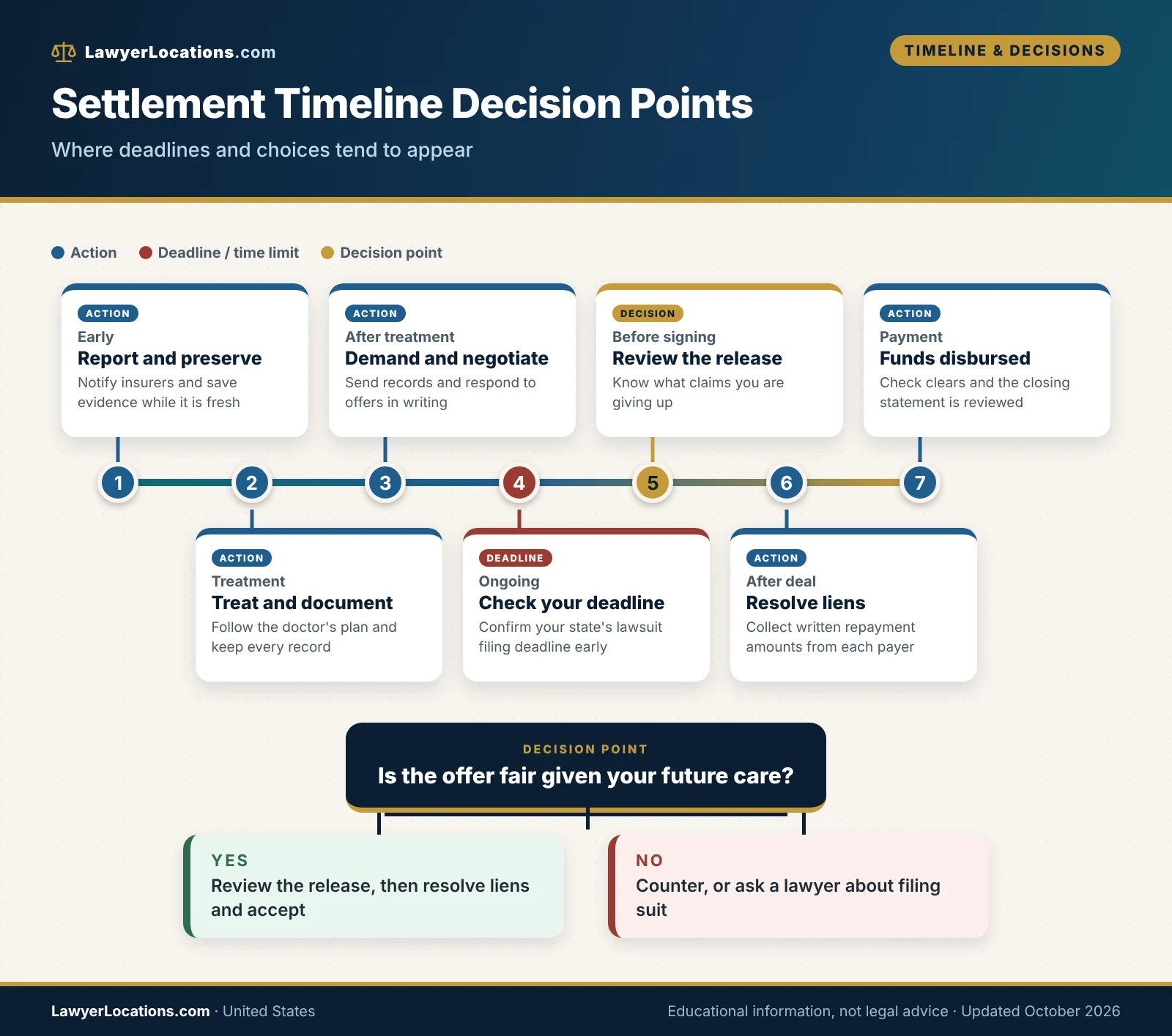
Text version of this graphic
- Crash and first care: report the claim and preserve evidence (action)
- Treatment: continue until your doctors describe the outlook (action)
- Demand and negotiation: send records and respond to offers (action)
- Lawsuit deadline: confirm your state’s filing deadline early (deadline)
- Release and liens: review the release and collect lien amounts (decision)
- Payment: check clears, liens paid, remainder disbursed (action)
- Decision point: is the offer fair given your future care, or should the case be filed?
The usual order of payment
Exact practice varies, but disbursement generally follows a logical order. Your lawyer’s fee and case costs come out according to the signed fee agreement, then liens and reimbursement claims are paid or held in trust until resolved, and the remainder goes to you. Sometimes a disputed lien amount is held back while the rest is paid.
| Step | What is paid | Where to check |
|---|---|---|
| 1 | Gross settlement deposited in the lawyer’s trust account | Settlement letter and trust account receipt |
| 2 | Attorney fee under the contingency agreement | Signed fee agreement and closing statement |
| 3 | Case expenses (records, experts, filing fees) | Itemized expense list |
| 4 | Liens and reimbursement claims | Written payoff letters from each payer |
| 5 | Unpaid medical bills not covered by a lien | Provider statements and any negotiated reductions |
| 6 | Net amount to you | Closing statement showing the math |
Are car accident settlements taxable?
Generally, compensation for physical injuries is not taxed as income, but there are exceptions. Federal law, 26 U.S.C. § 104(a)(2), excludes from gross income the amount of damages (other than punitive damages) received, by suit or agreement, on account of personal physical injuries or physical sickness. The statute also says emotional distress is not treated as a physical injury or sickness.
IRS Publication 4345 adds the practical points: if you deducted medical expenses on an earlier return and got a tax benefit, the part of the settlement for those expenses may have to be included in income; punitive damages are taxable; and interest on a settlement is generally taxable. Talk to a tax professional about your settlement agreement, because how the money is allocated can matter. This is general information, not tax advice.
Punitive damages are money meant to punish especially bad conduct rather than to compensate for a loss. They are rare in ordinary car accident settlements, and they are generally taxable even when the underlying injury was physical.
Common mistakes and next steps
Most settlement problems come from a few repeat patterns. Avoiding them costs nothing, and the same list works as a quick self-check at any stage.
Mistakes that slow or shrink a claim
- Accepting an early offer before the outlook for your injury is clear
- Giving a recorded statement or broad medical authorization without understanding it
- Missing a treatment appointment or leaving long gaps in care
- Posting about the crash, your activities or your injuries on social media
- Letting the lawsuit deadline approach while negotiating
- Signing a release or a funding contract without reading every page
- Ignoring a Medicare or health plan letter
Next steps for your own timeline
Start with your calendar. Write down the date of the crash, find your state’s lawsuit deadline, and set reminders well ahead of it. Then build your file, track your treatment and keep a list of every payer that may want repayment. If your claim is shaping up to be anything more than a minor one, a consultation with a licensed lawyer in your state can help you check your car accident settlement timeline against local rules before you commit to a path.
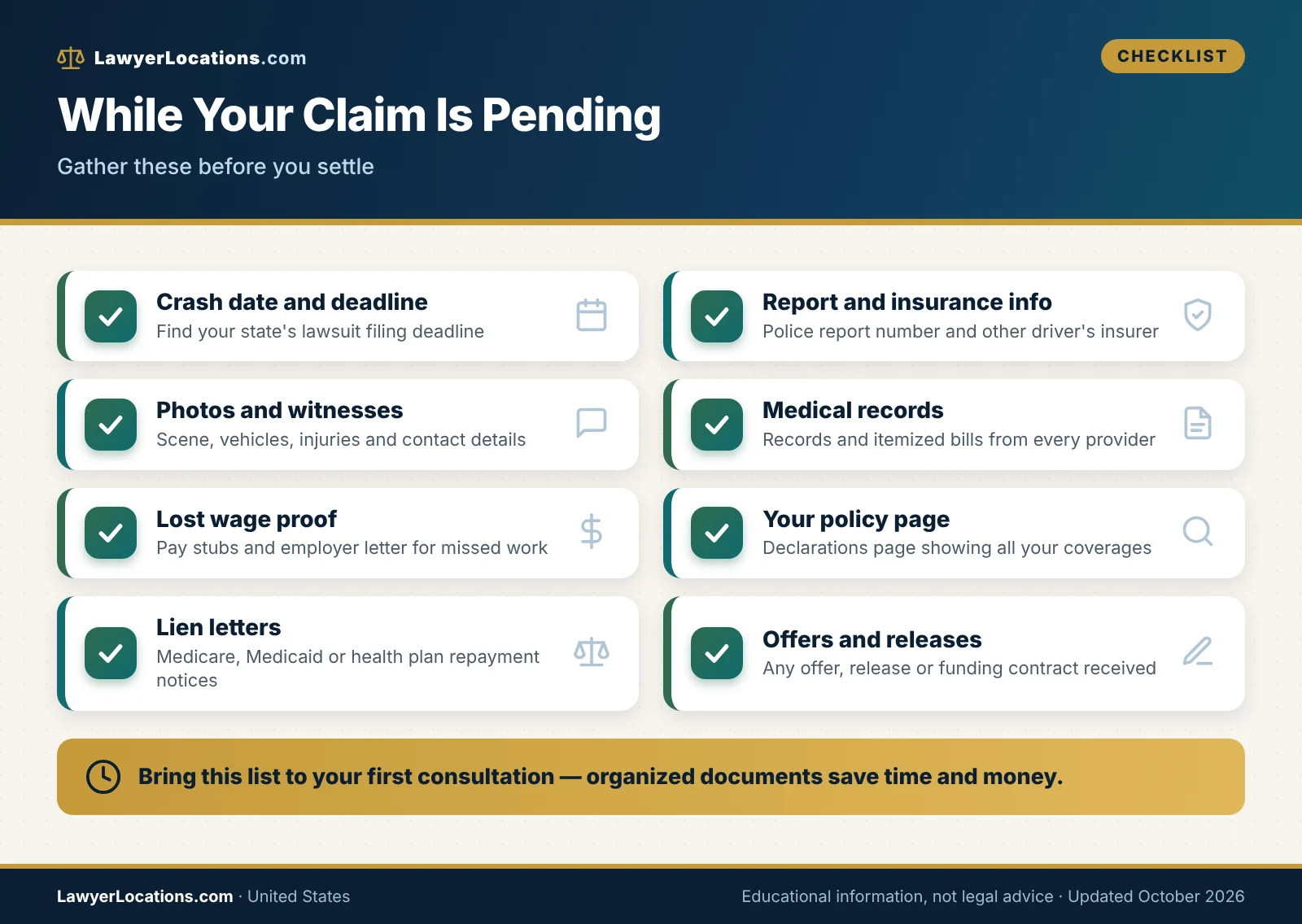
Text version of this graphic
- Crash date and your state’s lawsuit deadline
- Police report number and insurance details
- Photos, video and witness contacts
- Medical records and itemized bills
- Proof of lost wages
- Your policy declarations page
- Letters from Medicare, Medicaid or health plans
- Any offer, release or funding contract you have received
Ready to compare your options?
Gather the items above, write down your questions, and consider speaking with more than one licensed lawyer before you decide. LawyerLocations does not recommend or rank lawyers; it helps you ask better questions. For a related starting point, see our guide to fees and questions when a family loses someone in a crash.
Quick answers to common timeline questions
Short answers to frequent questions. Your facts and your state can change every one of them.
Timing questions
How long does a car accident settlement take?
From a few months for a simple claim to several years for a serious, disputed one. No official national average is published.
When can I settle my claim?
Usually after treatment ends or your doctors can describe your long-term outlook, and before your state’s lawsuit deadline.
Does filing a lawsuit make my case take longer?
Typically yes, because discovery and court scheduling add months, but filing also protects your right to sue and can move a stalled insurer.
Money and payment questions
Do I have to pay Medicare back?
If Medicare paid for crash-related care, it generally has a right to repayment from your settlement. CMS says the final demand is due within 60 days of its date.
Is my car accident settlement taxable?
Damages for physical injuries are generally excluded from income under federal law, but punitive damages and interest are not. Ask a tax professional about your case.
Can I negotiate liens and medical bills?
Often yes, though each payer follows different procedures. Ask for written payoff amounts and the process for requesting a reduction.
Sources & References
Show all 12 sources
- 26 U.S. Code § 104, Compensation for injuries or sickness — Legal Information Institute, Cornell Law School — law.cornell.edu/uscode/text/26/104 — accessed October 2026
- Publication 4345, Settlements — Taxability — Internal Revenue Service — irs.gov/pub/irs-pdf/p4345.pdf — accessed October 2026
- What You Need to Know About Conditional Payment Letters — Centers for Medicare & Medicaid Services — cms.gov/files/document/what-know-about-conditional-payment-letterspdf — accessed October 2026
- 10 CCR § 2695.2, Definitions (Fair Claims Settlement Practices Regulations) — California Code of Regulations via Cornell LII — law.cornell.edu/regulations/california/10-CCR-2695.2 — accessed October 2026
- 10 CCR § 2695.5, Duties upon receipt of communications and notice of claim — California Code of Regulations via Cornell LII — law.cornell.edu/regulations/california/10-CCR-2695.5 — accessed October 2026
- 10 CCR § 2695.7, Standards for prompt, fair and equitable settlements — California Code of Regulations via Cornell LII — law.cornell.edu/regulations/california/10-CCR-2695.7 — accessed October 2026
- Florida Statutes § 627.4265, Payment of settlement — The Florida Senate — m.flsenate.gov/Statutes/627.4265 — accessed October 2026
- Gallardo v. Marstiller, No. 20-1263 (U.S. June 6, 2022) — Supreme Court of the United States — supremecourt.gov/opinions/21pdf/596us1r34_c9dh.pdf — accessed October 2026
- US Airways, Inc. v. McCutchen, No. 11-1285 (U.S. Apr. 16, 2013) — Legal Information Institute, Cornell Law School — law.cornell.edu/supremecourt/text/11-1285 — accessed October 2026
- Model Rules of Professional Conduct, Rule 1.5: Fees — American Bar Association — americanbar.org (Rule 1.5) — accessed October 2026
- Ohio Revised Code § 1349.55, Non-recourse civil litigation advance contracts (repealed effective Oct. 6, 2026) — Ohio Laws & Administrative Rules — codes.ohio.gov/ohio-revised-code/section-1349.55 — accessed October 2026
- Ohio H.B. 105 (136th General Assembly), Revise non-recourse litigation funding agreement regulations — LegiScan (mirror of legislative record) — legiscan.com/OH/bill/HB105 — accessed October 2026
General information only. This guide is provided by LawyerLocations.com for general educational purposes. It is not legal, tax or insurance advice, it does not create an attorney-client relationship, and reading it does not make anyone your lawyer. LawyerLocations.com is a legal-education and lawyer-discovery resource, not a law firm. Laws, regulations, deadlines and court rules change and differ by state, and the examples here may not apply to your situation. Consult a lawyer licensed in the relevant jurisdiction, and a qualified tax professional for tax questions, about your own claim.
Legal Disclaimer and Limitation of Liability
Informational and illustrative purposes only. This article was prepared by LawyerLocations.com solely on the basis of the information available to us at the time of writing. It is an illustrative, general overview. It is not a complete or authoritative statement of the law, and it has not been reviewed by a lawyer licensed in your state or county.
Not legal advice. Nothing in this article is legal, financial, tax or immigration advice, and reading it does not create an attorney-client relationship between you and LawyerLocations.com or any author, lawyer or firm mentioned. Laws, court rules, fees, filing deadlines and agency procedures differ by state, county and court, and they change often. Some details here may be simplified, incomplete or out of date, and time limits for legal claims can be short.
No warranty. We make no representation or warranty, express or implied, about the accuracy, completeness, timeliness or suitability of this content for your situation. Please do not rely on it to make, delay or skip any legal decision. Check the facts against official sources and speak with a licensed attorney in the relevant jurisdiction before you act.
Limitation of liability. To the fullest extent permitted by law, LawyerLocations.com and its owners, authors and contributors disclaim all liability for any loss, damage, cost or other consequence arising from the use of, or reliance on, this article, including any content on third-party websites we link to. Mentioning a lawyer, firm, organization or service is not an endorsement and is not a promise of any result. If you are in immediate danger, contact your local emergency number.