If you searched for a “personal injury lawyer chicago il” after a crash, a fall, a bus incident or a medical error, you are really trying to answer four questions at once: is there a claim, how long do I have, what will it cost, and who should I call. Illinois is a fault-based state, the general deadline to sue for a personal injury is two years under 735 ILCS 5/13-202, and you are barred from recovery if a jury finds you were more than 50% at fault under 735 ILCS 5/2-1116.
This guide lays out the Illinois rules, the shorter clocks that apply to the CTA and other public bodies, how Cook County courts handle injury cases, how lawyers are paid, and a practical method for comparing lawyers before you sign. It is general information for readers in Chicago, not advice about your situation.
How Illinois Injury Law Works: Fault, Damages and Insurance
Illinois decides who pays for an injury by asking who was careless and how careless each person was. There is no “no-fault” auto system here, so the person who caused a crash, or the insurer behind that person, is generally the one asked to pay. The rules below come from Illinois statutes and apply the same way in Chicago as anywhere else in the state; what changes in the city is the courthouse, the transit and public-entity rules, and the local hazards covered in later sections.
Fault rules that decide whether you can recover
Modified comparative negligence and the 50% bar
Under 735 ILCS 5/2-1116, in a negligence-based claim for bodily injury or death, you are barred from recovering anything if your own fault is more than 50% of the proximate cause of your injury. If your share is 50% or less, you can still recover, but your damages are reduced by your percentage. The statute also applies to product-liability claims based on strict tort liability.
A jury finds a pedestrian suffered $100,000 in total damages and was 20% at fault for stepping into the street mid-block. The recovery would be reduced by that 20% share. If the same jury put the pedestrian’s fault at 51%, the claim would fail entirely. This is an illustration of the arithmetic, not a prediction about any real case.
This is why insurers probe for any sign that you were distracted, speeding or outside a crosswalk. A small shift in the fault percentage can change the outcome more than a small shift in medical bills, so describe the facts carefully and consistently.
Joint and several liability when several parties share blame
When more than one party contributed to an injury, 735 ILCS 5/2-1117 sets who can be made to pay the whole bill. A defendant whose fault is under 25% of the total fault is only “severally” liable, meaning it pays its own share, while a defendant at 25% or more can be held “jointly and severally” liable, meaning it can be held responsible for the full amount of the damages other than medical costs. Every defendant found liable is jointly and severally liable for the plaintiff’s past and future medical and medically related expenses, regardless of its percentage.
The percentage is measured against the plaintiff, the defendants the plaintiff sued, and any third-party defendants, with the plaintiff’s employer excluded from that calculation. Practically, this is one reason injury lawyers often name every plausible party in a Chicago case: a landlord, a property manager, a snow contractor and a driver can each get a slice of the fault, and who is in the lawsuit changes who can be made to pay.
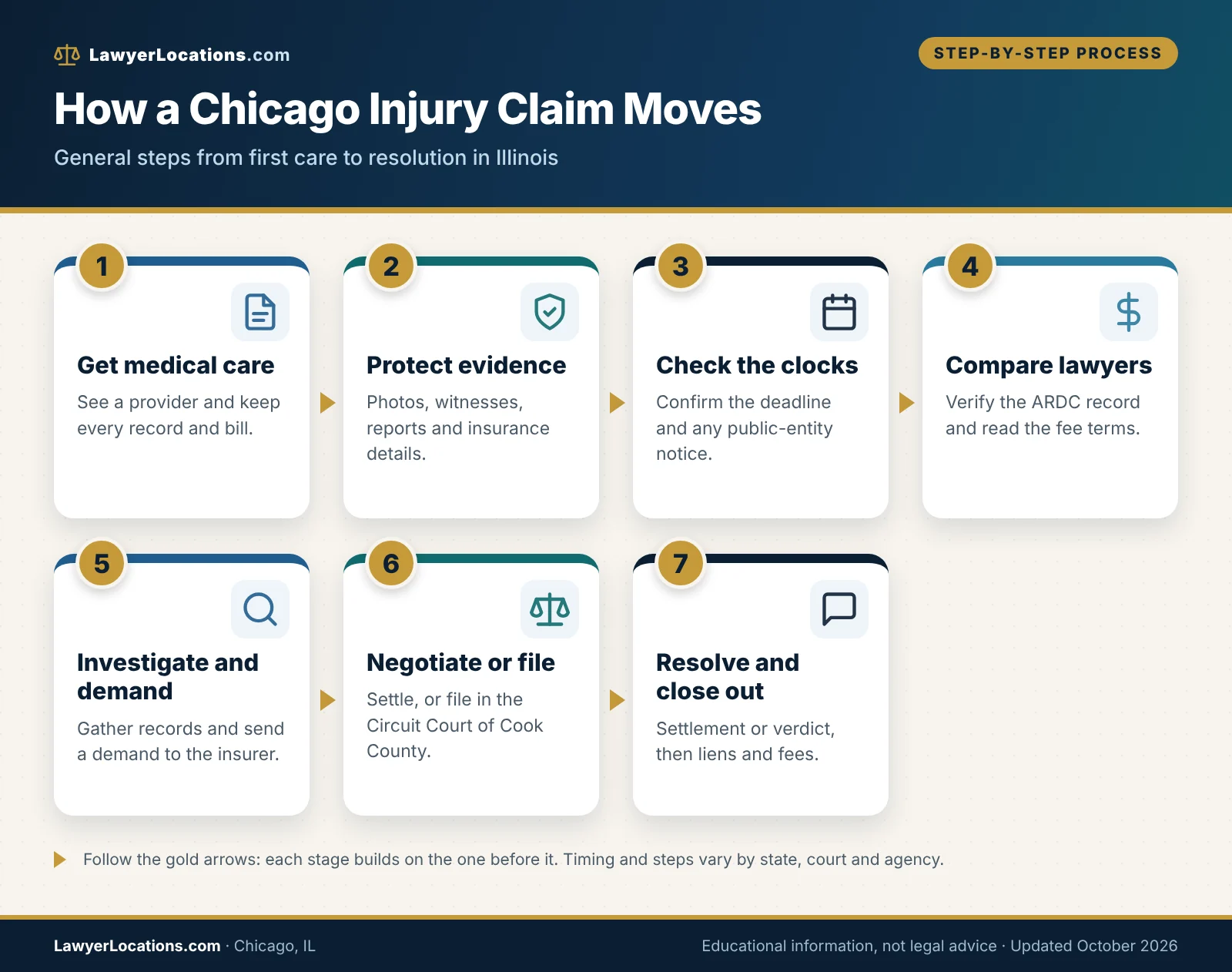
Text version of this graphic
- Get medical care and keep every record and bill.
- Protect the evidence: photos, witness names, reports, insurance details.
- Check the clocks: general two-year rule, plus any shorter public-entity notice.
- Compare lawyers: verify licenses and read the fee agreement.
- Investigate and demand: records, liability proof and a demand to the insurer.
- Negotiate or file in the Circuit Court of Cook County.
- Resolve by settlement, trial verdict or dismissal, then close out liens and fees.
Damages, caps and what a jury may consider
The kinds of losses a claim can cover
Injury claims generally seek two categories of losses. Economic damages are the measurable money losses: medical bills, future care, lost income and out-of-pocket costs. Non-economic damages are harder to total up and cover pain, disability, disfigurement and loss of normal life. Illinois courts are not shy about the second category, and a lawyer’s case evaluation should break out both so you can see what drives the number.
In 2010 the Illinois Supreme Court held in Lebron v. Gottlieb Memorial Hospital that the statutory cap on non-economic damages in medical-malpractice cases violated the separation-of-powers clause of the state constitution and voided the entire act that created it. Readers should treat that as a historical marker rather than a promise, because the legislature can pass new laws; ask any lawyer you interview whether any damages limit currently applies to your type of claim.
Seat belts, insurance limits and what the other side can argue
In a crash case, a common worry is whether not wearing a seat belt wipes out a claim. Under 625 ILCS 5/12-603.1(c), the failure to wear a belt cannot be used as evidence of negligence and does not reduce a damages recovery arising from the operation, maintenance or ownership of a motor vehicle. Defendants still argue other points, such as speed, lane position, phone use, pre-existing conditions and gaps in treatment.
Insurance in Illinois: liability, uninsured and underinsured coverage
Minimum liability limits and why they are often not enough
Illinois requires drivers to carry liability coverage with at least the limits in 625 ILCS 5/7-203. For policies issued or renewed on or after January 1, 2015, that is $25,000 for bodily injury or death to one person, $50,000 for two or more people in one crash, and $20,000 for property damage. A serious injury with surgery and months off work can exceed $25,000 quickly, which is why a lawyer will look for every available layer of coverage.
| Coverage | What it does | Figure or rule | Source |
|---|---|---|---|
| Bodily injury liability | Pays other people’s injury claims if you are at fault | At least $25,000 per person; $50,000 per crash | 625 ILCS 5/7-203 |
| Property damage liability | Pays for others’ vehicles and property you damage | At least $20,000 per crash | 625 ILCS 5/7-203 |
| Uninsured motorist (UM) | Your own policy pays when the at-fault driver has no insurance | Offered at an amount equal to your bodily injury limits; reducing it requires a written request | 215 ILCS 5/143a-2 |
| Underinsured motorist (UIM) | Your own policy tops up when the at-fault driver’s limits are too low | Payments are reduced by what you recover from the at-fault driver’s policy | 215 ILCS 5/143a-2 |
Uninsured and underinsured motorist coverage on your own policy
Uninsured and underinsured motorist coverage (UM/UIM) is part of your own policy and matters in hit-and-run, uninsured-driver and low-limits crashes. Under 215 ILCS 5/143a-2, insurers must include UM coverage in an amount equal to the insured’s bodily-injury liability limits unless the insured makes a written request for lower limits. UIM payments are reduced by amounts you already recovered from the at-fault driver’s policies, and a policy may delay UIM payment until the at-fault driver’s limits are exhausted by judgment or settlement.
Find your own declarations page before you call a lawyer. It shows your UM/UIM limits, medical-payments coverage and any selection forms, and it tells the lawyer in minutes whether your own policy may become a source of recovery.
Common Chicago Injury Scenarios and Who May Be Responsible
Most Chicago injury claims fall into a handful of patterns, and each one points to different defendants, different insurance and sometimes different deadlines. A claim from a CTA bus incident follows rules that a claim from a fender-bender on the Kennedy Expressway does not.
Crashes on Chicago roads and expressways
Car, truck and motorcycle collisions
Crash claims in Chicago usually turn on who had the right of way, speed, and whether a commercial vehicle or a company was involved. Dense city traffic, lakefront driving on DuSable Lake Shore Drive, expressway merges, and winter conditions create sudden-stop and chain-reaction collisions in which several drivers may share fault, which is where the 25% rule from section 2-1117 starts to matter. If a truck driver was working at the time, the employer or a contracting company may also be a defendant, and that can open a larger insurance policy than the driver’s own.
Our guides to rear-end accident lawyers and the car accident settlement timeline go deeper on crash claims.
Rideshare and taxi passengers, drivers and pedestrians
Rideshare claims depend on the driver’s status at the moment of the crash. Under the Transportation Network Providers Act, 625 ILCS 57/10, coverage is tiered: when a driver is logged on but has not accepted a ride, the required limits are $50,000 per person and $100,000 per incident for death and personal injury plus $25,000 for property damage. During a prearranged ride, the requirement is $1,000,000 for death, personal injury and property damage, along with $50,000 in uninsured and underinsured motorist coverage from the time a passenger enters the vehicle until the passenger exits. The section on that page is marked as scheduled to be repealed on September 1, 2028, so a lawyer should confirm the current text for any later crash.
| Driver status | Injury and death coverage | Property damage | Notes |
|---|---|---|---|
| Logged on, no ride accepted | $50,000 per person; $100,000 per incident | $25,000 | Contingent coverage must exist if the driver’s own policy excludes or falls short |
| Prearranged ride in progress | $1,000,000 combined | Included in the $1,000,000 | Primary coverage; UM/UIM of $50,000 applies while a passenger is in the vehicle |
Transit, sidewalks and buildings
CTA buses and trains, and other public bodies
If you were hurt on a CTA bus or train, in a crash with a CTA vehicle, or because of a city-owned street or sidewalk defect, the claim is against a public body, and a short notice-and-deadline regime usually applies. Illinois’ Local Governmental and Governmental Employees Tort Immunity Act generally gives most civil actions against a local entity or its employees a one-year filing deadline under 745 ILCS 10/8-101. Claims against the Chicago Transit Authority have also been described by Illinois appellate courts as requiring a written notice within six months. Section 3 sets out those rules and flags what to verify.
Because notice errors can end a claim before a lawyer sees it, treat any CTA, City of Chicago or other public-body incident as time-sensitive from day one.
Slip and fall, premises liability, snow and ice
Premises claims in Illinois are governed by the Premises Liability Act, 740 ILCS 130/2, which abolished the old invitee/licensee distinction and says owners and occupiers owe entrants reasonable care under the circumstances regarding the condition of the premises. The practical fight is usually over notice: did the owner or manager know, or should they have known, about the spill, broken stair, dark hallway or loose carpet, and did they act in time?
Snow and ice add a Chicago-winter layer. Illinois courts apply a natural accumulation rule: as the Appellate Court explained in Ryan v. Glen Ellyn Raintree Condominium Ass’n, 2014 IL App (2d) 130682, an owner generally has no common-law duty to remove natural accumulations of ice and snow, and liability can arise when the accumulation is unnatural, for example when snow removal efforts themselves create the hazard or a defective roof or awning drips water that freezes. Another appellate decision, Gallagher v. Union Square Condominium Homeowner’s Ass’n, held the Snow and Ice Removal Act’s protection covers sidewalks and not driveways. These cases are fact-specific and the Act has its own wording, so ask a lawyer how it applies to your fall.
Do not assume an icy fall is a lost cause because the weather caused it, and do not assume it is a sure win either. Where the ice formed, who plowed or salted, how water drained and whether the property is residential or commercial all change the analysis, so photograph the exact spot, the surrounding drainage and the weather on the same day.
Construction, medical care, long-term care and death claims
Construction-site injuries after the Structural Work Act
Older Chicago lawyers still talk about the Illinois Structural Work Act, also called the Scaffold Act, a 1907 law that gave injured construction workers a direct civil remedy against owners and contractors. According to a practitioner’s history article on dcba.org, the Act was repealed effective February 14, 1995, and injured workers since then generally must prove ordinary common-law negligence. Courts use Restatement (Second) of Torts section 414 to ask whether a general contractor retained enough control over the work to owe a duty to a subcontractor’s employee. Control over the manner of the work matters; a mere right to stop work or inspect usually is not enough.
For most employees hurt on the job, the employer’s workers’ compensation is the main remedy, and under 820 ILCS 305/5 the employee generally cannot sue the employer. The same section preserves the worker’s right to sue an outside party whose negligence caused the injury, such as a property owner, equipment maker or another contractor, and gives the employer a lien on that recovery. That is why a construction injury often involves two tracks at once.
Medical malpractice, nursing home neglect and wrongful death
Medical malpractice has its own gatekeeping rule. Under 735 ILCS 5/2-622, a plaintiff’s lawyer must file an affidavit and a health professional’s written report finding a “reasonable and meritorious cause” for the case, with narrow exceptions that allow filing the report later, and failure to comply is grounds for dismissal. In practice, medical cases need record review and a qualified medical reviewer before suit, which makes them expensive for lawyers to screen and means many Chicago firms limit or decline them.
Nursing home claims arise under the Nursing Home Care Act. Under 210 ILCS 45/3-601 a facility’s owner and licensee are liable to a resident for injuries caused by the intentional or negligent acts or omissions of their agents or employees, and under 210 ILCS 45/3-602 a licensee that violates a resident’s rights must pay actual damages, court costs and attorney’s fees. If a loved one died, the Wrongful Death Act, 740 ILCS 180/2, requires the action to be brought by the decedent’s personal representative for the benefit of the surviving spouse and next of kin. Our guide to wrongful death lawyer costs explains how those fee arrangements work.
Deadlines and Notice Rules That Can End a Claim
The most important deadline in an Illinois injury case is the two-year statute of limitations, but it is not the only clock and it is not the shortest. Claims against the CTA and other local public bodies run on one year and can require a written notice well before that. Because a missed deadline can bar a claim no matter how strong the facts are, check these rules before you spend weeks comparing lawyers.
If a public body might be involved, such as the CTA, a city street or sidewalk, a city vehicle, a public school or a park, contact a lawyer or send the required notice quickly instead of waiting out the two-year rule. Our broader guide on how long you have to file a personal injury claim explains why deadlines vary by state and claim type.
The general clock for private defendants
Two years under 735 ILCS 5/13-202
Illinois requires personal injury actions to be commenced within 2 years after the cause of action accrues, under 735 ILCS 5/13-202. For a crash or a fall, accrual is usually the date of the injury. The section also contains narrow carve-outs, for example for damages from first-degree murder or a Class X felony when the perpetrator is convicted, and a tolling rule for confessions compelled by threats of imminent bodily harm.
“Commenced” means a lawsuit has been filed in court, not that a claim has been submitted to an insurer. Insurance negotiations do not stop the clock on their own, and an adjuster who says the file is “still under review” has no power to extend your filing deadline.
Children and people under a legal disability
Under 735 ILCS 5/13-211, a person who was a minor or under a legal disability when the claim arose can file within 2 years after turning 18 or after the disability is removed, for the claims covered by the listed sections. If someone becomes disabled after a claim accrues but before the period runs out, the clock stops until the disability ends, with limits for statutes of repose.
Parents’ own claims, such as for a child’s medical bills, may run on the ordinary clock, so ask a lawyer to separate the two at the first meeting.
Claims involving the CTA, the City and other public entities
One-year filing deadline under the Tort Immunity Act
The Local Governmental and Governmental Employees Tort Immunity Act, 745 ILCS 10/8-101, says most civil actions against a local entity or its employees for injury must be commenced within one year from when the injury was received or the cause of action accrued. For claims arising out of patient care, such as treatment at a public hospital, the same section sets a different rule: two years from when the claimant knew or should have known of the injury (or received written notice of it), and in no event more than four years after the act or omission.
Written notice rules, including the CTA
On top of the one-year deadline, Illinois has historically required people injured by local entities to give written notice within a short window. The Tort Immunity Act’s notice provision is commonly cited as a six-month notice to the entity’s attorney or clerk.
For the CTA specifically, an Illinois appellate opinion, Joseph v. CTA, No. 1-98-3298, quotes the Metropolitan Transit Authority Act as requiring a written statement within six months, filed with both the secretary of the Chicago Transit Board and the CTA’s General Counsel, giving the claimant’s name, the injured person’s name and residence, the date and approximate hour of the accident, its location and the attending physician’s name and address. The court treated those requirements as mandatory and strictly enforced, and said a failure to give notice requires dismissal. That opinion dates from the 1990s, so the current section text and any amendments must be checked before relying on it.
Never rely on a general reading of “two years” if the CTA, a city department or another public body might be responsible. Make a note of the date and hour of the incident, the vehicle or bus number, the route and the exact location, because those details are the core of the written notice.
Special deadlines for particular claim types
Medical malpractice and nursing home claims
Medical malpractice suits against physicians, dentists, registered nurses and licensed hospitals are governed by 735 ILCS 5/13-212. Suit generally must be filed within 2 years after the claimant knew, or reasonably should have known, of the injury, or received written notice of it, and in no event more than 4 years after the act or omission. If the patient was under 18 at accrual, the outer limit is 8 years from the act, but never after the person’s 22nd birthday.
The nursing home sections we reviewed, 3-601 and 3-602 of the Nursing Home Care Act, do not state a filing deadline, and Illinois Legal Aid Online’s nursing home page lists deadlines only for administrative appeals to the Department of Public Health. For planning purposes, assume the shortest realistic clock applies and ask a lawyer to confirm the specific deadline for your claim.
Wrongful death and construction-defect claims
A wrongful death action under 740 ILCS 180/2 must be commenced within 2 years after the death, with an extension to 5 years when the death resulted from violent intentional conduct and a different rule tied to certain criminal proceedings. A beneficiary who was under 18 when the claim accrued may sue within 2 years after turning 18.
If your injury involves the design, planning, supervision or construction of a building or improvement, 735 ILCS 5/13-214 sets a 4-year limitations period from when the claimant knew or should have known, with a 10-year statute of repose from the act or omission, and a carve-out from the repose period for asbestos-related personal injury. Those periods apply to claims against the design and construction professionals, not to ordinary negligence claims against a driver or a property owner.
| Claim type | Basic deadline | Statute | Watch for |
|---|---|---|---|
| General personal injury (private defendant) | 2 years from accrual | 735 ILCS 5/13-202 | Narrow crime-related exceptions |
| Minors or legally disabled people | 2 years after turning 18 or disability ends | 735 ILCS 5/13-211 | Parents’ separate claims run on the ordinary clock |
| Local public entity or employee | 1 year from injury or accrual | 745 ILCS 10/8-101 | Written notice rules; patient-care claims differ |
| CTA claims | 1 year, with a six-month written notice described in case law | Metropolitan Transit Authority Act, section 41 | Notice must reach both the Board secretary and General Counsel |
| Medical malpractice | 2 years from discovery; 4-year outer limit | 735 ILCS 5/13-212 | Longer outer limit for minors, never past age 22 |
| Wrongful death | 2 years from the death | 740 ILCS 180/2 | 5-year rule for violent intentional acts |
| Construction design or supervision claims | 4 years from discovery; 10-year repose | 735 ILCS 5/13-214 | Asbestos injury carve-out from repose |
What Injury Lawyers Charge and How Contracts Work
Personal injury lawyers in Chicago are commonly paid through a contingent fee, which means the lawyer is paid a percentage of what is recovered, and nothing in fees if there is no recovery. Illinois does not fix a single percentage for ordinary injury cases, so the number in the contract is a point of negotiation and comparison. We do not publish typical percentages because no verified official source reports them.
Contingent fees and Illinois Rule 1.5
What the written agreement must say
Illinois Rule of Professional Conduct 1.5 requires contingent-fee agreements to be in a writing signed by the client. The agreement must state how the fee is determined, including the percentage for settlement, for trial and for appeal, and it must specify the litigation and other expenses that will be deducted from the recovery. It must also say whether those expenses are deducted before or after the contingent fee is calculated, and clearly notify the client of any expenses the client will owe whether or not there is a recovery.
When the matter ends, Rule 1.5 requires a written closing statement showing the outcome and, if there is a recovery, how the remittance to the client was calculated. Keep that statement; it is the paper trail that explains where each dollar went.
Medical malpractice fee cap and how percentages are negotiated
Illinois does set a ceiling for one category. Under 735 ILCS 5/2-1114, the total contingent fee for plaintiff’s lawyers in a medical malpractice action may not exceed 33 1/3% of all sums recovered. The statute defines a contingent fee broadly, so arrangements that depend wholly or partly on the result are covered, and future periodic payments are converted to a present lump-sum value for the calculation.
For other injury claims, think of the percentage as a starting offer. Ask whether the percentage changes if the case goes into a lawsuit or to trial, and ask for the fee schedule in writing before you decide.
Ask for a worked example with fake numbers. A simple $90,000 recovery example with a hypothetical fee, expenses and medical liens shows you in minutes how the contract treats expenses and in what order the money is split.
Case costs, liens and what you may owe
Filing fees, experts and other case expenses
Case expenses are separate from the lawyer’s fee. They can include court filing fees at the Clerk of the Circuit Court of Cook County, records charges, court reporters for depositions, and fees for medical or engineering experts. Because filing fees change, check the Clerk’s current fee schedule or ask the lawyer to state the fees they expect for your case in writing.
Medical liens, workers’ compensation reimbursement and health insurance
A settlement does not always flow straight to you. Hospitals, health insurers, government health programs and, in a work injury, the employer’s workers’ compensation carrier may have reimbursement or lien rights. Under 820 ILCS 305/5, for example, an employer that paid workers’ compensation is repaid from a third-party recovery, pays its pro rata share of costs, and may owe the employee’s attorney 25% of the gross reimbursement if the attorney substantially contributed to the recovery.
Ask who will identify, verify and negotiate the liens, and whether that work is included in the fee.
Consultations, referral services and “free” offers
Bar referral fees in Chicago
The Chicago Bar Association’s Lawyer Referral Service connects callers with attorneys for personal injury matters. One CBA page says the referred lawyer collects $30 at the initial consultation, which goes toward the service’s operating costs, while another page says $35 and advertises a 30-minute consultation; the lawyer may also charge for their time, so ask before the meeting. The ISBA’s Lawyer Finder service takes calls at (800) 922-8757 from people seeking a lawyer, though its page does not say what clients pay.
Reading consultation promises
Many injury firms advertise a no-cost first meeting. That can be a perfectly legitimate way to let you compare, but the promise does not tell you anything about the fee percentage, case expenses or who will do the work. Treat an advertisement as an invitation to ask questions, and separate the cost of the meeting from the cost of the case.
How to Find and Compare Personal Injury Lawyers in Chicago
Finding a lawyer is a two-step job: confirm who is legitimately licensed, then compare fit, fees and communication across two or three candidates. LawyerLocations.com is a legal-education and discovery resource, not a law firm, so we do not rank or recommend individual lawyers; this section gives you the method to do that yourself.
Verify who you are talking to
Check the Illinois ARDC record
The Attorney Registration and Disciplinary Commission (ARDC) runs a public Lawyer Search. According to the ARDC’s public FAQ, the tool shows a lawyer’s license status, contact details, public disciplinary history and whether the lawyer reports having malpractice insurance. The ARDC does not give legal advice, assign lawyers or settle fee disputes, so use it as a verification step, not a recommendation engine.
Look up every lawyer you consider. If a name does not appear, or the license status is not active, pause until you understand why.
Referral services as one starting point
Two bar-run starting points serve Chicago readers. The Chicago Bar Association’s Lawyer Referral Service can be reached at (312) 554-2001 and says it meets the American Bar Association’s Standards for Lawyer Referral, with among the highest experience requirements for its personal injury lawyers. The Illinois State Bar Association’s Lawyer Finder service takes calls at (800) 922-8757, Monday through Friday.
A referral is a starting point, not an endorsement, so ask a referred lawyer the same questions you would ask anyone else.
Questions that separate fit from marketing
Experience that matches your type of claim
“Personal injury” is an umbrella for very different work. A lawyer who regularly handles car and truck crashes may not handle CTA claims, nursing home cases, construction injuries or medical malpractice, which have their own affidavit rule, fee cap and deadlines. Ask what share of the lawyer’s recent matters look like yours and how often they have been in the Cook County Law Division courtroom.
Who does the work and how you will hear about it
Larger firms often assign day-to-day work to paralegals and associates. That can be fine, but you should know who will answer your calls, who will attend depositions and who will be in the room if the case goes to trial. Ask how often you will get updates and in what form, and whether you will be told promptly about every offer.
Comparing two or three lawyers is normal. A lawyer who is confident about the work will usually expect you to ask questions and read the contract before signing.
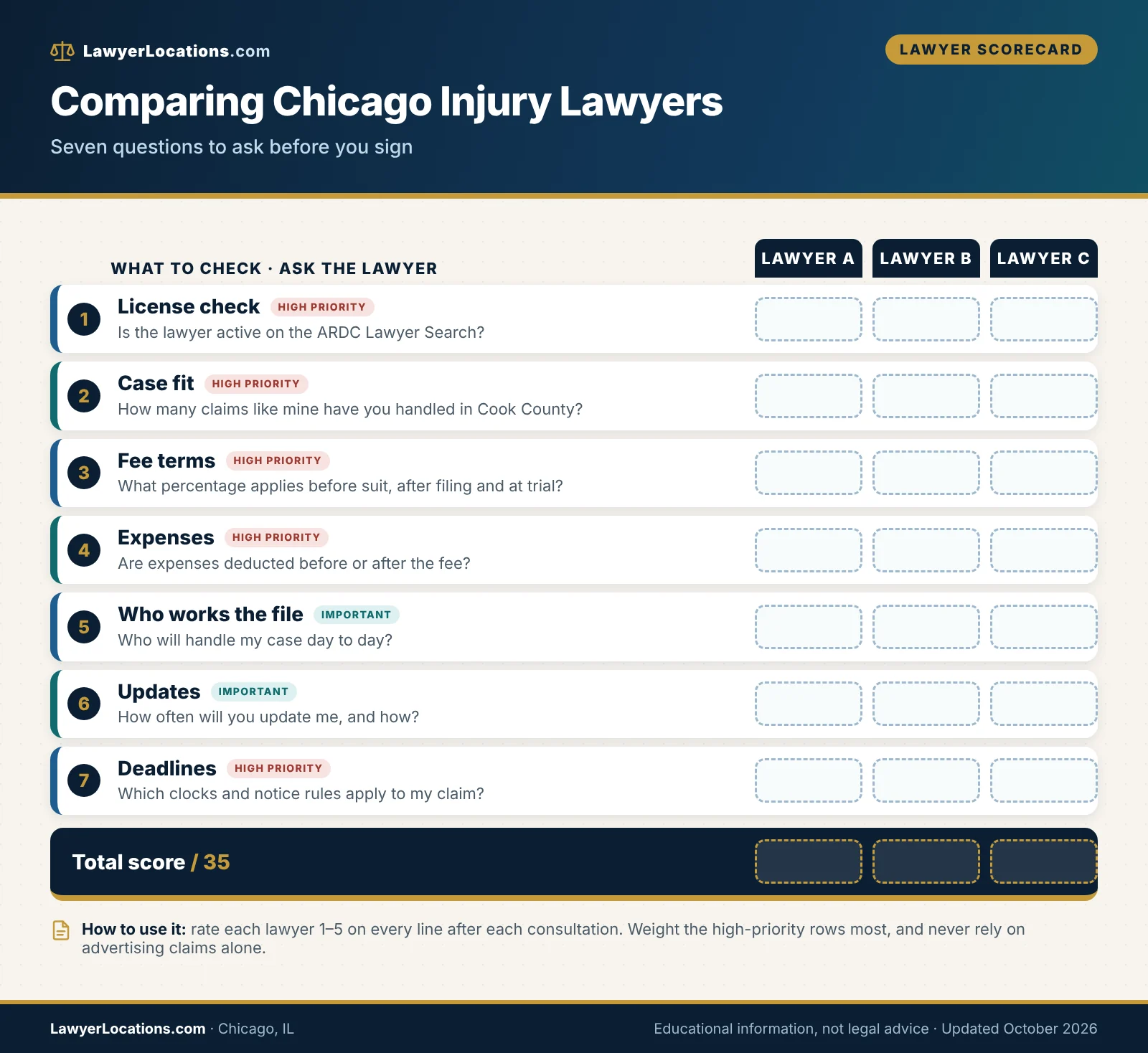
Text version of this graphic
- License check: Is the lawyer active on the ARDC Lawyer Search?
- Case fit: How many claims like mine have you handled in Cook County?
- Fee terms: What percentage applies before suit, after filing and at trial?
- Expenses: Are expenses deducted before or after the fee, and what if I lose?
- Who works the file: Who will handle my case day to day?
- Updates: How often will you update me, and in what form?
- Deadlines: Which clocks apply to my claim, including public-entity notice?
Red flags and a side-by-side method
Red flags to watch for
- Pressure to sign at the first meeting or “today only” offers.
- A fee agreement that is not in writing, or one you cannot take home to read.
- Promises about a result or a dollar amount before the lawyer has seen the records.
- Vague answers about expenses, liens or what happens if the case loses.
- No ARDC record or an inactive license status.
- Unsolicited calls, texts or visits from someone offering to “take your case.”
Weighing two or three options
Put the candidates in one table and fill it in after each call. Compare the license check, case fit, fee terms, expense handling and communication, then weigh how comfortable you felt asking hard questions. A slightly higher percentage can be reasonable if the lawyer’s experience fits your claim, and a lower percentage can cost you if the lawyer has little experience with your type of case.
| Topic | Question to ask | A clear answer sounds like | A warning sign |
|---|---|---|---|
| License | May I have your ARDC registration details? | Gives the name as registered; welcomes the check | Dodges or cannot say |
| Case fit | Have you handled this type of claim in Cook County? | Describes the type of cases and forums, without naming clients | “We take everything” with no detail |
| Fee | What is the percentage at each stage? | States percentages for settlement, trial and appeal in writing | Will not put it in writing |
| Expenses | Are expenses taken before or after the fee? Do I owe them if we lose? | Explains the order of deduction and the loss scenario | “We will sort it out later” |
| Staffing | Who will actually work on my file? | Names the roles and how you will reach them | Only a sales contact is available |
| Deadlines | Which deadlines apply to my situation? | Identifies the limitations period and any notice rule, including public-entity notice | Says only “plenty of time” |
Cook County Courts and How a Chicago Injury Case Moves
Most Chicago injury lawsuits are filed in the Circuit Court of Cook County, which sits at the Richard J. Daley Center, 50 West Washington Street. The dollar amount of the claim determines which division hears it, and whether a case settles before or after a lawsuit is filed depends on the facts, the injuries and the insurer’s response.
Which Cook County court handles the case
Law Division versus Civil Division
The Clerk of the Circuit Court says the Law Division hears civil suits seeking money damages in excess of $30,000 in the city of Chicago, including personal injury and wrongful death, medical and legal malpractice, product liability and premises liability; the Circuit Court’s own Law Division page adds that the threshold is higher for the suburban districts. The Clerk’s Civil Division handles civil cases seeking damages below $30,000, including personal injury.
| Feature | Law Division | Civil Division |
|---|---|---|
| Typical amount sought | More than $30,000 for Chicago cases | Less than $30,000 |
| Case types listed | Personal injury and wrongful death, medical malpractice, product liability, premises liability, contract, property damage | Contract, property damage, personal injury, eviction and other smaller civil matters |
| Location | Daley Center, 50 W. Washington St.; Clerk’s Law Division office in Room 801 | Daley Center, 50 W. Washington St.; the Clerk’s page lists conflicting room numbers, so confirm before visiting |
| Contact | Clerk information desk (312) 603-5426; Law Division main line (312) 603-6343 | Clerk information desk (312) 603-5426 |
| Calendars | Trial Setting Call, Motion Section, Assignment Section, Trial Section and individual calendars | Civil Division calendars |
E-filing and getting around the Daley Center
The Clerk’s office says e-filing became mandatory on July 1, 2018, for civil areas, with exceptions for Quasi-Criminal, Housing and Wills matters, and the system uses the state-wide eFileIL portal supplied by Tyler Technologies. Lawyers file electronically, so you will not usually carry paper documents into the clerk’s office; instead, keep your own copy of everything you sign.
The Clerk’s Law Division office lists hours of Monday through Friday, 8:30 a.m. to 4:30 p.m., and its information desk is at (312) 603-5426.
From first call to resolution
Claim, demand and negotiation
Many claims begin outside court. After treatment stabilizes, your lawyer gathers medical records, bills, wage proof and liability evidence, then sends a demand to the insurer. The insurer evaluates liability and damages and responds, often with a counteroffer that may reflect the fault percentage it assigns you under the 50% bar.
Do not accept a first offer before you know your full medical picture, because a settled claim generally cannot be reopened for later surgery or therapy.
Lawsuit, discovery and trial
If negotiation fails, or the deadline is approaching, the lawyer files a complaint in Cook County. The parties then exchange information in discovery, which includes written questions, document requests, depositions and medical examinations. Many cases settle during or after discovery, and some are tried to a judge or jury.
Ask your lawyer to explain what each phase means in time and cost. You decide whether to accept a settlement offer; your lawyer should advise you but should not decide that for you.
Costs, deadlines and decision points
The settle-or-file decision
The central decision in many cases is whether to accept an insurer’s offer or file suit. Compare the offer against your documented medical costs, lost income, future care and the realistic risk that a jury could assign you part of the fault. Account for liens and fees so you are comparing net amounts, not headline numbers.
Decision points to mark on your calendar
Create a short list of dates: the date of injury, the date of any public-entity notice, the date two years after the injury and the date you expect to reach maximum medical improvement. Share the list with every lawyer you interview so each can confirm or correct it.
If you are approaching the end of a limitations period and still have not chosen a lawyer, tell candidates about the date immediately.
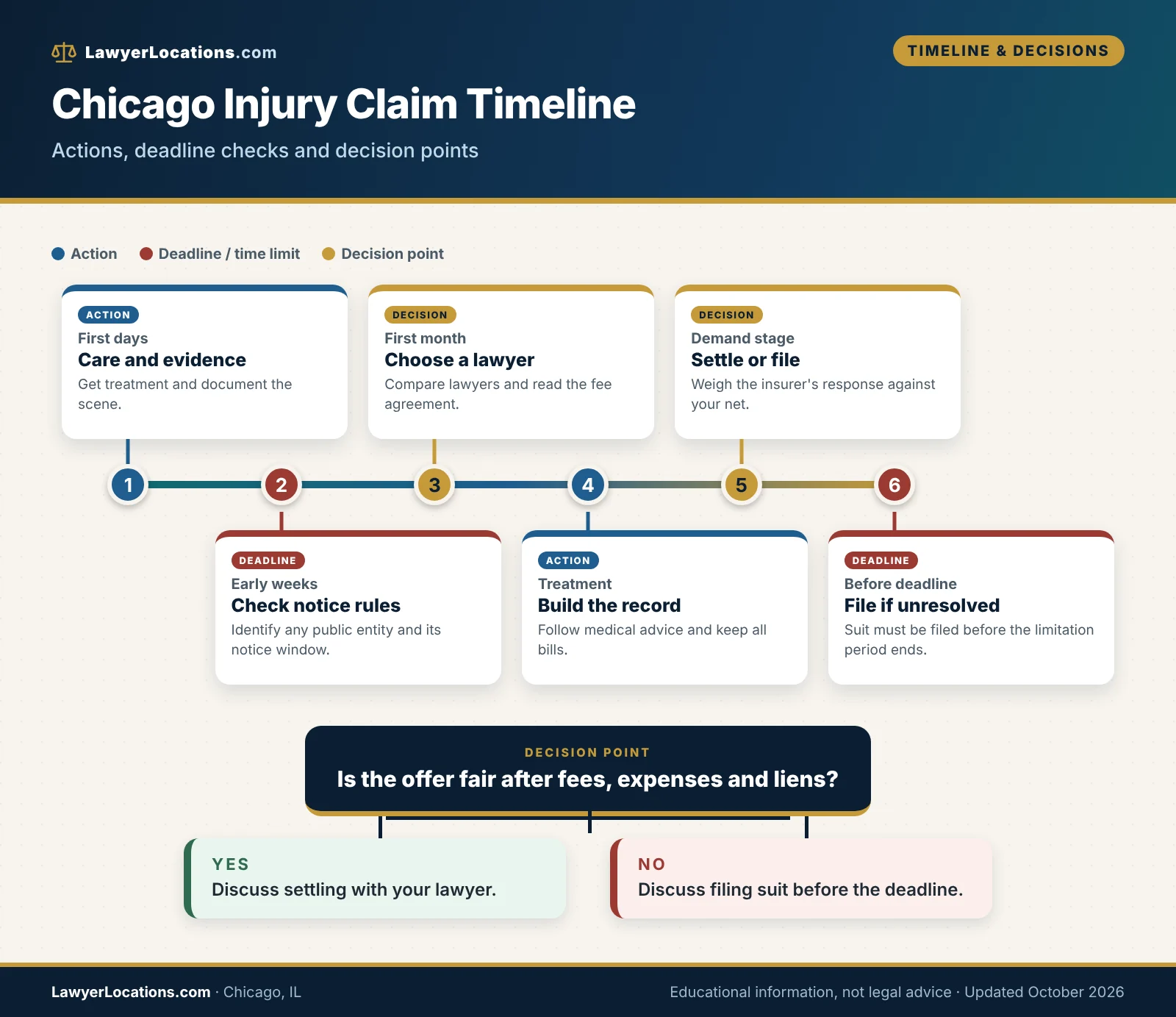
Text version of this graphic
- Days 1 to 7, action: get care, document the scene, preserve evidence.
- First weeks, deadline: identify any public entity and calendar the short notice window.
- First month, decision: compare lawyers and read the fee agreement.
- Treatment period, action: follow medical advice and keep all bills.
- Demand stage, decision: settle or file after the insurer responds.
- Before two years, deadline: file suit if the claim is unresolved.
Decision question: Is the insurer’s offer fair after fees, expenses and liens? If yes, consider settling; if no, discuss filing suit with your lawyer.
Evidence, Mistakes, Free Help and Next Steps
Strong claims usually have a clear timeline, consistent medical records and preserved evidence. The steps below take hours, not days, and they help both you and any lawyer who reviews your case.
Evidence to gather in the first days
At the scene and with your doctor
Get medical care first and tell the provider how you were hurt, since the first records often become the backbone of the claim. If you can, photograph the scene, the hazard, your injuries, vehicle damage and any visible signs such as skid marks, ice or broken stairs, and write down witness names and phone numbers.
- Photos and video of the scene, the hazard and your injuries
- Names and contact details for witnesses and anyone who took a report
- Insurance details for every driver or property owner involved
- Medical records, bills and a dated log of pain and missed work
- Crash, incident or police report numbers
- Vehicle, bus or train number, route and time if public transit was involved
- Your own insurance declarations page
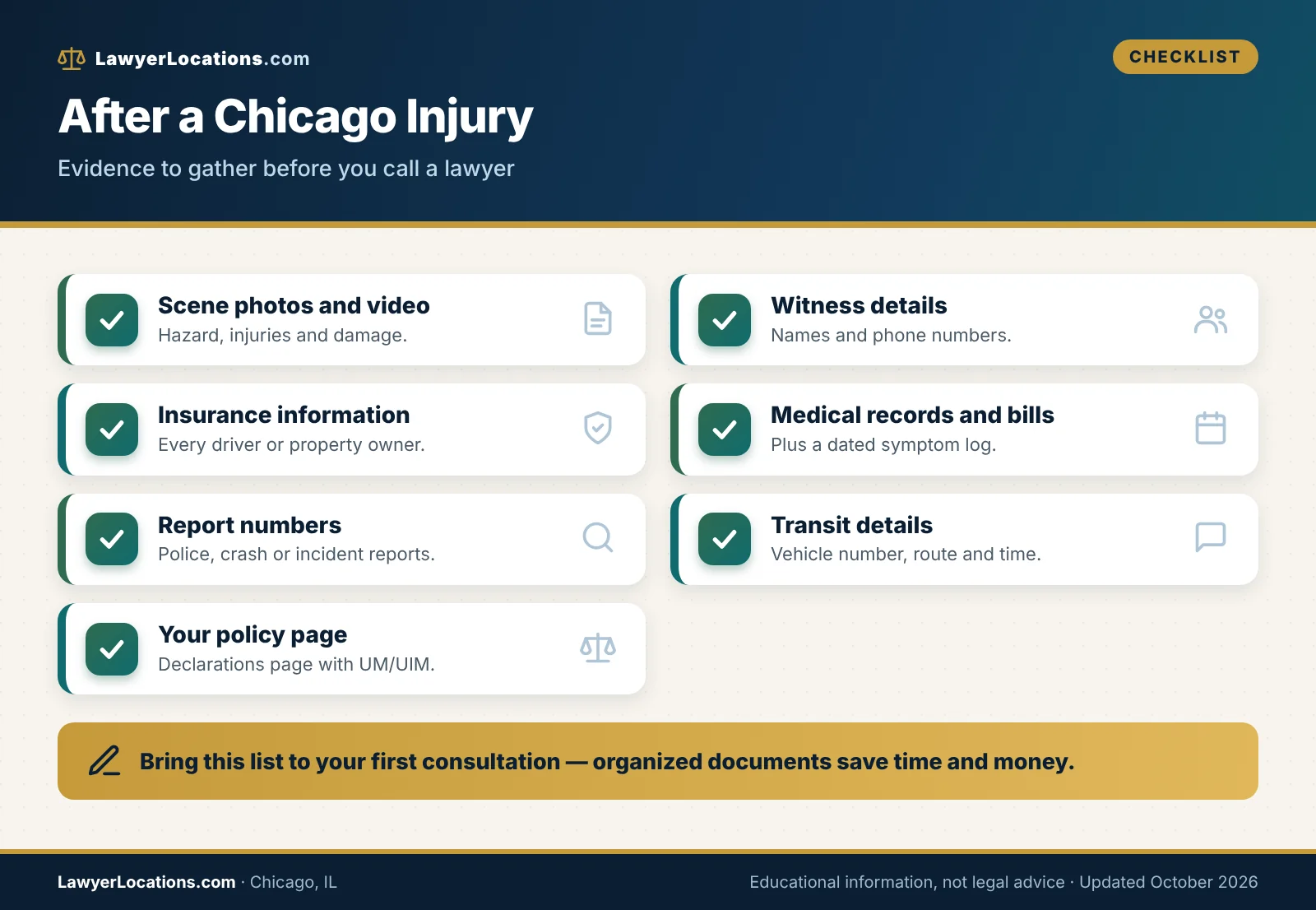
Text version of this graphic
- Photos and video of the scene and injuries
- Witness names and contact details
- Insurance details for everyone involved
- Medical records, bills and a symptom log
- Police or incident report numbers
- Transit vehicle number, route and time
- Your own policy declarations page
Reports and records in Chicago
The Chicago Police Department lets you purchase a traffic crash report online, listing the fee as $6.00 per report and $1.50 per amended report. Reports from before 2016, paper reports and other inquiries must be requested in person at the Records Customer Service Section, 3510 South Michigan Avenue, Monday through Friday from 8:00 a.m. to 1:30 p.m., or by calling (312) 745-5130. The CPD page also says driver information for an Illinois Motorist Report is available through the Driver Information Exchange only for crashes reported within the past two weeks.
Mistakes that quietly weaken claims
Statements, social media and early settlements
- Giving a recorded statement to the other side’s insurer before you understand your injuries.
- Posting photos or comments about your activity or the accident online.
- Skipping appointments or leaving gaps in treatment that an insurer can read as recovery.
- Signing a release before you know the full cost of care.
You may speak to your own insurer, as your policy requires. If the other side’s adjuster calls, you can say you will respond after you have had time to review your options.
Missing a notice or a deadline
The costliest mistake is waiting. Public-entity notice rules, the one-year deadline against local governments and the two-year general deadline can each end a claim, and the shortest clock is the one that matters. Write the date of the incident on a calendar today and count forward.
Free help and next steps
Legal aid and referral resources
If cost is the barrier, start with Illinois Legal Aid Online, a statewide resource with plain-language legal information, including a page on nursing home residents’ rights. For nursing home concerns, that page lists the Long-Term Care Ombudsman through the Senior Helpline at (800) 252-8966 and the Illinois Department of Public Health’s Central Complaint Registry Hotline at (800) 252-4343.
For injury lawyers, the CBA and ISBA referral services described above are practical starting points. Whichever route you take, do the ARDC check and read the fee agreement before you sign.
A simple plan for the next week
- Get medical care and follow your provider’s instructions.
- Write down the date, time and location, and any public body involved.
- Gather your documents using the checklist above.
- Contact two or three lawyers and verify each one with the ARDC.
- Compare fee terms in writing before you sign anything.
Ready to compare your options?
Use the questions in this guide to compare two or three Chicago injury lawyers side by side. If a dog caused the injury, our guide to dog bite lawyers in Chicago covers the Animal Control Act and the reporting steps that apply there.
Is Illinois a no-fault state for car accidents?
No. Illinois is a fault-based state, so the at-fault driver or that driver’s insurer is generally asked to pay, and your recovery is reduced by your share of fault and barred above 50%.
How long do I have to sue after a Chicago car accident?
For a private defendant, the general rule is two years under 735 ILCS 5/13-202. If a public body such as the CTA is involved, the deadline is shorter and written notice may be required.
Does Illinois cap pain and suffering damages?
The Illinois Supreme Court struck down the statutory cap on non-economic damages in medical malpractice cases in 2010. Ask a lawyer whether any limit currently applies to your type of claim.
How do I check whether a Chicago lawyer is licensed?
Use the ARDC Lawyer Search. It shows license status, contact details, public disciplinary history and whether the lawyer reports malpractice insurance.
Sources & References
Show all 34 sources
- 735 ILCS 5/13-202, personal injury limitation period — Illinois General Assembly — ilga.gov — accessed October 2026.
- 735 ILCS 5/13-211, minors and persons under legal disability — Illinois General Assembly — ilga.gov — accessed October 2026.
- 735 ILCS 5/2-1116, modified comparative fault — Illinois General Assembly — ilga.gov — accessed October 2026.
- 735 ILCS 5/2-1117, joint liability — Illinois General Assembly — ilga.gov — accessed October 2026.
- 745 ILCS 10/8-101, Local Governmental and Governmental Employees Tort Immunity Act — Illinois General Assembly — ilga.gov — accessed October 2026.
- Joseph v. CTA, No. 1-98-3298 (Ill. App. Ct.), quoting section 41 of the Metropolitan Transit Authority Act — Illinois Courts — illinoiscourts.gov — accessed October 2026.
- 625 ILCS 5/7-203, minimum liability insurance — Illinois General Assembly — ilga.gov — accessed October 2026.
- 215 ILCS 5/143a-2, uninsured and underinsured motorist coverage — Illinois General Assembly — ilga.gov — accessed October 2026.
- 625 ILCS 57/10, Transportation Network Providers Act insurance requirements — Illinois General Assembly — ilga.gov — accessed October 2026.
- 625 ILCS 5/12-603.1, seat belts — Illinois General Assembly — ilga.gov — accessed October 2026.
- 740 ILCS 130/2, Premises Liability Act — Illinois General Assembly — ilga.gov — accessed October 2026.
- Ryan v. Glen Ellyn Raintree Condominium Ass’n, 2014 IL App (2d) 130682 — Illinois Courts — illinoiscourts.gov — accessed October 2026.
- Gallagher v. Union Square Condominium Homeowner’s Ass’n, No. 2-09-0271 (Ill. App. Ct. 2010) — Illinois Courts — illinoiscourts.gov — accessed October 2026.
- An Overview of the History of General Contractor Liability and Evaluation of Current Trends (A. Kmak) — dcba.org — dcba.org — accessed October 2026.
- 820 ILCS 305/5, Workers’ Compensation Act, exclusive remedy and third-party claims — Illinois General Assembly — ilga.gov — accessed October 2026.
- 735 ILCS 5/2-622, healing art malpractice affidavit and report — Illinois General Assembly — ilga.gov — accessed October 2026.
- 735 ILCS 5/13-212, medical malpractice limitation — Illinois General Assembly — ilga.gov — accessed October 2026.
- 735 ILCS 5/2-1114, medical malpractice contingent fee limit — Illinois General Assembly — ilga.gov — accessed October 2026.
- 735 ILCS 5/13-214, construction-related claims — Illinois General Assembly — ilga.gov — accessed October 2026.
- 210 ILCS 45/3-601, Nursing Home Care Act, liability for acts of agents — Illinois General Assembly — ilga.gov — accessed October 2026.
- 210 ILCS 45/3-602, Nursing Home Care Act, licensee liability to residents — Illinois General Assembly — ilga.gov — accessed October 2026.
- 740 ILCS 180/2, Wrongful Death Act — Illinois General Assembly — ilga.gov — accessed October 2026.
- Lebron v. Gottlieb Memorial Hospital, Nos. 105741, 105745 (Ill. Feb. 4, 2010) — Illinois Courts — illinoiscourts.gov — accessed October 2026.
- Illinois Rule of Professional Conduct 1.5 (Fees) — Illinois Courts — illinoiscourts.gov resource — accessed October 2026.
- Law Division — Clerk of the Circuit Court of Cook County — cookcountyclerkofcourt.org — accessed October 2026.
- Civil Division — Clerk of the Circuit Court of Cook County — cookcountyclerkofcourt.org — accessed October 2026.
- eFile information — Clerk of the Circuit Court of Cook County — cookcountyclerkofcourt.org/eFile — accessed October 2026.
- Law Division — Circuit Court of Cook County — cookcountycourtil.gov — accessed October 2026.
- Traffic Crash Reports — Chicago Police Department — chicagopolice.org — accessed October 2026.
- Lawyer Referral Service, Personal Injury — Chicago Bar Association — lrs.chicagobar.org — accessed October 2026.
- Lawyer Referral Service, How It Works — Chicago Bar Association — lrs.chicagobar.org — accessed October 2026.
- Illinois Lawyer Finder — Illinois State Bar Association — isba.org — accessed October 2026.
- FAQs for the Public — Attorney Registration and Disciplinary Commission of Illinois — iardc.org — accessed October 2026.
- Nursing home violated my rights or my contract — Illinois Legal Aid Online — illinoislegalaid.org — accessed October 2026.
General information only. This guide is provided by LawyerLocations.com for general educational purposes and is not legal advice. Reading it does not create an attorney-client relationship, and LawyerLocations.com is not a law firm and does not recommend or rank individual lawyers. Statutes, court rules, fees and agency procedures change, and the facts of each situation differ, so consult a lawyer licensed in Illinois about your own claim and verify current deadlines with the court, agency or statute itself.
Legal Disclaimer and Limitation of Liability
Informational and illustrative purposes only. This article was prepared by LawyerLocations.com solely on the basis of the information available to us at the time of writing. It is an illustrative, general overview. It is not a complete or authoritative statement of the law, and it has not been reviewed by a lawyer licensed in your state or county.
Not legal advice. Nothing in this article is legal, financial, tax or immigration advice, and reading it does not create an attorney-client relationship between you and LawyerLocations.com or any author, lawyer or firm mentioned. Laws, court rules, fees, filing deadlines and agency procedures differ by state, county and court, and they change often. Some details here may be simplified, incomplete or out of date, and time limits for legal claims can be short.
No warranty. We make no representation or warranty, express or implied, about the accuracy, completeness, timeliness or suitability of this content for your situation. Please do not rely on it to make, delay or skip any legal decision. Check the facts against official sources and speak with a licensed attorney in the relevant jurisdiction before you act.
Limitation of liability. To the fullest extent permitted by law, LawyerLocations.com and its owners, authors and contributors disclaim all liability for any loss, damage, cost or other consequence arising from the use of, or reliance on, this article, including any content on third-party websites we link to. Mentioning a lawyer, firm, organization or service is not an endorsement and is not a promise of any result. If you are in immediate danger, contact your local emergency number.