
Choosing a slip and fall lawyer San Jose CA residents can rely on starts with three facts. California generally gives you 2 years to sue under Code of Civil Procedure § 335.1, but a fall on city, county or other public property usually requires a written government claim within 6 months. And your case turns on whether the property owner knew or should have known about the hazard and failed to fix or warn about it.
This guide explains how those rules play out in San Jose and Santa Clara County, which courts hear the case, how contingency fee agreements work, and how to compare lawyers without relying on advertising. It is legal education, not legal advice.
How a Slip and Fall Lawyer Case Works in San Jose, CA
A slip and fall case in San Jose is a premises liability claim under California law. It asks whether a property owner or occupier used reasonable care to keep the place safe, and whether a hazard they knew about, or should have found, caused your injury. A lawyer’s job is to gather proof of that chain, value the harm, and negotiate or litigate the claim.
What California law requires you to prove
California does not make property owners insurers of every visitor’s safety. A fall alone does not create liability. The law asks about reasonable care and about what the owner knew or should have known, and those two questions drive almost every dispute.
Duty of care and the “knew or should have known” test
The Judicial Council’s civil jury instruction on unsafe conditions (CACI No. 1003) frames the question this way: the condition created an unreasonable risk of harm, the owner knew or, through reasonable care, should have known about it, and the owner failed to repair it, protect people from it, or give adequate warning. Judges read that instruction together with the general premises liability elements in CACI No. 1000.
In plain terms, you need more than “there was a puddle.” You need facts showing why the owner can be held responsible for the puddle. The sections below show how lawyers build that proof.
constructive notice means the law treats the owner as if they knew about a hazard because it existed long enough that a reasonable inspection would have found it. Actual notice means someone with the owner or business really did know, such as an employee who saw the spill or a tenant who complained in writing.
Why inspection routines matter in store and building cases
In Ortega v. Kmart Corp. (California Supreme Court, 2001), a shopper slipped on spilled milk. The court held that a plaintiff does not have to prove exactly how long a hazard sat on the floor. Circumstantial evidence can show the condition lasted long enough, including evidence that the owner failed to make reasonable inspections within a reasonable time before the fall.
The same decision also protects owners who do inspect reasonably, even if a customer is hurt anyway. That is why a good lawyer asks early for inspection logs, cleaning schedules, staffing records and camera footage. Those records often decide whether a case is strong or weak.
The typical life of a case in Santa Clara County
Most injury claims follow the same broad path: protect evidence, treat the injury, send a claim, negotiate, and file suit only if negotiation fails. The timing varies enormously from case to case, so treat any promised timeline with suspicion.
Before any lawsuit is filed
The first stage is investigation and documentation. A lawyer sends a preservation request so the owner does not overwrite video, collects your medical records, identifies who owns, leases and maintains the spot where you fell, and tracks whether a short government-claim deadline applies.
After treatment stabilizes, the lawyer prepares a demand to the owner’s liability insurer. Insurers typically investigate, ask for recorded statements and medical authorizations, and may dispute either fault or the extent of the injury. You can talk to a lawyer before giving a recorded statement.
After a complaint is filed in Superior Court
If negotiation fails, your lawyer files a complaint in the Superior Court of Santa Clara County. The defendant responds, both sides exchange evidence in discovery (written questions, document requests and depositions), and the court sets case management dates. Many cases settle during or after discovery, often following mediation. A small share go to trial.
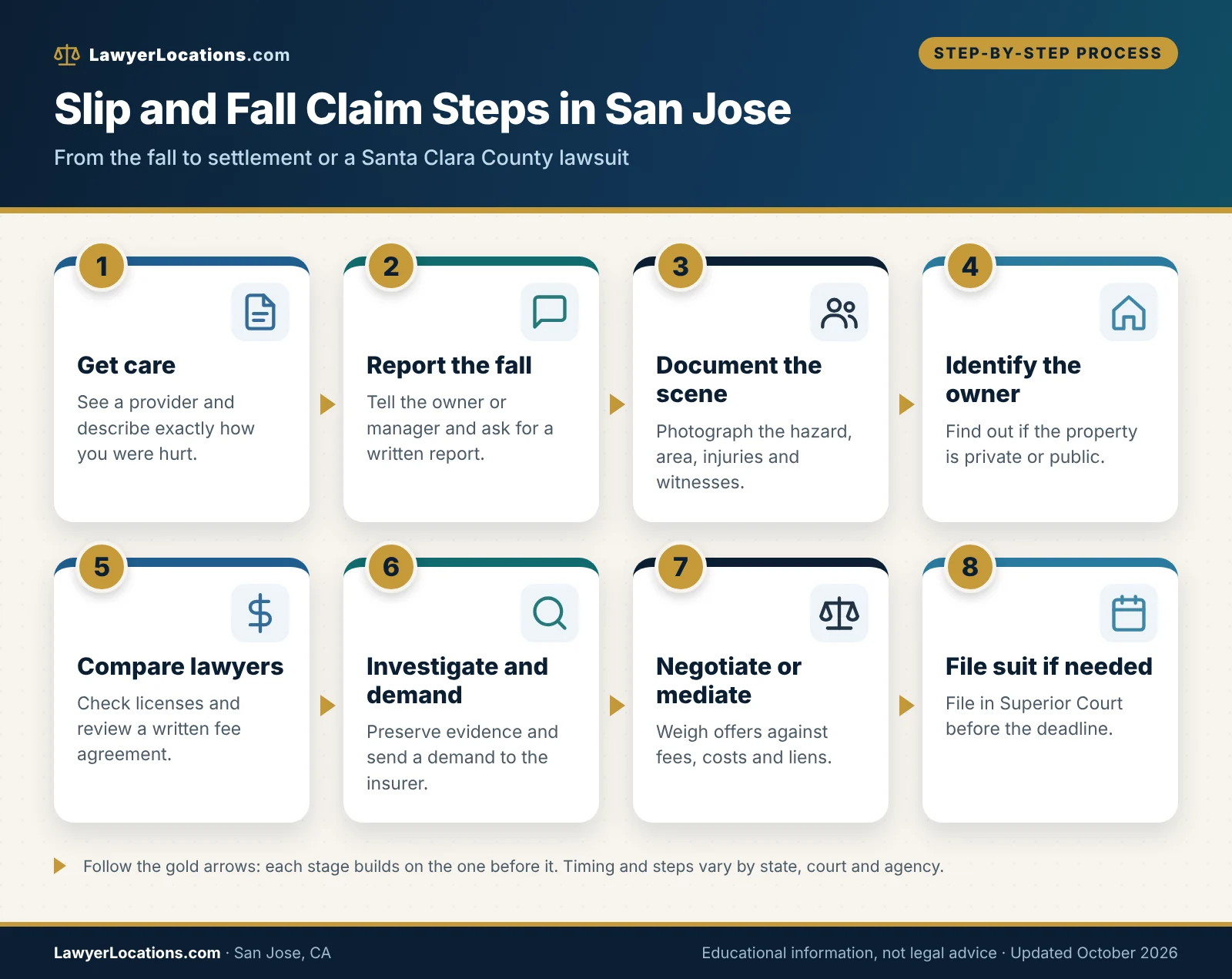
Text version of this graphic
- Get medical care and report the fall to the property owner or manager.
- Document the scene, your injuries and any witnesses.
- Check whether the property is public, which triggers a short claim deadline.
- Consult one or more lawyers and review a written fee agreement.
- Your lawyer investigates, preserves evidence and sends a demand to the insurer.
- Negotiate and, if needed, mediate toward a settlement.
- If there is no fair settlement, file suit in Santa Clara County Superior Court before the deadline.
- Resolve the case by settlement, or through trial and judgment.
What counts as a slip and fall injury claim
The phrase “slip and fall” covers slips, trips and falls on dangerous surfaces, stairs, uneven pavement, poorly lit areas and similar hazards. Where the fall happened affects who may be responsible, which rules apply and how fast you must act.
Common San Jose settings for falls
Typical settings include grocery and retail stores, restaurants, apartment complexes and common areas, parking lots and garages, office buildings, sidewalks and curb cuts, and parks. Each setting points to a different mix of potentially responsible parties: a store operator, a landlord, a management company, a contractor, an adjacent property owner or a public entity.
A single fall can involve more than one responsible party. A shopping center might own the parking lot while a tenant store controls the entrance mat. Your lawyer’s early work includes sorting out who controlled the area, which is often not obvious from the scene.
Injuries that tend to drive claim value
Claims often involve broken wrists, hips and ankles, head injuries, back and neck injuries, and soft-tissue injuries that take months to resolve. The nature of the injury, the treatment it requires, the time away from work and the lasting effects all shape what a claim is worth.
No honest lawyer can quote a value before reviewing your medical records and the liability facts. Treat anyone who promises a number on the first call as a red flag, as covered in the lawyer-comparison section below.
Write down the exact location of your fall, the time, the lighting, the weather and what you were carrying or wearing within the first day. Notes made while memory is fresh are far more useful than details reconstructed months later.
Fault is shared, not all-or-nothing
California follows pure comparative negligence. The California Supreme Court adopted the rule in Li v. Yellow Cab Co. (1975), replacing the old rule that any fault by the injured person barred recovery. Under the current approach, a jury or insurer can reduce your recovery by the percentage of fault assigned to you rather than deny it entirely.
How insurers use shared-fault arguments
Defense insurers frequently argue that a person was distracted, wearing unsafe footwear, ignoring a posted warning or walking in a closed area. Some arguments are fair and some are stretches. A lawyer weighs them against the owner’s failures, such as no warning cone, a burned-out light or a known drainage problem.
Because the percentage of fault directly reduces your recovery, avoid casual statements like “I wasn’t looking where I was going.” Describe what happened accurately, but do not speculate about blame at the scene or in recorded statements.
When the owner was not at fault
Some falls are accidents that nobody could reasonably have prevented. If a spill happened moments before you stepped in it and the owner had reasonable inspection routines, a premises claim may be weak. A candid lawyer will tell you when a case does not justify the time and expense of pursuing it, and will tell you promptly so you can still consider other options.
Deadlines and Special Rules That Can End a San Jose Slip and Fall Claim
The deadline depends mostly on who owns or controls the property. For private property the general rule is two years to file suit. For city, county, transit or other public property, a written claim is usually due much sooner. Missing a deadline can end a claim no matter how strong the facts are.
The general two-year rule for private property
California’s general statute of limitations for personal injury is found in Code of Civil Procedure § 335.1, which sets a two-year period for an action for injury to an individual caused by the wrongful act or neglect of another. The statute took effect January 1, 2003. For a deeper national comparison, see our guide on how long you have to file a personal injury claim.
When the clock usually starts
In a typical fall, the period runs from the date of the injury. Some situations raise questions about when a claim “accrues,” such as injuries discovered later or disputes over the date of an ongoing hazard. Do not assume a later start date. Ask a lawyer to calendar the earliest reasonable date.
Filing a lawsuit is different from sending a demand letter to an insurer. A demand or settlement talks do not stop the limitations clock on their own, so a case still needs to be filed in court on time if it has not settled.
Minors and people who lack legal capacity
Under Code of Civil Procedure § 352, if the injured person was a minor or lacked legal capacity to make decisions when the claim arose, that period of disability generally does not count toward the filing deadline. This tolling rule has an important exception: it does not apply where a government claim must first be presented to a public entity.
Families sometimes assume a child’s claim can wait years. That is risky, particularly if a public entity might be involved. Talk to a lawyer promptly about any injury to a child or an adult who could not manage their own affairs.
Do not wait until the two-year mark to look for a lawyer. Evidence such as video is often overwritten within weeks, and lawyers need time to investigate before a filing deadline. If any part of the property is public, the real deadline may be six months from the fall.
Falls on public property: the government claim rule
When the property belongs to a city, county, school district, transit agency or other public entity, California’s Government Claims Act applies. Under Government Code § 911.2, a claim for personal injury must be presented to the entity not later than six months after the cause of action accrues. That is a written claim to the agency, not a lawsuit.
Claims against the City of San Jose
The City of San José publishes a claim form for injuries to persons or damage to personal property. The form states that the claim generally must be filed within six months after the incident, cites Government Code § 911.2, and directs claims to the Office of the City Clerk at City Hall. It asks for the date and exact location, the circumstances, the city actions or employees involved, the amount claimed and how you computed it, and witnesses and medical providers. You sign it under penalty of perjury, and the form warns that a false claim is a crime under Penal Code § 72.
Always download the current form and filing instructions from the City Clerk’s office rather than relying on an old copy, since addresses and procedures can change. Other agencies, such as the County of Santa Clara or a transit agency, have their own claim procedures and addresses.
Late claims and suing after a claim is rejected
If you miss the six-month window, California law allows an application to present a late claim in limited circumstances, such as excusable mistake or neglect, being a minor, or physical or mental incapacity. The application must be made within a reasonable time and no later than one year after the cause of action accrued. Approval is not automatic, and a denied application can be challenged only by petitioning the court within a short window.
If the claim is timely, Government Code § 945.6 sets the next deadline. When the entity sends written notice rejecting your claim, you generally have six months from the date the notice was delivered or mailed to file suit. If the entity never sends a rejection notice, the outer limit is two years from accrual. These are firm cut-offs, so ask your lawyer to calendar both.
If a lawyer or intake worker says “you have two years” without first asking who owns the property, ask a follow-up question. In a public-property case, that answer can be wrong by more than a year.
| Situation | First deadline | Legal source | What it requires |
|---|---|---|---|
| Fall on private property (store, apartment, private lot) | 2 years to sue | Code of Civil Procedure § 335.1 | Lawsuit filed in court |
| Fall on public property (city, county, school or transit agency) | 6 months to present a claim | Government Code § 911.2 | Written claim to the public entity, not a lawsuit |
| Suit after a timely claim is rejected in writing | 6 months from the rejection notice | Government Code § 945.6 | Lawsuit filed in court |
| Suit after a claim with no written rejection | 2 years from accrual | Government Code § 945.6 | Lawsuit filed in court |
| Minor or person lacking capacity (private defendant) | Disability period not counted | Code of Civil Procedure § 352(a) | Does not apply where a government claim is required |
Whose property was it? Finding the responsible party
Deciding who is responsible for a hazard is often the hardest early question. Ownership, leases, maintenance contracts and local ordinances all play a role, and the answer shapes both the deadline and the defendant.
Sidewalks and walkways in San Jose
Sidewalk falls are a common San Jose scenario. State law, Streets and Highways Code § 5610, requires owners of lots fronting an improved public street to maintain the sidewalk so it will not endanger persons or property. The City of San José’s own sidewalk page states that property owners maintain the sidewalk, park strip, driveway approach and curb and gutter next to their property, and that inspections can be requested by the adjacent owner or by a concerned resident.
That does not mean the city can never be responsible, since a public entity can be liable for a dangerous condition of its own property under Government Code § 835 when an employee created the condition or the entity had actual or constructive notice of it. Which rules fit your fall depends on exactly where it happened and who controlled that spot, so a lawyer should evaluate both the adjacent owner and the city.
Stores, apartments and workplaces
In a store, the operator usually controls the sales floor, entrances and restrooms, while a landlord or management company may control parking lots, exterior walkways and common areas. In apartment buildings, tenants and visitors can sometimes claim against the owner or manager for hazards in stairways, lobbies, pools and laundry rooms.
If you fell while working, workers’ compensation rules may apply instead of, or in addition to, a premises claim. See our guide to finding a workers’ comp lawyer in California for how that system differs. A fall that happened at work on someone else’s property can involve both systems.
San Jose and Santa Clara County Courts and Local Resources
San Jose cases are heard in the Superior Court of Santa Clara County, California’s state trial court for the county. The court’s civil division handles injury lawsuits, and its published courthouse directory lists San Jose locations downtown. Court procedures and online tools change, so confirm details on the court’s own website before you file or appear.
Where slip and fall cases are filed
The county’s civil cases are concentrated in downtown San Jose. Which department hears your case depends on the court’s assignment system, not on your preference.
Downtown Superior Court and the Old Courthouse
The court’s civil division page states that civil cases are heard at the Downtown Superior Court (DTS) and the Old Courthouse. The Downtown Superior Court is at 191 North First Street, San Jose, CA 95113, and the court lists civil, probate and small claims among the case types handled there. The Old Courthouse is listed at 161 North First Street.
The court’s page for DTS says the building is open Monday through Friday, with published phone-service hours for civil, probate and small claims that are shorter than the building hours and differ on Fridays. It also describes a lobby drop box for civil documents. Because hours and filing options change, check the court’s current page before you go.
Small claims, limited civil and unlimited civil
The amount at stake determines the type of case. Under the court’s civil division page, cases worth $35,000 or less are limited civil cases, and cases worth more than that are unlimited civil cases. Small claims has separate caps: $12,500 for individuals and $6,500 for businesses. The $35,000 and $12,500 figures reflect Senate Bill 71, chaptered in 2023.
Serious injuries almost always exceed those limits once medical costs, lost income and long-term effects are counted. Minor falls with modest bills can fit small claims, a process designed for people to present their own cases. Ask a lawyer whether it makes sense to pursue small claims before assuming you need a full lawsuit.
| Case type | Amount threshold | Where to look | Practical note |
|---|---|---|---|
| Small claims (individual plaintiff) | Up to $12,500 | Court’s small claims division and self-help pages | Simplified process; useful for minor, well-documented losses |
| Small claims (business plaintiff) | Up to $6,500 | Same | Separate lower cap for businesses |
| Limited civil | $35,000 or less | Civil division | Early Settlement Conference available if both sides agree |
| Unlimited civil | More than $35,000 | Civil division | Parties generally must attempt ADR before trial under local rules |
How a case moves through the local court
Once a complaint is filed and served, the Santa Clara court’s civil rules and the statewide Rules of Court set a rhythm of paperwork and hearings. A lawyer handles most of this for you, but knowing the steps helps you ask better questions and avoid surprises.
Case management and alternative dispute resolution
The court’s civil FAQs explain that each party must file a case management statement at least 15 days before the first case management conference (California Rules of Court 3.725) and must meet and confer beforehand about how the case will be handled and whether it can settle (Rule 3.724). Parties or their lawyers must attend, and if a plaintiff does not appear, the court may place the case on a dismissal calendar.
For limited civil cases, the court usually sets a trial date at the first conference, and the parties can request an Early Settlement Conference if both agree. For unlimited civil cases, no trial date is given at the first conference, and the parties generally must attempt alternative dispute resolution before trial under Local Civil Rule 1E. Options include mediation, neutral evaluation and judicial arbitration.
Fee waivers, e-filing and case lookup
People with limited income can ask the court to waive filing fees. The civil FAQs say waivers are available only to low-income applicants under California Rules of Court 3.50 through 3.62. A lawyer working on contingency typically advances filing fees and recovers them from the settlement or judgment, so ask how that works in your fee agreement.
The court also maintains an e-filing page and a Case Information Portal where you can look up civil case and calendar information. Whether electronic filing is required for a particular filing depends on the court’s current rules, so check the e-filing FAQs or ask your lawyer.
Local help and referral resources
Finding the right lawyer is easier when you know which official tools exist. San Jose residents have a local bar association referral service, State Bar tools and several legal aid and self-help options.
Lawyer referral services and State Bar tools
The court’s Free and Low-Cost Legal Help page lists the Santa Clara County Bar Association as the local bar association referral service and says it can refer you to a lawyer or to a legal aid group. The State Bar of California says to use only certified lawyer referral services, which must meet standards approved by the California Supreme Court and display their State Bar certification number or mark in advertising. According to the State Bar, lawyers in a certified service must be licensed and in good standing and carry professional liability insurance, and the first consultation is typically discounted or free.
You can search the State Bar’s directory of certified referral services by county, area of law and language, and use its attorney search to look up an individual lawyer’s license profile. Confirm that any referral service you use is on the certified list before relying on its name.
Legal aid, pro bono and court self-help
The court’s list of free and low-cost help includes the Law Foundation of Silicon Valley, the Pro Bono Project, Bay Area Legal Aid, Asian Law Alliance and the Katharine and George Alexander Community Law Center at Santa Clara University School of Law, among others. The court’s page does not describe these groups as handling injury claims, and many focus on housing, family, public benefits or immigration, so call and ask whether they can help or refer you.
The court also runs a Self-Service Center with self-help topics and forms for people handling a matter without a lawyer. If your fall happened in a rental home and the problem is unsafe housing conditions rather than an injury claim, a legal aid group may be a better first call.
| Resource | What it offers | How to use it |
|---|---|---|
| Santa Clara County Bar Association referral service | Referral to a private lawyer or legal aid group, per the court’s help page | Ask whether the service is State Bar certified and what a first consultation costs |
| State Bar of California certified referral directory | Searchable by county, area of law and language | Use it to confirm certification before relying on any referral service |
| State Bar attorney search | License profile for individual lawyers | Check status before you sign a fee agreement |
| Court Self-Service Center and free help page | Forms, self-help topics and a directory of legal aid groups | Start here if you cannot afford a lawyer or want to try small claims |
| Legal aid groups (Law Foundation of Silicon Valley, Pro Bono Project and others) | Free or low-cost help, usually limited to certain case types and income levels | Call and ask whether injury claims or referrals are available |
If a person or website promises to match you with “the top slip and fall lawyer in San Jose,” treat that as marketing. Lawyers cannot be ranked that way. Use certified referral services and the State Bar’s tools, then interview more than one lawyer yourself.
How to Compare Slip and Fall Lawyers in San Jose
Compare lawyers on verifiable facts: license status, experience with premises cases, who will actually work on your file, how fees and costs are handled, and how clearly they explain risk. Avoid choosing on advertising volume or billboard slogans. You are looking for a good fit, and you should meet more than one lawyer if you can.
Verify the lawyer before you meet
A little checking before the consultation saves time and avoids bad surprises. None of these steps requires a lawyer’s help.
Confirm the license on the State Bar profile
Every lawyer who practices in California must be licensed by the State Bar. The State Bar’s public attorney search lets you look up a lawyer by name and see the license status on their profile. Confirm the spelling of the name and the firm’s information, and note anything on the profile that you want to ask about.
Be cautious about titles like “specialist” or “expert.” The State Bar keeps a separate directory of certified specialists for certain fields, so ask what a title means and where it comes from.
Look past advertising to real experience
Ask how many premises liability claims the lawyer has handled to resolution and whether they have taken any to trial. Ask what kinds of premises cases they have handled, such as retail stores, apartments or public property. A lawyer who is candid about limits is often a better partner than one who says yes to everything.
Online reviews can help you spot patterns in communication, but they are opinions, not legal assessments. Treat them as one input among several, not as proof of results.

Text version of this graphic
| Criterion | Question to ask | Priority |
|---|---|---|
| License and standing | Is your State Bar license active, and may I see your profile? | High |
| Premises experience | Which slip and fall cases have you handled recently? | High |
| Who works on my case | Who will handle my file day to day? | High |
| Fee agreement | What percentage applies, and is it before or after costs? | High |
| Case costs | Which costs will you advance, and who pays if we lose? | High |
| Public-entity deadlines | Have you checked whether a government claim deadline applies? | High |
| Communication | How often will you update me, and by what method? | Medium |
| Trial readiness | Will you file suit and go to trial if needed? | Medium |
Questions to ask in a consultation
Bring a one-page summary to every consultation: the date and place of the fall, who owns the property if you know, your injuries, your treatment so far and your questions. Same summary, every lawyer makes the meetings easier to compare afterward.
Bring your documents, take notes, and expect candid answers about strengths and weaknesses. The State Bar’s own guidance for choosing a lawyer suggests interviewing at least two, asking about experience and about who will handle your case, and being cautious about anyone who promises a specific outcome.
Experience, staffing and strategy
Ask who will personally handle your file and who you will talk to when you call. In many firms, paralegals and case managers do much of the day-to-day work under a lawyer’s supervision, which is normal if the lawyer is clear about it. If someone else at the firm handles parts of the case, ask to meet that person too.
Ask the lawyer to walk through how they would investigate your fall. A good answer mentions preservation of video and inspection records, identifying the responsible owner or operator, checking for government-claim deadlines, and how they would address any shared-fault arguments.
Communication, costs and realistic expectations
Ask how and how often the lawyer will update you, who decides whether to accept a settlement, and what the lawyer needs from you. Ask who makes the final call on settlement; you should expect your lawyer to explain every offer so that you can decide.
Ask for a plain-language estimate of the stages and what could slow the case down. A realistic lawyer will explain that medical treatment and recovery drive timing and that no one can promise a result or a date.
A grocery shopper falls on a wet floor near produce in a San Jose store. She asks two lawyers how they would find out whether anyone had inspected the aisle. One mentions requesting inspection logs, camera footage and employee schedules, and sending a preservation letter now. The other says “we’ll handle it.” The first answer shows a plan she can evaluate; the second tells her little.
Red flags when choosing a lawyer
Some warning signs appear before you sign anything. Spotting them early protects both your claim and your wallet.
Pressure, promises and unsolicited contact
- Promises of a result or an amount before reviewing your records.
- Pressure to sign the same day, or claims that the offer expires at the end of the consultation.
- Unsolicited calls, texts or visits after a fall, which call for extra caution.
- Unwillingness to explain how they would investigate your specific fall.
A lawyer who is confident in their work does not need pressure tactics. You can take the agreement home, read it carefully and compare it with another lawyer’s terms.
Fee agreement warning signs
- No written fee agreement, or one you cannot take home to review.
- Unclear treatment of case costs, such as whether the percentage is calculated before or after costs are deducted.
- Vague statements about liens and reimbursement claims from health insurers and medical providers.
- Reluctance to say what happens to the fee if you change lawyers.
California law requires contingency fee agreements to include specific terms, covered in the next section. If a contract is missing them, ask why.
- The lawyer explains how they would prove notice and handle your deadlines
- The written fee agreement is clear about percentages and costs
- You understand who will work on your file
- You meet more than one lawyer before choosing
- Someone promises a result or amount on the first call
- You are pushed to sign immediately
- The fee agreement is vague or not provided in writing
- No one asks who owns or controls the property
Fees, Costs, Deadlines and Decision Points
Most slip and fall lawyers in California work on a contingency fee: the fee is a percentage of the recovery, so you pay no hourly fees. The percentage, the treatment of case costs and the handling of medical liens all come from the written agreement. Read it before you sign, and compare it with at least one other lawyer’s terms.
How contingency fees work in California
A contingency arrangement means the lawyer is paid only if the case produces a recovery, and the fee is taken from that recovery. Because the lawyer shares the risk, they will evaluate carefully whether to take your case.
What the written agreement must say
Business and Professions Code § 6147 sets the baseline rules for contingency fee contracts in California. The agreement must be in writing, and the lawyer must give you a duplicate copy signed by both of you when you sign. It must state the contingency rate, explain how disbursements and costs affect the fee and your recovery, say whether you could owe the lawyer anything for related matters outside the contingency contract, and, where the special medical-injury fee limits in Section 6146 do not apply, state that the fee is not set by law and is negotiable.
If the contract does not comply, it is voidable at your option, and the lawyer would still be entitled to a reasonable fee. Workers’ compensation contingency contracts are treated separately. Ask the lawyer to walk you through each required term in plain language.
Percentages are negotiable, so compare
No statute fixes a percentage for a typical slip and fall case, and this guide does not publish an “average,” because there is no verified official figure to cite. Some firms use a sliding scale that rises if the case is filed in court or goes to trial. Ask for the percentages at each stage in writing.
Also ask whether the percentage is calculated on the gross recovery or after costs are subtracted, because the order of those two steps changes what you take home. Two lawyers can quote the same percentage and produce different net results.
| Term | Why it matters | What to ask |
|---|---|---|
| Contingency rate | Sets the lawyer’s share of any recovery | Does the rate change if a lawsuit is filed or the case goes to trial? |
| Costs and disbursements | Required to be explained, since they affect the fee and your net | Which costs are advanced, and are they repaid if there is no recovery? |
| Gross vs. net calculation | The order of fee and cost deduction changes your payout | Is the fee computed before or after costs? |
| Related matters | Required to state whether you could owe fees outside the contingency contract | Does this agreement cover a government claim, a lien dispute or an appeal? |
| Negotiability statement | The agreement must say the fee is not set by law and is negotiable | Is the statement in the contract, and did anyone explain it? |
| Signed duplicate copy | You are entitled to a signed copy when you sign | Can I take the draft home and compare it? |
| Ending the relationship | Affects what you owe if you switch lawyers | What happens to the fee and costs if I change lawyers? |
Case costs, liens and what you take home
The fee percentage is only part of the picture. Costs, liens and reimbursement claims can reduce what reaches you, and it helps to understand them before you accept any settlement.
Typical case costs
Case costs are the out-of-pocket expenses of building the claim, separate from the lawyer’s fee. They commonly include court filing fees, medical record charges, investigator or expert fees, deposition transcripts and mediator fees. Some lawyers advance these costs; others ask you to pay certain costs as they arise.
Ask for periodic cost reports and ask what limit, if any, the lawyer will check with you before exceeding. Also ask whether costs are repaid out of a recovery only, or whether you owe them if the case ends without one.
Medical bills, liens and reimbursement claims
Your health insurer, a medical provider or a government health program may claim part of a settlement for treatment they paid for or provided. These claims can change the net value of an offer, and the rules differ depending on who paid. Our guide on who pays medical bills after an accident explains how these claims typically arise, even though it focuses on car accidents.
Ask a prospective lawyer how they handle liens, whether they negotiate them, and whether the fee agreement addresses that work. A written settlement statement should show the gross amount, fee, costs, liens and your net before you sign a release.
Do not sign a release or accept a check until you understand how the fee, costs and liens affect your net. A release usually ends your right to seek more later, even if your injuries turn out to be worse than expected.
Timelines and decision points
Slip and fall cases usually involve a few real decisions: whether to hire a lawyer, whether to file a government claim, whether to accept an offer or file suit, and whether to try mediation. Each has a time dimension.
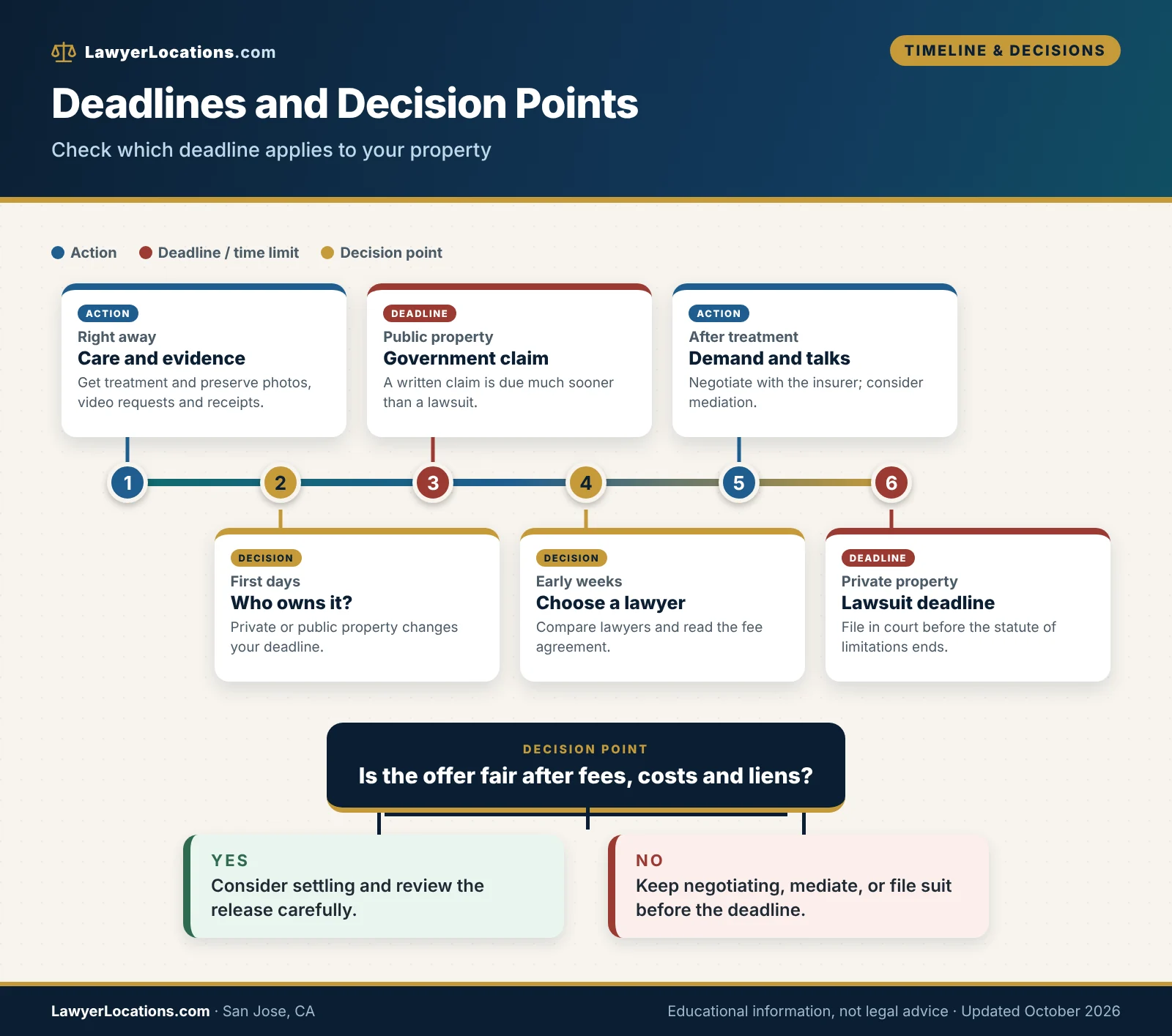
Text version of this graphic
| When | Stage | What happens |
|---|---|---|
| Right away | Care and documentation | Get medical care, report the fall, photograph the scene, save footwear and receipts. |
| First days | Identify the owner | Work out whether the property is private or public; preserve video and witness contacts. |
| Within 6 months if public | Government claim | Written claim to the city, county or agency under Government Code section 911.2. |
| Early weeks | Choose a lawyer | Compare lawyers and review a written fee agreement before signing. |
| After treatment stabilizes | Demand and negotiation | Lawyer submits a demand to the insurer and negotiates. |
| Within 2 years if private | File suit if needed | Complaint filed in Santa Clara County Superior Court before the deadline. |
Decision point: Is the offer fair after fees, costs and liens? If yes, consider settling. If no, continue negotiating, consider mediation, or file suit before the deadline.
Whether to handle it yourself, use small claims or hire a lawyer
A minor fall with small medical bills and clear fault may fit within small claims limits. Serious injuries, disputed fault, public-property claims, multiple defendants and ongoing treatment generally call for a lawyer. Many lawyers will tell you in a first meeting whether they think the case is worth pursuing.
If a lawyer declines your case, ask why and whether any deadline concerns them. A decline is not a judgment on you, and the reason may help you decide whether to try another lawyer, a small claims filing or no claim at all. Ask them to put any deadline warning in writing.
Whether to accept an offer or file suit
Insurers often make an early offer before the full extent of your injuries is known. Ask your lawyer to explain what the offer covers, what it leaves out, and what additional treatment or lost income could follow. Consider mediation, which the Santa Clara County court encourages and, in unlimited civil cases, generally requires parties to attempt before trial.
Do not let negotiations run so long that you miss the deadline to file. Ask your lawyer to tell you the date by which suit must be filed if the case does not settle, and whether any exceptions apply.
Evidence, Common Mistakes and Next Steps
The strongest slip and fall claims are built from facts collected early: photographs, witnesses, medical records and the property owner’s own records. What you do in the first days after a fall often matters more than anything you say later to an insurer.
Evidence to gather after a fall
Your goals are to protect your health, record the scene and preserve proof. Only do what you can do safely, and ask a friend or family member to help if you are hurt.
At the scene and in the first days
Report the fall to the store manager, landlord or property manager and ask that it be written down. Photograph the hazard from several angles, including wide shots that show the surroundings, lighting and any warning signs. Get names and contact information from witnesses. Keep the shoes and clothing you wore and do not wash or repair them.
Get medical attention even if you think the injury is minor, and tell the provider exactly how you were hurt. Prompt treatment protects your health and creates a clear record that links the injury to the fall.
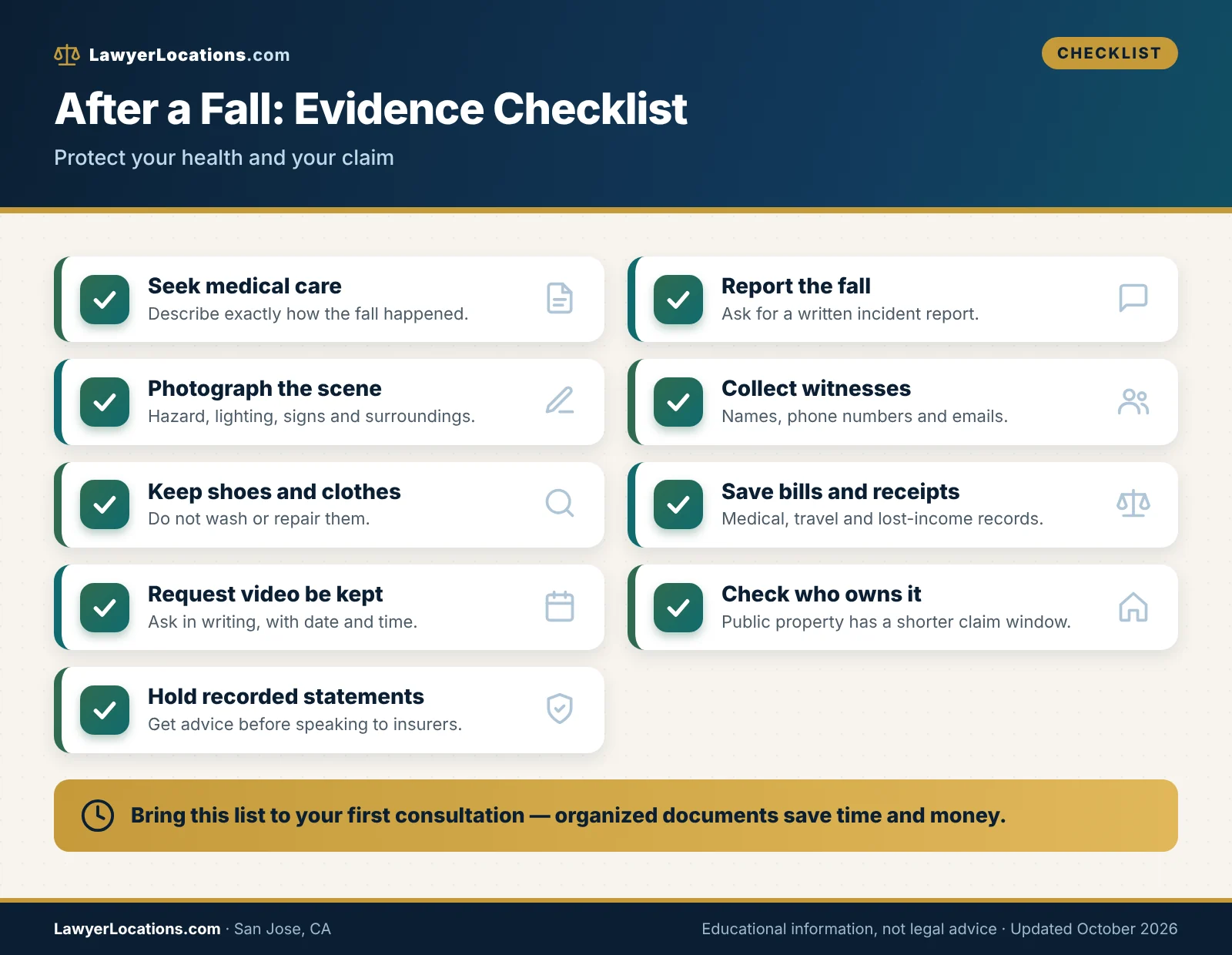
Text version of this graphic
- Seek medical care and describe how you were hurt.
- Report the fall and ask for a written incident report.
- Photograph the hazard, the area and your injuries.
- Collect witness names and contact information.
- Keep your shoes, clothing and receipts.
- Write down what happened while memory is fresh.
- Check whether the property is public, which affects deadlines.
- Do not give a recorded statement before getting advice.
Records, video and documents to request
- Medical records and bills from every provider who treated the injury.
- Proof of lost income, such as pay stubs and a note from your employer.
- The incident report, with a note of who prepared it and when.
- Names of employees on duty and managers in charge.
- A written request that the owner preserve surveillance video and inspection or cleaning logs.
- Photographs, text messages and emails that mention the hazard or the fall.
- Any notice you received from a landlord, store or city agency afterward.
Video is often kept only for a limited time, so a prompt preservation request matters. A lawyer can send it formally, but you can also ask the manager in writing to keep the footage for the date and time of your fall.
Common mistakes that weaken claims
Most of these mistakes are easy to avoid once you know about them. They do not mean your claim is lost, but they can make it harder.
Mistakes with insurers and evidence
- Giving a recorded statement to the property’s insurer before you understand your injuries or your rights.
- Posting about the fall or your activities on social media, where posts may be read out of context.
- Skipping medical visits or stopping treatment without telling your provider.
- Throwing away shoes, clothing or receipts.
- Accepting a quick check and signing a release before the full extent of the injury is known.
If an adjuster calls, you can politely say you are not ready to discuss the claim and will follow up. You are not required to give a recorded statement to the other side’s insurer.
Mistakes with deadlines and lawyers
- Assuming you have two years when the property may be public and the claim deadline may be much shorter.
- Waiting for treatment to finish before consulting a lawyer about deadlines.
- Signing a fee agreement without understanding costs and liens.
- Hiring the first lawyer you speak with without asking any comparison questions.
- Missing a deadline because you assumed the insurer or the lawyer would “take care of it” without confirming the date in writing.
You can ask any lawyer to name the filing deadline for your case, who it applies to and the date they calendared. A clear answer is a good sign.
Your next steps and quick answers
If you were hurt in a fall and are searching for a slip and fall lawyer in San Jose, CA, the most useful sequence is: protect your health, preserve evidence, find out who owns the property, check deadlines and then compare lawyers. You do not have to decide everything at once.
Quick answers to common questions
How long do I have to sue after a slip and fall in San Jose?
For private property, California generally allows two years under Code of Civil Procedure § 335.1. For a fall on public property, a written government claim is generally due within six months, so ask a lawyer promptly.
Do I need to prove the owner knew about the hazard?
You need to show the owner knew or should have known about it. Under Ortega v. Kmart, circumstantial evidence, including a failure to make reasonable inspections, can help show constructive notice.
Can I recover anything if I was partly at fault?
Usually yes. California follows pure comparative negligence, so your recovery is reduced by your share of fault rather than barred. Facts about warnings, lighting and footwear can affect that share.
What does a slip and fall lawyer in San Jose usually charge?
Many work on contingency, taking a percentage of any recovery. California law requires a written agreement stating the rate and how costs affect your recovery, and says the fee is negotiable. Compare the terms across lawyers.
Which court hears a San Jose slip and fall lawsuit?
The Superior Court of Santa Clara County. Its civil division says civil cases are heard at the Downtown Superior Court and the Old Courthouse in downtown San Jose.
Can I use small claims for a minor fall?
Possibly. The Santa Clara County court lists a small claims limit of $12,500 for individuals. Consider whether your medical bills, lost income and ongoing treatment fit within that cap before choosing it, since a judgment there ends the claim.
Who is responsible for a broken San Jose sidewalk?
State law and the City of San José generally place sidewalk maintenance on the adjacent property owner, but public entities can also be liable for dangerous conditions of their own property. A lawyer should check both possibilities and the six-month claim deadline.
What if I fell at work?
Workers’ compensation may apply instead of or alongside a premises claim, depending on the facts. Speak with a lawyer who handles both kinds of claims.
Your next steps
- Protect your health. Follow your provider’s treatment plan and keep appointments.
- Preserve evidence. Save photographs, clothing, receipts and witness details, and ask the owner in writing to keep video.
- Identify the owner. Find out whether the spot was private or public, since that decides the deadline.
- Verify and compare lawyers. Check State Bar profiles, use certified referral services and interview at least two lawyers.
- Read the fee agreement. Compare percentages, cost handling and lien handling before signing.
- Calendar the deadlines. Ask the lawyer to confirm the claim and filing dates in writing.
Ready to compare your options?
Use the scorecard and consultation questions above to speak with more than one lawyer licensed in California. If your fall involved a car, a bicycle or a pedestrian crossing, see our guides on whether you need a lawyer after a car accident and pedestrian accident lawyers in Oakland for related comparisons in other California cities.
General information only. This guide is educational and is not legal advice. Reading it does not create an attorney-client relationship, and LawyerLocations.com is not a law firm or a lawyer referral service. Laws, court rules, fees and procedures change, and the right answer depends on your facts. Consult a lawyer licensed in California about your situation and deadlines.
Sources & References
Show all 20 sources
- Code of Civil Procedure § 335.1 — Justia (California Code) — law.justia.com — accessed October 2026
- Code of Civil Procedure § 352 — California Public.Law — california.public.law — accessed October 2026
- Government Code § 911.2 — Justia (California Code) — law.justia.com — accessed October 2026
- Government Code § 945.6 — Justia (California Code) — law.justia.com — accessed October 2026
- Government Code § 835 — California Public.Law — california.public.law — accessed October 2026
- Guide to submitting an untimely tort claim (Government Code §§ 911.4, 946.6) — crpa.org-hosted guide — crpa.org — accessed October 2026
- Streets and Highways Code § 5610 — Justia (California Code) — law.justia.com — accessed October 2026
- Sidewalks and Curb Ramps — City of San José Department of Transportation — sanjoseca.gov — accessed October 2026
- Claim Against the City of San José (claim form and instructions) — City of San José, Office of the City Clerk — sanjoseca.gov — accessed October 2026
- CACI No. 1003, Unsafe Conditions (with Directions for Use) — Judicial Council of California jury instructions, via Justia — justia.com — accessed October 2026
- Ortega v. Kmart Corp. (2001) 26 Cal.4th 1200 — Supreme Court of California, via Stanford SCOCAL — scocal.stanford.edu — accessed October 2026
- Li v. Yellow Cab Co. (1975) 13 Cal.3d 804 — Supreme Court of California, case brief — lexplug.com — accessed October 2026
- Business and Professions Code § 6147 — California Public.Law — california.public.law — accessed October 2026
- Senate Bill 71 (2023), chaptered text — California Legislature, via LegiScan — legiscan.com — accessed October 2026
- Civil Division — Superior Court of California, County of Santa Clara — santaclara.courts.ca.gov — accessed October 2026
- Civil FAQs — Superior Court of California, County of Santa Clara — santaclara.courts.ca.gov — accessed October 2026
- Downtown Superior Court (DTS) — Superior Court of California, County of Santa Clara — santaclara.courts.ca.gov — accessed October 2026
- Free & Low-Cost Legal Help — Superior Court of California, County of Santa Clara Self-Help Center — santaclara.courts.ca.gov — accessed October 2026
- How a Certified Lawyer Referral Service Works — State Bar of California — calbar.ca.gov — accessed October 2026
- Before Selecting an Attorney — State Bar of California — calbar.ca.gov — accessed October 2026
Legal Disclaimer and Limitation of Liability
Informational and illustrative purposes only. This article was prepared by LawyerLocations.com solely on the basis of the information available to us at the time of writing. It is an illustrative, general overview. It is not a complete or authoritative statement of the law, and it has not been reviewed by a lawyer licensed in your state or county.
Not legal advice. Nothing in this article is legal, financial, tax or immigration advice, and reading it does not create an attorney-client relationship between you and LawyerLocations.com or any author, lawyer or firm mentioned. Laws, court rules, fees, filing deadlines and agency procedures differ by state, county and court, and they change often. Some details here may be simplified, incomplete or out of date, and time limits for legal claims can be short.
No warranty. We make no representation or warranty, express or implied, about the accuracy, completeness, timeliness or suitability of this content for your situation. Please do not rely on it to make, delay or skip any legal decision. Check the facts against official sources and speak with a licensed attorney in the relevant jurisdiction before you act.
Limitation of liability. To the fullest extent permitted by law, LawyerLocations.com and its owners, authors and contributors disclaim all liability for any loss, damage, cost or other consequence arising from the use of, or reliance on, this article, including any content on third-party websites we link to. Mentioning a lawyer, firm, organization or service is not an endorsement and is not a promise of any result. If you are in immediate danger, contact your local emergency number.