

If you are searching for a bicycle accident lawyer New Orleans LA riders can compare, start with three Louisiana rules that decide most bicycle cases. For a crash on or after July 1, 2024, the filing deadline for a tort claim is two years under the Civil Code, and since January 1, 2026 a rider found 51% or more at fault can recover nothing. If a pothole, track gap or state-owned road caused the fall, a separate set of rules for suing public bodies applies.
This guide explains those rules, how a claim moves from the NOPD report to Orleans Parish Civil District Court, how injury lawyers are usually paid, and how to compare lawyers before you sign. It is general information about Louisiana and New Orleans, not advice about your crash.
What a Bicycle Injury Lawyer Does in New Orleans
A bicycle injury lawyer helps an injured rider prove who caused a crash, put a value on the harm, and press an insurer or a court for payment. In New Orleans the job has a local twist, because the same crash can involve a driver’s insurer, a city street, a state highway or a transit authority, and each one follows different rules.
The work behind a bicycle claim
Most people picture a lawyer arguing in a courtroom. In practice, most of the work happens before any judge is involved. A bicycle case is built on paper, photographs, medical records and a clear timeline, and much of that evidence is easiest to collect in the first weeks.
Investigation and proof
A lawyer starts by working out what happened and who might answer for it. That usually means getting the crash report, the 911 and dispatch records, any traffic or doorbell camera video, and statements from witnesses who may not stay in touch. If a vehicle was involved, the lawyer will also look for the driver’s insurance and for any employer or vehicle owner who might share responsibility.
Insurance claims, negotiation and, when needed, a lawsuit
Many bicycle claims are resolved through the at-fault driver’s liability insurer or the rider’s own uninsured motorist coverage without a trial. The lawyer gathers your medical bills and records, documents lost income, and sends the insurer a written demand that explains fault and damages. If the insurer will not make a fair offer, or if time is running short, the next step is a lawsuit in the right court.
No honest lawyer can promise an outcome. A lawyer can manage deadlines, organize evidence and tell you plainly when an offer looks low. Our guide to the car accident settlement timeline walks through the same stages in more general terms.
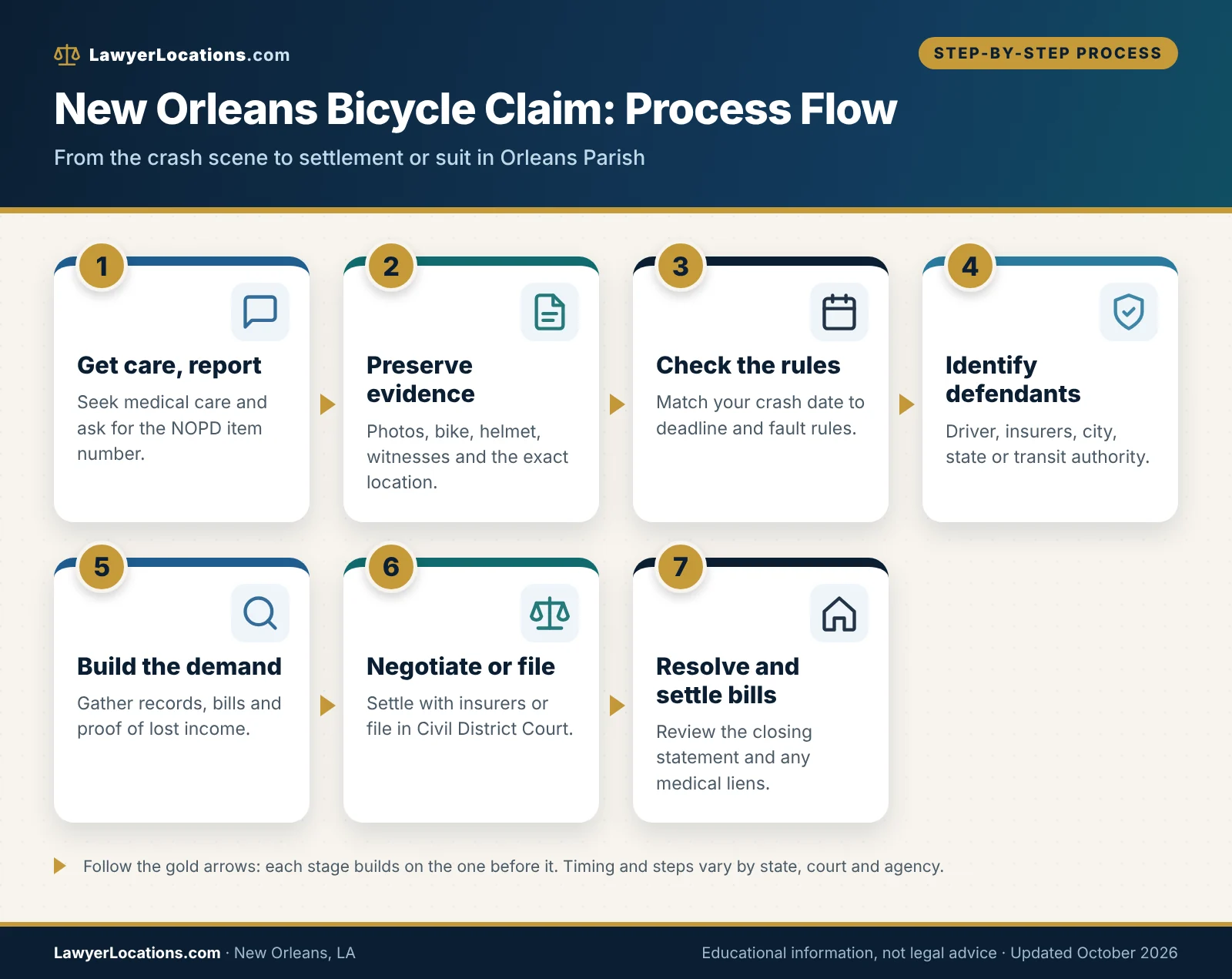
Text version of this graphic
- Get medical care and report the crash to NOPD.
- Preserve evidence: photos, bike, helmet, witness names.
- Check the deadline and which rules apply to your crash date.
- Identify every possible insurer or public body.
- Gather medical records and a demand package.
- Negotiate with the insurer, or file suit in Civil District Court.
- Resolve the case by settlement or trial, then settle medical liens.
What makes New Orleans riding claims different
The city is flat, compact and popular with riders, which is good for commuting and bad for margins of error. Narrow streets, heavy parking, festival crowds and aging pavement all show up in local bicycle claims. A lawyer who knows these conditions can spot evidence and defendants that a generic checklist would miss.
Streetcar tracks, potholes and shared streets
Streetcar rails run along corridors such as St. Charles Avenue and Canal Street, and rails can trap a narrow bicycle tire. The Regional Transit Authority (RTA), which has run New Orleans bus and streetcar service in-house since December 2020, has told the public to use caution near streetcars and has reminded drivers that vehicles on or near the tracks must yield to streetcars.1 A fall on a track gap can raise questions about the rider, the road surface and the authority that maintains the rail corridor.
The city’s Department of Public Works (DPW) fills potholes through its Maintenance Division and says that when a utility or other entity caused a pothole, it refers the repair to that agency.2 The right defendant may be the city, a utility contractor or somebody else, as the public-body section below explains.
State routes, city streets and who answers for each
Not every busy New Orleans street belongs to the city. WWNO reported in September 2025 that St. Claude Avenue is largely managed by the state as Highway LA-46, and that advocates have asked the Louisiana Department of Transportation and Development (DOTD) to study safer designs there.3 If a crash happens on a state route, the state may be the party responsible for the road, not the City of New Orleans.
The same report said the city’s bikeway network has grown past 150 miles, up from about seven miles before Hurricane Katrina, and that DPW counts 35 miles added or improved since 2020.3
Write down the nearest cross street, the block number and any landmark before you leave the scene. A lawyer can use that to check state route versus city street ownership, which can change who is responsible and which procedures apply.
Louisiana Law That Controls a New Orleans Bicycle Injury Claim
Louisiana is a civil-law state, so injury claims run through the Louisiana Civil Code rather than a common-law “statute of limitations.” Three rules do most of the work: the time limit to sue, how a rider’s own fault reduces or bars a recovery, and which insurance can be reached. Several of them changed in 2024 and 2025, so older web pages can be wrong.
The two-year deadline and the crash-date rules
Louisiana calls the time limit to sue “liberative prescription.” It works like a statute of limitations, but it is written into the Civil Code. The key point for riders is that the length of the period depends on the date of the crash.
What the Civil Code says about delictual actions
Liberative prescription is Louisiana’s word for losing the right to sue because too much time passed. Think of it as the state’s version of a statute of limitations.
A delictual action is Louisiana’s term for a tort claim, such as a negligence claim after a crash. Under the Louisiana State Legislature’s page for Civil Code art. 3493.1, delictual actions are subject to a liberative prescription of two years, and the period starts to run from the day the injury or damage is sustained.4 The change came from Act 423 of the 2024 Regular Session (HB 315), effective July 1, 2024, which also repealed former articles 3492 and 3493, the old one-year rule.5
The Act itself, as posted by the Legislature, lists the new articles as 3493.11 and 3493.12, while the Civil Code page displays the delictual article as 3493.1.4,5 Because the numbering differs between sources, ask any lawyer to confirm the current article number and text for your crash date.
The two-year period applies only to damage occurring on or after July 1, 2024. One law-firm analysis of Act 423 gives this example: a crash on June 30, 2024 had to be filed by June 30, 2025, while a crash on July 1, 2024 could be filed until July 1, 2026.6 A crash in the first months after July 1, 2024 may already be out of time, so do not wait to check.
Which rules apply to which crash date
Because the legislature changed several rules in a short span, the rules that govern your case depend on when you were hurt. The table below summarizes the three windows. It is a map for the conversation with a lawyer, not a calculation of your own deadline.
| Crash date | Time limit to sue | Fault rule | What to do now |
|---|---|---|---|
| Before July 1, 2024 | One year under former art. 3492 (repealed for later damage) | Pure comparative fault | The one-year period has almost certainly passed; a lawyer can check for any exception or a different defendant. |
| July 1, 2024 to Dec. 31, 2025 | Two years from the day of injury | Pure comparative fault, per a law-firm reading of the 2026 change | The window may be closing or closed; treat the date as urgent and ask a lawyer to compute it. |
| Jan. 1, 2026 or later | Two years from the day of injury | 51% bar: a claimant 51% or more at fault recovers nothing | Preserve evidence of the driver’s and any public body’s fault, and avoid statements that assign blame to yourself. |
Two more points belong on your calendar. First, a Louisiana article on interruption of prescription (art. 3462) says that a suit filed in a court without jurisdiction or in an improper venue interrupts the clock only against defendants served within the prescriptive period, so filing in the right place matters. Second, the text of art. 3493.1 carves out only a narrow exception for minors and interdicts in certain permanent-disability product-liability actions, so a parent should not assume a child’s claim is paused.4 For more on how deadlines vary, see our guide to how long you have to file a personal injury claim.
Fault: the 51% bar and Louisiana’s bicycle statutes
Fault is where many bicycle cases are won or lost. Drivers and insurers often argue that the rider was somewhere they should not have been, was hard to see, or swerved. Louisiana’s rule on how that argument affects your recovery changed on January 1, 2026.
How comparative fault works after January 1, 2026
Civil Code art. 2323 governs comparative fault. The Legislature’s page shows that art. 2323(A) now says a claimant whose negligence is 51% or more of the cause cannot recover damages, while a claimant below 51% can recover, with the award reduced by the claimant’s percentage of fault. The same page lists the amendment as Act 15 of 2025, effective January 1, 2026.7
That means the older description of Louisiana as a “pure comparative fault” state no longer holds for newer crashes. Liskow & Lewis, a Louisiana law firm, reads the change as tied to when the injury occurred: injuries on or after January 1, 2026 fall under the 51% rule, and earlier accidents remain under pure comparative fault even if the suit is filed later and is timely.8 The bill itself contained only an effective-date section and no separate transition clause.9
Suppose a jury finds $100,000 in damages. Under the rule that applies to crashes from January 1, 2026, a rider found 40% at fault would recover $60,000, while a rider found 51% at fault would recover nothing. That example comes from the same law-firm analysis, and it shows why every percentage point matters.8
Bicycle statutes that come up in fault disputes
Louisiana bicycle rules are short, and most of them are in Title 32, the traffic statutes. The table lists the ones that most often appear in arguments about fault. A traffic citation or a statutory violation is evidence, not an automatic verdict, so a lawyer will connect each rule to the facts.
| Statute | What it says in plain terms | Why it matters |
|---|---|---|
| La. R.S. 32:194 | A person riding a bicycle on a highway has the same rights and duties as a vehicle driver, except for special bicycle rules and rules that cannot apply to bicycles.10 | Riders must follow signals and stop signs, and drivers owe riders the same right-of-way as other vehicles. |
| La. R.S. 32:197 | Ride as close to the right edge as practical, with exceptions for passing, left turns, hazards, a lane too narrow to share, and approaching a right turn. No more than two abreast.11 | The exceptions often decide whether a rider “in the lane” was at fault. |
| La. R.S. 32:76.1 | A driver passing a bicycle in the same direction must keep at least three feet of clearance until fully past; a violation carries a fine of up to $250.12 | A close pass is direct evidence of driver fault. |
| La. R.S. 32:199 | Parents may not knowingly allow a child under 12 to ride without an approved helmet. A citation is not prima facie evidence of negligence, and comparative negligence rules apply.13 | An adult rider has no statutory helmet duty here, and the child rule does not automatically cut a recovery. |
| La. R.S. 32:283 | Drivers and passengers must check that opening a door will not interfere with traffic or endanger others.14 | Central to “dooring” claims along parked-car corridors. |
The state also reports that Louisiana has no statute that specifically allows or bans sidewalk riding, does not let riders treat stop signs as yield signs, and does not require riders to use a bike lane instead of a normal lane.14 Local New Orleans ordinances may add rules, so a lawyer should check city law for the exact block.
Insurance: direct action and uninsured motorist coverage
A bicycle claim is only as useful as the money behind it. Louisiana law gives injured people two main paths to insurance, and the first narrowed in 2024.
Suing the insurer: the direct action statute after Act 275
Louisiana’s direct action statute, La. R.S. 22:1269, once let an injured person sue a negligent driver and that driver’s liability insurer together. Act 275 of 2024 (HB 337), effective August 1, 2024, now generally requires the claim to proceed against the insured first, and allows a direct action against the insurer alone only in listed situations.15 Those include bankruptcy of the insured, insolvency, failed service or the insured’s refusal to answer or defend within 180 days of service, the insured’s death, an uninsured motorist carrier as the insurer, and cases where the insurer defends under a reservation of rights or denies coverage solely to establish coverage.15
A law-firm summary adds that an insurer’s name cannot appear in the case caption and that coverage generally may not be mentioned to the jury.16 Whether the revision applies to suits already pending is not stated in the sources we reviewed.
Uninsured, underinsured and hit-and-run drivers
If the driver has no insurance, too little insurance, or leaves the scene, the rider’s own uninsured/underinsured motorist (UM) coverage may help. La. R.S. 22:1295 requires UM coverage to be offered on Louisiana auto liability policies, and rejection or lower limits require a signed form prescribed by the insurance commissioner.17 The statute treats an underinsured vehicle as one whose liability coverage is less than the damages suffered.17
For a hit-and-run with no physical contact, the statute requires the injured person to prove through an independent and disinterested witness that an unidentified driver caused the injury.17 That is a strong reason to collect witness names at the scene. The Louisiana Department of Insurance guide lists the state’s minimum liability limits as $15,000 per person, $30,000 per accident and $25,000 for property damage, which is why a serious bicycle injury can quickly exceed a driver’s coverage.18
Potholes, Streetcar Tracks and Claims Against Public Bodies
When a road defect, not a driver, causes a bicycle fall, the defendant is often a government body, and Louisiana sets special rules for those suits. The rules cover what you must prove about the defect, how fast you must serve the suit, where it can be filed, whether a jury is allowed and how much can be recovered.
Proving a road-defect claim under La. R.S. 9:2800
New Orleans riders know the usual suspects: deep potholes, sunken utility cuts, broken edges at curbs, steel plates and rail gaps. Louisiana does not make a city or state liable simply because a defect exists. The statute asks whether the public body knew, or should have known, about it and had a fair chance to fix it.
Notice, time to repair and failure to repair
La. R.S. 9:2800 governs most claims against a public entity for the condition of things in its custody. For things other than buildings, the claimant must show that the entity had actual or constructive notice of the particular vice or defect before the occurrence, had a reasonable opportunity to remedy it, and failed to do so.19 The statute defines constructive notice as the existence of facts that infer actual knowledge.19
This is a notice of the defect, not a notice of your claim. People often confuse the two. A pothole that has been reported through 311 for months looks very different, legally, from one that opened the night before your ride. The statute also says that violating a public entity’s own rules is not negligence per se, and it addresses what happens when an entity responds to a report about property it does not own or control.19
Documenting a defect before it is fixed
Public defects get patched, which can erase the proof. Photograph the defect from several angles with something for scale, such as a tape measure or your shoe, and note the date and time. Record the exact location, then check whether the same spot appears in 311 records.
DPW says residents can report a pothole by calling 311, dialing (504) 539-3266, or using nola.gov/311, and that each report gets a ticket number.2 A lawyer may ask for the city’s records of earlier complaints, because only reports made before your crash help on the notice element.
Do not let anyone talk you out of documenting a defect because “the city will fix it anyway.” Repairs can wipe out the evidence of size, depth and location. Photograph first, then report.
Special procedures when the defendant is public
The Louisiana Governmental Claims Act, La. R.S. 13:5101 and following, applies to suits for injury to person or property against the state or a state agency, a political subdivision and their officers and employees acting within their duties.24 The RTA and the City of New Orleans fall on the public side of the line, so these rules matter to streetcar-track and street-surface claims. Whether a specific entity counts as a political subdivision is something a lawyer will confirm.
Service within 90 days, venue and the state-court requirement
La. R.S. 13:5107 sets a trap that catches careless filings. Service on a political subdivision must be requested within 90 days of commencing the action, unless the defendant waives that in writing. If service is not requested in time, the court dismisses the claims against that party without prejudice, and the summary of the statute we reviewed says the suit does not stop prescription from running against the unserved party.20 A timely request counts even if the service is later found insufficient.20
Venue is addressed in La. R.S. 13:5104. A suit against the state or a state agency may be filed in the judicial district where the state capitol is located or in the district court of the parish where the cause of action arose. A suit against a political subdivision may be filed in the district where the subdivision is located or the parish where the cause of action arose.21 For a New Orleans crash, that usually points to Orleans Parish Civil District Court. Separately, La. R.S. 13:5106(A) says suits against the state or a political subdivision must be brought in a Louisiana state court.23
No jury and a damages cap
Two features of public-body suits surprise many injured riders. Under La. R.S. 13:5105, no suit against a political subdivision is tried by jury, although a subdivision may lift that bar by a general ordinance or resolution.22 Cases against the state generally are not tried by jury unless a timely jury demand is filed.22
La. R.S. 13:5106 also caps total liability of the state and political subdivisions for personal injury to any one person at $500,000, regardless of the number of suits or claims.23 The cap excludes property damages, medical care and related benefits, and loss of earnings and future earnings.23 For a political subdivision, the court orders future medical care paid through a reversionary trust directly to providers as incurred.23 Ask a lawyer how the cap and the medical-care carve-out apply to your injuries.
| Issue | Private driver or owner | City, RTA or other political subdivision | State agency (for example, DOTD) |
|---|---|---|---|
| Proof of the defect | Ordinary negligence | Actual or constructive notice, time to repair, failure to repair (R.S. 9:2800) | Same R.S. 9:2800 test for things in state custody |
| Service of suit | Normal service rules | Request service within 90 days (R.S. 13:5107) | Generally the same 90-day rule; confirm for your defendant (R.S. 13:5107) |
| Jury trial | Available if the claim exceeds $10,000 (C.C.P. art. 1732) | None unless waived by ordinance or resolution (R.S. 13:5105) | Only on a timely jury demand (R.S. 13:5105) |
| Venue | Rules in the Code of Civil Procedure | District where located or parish where cause arose (R.S. 13:5104(B)) | Capitol district or parish where cause arose (R.S. 13:5104(A)) |
| Damage limits | No general damages cap in the statutes reviewed here | $500,000 cap, with carve-outs (R.S. 13:5106) | $500,000 cap, with carve-outs (R.S. 13:5106) |
The table is general. Some statutes carry exceptions, and local ordinances may add steps. We did not find a separate pre-suit notice-of-claim requirement in the Governmental Claims Act provisions summarized here, but an individual agency’s own claims process may exist, so a lawyer should confirm the steps for your specific defendant before relying on that. If you are comparing how different case types are handled, our article on rear-end accident claims shows how ordinary driver-versus-driver fault works.
How to Compare Bicycle Accident Lawyers in New Orleans, LA
You compare lawyers by checking who they are, what they have actually handled, how they get paid and how they communicate. This guide never ranks or recommends individual lawyers, and neither should a directory. What it can do is show you how to test any name on your list.
Verify who you are talking to
Before you sit down with anyone, confirm that the person is licensed in Louisiana and in good standing. The Louisiana State Bar Association (LSBA) publishes a public membership directory, information on filing a complaint, and a lawyer-advertising filing search.30 Those tools help you check the basics before a first call.
License, discipline and advertising checks
Start with the LSBA Membership Directory at lsba.org, and use the Complaints and Attorney Disciplinary Procedures pages to understand how the system works.30 The LSBA also offers a Lawyer Advertising Filing Search, which can help when a billboard or television ad makes bold promises.30 A lawyer’s advertising is not proof of results, and it is fair to ask what the firm has actually handled for bicycle riders.
Referral services and legal aid
The LSBA lists a Lawyer Referral and Information service and a Find Legal Help page.30 A referral service can be a starting point, but it is not an endorsement, and a lawyer still has to be right for your facts. The Civil District Court’s Self-Help Resource Center serves self-represented litigants in family-law matters and does not give legal advice, so it is not a bicycle-injury resource.33 If cost is the worry, ask each lawyer plainly what you would owe if the case does not succeed.
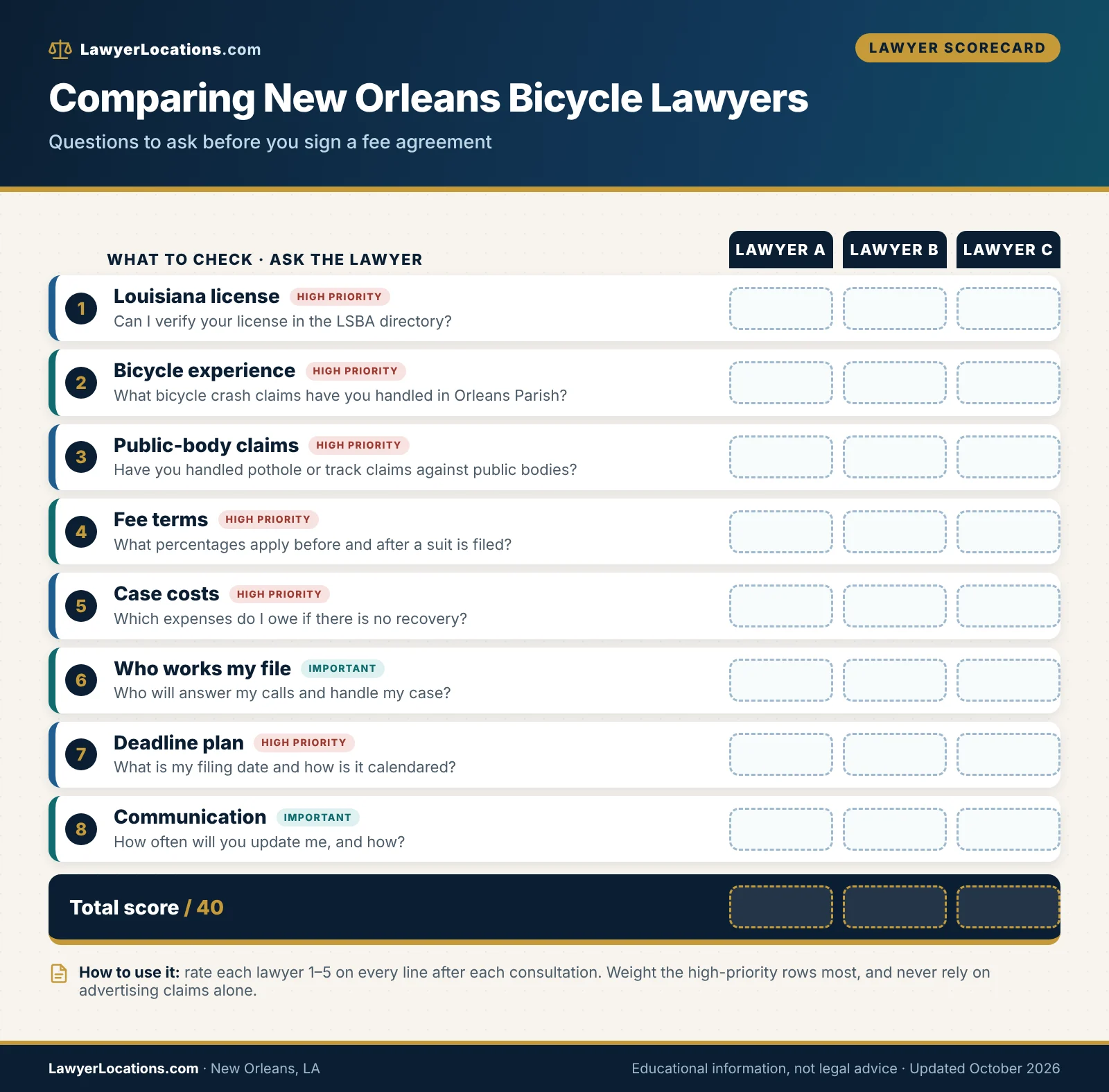
Text version of this graphic
| Criterion | Question to ask |
|---|---|
| Louisiana license | Are you licensed here, and can I check the LSBA directory? |
| Bicycle experience | What bicycle crash claims have you handled in Orleans Parish? |
| Public-body claims | Have you handled pothole or track claims against public bodies? |
| Fee terms | What percentage applies before and after suit is filed? |
| Case costs | Which costs do I owe if there is no recovery? |
| Who works my file | Who will answer my calls and make decisions? |
| Deadline plan | What is my filing date, and how will you calendar it? |
| Communication | How often will you update me, and by what method? |
Questions that separate a good fit from a mismatch
A first conversation is a chance for you to interview the lawyer. Our directory does not promise free consultations or response times, so ask each firm what its first meeting involves and whether it charges anything.
Experience questions about bicycles and public defendants
Ask how many bicycle cases the lawyer has handled in the last few years and what kinds of defendants were involved. A case against a driver’s insurer is different from a case against the city for a pothole. Ask whether the lawyer has worked with the 90-day service rule, the no-jury rule and the damages cap described above.
Ask how the lawyer would approach fault under the 51% rule if your crash happened on or after January 1, 2026. A thoughtful answer mentions evidence, witnesses and the specific bicycle statutes.
Communication, staffing and realistic expectations
Ask who will be your main contact, how often you will get updates, and how the firm handles questions after hours. Ask what a typical timeline looks like for a case like yours and what usually causes delay. If the lawyer promises a result, a number or a speed, treat that as a warning sign.
Bring your photos, the crash report number, your insurance cards and a list of every provider you have seen to the first meeting. You can ask for the same meeting with more than one lawyer and compare how each explains fault, deadline and fees in plain language.
- The lawyer explains the deadline for your crash date without being asked.
- The fee agreement is written, signed and explains costs clearly.
- You get specific answers about public-body procedures if a road defect is involved.
- The lawyer pushes you to sign on the spot.
- You are promised a result, a dollar figure or a timeline.
- Nobody can say who will actually work on your file.
From Crash Scene to Civil District Court
A New Orleans bicycle claim usually moves from the scene, to medical care, to an insurance claim, and only then to a lawsuit in Orleans Parish. Knowing the sequence helps you see where a lawyer adds value and where your own choices matter most.
The first days after a crash
Your health comes first. Get medical attention even if you feel “mostly okay,” because some injuries show up hours or days later, and gaps in treatment give insurers an argument. After that, the goal is to capture facts while they are fresh.
Police and crash reports
If a vehicle was involved, ask the responding officer for the report or item number before you leave. The NOPD’s records page says an initial police report request form is mailed to the Records Division at 715 South Broad Street, with a $25.00 fee for the first 10 pages plus $1.00 for each additional page, and that accident reports are purchased online at crashlogic.com.29 Check the NOPD site for the current process, because procedures and fees change.
Evidence and medical records checklist
If you fell without a vehicle, such as at a pothole or rail gap, there may be no police report at all, so your own photographs and 311 ticket history carry more weight.
Evidence in a bicycle case disappears quickly: skid marks fade, video is overwritten and witnesses move on. The checklist below is what most lawyers want in hand early.
- The NOPD item number and the crash report number, when one exists.
- Photos of the scene, the road surface, signs, lane markings, the vehicle and your injuries.
- Names and contact details of witnesses and the driver, plus plate and insurance details.
- Your bike, helmet, lights and clothing, stored without repair or cleaning.
- Medical records, bills, receipts and a simple symptom diary.
- Proof of missed work, such as pay stubs and a note from your employer.
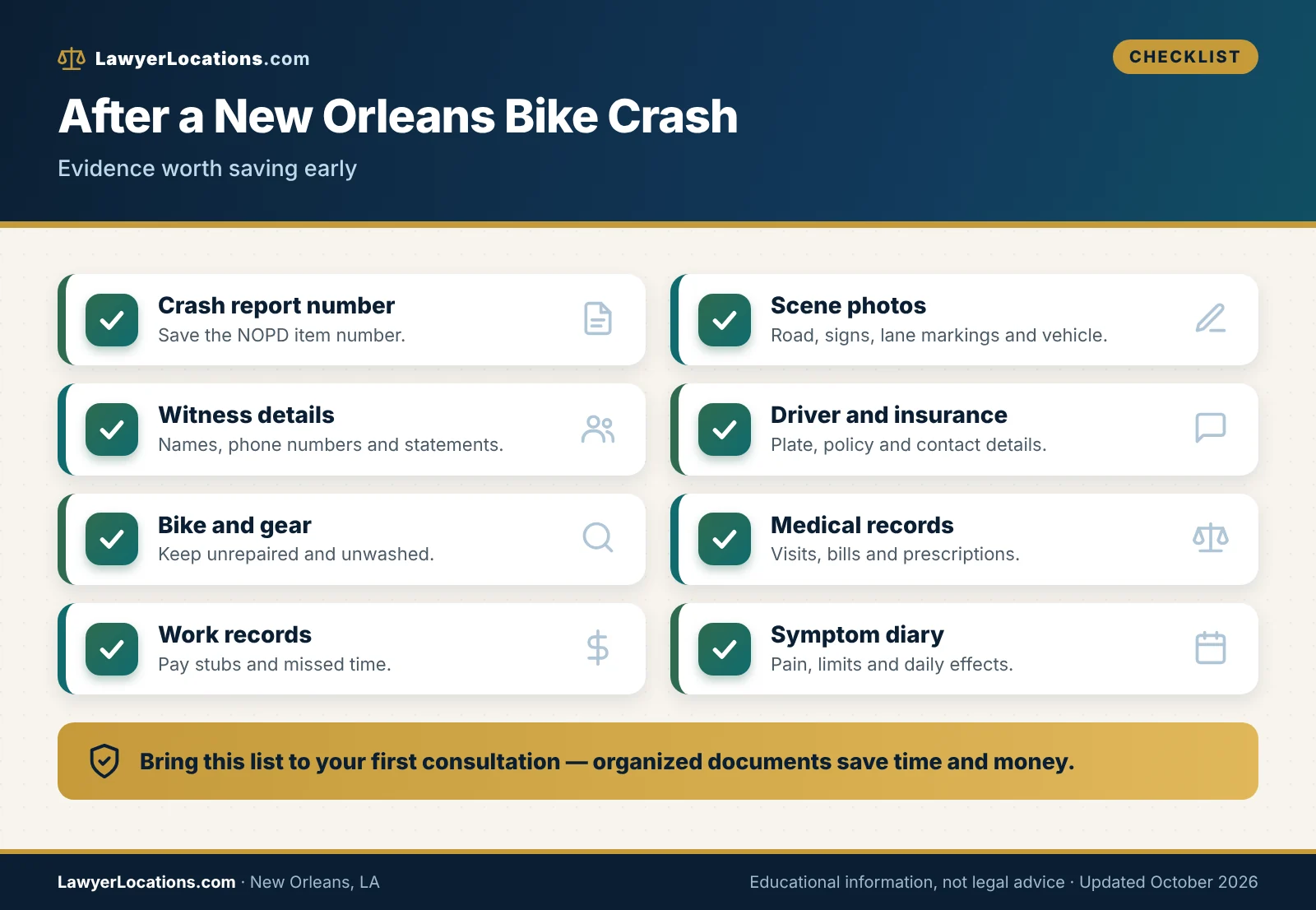
Text version of this graphic
- Crash report number: save the NOPD item number.
- Scene photos: road, signs, lane markings and vehicle.
- Witness details: names, phone numbers and statements.
- Driver and insurance details: plate, policy and contact.
- Bike and gear: keep unrepaired and unwashed.
- Medical records: visits, bills and prescriptions.
- Work records: pay stubs and missed time.
- Symptom diary: pain, limits and daily effects.
Do not give a recorded statement to the other driver’s insurer or sign a medical release before you understand what it covers. Adjusters can ask broad questions that later get used on fault. You can politely say you are getting advice first.
Claim, negotiation and filing suit in Orleans Parish
Once your medical picture is clearer, the claim shifts to numbers and timing. Rushing to settle before you know how long you will need treatment is a common error, but waiting too long runs into the filing deadline.
Insurer contact and the demand
A lawyer typically notifies the liability insurer, your own UM carrier if relevant, and any public body. The demand package then sets out the facts, the fault argument and the damages, supported by records.
Many riders also own a car. Their own auto policy’s UM coverage may apply to a bicycle crash, depending on the wording. Ask a lawyer to read the actual policy.
For crashes after May 28, 2025, a 2025 Louisiana change enacted as Code of Evidence art. 306.1 overruled the Housley presumption, under which an injured person with no prior condition could argue that the accident caused a later one, according to a law-firm summary.32 This makes careful medical records and a treating provider’s explanation of cause more important.
Filing in Civil District Court
The Orleans Parish Civil District Court is at 421 Loyola Avenue, has original jurisdiction over civil matters in Orleans Parish, and has fourteen elected divisions, A through N.25 The Clerk of Civil District Court handles filing of civil suits such as personal injury cases, and the clerk’s site links to forms, rules, a fee schedule and online records.26 A bicycle injury suit against a driver or a private owner normally starts there when the crash happened in the parish.
Under C.C.P. art. 1732, a jury trial is unavailable when no individual petitioner’s claim exceeds $10,000, excluding interest and costs, with limited exceptions.28 Many bicycle injuries involve more than that, but the rule shows why the value of a claim matters at the filing stage.
Costs, Deadlines and Decision Points
Costs in a bicycle case fall into three groups: the lawyer’s fee, case expenses and money owed from your own medical care. Louisiana regulates the paperwork for the first, and the clerk publishes the court’s fees. Nobody can fairly give you an “average” without data, so this section sticks to rules and verified numbers.
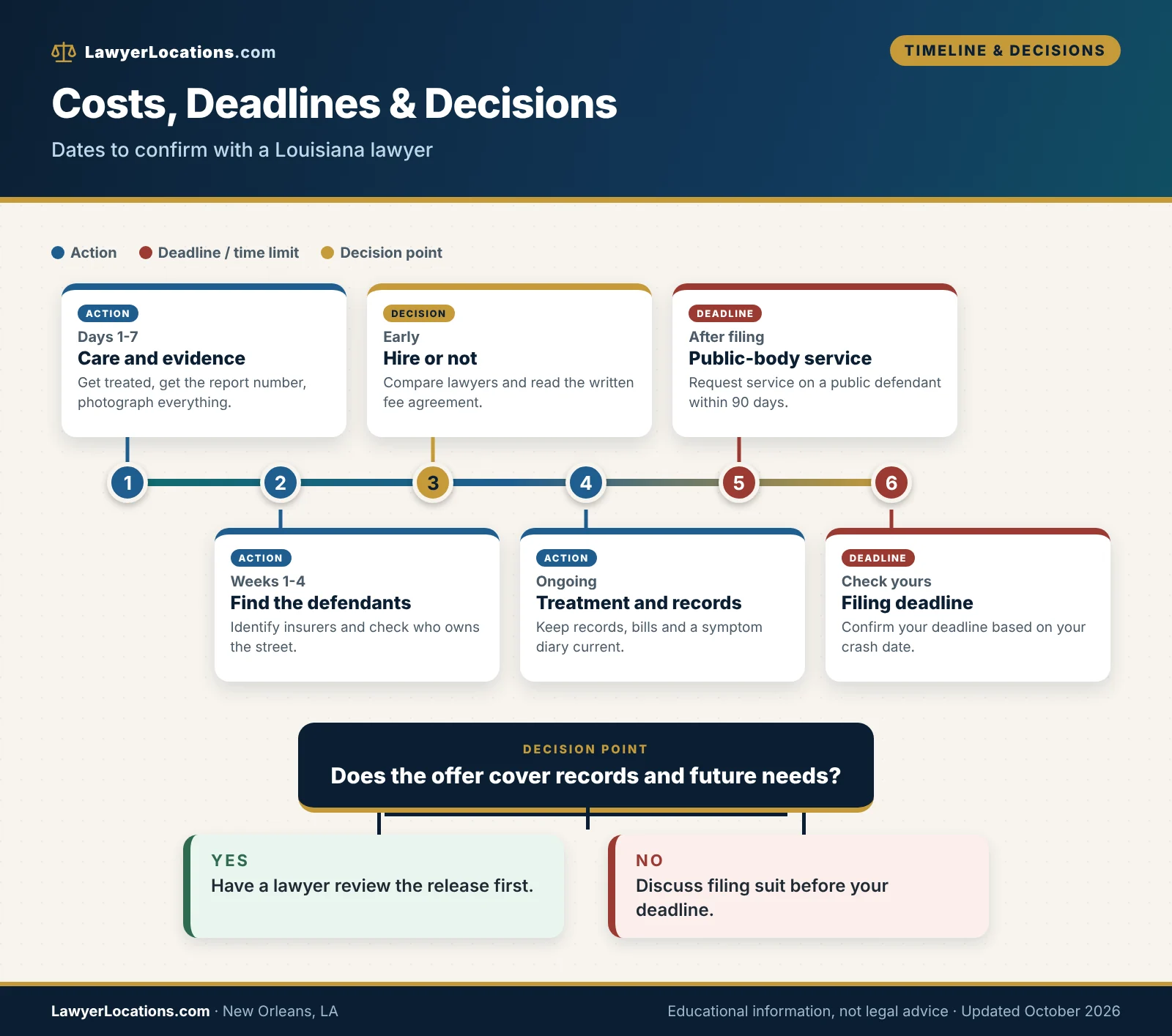
Text version of this graphic
- Right away: medical care, report the crash and preserve evidence.
- First weeks: identify insurers and public bodies; consult a lawyer.
- Before treatment ends: avoid recorded statements and early releases.
- When filing is near: decide whether to settle or file suit.
- If a public body is a defendant: request service within 90 days of filing.
- Deadline: file within two years for crashes on or after July 1, 2024.
Decision: Does the insurer’s offer cover your records and future needs? If yes, ask a lawyer to review the release; if no, discuss filing suit before the deadline.
How Louisiana contingency fee agreements work
Most bicycle injury lawyers work on a contingent fee, which means the fee is a share of any recovery and not an hourly bill. Louisiana controls how those agreements must be written, even though it does not set a single percentage in the rule we reviewed.
What the written agreement must say
Under Louisiana Rule of Professional Conduct 1.5(c), a contingent fee agreement must be in a writing signed by the client, and the client must receive a copy when it is signed.31 It must state how the fee is calculated, including the percentage for settlement, trial or appeal, and which expenses are deducted from the recovery, and whether they come out before or after the fee is calculated.31 It must also clearly tell the client which expenses the client owes even if the client does not prevail.31
When the matter ends, the lawyer must give the client a written statement of the outcome that shows what was paid to the client and how it was calculated.31 Read that statement. If it does not match what you signed, ask questions before you sign a release or deposit a check.
Fees versus case expenses
A fee percentage and case expenses are different things. Expenses include medical record charges, expert reports, filing and service costs and deposition costs. Two agreements with the same percentage can leave you with very different net amounts depending on whether expenses are subtracted before or after the fee is calculated.
Money questions beyond the lawyer’s fee
Court filing costs in Orleans Parish
The Clerk of Civil District Court’s fee schedule effective July 1, 2026 lists a petition at $514.50, according to a clerk memo dated June 15, 2026.27 That is only the opening fee. Service, jury requests and other filings carry their own charges, and the schedule we reviewed did not give a clear figure for service or jury costs, so ask the clerk or your lawyer for a current estimate.
Medical bills, health insurers and reimbursement claims
Medical bills can follow you even if a claim is pending. Some health plans, government programs and medical providers may have rights to be repaid from a recovery, and the details differ by payer. Ask the lawyer how they will identify those claims and whether they negotiate them as part of their work.
If a rider dies, a separate set of Louisiana articles governs wrongful death and survival claims, and the 2024 change may affect their timing, so survivors should ask about the deadline immediately. Our guide to wrongful death lawyer costs covers the fee questions families face.
Decision points and a working calendar
Calendar to build with your lawyer
| Stage | What to decide or do | Rule or source |
|---|---|---|
| Within days | Seek care, get the NOPD item number, photograph the scene, preserve the bike and gear. | Practical step; NOPD records page |
| Early weeks | Identify every insurer and public body; check whether the street is state-owned or city-owned. | R.S. 22:1295; R.S. 9:2800 |
| Before the offer | Compare any insurer offer against bills, wages and future care; ask for the fee and expense math. | Rule 1.5(c) |
| Two years from the injury date | File suit for crashes on or after July 1, 2024. | La. C.C. art. 3493.1 |
| After filing against a public body | Request service within 90 days. | R.S. 13:5107 |
| Filing day | Pay the petition fee and choose the right court. | Clerk fee schedule (effective July 1, 2026) |
When to settle and when to file
A settlement can be reasonable when your treatment is complete or stable, your records support the offer and the release is limited to the claims you meant to resolve. Filing suit becomes more important when time is running short, when liability is disputed or when the insurer will not move. Filing does not mean the case is going to trial, since many suits still resolve through negotiation.
Common Mistakes, Red Flags and Next Steps
Most avoidable problems in bicycle claims come from waiting, over-sharing or signing too fast. This section lists common mistakes and explains how to spot a poor-fit lawyer before you commit.
Mistakes that weaken a claim
Early statements and social media
Saying “I’m fine” or “it was my fault” at the scene can be quoted back later. Under the 51% rule, an admission that you were mostly at fault can matter a great deal. Keep your statements factual, short and polite.
Waiting on the clock
The deadline is a fixed point, but the evidence clock moves faster. Video gets erased, repairs change a road defect and memories fade.
For crashes soon after July 1, 2024, the two-year period may already be near its end, so do not wait for treatment to finish before asking about the deadline. If you are unsure which window your crash falls in, ask a Louisiana lawyer to compute your specific date.
Red flags when hiring
Pressure and promises
- A promise of a result, a dollar amount or a speed.
- Pressure to sign at the first call or at the hospital.
- A refusal to put the fee and expense terms in writing.
- A request that you not speak to other lawyers.
Louisiana’s rule requires a written, signed contingent fee agreement, so a lawyer who resists paperwork is working against the rule.31 You can say no without explanation.
Missing paperwork and unclear roles
Be wary of any arrangement where you cannot tell who is responsible for the case. Ask for a copy of the signed agreement and keep it. If you are unsure whether a firm is licensed or what discipline it has faced, use the LSBA tools before paying anything.30
Quick answers to common questions
These short answers point back to the fuller discussion above.
Questions about deadlines, fault and public bodies
How long do I have to sue after a bicycle accident in Louisiana?
For damage on or after July 1, 2024, delictual actions are subject to a two-year prescription from the day of injury.4 Earlier crashes fell under a one-year rule.6 Have a lawyer confirm your date.
Can I recover if I was partly at fault?
Yes in many cases, but the rule depends on the crash date. For crashes on or after January 1, 2026, a claimant 51% or more at fault recovers nothing, and a claimant below 51% recovers a reduced amount.7
What if a driver hits me and leaves?
Your own UM coverage may apply. If there was no physical contact, the statute requires proof through an independent and disinterested witness.17
Can I sue the City of New Orleans over a pothole?
Possibly, but you generally must show the city had actual or constructive notice of the defect and a reasonable chance to fix it.19 Special rules apply to service, jury trials and damages.20,22,23
Questions about reports, courts, insurance and money
Can I sue the driver’s insurance company directly?
Not in most situations since Act 275 took effect August 1, 2024. The statute allows a direct action only in listed circumstances, such as insolvency or a reservation of rights.15
What if I was riding an e-bike?
La. R.S. 32:198 treats a motorized bicycle differently from a regular bicycle, requiring the rider to be at least fifteen with a valid Louisiana driver’s license and limiting where it may be operated.34 Whether your device counts as a bicycle or a motorized bicycle is a question for a lawyer.
Your next steps
If you are comparing a bicycle accident lawyer New Orleans, LA riders trust for clear answers, start with a short list of three actions. Write down your crash date, because it controls the deadline and the fault rule. Save your evidence, and make a list of every insurer or public body that might be involved. Then interview more than one lawyer using the scorecard above, and compare how each explains the fee agreement.
Before you sign anything
Check each lawyer in the LSBA directory, ask for the fee agreement in writing, and take time to read it. If any lawyer pressures you or promises results, keep looking.
Ready to compare your options?
Use the questions in this guide to speak with more than one Louisiana lawyer, and bring your crash date, photos and insurance details. For related background, read our guides on the car accident settlement timeline and personal injury filing deadlines by state.
When to ask for urgent help
Ask for legal advice quickly if your crash happened in the second half of 2024, if a public body may be involved, or if an insurer has sent you a release. This is a reason to start the conversation, not to rush into a bad contract.
Sources & References
Show all 34 sources
- New Orleans Regional Transit Authority — “New Orleans RTA launches awareness campaign for Rail Safety Week” (Sept. 17, 2023) — norta.com; and City of New Orleans — “RTA successfully brings operations and maintenance in-house” — nola.gov — accessed October 2026.
- City of New Orleans Department of Public Works — Potholes — nola.gov/next/public-works/topics/potholes — accessed October 2026.
- WWNO — “New Orleans cyclists ask for bike safety on St. Claude Avenue and beyond” (Sept. 4, 2025) — wwno.org — accessed October 2026.
- Louisiana State Legislature — La. Civil Code art. 3493.1, Delictual actions (Section 1-A, Two-Year Prescription) — legis.la.gov — accessed October 2026.
- Louisiana State Legislature — 2024 Regular Session, Act 423 (HB 315) digest and bill text — digest; bill text — accessed October 2026.
- DK Deutsch Kerrigan via Mondaq — “Monumental changes for litigators and insurance companies in Louisiana: state adopts two-year prescriptive period” — mondaq.com — accessed October 2026.
- Louisiana State Legislature — La. Civil Code art. 2323, Comparative fault — legis.la.gov — accessed October 2026.
- Liskow & Lewis — “Louisiana’s new comparative fault law: what changed on January 1, 2026” (Jan. 15, 2026) — liskow.com — accessed October 2026.
- Louisiana State Legislature — 2025 Regular Session, HB 431 (comparative fault) — legis.la.gov — accessed October 2026.
- Louisiana State Legislature — La. R.S. 32:194, Traffic laws apply to persons riding bicycles — legis.la.gov — accessed October 2026.
- Louisiana State Legislature — La. R.S. 32:197, Riding on roadways and bicycle paths — legis.la.gov — accessed October 2026.
- Louisiana State Legislature — La. R.S. 32:76.1, Passing bicycles — legis.la.gov — accessed October 2026.
- Louisiana State Legislature — La. R.S. 32:199, Bicycle helmets; restraining seats — legis.la.gov — accessed October 2026.
- Louisiana Department of Transportation and Development — Bicyclists and Pedestrians (summary of Louisiana bicycle laws, including R.S. 32:283 and 32:201) — dotd.la.gov — accessed October 2026.
- Louisiana State Legislature — 2024 Regular Session, Act 275 (HB 337) digest, amending R.S. 22:1269 — legis.la.gov — accessed October 2026.
- Thompson Coe — “Louisiana’s direct action statute significantly revised” — thompsoncoe.com — accessed October 2026.
- Louisiana State Legislature — La. R.S. 22:1295, Uninsured motorist coverage — legis.la.gov — accessed October 2026.
- Louisiana Department of Insurance — Auto insurance guide — ldi.la.gov — accessed October 2026.
- Louisiana State Legislature — La. R.S. 9:2800, Limitation of liability for public bodies — legis.la.gov — accessed October 2026.
- Louisiana State Legislature — La. R.S. 13:5107, Service of citation and process — legis.la.gov — accessed October 2026.
- Louisiana State Legislature — La. R.S. 13:5104, Venue — legis.la.gov — accessed October 2026.
- Louisiana State Legislature — La. R.S. 13:5105, Jury trials — legis.la.gov — accessed October 2026.
- Louisiana State Legislature — La. R.S. 13:5106, Limitation on damages — legis.la.gov — accessed October 2026.
- Louisiana State Legislature — La. R.S. 13:5101, Louisiana Governmental Claims Act — legis.la.gov — accessed October 2026.
- Orleans Parish Civil District Court — Court home page — orleanscivildistrictcourt.org — accessed October 2026.
- Clerk of Civil District Court for the Parish of Orleans — Home page — orleanscivilclerk.com — accessed October 2026.
- Clerk of Civil District Court for the Parish of Orleans — Civil filing fee schedule effective July 1, 2026 — orleanscivilclerk.com — accessed October 2026.
- Louisiana State Legislature — La. Code of Civil Procedure art. 1732, Limitation on jury trial — legis.la.gov — accessed October 2026.
- New Orleans Police Department — Request for initial police report — nola.gov — accessed October 2026.
- Louisiana State Bar Association — Public resources (lawyer referral, membership directory, complaints, advertising filings, fee dispute resolution) — lsba.org — accessed October 2026.
- Louisiana Rules of Professional Conduct, Rule 1.5 (Fees), as published on CourtRules.net — courtrules.net — accessed October 2026.
- Lewis Brisbois via Mondaq — “Louisiana State Legislature 2025 Regular Session: tort reform acts, vetoed insurance bill” — mondaq.com — accessed October 2026.
- Orleans Parish Civil District Court — Self-Help Resource Center — orleanscivildistrictcourt.org — accessed October 2026.
- Louisiana State Legislature — La. R.S. 32:198, Operating motorized bicycles — legis.la.gov — accessed October 2026.
General information only. LawyerLocations.com is a legal-education and lawyer-discovery resource, not a law firm, and reading this page does not create an attorney-client relationship. This article is not legal advice. Laws, court fees and local procedures change, and the facts of your crash may change the answer. Consult a lawyer licensed in Louisiana about your situation, and do not rely on this page to decide whether or when to file a claim.
Legal Disclaimer and Limitation of Liability
Informational and illustrative purposes only. This article was prepared by LawyerLocations.com solely on the basis of the information available to us at the time of writing. It is an illustrative, general overview. It is not a complete or authoritative statement of the law, and it has not been reviewed by a lawyer licensed in your state or county.
Not legal advice. Nothing in this article is legal, financial, tax or immigration advice, and reading it does not create an attorney-client relationship between you and LawyerLocations.com or any author, lawyer or firm mentioned. Laws, court rules, fees, filing deadlines and agency procedures differ by state, county and court, and they change often. Some details here may be simplified, incomplete or out of date, and time limits for legal claims can be short.
No warranty. We make no representation or warranty, express or implied, about the accuracy, completeness, timeliness or suitability of this content for your situation. Please do not rely on it to make, delay or skip any legal decision. Check the facts against official sources and speak with a licensed attorney in the relevant jurisdiction before you act.
Limitation of liability. To the fullest extent permitted by law, LawyerLocations.com and its owners, authors and contributors disclaim all liability for any loss, damage, cost or other consequence arising from the use of, or reliance on, this article, including any content on third-party websites we link to. Mentioning a lawyer, firm, organization or service is not an endorsement and is not a promise of any result. If you are in immediate danger, contact your local emergency number.