If another driver hit you from behind, the law in many states starts from the assumption that the rear driver was careless, and a rear end accident lawyer can help you test how that assumption holds up in your state. The presumption is rebuttable: sudden stops, dead brake lights, chain-reaction crashes and shared fault can change who pays and how much.
State rules matter just as much. Contributory-negligence states can bar a claim over small shared fault, no-fault states can limit when you may sue for pain and suffering, and filing deadlines in the states reviewed here run from 1 year to 6 years. This guide covers fault, evidence, whiplash claims, insurer tactics, deadlines, contingency fees and when to compare lawyers. It is general information, not advice about your case.
Who Is at Fault in a Rear-End Collision?
In many states, the driver who hits the back of another vehicle is presumed to be at fault, because every driver must leave enough room to stop safely. That presumption is a starting point, not a verdict.
The default rule: the driver behind starts at a disadvantage
Courts and lawmakers in many states treat a rear-end crash as evidence that the rear driver followed too closely, drove too fast for conditions or was not paying attention. The rule is a legal presumption, which shifts the job of explaining the crash onto one side.
Why the law starts with the driver behind
The logic comes from following-distance rules. In New York, courts cite Vehicle and Traffic Law § 1129(a) for the duty to keep a reasonably safe distance, and in Scheker v. Brown (2011 NY Slip Op 05480) the court said a rear-end collision establishes a prima facie case of negligence by the rear driver. “Prima facie” means the injured person has shown enough to win the point unless the other side answers it.
Michigan writes the idea into a statute: the Court of Appeals, discussing MCL 257.402(a), explained that a driver who strikes the rear of a vehicle proceeding in the same direction or lawfully standing is deemed prima facie guilty of negligence. Florida reaches a similar place through case law in Birge v. Charron, No. SC10-1755 (Fla. Nov. 21, 2012), which described a rebuttable presumption that the rear driver was negligent.
What “rebuttable” means in practice
A rebuttable presumption can be answered with evidence. In New York the rear driver must offer a “nonnegligent explanation” for the crash (Motta v. Gomez, 2018, citing Tutrani v. County of Suffolk, 10 NY3d 906 (2008)). In Florida, the presumption is rebutted when a jury could find the front driver was also negligent, and it then becomes an inference a jury may or may not draw. Other states may rely on following-too-closely statutes and ordinary negligence law without a formal presumption, so check the rule where the crash happened.
Being hit from behind gives you a head start, not a finished case. The rear driver’s insurer will look for any fact that fits an exception, and your job is to document the facts that close those doors.
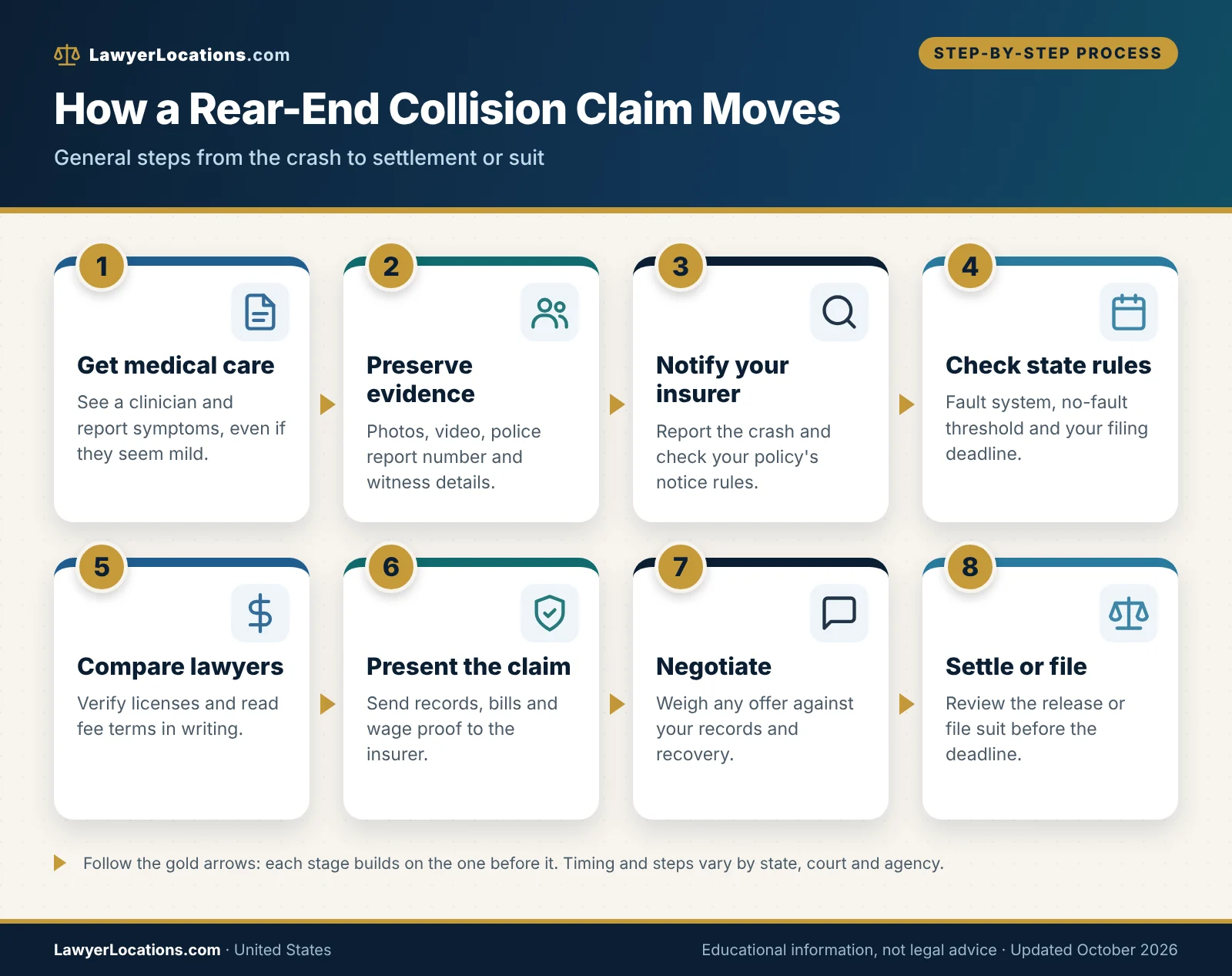
Text version of this graphic
- Get medical care and report the crash; keep every record.
- Document the scene, vehicles, witnesses and insurance details.
- Notify your own insurer and avoid statements about fault.
- Learn your state’s fault rule, no-fault rules and filing deadline.
- Compare lawyers and read the fee terms in writing.
- Present the claim with medical records, bills and wage proof.
- Negotiate; accept, counter or reject any offer in writing.
- File suit before the deadline if talks fail, then settle or try the case.
Exceptions that can shift or share fault
The presumption gives way when the facts show the front driver did something unsafe, or when something other than the rear driver’s carelessness caused the impact. Each exception below turns on proof, so what you can show matters more than what you remember.
Sudden or unsignaled stops
Drivers ahead of you also have duties. In Bourdier v. Metropolitan Transportation Authority (2025 NY Slip Op 06685, Second Dept., Dec. 3, 2025), the court noted the front driver must not stop suddenly or slow without proper signaling, and that if the front driver was negligent too, comparative negligence is a jury question. Ordinary stops, however, are foreseeable: Quintanilla v. Mark (2022 NY Slip Op 06151) says they must be anticipated by the driver who follows.
A stop for a red light or slowing traffic rarely shifts fault. A stop for no reason, or where stopping is unlawful, can. The Michigan statute covers a vehicle that is “lawfully standing,” and the Court of Appeals treated whether a car was lawfully stopped in a freeway lane as a fact question.
Brake lights, signals and vehicle defects
If the lead car’s brake lights were out, the rear driver may say the stop could not be seen, but a bare claim is not enough. In Quintanilla, the defendant’s statement that he “did not see brake lights” did not, standing alone, raise a triable issue about a malfunction.
Proof changes that. A bulb that tests as burned out, a repair record or video showing no light at impact can support shared fault. If you were the lead driver, have your vehicle inspected and photographed before repairs.
Chain-reaction collisions
With three or more vehicles, the question is which impact came first. In Bourdier, the court said a middle driver can show entitlement to judgment by demonstrating the vehicle was properly stopped behind the lead car when it was hit, and that being struck and pushed forward may be a sufficient non-negligent explanation. When witnesses disagreed about whether the middle car hit the front car before the rear impact, that request failed. The order of impacts, damage patterns and any camera footage can decide who is responsible for which injuries.
Emergencies, cut-ins and mechanical surprises
A sudden emergency can rebut the presumption in Michigan if it was “unusual or unsuspected” and not of the driver’s making (White v. Taylor Distributing Co., 482 Mich 136 (2008)). A cut-in can also matter: in Scheker, testimony that the other car changed lanes without signaling and then slowed raised a triable question about a non-negligent explanation. These exceptions tend to reduce a claim rather than erase it, because many states split fault by percentage.
| Situation | Why it can change fault | Evidence that helps |
|---|---|---|
| Front driver stopped for no reason | Front drivers must not stop suddenly or slow without proper signaling (Bourdier, N.Y. 2025) | Dash camera, witness statements, 911 audio, location of the stop |
| Brake lights not working | May support shared fault if the stop could not be seen; a bare claim is not enough (Quintanilla, N.Y. 2022) | Photos of the lights, inspection or repair records, video |
| Chain-reaction crash | Middle driver may show they were properly stopped and pushed forward (Bourdier) | Order of impacts, damage pattern, witnesses, camera footage |
| Lane change or cut-in | A sudden, unsignaled lane change may supply a non-negligent explanation (Scheker, N.Y. 2011) | Video, independent witnesses, vehicle positions at rest |
| Sudden emergency | Michigan permits rebuttal if the emergency was unusual, unsuspected and not of the driver’s making (White, 2008) | Sworn testimony, scene photos, road and weather records |
| Front car not lawfully standing | The Michigan statute covers a vehicle lawfully standing; legality of the stop is a fact question | Location photos, police report, traffic-control evidence |
Photograph the rear of your own vehicle, the tail lights and the road marking where you stopped before the car is repaired or towed to a salvage yard. Those images answer the two most common rebuttals, “the lights were out” and “the stop came from nowhere.”
How Your State’s Fault and No-Fault Rules Change the Outcome
Even after fault is clear, state law decides how much you can recover if you share any blame, and whether you may sue the other driver for pain and suffering at all. Comparative or contributory negligence governs shared blame; no-fault law governs which claims go through your own insurer first.
Comparative and contributory negligence
Shared fault is common in rear-end cases because the other side nearly always argues you contributed. States use three families of rules.
Pure and modified comparative negligence
Under pure comparative negligence, your damages are reduced by your percentage of fault, and you can recover even if you were mostly at fault. New York’s CPLR 1411 says a claimant’s culpable conduct does not bar recovery and diminishes damages in proportion. Under modified comparative negligence, you recover a reduced amount unless your fault crosses a line, usually 50% or 51%. Texas bars a claimant whose responsibility is greater than 50 percent (Tex. Civ. Prac. & Rem. Code § 33.001), and Florida’s rule is similar for most negligence actions (Fla. Stat. § 768.81(6)), with an exception for medical negligence.
Contributory negligence states
A few jurisdictions still follow the older rule. Under contributory negligence, any fault by the injured person, even a small percentage, can bar recovery. Justia’s 50-state survey lists Alabama, Maryland, North Carolina, Virginia and the District of Columbia, with a separate rule in D.C. for pedestrian and “vulnerable user” collisions. Classifications from a secondary survey can lag behind new laws. In 2013 the Maryland Court of Appeals declined to abandon the rule in Coleman v. Soccer Association of Columbia.
In a contributory-negligence jurisdiction, treat every statement about your own driving as potentially claim-ending. Avoid giving the other driver’s insurer an account of what you did before the crash until you have talked with a lawyer licensed in that state.
| System | How shared fault is treated | Example states (per Justia survey) | Primary source seen for this guide |
|---|---|---|---|
| Pure comparative | Damages reduced by your percentage; no cut-off | California, New York, Kentucky, Louisiana | N.Y. CPLR 1411 |
| Modified, 51% bar | Reduced unless your fault is greater than 50% | Texas, Illinois, Florida, Pennsylvania | Tex. Civ. Prac. & Rem. Code § 33.001; Fla. Stat. § 768.81(6) |
| Modified, 50% bar | Generally barred if your fault reaches 50% | Tennessee, Georgia, Colorado, Kansas | Survey only; check statute |
| Contributory negligence | Any fault by you can bar recovery | Alabama, Maryland, North Carolina, Virginia, D.C. | Coleman v. Soccer Ass’n (Md. 2013) |
| Split rules | Different rules by claim or damages type | Michigan (non-economic damages), Florida (medical negligence) | Justia survey; Fla. Stat. § 768.81(6) |
Suppose a rear-end claim is worth $100,000 and a jury finds the front driver 20% at fault for stopping without signaling. A pure comparative or 51% modified state would reduce the claim to $80,000; a contributory-negligence state could pay $0. At 60% front-driver fault, a pure system still pays $40,000, while a modified system pays nothing.
No-fault states and injury thresholds
No-fault auto insurance changes who pays first. You generally claim medical bills and some lost income from your own policy, and you may sue the other driver for pain and suffering only if your injuries meet a legal threshold.
Which states use no-fault
The Insurance Information Institute says twelve states and Puerto Rico have no-fault laws. Florida, Michigan, New Jersey, New York and Pennsylvania use a verbal threshold, a description-based test of injury seriousness. Hawaii, Kansas, Kentucky, Massachusetts, Minnesota, North Dakota and Utah use a monetary threshold. New Jersey, Pennsylvania and Kentucky are “choice no-fault” states, where drivers can opt to keep the right to sue.
Check claims that a state dropped no-fault against official sources. In May 2026, Insurance Journal reported that Florida’s PIP statute had not been repealed, after repeal bills stalled in 2025 and 2026 and a 2021 repeal was vetoed.
What the thresholds say in four states
Michigan allows a claim for non-economic loss only for death, serious impairment of body function or permanent serious disfigurement; serious impairment must be objectively manifested, affect an important body function and affect the person’s general ability to lead a normal life (MCL 500.3135). Florida requires one of four things: significant and permanent loss of an important bodily function, permanent injury within a reasonable degree of medical probability, significant and permanent scarring or disfigurement, or death (Fla. Stat. § 627.737(2)).
New York’s “serious injury” list includes death, dismemberment, significant disfigurement, a fracture and significant limitation of use of a body function or system (Insurance Law § 5102(d)), and basic economic loss is up to $50,000 per person under § 5102(a). Pennsylvania lets drivers choose limited or full tort; limited tort precludes non-economic claims unless the injury is a serious injury, with listed exceptions (75 Pa.C.S. § 1705).
| State | Type (per III) | What the statute says about suing for pain and suffering | Related first-party benefit |
|---|---|---|---|
| Florida | Verbal threshold | Four listed conditions, such as permanent injury within a reasonable degree of medical probability (§ 627.737) | PIP of $10,000; initial care within 14 days (§ 627.736) |
| Michigan | Verbal threshold | Serious impairment of body function, objectively manifested, affecting normal life (MCL 500.3135) | Varies by policy |
| New York | Verbal threshold | “Serious injury” list in Insurance Law § 5102(d) | Basic economic loss up to $50,000 per person (§ 5102(a)) |
| Pennsylvania | Verbal threshold; choice of limited or full tort | Limited tort bars non-economic claims unless serious injury (75 Pa.C.S. § 1705) | Varies by policy |
In Florida, PIP medical benefits are tied to starting care within 14 days of the crash (Fla. Stat. § 627.736). A person who waits to see whether neck pain “goes away” can lose coverage that would otherwise have applied. Check your own state’s no-fault notice and treatment rules the same day you read your policy.
Evidence That Proves Fault and Injury
Rear-end claims are won and lost on documents and images gathered in the first days. Preserve both proof of how the crash happened and proof of its effects before cars are repaired, phones replaced and memories fade.
At the scene and in the first 48 hours
Your first priority is safety and health: call 911 if anyone may be hurt. Once you are safe and checked, collect what is still fresh.
Photos, video and witnesses
Take wide photos of the road, lane markings, signals and the final positions of the vehicles, then close-ups of damage, the lead vehicle’s rear lights and license plates. Get names and phone numbers of bystanders; independent witnesses often carry the most weight when drivers disagree about a sudden stop.
Exchange insurance and contact information, but keep the conversation short. Do not apologize, guess about speeds or say “I’m fine.” Adrenaline hides pain, and a casual remark can be quoted back to you.
The police report and what it does not do
Report the crash according to your state’s rules; the report records names, insurance, road conditions and the officer’s observations. It is useful evidence but usually not the final word on fault. Officers usually arrive after the crash, their conclusions may be limited in court, and an insurer is not bound by them. If something is wrong in the report, ask the agency how to add a supplemental statement.
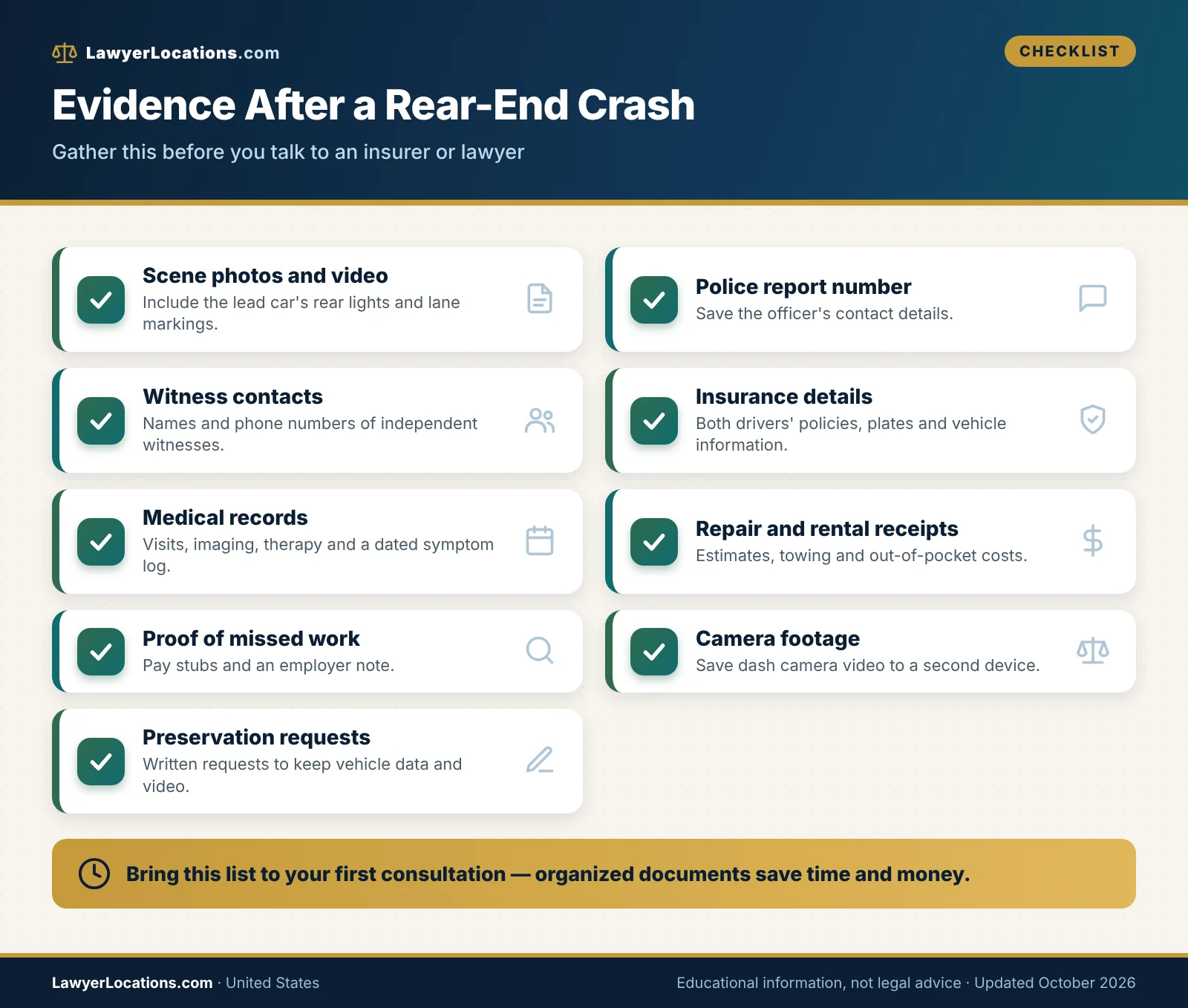
Text version of this graphic
- Scene photos and video, including the lead car’s rear lights.
- Police report number and officer contact.
- Names and numbers of independent witnesses.
- Both drivers’ insurance and vehicle details.
- Medical records, bills and a dated symptom log.
- Repair estimates, towing and rental-car receipts.
- Pay stubs and employer note for missed work.
- Dash camera or phone video, saved to a second location.
- Written requests to preserve vehicle data and footage.
Keep one folder, paper or digital, for every bill, letter, photo and dated note. That paper trail turns memory into proof. Include pay stubs, repair estimates and rental receipts as they arrive.
Vehicle and digital evidence
Vehicles and phones record more about a crash than most people realize, and some of it is overwritten or lost if a car is repaired or scrapped.
Event data recorders and who controls them
An event data recorder, or EDR, is a device that records technical vehicle and occupant information for a short period around a crash, measured in seconds, according to NHTSA. It may capture pre-crash vehicle dynamics, driver inputs and restraint use, which can show whether the rear driver braked before impact.
The federal Driver Privacy Act of 2015, in the Senate-reported text of S. 766 I reviewed, says EDR data belongs to the vehicle’s owner or lessee and bars access by others unless a court authorizes it, the owner consents or another listed exception applies. In practice, getting the other driver’s data usually takes a preservation request, the claims process or a court order.
Dash cameras, phones and preservation letters
Save dash camera footage to a second device right away, because loops overwrite themselves. Keep original phone photos unedited, and ask nearby businesses or cities promptly about video retention. A written preservation letter asks someone to keep evidence such as a vehicle, its data or video. A lawyer can send one on your behalf; a letter from you can still create a record but cannot force anyone to act.
Whiplash and Soft-Tissue Injury Claims
Whiplash is a neck injury caused by rapid back-and-forth movement of the head, and rear-end collisions are the classic cause. It is also one of the most disputed injuries in claims because it often shows little on a standard scan, so documentation and medical follow-up matter.
What whiplash is and why symptoms can lag
The Mayo Clinic says whiplash most often occurs when the head is quickly thrown backward and then forward with force, often in a rear-end crash. This section is general education, not a diagnosis.
Symptoms to take seriously
According to the Mayo Clinic, symptoms can include neck pain and stiffness, pain that worsens with neck movement, reduced range of motion, headaches, often at the back of the head, and pain or tenderness in the shoulders, upper back or arms. Some people also report tingling or numbness in the arms, fatigue or dizziness. Less commonly, people report blurred vision, ringing in the ears, sleep problems, irritability, trouble concentrating, memory problems or depression.
Why early care protects your health and your claim
The Mayo Clinic says symptoms most often start within days of the injury and advises care after neck pain following a car accident, because prompt evaluation helps rule out fractures or other damage. Early records also tie symptoms to the crash. If you have symptoms, see a medical professional before deciding what the injury is worth.
How soft-tissue claims are proven and challenged
A soft-tissue injury involves muscles, ligaments and tendons rather than bones. Because it may not show on an X-ray, the claim rests on exam findings, the pattern of symptoms over time and the credibility of the records.
Records, imaging and gaps in care
Treatment notes describing the mechanism of injury, exam findings and follow-up plan carry weight. A normal scan does not mean there was no injury, and a clinician decides what testing is appropriate. Insurers watch for gaps: long stretches without treatment or ended therapy are used to argue the problem resolved. If cost or scheduling caused a gap, say so in your records, and describe symptoms accurately, neither exaggerating nor downplaying them.
Pre-existing conditions and the “minor impact” argument
Insurers commonly point to prior neck or back problems or small-looking vehicle damage to argue the crash could not have caused the injury. A person with a prior condition may still recover for a new injury or an aggravation, but treatment varies by state and by the medical evidence. Disclose prior treatment to your providers, because hidden history damages credibility. Repair cost says little about forces on a body, since bumpers absorb impact and hide damage; a treating clinician’s explanation is usually more persuasive.
What a rear-end claim can cover
Economic damages are measurable costs such as medical bills, expected future treatment, lost wages and property damage. Non-economic damages compensate for pain and limits on daily life. States treat both differently, and no-fault thresholds can limit what you may pursue against the other driver, as the earlier tables show. Be cautious about anyone who offers a dollar figure before reviewing your records.
The Insurance Institute for Highway Safety reported in an updated analysis that automatic emergency braking reduced rear-end crashes by about 50% and injury-causing rear-end crashes by about 56%, in the vehicles it studied, compared with the same models without it (release dated January 28, 2016).
When to Hire a Rear End Accident Lawyer, and How Fees Work
Many rear-end claims with no injuries and clear fault settle without a lawsuit. Injuries, disputed fault and state-law traps are signs that a consultation may be worth your time, and most injury lawyers work on a contingent fee, which the written agreement should spell out.
When to call a rear end accident lawyer
No rule says you must hire a lawyer after a rear-end collision. The question is whether the risk of a mistake, a low offer or a missed deadline outweighs the cost of help.
Situations where legal help is worth a conversation
- You have a significant injury, ongoing symptoms or a doctor has recommended continued treatment, surgery or time off work.
- The other driver or insurer says you were partly at fault, especially in a contributory-negligence state where small fault can bar a claim.
- You are in a no-fault state and your injuries may or may not meet the threshold to sue.
- The other driver is uninsured or underinsured, fled the scene, or was working at the time.
- A chain-reaction collision involves several vehicles or insurers who point at each other.
- The insurer has denied the claim, stopped responding, asked for a recorded statement or pressed you to sign a release.
- A government vehicle was involved, which can bring short notice requirements and special procedures.
When you may be able to handle it on your own
If injuries are minor and resolved, fault is undisputed and the other driver’s insurer has agreed to pay repairs, you may not need a lawyer. Even then, keep records, read any release carefully and do not close the injury claim until a clinician says you have recovered.
How to compare lawyers before you sign
Comparing two or three lawyers on the same questions beats relying on advertising. LawyerLocations.com does not rate or recommend lawyers, so use this framework on anyone you consider. For a city-level example, see this Chicago personal injury hiring guide.
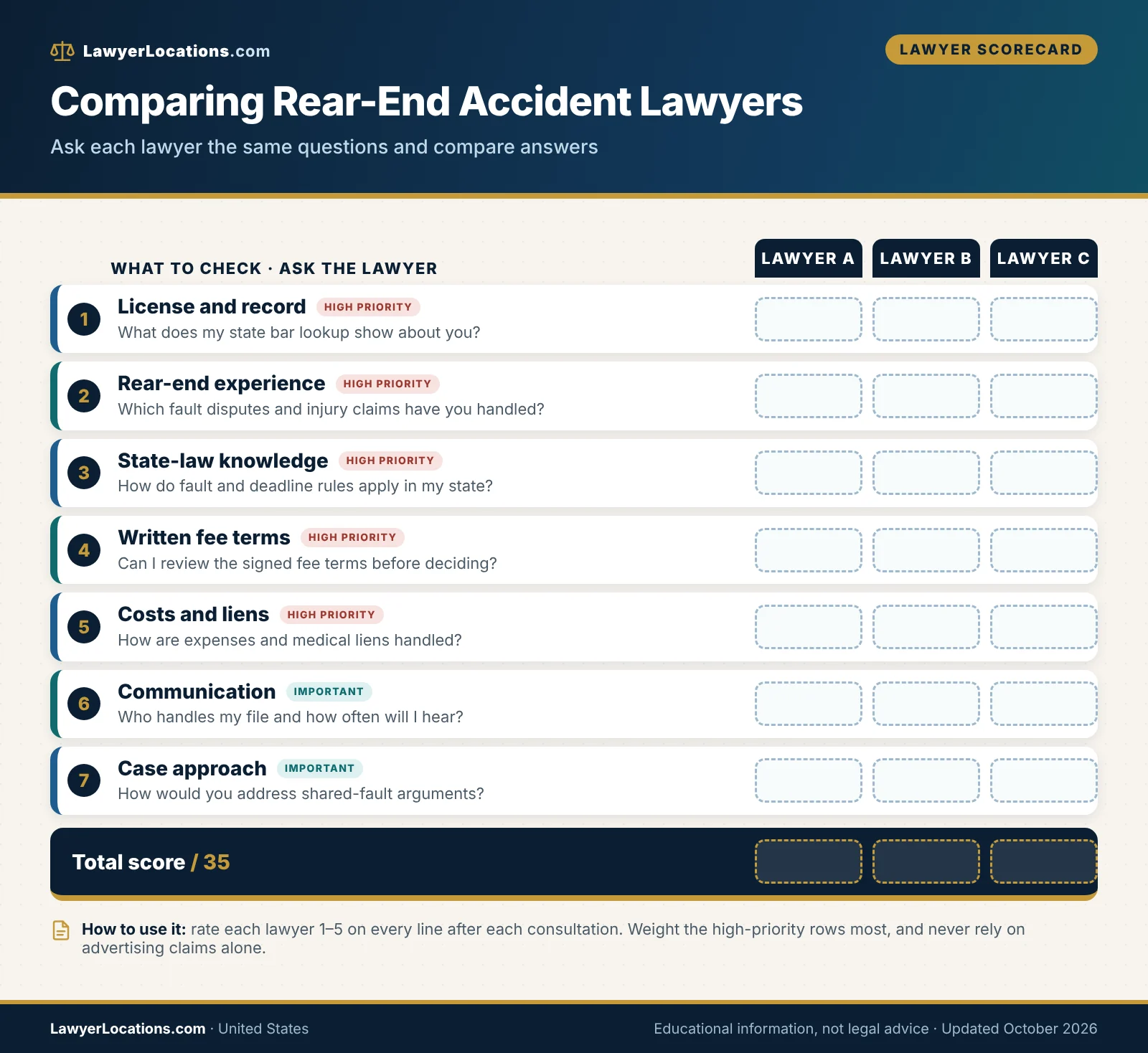
Text version of this graphic
- License and record: What does my state bar lookup show about you? (high weight)
- Rear-end experience: Which fault disputes and injury claims have you handled? (high)
- State-law knowledge: How do fault, no-fault and deadline rules apply here? (high)
- Written fee terms: Can I review the signed fee agreement before deciding? (high)
- Costs and liens: How are expenses and medical liens handled? (high)
- Communication: Who will handle my file and how often will I hear from you? (medium)
- Case approach: How would you address shared-fault arguments? (medium)
Verify the license and the record
Start with your state bar’s or supreme court’s attorney lookup, which usually shows whether a lawyer is licensed, in good standing and publicly disciplined. The American Bar Association’s directory helps you find state and local bar associations, and its FindLegalHelp.org page describes referral services as public-service ways to be matched with a lawyer. Confirm the license in the state where your case would be filed.
Questions to ask every lawyer
Use the same list in every conversation: who will work on the file, how the lawyer would handle a shared-fault argument, what the filing deadline appears to be in your state, and what happens if you disagree about a settlement offer. Be wary of any lawyer who promises a result or a dollar figure before reviewing your records. Advertising rules vary by state, and promised outcomes are a clear warning sign.
Red flags during a first call
- A promise of a specific outcome, a specific payout or a “sure win.”
- Pressure to sign the same day, or refusal to let you take the fee agreement home.
- No written fee agreement, or an agreement that is vague about expenses and percentages.
- Reluctance to explain who will handle your file, or an unwillingness to answer questions about the filing deadline.
Contingency fees and case costs
A contingent fee depends on the outcome: if there is a recovery, the lawyer receives an agreed share; if not, the client generally owes no fee, though the agreement may still make the client responsible for certain costs.
How a contingent fee works
ABA Model Rule 1.5(c) says a contingent fee agreement shall be in a writing signed by the client. It must state how the fee is calculated, including the percentage if the matter settles, goes to trial or is appealed; identify the expenses deducted from the recovery and whether they come out before or after the fee; and require a written statement at the end showing the outcome and how any money was divided. State rules are based on this model but can differ.
Some states also regulate percentages. Florida’s Rule 4-1.5(f)(4), for example, includes a presumptive contingent-fee schedule above which a fee is presumed clearly excessive unless a court approves it. Ask each lawyer for the percentage at each stage in writing. For how fee agreements work in another injury context, see this guide to wrongful death lawyer costs.
Costs, liens and what you take home
Fees and expenses are different. Expenses can include filing fees, records fees, expert reviews and deposition costs, and the agreement should say whether you owe them if the case fails. Medical providers, health insurers and government programs may also claim repayment from a settlement, known as a lien, so ask who negotiates liens.
| Term | What to ask | Why it matters |
|---|---|---|
| Percentage by stage | What percentage applies at settlement, trial and appeal? | The share can rise if a lawsuit is filed or the case goes to trial |
| Expenses | Which costs are advanced, and are they repaid from my share? | Affects your net recovery and what you owe if there is no recovery |
| Order of deductions | Are expenses deducted before or after the fee is calculated? | Changes the math on the same settlement amount |
| Liens and bills | Who negotiates medical liens and insurer reimbursement claims? | Unpaid liens can shrink what reaches you |
| Closing statement | Will I receive a written breakdown when the case ends? | Model Rule 1.5(c) calls for a statement of outcome and distribution |
| Ending the relationship | What happens if I change lawyers or the lawyer withdraws? | Clarifies fee claims against any later recovery |
Consultations and low-cost help
Many injury lawyers offer an initial case review without charging a fee, but practices vary, so ask what the meeting costs and covers. Do not sign at a first meeting unless you have read the agreement. If income is low, the Legal Services Corporation funds 129 civil legal aid organizations, and its website helps you find the one for your area; many focus on housing, benefits and family issues, so ask whether they take injury cases or can refer you to a bar referral service.
Insurance Company Tactics and How to Respond
Adjusters work for the insurer’s interests, not yours. That does not make every adjuster an adversary, but you should understand common moves before answering a phone call.
First contact: statements, quick offers and releases
The first call from the other driver’s insurer often comes within days, before medical evaluation is finished. It can feel friendly, but what you say is recorded and used.
Recorded statements
The California Department of Insurance advises people not to sign statements regarding fault or promise to pay the other parties’ damages, and notes your own insurer may request a written or recorded statement. Your duty to cooperate with your own insurer is different from any duty to help the other driver’s insurer build its defense. If you give a statement, keep it short and factual, avoid guessing speeds and distances, and do not call yourself “fine” while still being evaluated.
Fast offers and releases
An early offer may arrive before you know the full extent of your injuries. A release is the document you sign to accept the money, and it typically ends the claim entirely, including for problems that appear later. Do not sign while still treating or awaiting a diagnosis. The California Department of Insurance also cautions that releasing the at-fault party in exchange for your deductible could jeopardize your insurer’s right to recover what it paid, so talk to your insurer first.
Arguments adjusters commonly raise
Adjusters rarely say “we want to pay you less.” They raise reasons tied to the evidence, so knowing the patterns helps you prepare your records.
Arguments about fault
Expect questions aimed at shared fault: whether your brake lights worked, why you stopped, whether you changed lanes, whether you were distracted. Under the comparative rules above, even a small percentage can reduce a payment, and in contributory-negligence states it can bar one. Photos, witnesses and video are the best counter.
Arguments about injury and treatment
Typical points are that the impact was minor, you waited too long to see a doctor, treatment was excessive, you have a prior condition, or your social media activity seems inconsistent with your complaints. Keep accounts consistent, avoid posting about the crash while a claim is pending, and keep up the care your clinician recommends.
| Tactic | What it can look like | Practical response |
|---|---|---|
| Recorded statement | A friendly call asking you to “walk through” the crash | Stay factual; do not guess; consider legal advice before speaking to the other driver’s insurer |
| Quick offer | A check or offer within days, before full treatment | Do not sign until a clinician describes your recovery |
| Minor-impact argument | “The bumper barely dented” | Rely on medical records and a clinician’s explanation, not repair costs |
| Treatment gap | Questions about weeks without care | Document reasons for any gap; keep follow-ups |
| Fault shifting | Suggestions that you braked suddenly or changed lanes | Preserve video, photos and witness details |
Your own coverage and fair-claims rules
Your auto policy may provide benefits regardless of fault, and regulators set standards for claim handling.
First-party coverages
Depending on your state and policy, you may have personal injury protection, medical payments coverage or uninsured and underinsured motorist coverage. Read the declarations page and ask your insurer in writing which coverages apply and what notice deadlines the policy sets; these can be shorter than the lawsuit deadline, as Florida’s 14-day PIP rule shows.
Fair claims handling standards
The National Association of Insurance Commissioners publishes an Unfair Claims Settlement Practices Model Act that many states have adopted in some form. Its list includes misrepresenting relevant facts or policy provisions, failing to acknowledge claim communications with reasonable promptness, failing to attempt in good faith a prompt and fair settlement when liability is reasonably clear, and forcing policyholders to sue by offering substantially less than later recovered. The act reaches flagrant conduct or a general business practice, and states differ on who may enforce these rules, so a complaint to your state’s department of insurance is often the practical step. For how long a claim can run after those first calls, see the car accident settlement timeline guide.
Deadlines, Decision Points and Next Steps
Every state sets a deadline, called a statute of limitations, for filing a lawsuit over a car crash injury. Among the states reviewed for this guide the general injury deadline ranges from 1 year in Tennessee to 6 years in Maine, so you need to look up the rule for the state where the crash happened, not the state where you live.
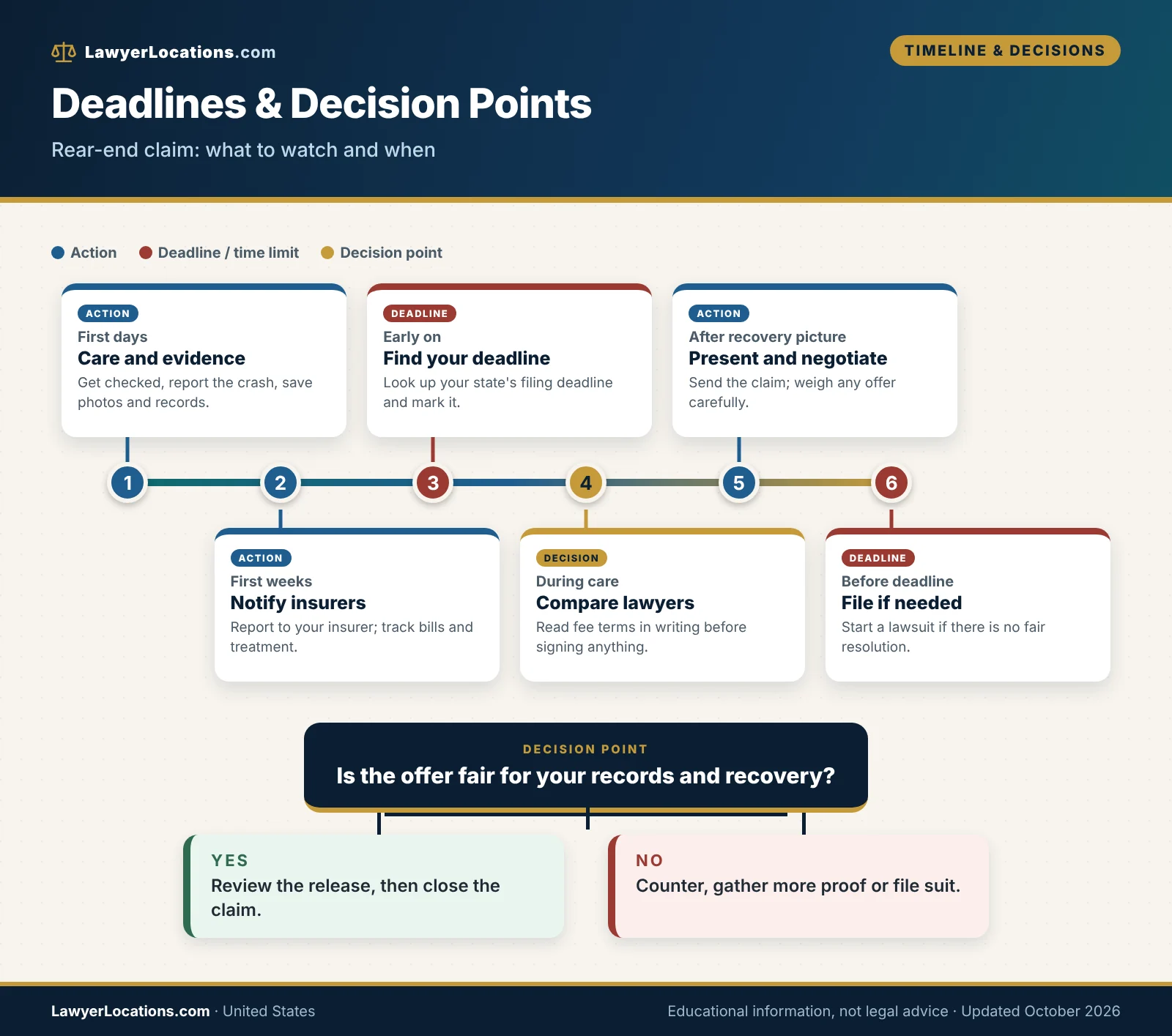
Text version of this graphic
- First days: get medical care, report the crash, preserve evidence (action).
- First weeks: notify your insurer, start treatment, track bills (action).
- Early on: look up your state’s filing deadline (deadline).
- During treatment: compare lawyers and read fee terms in writing (decision).
- Once recovery is clearer: present the claim and negotiate (action).
- Before the deadline: file suit if there is no fair resolution (deadline).
- Decision: Is the offer fair given your records, treatment and risk? If yes, review the release and close the claim; if no, counter or file suit.
Time limits that can end a claim
Missing a filing deadline can end a claim no matter how strong the facts are, and insurers do not have to remind you.
Filing deadlines in a sample of states
The table is a sample of general personal injury deadlines, not a 50-state chart. The period usually starts on the date of the crash or injury, but some states apply a discovery rule or other exceptions, so confirm the current text before relying on any entry.
| State | General deadline | Where it comes from | Note |
|---|---|---|---|
| California | 2 years | Code Civ. Proc. § 335.1 | Injury caused by the wrongful act or neglect of another |
| Florida | 2 years | Fla. Stat. § 95.11(5)(a) | Negligence actions were four years before 2023 reform (HB 837) |
| Illinois | 2 years | 735 ILCS 5/13-202 | Actions for injury to the person |
| Kentucky | 2 years from injury or last no-fault payment | KRS 304.39-230 | Version reviewed dated 2011 |
| Louisiana | 2 years | Civil Code art. 3493.1 (Acts 2024, No. 423) | Effective July 1, 2024; older injuries may fall under earlier rules |
| Maine | 6 years | 14 M.R.S. § 752 | General civil-action period |
| Maryland | 3 years | Cts. & Jud. Proc. § 5-101 | Contributory-negligence state |
| New York | 3 years | CPLR 214(5) | Subject to listed exceptions |
| North Carolina | 3 years | G.S. 1-52(16) | Accrual tied to when harm is apparent; outer limit applies |
| Tennessee | 1 year | Tenn. Code Ann. § 28-3-104(a)(1) | The shortest period in this sample |
| Texas | 2 years | Civ. Prac. & Rem. Code § 16.003(a) | Counted from the day the cause of action accrues |
| Virginia | 2 years | Va. Code § 8.01-243(A) | Contributory-negligence state |
Two states in this table changed their rules recently. Florida’s negligence period moved from four years to two under a 2023 law that a law-firm summary says took effect March 24, 2023, and Louisiana adopted a two-year period effective July 1, 2024. If your crash happened near a change like that, ask a lawyer which version applies. For deadlines in another injury context, see this New Orleans bicycle accident guide.
Shorter notices and special rules
The standard deadline is not the only clock. Claims against a government agency, such as a city bus or road crew vehicle, are often subject to special notice requirements and shorter timelines, so ask quickly if a public vehicle was involved. Your own policy may require prompt notice of the crash and, in no-fault systems, prompt treatment. Other rules can pause or extend the period, such as special treatment for injured children. Write down the crash date and the earliest deadline you can identify, and check it with a lawyer licensed in the state.
A realistic timeline and the settle-or-file decision
Rear-end claims move at the speed of medical recovery, not the speed of the insurer. No honest source can promise how long yours will take, but the stages are fairly predictable.
First days through negotiation
The first weeks are about health, evidence and notice: medical care, a police report, photos and a report to your own insurer. As treatment progresses, the file grows with records and bills. A claim is usually presented once your clinician can describe where recovery is heading, since settling earlier risks leaving future care unpaid. The insurer then responds, questions the records and may make an offer. For a broader look at how long this stretch can run, see the car accident settlement timeline guide.
Deciding whether to settle or file
A settlement ends the claim in exchange for payment. A lawsuit starts a formal process of exchanging information, testimony and possibly trial, which takes more time and cost and carries the risk of an unfavorable result. Weigh whether fault is truly contested, how strong the medical proof is, whether policy limits are likely to cover the losses, and how close the filing deadline is. If a deadline is near, many lawyers file suit to protect the claim and keep negotiating.
Common mistakes and quick answers
Most problems that hurt rear-end claims are avoidable.
Mistakes that weaken rear-end claims
- Waiting to get checked out, then explaining the delay to an adjuster.
- Giving a recorded statement before you understand your symptoms or your state’s fault rule.
- Signing a release or cashing a check marked as a final payment before treatment is complete.
- Repairing or scrapping the car before photos, inspections and data requests are done.
- Letting a filing deadline or a policy notice deadline pass because you assumed the insurer was handling it.
Quick answers to common questions
Is the rear driver always at fault?
No. In states that use a presumption, the rear driver starts as the likely responsible party, but the presumption can be rebutted with evidence such as an unsignaled stop, a lane change or a sudden emergency. Many states then divide fault by percentage.
Can I be blamed if I was the one rear-ended?
Yes, partly. Insurers may argue that you stopped suddenly, had defective brake lights or changed lanes. Depending on the state, shared fault reduces your payment, bars it above 50% or 51%, or in a contributory-negligence jurisdiction can bar it altogether.
What if my brake lights were out?
It may support a shared-fault argument, but New York courts have said a bare claim of not seeing brake lights is not enough by itself. Photos, inspection records or video decide how much weight the point gets.
Do I need a lawyer for a minor rear-end accident?
Not necessarily. If injuries are minor and resolved, fault is clear and the insurer is paying repairs, you may handle it directly; a consultation is more useful when injuries persist, fault is disputed or a deadline is near.
How much does a rear end accident lawyer cost?
Most are paid by a contingent fee, which is a share of any recovery. The percentage, expense terms and lien handling vary, so ask for the written agreement and compare it across lawyers.
Your next steps
If you have been rear-ended, the next steps are concrete and mostly within your control, whether you handle the claim yourself or talk with a rear end accident lawyer.
What to do this week
- Get checked. See a clinician about any neck, back, head or other symptoms, and follow the treatment plan.
- Preserve proof. Save photos, video, the police report number, witness details and repair estimates in one folder.
- Notify your insurer. Read your policy for notice and treatment deadlines, and ask which coverages apply.
- Limit statements. Stay factual with the other driver’s insurer, and avoid guessing or signing releases.
- Write down the deadline. Look up your state’s filing deadline in the statute or a court resource and mark it on a calendar.
Before you call a rear end accident lawyer
Bring the crash date, the other driver’s insurance information, photos, medical records so far and any insurer letters. Write your questions in advance using the scorecard above, and ask for fee terms in writing. If you cannot afford a lawyer, the Legal Services Corporation’s website can help you find the funded legal aid organization for your area, and state and local bar referral services are another place to start.
Ready to compare your options?
Use the checklist and scorecard in this guide to compare two or three lawyers licensed in the state where your crash happened. LawyerLocations.com does not rate or recommend lawyers; the questions, not the advertising, will tell you what you need to know. Reading this page does not create an attorney-client relationship.
Sources & References
Show all 42 sources
- Comparative & Contributory Negligence Laws: 50-State Survey — Justia — justia.com — accessed October 2026.
- Birge v. Charron, No. SC10-1755 (Fla. Nov. 21, 2012) — Florida Supreme Court, via FindLaw — caselaw.findlaw.com — accessed October 2026.
- Motta v. Gomez, 2018 NY Slip Op 03124 (App. Div. 2d Dep’t) — New York State Unified Court System — nycourts.gov — accessed October 2026.
- Scheker v. Brown, 2011 NY Slip Op 05480 (App. Div.) — New York State Unified Court System — nycourts.gov — accessed October 2026.
- Bourdier v. Metropolitan Transportation Authority, 2025 NY Slip Op 06685 (App. Div. 2d Dep’t Dec. 3, 2025) — New York State Unified Court System — nycourts.gov — accessed October 2026.
- Quintanilla v. Mark, 2022 NY Slip Op 06151 (App. Div. 2d Dep’t Nov. 2, 2022) — New York State Unified Court System — nycourts.gov — accessed October 2026.
- Baskin v. Namer, Mich. Ct. App. unpublished opinion, Docket No. 358176 (Oct. 27, 2022) (discussing MCL 257.402(a), White v. Taylor Distributing Co., 482 Mich 136 (2008), and Vander Laan v. Miedema, 385 Mich 226 (1971)) — Michigan Courts — courts.michigan.gov — accessed October 2026.
- Coleman v. Soccer Association of Columbia, No. 9, Sept. Term 2012 (Md. July 9, 2013) — Maryland Courts — mdcourts.gov — accessed October 2026.
- N.Y. CPLR 1411 (comparative fault) — New York State Senate — nysenate.gov — accessed October 2026.
- N.Y. CPLR 214 (three-year limit, subdivision 5) — New York State Senate — nysenate.gov — accessed October 2026.
- N.Y. Insurance Law § 5102 (basic economic loss; serious injury) — New York State Senate — nysenate.gov — accessed October 2026.
- Tex. Civ. Prac. & Rem. Code § 33.001 — Texas statutes (public.law mirror) — texas.public.law — accessed October 2026.
- Tex. Civ. Prac. & Rem. Code § 16.003 — Justia Texas Code (2025) — law.justia.com — accessed October 2026.
- Fla. Stat. § 768.81 (comparative fault) — Florida Legislature — leg.state.fl.us — accessed October 2026.
- Fla. Stat. § 95.11 (limitations) — Florida Legislature — leg.state.fl.us — accessed October 2026.
- Fla. Stat. § 627.736 (PIP benefits) — Florida Legislature — leg.state.fl.us — accessed October 2026.
- Fla. Stat. § 627.737 (tort exemption; limitation on right to damages) — Florida Legislature — leg.state.fl.us — accessed October 2026.
- “Tort Reform Overhauls Florida’s Litigation Landscape” (HB 837 summary), April 2023 — Greenberg Traurig — gtlaw.com — accessed October 2026.
- “Did you hear that Florida’s 55-year-old ‘no-fault’ auto insurance statute has been repealed?” May 5, 2026 — Insurance Journal — insurancejournal.com — accessed October 2026.
- Rule 4-1.5 contingent fee schedule (reproduced) — Florida Justice Association (secondary source) — floridajustice.com — accessed October 2026.
- Background on no-fault auto insurance — Insurance Information Institute — iii.org — accessed October 2026.
- MCL 500.3135 (tort liability; serious impairment of body function) — Michigan Legislature — ombudsman.legislature.mi.gov — accessed October 2026.
- 75 Pa.C.S. § 1705 (election of tort options) — Pennsylvania General Assembly — legis.state.pa.us — accessed October 2026.
- 735 ILCS 5/13-202 — Illinois General Assembly — ilga.gov — accessed October 2026.
- Cal. Code Civ. Proc. § 335.1 — Justia California Code (2025) — law.justia.com — accessed October 2026.
- La. Civil Code art. 3493.1 (Acts 2024, No. 423) — Louisiana Legislature — legis.la.gov — accessed October 2026.
- 14 M.R.S. § 752, Title 14 chapter 205 — Maine Legislature — legislature.maine.gov — accessed October 2026.
- Md. Code, Cts. & Jud. Proc. § 5-101 — Justia Maryland Code (2025) — law.justia.com — accessed October 2026.
- N.C. Gen. Stat. § 1-52 — North Carolina General Assembly — ncleg.gov — accessed October 2026.
- Tenn. Code Ann. § 28-3-104 — Justia Tennessee Code (2025) — law.justia.com — accessed October 2026.
- Va. Code § 8.01-243 — Virginia Law (Division of Legislative Services) — law.lis.virginia.gov — accessed October 2026.
- KRS 304.39-230 (2011 version) — Justia Kentucky Code — law.justia.com — accessed October 2026.
- Event Data Recorder overview — National Highway Traffic Safety Administration — nhtsa.gov — accessed October 2026.
- S. 766, Driver Privacy Act of 2015 (Senate-reported text) — U.S. Congress — congress.gov — accessed October 2026.
- Whiplash: Symptoms and causes — Mayo Clinic — mayoclinic.org — accessed October 2026.
- Front crash prevention slashes police-reported rear-end crashes (Jan. 28, 2016, with later update) — Insurance Institute for Highway Safety — iihs.org — accessed October 2026.
- Model Rule 1.5: Fees — American Bar Association — americanbar.org — accessed October 2026.
- Hire a lawyer (lawyer referral services; bar directories; legal plans) — American Bar Association, FindLegalHelp.org — americanbar.org — accessed October 2026.
- Lawyer referral directory — American Bar Association — americanbar.org — accessed October 2026.
- Get legal help (find LSC-funded legal aid) — Legal Services Corporation — lsc.gov — accessed October 2026.
- Accident: What Next? consumer brochure — California Department of Insurance — insurance.ca.gov — accessed October 2026.
- Unfair Claims Settlement Practices Model Act (Model #900) — National Association of Insurance Commissioners — content.naic.org — accessed October 2026.
General information only. This article is for general education and is not legal advice. Reading it does not create an attorney-client relationship, and LawyerLocations.com is not a law firm and does not recommend or rate individual lawyers. Laws, deadlines, fees and court practices change, and the facts of each crash matter. Consult a lawyer licensed in the state where your collision happened, and verify any deadline before relying on it.
Legal Disclaimer and Limitation of Liability
Informational and illustrative purposes only. This article was prepared by LawyerLocations.com solely on the basis of the information available to us at the time of writing. It is an illustrative, general overview. It is not a complete or authoritative statement of the law, and it has not been reviewed by a lawyer licensed in your state or county.
Not legal advice. Nothing in this article is legal, financial, tax or immigration advice, and reading it does not create an attorney-client relationship between you and LawyerLocations.com or any author, lawyer or firm mentioned. Laws, court rules, fees, filing deadlines and agency procedures differ by state, county and court, and they change often. Some details here may be simplified, incomplete or out of date, and time limits for legal claims can be short.
No warranty. We make no representation or warranty, express or implied, about the accuracy, completeness, timeliness or suitability of this content for your situation. Please do not rely on it to make, delay or skip any legal decision. Check the facts against official sources and speak with a licensed attorney in the relevant jurisdiction before you act.
Limitation of liability. To the fullest extent permitted by law, LawyerLocations.com and its owners, authors and contributors disclaim all liability for any loss, damage, cost or other consequence arising from the use of, or reliance on, this article, including any content on third-party websites we link to. Mentioning a lawyer, firm, organization or service is not an endorsement and is not a promise of any result. If you are in immediate danger, contact your local emergency number.