A traffic ticket lawyer in California handles citations for Vehicle Code violations, most of which are infractions heard in the superior court of the county where you were cited. You can pay, attend traffic school if you qualify, fix a correctable ticket, or contest the citation. Paying is treated as an admission of guilt, and a conviction can add a point to your DMV record, so the choice deserves a few minutes of thought before the date on your notice.
This guide explains how the process works statewide, when hiring a lawyer is worth considering, how fees are usually structured, and how to compare attorneys without relying on advertising.
How a California Traffic Ticket Case Works
A California traffic ticket starts as a citation (officially a notice to appear) and ends in one of a few outcomes: you pay, you complete traffic school, you prove a fix, or a judge decides after a trial. Every path runs through the superior court of the county where the ticket was issued, and the date on your paperwork controls the clock.
Infractions, misdemeanors and why the label matters
Most moving violations and equipment problems are charged as infractions. Understanding which category your citation falls into tells you what is actually at stake, so start there before comparing any lawyer.
What an infraction means in California
Under Penal Code 19.6, an infraction is not punishable by jail. A person charged with an infraction has no right to a jury trial and generally no right to a lawyer appointed at public expense, unless the person was arrested and not released on a written promise to appear, their own recognizance, or bail. A judge or commissioner hears the case instead.
Under Penal Code 19.8, an infraction is generally punishable by a fine of up to $250, unless the law sets a lower maximum or prescribes different punishment for that violation. The total printed on your notice can look larger than that base figure because courts add statutory assessments and fees, so read the amount line by line and ask the clerk how it was calculated.
When a driving offense is more than a ticket
Some driving charges are written as misdemeanors, which can carry jail, probation and a criminal record. A DUI is the best-known example, and Vehicle Code 40902 itself carves DUI citations out of the written-declaration process. If your paperwork says “misdemeanor,” mentions a mandatory court appearance, or involves alcohol or drugs, treat it differently from an ordinary speeding or stop-sign ticket. Our guides on what a DUI lawyer costs and whether you need a lawyer for a DUI cover that territory, and felony charges are a separate world again.
Check the box on your citation. If the ticket lists a misdemeanor offense, a required court date, or an alcohol- or drug-related charge, do not treat it as a routine traffic ticket. Speak with a criminal defense lawyer licensed in California before you respond.
Your options after you receive a ticket
The California courts’ self-help site describes three main choices: pay the ticket, fix it if it is a correctable violation, or contest it by asking for a trial. Each has consequences, and the table below puts them side by side.
The three basic paths
Paying ends the case quickly but counts as a guilty plea. Fixing applies only to correctable violations. Contesting keeps the case open so a judge can decide, and it is the only path where a lawyer’s trial skills come into play.
| Option | What it means | Main upside | Main watch-out |
|---|---|---|---|
| Pay the ticket | You forfeit bail, which is treated as a guilty plea | Fast and final | A conviction can add a DMV point for violations involving safe operation, which insurers may see |
| Pay and attend traffic school | You complete a licensed course by the court’s deadline | The point is kept from insurers when you qualify | Not available if you finished traffic school within 18 months; equipment and alcohol or drug tickets usually do not qualify |
| Fix-it (correctable violation) | You repair the problem, get proof signed, and pay a small dismissal fee | Dismissal of the underlying charge after proof | Missing the due date can turn a small ticket into a bigger one |
| Contest in person | Arraignment, then a later trial before a judge or commissioner | You can question the officer and present photos or witnesses | Takes time; some courts require bail first if arraignment and trial are combined |
| Contest by written declaration | You and the officer submit written statements; the judge decides | No trip to court | You generally pay bail up front (refunded if you win), and a second look may be limited |
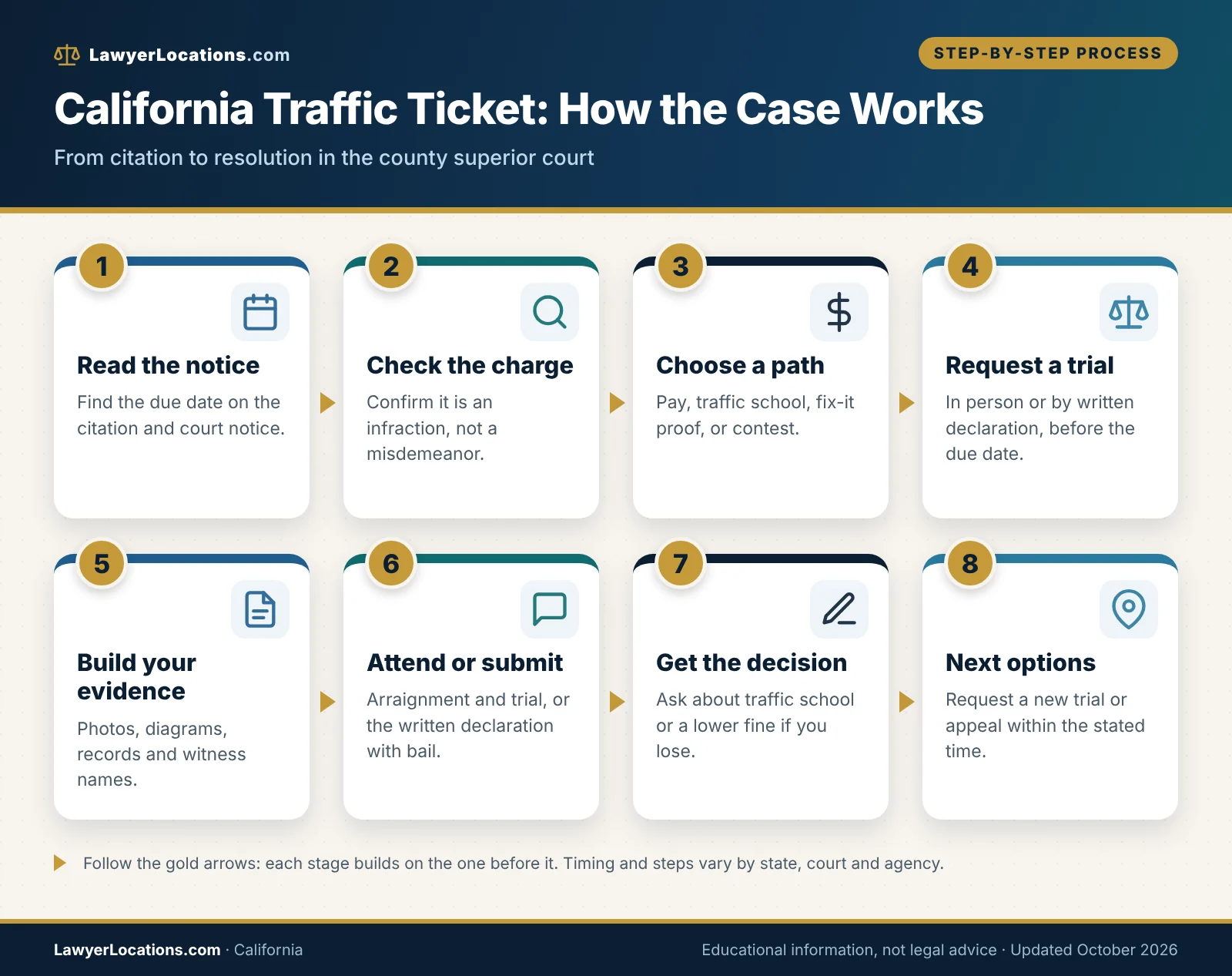
Text version of this graphic
- Read the citation and the court notice, and note the due date.
- Identify whether it is an infraction or a misdemeanor.
- Choose a path: pay, traffic school, fix-it, or contest.
- If contesting, request an in-person trial or a trial by written declaration.
- Gather evidence: photos, diagrams, records, witness names.
- Attend arraignment or submit the written declaration by the due date.
- Receive the decision; ask about traffic school or a lower fine if you lose.
- If needed, request a new trial or appeal within the stated time.
How the steps connect
The sections below follow the order in the graphic. Think of the ticket as a process with a few decision points, not a single yes-or-no choice, and note that you can still ask for traffic school or a lower fine after a trial, although the judge decides.
What the court notice tells you
The ticket you receive on the roadside is only the start. The court then sends its own notice, and that paper is where your due date and instructions live. Learning to read it prevents the most common and most avoidable mistakes.
Due dates and the timing of notices
Under Vehicle Code 40501, a notice to appear must set a specific date at least 21 days after the arrest, unless the court lets the officer allow an earlier appearance. In practice, the court’s own mailed notice may take 30 days or longer to arrive and lists your due date, according to the California courts’ self-help site. Do not wait for the mail if your ticket shows a date. Look up the citation on your county court’s website or call the clerk using a number from the official site.
What each box and line on the notice means
Look for the court name, the violation section, the appearance or due date, and the bail amount. If the ticket was marked as correctable, there will be instructions for proof of correction. If a line is unclear, the clerk can explain the procedure (though clerks cannot give legal advice). Write down the citation number and keep a copy of every receipt, because the paper trail is your best protection if a payment or filing goes missing.
When a Traffic Ticket Lawyer Makes Sense
Many drivers handle a routine ticket themselves, and that is a reasonable choice. A lawyer becomes worth a consultation when the consequences go beyond the fine, such as license points, insurance, a commercial license, or a charge that is really a misdemeanor.
Consequences that reach beyond the fine
The fine is often the smaller part of the cost. The longer-term effects land on your driving record, your insurance and sometimes your job.
DMV points and the negligent operator system
The DMV’s Negligent Operator Treatment System (NOTS) tracks convictions and sends warning letters and progressive penalties against a driving privilege. According to the DMV, traffic convictions carry between 0 and 3 points, and any conviction involving the safe operation of a motor vehicle on the highway receives one point. Speeding under Vehicle Code 22348(a) and unsafe-vehicle violations under Vehicle Code 24002 are listed at one point each, while hit and run and driving under the influence are listed at two. Mechanical violations that do not affect safe operation, such as a missing license plate light, carry no points.
Points matter because they accumulate. The thresholds that trigger DMV action depend on factors such as your license class, so check the DMV’s current negligent-operator page for the numbers that apply to you rather than relying on a rule of thumb.
Insurance, commercial licenses and work
If you complete traffic school and qualify, the court’s self-help site says the point is not visible to insurers, which usually means it should not raise your rates. A ticket you simply pay does not get that protection. Drivers with a commercial driver’s license face different rules: the courts’ traffic school page tells commercial license holders to ask the court how traffic school works in their situation. If your job depends on your license, a consultation before you pay is usually worth the time.
Before paying any ticket, ask yourself one question: “What will a conviction on my record cost me over the next three years?” Consider insurance renewals, a commercial license, rideshare or delivery work, and any employer rule about driving records.
What a lawyer can and cannot do
Knowing the realistic scope of a traffic ticket attorney’s work helps you judge quotes and avoid disappointment.
Typical tasks a lawyer handles
A lawyer can read the citation and the court notice, advise you on the options in the table above, request discovery or officer records where the court allows it, appear at arraignment or trial, question the officer, and negotiate where the court and prosecutor permit. For clients who live far from the courthouse or cannot miss work, handling appearances can be the main convenience, although whether your own attendance is required depends on the court and the charge, so confirm it with the lawyer and the court. Some people use a lawyer only to prepare a written declaration or to talk through evidence.
- Reviewing the citation for errors in the violation section, location, date, or officer information
- Explaining whether traffic school is likely to be available and how it affects your record
- Preparing questions for the officer and organizing your photos, diagrams, and witnesses
- Handling court appearances where the court permits, which may reduce travel and time off work
- Advising on DMV consequences, including license class and point effects
Limits you should expect
No honest lawyer can promise a dismissal. The officer’s account, the evidence, and the judge’s view all matter, and many tickets are resolved with a lower fine or traffic school rather than a full win. Because infractions do not come with a right to appointed counsel in most situations, you pay for the lawyer yourself, and you should expect to hear the fee before you commit.
Be wary of anyone who guarantees that a ticket will be dismissed, tells you to ignore your court notice, or says they can “take care of it” without explaining your options in writing.
A decision framework: handle it yourself or consult a lawyer
Use the table to sort your own situation. It is a starting point, not a verdict, and it does not replace advice from a lawyer licensed in California.
Situations where self-handling is often reasonable
A first-time, one-point moving violation with a clear traffic school option is the classic example. So is a correctable equipment ticket, where the fix and a modest dismissal fee end the matter. A driver with a clean record, no commercial license, and no insurance concerns can usually weigh the choice alone using the court’s self-help instructions.
Situations that call for a consultation
Consider talking with a lawyer if you hold a commercial license, have used traffic school recently, face multiple citations from one stop, were cited in a crash with injuries, or were told the offense is a misdemeanor. The same applies if you missed a court date. After a collision, our guides on what to do after a car accident and whether you need a lawyer after a car accident explain how a ticket can interact with a civil claim.
| Situation | Why it matters | Consultation worth considering? |
|---|---|---|
| First-time minor moving violation, traffic school offered | Traffic school keeps the point from insurers when you qualify | Often not necessary |
| Correctable equipment or paperwork ticket | Proof of correction and a small fee usually resolve it | Often not necessary |
| Traffic school finished within the past 18 months | The point may become visible and count toward DMV action | Reasonable to consider |
| Commercial driver’s license holder | Different rules apply and work may depend on the license | Strongly consider |
| Several citations from one stop, or a crash | Admissions on one ticket can affect other issues | Strongly consider |
| Missed court date or unpaid fine | Separate penalties can attach, including misdemeanor exposure | Strongly consider, promptly |
| Citation mentions alcohol, drugs, or a misdemeanor | Criminal consequences are possible | Consult a criminal defense lawyer |
California Courts, Traffic School and Trial Options
California has one statewide set of traffic laws but applies them through county superior courts, each with its own website, payment portal and clerk’s office. The statewide rules are the same; the logistics are local. This section covers the pieces that are specific to California, in the order you will meet them.
Where your case is heard and how to reach the court
Your ticket is handled by the superior court for the county where the violation occurred, not by the county where you live. Out-of-area drivers are common, so the logistics matter.
Finding the right superior court
The Judicial Branch of California runs a court locator at courts.ca.gov/find-my-court where you can search by ZIP code or city to find nearby court locations. Each county court then posts its own traffic page with payment options, hours, arraignment procedures and its bail instructions. If you were ticketed far from home, check whether that court offers online options so you do not need to travel.
Online tools, MyCitations and scam warnings
Many courts let you pay, request traffic school, or ask for a lower fine online. The statewide self-help site describes MyCitations as an online program through which you can request a lower fine, upload financial proof, and receive a decision by email, and it notes that some courts allow trial by written declaration through MyCitations without prepaying bail. Availability varies by court, so confirm on your county court’s own site.
The courts’ self-help site warns that scammers send fake texts, calls and emails claiming you owe money on a traffic ticket. California courts will never ask for payment by text, phone or email, and will not send links to pay tickets by text. Do not click, reply or call back. Check your ticket on the court’s official website or by calling a number you trust, and pay only through the official court site or in person.
Traffic school and the 18-month rule
For drivers who qualify, traffic school is often the simplest way to protect an insurance record. The details of eligibility are where drivers get tripped up.
Who is usually eligible
According to the courts’ traffic school page, you generally qualify if you hold a valid driver’s license, the ticket involves a noncommercial vehicle, and you have not completed traffic school within the past 18 months. Your court notice states whether you are eligible, and if it is unclear you should contact the court. Vehicle Code 41500 adds that the court must tell you only one conviction within 18 months will be held confidential, and it excludes certain offenses listed in Vehicle Code 12810.
The same page explains that equipment problems (such as a broken taillight) and tickets related to alcohol or drugs usually do not qualify. You pay the traffic school’s fee and the court’s own fee, and the court sets your deadline to finish. The page lists no dollar amounts, so rely on your notice and the court’s fee information for the figures.
Commercial licenses and what traffic school really does
If you hold a commercial driver’s license, different rules apply, and the courts advise asking the court how they work in your case. For noncommercial drivers, completing traffic school keeps the ticket’s point from being visible to insurers, so it generally should not raise your rates. The point itself remains on your DMV record, as the statewide self-help site explains, so do not treat traffic school as erasing the ticket.
Traffic school has its own due date, set by the court. A missed deadline can create new problems, and if you miss one for a good reason such as illness, the self-help site says to contact the court right away. Put the date in your calendar the day you enroll.
Contesting the ticket: in-person trial or written declaration
If you believe the ticket is wrong, or you want a judge to hear context, you can ask for a trial. California offers two formats for most Vehicle Code infractions.
The in-person trial
You request a trial at the courthouse, but the trial usually does not happen that day. At arraignment, the judge explains the charge and your rights and asks whether you plead guilty or not guilty. If you plead not guilty, a trial date is set. There is no jury; a judge or commissioner decides. You can speak, the officer who issued the ticket also speaks, and you can bring photos, videos or witnesses.
Payment before trial is not always required, according to the self-help site, but skipping payment means separate arraignment and trial dates. Some courts hold both on the same day and may require bail first, which is returned if you are found not guilty.
Trial by written declaration under Vehicle Code 40902
Vehicle Code 40902 requires courts to let a defendant elect a trial by written declaration for most Vehicle Code and local-ordinance infractions, with the exception of infractions cited under the DUI article. The defendant submits bail set by the uniform traffic penalty schedule (Vehicle Code 40310), and the bail is refunded if the defendant is found not guilty or the charges are dismissed. The statute lets trial rules admit certain evidence, such as the notice to appear, a business record or receipt, the officer’s sworn declaration, or the defendant’s signed statement, even though hearsay rules would otherwise limit it.
In practice, the steps look like this according to the courts’ self-help site:
- Get your instructions. Check the court notice or website for the due date, bail amount and submission method.
- Complete the request. Use Request for Trial by Written Declaration (TR-205), and Attached Declaration (MC-031) if you need more room or witness statements.
- Pay bail and submit. Send everything before the due date by mail or, where accepted, online.
- Officer statement. The court requests the officer’s written statement by a set date.
- Decision. The judge reviews both statements and your evidence and mails a decision.
A written declaration is persuasive only if it is organized. Photos need captions, diagrams need labels, and your statement should answer one question: what exactly happened, in order, with times and distances. A lawyer can help here even if you never go to court.
If the result goes against you or you cannot afford the fine
A loss is not always the end, and a high fine is not always the final amount. Both situations have defined next steps.
New trial and appeal
If you lose a trial by written declaration, Vehicle Code 40902 entitles you to a trial de novo, which is a fresh trial. The self-help site says you request it by filing Request for New Trial (TR-220) within 20 calendar days of the date the court mailed the Decision and Notice (TR-215), and that the court schedules it within 45 days. A trial de novo is not available if your court lets you use MyCitations for an online trial by declaration. An appeal to a higher court is the alternative, but it reviews legal errors only and has no new evidence.
Asking for a lower fine or payment help
After the court decides you owe a fine, you can ask it to review your finances. The self-help site points to form TR-320, “Can’t Afford to Pay Fine: Traffic and Other Infractions,” and to MyCitations where available. Options the court may offer include a lower fine, more time to pay, a payment plan, or community service in place of payment. You will need to share income and expense information. If your circumstances change, you can submit a new request.
| Form or tool | Purpose | Key timing note |
|---|---|---|
| TR-205 | Request for Trial by Written Declaration | Submit with bail before the due date on your notice |
| MC-031 | Attached Declaration for extra detail or witness statements | Submit with TR-205 |
| TR-215 | Decision and Notice after a trial by written declaration | Starts the 20-day window for a new-trial request |
| TR-220 | Request for New Trial (trial de novo) | File within 20 calendar days of the TR-215 mailing date; not available after a MyCitations trial |
| TR-320 | Can’t Afford to Pay Fine: Traffic and Other Infractions | Use after the court has decided the amount owed |
| Certificate of Correction | Proof of fix on the back of a correctable ticket | Complete by the due date; $25 dismissal fee per ticket |
| MyCitations | Online requests for lower fines and, in some courts, trials | Availability varies by court |
Fix-it tickets in California
A fix-it ticket is the gentlest category, but it still has a due date.
What counts as correctable
The statewide self-help site lists four common categories: mechanical problems such as a broken taillight, driver’s license problems, expired registration, and lack of proof of insurance. If the ticket includes a fix-it issue and another charge, the court will tell you what you still owe after you prove the fix.
How to clear it
Fix the problem by the due date and show proof. For a mechanical problem, a local police officer signs the Certificate of Correction on the back of the ticket. For a license problem, the DMV or a police officer signs, and some courts accept a valid California license shown to the clerk. For expired registration, bring a copy of current registration to the clerk. For no insurance, bring proof you were insured when you were cited. Then pay the $25 dismissal fee for each fix-it ticket. If you live out of state, contact the court that issued the ticket and ask whether local law enforcement can sign it.
How to Compare Traffic Ticket Lawyers
The right question is not “who advertises loudest?” but “who can explain my options clearly, quote a fee in writing, and show the experience my situation needs?” Compare in a consistent way, using the same questions for each lawyer.
Where to look and how to verify
Start with sources that have a screening or accountability process, and then verify each lawyer directly.
Referral services and legal aid
The State Bar of California maintains a directory of State Bar-certified lawyer referral services, and it explains how a certified service works and why to use one. Local bar associations often run similar services. For people with limited income, LawHelpCA, maintained by the Legal Aid Association of California, offers self-help information and a directory to find legal aid providers and pro bono lawyers by service area. Legal aid organizations may not take routine tickets, so ask what they cover.
- State Bar of California directory of certified lawyer referral services
- Your county or city bar association’s referral service
- LawHelpCA directory for legal aid and pro bono options
- Your county superior court’s self-help center or traffic page
Checking a license before you hire
Confirm that any lawyer you consider is licensed in California and in good standing on the State Bar’s public attorney search. Look for discipline history and check that the person you meet is the person who will handle your case. A directory such as LawyerLocations.com is an educational resource, not an endorsement, and we do not rate or recommend individual lawyers.
Questions that separate clear answers from vague ones
A short consultation, even a paid one, reveals how a lawyer thinks. Ask the same questions of everyone.
Experience and approach
Ask how often the lawyer handles infractions in the specific superior court where you were cited, what the usual sequence is (arraignment, trial, written declaration), and whether the lawyer will appear personally. Ask what facts in your ticket matter most and what additional information they would want. A thoughtful lawyer explains trade-offs rather than promising an outcome. Our guide to free criminal defense consultations explains what to expect from a first conversation.
Communication and conflicts of interest
Ask who your day-to-day contact will be, how updates arrive, and what happens if the court date moves. Ask whether the lawyer will tell you before accepting any plea or lower-fine arrangement. Confirm that the lawyer has no conflict, such as a relationship with the cited officer’s agency that could affect the representation. You should come away able to describe your options in your own words.
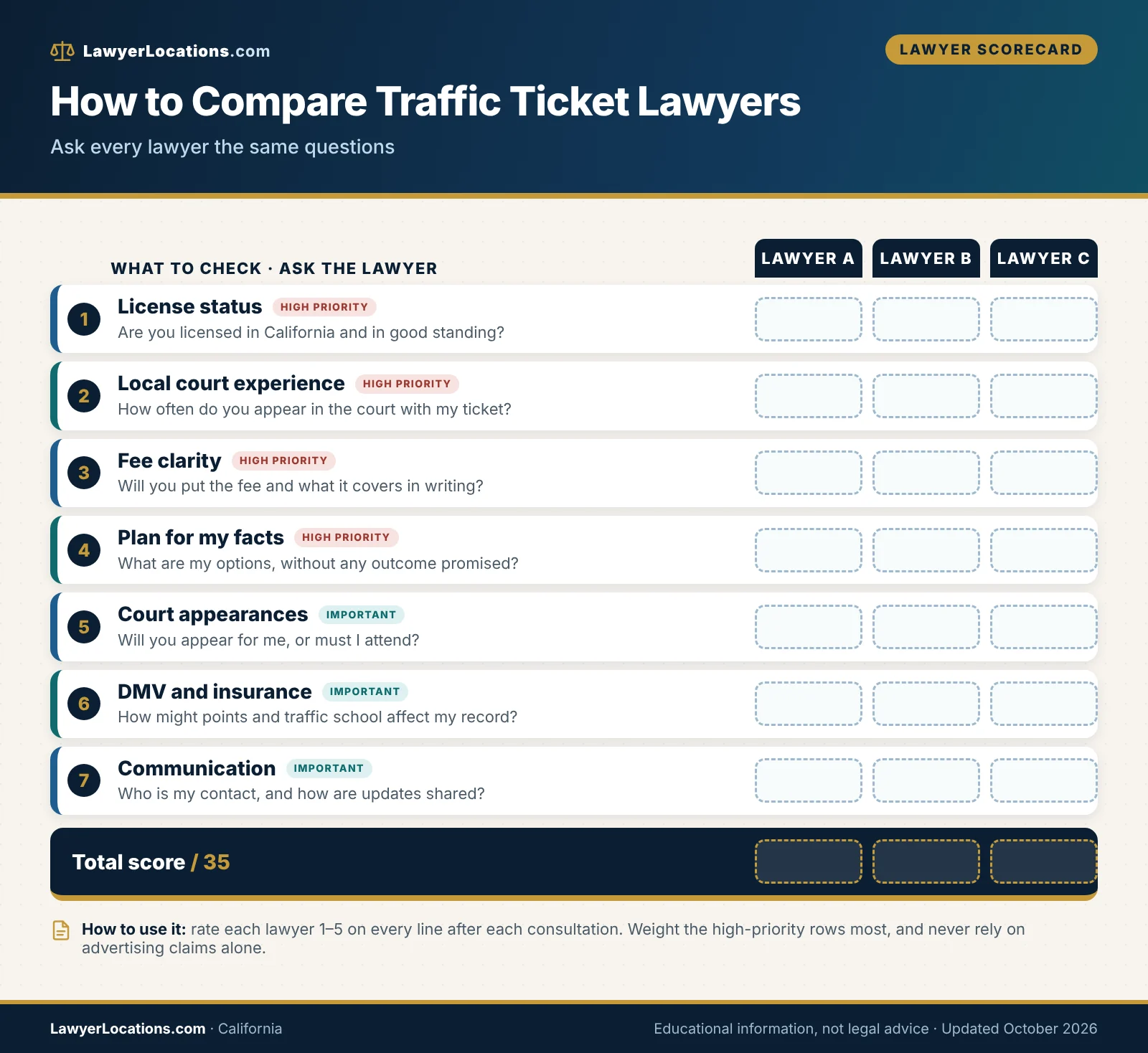
Text version of this graphic
- License status: Is the lawyer licensed in California and in good standing?
- Local court experience: How often do they appear in the court that has your ticket?
- Fee clarity: Is the fee in writing, and what does it include?
- Plan for your facts: Can they explain your options without guaranteeing results?
- Appearance policy: Will they appear for you, or will you need to attend?
- DMV and insurance advice: Do they explain points, traffic school, and license class effects?
- Communication: Who is your contact, and how fast are updates shared?
Fee structures you may see
Fees for traffic matters are set by each lawyer and vary widely, so this guide gives no price figures. What you can compare is the structure and what each fee covers.
Flat fee, hourly and per-appearance
Many traffic ticket lawyers quote a flat fee for the case, which gives you a known cost. Others bill hourly, which can be reasonable for a narrow task such as reviewing a ticket or drafting a declaration but may rise if the case grows. Some charge per court appearance. Ask what happens if the court sets a second date, if you request a new trial, or if the case moves to an appeal. Compare these structures in the table below, then ask each lawyer which one applies to you.
What the quote should say in writing
A clear written fee agreement lists the services included, whether court costs, bail and traffic school fees are separate, what happens at each stage, and how refunds work if the matter resolves early. Be cautious about any lawyer who asks you to send bail or fine money to the lawyer’s personal account rather than paying the court directly. The ticket fine and the lawyer’s fee are two different things, and you should be able to see both. Our national guide on criminal defense lawyer costs explains common fee models in more detail.
| Fee structure | How it works | Best suited to | Question to ask |
|---|---|---|---|
| Flat fee | One agreed price for a defined scope | Routine tickets with a predictable path | What is excluded, and what triggers extra charges? |
| Hourly | You pay for time spent | Narrow tasks like a ticket review or declaration help | What is your estimate and your cap? |
| Per appearance | A set amount each time the lawyer appears | Cases likely to need one or two hearings | What happens if a date is continued? |
| Consultation only | A fee for advice with no ongoing representation | People who will self-represent but want direction | Is the consultation fee credited if I hire you? |
Walk away from any lawyer or “ticket service” that guarantees a dismissal, discourages you from reading your court notice, asks you to pay the court fine to them without a receipt from the court, or pressures you to decide on the first call.
Deadlines, Costs and Decision Points
The cost of a California traffic ticket is more than the number printed on it, and the deadline that matters is the one on your own notice. Treat the due date as fixed and the rest as a set of choices you can still make.
The deadlines that matter most
A handful of dates control most of what can go wrong. Keep them in one place, such as a phone calendar with a reminder a week ahead.
Deadlines drawn from your paperwork and the courts
Your court notice lists the main due date for paying, requesting traffic school, or asking for a trial. A fix-it ticket has its own due date for the repair and proof. Traffic school has a completion date set by the court. After a trial by written declaration, a new-trial request must be filed within 20 calendar days of the mailing date on the decision notice. The table summarizes them.
| Stage | Deadline source | What can happen if it is missed |
|---|---|---|
| Respond to the citation | Date on your ticket and court notice (the notice to appear must set a date at least 21 days after the arrest unless the court allows earlier) | A civil assessment, a failure-to-appear charge and a DMV record entry are possible |
| Traffic school | Completion date set by the court | You may lose the chance to keep the point from insurers; contact the court right away if you have a good reason |
| Fix-it proof | Due date on the ticket | The dismissal option can be lost and additional penalties may follow |
| Written declaration | Due date on the notice, with bail | The court may not accept a late request |
| New trial request (TR-220) | 20 calendar days from the TR-215 mailing date | The trial de novo option may be lost |
| Paying the fine | Time the court allows or a payment plan it approves | Willful failure to pay can be a misdemeanor under Vehicle Code 40508 |
When you have a good reason to be late
The courts’ self-help site says that if you miss a deadline for a good reason, such as illness, you should contact the court right away. Do it in writing where possible, keep a copy, and ask the clerk what documentation the court needs. Delay makes every later option harder, and a lawyer can help you present the reason clearly.
What happens if you ignore a ticket
Ignoring a ticket does not make it go away. It adds new problems on top of the original one, and that is the main reason to act early.
Civil assessments and the DMV record
The self-help site warns that ignoring a ticket can lead to a late fee of up to $100 (called a civil assessment), a failure-to-appear charge, and an entry on your DMV record. It also says the court notice may take 30 days or longer to arrive. If your ticket shows a date and you have not heard from the court, check the status yourself.
Misdemeanor exposure under Vehicle Code 40508
Vehicle Code 40508 makes it a misdemeanor to willfully violate a written promise to appear, regardless of how the original charge ends. It also covers willful failure to pay a lawfully imposed fine, or to pay bail in installments under Vehicle Code 40510.5, when you do not pay within the court’s authorized time and have no lawful excuse presented to the court by the due date. Later full payment does not cure the offense under subdivision (b). The statute does not set the penalty, so a lawyer can advise on how a particular court handles it. In short, simply ignoring a ticket can turn a minor infraction into a criminal matter.
If you already missed a date, do not wait for a letter. Contact the court through its official website or a phone number you trust, and consider speaking with a lawyer promptly. Acting now is almost always better than explaining a longer gap later.
Budgeting for the full cost
Think in layers: the court amount, the optional pieces, and the long-term cost of a conviction. Putting numbers next to each layer is what makes the decision clear.
What makes up the total
- The fine or bail amount shown on your notice, which can include statutory assessments
- The court’s fee and the traffic school provider’s fee, if you choose traffic school
- The $25 dismissal fee for each fix-it ticket, plus repair costs
- Any lawyer’s fee, which is separate from the fine
- Insurance changes after a conviction that insurers can see (ask your insurer how it treats tickets)
Because the court’s fee and traffic school fee are not listed on the self-help pages, look them up on your own county court’s website. Do not rely on a figure from a forum post.
Weighing a lawyer’s fee against the stakes
Compare the lawyer’s written quote against what a conviction might cost you over time: insurance, a commercial license, job requirements, or a DMV action. If the ticket is a routine first offense with a traffic school option, the math often favors handling it yourself. If the stakes are high, a fee can be reasonable. Ask the lawyer to explain how the fee relates to the likely options, and compare at least two quotes.
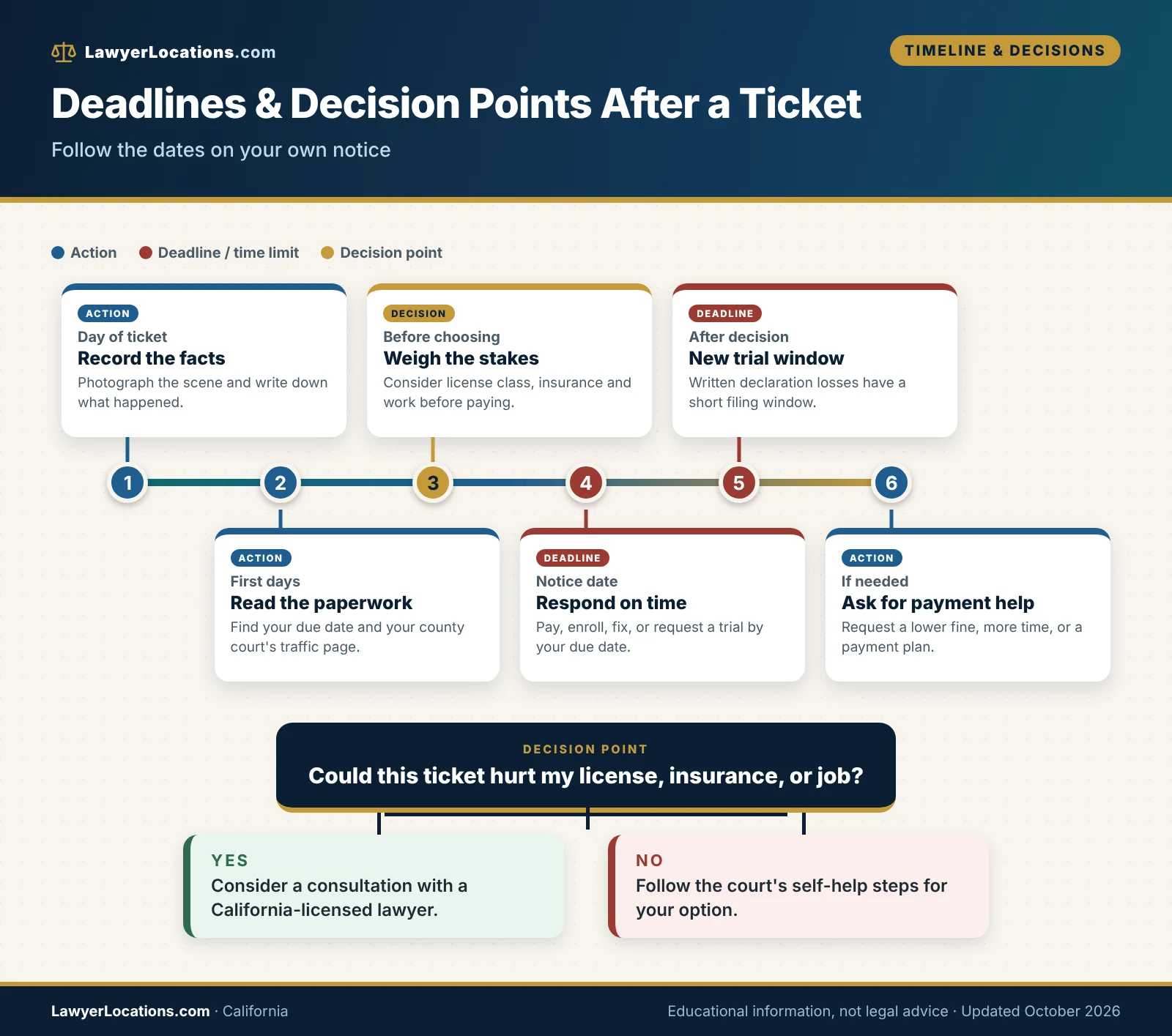
Text version of this graphic
- Day of the ticket (action): Photograph the scene and write down what happened while it is fresh.
- Within days (action): Read the citation and look up your court’s traffic page.
- Before the notice date (deadline): Choose pay, traffic school, fix-it, or contest, and respond on time.
- Before choosing (decision): Is it only a fine, or could it hurt my license, insurance, or job?
- After the court decision (deadline): Watch the 20-day window to request a new trial.
- If you cannot pay (action): Ask the court for a lower fine, more time, a payment plan, or community service.
Decision: Could this ticket hurt my license, insurance, or job? If yes, consider a lawyer consultation before paying. If no, follow the court’s self-help steps.
Preparing, Avoiding Mistakes and Next Steps
Good preparation shortens a consultation, lowers the chance of a missed detail, and helps you compare lawyers fairly. Spend an hour organizing before you call anyone.
Prepare for a consultation
Walking in with your facts organized saves time and often saves money if the lawyer bills by the hour.
Documents and evidence to gather
Bring the citation itself, the court notice, and any receipts or payment confirmations. Add photos of the location, signs, road markings and your own vehicle, along with any dash camera footage. Write a short, dated account of what happened, and list witnesses with contact details. Keep your driver’s license class, insurance information, and any prior traffic school completion dates handy, since the 18-month rule depends on them.
- Citation and court notice (both sides of the ticket)
- Payment receipts, portal confirmations, and any court emails or letters
- Photos or video of the scene, signs, and road conditions
- Your written, dated account of the stop
- Witness names and contact information
- Driver’s license class and the date of any prior traffic school
- Insurance policy details and any employer driving policy
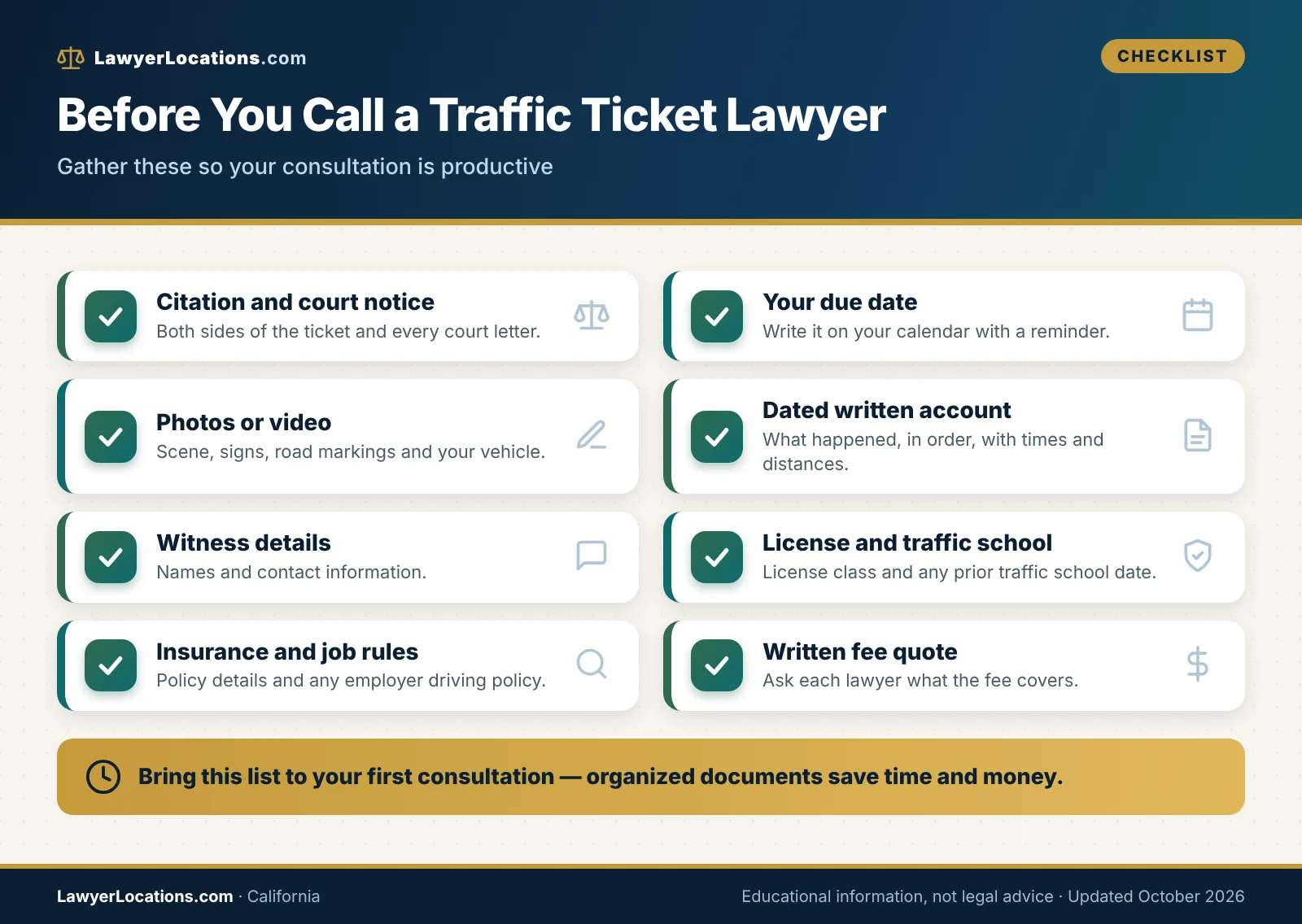
Text version of this graphic
- Citation and court notice
- Due date written on your calendar
- Photos or video of the scene
- Your dated written account
- Witness contact details
- License class and prior traffic school date
- Insurance and employer driving rules
- Written fee quote from each lawyer
Questions to bring to the consultation
Bring a written list so you do not forget in the moment. Ask what the lawyer sees as the strongest and weakest parts of your situation, what each option would cost, how long each would take, and what the lawyer will do if the court refuses a request. Ask what you should avoid doing in the meantime, and whether you should say anything to your insurer. Our expungement guide is also worth reading if a past conviction is part of your concern.
Common mistakes and red flags
Most problems come from a short list of avoidable errors. Reviewing them now is cheaper than fixing them later.
Mistakes that make a ticket worse
- Waiting for a mailed notice when your ticket already shows a date
- Paying without realizing it counts as an admission of guilt
- Assuming traffic school is available without checking the 18-month rule and your court notice
- Ignoring a fix-it due date because the repair seems minor
- Paying through a link in a text message or email instead of the official court site
- Missing the 20-day window to request a new trial after a written declaration loss
- Skipping the ability-to-pay request when the fine is unaffordable
Each of these has a simple prevention: read the notice, mark the date, and use only the court’s official channels.
Red flags in lawyer advertising and intake
Be careful with guarantees, claims of “special connections” with officers or judges, and requests for large cash payments without a written agreement. Watch for pressure to sign before you have heard your options. A lawyer who answers your questions directly, explains the downside, and welcomes a written fee agreement is behaving the way you want. Because attorney advertising varies, verify claims yourself with the State Bar’s public records.
Quick answers to common questions
These are the questions drivers ask most often when they search for a traffic ticket lawyer in California. Each answer points back to the sections above for detail.
Tickets, courts and traffic school
These answers cover the process questions people raise first, from paying to missed dates.
Is paying a California traffic ticket the same as pleading guilty?
Yes. According to the statewide court self-help site, paying means you agree you are guilty, which is called forfeiting bail. For violations involving safe operation, a conviction can add a point to your DMV record.
Can I contest a traffic ticket without going to court?
Often, yes. Vehicle Code 40902 requires courts to allow trial by written declaration for most Vehicle Code infractions, excluding DUI citations. You generally pay bail first, and it is refunded if you win.
How often can I go to traffic school?
You generally cannot use it if you completed traffic school within the past 18 months. Your court notice states whether you are eligible, and commercial license holders should ask the court how the rules apply to them.
Can I get a public defender for a traffic ticket?
Generally no. Under Penal Code 19.6, a person charged with an infraction is generally not entitled to appointed counsel at public expense, unless arrested and not released on a promise to appear, own recognizance, or bail. Consider a referral service or legal aid group for guidance.
What happens if I miss my court date?
You can face a civil assessment of up to $100, a failure-to-appear charge and an entry on your DMV record. Willfully violating a written promise to appear is a misdemeanor under Vehicle Code 40508. Contact the court right away, and consider speaking with a lawyer.
How do I know whether a text about my ticket is real?
Assume it is not. California courts say they will never ask for payment by text, phone or email. Check your ticket through your court’s official website or a trusted phone number.
Lawyers, fees and your record
These answers cover hiring, cost and the effect of a ticket on your driving record.
How much does a traffic ticket lawyer cost in California?
It depends on the lawyer, the court and the complexity of the case, so we do not quote a figure. Typical structures are flat, hourly and per-appearance fees. Ask for the fee in writing and what it includes. The fine is separate from the lawyer’s fee.
Is a traffic ticket lawyer worth it for a minor ticket?
Often not, when traffic school is available and you hold a regular license. It can be worth a consultation if you have a commercial license, used traffic school recently, were cited in a crash, or face a possible misdemeanor.
What if I lose a trial by written declaration?
You can request a trial de novo by filing form TR-220 within 20 calendar days of the date the court mailed the TR-215 decision, unless your court used MyCitations for the online trial. Appeal to a higher court is the other route.
What if I cannot afford the fine?
Ask the court. It may lower the fine, give more time, set up a payment plan, or allow community service. Use form TR-320 or MyCitations if your court offers it.
Will traffic school remove the point from my record?
No. For noncommercial drivers who qualify, the point stays on the DMV record but is hidden from insurers. Ask the court how this works if you hold a commercial license.
Where do I find a traffic ticket lawyer near me?
Start with the State Bar of California’s directory of certified referral services, a local bar association’s service, or LawHelpCA for legal aid. Then verify the lawyer’s license on the State Bar’s public attorney search.
Your next steps
A short plan keeps you from drifting past a deadline. You can complete it in a week.
A one-week plan
- Day 1. Photograph the ticket, write a dated account, and find your due date on the citation and court notice.
- Day 2. Look up your case on the county court’s official website and read its traffic page.
- Day 3. Decide whether the ticket is routine or has wider stakes: license class, insurance, work, or a possible misdemeanor.
- Days 4 to 5. If the stakes are higher, contact two lawyers through a referral service and compare written fee quotes.
- Days 6 to 7. Act on your chosen path before the due date: pay, enroll in traffic school, complete the fix, or file your request.
When to stop going it alone
Consider a lawyer promptly if you missed a date, hold a commercial license, were told the offense is a misdemeanor, or were cited alongside a crash. If you simply want to keep a clean record at the lowest cost, the court’s own self-help pages are a sound place to start. Either way, keep your paperwork, meet every date, and ask for fees in writing.
Ready to compare your options?
Use the scorecard questions above to speak with at least two California-licensed lawyers about your ticket, and ask each for a written fee quote and an explanation of the likely paths. If your citation involves alcohol, drugs or a possible misdemeanor, start with our guide on whether you need a lawyer for a DUI.
General information only. This guide is a general educational resource and is not legal advice. Reading it does not create an attorney-client relationship with LawyerLocations.com or anyone else. LawyerLocations.com is not a law firm and does not recommend or rate individual lawyers. Laws, court rules, fees and forms change, and outcomes depend on the facts of each case, so consult a lawyer licensed in California about your situation and confirm current details with your court.
Sources & References
Show all 17 sources
- Traffic Tickets (Self-Help Guide) — Judicial Branch of California — selfhelp.courts.ca.gov — accessed October 2026
- Traffic School — Judicial Branch of California — selfhelp.courts.ca.gov — accessed October 2026
- Trial by Written Declaration — Judicial Branch of California — selfhelp.courts.ca.gov — accessed October 2026
- Going to Court for a Traffic Ticket (In-Person Trial) — Judicial Branch of California — selfhelp.courts.ca.gov — accessed October 2026
- Ask for a Lower Fine or Payment Options — Judicial Branch of California — selfhelp.courts.ca.gov — accessed October 2026
- Fix-It Tickets — Judicial Branch of California — selfhelp.courts.ca.gov — accessed October 2026
- Traffic Ticket Scam Warning — Judicial Branch of California — selfhelp.courts.ca.gov — accessed October 2026
- Find My Court — Judicial Branch of California — courts.ca.gov — accessed October 2026
- California Vehicle Code section 40902 — California Public Law (statute text mirror) — california.public.law — accessed October 2026
- California Vehicle Code section 40501 — California Public Law (statute text mirror) — california.public.law — accessed October 2026
- California Vehicle Code section 40508 — California Public Law (statute text mirror) — california.public.law — accessed October 2026
- California Vehicle Code Chapter 1 (sections 41500 et seq., traffic school) — California Legislative Information — leginfo.legislature.ca.gov — accessed October 2026
- California Penal Code section 19.6 — California Public Law (statute text mirror) — california.public.law — accessed October 2026
- California Penal Code section 19.8 — California Public Law (statute text mirror) — california.public.law — accessed October 2026
- The Negligent Operator Treatment System (NOTS) — California Department of Motor Vehicles — dmv.ca.gov — accessed October 2026
- Certified Lawyer Referral Services Directory — State Bar of California — calbar.ca.gov — accessed October 2026
- LawHelpCA — Legal Aid Association of California — lawhelpca.org — accessed October 2026
Legal Disclaimer and Limitation of Liability
Informational and illustrative purposes only. This article was prepared by LawyerLocations.com solely on the basis of the information available to us at the time of writing. It is an illustrative, general overview. It is not a complete or authoritative statement of the law, and it has not been reviewed by a lawyer licensed in your state or county.
Not legal advice. Nothing in this article is legal, financial, tax or immigration advice, and reading it does not create an attorney-client relationship between you and LawyerLocations.com or any author, lawyer or firm mentioned. Laws, court rules, fees, filing deadlines and agency procedures differ by state, county and court, and they change often. Some details here may be simplified, incomplete or out of date, and time limits for legal claims can be short.
No warranty. We make no representation or warranty, express or implied, about the accuracy, completeness, timeliness or suitability of this content for your situation. Please do not rely on it to make, delay or skip any legal decision. Check the facts against official sources and speak with a licensed attorney in the relevant jurisdiction before you act.
Limitation of liability. To the fullest extent permitted by law, LawyerLocations.com and its owners, authors and contributors disclaim all liability for any loss, damage, cost or other consequence arising from the use of, or reliance on, this article, including any content on third-party websites we link to. Mentioning a lawyer, firm, organization or service is not an endorsement and is not a promise of any result. If you are in immediate danger, contact your local emergency number.