
If you searched for a slip and fall lawyer Arlington TX residents can compare, you are probably dealing with a fall on a wet floor, a broken stair, a dark parking lot, or a sidewalk that was not maintained. Texas treats these as premises liability claims, and the general deadline to sue is two years under Tex. Civ. Prac. & Rem. Code § 16.003. If the fall happened on city or other government property, a much shorter written-notice window can apply.
This guide explains what a Texas premises claim requires, how Tarrant County courts and the City of Arlington’s claim process fit in, how contingent fees work, and how to compare lawyers before you sign anything. It is general information, not advice about your fall.
How a Slip and Fall Lawyer Case Works in Arlington, TX
A slip and fall lawyer helps people hurt on someone else’s property pursue payment for medical bills, lost income, and other harm, usually by proving the property owner or operator failed to deal with a hazard it knew about or should have found. In Arlington that work runs through Texas premises liability law and, if a lawsuit becomes necessary, the courts of Tarrant County.
Most of these claims never reach a jury. They are built, valued, and negotiated on paper, which means the first weeks after a fall matter more than most people expect. The sections below walk through what the claim is, how it moves, and where Arlington’s local details change the picture.
What counts as a slip and fall claim in Texas
The phrase “slip and fall” is shorthand. Legally, the claim is that a dangerous condition on land or in a building hurt you and the person in control of the property is responsible. The fall itself is only the injury; the case is about the condition and what the property controller knew.
Common hazards behind these claims
Typical examples include spilled liquids and wet floors, loose or torn carpet, uneven or broken pavement, missing handrails, poorly lit stairwells and parking lots, debris in aisles, and icy or flooded walkways. Weather adds to the list: rain tracked in through entrances and icy mornings can turn ordinary walkways into hazards that owners are expected to manage.
Not every fall is a claim. A fall caused by your own misstep on a clean, well-lit surface usually is not, and a lawyer’s first job at a consultation is often an honest look at whether a hazard existed at all.
Who can be responsible for the property
The responsible party is whoever controls the premises, which is not always the name on the deed. It can be a store operator, a landlord, a property management company, a tenant running a restaurant inside a larger building, a contractor who left a work area unsafe, or a unit of government. Identifying the right party early matters because each one has different insurance, different records, and sometimes different notice rules.
That is why a careful lawyer will ask who mopped, who inspected, who owned the building, and who held the lease. Those answers decide who gets the first letter.
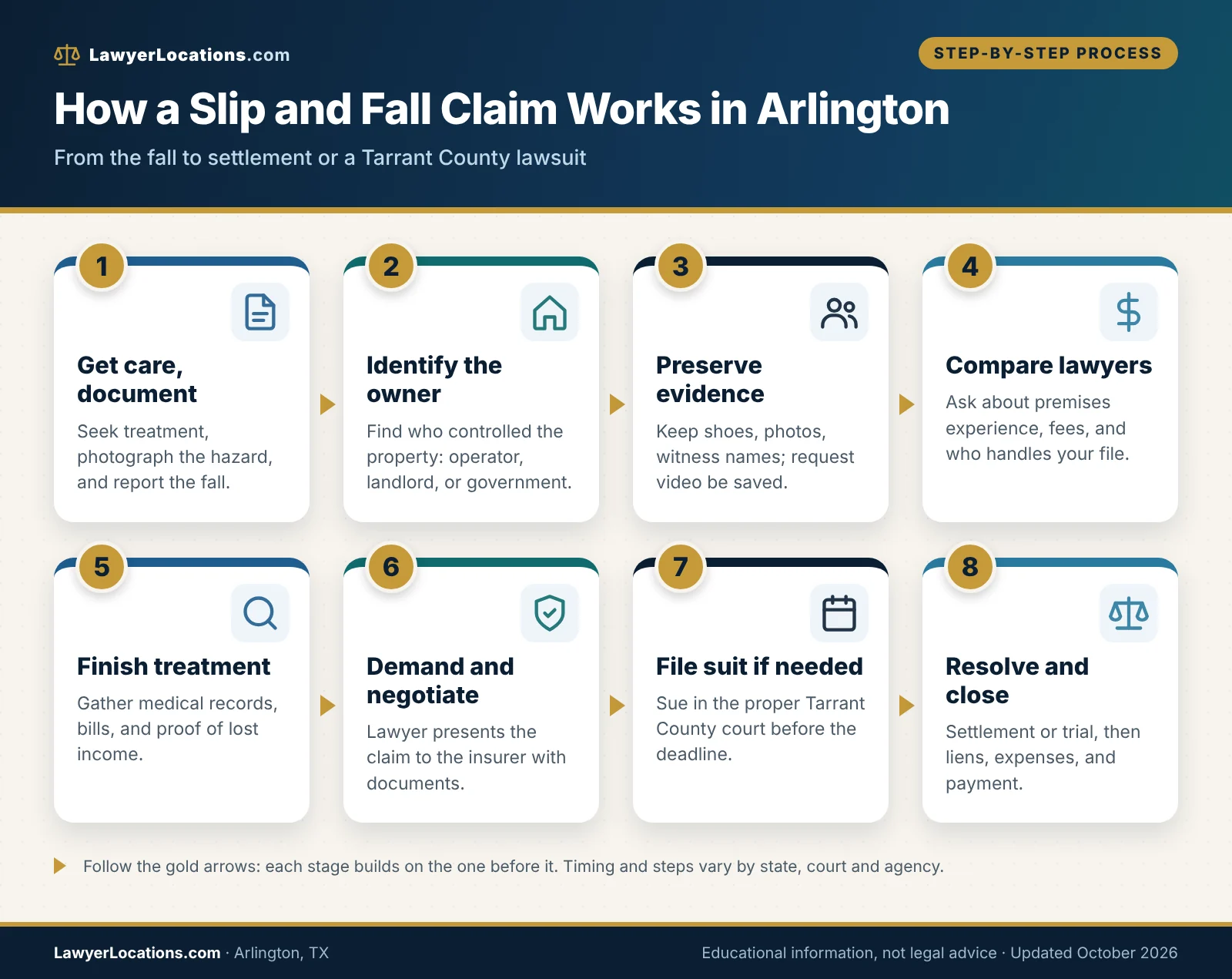
Text version of this graphic
- Get care and document the scene. Seek treatment, photograph the hazard and your injuries, and report the fall to the owner or manager.
- Identify who controlled the property. Owner, operator, landlord, contractor, or government entity.
- Preserve evidence. Footwear, photos, witness names, and a written request that video and inspection records be kept.
- Meet with lawyers and compare. Ask about premises experience, fees, and who will handle your file.
- Complete treatment and gather records. Medical bills, records, and proof of lost income build the claim’s value.
- Send a demand and negotiate. The lawyer presents the claim to the insurer with supporting documents.
- File suit if needed. Before the deadline, in the proper Tarrant County court.
- Resolve the case. Settlement, mediation, or trial, followed by closing statements and payment of liens and expenses.
How a case moves from fall to resolution
Most Arlington slip and fall claims follow the same arc: care and evidence first, a demand to the insurer second, and a lawsuit only when negotiation does not produce a fair result or the deadline is close. The timing varies widely, and no responsible lawyer can promise an outcome or a schedule.
The first days and weeks
The early window is about your health and the paper trail. Get medical care and tell the provider exactly how you were hurt, since records written near the event carry weight. Report the fall to the manager or property owner and ask that an incident report be made, but avoid giving a recorded statement to an insurance adjuster before you understand your rights.
If you can do it safely, photograph the spot, the lighting, any warning signs (or their absence), and the shoes you were wearing. A casual photo taken on your phone can matter more than a polished reconstruction months later.
Demand, negotiation, and filing suit
Once treatment stabilizes, a lawyer typically assembles records and bills, documents lost earnings, and sends the insurer a written demand. The insurer may accept, counter, or deny, often arguing that the hazard was not known, was visible, or that you were partly at fault. Many cases settle at this stage or after a lawsuit is filed and the parties exchange information.
If a lawsuit is needed, it is filed in the proper court before the limitations deadline discussed in the next section. For the general timeline and how deadlines vary around the country, see our guide on how long you have to file a personal injury claim.
LawyerLocations.com is a legal-education and lawyer-discovery resource, not a law firm, and reading this page does not create an attorney-client relationship. Use it to prepare questions, then verify any lawyer you are considering before you hire.
Where Arlington slip and fall claims tend to arise
Slip and fall claims can arise anywhere people walk, which in a city the size of Arlington includes many kinds of property. This section describes categories, not statistics; we are not citing local claim data.
Retail, restaurants, and apartment communities
Businesses open to the public owe customers a higher level of care than they owe people who wander onto the property uninvited. Grocery aisles, restaurant entrances, big-box stores, and apartment common areas such as stairs, breezeways, and parking lots are classic settings because owners control them and can inspect them. A tenant who falls inside their own rental unit may have a different kind of claim, often involving repair obligations under the lease and Texas landlord-tenant law, which is a separate analysis.
If you fell in a large complex, there may be several layers of responsibility: the owner, the management company, a janitorial contractor, and a tenant business. Each can have its own insurer.
Entertainment venues, campuses, and public property
Arlington has large entertainment venues, shopping centers, and a university campus, and people also fall on city sidewalks, in parks, and in public buildings. Falls at ticketed venues can involve contract terms, ticket-back language, and venue operators who use outside contractors for cleaning and security. Falls on government-owned property raise a different set of rules, including a short notice window, covered in the Arlington section below.
Whatever the setting, the most important early question is the same: who was in charge of this space when I was hurt, and how do I make sure that party knows about my claim in time?
Texas Premises Liability Law Behind a Slip and Fall Claim
Texas law does not make a property owner an insurer of everyone’s safety. To recover, an injured visitor generally has to show the owner knew or reasonably should have known about an unreasonably dangerous condition and did not make it safe or adequately warn. That standard comes from Texas Supreme Court decisions rather than a single statute, which is why the details matter and why lawyers argue about them.
Texas is a state-law jurisdiction for these claims: the rules below apply to falls in Arlington because Texas law governs injuries on Texas property, regardless of whether the visitor lives in Arlington or travels in from elsewhere.
What you generally must prove
A premises claim built on a dangerous condition is a different legal theory from a claim that someone’s conduct caused your injury. Texas courts distinguish between the two, and a plaintiff hurt by a condition on the property generally has to proceed on the premises theory.
The condition, the owner’s knowledge, and the time factor
Texas Supreme Court decisions describe the core of the claim this way: the owner had actual or constructive knowledge of a condition, the condition posed an unreasonable risk of harm, the owner did not use reasonable care to reduce or eliminate the risk, and that failure proximately caused your injury. Those elements were reviewed in the Texas Supreme Court’s slip-and-fall line of cases, including Keetch v. Kroger Co. and Corbin v. Safeway Stores, as described in a published appellate opinion that applies them.
Constructive knowledge means the owner is treated as knowing what a reasonable inspection would have found. In spill cases, Texas courts apply what is often called the time-notice rule from Wal-Mart Stores, Inc. v. Reece: the injured person generally must show the owner put the substance there, actually knew about it, or that it more likely than not sat on the floor long enough for the owner to reasonably discover and fix it. Evidence about how long a hazard existed, such as video, employee testimony, or the condition of the spill itself, is often the center of a dispute.
Unreasonable risk and causation
The condition has to be unreasonably dangerous, not just imperfect. A small, visible difference in floor height may or may not qualify, depending on lighting, location, and how people actually use the space. You also must show that the hazard, and the owner’s failure to deal with it, caused your injuries rather than a pre-existing condition or an unrelated event.
Medical records written close to the fall help here, because they link the mechanism of injury to your symptoms. Gaps in treatment give the insurer room to argue otherwise.
| Question the claim must answer | Why it matters | Evidence that often helps |
|---|---|---|
| Was there an unreasonably dangerous condition? | Without a real hazard, there is usually no premises claim. | Photos, measurements, incident report, building or inspection records. |
| Did the owner know, or should it have known? | Actual or constructive knowledge is central under Texas decisions. | Surveillance video, cleaning logs, employee statements, prior complaints. |
| How long did the hazard exist? | The time-notice rule asks whether the owner had a fair chance to discover it. | Time-stamped video, footprints or tracks in a spill, witness estimates. |
| Was the hazard concealed or open and obvious? | Open and obvious dangers can defeat the owner’s duty to warn. | Lighting evidence, signage, your own account of what you could see. |
| What did the fall cause? | Damages depend on a medical link between the fall and your injuries. | Prompt medical records, imaging, provider notes, treatment history. |
| What was your share of fault? | Over 50% responsibility bars recovery in Texas. | Footwear, distraction, and conduct evidence from both sides. |
If you can safely note the time of the fall and the name of any employee you spoke with, write it down the same day. Time of day lets a lawyer ask for the right video segment, and names help identify who inspected the area.
Open and obvious hazards and shared fault
Two defenses appear in almost every slip and fall dispute: the owner says the danger was plain to see, and the owner says you were partly responsible. Understanding both helps you judge a lawyer’s candor about your case.
Open and obvious hazards
In Austin v. Kroger Texas, L.P. (Tex. 2015), the Texas Supreme Court reaffirmed that a landowner generally owes no duty to warn of dangers that are open and obvious or already known to the visitor, while recognizing exceptions, including a “necessary use” exception and a criminal-activity exception. The practical meaning is that a hazard you could plainly see may weaken a claim, but the analysis turns on facts such as lighting, distractions built into the setting, and whether you had any real choice but to use the path.
Do not assume a case is over because a hazard seems visible in hindsight. Equally, do not assume a hazard that surprised you is automatically concealed. A lawyer will test both questions against the actual photos and video.
Proportionate responsibility and the 51% rule
Texas uses a modified comparative-fault rule in Chapter 33 of the Civil Practice and Remedies Code. Under § 33.001, a claimant may not recover damages if his or her percentage of responsibility is greater than 50 percent. If you are 50 percent responsible or less, the award is generally reduced by your share.
That rule is why details like phone use, footwear, rushing, or ignoring a posted sign often become part of the negotiation. It is also why you should avoid guessing about fault when you speak with an adjuster. A statement such as “I wasn’t looking” can be quoted back to you.
A shopper slips on a clear liquid near a store entrance on a rainy afternoon. The store’s video shows the spill was not there ten minutes earlier but the entrance mat had been missing for hours. A lawyer might focus on whether the missing mat was an unreasonably dangerous condition the store knew about, rather than only on the spill. This is an illustration of how issues are framed, not a prediction about any real case.
The deadline to sue and how medical bills are treated
Two rules shape both the timing and the dollar value of nearly every Texas injury claim: the statute of limitations and the way Texas limits recovery of medical expenses. Both are worth understanding before you speak with insurers.
The two-year limitations period
Under Tex. Civ. Prac. & Rem. Code § 16.003(a), a person must bring suit for personal injury not later than two years after the day the cause of action accrues. For a fall, the clock usually starts on the date of the fall. If a fall causes a death, § 16.003(b) likewise sets two years, running from the date of death; our guide on wrongful death lawyer costs explains how families approach those cases.
Texas also has special rules that can pause or change the clock in narrow situations, such as certain claims involving minors, and shorter notice periods apply against governments. Because a missed deadline can end a claim no matter how strong the facts, ask any lawyer you consult to identify the exact filing deadline in writing at the first meeting.
Medical expenses: paid or incurred, and how they are proven
Texas limits recovery of medical or health care expenses to the amount actually paid or incurred by or on behalf of the claimant under § 41.0105. In plain terms, the number on a provider’s original bill is not always the number a jury hears, because discounts negotiated by a health plan may reduce the recoverable figure.
Texas also has an affidavit procedure under § 18.001 that lets a provider’s sworn affidavit support a finding that charges were reasonable and the services necessary, unless the other side serves a timely counteraffidavit. The affidavit does not prove causation, which is why your medical narrative still matters. For how health plans, providers, and reimbursement claims interact with an injury settlement, see our guide to who pays medical bills after an accident; the reimbursement concepts apply to falls as well.
Two years is the general rule for a private-property fall. If a unit of government may be responsible, the written-notice period can be as short as six months. Do not wait to find out which rule applies to you.
Arlington and Tarrant County: Courts, City Property and Local Help
Arlington is a Tarrant County city, so a lawsuit over a fall in Arlington is ordinarily filed in Tarrant County, with civil records kept in Fort Worth rather than in Arlington itself. If the property sits near a county line, ask a lawyer to confirm the proper county before anything is filed. The rest of this section covers the local venues, the city’s own claim process, and free or low-cost places to start.
Unlike the substantive Texas rules above, which are the same in every Texas city, the points below are where an Arlington case differs from a Houston or El Paso case: which court, which clerk, which city office, and which local resources.
Where Arlington slip and fall suits are filed
Which court hears a case depends mainly on the amount in dispute and the lawyer’s strategy. In Tarrant County, injury suits of any significant size are generally filed in the civil district courts, while smaller claims can go to a justice court.
Tarrant County civil district courts and the District Clerk
The Tarrant County District Clerk keeps civil court files. The Clerk’s page lists its address as 100 N. Calhoun St., Fort Worth, Texas 76196, general hours of Monday through Friday, 8 a.m. to 5 p.m., and a general phone number of 817-884-1574, and it offers a court document lookup tool for case records. The Tarrant County civil district courts, such as the 348th District Court, are located in the Tom Vandergriff Civil Courts Building at that Calhoun Street address.
Because the courthouse is in Fort Worth rather than Arlington, plan travel time if you are asked to attend a hearing or mediation. Many filings are now made electronically through the lawyer’s filing system, but you may still be asked to appear in person for key events. Fee amounts and filing rules change, so check the District Clerk’s current civil information instead of relying on a number in an article.
Justice courts and smaller claims
Tarrant County also has justice of the peace courts. For small claims, the county’s Justice Court 5 page states that a small claims case can seek no more than $20,000, not counting statutory interest and court costs, and that attorney fees count toward that limit. Most claims with significant medical treatment will exceed that figure, but a minor fall with limited bills might be a candidate.
The county directs people to its address directory to find which justice precinct covers a given address. Because a justice court is built for people who often represent themselves, a lawyer may or may not take a modest-value case. Ask directly whether a small claim is worth pursuing with representation.
| Where the fall happened | Likely responsible party | First notice step | Typical deadline reference |
|---|---|---|---|
| Store, restaurant, or shopping center | Operator, landlord, or contractor | Report to manager; preserve evidence; insurer contact usually through a lawyer | Two years to sue, § 16.003 |
| Apartment common area or parking lot | Owner and management company | Written report to management; keep a copy | Two years to sue, § 16.003 |
| City of Arlington sidewalk, park, or building | City of Arlington | Notice of claim to the City Secretary through the city’s claim process | Notice generally within six months (§ 101.101) or the city’s charter period |
| County, school, or state property | That governmental unit | Written notice to that entity | Notice generally within six months (§ 101.101); confirm the entity’s own rules |
| Event venue or ticketed attraction | Venue operator or its contractor | Report to venue staff; request incident report | Two years to sue; check contract terms |
Falls on City of Arlington or other government property
Government entities in Texas are protected by governmental immunity, which means they can be sued only to the extent the Legislature has waived it. The Texas Tort Claims Act contains that limited waiver, and it comes with strict notice requirements and damage caps that private property owners do not have.
Limited waiver, a narrower duty, and damage caps
When a claim arises from a premises defect on government property, § 101.022(a) says the governmental unit owes the claimant only the duty that a private person owes to a licensee on private property, unless the claimant pays for the use of the premises. A licensee is generally someone on the property with permission but without a business purpose; the duty owed is narrower than the duty owed to a paying customer. The statute separately addresses special defects such as excavations or obstructions on roads and the duty to warn about traffic signs and signals.
Damages against governmental units are also capped. For a municipality, § 101.023(c) limits liability to $250,000 for each person and $500,000 for each single occurrence for bodily injury or death. Other units of local government have lower statutory limits in § 101.023(b). Those are ceilings, not predictions of value.
The notice of claim and the City of Arlington’s process
Section § 101.101(a) provides that a governmental unit is entitled to receive notice of a claim not later than six months after the incident, and § 101.101(b) ratifies city charter and ordinance provisions that require notice within a charter period permitted by law. In other words, the default is six months, but a city charter may set its own period, so you cannot safely assume.
The City of Arlington’s City Secretary page on “Claims Against the City” says claims for property damage or bodily injury are made by completing the online Notice of Claim form and sending any required or supporting documentation to the city’s risk management email address, or by delivering them in person to the City Secretary’s Office at 101 West Abram Street, Arlington, Texas 76010. It states that the claim process takes approximately two to four weeks, and lists Risk Management at 817-459-6310. The page does not state a deadline, so call Risk Management or have a lawyer confirm the period that applies to your date of injury.
Filing a city claim form does not by itself stop the lawsuit deadline, and a pending claim review is not a reason to wait on getting advice. If a city sidewalk, park, or building is involved, treat the notice window as the first deadline, not the second.
Free and low-cost legal help in Tarrant County
Not everyone who is hurt in a fall can or wants to hire a private lawyer immediately. Tarrant County has several places to ask a first question before you decide.
Legal aid, the law library, and bar association programs
The Tarrant County Law Library’s free and low-cost legal assistance page lists Legal Aid of NorthWest Texas (817-336-3943 for Fort Worth), which provides free civil legal assistance to low-income residents; the Tarrant County Bar Association’s Lawyer Referral and Information Service; and the Tarrant County Bar Association’s LegalLine, where volunteer attorneys answer questions by phone and slots are booked online for certain evenings. Legal aid programs set their own priorities and income limits, and injury claims that private lawyers handle on contingency may fall outside them, so treat legal aid as a possible starting point rather than an assumption.
The same county page notes that the lawyer referral service screens callers and may charge fees for the referral and the initial consultation. Fee terms change, so confirm them on the bar association’s own site before you call.
Checking a Texas lawyer’s license
Whoever you consider hiring, confirm the lawyer holds a Texas license and review any public discipline history using the State Bar of Texas’s online attorney directory. Make sure the name and bar information match the person who will actually sign your fee agreement. A lawyer licensed elsewhere may not be authorized to appear in Tarrant County courts without Texas admission.
Our guides for neighboring cities, such as personal injury lawyers in Fort Worth and in Dallas, cover the same Texas rules with different local courts, which is helpful if your fall happened outside Arlington or your case may be handled by a firm in a nearby city.
How to Compare Slip and Fall Lawyers in Arlington
The best way to compare lawyers is to hold the same set of questions up to each one and note the differences in their answers, rather than choosing by advertising. LawyerLocations.com does not rate or recommend lawyers; what follows is a framework you can use with any firm you contact.
A slip and fall claim can be modest in value and still expensive to prove, since video requests, inspection records, and medical proof take effort. So the match between a lawyer’s habits and your type of fall matters more than size or slogans.
Verify the lawyer, then verify the fit
Licensing comes first, because everything else assumes a lawyer is allowed to practice. After that, the question is whether the lawyer regularly handles the kind of claim you have.
License, discipline history, and who will actually work on your file
Look up the lawyer in the State Bar of Texas’s directory and read the public profile. Then ask who at the firm will manage your case day to day: the lawyer you meet, an associate, or a case manager. There is nothing wrong with a team approach, but you should know who answers your calls and who signs the demand letter.
Ask how many matters that lawyer is handling at once. A high-volume practice can work well if intake is organized and a person is accountable for your file; it can also mean slower responses.
Premises liability experience
Slip and fall cases are fought over notice, timing, and video, so ask how the lawyer handles those issues. Useful questions include how they request and preserve surveillance footage, how they work with property managers’ insurers, and whether they have taken premises cases through trial or mediation in Tarrant County courts or only negotiated them.
You are not asking for a track record of results; lawyers cannot ethically promise one. You are listening for specifics about process, not slogans.
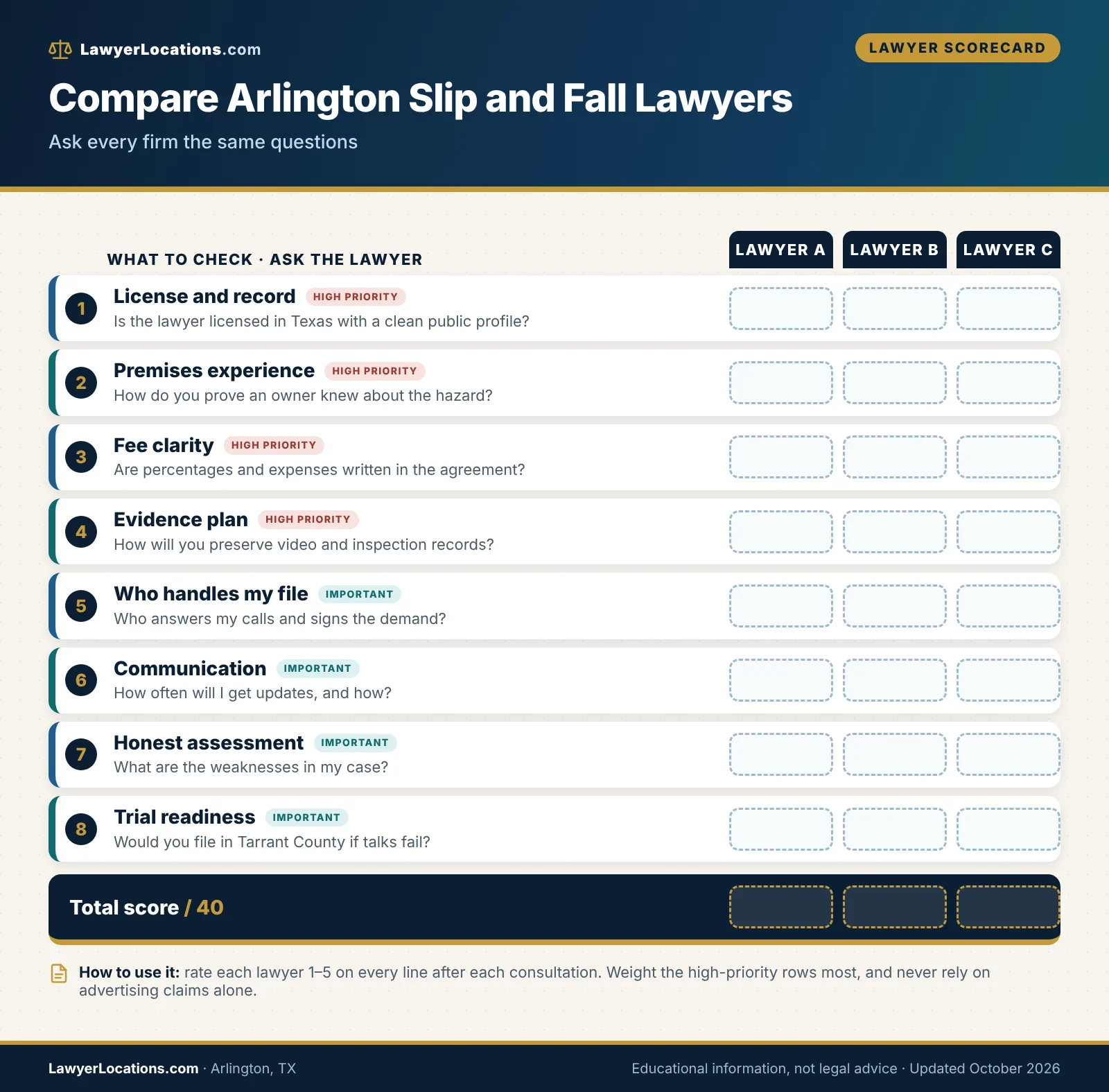
Text version of this graphic
- License and discipline record. Is the lawyer licensed in Texas, and is the public profile clean?
- Premises case experience. How often does the firm handle falls, and how does it prove notice?
- Who handles my file. Who is accountable day to day, and who communicates with me?
- Fee clarity. Is the percentage, and every case expense, in a written agreement?
- Evidence plan. How will video, inspection logs, and witnesses be preserved?
- Communication habits. How often will I get updates, and by what method?
- Honest case assessment. Did the lawyer explain weaknesses, not only strengths?
- Trial readiness. Would the firm file suit in Tarrant County if negotiation fails?
Questions to ask at the consultation
A first meeting is a two-way interview. Bring your documents, but also bring a short list of questions and write down the answers so you can compare firms afterward.
Questions about the case
Ask what the lawyer sees as the strongest and weakest parts of your claim, and what evidence would change that view. Ask what the filing deadline is in your case, whether any government entity is involved, and what the first three steps will be. A lawyer who explains your weaknesses plainly is giving you better information than one who says everything looks great.
Ask also whether the lawyer expects to send a preservation request to the property owner, and how soon. That letter, discussed later, can be time-sensitive if the owner keeps video for only a short period.
Questions about communication and decisions
Ask who has authority to settle, how settlement offers are communicated to you, and whether you will be consulted before any offer is accepted or rejected. Ask how often you will hear from the firm without having to call, and what happens if you disagree with the lawyer’s advice.
Ask what the firm needs from you: authorizations for medical records, work records, and photographs, and the time frame for providing them.
| Topic | What to ask | What a clear answer sounds like |
|---|---|---|
| Licensing | Are you licensed in Texas, and may I read your State Bar profile? | A direct yes, with the bar number or profile available. |
| Experience | How do you prove that a store or owner knew about a hazard? | Specifics about video, logs, witnesses, and timing, not general reassurance. |
| Staffing | Who will manage my file and answer my calls? | A named person and a realistic response window. |
| Fees | What percentage applies before suit, after suit, and at trial? | Percentages stated in a written agreement, with no surprises. |
| Expenses | Which costs are deducted, and before or after the fee is calculated? | A written list of expense types and the order of deduction. |
| Strategy | What would you do if the insurer denies the claim? | A description of next steps, including filing suit if needed. |
| Honesty | What are the weaknesses in my case? | A balanced answer that includes risks and uncertainty. |
Red flags when choosing a lawyer
Most lawyers deal with injured clients ethically, but injury work attracts aggressive marketing. A few warning signs are worth knowing before you sign.
Promises, pressure, and unclear fees
- Promising a specific result or a specific dollar amount before reviewing your records.
- Pressuring you to sign during the first call or implying that you must decide today.
- Declining to put the fee percentage and the expense terms in writing.
- Asking you to sign blank forms, or to agree to settle without explaining the offer.
- Discouraging you from asking about the State Bar profile or the lawyer who will handle your file.
Texas Disciplinary Rule 1.04(a) says a fee is unconscionable if a competent lawyer could not form a reasonable belief that it is reasonable, and the rule’s commentary points to overreaching and failure to explain at the outset how the fee will be calculated as warning signs. Those are the same things a careful client watches for.
Referral services, advertising, and unsolicited contact
A lawyer referral service matches you with a participating lawyer; it is not a recommendation of quality, and some charge fees. Online lead generators may collect your details and sell them, so read what you agree to when you submit a form. If someone contacts you uninvited right after a fall, treat it with caution and verify who they are.
Our guide to whether you need a lawyer after a car accident offers a similar decision framework for deciding when professional help is worth the cost, and much of it carries over to falls.
- The fall caused treatment beyond a single urgent-care visit.
- Responsibility is disputed or shared among several parties.
- A government entity or a large business insurer is involved.
- The property owner may delete video or repair the hazard soon.
- Your injuries were minor and your bills are very small.
- You can handle a straightforward claim directly with the insurer.
- The fee terms are vague or only given verbally.
- You feel rushed into signing before you have compared options.
Fees, Case Expenses, Deadlines and Decision Points
Most slip and fall lawyers in Texas work on a contingent fee, meaning the fee is a percentage of any recovery and is not billed hourly while the case is pending. The percentage, the expenses, and what you net after liens are three separate numbers, and you should understand all three before signing.
This guide does not publish fee averages, because no reliable official statistic exists and percentages vary by firm and case stage. Instead, it shows you what the written agreement must contain and how to compare offers.
Contingent fee agreements in Texas
A contingent fee is common in injury work because many injured people cannot pay hourly rates, but it only protects you if the terms are clear. Texas ethics rules require the terms to be written down.
What Rule 1.04(d) requires
Under Texas Disciplinary Rule of Professional Conduct 1.04(d), a contingent fee agreement must be in writing and must state how the fee will be determined. If the percentage differs for settlement, trial, or appeal, each percentage has to be stated. The agreement must also list the expenses to be deducted from the recovery and say whether they are deducted before or after the fee is calculated.
At the end of the matter, the lawyer must give you a written statement of the outcome and, if there is a recovery, how the remittance to you was calculated. Keep that statement; it is your record of how the money was divided.
Before-suit and after-suit percentages
Many fee agreements use a lower percentage if the case resolves before a lawsuit is filed and a higher one after filing, with another step at trial or appeal. Those tiers are common but not universal, and the dollars involved can differ greatly depending on when your case resolves.
Ask the lawyer to walk you through a sample calculation using round numbers, so you understand what a settlement of a given size would leave you after fees and expenses. If the lawyer refuses to do that, treat it as a signal. For a general overview of how fee structures work in other practice areas, our guide to wrongful death lawyer fees and case expenses shows the same cost categories families are asked about.
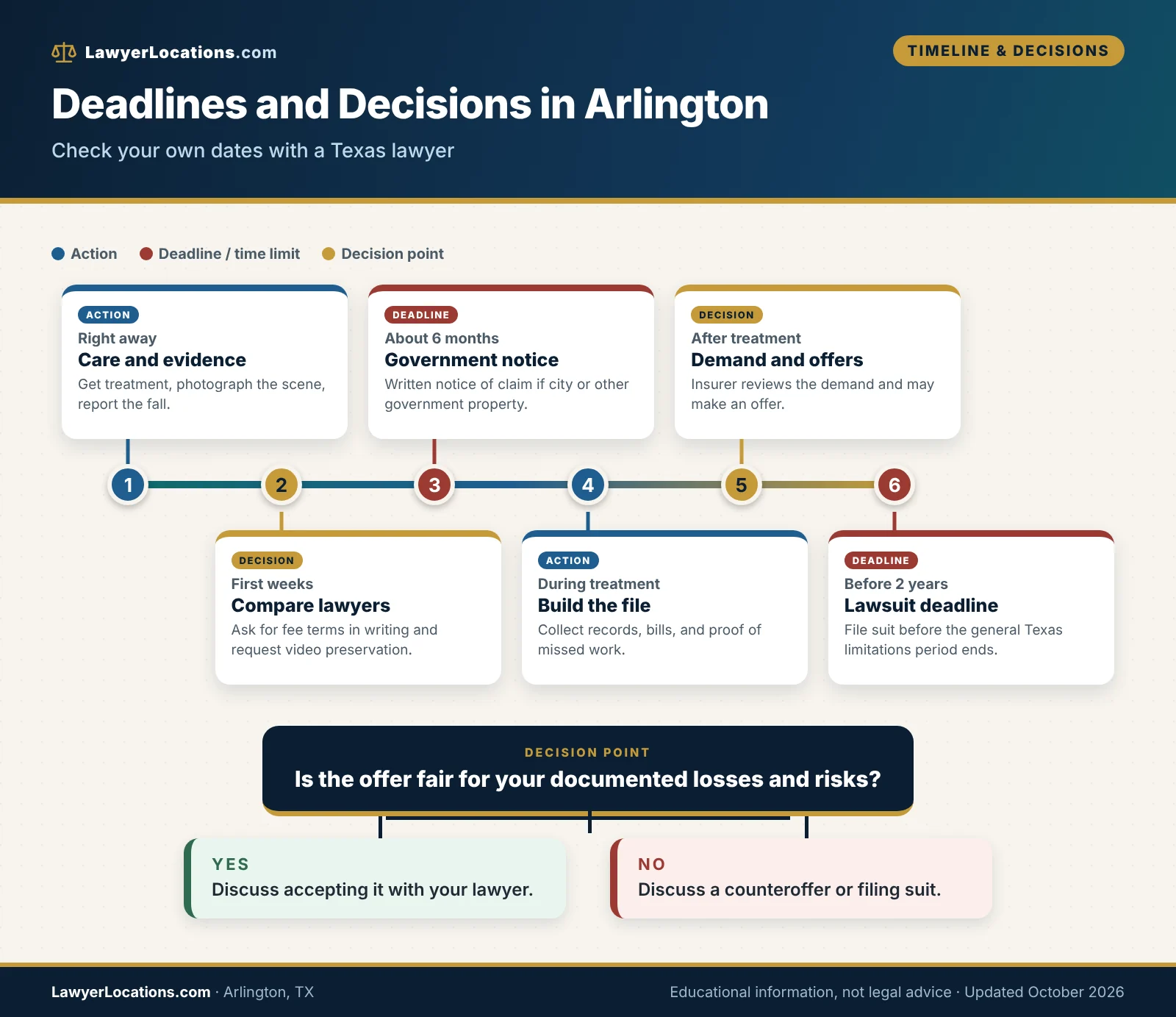
Text version of this graphic
| When | What happens | Type |
|---|---|---|
| Right away | Get care, photograph the scene, report the fall, and write down witness names. | Action |
| First weeks | Request that video and inspection records be preserved; compare lawyers. | Decision |
| Within about six months (government property) | Written notice of claim to the City of Arlington or other government unit, or the shorter or longer charter period if it applies. | Deadline |
| Treatment period | Complete treatment and gather records and bills. | Action |
| Demand and negotiation | Insurer reviews the demand; settlement discussions follow. | Decision |
| Before two years | Lawsuit must be filed under Tex. Civ. Prac. & Rem. Code § 16.003 if the claim has not resolved. | Deadline |
Decision point: Is the settlement offer fair compared with your documented losses and the risks of litigation? If yes, discuss accepting it with your lawyer; if no, discuss a counteroffer or filing suit.
Case expenses, liens, and what you take home
Fees are only one deduction from a settlement. Case expenses and reimbursement claims from health plans and providers also come out, and they can change your net recovery significantly.
Expenses of pursuing the claim
Case expenses are the out-of-pocket costs of building the claim, such as medical record fees, filing and service costs, deposition transcripts, expert opinions, and mediation fees. Some firms advance these costs and recover them from the settlement; others pass them through as they occur. The written agreement should say which approach applies and what happens to expenses if there is no recovery.
Ask how often you will receive an itemized expense report, and whether you must approve costs above a certain amount. Rule 1.04(d)’s requirement that the agreement state the deducted expenses is the hook for that conversation.
Health plan reimbursement and provider liens
If a health plan or other payer covered your treatment, it may assert a right to be reimbursed out of your settlement, and some medical providers may assert their own claims for unpaid charges. These amounts are negotiated or resolved before the lawyer disburses the remainder, and the process affects what reaches you.
Because § 41.0105 ties recoverable medical expenses to what was actually paid or incurred, the way bills were handled can affect both your claim value and the reimbursement claims. Our guide to who pays medical bills after an accident explains how payers, providers, and reimbursement claims interact.
| Item | Who it is paid to | What to ask your lawyer |
|---|---|---|
| Attorney fee | The law firm | What percentage applies at each stage, and is it written? |
| Case expenses | Vendors, courts, record providers, experts | Which are advanced, and are they deducted before or after the fee? |
| Health plan or provider reimbursement | Payers and providers with a legal claim | Who negotiates them and can they be reduced? |
| Unpaid medical balances | Treating providers | Will balances be addressed before disbursement? |
| Net to you | You | Can I see a written closing statement before I sign a release? |
Deadlines and decision points
Deadlines and decisions are where a claim is most often lost or compromised. This section pulls the key points into one place so you can check them against your own dates.
The deadlines that matter most
The general lawsuit deadline is two years from the fall (§ 16.003). If a government entity is involved, the notice period of about six months under § 101.101, or a city charter’s period, comes first. Also keep in mind any deadline contained in a contract, such as a ticket or a lease, and ask your lawyer to review those documents.
The safest practice is to calendar the earliest possible date and work backward. Your lawyer should tell you in writing which dates apply.
When to accept, negotiate, or sue
Settlement offers usually arrive before your treatment ends or soon after. Accepting an offer ends the claim, and you generally cannot reopen it if new symptoms appear. Ask your lawyer how your treatment status, future care needs, and outstanding bills affect the timing of a response.
Questions that help structure the decision include whether the offer covers documented medical costs and lost income, what reimbursement claims must be paid from it, and what the realistic risks are if the case proceeds. A lawyer’s job is to explain; the decision belongs to you.
Ask for the fee agreement and any release or settlement documents a day before you are expected to sign, so you can read them without pressure. A reasonable lawyer will give you time.
Evidence, Mistakes to Avoid, Next Steps and Common Questions
The things that most often help a slip and fall claim are small and practical: a photo, a witness name, a prompt doctor’s visit, and a written request to keep video. The mistakes that most often hurt it are equally ordinary, such as a recorded statement or a social media post.
This final section turns the guide into a short action plan and answers questions people ask before they call a lawyer.
Evidence and documents to gather
Evidence in a fall case tends to disappear quickly. Hazards get cleaned up, video gets overwritten, and memories fade, so gather what you can early.
At the scene and in the first days
Take wide and close-up photos of the hazard and the surrounding area, including lighting, signs, and floor conditions. Photograph your injuries and the shoes you wore, and keep the shoes unwashed. Note the date, time, and exact location, and get names and contact details for any witness or employee involved.
If a manager prepares an incident report, ask for the name of the person who prepared it and ask for a copy, understanding that the business may decline. Do not sign anything beyond a basic acknowledgment without understanding it.
Records that build the claim over time
Keep every medical bill, explanation of benefits, prescription receipt, and appointment record, and keep a simple diary of symptoms and limits on daily activities. Gather pay stubs or an employer letter if you missed work. Save communications with the property owner or insurer, and write down the date and substance of any phone call.
A lawyer will request your records formally, but having your own organized file makes the first consultation more productive and may help the lawyer evaluate the case faster.
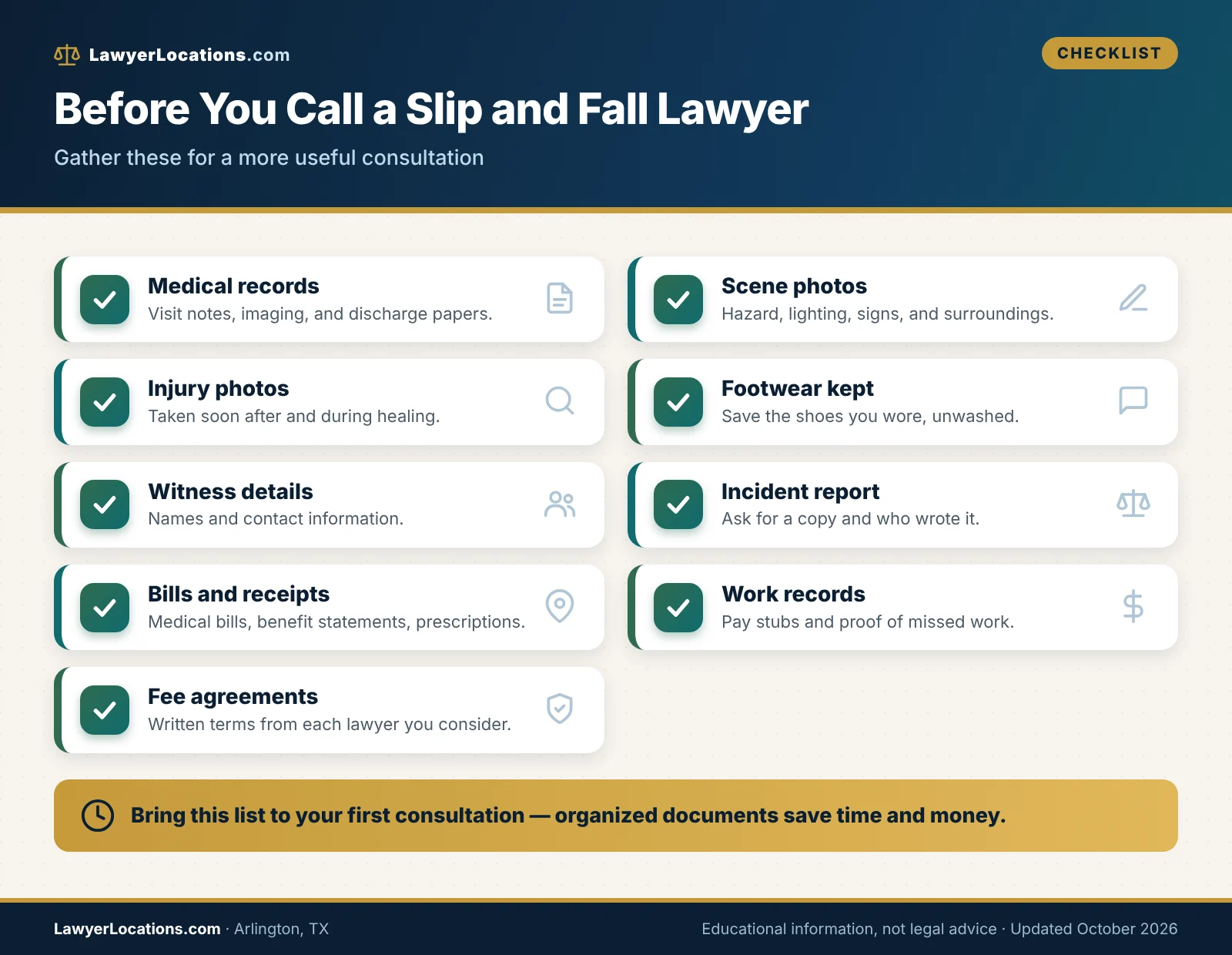
Text version of this graphic
- Medical care records. Visit notes, imaging, and discharge papers after the fall.
- Scene photos. The hazard, lighting, signs, and surrounding area.
- Injury photos. Taken soon after the fall and as healing continues.
- Footwear. Keep the shoes you wore, unwashed.
- Witness details. Names and contact information for anyone who saw the fall.
- Incident report copy. Request it and note who prepared it.
- Bills and receipts. Medical bills, explanations of benefits, and prescription receipts.
- Work records. Pay stubs and proof of missed work.
- Fee agreement drafts. Written terms from every lawyer you consider.
Texas courts treat the loss of evidence seriously but narrowly. In Brookshire Bros. v. Aldridge (Tex. 2014), the Texas Supreme Court held that a jury instruction presuming lost video would have hurt the store is available only in limited situations, such as intentional destruction to conceal evidence, and that a duty to preserve arises when a party knows or should know a claim is likely. Do not count on a court to cure missing video later; ask a lawyer to send a preservation request early.
Mistakes that can weaken a claim
Most mistakes are understandable and avoidable. Knowing them in advance makes it easier to protect your position without turning every conversation into a legal contest.
Dealing with insurers and property owners
- Giving a recorded statement to the owner’s insurer before you understand the process.
- Guessing about fault, speed, or what you were doing when you fell.
- Accepting a quick settlement before the full extent of the injury is known.
- Signing a release or medical authorization that is broader than needed.
It is fine to be polite and to give basic facts, such as your name and that you were hurt. If an adjuster calls and you are unsure what to say, you can say you will respond after getting advice.
Delay, gaps in treatment, and social media
Waiting weeks to see a doctor, or stopping treatment without explanation, gives an insurer room to argue your injuries were not serious or not caused by the fall. Posts showing strenuous activity, vacations, or sports can be used to question your reported limits, even when the context is innocent.
Consider adjusting privacy settings and avoiding posts about the fall, your injuries, or your activities until the claim is resolved. Do not delete existing content, because deleting may create problems of its own; ask your lawyer.
Next steps and short answers to common questions
If you were hurt in a fall, you do not need to have every answer before you make a call. A sensible first week looks like the plan below, followed by the questions people most often ask.
A simple first-week plan
- Treat the injury. Follow your provider’s instructions and keep every record.
- Write down the facts. Date, time, location, who you spoke with, and what you saw.
- Identify who controls the property. If it is government property, note the entity and look up its notice process immediately.
- Request preservation of video and records. A lawyer can send a formal letter.
- Compare two or three lawyers. Use the worksheet above and ask for fee terms in writing.
Ready to compare your options?
Start with a clear picture of your dates, your documents, and your questions, then speak with more than one Texas-licensed lawyer before you sign. If a nearby city is closer to where the fall happened or where you work, our guides for Fort Worth and Houston slip and fall cases show how the same Texas rules play out in other courts.
Answers to common questions about falls, deadlines, and lawyers
How long do I have to file a slip and fall lawsuit in Texas?
The general deadline is two years from the date the cause of action accrues, under Tex. Civ. Prac. & Rem. Code § 16.003. For a fall, that is usually the date you fell. Claims against governmental units have a separate, shorter notice requirement, so confirm both with a lawyer.
What if I fell on City of Arlington property?
You will likely need to give the city written notice of your claim, generally within six months under § 101.101 or within a period set by the city’s charter. The City Secretary’s page describes an online Notice of Claim form and an in-person option at 101 West Abram Street. Damage caps and a narrower duty also apply to claims against governments.
Can I still recover if I was partly at fault?
Possibly. Under § 33.001, a claimant cannot recover if his or her percentage of responsibility is greater than 50 percent. At 50 percent or less, recovery is generally reduced by your share.
What if the hazard was obvious?
An open and obvious danger can limit the owner’s duty to warn, as the Texas Supreme Court explained in Austin v. Kroger Texas, L.P. There are exceptions, and the facts matter, including lighting, distractions, and whether you had a practical alternative route.
Do I have to prove the owner knew about the spill or defect?
Generally yes, either actual knowledge or constructive knowledge, meaning the hazard existed long enough that a reasonable inspection would have found it. Evidence of how long it was there is often central.
Where would a lawsuit about an Arlington fall be filed?
Ordinarily in Tarrant County. Larger injury suits are generally filed in a civil district court, with records kept by the Tarrant County District Clerk at 100 N. Calhoun St., Fort Worth. Smaller claims of up to $20,000 can be brought in a justice court small claims case.
How do slip and fall lawyers get paid?
Usually through a contingent fee: a percentage of any recovery. Texas Rule 1.04(d) requires a contingent fee agreement to be in writing, state how the fee is determined, state each percentage if it varies, and list deducted expenses and whether they come out before or after the fee.
Will I owe money if I lose?
That depends on your written agreement. Ask specifically whether case expenses are your responsibility if there is no recovery, and get the answer in the agreement.
Should I talk to the other side’s insurer?
You can give basic facts, but think carefully before giving a recorded statement or accepting an early offer. Speaking with a lawyer first is a reasonable choice.
What does the District Clerk’s court document lookup do?
The Tarrant County District Clerk offers an online lookup for court documents. It is a way to find filings in existing cases, not a way to learn about your claim before a suit is filed.
Is there free help if I cannot afford a lawyer?
The Tarrant County Law Library lists Legal Aid of NorthWest Texas and bar association programs, including a volunteer LegalLine, but injury claims may not fit every program’s priorities. Many private injury lawyers work on contingency instead.
Are medical bills reduced in a Texas injury claim?
Recovery of medical expenses is limited to the amount actually paid or incurred under § 41.0105, so discounted amounts a health plan paid can matter more than the original charge.
Sources & References
Show all 16 sources
- Tex. Civ. Prac. & Rem. Code § 16.003 (limitations for personal injury and death) — Public.Law (Texas statutes) — texas.public.law — accessed October 2026
- Tex. Civ. Prac. & Rem. Code § 33.001 (proportionate responsibility bar) — Public.Law (Texas statutes) — texas.public.law — accessed October 2026
- Tex. Civ. Prac. & Rem. Code § 41.0105 (recovery of medical expenses) — Public.Law (Texas statutes) — texas.public.law — accessed October 2026
- Tex. Civ. Prac. & Rem. Code § 18.001 (affidavit concerning cost and necessity of services) — Public.Law (Texas statutes) — texas.public.law — accessed October 2026
- Tex. Civ. Prac. & Rem. Code § 101.101 (notice of claim against governmental unit) — Public.Law (Texas statutes) — texas.public.law — accessed October 2026
- Tex. Civ. Prac. & Rem. Code § 101.022 (duty owed: premises and special defects) — Public.Law (Texas statutes) — texas.public.law — accessed October 2026
- Tex. Civ. Prac. & Rem. Code § 101.023 (liability limited) — Public.Law (Texas statutes) — texas.public.law — accessed October 2026
- Texas Disciplinary Rules of Professional Conduct, Rule 1.04 (Fees) — University of Houston Law Center ethics library — law.uh.edu — accessed October 2026
- Austin v. Kroger Texas, L.P., No. 14-0216 (Tex. June 12, 2015), case summary — McCathern PLLC — mccathernlaw.com — accessed October 2026
- Brookshire Grocery Co. v. Taylor, 102 S.W.3d 816 (Tex. App.—Texarkana 2003) (discussing Keetch, Corbin, and Reece) — vLex — case-law.vlex.com — accessed October 2026
- Brookshire Bros., Ltd. v. Aldridge (Tex. 2014), case analysis — Hunton Andrews Kurth — hunton.com — accessed October 2026
- Claims Against the City — City of Arlington City Secretary — arlingtontx.gov — accessed October 2026
- District Clerk (civil and tax division, address, hours, document lookup) — Tarrant County — tarrantcountytx.gov — accessed October 2026
- 348th District Court location — Tarrant County — tarrantcountytx.gov — accessed October 2026
- Small Claims Case (Justice Court 5) — Tarrant County — tarrantcountytx.gov — accessed October 2026
- Free/Low Cost Legal Assistance — Tarrant County Law Library — tarrantcountytx.gov — accessed October 2026
General information only. This article is provided for general educational purposes and is not legal advice. Reading it does not create an attorney-client relationship with LawyerLocations.com or any lawyer, and LawyerLocations.com is not a law firm. Laws, court rules, fees, and agency procedures change and depend on your facts; consult a lawyer licensed in Texas about your situation, and verify deadlines with the court or agency involved.
Legal Disclaimer and Limitation of Liability
Informational and illustrative purposes only. This article was prepared by LawyerLocations.com solely on the basis of the information available to us at the time of writing. It is an illustrative, general overview. It is not a complete or authoritative statement of the law, and it has not been reviewed by a lawyer licensed in your state or county.
Not legal advice. Nothing in this article is legal, financial, tax or immigration advice, and reading it does not create an attorney-client relationship between you and LawyerLocations.com or any author, lawyer or firm mentioned. Laws, court rules, fees, filing deadlines and agency procedures differ by state, county and court, and they change often. Some details here may be simplified, incomplete or out of date, and time limits for legal claims can be short.
No warranty. We make no representation or warranty, express or implied, about the accuracy, completeness, timeliness or suitability of this content for your situation. Please do not rely on it to make, delay or skip any legal decision. Check the facts against official sources and speak with a licensed attorney in the relevant jurisdiction before you act.
Limitation of liability. To the fullest extent permitted by law, LawyerLocations.com and its owners, authors and contributors disclaim all liability for any loss, damage, cost or other consequence arising from the use of, or reliance on, this article, including any content on third-party websites we link to. Mentioning a lawyer, firm, organization or service is not an endorsement and is not a promise of any result. If you are in immediate danger, contact your local emergency number.