Anyone searching for a “wills and trusts lawyer colorado springs co” is usually weighing three things: what Colorado law requires, what the work will cost, and how to tell one lawyer from another. In Colorado, wills fall under the Colorado Probate Code, C.R.S. Title 15, Article 11 and trusts under the Colorado Uniform Trust Code, C.R.S. Title 15, Article 5. A will needs a signed writing plus two witnesses or a notary acknowledgment, and probate for a Colorado Springs resident runs through the El Paso County district court on South Tejon Street.
This guide explains those rules, the local courts and free help available around Colorado Springs, how estate-planning lawyers charge under Colorado’s fee rule, and how to compare lawyers before you sign an engagement agreement. It is general information, not advice about your situation.
What a Wills and Trusts Lawyer in Colorado Springs Does, From First Call to Signing
A wills and trusts lawyer turns your wishes about property, children and health decisions into documents that Colorado courts and financial institutions will accept. The work is mostly planning and drafting, not courtroom work. Most clients never see a judge, and the point of good planning is often to keep it that way.
The sections below follow the same order most engagements follow: what happens first, which documents come up, and where Colorado Springs and El Paso County enter the picture. If you only need to know who to call, jump to the comparison section.
The usual path from first call to signed documents
Estate-planning engagements follow a fairly steady rhythm even though every family’s facts differ. Knowing the rhythm helps you spot a firm that skips steps or rushes you to sign.
Intake, conflict check and scope
The first contact is usually a short call or form that tells the firm who you are, whether you are married, whether you have children, and roughly what you own. Before anything substantive, a firm should run a conflict check, meaning a search to confirm it does not already represent someone whose interests clash with yours, such as a relative who would inherit under your plan.
Fact-gathering and drafting
Next comes a deeper conversation about family structure, assets, debts and goals. The lawyer will ask who should manage your affairs if you cannot, who should raise minor children, and what should happen if a beneficiary dies before you do. These are decisions, not legal technicalities, and the better prepared you are, the less drafting time you pay for.
Signing, funding and storage
The signing meeting is where Colorado’s formalities matter. A will needs witnesses or a notary acknowledgment, and many firms arrange for staff to serve as witnesses and notary so the paperwork is handled the same day. A revocable trust also needs to be funded, which means retitling assets or naming the trust on accounts and deeds so that the document actually controls something.
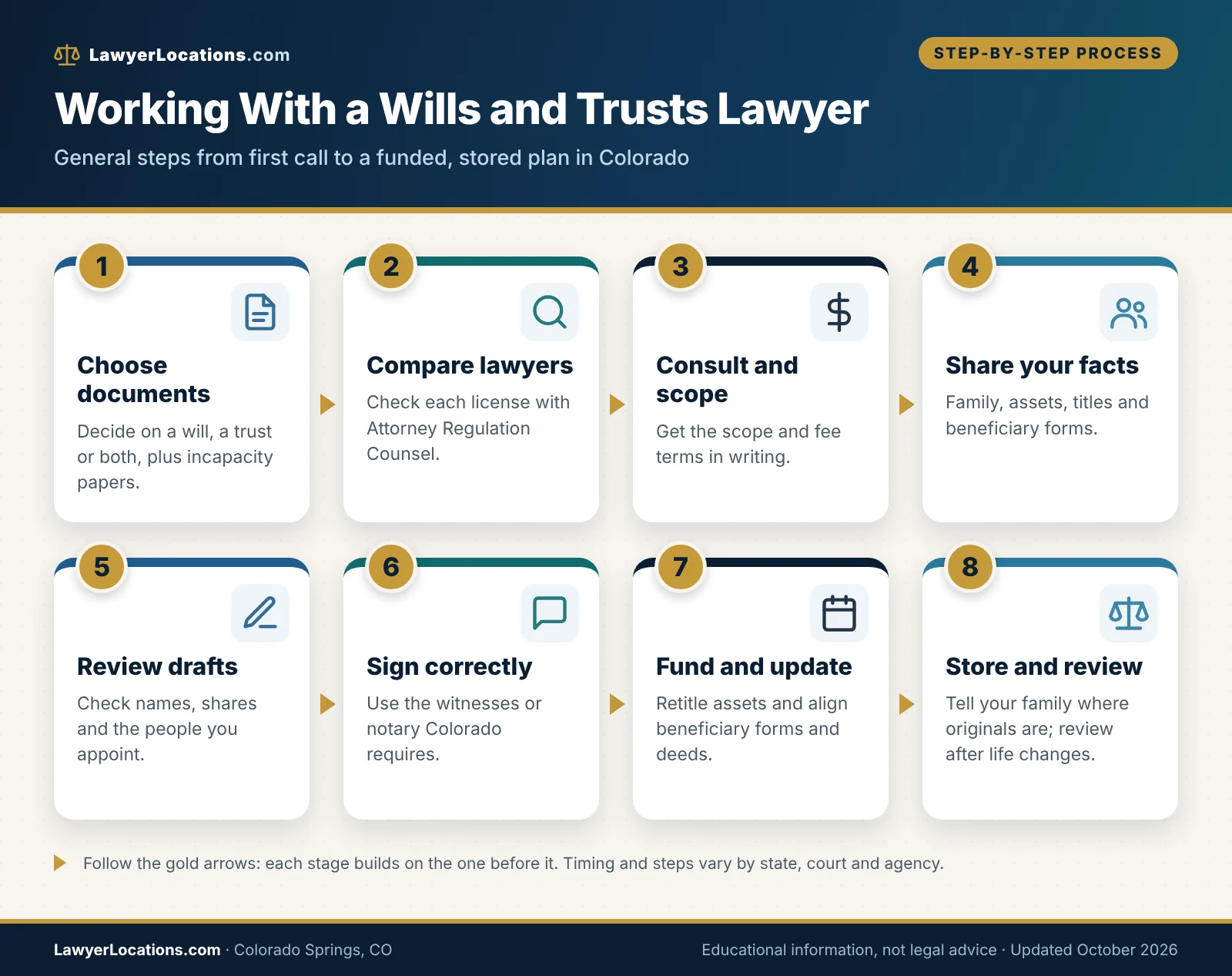
Text version of this graphic
- Choose what you need: a will, a trust, or both, plus incapacity documents.
- Compare lawyers and check each license with the Office of Attorney Regulation Counsel.
- Hold a consultation and get the scope and fee terms in writing.
- Share family, asset and beneficiary details.
- Review the drafts for names, shares and fiduciary choices.
- Sign with the witnesses or notary Colorado requires.
- Fund the trust and update beneficiary designations and deeds.
- Store the originals and schedule a review after major life changes.
Will, trust or both: how lawyers frame the choice
The question of whether you need a will, a trust or both has no universal answer, and anyone who gives you one before asking about your property is selling something. Lawyers usually weigh the same handful of factors: how much real estate you own, how you hold title, whether you want privacy, and how complicated your family is.
When a will carries most of the load
A will names who inherits, who serves as personal representative (Colorado’s term for the executor), and who becomes guardian of minor children. For many households with modest assets and clear beneficiaries, a will, combined with beneficiary designations on retirement accounts and insurance, covers most needs.
When a revocable trust may earn its keep
A revocable living trust is a written arrangement in which you, as the creator, transfer assets to a trustee (often yourself while you are alive) to manage for the benefit of named beneficiaries. Property that is properly titled in the trust can generally be distributed by the successor trustee without opening a probate case, and the trust can provide for management if you become incapacitated.
The cost is up-front work and ongoing discipline. A trust that is signed but never funded does little, a point we return to in the mistakes section. For a deeper national look at when trusts make sense, see our guide on what to know before hiring a living trust lawyer.
How the options compare side by side
The table below summarizes the tools Colorado Springs clients most often discuss. It is a framework for the conversation with a lawyer, not a recommendation for any particular household.
| Tool | What it does | Goes through probate? | Key Colorado authority |
|---|---|---|---|
| Will | Names beneficiaries, personal representative and guardians; takes effect only at death | Usually yes, unless the estate qualifies for the small-estate affidavit | C.R.S. 15-11-501 to 15-11-516 |
| Revocable trust | Holds titled assets, names successor trustee, can manage property during incapacity | Trust assets generally do not, if the trust was funded | Colorado Uniform Trust Code, C.R.S. 15-5-101 and following |
| Beneficiary deed | Transfers real property at the owner’s death to a named beneficiary | The property passes outside the will if the deed is valid and recorded | C.R.S. 15-15-404 |
| Account or policy beneficiary designation | Directs retirement accounts, life insurance and payable-on-death accounts to named people | No; the designation generally controls over the will | Set by the account contract; the Judicial Branch probate instructions exclude these assets from estate totals |
Bring your most recent account statements and your deed to the first meeting. Beneficiary designations and the way you hold title often decide who inherits more than the will does, so a lawyer can only give you a useful answer after seeing them.
Documents that often travel with a will or trust
People who search for a wills and trusts lawyer often leave with more than one signed document. The related paperwork is not an upsell if it addresses real gaps, but you should understand what each piece does before paying for it.
Incapacity documents
A will does nothing while you are alive. If an illness or accident leaves you unable to manage money or make medical choices, the documents that matter are powers of attorney for finances and for health care, and any advance medical directives you want to put in writing. Most estate-planning packages include them.
Beneficiary deeds and designated beneficiary agreements
Colorado lets a property owner sign a beneficiary deed that transfers real estate at death. Under C.R.S. 15-15-404, the deed must be recorded with the clerk and recorder of the county where the property sits before the owner dies, and the statutory form describes the deed as revocable during the owner’s life. The form also warns that the deed may affect Medicaid eligibility and may not avoid probate in every case, so it deserves a conversation rather than a download.
Colorado also recognizes a designated beneficiary agreement under C.R.S. Title 15, Article 22, a notarized document that lets two unmarried adults give each other certain rights. A Colorado Bar Association pamphlet says the agreement cannot amend or revoke a will or power of attorney and that those documents control if they conflict. The pamphlet dates from 2012 and warns that the law may have changed, so ask a lawyer about current requirements.
The Colorado Springs area includes Fort Carson and the Peterson and Schriever installations served by Space Base Delta 1, and their legal offices prepare wills and powers of attorney for eligible service members and families. We cover them in the local help section, so check eligibility before paying for a document you may be able to get at no charge.
Colorado Law Behind Your Will and Trust
Colorado’s rules for wills sit in the Probate Code, C.R.S. Title 15, Article 11, and its trust rules sit in the Colorado Uniform Trust Code, C.R.S. Title 15, Article 5. These are state laws, so they apply the same way in Colorado Springs as in Denver or Grand Junction. What changes locally is the court, the staff and the practical logistics covered later in this guide. Statutory text below reflects the 2025 edition of the Colorado Revised Statutes as published online, checked as of October 2026.
Making a valid will in Colorado
A will that fails the signing rules can leave your property to the people the law picks instead of the people you picked. The formalities are not complicated, but they are strict enough that a lawyer’s supervision at signing is one of the more concrete things you pay for.
Who can make a will and how it must be signed
Under C.R.S. 15-11-501, a person who is at least 18 years old and of sound mind may make a will. Under C.R.S. 15-11-502, the will must be in writing and signed by the testator (or by another person in the testator’s presence and at the testator’s direction). It must also either be signed by at least two witnesses within a reasonable time or be acknowledged by the testator before a notary or other authorized official.
Two witnesses or a notary acknowledgment is the core Colorado rule. The statute also defines “conscious presence” to require physical proximity to the testator without requiring that the witness has a line of sight.
Self-proving affidavits, handwritten wills and electronic wills
A self-proved will carries sworn statements from the testator and the witnesses, taken before an officer authorized to administer oaths. C.R.S. 15-11-504 allows that to be done when the will is signed or at any later time, and a self-proved will can be admitted to probate without testimony from the witnesses. The practical benefit is mainly in formal court proceedings, and the will is otherwise treated like any other.
Colorado also recognizes a holographic will, one that does not meet the witness rules but is valid if the signature and material portions are in the testator’s own handwriting (15-11-502(2)). Handwritten wills are a legal gamble because they invite disputes over what the writer meant. Separately, Colorado adopted a Uniform Electronic Wills Act through House Bill 21-1004, codified beginning at C.R.S. 15-11-1301, which provides that an electronic will is a will for all purposes of Colorado law (15-11-1303). A Colorado Bar Association article on the Act notes detailed requirements for electronic signatures, remote witnessing and notarization, so do not assume an e-signature app produces a valid will.
When a defective will might still count
Under C.R.S. 15-11-503, a court may treat a defectively executed document as a valid will if the person offering it proves, by clear and convincing evidence, that the decedent intended it to be the will. The court, not a jury, decides in formal proceedings.
If anyone tells you a will is “fine” because the court can overlook signing mistakes, treat that as a warning. The statute puts the burden on your family to prove your intent, and the standard is clear and convincing evidence.
Changing, revoking and updating your documents
Life changes faster than documents do. Colorado law spells out how wills end, what divorce does automatically, and how you can park the original for safekeeping.
Revoking or replacing a will
Under C.R.S. 15-11-507, a will is revoked by a later will that revokes it expressly or by inconsistency, or by a revocatory act on the document, such as burning, tearing, canceling, obliterating or destroying it, done with the intent to revoke. A later will that makes a complete disposition of the estate is presumed to replace the earlier one.
What divorce does to your documents
Under C.R.S. 15-11-804, unless the document, a court order or a contract between the spouses says otherwise, a divorce or annulment cancels revocable gifts, powers of appointment and fiduciary nominations in favor of the former spouse and the former spouse’s relatives. Joint tenancy with survivorship converts to tenancy in common.
That statute does not reach everything. Beneficiary forms held by financial institutions follow their own rules and paperwork, so a divorce is a good moment to review every account, and our national guide to legal separation versus divorce explains why the family-law side deserves its own lawyer’s attention.
Where to keep the original
Under C.R.S. 15-11-515, a testator or the testator’s agent can file a will with any court for safe custody. The will is sealed and kept confidential, and during the testator’s lifetime it is released only to the testator or a person the testator names in a signed writing. The Colorado Judicial Branch fee list shows a deposit-of-will fee of $18, based on its January 2025 publication (see the fee table in the local procedure section).
After death, C.R.S. 15-11-516 requires a custodian of a purported will to deliver it to the probate court within ten days after the testator’s death or as soon as the custodian learns of the death. Anyone who willfully fails to do so can be liable for damages to anyone harmed, so tell the family where the original is.
How Colorado treats trusts
A trust is a legal relationship that exists only if specific elements are met. The Colorado Uniform Trust Code lays them out, and it contains a few defaults that surprise people who assume trust law works like contract law.
Creating a trust
Under C.R.S. 15-5-401, a trust can be created by transferring property to a trustee, by an owner declaring that they hold identifiable property as trustee, by exercising a power of appointment, or by a statute, judgment or court decree. Under C.R.S. 15-5-402, a trust needs a settlor with capacity who intends to create it, a definite beneficiary (unless it is a charitable, animal-care or noncharitable-purpose trust), duties for the trustee, and a trustee who is not also the sole beneficiary.
Revocable unless the document says otherwise
Under C.R.S. 15-5-602, a trust is revocable unless its terms expressly say it is irrevocable, and the default does not apply to trusts created under instruments executed before August 7, 2013. A settlor can revoke or amend by substantially complying with a method in the trust, or, if the trust names no exclusive method, by any method that shows clear and convincing evidence of intent.
Pour-over wills and what trustees owe beneficiaries
A pour-over will leaves property to the trustee of an existing trust, and C.R.S. 15-11-511 says that gift stays valid even if the trust is amendable or revocable or was changed after the will was signed. A trust that has few or no assets at signing is not invalid for that reason alone, according to the case annotation on the statute page. The pour-over will is a safety net for assets you forgot to retitle, but assets that reach the trust only through the will still go through probate first.
After the settlor dies, C.R.S. 15-5-813 requires the trustee, within 60 days of learning that a formerly revocable trust became irrevocable, to notify qualified beneficiaries of the trust’s existence, the settlor’s identity, their right to request relevant parts of the trust instrument, and their right to a trustee’s report. Trustees must also send an annual report to the beneficiaries entitled to it.
Taxes: federal and Colorado
Tax questions drive many people to a lawyer, and they are also where misinformation is thickest. The facts below come from the IRS and from Colorado legislative staff, with their dates.
Federal estate and gift tax in 2026
The IRS page on estate and gift tax, last reviewed July 23, 2026, states that the basic exclusion amount is $15,000,000 for people who die in 2026 (up from $13,990,000 for 2025 deaths) following Public Law 119-21. The same page lists the annual gift exclusion at $19,000 per recipient for 2026.
Colorado estate and inheritance tax
Colorado Legislative Council Staff report that no Colorado estate tax filing is required for people who die after December 31, 2004, and that the state has not collected any estate taxes since fiscal year 2013-14. The staff page describes a state inheritance tax created in 1927 and replaced by an estate tax in 1980, and it describes no current inheritance tax. It adds that a Colorado estate tax could be collected in future years if federal law reinstates the credit it was tied to.
The basic exclusion amount is the total value a person can leave at death, counting certain lifetime gifts, before federal estate tax applies. Anything under it is not taxed at the federal level.
How to Compare Wills and Trusts Lawyers in Colorado Springs
Compare Colorado Springs estate-planning lawyers on four things: whether their license is active, how much of their work involves wills and trusts, how clearly they explain fees in writing, and whether they communicate in a way that suits you. Avoid choosing on advertising alone, because lawyer advertising and directory placement do not measure quality, and LawyerLocations.com does not rank or recommend individual lawyers.
Verify the license and record first
The cheapest due diligence you can do takes about two minutes. Do it before the first consultation and again before you sign a fee agreement.
Look the lawyer up with Attorney Regulation Counsel
The Colorado Supreme Court’s Office of Attorney Regulation Counsel runs an Attorney/LLP Search tool that shows a lawyer’s status and disciplinary history. Its page notes that a lawyer must be “active” and in good standing to practice in Colorado, and you can search by name or by registration number.
Know who is and is not a lawyer
The same regulator lists licensed legal paraprofessionals (LLPs), whose registration numbers fall in the 600000 range. The Judicial Branch handout describes LLPs as providing limited services in certain family law matters, so ask any non-lawyer exactly what they are licensed to do before relying on them for a will or trust.
Where candidate lawyers come from
Most people start with a list of two or three names. The sources below each have limits, and understanding them helps you weigh what you see.
Bar association referral and directories
The El Paso County Bar Association’s Lawyer Referral & Information Service says it refers people to lawyers while considering their financial circumstances, language, disability, geographic convenience and the nature and complexity of the problem. Its stated purpose is to educate people about their legal rights and to improve access to affordable representation. The Colorado Bar Association’s Find-A-Lawyer tool is described on its page as a directory that asks follow-up questions and lets you filter by expertise, services and payment options.
Personal referrals and professional advisers
Friends, a financial adviser, an accountant or a bank trust officer may give you a name. That is useful, especially if the adviser works with the lawyer on coordinating tax and investment decisions. Ask whether the person receives anything for the referral. Colorado’s fee rule, Rule 1.5(e), prohibits referral fees, which is a good reason to ask a direct question and expect a straight answer.
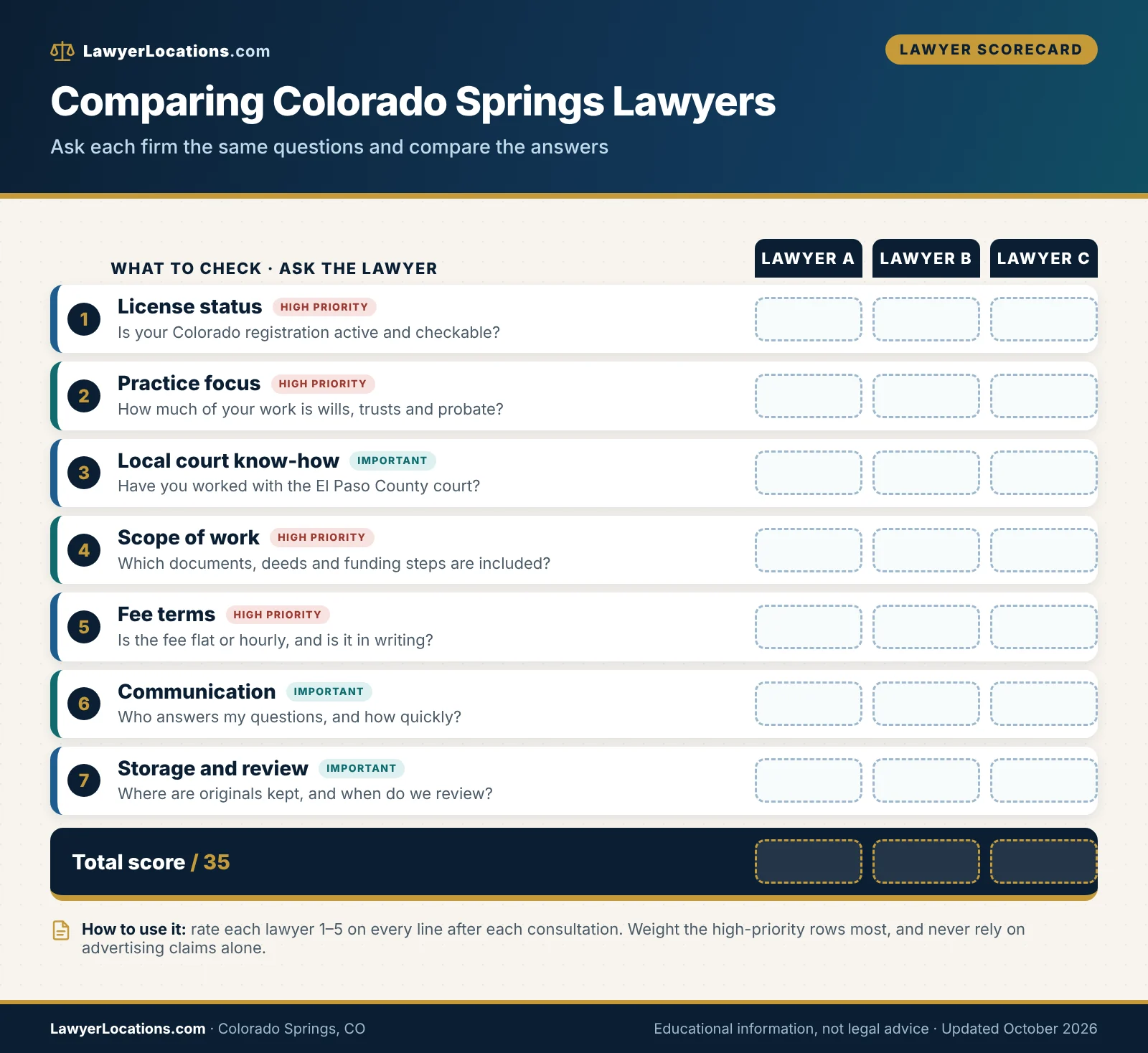
Text version of this graphic
- License and discipline: is the lawyer active on the Office of Attorney Regulation Counsel search?
- Focus: how much of the practice involves wills, trusts and probate?
- Local knowledge: has the firm worked with the El Paso County court?
- Scope: which documents, signing and funding steps are included?
- Fees: flat or hourly, what is covered, and where is the agreement in writing?
- Communication: who will answer questions and how fast?
- Storage and follow-up: where are originals kept and when will the plan be reviewed?
What to ask at the consultation
A consultation is a two-way interview. You are deciding whether to hire the lawyer, and the lawyer is deciding whether your matter is a good fit. Prepare questions in advance and compare answers across firms.
Experience and scope
Ask how much of the firm’s work involves wills, trusts and probate, and who will do the drafting. Ask whether the lawyer has worked with the El Paso County probate court and whether the firm also handles administering an estate after a death, because your family may want the same firm later.
Process and communication
Ask who your day-to-day contact will be, how long drafting usually takes, and how revisions are handled. Ask whether the firm arranges witnesses and a notary at signing and how it will confirm that the trust is funded. For couples, ask how the firm handles a conflict if you disagree about a major decision.
Fees and what is included
Ask for the fee in writing and what it covers: drafting, a signing meeting, deed preparation and recording, funding help and later updates. The scorecard table below turns these topics into questions you can ask every firm in the same way.
| Topic | Question to ask | A clear answer sounds like |
|---|---|---|
| License | May I have your Colorado registration number? | A number you can check on the Attorney Regulation Counsel search, given without hesitation |
| Focus | How much of your practice is wills, trusts and probate? | A specific description of the work, with no promises about results |
| Local court | Have you worked with the El Paso County Probate Window and court staff? | Concrete examples of how the court process affects the plan |
| Scope | Which documents, signing, deeds and funding steps are in the price? | A written list that matches the fee agreement |
| Fees | Is the fee flat or hourly, and what happens if my needs change? | Written terms that describe the services, the amount and what happens if the work ends early |
| Communication | Who will answer my questions, and what is the usual response time? | A named person and a realistic description, not a promise |
| Storage | Where will the originals be kept, and who will know? | A clear plan, including the option of court deposit or a fireproof home location |
Be careful if a firm will not put its fee terms in writing, pushes you to sign during the first meeting, or advertises itself as the number-one choice or promises a sure result. No honest lawyer can promise an outcome, and rankings in advertising are not a substitute for checking the license and asking questions.
Colorado Springs Courts, Probate Steps and Local Help
Probate cases for people who lived in Colorado Springs are handled by the district court in El Paso County, in Colorado’s Fourth Judicial District. The court is at 270 S. Tejon Street, and the Probate Window is Room W149. This section covers what the courthouse does, which steps your documents will meet after a death, and the free help that exists locally.
Where probate and trust cases are handled in Colorado Springs
Most people first visit the courthouse after a family member has died. Knowing the basics ahead of time helps you choose documents that make that visit simpler.
The El Paso County Judicial Building and the Probate Window
The state’s Judicial Legal Help Center lists the court as the El Paso Combined Court at 270 S. Tejon Street, Colorado Springs, CO 80903, phone 719-452-5000, open Monday through Friday from 7:30 a.m. to 4:30 p.m., with records and financial services open until 5:00 p.m. The Judicial Branch’s July 2026 legal assistance handout lists the Probate Window at 719-452-5003, Room W149.
Per that handout, assistance with guardianship or conservatorship matters is offered at the window on Wednesdays from 8:30 a.m. to noon, and help with estate matters is offered Wednesdays from 1:00 to 4:30 p.m. Court staff cannot fill out paperwork or give legal advice, so plan to arrive prepared.
Choosing the right county
The Judicial Branch’s instructions for probate with a will (JDF 906, revised June 8, 2026) state that a case must be filed in the Colorado county where the decedent lived or was domiciled. If the decedent lived out of state, the case may be filed in a Colorado county where the decedent owned property.
For Colorado Springs residents, that usually means El Paso County. If you have moved to Colorado Springs recently, update your documents and tell your family where the originals are kept.
E-filing and forms
The Judicial Branch operates the Colorado Courts E-Filing system for attorneys licensed in Colorado, and its page lists general-jurisdiction probate cases in district court among the case types. Self-represented people can find probate instructions and forms on the Judicial Branch self-help forms pages.
Probate steps your documents will eventually meet
Three pieces of the court process matter most for planning choices.
Opening a probate case with a will
JDF 906 sets out two ways to open: an informal application to the Registrar or a formal petition to the court. The original will must be filed. The court cannot act until 120 hours after death, and a creditor cannot file for appointment until 45 days after death. After appointment, the personal representative must send an information of appointment to heirs within 30 days, complete an estate inventory within three months, and publish a notice to creditors weekly for three consecutive weeks unless a year or more has passed since death.
The instructions list a filing fee of $229.00, with a fee-waiver option through a motion for people who cannot pay.
The small-estate affidavit
Under C.R.S. 15-12-1201, a successor can collect a decedent’s personal property by affidavit, without opening a probate case, if at least ten days have passed since death, no personal representative has been or is being appointed anywhere, and the net value of the estate does not exceed the limit for the year of death. The Judicial Branch’s guide (JDF 998) lists the limit as $88,000 for deaths in 2026 and $86,000 for 2025, and states that the process requires no court filing and no filing fee.
The affidavit covers personal property only, not real estate. If a lien on real estate needs to be transferred, the affidavit must be recorded with the county clerk and recorder along with proof of death. Different packets on the court’s site may cite different dollar figures, so use the year-of-death table in JDF 998 or ask the Probate Window.
Court fees you may see
The Judicial Branch’s List of Fees page shows the probate amounts below, stating that they reflect amounts at the time of publication in January 2025 and that they are ultimately governed by statute. The $229 opening fee also appears in JDF 906 as revised in June 2026, but the other lines have not been separately re-confirmed.
| Filing | Fee | Authority cited by the court |
|---|---|---|
| First filing for a decedent’s estate (not a small estate) | $229 | C.R.S. 13-32-102(1)(b), (7) |
| Small estate filing | $113 | C.R.S. 13-32-102(1)(a), (7) |
| Supervised administration (except contested claims) | $198 | C.R.S. 13-32-102(1)(c) |
| Petition for trust action | $229 | C.R.S. 13-32-102(1)(f), (7) |
| Deposit of will | $18 | C.R.S. 13-32-102(1)(h); 15-12-204 |
| Demand for notice | $36 | C.R.S. 13-32-102(1)(g); 15-12-204 |
Free and low-cost help in the Pikes Peak area
Not everyone needs, or can pay for, a full-service law firm. Several programs near Colorado Springs help with court paperwork, simple questions or income-based representation, but none replaces individualized advice, and the published information does not say that most of them draft wills.
Court-based help and the law library
The Colorado Springs Self-Help Center at 270 S. Tejon helps people representing themselves with paperwork and procedures, but its staff are not lawyers and cannot give legal advice. Its page does not mention probate or wills specifically, so ask what it can do for your matter.
The Law Library inside the Penrose Public Library at 20 N. Cascade lets you research state statutes and case law, according to the Judicial Branch handout. Reading the statutes cited in this guide there is a free way to check what a lawyer tells you.
Legal aid, volunteer lawyers and referral services
The handout lists Colorado Legal Services at 102 S. Tejon Street, #430, phone 719-471-0380, described as a statewide non-profit law firm whose qualified clients can receive services at no cost. It also lists the Justice Center’s Call-a-Lawyer line (Wednesdays 7:00 to 8:30 p.m., 719-473-6212, volunteer lawyers answer calls) and its Find-a-Lawyer program for income-eligible people in El Paso and Teller counties, with priority for groups such as veterans, active-duty members, first responders and seniors. Several case types, including bankruptcy, immigration and personal injury, are excluded.
The handout also lists the El Paso County Bar Association’s Lawyer Referral Service at 719-473-9700, stating that participating lawyers may charge up to $100 for an initial 30-minute consultation and standard rates, which it describes as roughly $250 to $450 per hour, on retention. Those figures are the handout’s description of that program, not a market average.
| Resource | What it offers | How to reach it |
|---|---|---|
| Probate Window, El Paso County courthouse | Estate help on Wednesday afternoons; staff cannot fill out paperwork or give legal advice | 270 S. Tejon, Room W149; 719-452-5003 |
| Colorado Springs Self-Help Center | Help for self-represented people with court paperwork and procedures; no legal advice | 270 S. Tejon, Room S101; [email protected] |
| Law Library, Penrose Public Library | Statutes, case law and appointments with the law librarian | 20 N. Cascade; 719-531-6333 |
| Colorado Legal Services | Free civil legal help for qualified low-income applicants | 102 S. Tejon St., #430; 719-471-0380 |
| Justice Center Call-a-Lawyer | Wednesday-evening phone calls with volunteer attorneys | 719-473-6212 (7:00 to 8:30 p.m.) |
| El Paso County Bar Lawyer Referral | Referrals to participating lawyers; initial consultation may cost up to $100 per the handout | 719-473-9700; elpasocountybar.org |
Help for military families near Fort Carson and Peterson
Eligible service members, family members and some retirees can use military legal assistance offices for wills and powers of attorney, which can change how much outside planning work you need. Each office sets its own eligibility and scheduling rules, so confirm before you go.
Fort Carson Legal Assistance Office
The Fort Carson Staff Judge Advocate page, last modified September 29, 2026, says powers of attorney and notary services are walk-in, while wills and estate planning require an appointment and the client should fill out the will worksheet beforehand. Eligible clients include active component members and their family members, reserve component members on active duty for more than 29 days and their family members, and certain retirees, and the page notes that gray-card retired reservists are not eligible.
The page lists 719-524-4955 and 719-526-4788 and says appointments can be booked online. The office closes on training and federal holidays, so confirm hours before your visit.
Space Base Delta 1 legal office at Peterson and Schriever
The Peterson Space Force Base Judge Advocate page lists wills, living wills and general, special and medical powers of attorney, with appointments at Peterson or Schriever. It describes completing a will or power of attorney worksheet online, saving the ticket number, calling to schedule, and then meeting an attorney to finalize and sign, with wills and medical powers of attorney requiring an attorney appointment. The page is undated and refers to pandemic-era procedures, so call the office to confirm current rules.
If you qualify for military legal assistance, start there for a basic will and powers of attorney. Then bring those documents to a civilian lawyer only for what they don’t cover, such as a trust, a business succession plan or a complicated blended-family arrangement.
Fees, Costs and Timing
Colorado does not set a price list for estate-planning work, and LawyerLocations.com does not publish “average” fees because no verified official source reports one. What Colorado does regulate is how a fee is explained and handled: under Colorado Rule of Professional Conduct 1.5, a fee must be reasonable, and the lawyer must communicate the fee basis, the expenses you will bear and the scope of the work in writing.
How estate-planning lawyers charge
Estate planning is commonly priced as a flat fee for a defined package or as an hourly rate, and some firms blend the two. Rule 1.5 treats each differently, and knowing the difference helps you read an engagement letter.
Flat fees
A flat fee is a fixed amount for specified services regardless of the time spent. Under Rule 1.5(h) as shown in the version dated February 2026, the written terms must describe the services, the amount and payment timing, any milestones for earning portions of the fee, and how the fee is computed if the representation ends early.
Hourly fees and retainers
Under hourly billing you pay for time spent, often against an advance deposit. Rule 1.5(f) provides that advance payments of unearned fees belong to the client and must be held in the lawyer’s trust account until earned. Rule 1.5(g) prohibits nonrefundable fees and retainers, and Comment [18] describes calling any fee nonrefundable as unethical.
Reasonableness and what it covers
Rule 1.5(a) lists factors for judging whether a fee is reasonable, including the time and skill required, the fees customarily charged locally, the amount involved, the experience and reputation of the lawyer and whether the fee is fixed or contingent. Contingent fees, which depend on winning a recovery, are not how estate planning is normally priced. For a comparison with another fee-heavy field, our guide to DUI lawyer costs shows how flat and hourly structures work in criminal defense.
If a lawyer asks you to sign a fee agreement that calls the fee nonrefundable, ask for the clause to be explained. Rule 1.5(g) prohibits nonrefundable fees and retainers, and fees remain subject to refund if they are unearned or excessive.
Other costs beyond the lawyer’s bill
The fee agreement is rarely the whole cost of a plan or an estate. Knowing the other line items makes comparisons fairer.
Recording, notary and deposit costs
A beneficiary deed must be recorded with the county clerk and recorder, which charges its own recording fees. Depositing a will with the court carries the $18 deposit fee shown on the Judicial Branch fee list. Ask whether the lawyer’s quote includes recording and notary costs or bills them separately.
Costs after a death
Opening a probate case costs $229 per the Judicial Branch instructions, plus charges for certified copies and the creditor-notice publication that the process requires. A small-estate affidavit under JDF 998 requires no court filing and no filing fee, although recording the affidavit with the county clerk if a lien on real estate must be transferred involves recording costs. Lawyer, personal representative and trustee compensation are separate and depend on the documents and the arrangement.
Timing and decision points
Planning works best when it is done before a crisis, and some deadlines apply only after a death. The sequence below shows how those clocks fit together.
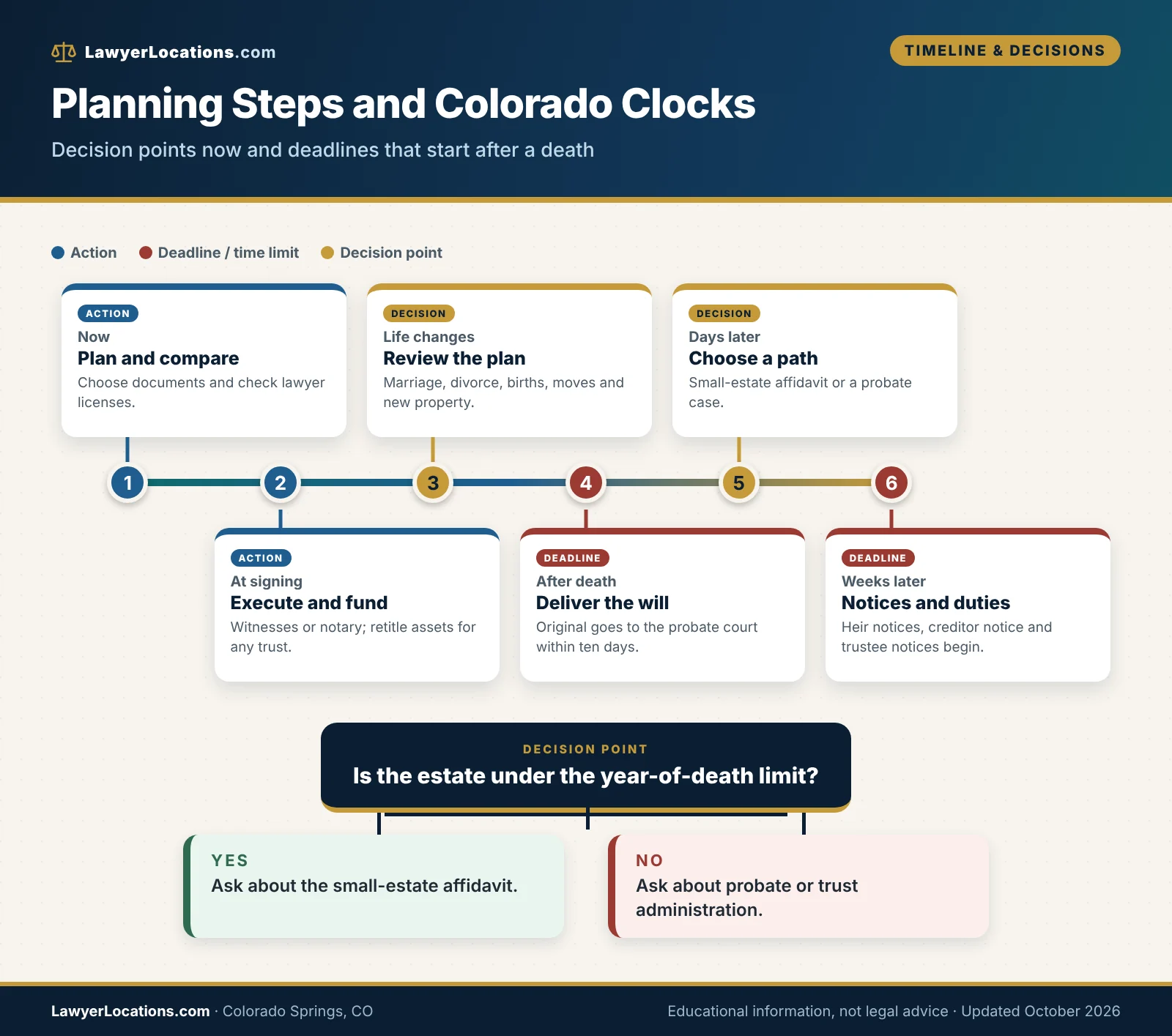
Text version of this graphic
- Now: decide on documents, compare lawyers and check licenses.
- Signing: execute with two witnesses or a notary and fund any trust.
- After life changes: review the plan, including beneficiary forms.
- After a death, first days: locate the original will and deliver it to the court within ten days.
- Small estate path: an affidavit can be used after ten days if the estate is under the limit.
- Probate path: the court cannot act before 120 hours; creditors cannot file before 45 days.
- Decision: is the estate small enough for an affidavit, or does it need probate or trust administration?
Now versus later
If you have minor children, own a home, or care for someone who depends on you, you have reasons to plan now. If your situation is simple and your beneficiary designations are current, a short consultation to confirm that may be enough. Waiting for a perfect time is the usual reason plans never get written.
Events that should trigger a review
Marriage, divorce, a birth or adoption, a move to or from Colorado, buying or selling a home, the death of a named beneficiary or fiduciary, and changes in tax law are all reasons to revisit your documents. The 2026 change in the federal exclusion described earlier is one example. Under C.R.S. 15-11-804, divorce also changes some provisions automatically, which may or may not be what you want.
After a death: the clocks that start running
Several time limits start from the date of death. The will must be delivered to the court within ten days under C.R.S. 15-11-516, the small-estate affidavit can be used after ten days, the court cannot act on an application before 120 hours, creditors cannot file for appointment until 45 days, and a trustee has 60 days to notify qualified beneficiaries once a trust becomes irrevocable. Families who understand these dates make fewer panicked calls.
If you are holding someone else’s original will, deliver it to the probate court within ten days of learning of the death. C.R.S. 15-11-516 makes willful failure to deliver a will grounds for damages.
Preparing for the Consultation and Avoiding Mistakes
Come to the first meeting with documents and decisions rather than with a blank page. A prepared client usually gets sharper advice, and the lawyer can spend the time on options instead of on collecting facts.
What to bring and decide
The list below is practical, not exhaustive, and your lawyer may add items. Start gathering it a week or two before the meeting.
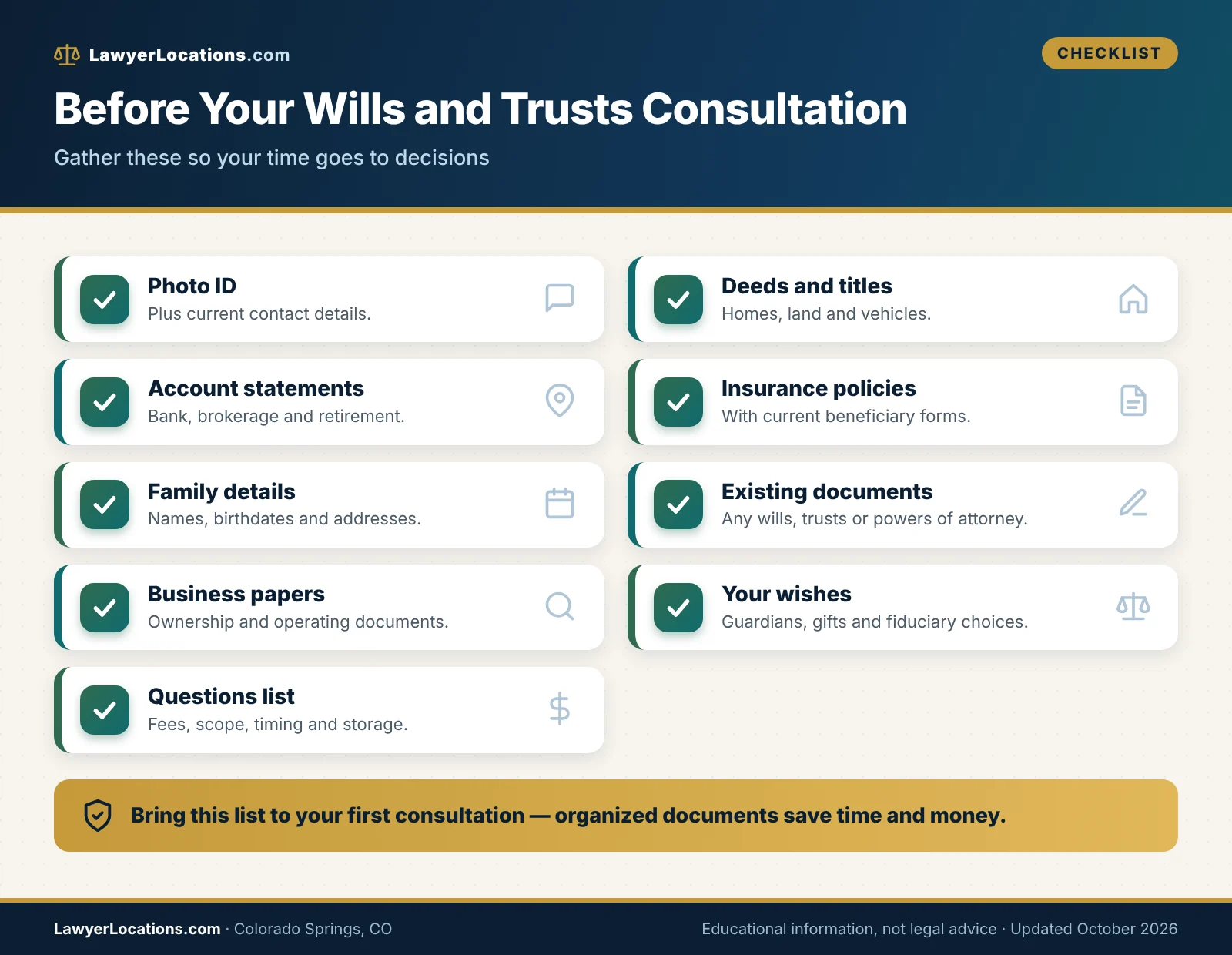
Text version of this graphic
- Photo ID and your current contact details.
- Deeds, mortgage statements and vehicle titles.
- Recent statements for bank, brokerage and retirement accounts.
- Life insurance policies and current beneficiary forms.
- Names, birthdates and addresses of family and fiduciaries.
- Existing wills, trusts and powers of attorney.
- Business ownership documents, if any.
- A list of questions and your wishes for guardians and gifts.
Assets and how they are titled
- Deeds and mortgage statements for any Colorado real estate.
- Recent statements for bank, brokerage and retirement accounts.
- Life insurance policies and the current beneficiary forms for each.
- Business ownership documents, vehicle titles and digital-account lists.
People and roles
Write down the people you want to name as personal representative, trustee, guardian for minor children and agent under powers of attorney, plus backups for each. Include full legal names and relationships. If any family member has special needs or a complicated financial situation, say so at the outset because it can change the type of document the lawyer recommends.
Common mistakes in wills and trusts
Most estate-planning problems come from small, avoidable gaps rather than from complicated law. These three gaps are worth checking in any plan.
Unfunded trusts and stale beneficiary forms
A trust works only for assets that were transferred to it or that name it as beneficiary. A pour-over will can catch assets you missed, but those assets then go through probate before they reach the trust. Also review beneficiary forms after any major life event, because they generally control over a will.
Do-it-yourself and online forms
Online forms can help with a very simple situation, but they cannot tell you whether the form fits your facts or whether your property is titled in a way that defeats it. The Colorado Judicial Branch’s forms are for court cases like probate, not for drafting your own will. If you use a template, have a Colorado lawyer review it before you rely on it.
Red flags when hiring
A few warning signs apply to any lawyer you are thinking of hiring, and they are easy to spot if you know what to look for.
Pressure and promises
- A demand that you sign during the first meeting or “today only” pricing.
- Promises that a trust will save you a specific amount of tax or avoid every cost.
- Claims that a document is “court-proof” or immune to challenge.
Fee and scope red flags
- No written fee agreement, or one that calls the fee nonrefundable.
- A vague description of what the price includes, especially funding and recording.
- Refusing to give a registration number you can look up on the Attorney Regulation Counsel site.
Hypothetical: a couple in Colorado Springs signs a revocable trust but never retitles their home or updates their bank accounts. When one of them dies, the house is still in their individual names, and the family finds out it needs a probate filing in El Paso County after all. A short funding checklist at signing would have avoided it.
Common Questions and Next Steps
The short answers below pull together the points above. Each is general information for Colorado and for Colorado Springs readers, not advice about your facts.
Quick answers on trusts, dollar figures and local help
These answers mix law, logistics and local resources. The dollar figures come from official sources and carry the dates noted.
Do I need a trust if I have a will?
Not always. A trust can avoid probate for assets it holds and can manage property during incapacity, but it costs more to set up and requires funding. To see how another state’s probate process compares, read our guide to probate lawyers in Milwaukee, Wisconsin.
What are the key 2026 dollar figures?
The Judicial Branch’s JDF 998 lists $88,000 as the small-estate limit for 2026 deaths (personal property only). The IRS lists $15,000,000 as the federal estate tax exclusion for 2026 deaths, and Colorado Legislative Council Staff report that no Colorado estate tax filing is required for deaths after December 31, 2004.
Where do I file probate, and is there free help in Colorado Springs?
Probate is filed in the county where the decedent lived, which for Colorado Springs residents is El Paso County, at 270 S. Tejon Street. Eligible military families can use legal assistance offices, income-eligible residents may qualify for Colorado Legal Services or Justice Center programs, and the Probate Window offers procedural help on Wednesdays. Ask each program whether wills fall within its scope.
Your next steps
Choosing a wills and trusts lawyer in Colorado Springs does not have to be a marathon. A short, structured process gets most people to a good decision.
This week
- List your assets and how each is titled, and find your latest beneficiary forms.
- Check whether you qualify for military legal assistance.
- Pick two or three lawyers and look each one up with Attorney Regulation Counsel.
- Ask each firm for the fee terms in writing before the meeting.
Before you sign
Read the draft documents for names and shares, confirm who will witness and notarize, and ask for a funding checklist if a trust is involved. Tell your named personal representative and trustee where the originals are kept. After signing, put a reminder on your calendar to review the plan after major life changes.
Ready to compare your options?
Searching for a “wills and trusts lawyer colorado springs co” is the easy part. Use the scorecard questions, verify each license, and get fee terms in writing before you decide. For a broader look at trusts, read our living trust lawyer guide, and for questions about what to ask in a first meeting, see how consultations work and what “free” can mean.
Sources & References
Show all 34 sources
- JDF 998 Guide to Collecting a Decedent’s Personal Property — Colorado Judicial Branch — coloradojudicial.gov — accessed October 2026
- JDF 906 Instructions for Probate with a Will (rev. June 8, 2026) — Colorado Judicial Branch — coloradojudicial.gov — accessed October 2026
- List of Fees — Colorado Judicial Branch — coloradojudicial.gov — accessed October 2026
- Legal Assistance handout (Rev. July 2026) — Colorado Judicial Branch, 4th Judicial District — coloradojudicial.gov — accessed October 2026
- El Paso Combined Court — Colorado Judicial Legal Help Center — lawhelp.colorado.gov — accessed October 2026
- Colorado Springs Self-Help Center — Colorado Judicial Legal Help Center — lawhelp.colorado.gov — accessed October 2026
- Lawyers and Legal Assistance — Colorado Judicial Legal Help Center — lawhelp.colorado.gov — accessed October 2026
- Colorado Courts E-Filing — Colorado Judicial Branch — coloradojudicial.gov — accessed October 2026
- C.R.S. 15-11-501 Who may make a will — Colorado Revised Statutes (2025 edition, via Justia) — law.justia.com — accessed October 2026
- C.R.S. 15-11-502 Execution — Colorado Revised Statutes (2025 edition, via Justia) — law.justia.com — accessed October 2026
- C.R.S. 15-11-503 Writings intended as wills — Colorado Revised Statutes (2025 edition, via Justia) — law.justia.com — accessed October 2026
- C.R.S. 15-11-504 Self-proved will — Colorado Revised Statutes (2025 edition, via Justia) — law.justia.com — accessed October 2026
- C.R.S. 15-11-507 Revocation by writing or by act — Colorado Revised Statutes (2025 edition, via Justia) — law.justia.com — accessed October 2026
- C.R.S. 15-11-511 Testamentary additions to trusts — Colorado Revised Statutes (2025 edition, via Justia) — law.justia.com — accessed October 2026
- C.R.S. 15-11-515 Deposit of will with court in testator’s lifetime — Colorado Revised Statutes (2025 edition, via Justia) — law.justia.com — accessed October 2026
- C.R.S. 15-11-516 Duty of custodian of will — Colorado Revised Statutes (2025 edition, via Justia) — law.justia.com — accessed October 2026
- C.R.S. 15-11-804 Revocation by divorce — Colorado Revised Statutes (2025 edition, via Justia) — law.justia.com — accessed October 2026
- C.R.S. 15-11-1303 Law applicable to electronic wills — Colorado Revised Statutes (via Colorado Public.Law) — colorado.public.law — accessed October 2026
- Colorado’s New Uniform Electronic Wills Act — Colorado Lawyer, Colorado Bar Association — cl.cobar.org — accessed October 2026
- C.R.S. 15-12-1201 Collection of personal property by affidavit — Colorado Revised Statutes (2025 edition, via Justia) — law.justia.com — accessed October 2026
- C.R.S. 15-15-404 Form of beneficiary deed — Colorado Revised Statutes (2025 edition, via Justia) — law.justia.com — accessed October 2026
- C.R.S. 15-5-401 Methods of creating trust — Colorado Revised Statutes (2025 edition, via Justia) — law.justia.com — accessed October 2026
- C.R.S. 15-5-402 Requirements for creation — Colorado Revised Statutes (2025 edition, via Justia) — law.justia.com — accessed October 2026
- C.R.S. 15-5-602 Revocation or amendment of revocable trust — Colorado Revised Statutes (2025 edition, via Justia) — law.justia.com — accessed October 2026
- C.R.S. 15-5-813 Duty to inform and report — Colorado Revised Statutes (2025 edition, via Justia) — law.justia.com — accessed October 2026
- Colorado’s Designated Beneficiary Act flyer (2012) — Colorado Bar Association — cobar.org — accessed October 2026
- What’s New: Estate and Gift Tax — Internal Revenue Service — irs.gov — accessed October 2026
- Estate Tax — Colorado Legislative Council Staff — content.leg.colorado.gov — accessed October 2026
- Colorado Rule of Professional Conduct 1.5 Fees — Colorado Bar Association (rule text, Lexis printout February 2026) — cobar.org — accessed October 2026
- Attorney/LLP Search — Colorado Supreme Court Office of Attorney Regulation Counsel — coloradolegalregulation.com — accessed October 2026
- Find-A-Lawyer — Colorado Bar Association — cobar.org — accessed October 2026
- Lawyer Referral & Information Service — El Paso County Bar Association — elpasocountybar.org — accessed October 2026
- Legal Assistance — Fort Carson Staff Judge Advocate, U.S. Army — home.army.mil — accessed October 2026
- Judge Advocate — Peterson Space Force Base, U.S. Space Force — peterson.spaceforce.mil — accessed October 2026
General information only. This article is general legal information about wills, trusts and probate in Colorado and Colorado Springs, not legal advice, and reading it does not create an attorney-client relationship. LawyerLocations.com is a legal-education and lawyer-discovery resource, not a law firm, and does not recommend or rank individual lawyers. Statutes, court fees, forms, local procedures and program details change, and your facts may change the answer. Consult a lawyer licensed in Colorado before relying on any of this for your own situation. Information was reviewed as of October 2026.
Legal Disclaimer and Limitation of Liability
Informational and illustrative purposes only. This article was prepared by LawyerLocations.com solely on the basis of the information available to us at the time of writing. It is an illustrative, general overview. It is not a complete or authoritative statement of the law, and it has not been reviewed by a lawyer licensed in your state or county.
Not legal advice. Nothing in this article is legal, financial, tax or immigration advice, and reading it does not create an attorney-client relationship between you and LawyerLocations.com or any author, lawyer or firm mentioned. Laws, court rules, fees, filing deadlines and agency procedures differ by state, county and court, and they change often. Some details here may be simplified, incomplete or out of date, and time limits for legal claims can be short.
No warranty. We make no representation or warranty, express or implied, about the accuracy, completeness, timeliness or suitability of this content for your situation. Please do not rely on it to make, delay or skip any legal decision. Check the facts against official sources and speak with a licensed attorney in the relevant jurisdiction before you act.
Limitation of liability. To the fullest extent permitted by law, LawyerLocations.com and its owners, authors and contributors disclaim all liability for any loss, damage, cost or other consequence arising from the use of, or reliance on, this article, including any content on third-party websites we link to. Mentioning a lawyer, firm, organization or service is not an endorsement and is not a promise of any result. If you are in immediate danger, contact your local emergency number.